← The Official SaaStr Podcast: SaaS | Founders | Investors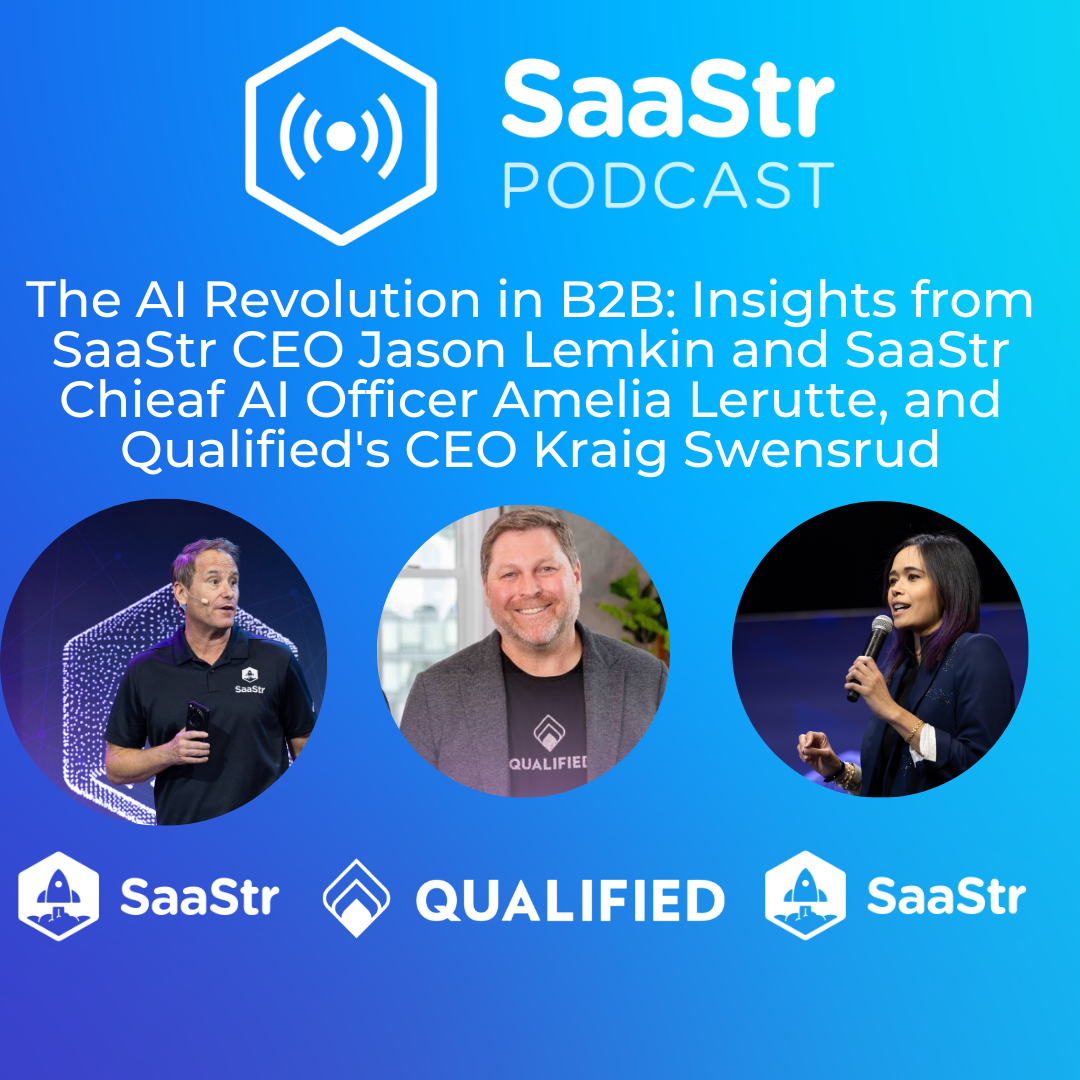
The Official SaaStr Podcast: SaaS | Founders | Investors
SaaStr 828: The AI Revolution in B2B: Insights from SaaStr CEO Jason Lemkin and SaaStr Chief AI Officer Amelia Lerutte, and Qualified's CEO and Founder Kraig Swensrud
00:44:30
Loading summary
Transcript153 lines
- [00:01]
A
Welcome to the official Saster podcast where you can hear some of the best Saster speakers. This is where the cloud meets up today on the Saster podcast. I recently had a CRO I've worked with for years, the deepest respect, reach out to me in an almost panicked email. I need to learn AI, right? I'll do anything. I'll intern for you, I'll hang out with Amelia's office, I'll do whatever. And I hear this all the time. I need to learn AI. We hear it all. I need to learn AI, Craig. It's important for my job. It's the simplest advice, tying all this like, no, you need to do AI, don't learn it. Buying a subscription to Claude does not count as learning AI. The way you're going to do it is pick an agent, an agentic product. Pick the simplest possible one use case and I know it can be scary for some people. Deploy it yourself, buy it, set it up. If you need a little bit of help connecting it to your CRM or your marketing, okay, that's okay. You don't have to like do the connectors, own the deployment. You don't know what training is. It's okay. Take your time, do something simple. If you deploy an agent yourself, train it, QA it, test it, you will be ahead of 90% of the world.
- [01:08]
B
Hands on.
- [01:09]
A
Yeah, yourself. Hey everybody, it's Saster. Connect data, automate busy work and empower teams like nobody's business with the one platform that grows with you every step of the way. Learn how Salesforce works for startups@salesforce.com SMB that's salesforce.com SMB hey everybody. At Saster, Fin is the number one AI agent for resolving complex queries like refunds, transaction disputes and technical troubleshooting, all with speed and reliability. See how Fin can deliver the highest resolution rates and highest quality customer experience at fin.AI Saster. That's FIA. Hey, everybody, get excited. Saster AI London is this December, December 1st and 2nd and we're on track to completely sell out with the playbooks for AI and B2B. Join 2000/BI and AI leaders for two days. Two days of practical advice on scaling in the new year. We'll have speakers flying in from OpenAI, Wiz, Clay, Intercom, Fin and all your favorite B2B companies, including yours truly with Harry Stebbins and more. Doing our live 20 VC podcast. It'll be fun all the heart of London. Don't miss out. Get your tickets, you can still go. Go to podcast.saster London.com. that's podcast. Do London.com for special discount just for you.
- [02:42]
B
All right, welcome, everybody. My name is Craig Swensford, the founder and CEO of Qualified, and I'm joined today in Qualified Studios by two very special guests. Of course we have Jason Lemkin, who's originally the founder and CEO of EchoSign, sold to Adobe 2011, and of course, everybody knows him today as the founder and CEO of Saster, and also Emilio LaRue, who is the chief AI officer.
- [03:06]
A
Yes.
- [03:07]
B
Of Saster, which is. Which is totally awesome. Thank you so much for being with us today.
- [03:11]
A
Thanks so much. That's great.
- [03:13]
B
All right, so what does everybody want to know about in today's day and agents? What's going on out there in the real world with agents and Jason, something I read, you know, that you post on LinkedIn, was people are wondering, there's a ton of agent platforms, Agentix solutions, AI this, AI that, that are on the market right now. Like, where do I actually start? And then I think somebody wrote, you know what, you know what's better? Replit or lovable? Which AISDR platform is the best? What AI tool is the best for RevOps? And you had a killer answer to that.
- [03:43]
A
Can you share that with us? Yeah, it was learning because, you know, we started 2025 behind. We had a lot of AI speakers at Saster, but we were pretty AI lean here. We started with one general tool, and now we've expanded to 20 agents and we use qualified and 20 tools that are sort of, maybe 12 are part of our core architecture, which Emilia can talked about. But it took me a while to know the answer to that question or to know the answer between replit and Lovable. They're related. We could talk about it. But listen, today the world's going to keep changing. This stuff is new, right? In fact, most of these products, I don't know about qualified, but certainly rapid and lovable didn't even work before, like Cloud 4. Okay. It didn't even work before the start of 2025. The Replit level didn't even exist. Replit existed for a decade, but the AI just wasn't good enough. So everything's changed. And what I learned is pick a leading vendor. For sure, it does matter. But you. Training is more important. Training is more important. There are very few agentic products, at least, that have some level of complexity where you wanted to do something like a qualified, interact with customers, speak with authority, close deals. Right. I mean, Amelia was telling me last week, Qualified set up Seven appointments for us right on its own. Now that sounds great and it is great. Like put that as a case study. But it wouldn't have happened if we put zero minutes of training into it. Right.
- [05:03]
B
100.
- [05:04]
A
So I would rather listen. You know, we're on the qualified podcast. Buy Qualified. We are super fans. But more important is just in any space, support, marketing, sales, coding, just pick a leader and go deep, Train it. Train it up front for 30 days, commit the time and every day for the next 30 days, train it and then every week. And it sounds. First of all, most people don't know how to do it. And the other thing is you think, I mean, you were at Salesforce. Think about how people bought enterprise software before AI. You would buy from a sales rep. Then you might hire an Accenture or a Blue Wolf to deploy it over like a year and you would hope and pray it worked like the sales rep told you.
- [05:42]
B
Got it.
- [05:43]
A
No one will tolerate that in AI this year. No one will tolerate it. Time to value actually often has to be even before you get a contract signed. Right. And so, and training is this key piece to it. You got to train it. So that's, I mean, you know, we love qualified. I'm deep on replit versus lovable, but in the repl versus lovable, they are different. But most important, just knowing the goddamn thing, spending a hunt. I'm a, you know, I've only 100 days into Replit, but I'm probably 200 hours expert now to make it great. And so that's. That is just a sea change in how we use software. We're used to buying from a people person and then scaling it up over time and having humans do all the work, put the leads in, in the context. Those days are behind us.
- [06:26]
B
But remember the old adage which was like no one got fired for buying IBM. So yes, in like the old days, people would wait to see like who's the emerging leader. So they would wait, wait, wait until there was like the IBM and then they would go. But you're just saying you don't have to pick the leader, just pick a leader. Like pick somebody, pick a leader and go and go and invest the time in training it.
- [06:47]
A
And we're also at a weird time where in many categories there is no billion dollar AR company yet. There is no. You can say you're a leader. Maybe qualified's the leader. But as great as qualified is, it's not a billionaire yet, I don't think.
- [06:59]
B
Right.
- [06:59]
A
I haven't.
- [06:59]
B
Not quite yet.
- [07:00]
A
Not yet, so. So we are seeing leaders emerge, but it's early. But at the same time, what is different from the old days, not only are leaders emerging, but we've never seen so many folks looking for new vendors. They're either looking for new vendors because they have a budget, they're looking for vendors because they're under pressure from their boss to show AI innovation. And it's for. It's. In many cases, it's the only. Only incremental budget. No one is putting more budget into their old SaaS software. It's all going into AI. And so everyone's in market. It used to be, I don't know what, what you learned as a marketer at Salesforce, but that traditionally you'd hoped a prospect would be in market every five to six years, right, For a big buy, right? Because it would take like a year to get it going, the second year to scale up, the third year to get frustrated, and the fourth or fifth, fourth year to start looking at a new solution at a fifth year. Right now, everything's in market. Again, this has never happened in maybe when the web started, right. But everything's in market. It's in total flux. It means a lot of things for different players. But if you're a buyer, just get going.
- [08:03]
B
It's the right peril, right? In 1999, 2000, like, everything was in flux and nobody knew. Is PeopleSoft going to lead me to the future of HR? You know, is Siebel going to lead me to the future of CRM? And it's kind of like that same thing right now, like, who's going to lead me to the future of, in our case, go to market, but in all these other markets.
- [08:21]
A
But even there, you know, as cloud got bigger, you know, the only time I think in our lifetimes we saw intense pressure to go to the cloud was 2020. Okay. And that was an exogenous situation where people. I literally saw it. Investments I made, we saw it in new signatures, but I saw it in companies I invested in, like Talk Desk for Cloud Contact center. Like, you could wait 20 years to decide if you really wanted your contact center to go to the cloud. And then in March 2020 20, these businesses went 10x because I have no choice, right? But that was the only time when people felt like they had to go to the cloud instantly. But now, yes, it is a small subset of tech and innovation. But there's so much money in. I need to go AI today.
- [09:02]
B
Right, Right.
- [09:03]
A
And you got to be part of that if you want to win.
- [09:04]
B
For most companies, it's coming tops down from their board. It's like the board to the CEO to everybody else.
- [09:09]
A
Move, move, move.
- [09:10]
B
And so, of course, that's where the incremental budget is coming from. You guys are a unique company because of who you are and what you do. But you said at the beginning of this year I had zero agents.
- [09:21]
A
Yeah.
- [09:21]
B
And Now I've got 20 agents that are in production doing various things. And Amelia, you're the chief AI Officer of the company. What have you got and kind of, how have you done it and what have you learned?
- [09:33]
C
Yeah, we started with a platform for advice. Right. So Saster that Jason started was for giving founders advice, giving them, you know, how to hire my next VP of sales. What should their comp plan be? How should I hire the next CRO, when to hire a CRO, don't hire, you know, a marketer who's only going to give you blue pens. Like fate now, famously classic advice, right, For Saster. And so we started the year with no agents and we're like, okay, what's the number one problem we have is like, outside of Sasser Annual or like Sasser London, all these events we do, people always want to ask Jason a question, right? Like, they come up to him, even here at Dreamforce, people come up to him, they ask him questions, and you can't really scale that. And so we started with a platform that's called Delphi and it's a clone of Jason. So it is all of your advice, your social media, everything on Sastor for the last 12, 13 years in the clone.
- [10:23]
B
And so, by the way, it's incredible for the founders and entrepreneurs that are out there.
- [10:26]
C
Try it.
- [10:27]
B
It is incredible.
- [10:28]
A
Yeah.
- [10:28]
B
Go to saster.com in the bottom right hand corner, you'll see.
- [10:31]
C
Exactly. Yeah, yeah.
- [10:32]
A
We were blown away at first, how good it was with training, with training.
- [10:35]
C
With training, because it ingested all of Saster, which is. I mean, now I'm like, oh, a lot of tools do that. But back, like, at the beginning of the year, I was like, that's impressive. Like, it's a lot of.
- [10:45]
A
It's like, what, 20 million words of content, a thousand YouTubes, all the tweets, all the LinkedIns. It did break the ingestion engine.
- [10:50]
C
It did.
- [10:51]
A
But once it did, it was pretty good. Once we.
- [10:53]
C
Yeah, I'm like, okay, that's pretty magical.
- [10:54]
B
You started. You call that Jason AI?
- [10:56]
C
That's the JSON.
- [10:57]
B
Okay, so you started with the Jason AI and where did you go from there?
- [11:00]
C
So that was before our big event this year, which was in May. And so in the run up to that, famously, we both were like, okay, this is pretty cool. And people are starting to use it more often. They like it for advice. Again, classic like. But now it's like, how do I hire a VP of sales? They have the conversation with the AI and the AI can have follow up conversations. So now we'll see people use it as like a copilot of oh, hey, I'm thinking about hiring this person for my VP of sales. What do you think of their resume? Or I asked them this in their interview and they asked me for this comp. Should I push back on that? Like, what would. What would real Jason do? And so that piece was cool. And it's really good at that. And it still is to your point. But where I kind of saw some failings that we both saw. I was like, it's not as good at answering our actual like Saster needs of, okay, we have this event coming.
- [11:43]
B
So that's a specific use case of basically trying to clone Jason.
- [11:47]
A
But the interesting part, d' Amelia, Dave, for sure. We. It's a horizontal. You know, there's talked or Dreamforce say about horizontal versus vertical agents. Right. Delphi is as horizontal as it gets. There's almost no workflow. There's. There's maybe a couple little triggers. It can't do things that qualified can.
- [12:01]
C
Right.
- [12:01]
A
But it can do a little bit of everything. Yeah. And so it was supposed to just be digital JSON. And what was interesting is, and this is an issue with a lot of agents, people would start using it for support. Okay. Hey, I got a booth at Saster annual. Can I have popcorn? Yeah. And. And we didn't expect that.
- [12:16]
C
Yeah.
- [12:17]
A
And this is an issue so many will have with AI agents. Is it will people. If it's any. If it's good, if it's bad, you'll have no roi. If it's good, people will start using it. We hear this. I'm sure you hear it all the time. People will use it for things you do not envision. If they trust it, you got it. So instantly people wanted it for. For issues with attending our events and for sponsors. And we're like, oh, well then it started to hallucinate. Okay. It was pretty good on my content. And so we had a magical moment which is we uploaded our prospectus.
- [12:44]
C
Yes.
- [12:44]
A
And it only took a certain amount of context and training. But then it started to get good. So then it was pretty good at doing maybe 20% of what? Qualified. Good. But, but here's the thing, and the people get this wrong. 20%'s a lot better than zero. Like, if we never used qualified and only use this general agent, we wouldn't have the seven appointments because it can't set meetings. Yeah, but even 20% is better than zero if it's good.
- [13:07]
B
Sure.
- [13:07]
A
Just the fact that instead of it being go, like we used to use intercom and it'd be a weak response time. Okay. So we switched to our agent and it could instantly tell you about 90%. Right. Your customer question. And so sometimes 20% is enough. That's as far as we got. And then when we had time after annual, we're like, okay, let's do better. Let's go from horizontal to vertical as a phase two. And I don't think that's a bad approach for some folks. Like, get one thing working that's horizontal, gets confident and then go, okay, now let's do sdr. BDR Marketing dedicated this, dedicated that. Right. So we went from horizontal to, you know, 12 verticalized agents in a sense.
- [13:45]
C
But we knew in that process it set us up for. For where we are now, like successfully with multiple agents. Because I think otherwise, if it had failed or if we expected too much out of it, I don't know, we probably would have stayed on the one or something or dumped it. Right. So I think that's where we're like, okay, post annual, when we have more time, I started to look for vendors like a qualified, an artisan, a Delphi that we could bring on. That would make sense for us. Right. So Saster has big scale, but internally we're very small. So it's like, okay, the number one thing that was driving me crazy was twofold. Like two things were driving me crazy. The first being that when you came to the website to become a sponsor or buy a ticket is very antiquated. Like, fill out this contact form, which I hated. I was like, not only is this the worst of filling out a contact form, it's very dated. And also half the time I round robin it to our sales team, they don't follow up.
- [14:34]
A
Right. So that at least half the time.
- [14:36]
C
At least half the time. So like I'm like half the time, I know if I'm giving it to like one of the better reps, it's going to get followed up with instantly. But I give it to the other rep because it's their day on round robin. I'm like, they're either getting a response half the time. Or not at all.
- [14:49]
B
So have you blown all that up and you just do it all with agents now?
- [14:52]
C
Yes.
- [14:53]
B
And who manages the agents right now?
- [14:55]
C
I do. This is why we changed my title to it's an issue.
- [14:58]
A
It's an. It's an issue. Right. Just briefly, we can talk about that. The learning for folks that watch. I didn't know this at the time. Stair step it. Yeah, I learned this for our agents and I Learned it on RepWit. Okay. So the fact that we went from Delphi, a horizontal agent, which basically can self ingest your content with no training like you do need to, but it's the least amount of training of the tools in our stack. Start easy, start broad, get a few. Get a win under your belt. Even if you started with say qualified. I'm not total qualified. Start for the simplest use case. Okay. Because if you fail with your first agentic thing, not only will it. Is it frustrating trading. You won't know. We won't know. Yes, you just won't know. Because we had the early win that. That was better than expected. Like our general digital. Jason could do some sales, it could do some qualification and it would start to say, you know what, Craig, you're not big enough for Sasser annual this year. Don't come. That was like great for us. Like it would do it on its own. And so we, we gained confidence. And then I know we use different nomenclature from you, but going from that to SDR to bdr. So going from outbound to inbound, for us, different people are different. For us, outbound was easier than inbound. We didn't. It was less risky to send a better email than a mediocre human, than to trust an agent with our. With. With the precious lead.
- [16:10]
B
You got it right.
- [16:11]
A
Yeah. So if you want to go to the most complex part, at least learn somehow learn first because it's just too risky. But if you can stairstep this stuff, you will build confidence by your second, third agent or deployment. And we didn't intend. But that's what we ended up doing. And that's how even us were successful. We stair step.
- [16:28]
B
I think every company is probably a little bit different, but like the stair step we always talk about, you got to. You got to crawl, walk, run. Everybody, like, sees the prize of like, I'm going to be sprinting. And you're like, whoa, you know, where do I start? And you got to get the quick win. You got to build the confidence internally. You got to kind of learn the tool. You got to invest the Time, and, like, you have to, but it doesn't. It doesn't take that long. You guys had zero agents at the beginning of this year, and now you have 20.
- [16:52]
A
Yeah.
- [16:53]
B
So it's not like we're talking about crawl, walk, run in three years. We're talking about in months. Right?
- [16:58]
A
Yeah, but I don't want to hear Amelia's thoughts. I would say there's different ways you could count, because I think there's. There's agents that are simplistic, and there's rich agents, and there's agents that take more of your time than others, but we think of us as maybe having 12 prime agents. I don't. Without another human, this is about the most we can do. Okay, like, we. I don't. It was fun. Now, like, the bar is so high for us to add a 13th core tool. It better. We will. There's some stuff that is not automated, but it is. You know, the. Because you wake up. Amelia wakes up in the morning. Used to be me when I trained her journal. I mean, it's an hour of work in the morning dealing with the outputs, and you're thinking about it all day.
- [17:38]
B
You said a couple of times, I can't remember what show it was on, but you said, you put in an hour in a day, and you'll reap the rewards.
- [17:45]
C
Oh, for sure.
- [17:45]
A
Doing that. We'll never go back.
- [17:47]
C
Yeah, I'm never going back. No, for sure. Like. Well, I do think stair stepping was very important, like, to both of your. Both of your points there. But I think part of it, too, is, like, when I spend that hour in the morning, it's an hour I used to spend with people. Like, okay, when we app, we had human SDRs and human BDRs that, again, would maybe half the time follow up with an inbound lead. Or half the time, maybe a quarter of the time, send an outbound. Right? Like, maybe even worse. Like, this was an hour I would spend with those people, either doing one on ones or going through accounts, or, you know, going through accounts they should be following up with. Or again, like, hey, here's a lead. Here's what they did with Aster. Like, giving them a context of what people have done with Aster. So instead of that hour going to that now, I just spent an hour with the agent. I'm like, okay, the agent. I wake up in the morning, I'm like, okay, the qualified agent has booked already. You know, whatever. A couple of meetings with David. I can see the conversation. I can give him any context I can Be like, hey David, you know, just FYI because we use momentum too. I'll be like, okay, read the pre read and momentum so you can see what they did with us before. Make sure you just open it off so it'll move the stage for you. And I'm like done. And then I'll check on like I literally go agent to agent. Like I'll go qualified, I'll go artisan, I'll go Delphi. Now I go agent force. Like I just go through all of our agents and I just check on them for that hour.
- [18:59]
B
But let me get your perspective on this. You said that same hour you used to spend with people. With people. Yeah, right. And inevitably some of those people would move on from your organization or you'd find that maybe they weren't the best and like you'd part ways in some way. But that hour you spend with the agent is so much more productive compounds over time.
- [19:18]
A
Have you found that?
- [19:19]
C
Yeah, it's so much more productive. I would say in the early days for any platform you get that's agentic. Right. Most of your time is going to be more than an hour and it's going to be setting it up like all these at the forefront required a lot more setup time. Right. Like it just does. Because either you have to fix your data or it needs to talk to something else. It needs to talk to something else. Or like us. I was like, you know, I thought we had okay data quality in Salesforce. And then I was like, no, it's terrible.
- [19:45]
B
But it exposes that.
- [19:46]
C
It exposes that. Right? Or like famously when we hooked up momentum, which is like a bit of a recorder and a complimentary go to market tool to qualified, we had somebody leave our team that day. Because what it does is it will slack you a summary. It does a lot of stuff, but it'll slack you a summary after each sales call. And it'll also slack me anytime like a new opportunity is opened or meetings booked or like whatever. And this rap was like, I have no activity. So like it literally exposed that like, what are you gonna do? You have to quit that day. You, you like, you can't hide. You're gonna be found out instantly. So yeah, instead of my hour now being with those people, I spent an hour with all of our agents in the morning. Again, it used to be set up. Now I check on all of them, I see if there's any follow ups we need to do. And then I do more things now. Right. Like used to be. Okay, I'm gonna Set up all the platforms to do their core things. I'm gonna set up inbound, outbound support, ticket information, event support, like whatever we need. We have that all set up now with our agents. Then I was like, oh, now I can do email. Like, I can anonymize some of our website traffic. I can send them a follow up campaign if they didn't actually buy a ticket. Maybe it doesn't matter if they were on the website or not. Like, now we have all these different use cases that it started to compound itself because I'm like, now I can just do a lot more in that one hour with like my five core agents than talking to two humans, 30 minutes each.
- [21:06]
A
But it is more like this is as a society, we're going to have to figure this out. It is because you can do more work. It is a higher cognitive load. You have to think more.
- [21:15]
B
Right.
- [21:15]
A
You don't, you don't spend time arguing with people. As I say with Amelia, the agents don't cry. Okay? They don't cry. And that is exhausting. Right. But it's exhausting in a different way. Right, Exactly. You know, if someone's going to cry. Meeting with you, Craig, you just have to sit there for an hour. Okay. But you don't have to think. You don't have to use all your brain cells for an hour, do you? With your agents. It's so many brain cells. And that's, that's. And so I just think that, you know, even if you think about coding, you know, everyone. I just wrote this up. Everyone brags that 50% of our code of qualified is written by, by cursor or. But that doesn't mean your engineers only work three hours a day, does it? No, not at all. Yeah. And so I haven't seen a lot of engineers complain about. But I do think for the best engineers, there's more cognitive load because you can do more. It's not as simple as doing more releases. That's more. You have think, okay. You know, engineering is very creative. And so the more of the road stuff that's done, it's fun, but it's exhausting. You know, you might have to think about how to make that agent work better. Eight hours a day instead of three hours a day. It's much better. But it's. But I don't know that everyone can make the jump. Right.
- [22:18]
B
Where do people start? You did a post that was about the layup roles.
- [22:22]
A
Yeah.
- [22:22]
B
And can you define, like, what are these layup roles? If somebody's like, you have now almost a year's worth of experience and getting agents into production. You've seen what works, you've seen what doesn't work. What are these layup roles? Where should people start?
- [22:38]
A
I think the layup, maybe it's Captain Obvious. The layup are the things where there is a tool that exists that is trustworthy, where it's just not getting done in your org. Right. And there are a lot of reasons that might not get done in your org. It might be an area that's tough to hire in. You might be in a geography that's tough to hire in. It might just be your DNA. Right. There are companies that are very sales centric organizations. There's companies that are very product centric. If you like hate salespeople and you like product, maybe you should start with agentic sales. Right. If you love sales and that's your superpower. Right. Maybe get an AI to help you as an se. Right. Or to help you to support you as sales is a superpower. So don't try to replace the stuff that's sort of working. Look at where like there's literally no one doing the work. Right. And so there's a lot of them. But, but, but at a basic level, you know, the two areas that have took off the most quickly were support and programming. Engineering. Right. A lot of us have terrible support. Terrible support. Right. So that's still, that's still the easiest layup of all. Like go try your own. Support yourself as a founder and executive. I bet nine times out of ten you're going to cry how bad your support is. Not all of you, but the people are often in tears when they do it.
- [23:49]
B
100%.
- [23:50]
A
Yeah. How was I treated this way? Pretend quality. You just had a huge issue with qualified. I know qualified never goes down and does any problems, but go to go. Go to your go to go and say, listen, I have a P1 issue. This is broken. And it'll say we get back to you in a week. Or I don't understand the problem. Right. Or you know, you just, you just want to start there. Right?
- [24:10]
B
And that's where we've seen the adoption of agents like customer support, even internal IT help desk coding. And then you get like go to market in. In. In. In in sales and marketing.
- [24:20]
A
But I would say for us like so we. Our order. So. So the generalist was easy outbound. We couldn't get our SDRs to do outbound, so that was the lowest hanging fruit. But our qualification was terrible.
- [24:33]
C
Yeah.
- [24:33]
A
That process of going to A website, clicking on something and hoping over the next week a human would get back to you. That was like when we deployed, qualified didn't have to be that good. Yeah. Now listen, it's great, but the bar, it's not like we had a great team of qualifying of 10 people where we had an SLA or every, every. If every prospect got Back to in five minutes with 100% time by, by a product expert, we might have waited a year. Right. But that was, it wasn't, it was close to broken. But none of our SDRs being willing to send an email was more broken.
- [25:05]
B
Well, of course, I mean you guys are a unique company but I think every single go to market organization has some flavor of what you just said, which is you got high turnover of the people. You got people that are three months on the job. How could they know your products, how could they know your competitors? How could they know your market? Like how could they know all this stuff? And then they'll only work a certain number of hours a day and some don't like the job and they don't put in the effort and like everybody has some like flavor of this with these types of roles.
- [25:32]
A
Yeah.
- [25:32]
B
And that's when you look at AI and you're like, oh my gosh, like it could just do so much better.
- [25:37]
A
It is. But I think the failure that I see, especially CMOs make is they're looking for a hero purchase. They want to go to their boss, to the CEO or whoever and say I bought AI.
- [25:46]
B
Yeah, I think everybody right now wants that hero purchase.
- [25:48]
A
And listen, I'm not saying you shouldn't save your job, but I guarantee it's probably going to fail because that hero purchase is probably going to be aligned with something you're decent at. The bar is so high and you're not going to know how to train it because it's your first agent. So you're looking for, you're solving medium high hanging fruit because it's already working and you've never done it before and you don't know how to train and onboard it. Like I know you're going to get that. There are a bunch of apps we know that have done really well is the hero apps and maybe buy it. It's just a little bit of money. But I would not deploy it first. I would leave it on the shelf and deploy something where your org just isn't doing it. Just it's not happening. Right. And then you get a win. Right. But I just, you know, some of these hero apps we just watch them fail again and again. And I, and I hadn't fully reflected them because one of the reasons is that it's not necessarily the most broken problem in their org, right? Just making. If AI is only going to make something 20% better, maybe 2025 is not the year. Maybe that's a 2026 project.
- [26:47]
B
So this is about, this is about picking. Everybody, I think, has started. I think, like we're sitting here in the fall of 2025. Very few people are. Like, I haven't even thought about this. There's probably been some experimentation like there has at your organization throughout the course of the year. But as all of this is coming together, you said something on a recent interview that was about, you know, what's happening to SaaS. And that's what people are kind of wondering, is SaaS dead? Is like kind of the mega theme of the moment right now. And how are AI agents changing all that? But you've got a long history, Jason, in the SaaS industry. In fact, you created a company called Saster. So you run a massive conference called Saster Annual. You know, what do you see going on in the world of SaaS? And how is that transforming in the age of AI?
- [27:31]
A
Well, look, some of this is marketing and hysteria, right? SaaS is dead. But there's a lot of truth in it. Let's step back. I mean, two things. One, AI is putting more CIO budget and probably more SMB budget into business software than ever before. In its own way, it's like the tidal wave of 2020 because we needed. All of a sudden budgets went up because everyone was at home, right? So budget budgets for E signatures, for context, it just. There was no limits, right? We're not like that today. But tradition, here's a stressor. Traditional budgets are frozen. In fact, CEOs are still going around the table at the end of the year and telling every functional head to cut some SaaS apps. Right? We had CAS who just took over CEO of Opendoor. He told them they had to get rid of 20 or 30% of their SaaS apps. Or, you know, they're gone the first week. That still seems to be a layup. Like, we want you to cut the number of apps you have. It's. We have Apple, Oat and worse, half of our incremental budgets going to price increases. Salesforce raised prices 8% this year, 6%. That compounds. So if I'm growing my IT budget 6% and my core vendors are all raising prices 7, 8%, how much room is There for another business process workflow app like, I'm sorry, the cap of the vendor, cutting the vendors and all the incremental budget going to price increases is tough. That's also why even the leaders are struggling with upsell. Right. If all that budget went into my price increase at Salesforce, it's probably harder to buy another cloud, isn't it? At the margin. Right. But there's so much AI budget, and when you add it together, business software is growing faster than it has ever before. But if you don't tap into that AI budget, it's tough. There just isn't budget. It's just not there. So if you're selling the way you sold in 2021, this is one of 50 reasons it's dead. There's not. The budget's harder. It's all going to existing investors. Inflation and price increases are doing all. And all the energy is in AI for solutions. So if that's you, it feels dead. It feels like these are all the people on LinkedIn. The playbook doesn't work. Outbound's dead. Nothing works. Events don't work. You know, tell it to anyone that's on fire. It all works. Meeting with your customers works. Outbound works. If anyone wants to buy your product. Right.
- [29:41]
B
You said something like, classic SaaS is in fact dead or it's geriatric or something like that. But B2B software, B2B software right now is exploding.
- [29:49]
A
Yeah.
- [29:49]
B
And that's something that is. I think maybe it's kind of obvious if you live here in Silicon Valley, but when you look at the software industry from the outside in, it's like a tale of two cities, Tale of China.
- [29:59]
A
Yeah. But the simple question I ask founders who are struggling, right, Is what if. If you haven't figured it out yet, what can you do in. You already have a thousand customers, five thousand, ten thousand. What can you do in AI that couldn't be done before that's magical. That's ten times better. Take a pause and figure this out.
- [30:16]
B
In your space 10 times better.
- [30:17]
A
Like, yeah, but usually there is an idea. Usually there's an idea, right? I mean, even Agent. We're here at Dreamforce when. If Agent Force were fully deployed at Mark's vision, like if everyone was live with Agent Force, everyone had all this automated across a million workflows, it would be magical, wouldn't it? It would be, yeah. It would be magical. So you may be Mark's not can't do. I mean, it's so much business process change. Right? I mean, you work there. Right. But at least that's the answer. I think. I think it's the right answer. But if you're, if you're, if you're running a company, if you don't have that answer today, you get an F. So let's talk.
- [30:47]
B
We're here at Dreamforce. Let's talk about the agency enterprise, which is kind of the vision that Salesforce is talking about at this conference. How long does a company have, do you think, to get on board the train before they just miss the train? How fast do people need to be.
- [31:03]
A
Which is like for a startup. I said Halloween. Halloween's the very latest Halloween for a start. For a startup. Yeah. Because you're going to get out competed if you're a startup, Right.
- [31:11]
B
Okay, so you're already behind.
- [31:14]
C
Two weeks.
- [31:14]
B
Two weeks or you're already behind.
- [31:16]
A
I'll tell you. You know, maybe it's mean. Every VC I know, every investor I know, where the startup hasn't made the jump yet, they've given up that now they've lost hope.
- [31:24]
B
Okay, tell me more.
- [31:24]
A
They've all lost hope because it's not. I mean, you could make. When Chat GBD came out, we could all make fun of it, right? I mean, I honestly didn't get it at first. Like, there were so many hallucinations. Right. But if you didn't pay attention to how everything changed, at least at the start of 2025, and didn't have a plan, there's no excuse. Everything's great now. In fact, even mediocre software just got better when you put the fours in, right? Claude Forge, you could take the same. I don't know how qualified change, but I bet you it's a five times better product just changing the ll. I tell this the story about qualified. I don't know if it's true, but I know it's true. I'm like the reason they're having to glow up because they've been, they've been doing this for a while. Like they have a great team, but you stick a better L. It was met and it was. I mean, Replit took 10 years to get to a million, right? They add, they add Cloud 4 now they're almost 200 million in one year. But it's the same IDE, right? It's the same software, Right. So my point is everyone that sees other companies know, okay, we'll give you 2023. If you didn't figure it out, totally cool. We get it right. 2024, you had to be. You could be A critic like you might start losing deals to the all these hot AI companies, but at least you could have a principled position. This stuff wasn't going to work. There's no excuse in 2025, no excuse. So Halloween, you've had 10 months. You don't have anything in production that is disruptive. You're not working at an acceptable speed. In the age of AI, you have already lost. You may, it may not be over, but you got to get rid of most of your team at a minimum and start over. You have to reboot your entire. If you're not in market with a disruptive AI agent as a startup on Halloween, you need a brand new team. A brand new team, maybe even 80% of them. Got to go. And you give them a nice Thanksgiving bonus and a turkey and tell them they got to go because you've had 10 months.
- [33:03]
B
How about on the flip side, not for the, not for the technology vendors, but for businesses out there, in our case, marketing, sales organizations that are out there even at, you know, thousand plus person companies, Fortune 500 enterprises. How fast do they need to be adopting relative to what you see going on in like the, the technology ecosystem?
- [33:25]
A
Well, I don't know what amazing. I mean, honestly. I mean, I know this is an annoying thing to say, but it really does vary.
- [33:29]
C
Yeah.
- [33:29]
A
If literally your business is fine, if it's. Your business has not changed since a year ago, if your growth is as good, as better as it was 12 months ago, you're in a traditional industry, everything's working there. You can be a late adopter. You don't. Not everyone has to. There's a lot of pressure to be an early adopter from a lot of companies and there's a lot of reasons there's that pressure. But if it's not external, if it doesn't exist, be a late adopter. You know, qualified is going to be a better tool in a year. It's a much better tool than a year ago you just said. Right. It's a much better tool. Right. I know you want, I know you want them today, but here's the thing about like I know replit, so I can't tell you in a hundred days how much better replit is than I started. It's not a little bit better. It's epically better. So there is, there are early adopter advantages in AI, but if you can wait as a customer, as a deployer, there are late adopter advantages too, right? Maybe if qualified can't do what I want to do in A year rather than classic SaaS. Buy it anyway and brute force it. I'm not dropping out of your pipeline, I'm not buying another vendor. But hit me up in the summer when it really. Because you know, we used to. We've all been in the old SaaS days when a customer would come in and say, I need this and you would promise it in the contract and it didn't exist. I think those days are dying in. AI don't promise me it'll be here in a year like we used to do. To close a big now with AI, we just, just show me the agent that it works and if it's not ready, I don't blame you. I get it's early. Come back to me when it works.
- [34:52]
B
So for example, we're doing on your website, we're doing Amelia AI.
- [34:56]
C
Yes.
- [34:57]
B
And we're turning to your face, right?
- [34:59]
C
Yeah.
- [35:00]
B
And you're super excited about that and we're going to have you in our studio and film a whole behind the scenes episode on it.
- [35:04]
C
Yes.
- [35:05]
B
And you know, some people are going, ah, you know, it's not quite right. And the voice interrupt detection is. Everyone is very quick to point out all the little flaws and like my message back to them is just like, just wait nine months. And all those things that you are nitpicking about right now, those are going to be gone.
- [35:24]
A
Yeah.
- [35:24]
C
But even at that point, right. It's like, okay, talking to the Jason L. AI or now the Amelia AI more so like on our event sites for like support or sales tickets, sponsorships, whatever it is like half the time right now, our next events in London. So half the time I wake up and I spend this hour with our agents. Most of the conversations for London have already happened because when we wake up in Pacific time, it's their afternoon, it's their evening. And at first I was nervous. I was like, okay, we're going to deploy the qualified. But like, what if it does answer things wrong and I'm not there to like catch it because I'm not awake? And so I got over that with, you know, training and help from your team and we got it. I was like, okay, nevermind, it's pretty good. Like it's good. Like it knows enough and it knows when to escalate, which is nice of like, okay, it'll say like, oh, it's.
- [36:05]
A
Better than when you started with.
- [36:05]
C
It's better than when I started. Yeah, for sure. So like that part has been really nice. I've gotten a lot of comfortability around it. But I am excited to add the voice and video portion to it because I'm like, it could now. I trust it to do more overnight. Right. Like, I trust it fully now on chat to, like, answer people's question. It's. It's a seller. Like, literally, it's been selling tickets to our events. Like, I can. It's done. I was just looking at it this morning. It's probably done 100 tickets to our London event. I don't know how long we've been on qualified. Six weeks.
- [36:34]
A
Definitely helpful.
- [36:35]
C
At least eight weeks. Yeah. 100 out of, like, 2,000 is not nothing. Like, that's a pretty good percentage of people.
- [36:40]
B
Pretty awesome.
- [36:40]
C
Yeah, pretty awesome. And so now I'm like, oh, let it do more. Like, let it, you know, have. Let. Let's do the voice and video. Like, let. It can sell tickets, sure. But it can also start to be a copilot, like the Amelia AI. Much like the JSON, AI can turn into our agent, like, event copilot of. Oh, hey, I saw you're coming to London. You already bought the ticket because I got you to buy the ticket as the agent. But now let me tell you about, like, the networking, because you didn't sign in for, like, your networking yet, or you haven't booked your sessions yet. Like, let me tell you what sessions to book. Like, or let me just talk to you because, like, real Amelia is asleep, but Amelia AI is awake and can answer your questions. Like, half the time I see unqualified. It is current, like, ticket holders or sponsors asking questions like, we used to get before annual of like, hey, I forgot it was the first or, hey, I forgot the link for the hotel block. Or remind me what hotel the venue is and it will just answer all these things again overnight while I'm sleeping. Which is kind of crazy and cool because that's what it should do, right? Like, it should empower you to talk to your customers whenever 24 7. Because the AI doesn't sleep. But real Amelia has to. And then let it do more. Like, I just have all these edge cases now of, like, how I want to use it because we've built trust in our agent. And now also people. People will walk up to me and they'll be like, you're that Amelia AI. I'm like, yeah, I'm Amelia. So, yeah, that's my AI that you talk to. And so that's fine. I know Blake has had the same experience because she's your piper, but that. And that's a little funky because I'm like, okay, now when we get to London, people are going to be like, oh, I had this whole conversation with you, and I'll have to either say it was my AI or fess up. It happens on Outbound, too. Like, I get the question all the time on Outbound. Like, hey, is this really Amelia or is this an agent of Amelia? And it's. But it's always after a purchase, so I'm like, it already doesn't matter. Like, it doesn't matter if it was real me or AI me or 1 of my agents. Because you got the value.
- [38:36]
B
And people are getting so comfortable. Correct with this.
- [38:38]
A
Yeah.
- [38:39]
B
You guys are so awesome for stopping by our studio today. Just one final question. Do you have any words of advice for. The listeners of this podcast are primarily go to market executives, marketing leadership people kind of in the revenue line, B2B companies. And they're probably, like, tuning into this and they're like, what's your advice?
- [39:00]
A
What?
- [39:01]
B
You know, you don't speak on behalf of any specific vendor, but you. You see it all in a way that almost nobody else does.
- [39:08]
A
I'll tell you, my encouraging goes.
- [39:09]
C
Sure.
- [39:10]
A
I recently had a CRO I've worked with for years, the deepest respect, reach out to me in an almost panicked email. I need to learn AI. Right? I'll do anything. I'll intern for you. I'll hang out with Amelia's office. I'll do whatever. And I hear this all the time. I need to learn. We hear it all. I need to learn AI, Craig. It's part of my job. It's the simplest advice, tying to all this. Like, no, you need to do AI. Don't do it. Don't learn it. Buying a subscription to Claude does not count as learning AI. The way you're going to do it is. Pick an agent. An agentic product. Pick the simplest possible one use case. And I know it can be scary for some people. Deploy it yourself.
- [39:49]
C
Yeah.
- [39:50]
A
Buy it, set it up. If you need a little bit of help connecting it to your CRM or your marketing, okay. That's okay. You don't have to, like, do the connectors own the deployment? You don't know what training is. It's okay. Take your time. Do something simple. If you deploy an agent yourself, train it, QA it, test it, you will be ahead of 90% of the world.
- [40:09]
B
Hands on.
- [40:10]
A
Yeah. Yourself, not your team. And don't learn it. Don't learn it. We do so many workshop Wednesdays with CMOs. They're like, oh. We encourage our team to Use any AI tool they want. We allow them to try Perplexity if they want, and we encourage them to learn recipes online. I'm like, you will never learn to go to motion in today's. You got to do it right. And it can be scary to some people that don't want to do it. It is different. It is different. Learning how to deploy and train an agent. It's not what we were taught five years ago. And it is scary to people, but it is not impossible. But if you don't do it hands on keyboard, you will not have a job. And literally, I'll give you another example, and then I won't hear me. For example, one of the. Another CMO who I love. I've gotten her her last two jobs. Obviously, I recommended her, just reached out. After many years, she's ready for her third. And I'm like, I don't mean to mean I got nothing for you. I was really direct. I'm like, can I be honest with you? She's like, yeah, I always trust you, Jason. I got nothing for you. I gave you five ideas, though. I got nothing for you. Why? You don't know this stuff yet. You don't know this stuff yet. You go out and deploy an agent, tell me how it worked, tell me how the training went. Come back to me. I'll get you two jobs. I got nothing. I got nothing for her. And honestly, because I get a lot of folks, I know it's stressful to be a cmo, but I'll tell you, it's a weird thing. There is much more demand than CMOs. Think if you. I know 100 CEOs today that for a great marketer, they're, they're desperate, okay? They'll do anything for a great marketer, but they do not want someone running the Marketo, you know, 2019 playbook. Then there's just no interest in hiring that person. So you got to do it. You got to suck it up. You got to do it. It is scary.
- [41:50]
C
Yeah.
- [41:51]
A
Like, it is. So do something simple. But if you don't, that's, that's, that's my best advice.
- [41:56]
C
I would say I'll take the founder perspective, which is like, I was just talking to founder this week because we're at Dreamforce on. She was asking me about all of her agents. She's like, how's it going? What do I need to know? Like, I, I have some agents, but I'm worried about. I'm next worried about rolling this out to our sales team. Like, I'M worried about sales specifically for go to market AI because I don't know how our 50 sellers are going to react. Like I think they might revolt or some of them might quit. And I said, that's okay, let them. Like it's okay. It's almost Halloween. It's okay. Like it's nearing the end of 2025. I think if your team can't get there over the hurdle, some of them may quietly leave and that is okay. But I was like, you can't forsake the future of your company and how much faster it could grow with AI booking meetings, doing outbound for you to not hurt people's feelings. I was like, you have to just go for it. Like rip the band aid. Like you gotta go for it. Obviously try and do it in the right way where you can show them that they can be empowered with the AI. They can have more use cases. They should actually be excited to do it because they could crush their quota with AI. Like they should be roaring to get the AI go and not like scared of it, right? So I'm like, if you see those people that start to hide in the corner, maybe it's okay if they quietly, you give them a turkey and you let them weed themselves out, right? But the other folks will want it because they can do more, they can sell more, they can buy another purse or whatever it is for the holidays, right? Because they'll crush their quota with AI. Like they can book more meetings, they can have better conversations, they can get more inbound meetings. Like they could just 10x themselves as like AES and sellers once they get over that fear. And I think a lot of people, the best ones will. But I was like, you just gotta do it. Like you just gotta go for it and not worry. I was like, I know you're the founder so sometimes you do have to talk to people and have therapy in your one on ones. But I was like, this is not one of those times. Like just go for it.
- [43:47]
B
Yeah, that, that's actually a perfect way to end this podcast. Rip the band aid off because we.
- [43:51]
C
Gotta go, we gotta go guys. Almost 2026.
- [43:55]
B
Well, Jason, Amelia, thank you so much for being on the podcast here today in qualified studios.
- [44:00]
A
Yeah, you've been awesome.
- [44:01]
B
Thanks so much.
- [44:04]
A
You didn't create a startup to run a small business. Let Salesforce help you connect data, automate busy work and empower employees on the only platform you will ever need, no matter how big you get. With smarter AI and built in collaboration tools like Slack, which we use and you use the sky is the limit. Learn how Salesforce works for startups@salesforce.com SMB that's salesforce.com SMB.