← The Overwhelmed Brain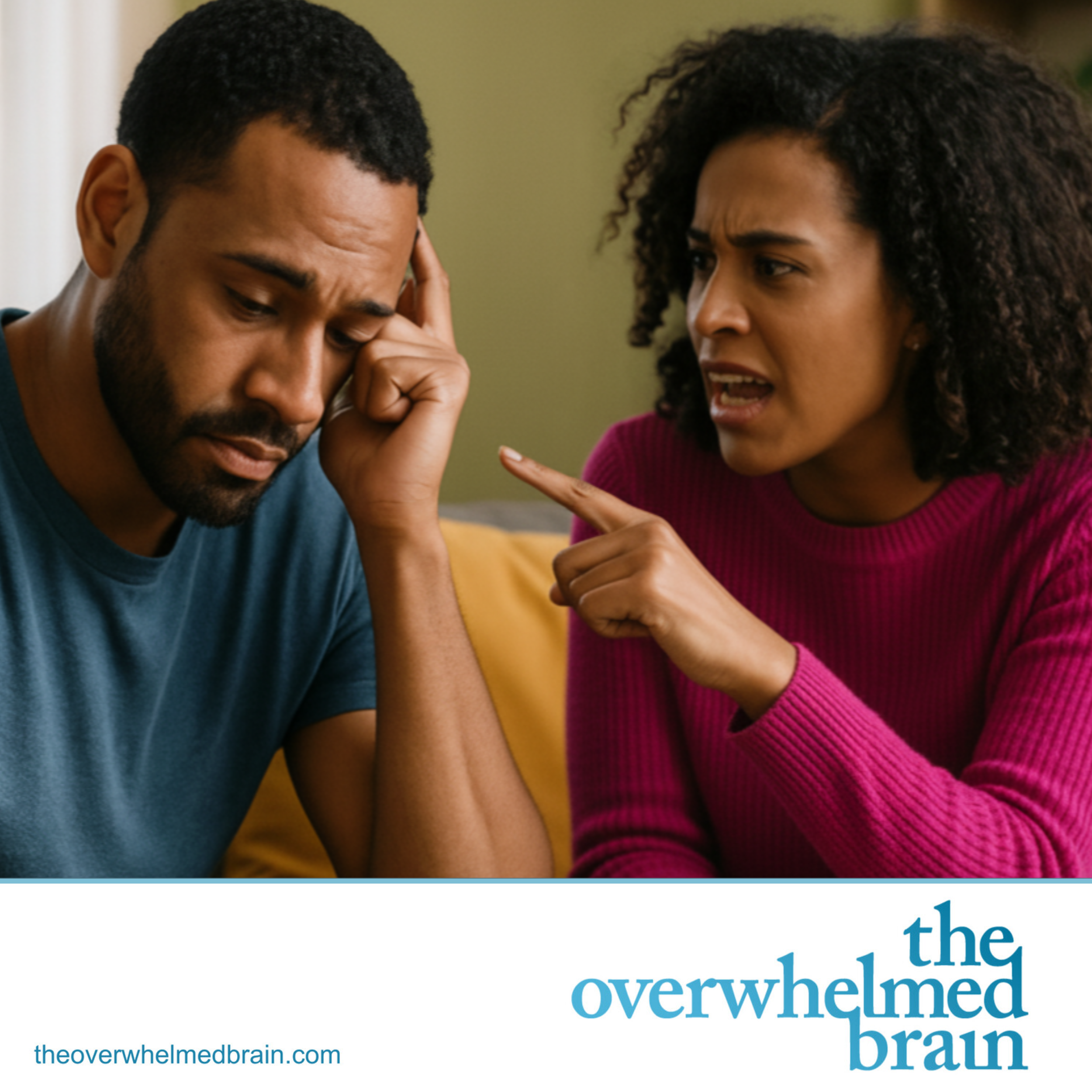
The Overwhelmed Brain
When it's always your fault
00:46:20
If you find yourself constantly being blamed for everything going wrong, it's time to question whether you’re being manipulated into believing what may be a deflection. In this episode, I tackle the sometimes tricky dynamics of responsibility and blame.
Loading summary
Transcript1 lines
- [00:00]
A
These are my personal opinions. Always seek a professional when you're making choices about your mental health and well being. Some people just want you to feel bad. Some people want you to feel guilty. They want you to feel responsible. This could definitely be an episode for Love and Abuse, my other podcast, because one of the signs of the many signs of emotionally abusive behavior is making you feel responsible and guilty for anything. Any problem that comes in the relationship that they find is a problem. This could be a romantic relationship, this could be a family relationship, a co working situation or a boss or whatever subordinate. Anyone that turns the table, puts the mirror up to you and says, no, you're doing this, you're the problem. That is somebody doing emotionally abusive behavior. Typically there are actual times this happens when you really are the problem or they really are the problem and you do the same thing to them. But when you're not actually intentionally causing trouble, when you're not trying to make them feel bad or take the spotlight off of you, when you're not doing those things, you are probably not trying to hurt them or make them feel bad in any way. And you're more likely to take responsibility for what's going on in the relationship and for your role and what is happening in the relationship. But when you're intentionally deflecting or trying to point their attention at something else, especially themselves, you are taking what they're saying or doing and turning it around back on them in order to make them feel bad, in order to make them feel like they have to address what's going on inside of them instead of you having to address what's going on inside of you. That's when somebody might be manipulating you or being coercive with you. And if that's the case, what's going on with them? Why are they taking the spotlight off of them and putting it on you? The main reason is because they don't want to take responsibility and they don't want to change. And they would rather look right in other people's eyes, in your eyes. They would rather not have to feel wrong or be wrong or have to change. They don't want to change. They don't want to have to do anything different. They just want to be right, even. Even when they know they're not. This is why some people lie. They lie so that they don't have to change. They don't have to face the consequences for their actions. They don't have to take responsibility for what they did wrong or even if they didn't mean to do something Wrong. Somebody might lie to protect themselves. They're protecting themselves from the consequences, which might only be somebody getting upset or could be worse. Somebody getting so mad that they say the relationship's over or you're fired, whatever the situation is. And so people lie, they coerce, they manipulate, they do all these things. And it typically involves a mirror to show you what you're doing wrong. So that they are behind the mirror and you can't see anything but a reflection of yourself. That's a visual. Somebody's holding a mirror up to you. They're behind the mirror so you can't see them. You can only see yourself. And then they're trying to convince you that you're the problem. So put the focus back on you, not on me. Don't make this about me. The problem is, you see, and then they force you to reflect on yourself and your behaviors instead of addressing what you are having a challenge with in them. And the very few reasons that somebody might do that include somebody not wanting to take responsibility because that would require them to be different than they are. And some people, a lot of people, don't want to be different. They don't want to change. And they especially don't want to look or feel stupid. They don't want to look or feel like the bad guy. They don't want to look or feel like a low moral person, like they have low morals. And so what they end up doing is putting the attention back on you. I call it like taking the spotlight off of them, putting it on you. And as long as the spotlight is on you, they don't have to take responsibility for anything. There's no accountability. Because now, because you are probably, in this scenario I described, you are probably an honest person, a kind person, somebody who takes responsibility for their behaviors, their words, and is willing to admit when they're wrong. And because you are like that, some people know that about you. And they know that you are willing to look at your own behaviors and are willing to be vulnerable enough to say, maybe I should check in with myself and see if I'm doing these things, because if I am, I don't want to be that person. So I will take responsibility for what I'm doing and for my role in the relationship, and I will look at myself. Because some people know that you are the type of person to look at yourself and assess and evaluate your own behaviors. You are more likely to stay in the spotlight so they can stay out of it, and they keep you busy doing that. And so there are people like this, you probably know somebody, you might know somebody in your life that does this. Unfortunately, I don't mean to laugh at that, but the whole thing is kind of ridiculous. So it's laughable. Even though it's difficult to go through with certain people. This happens mostly in relationships with people who have some low self worth issues or insecurities that they need to deal with. Low self worth and emotionally abusive behaviors like that can stem from insecurities and low self worth and low self esteem. And that's just one path for somebody to take. If they don't know how to cope with challenges, they take the path of being emotionally abusive by putting the blame on the other person or putting the spotlight on the other person and making the other person concentrate on themselves and not the person who's actually at fault. Now this doesn't mean that everyone with low self worth and low self esteem and other insecurities automatically have emotionally abusive behavior, but they often have dysfunctions. Something that makes them not as functional as other people, that might be a little bit more emotionally stable or emotionally regulated and somebody who's worked on their coping skills so that when challenges come along, they don't have these reactions that can be hurtful to others or toward others. So you're not always going to find insecure people or low self worth, low self esteem people who are doing emotionally abusive behaviors. Emotionally abusive behaviors typically are towards someone else because that is about taking the attention off of oneself and putting it onto another, making them deal with the challenges that they themselves don't want to heal or handle or whatever they need to do to become more functional or more healthy. Functional is not the best word there. But more healthy in their behaviors because if they haven't learned how to cope with, well because of their upbringing, they were typically in survival mode. And those survival skills helped them when they were children. But then when they grew up and grew out of childhood and got into adult relationships, those survival skills turned into how they cope with other challenges. For example, when I was a child, my stepfather was the danger in the household. And I, I reacted to danger by hiding, by becoming silent, by being quiet, and sometimes by leaving and being on my own by myself. That pretty much turned me into an introvert for most of my life. And it also helped me survive at least my version of survival in childhood. And I never unlearned that that was how I avoided danger as a child. So that actually transformed into how I coped with conflict and challenge. And so when I got into adult relationships, friendships, romantic relationships, work situations, Co workers, bosses, all of these relationships had to deal with and experience my silence with conflict. And what that might look like is if conflict, for example, came up at work, I would do everything to avoid the conflict. I would people please. I would say things or even lie like we were talking about earlier to make sure I kept the peace. Because if I didn't keep the peace, what happens? Well, in my child brain as an adult, because I had all these childhood functions or dysfunctions still going on inside of me, still running and operating, running the show, pretty much my childhood function takes over and says, I don't want the consequence. I don't think I can survive this. And I never really defined what survival meant. I just knew that I didn't want it. It was scary and I was so fearful that I didn't want to find out what happened if I actually allowed conflict into my life and had to deal with it. So I did everything I could to avoid it. Typical people pleasing and also avoidant behaviors that kept me safe. When we are dysfunctional, we are walking around trying to keep ourselves safe. Because what would happen if you chose to do something other than your dysfunction? Think about something. Maybe this doesn't apply to you, but somebody listening out there, think about something that you do that somebody else might find a tad bit unhealthy or a tad bit dysfunctional. You can probably think of a few things, maybe you can't. Maybe there are things that you do that you don't even realize are dysfunctional. For example, one of the common challenges I hear about a lot is someone left me a romantic relationship. Someone left me and now I believe I'll never be happy again and my life is over. And without that person in my life, I am nothing. That, I'm sorry to say is dysfunctional. It's a part of how you cope with the challenge of loss. And I'm not just talking about somebody dying. I mean, dying is a whole different thing. It's grieving somebody that is gone forever. And there is a grieving process that we need to go through when somebody dies. But when somebody leaves us or we get a divorce or again, typically romantic relationship, when somebody is no longer in our lives either because of a breakup or they've betrayed us or whatever, they're no longer in our life. If we go into a state of I'll never be happy again, my life is over. And because I'll never have them in my life again, I'll never be happy again. If we go into that space, we are entering a dysfunctional Place inside of us. That doesn't mean we're broken. It doesn't mean that we're bad or unhealthy. It's just that we are reacting from that childhood survival mechanism that we don't even always attribute or realize. That's where it comes from. Like, for me as a child, I didn't get the amount of love and connection from two healthy parents. Maybe you can relate, but if you didn't get the love and connection from two healthy parents, then what you may end up with is the feeling of neglect. Even undefined. Like you may not even realize you were neglected. Like, I look at my past and I see my mom. You know, I think about her back then and her primary responsibility. You know, looking at this from the adult perspective I have today, her primary responsibility was to keep the peace between my stepfather and the rest of the family. So she acted as a buffer and a people pleaser and a conflict avoider to make sure that all of us were safe. But how much energy did she have to give to us kids to love us, to spend the time with us, to connect with us in ways that we're nurturing? That doesn't mean I blame her. It doesn't mean that she even did it wrong. I mean, she may have done everything right as far as considering all the challenges that she had to deal with because of our family dynamic. But even if she did everything right, we can still feel neglect. Even a good parent who does everything right. Right. And does all the nurturing and fostering of an amazing, amazingly loving, supportive relationship and family dynamic doesn't mean that we still can't come out of childhood with something missing. Because some of us maybe need more than others. Some of us were looking for something specific and we didn't get it. And this can happen very unconsciously. Sometimes we are missing something from our childhood that we didn't realize we were missing. So that when we become adults and get into adult relationships, that missing thing becomes the dysfunction that that can be a hazard in the relationship, an obstacle to love and connection. And that obstacle can be there without us even realizing it's there. Like I didn't realize that giving my partner my previous partners in the past, the silent treatment was a necessarily unhealthy thing to do. I just thought withholding love and connection to get what I want to make her comply with what I wanted was the way you're supposed to function. As dysfunctional as that sounds and as ignorant as that sounds, the way I talk about it today, back then I thought that's what I was supposed to do, because if I didn't do it, I wouldn't feel safe. That's the full circle here. We walk around with dysfunctions because we don't feel safe. Our insecurities typically come from not feeling safe. And we don't want to feel unsafe. We don't want that feeling. It's hardwired into us to protect ourselves. And if we don't have the right toolbox or any toolbox to protect ourselves, then we end up making up behaviors or pulling from those old behaviors in childhood and either evolving or devolving them into behaviors that we do today or just making up new behaviors. It's all in an effort to protect a part of us that we don't want exposed to danger. And when we walk around not wanting to be exposed to danger, even at the subconscious level, we will show up to other people in a way that may be harmful to them and us. And that's the extreme version of this. But that can happen. I know I was. I was harmful to all my previous partners. And when I got the divorce, that was inevitable. My previous partner was my marriage that I thought was going to last the rest of my life. When that ended, I finally took responsibility, turned the mirror around, pointed it at myself and looked at myself and said, what do you need to change about you? And I'm motioning right now, pointing my finger at the mirror that I'm looking at, which is a reflection of myself. That divorce was the wake up call. I needed to ask myself, what could I be doing to cause the problems in my relationships? What could I be doing to cause people to leave me all the time? That's when I finally decided that I was going to choose to be single until I figured this out or until I did some healing. Because I knew if I got into another relationship after that without addressing what was going on inside of me, reflecting on myself, looking at my own behaviors, looking at how I handled challenges that came along. Until I did that, I was going to ruin other relationships. And so that's when I really got serious about working on myself. And that led to who I am today, which I'm quite proud of, quite happy with. And my wife, she seems pretty happy with me. We just got married a year or two ago, as of this recording, but we've been together over a decade now. And this is the longest relationship I've had with where I'm walking around in a low level triggered state, like almost triggered all the time, like on the cusp of reacting to something that she's going to do or say that's going to upset me. And I don't want that to happen because I don't want to feel unsafe. I don't want to get what I don't want in my life, which is another form of feeling unsafe. Because if you get things that you don't want in your life, it inconveniences you, it doesn't discomforts you, it puts you in a lower state of being. I mean, not always, but some of the things that we get in our life, we don't want, or we're so afraid of getting those things or something happening that we don't want in our life that we don't even consider that it might not be that bad because maybe it never happened to us before, but we never considered how bad it really would be if it happened. So we try to avoid the things that are uncomfortable, inconvenient, or brand new that we don't want to experience because of fear or insecurities. And by doing that, we can actually show up as dysfunctional and toxic to others, which is why it's so important. It's so important to look inward. It's so important to look in the mirror all the time. And I think most people that listen to this show do that. And the people that talk need to change, aren't doing it. Some of the people that are listening to this show right now know people. Maybe you know someone that really needs to look in the mirror. And another question I get a lot is, well, how do I know who that is? How do I know who is the bad guy or the one that keeps putting the mirror back on me? And they don't have the best of intentions for me. And my answer to that is always the same. My answer is the person who doesn't take responsibility for themselves and apologize for how they come across or how they show up. The person who doesn't think they're wrong and is more interested in pointing the finger at someone else saying that they're the problem instead of ever pointing the finger at themselves, saying, this is what I need to work on, that person is usually the culprit. The person who points the finger at the other person and takes no responsibility for themselves and has no intention of changing and doesn't even seem to recognize that they have issues too. That's really what it comes down to. The people that aren't the perpetrators of this kind of behavior are always willing to look inward. That's it in a nutshell. You aren't a perpetrator of toxic behavior. If you are willing to look inward and work on yourself and improve yourself, you might be inadvertently doing toxic behaviors. And if that's the case, guess what? You're going to look inward, reflect on your own behaviors, reflect on how that conversation went or what why the argument ensued when it shouldn't have been an argument. You are going to be willing to look inward and ask yourself questions and look at your behaviors and wonder if you could have shown up better. Toxic people don't do that. Toxic people aren't interested in looking inward and saying, oh man, I could have handled that better. Maybe I shouldn't have said that. Maybe I could have done better, said something nice. Or maybe I could have asked questions and been more supportive instead of just lashing out. That's typically not what a toxic person does. Or an entitled, selfish person. They just want to be right no matter what, even when they're wrong. And they will lie just to get their way. And I'm not trying to say that only people who lie are toxic or anything like that, because people who lie are trying to protect themselves. And sometimes that is the victim of such behavior, trying to protect themselves. Like, if you didn't lie, things would be terrible for you. So you have to. I'm not endorsing that. I think the truth is the best way to go. And in healthy relationships, you can have honest, transparent conversations, because a relationship that can handle truth becomes more resilient, becomes stronger over the months and years that they're together and the hard conversations are had. What I like to do in my relationship is be honest, even at the risk of the relationship. That is something a philosophy I live by, being honest at the risk of the relationship. And what that means to me is if our relationship is strong and we both support and love each other, then it can handle the truth and work through it and get through it, which also not only builds love and connection, but also builds trust and strengthens trust. Like, into concrete. Like, the trust becomes solid. How do you build solid trust? You tell the truth. This is what happened. This is what I said and did. I am sorry I did that. You know, apologies are usually followed by a truth. I am so sorry. This is what I did, and I didn't mean to do that. And I'm sorry that I caused this problem taking responsibility. I'm sorry that I was this way. I'm sorry that I raised my voice. I'm sorry that I scratched your car. I'm sorry that I called you a jerk in Front of all those people, you're taking responsibility. And when you take responsibility, you build credibility, you build trust, and in most cases, you strengthen the relationship, because two people who care about each other will be more likely to care more about the person who is honest, even if it risks the relationship. Again, this is how I operate, is that I want my wife to be able to tell me a truth, no matter how hard it is to hear or how hard it is for her to say it. This is something we talked about, my wife and I talked about early on in our relationship, because she would kind of hide things. Nothing major but her upset. She would hide her upset because she didn't want to upset me. Sometimes days or weeks would go by, and I would finally ask, why? What's going on? What's wrong with you? And you know the answer? Nothing. I'm sort of putting her under the bus right now, and I don't mean to, but she'll recall this. She'll talk about this in her own words someday we'll talk about it on the air or something. And I remember the conversation, and she finally told me, I don't want to tell you because I didn't want to upset you, which has all the nicest intentions. I mean, she really wanted us to get along, and she knew we had something good, so she didn't want to ruin that. And I finally told her, look, I'd rather have you upset me than avoid talking to me at all and avoiding conflict or whatever you're thinking, because what's happening now, we're not even connecting. And that feels worse than hearing some hard truth that I need to hear or that you need to share, because what's happening to us now is it's only going downhill. So the hidden truth was causing things to go downhill. But then when she revealed the truth, which was just a money issue, she brought up the money issue. And I said, oh, well, thank you for telling me. It was no big deal to me, but it was a big deal to her because it probably didn't go well with other relationships in her past. And maybe that stems from other fears that she had or insecurities, I don't know. But I said, oh, I'm so glad you told me. Thank you so much. You don't have to be afraid to tell me that stuff. Let's talk about it. And then we would talk about it and straighten things out and things would get better. And from that point on, she realized, oh, this is better than what it was. This is better than avoiding the topic this is better than not trying to upset him. It's better to bring up the topic at the risk of upsetting me, than. Than to not bring it up and cause this rift between us to continue getting wider and wider. Not that that was her intention. Her intention was. Or all her intentions were good. They were to keep us together without conflict, which was great. I mean, it's good intentions, but sometimes the road to hell is paved with good intentions or something like that. And we had to have a moment like that in order to evolve our communication and strengthen our bond and absolutely strengthen the trust, because that's where it needs to go in order for trust to build. You might have to face challenges where trust is in question or truth is in question, or truth is a challenge to share. If it's not a challenge, then trust stays where it is. And if it's in a good place, then you probably have nothing to worry about. But if trust is an issue, you don't trust them, they don't trust you. Then bringing up issues that involve truth will pave the way forward for the relationship. And if the truth isn't told, you're on rocky ground. And the rocky ground just means there's a degradation that's going to happen in the relationship that is eventually going to send it spiraling downhill. And you don't want that. Typically in most relationships, you don't want that unless you do. And that's a different story. I started off saying, some people want to make you feel bad and make you feel responsible for the relationship issues. And this actually stemmed from an email that I got. I'm just going to read you a portion of it. This person said that they got out of bed at 3am to pee, and their partner said, you woke me up. The bed squeaks when you get up. So the person who wrote to me said, I got irritated and I said, I'm sorry, I had to pee. And then they said their usual response is, oh, sorry, I knew you'd take it wrong. You catch that turnaround game right there. The person who said, oh, I'm sorry, I knew you'd take it wrong is taking the spotlight off themselves, putting it on the other person so that they don't have to be responsible for what they just did. And in this case, they just turn the spotlight back on the other person so that they wouldn't have to deal with being wrong, being called out, being pointed at themselves, even though they're being unreasonable, saying, hey, don't get up to pee because the bed squeaks. You know, My perfect answer to that, like, if my wife said, when you get up to pee, the bed squeaks, you're waking me up. If she said that, I'd probably say, then wear earplugs, because I am in my 50s. I'm going to have to pee probably three or four more times tonight. So if it's squeaking, I'm sorry, but there's nothing I can do, at least right now, unless you can think of a way to prevent me from peeing at night or moving or getting up for any reason at all. I think I'd have an issue if somebody blamed me for doing something perfectly natural that was not intentional or intentionally meant to harm the person I'm with. Because that's how, in this scenario, this example my wife would have reacted is that she would have had to think that I was doing something harmful on purpose, that I wanted to interrupt her sleep. Now, this doesn't mean that this person who wrote to me hasn't had issues in their relationship. They may have had issues for years, and every little thing that the other person does is annoying, and it is destroying connection and love, and it doesn't matter, even if it was completely innocent. But the other person's behaviors are totally bothersome. Like the things that were cute at the beginning of the relationship are now the biggest irritations. So that can happen in a very challenging, difficult relationship. In this case, there's a big problem that came up and it would be better to have a real conversation. Just like I was saying earlier about this issue. What would you like me to do? That would be my response to my wife. What would you like me to do about it? If I asked that question of my wife, then she would have to face the consequences of bringing something up that she knew I didn't, in the moment, have control over. And now the spotlight is back on her. What would you like me to do about it? Now, if she said, you've been telling me that you're going to fix that squeak for months, then maybe I am responsible, and that would be a different conversation. But if she said, well, it squeaks and that's a problem for me, and I would ask her, what would you like me to do? I don't know how to fix this problem right now, so let's talk about it so we'll have a conversation on it. Now, this is a lot easier when you have two healthier people who want to work things out. And that involves a maturity at looking at both sides of an issue and just talking through it. And even Speaking hard truths, if that's what's needed. But with this person who wrote, it doesn't sound like this is a very healthy or stable situation. Because they went on to say other things. Like, my partner will point out every mistake I make. If I leave a spoon unwashed in the sink, even though I've done the dishes 99 out of 100 times and I've never done that, they'll point it out. So clearly there's a lot more going on there. But this whole email that I received. And again, I didn't read the whole thing. But it is all about taking the spotlight off that person and putting it on the person who wrote and making them feel responsible for almost everything so that they don't have to deal with their own stuff. I've seen this over and over and over again. And when it happens, it's almost always somebody who doesn't apologize, Someone who doesn't face accountability for their behaviors. And accountability is something that we typically have to administer when we're around people like that. Because if we don't say anything, then they'll continue doing what they're doing. Because there's not a problem with it. Like, we don't really have a problem with it. And people like that don't typically take into account how harmful or hurtful they're being. Which is why we have to have these hard conversations to get this stuff out in the open and either strengthen the relationship or cause the relationship to crumble. Because that's what can happen, too. When you are honest, the relationship could crumble, But a relationship that crumbles with truths doesn't have a chance. A relationship that crumbles when there is truth and transparency and honesty and vulnerability. Because telling the truth can be quite vulnerable sometimes. If it crumbles because of that, then that kind of relationship didn't have a chance in the first place. And I would question if the rest of the relationship was actually built on trust or if it even had trust in it as a primary component. Because if trust is not a primary component of the relationship and a truth is spoken, and that truth causes a breakdown in the relationship, which it can. I mean, there are some truths that are very hard. If the relationship doesn't strengthen, then it wouldn't have lasted anyway. So the truth reveals where the relationship would go anyway. The fear that comes in from not speaking a truth is usually based in some sort of dysfunction, which I was talking about earlier. And that dysfunction might be a fear of abandonment, a fear of being alone, a fear of rejection. A fear of not receiving love. Like you feel like you are not lovable, and this is the only person that will love you. Those are dysfunctions, because all of those are based on fear. All of those behaviors are based on the fear of what could happen if things don't go the way you want. And so what you end up doing is making up for what you don't want to happen, which could cause this dysfunctional behavior. I hope I'm not speaking in riddles here. I'm sure you probably understand everything I'm saying, or at least most of what I'm saying here. But my point, or my primary point with how we show up in a relationship, are we making decisions based on fear, which would cause us to lie, which would cause us to be harmful or defensive, or push people away or manipulate them, control them? Those are all decisions that we might make if we have these fears or insecurities inside of us. And if they leave us, those insecurities will cause us to go into a state of I'll never be happy again. That was the only person for me. Life is nothing without them. I mean, those are dysfunctional thoughts that I've had many of. I'm not saying that I was immune to that, but I've had many of those thoughts over my breakups and a divorce in my past. And so I really had to work on what was emotionally deficit inside of me or thoughtfully deficit as well. Because sometimes we think we need a specific person. That person has to be that person, and they have to be in my life, otherwise I won't be happy. That is not functional thinking. That is unhealthy thinking. Because what it ends up doing is narrowing down your chances of happiness. When happiness can be found in so many other ways with so many other people in so many other situations. Just like I thought I would never be happy again after every relationship ended, I really did. I thought I would never be happy again. And I also believed it had to be that person to get back into my life. And it turned out I asked myself a question one day after my divorce. I said, what would happen if somebody came along who was just as funny, and we got along just as well, and I was just as attracted to them. And the love and the connection and the intimacy were all just as good, if not better, than the person who left. I thought about this after my marriage ended, which is, again, what I thought was going to last forever. And when it didn't, and I was grieving and I was trying to figure out how to not feel this way that might lead to a depression. I wanted to figure this stuff out. Why am I so sad? Why am I so hurt? Why am I thinking so fatally, like I'm having fatalistic thinking, like, there'll never be another one like her. I'll never have that kind of love again? And I thought about that question. If somebody came along that was just as nice and attractive and funny and we had just as much fun, and I was attracted to her in every way possible, but maybe even more than the person I was with, would I reject them? Would I stay stuck on the person who left? Would I be stuck on that person? Their name? Would it have to still be that person in order for me to be happy? If somebody came along that was just as good in all those areas, if not better, would I still feel this way? That nobody else could replace her and there'll never be another one like her? In that moment, I realized that my obsessive thinking was causing me to stay stuck in this rut and narrow down my chances of happiness. Because as soon as I answered that question where I said no, I wouldn't feel that way. In fact, I would probably be happy. As soon as I said that, I realized that my myopic thinking about that one person fulfilling me and being the only solution to my unhappiness was faulty. And it also made me realize that thinking like that, like, she's the only one and there'll never be anyone like her, and I'll never have as much fun or joy in my life ever again because she's not in it was dysfunctional. It is not functional to think that a single person completes you. It's not functional to think that a single person is everything. Because every time I meet someone new, my definition of everything changes. And as you discover that there's more to everything than everything that you've defined, at least when it comes to being with a person that you really care about and you believe that this is all you want and need, and as long as you have this person, there'll never be any problems in your life whatsoever. And that can be true with a single person, but it doesn't always have to be that person. A lot of us are built very much the same way. Maybe not mentally, but a lot of us have a lot of similar things going on. We get surprised by very similar things. We get sad by very similar things. We fall in love for very similar reasons. And then we attribute all of this to one person. And that doesn't mean we shouldn't. It just Means if we do lose a person in our life, it doesn't mean life stops. It just means life changes, and we're going to learn something new and our definition of everything is going to change. If they were everything to you. And so coming full circle to the mirror, the mirror that somebody points at you can often be a distraction. Don't look at me, look at yourself. Because I don't want to take responsibility for my behavior. I want you to take responsibility for my behavior. That can be a distraction, that can be a deflection, and that can be a way for them to stay in the clear while you keep focusing on what you need to do better, which could be an endless pursuit, because some people are never satisfied and they will always point the mirror at you to look at yourself. There's that aspect of the mirror. And then the other aspect of the mirror is sometimes we need to look at ourselves to make sure that we're not carrying faulty beliefs that cause us to make decisions from a place of fear or from a place of lack, causing a situation that might exist in your life, like being stuck in a rut, longing and pining for somebody who you want back into your life. It could be about that, or it could be about being in a relationship. Like this person who wrote they're in a relationship with somebody who doesn't seem to want to take responsibility for what they say and what they do and is always pointing the finger back at them, not wanting to have a real conversation about what's really going on. And so they just act from a place of dysfunction, which can be toxic, can be abusive in all of the above. And they certainly need to look in the mirror themselves, but they usually don't until something big happens, like when somebody says, hey, if you don't change, I'm leaving. And that might be the big enough thing to happen in their life that they finally say, oh, so you're serious. I know it. You'd think it shouldn't have to get that far, but sometimes it does. Sometimes it has to get that far. So they realize that they need to step out of their selfish ways and look at that mirror. Look in the mirror. And we look at the mirror to make sure that we're not carrying dysfunctions and accepting the behaviors of others and allowing people to cross our boundaries or make us feel bad, causing us to think that we're the problem when they are. And if you need a reminder, if you're always trying to improve yourself and show up as a better version of yourself and are willing to take responsibility and apologize. When you know that you made a mistake or you believe you made a mistake, you're probably looking in the mirror already. So you're doing the best you can. And sometimes that's all. We can do, the best we can. I hope you got something from this episode. Thanks for listening to the overwhelmed. I want to thank the patrons of the week. Wanda, Dileck and Heather, thank you so much for your support. I'm very grateful for you. Thank you for doing what you do so that I can do what I do and putting your money where my mouth is. I appreciate you. I'm very grateful again. And if you value this show like these patrons do, head over to MoreToB.com and there are ways to give back over there. And for a show on how to navigate the difficult relationship. Well, you can listen to this one again or listen to my other podcast called Love and abuse over@loveandabuse.com we really get into the weeds over there and talk about control and manipulation and emotionally abusive behaviors that I really shine a spotlight on. So check it out over@loveandabuse.com and if you know you are the difficult one in the relationship, then I encourage you to join the program that is helping, helping a lot of people heal and change their behaviors so that they can become the best version of themselves for others so that they stop hurting those people as well. If that's you and you want to work on that in yourself, head over to healedbeing.com and I have a very comprehensive program with some free lessons to start. That's healedbeing.com and with that, always keep your mind mind open because that's how you make the best decisions and be firm in your decisions and actions so that you can create the life you want. Always take steps to grow and evolve. You are powerful beyond measure. And above all, and this is something I absolutely know to be true about you. You are amazing.