← The Power and The Punchline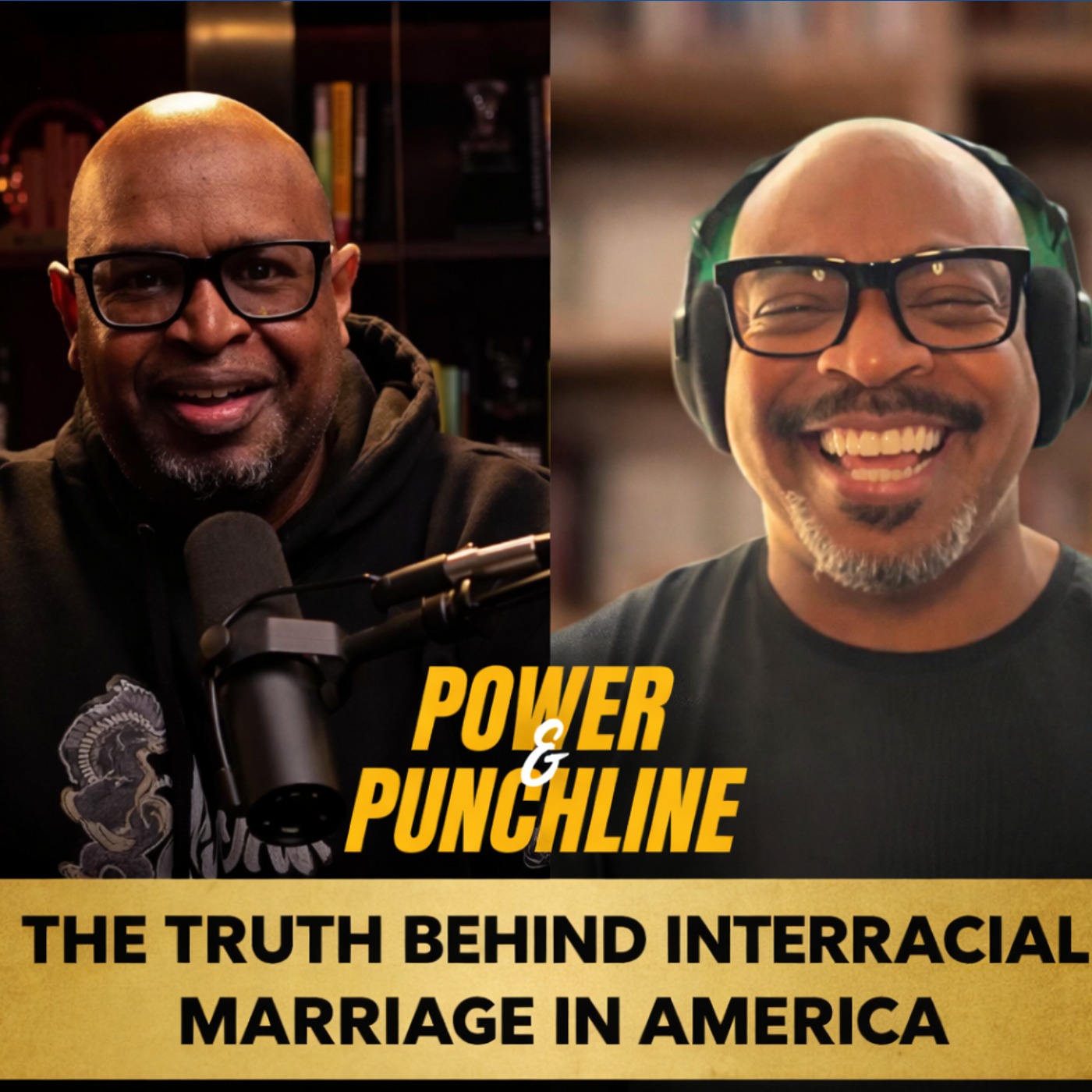
Loading summary
Transcript248 lines
- [00:00]
A
Hey, what's up? Welcome to the Power and the Punchline. This is where the power gets honest and the punchline actually means something. We talk leadership, culture, influence, and real life. No fluff, no filters. I'm Rudy Rush. Let's get powerful.
- [00:17]
B
Ladies and gentlemen, we are here. We are back and today's conversation. One of us could be qualified as an expert to talk about it. One of us. I don't know who that one is, but today we're going to talk about interracial marriage, interracial dating, and everything. Nobody warns you about the good, the awkward, the hilarious, and the stuff people whisper but never say out loud. I am Mick Hunt, here with my amazing co host. Yes, Mr. Rudy Rush. Rudy. And a racial marriage, bro.
- [00:54]
A
Yo, Nick. This is something. And I'm surprised we're tackling this as early as we are. You know, people need to understand we do show prep. This is one thing that you do in radio. I've had some people who don't believe in that. So I'm, I'm doing a little dig to folks I work with in the past. But, you know, you got to prepare. And in our preparation for the show, you sent a list of things that we can probably talk about and, you know, hit on. And one of the things you talked about, which I thought was great early on, let's talk about this. Interracial marriage, dating. Because we live in a. In a society where that's the norm. Or is it? That's what we're here to discuss today.
- [01:34]
B
Yeah. And talking about is it, man, I have some stats. So 1958, long time ago, but not that long ago, only 4% of Americans approved interracial marriage.
- [01:50]
A
Not.
- [01:50]
B
Not were interracially married, but approved it. 1958. Today, as of the end of 2025, when, when the last poll was ran, that number is actually 94% of people approve it. Okay, my question to Rudy Rush. Do you believe it?
- [02:13]
A
So I don't know if 90, 94 is a big number, especially with some of the things that I've seen, like, you know, brothers still ain't taking chicks to Harlem Week to hang out. If, you know, if I got a white girlfriend, she ain't coming to Harlem Week with me. Like some places you don't go with your girl and if you're from the hood or something like that. But, you know, I think the approval weight, approval rate is Definitely higher than 4%. Way higher than 4%, but not as high as 94.
- [02:43]
B
And so I thought that too. I was like, there's no way 94 of Americans approve it. But then, Rudy, man, I started thinking about it from the whole context of interracial marriage. Because a lot of times when we think interracial marriage, we immediately go black and white. Right. And I'm sure everybody that's watching and listening when we said interracial marriage, you immediately went black and white to Rudy.
- [03:08]
A
Totally.
- [03:10]
B
What do you think the highest percentage of interracial marriage is like? If I were to say, tell me the two races, what do you think it is?
- [03:19]
A
You know what I honestly feel, because I've been. I'm well traveled, I like to think of myself as a world traveler. I see a lot of interracial because. Because of what the climate is in the US but absolutely internationally. And in the US I think it's actually Asian and Anglo Saxon American. I think it's more of that than anything else. Then there's others that fall in line.
- [03:47]
B
All right, so in the United States, 42%. And these are facts. And for those who don't believe there's actual numbers on this paper, 42% of interracial marriage in the United States. You ready for this? Hispanic and white.
- [04:07]
A
Wow. You know what? It makes perfect sense because there's reasons for it.
- [04:14]
B
Yeah.
- [04:15]
A
You know what the reason is?
- [04:17]
B
Oh, I know what the reason is.
- [04:19]
A
Yeah.
- [04:19]
B
The reason is to travel far, to be here. We took over their land, so they were already here. Like we say Mexican. But what it really was was it was Native Americans. And then we taught them, or not we. But someone taught them Spanish, so then they became Hispanic. So this was. We integrated into their land. I'm just going to be honest. Yes.
- [04:38]
A
And then when you think about it, there are a lot of Hispanic Americans or Hispanics from other places that can pass for Anglo. Saxons can pass for white. They can, actually. Sometimes I've seen women and men before, they speak without an accent. They look white to me. So I feel like that's something where you could be closerly knitted, where you kind of look like your partner. Like, you guys look like you're from the same quote, unquote tribe. So that would be more sensitive since it makes more sense.
- [05:14]
B
Yeah. Shocking number, Shocking number. That is 42%. Right? So the next percentage is a big number. And again, stats to back it up. I'll send it to everybody that's watching if you don't believe me. The next percentage is 15%. What are the two races that interracially marry? 15% in the United States.
- [05:45]
A
Man, 15. I'm gonna have to go with my. My first guest again. Is that Asian American and white American.
- [05:54]
B
That is correct. 15% of interracially married couples in the United States are white and Asian. And I was like, man, that's not true. Because, you know, like, that's not true. But then I thought about it, and I don't want anyone to at me or yell at me or scream at me, but we know the most populous country or continent is Asia. Most populous country is China. When they get to America, they keep having babies, right?
- [06:21]
A
Oh, they do. They do. Hey, but so number two, listen. Yeah. And I got. I have some Asian male and female friends.
- [06:37]
B
Yeah.
- [06:37]
A
On both sides. And they have. They have white counterparts. Right.
- [06:43]
B
Right. And at number three, we have black and white.
- [06:51]
A
So at what percent. At what percent, though?
- [06:53]
B
10.
- [06:55]
A
Okay, that's. That's healthy.
- [06:58]
B
10. So number one, Bison Sparrow is Hispanic and white. 42% of interracially married couples in the United States. And this is just the United States, Hispanic and white. Number two, at 15% is Asian and white. And number three, at 10% is black and white. But like I said, when we think of interracial dating, marriage, the context usually goes black and white. But these stats prove. I don't even know if they prove anything. But the stats show that we've got to think broader. We've got to look at big picture, and we can't always zero in, because I think as society, we've always zeroed in on black and white. Yeah.
- [07:48]
A
I think because of the history of the country, but because of what's, you know, perpetuated in the news and. And TV shows and everything. It's always. And it changed the whole dynamic of what I thought this conversation was going to be like when you put those numbers out there, honestly. Because when you said it to me, I'm thinking we're talking black and white and how people are perceived and how people go about it and talk about our own personal experiences with it. But to know that those numbers are so far away from where we are, like, Even with the 15, people don't understand. That's a lot. 5% is a lot more than 10. You know what I'm saying? 15 is more than 10. And to have a 45, that's unbelievable. Like, that's almost every other, if not every two people to one. You know what I mean? So that's crazy.
- [08:39]
B
Yeah. Yeah. So I want to talk about it because like I said, one of us is. Is kind of expert in this field of interracial dating. I don't know if it's you, Rudy, but since I've been. I've been an expert. I've been a guru in this topic since I was 13 years old, bro. Wow.
- [09:02]
A
You got me beat on that one.
- [09:08]
B
Since I was 13.
- [09:09]
A
And.
- [09:10]
B
And, you know, society's changed. Society's evolved. We've come a long way, but in some aspects, we haven't. But I. I think for the greater good, we can definitely say we're in a much better place than we were many, many years ago. And. And this isn't to. This episode isn't to. To talk down on people. It's just to. To have the conversation, right? The things that. That people maybe they don't want to talk about out loud or they don't talk about out loud. We're gonna talk about it. And my first question. I guess this is my third question to Rudy Rush now. But. But. But I have a real question that I know Rudy can answer, because I know how Rudy's brain goes. So when we just heard that 42% of interracial marriages are Hispanic and white, 12 or 15% are Asian and white, 10% black and white. I can talk through the 10% because, you know, that's where I live. I want to know from Rudy, do you think Hispanic and white have the same challenges with seasonings in the Thanksgiving bill that black and white have?
- [10:21]
A
No, not at all. You know what? They could, though, because the Hispanics, they bring some seasoning. They got more seasoning than black folks. I'm gonna give you that. Black folks got some seasoning. Well, Hispanics got way more.
- [10:37]
B
And what about Asian, white? Do you think they have seasoning conversations at the house, too?
- [10:42]
A
Oh, you know what? Yeah, they gotta slow down on the garlic. Please relax.
- [10:49]
B
So now let me give you a true. A true story. I'm not gonna name name names, but we all know this, right? Like, a lot of times when we talk about the cookout, and it's, oh, well, if so. And so brought the potato salad, we can't eat it. I'm gonna break this myth right now. There are people in my own family that if they bring the potato salad, ain't nobody eating.
- [11:14]
A
Ain't nobody touching. That's one thing people don't talk about. There's black people on the no fly zone list of eating their food. That's that. That goes without saying. Yeah, absolutely.
- [11:26]
B
But. But the one dish that I can say I'm gonna get myself in trouble, that I usually don't eat outside of culture is Mac and cheese.
- [11:39]
A
Why?
- [11:39]
B
Why is that, Rudy?
- [11:40]
A
Why?
- [11:40]
B
I. I don't. I. I'm picky on my Mac and cheese, man.
- [11:45]
A
As you should be, my friend. Let me tell you something about Mac and cheese. Mac and cheese is like. It's a relationship. It's your mama, it's your daddy, then there's Mac and cheese, and then there's your siblings. Like, Mac and cheese is a part of your DNA if you're an African American. And it has to be. You ever. You ever had somebody make, like, let me give you a prime example. You and I, we eat at restaurants now that we go off of meetings or you want to go off of a fine dining experience. We'll tolerate Mac and cheese at a restaurant because we like. Okay, this is how they make it. It's new. It's macaroni noodles with some cheese with some crunch, crumpled up bacon in it or something. We'll do that. Yeah.
- [12:27]
B
You don't have expectation, but you're surprised when it's great, though, like. Right? It's one of those things. Like, you'll eat it. Not gonna say anything, but you get some good Mac and cheese out, it's like, wait, who in the back? Who is in the back?
- [12:42]
A
No, absolutely. But in the African American household, somebody's making that Mac and cheese with the brown top. It gotta have a brown tag. I'd be crusty on the sides and. And it almost got to be. It can't be watery. It got to have this consistency of like this cookie. It sounds, you know, very, very unconventional, but it has a little cookie sound to it. It has to have. It's a whole project. It's a situation.
- [13:09]
B
It's the star of the dish. Even though it's a side dish, it's actually the star of the plate in my household.
- [13:14]
A
No, don't, don't. Don't let the vegans up in there, because that is the main dish. Add some vegan cheese or whatever. Them fake vegans that be eating cheese.
- [13:27]
B
Yeah, yeah, yeah. So. So back to these stats and numbers, right? So one out of every five marriage today is interracial. One out of every five is interracial. That's a lot. It is, it is. Over 11 million Americans are married to someone from a different race. 11Americans.
- [14:01]
A
So they don't. They don't tell you this one, Mick. About 3 million of that 11 million don't know that they partners from another race. They passed. They passing. That brother passing. He just real light skin.
- [14:19]
B
Yeah, yeah. So I'm gonna ask you this, United States, where Do you think the highest region of interracial marriages. Just region. You don't got to go specific with the states.
- [14:34]
A
It's going to be in the Southeast. Easy. Wrong. What?
- [14:40]
B
The western region is the highest.
- [14:44]
A
On the West Coast.
- [14:46]
B
The western region is the highest.
- [14:51]
A
Okay. You know why? You know why you're right with that? Because if it goes back to the numbers, see, I'm still thinking in the primitive.
- [14:57]
B
42, 42, and 15.
- [15:00]
A
Yeah, yeah. They all on the west. Yeah.
- [15:06]
B
Where do you think the lowest is?
- [15:09]
A
It's probably going to be the Northeast.
- [15:11]
B
The Midwest.
- [15:14]
A
Wow.
- [15:15]
B
The Midwest. So that means if you're in, like, Ohio, western Pennsylvania, Michigan, all that Midwest. That's the lowest.
- [15:27]
A
Wow.
- [15:28]
B
Rudy, you do comedy shows up there. I want you to think back. You ever felt uncomfortable? Now.
- [15:36]
A
You know what? But I. I have seen a. I haven't seen a lot of mixed race, you know, couples, but there are places in this, like you said. Yeah. You know what? No, I haven't recalled any mixed couples going up in the Illinois, especially Iowa area. Yeah. None of it.
- [15:55]
B
Yeah, man. Yeah, man, that's. You know, but. But it gets a pass because you got Chicago and Detroit right there. So, you know, but from what I really usually hangs out anyway.
- [16:06]
A
Well, I heard Chicago's really segregated, too. I heard that's one of the places that's more segregated than any major city in America. So I don't know.
- [16:16]
B
Yeah, yeah.
- [16:17]
A
With that. So let's talk about the elephant in the room real quick, though. You know, you talked about being an expert.
- [16:25]
B
Let's, let's.
- [16:26]
A
Let's put you on the hot seat because you are, in fact, in an interracial relationship. Marriage.
- [16:35]
B
Marriage. Don't say relationship. I'll get in trouble.
- [16:37]
A
Yeah, yeah, I'll get in trouble. Because, you know, your wife and I really good friends at this point. I want to mess that up.
- [16:44]
B
Yes, sir.
- [16:45]
A
But no, you've been with your wife. How many years have you been married?
- [16:49]
B
Two and a half.
- [16:51]
A
Wow. Okay, so it's fairly new.
- [16:54]
B
Yeah, yeah.
- [16:56]
A
So how. Now how is that. Because were you married before? Because, you know, we never.
- [17:01]
B
This is. This is my second wife. Yep.
- [17:05]
A
Okay. So. So was your first wife African American?
- [17:09]
B
I'm in the culture, bro. Yeah. Yeah. First wife, also white.
- [17:16]
A
Okay, okay. You keeping it. Keeping it uniform.
- [17:19]
B
I'm consistent. I'm consistent.
- [17:21]
A
Yeah. Yeah. So now. Yeah. So when you talk about being an expert and, you know, we laugh and we joke on the show. But. But honestly and truthfully, you know, what are some of the. Because, you know, there Are some people looking from, from, from bleacher seats, you know, like, you know, up in the stands? Hey, you know, I have some relationships that I want to probably turn into something more or life, life long and, and, and, and, and make the jump. But there are some, some, some obstacles, some fear. So what are some of the things? Like, you know, you said we're going to talk about the good, the bad. Let's talk about some of the good stuff first. Like, I mean people are people. You got a good person. Of course that, that probably goes to a lot of the good. But what are some of the challenges maybe that you faced, if any, having an interracial marriage?
- [18:09]
B
So you, you know, what's, what's funny or sad or however you want to look at it? When people think of the public view of interracial dating, we'll just start there, right? Like going out in public, going to restaurants, going to comedy shows, going to games, whatever it is, publicly, that usually isn't where the eyeballs are, right? You know where the eyeballs start? Family. Family. It's not strangers, it's family. And I'm not even saying it from, from my perspective on, on my side at all because I'd also say in my family, for the most part, we're, we're gurus in the subject too. Take that how you want to, but, but I get it. But you get a lot of eyeballs and conversations and talk from family, right? Like when strangers say something, I don't ever have to see them again. I don't even know their name, you know what I'm saying? Like somebody could walk up and give me a glance and strangers, I don't care. But when it's family, man, it's different. And, and I'd say family on the spouse side, right? Where maybe it's not as accepted as it is on one side. Like that's the biggest challenge when, when you don't know how other people that are now going to be family filled. And when you talk about a two, two and a half year marriage, you don't know the history of everybody, right? Like you got siblings and parents that have been set in their ways for 50, 60, 70, maybe even 80 years. And you don't know. I mean, social media didn't exist forever, you know what I mean? Like, like I could look up and see, oh, this person said this word eight years ago on Twitter.
- [19:48]
A
Hahaha.
- [19:51]
B
Exist in 70s, 80s, 90s, early 2000s, bro. So I don't know what some of those preconceived Feelings might be, or even existing feelings. So that's the biggest challenge is trying to understand the complexity of family and how people not just feel, but also think. And are people going to accept and evolve the way that you have or the way that you are?
- [20:19]
A
Yeah. You know, that's interesting because, like, like you said, like, you would think someone who is in love with you and a lot of the love that they know how to, you know, exhibit is, is based upon how they were raised. You know what I mean? So if someone is in love with you from another race, obviously they were taught to kind of be open to everyone and to love who you love. You know what I mean? So when you get involved with a person like that and you get in a situation where, like you said, it's. It's. It's stairs and there's uncomfortable situations with family members, how do you deal with that? Like, how does that. Because now, you know, your partner is torn between choosing, of course, my. My husband, who I love dearly, and then my family members who make my husband feel uncomfortable and myself as well.
- [21:10]
B
Yeah. I think for me, it's helped me understand something we talked about in episode one. Family doesn't mean blood in every sense. And so for me, it's drawing that line of what family means to me. Regardless of what blood says to me, family is that. That bigger circle. It's almost like that community. And so that's what we start to associate with. So does it mean that you have to. To eliminate people out of family? We talked about eliminating people out of circles. Right. So it's almost the same thing. It's like, okay, I know by blood supposed to be there, and I'll never take blood out of the equation, but we don't have to act like family. We don't have to have everybody over at the cookout. You know, I mean, like, we don't have to have everybody over at Thanksgiving. And those who are. That's family, and that's how we define it. So as a grown adult now, what I've realized, Rudy, is I don't put myself in uncomfortable slash tense situations. I can get uncomfortable when I'm trying to learn something, when I'm personally trying to grow.
- [22:22]
A
Right.
- [22:23]
B
Like, I want to be uncomfortable at that sense. I don't want to be uncomfortable around human beings, though. And so I don't put myself in those situations anymore.
- [22:32]
A
Yeah. And how is that? Because, you know, honestly, does that make you and your partner a lot closer? Because, you know, that's a. You know, you can go from loving a cousin or sibling, you know, and now all of a sudden, the person that you've chose to spend the rest of your life with, they have an issue with them for reasons that are very uncomfortable in as far as society is concerned, you know, and so how do you know? Does that make you closer or does that maybe sometimes build a wedge? Because they, you know, like I said, there's, that, there's a, there's a love on both ends and you have to decide which one you want.
- [23:09]
B
Yeah, so. So here's how I'm going to answer that. I'm gonna say it makes you closer. Yes. But here's how it makes you closer. You got to start having those conversations early. Meaning even from a friendship perspective. Like, my, my close friends, we talk about race, right? My close friends, we talk about everything because that lets us know viewpoints, that lets us know feelings, that lets us know, hey, when there's a real situation, how are you going to respond? And I want that. And so from a spouse standpoint, from a dating standpoint, we have those conversations. We ask pointed questions, right? Like, you know, there's two things that, that I used to ask as an adult when I was dating. What's your credit score? Got any racist in your family?
- [23:52]
A
Right?
- [23:53]
B
Like, I want to know, I want to know those two things and we gonna talk about it because that's really important, right? Like, and I want you to ask me those things too, because I don't want people to assume that there's not racist from all races. You know what I mean? And like, like racism isn't a black thing, a white thing. Like, it's an all type thing. And so I think for everybody that's watching this, listening, have those conversations and don't be afraid to have them, right? I mean, again, me and all my friends, we talk about race, we joke about race, because that's how people connect and get better, right? You don't, you don't grow when you don't know. And by communicating, you, you start to know.
- [24:34]
A
Yeah, no, and I'm glad and I appreciate you for not asking me about my credit score before joining the show.
- [24:42]
B
We were not, we were not trying to date each other, bro. We, you know, we're not dating, so I don't need to know that.
- [24:48]
A
But we're still gonna be partners in a huge way coming soon. So you might want to know because I'm like, can you co sign for me, Mick? But no, I honestly, I honestly feel the way you feel with, with the friends, especially opening up that dialogue even with male, with male friends, like just checking the temperature with your white friends having jokes that kind of, you know, and me as a comic, you know, I live in a world that it's over exaggerated in a sense where like that's all we do. Like, you know, I mean, I'll put him on blast. Like Big Bill Burr and I, we go back and forth about the black and white stuff. Like we laugh and joke and see the funny and everything. But you also learn a lot from other people, from other, you know, coaches and type of friends you have. But even me, myself, if somebody, I have friends who are Trump supporters.
- [25:39]
B
Yep.
- [25:40]
A
And that's, it's okay with me because I have a different sense of people's political ideals. Like, I know that's just your opinion. It doesn't make you a racist. It doesn't make you anything that is threatening to me. That's just something that we probably shouldn't kind of cross the lines. They tell you don't talk about politics anyway. But it just shows me like you like this and I like that. That's it.
- [26:01]
B
Right, right.
- [26:02]
A
It's like liking different sports teams. I don't, you know, that's it.
- [26:05]
B
Yep, yep. Totally agree, totally agree. So Rudy, with these facts, like, I think there's also a bigger elephant in the room that we in America also need to understand too. So we talked about, you know, one in every five marriages now is an interracial marriage. That also means that we have more multiracial human beings in the United States now in America. Right. And at some point, and I don't have the stats and I don't know the number, but I'm going to look it up and I'll find out and we'll talk about it or we'll drop some, some wisdom in some of the comments and chats that we have. But that means at some point there's going to be more biracial, multiracial people than there are singular race people in the United States. Right. Like, and I'm not even saying there's going to be more, more mixed race than whites, more mixed race than blacks, more mixed race than, it's like, I'm just saying overall, big picture, there's going to be more mixed or biracial multiracial human beings on in the United States than there are single race people. And to me that's an important thing to understand because to me that means that we've got to teach better in the educational systems when we talk about us growing up. Right. Like we had U. S. History and then a lot of U. S. History depending on where you lived, was the civil war, right? Well now we've got to broaden that scope to, to learn about other races, other ethnicities, other cultures. And, and to me that has to start at a much younger age when you have people that are multi race because if not you're going to force people to learn things on their own. And that's always dangerous, always dangerous.
- [27:54]
A
And you know, sometimes, and I'm sure this has happened to you because you know, you're a student of everything. You put your, it's like this, I've learned more about history after 45 and I'm 52, you know what I mean? Some of the things that were told to me and taught to me in Catholic school and in you know, high school and stuff like that, totally fraudulent or just not the whole story. And so it's very important to teach, you know, these new kids coming up, the culture and their backgrounds and stuff like that. I had a joke one time, I said white women have done more single handedly to stop racism because all of these light skinned babies running around Here with this 80 year old man, 80 year old white man who hated black people in the mall. Love that little chocolate baby though. He ain't no racist no more. Hilarious.
- [28:46]
B
Hilarious. Yes sir.
- [28:49]
A
Shout out to the Karen's making these, these little brown babies. But yeah, I, I love the fact that it's, it's going in that way, you know, because that's the way the world was intended to be actually.
- [29:02]
B
Agree, totally agree man, totally agree. So from your perspective, right, like you're, you're out in the US a lot, I mean and you're out internationally a lot. And we, we drop United States numbers. What do you see in other countries, right? Like what do you see in Europe? What are you seeing when you're, when you're touring Africa? Like what do you see from a mixed race perspective in other countries?
- [29:31]
A
So in the UK I see it a lot more fluid, you know and I, and I feel that there's still racism in other countries in every country unfortunately. But I feel like the, the outpouring and the flow of interracial relationships in other countries, I think it just flows a little easier. I see a lot of, especially like you know, French and Greek Africans dating other cultures because, because of course there's, there's not many other races in those countries. Like here you have everything, you know, you're African American male in America, I mean Indian, Asian, Hispanic, you Can have anything. But if you're in France, there's only French women, you know. In the UK There's a lot of, you know, Anglo Saxon, whatever you want to call it, Italy, so forth and so on. So what I've seen is, I've seen a lot of, like, you know, and, and, and when you get out of the United States, of course, a lot of the gentlemen who are of. Of, you know, melanin complexion, they're from Africa. So, yeah, there's a lot of African guys dating whoever out there. Ain't too many African dudes in China, but they're out there in Japan as well. I've been there too. But yeah, it's. It's a lot of African guys getting with the chicks overseas.
- [30:45]
B
There it is. There it is. All right, we're going to address another elephant. So we talked about interracial couples, interracial datings. I threw out some. Some stats, right? 42, 15, 10. We're gonna go in the cultures, though. Who do you think in the cultures from a male, female perspective are the ones that have a higher percentage of actually interracially dating or marrying? So. So I'll start like this. So when we say Hispanics, right? And we say 42% of the interracial marriages are Hispanic and white. If we go to. To Hispanics, who do you think, male or female, is actually interracially dating more or marrying more?
- [31:36]
A
I'm gonna tell you, it's the female. It is the female.
- [31:42]
C
What?
- [31:43]
B
Wrong.
- [31:44]
A
Really?
- [31:45]
B
Yeah, wrong.
- [31:47]
A
Okay, wrong. I'm just going from people I know. I know, like six.
- [31:53]
B
I assume the same thing, man. I assume the same thing. I assume the same thing. All right? White, Caucasian, who's interracially marrying, dating more, male or female.
- [32:07]
A
Now, that seemingly could be easy, but it may not be. I'm thinking it's the white woman.
- [32:14]
B
You were correct.
- [32:16]
A
Yeah. Because they date Asian dudes. I've seen them with Spanish dudes, black dudes, Indian cats.
- [32:24]
B
I've seen them with everybody, which would make sense, right? So if you think about it, if. If white women are dating more outside of their race, there, that means they're dating men, which is why Hispanic men would have a higher rate. And. And so then I'm going to ask you from an Asian perspective, what do you think?
- [32:41]
A
I'm gonna be honest with you. No. No disrespect to the Asian brothers, but it's the Asian women that have more relationships. Yeah. They looking for a home.
- [32:55]
B
What if I told you this? That's my 30 for 30 voice. What if I told you you're incorrect again.
- [33:01]
A
No way.
- [33:04]
B
Culture, man. Like, I. I think not. I think I know. I have Asian. Asian buddies. One of my very best friends. Shout out to Daniel Song and his beautiful family, my sister in law, Christina Song out there. Culturally, Asian women are culture followers. So it's. It's one of those things where, like, hey, we. We were raised to do it this way, and they're. They're not. So it's just the men. It's a closer percentage, but. But men do. It was close.
- [33:34]
A
Yeah. Because I was right there on the line because I'm like, what my numbers? Let me get my paperwork out.
- [33:40]
B
All right, now I'm gonna hit your home.
- [33:44]
A
Yeah, yeah.
- [33:44]
B
Let's get a black household in. In the black.
- [33:47]
A
I know this.
- [33:47]
B
I knew this one.
- [33:48]
A
I know this one.
- [33:50]
B
Rudy said if I'm an expert at one thing, it's this topic right here. It's this, this one. What you got?
- [33:57]
A
So listen, it's the African American male and by far. More than the woman.
- [34:05]
B
By far.
- [34:07]
A
By far.
- [34:08]
B
But you're ready to go on record and say, by far. We're recording this one. You sure?
- [34:13]
A
Yes, I'm. I'm willing to go on record. And if I'm wrong, we need a recount because it's not an election.
- [34:20]
B
We're not talking politics.
- [34:22]
A
What I see, brothers, is out in the streets, man.
- [34:27]
B
So I'm gonna say Rudy Rush is correct and Rudy Rush is correct on both fronts. It is by far. It is by far.
- [34:35]
A
And let me say this.
- [34:36]
B
Four and a half, five to one.
- [34:39]
A
Yes. And let me say this is the reason I think African American women, whether they were taught to or not, much like the Asian women like you talked about, they're more coached, they're more streamlined like that. They're. They're closer to dealing with their own. Black women are very. They're not. They don't seem to me like they're attracted to other races as others are willing to go off and. And get with someone else. Black women love black guys.
- [35:07]
B
Yeah, Yeah.
- [35:08]
A
I mean, that's straight up. But I'm gonna say this, Mick, and I know, you know, don't feel guilty. I'll take the heat. You know what I'm saying? But black women, Black men are actually the most sought after man out of it. Do you got the numbers for that?
- [35:25]
B
I. I don't, because I feel like.
- [35:27]
A
Yeah, I've seen a brother with every. Everything. And I'm not talking about no players. I'm talking about marriage, relationship, children. I've seen black men with every culture. I haven't seen every culture with other cultures. You know what I mean? Like black guys, I've seen with Indian, I've seen them with Asian, Hispanic, and I have not seen. And as far as the desire for that, black men are very sought after.
- [35:52]
B
So I'm glad we. I'm glad you said that. I didn't know you were going to say that. And I think I know where this may stem from. And I want you to think about it, right? Because we just talked about how in the 1950s, early 60s, 4% of society accepted, not were accepted it, right? Yes. Now, according to numbers, more than 90 accept it. Whether they are. They do it or not. That just means that they accept it, they're okay with it. Yeah, yeah. You know what started happening in the, the late 60s, the early 70s, and, and obviously now it's everywhere. We see what's that? Sports on tv. And do you know what started to evolve and change in sports?
- [36:44]
A
What's that?
- [36:46]
B
We, we started playing sports and, and being on tv and I think that became. And, and it's not bad. By no stretch imaginations, it's bad. That's what we saw, right? And, and that's what we started wanting to do, right? Like it was like, oh, I want to be like Mike. There was a big commercial on being like Mike for, for generations and decades, right? Like, oh, yeah. Oh yeah. We the folks that get the advertising, the sponsorship dollars. It started with athletes, like, yeah, now you get rappers, you get entertainers that get. But the real sponsor dollars. Like you want Gatorade to sell? You're that, yeah, right, yeah. You want Doritos to sell, you want Subway to sell. Yeah. Get an athlete. And that's why I think the comment that you made is validated.
- [37:41]
A
You know, I didn't think about it that way, but when you look at it like that and even when you, when it trickles down in entertainment, period, when you go from, you know, sports celebrities, then you have music and comedy and acting and things like that, you know, but, but to concentrate on one thing that sports is definitely something because that's the biggest, you know, money maker and the biggest, biggest exposure with Mike.
- [38:07]
B
And Tiger is always going to be the biggest event we ever see. Every year. Every year. No, not even a close second.
- [38:14]
A
I just thought because I was fine. I'm black, I'm fine, everybody want me.
- [38:19]
B
But those were the thoughts and comments and mental disparities of Rudy Rush and Rudy Rush. Only Rudy in his mind thinks that he is fine, but that's him. So. No, no. One of the most popular segments of episode one, Rudy, was your top five.
- [38:36]
A
Ah, was.
- [38:40]
B
Was your top five. So the segment has to continue, apparently, because it was popular and people wanted to see it. They want to hear it. A bunch of social clips about it. In today's top five, it's still. I don't. I don't have Once Upon a Coconut here, but Once Upon a Coconut is still. Is doing this one in conjunction with Ultralight. The best light for creators out there. But, Rudy, your top five today. What you got?
- [39:09]
A
Okay, so, you know, I was thinking about it. I had to change up a little bit because the topic really went in a different direction today. I don't like what you did with the numbers, so kudos to you, brother. I really like you. Kind of threw a little curveball. And what I was thinking overnight in past days about our preparation, I was like, yeah, we're gonna talk about this and that. But those numbers really jumped out at me. And so it made me change my list, bro. All right. Okay. My top five today is Rudy's top five ways to have a successful interracial relationship.
- [39:44]
B
Let's go.
- [39:46]
A
Number one, don't serve your partner's favorite dishes until asked. You know what I mean? If you. If you're dating a black guy, ladies, you know, and you're not black yourself, don't. Unless I ask you to make some fried chicken. Unless I ask for something else, like some Mac and cheese or collard green, don't take it upon yourself to serve me that because, you know, I may not be eating that. I may not eat fried foods. Don't assume, you know what I mean? And, you know, for other people, you know, if you're dating someone else, don't be dipping into the curry unless you are requested to stay in your lane.
- [40:25]
B
That's me.
- [40:26]
A
That's your partner's. With you for other reasons than your food. All right, number two, this is for everybody. Learn each other's celebrities. Yeah, I said learn a celebrities, man. I know. You know, being black. I know. I feel like I know everybody. Celebrities when you black. You know, Conway Twitty over those. Remember those late night infomercials?
- [40:48]
B
Yeah.
- [40:48]
A
Hello.
- [40:49]
B
Nice to meet you.
- [40:50]
A
It's been. I know, I know all the white celebrities, but white people, y' all gotta help me out, man. Y' all don't know who Luther Vandross. Is. You bugging, you wiling. I dated a girl one time, man. She didn't know who the Vandross was. Things got real edgy. I don't know. You know what I'm saying? You ask them a simple question like, who's the most. Who's the most popular black heavyweight of all time? And they'll say something like, lizzo. I'm like, what?
- [41:19]
B
Yeah, yeah.
- [41:23]
A
Yeah. Big. This has nothing to do with this list, by the way.
- [41:29]
B
This is Rudy Rush's top five, ladies and gentlemen. Don't at me, at Rudy. Thank you.
- [41:34]
A
Now, this is for everybody. You can't mix all your friends. You got to figure it out, you know, you got to know who's for who. So basically, if you're from. If you're from one side of the street and your part is from another, this is an interracial relationship. You got to know what friends you could bring around the other friends. Sometimes it's gonna be 60, 40, sometimes 20, 80, you know what I'm saying? Because I got some friends, they can't even be around other black people, let alone some other body for somebody else's culture. So make sure you mix those friends right. Yeah, yeah. Don't bring around everybody. Listen, I'm gonna tell you this right now. Black people. This is for us. This is a way you can be very successful in your relationship and. And make. I think you may have this covered. Yeah, we gotta. We gotta be easy on our celebration. And I know black pride is a thing, you know what I mean? But if you are dating somebody from another culture and something major happens that's on. On the black scale that, you know, may not be popular in other cultures or whatever, we win one, we get one for the team. You got to be easy with the celebration.
- [42:42]
B
We.
- [42:42]
A
We are very bad celebrators as black people. I'm gonna put that out there.
- [42:47]
B
Yeah, yeah, yeah.
- [42:49]
A
Deion Sanders to Barack Obama. I could bring up some tape where we go overboard in the celebratory OJ all that. Don't have me go there.
- [42:59]
B
Shout out, prime man. Love you, bro. Love you.
- [43:02]
A
Yeah, I love prime man. He used to text me. Text me back, bro, are you making some money? Anyway? And last but not least, white people, listen if you can. This is for the white people only. Pull back on the raisins on everything. Just. Just. Just put the raisins in the back cupboard. Work. Walk. Walk your mate through it. Don't just be throwing them in the potato salad and throwing it inside the ca.
- [43:30]
B
Rose.
- [43:31]
A
Don't be surprising me, because some of us have PS ptsd. I'm from the hood. I'm thinking it's roaches. And.
- [43:40]
B
Which is why a lot of people don't eat raisins, man. Because it's like, it. It looked like. Yeah, you're right. Right.
- [43:48]
A
Listen, my mother was buying raisin brand because she was like, y' all figure it out, because I ain't buying another box of cereal. I was like, nah, you had that dag on Raisin Bran if you want. Want to.
- [43:59]
B
But, yo, so you said. You looked at the box like, this box said cornflakes. What look like razor.
- [44:08]
A
It's like, what is this in the box? So those are the top five ways you can have a successful interracial relationship. Thank you.
- [44:16]
B
I love it, man.
- [44:18]
A
Yeah, man.
- [44:18]
B
I actually have no issue with any of that.
- [44:20]
A
Yeah, some things. Listen, and let me just reiterate, for black people, with the celebrations, it's almost like them asking. And they did it for us, you know, at graduations and ceremonies, they'd be like, if you can please wait till the end to clap. My people would be like, so, pookie, the first person to graduate from junior high school. You crazy.
- [44:43]
B
Yes, sir. Which, you know, that's something we didn't.
- [44:46]
A
Talk about.
- [44:49]
B
But we're gonna talk about for two seconds. Before I get to. To the Mouth Rushmore topic today, one of the things that we also have to do is let people know nicknames. Oh, my. Because I can tell you from personal experience, right? I have a huge family, and we will talk about the same person and call them two or three different names and confuse the hell out of everybody in the room, bro. Like. Like my cousin. Shout out to my cousin Lamon. But, you know, his professional name is Corey, and we will call him Lamont because that's what he was growing up. And then sometimes he's just mine, you know what I'm saying? And, like, my wife will be like, where are they at? And I'm like, he is right there. And she's like, oh, got it. And then, you know, I got shout out to my cousin Randy. Growing up, he was Bubba. And she's like, who is Bubba? And I'm like, randy. Well, why don't you just call him Randy? Like, hey, he's a junior. And, you know, you can't say Randy. Randy. And so he was Bubba girl. Like, we gotta explain all the nicknames.
- [45:58]
A
But help me. Help me out with this one real quick. Nick, what about the black people who have a name that's a regular name? That's a nickname. It ain't on a birth certificate. Like, like you said Lamont like, that ain't his name. Why are we calling him Lamont? Because the grandmama was like, he looked like Lamont from. From the 1950s. And I just remember Lamont. He looked like him. Why do we have a name like that? It's not even a bubble or a pookie. Lamont. That ain't even his name.
- [46:27]
B
Yeah, yeah. It's out there like that, man. Like. Like, we. We gotta. I. I think the trend has stopped, but. But I don't know. I. I don't know. I just made sure with my kids. Like, what I call you is what I call you. That's what. So university. Like, that's what it is. That's what it is. All right, so the Mount Rushmore today. Yeah, the Mount Rushmore of interracial couples.
- [46:56]
A
That's nice.
- [46:59]
B
Rushmore of interracial couples.
- [47:03]
A
All right. I. I didn't think about that one. You got that one. I was wondering where.
- [47:06]
B
Yeah. Real or fiction? And there's a lot to choose from. And. And I don't want everybody at me because people aren't on the list. But it's the Mount Rushmore. It doesn't mean if you ain't on the list that it's bad. It's just, again, we can only choose four. All right, so the first one, I think is really important, and people don't know who it is. And I want the producers to make sure they show images right here. Richard and Mildred Loving. Richard and Mildred Loving. Do you know who they were, Rudy? You don't know, so let me tell you. Okay, tell me you do know who they were.
- [47:48]
A
I have an idea. But when you tell me, I'm gonna double down on it and say, yeah, I heard about that.
- [47:55]
B
Richard and Mildred Loving made interracial marriage legal. They were the first legally approved interracially married couple.
- [48:06]
A
They got to be first on the list.
- [48:08]
B
They're on the Mount Rushmore.
- [48:10]
A
Gotta be up there.
- [48:11]
B
They're on the Mount Rushmore.
- [48:14]
A
Nice one.
- [48:16]
B
Number two on the list. This is gonna shock some people, because I don't think people know this one.
- [48:22]
A
Okay.
- [48:23]
B
Alice Walker and Mel Leventhal. You know who Alice Walker is?
- [48:30]
A
No.
- [48:32]
B
Oh, you know who Alice Walker is?
- [48:34]
A
Is that Madison?
- [48:36]
B
Oh, Purple Celie.
- [48:39]
A
Yes.
- [48:40]
B
You know Alice Walker?
- [48:41]
A
That's a Whoopi Gold.
- [48:43]
B
Great, great, great, great writer.
- [48:46]
A
Wow.
- [48:48]
B
She and her husband, Mel Leventhal were the first interracial marriage in Mississippi post 1967. Jeez. Alice Walker.
- [48:58]
C
Color purple.
- [48:59]
A
Wow.
- [49:01]
B
Number two. All right, this is where it gets tough. This is where it Gets tough because we. We're talking about the Mount Rushmore, and some people are going to get left off. You ready? Because we talked about these numbers earlier, and it would be disrespectful for me to not represent the 42%. You ready for this one?
- [49:24]
A
I'm ready.
- [49:26]
B
Ricky Ricardo and Lucy.
- [49:29]
A
Oh, that's a tough. That's a good one.
- [49:32]
B
Ricky Ricardo and Lucy.
- [49:34]
A
And that actually goes to. You know, earlier in the show when you talked about the 42. Desi Arnaz was definitely. Okay, okay, Mick, I see what you're doing. I see you, playboy.
- [49:48]
B
Hey, I'm out here. I'm out here. And now fourth on the. And again, it's not in any order. It's just about Rushmore. Yeah, I had a lot to choose from, man.
- [49:55]
A
4.
- [49:56]
B
I could have chose, like, Sammy Davis and his wife. You brought up Jack Johnson, boxer. I could have brought him up because, you know, he was. He was boxing and saying, I'm the man and I'm gonna. I'm gonna go marry this. This woman over here that came to see me. You can't do nothing about it because I'm the heavyweight champion. I could have gone Prince Harry and Meghan Markle. That would be easy. I could have gone Tom and Helen Willis off the Jeffersons.
- [50:24]
A
Nice. That would have been a good one.
- [50:26]
B
But I gotta go with power, man. And I gotta. I gotta break some. Some stigmas here because we talked about in our culture, five to one is the black male that's gonna, you know, marry. My number four on the Mount Rushmore is Serena Williams and her husband Alexis. Wow.
- [50:47]
A
Okay. That's a good one. That's a good one.
- [50:52]
B
So again, to recap, Richard and Mildred Loving. I love saying Mildred's name. Richard and Mildred Loving. Alice Walker, Mel Leventhal. Ricky Ricardo and Lucy. Serena and Alexis. Wow, that was.
- [51:10]
A
That's a good one. And her husband. Serena's husband was not. Not trying to hear that. With Stephen A. Smith.
- [51:16]
B
He.
- [51:16]
A
He defend his woman. So I. He gets. He gets an invite to the cookout.
- [51:20]
B
Oh, he. He can. That. He should be on this show anyway because he's one of my favorite people in the world, so. Absolutely. So that's my Mount Rushmore generation couples.
- [51:31]
A
Good job, good job, good job. But you, you know, Dennis Rodman and Common Electra, they was on there, too.
- [51:39]
B
Yeah. You know, last Mount Rushmore, you said, hey, there was one that, that I missed. 1st and 15th. I like that one. What's. What's one that. That should be on the list now.
- [51:50]
A
You mentioned Jack Johnson, but, you know, Diddy is going to jail just because they couldn't get.
- [51:55]
B
This episode has just ended. Oh.
- [52:04]
A
No. Listen. Shout out to all the interracial couples. You know why? Because you know, when you go to the true definition of love, and this is for everybody who's in any relationship but interracial in this day and age, the way sometimes it's scrutinized and stuff like that, you really got to look at your partner and be like, you really love me? Because you. You're sacrificing some things that, you know, people take for granted each and every day. Like, you know, the air you breathe. You know, I can walk out with a black woman and never feel any uncomfortableness, but if I had a white woman. Some places we go, or Asian or anything, you'll get looks, you'll get stares, and you'll feel uncomfortable. And sometimes that's the definition of why two people don't make it. So shout out to everybody who sticks it out and loves each other and doesn't care about what people think.
- [52:51]
B
Hey. And shout out to. To my family. You know, we. We might do a recap episode of this one day, and. And I bring some of the other experts in my family, and we'll. We'll just talk about it. We'll let Rudy facilitate this. This conversation. How about that? That's what we'll do. And I want everybody to know, if you like this show, make sure you're doing your thing. But just one last message for the people.
- [53:15]
A
Yes.
- [53:15]
B
I'm gonna look everybody in the eye. We're gonna zoom in a little bit. Love didn't change America. People did. One relationship at a time. So keep loving, but keep evolving as humans, because America needs you more than you ever know. I'm Mick Hunt, with my illustrious, hilarious, but serious co host, Rudy Rush.
- [53:40]
A
That's the power and the punchline. If this episode hit, do me a favor, rate it, review it, subscribe. That's how we keep these conversations coming. Power moves the room. The punchline makes it stick. I'm Rudy Rush. See you next time.
- [53:55]
C
If you are a podcast host, listen up. This one's for you. My name is Allie Jackson. I'm the host of Finding Mr. Height, a dating and relationship podcast that I've been doing for four years now, sharing my positive and practical approach to dating that's built on my own life experience. And I wanted to share another experience that I've had. My secret behind monetizing my show. It's called Redcircle. And I was just telling my colleague about how much I love their platform. With Red Circle, not only am I getting a seamless hosting experience, but I also love the support I receive in ad sales. It's not just typical ad sales either. It's targeted opportunities based on my show and my life. And the platform is super simple. You just set your preferences and Red Circle matches you with sponsors that align with your show. You can vet every opportunity and their platform gives you great analytics. More recently too, my Red Circle team has brought me opportunities outside of my podcast on social media to really augment the podcast partnerships. Bring them full circle. I just can't recommend them enough. If you want to give it a try, go to redcircle.com to get your free trial. That's redcircle.com for a free trial.