Loading summary
Transcript59 lines
- [00:01]
Noah Efron
A reminder that the bodies of three hostages, Ron Gvili Dror or and Sudhisak Rinthalak are still in Gaza today, 775 days after they were taken on October 7th. We hope that by the time you hear this they will have been returned for burial to their loved ones and to all of us. This is TLV1. This episode may contain explicit language. Welcome to the Promise Podcast brought to you on TLV1, the voice of the city that is home to Yoel Darvish, a 27 year old filmmaker and production person on the popular satirical television show Eretz Naderet who has lately made his name in the highly competitive world of online influencing. Specifically in the specialized niche of bathroom influencing, offering pooh and loo reviews, ablution solutions, place of urination and defecation evaluations. Call it what you will, which influencing and evaluating all drains in the end to Yoel Darvish's Instagram page Mashpian Khara, which translates, I guess, to poop influencer, which carries the tagline Come poop with me. Professional bathroom criticism for impressive places of business and I am not made of stone, obviously. I went to the page and I was delighted to find reviews of several favorite places right in my own neighborhood, like one of Mitachat La' 8's under the tree, just a block down from Ben Yehuda, the one tiny bathroom of which is up a precarious set of wood stairs, which in the event did not bother Yoel Darvish. Which was the case too, with the big bug who crawled around the floor as he settled onto the toilet, about which Joel Darvish said, hey, hey, a friend's come to visit. Oh you cutie. Darvish admired the view through the second story window into the very green backyard of the building. He admired the toilet paper. The paper was two ply of a recognized brand, high quality and luxurious. In the end, Joel Darvish tabulated his scores in the different categories view 7 of 10 toilet comfort and cleanliness 4 of 10 company this for the bug 7 of 10 toiletries and paper 7 of 10 and when he did all of his calculating, he awarded Mitachad Leites under the Tree three and a half poop emojis out of a possible five in the comments underneath the Pope, Ido Meir wrote, quote, not all heroes wear capes. And Shahar Sigal wrote, I have also pooped at Mitahatla' 8's period. In a recent interview in Wynet under the headline the Internet Star who Visits Public Bathrooms, Yair Darvish described his method quote, I first check cleanliness, then whether there are wipes, if the seat is the right size, whether the toilet paper is of good quality, if the door locks properly, if the sink is easy to use, and most importantly if it smells good. Yoel Darvish also told the reporter, quote, one day I will try a famous Japanese toilet. That is my plan. My dream is to review the bathrooms of the ultra wealthy. That is the peak for a toilet critic. End quote. And arguably nothing captures the tongue in cheek etude. Also the near universal scorn for any attempt to separate high culture, in this case the high culture of professional criticism from low culture, in this case the archetypally low culture of literally potty humor of this city we love so well, Tel Aviva better than a good hearted soon to be director who will soon be on the other side of the critic's gaze, taking us with him at his most intimate moments and saying all the quiet parts out loud with us in the great underground vault that is the Serenity Studio at number 12 at Lesser Ory street here, which has a bathroom that, owing to the fact that the water hasn't worked in the sink for weeks and weeks, might be hard pressed to pull out a rating of more than four poop emojis, maybe even three. But I digress. Here in the lovely subterranean Serenity Studio is a woman who, if you were rating her lovely prose, breaking things out so that they're nice and scientific, then randomizing and anonymizing, you might get something like makes you thinkitude 10 of 10 unforgettability quotient 10 of 10 sentence level brilliance coefficient 10 of 10 humanity density index 10 of 10 insight yield per paragraph 10 of 10 quiet wisdom factor 10 of 10 obviously that woman whose prose rates those scores could only be Alison Kaplan Sommer. Allison has written for Politico, the New Republic, Foreign Policy, the Jerusalem Post, the jta, the Forward, and many other of your very best papers and magazines. She is a columnist with Haaretz. You have seen her on i24 television and Al Jazeera TV, and you have heard her on NPRPRI and the BBC and of course on the Haaretz podcast that she hosts very often two times a week. People. Allison holds a B' Nai B' rith World Center Award for Journalism recognizing excellence in Diaspora reportage, and a Simon Rockau Award for excellence in covering Zionism, Aliyah and Israel. Alison, how you doing?
- [05:36]
Alison Kaplan Sommer
I think we can safely say that is the shittiest introduction you've ever given Japanese Toilets. Man, I am such a fan. One of the reasons.
- [05:45]
Noah Efron
Have you literally ever seen one?
- [05:46]
Alison Kaplan Sommer
I've seen one. I've experienced one.
- [05:49]
Noah Efron
Really?
- [05:49]
Alison Kaplan Sommer
Repeatedly, no. You don't know what a Japanese toilet is?
- [05:53]
Noah Efron
I think I don't. I thought I did, but I think I don't.
- [05:55]
Alison Kaplan Sommer
You know what a bidet is?
- [05:56]
Noah Efron
Yes.
- [05:57]
Alison Kaplan Sommer
So a Japanese toilet basically has a built in bidet, so you don't have to move from one apparatus to the other. You stay in your toilet and it has all of the rinsing from all of the different angles and it's amazing.
- [06:10]
Noah Efron
And that has always sounded so icky to me for some reason.
- [06:13]
Alison Kaplan Sommer
No, it's a way of. It's a way of washing. And you know, you're saving the environment by not wasting toilet paper.
- [06:19]
Noah Efron
So you're saying, as somebody who cares about sustainability, I really ought to be all on the Japanese toilets.
- [06:23]
Alison Kaplan Sommer
You ought to be all over the Japanese toilets. Preferably one in which it warms the water because there's some that use the cold. Having cold water there isn't so great. But warm water. I could sit there all day.
- [06:33]
Noah Efron
I want the one who talks to you. Have you seen this on the interwebs?
- [06:37]
Alison Kaplan Sommer
No, no.
- [06:38]
Noah Efron
There is a toilet that talks to you, I think in Japanese is what I saw, but presumably they could make it talk to you in English. Now, as for me, my name is Noah Efron and I do not mean to boast, but a listener and highly regarded friend of the podcast, Israel Cohen, sent me a note saying that the generally considered authoritative for such matters, Baby center operation, which describes itself as, quote, the world's number one digital parenting research operation, aiming to provide the most helpful parenting in the world. We believe in the journey. We believe in you. End quote. That selfsame BabyCenter.com lately published its list of last year's most popular baby names, which they described in an article that began, quote, it's official, Olivia and Noah are keeping their titles as the number one girl and boy names among baby center parents. Now, as you gathered, Noah was also the most popular baby name for boys in the prior year. Now, I do not know how much of the popularity of the name, oh, to this podcast, it could be as little as 3 or 4%. But for me, the point is otherwise. I grew up never meeting another Noah. It was a lonely thing. And every time it rained, all the kids on the bus would say, noah, you better start building your ark. In fifth grade, Steve Lennett found his dad's old Bill Cosby records with the thing that he did about Noah and he played it for everyone in the yeshiva. And after that they'd go, noah, I want you to build an ark. Or they'd go, what's a cubit? And everyone would laugh and laugh. And I think that makes maybe one of the reasons I ended up moving to Israel was that I wanted to be in a place where I figured lots of people would be named Noah or Noah. In the event, there's political Zionism and there's cultural Zionism and mine was a nomological sort of Zionism. But then I got to Israel and dudes, no one here is named Noah, save for Noah Morris on kibbutz to Ra, who has long been a comfort to me. But now I learned from the good people at Baby center that in America these days everyone is named Noah. Though I would just like to say that also on the list at number 14 is Hudson, number 19 is Grayson, number 28 is Wyatt, number 60 is Weston, and number 72 is Atlas. While number 91 is Zion and number 96 is Grayson. And please don't think that I'm bragging. God knows that is not how my mother Rosalyn and my father Herman raised me. But I think maybe I like not fitting in even more than I always dreamed would be the greatest thing in the world for just a little while in one or two places, which is just fitting in. Today we got two topics which are so great, so huge, that if these topics were dogs, they would be Clifford the Big Red Dog. If they were hot dogs, they would be that 2000ft or 600 odd meter long hot dog that the Sara Lee people made for the 1996 Atlanta Olympics. You probably remember that. And if they were dog days, they would be July 23rd or so, when the star Sirius rises, most heliocally making it the doggiest dog day of the summer. And if they were doggerels, they would be that limerick about the man who comes from Nantucket. My point being that these topics are huge. They are great. They are probably the best topics we have ever discussed. But first, we have this matter in memoriam. A long time ago years, I heard a lecture at Tel Aviv University that I never really understood, but I never really forgot. It was when I was just starting as a graduate student and it was by a physicist named Eliyahu or Eli Komai, who looked like he was in his 30s, but I learned later was well in his 50s. What did I know? I was 20 something though. Eliao Komaii, for all that he was older, he was Also younger in that he was only about to get his doctorate, or maybe he had just gotten it. The details were never fully clear to me. Anyway. His dissertation was called Physical foundation of Nuclear Mass Difference Equations and Their Extrapolative Applications. And the lecture, which I heard through the Institute for the History and Philosophy of Science and Ideas, where I had just started, was about physics, but also not about physics. So it was certainly about physicists. And the lecture had enough equations and graphs and diagrams that I was lost almost when it began. But what the lecture was about, which was not lost on me, was about how a scientific field, even a scientific field as freewheeling and ruggedly irreverent as particle physics, it can develop the certain orthodoxy without the scientists even noticing. And once an orthodoxy had developed new theories that don't fit in with it, well, often enough they just seem wrong or unsophisticated or stupid. All of which was Aleph bet for historians and philosophers of science, or really anyone who had ever read Tom Kuhn's staggering the first time you read it, best selling academic book of all time, the Structure of Scientific Revolutions. But what Eli Komai brought to the matter was the fact that he was a new PhD or maybe an almost new PhD, and he had a particle physics theory of his own that did not fit well with the orthodoxies of most of the particle physicists who had just given or about to give him that PhD. And he had lots of criticisms of the orthodox views, what he called in the lecture the Standard Model, which he showed in equations on a whiteboard in Those days, before PowerPoint made the whiteboard the buggy whip of the seminar room. Now Eliahu Komai was finding his work was not getting a hearing by the lions of his field, who, he said, looked blankly at him when he presented to them, for instance, what he called simple proofs of contradictions in quantum electrodynamics, qed. Which contradictions, in light of the fact that QED is the jewel of the standard model of physics, disprove the entire standard model, which Eliahu Komai said ought to keep the professors up at night. But as he later wrote in something he called the moral of a short story, end quote. The short story being how, quote, unfortunately, the physical establishment completely ignores the inherent contradictions of its theories, end quote. A state of affairs about which Elie Komai wrote, quote, I am still waiting for someone who really cares, question mark, end quote. The beseeching quality of the question mark in that essay I now find a little haunting and very sad. Ofer Komai, one of Eli Komai's four sons. There is also Oded Dror and Omri wrote a book in Hebrew and English. In Hebrew it is called Astonishing, Brilliant, Preposterous, the Strange Story of the Most Precise Model in History. And in English it is called More on the Nosedly Science or Fiction, the Phony side of Particle Physics. The scientific advisor for the book is Eliahu Komai, and he is frequently the subject of the book, and when he is not, his spirit still hovers over every sentence. Ofer Komai is a mathematician who was three times over the span of just under 20 years, from 1980 to 1999, from when he was 22 to when he was 41, champion of the World Chess Solving Championship, in which entrants from around the world compete to solve chess problems. If you look at the list of champions over the last 45 years, it mostly reads Soviet Union. Soviet Union Soviet Union, Poland, Soviet Union Poland, Russia, Russia, Russia, Poland, Poland, Poland, though Great Britain has won three times, and Finland too, and Israel three times. All three times in the event being Ofer Komai, who also has on his CV a gold medal at the Israeli Youth Olympiad in Mathematics from back in the day. At the heart of the book is what Ofer Komai described as, quote, the vitriolic campaign of delegitimization against any scientist who dares to question or cast doubt on existing theories. I would like to apologize if from time to time I was unable to help myself from hurling the occasional sarcastic remark at those who partake in that campaign. The book is a broadside against groupthink and particle physics, carried out through anecdotes like this one, for instance, told in chapter 43 of the book, which is entitled the Ivory Tower. A physicist who was formerly the head of the particle physics department at Tel Aviv University received 10 lines of text showing a theoretical mistake in one of the premises on which the Higgs boson equation, among others, is founded. Just 10 lines. What can be easier than refuting an argument that spans less than a page if the Standard Model is indeed so devoid of contradictions? Several days later, the refutation was finally given by the esteemed professor. If what I read here is true, then everybody is wrong, and the chances that everybody is wrong are one in a million. But the book is something else as well. It is a hundreds of pages long love poem by a son for a father, tens of thousands of words of a boy defending the honor of a man, his father, who was 82 years old when the book was published in English 11 years ago, and who was still then publishing articles and letters in some of the best journals in physics, like the Physical Review ABC. Though to be honest, by then most of Eliyahu Komai's publications when he was in his 80s found their way into an open access journal called Progress in Physics that says on its masthead quote, owing to furtive jealousy and vested interest, Modern science abhors open discussion and willfully banishes those scientists who question the orthodox views. Very often, scientists of outstanding ability who point out deficiencies in current theories or interpretation of data are labeled as crackpots so that their views can be conveniently ignored. Speaking of his father after Eliyahu Komai died to Ofer Aderet, who does the obituaries for Haaretz, Ofer Komai said his discovery explains one of the fundamental forces in nature, the strong force, and the explanation it gives is essentially different from the explanations given by the Standard Theory. His model is astonishingly simple and known experimental findings are naturally explained by it without fancy manipulations. Despite this, and though it has never been contradicted or disproven, Mayaba's theories were never given serious discussion. There is a webpage hosted by Tel Aviv university called Eliahu Komai's site that looks like it was designed in 1994. Dozens of big, bold, bright blue and red headings that say things like for reading a refutation of Majorana neutrino theory, click here. Or for reading a discussion of erroneous elements of the gauge concept in qed, please click here. Or A short introduction to a present QED contradiction. For details, click here. Or Two simple arguments proving that the electroweak theory violates relativistic covariance. For the proof, click here and here Or A presentation of new errors of the Standard Model. And it goes on and on like that. Clicking on a link that reads who am I? One finds a text that says, among other things, during a very long period of my life, I was sure that physicists try to do good work, that they correct errors which may be found in their work, and that they objectively examine new ideas, and that they regard people who think differently as colleagues and even as friends. I'm quite sure that the man in the street shares this opinion. Unfortunately, I now think that the practice of the present particle physics community is different. Standard Model supporters who act as referees reject every paper that dares cast doubt on the correctness of any Standard Model element. Click on the link that says contact Me, though. And it takes you to Eliau Komai's Tel Aviv University email address, which he kept until the day he died, and we see this week, even after that. Physics was an important part of Eliyahu Komai's life, but it was only one part of his life. Eliahu Komai was born in tel Aviv in 1932. His folks had come here not long before from Latvia. Eliyahu Komai was named after his grandfather, Rabbi Eliyahu Baruch Kamai, who became famous, renowned and revered, really, first as the Rabbi of Karolitz and then in Minsk, where he served as the head of the Mere yeshiva. The writer Eliezer Steinman, himself, the son of a famous rabbi and a communist writer and poet who founded an important poetry journal with Avram Shlonsky in Tel Aviv. He told in his book Tsin tzinet Haman, the Jar of Manna, a book of stories about great rabbis, the story of how Rav Eliyahu Baruch Kamai got his first big appointment as Chief Rabbi of Karlitz. The people of that city had turned to Rav Yosef Dov Soloveitchik, the event my own great uncle, three times removed, who recommended to them the young scholar. Brilliant and sharp, he could slice a tamuric sugiya as if with a scalp. But when the delegation of the town elders came to meet the candidate, they saw a slender young man without the trappings of dignity, dressed in worn clothes, standing by the bookcase and perusing a sacred book. They asked him, where is Rabbi Yosef Dov? He answered, the rabbi will be here soon. The Karlat's elders sat and waited for the Rabbi of Brisk and paid no regard whatsoever to the young fellow standing there. By his short stature, his appearance and his attire, he looked to them like a poor yeshiva student or a beggar who lingered at the rabbi's table. And you've probably heard enough stories of this sort to know that when Rav Seloveitchik arrived, the elders of Karolitz asked him to introduce them to the young rabbi he had recommended so highly. And when he did, they could not hide their disappointment at how simple the young man looked, how thin, how ragged, how undignified. Rav Soloveitchik, in response, sent them to the marketplace, telling them to look for the head butcher. He has a robust body, a man of form in every respect. You will have satisfaction looking at a man like him. End quote. The elders of Karolitz, chastened, hired Rav Eliyahu Baruch Kamai when he moved to take the position as the head of the Mir Yeshiva, that institution was not yet known as it was, would come to be known as a place unsympathetic to Pilpul, pilpul being a style of Talmudic learning that scours for apparent contradictions in texts and slices them and dices them with the aim of producing greater clarity. Raveliyau Baruch Kamay. He believed in pilpul, though not the gag al gag pilpul, roof upon roof, pilpul meaning clever but ungrounded, unstable, that it got ahold of young scholars in Poland. But still he held that a text must be interrogated, dissected with clarity again as if with a scalpel. Rav Kamay agreeing in the event with his illustrious older contemporary, Rav Yisraelanter, who wrote that pilpul is a great and powerful foundation for seeking truth, and without it, almost Torah will not endure. End quote. When Rav Eliahu Baruch Kamay died in October 1917, a Hebrew paper printed in New York called Haivri published a long notice under the headline the Passing of a Great man, describing how he was one of the few who remained to quote all his soul, his being, to Torah learning and to innovations. End quote. Rav Eliyahu Baruch Kamai had eight children, of whom five perished in the Holocaust. Two moved to North America, one to Canada, the other to Detroit, and one, Yaakov Kamai. Eliyahu Kamai's father moved to Tel Aviv. Eliyahu Komai grew up in Tel Aviv. He went to Max Fine Vocational School school, where he studied to be an electrician. And in the afternoons there was the youth movement, the communist hashomer Hatzair. In 1950, when he was 18, Eliyahu Komayi joined the Gareen, given the task of founding Kibbutz Nachshon in the Ayalon Valley on the way to Jerusalem. And Eliyahu Komai worked there, first as an electrician, then in the bananas and then in the cowshed, which work suited him, though it did not give him the opportunity to move much. So he took to running between milkings twice a day, sometimes more. And in 1952, when he was 20, he signed up for the first ever running of the around the Mount Tavour run, 11 kilometers of up and down, and he came in 12th place, a fine showing that he knew that he could beat, which in time he did just a couple of years later, finishing first. A year after that first run, after the kibbutz movement split into Two Eliau Komai moved to kibbutz Yad Hana, which back then some people called, quote, unquote, the only real communist kibbutz. And it was there that he met Esti, his wife, who had come to the land from Egypt and come to Yad Chana because she too was looking for a place more committed to real communism than the kibbutz that she had first settled on. Yi Ron Ayad Hana. Eliyahu Komai again worked in the cowshed, and in between milkings again he ran. And by the 1957 Maccabiya Games, he became the first Israeli ever to win the 10 10K, setting a national record running barefoot. The kibbutz gave him running shoes to each according to his need, but Eliyahu Komai worried about getting sand in them while he ran. And after that, Eliahu Komai was off, breaking Israeli record after Israeli record in the 10k and the 5k and the marathon, and also competing internationally. A slender young fellow without the trappings of dignity, dressed in worn clothes. But boy, could he run. And he never lost his interest in setting records, as when, for instance, in 1988, now a 56 year old physicist and researcher at Tel Aviv University, he set the record for best time for anyone in the 55 to 60 age grouping. Grand Masters, they are called, running the 42 kilometers and 195 meters in 2 hours, 45 minutes and 33 seconds, a record that stood for 27 years. A few years before that, when he was 50, the papers reported his excellent achievement in the London marathon, finishing in 2 hours and 34 minutes and 1 second, which is an excellent achievement indeed. At the same time he was milking cows, running long distance races barefoot, getting degrees and picking fights in particle physics. Eliao Komai was all along deep into communist politics, appearing on the Communist Party's knesset slates in 1959 and 1961 and 1965 and 1969, he ran for a seat on the board of the Heastad Labor Union, also as a representative of the Communist Party. The papers over the years are filled with petitions he signed because he was by then a famous runner. His name turned up in the headlines, like in a petition he signed in 1972 that was reprinted in the Alhamishmar Socialist newspaper, calling on the army and the government to return confiscated lands to Palestinian farmers on the West Bank. In 1966, he helped organize the Communist student cell at the Hebrew University, and with his comrades he put on a conference calling to democratize higher education, throwing open the gates of the university to Israeli Arabs eager to study. Sometimes Eliyahu Komai's different interests would overlap, as when he was sent to the Soviet Union in the summer of 1957 to represent Israel at the World Festival of Youth and State Students in Moscow, where he listened to jazz, talked about Lenin and Marx, and ran barefoot through Gorky Park. All through his life, Eliahu Komai wrote angry letters to the editor. In October 1953, after Ariel Sharon led a retribution operation on the west bank village of Qibya, then under Jordanian control, killing dozens of people, including kids and women. This following a Fedayeen attack, killing four a woman and three of her children in Yehud, Eliahu Koma I wrote to the leftist tabloid Haolam Hazeh, attacking its editor Ori Avneri, for not being critical enough of what the IDF had done and for ignoring the better condemnation. The communist paper Matz Pen had written. The mass murder carried out yesterday by armed Israelis in the Arab village of Qibya, across in Jordan, is a terrifying criminal act which must be condemned with our firmest condemnation. Only irresponsible people without conscience could decide to carry out acts of murder in cold blood of women, children and old people in their sleep. In 1968, though, Eliao Komai wrote a very long, very angry letter to Matz Penh, the Communist Party newspaper, in response to a statement the paper had published about the Six Day War and the occupation of the west bank, which Matz Pen's statement had said, quote, it is the right and the duty of every conquered and oppressed people to resist and to struggle for its freedom. The proper and necessary methods, paths and means for this struggle are for the conquered and oppressed people alone to determine. And it would be sheer hypocrisy for outsiders, especially if they belong to the oppressing nation, to preach morality to it and say, do this and do not do that, end quote. To which Eliyahu Komai, outraged that his comrades had endorsed Palestinian terror in the service of Palestinian nationalism, wrote, it is a perfect match. The people of Matzpan, following in the footsteps of Balaam, the false prophet in the Bible, saying, a people that shall dwell alone and shall not be reckoned among the nations. After that, Ali Au Komai wrote a learned 2000 words parsing Marx and Lenin and Rosa Luxembourg, writing, among many other things, quote, mazpan has reached this point by violating a basic principle of the Marxist Leninist approach to the national question. The working class must not make a fetish of the national question. One might dare to say that this principle is almost the whole doctrine of communism in a single phrase. In response to all of which, the editors of the Matzpan newspaper replied with their own 2,000 words divided into 10 sections, the first of which starts Kumayi's reliance on Marx and Rosa Luxembourg, and all the more so on Lenin, is fundamentally baseless. In the examples he cites, the issue is the adoption of a position with respect to the political demands of one or another national movement. Recognition of the right of an occupied people does not mean supporting every national movement that arises within that occupied people, nor every demand such a movement may raise. And this is precisely the view expressed in our statement. End quote. The editor's rebuttal ends with this the reason that Zionism is worse than other forms of nationalism is twofold. First, Zionism is not merely a nationalist ideology, but a movement of colonization by one people at the expense of another. Second, Zionism was always and remains today, tied by an umbilical cord to imperialism. Kumai is of course free to ignore all of this, but if so, he has no right to wave Marx and Lenin in the air as he does so. End quote Oded Kumai, one of Eliyahu Kumai's boys, lately posted a home video with the title Eliaoo Kumai 1932-2025, which was put together by some of his grandkids who must be handy with imovie or final cut Pro. The headings read Saba does this, Saba does that, and the video shows Eliyahu Kumai crossing finish lines, communing with cows, getting degrees, speaking at lecterns. But mostly it shows him surrounded by family. First Esti, his wife, then their kids, then their kids and their kids. And this movie. It is very beautiful to see a runner at rest, to see a contrarian just happy with a little kid in his lap, to see a lifelong communist happy to enjoy the fat of the land, to see a family growing bigger and more beautiful as the slides go from one to the next, next and it is easy to conclude and to be pretty sure you're right to conclude that when Eli Kumai looked back, if he looked back, what he saw was that his was a life well lived. Esti died five years ago, which means that Eliahu Koma I and she had 70 years together before that, I saw Eliau Komai just once, decades ago. What I know about him, I know from reading about him and from reading what he wrote. And as I read, I could not keep from thinking the too fancy thought about how much Eliau Komai reminds me of his grandfather, the man whose name he carried, Rav Eliyahu Baruch Kamai, the head or dean of the Mir Yeshiva, who did not give a wit about what he wore or how he looked and who believed that a life was meant to find people worthy of arguing with with and then just arguing with them day and night to make them see this or that truth that you have seen and that you know to be true. Often I quote Rav David Hartman, who once said to me that the story of Zionism is like a little kid who says to his parents, I hate you, I hate you, I hate you. I am running away from home and you will never see me again. And then slams the door but stays on the wrong side of it inside the house. Just what Rav Eliyahu Baruch Khamai might have thought of his grandson, future Professor Eliyahu Komay, running barefoot through a park in Moscow, some hundreds of kilometers east of Mir, at a festival of communist kids from around the world we cannot know. But I think if the two men met, they would each see himself in the other and they would each find some pleasure and some solace in the fact that that in the terrible and miraculous past century and something in the terrible and miraculous past century and a bit of countless doors slammed and countless houses wrecked and rebuilt, we are still here, most of us still on the inside. May Eliahu Komai's memory be for a blessing today. Two topics for discussion. Our first discussion Thug Life. With apologies to Tupac, Mopreen McAdochees and the rated R. They together made the record, made the band Thug Life and the record as Prime Minister Netanyahu President Buji Herzog, IDF Chief of Staff Eyal Zamir and many others denounced this past week the swell of Jewish violence in the west bank against Palestinians and also against Israeli Jewish. Jewish protesters who have made their way to the west bank to try to protect Palestinians from Jews doing the violence. Sometimes this thing is called protective presence. And also against IDF soldiers trying to keep the Jews doing the violence from doing their worst. The announcements by the leaders being assigned that though the rock throwings and beatings and arson and mayhem ish aggression are nothing new, they have reached a point where it is hard for anyone to just turn their head and pretend he just doesn't see. As the Nobel Laureate put it. We will try to understand who are these mostly young thugs, mostly religious thugs behind the thuggery and why their pogromory only seems to be Getting worse and discussion 2 BoP till you drop where the P in BoP is capital, making it the acronym for Board of Peace, the colloquy of state leaders headed by Donald Trump who is shepherding peace into Gaza, making this title BOP til you drop. Such a good pun though, for which pun we still apologize to Rick Springfield as on Monday this week the United Nations Security Council voted voted to adopt UNSC resolution S RES 2803 open paren 2025 close paren which made Donald Trump's 20 point plan that ended the fighting in Gaza all nice and official and launched the second phase of the peace process. And we will try to make sense of what the UN endorsed and what it might mean going forward in the short term, the long term and in the in between term. And for our most unreasonably generous Patreon supporters in our extra special extra discussion, the link to which you can find in our show Notes on your podcast app or at patreon.com promisepodcast on the world Wide Web, we will talk about the letter that US President Donald Trump sent this past week to President Yitzhak Boujee Herzog, which read in its entirety, quote Dear Mr. President, it is my honor to write to you at this historic time, as we have together just secured peace that has been sought for at least 3,000 years. I hereby thank you and all Israelis again for your gracious and warm hospitality and am addressing a key topic of my speech at the Knesset. As the great State of Israel and the amazing Jewish people move past the terribly difficult times of the past three years, I hereby call on you to fully pardon Benjamin Netanyahu, who has been a formidable and decisive wartime Prime Minister and is now leading Israel into a time of peace which includes my continued work with key Mideast leaders to add many additional countries to the world changing Abraham Accords. Prime Minister Netanyahu has stood tall for Israel in the face of strong adversaries and long odds, and his attention cannot be unnecessarily diverted. While I absolutely respect the independence of the Israeli justice system and its requirements, I believe that this quote unquote case against Bibi, who has fought alongside me for a long time, including against the very tough adversary of Israel, Iran, is a political unjustified prosecution. Isaac we have established a great relationship, one that I am very thankful for and honored by, and we agreed as soon as I was inaugurated in January that the focus had to be centered on finally bringing the hostages home and getting the peace agreement Done. Now that we have achieved these unprecedented successes and are keeping Hamas in check, it's time to let Bibi unite Israel by pardoning him and ending the lawfare once and for all. Thank you for your attention to this message matter. Sincerely, all caps Donald J. Trump all caps President of the United States of America about which Yowza and about which Alison and I will chat mostly, but not exclusively, about how amazing the Jewish people really are, how we got our own People Policy Institute and by God, what about all those Nobel Prizes? Time permitting, we will also talk about what to make of an American president asking an Israeli president to pardon an Israeli prime Minister. But before we get to any of that, that listen to this. Mashem ratsu, fredom shal shalonu, kali kolai. That song is Ma Avak from the debut record of hip hop singer Shacher Hillel, who did an amazing show at Levantineva last week and whose debut record, Hilchot Milhama, the Rules of War is, I think, the first we've seen that is all and only about life after October 7th. And it is something we will listen to songs from the record over the course of the show. And now it is time for our first discussion. So, Alison, gangs of boys and men with their faces inside covered pelting farmers with rocks, beating up kids, women, anyone setting fires to cars and even a mosque. What is this thing?
- [40:16]
Alison Kaplan Sommer
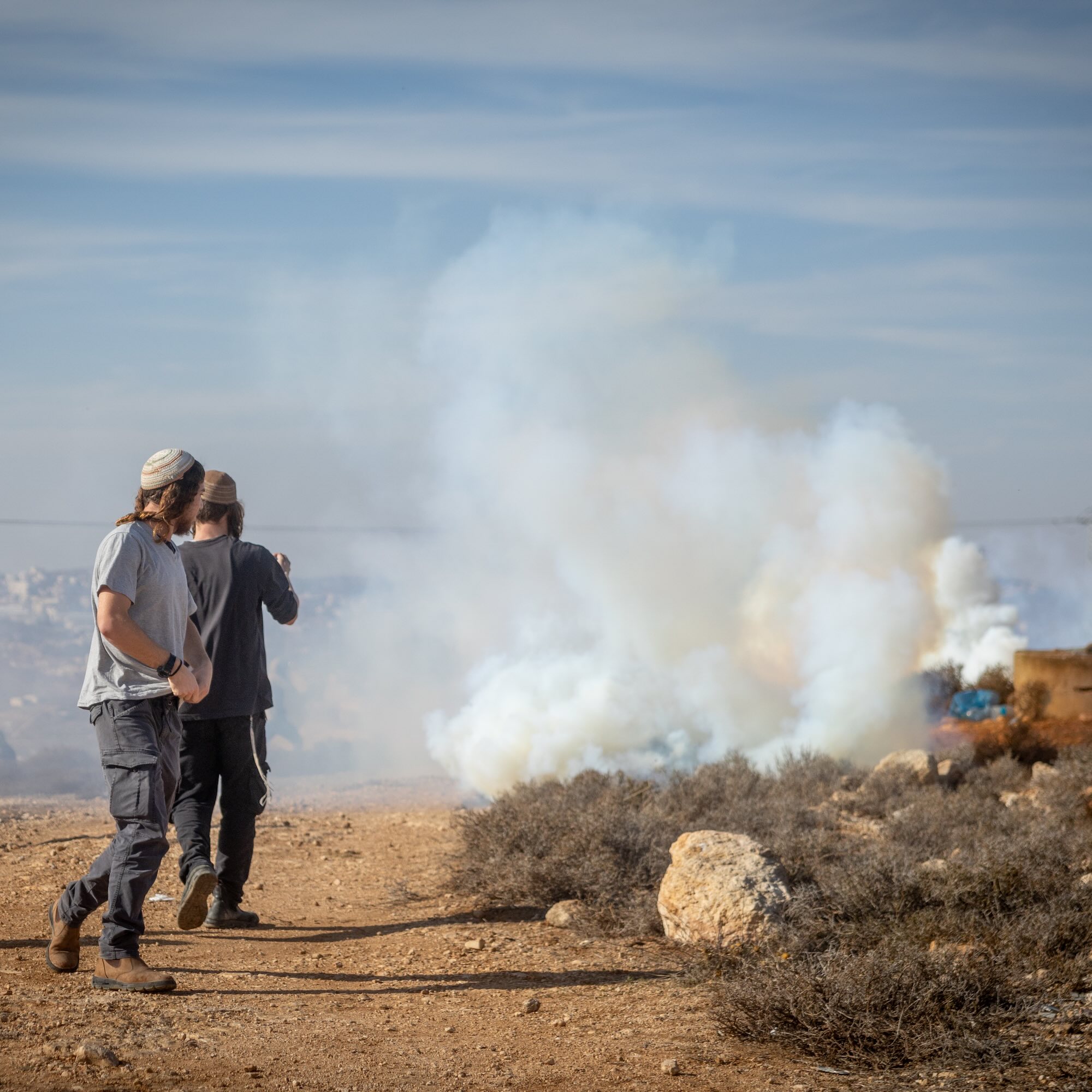
Well, it's kind of a very bad hobby, isn't it? Not something you want to see your your kid spending his spare time doing. It's a good sign and also a very bad one that Prime Minister Benjamin Netanyahu spoke out this week. Finally, against number one, attacks on the west bank, on Palestinians, mostly the farmers, but not only the farmers, and two, attacks on Israelis who have come to offer what in activist circles has called protective presence for the Palestinians under attack, who are coming from inside the Green Line to help pick olives or to simply be around to video violence should it erupt during the harvest and to try to dissuade the folks doing the violence from doing the violence. And number three, attacks on IDF soldiers trying to maintain order in the occupied areas. Prime Minister Netanyahu said that Israel, quote, will take very forceful action against the riots, against Palestinians and against IDF soldiers. Soldiers because we are a nation of laws and a nation of laws acts in accordance to the law. Interesting coming from Netanyahu. Netanyahu called the rioters, quote, a minority that goes into Judea and Samaria, AKA the West bank and does not represent the large community of law abiding loyal settlers. It is a good sign that the Prime Minister saw the riots and the thuggery as a problem that he was duty bound to address, even if he did so at the displeasure of some of his religious, Zionist and settler coalition partners. And it's a bad sign because the riots had to be pretty bad, pretty riotous, and the thuggery pretty freaking thuggish for the Prime Minister to stop pretending that it didn't exist. In a similar way, it was both good news and bad news that IDF chief of Staff Iel Zamir last week said he, quote, strongly condemns the violence, adding that, quote, the IDF will not tolerate phenomena of a criminal minority that besmirches a law abiding public good because the IDF chief of staff tries terribly hard to steer clear of making any political statements that might be considered divisive. So it is a significant act for him to condemn the people behind the violence and bad, because again, things have to be pretty darn bad for the head of the army to condemn a group of Israeli citizens. And it was in the same way, both good and bad news when President Yitzhak Buji Herzog called the attacks on Palestinians and Israelis trying to protect them, quote, shocking and serious and wrote on social media that quote, all state authorities must act decisively to eradicate the phenomenon. Phenomenon. And in fact, things are plenty bad. There's no precise figures that everyone agrees on, but use any measure you want and you'll come to this conclusion. The United Nations Humanitarian Office, which has for almost 20 years collected data on attacks on Palestinians carried out by settlers, announced that last month was the worst month since it started keeping records with 264 documented attacks. Of the roughly 9,600 attacks logged over the past almost 20 years, more than 15% of them took place in the first 10 months of just this year. A lot of these attacks involved throwing rocks at Palestinians working their fields or orchard, or walking on the side of the road. A lot of the attacks have been clubbings and beatings with sticks. There is also arson, burning down homes, warehouses, and in one case last week, torching a mosque. There has also been the uprooting or otherwise destroying of olive trees. A video went viral last week of thugs with their faces covered battering a 60 odd year old woman with sea sticks. Just who is behind the attacks is something that we do not know. With perfect clarity. Most of them seem to be young, aged 12 to 25. They are usually referred to as naray ha giva ot hilltop youth. That's how it's usually translated into English. That kind of has a Julie Andrews spinning around joyfully in the Alps vibe to it. But the Hilltop youth do not have the Sound of Music on their mind. They are not picking blueberries or escaping the Gestapo Chapo. The common lore is that the Hilltop youth are disaffected religious sorts who for one reason or another, didn't make it in their yeshiva and who maybe had enough of their parents house and who are free radicals, often zealots, wandering the occupied territories with the vague purpose of being God's thuggish enforcers, getting revenge for real and imagined Palestinian crimes against God's chosen people and forcing Palestinians that even they recognize are innocent of any crime off of the land that God promised the Jews by destroying their livelihoods and making their lives generally hell. Most every Israeli leader who condemns the violence on the west bank against Palestinians insists, as President Herzog said, that it is a product of a, quote, handful of thugs who don't represent the broader settler society in which most of them grew up. Prime Minister Netanyahu said that they are a, quote, small minority who do not represent the large community of law abiding, loyal settlers killers. Which may be true as far as it goes, without contradicting the conclusions that many people reach that there is something systemic about this problem. And while the thugs themselves are a problem, they are not the only problem. Noah, tell me please, why the big rise lately in thuggish violet violence on the west bank and what do we do about it?
- [45:30]
Noah Efron
First of all, I think that what you said is right, that, that it is both true and importantly not the whole truth to say that this is a small and thuggish minority of young and disaffected youth. I think that that is factually true. But I think that the way that young and disaffected youth express their youth and disaffection really depends on the context in which they live. And there is this broader context. So I think, you know, at Bar Ilan, I have friends who, and I run into a lot of people who have a lot of sympathy for settlers, are basically, you know, right wing sorts who are really upset by this. So I think that it is true that the majority of settlers or people who support settlers look at this and tisk, tsk, tsk, and say this is terrible and they're sincere about it, they really believe it. But that's far from enough. And certainly saying we need to stop this small minority is not enough. The context in which this happens, the specific now context, is partly the the end of this two years of war where I think that, that a lot of people felt as though the violence that they saw on October 7th, the like really hideous violence that they saw on October 7th, somehow unmasked a true face of Palestinian culture. And so therefore attacking Palestinians no longer seems to everyone as though even if the particular person you're attacking didn't do anything wrong, didn't commit any crime, never attacked a Jew, it's still there. I think there are a lot of people who feel as though Palestinian culture is guilty and Palestinian culture needs to be. So that's a broader thing that many people who tsk tsk about these thuggish kids still believe. And it's out there. And it's part of the explanation. Another part of the explanation is a feeling as though the peace process, put it in quotes or don't put it in quotes, that may or may not be underway, is something that might well lead Israel, lead the United States to pressure Israel to relinquish most or all of the occupied territories. And it feels as though there's this moment of crisis and so fighting back by any means necessary, including taking a stick, apparently, and beating a 60 year old woman feels as though it might in somebody's mind, as though it might have some justification. I think that's part of the background. I think there's also. So alongside that feeling of oh my, our side might be about to lose out is a feeling that oh my, our side is ascendant. And the really prominent place in Israeli politics that especially Itamar Benvir holds, but also all of the religious Zionists is, I think, encouraging of this sort of violence so those older people will no longer come right out and say on the radio that we ought to go around and, and destroy olive trees and burn mosques and beat people and throw rocks. We know that really this is what they want and this is growing and we are supporting them by doing these things. So I think all of those things and more are happening at once. And this is part of why at this moment there's such a big rise in this kind of thuggery which between us has, you know, existed for years and years and years. But, but so it, but that there's no comfort to be found in that because it, it both existed. It's terrible. That existed for years and years and years and it is over the past few months worse than it has ever been in all of Jewish history. How do you see these things, Alison?
- [49:41]
Alison Kaplan Sommer
I have completely different reasons for why this is happening. First of all, if this is like such a small fringe group of people and we've got this big gigantic intelligence apparatus in this country, I believe the government can, can thwart it. And it's a question of will to do it, not necessarily ability to do it. And, and the reason that the numbers have gone up and why it's intensified so much is because we have a government that does not have the will or desire to do it. So knowing that the government is on their side, that some of the most powerful people in the country are with them, the ministers, Bazal Smoch and, and Itamar Ben, who are them basically,
- [50:22]
Noah Efron
you
- [50:22]
Alison Kaplan Sommer
know, they know that they're not going to get into trouble and that's, you know, encourages them to do it more and for it to, to get worse and worse. And when you've got Ben, who's the minister of police, there are police on the scene. The, the IDF is respectively responsible for the, for the area. But you see police, military police in these videos standing by, not doing anything because they know they're going to get in more trouble interfering than not interfering in, in what's going on in these videos villages. A huge factor is the cancellation of administration detention which happened by Defense Minister Yisrael Katz in November of 2024. It basically came into effect in January of 2025 when Katz ordered the immediate release of all settlers who were administrative detention in order to send a clear message supporting and encouraging settlement growth. So you've got a, you've got a government that's basically winking at them and saying go ahead and encouraging them. So there's no sort of surprise at the fact fact that it's, that it's on the increase. By the way, it's not only settler youth that are participating in these violent acts. On my other podcast at, I interviewed someone from Rabbis for Human Rights and he said a kid from Beit Shan was recently injured in, in some of the clashes. And the, the extreme settlers are targeting disaffected youth within the Green Line to come over, come on over to the west bank, spend a Shabbat and get involved in this stuff.
- [51:47]
Noah Efron
So we're not, there's definitely a big part of it. I mean this, this phenomenon of, of the hilltop youth is primarily people who grew up in the Territories, but a lot of them are people who did not. So you drop out of school, you're in a yeshiva in Beitjean and you drop out of school, you might well find yourself sort of drawn gravitationally toward these groups in the West Bank. And so a lot of the people have parents who live in Jerusalem or have parents who live in Beitan or in Tel Aviv. That's, that's. And it's, it's part of this same, same phenomenon for sure. It's not, it's not, it's not necessarily. Or jest or even perhaps primarily the result of the particular education you might get in the settlements. But the. I just wanted to echo what you said about, about the Minister of Defense, Israel Katz, canceling the administrative detention, which I heard of really interesting interview this week with someone who works in intelligence who said this is really the single most important reason for this rise. That in the past we were able to gather intelligence about people about, about who. What he on the radio called Jewish terrorists. And we were able to stop them and we also arrested them and put them away, the key organizers. And then all at once with the stroke of a pen that was no longer something that we could do. Now one of the reasons why that is interesting to me personally is because I have always been really strongly against administrative detention. What that essentially is is locking someone up because you suspect them of doing something but you don't have any proof and they don't go to trial.
- [53:33]
Alison Kaplan Sommer
Which we use freely with Palestinians, which
- [53:35]
Noah Efron
we use freely with Palestinians and in the past have used with young Jews who are suspected of being drawn towards these kind of thuggish groups. And one of the reasons why the thuggish groups are thriving now is because we no longer just lock them up without due process, which for me is a little bit of mind fuckery. Because. Okay then does that mean that I am wrong to feel as though there's something wrong about locking up a 14 year old kid or a 16 year old kid because you know, he's getting involved in these kinds of things. I don't know, maybe I was wrong or. But maybe I, I wasn't wrong. It's, it's a, it's a very, very confusing thing. So what do you think needs to be done about this?
- [54:24]
Alison Kaplan Sommer
They need to enforce the law.
- [54:26]
Noah Efron
The. They being the being, being the army
- [54:28]
Alison Kaplan Sommer
and being the, and being the, the police. Obviously. Another factor which was interesting. I just happened to have done this, this podcast with, with Anton Goodman from, from Rabbis for Human Rights and, and, and he pointed out that during the war the. In the west bank people were called into reserve duty. And unusually unlike other parts of the country, although I don't. It might have been also in the north and the south, but definitely in the, in the west bank around the settlements, they were called into reserve Duty to protect their own settlements, to protect their own area. They were, they were local. So he says the, the Venn diagram between some of these reservists and some of these extreme, extreme settlers who participate in this, in these activities, there's free use of army uniforms, of weaponry. And so the, the, the, there's a blurred line now between, you know, who is the military and who is the settlers. There have been these clear settler versus IDF clashes when they've tried to clear outposts. But in these kinds of incidents, there hasn't really been a lot of conflict between the military and the settlers. And according to, to Goodman, who I, you know, trust as a, as a good source in that sometimes you can't even tell who is the army and who is, are the people doing this. He said, in some of the most recent attacks on the harvest, there have been, there's been drone use, use of drones. And I said, okay, so who's, you know, operating the drones, the military or the settlers? He said, honestly, we don't really know. So there's also that kind of blurred line that I think is, is problematic. And that happened, you know, as a result of the war.
- [56:02]
Noah Efron
The olive harvest just ended for, you know, biological plant related reasons. And so there's an expectation that some of this is going to sort of naturally die down, but there's also a certainty that a lot of it is going to continue and maybe actually drawing some of the violence away from the fields and into the villages might make it worse. It's a thing, it's a terrible thing. Now listen to this, Dakota. That song is Lamaan ma by Shahar Hillel from his new record Hilchot Milhama. And now it's time for our second discussion which we are calling, calling bop til you drop with apologies to Rick Springfield. And here is why. Speaking at the McDonald's. Yes, that McDonald's. The McDonald's impact summit. On Monday, U.S. president Donald Trump said this. Among many other things, they said skedaddle, the word skedaddle.
- [58:40]
Donald J. Trump
And that plane went like this. You know, when it drops a bump, it goes down very steeply because that gives it a better engine angle and you know, more speed for the bomb. Very, very heavy bombs. And they go boom. And that thing just turned in its side and I mean it's so unbelievable. And that knocked out Iran nuclear capability. And all of the Middle east became a different place. And now we have peace in the Middle East. And at the United States nations today they approve the board of peace, which is, I'm going to chair and we're picking the leaders or the heads of the most important nations in the world. I think it'll be a board like no other, other than perhaps the McDonald's board. You have a very good board. You actually have a very good board, but nobody thought a thing like that was this just happened today, the Board of Peace. And it's going to be comprised of myself and leaders of other very important nations and very respected nations. And it's going to be something I think is going to be very important. It was just a prude. It was, it was just endorsed by the United Nations. It was pretty great. It's a big thing. I think it's one of the most important things the United nations will ever do, actually. But Joe Biden's prices and his hikes cost a typical American family an estimated $33,000 and hit US workers and your customers and your small businesses very, very hard.
- [60:08]
Noah Efron
And it goes on like that. The endorsement of the UN that President Donald Trump talked about came in the form of a decision by the United Nations Security council to adopt UNSC resolution S RES 2803 open paren 2025 closed paren which quote 1. Endorses the comprehensive plan agreed to by the sides and signed in Charmel shadow on October 9 2. Welcomes the establishment of the Board of Peace BOP BOP as a transitional governance administration after the PA reform program is faithfully carried out and Gaza redevelopment has advanced, the conditions may finally be in place for a credible pathway to Palestinian self determination and statehood. The United States will establish a dialogue between Israel and the Palestinians to agree on a political horizon for peaceful and prosperous coexistence. 3. Underscores the importance of the full resumption of humanitarian aid. 4. Authorizes Member States participating in the BOP to establish operational entities for the performance of 1. Implementation of a transitional governance administration composing a Palestinian technocratic apolitical committee of competent Palestinians from the Strip as championed by the Arab League. 2. Reconstruction of Gaza 3. Delivery of public services and humanitarian assistance in Gaza Gaza 4. Facilitation of the movement of persons in and out of Gaza 5. Understands the operational entities referred to above will operate under the authority and oversight of the BOP. 6. Calls upon the World bank to facilitate and provide financial resources to support the reconstruction and development of Gaza. 7. Authorizes the BOP to establish a temporary international Stabilization Force ISF in Gaza to deploy under unified command acceptable to the BOP. Israel Defense Forces will withdraw from the Gaza Strip based on standards, milestones and timeframes linked to demilitarization that will be agreed upon between the idf, isf, the guarantors, and the United States, save for a security perimeter presence that will remain until Gaza is properly secure from any resurgent terror threat. Then there's articles 8 and 9, which are sort of blah, blah, blah, personnel progress reports, et cetera. And the document ends with number 10 decides to remain seized of the matter, which is my favorite security council resolution 2803 passed with 13 yay votes and no nay votes, but with two abstentions, Russia and China. A Hamas spokesperson responded to the passage by stating that his organization has no intention of abiding by the demand in Article 7 that they demilitarize, saying that, quote, resisting the occupation by all means is a legitimate right guaranteed by international laws and conventions. Weapons of resistance are linked to the existence of the occupation, end quote. Meaning Hamas will stockpile guns, bombs and rockets as long as there is a Jewish state in Palestine. For our part, Prime Minister Netanyahu responded to the resolution by saying that he would forever oppose the establishment of a Palestinian state and that Hamas would be forced to give up their weapons. Our opposition to a Palestinian state in
- [63:28]
Yitzhak Buji Herzog
any area west of the Jordan. That opposition exists and is strong and
- [63:31]
Noah Efron
hasn't changed in the slightest. Slightest.
- [63:33]
Yitzhak Buji Herzog
There will be no such thing as the alleged non demilitarization of the part of Gaza that is in Hamas's hands,
- [63:39]
Noah Efron
even in the 20 point plan and in everything else. This area will be demilitarized and Hamas will disarm. All of which responses may sound like a disappointing start for UNSC resolution. S/RES 2803 open paren 2025 closed paren Allison, what should we make make of it? Where can we expect it to lead us?
- [64:01]
Alison Kaplan Sommer
I wish, I wish that I had, you know, enough knowledge and confidence of my knowledge of of this stuff in the background to say like oh yeah, this is going to happen. It's going to work. It's not going to work. But we don't and I certainly don't. I turn as usual to those wiser than I and our friend very very very close friend of the the podcast and the har it's columnist Dalia Shenlin had a really good sort of breakdown of of this res. We should make it make of it and to to start to begin with her conclusion, she says the resolution may be a poor start, but it's all we have. It doesn't have to be the end point. So the analysis is basically, you know, the upsides and the, and the downsides of all sort of rides I think on what they call this International Stabilization Force. I love these names. The Board of Peace, by the way. I don't know if it's a gender thing, but when I hear bop, I think of Cyndi Lauper. She bop. Oh yeah, yeah, that's my bop. You went to a Rick Springfield. Springfield. So this, this resolution, you know, says that as the ISF establishes control and stability, the IDF will withdraw from the Gaza Strip. Right now we're over 50% still occupying the the Gaza Strip. That's going to presumably where this Board of Peace is going to start operating in the Israeli controlled side. So Dalia spoke to some think tank people and some of the more pessimistic ones are basically saying the resolution endorses a new occupying entity for Gaza. Except it's not an Israeli occupation, It's not an. Not Kogat from the idf, but it's the American and Israeli partnership. So who's gonna join this International Stabilization Force? Will it really be international? Will it even be American? Who's gonna be there? So, you know, the realistic implementation of this resolution in any way kind of depends on what's gonna happen there.
- [65:54]
Noah Efron
I think so far the country that's raised its hand most vigorously and shaken it is Turkey. Right? They're quite eager to be part of this.
- [66:04]
Alison Kaplan Sommer
Israel's not very eager to have Turkish armed soldiers, you know, at that proximity to its border. So that's a problem.
- [66:11]
Noah Efron
Right. And also how this, well, how this BOP operates is an important question. And also the maybe in my eyes, the most important thing, this technocratic committee that will be the governing body of Gaza, what could that possibly look like? And who will choose that? Presumably the Board of Peace, Donald Trump and the people that join that will have a hand in choosing that. Though what we have already heard is that of the names that have been floated now, though, exactly by whom they were floated is unclear to me. More than half of them are people known to be associated with Hamas. Hamas. So it's right. So what happens now is entirely unclear. Though I do remain true to Article 10 of the decision, I do remain seized of the matter. It still seems like don't have a seizure. It seems like an important thing, like an important step forward still, because. Because then the next step, and it's a step that we're facing right now, are exactly those things. How do you form this peacekeeping organization or body? How do you form the body that will run Gaza? How do you demilitarize Hamas? A Hamas that says that they refuse to be demilitarized and that there's good reason to think is going to try to be an important voice in, if not the controlling voice in the committee of technocrats that ends up ruling Gaza. Like how do you do these things? Those are the questions that having passed this on Monday, those are the questions that on Tuesday people are already starting to answer or try to answer. And that seems like a step forward to be actually talking about, about those things. After this month since the plan was accepted, the 20 point plan was accepted and basically a month in which nothing has happened.
- [68:24]
Alison Kaplan Sommer
Yeah. And the stabilization force, how long does it take to put a whole new military entity together? It's going to take months and months and months, maybe even up to a year. So what happens, happens before then, what steps into the void. A void, right.
- [68:42]
Noah Efron
I mean right now it seems as though what we got, the status quo, is something that all the sides might want to live with for a while. I think that it's clearly in Hamas's interest at the moment. Nobody is pressing them to give up their arms and it may well be in Israel's interests, certainly the Israel ruled by, by Netanyahu and his government, because Israel still controls 50% of the territories. And the possibility of anyone of Hamas, Islamic Jihad or anyone else launching an attack into Israel from Gaza seems vanishingly small at the moment. And I'm sure people would like to preserve that until the election. So it's very possible that we're now at the beginning of a long in between period. Which is another reason why I again agree, agreeing with Dalia Schindler in this think that what happened on Monday is an important step forward because now timetables are being set in offices somewhere by someone. Do you think that Donald Trump is gonna continue to be able to pay attention to this?
- [69:56]
Alison Kaplan Sommer
I don't think he'll have a choice. He's not, you know, if he doesn't wanna pay attention to it, people are going to force him to pay attention to it. And you know, he's always gonna want to distract from Jeffrey Epstein. So you know, he want to, we'll want to use that. But I, I can't stop thinking about something that, that Josh Leer, another HAR columnist said to me talking about the West Bankification of the Gaza Strip, that we basically it's going to be partitioned into two areas and the one, you know, closer to Israel and the border is going to be ruled by this, this entity. And then there's going to be the, the nastier part of Gaza, like the nastier part, you know, the areas BNC and the in divided up in the west bank where ISRA incursions into it. And also, you know, there's nothing as permanent as a temporary solution in the, you know, the west bank is supposed to be temporary. Right. So this, this temporariness that we're, that we're, you know, entering into is, you know, could be, could be long term. But in this case, I don't think we even understand what the temporary is going to be.
- [70:57]
Noah Efron
That. That's right. And as Israel creeps closer to elections, then the ability of Israel to change anything or accept any agreement becomes weaker and weaker and weaker, or the willingness of the government certainly to do anything that is unpopular among its base is going to get smaller and smaller, and that's going to make it harder to go forward. So it's true, it could be that we have this unstable, like you said, kind of status quo. But, but the status could be, could change in unexpected ways. And it's unclear exactly how it ends.
- [71:39]
Alison Kaplan Sommer
Yeah, no, I mean, really, it, it, the, the question to me is whether these other countries are really going to jump into Donald Trump's big adventure and really get on board. And really, because the, the, the Arab world has avoided getting involved in, in the mess in Gaza for, you know, decades and decades and decades. You know, really, will the will of Donald Trump change that situation?
- [72:03]
Noah Efron
Yeah, I mean, for me, a very, very big question is Egypt, which seems to me to be the most important player and which I personally have not seen mentioned over the past week. Like, I. Not at all.
- [72:14]
Alison Kaplan Sommer
Yeah. If you, I mean, if you, you're, you asked to just to, to roll back to what you said about. Will Trump continue to pay attention to it? He will because this is sort of, I mean, we've, we've become a side dish and the main course is really Trump's strengthening of the, of the connections and the, and the allyship of the, of the Gulf countries and the, and the Saudi countries and quote, unquote, pursuing solving the Palestinian problem, calming down Gaza, you know, looking towards a Palestinian state, you know, is part of the deal. It's part of his deal with the, the Saudis. So I think that, like, that's where Trump's interests are. And I think Trump will pay attention, not because he's so interested in the, in the issue per se, maybe Jared Kushner is, but because it is part of this, like, greater grand vision of, of, you know, becoming big buddies with the people of the, who have the gazillions of dollars in the Gulf.
- [73:07]
Noah Efron
Now. Listen to this.
- [74:13]
Alison Kaplan Sommer
Sam,
- [74:53]
Noah Efron
That song is nissim by Shachar Hillel from his remarkable disturbing debut record Hilchot Milhama which you can find in all the usual places. And now it is time already for our Vadak country segment. This is the part of the the show in which each of us described something that maybe brought us solace as we wended our way through our worlds over the last little while. Or frankly surprised and amused, delighted and enchanted and torsolder could be even fluged us as we did that very self same wending Alison what is your better country?
- [75:22]
Alison Kaplan Sommer
Nearly two years ago I sat in the auditorium of Bethe Palmach, the Palmach Museum to see my daughter all bright and shiny and excited. A new soldier who is being sworn into the IDF spokesperson's unit after she completed what is known as Kamad. Do you know what kamad is?
- [75:40]
Noah Efron
I don't.
- [75:41]
Alison Kaplan Sommer
Yeah, it's like course made Dovrut. Oh the, the course of what? Communication skills of spokesperson skills of the, of the spokesperson's office. So yeah, it's an abbreviation basically for the in house IDF School of Communications. They get an abbreviated basic training and then this intensified course. I'm basically you know, journalism school and marketing, you know everything like basically condensed into an intense three month program. Now my girl is no rah rah IDF go soldier. She's got very left wing politics and most of the people in the spokesperson's office, a lot of them are left wing, a lot of them, you know, on the gender and sexuality spectrum, you know, very. It's got, it's got an image of being you know, sort of the, what shall we say, the Williamsburg Brooklyn of the idf, something like that. But my daughter doesn't know how to do anything halfway. She like throws herself into whatever it is. So she was in the film unit, she made films. But then she decided to sign up to become the commander to become a commander in the next in this new commod course.
- [76:52]
Noah Efron
Oh wow.
- [76:53]
Alison Kaplan Sommer
So she actually got the job of not just being a regular old commander but being what's called a Madarit. Now they, they like to abbreviate everything in the. The idf.
- [77:02]
Noah Efron
Rashat Mador.
- [77:03]
Alison Kaplan Sommer
Yeah. Oh she sort of the head. So she basically developed the curriculum and did the logistics and how the course is going to run and the sort of like overall power. She you know, threw herself into it. She was responsible for, for so much stuff. I mean really like high level management things. You know, I would have done this what a country three years ago and not been apologetic that the cause that she was working for was the, the IDF and, you know, explaining some of the terrible things going on in Gaza. But let's put that aside for the moment. She's just 21 years old. I saw her there at this ceremony, you know, in charge, producing it, running it, feeling acting very maternal towards the new soldiers who she had, you know, ushered through the process that she had gone through, what, you know, a year and a half ago, 21 years old at 21, what did I know how to do? I knew how to write a great university paper. I knew how to read a lot of books. I was a theater major. So at least I knew how to do a thing. Just like some people, like, do a thing and do sports. But, you know, that's not life or death. You don't have, you know, really important consequences riding on your actions. So again, I just have such mixed feelings about the, you know, universal draft here and, and the service. And on one hand it's the military and it's tough and it's hard. And I have never gone through that, you know, having a kid in mortal danger on the battlefield. But I watch all three of them go through this really, you know, life changing life, forging experience at this young age, taking on huge amounts of responsibility. And I'm just, you know, incredibly impressed by what kids that age are really capable of when they are, you know, determined to be part of something larger than themselves and more important than themselves. And even, as in my daughter's case, you know, not necessarily a true believer, but it really, you know, marks their character forever. And I think it really has to mark the national character here in Israel as well. So congratulations to my daughter. Congratulations, congratulations to all of her new shiny, sweet soldiers. She says, like she says, I feel so much like I've given birth. And these, like, sweet, innocent, you know, kids who are so eager to do it now, I'm like pushing them back into the system and I'm worried about how they're going to act and how they're going to encounter. And I said, honey, welcome to motherhood.
- [79:26]
Noah Efron
Oh, that's wonderful. Mine is a little bit adjacent to that. I had a meeting at the Eret Yisrael Museum, Musa they call themselves now. So I figured that I'd bike over an hour early and go see a show that they have going at the Rabin center, which is called Moments that Remain. And it's an exhibit of 300 pictures picked from the hundreds of thousands of pictures taken by the army, mostly by soldiers serving in something called the Plugata Tiud Hamifza The Operational Documentation Unit or company, which embeds photographers and videographers in all sorts of combat units and other units. And their job is to document what they see for the sake of history, for the sake of the press, for the sake of investigators and lawyers who sometimes check whether there have been crimes committed. And this Moments that Remain exhibit was pictures from this war, starting on October 7 and all through to today. And to be honest, I wasn't sure whether or not I wanted to go at all, because I figured army pictures of mostly soldiers in this war, they are bound to be these heroic images and we're still burying our dead and they are burying their dead and so much is still wrecked. And I wasn't sure that I had the heart to see any of this heroically, but I was going to be one museum over and I was curious, so I went. And what I saw when I did was not what I expected. I mean, there is a photo of two infantry soldiers lying on top of a huge dune, a wall of sand, and behind them are two armored personnel carriers. And just over their heads, almost like they could reach up and touch it, is a helicopter. And the clouds mix with the smoke. And it is like a frame from a movie and it is very heroic. And there's a picture of a soldier on a rooftop in Gaza firing a shoulder held rock. And the plume of flame coming out from the back is so big and angry that you can't figure out how it does not consume him, the soldier. And there are pictures of soldiers marching towards a city in Gaza, one of them holding an Israeli flag. And these look like the pictures that maybe you'd expect in a collection of army pictures, like the pictures that I expected in a collection of army pictures. But then there are also walls of pictures, first from October 7 itself, the actual day, which are not heroic at all. They're pictures of blood on a kibbutz path, or of a house, house burned out of glass, pocked with bullet holes, of soldiers hiding behind a sliding board on a kid's playground, which sort of pictures, I guess we've all seen a lot of. And they also fit with a maybe heroic ish story of us rising after an attack. And there are also, though, pictures and the exhibit of people standing outside a building, apparently their building with a corner just sheared right off by a missile from Iran, which were all kind of what I expected. But then a lot of the pictures, most of them were something else altogether. A soldier in a dark concrete basement, maybe shining a flashlight, trying to make sense of what he sees and soldiers collapsed in a heap, sleeping on rocks and broken concrete and mostly sleeping on one of the another. Or soldiers walking through desolate streets, looking up at the porches of the big buildings rising on either side of them, trying to make out, I think, if there's anyone with a gun on any of those porches. And there are pictures of soldiers at funerals and soldiers praying. And when you look at them one after another, at least when I did, the feeling wasn't one of behold what we have wrought. The feeling was, well, mostly just exhaustion. These young strong people in the pictures seem mostly to be just so tired and looking at the 300 pictures, I got so tired. And I don't know, maybe ironically that was when I got that what I was looking at was heroic, but in the specific sense that I was looking at people who were carrying on day after day, week after week, month after month, because this war was what we were doing. So they were there. The curator of the Moments that Remain exhibit is a woman named Mimi Zeev, who's an artist and a professor. She paints and she illustrates and she works in fabric and she teaches fashion and design at Shankar. And her boy Lior Ziv, he was a documentary photographer in the Army. He was 20 when he was killed in Rafah photographing Givati soldiers on an operation to get a Hamas weapons cache. This was 22 years ago, in 2003, before Israel handed Gaza over to the Palestinian Authority. And on that day in 2023, there was an ambush and Leor Ziv died. And I guess you feel this too in the exhibit, which has a wall of photographs of army photographers. Their faces are all blurred. A few of them are now dead. You learn from the titles. And when I left the exhibit to go to, I saw that I'd been wrong to worry that this exhibit would be too heroic. Not because it wasn't heroic. It was. But because there is heroism and there is heroism and the heroism you get most often here is the heroism of a mother who 22 years ago buried her 20 year old boy and who is tired of all. There is always, and especially lately, for other young women and men like her boy to on focus photograph so tired, but still she wakes up every morning and she does her things and she makes her art and then she carries on. And that brings us to the end of our show, thanks to Itai Shalem, our station manager, without whom there would be none of this. Thanks to Achibo Lim, my favorite band from Kibbutz Geva. They gave us some music at the start and the end of our show. Thank you Alison. Thank you Natalie. We'd like to thank all of our Patreon supporters for your generosity and support. It keeps the show going, it keeps the station going and it keeps us moved and grateful and in your team debt. And we would like to thank all of you out there for taking the time to listen and ask you to like us on Facebook and drop us a line. We are going to answer at least eventually. After you do that, go to Apple Podcasts and give us a five star review. Maybe one that starts with this quote since the Promise Podcast has started broadcasting from its new Serenity Studios, the name Serenity has risen to become the 74th most popular baby name. And that is true just three slots below Brooklyn, according to the nomenologists at BabyCenter LLC. Do you really want to be listening to any other podcast? Finish that any way you want. But before you do that, remember that just yesterday as we record on November 19, we celebrated international Men's Day. So stipulated way back in 1999 in Port of Spain, Trinidad and Tobago, as according to Dr. Jerome Tilak Singh, one of the creators of the day. Quote I really realized that there was an International Women's Day, but no day for men. I chose that day for a few reasons. It is my dad's birthday. I felt the need to honor him. Secondly, it was the day in which the football team of my country created a level of unity which crossed gender, religious and ethnic divisions. End quote. As I am sure that I do not need to tell you, November 19, 1989 was the day upon which Trinidad and Tobago first qualified for the World Cup. Of of course, International Men's Day was established more than 90 years after international Women's Day, which was first marked on February 28, 1909, when it was organized in New York City by the Socialist Party of America as Working Women's Day. Vladimir Lenin embraced International Women's Day in 1922 as a homage to women's contributions to the Russian Revolution, and the United nations adapted International Women's Day in 1977. But neither the lefties nor the international nationalists ever warmed up to International Men's Day, which I get because I mean, what you gonna do? And I, speaking for myself, absolutely adore International Men's Day. It is probably my favorite day of the entire year, maybe the only day of the year when I feel truly seen as an international man. I mean, and it is a moment when I feel a rare fellowship with all men. And all through the day I was Putting my arms around strangers on the sidewalk, saying stuff like, how about that testosterone, Am I right? Or testicles. You can't live with them, you can't live without them. Am I right? Or earning 46% more than women. That's pretty sweet. Am I right? And the guys on the street and I, we would laugh and laugh and maybe put on some boxing gloves and go a few rounds, which is great. And it's not just about the men in your neighborhood. It's also about the fellowship that you feel with men all around the world. International Men's Day. Like what I feel for a fellow named Sai Kiran who posted this on social media. Social media.
- [88:29]
Yitzhak Buji Herzog
November 19th. International Men's Day. Most of you don't know that because Google doesn't have a doodle for it. Women's Day is being celebrated since 1909. Since that time, men have been fighting for a day of our own. And after nine decades of valiant struggle, finally in 1999, we've been given a date of our own that is November 19th. But by the time every date had multiple days. You look at the United Nations Commemorative days calendar, there will be so many days. It's even difficult to find Men's Day just in the letter M. There are more than a dozen days like May Day, Malala Day, Malaria Day, Mandela Day, Museum Day, Music Day, Minds Day, Migration Day, Migratory Birds Day, Migraine Day, Mother's Day, Mother Earth Day, Mother Tongue Day, my foot Day. In all that, it's so difficult to find Men's Day. And we've been clearly told that we can give you a date, but we can't give you an exclusive date. You have adjust with another day. It is fine. Real men and adjust. So we took whatever we got and we got November 19, which also happens to be International Toilet Today. And I saw some organization somewhere celebrating both days together. Welcome to the celebrations of International Mens Toilet Day. Lot of men attended, and it was literally and figuratively standing room only. At least on one day where nobody will shout at us for not putting back the toilet seat down. Or in the case of Indian men, for not lifting the toilet seat in the first place. Wish you a happy Men's Toilet Day.
- [89:56]
Noah Efron
And the day was such a happy day for me. But all through it there was this feeling like, you know how when the game is on and you start your first beer from a six pack, it's cool, but deep down you know that by halftime, all the beer is going to be gone. That's how I felt about International Men's day, all day that it would be gone soon, not to return for a long time. Long time not so the Promise Podcast we will be back for you next week and every week reminding you that while narcissism, aggression, hyper competitiveness, entitlement, fragile pride, emotional vacuity, risk taking, and unjustified self regard may be traits that in general make men so irresistibly charming in specific, sometimes those same charming traits can be downright cloying. On this the Promise Podcast, Sam.