Podcast
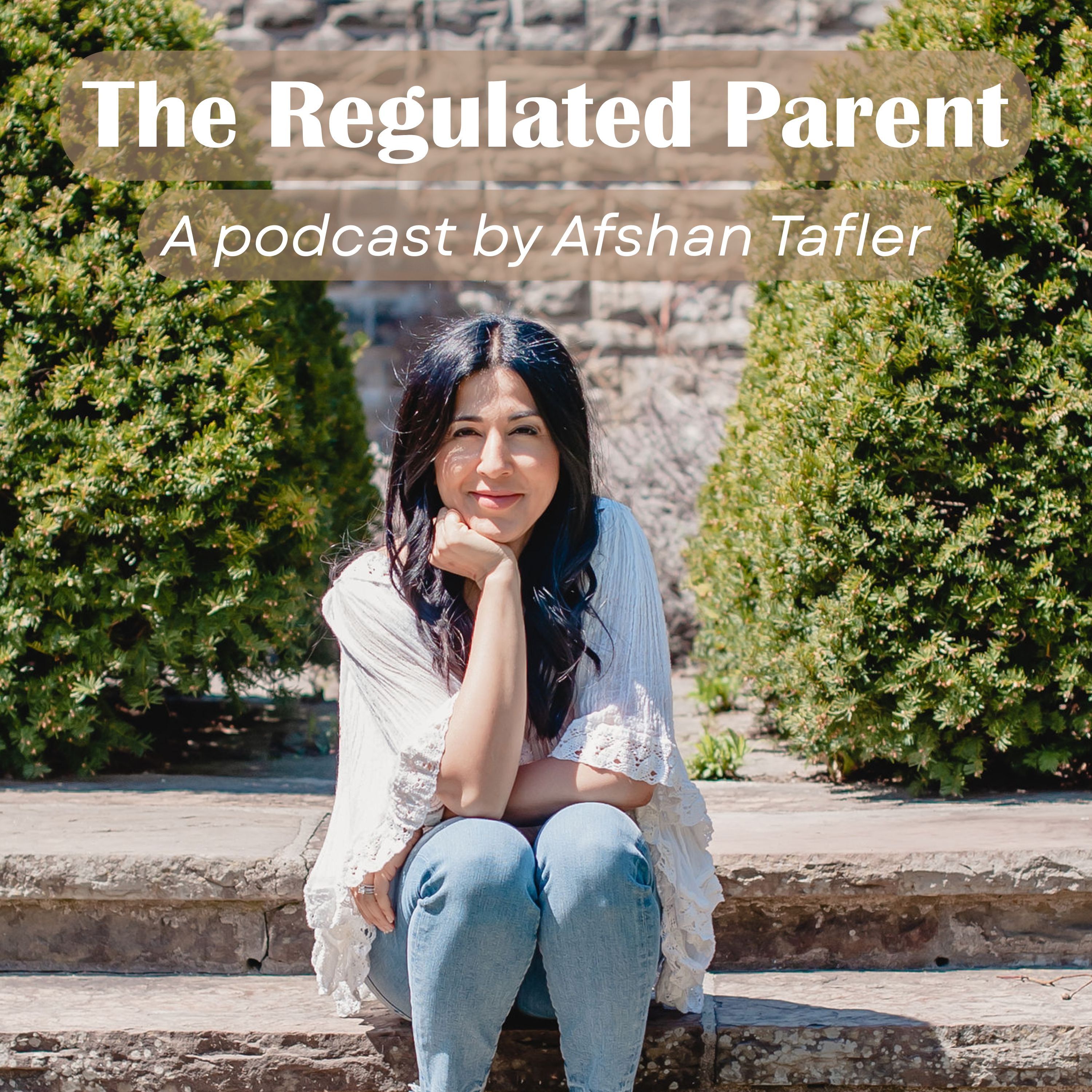
The Regulated Parent
Hosted by Afshan Tafler · EN
If you're raising a hypersensitive, high-needs child — including Autism, PDA, OCD, ODD, ADHD, or anxiety — this podcast is for you. I'm Afshan Tafler, a Nervous System Resilience Coach for parents like you. Here, we talk about what most people don’t: how it really feels, how your nervous system responds, and how to find your way back to calm, courage, and connection — even on the hardest days. You're not alone, and you were never meant to do this without support.
32episodes
Episodes
Newest firstAll episodes
Ep. 53 The Movements That Rewired Her Sons' Brains — and Kept Her Alive
2w ago01:16:50Tap to summarizeIt was 1 a.m., and Alma Galván was in tears. Both of her sons had severe autism, ADHD and sensory differences. Doctors told her to institutionalize her oldest son, and daily two-hour meltdowns had become normal. She remembers thinking, *"This isn't life."*With no internet or roadmap, Alma spent seven years searching for answers. What she discovered changed everything: gentle developmental movements that helped build the brain's lower centers, reducing chronic survival responses. Her sons, who were both non-speaking until after age six, are now adults in their 30s who are working and thriving.But the biggest surprise wasn't just what happened to her children—it was what happened to her. As she practiced the movements alongside them, her own nervous system began to settle for the first time in years.That experience led Alma to create **Alma Integration**, a program designed not just for children, but for parents.In this episode, we explore:• Why movement reaches the brain when reasoning and rewards can't• The role of the pons in survival, sensory overwhelm and meltdowns• Why a regulated parent is part of the intervention—not just the support• Why play and connection are essential for lasting change• How to tell whether your child is leaning in or pulling away• Alma's remarkable healing journey after 21 days in the ICU• Why healing happens in spirals, not straight lines• Two simple practices you can begin today—for you and your childIf you're parenting a PDA, autistic, ADHD or highly sensitive child and feel like you've tried everything, this conversation offers hope for both your child—and for you.🎟️ ALMA'S TWO FREE SUMMITS — I'm speaking at bothThe ADHD Toolbox Summit — August 4th The BrainWorx side. Understanding your child's brain, and practical new ways to help them. Live on day one, with additional speakers on day two. Finding Calm in a Chaotic World — The Alma Integration Summit — August 25th This one is for you. How do we help our own hearts find calm in a chaotic world? A completely different, deeper conversation.Both are free.🔗 FIND ALMABrainWorx — her work with children, families and educators.Alma Integration — her coaching practice, thought streams, and the work of returning to your original blueprint. Alma Integration on YouTube — her songs, which are layered little lessons in disguise. My son's favourite is the one on gratitude and we play it on repeat.📖 READ THE BLOG VERSIONThe full write-up, including both practices written out step by step so you can come back to them.🎁 FREE GUIDE — 7 TRUTHSAbout Why You React to Your Child (Even When You Know Better) What It Actually Takes to Regulate Your Nervous System and Feel Okay Inside a Life That Feels HardThe real reasons you keep getting hijacked — even after all the mindset work — and the 7 shifts that actually change it.Nervous system regulation for parents of hypersensitive, reactive kids (Autism, ADHD, PDA, OCD, ODD, Highly Sensitive).Download it free here 👉 GUIDE LINK
Transcribe →The #1 Regulation Tool That Cut My Autistic, PDA Child's Meltdowns by 95%
4w ago00:28:18Tap to summarizeIf I could offer you one tool that took my PDA, autistic son's aggressive behaviors from 5 hours of daily meltdowns and destruction, to less than 30 minutes a few times a week — would you want it?It's four letters. W.A.I.T. — Why Am I Talking.In this episode, I'm walking you through the single most powerful strategy we ever used to help my son regulate — and it wasn't a script, a technique, or the right words. It was learning to stop talking altogether.I share the real story of what this looked like in our house during my son's burnout, the two kinds of talking I used to reach for that both backfired every time, what I came to understand about why verbal processing is so hard for kids like ours in an activated state, and exactly how to practice WAIT yourself — including what to do with your own fight-or-flight energy instead of directing it at your child.This one is close to my heart, and it's the answer I give every time a professional or doctor asks what helped my son the most.🎧 Prefer to read? Catch the full blog version here.📘 Want a place to start today? Grab my free guide, The 3 Shifts To Make During Your Child's Meltdowns (So You Can Stay Calm Instead of React) — how to see your trigger loop, interrupt it, and respond, instead of holding it in or exploding. A nervous system guide for parents of highly reactive kids (ADHD, PDA, Autism, OCD, ODD) to regulate their own nervous systems first. Download it free here.
Transcribe →Ep. 51 Am I Damaging My Child? The 3 Shame Spirals That Keep Parents of PDA, Autistic, ADHD Kids Stuck
Jul 400:35:37Tap to summarize"I lost it on my child. I'm damaging them." "My child is still struggling. I must not be doing enough." "We don't fit in anywhere. Something must be fundamentally wrong with us."If you've felt any of those things — you're not broken. You're stuck in a shame spiral. And in this episode, I'm going to show you exactly what's driving these loops, what's underneath them, and how to start breaking free.I share a real day from our hardest years — the morning I ran at my son like an animal, the afternoon I watched him fail to connect online, the evening I found out we hadn't been invited to a family event we were always included in. All three shame loops. One regular day.Then I walk you through:→ Why shame is not a personal flaw — it's ancient survival biology wired into all of us → What actually happens in your nervous system when shame gets triggered (including the inner critic, dorsal vagal shutdown, and the emotions trapped underneath) → The childhood wound that was already there before your child arrived — and why this parenting keeps pulling that thread → What's really underneath each shame loop: the terror, grief, helplessness and longing that shame is protecting you from feeling → Why breaking free from shame is one of the most powerful things you can do for your child's nervous system — not just your own → Two practices: working with your inner critic, and Dr. Kristin Neff's 3-step self-compassion framework applied directly to shameThis is deep work. And it's also the most important work you can do — not just for yourself, but for your child, and for the generations that come after.📖 Prefer to read? Get the full blog version here.🎁 Free Resource — 7 Steps to Regulated & Resilient Parenting with your Autistic, ADHD, PDA, or high-needs child: FREE EBOOK + VIDEO SERIES LINKThe Regulated Parent is hosted by Afshan Tafler, Nervous System Resilience Coach and founder of Illuminate U. Afshan supports parents of PDA, autistic, ADHD, and high-needs children who are stuck in survival mode — through the Regulation Rebuild course and Regulation Rebuild Collective.Website: illuminateu.ca
Transcribe →Ep. 50 Reclaiming Your Joy and Aliveness — Even When Your Autistic Child Is Still Struggling
Jun 2000:51:26Tap to summarizeHave you lost your sense of aliveness? Your ease? Your feeling of well-being — that quiet sense of being at home inside yourself? If you're parenting a PDA, autistic, or high-needs child and somewhere along the way you stopped feeling like yourself, this episode is for you.I'm sharing the moment I watched my son laugh — during one of his first good days in years — and felt absolutely nothing. Not relief. Not joy. Not ease. Just flatness. And what that moment taught me about what chronic stress actually does to a parent's nervous system.Because here's what I've come to understand: we don't lose our joy, our aliveness, or our well-being. We lose access to them. And that is a completely different problem — with a completely different solution.In this episode: — Why joy, ease, aliveness, and well-being disappear under chronic stress (and why it's not a character flaw) — The difference between losing yourself and losing access to yourself— What I call the Inner Resource — the unshakable ground of well-being that was never actually gone — How I found my way back through sensation in my own body — the tingling, the pulsing, the quiet aliveness that was there all along — Why you don't have to wait for your child to be okay before you start feeling okay — A simple practice to begin reconnecting with yourself today.This episode won't tell you to think positively or practice gratitude. It will help you understand, at a nervous system level, why the good things stopped landing — and give you a real, embodied way back to yourself.📖 Prefer to read or want to share? Access the full blog post here.🎁 New here? Start with my free resource: 7 Steps To Regulated & Resilient Parenting — a free ebook + video series for parents of hypersensitive, PDA, autistic, and ADHD children who want to move out of survival mode for good.
Transcribe →Ep. 49 The To-Do List Trap: Why Productivity Keeps Parents of High-Needs Kids Dysregulated
Jun 1300:50:54Tap to summarizeDo you often feel like you spend so much of your time taking care of your PDA, autistic, ADHD, or high-needs child that nothing else gets done?You end the day exhausted.The laundry is still sitting there.The work didn't get done.The house feels chaotic.And despite spending the entire day helping your child, supporting them, accommodating them, and co-regulating them, you are left feeling like you didn't do enough.In this episode, I explore why so many parents of high-needs children get trapped in the productivity cycle, how productivity becomes tied to self-worth, why parenting often breaks that strategy, and what helped me begin finding enoughness beyond accomplishment.You'll learn:• Why the to-do list can become a nervous system survival strategy• How parenting a high-needs child challenges productivity-based definitions of success• Why helping your child feel safe often doesn't "count" in our minds• How productivity can shape the way we see ourselves and our children• The shifts that helped me move from doing to being📖 Read the full blog article here.🎁 Get my free resource.7 Steps to Regulated & Resilient Parenting With Your PDA, Autistic, ADHD, or High-Needs ChildIf this episode resonates with you, please subscribe, leave a review, and share it with another parent who may need to hear it today.
Transcribe →Ep. 48 Why Your PDA, Autistic Child Needs More Flexibility — And Why That Feels So Hard for Your Nervous System
May 3000:46:57Tap to summarizeWhy does giving your PDA, autistic, ADHD, or hypersensitive child more flexibility sometimes feel so terrifying — even when you intellectually understand they need it?In this episode, I explore the nervous system realities underneath control, rigidity, predictability, pressure, and fear in parenting.We’ll talk about:• why flexibility can feel emotionally and neurologically unsafe for many parents• how survival patterns can create rigidity and over-control• the difference between rule-based safety and nervous system safety• why uncertainty can trigger fear and catastrophic thinking• how conditioning around performance, structure, and success shapes parenting reactions• cognitive rigidity as a nervous system survival adaptation• and how parenting these children can become an invitation into deeper nervous system healing and flexibility.This episode is especially for parents of PDA, autistic, ADHD, and hypersensitive children who find themselves caught between wanting to be responsive to their child’s needs… while also feeling overwhelmed by fear, uncertainty, and the loss of control.⬇️ Read the full blog here.⬇️ Download my free eBook + video series:“7 Steps to Regulated & Resilient Parenting With Your Hypersensitive, PDA, Autistic, ADHD Child”
Transcribe →Ep. 47 Watching Your Autistic, PDA Child Suffer: The Grief, Guilt, and Helplessness Parents Carry
May 2300:47:25Tap to summarizeWatching your PDA, autistic, or high-needs child suffer can feel heartbreaking, helpless, and deeply overwhelming.In this episode, I talk openly about the hidden grief parents carry when watching their child struggle with things like fear, shutdown, social isolation, self-harm, burnout, survival mode, and nervous system dysregulation.I explore:• why watching your child suffer feels so unbearable• what gets triggered in parents emotionally and neurologically• ambiguous grief and the grief no one talks about• enmeshment, guilt, helplessness, and fear about the future• how grief impacts the nervous system and body• and how to work with this grief without losing yourself inside itThis episode is both deeply personal and deeply validating for parents of PDA, autistic, ADHD, and high-needs children.→ Click here for the BLOG VERSION→ FREE RESOURCE: EBOOK + VIDEO SERIES:7 Steps to Regulated & Resilient Parenting with your hypersensitive, PDA, autistic, ADHD, high-needs child
Transcribe →Ep. 46 How to Accommodate Your PDA, Autistic Child Without Fear, Burnout, or Losing Yourself
May 1601:02:42Tap to summarizeIf you’re parenting a hypersensitive, PDA, autistic, or high-needs child, you may already know that accommodating them is what helps.But that doesn’t mean it feels easy.Many parents find themselves stuck in a painful push-pull:👉 If I don’t accommodate, everything escalates 👉 If I do… am I setting them up for failure?At the same time, there’s exhaustion, overwhelm, and a growing feeling of losing yourself in the process.In this episode, we explore what’s really happening beneath that experience.There are 3 core things that get triggered when you begin accommodating your child:• Fear about the present and the future• Burnout from suppressed fight/flight energy• And the loss of self that can come from constantly adapting to your child’s needsYou’ll learn how these patterns are deeply connected to conditioning and nervous system responses—and how to begin working with them so you can:✨ Feel more confident in your parenting ✨ Reduce burnout and overwhelm ✨ Rebuild trust in yourself ✨ Support your child from a grounded, regulated place👉 Read the full blog version here👉 Get my free resource: 7 Steps to Regulated & Resilient Parenting with your hypersensitive, PDA, autistic, high-needs child
Transcribe →Ep. 45 When Mother’s Day Feels Hard: How to Feel Seen and Valued While Parenting a PDA, Autistic or High-Needs Child
May 900:45:59Tap to summarizeTranscribe →Ep. 44 Why 8 Core Childhood Wounds Make Parenting a PDA/Autistic or Hypersensitive Child Feel So Personal
May 201:03:30Tap to summarizeWhy does parenting your hypersensitive, PDA, autistic, or high-needs child feel so personal?Why do their behaviors, the lack of support, and the daily challenges seem to hit something so deep inside of you—leaving you feeling overwhelmed, alone, and like you’re somehow failing?In this episode, we explore the real reason behind that experience.It’s not just about what’s happening in the present.It’s about the 8 core childhood wounds that get activated again and again in this kind of parenting—and the meanings your brain learned to make about you long ago.When those wounds are triggered, your reactions aren’t just about your child.They’re connected to something deeper.And when you begin to understand that…everything starts to shift.In this episode, you’ll learn:The 8 core wounds that get activated in parenting a high-needs childWhy everything can feel so intense, overwhelming, and personalHow your nervous system links present moments to past meaningsA new way to begin working with triggers instead of fighting themHow to start building new beliefs like:I am safeI am enoughI am supportedI have power and choice👉 Read the full blog version here.👉 Download my free eBook + video series: 7 Steps to Becoming More Calm, Regulated and Resilient with Your Hypersensitive, Autistic, PDA, ODD, OCD, or ADHD ChildThis work isn’t about becoming a perfect, always-regulated parent.It’s about understanding what’s being activated inside of you…so you can stop taking everything personally, feel more grounded in yourself, and experience more freedom in your parenting and your life.
Transcribe →