Loading summary
Transcript120 lines
- [00:04]
A
For exclusive interviews, bonus episodes ad free listening, early access to series first look at live show tickets, a weekly newsletter and discounted books. Join the Declassified club@therestisclassified.com.
- [00:26]
B
What would it take to destroy Iran's nuclear capabilities? And how realistic is a special forces raid on the ground inside Iran? Well, welcome to the Rest is classified. I'm Gordon Carrera.
- [00:40]
A
And I'm David McCloskey.
- [00:41]
B
And that is the subject we're looking at in these two episodes. We're recording this, we should say time stamped on April 9th in the middle, I guess David, of what's supposed to be a two week ceasefire in the war with Iran doesn't entirely look like a ceasefire.
- [00:56]
A
Cease fire. Ish.
- [00:57]
B
Yeah, cease fire adjacent. But it does feel like it's a good moment for us to take stock of some of the big issues and I think there's none bigger, is there than this issue of Iran's nuclear program and what happens to it.
- [01:09]
A
The nuclear program is one of the reasons, and I kind of say that with some trepidation for Operation Epic Fury because of many, I do think the, the sort of, the war aims have been many and, and have moved a bit, I think we could say throughout the conflict. But certainly the nucle was among the top reasons given by President Trump when he announced the operation in his Truth Social post back in February. You know, he outlined at least four military objectives. Preventing Iran from acquiring a nuclear weapon was, was at the top of the list, you know, and he said as, as he announced Epic Fury that Iran had rejected every opportunity to renounce their nuclear ambitions and that we just can't take it anymore. Those are, those are direct quotes. So, so the nuke program is at the center, I think you could say, of this sort of, you know, evolving set of US War aims. And as we will see, this is what we really want to dive into in these episodes. When we say Iran's nuclear program, what we're talking about is really a sprawling architecture of people, supply chains, facilities, physical assets. But at its center is 440kg, 970lbs of highly enriched uranium, which is enough for about 10 bombs if it's enriched a bit more. And as we'll see, it's more complicated than just taping highly enriched uranium onto a missile. But that stockpile is really at the center of so much of the conversation around the nuke program.
- [02:51]
B
Yeah, that's right. And that's what we're going to be focusing on. Iran has always, and still it looks like is going to maintain its what it says is its right to enrich uranium, but it certainly looks like it's a priority for the US to do something, particularly about that stockpile of highly enriched uranium. And Defense Secretary Secretary of War Pete Hegseth on on Wednesday so April 8 said President Trump could order a U.S. commando raid to get that material. That's what we're going to be looking at. And he says we know exactly what they have. He told reporters they will either give it to us or we'll take it out. There we go.
- [03:31]
A
Pistol Pete, you should do that again with more feeling, Gordon. I think that's a, that's a, that's a dramatic line.
- [03:36]
B
I need a more dramatic pause. Should I do it again? We know exactly what they have, Mr. Hegseth told reporters. They'll either give it to us, Mr. Hegseth said of the enriched material, or we'll take it out. That's Pistol Pete, isn't it? We're going to look at the kind of wider issues around whether you can stop, degrade, destroy a nuclear program like Iran, but we're going to do that partly through some historical parallels and, you know, whether they give us some clues as to how to do that. But actually, we're going to then end with this question about whether a ground operation by special forces to seize the nuclear material is realistic or not, because we've had a lot of talk about it still looks like it's on the table from the American side if they don't give up that desire. So we want to kind of look really in some detail about how that might work out. And with that in mind, I guess it's worth starting and saying that we've already seen a ground operation by U.S. special Forces. You know, in a sense, you've got a parallel or a guide as to what elements of a mission to seize uranium could look like, because US Forces, special forces have been on the ground in Iran, and that was to rescue this downed US Pilot. And I think it's worth maybe if we start by looking at that, isn't it, David?
- [04:57]
A
I think it is a great place to start because as we'll see so many of the types of operators involved, the structure of the operation. Stamp this in your in your heads, listeners, because we'll be coming back to this when we go into the detail of what a sort of operation to go after the highly enriched uranium might look like in the next episode. And I guess we should say, Gordon, if you're not a member of the declassified club, go and Sign up@therestisclassified.com because you can listen to that episode right now.
- [05:25]
B
Don't have to wait. Foreign this episode is brought to you by hp.
- [05:34]
A
In intelligence work, it's rarely the obvious problem that causes failure. It's the overlooked detail or the flaw nobody quite solved the kind of vulnerability intelligence services look for.
- [05:46]
B
And running a business is the same, especially when you're building or growing a team. It's the risks you can't see or don't understand. HP designs technology so devices, collaboration tools and security work together as a single system, helping teams keep everything running smoothly at home, in the office and out in the field.
- [06:05]
A
The protection is built in hardware level security working quietly in the background, helping reduce risk without creating more work.
- [06:14]
B
With a team of business advisors, HP helps businesses of all sizes find technology that fits their needs and budget.
- [06:22]
A
To see how HP helps businesses work securely and productively, visit hp.com classified the rest is classified. Listeners also benefit from 10% off HP business technology with code TRIC10. Okay, so the rescue mission, it is last Friday again we're recording this on the day 9th of April. So this is Friday, April 3rd. It is early morning local time in Iran. There is a US F15 Strike Eagle fixed wing aircraft, call sign dude44.
- [06:58]
B
Gordon, I got to interrupt you there because the call sign dude44, I mean that sounds like something out of Top Gun. I mean I'm not even sure it makes for. It sounds like a kind of Top Gun spoof of which I think there was one Hot Shots part d' Oeux I seem to remember. It feels like, I mean, is that the real thing, dude 44?
- [07:19]
A
Yeah, the call sign of, of the aircraft was. Okay, was dude 44. And I guess we could say a call sign is a name given to the aircraft and then to the people in the aircraft so that they don't have to identify themselves or rank or anything like that while they're, while they're speaking to each other, which maybe is
- [07:41]
B
important in this case.
- [07:42]
A
The rank, which might be important in this case. Exactly. So dude 44 and it's an F15 is shot down while conducting an operation over southwestern Iran, the province of Khuzestan. It's shot down by a shoulder fired missile and it's, it's the first plane, the first US plane that's been shot down in the war, apart from the
- [08:04]
B
ones shot down by the Kuwaitis, I should say by the air defense. You know, there were those which I. That's a good friendly fire. That's A different one shot down by the Iranians.
- [08:12]
A
It's the first play the Iranians have shot down. But there's a new but. But there is a new Kuwaiti ace because he's shot down two us. Was it two US Planes?
- [08:22]
B
I remember two or three, I think.
- [08:24]
A
Yeah, yeah. That wasn't a good look. Okay, so it's a two seater. Both the pilot and the weapons systems officer eject. Now, the pilot was in constant communication and is rescued hours later by a 21 aircraft rescue force, which goes in under constant fire for a bunch of different reasons we don't need to get into. But during, you know, this sort of effort to get the pilot, a Reaper drone is shot down and then an A10 warthog is also hit. But it's able to fly probably to Kuwait, where the pilot ejects because the aircraft is not, not landable. The helicopters that are flying in to go after the pilot take constant fire on the way out, but the pilot is rescued. So in this case, knew where the guy was the whole time. He's in communication. The pilot was not injured after he ejected. Not, not seriously. And he's, he's rescued now. It's a, it's a bit hairy, right? I mean, yeah, these planes are, are, are shot up. There's a difference between having sort of air dominance and total mastery of the air. And we obviously don't have the latter. But the pilots rescued relatively quickly.
- [09:36]
B
But the weapons system officer, wso, or as I see, is called the Wizzo. Now he's missing. And crucially, they really don't hear from him. I mean, they've ejected. And even though obviously they've ejected from the same aircraft, but they deliberately go, I think, in different directions, don't they? And of course, wind and all kinds of things can take you in very different places. And there is this mystery because there is no contact or communication from him in the immediate aftermath of this.
- [10:04]
A
The Wizzo is call sign, you'll be curious to know, Gordon, call sign Dude44 Bravo. So Dude44 Alpha was the pilot. This is Dude44 Bravo. And he's, he's missing. Where in the world is the wizard now? Surveillance drones and planes can't find him. There are apparently two Blackhawk helicopters involved in the search. Blackhawks again, Gordon, they're shot, but not downed. And by nightfall on Friday, the Wizzo is considered missing in action.
- [10:39]
B
Yeah, and I think the US is almost preparing to put out a statement about what's been happening. And then pauses because not being able to locate him quickly is a big problem because of course the Iranians will also be looking for him, as we'll see, and looking pretty hard. And of course the issue is if Iran can capture him, that is a huge propaganda prize for them to parade on tv. And it is leverage in any negotiations. And it is something, you know, we talked about this in our Black Hawk down series, which, which we just did, which is the emotional significance as well for the US military in not leaving someone behind and being seen to go after someone, even if, as in Black Hawk down, it puts many more people at risk. That is just part of the culture. But it is also related, I think, to the risk of what could happen. So here we are, we don't know where he is, but having had no news from him, he is eventually going to be detected, isn't he?
- [11:34]
A
He is, and we should say there, I think there does continue to be some ambiguity about why he was not able to get in contact because when he, when he ejects, he has, with him, he has a pistol, he has a beacon that he can use so that the US can find his location. And he also has a kind of souped up pager that he can use to communicate, but there is this long period where he maybe isn't able to use them. Now there have been some reports that he's potentially injured. Right, Obviously he was injured, but he might have been concussed. He could have been knocked out for, for a period of time. He's also, we've now learned, begun a hike up a 7,000 foot cliff to wedge himself into a crevice so he could hide. Because to your point, Gordon, on, you know, the Iranians looking for him to get leverage. Right, he knows that. And his goal here is evasion and survival. And so he, he hides himself. He'll eventually activate the beacon which is by the way is called a combat survivor evader locator. And it's a device made by, it's which, which has a real nice rig to it. It's a device made by, by Boeing and it's, it is Basically a global 911 emergency call system for downed personnel. And I know you don't have 911 in the UK if I'm not mistaken.
- [13:02]
B
Yeah, 999, I think we get it.
- [13:04]
A
But you know, you know the concept.
- [13:05]
B
Yes.
- [13:05]
A
So that's, that's what it is. Right, so he's got that. And as a side note, we discussed this and previous examples of how technology is used to locate missing military personnel in hostile environments in Our latest free newsletter, which if you're not getting that, you really should. And you can go to the restisclassified.com to sign up. But it seems like even with that, there's this period of time where he has not yet authenticated that it's him, because obviously, you know, he could be down, out of contact, and then all of a sudden, you know, the US Gets a ping from the beacon, but you don't know who it is, potentially. And he needs to validate that it's him with a code.
- [13:45]
B
Yeah. Because the risk is otherwise for the US you could be. If it. If he's in Iranian hands, you could be luring rescue teams into a trap. And the Iranians in the meantime, have mustered forces to look for him. And they announce, I mean, we've seen these pictures on state TV broadcasts that, you know, Iranians should go look for him and turn him over for a kind of $60,000 rewards. You see these people kind of crawling over places and looking armed, some of those locals looking for him.
- [14:12]
A
Basically, we should say the plane goes down in a very remote region of Iran. So it's not like outside of a city. Right. I mean, he is out in the kind of the middle of nowhere. The CIA. I know, Gordon, you were. You're excited to see the CIA taking a really heroic role in this story.
- [14:30]
B
Can't keep them out the story.
- [14:31]
A
Can't keep him out of the story. So you have a downed. Downed plane, downed airmen. You're trying to find someone. It would be very standard to have the agency get involved to help potentially locate them, because the agency probably has assets on the ground who might be able to help with the search and addition, as we'll see, potentially some interesting tools that you could use to locate this downed downed air vent. Now, what the CIA is also doing is developing a deception plan to buy some time to locate exactly where this guy is and to mount the rescue, it seems. And we should say, you know, the reports are going to still come out on this.
- [15:13]
B
Yeah. And they're still. Yeah.
- [15:15]
A
Kind of early days. And there are a little bit sketchy, but it seems that the CIA is basically using assets that it has in Iran, including potentially some interesting technological capabilities, to spread disinformation inside the Iranian security forces and the IRGC to indicate that, okay, we've already found the airman and we're smuggling him out in a ground convoy. We're going to take him out on the roads.
- [15:43]
B
So they're actually kind of mimicking messages within the Iranian command and control system to suggest that they've got him, to make others think that they've got him and there's no need to continue to look for him. So they're actually kind of, if that's right, that they're really deep inside the Iranian comms, which is, I think, interesting. And certainly the evidence is there is confusion on the Iranian side about what the state of play really is. But what do we know about how they actually precisely locate and communicate with him? Because this is where I think it gets really interesting. And again, there's some sketchy details which are coming out. Which are. Which are. Which are interesting.
- [16:22]
A
Yeah. And I think they do seem kind of sketchy to be. Gordon, as we'll. As we'll see. I want them to be true, but they might not. Be. So obviously, to mount a rescue, the Americans need a precise location. And it seems that for much of. At least Friday and even into Saturday, we don't have one. Now, it could be some combination of. Again, he's injured. It seems like he may not have been able to use his beacon when he was hiding inside the crevice. He may have had to come out to use it. And so there might have been long periods of time where we don't exactly. Not able to exactly locate where he is. Obviously he doesn't know exactly where he is, so it's a challenge for him to report it back. This is where this technology comes in. Because there are reports that have come out to suggest, and I would say that both the president and John Ratcliffe, the CIA director in the press conference about this rescue have suggested that there was a unique piece of technology that the CIA used to help find the downed airmen. And what has come out, again, allegedly, is that this piece of tech is called Ghost Murmur. Great name.
- [17:38]
B
Yeah.
- [17:39]
A
And it is. It's apparently designed and built by the skunk works at Lockheed Martin, which is their sort of secretive advanced research and development arm. And the tool uses long range quantum magnetometry.
- [17:53]
B
Yeah, of course, it does.
- [17:54]
A
Find the electromagnetic fingerprint. I was thinking of human heartbeat. And then uses a bunch of sort of AI powered software to isolate the signature from a bunch of background noise, other electromagnetic signals, which could be the heartbeats of other animals, that could be whatever other electronic gear, and isolates it down to a human heartbeat. Now, Gordon, this is your opportunity. On the rest is classified. To explain what quantum magnetometry is.
- [18:21]
B
I have. And I was thinking that perhaps we'd spend like a good half hour looking at the quantum magnetometric. Have I actually said that Right.
- [18:32]
A
You have said it right. I believe I have.
- [18:34]
B
So quantum magnetometers are real, he says, reading an article. They're ultra precise, for instance, at detecting heart arrhythmias by measuring magnetic fields via quantum properties produced by the cardiac muscle. Now I'm reading this from a kind of Scientific American article which is very interesting because what the claim is, we should say is that this is a way of, I guess, spotting someone's heartbeat, isolating it, and perhaps even uniquely identifying it as a particular person from distance. That is the claim. And there is a kind of wild claim, which is in some of the reports about it. It's like hearing a voice in a stadium, except the stadium is a thousand square miles of desert. A source briefed on the program has told reporters, in the right conditions, if your heart is beating, we will find you. It is wild. And I mean, on the one hand the science, you know, this thing does exist. On the other hand, not this piece of gear, right?
- [19:45]
A
We, we know that you can detect, you can detect the human, the sort of electromagnetic imprint of a human heart if you, for example, are like a half an inch away from a human. Exactly right. Or like, or you have a device pressed against someone's chest. But to do it from a helicopter above a desert is, is ambitious because
- [20:09]
B
this is again, using my deep knowledge of quantum magnetic optometry. I can tell you the signal becomes dramatically weaker at a kilometer. And I can tell you more, but it's, it would have to contend with not just the Earth's magnetic field, I'm reading from Scientific America, by the way, and magnetic noise from natural and human made electric currents. But also you'd have to contend with the heartbeats of the sheep and dogs and jackrabbits, whatever else is running around there. So it's very interesting because they get
- [20:41]
A
up to the top of the cliff and there's just a sheep, a sheep sitting there looking surprised.
- [20:47]
B
Weirdly, you have the same heartbeat as this US kind of weapons officer. So what's interesting is if you look into the science of this, it is, on the one level it is theoretically possible. But the scientists who are the kind of experts of this have said it's fascinating, but it seems, well, they are suggesting, it seems almost unbelievable that you could do this over a long range because the President and John Ratcliffe, CIA Director, were very careful not to describe the technology and then it's since been kind of reported out.
- [21:20]
A
Because they didn't say ghost murmur, right? They were sort of wink and nod.
- [21:23]
B
No, they never said ghost murmur. Or gave any details of it. So I think it is possible that Ghost Murmur exists and the US And Lockheed Martin Skunk Works, which, you know, do these kind of extraordinary, you know, tech developments have managed to find this way of doing it. Maybe not at the range of miles, but maybe from a helicopter flying just above. Maybe they've got that range. Or maybe this is a bit of disinformation to avoid the real story coming out. I think it's. I think we should just leave that question open. But clearly there is some very fancy technology which was used to pick up this guy's signature and potentially his heartbeat, and to know that it's him and that he's alone, which I guess is crucial.
- [22:07]
A
Yeah, him being alone is crucial because, again, you want to be sure you're not walking into a trap. Right. So you need to confirm. You want to confirm that he is alive, where he is, and that he's alone. And I just have to say, I think it would be striking to me if it were just totally false. The. The tech, you know, it just. Why. Even. Why even mention it? The rate is, you know, impressive enough.
- [22:31]
B
Yeah, I think there's definitely some special tech there. Exactly what it is, maybe this kind of stuff.
- [22:37]
A
Yeah, right. So they got the location. He's alive. The wizzo's alive, and he's alone. And the US Military begins spooling up a rescue mission. Now, this, Gordon, I think, is where we start to see some potential parallels with the operation that we'll talk about, the theoretical, conceptual operation we'll talk about in the next episode to go after the highly enriched uranium. Because this plan, the rescue mission, calls for using over a hundred operators, primarily from Seal Team 6. There are Delta Force and Army Rangers on standby if needed. I think this is interesting because these special mission units were already in the region for another mission, unspecified. And I think it's possible, at least, that they are present in the Persian Gulf for the highly enriched uranium operation, that they are getting ready for that,
- [23:35]
B
which is why this mission is such an interesting guide as to that. Yeah, definitely possible.
- [23:40]
A
So they wait until darkness on Saturday. Again, this kind of, you know, you want to do these kind of operations in one period of darkness, right? So they wait until darkness on Saturday. Now, the. The Wizzo has been on the ground for almost two days at this point. Hiding rescue commences now. There is a huge aerial support package of surveillance planes and drones, fighters, refueling tankers, helicopters. More than 150, 50 air assets are used. And I think it's actually that number is getting close to the number of air assets used in the Maduro raid back in January. The large number here seems to be driven in part by the need to deceive the Iranians about where they're actually headed. And it seems like a bunch of these. They kind of broke off into groups and flew to at least seven different locations to confuse Iranian searchers. It gives you a sense of how much leverage the Iranians would have if they. If they captured, you know, a downed US Airman. Now, while this is going on, US And Israeli planes basically drop preparatory fire. So they're. They're blowing up almost everything they can around the site where the airmen is, or sort of in the area where the airman is. They jam Iranian transmissions, destroy communications towers, bomb key roads to prevent Iranian forces from getting close. It seems like the Iranians shot down a second Reaper drone during this period. The operators, again, primarily SEAL Team 6, that are headed to the airmen's real location are brought in on variants of the C130. It's military transport aircraft. They land on a flat airstrip and establish basically a forward kind of operating base to support the rescue itself. I think this part's fascinating because we have a pre. Kind of planned and potentially prepared rough airstrip in southwestern Iran that is being used as the staging point for the
- [25:48]
B
rescue, which again, is perhaps when we come back to the potential rate to go off the highly enriched uranium. That is the kind of thing you'd need to do, but on a longer and larger scale, lasting much longer. But the. The idea is you've got these big C130s coming in, and then they've got smaller helicopters, haven't they? Four of these little bird helicopters, which. Which we talked a bit about in our Black Hawk down series, which. Which are the small helicopters which are going to be able to try and get to or get close to the weapons officer himself.
- [26:20]
A
And those Littlebird helicopters are taken out of the C130s, take off in darkness with Seal Team 6 and these air Force para jumpers, which we also, you know, guys from that unit were present in Bogadishu back in 1993. They're basically kind of daredevil combat medics that are riding on benches outside of these little bird helicopters. Now, it does seem like members of the Basij militia, which is this kind of, I guess, paramilitary volunteer militia connected to the Revolutionary Guards, are closing in on the airmen's location at this point, maybe.
- [27:00]
B
But there is a bit of ambiguity about whether there is actually a firefight and what happens. I Mean, it definitely seems as if the US is going to strike from the air positions of, you know, people coming into this area. But whether there's actually a firefight or not is a little bit unclear. But those little bird helicopters, they're the ones which are now going to go out to the location where they think the airman is based.
- [27:27]
A
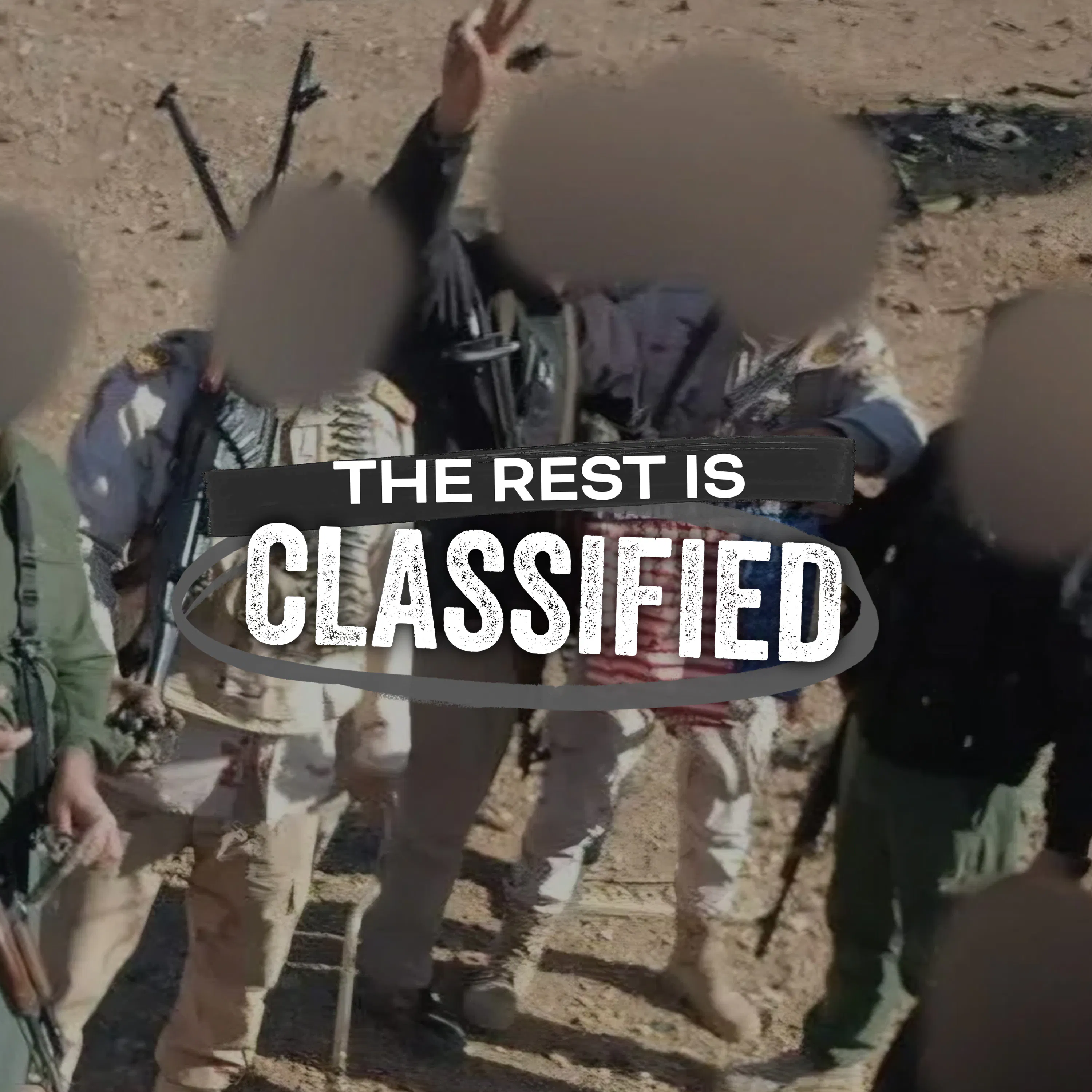
There seems to have been a number of Iranian casualties during the operation, but I think the exact number, extent and how they occurred, very much ambiguous at this point. This, I think is one of the best parts of the story, Gordon, because as those little bird helicopters with the seals are approaching, the reports suggest that the Wizzo used his American Eagle US flag patterned underpants, spocks or shorts to signal his position to the rescue party. I should say if you're, you know, if you are watching this on video or not watching this on video, rather, you're missing out because this is exactly the pair of underpants that Gordon Carrera is wearing at this very moment.
- [28:18]
B
My Union, which is a great, My Union Jack underpants, not American Eagle.
- [28:24]
A
No, no to shorts. You're showing, you're showing off the, you know, the sort of transatlantic, you know, the special relationship the partnership Union Jack wants for me.
- [28:33]
B
I mean, this detail almost feels like it was, you know, the cliche of being written for Hollywood or written for a movie. Feels like, feels like it, it has been because it is almost too wild. You know, if a, if a script writer put it in, you'd be like, that's a bit too much. But the reason why it does seem plausible is it's, it's supposedly these, these boxer shorts are later recovered by the Iranian militiamen and is that right? And you kind of, there are pictures of them. So there is actually some photographic evidence that this may be true.
- [29:04]
A
Oh yeah, have you seen the, have you seen the picture on social media?
- [29:07]
B
We'll have to get that up somewhere.
- [29:08]
A
Yeah, they're holding, holding up, they're holding up these, these underpants. And then, I mean, Trump has actually commented on it saying, you know, congratulations, all you got out of this was a pair of underpants. Becky is asking if are these underpants standard issue? And no, I do not think they are part of the standard. You do not have to wear, I don't think you have to wear these if you're a US fighter pilot operating over Iran. But I think, you know, it's a nod, you know, it's a patriotic nod to be wearing some American flag pattern underpants. So anyway, you can find the, the trophy photo on social media of this guy's underpants.
- [29:46]
B
So they've got him and they've got him.
- [29:48]
A
So they go back to the airstrip, okay, and the plan is to load the airmen and the operators onto the two C130 variants that they have there, and they'll load the helicopters back up. They'll go to Kuwait, probably, But the nose gear of at least one of those C130s, and maybe both get stuck in the kind of sandy dirt of the airstrip. Scare quotes. Because this is not a Runway. Proper Runway.
- [30:20]
B
Yeah. I mean, Trump himself, I think, says this was a farm, not a Runway. And it's a kind of sandy, muddy soil surface area. I mean, it reminds me, just shows how small things go wrong. It was like the kind of backdrop, wasn't it, on. On the bin Laden raid, which they hadn't quite predicted. When they go into the compound, leads to one of the helicopters crashing here. I mean, this is the bit I found extraordinary from stories they spend hours trying to work out if they can get them out. I mean, hours that they're here stuck basically in the sand with the airmen they've rescued. But they're with this massive team and with Iranian forces around them who are getting hit, I think, by US Forces kind of striking any Iranian forces which come near. But they're going to need a new plan to get the whole team out. So basically, the rescue force now needs to get rescued.
- [31:12]
A
Needs to get rescued. So three replacement aircraft are called in. Now, these seem to be smaller turboprop aircraft which are lighter, capable of landing on smaller, more fragile, I guess, airstrips. These planes come in. They also have with them a quick reaction force of operators from Delta Force, because, again, you'd have to assume that at some point there could be a firefight with an Iranian force that is attempting to stop this team from taking off. They arrive at intervals because they can't land simultaneously. So it's kind of one goes in and loads, leaves, the next one comes in and the operators and the injured airmen are taken out. Right. And around sunrise. So they've been there for most of the night, they take off in waves from this remote airstrip. Now, then you have the problem, you know, as you're getting ready to go, of, well, we've got these two disabled C130s. And my understanding is that they. There's not enough room in the new planes that they were bringing in, which I think are an Airbus variant kind of a transport plane to take out all of those little bird helicopters. They used to actually go and retrieve the airmen. They might have only had room for two of those. So they. They have to destroy everything. So what. What probably happens is the Delta Force guys who have come in along with the seals, destroy all of the avionics on the ground, all the sensitive stuff. And then after they've left and we've seen the pictures of the wreckage since. Yeah. There are bombs dropped on the planes and on the. On the remaining helicopters to totally destroy them so the Iranians can't use them. Now, by the time he's rescued, the airman has been in Iran again for nearly two days, hiding.
- [32:58]
B
Yeah.
- [32:59]
A
Now, seems that he's been taken to Landstuhl in Germany for treatment. Big medical hospital that the U.S. military uses in Germany. And again, you know, some sources, I think a lot of ambiguity on how many Iranian casualties there might have been during the rescue. No U.S. casualties. And President Trump, as he was describing this, said we had great talent and we got a little luck, too, I would say. So a little luck never, never hurts in a rescue operation.
- [33:28]
B
No, that's right. And I think you get a sense there just how unpredictable these operations are, how difficult they are, how things happen, which no one expected, you know, with the planes getting stuck in the sand. And I guess that gives a flavor, really, of what an operation on the ground, a Special Forces operation, might look like. With that in mind, you can imagine that one going after nuclear material, as we're going to look at later on in our discussion, is going to be even more challenging and potentially more dangerous than that operation. So to set that up, I think we need to have a look at exactly what constitutes Iran's nuclear program. But before we get to that, let's take a quick break.
- [34:16]
C
Hi there. Alistair Campbell here from the Rest is Politics. And I'm here to tell you about a really important interview that's out now on our podcast channel, the Rest is Politics. Leading this week, I spoke to one of the defining political figures of our time, President Volodymyr Zelensky of Ukraine. It is a fascinating interview. Reflects on his upbringing, reflects on his political rise, reflects on how he stayed in Kyiv during Russia's invasion, redefining leadership in wartime. And he warns us very much against anyone, not least on Donald Trump falling for Vladimir Putin's lies. Warns that ceasefires may serve as a strategic pause rather than a sign of genuine peace. He offers a very blunt assessment of Putin, looks at his enemy's strengths, strategy, and, crucially, his weaknesses in a war he is convinced Russia cannot win. And he doesn't hold back on the international response at times, particularly from the US if you'd like to hear more, and I hope you do, search the Rest His Politics Leading wherever he you get your podcasts. And now back to your show. Hi there. Alistair Campbell here from the Rest Is Politics. And I'm here to tell you about a really important interview that's out now on our podcast channel, the Rest Is Politics Leading. This week I spoke to one of the defining political figures of our time. President Vladimir Zelensky of Ukraine is a fascinating interview. Reflects on his upbringing, reflects on his political rise, reflects on how he stayed in Kyiv during Russia's invasion, redefining leadership in wartime. And he warns us very much against anyone, not least Donald Trump, falling for Vladimir Putin's lies, warns that ceasefires may serve as a strategic pause rather than a sign of genuine peace. He offers a very blunt assessment of Putin, looks at his enemy's strengths, strategy and crucially, his weaknesses in a war he is convinced Russia cannot win. And he doesn't hold back on the international response at times, particularly from the US if you'd like to hear more, and I hope you do, search the Rest Is Politics Leading wherever you get your podcasts. And now back to your show.
- [36:26]
A
Well, welcome back. We are talking about what it would take to destroy Iran's nuclear program. And Gordon, we love, we love talking about a nuclear program on the Rest is classified, don't we? In the Iranian one actually predates the Islamic Republic.
- [36:41]
B
Yeah, we've done a lot in it. But it's worth a brief refresher, isn't it, that it goes back to the time the shah. So pre the 79 revolution, he was looking at nuclear power reactors, but perhaps also thinking about a weapon after the revolution. Ayatollah Khomeini initially sees nuclear weapons is the work of the devil, un Islamic. But then you get the Iran Iraq war. Iraq uses chemical weapons. We'll look at this more later. Iraq is also looking at a bomb. And so from around 1984, Iranian interest in nuclear weapons picks up. Now, crucially, and this is important, is two routes to a bomb. You need the nuclear material to make a bomb. That's the first crucial bit. Both of which can come out of civil energy, nuclear energy programs. You can either get plutonium from a nuclear power plant or reactor or you can enrich uranium. And that enriched uranium at lower levels can be fuel for nuclear power. Higher levels, you can use it for a bomb. So the Iranians are fundamentally going down the enrichment path. They're going to build an enrichment facility at Natanz around the end of the 90s gets public 2002. So at that moment, the world goes. Hang on a sec. The Iranians look like they are developing something which has been secret. Maybe they want a bomb. Worth saying, though, as well, that the Iranians are not racing for a bomb and they never have been. They want the potential for a bomb. They're looking to have the ability to build one quickly if there's a political decision made to go for it. So they're trying to shorten what's called the breakout time, the gap between deciding to go for one and actually having one. So I guess from 2002, which is where we're now looking at, there is this question which is, what can you do about that? Particularly if the US and Israel want to stop them. What could you do about it? Are there options to prevent Iran developing this nuclear program?
- [38:35]
A
And there is precedent for preventing a state from. From having a nuclear program with. With a bomb, isn't there, Gordon? I mean, in particular, there's precedent for the Israelis to do this. And there's, I think, two historical examples, one in Iraq and the other from Syria, in which the Israelis have bombed a nuclear program and either slowed it down or taken it entirely out of existence.
- [39:03]
B
Iraq is the first one, maybe we'll look at briefly, just a flag. We're actually going to be doing a big series on Iraq and weapons of mass destruction, what Western intelligence knew and what they got wrong, featuring also, I should say, some very interesting bonus interviews for club members. That's going to be coming actually, just in a few weeks. So we'll do the real detail for
- [39:19]
A
that at the end of that series. We're going to find that WMD finally, right, Gordon?
- [39:23]
B
Yes.
- [39:24]
A
I don't want to get too much
- [39:25]
B
away, it really is, but we're. We're going to unveil history at last. Yeah, looking forward to that. But back to Iraq. It also has been looking at nuclear power from the 70s under Saddam. The Saddam Hussein, leader of Iraq, gets a reactor from the French called Osirac, a mixture of Osiris, the reactor model, and Iraq, which Israel is worried about. This is in the mid-70s, Israel is very worried about and goes through these interesting stages. So there are two stages. One is it tries covert action first to slow down the program. So Mossad, Israel's intelligence agency, recruits scientists in France, gathers intelligence on the layout. They actually blow up some of the components in a French warehouse. It's thought, suspected, never proved. You know, an Egyptian nuclear scientist working on the Iraqi program gets assassinated. It's all going to sound familiar if you've been following the Iranian story, but by the time you get to 1981, the Israelis are worried the reactor is about to be fueled. And so at that point they decide they are going to go for an airstrike on the reactor to take it out.
- [40:36]
A
And so on June 7, 1981, eight Israeli F16s which each carry is 2,000 pound bombs, take off and they're escorted by six F15s, part of the support package. The reactor is over a thousand kilometers from Israel. So at the time, this is the absolute outer edge of the F16 range. That strike package flies southern route across Saudi Arabian airspace at an extremely low altitude to avoid radar detection. Pilots navigating by visual landmarks across the desert. Now they have no external fuel tanks since all that capacity is needed for the munition. So the bargen on fuel here is razor thin. But they approaching the target in formation, climb to attack altitude, dive on the reactor dome in pairs, destroy the dome and the reactor core. It takes 90 seconds and it is the first successful destruction of a nuclear reactor in history. And I think this raises a big question which is did it accomplish what the Israelis wanted it to accomplish?
- [41:39]
B
On one level, yes. On another one, no. On the yes front it did destroys the reactor, which was the main route the Iraqis could have taken to getting nuclear material quickly. But it really does cripple that reactor. So it's out, but that is a single building. But what we'll see when we do our Iraq WMD series when we find the wmd, is it actually increases Saddam's desire for a bomb and it pushes Saddam Hussein actually to look for different routes, more clandestine routes, including enrichment, to try and get a bomb with quite serious consequences which will flow out in the years to come and eventually play a part in a war the US and the UK get involved in in 2003. So I think it's an interesting case where short term military success but medium term more complicated results. What about the Syria case? I mean this is a subject you, Noel, you were a CIA analyst working on Syria. I mean there is a particular raid the Israelis do on a Syrian program as well, isn't there in the 2000s?
- [42:44]
A
Yeah. The Israelis have, I mean a very similar situation to osirak in the mid 2000s right next door in Syria. And I think we're setting up just a bit of the Syrian desire for a bomb. I mean very similar to Iraq. The Syrians had harbored nuclear ambitions for years, former. Now former President Bashar al Assad's father, Hafez, had tried to buy research reactors. Deals had fallen through. There'd also been some hints in the intelligence picture in the early 2000s that there are these strange visits from North Koreans, trucks heading out to the eastern desert, shipments coming in from Asia with no apparent purpose. But there's kind of. There is a suspicion in particular on the party of the Israelis that the Syrians have nuclear ambitions and might be doing something. But there's no real hard intel on what is going on now. In the summer of 2006, Israeli intelligence identifies this kind of isolated building under construction in the Syrian desert at a place called Al Qibar. It is labeled by the geospatial analysts an enigmatic facility, which. Which I find to be a wonderful term for a facility. A subsequent review of the imagery shows that it's been under construction since 2002. And it's. It's fascinating because the site is really kind of hidden out in the open. It kind of looks like an old Ottoman fort that you would find in the region. There's no significant air defenses around it, and it's hidden kind of down in this wadi, so it's not visible to the civilians who might be passing by on the road. So what is it? The Israelis think it's interesting, but they don't exactly know what it is. Breakthrough comes in March of 2007, when the director of Syria's Atomic Energy Commission is traveling to Vienna. He's attending an IAEA Board of Governors meeting there. And Mossad officers break into an apartment that this guy maintained in Vienna and extract information from his laptop, or in some accounts, install software that allows Mossad to access the device remotely. The Israeli analysts hit the jackpot because they end up with three dozen color photographs taken from inside this Al Qbar facility.
- [44:56]
B
That's pretty good evidence, isn't it?
- [44:58]
A
Pretty good evidence showing it in various stages of construction. They get the architectural plans. They've got correspondence back and forth, and there's a. I mean, it's just. It's. It's insane. There's a photo showing the head of Syria's Atomic Energy Commission in a meeting with a senior North Korean nuclear official. And I'm not sure if they're shaking hands, but that's essentially the point. And the interior photographs of the facility make it unmistakably clear that it's a plutonium reactor, because it looks exactly like the North Korean reactor at Yongbyon. And it's a model that only the North Koreans build. So it's like it's a North Korean plutonium reactor out in the eastern desert.
- [45:36]
B
Just transplanted into Syria.
- [45:38]
A
Exactly.
- [45:39]
B
Just planted into Syria. It's wild, isn't it? So I guess then the question becomes what do they do about it? And there's some discussions, aren't there, between the US and Israel about what to do. And I think the Americans are a lot more cautious, but given the cooperation we've seen between Israel and the US over Iran, in this case, it is much more of a Israeli decision in the end that once again, a bit like the Iraqis nuclear reactor, they're going to strike it before it gets hot, before it basically can be fueled.
- [46:11]
A
There is a really interesting back and forth between kind of the intelligence and the policymakers here and the dynamics inside the US Israel relationship that will probably do this as its own story at some point down the line.
- [46:24]
B
Yeah. And we can get deeper into it.
- [46:25]
A
But essentially what happens is the CIA can't find any Israelis can't find the other essentials of a weapons program in Syria. Where's the work on a, on a warhead? Where's the reprocessing plant to extract the plutonium from the reactor? Spent fuel rods? That's a big piece of the weaponization. Sure. Where is it? And there's no signs of these things. Right. And essentially what happens is the Israelis come to the US and say, will you please blow this thing up? At the time, President Bush is dealing with a war ostensibly fought over a weapons of mass destruction program in Iraq that didn't exist. Right. And so Bush says essentially to the Israeli that then, you know, Israeli Prime Minister Ehud Olmert, we're not going to do it, but we're also not going to get in the way if you want to do it. And one of the very interesting pieces of the Israeli response here is, and this is where it's very different from Iraq, because with the Ocerac reactor, the Israelis essentially bragged immediately that they had destroyed Saddam's program. And in this case, the Israeli analysts and I would say much to their credit, believed that if they gave President Assad what they called a zone of denial and essentially said nothing, that there would be no response because they figured
- [47:45]
B
he doesn't want to admit to it,
- [47:46]
A
he doesn't want to admit to it. It's way out in the eastern desert, no one will know it. You know, it's very remote. And the nuclear program isn't really integrated into Syria's military industrial establishment. This is a North Korean transplant. And they were exactly right. Because when on the night of September 5 and 6, 2007, they sent warplanes out to the eastern desert of Al Qibar, we should say we're skipping a lot of parts of this story where the Israelis get more and more confidence that this is actually, you know, this reactor is about to go operational, and they go out and drop 17 tons of munitions on the reactor and destroy it. And reports of a strike leak very quickly. I actually remember Gordon. I had been a summer intern at the CIA in the summer of 2007. There were people on my team that were doing things that I wasn't read into and that most of the other members of the team weren't read into. And it was very unclear the whole summer where these. Where these analysts were headed, what they had, who they were talking to. It was all very squirrely. And I remember going back to school and actually waking up on the morning of September, 6, 2007, in my college dorm and seeing a report in the New York Times about this strike out in the eastern desert, Syria.
- [49:03]
B
Now I know.
- [49:04]
A
Now I know what those guys.
- [49:05]
B
Guys are up to.
- [49:06]
A
Now I know what they were up to. But again, it's the total opposite of Iraq, because the Israelis don't acknowledge the strike until 2018.
- [49:15]
B
Yeah, yeah. And in a way, it is a, you know, this is a successful strike on a program. Kind of the Syrian capacity, whatever it, you know, would have been, is destroyed. It doesn't come back. There's no sign of him restarting it. There are other cases as well in which countries try and develop nuclear programs and they are disarmed through negotiations. So you think of. There's Libya, which is a very interesting story to do with a Q car, but I think we'll look at that again separately at a later point where, you know, intelligence, the pressure of the Iraq war, leads Gaddafi to decide to give up his weapons when North Korea develops the weapons and is never struck. I think one of the interesting questions, though, that comes out of this is if you're trying to stop countries developing nuclear weapons, you know, one of the lessons people take from all of these incidents is the dangerous bit is when you're on the way to a bomb, once you get the bomb, like the North Koreans, you're kind of in a more secure position, aren't you? Because you've got this kind of guarantee that we can nuke you if you attack us. But the dangerous point is, is en route because that is where you can get hit again.
- [50:20]
A
It makes the Iranian approach of doing this very, very slowly. Now, in retrospect, look, look like a strategic error, doesn't it? Because there was never a race. And now look what's happened, right? I mean, end of the case of the North Koreans where they raced to get one, nothing has happened. But if you're Gaddafi and you disarm, look what happened, you still end up dead. If you're Gaddafi, right, you still end up dead. I mean, Gaddafi, Saddam and the House of Assad are all gone. And the Kim family is still running its prison colony in North Korea. So, I mean, I guess that takes us back to Iran. So, you know, if we, and again, if we go back to this point in kind of the mid-2000s when that enrichment facility at Natanz is first discovered, you know, by Israeli and Western intelligence, I mean, it raises this question of at the time, why wasn't the military option used?
- [51:15]
B
Yeah, why didn't they bomb it? And I think the truth would be that it's partly circumstance, I mean, particularly on the US side because it's revealed. You know, I remember this quite vividly in Washington, the program by the Iranian opposition group summer of 2002. But that is exactly the moment the US is preparing for war with Iraq over WMD. And it's also always one of the great ironies that the US went to war with Iraq over wmd, which didn't turn out to exist. Where Next door in Iran. It had just been shown they were developing a clandestine enrichment facility facility. But you know, the US was focused on Iraq, of course, then doesn't find the WMD in Iraq, gets bogged down in Iraq and that reduces the US will at that point, I think, to do anything. Plus on the Israeli side, we know Benjamin Netanyahu is obsessed with Iran. He always has been at this point. He is not always Prime Minister Erish. Iran is, you know, in those early 2000s, they're very focused on the west bank and the Palestinian issue. So you, you know, there are political reasons why, why at that point you don't get a kind of bombing raid that you might do later, I think, and I think it's worth saying as well, the nature of the Iranian program. We're going to come back to this. It is different, isn't. Is not just one reactor like Al Kibr or Sirak, the Iraqi and Syrian reactors, there are multiple sites, including particularly Natanz, which just does make it more difficult, doesn't it?
- [52:38]
A
So the dispersion makes it more difficult. The Iranians have also learned, I think from the Iraqi example. Right. And they have started to bury these facilities underground. Right. And I mean, Natanz has these hardened underground centrifuge halls, as we'll see go forward in time, and there are more facilities. The Iranians understand that the way to harden them is to put them as deep as you possibly can underground, which makes it very difficult for the Israelis who don't have some of these kind of bunker busting munitions to do the raid on, you know, or do these kind of attacks on their own. You have an Iranian program that's also, I mean, it's institutionalized. Right. It's indigenous. So it's, it's different in some ways.
- [53:25]
B
Yeah.
- [53:25]
A
From the Iraqi program and the Syrian program. It's dispersed. And all of that means that you have harder targets to hit, you have more targets to hit. And a lot of the capability is the IP that exists in the heads of Iranians.
- [53:42]
B
Yeah. And I think one of the important points there is, as you said, the Israelis probably couldn't do it themselves because of the nature of the target. So they need the US to come on board. And as we'll see, it takes many years before they get the US on board. So what you get instead is the COVID program, and we've talked about this in previous episodes, we won't go through it again. But you get stuxnet, the cyber sabotage of Iran's nuclear program to undermine its ability to do enrichment. And you get the assassination of nuclear scientists, all trying to buy time to slow down the moment when Iran could possibly get a bomb. Iran, of course, maintains it doesn't want a bomb and of course it's being careful, as we said, not to race for a bomb bomb. But what it is doing is kind of enriching more and more uranium. So at that point you then get the shift to a diplomatic move, which is the Joint Comprehensive Plan of action, the JCPOA so called Iran nuclear deal in 2015.
- [54:37]
A
I always like my plans of action to be joint and comprehensive, comprehensive. I'm a stickler for that.
- [54:45]
B
A singular partial plan of action. That would not be such a good plan. No, no, but we should say that comes in 2015, result of lots of negotiations. The key thing there is it apparently puts a lid on Iran's enrichment. So it doesn't get rid of the material, it's enriched. And this is important, but it puts a lid on its ability to do more in return for sanctions relief. And that we should say does appear to at least, as I said, put a lid on the program. But it's not destroyed it.
- [55:18]
A
There were additional constraints, too. Right. I mean, so there were. They had to reduce their centrifuge inventory, you know, more stringent inspections, reducing its stockpile of enriched uranium. That said, the. The jcpoa, despite the fact that it was both joint and comprehensive, was always contentious, I think it's fair to say, at least in American politics.
- [55:40]
B
But some people, yeah, it was. It was politically contentious in Washington. I think a lot of other countries, he says, thinking about Europe would say this is the best you can get. Whereas I think Donald Trump described it as the worst deal ever negotiated. So bringing us up to. You could see strong man, strong views. We get up to closer to today because he exits. So there had been this deal, as I said, if you want to see it positively, which put a lid, at least on the Iranian program, but didn't destroy it, didn't eliminate it, and didn't
- [56:11]
A
deal with other aspects of. I think this is one of the major issues was it didn't deal with other aspects of Iran's behavior, its support for terrorist groups in the region.
- [56:19]
B
No, I think that's important. Yeah.
- [56:21]
A
And there was sanctions relief, too. That was contentious. Right. Because it put money back in the pockets of the regime.
- [56:27]
B
But. Yeah, but Trump exits in his first term, the jcpoa, and nothing basically comes to replace it, either during his term or. Or during the Biden term. That comes after. And this is really to bring us up to today, because after the withdrawal, Iran then does what I guess there's no longer a deal constraining it. So it starts to enrich the uranium to higher levels and start stockpiling more of it and remind it, you know, enriching uranium is hard, but it gets easier. The more enriched it gets, the quickest quicker it is to get it to the higher levels. And eventually you'd need to get up to the 90s to get a bomb. It's never reached that level, but it's enriched more and more. It's building up this. By 2021, I think it's reached 60% highly enriched uranium. And at this point, you've got this stockpile growing of highly enriched uranium. And the question what do you do about it?
- [57:23]
A
Oh, that's a good cliffhanger, Gordon. I think we should end there and next time, come back. We will look at the first military strike on Iran's nuclear program, Operation Midnight Hammer, what it accomplished and what can realistically be done, if anything, to eliminate Iran's nuclear program once and for all as part of Operation Epic Fury. But of course, if you don't want to wait to see, to listen to us describe in immense detail how the program could be destroyed, you don't have to wait. Go and join the Declassified club@therestisclassified.com. get Early Access to series a bunch of other goodies. And I think we should also say, Gordon, we have a live show coming up, don't we?
- [58:10]
B
4th to 5th of September at the South bank center in London. So do get your tickets for that. We're really looking forward to it. It's going to be a great show. Do sign up for the newsletter as well, in which we're looking. A bit more detail at the pilot rescue mission as well. But otherwise, we will see you next time.
- [58:28]
A
We'll see you next time.