Loading summary
Transcript191 lines
- [00:04]
David McCloskey
For exclusive interviews, bonus episodes, ad free listening, early access to series first look at live show tickets, a weekly newsletter and discounted books. Join the declassified club@therealisclassified.com this podcast is.
- [00:19]
Carvana Advertiser
Brought to you by Carvana. Carvana makes car selling fast and easy from start to finish. Enter your license plate or VIN and get a real offer in seconds, down to the penny. If you accept, Carvana will come pick up your car from your drive, or you can drop it off at one of our car vending machines. Either way, you get paid instantly. It's fast, transparent, and 100% online car selling that saves your time. That's Carvana.
- [00:44]
Gordon Corera
Carvana.
- [00:46]
Carvana Advertiser
Pickup fees may apply.
- [00:48]
David McCloskey
You have Geni Prigozhin, restaurateur to Vladimir Putin, co founder the infamous Wagner group.
- [00:54]
Gordon Corera
Who a couple of years ago led a mutiny which was the closest Vladimir Putin has ever come to being toppled from power. He's one of Russia's rich, richest and most powerful oligarchs. He knows what people want.
- [01:08]
David McCloskey
Prigozhin brings this entrepreneurial streak to violence.
- [01:12]
Gordon Corera
The man the Kremlin calls on to do its dirty work. He is moving into a space that really only Putin should be in. The government depends on Wagner for its survival. At the moment of the peak, he's gonna fly too close to the sun.
- [01:26]
Carvana Advertiser
The world watched as the Wagner group turned on Russia's military. Yevgeny Prigozhin was enraged by what he says were Russian strikes on his troops in Ukraine.
- [01:37]
Gordon Corera
This is the moment where you go civil war.
- [01:39]
David McCloskey
Putin is the ultimate apostle of payback. So I would be surprised if Prigozhiv escapes further retribution for this. If you cross Putin, the likelihood is you're gonna die. I've never been a chef. I used to be a restaurateur and quite successful. I can't cook myself. They should have just called me Putin's butcher and everything would have been fine. Well, welcome to the Rest is classified. I'm David McCloskey.
- [02:18]
Gordon Corera
And I'm Gordon Carrera.
- [02:19]
David McCloskey
And those are the words of Yevgeny Prigozhin, restaurateur, not a cook. Restaurateur to Vladimir Putin, co founder, I think we'd say, of the infamous Wagner group. Yeah, private mercenary army used by the Kremlin, soon to be friend of the Pod.
- [02:37]
Gordon Corera
Not sure about that.
- [02:38]
David McCloskey
After we complete our six part investigation, our series that we're starting this deep dive into this murky world that blends the security services, the Russian security services, private armies, the Russian state, organized crime, and at its center, a man who used to run a hot dog stand in St. Petersburg.
- [03:03]
Gordon Corera
When you read that opening quote, I was thinking some people might. Thought they got. The rest is food, and we're just going to spend.
- [03:08]
David McCloskey
There will be a culinary element to this.
- [03:09]
Gordon Corera
Yeah, there will be a culinary element, how to run a restaurant, you know, how to develop a good menu. We're going to be looking at some of those things, aren't we? Yes. As we also look at sledgehammers, you know, murder and mayhem and coups. So it's going to be a kind of slightly crazy mix. It is of a series, but what I think is significant about Evgeny Prigozhin, who, you know, a couple of years ago led a mutiny effectively in Russia, which was the closest Vladimir Putin has ever come to being toppled from power. You know, Putin has been there for more than a quarter of a century. This was the one moment when people thought on one day it might be over, he might be overthrown. And it was due to this one guy who has started off selling hot dogs in St. Petersburg 25, 30 years ago and knew Putin all the way from back then. So it kind of tells you quite a lot about Putin and power in Russia.
- [04:04]
David McCloskey
I think it shows the extent to which I think Russian power feels very medieval. It feels like a medieval court in a lot of ways. I mean, here's this kind of spurned courtier, staffer to Putin who wants to, or perhaps believes he's a bigger man in the system than he really is, and who is going to come face to face with sort of the realities of. Of how Putin manages. Yeah, the people around him in this kind of hub and spoke model of. Of sort of Russian autocracy, as we'll see. And, you know, I think it also feels a lot like a. A criminal enterprise, a gangland, a gangland, you know, sort of sort of a mafia between the big boss, right, the Don Putin, and one of his kind of henchmen. We have a tendency, I think, in the States or in the west, in the uk to view other states through the lens of their bureaucracies. And we think, okay, you've got your security services and you've got your military, and there's sort of an official, you know, system. And as we'll see, Prigozhin, he's very entrepreneurial. Yeah, isn't he? I mean, he's a restaurateur, he's an entrepreneur of food. The seams of these power structures are where Prigozhin is, is going to really excel. And he's A violent man and very entrepreneurial about his violence in the creation of the Wagner group. And this is also a globe trotting story.
- [05:34]
Gordon Corera
Definitely. We're going to go right around the world. We're going to go from kind of Leningrad, St. Petersburg in the kind of Cold War days, across Africa, Middle East, Syria place, you know. Well, and then of course back to Moscow and with a bit of time in Ukraine. So it's going to kind of encompass a story which really actually has an impact on a huge number of countries. You know, it's not just a story about Russia, it's a story about Africa, it's a story about the Middle east, it's a story about Ukraine, it's a story about Europe as well.
- [06:02]
David McCloskey
I think that's right. And we will journey to some of actually the worst places in the world.
- [06:05]
Gordon Corera
Yeah.
- [06:06]
David McCloskey
And the darkest places, the wilds of Mali and St. Petersburg during sort of the Soviet collapse. And I guess maybe it makes sense, Gordon, to start with some places that will maybe even worse.
- [06:16]
Gordon Corera
Yeah.
- [06:17]
David McCloskey
Which is Yevgeny Prigozhins or early life.
- [06:20]
Gordon Corera
Yeah. So Evgeny Prigozhin, born in Leningrad in the Soviet Union, which is of course now called St. Petersburg, 1961, interestingly enough, a kind of middle class Soviet intelligentsia family, not a kind of poor working class family. His mother, Violeta, works at a hospital. His father, Viktor, who dies early, is the nephew of a famous engineer. He's growing up in a slightly dull, stifling world then of the Soviet Union in the late 60s and the 70s under Brezhnev, he's known as the Xenia Young. Prigozhin goes to a good school. He goes to a boarding school which specializes in sports, which he's into it trains, Olympians, he's into cross country skiing. It's the classic story, which is if he hadn't had an injury, he would have been an Olympic skier. Now, I don't know if that's true, but you know, he's not handsome, but he's got a swagger. Now here's the thing though, pretty good start in life, but he leaves School at 16 in 1977, age 16 and. And he gets mixed up with the wrong crowd.
- [07:16]
David McCloskey
He drops out of school, he leaves school.
- [07:18]
Gordon Corera
Yeah. And maybe it's because the sports thing isn't happening for him. He's clearly clever, he's clearly ambitious, but he's not really suited or into those kind of middle class professional jobs there might have been. And for all the talk of equality in the Soviet Union, it's Quite a stratified society in that point. He doesn't want to kind of move down the social class. He's a bit of a misfit, doesn't fit in. He can see people around him leading a fancier life. He's ambitious, he's hot headed, he's a bit cruel. Does a brief stint as a pe, a physical education trainer. So you could have got your workout from Evgeny. But he quickly gets into crime as a teenager and this is the key moment and it starts with petty crime he's hanging around with low level criminals are on the make. Gets arrested for petty theft aged 18 in 1979, two and a half year suspended sentence. He's sent to work in Novgorod, 100 miles from St. Petersburg in a chemicals factory. But he doesn't learn his lesson. Should have learned his lesson, you know.
- [08:20]
David McCloskey
Life of crime at the chemicals factory.
- [08:22]
Gordon Corera
At the chemicals factory. But instead goes back to St. Petersburg after that. And this is where he gets deeper into the world of crime.
- [08:28]
David McCloskey
Do we know why he got into crime? Obviously crime doesn't pay, it doesn't pay.
- [08:33]
Gordon Corera
Kids. Don't do it.
- [08:34]
David McCloskey
Yeah, don't do it.
- [08:35]
Gordon Corera
It's again, I think it's ambition, greed, not having a place and a desire. I guess you could see it from the earliest days, a desire for things that he feels he should have, others have and he doesn't have. He's gonna wanna take those things, he's gonna be ambitious to take them. And I think you can see that when he starts hanging out in this, you know, as an 18 year old he hangs out with Alexei Lesher Bushman, who's a few years older and runs a small gang of a handful of thieves. I think of kind of a Dickensian world, you know, street urchins, street ur. But in St. Petersburg. And Prigozhin is going to help pick the targets for their activities. Sometimes people he knows. February 1980, break into apartments, steal a vase, a candy bowl, a napkin holder and some glasses with a value of 177Rubles. It's not kind of big crime. Next month they steal a leather steering wheel cover, I mean and a set of ballpoint pens, a tape recorder, a denim jacket and a women's handbag. I mean it's kind of at this.
- [09:37]
David McCloskey
Point this is all very juvenile. This is pretty juvenile, yeah.
- [09:40]
Gordon Corera
But they swindle a man out of 250 rubles over some jeans. They go out drinking champagne to celebrate and brandy at a restaurant. And at that restaurant, about midnight, they see a young woman with a fancy coat leaving the restaurant. And this coat speaks of money. So Prigozhin says, let's rob her. They follow her by taxi, then on foot. And in a dark street, one of them asks her for a cigarette. Then Prigozhin grabs her by the neck and he starts to choke her. Another man pulls a knife. She screams, prigozhin, to try and stop her, squeeze harder on her neck until she passes out. They drag her down an alley. One person takes her boots. Prigozhin pulls off her earrings. But her screams have already kind of summoned the police who are nearby. So these gang of thieves run. One of them doesn't make it, Prigozhin does. But the police will eventually track them all down and come knocking. So now he's in big trouble. They're gonna find the other stolen goods. There's robbery with violence, and he's broken his probation. But I think you could see that story. This is a guy who's cruel and violent. You know, you get a sense of.
- [10:44]
David McCloskey
He selected the target. He uses physical violence on her already at a young age.
- [10:50]
Gordon Corera
At a young age, as a kind of 18 year old. So he's going to get sentenced to 13 years in a penal colony. Fortunately, I've never been to a Soviet gulag as the ladies still time, but they are, I hear, famously brutal places, you know, maybe not quite as dark as in Stalin's day.
- [11:07]
David McCloskey
It's where Goal Hanger rehabilitates its hosts.
- [11:10]
Gordon Corera
So, yes, there we go.
- [11:10]
David McCloskey
There's still time.
- [11:11]
Gordon Corera
There's still time. But this is Vorovskoymir, the thieves world. Inside these gulags, these prison camps, of course there's violence. Prisoners in these huge barracks. And the barracks are run by the prisoners rather than by the guards and the officials and especially hardened criminal gangs. And so Prigozhin's gonna learn from here. You have to make friends with the big guys to survive. It's the same lesson you learn in any prison, as you know from your time in Texas Penitentiary, David. That's right, you're either in. Sorry you weren't there, but if you're.
- [11:46]
David McCloskey
Watching now, all of my tattoos are covered up, so.
- [11:49]
Gordon Corera
So you were in or out of the gang, and at the bottom of the pile were the Roosters, as they were known, who were preyed on sexually by the other prisoners. Now, there's no sign at the time that percussion was at the bottom, but we'll come back to that possibility later, because at the end of his life, this will be raised as a issue.
- [12:08]
David McCloskey
If that's not enough reason to go and join the Declassified club. So you get early access to all of these episodes. I can't help you. Go to the restisclassified.com and sign up.
- [12:19]
Gordon Corera
Because that's gonna come back that bit of the story. But he learns to play by the system and he shows he's got what it takes to survive. He gets a tattoo on his back of a woman. And now this is made with a makeshift needle with the ink made from rubber soot and urine. Again, you know, not part of my experience.
- [12:38]
David McCloskey
The back infection must have been tremendous. What, what was the tattoo of?
- [12:42]
Gordon Corera
Of a woman.
- [12:43]
David McCloskey
Just a woman?
- [12:43]
Gordon Corera
Yeah. Hopefully not the one he robbed, but he. He asked for a transfer to a timber logging colony because, of course, these are all labor camps you work. And here it's interesting, he starts his own kind of business in which he gets other inmates to carve wood which then can be sold to people outside the camp. So I guess what you see there is the combination of entrepreneurial, ambitious nature coupled with violence, brutality, and an ability to survive. That is his personality there, you know, in those early, early days. It's set.
- [13:16]
David McCloskey
I think it reminds me of Pablo Escobar, the other friend of the pod, who had a kind of middle class upbringing, but very early on demonstrated absolutely no interest in following any of the normal paths that would lead from that. And who tilts into crime early, gets involved in these gangs, has his own sort of personal capacity for violence. He's not just at arm's length.
- [13:40]
Gordon Corera
It's very similar. It's very smart enough to run things rather than be.
- [13:44]
David McCloskey
The Soviet Union's changing while he's in prison.
- [13:46]
Gordon Corera
Yeah, exactly. So he's imprisoned in this period in the 80s, 85, Gorbachev comes to power. Younger generation of leaders wants to open up the Soviet Union. There's going to be political and economic reforms, new private enterprise, new freedoms, opportunities for the ambitious. Eventually, of course, as we know, that's going to spiral out of control. And Prigozhin gets released in 1990. So that's effectively the last year of the Soviet Union before it's going to collapse. And there's going to be a coup in 1991 to try and halt the changes. But effectively you've got the end of the Soviet empire, the end of Russia's control through the Soviet Union of places like Ukraine and the Baltic States and. And Russia, as it hits the 90s, enters this wild decade. Economic collapse, massive social change, a kind of Wild west mafia capitalism in which business deals are Done with threats of violence to accompany them. Everyone trying to get rich as fast as they can and get rich so they have enough power to stop them getting killed by a rival. It's kind of brutal, violent world.
- [14:50]
David McCloskey
Maybe it's less the case now, but when I was in school and I was learning about this era in Russia, there was a tendency to view it through the lens of this kind of attempted and ultimately failed experiment with liberal democracy. To some degree, that's true, but I think it's better or more accurate to see this as a bunch of people who were living essentially in a failed state, a government and a society, an empire in many ways, that had collapsed.
- [15:20]
Gordon Corera
Yeah.
- [15:21]
David McCloskey
And the violence. You know, it's interesting talking to former agency officers who served in Leningrad and then St. Petersburg in the 90s. You know, they would talk about regularly hearing gunshots, explosions. It's a sense of a place that had kind of come apart at the seams and that was very lawless.
- [15:41]
Gordon Corera
Yeah.
- [15:41]
David McCloskey
You know, and I think that kind of. For a criminal entrepreneur. Yeah. Like any Prigozhin, there's a lot of opportunity.
- [15:48]
Gordon Corera
Exactly. So everybody's trying to get rich. Everyone needs protection from someone more powerful to avoid being at the bottom of the pile. In some ways, I think all of this, as you said, is suited to Prigozhin, who understands violence and business. In some ways, the outside world is now becoming like the world of the Russian or the Soviet prisons, the prison. It's kind of mirroring some of that power structures in which having protection is actually translating into the business world of Russia. So he got this feel for it. So he's going to drop out of college. He's going to marry lyubov in 1991. Works at a car dealership. But his side hustle, and I love this, is running kiosks in Leningrad, selling hot dogs. Now, this is. I mean, this is where kind of, you know, some of his reputation as a hot dog salesman comes from. Sausages have been around for a while in Russia, Soviet Union, but the key was no bun.
- [16:40]
David McCloskey
No bun, no mustard.
- [16:42]
Gordon Corera
No mustard, no ketchup. So you do that and suddenly you take the old sausage, add those things, and you have something kind of cool and western and new, which in the 1990s, we didn't do very well.
- [16:53]
David McCloskey
It's the genes of the culinary world.
- [16:55]
Gordon Corera
It is the hot dog. That's our first food reference. He says he fixes the mustard in his kitchen. And his mother, Violetta helps count cash. She kind of plays out.
- [17:05]
David McCloskey
His wife isn't Helping?
- [17:06]
Gordon Corera
No, but his mother kind of is there actually, all through his career. It's interesting in the kind of background, she's kind of interesting figure. But he's making money pretty quickly, and he says he's having to pay $100 per kiosk per month, protection money to the gangs. So you get a sense already that he's getting to know the gangs and understanding how to navigate that world.
- [17:27]
David McCloskey
This is maybe perhaps my only piece of knowledge that I'll drop on Russian criminality, but I believe the Russian word which I will horribly mispronounce for protection.
- [17:38]
Gordon Corera
Yeah, A roof. Roof, yeah.
- [17:40]
David McCloskey
An overhang. Something over top of your head.
- [17:41]
Gordon Corera
Over your head, yeah, exactly, yeah.
- [17:43]
David McCloskey
So he's paying for.
- [17:46]
Gordon Corera
And here in St. Petersburg, it's interesting, we were talking to an exile Russian the other day, was saying, you know, Moscow, you have a central authority, you have the Kremlin, you have power. But St. Petersburg, you know, what had been Leningrad is a little bit wilder. You know, actually, the thugs, the spooks, the businessmen have slightly freer reign, and they're all kind of mixing together in this world as well, all using each other for kind of money, Protection, muscle. Everyone's on the take. So Prigozhin is starting to move with more senior gangsters. They can see he's got good skills. They can see his ambition. So he moves on from hot dogs. He manages some grocery stores and then casinos. Classic kind of gangster thing, which, of course, the casinos are closely tied to the banks and to the gangs. Then comes the kind of the beginnings of the move into the world of restaurateurring. 1995, he's running a place called the Wine Club, a bar. He's got an English manager called Tony, which I guess makes him look classy, although it does occasionally feature strippers as well. So it's not that classy.
- [18:46]
David McCloskey
Could be classy.
- [18:47]
Gordon Corera
It could be classy. And then comes the big break because he opens a restaurant called the Old Customs House. It's a fancy old 19th century building on the riverfront near the Winter Palace. Tony, the English manager, comes along. French chef.
- [19:00]
David McCloskey
Where does the capital come from for this? Is it the hot dog money, or.
- [19:03]
Gordon Corera
I think.
- [19:03]
David McCloskey
I think is he just kind of slowly working his way up?
- [19:05]
Gordon Corera
He's got some business parts who are basically gangsters.
- [19:09]
David McCloskey
Okay.
- [19:09]
Gordon Corera
And at that point, they're in it together and he'll eventually kind of ease them out. And it's interesting. Bogoshin can be charming, but also violent. He supposedly assaulted a chef after a complaint from a customer about the quality of the food. The chef was taken to the cellar and pummeled to the point of being hospitalized for two months. It's like not quite Gordon Ramsay shouting at you for a second. No, it's a lot worse.
- [19:31]
David McCloskey
It's not merely verbal abuse. Yes, indeed, worse.
- [19:35]
Gordon Corera
So he's got mix of charm and violence. Place will serve foreign food. That's the key, because, you know, the elite want the foreign food. French foie gras, oysters from Brittany. Starting to be the same, you know, place where the new elite are kind of moving. World of mobsters and bodyguards, city officials, spooks. To me, I don't know Chicago, you.
- [19:55]
David McCloskey
Know, it feels like Chicago in the 20s and 30s or Vegas in the 50s.
- [19:59]
Gordon Corera
I don't know. Something like that. It's got a feel of that, hasn't it?
- [20:02]
David McCloskey
It does. It's sort of borderline lawless, and yet real collaboration in some cases between the authorities and the criminals. I think that, to me, is one of the hardest things to understand.
- [20:15]
Gordon Corera
Yeah.
- [20:16]
David McCloskey
About. I mean, Russia in that period and Russia today is this very strange kind of marriage.
- [20:23]
Gordon Corera
Yeah.
- [20:24]
David McCloskey
Between the security services, then the kgb, fsb, and these guys like Prigozhin, who have lived for so much of their life sort of outside of the law, you know, but they're all.
- [20:36]
Gordon Corera
They're all on the make.
- [20:37]
David McCloskey
On the make, and they all kind.
- [20:38]
Gordon Corera
Of need each other. I guess that's the point. So, you know, this is his first restaurant. According to Candice Rondeau's book, Putin's Sledgehammer, among the guests at this place are Susie Cuatro and the Pet Shop Boys. I don't know if those are references which mean a lot to you.
- [20:51]
David McCloskey
I know the Pet Shop Boys because my dad is a big Pet Shop Boys fan, and I listened to that extensively as a child.
- [20:58]
Gordon Corera
As a result, if the Pet Shop Boys listen, then let us know if you ever visited one of Prigozhin's restaurant. But about that time, it's thought Putin is kind of moving in these circles. So in some ways, Putin and Prigozhin, I think, are kind of similar because they are two people who've grown up on the wrong side of the street. And Putin has come from quite a poor background in Leningrad, now St. Petersburg, and he grew up in a kind of crowded apartment blocks. And Yuli Yoffey, the journalist, you know, talks a bit about this, about the. The world of the courtyard, the vor, which is where, you know, the courtyard of these apartment blocks. As a boy, Putin would have to show he could survive against the bullies and the thugs. And he's a small guy, Putin.
- [21:42]
David McCloskey
Yeah.
- [21:42]
Gordon Corera
And so his. His way of surviving was to show he was capable of more violence than anyone else.
- [21:49]
David McCloskey
It's essentially. I mean, it's not quite this, but it's not dissimilar to the dynamics of the prison camp.
- [21:54]
Gordon Corera
Exactly. I think it's the same kind of dynamics, which is you've got to show strength, you never show weakness, you're loyal to your friends. Anyone who bullies you, you hit them back harder. That's the kind of teenage world Putin grew up in, in Leningrad, St. Petersburg. So you can already see he's projecting the tough guy thing. You know, it's why he learns martial arts. Cause he knows. Cause he's small. He's gotta survive. That's what he's come from as well. And that's also why Putin is going to be quite good at prospering in this new world of rough, tough, violent, kind of thuggish capitalism. Security services of Russia in the 90s. He's got the right skills, just like Prigozhin.
- [22:32]
David McCloskey
I think it's fascinating when you look at the demographics in the Soviet Union in the 50s, how many of the men were dead and how the Soviet state around the time that, you know, guys like Putin and Prigozhin are being brought up, has essentially tried to engineer a baby boom to resurrect the population without any dads around.
- [22:51]
Gordon Corera
Yeah.
- [22:52]
David McCloskey
So you do you have this. I mean, not to get all touchy feely on it, Gordon, but it's like, it's this. It's a period in time where they actually. There aren't a lot of dads around. And so you have, you know, whether it's these prison camps or whether it's these court, you know, the vor, these courtyards. I mean, it's a pretty unsupervised time for young Russian men. And I guess maybe there, Gordon, having set up the young entrepreneurial criminal, sort of brutal.
- [23:18]
Gordon Corera
Yeah.
- [23:19]
David McCloskey
Evgeny Prigozhin. Let's take a break and when we come back, we'll see how he gets enmeshed into the world of Vladimir Putin.
- [23:26]
Gordon Corera
See you after the break.
- [23:31]
David McCloskey
This episode is brought to you by atio, the CRM for the AI era.
- [23:37]
Gordon Corera
Now, David, people think that spycraft is just car chases and secret codes, but an awful lot of it is just idling around, waiting for the action.
- [23:47]
David McCloskey
It's a bit like starting your own business. You think it's going to be as easy as creating and selling a product. But the reality is business owners spend far too long trying to get their CRM to fit a system not built for them.
- [23:59]
Gordon Corera
Attio's AI driven CRM enables you to take control of your platform to build something from the ground up that fits your needs.
- [24:08]
David McCloskey
James Bond had cues, X ray shades, an explosive watch and a pen grenade. Business owners have Adeo's real time customer insights and platform that grows with them. All tools relevant for your mission to build a company from the ground up.
- [24:23]
Gordon Corera
Attio even has something called agent collaboration.
- [24:27]
David McCloskey
Yes, but in this case that means giving people the ability to let AI work seamlessly in the background for them.
- [24:34]
Gordon Corera
Try Attio for free@attio.com trick hey, new.
- [24:41]
TikTok Advertiser
To TikTok, here's a gift just for you. Join TikTok today and claim your $20, no minimum spend voucher completely free. Simply download the TikTok app, search for Get Tik, that's G E T T I K and your voucher will be ready to use right away. Spend it freely on TikTok shop fashion, gadgets, beauty and more. Don't wait. Download TikTok today and grab your $20 a voucher now.
- [25:16]
David McCloskey
Well, welcome back. Evgeny Prigozhin is rising through the ranks of illicit but also increasingly official St. Petersburg society, and he is going to become Putin's chef.
- [25:30]
Gordon Corera
Yeah, that's what he gets known as. But it's interesting trying to work out exactly when they met. It's a little bit murky. Both of them, I think, hit it a bit. But Putin is going to turn up perhaps at Prigozhin's first big restaurant, the old Customs House. They might have also had some contact because Putin at one point sits on the gambling board. So Putin, we should say, has been a KGB officer, but then around the time of the end of the Soviet Union, he moves into city government as an advisor to the mayor of St. Petersburg. And so it's at that point that him and Prigozhin are going to meet in this kind of murky milieu of kind of spies, crooks, officials, maybe, as I said, because of the casinos that Prigozhin is running and Putin's on the gambling board. The extent to which Putin himself is involved in criminality is long been questioned about that period in the 1990s. There's a lot of interesting, slightly murky connections and deals, but it's fair to say that those who knew about it are largely dead or are close to Putin. And people who weren't into it weren't dead.
- [26:35]
David McCloskey
What are you implying?
- [26:35]
Gordon Corera
Implying they've met strange ends, but they're going to get to know each other, Prigozhin and Putin. I think one thing to say is, though it's very much Prigozhin is more like staff. The phrase Putin's chef, which we'll come to, is, is kind of true. He's someone who's useful, whose staff, who works, if you like, downstairs working for the boss. He's not on the same level in some ways as this. Of course, it's not quite true because he's not going to cook for Putin, but he's going to run the restaurant and run the catering, which I think suggests the power balance of the relationship. So Prigozhin's restaurant business grows and this is important for the story because he's inspired by a trip to Paris and he sets up his new company, Concord Catering. And Concord will be the name, which is the kind of overarching business structure which is going to run a lot of these things. They're going to buy a rusty old boat, remodel it and turn it into a fancy floating restaurant called New Island. Now, this does really well, has its own truffle menu, David, which I always like.
- [27:37]
David McCloskey
He's gone from hot dogs to a.
- [27:39]
Gordon Corera
Truffle themed menu with white glove waiters. He's moving up and it is all about ostentatious wealth. He's good about understanding what the rich, what the elite, what they want. He's got just that instinctive feel of what they want and he knows how to offer it to them. Interestingly enough, the kind of waiters also are good at overhearing conversations and reporting back to him, but he's very discreet. And Putin, meanwhile, is on the rise. So they've encountered each other, but Putin is actually going to move from St Petersburg to Moscow and he's going to go into official positions in Moscow, in the presidential administration. He's going to get picked to run the fsb, the security service. He's going to become prime minister in 1999. By 2000, the end of the 90s, Putin is president of Russia and he's going to bring a lot of his Leningrad, St. Petersburg friends with him to Moscow and keep them close throughout his life. And Putin's message, of course, is there's been this decade of Wild west, of humiliation, of economic collapse of the west exploiting us, of just disaster and violence and crime. And Putin's message is, I will bring order, I will bring stability. I have the right skills. And you can see people responded to that after this period of chaos. Prigozhin, though, is still in Leningrad or St. Petersburg. He's not one of the inner circle of friends.
- [29:03]
David McCloskey
I guess if you move, you don't necessarily bring your caterer with you to the other city, right?
- [29:11]
Gordon Corera
Yeah. You bring your mates, you bring your close friends. But Putin hasn't forgotten him. And so two months after he becomes president, Putin brings the Japanese Prime Minister to the new island floating restaurant to show off. So he is a chef. But it's a kind of interesting position, because one thing, as we get to the kind of way in which being a chef to a leader is important, is that you have to also be trusted to be a chef, because you've got to be trusted. You're not poisoning the food, you know, which in medieval times, the chef was a kind of trusted position. And actually, Putin's own grandfather, weirdly, had been a chef to Lenin and Stalin. So I also wonder if Putin's got kind of admiration for chefs or a kind of respect for them. So he's kind of decided Prigozhin is his trusted chef. You know, not chef as in cook, but, you know, caterer person, to do it.
- [30:03]
David McCloskey
Supplier.
- [30:04]
Gordon Corera
Supplier, yeah, exactly.
- [30:06]
David McCloskey
Of food and food experiences.
- [30:08]
Gordon Corera
And Putin wants to show off to all these kind of foreign leaders who he's bringing to Russia. Actually, Russia isn't what you thought it was. This kind of collapsing country. You know, we're capable of having fancy restaurants. So next year, Prigozhin is serving wine to President Chirac of France, whom Putin has brought as a guest. And Prigozhin will claim in a resume, which of course might be boasted, that he caters to 70 leaders of countries, including Prince Charles. Now the king here, Tony Blair, Berlusconi of Italy, the then king of Saudi Arabia.
- [30:38]
David McCloskey
Why is he writing a resume?
- [30:40]
Gordon Corera
It gets hacked at some point. It's a little bit murky.
- [30:43]
David McCloskey
This is how you know he's not actually one of Putin's friends. If you're having to draft a resume in the Russian system, you are not. You are not in the inner circle. You're not in the inner circle.
- [30:52]
Gordon Corera
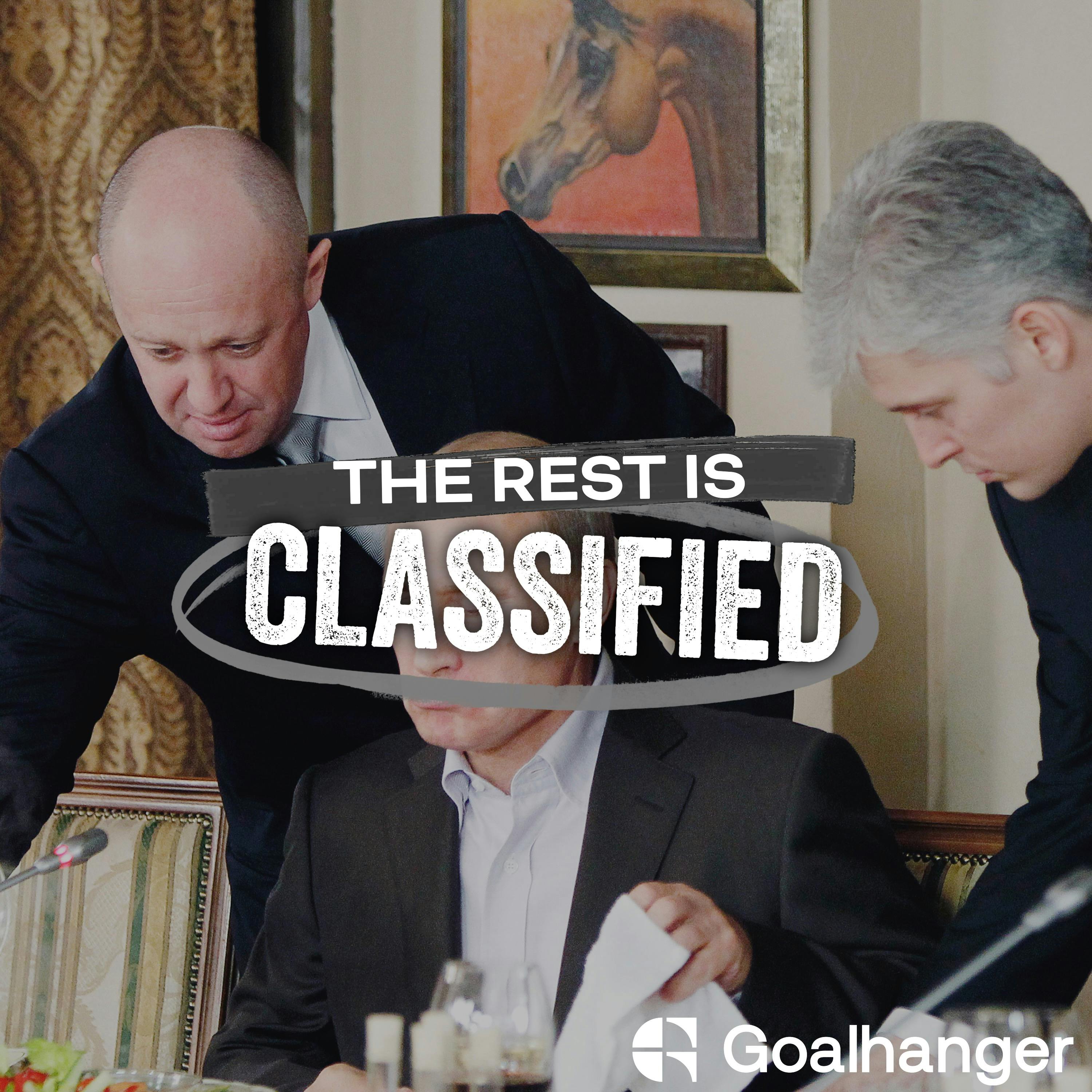
Yeah. One person we do know for sure that he does really serve is President George W. Bush, because there's a couple of pictures of him being served by Prigozhin at the Table 1 on May 25, 2002. The menu, I think this is important because now we get to our rest is food bit.
- [31:08]
David McCloskey
That's right.
- [31:09]
Gordon Corera
The menu was.
- [31:10]
David McCloskey
This is our audition.
- [31:11]
Gordon Corera
Yeah, yeah, exactly. He's looking to Be sponsored by some fancy restaurant. The menu was duck liver pate and gingerbread. I don't know what I think about that. Served with prunes and aged pork caramel. Dunno. Dunno. It's not my thing. Black caviar on ice. Fried fillet of beef with black truffles accompanied by fresh morels and baby carrots boiled in a rowan broth and raspberry mille foy for dessert. Excuse me. I can't even read these words because I'm so not used to them.
- [31:44]
David McCloskey
French pronunciations are notoriously uneven.
- [31:48]
Gordon Corera
I wouldn't make a good kind of, you know, maitre d at the Rest is classified restaurants.
- [31:52]
David McCloskey
You were not selling our Rest is food pitch very well, Gordon. So just. But what.
- [31:57]
Gordon Corera
I love it. You can see in the picture. Prigozhin is there kind of behind Putin and Bush. He's kind of, you know, he's there making sure everything goes well. He is the kind of maitre d of the thing. Putin then celebrates his birthday at the New Island Restaurant, 2003.
- [32:11]
David McCloskey
And we should say follow us on Instagram to see that photo, because we will certainly.
- [32:14]
Gordon Corera
We've got some great photos posting that to the feed on the social media feed. A Bush gets served again in 2006 when all the leaders are there at a G8 summit. It's not at the restaurant, but Prigozhin's doing the catering this time. Prigozhin wears a silver tie at the menu this time. Should we go through it? We should. Astrakhan. Astrakhan.
- [32:33]
David McCloskey
Astrakhan. Tomatoes, yeah.
- [32:34]
Gordon Corera
Do you know what those are?
- [32:35]
David McCloskey
No, no. Tomatoes from Astrakhan, I guess.
- [32:39]
Gordon Corera
Write in and tell us if you know. In balsamic vinegar. Crayfish with gooseberry marmalade. I don't know what I feel about that.
- [32:46]
David McCloskey
You know what this reminds me of? Have you listened to the Rest is History episode on medieval cooking?
- [32:52]
Gordon Corera
Yeah.
- [32:53]
David McCloskey
Where people are eating like, you know, it's like eels.
- [32:55]
Gordon Corera
Yeah. You know, and you're like, why would you do that?
- [32:58]
David McCloskey
It's not luxury eels, like stuffed with cow liver, you know, and like, you know, duck hearts or something like that. This is like combining some exotic and strange animals with weird, weird flavors and sauces.
- [33:11]
Gordon Corera
Fried smelt with turnips and baby zucchini. What smell? I don't even know what smelt is, but I like this one fact. Bush. President Bush ordered a steak.
- [33:20]
David McCloskey
Ordered a steak.
- [33:22]
Gordon Corera
It's like he didn't.
- [33:23]
David McCloskey
He didn't want the. He saw the crayfish floating in the gooseberry marmalade and he decided against. But Prigozhin's doing well, right? I mean, he's, he's now, I mean, I guess, as all of these ridiculous menus suggest, when Putin is entertaining really important world leaders, he goes to Prigozhin.
- [33:40]
Gordon Corera
Yeah.
- [33:41]
David McCloskey
To provide the service of the catering and the food.
- [33:43]
Gordon Corera
Exactly. So he's not. Prigozhin isn't one of the kind of big oligarchs. He's not like a kind of billionaire who's got lots of power in the 90s. He's kind of a new breed of people who are becoming rich under Putin and thanks to Putin and owe their loyalty to him. But he's not quite in the category of the kind of either the big billionaires or millionaires or Putin's close pals, like Sergei Shoigu, who is one of his Putin's old judo partners. So he's a pal. But Shoigu will become Prigozhin's arch nemesis eventually. There's also other things he tries something called Blini and McDonald's. So Blinis are, you know, kind of little pancakes. Little pancakes. And it's blinny Blindonald's, Blinny Donald's, which is a kind of like version of McDonald's, I guess.
- [34:30]
David McCloskey
Do we have any of the menu? Like, do we know what the menu was? No, the menu's been wiped from the.
- [34:36]
Gordon Corera
Internet because I think that business collapses. He also weirdly writes a kid's book in 2004 because he's now going.
- [34:43]
David McCloskey
He's a Renaissance man.
- [34:45]
Gordon Corera
Exactly. He's going legit, supposedly with his son, because he's now got a son Pavel, and a daughter Polina. And it's the tale of a little boy and a sister who live with their family inside a chandelier. The boy falls from the ceiling into the world of normal human sized beings and tries to get home. And a boy in this world of big people helps them out. Anyway, it's self published, so 2000 copies given away.
- [35:13]
David McCloskey
He was able to get contracts from the Russian state for food services, but he was not able to get a job that's published.
- [35:20]
Gordon Corera
But the business empire is growing. He gets rid of some of his kind of dodgier gangland partners. He opens restaurants in Moscow again where he can kind of ingratiate himself with the new elite. Now the point is he's going to use his friendships to get big government contracts. So he's now moving from restaurants to catering supply and including also things like construction and real estate. But the crucial Thing is, he gets a contract for food for schools. Putin himself will open one of the factories doing the supply. I don't think the kids got the truffles and the caviar. I think this was a slightly lower level of catering. And actually there's lots of reports in later years about the kids end up with vomiting bugs and dysentery from daycare.
- [36:03]
David McCloskey
The quality control was lax relative to the state dinners he was serving.
- [36:08]
Gordon Corera
So he's getting particularly gets to know a guy called Dmitry Bulgakov, who's in charge of logistics for the Ministry of Defense. You can see how he's moving in these circles. And that gets him a crucial contract for the military worth about 500 million pounds, $750 million to supply food for the Russian army. Now, that is a big deal.
- [36:25]
David McCloskey
That's a big deal.
- [36:26]
Gordon Corera
Yeah, that's a big deal. That's huge. Yeah. So he's moving into making big money now, which, again, is just this entrepreneurial guy. May 2008, his company, Concord Catering, wins the contract to feed guests at Dmitry Medvedev's presidential inauguration. So important part of the story, Putin's been in power as president, but 2008, he decides he's going to step back to being prime minister. And his kind of protege at that time, Medvedev is going to kind of hand over. But the problem is Medvedev doesn't do what Putin wants. Putin's going to feel dissatisfied, and Putin is going to decide he needs to come back as president. He's tried stepping back. He doesn't like it.
- [37:06]
David McCloskey
Shocking.
- [37:07]
Gordon Corera
Shocking. But that doesn't go well with those who thought Russia was on a path to a more liberal, Western democratic system. And so when Putin says he's coming back, there's actually street protests, particularly in the big cities, particularly claims of rigged elections. This is all kind of December 2011. And Putin hates these protests. He comes to see them as being organized by those sneaky folks at the CIA. You know, all part of a plot by Western intelligence to bring about regime change in Russia. Strangely, people linked to Prigozhin are doing some of the catering for the protesters. This is a kind of weird detail, but it is interesting. Now, that's odd, unless you realize he might be using it to kind of spy on them and understand what's happening.
- [37:53]
David McCloskey
Which is the nexus of catering and espionage that we've been searching for in this series. We've just found it.
- [37:58]
Gordon Corera
We just found it. So Putin hates these protests. He fears the west is trying to spread these color revolutions, which have happened in neighboring countries to kind of bring down pro Moscow governments. So he's getting more and more aggrieved. He wants to crack down on dissent at home, go after his critics as he returns to the presidency. He's famously called the Internet a CIA project. So he views the Internet and the west as driving and using social media in these things designed to kind of spread Western ideas, undermine the country. And so at this point, he's going to think, I've got to do, you know, I've got to do something about that. You know, I need to fight back. And interestingly enough, he's going to end up turning to Prigozhin to do this.
- [38:42]
David McCloskey
Who does not at first blush seem like a natural sort of resource in this fight.
- [38:49]
Gordon Corera
No.
- [38:50]
David McCloskey
Does he?
- [38:50]
Gordon Corera
No. And that, I think is one of the curiosities of this story, is that you're going to take someone who's been a criminal, a thug, a kind of restaurateur, a supply caterer, and who is yet going to be part of Putin's core political project both within Russia and then extending even into the United States.
- [39:16]
David McCloskey
That sounds like a cliffhanger to me, Gordon.
- [39:18]
Gordon Corera
It is, David.
- [39:18]
David McCloskey
And I think there with the former hot dog vendor now on the cusp of finding himself at the center of Russian official disinformation campaigns. Let's stop. And when we come back, we will see exactly how Yevgeny Prigozhin, I guess, ends up in the middle of a disputed American election.
- [39:44]
Gordon Corera
See you next time.
- [39:45]
David McCloskey
We'll see you next time.
- [39:46]
Gordon Corera
But don't forget. Oh, don't forget.
- [39:48]
David McCloskey
We almost forgot. We almost forgot.
- [39:50]
Gordon Corera
We almost forgot.
- [39:50]
David McCloskey
But you join the Declassified cup because.
- [39:52]
Gordon Corera
You do not have to wait. Because if you want to hear all six episodes, all six, if you want to know how it ends and it ends spectacularly, you can, you can binge by joining the Rest is Classified club, the declassified club@therealisclassified.com Sign up there. But otherwise, we'll see you next time.
- [40:10]
David McCloskey
We'll see you next time.
- [40:19]
William Drymple and Anita Arnand
George Orwell was one of the most impactful voices of the 20th century. But do you know what? His life story is just as interesting as the things he wrote.
- [40:28]
Gordon Corera
I'm William Drymple.
- [40:29]
William Drymple and Anita Arnand
And I'm Anita Arnand. And we are the hosts of Empire, a goal hanger show about world history. And on Empire, we're currently in the middle of a gripping four part series about the life of George Orwell.
- [40:39]
Gordon Corera
Orwell's early life was wrapped up in the British Empire. He was born in India to an opium trading father, and in his 20s he served as a colonial police officer in Burma.
- [40:50]
William Drymple and Anita Arnand
His later life crystallized his hatred of totalitarianism. As an idealistic writer, he traveled to fight with the Republicans against Franco's fascists in the Spanish Civil War, and he witnessed the horrors of the Blitz.
- [41:02]
Gordon Corera
These experiences led him to write his most famous novels, animal farm and 1984, giving us enduring phrases like Big Brother is watching you.
- [41:10]
William Drymple and Anita Arnand
To listen to our miniseries now, subscribe to Empire. Wherever you get your podcasts.