Loading summary
Transcript122 lines
- [00:00]
Alistair Campbell
Thanks for listening to the Rest Is Politics. To support the podcast, listen without the adverts and get early access to episodes and live show tickets, go to therestispolitics.com.
- [00:09]
Rory Stewart
That'S therestispolitics.com how is Farage getting away with so many lies?
- [00:16]
Alistair Campbell
Breaches of electoral law, Russian interference, foreign funding from billionaires in crypto. Deeply worrying and pretty authoritarian, Orban Magus style, anti women's rights and abortion, gender, violent rhetoric, close ties to convicted criminals. He just gets away with with again and again and again and again.
- [00:34]
Rory Stewart
People assume that Farage is a bit of a bullshitting rogue and therefore when all this stuff happens, it's sort of rolled into the general picture.
- [00:42]
Alistair Campbell
Trump created a media landscape that gives up on proper scrutiny, and I think we're seeing the same develop with Farage. This is a network and Farage is fundamental to that network. I just wish our bloody media would grow up a bit and start to join a few dots. This episode is powered by Fuse Energy.
- [01:01]
Rory Stewart
Most of us are buying energy in the dark, not knowing what it costs. You wouldn't do that with your weekly food shop, but with energy, you're often charged first and only find out the number later.
- [01:11]
Alistair Campbell
When you don't have that clarity, you usually end up paying more than you should, which is what Fuse Energy is working to change about how energy works.
- [01:18]
Rory Stewart
The average household switching to Fuse can save around £200 on their energy bills.
- [01:23]
Alistair Campbell
Fuse handles the practical side. The app shows what you're spending day by day and what that actually means for your bills.
- [01:30]
Rory Stewart
For listeners to the show, there's an added benefit. Use the code Politics when you switch and you'll receive a free trip plus subscription.
- [01:38]
Alistair Campbell
Switch to Fuse Energy and save around 200 pounds on your energy bills. Use the code Politics for a free trip plus subscription.
- [01:44]
Carvana Advertiser
Fusenergy.com politics this podcast is brought to you by Carvana. Car shopping shouldn't feel like preparing for a marathon of paperwork. That's why Carvana makes buying and financing your car easy from start to finish. Search thousands of vehicles with great prices, all online, all on your time. And when you're ready, your new car shows up right at your door. It doesn't get better than that. Buy your car the easy way on delivery fees may apply.
- [02:26]
Rory Stewart
Welcome to the Rest is Politics Question Time with me, Rory Stewart and me.
- [02:30]
Alistair Campbell
Alistair Campbell and Rory. We're going to talk Nigel Farage and reform. We're going to talk about elections in Thailand, as we promised last week, but also in Bangladesh. Fascinating election just taking place in Bangladesh. We're going to talk a little bit about Munich and then I know you want to. Having been sort of pretty vile about Keir Starmer on his Munich speech, you want to be nice about him in relation to something else. We've got lots to get through, but where do you want to start?
- [02:55]
Rory Stewart
I'm going to start with a question from Alison Cohen. How is Farage getting away with so many lies?
- [03:01]
Alistair Campbell
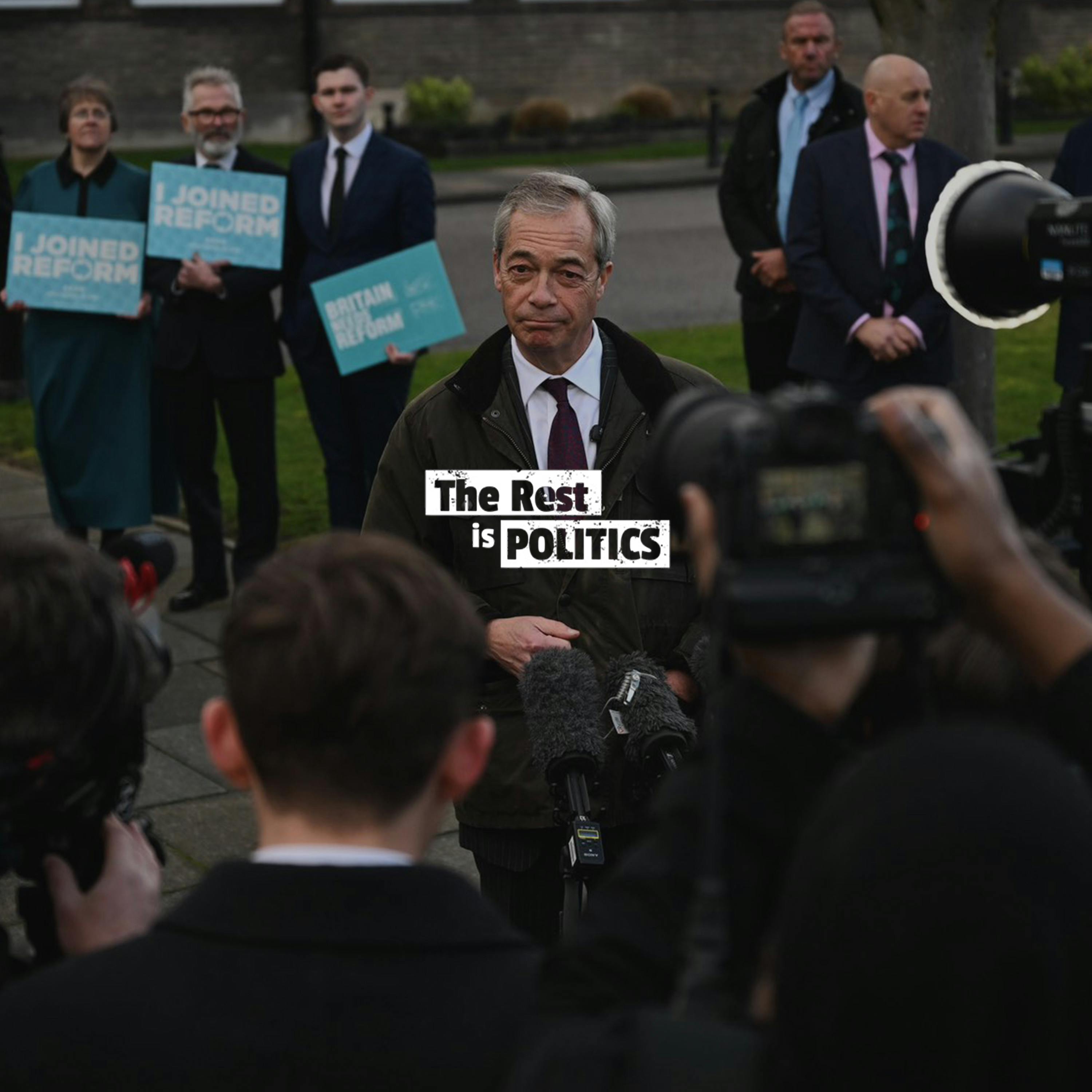
Well, it's not just lies. I think Farage gets away with murder. And I think the rise of reform uk, or what Chris Mason of the BBC likes to call the rise and rise of reform uk has actually happened despite, and in part because most of the media largely played out not just the lies, but the controversies and the scandals we're talking about breaches of electoral law, Russian interference, his role in Brexit, foreign funding from billionaires and crypto. Deeply worrying. And shout out to Natasha Devon on LBC at the weekend end. Pretty authoritarian, Orban Maga style. Anti women's rights and abortion. Gender violent rhetoric, close ties to convicted criminals. We've seen this with Trump. Trump created a media landscape that gives up, frankly, is slightly giving up on proper scrutiny. And I think we're seeing the same develop with Farage. Now, first of all, let me say not all. I'm not tarrying every with the same brush. Pippa Creer of the Guardian took me to task recently for saying the media are too soft on Farage when papers like the Guardian, Time To Time really go for them. But there are so many stories, Roy, that if these were about Labour politicians or even Tory politicians, it's not just a right left thing, they would never be out of the news. And there's another common link which is hugely underplayed, and that's Epstein and Steve Bannon, both jailbirds like George Cottrell, the man Farage calls, you know, like a son, and whose book on money laundering he and other key reform figures attended. But let me just. Let me just go through a few. 17 breaches of the parliamentary by Farage. 17. I don't know how many times you broke the rules. I suspect it was zero. Nathan Gill. I've been banging on about this for yonks and yonks and yonks. There was media interest in Nathan Gill for one day only, the day he went to jail for taking bribes from Russia. The whole crypto world, I think we just don't understand just how deep they are into this. Farage's use of a private company to pay corporation tax on all his outside earnings. Rather than income tax, which means it's 25%, not 40. And surprise, surprise, says he won't publish his tax returns if he becomes prime minister. And then there's all these things that just get forgotten in the midst of times. Farage claimed he never met the Russian ambassador, but he did. He claimed that he bought a house in Clacton, but he hadn't. Aaron Banks, his right hand man, the bad boy of Brexit, said he'd had one boozy lunch with Russian officials, then it was two or three, then it was four. It turns out it's almost a dozen. Richard Tice, you know, the working from. We'll come on to working from home later. Richard Tice, who works from home in Dubai with his lovely wife Isabel Oakeshott. You know, he had relations with this Russian guy and didn't declare them until the journalists got hold of him. I mean, maybe he was going to register it, but the truth is that he didn't register it until, Hope not Hate, the campaign group got hold of it and challenged him over it. And then just this week before, you kind of come back at me on some of this, just this week, this pattern of admission and dismissal, so you kind of say, no, no, we didn't do that, oh yeah, well maybe we did, but does it really matter? And that's helped get rid of an apparent electoral law breach in the by election taking place in Manchester. And just this week, another one repeatedly. Farage, this is his kind of line of the moment, going on radio, going on television, going on social media saying that 1 million people in Britain cannot speak English, okay, When he knows that is untrue, because he's actually written the true figure in an article in the Daily Telegraph earlier. It's actually hundred sixty one thousand. So whether you go, you know, his warm words for Putin, his apologies for Russian aggression, if you poke the Russian bear with a stick, you'll respond. His endorsement of Andrew Tate, his meeting with Assange, his fundraising to support, get this, a Russian backed campaign to split California. Now Farage didn't know at the time necessarily that this was kind of Russian involvement, but it is nonetheless a bit weird. The thing about the press and the media, part of the strategy, this is Natasha Duvern made this point in lbc. Part of Faraj's strategy at the moment is to keep calling press conferences. So the press trot in and either he gets on the news saying how bad Labour are being that day or he throws out some new little sort of firework. So the other day it was let's stop all this working from home nonsense. Brackets. One of his big backers is a big office space guy, probably totally unrelated. I'm just asking the question, as Nigel might say. But here's the thing about working from home. His home, work wise, is Clacton. He's never there. His wife worked from home when he was an mep. It's the hypocrisy that he just gets away with again and again and again and again. And if you think about when I was a journalist, the local government. Let's take local government. We've now got these reform councils, lots of defections, lots of cronyism, lots of stuff. Lots of absolute incompetent people doing incompetent things. It's barely figures on the national news. When Labour had. Do you remember the loony left?
- [08:12]
Rory Stewart
I remember the loony left.
- [08:13]
Alistair Campbell
You remember the looney left, wasn't it? But it was like, you know, all the CND stuff and all the kind of, you know. So the loony left became a national media story. Why is reform in local government not getting any national coverage? Given we have the rise and rise of reform and they're basically saying this guy's nailed on as Prime Minister. So is it a fair point, Rory, that this law get away with murder compared with the other people who want to be Prime Minister, such as Keir Starmer?
- [08:45]
Rory Stewart
Yeah, I mean, I think that it's definitely true that somehow you get a sense that different standards are applied. And it is worrying because it's a little bit like Trump. I mean, I think part of the reason he gets away with it is that it's sort of priced in. People assume that voters assume that Farage is a bit of a bullshitting rogue. And therefore when all this stuff happens, it's sort of rolled into the general picture. And part of the problem for Starmer, I guess, is that Starmer came in on a big message of a sort of moral campaign challenging the Conservatives, bringing seriousness to government, bringing rectitude. And therefore it's a more appealing story to a journalist to point to sort of hypocrisy and say, you know, this guy sets himself up as a saint and here's all this stuff going wrong. I think the second thing is that to be fair for a second and to try to play the other side, what you're talking about is a very worrying pattern and we can develop that a bit. I mean, you didn't talk that much about the funding, but I think one of the things that worries me most is our Rules in Britain are so lax in terms of who can give money. You don't actually have to be a British citizen to give money, you just have to be on the electoral register or you'll have to have a UK company. So theoretically, Elon Musk could put. People have been exploring this. How could he possibly put £67 million into a campaign through some UK company?
- [10:10]
Alistair Campbell
Well, he's now back in Rupert Lowe. Apparently Farage is not quite. He'll end up back in Tommy Robinson, I suspect. And Tommy Robinson, of course, is backing Matt Goodwin in the Manchester by election. So. Yeah, but no, but the funding, you're right about the funding, thank goodness.
- [10:23]
Rory Stewart
Still, we are not in the situation of Farage actually breaking the law. Right. These things are him. Conflicts of interest, breaking of parliamentary regulations, sailing very close to the wind. But so far he's not been convicted of a crime and the Parliamentary Commissioner has said that he thinks these things are inadvertent. But you're completely right. The general pattern of populism, polarization, post truth, strange links. We haven't talked much about these extraordinary revelations of the fact that when I was in Theresa May's government, it turns out that Steve Bannon, Trump's big kind of right hand ideologue, had relocated to Britain and was there cheerfully sending emails saying, I'm meeting Boris Johnson, I'm meeting Nigel Farage and we're just about to bring down Theresa May and I've just written a speech for Boris Johnson for his resignation. It's all the stuff when Boris Johnson resigns as Foreign Secretary and they're trying to trigger May to go, I had no idea. I wonder whether Theresa May was aware.
- [11:25]
Alistair Campbell
I very much doubt it.
- [11:27]
Rory Stewart
And then where was Dominic Cummings? And all this because of course, Dominic Cummings is a figure very much part of the same ecosystem, the same polarizing Brexit tech bro ecosystem which Steve Bannon's adjacent to and of course he becomes Boris Johnson's Chief of staff. So what's all that story? What's that moment going on? Because I came quite innocently into that leadership race against Boris Johnson, Winters and Mayfell without any idea that somewhere in the background were these sort of extraordinary figures like Bannon floating around. And of course, in retrospect, presumably Dominic Cummings pushing Boris Johnson's campaign from the beginning.
- [12:02]
Alistair Campbell
And the thing about Bannon, of course, if you remember when Brexit happened, and in a rare moment of candor, Nigel Farage was being filmed and turned to the camera and said, here's to you, Steve Bannon. You did this. So that's been going on for a long time. And of course, Steve Bannon, like a lot of these MAGA people, there is an element to him of being a complete bullshitter. And therefore he wants you to think that I can bring down Theresa May, I can get Boris Johnson into power, what have you. But the truth, Steve Bannon is fundamental, central to this international network of Orban. You know, we were in Munich the other day, Rubio makes his speech, all the European diplomats go, wasn't that wonderful? He didn't tell us. We were terrible. What's the first thing he does? He gets on a plane, he goes to Slovakia and then Hungary to see Orban, to say, Trump wants Orban to win the Hungarian election. This is a network and Farage is fundamental to that network. And what he does, what he manages, because of the sort of cheeky chappie having a fag, having a pint, sort of, you know, just being a Callum cosplaying man of the people, is he manages to sort of dismiss this stuff, like Trump does. They all learn from each other. You and I were in Davos, Nigel Farage was in Davos and Nigel Farage was doing lots of interviews, saying, oh, back Donald Trump on this, and Keir Starmer's terrible, what have you. None of them, so far as I know, have actually done it. None of the broadcasters who happily had him on air have actually asked the questions and found the answers. Well, who paid for you to be there?
- [13:31]
Rory Stewart
I think if you looked at his past carefully, he wasn't there under his own name. He was actually there as a sort of plus one, as a sort of assistant to a British Iranian businessman.
- [13:41]
Alistair Campbell
Yeah, yeah. And then you have all this stuff about he's got these links to the crypto world. And then again back into Epstein. Epstein, Peter Thiel celebrating Brexit. This is just the beginning. Epstein and Bannon talking about Bannon boasting about having all these European parties that are going to do well in the European elections. We can stop any of the regulation for crypto. So I just wish our bloody media would grow up a bit and start to join a few dots instead of just think that Farage is a useful guy to get on day after day after day and say, the government is terrible. He did it with the Tories and now he does it with labor and that's how they use him.
- [14:22]
Rory Stewart
We also need very, very quickly to get clear campaign finance reform, which the.
- [14:28]
Alistair Campbell
Government are talking about, aren't they?
- [14:30]
Rory Stewart
They're talking about, but it's not Coming through. I mean, if we genuinely are, are facing a risk of Nigel Farage taking over, we need to build the institutions now to protect democracy properly and that means we need to stop non British nationals being able to pour lots of money in. I personally think actually we should stop private individuals and trade unions being able to pour millions of dollars in. We should be following the South Australia model. We should put very clear rules about crypto. Crypto is a very strange thing, very difficult to trace. What are the origins of things. We should have much clearer views on declarations. I mean, what we're seeing again and again, part of this stuff we're seeing with Farage, you know, who's paying for this trips, are they being declared? We saw this in spades with Mandelson, you know, people not declaring, getting on private planes and then completely changing the way in which ministers are trained on security. So I was very surprised when I became a minister and when I ended up eventually on the National Security Council, that I didn't get anything like the briefing that I'd got when I was a diplomat. So when I as a 21 year old joined the government there were very, very clear training around the Official Secrets act, the sensitivity of information, how to protect sources, how to make sure there weren't conflicts of interest. Certainly in my day, Ministers simply didn't get the same seriousness and depth of people reinforcing that they're dealing with the most sensitive information in the that could put agents lives at risk, that could allow wealthy bankers to make billions of pounds. So absolutely, with Farage. But I'd also like someone to come up with a solution. I mean, as well as us identifying the problem, how do we put the principles and policies in place now to make sure that our politics is cleaner in the future than it is now?
- [16:20]
Alistair Campbell
The fact that it needs to be cleaner, there's no doubt about that. And Gordon Brown on the back of the Epstein stuff and Peter Mandelson came out and had all sorts of proposals and as I said at the time, I worried that that was sort of t them all with the same brush, like, you know, Pippa Creera. I think I do sometimes with the, with the media. But let me just give you another example of the sort of the double standard here. Let's imagine that I, or Peter Mandelson or somebody who was associated with New Labour wrote a book called how to Launder Money. And let's imagine, and let's imagine that Tony Blair, Gordon Brown, Keir Starmer, David Lowey, Yvette Cooper all turn up at the launch of our book, How To Launder Money. So George Cottrell, who is this guy that Nigel Farage says is like a son to him, who's been to jail for laundering criminal proceeds, who spent several months in prison, he writes a book, how to Launder Money. And who turns up at the launch? Nigel Farage, Richard Tice, Nick Candy, the billionaire property guy with the biggest house in bloody Regents Park. Layla Cunningham, the mayor, the candidate for London, James Orr, the intellectual of reform, et cetera, et cetera, et cetera. So this is part of the Trumpian thing. Instead of sort of getting on the defensive about being a money launderer, you write a book about it and you call it how to Launder Money. And then when people like you and me say, this is really terrible, people like Farage go, oh, it's just a bit of fun. You lot, you're too serious, you lefty bedwetters, you know, blahdy, blahdy, blahdy, blahdy, blah. Now, what Posh George, as he's known as will say, is that this is a bit book designed to help policymakers and politicians and the public understand money laundering. But you can't deny it's quite a provocative title for somebody who's been banged up in the past for such things. How To Launder Money. So, Posh George, good luck with your book. I suspect it won't get right to the top of the best seller list, but you certainly had a good turnout for your launch. Right, before I stop my rant, Rory, and we go to the next question, a book on money laundering, which I've been reading. Oliver Bullough, we've talked about him before. This guy writes these amazing books about financial crime and he's got a book out at the moment, I think he's out this week, and it's about money laundering and people should take it seriously and it's a proper piece of journalism. So there are good journalists out there. So, Alison, thank you for your question. You can see it had quite a triggering effect, but I'm very, very grateful and I hope that some of our frank, fearless, free journos are listening. And by the way, I suspect this rant may be the end of our of Nigel Farage. I sent him a message this week and I said, look, am I wasting my time trying to get you come onto the podcast? Are you only going to do nice, soft, tame interviews? We'd be nice, we'd be respectful, we'd be polite, but we do need to ask you some difficult questions. Anyway, reply came then. None Rant over, rant over.
- [19:19]
Rory Stewart
Well, do we have any other questions?
- [19:20]
Alistair Campbell
Last week we promised to return to the issue of the tight end election. So let me try and wrap a couple of questions together. Lucy is a Trip plus member from Yorkshire. Have voters in Thailand given up on the idea that democrats can deliver change from the status quo? And then Tim in Brussels. Does the election result in Bangladesh mark a genuine democratic reset, or does the exclusion of the Awami League, that's the party of Sheikh Hasina, currently in exile in India, and the rise of dynastic and Islamist forces risk replacing one form of dominance with another?
- [19:49]
Rory Stewart
Both cases, what you've got is a situation in which from 2012, 2014, both Thailand and Bangladesh seem to be moving away from democracy. So Bangladesh, for example, having been a sort of actually a bit of a poster child for democracy, or it felt like it in the 90s, early 2000s, because there have been elections and the party's been swapping back and forwards. Effectively. Sheikh Hasina, who was the ruler, took control in 2012 and took over the courts, took over the police, intimidated her opponents and set up an authoritarian regiment regime. And In Thailand in 2014, there was a military coup. And basically the military and people around the royal family, the kings, very strong in Thailand, ran a pretty authoritarian state. And then suddenly, rather oddly, given the general story that we see in our worlds, there was a bit of hope. So in 2023 in Thailand, this charismatic young leader of a progressive party did fantastically well in the polls. And in 2024, in August in Bangladesh, there was an uprising and Sheikh Hasina was finally toppled. And Muhammad Yunus, a Nobel Peace Prize winning guy, the guy that set up microcredit, takes over. So in both stories, the stories seem to be actually rather oddly, given we're in the age of Trump, it was moving in a more progressive, democratic direction. And now the elections have happened and they are sadly, a crushing disappointment, because in Thailand, what's happened is the progressives have been beaten and there's been an incredible turnaround in the fortunes of this more conservative, pro military party that's gone from number three in parliament. So they had about 70 seats to firing themselves up to top place at about 190. Meanwhile, in Bangladesh, yes, Sheikh Hasina's gone, but politics have just lurched back to the other great big machine party of Bangladeshi politics, the bmp. And of course, the person who's now won with the BNP is Tariq Rehman, who is the son of son of the former president and military ruler, General Ziare Ehman, who was assassinated in 1981, as opposed to Sheikh Hasina, who was the daughter of the leader killed in an assassination in the 1970s, has now taken over again.
- [21:58]
Alistair Campbell
Holloway, he's not just the son of a former president, he's also the son on the maternal side of a former prime minister, Zia Kaleida, who I met when with Tony Blair back in early 2000s, I think it was. No, you're right. And of course, of course, on the one hand, Sheikha scene are gone. They now have a warrant. They're in these discussions with India about whether they can get her back because they want to put her to death, frankly. And of course, her party was not allowed to stand. So the bnp, and of course, because of the, the UK context, the bnp, it sounds a bit weird, say the bnp, this is the Bangladesh National Party, not the British National Party, so they're a nationalist party and they've just, they've two thirds of the entire parliament. So this huge, huge win. Whereas in Thailand, although it was a big win and a very unexpected win against the polls set against the poles in advance, they are still going to have to do pretty much a coalition with the party that came third, the progressives came second, having been way ahead in the polls. And one thing that was really interesting there was the rural urban divide. And we see this in a lot of countries, but this is just massive. So in Bangkok, the, you know, the capital, the most urbanized area, the progressives won every single seat, every single one, and yet get out a little bit and they see that the. And of course, it's a mixed system, it's a hybrid system, part first past the post, part proportional. But it was a very, very big shock. And what it means is that the traditional powers of monarchy, military, and the appeal to national unity, particularly at a time when they've been having this conflict, conflict with Cambodia, it seems to have won the day. However, a lot of allegations of vote rigging, vote buying and, you know, cameras turning off during the voting. And so, you know, it's left a bit of a nasty taste, but, you know, it's a big win.
- [23:56]
Rory Stewart
It's also part of a really interesting bigger story about what's happening in South Asia, Southeast Asia, with democracies and economies. The normal story that we would have wanted to tell ourselves after the fall of the Berlin Wall is that the whole world was becoming more and more democratic and more and more liberal in terms of its economics. And I guess because we're Europeans, we often have the model in our head of what happened in Eastern Europe, you know, Lithuania, Romania and these countries on this amazing journey. The story in Southeast Asia and South Asia has been more complicated. There's been been incredible economic performance for many of these countries, particularly in the 90s, early 2000s, where Bangladesh, famously the basket case of international development, shot on its path to become a middle income country. Thailand actually diversified away from tourism, did amazing stuff in light manufacturing, beginning to grow very fast. But both those economies have basically run into trouble. They've run into trouble partly with tariffs, with the United States, partly simply endemic corruption, kleptocracy. Poor institutions are really choking growth. Meanwhile, autocratic states like Vietnam, which is basically in many ways went through a smaller version of China. In other words, Communist Party remains in place. Big modernization drive from 1986 shot ahead and its economy continuing to grow probably 5, 6, 6% this year, while Thailand's probably only grow 1.5%.
- [25:29]
Alistair Campbell
And also Indonesia becoming a giant in its own way.
- [25:32]
Rory Stewart
Indonesia becoming giant. $1.4 trillion economy now in Indonesia. I guess if we step back from South Asia, Southeast Asia, and this is probably an area of the world we don't talk about enough because this, you know, when we talk about middle powers, how do we balance the United States, China, Russia? A lot of the answer is going to be in these enormous economies. South Asia, India, Bangladesh, Pakistan, but also these enormous economies of Southeast Asia and East Asia. The question of whether Britain, Europe can ally with them, build economies around them, share values with them is made very, very complicated by the fact that these countries are not on easy paths towards liberal democracy. And of course, as you've just pointed out with Nigel, France and with Hungary and Europe, there's some pretty serious problems now happening back at home too.
- [26:23]
Alistair Campbell
The other interesting thing about Bangladesh, they also had a referendum on the same day with a reasonably high turnout. And this was to make major constitutional reforms, sort of stuff that you and I be saying, let's have some of this for the UK. So they, they brought in, I think it's 80 changes to the constitution and the most important, I guess two term limit for prime ministers, more powerful judges directly elected upper house. So this is, you know, there is at least kind of democratic change in renewal being being attempted there. But I think the thing with India is really interesting and Pakistan as well and how these relations develop. Because of course one of the reasons why Sheikh Hasina was able to go to India is because relations with India under her had been pretty strong since her departure. They've been, they've been Very substantially weakened and become very, very hostile. The relations are so bad that in the T20 World cup currently going on, Bangladesh refused to play unless their games were moved out of India. So that is why Scotland allowed the World cup, because Bangladesh, Bangladesh pulled out. So they've got this real tensions between them. And of course, now you have Modi. He gave a message of congratulation to Tariq Rahman, the new guy, who actually I've met in London, I think, in the past, because he's lived in London in exile for the last 17 years or so. So these tensions are still there, and Modi is going to have to be pretty careful about how he handles that. And likewise, relations with Pakistan and Bangladesh, you know, tensions there as well. So we should come back to this once the new guy has settled in, as you say, to some extent, it's a story of two great dynastic powers that have sort of, you know, moved in and out and in and out of jail and in and out of power and what have you. But we'll see whether this constitutional change ever comes.
- [28:21]
Rory Stewart
Alastair, when we come back from the break, we've got a good question, actually, to follow up on the Munich Security Conference for you.
- [28:28]
Alistair Campbell
Excellent. See you soon.
- [28:31]
Dominic Sambrook
Hello, everybody, and welcome to the Book Club, a new podcast from From Goal Hanger, hosted by me, Dominic Sambrook, and me, Tabitha Syed.
- [28:39]
Tabitha Syed
As some of you may know, I have been Dominic's producer on the Rest Is History. And we even did a miniseries last year about all things books.
- [28:47]
Dominic Sambrook
And since we enjoyed that so much, we have decided to roll it out as its own show. So it'll be coming out every Tuesday. We'll be doing a different book each time and digging into all the stories behind them.
- [28:59]
Tabitha Syed
And we are going to be talking, talking about the historical contexts behind some of the greatest and most famous books of all time. We're going to be digging into the remarkable people behind them, the unexpected stories behind the stories, and also unraveling the plot of each book a bit and delving into the depths of the story.
- [29:17]
Alistair Campbell
Now, you don't have to have read.
- [29:18]
Dominic Sambrook
The books to listen to the show, but we hope that by the end of each episode, you will be able to pretend to people that you've read them. That is the key thing. And either way, whether you read them or not, we hope that you'll learn lots of fascinating facts, you'll do lots of great stories and maybe Tabby the odd laugh.
- [29:33]
Tabitha Syed
We will be looking at thrilling gothic bodice rippers like Wuthering Heights and Frankenstein. As well as iconic stories like the Great Gatsby or Little Women and then also some more modern stuff. So Game of Thrones, normal people, the Hunger Games, Hamnet, all massive manner of exciting stories.
- [29:53]
Dominic Sambrook
So please join us on our journey into all things books. Wherever you get your podcasts, just search for the Book Club every Tuesday and hopefully we will see you there.
- [30:17]
Alistair Campbell
Now.
- [30:17]
Rory Stewart
Now just a quick pause in the podcast to mention our sponsor NordVPN.
- [30:22]
Alistair Campbell
We are in February and that is the month when the year stops being theoretical, good intentions turn into systems, accounts, passwords, payments and life starts running through logins again almost without pause and it feels completely normal.
- [30:35]
Rory Stewart
And it's also exhausting. So there you are, whacking in all this sensitive information day after day, simply as part of your everyday life.
- [30:42]
Alistair Campbell
NORDVPN works quietly in the background, protects your data as you get on with life online. It adds privacy without asking for constant attention, encrypting what you do and keeping your location private.
- [30:53]
Rory Stewart
And we can't begin to tell you how much danger there is if you start having sensitive information and passwords and locations out there. And privacy as provided by NordVPN tends to work best when it's built in.
- [31:05]
Alistair Campbell
One NordVPN account covers up to 10 devices, or you can install it on your router and protect your entire home network in one go.
- [31:12]
Rory Stewart
To get the best discount on your NORDVPN plan, go to nordvpn.com restispolitics. You'll get four extra months free on the two year plan, plus a 30 day money back guarantee. The links in the Episode Description. This episode is brought to you by Whoop.
- [31:33]
Alistair Campbell
Whoopee. If politics teaches you anything, it's that the danger comes when you only focus on the headline and miss what's really driving the outcomes underneath.
- [31:42]
Rory Stewart
And listen, I'm wearing the whoop now. Okay, so I actually use this device. Shoshana particularly really loves it. She works out every day. She really wants to know what her resilience level, how far she can push in a training session. And what it tells you basically when you wake up in the morning is what your resilience is and how high you can push it. So yesterday for example, it said to me, listen, you had massive resilience. You didn't push yourself hard enough in your training session, you could have done much more more.
- [32:09]
Alistair Campbell
So it's giving you personalized insights so you can build routines that last and add more life to your years. So if you want better to understand how you can feel and live at your best for years to come. Head to join.Whoop.com Tripp and get started on WHOOP today.
- [32:26]
Rory Stewart
You can even sign up for a free 30 day trial so you can try Whoop risk free and start your year with a bit of momentum. Foreign.
- [32:39]
Alistair Campbell
Welcome back to THE REST of politics. Question time with me, Alistair Campbell and.
- [32:43]
Rory Stewart
With me Rory Stewart. So first question after the break from Alexandra in Hertfordshire, who was the most impressive leader at the Munich security conference and what else happened on the sidelines? And Ian, this is a question I'm fascinated by, but maybe we'll have to do this in more detail another time. Do you think JD advance is being sidelined by Trump in favor of Rubio? But anyway, give us a sense because I left Munich security conference before you, what did you continue to see, Am I right, that you managed to have a bit of time with Zelensky and things tell us a little bit about what you saw.
- [33:15]
Alistair Campbell
Well, I saw lots of things. And the thing that I was most impressed by, impressed as in struck moved, was actually a panel on Arctic security which was attended by the prime minister of Denmark, Mette Fredriksen, who we've interviewed before. Prime minister of Greenland, Jens Frederick Nielsen, a Republican senator from Alaska, Lisa Murkowski, foreign minister of Canada, Anita Anand, had a really nice chat with her about how much she loves Mark Carney and also the German foreign minister, Boris Pistorius. And what was fascinating about it was it was, do you remember there was the big room where the big stuff was going on, Ruby, et cetera. And then you had these smaller rooms. And this one was in one of the smaller rooms, probably held about 2, 300 people. And there were hundreds of people trying to get in. And I spoke to this Norwegian guy who said, you know what, normally the Arctic security panel, we can't fill the first row. And somebody else said we should give Trump the Charlemagne Prize for uniting Europe in the way that he's done. But what was really fascinating was to see Frederickson and Nielsen, the Greenland prime minister. They do not think this is over remotely. They are still very, very concerned about what's going on. It was also Drury, I should give a plug to our miniseries on the Arctic because several of the people there, including Alexander Stubb, when we interviewed him, the president of Finland had listened to the first part of the miniseries we did with Ken Rosen on the Arctic. So this has become like one of the biggest issues in the world. And it's because Trump has put it there. I thought the Greenland prime minister, imagine he's a young Guy, he's in his 30s, population of 57,000, and he's suddenly thrust into this geopolitical nightmare. He looked very stressed. I had a chat with him afterwards and he actually was pretty calm and very impressive. But, oh, my God, you could feel just, you could feel the weight on top of him.
- [35:14]
Rory Stewart
You and I, I think, were very much of the view that the people standing up to applaud Marco Rubio's speech weren't listening. They were being influenced by the flattery and the tone and they weren't picking up actually on the content of it. And Rubio then went on, after Munich, Security Council, do other stuff. What was your reflection? Because basically there was a disagreement. We took the view that actually you should be worried by Rubio's speech. A lot of other people were going around being relieved and applauding over to you.
- [35:44]
Alistair Campbell
Well, most notably Wolfgang Ischinger, who's the German diplomat who's the chair of the whole event. And he, he did a Q and A with Rubio after Rubio's speech and he said, I hope you could feel the sigh of relief in the hall at your message of unity and reassurance. I mean, I had another German diplomat, perhaps a little more battle hardened and less kind of lovey, lovey with the Americans than Ishinga. She said that a friend of hers, a very close friend of hers, had over years been the victim of domestic violence. And she felt that Rubio's speech was like coercive control. You know, I really love you, I really, really love you. But all these bad things that I'm doing to you that you don't like, they really are for your own good. And that was the sort of. The tone of his message was, you know, we're children of Europe. We'll never forget Europe. We love Shakespeare, we love the Beatles, we love Mozart, all that stuff. But the message, to my mind, was not a bit different to JD Vance a year ago. And I was appalled, frankly, that the Europeans, so many of them, fell for it so much. And I think the penny dropped later the next 24 hours. Most people I spoke to thought, yeah, it wasn't that great, was it? And then, of course, to see him go off to Slovakia to see Orban's mate, then to go and see Orban himself and intervene directly in the Hungarian election, basically by saying, trump loves you. If anything ever happens to Hungary with you in charge, America will always be there to help. It was a total direct interference in a European election. So I think you and I both got the Right. Sense of what that speech was about. The other thing I saw after you left, Rory, I went to see Eldridge Colby, who's the guy who is the kind of Under Secretary of Defense, very kind of maga. He was asked direct question, if Russia sought to annex the Russian speaking part of Estonia, would that be seen as an act which required an Article 5 NATO response? And he gave a long lecture about NATO 1.0, NATO 2.0, NATO 3.0. You guys, you've got this theological framing around Article 5. He went on and on and on, on. And then at the end, the questioner said, can I just remind you, it really was a very simple yes, no answer.
- [38:15]
Rory Stewart
It's terrifying us. I mean, just to sort of reinforce to people what this means. So NATO Article 5 is the core of all of NATO. An attack on one is an attack on all. And the answer to the question, what happens if Russia invades Estonia, a NATO member, is very simple. There is a complete response by the United States and everybody immediately. And the fact that the US Deputy Secretary of War, Elbrich Colby, is incapable of saying, clearly, we, of course, would respond completely and dramatically to any invasion of Estonia. Your point about that German diplomat saying that the Trump administration is doing a form of gaslighting where they keep saying, this is all for your own good. That Colby thing reveals so much about what's going on that the story that Colby's been selling the world is, yes, it's very reasonable. Europe hasn't spent enough on defense. We need to concentrate more on China. Europe needs to step up and do a bit more and stand a bit more on his two feet. He said it so effectively that you often have heard until Greenland, European politicians just parroting that, beating themselves up. It's true, we haven't spent enough on defence, et cetera, et cetera, etcetera. But the truth of the matter is that the biggest incentive to Russia intervening in Europe is not how much Europe does or doesn't spend on defense, it's whether or not they believe that the United States would respond immediately to any incursion. And for the US to keep the security of Europe isn't actually, in the end, about how many troops America keeps on the ground. It is about the cross. Crystal clear reiteration that an attack on one is an attack on the other. With the threat of the US nuclear arsenal behind, if America remained consistent on its statements, Europe would be in a much safer place.
- [40:13]
Alistair Campbell
The other intervention I saw that was worth looking the French Europe minister, Benjamin Haddad, he did a Very interesting thing. He said, look, this is all a bit pathetic, that we listen to these Americans, politicians, and we're kind of looking for little words of love that tell us, yeah, yeah, we still love you. And of course, it struck me at the end of Rubio's speech, it was Valentine's Day, and I wonder whether that's why he did all that kind of, you know, lovey dovey stuff. But the policy has not changed. And the point about Estonia, Rory, that is the thesis of that book that I mentioned, my book of the year last year. If Russia wins, it starts by, by Russia taking over a bit of Estonia and America deciding it's not important enough.
- [40:56]
Rory Stewart
Without blowing my Trump in any way, because I wasn't alone in this. But when I was chair of the House of Commons Defense select committee in 2014, so 12 years ago, we used that Estonia case study as a way of trying to explain why we thought Europe was in real trouble. And in 2014, we were saying, what happens if Russia just parks a few little green men a few hundred yards into Estonia and just sits there? And will that trigger article 5 and how will people respond? And so for more than 12 years, people have been trying to bring this to light. And for Elbridge Colby, who presents himself as this great defense intellectual, to be unable to answer the simplest question in geopolitics is catastrophic.
- [41:39]
Alistair Campbell
Yeah, I totally agree. At the event he was doing, I was sitting behind a few Canadians and they were. Oh, my God, they were not buying it one bit at all. I'll tell you, I was impressed by Anita Annan, the Canadian foreign minister. I thought she was really impressive. She. I hadn't realized till I spoke to her afterwards she was planning to retire from politics and Mark Carney persuaded her to come back. But also the senator from Alaska, really interesting. She's Republican, but my God, she could not have been more critical and condemnatory of the way that Trump has handled Greenland. And also making the point that Ken Rosen made in our miniseries, Americans who aren't in Alaska, they really don't understand what life is like in the Arctic. She was telling me, for example, that her phone, when it's cold where she lives, when it's really cold, you have to go out with your. Put your mobile phone under your armpit and keep it warm in something else. Otherwise the battery just dies in like an hour in the cold. And so I was fascinated by. It's so interesting how a book can kind of change things. Ken Rosen's book Polar War has completely changed the way that I think about the Arctic and think that we should think about the Arctic and its importance to all of this stuff that we talk about. RORY before we go to the next question, I should tell you, you'll be thrilled to hear this. Fiona listened to our discussion about Keir Starmer's speech, and she said, I agree with Rory. That's the first thing. And I should tell you as well that I spoke to quite a lot of Carney's team, Macron's team, Merz's team. I think the balance was with you.
- [43:26]
Rory Stewart
I'd say, in retrospect, why do you think you were were seeing it as a slightly more positive speech?
- [43:32]
Alistair Campbell
I still do, because of what I sense is Keir Starmer preparing the ground for a significant shift on Britain and Europe, and also preparing the country for the fact that we may actually have to get to a place a bit like the Finza. When we talked to Alexander Stubb in terms of a sort of more we're actually at war. Remember, the Polish foreign minister said to us, as far as we're concerned, we're already at war. War. Well, that requires a change in mindset. And it's interesting. The day after you and I both said that he's preparing the way to increase defense spending even further and even faster, Keir Starmer announced that that's exactly what they're planning to do. So that's the bit and where I agreed with you, I thought I didn't see the point of the direct rebuttal of Mark Carney. Is it a rupture? Is it a transition? But anyway, the Canadians in particular, shall I say, were particularly on your side of the argument. Rory Right. Tom from London, with all the criticism facing Keir Starmer at the moment, can you say something positive about him? Well, I've just done that, so why can't you do the same? Rory?
- [44:42]
Rory Stewart
Well, here we are. So I was at a reception for carers at Windsor Castle. This was last week, right in the middle of Star basically fighting, it felt, in the newspapers, for his complete political survival. And what struck me is that he came out to Windsor and he was there with Stephen Kinnock, he was there with Pat McFadden. So senior members of his government and I watched him spend an hour and a half working his way around, speaking to unpaid carers. The people there were people who, who every one of them had a story of who they were caring for. There was no sort of showmanship about it. I watched him very carefully. He was thoughtful, he listened really hard, and these were extraordinary stories. I saw him talking to somebody who has been looking after her mother since I think she was nine years old. Her mother's quadriplegic. He was talking to husbands looking after wives with severe dementia. He was talking to people working in hospices for children as well as for adults. It's quiet, it's unshowy. He could have just come in, just taken a photograph, been there for a few minutes and left again. I guess Windsor is not a very convenient place for him to get to, back and forth. And presumably there would have been people in number 10 saying, Come on, you know, the whole world's turning against you. And he was there doing the job and doing it really well. And, and I should put it on record, there are five point something million carers in the UK who are doing so much. It's the toughest job imaginable, can be very lonely, often stuck at home looking after somebody with very severe needs. And of course, by doing it, they're saving the NHS and the whole system a huge amount of money and they get very little carers allowance is very, very low for doing that. But I just thought it was a lovely indication of another side of care that people don't necessarily see and another side of these politicians in general, that there was just kind of no swank there, there was no sort of showing off, it was just patiently working their way around that big room.
- [46:53]
Alistair Campbell
Well, it's interesting you say, because I. I actually got, the next morning, I got a message from Pat McFadden saying that he's seen you and he was saying nice things about you as well, Roy. So it was obviously a very nice event all round.
- [47:03]
Rory Stewart
Well, yes. So can I just quickly also pay tribute obviously to the King and Queen who, who brought it together. And again, you know, they also, I mean, sorry, I'd seen the King earlier in the morning, he came to open this exhibition at the Garrison Chapel and there he too, like Keir Starmer, was spending, I guess an hour and a half working his way slowly around the room, listening to everybody, talking to everybody, when, you know, he's not had the best health recently, he's had. I can't imagine how many appointments that day he may have, you know, also, like Kier wanted to get back to bed, have some rest and just seen both of them together. Cheered me up.
- [47:38]
Alistair Campbell
Well, of course, what's interesting about that, to go back to the first part of our discussion about the way the media covers stuff, is that, of course, for King Charles, it's kind of his job and actually when he Went to Shoshana's exhibition that was on the news, a sort of wallpaper for something else going on, probably to do with Prince Andrew, I don't know, rather than the thing. But. So he does that all the time. Whereas let's imagine if the morning that Keir Starmer was doing that visit, Downing street had briefed saying, well, if you want to get to the Prime Minister today, this is his only public engagement. So we want you to cover carers and here's a briefing about our carers strategy and da da, da. They wouldn't even have taken a note. He would probably only have got on the news assuming there was a, was there a pool camera there? Were there media there?
- [48:23]
Rory Stewart
I didn't see any, There may have been, but I, I, there was some photographs but I, I didn't see much media at all.
- [48:28]
Alistair Campbell
Yeah, but let's imagine how he might have got in the news is if one of the carers had said to him, you know, why did you appoint Peter Panelson as Ambassador Washington? And then it would have been Keir Starmer's attempt to put the spotlight on carers was overshadowed or upturned by a da da, da da da. So he is in that mode at the moment. I'll do another one in special educational needs which is a massive, massive, massive problem. Okay, Georgia Gould, who is the minister in charge of this and she's, you know, she's got a young family, she's got a white paper coming out, she has been to literally hundreds of meetings with parents and so she was on the radio the other day being challenged, why haven't you already produced a strategy answer? In part. I am absolutely determined to get this right and I'm going to talk to people and talk to people and talk to people. So anyway, I think we should cut up your little paean of praise to Kieran. I'll send it to him.
- [49:28]
Rory Stewart
Well, I want to finish with a lovely question that we've received from Hannah Fry, but here's a question from Metta Hinton from Cambridge for you. What would a strong number 10 team look like?
- [49:41]
Alistair Campbell
Well, a strong number 10 team will be a strong number 10 team if there is a clear, compelling narrative coming out of number 10 all the time.
- [49:49]
Rory Stewart
Time.
- [49:49]
Alistair Campbell
That's the first thing that comes from the top, that comes from the Prime Minister being really, really clear. And then I think you would have, I guess, you know, number 10 covers so much. It covers everything that's happening in government. So the structure, the first thing that the focus has to be on the word team are the people who are in there doing the key jobs. They don't have to be best friends, they don't have to go to each other's weddings and funerals and holidays and all that, that. But what they have to have is a sense of what Jonathan Powell used to call complementarity. They've got skills that match each other. You definitely need, whether you call it Chief of Staff or Director of Operations, call it what you want, you need somebody who is kind of making the trains run on time, controlling the traffic that's going into the Prime Minister. Should they see that? Should they see that? Remember Barack Obama once said that most of the decisions that are sent to him don't even reach him because he had people that he trusted to say this is what he would say about that, this is what he would do about that. So that control goes in there. You then need somebody who's in charge of communications and strategy and you need. And I think that the other thing that maybe is a bit confusing in this number 10 operation and maybe with all the change that's gone on since Morgan Boots Sweeney left and the Cabinet Secretary, this can be addressed but you're never quite sure where the policy directions coming from. It's all felt a bit bits and pieces. And then the other thing a strong number 10 team looks like and has is really good relations with other departments. That's important as well. So you did put me spot on there. I guess all I've done is kind of describe our operation and that's not a really sensible thing to do because of course we're in a completely different age. But I think you do need that.
- [51:36]
Rory Stewart
The principles, I guess, I think the.
- [51:37]
Alistair Campbell
Principles are rather so right. Final question, Rory has actually come from Hannah Fry, who is a presenter of the Rest Is Science. And because we're so modern and technological, here it is video and sound.
- [51:53]
Hannah Fry
Hello, Alastair and Rory. Hannah Fry here from obviously your favourite of the Rest is Sister Shows. The Rest is Science. I have a question for you which is I guess about the overlap between, between science and politics. Science, I mean we're continually warning about things that will happen on a 10 year timescale, a 20 year, 50 year and so on. But politicians seem structurally incentivized to only really care about these five year election cycles. So I am wondering and looking at the evidence of things that have gone in the last few years, is democratic politics just fundamentally incompatible, compatible with helping us to navigate through these long term scientific crises? I'm not just thinking about Climate change here, but pandemics, the ills of the Internet, algorithmic harm, artificial intelligence, quantum computing, and so on and so on. What do you think?
- [52:49]
Rory Stewart
I just want to quickly say how much I'm enjoying the rest of the science. If you're a little bit nerdy like me, it's the most wonderful thing. And let me try this one on you. So you play cards, right?
- [53:01]
Alistair Campbell
Okay.
- [53:01]
Rory Stewart
One of the things they did recently on the Rest of Science is that they looked at how many combinations you can get from 52 cards. So imagine ace of spades, king of spades, queen of spades, and then you just move up the three of hearts, the top. That changes the combination of things. The number of combinations you can get from a pack of cards is 52 factorial. And they're trying to. You know, we keep talking about how you explain big numbers. Get this, their explanation. Imagine that you set a timer for 52 factorial seconds going forward, right? Take one step every billion years, continue to walk till you've walked all the way around the world. When you've got back to where you started, take one drop out of the Pacific Ocean and then set off walking around the world again with one step every billion years. When you've emptied the Pacific Ocean, lay down a sheet of paper, then pile sheets of paper all the way up to the sun, and each piece of paper represents an emptying of the Pacific Ocean and you've got 52 factorial. How about that?
- [54:06]
Alistair Campbell
Wow.
- [54:07]
Rory Stewart
It's beyond unbelievable. I still actually am struggling to believe them, but I did try to run the numbers yesterday, and I think they may be right. But what a lovely vision of how big numbers can get.
- [54:17]
Alistair Campbell
I got 100% in my maths, GCSE or O level mock, and I didn't understand that at all.
- [54:24]
Rory Stewart
Oh, no, I didn't explain it very well. The point is, obviously, if you're walking all the way around the world at a pace of one step every billion years and then emptying the Pacific Ocean one drop at a time. That's a lot of time.
- [54:36]
Alistair Campbell
That is a lot of time. That's a lot of time.
- [54:39]
Rory Stewart
And you're not beginning to get to. And then going all the way up to sun with sheets of paper, you're not beginning to get 52 factorial. So anyone who enjoys nerding out. That's a lovely example of the rest of science trying to deal with a pack of cards. On the more serious issue.
- [54:52]
Alistair Campbell
Yeah, no, I was going to say where. Hannah's absolutely right, though. I mean, science is about discovery and about testing and about challenging assessments that you. And conventional wisdoms. And that's how you make change. There is something weird about politics, where you set out a policy, you then devise the policy, you then implement the policy, then you realize it's not going as you planned, therefore you try to change it. That's actually quite a rational process. But in politics it's seen as weakness and it shouldn't be, in a way. But no, it's a very, very, very good point. And of course, she's making that point at a time when science is under threat from politics, not least in relation to climate. I mean, some of the stuff you heard from these MAGA people in Munich about the climate stuff. And thank God for Gavin. Do you see Gavin Newsom? He, by the way, I was really impressed by when we interviewed him, but I see he came from Munich, went to London and yesterday did a big signing ceremony with Ed Miliband, a kind of green climate thing between California and the uk. But no, Hannah's absolutely right. I always struggle with science at school, I have to be honest.
- [56:00]
Rory Stewart
But you didn't like it as much as your maths? You didn't. You didn't enjoy.
- [56:03]
Alistair Campbell
No, I got with math, I got on really well with maths, but biology, chemistry, physics, they were my three weakest subjects, by some way. And my dad was a bit upset by that because he was a vet and he was hoping that one of his four kids might become a vet, but none of us did.
- [56:15]
Rory Stewart
Would you have been a large animal vet or a small animal vet?
- [56:19]
Alistair Campbell
Well, the only small animal I love is my own sky. I would definitely have been a large animal vet. My dad was horses and. Horses and cows were his.
- [56:27]
Rory Stewart
Delivered calves and things.
- [56:28]
Alistair Campbell
Absolutely 100% and also cured equine flu. I would have happily done that.
- [56:35]
Rory Stewart
Well, on that, Alistair, I think we'll finish that lovely vision of you delivering a calf.
- [56:41]
Alistair Campbell
I have delivered a calf. I have done that.
- [56:42]
Rory Stewart
Have you? It's a hell of a thing, isn't it?
- [56:45]
Alistair Campbell
It's a hell of a thing.
- [56:46]
Rory Stewart
And their legs are surprisingly unwieldy and long. Getting it out of the womb?
- [56:50]
Alistair Campbell
No, because I worked a lot of my youth on my Uncle Jim's farm and of course the sort of, you know. And sometimes it gets really complic and you have to sort of tie ropes around their ankles.
- [57:01]
Rory Stewart
That's right. To pull them out, don't you? If it's a rear breach exit instead of coming up by the head.
- [57:06]
Alistair Campbell
Yeah. So, yeah, I've done all that God.
- [57:10]
Rory Stewart
Well, you're a great loss to veterinary science, but thank you for joining us on the podcasting world.
- [57:15]
Alistair Campbell
See you soon.
- [57:16]
Rory Stewart
Bye bye bye.
- [57:23]
Empire World History Narrator
Troy, the Odyssey, the Iliad, all of these great ancient epics depict a monumental collapse that destroyed the interconnected empires of 3,000 years ago. And to understand the Bronze Age apocalypse that homer wrote about 400 years after it happened, subscribe to Empire World History, a fellow goal hanger podcast where we are deep diving into the biggest imperial collapse in ancient history. To get a flavor of the series, here is a clip from our episode with none other than Stephen Fry.
- [57:52]
Stephen Fry
It is one of my favorite subjects, the story of the Greeks and the siege of Troy and Odysseus return home. Of course I say Greeks. Homer called them the Achaeans, the Danaans, the Argives. The word Greeks is a much later one, but it refers really to the Mycenaeans, a warrior aristocracy essentially obsessed with honor and reputation that would give them an eternal glory. A kleos, as they call it. It's the kios that's in the name of so many Greeks. You know, Cleopatra and all the Socrates, Heracles. Heracles, who's Hercules, you know, Hera's glory. He was actually named Heracles because she hated him, because he was a love child of Zeus. And she never liked Zeus's love childs. Her husband, her errant husband. And so as an attempt to placate her, Tiresias, because he was born in Thebes, suggested that he change his name as a baby. This was to Heracles, the glory of her.
- [58:51]
Hannah Fry
It didn't help much.
- [58:52]
Stephen Fry
It didn't help at all. Athena even Place even put her on Hera's breast when Hera was asleep because it would bond them if he suckled her milk. But she woke and saw it and tossed him away and her breast milk spread across the sky to form the Milky Way.
- [59:06]
Alistair Campbell
I didn't know that story because Galaxy.
- [59:08]
Stephen Fry
Of course, is from the Greek for milk, Galactic, as in lactic. So the chocolate makers are right. Anyway, this is completely separate.
- [59:15]
Rory Stewart
Lovely though.
- [59:16]
Alistair Campbell
Keep going, don't stop.
- [59:19]
Rory Stewart
Well, we really hope you enjoyed that clip here.
- [59:21]
Hannah Fry
More on the the Bronze Age apocalypse and how it shaped the ancient Greek epics.
- [59:27]
Alistair Campbell
Just subscribe to Empire wherever you get your podcasts.