← The Rest Is Politics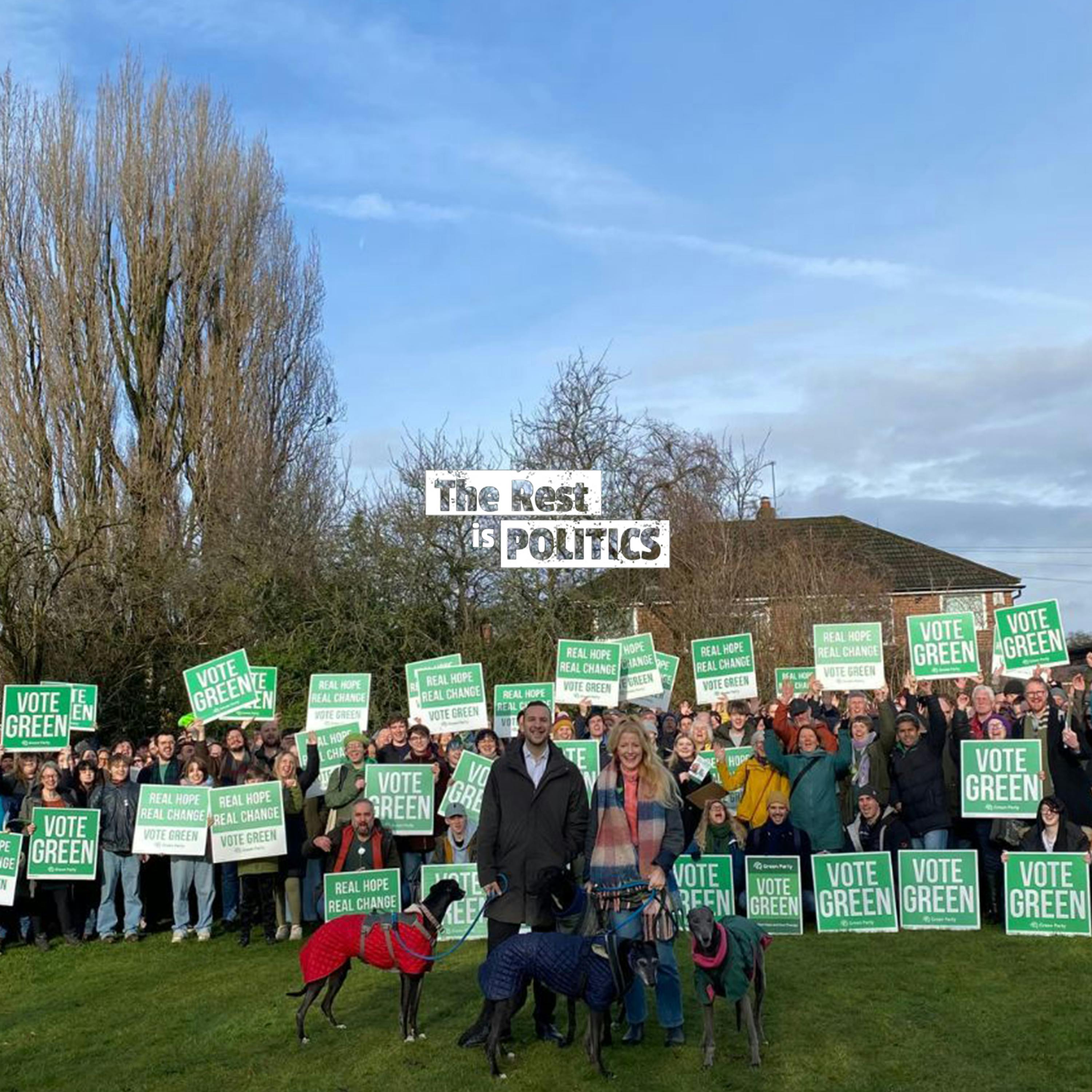
The Rest Is Politics
509. Labour's Polanski Problem and the Student Loans Scandal (Question Time)
00:41:33
Loading summary
Transcript87 lines
- [00:00]
Alistair Campbell
Thanks for listening to the Rest Is Politics. To support the podcast, listen without the adverts and get early access to episodes and live show tickets, go to therestispolitics.com that's therestispolitics.com.
- [00:20]
Rory Stewart
Welcome to the Rest is Politics. Question time with me, Rory Stewart.
- [00:25]
Alistair Campbell
And with me Alistair Campbell. And Rory. It seems a long, long, long time ago that we were talking about whether we shouldn't do special episode on the Gorton and Denton by election, since we've done quite a lot of special episodes, none of them on the Gorton and Denton by election, but we did nonetheless get a lot of questions. Graham Trip plus member from Vancouver doesn't the Gorton and Denton result suggest that voters haven't shifted much, but the parties have? In this traditional Labour seat, most voters still favour progressive policies, yet Labour's move right has left space for the Greens to benefit. Meanwhile, with the Conservatives diminished, traditionally right leaning voters appear to have turned to reform as the party with momentum.
- [01:07]
Rory Stewart
Let's just remind people what happened. So this was very, very recently, as you point out, since the Last main podcast, 26 February, this Labour seat, where traditionally Labour had well over 50% of the vote, came up. This was the one that listeners will remember. Andy Burnham, the Mayor of Manchester, was hoping to stand for that seat as his route back into Parliament and maybe his route to be Prime Minister. He was blocked by the Labour Party from standing and the result was that the Green party won with 40.9% of the vote. Somebody called Hannah Spencer, Reform UK. Matt Goodwin, who my mother thinks is good looking, 28.7%.
- [01:45]
Alistair Campbell
For God's sake, Rory.
- [01:48]
Rory Stewart
Labour dropped.
- [01:49]
Alistair Campbell
He's hideous.
- [01:50]
Rory Stewart
From having won over 50% of the vote in 2024, dropped to third place, down to 24.9% of the vote. And the Tories, for only the second time since 1962, managed to lose their 500 pound deposit. They got so few they didn't even clear 2% of the vote in this seat.
- [02:09]
Alistair Campbell
Yeah, amazing.
- [02:10]
Rory Stewart
The combined Green and Reform vote. I mean, if we go back in the days when, you know, not very long ago, right, the combined Labour and Conservative vote would be well into three quarters. In this election, the combined Green and reform vote was 68%. Almost 70% of people in this constituency voted either for what we call the far right and what I'd be tempted to call the far left.
- [02:34]
Alistair Campbell
I know you have views about the Green pies, we'll maybe go on to that. But I think what going back to Graham's question, though, if you add Green plus Labor, you're talking about more than 65%. So 2/3 voting for what you would define as progressive voices.
- [02:52]
Rory Stewart
The left.
- [02:52]
Alistair Campbell
Yeah, yeah. I was at. Do you remember a couple of years ago we did that Polycon, the event at Central hall for 2000 politics A level students? It again.
- [03:02]
Rory Stewart
Oh, yeah, yeah, yeah. And, and you, you replaced me with Zach Polanski this time, is that right?
- [03:06]
Alistair Campbell
No, I didn't do it with Zach Polanski. I did it on my own. And Zach Polanski was also there. Zach Polinsky, I have to say, he got a huge, huge. It was like a kind of rock star stuff when he arrived. So he's very, very man of the moment. I was able to put people a bit right later on, but he's. There's no doubt the Greens are, they're hitting a chord that is, that is resonating with quite a lot of people. And I think Graham is right that it's because there is this Sen. Labor haven't necessarily delivered all the change that they said they would is too slow. It's too kind of technocratic and also a sense that they are. Yeah. And I've said this many, many times on the podcast that I think that the strategy to sort of, you know, have a kind of imaginative. An imaginary reform voter who's going to come back to labor has driven too much of the comms and actually too much of the policy. I hope that changes. I hope that changes.
- [04:00]
Rory Stewart
The thing that makes me anxious in the background is just a sense. Obviously partly the center's completely collapsed here and we talk a lot about reform and it horrifies me that nearly 30% of the vote here is going to reform and that reformers seem to be sitting at about 30% of the polls pretty consistently over the last year. And we can talk about what that means. It's got very disturbing views on many, many issues. Very disturbing party. But it's something also about the modern world and social media and goodness knows what, that we've gone from a world in which Labour and Conservatives were getting even 90% of the vote a few decades ago to now. This kind of five party system and this idea that the Greens in particular, I mean, you know, the Green Party, I think their previous best by election performance barely reached double digits. Yeah, 10.2% in Somerton and Froome 2023. This result was four times larger. Four times larger.
- [04:58]
Alistair Campbell
This episode is powered by Fuse Energy.
- [05:01]
Rory Stewart
Most of us are buying energy in the dark, not knowing what it costs. You wouldn't do that with your weekly food shop. But with energy, you're often charged first and only find out the number later.
- [05:11]
Alistair Campbell
When you don't have that clarity, you usually end up paying more than you should, which is what Fuse Energy is working to change about how energy works.
- [05:18]
Rory Stewart
The average household switching to Fuse can save around £200 on their energy bills.
- [05:23]
Alistair Campbell
Fuse handles the practical side. The app shows what you're spending day by day and what that actually means for your bills.
- [05:30]
Rory Stewart
For listeners to the show, there's an added benefit. Use the Code Politics when you switch and you'll receive a free trip subscription.
- [05:38]
Alistair Campbell
Switch to Fuse Energy and save around £200 on your energy bills. Use the Code Politics for a free trip subscription. Fuseenergy.com politics and given I mean, I
- [05:51]
Rory Stewart
don't want to re fight this, but obviously there are some people like me who don't actually think that the Green Party's economic policies make sense. I think it's no secret to say it's not just I don't think they make sense. I don't think even Rachel Reeves thinks they make sense or she'd be doing something very, very different with her budgets. Right. Broadly speaking, conventional people in the Conservative and Labour Party think the kind of stuff that Zach Polanski is talking about doesn't make sense. And as we found when we did the interview with him, even more troubling, I felt he didn't seem very comfortable talking about some of the economic facts. I don't want to have this fight again with listeners. But anyway, I'm just worried because I think this is a Green Party. That is, if I was being provocative, I would say is close to being pretty economically irresponsible. And there's another sectarian thing we can talk about as well going on in this by election and they've just romped home. So what the hell does it tell us about our politics that so many people are voting for this party, which I think should be on the fringes, shouldn't be getting 40% of the vote?
- [07:00]
Alistair Campbell
Yeah, well, I think what it says is that people are pretty pissed off. I think I've changed my mind about the Andy Burnham thing. I said at the time that I thought I totally understood why they were blocking him because I thought it just created a great soap opera and it's not entirely clear that Andy Burnham would have won, but he might have done and if he had, that would have been quite a big thing. I think then if Keira just said, right, he's a big beast, I'm going to put him straight in the Cabinet. I want him to be in charge of devolution, Max. And we're going to do big rollout of powers that would have reset things. He could have lost. He could have gone back to being mayor of Manchester and probably won the mayoralty election. So there you go, Rory. You said, I wouldn't criticise Keir Starmer. I think he got it wrong and I got it wrong.
- [07:42]
Rory Stewart
Might go further if he'd lost. You know, that would have been a bit of a win for Starmer.
- [07:45]
Alistair Campbell
Well, never a win to lose a by election.
- [07:48]
Rory Stewart
If he'd won, it would be a chance for Starmer to show what I think he's often struggling to show, which is why didn't he bring in people like David Miliband, Andy Burnham into the front ranks of his politics? You know, where's that sense of confidence and generosity building that really strong, impressive top team? No, I think it's sad.
- [08:08]
Alistair Campbell
I also thought that Keir struck totally the wrong note and the wrong tone in his response. He wrote a letter, MPs that really attacked the Greens and really attacked Hannah Spencer, the candidate, which I think was wrong. I think far better to say, yeah, we are going to have to learn lessons from this and we're going to do it.
- [08:26]
Rory Stewart
We had a bit of a discussion about this, didn't we? Because you almost wanted to try to kind of draft version of the letter is that you weren't particularly following Keir in attacking Greens or complaining about their sectarian campaigning. You were saying, we lost, we screwed up. In a way, it's a little bit like your advice to Rishi Sunak, which is that you actually have to own the mistake and the failure and promise to do better and that continuing to sort of defend the indefinite.
- [08:53]
Alistair Campbell
I also her speech, by the way, Hannah Spencer, the plumber and plasterer, when I was watching her speech, when she won, she was saying the sort of things that a lot of Labour candidates said at the last election. Because what the Greens have done, they sort of dumped the environment, you know, as their main thing. It's all. It's a kind of. It's a left wing, economic, social prospectus. Now, where Keir Starmer's right is that they don't have a program for government, but they're like reform right now. They don't need to. They're just sort of. They're the populists of the left. And so I think it should be a bit of a wake up call. But I go back to the point. I'VE been saying, you know, ever since the election. It's about taking the country with you on a journey behind a clear, compelling narrative where you see things getting better. And that's the story that's not being told.
- [09:38]
Rory Stewart
Yeah. Final one for me is the sectarian stuff. So Gordon and Denton's quite interesting. It's got, I think, a 30% minority ethnic population, which is predominantly British Pakistanis, I think certainly British Asian Muslims. And quite a lot of the campaign involved the Green Party putting out leaflets in Urdu. There was quite a lot of reference to Palestine. And it produced this rather interesting, unusual coalition, which is you've got a Green Party led by a gay Jewish guy who's very comfortable with progressive social policies, somehow scooping up the vote of quite conservative Muslim voters who seem to be motivated people, suggested, at least on the basis of leaflets, by questions of immigration in Palestine. And I'm a little worried about it. I'm not using this, actually primarily to attack the Greens. I'm equally worried, by the way, that the Tories in Harrow, Bob Blackburn, has courted a particular pro Modi Indian vote. In fact, he's got, you know, talking about Trump in the last podcast, getting Congressional Medal of Honor, Bob Blackmun has managed to get the highest medal in India awarded to him by Modi for his unstinting championing of that particular populist nationalist government.
- [11:00]
Alistair Campbell
Wow.
- [11:00]
Rory Stewart
And which has created, I think, one of the very safest Conservative seats in the country. And there is a really interesting question, as we become a more diverse population, do we embrace what's almost taken for granted in the us Certainly was taken for granted with the Irish community and others, that in the end, your foreign policy is partly shaped by relatively recent immigrants and their own connections back to the homeland. Labour's also part of this. We talked about the fact that Anna Salwar's dad, Mohamed Salwar, left being an MP with me in the House of Commons and went back to be a senior minister in the Pakistani government. And we've also been talking about the fact that the niece of Sheikh Hasina, the former leader of Bangladesh, got caught up in Bangladeshi politics and had to resign as a minister from the Labour government. Right. So as we become more diverse, there's a really interesting question of whether we say, as I'd like us to, absolutely not. We have a UK national interest that is completely distinct from this. And we're not going to get involved in what I saw again and again in Parliament, which is, depending on which constituency you represented, you were either championing the Indian side on Kashmir or the Pakistani side on Kashmir, or you were championing the Israeli view on Gaza or the Palestinian view on Gaza or the Turkish view on Cyprus or the Greek view on Cyprus, I want to say, forget all of that. This is not what we're about. In fact, we should be very suspicious of letting our foreign policy be guided by us. Or you can take the other view, which is just the way the world is and this is the direction in which the election's going. Anyway, over to you.
- [12:31]
Alistair Campbell
I fear it's the latter, although I think there's something really weird about the way that reform the Tories. Keir Starmer, to some extent, in the response, talking about this sort of. In the Greens being sectarian, because they managed to attract the support in quite large numbers of a certain group of people. You know, if you go out to Scottish exiles, let's say you go to Scottish exiles, or you. You go out to people who like a particular kind of cultural thing. Is that sectarian? What you do in an election is you target different sections and different groups. You have an overall big message that you're trying to get through. And then sometimes you go. You drill down. When I was a journalist, I don't know if they still do, but people always used to talk about, you know, the Church of England is the Tory party at prayer.
- [13:22]
Rory Stewart
Right.
- [13:22]
Alistair Campbell
Does that mean that if you're a Church of England and you're voting, you're expected to vote Tory? Is that sectarian politics? Of course. That's where I see sectarianism is in religion, in politics.
- [13:32]
Rory Stewart
The bits I glimpsed of this a little bit was my friend Frank Roy showing me around Motherwell, and this was his great statement that Monday to Friday his body was with the trade union movement. Saturday, his heart was with Celtic Football club. Sunday it was with the Catholic Church. And he very much spoke for the Catholic community in Glasgow and was very funny and interesting about the Orange Lodges and the Protestant community and which pub was with who and who was voting for who. And he was sitting in the front row of the Catholic Cathedral and the Cardinal was pointing at him during the sermon. When I was running to be mayor of London as an Independent, I was encouraged to go to SILAT in Bangladesh to campaign, because key voter groups in London are Bangladeshis from silat.
- [14:20]
Alistair Campbell
Yeah.
- [14:21]
Rory Stewart
George Galloway famously, I think, spends about two, three weeks campaigning in Sillard whenever he's. He's running. I mean, you must also, on the other side, also see why people might be a little bit anxious about that.
- [14:31]
Alistair Campbell
Yeah, of course, yeah. Yeah, yeah, yeah, yeah, I do, I do. But I think it's just a fact of life. It's a fact of the way. Our apologies has changed, but. And our demographics have changed, but I just didn't. I just don't like the way they will have this label of sectarians. I think it's all driven by the same sort of racism that we then saw at the end of the violation when Farage and Goodwin, or bad loss as we now call him, the day after the bombing of Iran. Front page of the Mail on Sunday, it was Farage bleating that he won amongst British born voters. Right. You weren't born in Britain.
- [15:09]
Rory Stewart
No, I wasn't. No, I was born in Hong Kong.
- [15:11]
Alistair Campbell
Exactly. But Farage is basically saying, unless you were born in Britain, you can't really have a vote. It's just a sort of. It's another racist trope. And what I really enjoyed about the by election was seeing that Matthew Goodwin being sort of sent out of Manchester, probably never to see the place again. I mean, Farage, they're not spoiled for choice for good candidates. If he thought that was his best candidate for that constituency, that said to me, Farage is making quite big mistakes at the moment. That was a big mistake. Goodwin's. Goodwin's. Have you ever seen him on television? The guy's got the charm of this water bottle. I mean, he just, he just. I can't believe. Your mother may fancy him, Rory, but this is very weird. But, you know, he, he's got, he's got no charm. We'll put in the newsletter this video of him campaigning on the top of a bus. Okay? Keir Starmer's a robot. Labor are terrible. Vote reform. It's the most pathetic piece of campaigning. And I thought, I wonder whether this was Farage cutting him down to size. I don't know, because there's no reason. You know, I agree with you, it's bad. A third of people thought this guy could be their mp. He's terrible. And then he, then he did this bleating about it was stolen by the Islamists and the woke progressives. And by the way, that's a pattern for Farage. This is taken out of the Trump playbook. They always try to claim that somehow they were cheated of a victory. I thought the Green candidate, what I saw of her, I thought she was a very, very effective campaigner. I think you've got to say that. And I think Labour should actually say, yeah. What happened is that a lot of people who are not happy, they decided The Green was a perfectly sensible person to vote for and that's what they did. And Labour's got to think that through. And it is not done by playing this let's pretend that we're reform stuff because it just doesn't work.
- [16:58]
Rory Stewart
Okay? Now Alistair, here's one for you, which I think you've been thinking about a lot. From James. Hi Alistair and Rory. I went to university 2012 to 2016 to study civil engineering at UCL. I was unfortunate to be in the first cohort being charged £9,000 per year in fees and I'm from a low income background. I was required to also take the maximum maintenance loan. As a result, I needed to borrow £61,000 to complete my degree. I've worked full time since graduating and amongst the top 5% earners for my age. Therefore, since graduating I've repaid £15,000. However, during that same period I've accrued £39,000 in interest, meaning my resulting balance is 85,921. So he borrows 61,000, he repays 15,000, which inflation aside would make you think it's down to 45,000, but actually it's up to 85,000. The result of this 9% working class student tax trap is it widens the gap between classes and destroys social mobility in the uk. My peers, who earn similar to me but whose parents paid for their education, are now taking home over £500 more a month than I am. So £6,000 a year. They're buying houses sooner, investing in their future sooner. So what to do? This issue needs radical reform. The feeling of intergenerational injustice amongst my peers towards the government is palpable right now, tracing back to Brexit and the Tory Lib Dem coalition in 2012. But presumably what James has said but hasn't really been addressed by the new government that's come in over to you
- [18:29]
Alistair Campbell
and this has made it worse. And I mentioned this thing I was at yesterday with 2000 A level students. This came up quite a lot. Not in the. In the event, but when I was doing a book signing later. And by the way, Rory, we should be very, very, very proud about how many school kids listen to our podcast. Hundreds of them, hundreds of them. They were quoting their favorite bits. It was all. It was all very, very nice. Anyway, so I was very pleased with that. This is something we should apologise actually, because we've had a lot of people asking us to talk about this for some time, but, you know, we've been so focused on international, what have you. But it's a. I think this is a massive issue and I think the labour to get its head around this pretty quickly, they've got some massive issues they're dealing with. We talked about SEND recently and the school's white paper, but I think this is another one and when you match it, put it alongside the survivability of the university sector. I think this is a really, really, really big issue. So thank you to everybody, the many, many, many people who sent in their stories. The basic issue is something called the Plan 2 loans. And the Plan 2 loans, the way that they're working is it's less like a loan than it's more like a graduate tax. What's happening is that those people who are lucky enough to be able to say to their kids, right, here's the fees, let's just pay them off, let's get rid of it now then they're already well off and they're going to be even better off because they're not going to get trapped into this sort of, you know, never ending rising interest rate. So the way that it works is that you pay interest rates at RPI plus 3%. Okay. And what James is saying is it means you never quite manage to get things down. And what happened, the reason why this particular anger at the moment is in the budget. The last budget, Rachel Rees, froze the repayment threshold at just under 30,000 until 2030. The original plan was it would go up with average earnings, but instead it's been frozen. So you're actually going to end up having to pay the interest on the loan for longer, even as you pay it off. And that is leading to very, very high marginal tax rates. It's adding to a sense of greater inequality. And the other thing I think is worth bearing in mind, Rory, a lot of the MPs who came in last time, I mean, they're quite young and some of them have got this specific problem themselves. So they know about it. And of course, if you wind the whole thing back, we, Tony Blair's government started this whole tuition fees ball rolling. But I would argue that was a kind of a genuine loans system. And because it was £3,000, it was, you know, versus almost 10,000 today. The interest was relatively modest. There were grants that you get alongside it. So you could at least see that what you were owed, what you were owing, once you graduate, you could see it coming down quite quickly. What people in the workforce are saying now is that what they're owing never seems to come down even though they are paying according to the system that they have been given. Look, stuff like this is always very, very technically very complicated. There's one piece we should put in the newsletter. Martin Lewis wrote this really, really good, long, detailed, you know, Q and A type piece about this system and he's absolutely clear this has got to change. And by the way, we put together lots of the complaints that student loan paying people have been, have been making to us. There's a lot of them and they're all essentially saying the same thing, that this feels like they are being punished for having decided to do what everybody says we should do, which is do really well at school, go to university and then try and build a career. And of course, alongside it, there's another piece I'd like to put in the newsletter this week. My friend Peter Hyman wrote a brilliant substack about the Neets and he's out now. Remember, he was talking to young people before the election, he's now talking to
- [22:21]
Rory Stewart
Neets, which is the other end of the extreme right. Neets are not people who are paying student tuition fees, they're people who aren't in education.
- [22:30]
Alistair Campbell
Yeah, exactly. And there's another thing I want to plug the New world. There's a young writer called Lucy Reed and she's written a long read this week about the same issue. I think we've been a bit slow on this because I think it's a very. This is a really big, deep political issue. You'll be interested in this, Roy. The number of starter jobs has fallen by nearly a third since 2022. Coincidentally, the same year ChatGPT was launched. And why people say, why don't the boomers just retire and free up the job change so we can get on the ladder? And I'm inclined to agree, except there isn't a chicken and egg. The longer under 30 stay unemployed or on the minimum wage or no wage internships, the longer the bank of mum and dad has to stay open. The longer that stays open, the longer parents who may have planned to retire at 65 have to keep going to cover their kids ever rocketing rents. The figures are quite terrifying on this.
- [23:23]
Rory Stewart
Well, completely terrifying. Well, let's just look at this. There are approximately 1.2 million recent graduates competing for about 20,000 top tier structured graduate roles.
- [23:36]
Alistair Campbell
Yeah, exactly.
- [23:37]
Rory Stewart
600,000 applicants were interviewed for those roles. So there's a ratio of between 35 if you take the number of people who applied or the total graduate population looking nearly 70 applicants per vacancy. We're doing for members. And just before we go to the break, a little plug for the AI miniseries. We're doing another episode this week where we're taking listeners questions. One of the things we're definitely going to dig into is one of the reasons why you're seeing this massive fall in graduate intake that simply that a lot of these graduate employers are no longer hiring because they can use large language models to do the stuff that previously young graduates did. And what does that mean for educating the next generation children? What does that mean for me as the father of an 8 and 11 year old? What are my children supposed to be studying? What kind of jobs are they going to get? Ivo currently is saying that he wants to be somebody who, he wants to be a road builder, he wants to be the person who smashes rocks, but he's insisting he wants to do it with a pickaxe, not with a pneumatic drill.
- [24:41]
Alistair Campbell
I'm not sure,
- [24:44]
Rory Stewart
maybe that's a better job path than some of the others. Maybe it's something AI will be slower to take on.
- [24:50]
Alistair Campbell
Yeah, but that stat you just read out is pretty terrifying. And so when I look at all those young people yesterday who honestly there was such an energy in the room and they were nice and they were smart and they were clever and they were funny and all this sort of stuff and if that stat that you've just read out, they are going to maybe go to university. A lot of them, some of them were telling me they got their, you know, they were going to this university, that university and then they go and have this sort of soul destroying attempt to find a job. And Lucy Reed's piece, it sort of describes what it's like when you're just going from one application that doesn't get a reply to the next. One interview where you make a sort of minor mistakes. Somebody said they didn't, they were told they didn't get the job because they forgot to bring their own pen. You have this kind of, they're in a, they're trapped in this sense of, you know, everybody says we're snowflakes, everybody says we don't do this, we don't do that, but actually we really, really try hard to work. And so I think what Alan Milburn is doing with this review of the NEETs, in which I hope Peter Hyman's studies will help him as well, that is a really big bad issue. But I think this is one that is not getting the traction in the, in the debate that it should. I do think, I know she's got a lot on her plate and as we speak, she's doing the spring statement today. But I do think this is something the government is going to have to take a really, really careful look at. And also, it does also highlight we got to sort of start valuing vocational education a lot more than we've done historically. And we've got to fight back against these tech bros. Rory, I hope you say that on the Q and A on the AI thing tomorrow.
- [26:30]
Rory Stewart
I hope you enjoy the episode when it comes. Let's take a quick break and then back for some more.
- [26:33]
Alistair Campbell
See you soon.
- [26:34]
Starbucks Advertiser
Spring is here and there's a whole new way to chai at Starbucks that's made perfect for you. Choose your sweetness, dial it up or keep things light. Add a touch of pistachio, a hint of strawberry or vanilla, or make it a spring classic with lavender. Because this, this season, there's endless ways to chai at Starbucks.
- [27:02]
Rory Stewart
Welcome back to the Restless Politics Question
- [27:04]
Alistair Campbell
time with me, Rory Stewart, and with me, Alistair Campbell. Now, Rory, somebody here called Donald and it then said Donald T.R. and I thought, oh, no, please tell me he's not now sending in questions. But it's Donald Trip plus member from Buckingham. I get triggered by seeing Donald because my dad was called Donald, my brother was called Donald, and I hate the fact that every time I hear the word Donald, it's about Donald Trump. It really upsets me. Anyway, this is a really nice question about cultural soft power in the uk, of which we do not make nearly enough. Listening to Rory's interview with John Teucer, ex BBC legend, I was reminded, listening to one man's career, about the vast array of cultural institutions and soft power assets that Britain possesses. At a time when the Labour government is disappointingly continuing the Tories legacy of cutting the World Service. Could reversing course on this be a real opportunity for Starmer? Championing and properly funding Britain's cultural institutions seems like an area where he could differentiate himself on the world stage, especially as American soft power has become so unreliable under Trump. So, Rory, tell us about this interview with John Tuso, who I read is your godfather.
- [28:15]
Rory Stewart
Yeah, yeah. So he's just turned 90, right? Get this, age 90. Johnny has now launched his own podcast called the Best Is Yet To Come.
- [28:25]
Alistair Campbell
Should we be promoting this rival podcast, Roy?
- [28:28]
Rory Stewart
Should we really? Well, it's a very particular idea. His idea is that he's going to interview people aged over 90. He's 90, so he'll be interviewing everybody, Michael Hestein, others. And I guess his point is that amongst the many other bits of bizarre discrimination we have in our society, one of the strongest is actually we tend to stop taking any interest in anyone who's over 90. And he's very much there to correct that. And, of course, he's a legend, as you say. He's a guy who was the Director General of the BBC World Service for a long time. He was then set up Newsnight, one of the big Newsnight presenters, ran the Barbican center and all this kind of stuff. And a brilliant example to encourage us to keep going with our podcast, of somebody who is firing on all cylinders at MIT and has views about the entire world. It's a lovely interview, if you have a chance to listen or listen to the podcast. I think it's a great idea to be harnessing all these people nobody's talked to.
- [29:22]
Alistair Campbell
So you interviewed him?
- [29:24]
Rory Stewart
I interviewed him. But hereafter he's going to be just interviewing other people at show of 90. And his story's lovely. I think you'd love it, because he was born in the Czech Republic, his family basically fled Hitler, moved to Essex, where they set up a branch, the Barter Shoe Factory, which was a Czech shoe factory in Britain. And Johnny, who looks very Czech, grew up speaking Czech, became in love with Britain and he managed to get a National Service Commission in the British Army. Very unusual because, in fact, people were worried about security and checks and things. And he remains to this day a kind of really interesting icon of so many things. He's pretty liberal, like Jon Snow. There's some pretty strange coloured ties going on. There's a huge amount of interest in. He loves music, he loves culture, you'd like the fact he loves football. But he's also really interesting on this question around soft power. So let me throw the soft power thing back to you, because BBC World Service is one example. Many other examples. I think DFID was another example. And one of the sad things is just as America's cut its budget for international aid, and we talked about all the people dying of AIDS and malaria as a result, all around the world and people in extreme poverty and trouble, Britain and Germany have done the same thing. And you would have thought this was exactly the moment to return to one of my old chestnuts, where Britain and Germany, as America leaves the world, should be stepping up to fill some of the space rather than following them into retreat.
- [30:58]
Alistair Campbell
Sticking with the over 90s theme just for one second before I come to sop out Fiona's mum, Audrey, who's now 101 and she's a very good pianist and she stopped playing for a bit and she, she revisited it the other day just. And she always plays by ear. She just, she doesn't read. Well, she can read music, but she basically just sort of sits there drinking away. And it's amazing to watch somebody 101 just sort of, you know, and if you shut your eyes, you know, it's 80 years ago, 50 years ago, whatever. So maybe we should get. We should get Audrey to do the theme tune for your. Your Godfather's. Your Godfather's podcast. Look, I'm a. I think soft power is so important. I'm really looking forward to this year's Soft power index. The UK and the US nearly always come one and two, very rarely, if ever out of the top three. Very hard to imagine the US aren't going to be somewhere down with, you know, Chad. And I mean, it's like, you know, their soft power is. Yeah, I think so. I think Azerbaijan. But I think we. I think we totally underestimate soft power powers. The BBC, absolutely a big part of it. And that's why I don't like it when I draw, but get drawn into slagging off the BBC. But I do. But I still think it's an amazing thing. I think the English language, whether we like it or not, maybe because the Americans speak it with the English language, language is an incredibly important part of our soft power. I felt, though, when I was in Ukraine with all these European. There was all these European diplomats and leaders. So there's. The European Union gets, you know, basically started by the French and the Germans and we kind of pitch in a bit later. It's now totally accepted that English is the language of the European Union. That's a very important part of our, of our soft power, I think, culturally. And music. I think the fact that Shakespeare is probably recognized as the greatest writer who ever lived. I think the Beatles, the fact that Rubio, at that awful speech he made in Munich, who did he mention? He mentioned Shakespeare, he mentioned the Beatles, you know, etc. Amazing theater, amazing cinema, amazing sport, the Premier League. I mean, I hate it at the moment because of Var, but it's still one of the most amazing leagues in the world. And we've just got so much going for us. And that's why I think that the media, our media, which should be part of our soft power, I find it quite weird that it spends most of its time telling its readers just how shit the country is when there's actually quite a lot of stuff Here. That's very, very good.
- [33:20]
Rory Stewart
The government could do a bit more.
- [33:21]
Alistair Campbell
Yeah, they could.
- [33:23]
Rory Stewart
We've often talked about how they could use this Trump world to reset and take Britain in different directions, whether it's around what they do on tax or what they do on defense. I would have loved to see a really interesting reset where at some point Starmer says, not just we're getting closer to Europe, but we're going to have a vision of the world and soft power is going to be a really important part of that and some international development and some media and some sport and some music and the whole thing. We're going to talk about Britain in a different way. I don't want to sound too Cool Britannia about this whole thing, but there would be something quite interesting at a moment where everyone's in a defensive crouch.
- [34:09]
Alistair Campbell
Yeah.
- [34:10]
Rory Stewart
To say, actually this needn't all be about hard power. This actually is an extraordinary opportunity, particularly when America is evacuating the value space, for Britain, Europe, Canada to be more about values in a gentle, thoughtful way. I mean, what is Scandinavia about in the end? Everybody actually still at some level, has sympathy admiration around the world for Norway, Sweden, Denmark. I'm always struck by this, you know, dealing with China, dealing with the Middle East. Even when the Scandinavians are lecturing them on human rights, you sort of get the sense sometimes, at least, that these countries are like, okay, we get that. That's where the Scandinavians are coming from. That's their deal.
- [34:52]
Alistair Campbell
Yeah. And I mentioned. I was talking to Stubb from Finland. I mean, the happiest nation in the world. You know, it's bloody cold.
- [34:58]
Rory Stewart
Pretty cold.
- [34:59]
Alistair Campbell
Exactly. We're the happiest nation in the world. He's often India at the moment, which apparently is the most optimistic nation in the world.
- [35:05]
Rory Stewart
Final one for me. Iran consistently the most paranoid nation in the world. 15% of Iranians are open to trusting other people in repeated polls. It's one of the reasons why one needs to be a bit concerned about the direction in which Iranian politics goes. It's not a society which in the polls necessarily tends towards liberal democracy, because the other country with a slightly paranoid style of politics is, of course, Russia.
- [35:32]
Alistair Campbell
North Korea might be a little bit. Just a tad.
- [35:34]
Rory Stewart
Well, there's a lovely. Have you ever listened to. There's a great Iranian thing called Uncle Napoleon in the 1970s, which is basically about a batty old Iranian grandfather who's obsessed with British plots. The Shaitan E Kuchek, the small Satan that Khomeini refers to. Come and again but yeah, anyway, so I like that. I like that. Happy nations, optimistic nations, paranoid nations.
- [35:58]
Alistair Campbell
Yeah. So what would we be? What's our identity?
- [36:00]
Rory Stewart
Well, come on, then. Go on, then, tell us.
- [36:02]
Alistair Campbell
I've said before, I think it should be as a cultural superpower. We're the cultural. We're a cultured, cultural nation. And that means that's in schools and that's in the arts, and it's through the whole. Right across our society. That's how we.
- [36:16]
Rory Stewart
Comedy. We don't talk about comedy. We're pretty funny. Or we think we're pretty funny, anyway.
- [36:20]
Alistair Campbell
Well, my daughter's very funny, makes a living out of it, so. Right, Rory, here's one. Liv. Rory, what is a subject, class or skill that private schools teach that you think all state schools should teach, too? I think it's memorizing really random pieces of historical literature, being able to spout them on a podcast like you did last week. I can't do that.
- [36:41]
Rory Stewart
Well, I think memorizing. I don't see why memorizing poetry shouldn't be a good thing. No, I'm afraid it's awful. But it's something to do with confidence. I mean, it's exactly the kind of thing that winds you up when you're being angry about private schools, because in the wrong hands, it's the Boris Johnson phenomenon. But in the right hands, it's, of course, really going to be really important in the world of AI because a lot of the world is not, sadly, just going to be about how good you are technically, or how high your IQ is, but how you interrelate with other people. I mean, you talk about resilience. There's a resilience bit, too. I mean, I wouldn't underestimate. I was sent off to boarding school at the age of eight. It doesn't help you in every way, but it did mean that when I was sent to Iraq and I was stuck in a military base for a few months, it didn't feel very different to being a boarding school. So there's some of that stuff, because, of course, these schools were slightly designed for that.
- [37:44]
Alistair Campbell
Yeah, I'm totally with you on the confidence thing. If I go into a school in a really tough, challenging area, as opposed to school in a more affluent area, that's the thing I notice most is the gap in confidence, the gap in people feeling that they have a voice, that people care what they think, that there's any point to really working hard and learning. So I don't disagree with you. I also do wish, honestly I remember once when my son Rory was doing a lot of cross country running, we went to Stowe, Stowe College, which I think is about number five in the list. I don't know where it fits in the Eaton Harrow list.
- [38:25]
Rory Stewart
Well, it's got quickly on that one I don't want to get, but they have a lovely line. The first headmaster of Stowe said he wanted boys who were competent at a dance and invaluable in a shipwreck.
- [38:37]
Alistair Campbell
How do you know that? How do you know what a headmaster of Stowe College was? Anyway? Rory was running. It was the national cross country championships and they're at Stowe College. And honestly, you come off the road, you go past the golf course, you then go past the shooting range, you then got the archery courts over here. It's just unbelievable. I think, God, if every kid in the country had access to this sort of sports facilities, would be a much better country with loads of soft power.
- [39:07]
Rory Stewart
Good, well, good thing to close on. Alistair, thank you. Lovely chat today. Quite domestic, thoughtful stuff, and look forward to engaging again soon. Bye bye.
- [39:15]
Alistair Campbell
See you soon. Bye bye. Foreign.
- [39:23]
Lifelock Advertiser
It's tax season and at Lifelock, we know you're tired of numbers, but here's a big one you need to hear. Billions. That's the amount of money in refunds the IRS has flagged for possible identity fraud. Now here's another big number. 100 million. That's how many data points Lifelock monitors every second. If your identity is stolen, we'll fix it, guaranteed. One last big number. Save up to 40% your first year. Visit lifelock.com podcast for the threats you can't control. Terms apply.