← The Rest Is Politics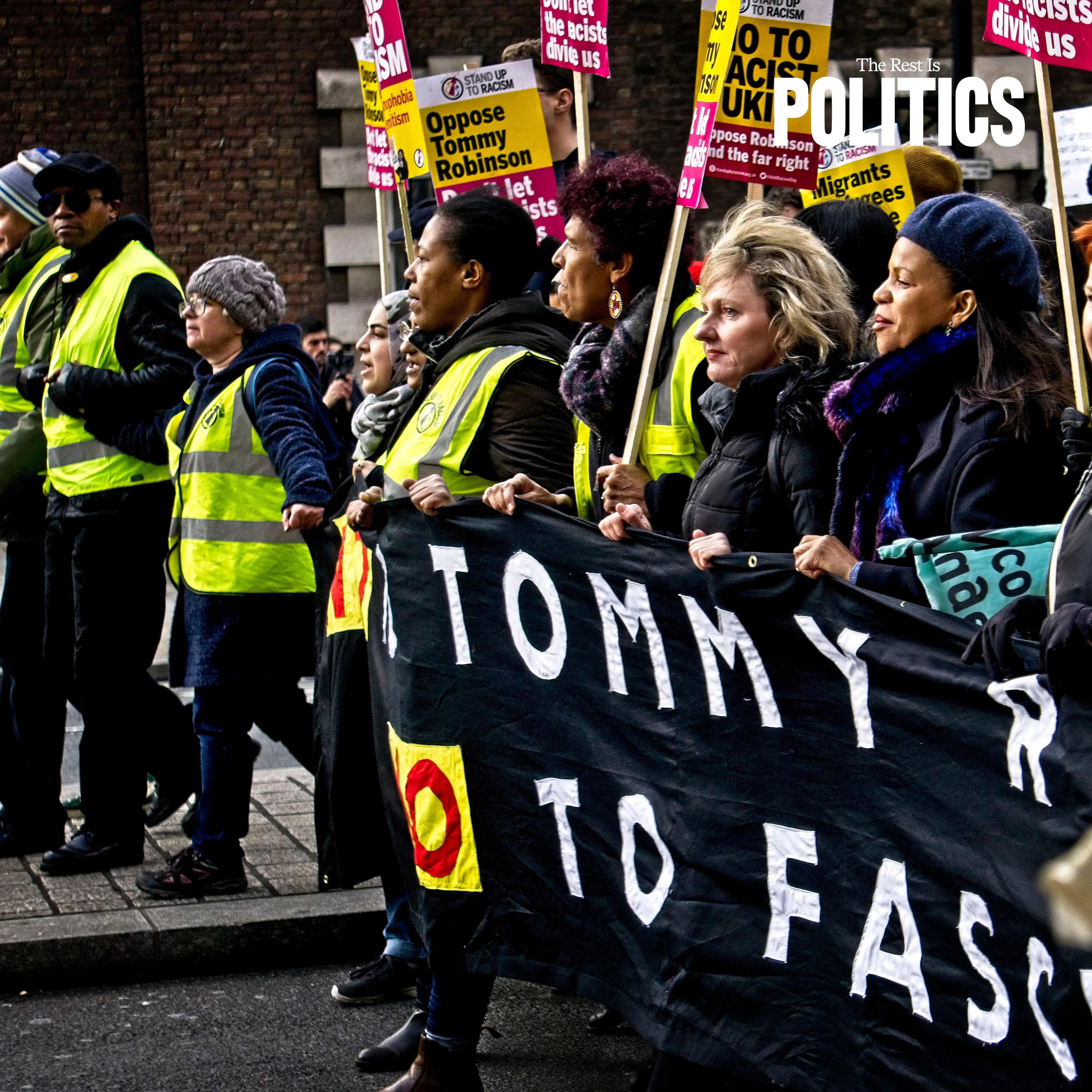
Loading summary
Transcript124 lines
- [00:00]
Alistair Campbell
Thanks for listening to the rest is Politics. To support the podcast, listen without the adverts and get early access to episodes and live show tickets, go to therestispolitics.com that's therestispolitics.com
- [00:14]
Rory Stewart
how serious is the new Ebola outbreak?
- [00:16]
Alistair Campbell
The answer is very and the cuts to US Global health funding are probably part of the reason why this is happening now.
- [00:22]
Rory Stewart
Elon Musk is worth hundreds of billions. I mean, he could feed all the hungry people in the world, especially as
- [00:28]
Alistair Campbell
he was the one who cut USAID in the first place. One of my favorite quotes of the whole thing. He's trying to flatter him, but he's basically just abusing the country. Trump said he's very, very tall, especially for this country because they tend to be a little shorter. As we speak, Putin is on his way to Beijing. Yeah, his 40th meeting.
- [00:45]
Rory Stewart
And that'll be very interesting. Very interesting watching that.
- [00:50]
Alistair Campbell
This episode is brought to you by Fuse Energy.
- [00:52]
Rory Stewart
Fuse has introduced the tracker tariff, designed to give customers what matters most from from their energy supplier, savings, clarity and a bit more control.
- [01:02]
Alistair Campbell
And it guarantees that your rates stay below the offgem price gap, which saves you up to £200. And the tariff updates automatically every quarter.
- [01:13]
Rory Stewart
Energy prices don't move in straight lines. Global events and market pressures you can't predict and certainly can't control still find their way onto your bill.
- [01:21]
Alistair Campbell
And if you're on the wrong tariff, you can be stuck with higher rates after the pressure has ended with Fuse
- [01:27]
Rory Stewart
Energy's tracker tariff that changes if prices fall, your rate adjusts at the next
- [01:32]
Alistair Campbell
quarterly update and it's automatic. No switching, no trying to second guess the market. You're protected while prices are high and ready to benefit when they fall.
- [01:41]
Rory Stewart
Switch to Fuse Energy's tracker tariff@fuseenergy.com politics and use code politics to get a free trip plus subscription.
- [01:50]
Alistair Campbell
Visit fuseenergy.com for full terms and conditions.
- [01:54]
Rory Stewart
Foreign. Welcome to Rest Politics Question Time with
- [02:05]
Alistair Campbell
me, Rory Stewart and me, Alistair Campbell. Now, Rory, we managed to get through the whole of the main episode without mentioning DJ Trump. But we're not going to succeed this time.
- [02:16]
Rory Stewart
No, we're not. So we're going to do. We're going to do us China to follow up on the episode we did, what actually happened in that summit, what came out of it? What does it mean about the new world? We're going to look at Ebola outbreak and what that means for the world. We're going to look at the question of the far right in Britain. And we've got a rather interesting question about communities. So a lot of things to get through. So, Alistair, starting on this, and it'd be interesting whether you think we got what we got right, what we got wrong. But Evie's asked, are Xi and Putin playing Trump and Roy not? Rory has said, has Trump's visit to China shown that China has trumped the USA and the USA is now subordinate to China on the world stage?
- [02:57]
Alistair Campbell
It's interesting how those questions, I think, reflect most of the questions that came in about this, which suggests that most of our listeners and viewers do think that if there was a winner or loser, then Xi was the winner and Trump was the loser. Look, I thought it was fascinating to watch. I really did. And I've got to obviously try to park my Trump derangement syndrome.
- [03:18]
Rory Stewart
And before the tds, give us a sense what it looked like and felt like in there.
- [03:21]
Alistair Campbell
What stood out to me was to go to, to Evie's point, I did feel that he was being played because he loves all that stuff. He loves all the children waving their flags. As he came off the plane, the MAGA crowd was saying, this is a bigger reception than Obama got when he went there. I'll tell you what I found the most interesting thing was that right at the top, President Xi said something really tough about Taiwan. He basically said, if we get this right, that would be great for relations. If we mishandle this issue, it will affect American Chinese relations at every level. And then the other thing I thought was stunning was when he basically said it was this one phrase. I mean, in English on the translation, it came over in five words and it said, century long transformation is accelerating. And what that said to me, I'm not a China expert, but what it said to me was this was him to Donald Trump's face saying, we are overtaking you.
- [04:26]
Rory Stewart
It's an amazing moment. I was struck by the fact that there's this famous story and detective stories. You remember the dog that didn't bark? So the coverage has been about what didn't happen, but I think that's very significant. So we go back the last 20 years has really been about America and China pumping up for a new Cold War started with Obama talking about pivot towards Asia. During Trump won, we had his Secretary of State, who we've interviewed, Mike Pompeo, lacerating China as a dictatorship.
- [04:58]
Alistair Campbell
And then actually even Marco Rubio does the same. Did the same.
- [05:01]
Rory Stewart
Yeah. And even Biden.
- [05:03]
Alistair Campbell
Yep.
- [05:04]
Rory Stewart
You'll remember when we were recording podcasts, some of the very Tense meetings that Jake Sullivan was holding with his Chinese counterpart and Biden not visiting China and skirting around the edge of each other at Bali and trying to read this. So you would have expected until this year one of two things. Either that narrative, which is the narrative that Rubio was pushing, Elbridge Colby was pushing who's the deputy secretary of defense. And he's written a whole book about this, which is how is this used to really put China back in its box? So their dream would be, number one, you reinforce deterrence on Taiwan. You really signal to China, we've got Taiwan's back, we've got the back of Japan and South Korea and all of the US Military is concentrating there, not in the Gulf, not in the Middle east, not in Europe. It's all there. Second thing, you'd probably lean very, very hard into unequal balance on trade. So let's say you really felt as many, many people do, and particularly Republican voters, China's hollowed out American industry, cost millions of American jobs because they've unw, unfairly manipulated their currency, subsidized their industries, stolen our intellectual property. This is a summit in which you really stick it to China on that or you do something else, which is you do the G2 model. The G2 model says the rest of the world doesn't really matter now. We're 50% of the world economy. China, which was smaller, smaller than the British economy in 2004, it's now seven times larger than us. So it is a G2 setup in this world. So you might say, okay, let's sort out the world's issues. We're going to sort out AI safety, we're going to come up with agreements on global development, global trade.
- [06:50]
Alistair Campbell
That's all the stuff we said they might do.
- [06:51]
Rory Stewart
Environment, climate, whatever you might do. None of that happened. But what's interesting for me is that it could have been worse, right? Trump, I mean, I don't know whether he gets a cookie for this, but he didn't really say very much about Taiwan, which was a, a turn up for the books because pretty much anything he said about Taiwan would have gone wrong. And the summit ended really with these two big superpowers circling around each other. A bit suspicious, but they haven't upped the ante either in trade wars or Cold war.
- [07:18]
Alistair Campbell
Yeah. Should tell listeners we've interviewed this week, Rahm Emanuel, who was Barack Obama's chief of staff, and he's now putting his toe pretty deep into the water to try and become the next American president. He's still very hard over on China. We've also had quite a lot of feedback that we weren't hard over enough. Very, very interesting how we sort of quite liked him, but our team really, really didn't. So I'd be fascinated what listeners and viewers think. They're two. When you said, what was it like to sort of watch them? They're two such different people, but actually they've got similarities. One of my favorite favorite quotes of the whole thing was Trump said this. He said, he's very, very tall, especially for this country. He's standing there, by the way. He's very, very tall, especially for this country, because they tend to be a little shorter, which is a kind of. He's trying to flatter him, but he's basically just abusing the country in his own sort of his own pre racist world.
- [08:14]
Rory Stewart
Do you know that the height of Chinese teenagers has increased something like 5 inches? And a lot of this is to do. You know, I don't want to turn this even more into a health podcast, but it's almost entirely about protein. The same happened in Japan after the war. Incredible expansion height. I was born in Hong Kong and my parents lived in Hong Kong till 1997. And when my mother started teaching at Hong Kong University. My mother's very short, about 5 foot 2, 3, she was taller than a lot of her students. By the time she left, she was dwarfed by her students. Incredible what protein does.
- [08:46]
Alistair Campbell
Well, anyway, he's very, very tall. I was also struck by how absolutely exquisite President Xi's suits were.
- [08:54]
Rory Stewart
Is that what he noticed?
- [08:55]
Alistair Campbell
Oh, I mean, they cost a fortune. They were really, really smart. Trump's. Because their styles are so different. Trump goes in. If you remember the last summit when they first met, he said, I'd give the meeting 12 out of 10. We know he struggles with maths, right? But 12 out of 10 isn't a thing, really. This one. He went in saying the first thing that's gonna happen, he's gonna give me a big hug. Well, he didn't give him. It was pretty cold. And so you have this situation, particularly as after the summit ended, Trump gets on airlines.
- [09:26]
Rory Stewart
You remember that famous fraternal embrace that Brezhnev used to give these German leaders where they'd kiss them on the lips and they said, there's nothing like that.
- [09:32]
Alistair Campbell
There was nothing like that. But Trump kept saying the whole time, he's a great friend. He's become a great friend. I get a lot of trouble for saying he's a great friend. He said, all this stuff, he was really trying to lay it on and Xi was having none of it. And then when they got to the briefings after the whole thing, one of the Chinese Foreign Ministry guy was asked whether they were friends, as Trump kept saying, and his reply was the two sides exchanged views on major issues. So Trump gets on the plane and they were all saying, well that was all a bit disappointing, wasn't it Mr. President? He was amazing. The deals on this and Boeing, Boeing shares fell, by the way, because the expectations were not good.
- [10:09]
Rory Stewart
Incidentally, just sort of footnote here. Trump has just disclosed his financial investments. Oh, I know he's a big investor in Boeing. You hear people in the newspapers speaking on behalf of Boeing saying, if you want to make President Trump happ buy Boeing, he's a big shareholder in Boeing. He goes around the world selling Boeing airplanes and he's a big shareholder in Boeing.
- [10:30]
Alistair Campbell
He's also done more trades since becoming President than every president in history.
- [10:35]
Rory Stewart
Anyway, so there it was. So he went off, bought lots of Boeing shares. I'm going to sell lots of Boeings and the Boeing share price will go up and I'll make lots of money.
- [10:40]
Alistair Campbell
Well, in fact it went down because he oversold how many he was going to sell and they didn't buy quite as many. He gets on the plane and says they've done all these amazing deals. So then Wang Yi, the Chinese Foreign Minister is asked about all these amazing deals and his answer is this. We're continuing to implement all the consensus reached in earlier consultations, agreeing to establish a Board of Trade and a Board of investment, addressing each other's concerns over market access and advancing the expansion of two way trade under a reciprocal tariff reduction framework.
- [11:09]
Rory Stewart
Blimey. So in an age of kind of authenticity, populism and sound bites, basically every quote you're giving me from the Chinese government sounds like some 1990s policy paper.
- [11:19]
Alistair Campbell
Yeah. But they're both saying no bullshit. Yeah, they both say bullshit. And here's the other thing. Evie's question, are Xi and Putin playing Trump as we speak? Putin is on his way to Beijing. Yeah, his 40th meeting.
- [11:35]
Rory Stewart
And that'll be very interesting. 40th meeting, very interesting.
- [11:38]
Alistair Campbell
Watching that, I thought the other really interesting thing about, and it was so deliberate, he was doing it so deliberately was when he talked about all the differences between them. But he then said, you know, the key question is, can we, China and us, can we overcome the so called Thucydides trap? And this again I think was a way of saying we're overtaking you because the Thucydides trap, which was made famous by a book by a guy called Graham Allison. Graham Allison, whose book was called Destined for War. And his thesis is that whenever there has been a rising power approaching an established power, a hegemony that inevitably ends in war, and he studied 16 situations like that, 12 of them ended in war.
- [12:23]
Rory Stewart
So Graham Allison actually was a colleague of mine at Harvard. I know him quite well. And he is pretty amazing because he defines these ideas. And one of the great tricks actually, in being somebody working on government is he came up with the phrase Thucydides trap. And now you can see Xi Jinping using it. And his great friend and colleague Joe Nye came up with the phrase soft power. Yeah, yeah, yeah. So it's a great trick. And you've got to get there with perseverance.
- [12:50]
Alistair Campbell
It's not getting there very quickly, is it? He's now three years old.
- [12:55]
Rory Stewart
Xi Jinping hasn't done it yet.
- [12:56]
Alistair Campbell
I mean, Xi Jinping, he is perseverant.
- [12:58]
Rory Stewart
Yeah.
- [12:58]
Alistair Campbell
I mean, he just. He's just. You keep going. So I think that was him saying, as he was saying with the transformation, by the way, which he said the first time he said that concept of the acceleration was in a meeting in Moscow two years ago with Putin. So I think what he's saying, and I actually think the timing of Putin's visit is deliberate. It's basically saying the state media today in China is saying, this shows that we are now the center of global power. We had Trump last week, we've got Putin this week. We've had all those leaders I mentioned last week going. So I think they will have felt they got a lot more out of this than America.
- [13:34]
Rory Stewart
Okay, well, look, we talked about the fact that they didn't talk about the big global issues, global development, Africa, climate, AI, safety. And one issue they didn't talk about was global public health. So we've had a question from Ezra Helen, and this relates exactly to this. How serious is the new Ebola outbreak? Should we be worried about it spreading beyond Africa, especially with the cuts to US Global health funding?
- [13:59]
Alistair Campbell
Very good question. The answer is very. And yes. And the cuts to US Global health funding are probably part of the reason why this is happening now.
- [14:08]
Rory Stewart
Big plug, as always, for leading and people who aren't listening to the back catalogue of leading, as Will Gawande has done some wonderful stuff on this recently. He was the USAID deputy administrator who led on global health. This is something means a lot to me because I was the Minister, during the last big ebola outbreak about 10 years ago.
- [14:27]
Alistair Campbell
DFID. DFID, yeah.
- [14:29]
Rory Stewart
And when that happened 10 years ago, I got together in Paris immediately with Mark Green, who was the head of usaid. We went for a walk over that bridge with all the padlocks on it in the margins of a. I think it was a G7 development analysis meeting. And we worked out funding, and I think we put in an extra 100 million. USAID put in an extra 100 million. Why does it matter? It matters because that allowed us to fund protective equipment, getting the nurses to the front line, doing the testing, developing the vaccination. I then went out to Eastern drc. I went into these Ebola centers. I sat with a nurse who very sadly contracted Ebola and was dying in front of me. I saw children whose parents were in the. The center dying. We were washing ourselves in this very, very intense way to try to make sure there was no fluids of any sort, because.
- [15:20]
Alistair Campbell
Is it through fluid that you get it?
- [15:21]
Rory Stewart
Yeah. And once you've contracted it, your mortality rate at the Moment is about 50%, half a chance. They're very different to Covid.
- [15:28]
Alistair Campbell
So when you were with the nurse who had it, what was the.
- [15:31]
Rory Stewart
There was a plastic sheet between me and him.
- [15:33]
Alistair Campbell
Right.
- [15:33]
Rory Stewart
We were talking through a plastic sheet. He was very, very courageous to see talking to me. And he probably had two days to live. So it's something where. And people will hear this, paradoxically, because it's so lethal, it doesn't spread quite as easily as things like Covid, because so many of the carriers are killed before they can pass it on. But the bigger issue is that global pandemics are, along with AI, probably the biggest threat for the next 20, 30 years that we need to worry about, and dismantling all the money in the global health architecture that stops not just this outbreak of Ebola, but other forms of pandemic coming out of poor developing countries, overwhelming their health systems, overwhelming their borders, and ultimately getting to Britain.
- [16:17]
Alistair Campbell
But if you go back to our previous discussion about the summit, Trump and Xi, given that it's not that long ago since COVID and given Trump at the time was obsessed with the, you know, the China element of COVID you'd have thought that might have been part of the discussion. What have you learned? Have you studied it? What more can we say? But they're just. Because it's not serious.
- [16:39]
Rory Stewart
It's so weird because even for Britain or Germany, if you're looking for a type of investment in international development where you can Prove that there's a national interest. You're not just inverted commas wasting money, giving to people in another country, but you're actually protecting yourself. Global health is the key example. You spend on the border between Uganda and eastern drc, and you are less likely to end up with a border in Britain. I don't understand why people are not making these arguments. I don't understand why we're cutting our global health funding.
- [17:08]
Alistair Campbell
I had a meeting this morning with a guy, a Swedish guy, called Carl Skau, who is the COO of the World Food Program. And this doesn't relate specifically to Ebola, but he was explaining what he has already seen about the consequences of usaid, uk, dfid, German, other countries that have cut their defense spending. He literally got back to yesterday from Afghanistan. He was saying they've had an earthquake, they've had two floods, they've got 2.5 million refugees that have come back from Pakistan and Iran. USAID has cut all, every single penny of funding to Afghanistan, Yemen and Somalia. Okay, he was talking about Gaza. He said, basically in Gaza, they are now managing World Food Program, is managing to get food in, but that is all that's going in.
- [18:07]
Rory Stewart
Okay, can I just interrupt then? Because just to make the problem worse, Afghanistan, Yemen, Somalia, Gaza, when USAID and DFID took its money out, the only people really who stepped up in significant amounts for that were the Gulf, Qatar, Saudi, uae, And their economies are now being crippled by the Iran blockade and this war that Trump and Israel have launched on Iran and Iran's response, which has been attacking them and closing their exports and destroying their economies. So the backup, the Plan B, which was to get wealthy Gulf countries to step up and handle these problems, that's foreign side, because those wealthy Gulf countries are now freezing their funding and are struggling to make their payments because they're not getting the income in.
- [18:53]
Alistair Campbell
That's absolutely right. He said there are four key areas, themes that are directly related to making their life much more difficult as a result. Specifically, we'll come back to the cuts, but the Iran war. The first is they're having to step up their operations in Lebanon and to some extent Gaza as well. The second is the cost of operations have gone up 25% because of the rise in the oil price. There are currently 300 million acutely hungry in the world. And he said if the oil price stays above $100 for any considerable period of time, they've calculated another 45 million will be pushed into acute hunger. And his final point is fertilizer. All of Africa's fertilizer comes through the Straits of Hormuz. So that's going to put prices up and supply down, I think.
- [19:45]
Rory Stewart
Huge credit to the people who are desperately trying to fill some of these gaps when these governments are falling aside and when this chaos is happening. Huge credit to governments like Qatar, which is still trying to support communities in these places. Huge credit also to the private philanthropists. I mean, I think it's wonderful that you do have private individuals being unbelievably generous, stepping in where governments are falling aside. But it can't carry it. You can't deal with Ebola on this basis. You can't deal with vaccinating people. You can't deal with malaria bed nets. You can't deal with a really big multi billion dollar things.
- [20:23]
Alistair Campbell
Well, hold on. Some of these guys, the guys you talk about in your AI series, they could. I mean this. Carl said it would take $13 billion to feed the hungry of the world today. And the war in Iran is costing 2 billion a day.
- [20:40]
Rory Stewart
So stop the war in Iran. And Elon Musk is worth hundreds of billions. I mean he could feed all the hungry people in the world and it would be a rounding era and it would be nice to see him do it. So Elon, if you're listening, especially as
- [20:52]
Alistair Campbell
he was the one who cut USAID in the first place.
- [20:54]
Rory Stewart
Absolutely. If you're listening, step up. I know you're very, very anxious about global population collapse. Fantastic opportunity to support some of the countries in the world that have the strongest population growth and maybe invite them to the United States where they can provide that labor that you're so worried about.
- [21:10]
Alistair Campbell
I can see the sincerity with which you're putting that final word for me on Carl. He said this, this thing which really kind of hit home to me. He said we have been cut. And by the way, UK hasn't got a great story to tell here. The funding from the UK to the World Food Program has been cut from 600 million to 200 million. That's 2/3 gone. Yeah, and he said he put together all the big countries that have pulled back. We've been cut to the bone. And he said this. We are taking from the Hungary to feed only the starving.
- [21:38]
Rory Stewart
Okay, let's take a break. I'm back from the break. This episode is sponsored by Starling, the bank that helps you organize your money, build great habits and stay in control of your spending. Plenty of us have strong opinions on how to run the country. But knowing how to manage your own day to Day can be more of a challenge, especially when it comes to being good with money. That kind of self assured, self governance could start with just checking your balance daily. And yes, it can feel like opening the books at the treasury, but eventually you'll feel like the Chancellor of your own ideal Exchequer.
- [22:13]
Alistair Campbell
Of course you'll want to examine the data around your balance. For that there are tools like Starling's Spending Intelligence. It's an AI powered search bar within Starling Current accounts where you can ask a question about your spending habits and get an instant answer in. App helps deepen your knowledge and make more informed money decisions.
- [22:34]
Rory Stewart
A bit like having a select committee in your wallet.
- [22:37]
Alistair Campbell
Search Starling bank to find out more good with money starts here. Welcome back to the Reciprocal Question Time with me, Alistair Campbell.
- [22:51]
Rory Stewart
And with me Rory Stewart.
- [22:53]
Alistair Campbell
Rory somebody here with a wonderful name, Josh Prose, as opposed to Josh Poetry. At the Unite the Kingdom rally over the weekend, Tommy Robinson, AKA Stephen Yaxley Lennon explicitly told his supporters to join right wing political parties ahead of the 2029 election. Given recent revelations about Nigel Farage's funding and Reform UK's growing profile, how concerned should mainstream politics be about far right street movements transitioning into the ballot box?
- [23:23]
Rory Stewart
Well, I think the first thing is that one should be disturbed and disturbed by the number of people that are supporting them. I mean, I was out, as many other people will have been in London, and I saw the edge of both marches and I saw a really impressive police deployment. That was not an easy thing. Right. You've got a Nakba march happening on one side, you've got Tommy Robinson's march happening on the other. That could have been really horrible.
- [23:45]
Alistair Campbell
How close were they?
- [23:46]
Rory Stewart
Well, one lot were mostly around when I saw them around the edge of Hyde Park. The other lot were around Trafalgar Square. So I suppose the police were keeping a distance between the two. But anyway, it was impressive, impressive policing, but it's pretty scary. I mean, yes, the numbers were down, but there was all this business, which I guess you wouldn't find. I'd actually, sorry, correct me if I'm wrong, one of the things that kept happening is people kept picking up wooden crosses and Tommy Robinson sent out a tweet with the Lord's Prayer in it. So this is all this kind of leaning into Christian nationalism. Would Le Pen's party or the AFD be going so strong on Christian symbolism?
- [24:24]
Alistair Campbell
I've not seen it. I think I expect some of it will.
- [24:27]
Rory Stewart
I mean, in France, this is laiste, right. So they wouldn't be Going to.
- [24:32]
Alistair Campbell
You'd have thought not, but they might do it in terms. Because, I mean, there is a sort of a streak of anti Islam in all of them. Well, more than a streak of anti Islam. And so it was very, very deliberate. I mean, I didn't go to the march, but I was watching some of the coverage. There were these piles, you know, when you go to Stop the War march or something, the piles of black arts. There were piles of crosses.
- [24:54]
Rory Stewart
Yeah, yeah.
- [24:54]
Alistair Campbell
Now, I don't see Tommy Robinson as being a very Christian person in terms of the way he looks at other people and the way he conducts himself.
- [25:03]
Rory Stewart
One of the things that's so interesting is, of course, all the leaders of the Church are expressing serious concern. I mean, we saw the Pope expressing concern, but you also, most of the Church of England clergymen are horrified by this idea that you're sort of using Christianity to. To chasers. I also again talked to people who had relatives on the march and again, the narrative was, oh, it's all very friendly, they're very normal people. Well, maybe, but the people who were speaking on the stage are far from normal. Some people were banned from coming in. But the kind of people he's trying to get speaking are people who claim that Islam is a supremacist religion trying to wipe us all out. There's a particular guy, in fact, wasn't on this much, but who they love retweeting, who's a great inspiration to Elon Musk, who claims that of the 2 billion Muslims in the world, hundreds of millions of them are engaged in a genocidal attempt to try to wipe out the rest of us. Many of them talking about expelling Muslims, many of them talking about banning non Christian places of worship. A lot of this story which we hear again and again on Twitter, Elon Musk's civil war in Britain is inevitable. And when he said that, it got literally millions of retweets and likes. And here's my final point. 26% of UK voters have a positive view of that march. And 50% of men aged 25 to 34 have a positive view of what's going on. I was very troubled. I do not like the vision of a bunch of people marching with crosses, swaggering around in the central London, going to hear speakers who want to expel all the Muslims.
- [26:40]
Alistair Campbell
The reason why Elon Musk is so important is because his whole platform that he's turned into, what he's done with X is the weaponization of hatred and division. And you see a Lot of that. And of course you will get people saying, well, it's because I'm worried about this, I'm worried about that. This is where I kind of have to have a bit of difficulty with the Gary Stevenson point that we talked about on the main podcast is that you can't not confront this. You can't just pretend that it's part of a. Well, the country's not really working very well. This goes way beyond that. People like Yaxley, Lenin, they go way beyond that. And of course, the whole kind of infrastructure that's developing on the right of British politics is so interesting because he didn't just say get involved with Restore or Advance, Rupert Lowe and Ben Nabib's parties. He said, think about joining reform or the Conservative Party. So they're lumping it all in together on the right as you have to hate everybody else to the left of you.
- [27:41]
Rory Stewart
And one of the very disturbing things for me, as somebody who comes from the Conservative Party and are now seeing a lot of Conservative voters becoming reform voters, I was talking to a former colleague of mine this morning on the phone who is a former mp, saying on no account am I to quote him, but he would be tempted to vote for reform if he thought it would keep Labour out. Two thirds of reform voters have a positive view of Rupert Lowe. 61% of Reform voters like Tommy Robinson, like Tommy Robinson. And 54% of them think non white British citizens born abroad should be forced to leave the uk. That's more than half of reform voters. So this story that we're getting out of moderate remain voting Tories, that this is just the Tory Party, it's all fine, there's no problem, they can just go across to reform. They're joining a party where more than half the members think Tommy Robinson's a good thing and think that non white British people should be made to leave the UK who are not born in the UK anyway. So huge thank you to Evan, who did a lot of research on it, but also hope not Hate, which has done quite an interesting report on the British far right from which quite a lot of these figures have been extracted. Now, final question maybe from me, or final serious question, which comes from Brendan Cox. Brendan Cox was married to Jo Cox, my colleague in Parliament, who was horribly murdered just in the lead up to the Brexit referendum and whose sister, Kim Ledbetter is now in Parliament, has been leading all the stuff and her sister dying. Brennan Cox is running an initiative with Oxford University where he's asking people to record 60 seconds on what they think about community, which is then going to be fed into a large AI model about which more later. And he's asked us to do it. So it's a bit unfair to you because you've had no prep, but gone. Give us 60 seconds on what you think about community. I've got my timer up. Ready.
- [29:39]
Alistair Campbell
As you know, Rory, I am a. For an old man, 69 next week. I am a great believer in young people in this country. So I want to live in a country where we respect young people and where young people respect each other. And I think that starts by teaching values in schools, by teaching history in the context of how we have become the country that we are and being proud of that without feeling that we have to own every mistake in our past as well. So I want to live in a community where everybody is well educated, where everybody is taught values of tolerance and respect, and where everybody feels that there is a possibility of them making the most of every inch of every ounce of talent they've got.
- [30:30]
Rory Stewart
So just on your minute, alistair. Here's my 58 seconds. So, firstly, I think we need to start with a sense of anger and shame at how bad things have got in Britain. We need to accept that we have levels of poverty which are completely unjustifiable in the country as wealthy as this, that the situation in our prisons with the homeless is solvable by any government that wanted to do it, that our retreat from international development assistance is a complete betrayal of the world. We need to deliver decent functioning services. And that also involves radicalism. That will mean cuts to welfare. That will mean, unfortunately, some civil servants having to lose their jobs. That will mean very radical reforms. It will mean localism driven by figures like Andy Burnin. And it's going to build towards a positive vision where we know each other, we share values, and we have a positive sense of national pride.
- [31:26]
Alistair Campbell
Okay, okay. Was that bang on a minute?
- [31:29]
Rory Stewart
That was bang on a minute, yeah. It got a bit rushed at the end.
- [31:34]
Alistair Campbell
Yeah.
- [31:34]
Rory Stewart
Well, okay, so the history point I thought was interesting. I mean, one of the things that I think reform voters sense is they worry that, I don't know, labor elite living in London doesn't really resonate with the kind of history that they care about. And, I mean, it's striking. David Cameron asked what his favorite movie was, said it was Zulu. And clearly quite a lot of people who are watching, who are conservative reform voters, love watching Where Eagles Dare or the Battle of Britain and this kind of stuff.
- [32:11]
Alistair Campbell
What was yours?
- [32:12]
Rory Stewart
I love really cheesy Action films. I love things like Gladiator. I think it's really cool. Yeah, I think it's really cool. Gladiator. That's really cool. Yeah.
- [32:18]
Alistair Campbell
Mine's Lady Sings the Blues.
- [32:20]
Rory Stewart
Lady Sings the Blues? Yeah. I thought he was gonna say some weird Japanese black and white 1950s thing. Do you think there is a question around how you tell a positive sense of history, you know, what replaces. If you're Andy Burn, you're going to be like quietly patriotic, appealing to working class vote. What do you do with stories about the Second World War, which after all look pretty recent. You know, our parents, you know, our fathers were alive as adults during that time. Do you have to abandon that entirely? Can you talk about that now?
- [32:50]
Alistair Campbell
Definitely not, no. One of the things I loathe about the right is the way that they've. They think that they own all of that sense of, you know, the military and war and fighting and fighting for values. What I don't like about the debate about history is this sense that, you know, we have to. The statues thing sort of brought this home. You know, we have to, we have to apologize. We shouldn't necessarily apologize, but nor should we pretend that everything's been perfect, that we've always been this perfect country. And this thing about make Britain great again is all about going back to something that we've allegedly lost. Why do I would I define myself as progressive rather than conservative? Because you want to progress, you want to improve from everything that's gone before. So, no, I think history is incredibly important. So I don't know really why. I mean, you threw the question at me. I had no idea it was coming. So I thought I did quite well for my 60 minutes. If I had a few minutes, Roy, I'd have made it much better.
- [33:49]
Rory Stewart
You would have done better, yeah.
- [33:50]
Alistair Campbell
60 seconds. I thought you were a bit policy heavy.
- [33:52]
Rory Stewart
It's a bit party.
- [33:53]
Alistair Campbell
So what's happening? Sanjay Javid explained it really well this morning. He's involved in this with Brendan Cox, is that you record a 60 second voice note saying what you want your community to feel like to be, etc.
- [34:06]
Rory Stewart
Hopefully with a bit more preparation than you and me.
- [34:08]
Alistair Campbell
With more preparation, you can even write it and it then goes into some sort of amazing AI thing and out of that will come a kind of assessment of what people mean by community. And if you want to take part, which we encourage you all to do, then just go to the link in the episode description and it's really interesting.
- [34:28]
Rory Stewart
Again, I keep plugging back, leading, but Audrey Tang who was the AI minister in Taiwan, used a lot of AI to do government and consultations, and it's been done at a local level at American towns by mez. I think we may find that actually it produces surprisingly interesting things, not boiled down, platitudes, but actually, I'm quite confident that these models will produce things which might be quite powerful for politicians.
- [34:55]
Alistair Campbell
Okay, good. And by the way, we're coming up
- [34:58]
Rory Stewart
to the 10th anniversary.
- [34:59]
Alistair Campbell
10th anniversary. Because we're also coming up to the 10th anniversary of the referendum, which is why. Sorry to sort of keep poking Nigel Farage. I thought it was disgusting when he was arguing that his five million pounds was given for his security, when he said he's been. He's the most attacked politician in the uk. Right. Jo Cox was attacked to the point of death. David Amos was attacked to the point of death. So I'll just leave that there. But the. So. So what Jo Cox's politics is all about and what Kim is trying to do and what Brendan is trying to do is this sense that there's more that unites us than divides us. So I think, I guess that's the big point. Where do we find the things that unite us? So on the radio this morning, when I was heading into the studio, they were interviewing people somewhere about, you know, whether we can unite, whether we feel more divided. I can't believe that every single person they spoke to said yes to that question, but every single person that was on said yes to that.
- [35:58]
Rory Stewart
So we're more united, we're more divided, we're more divided, we're more divided.
- [36:01]
Alistair Campbell
There's more hate.
- [36:01]
Rory Stewart
Well, it is, it's just. But part of it is social media, so we should lean into this a bit more. But. So question from Jenny, which I'm going to use for a massive tilt to link what you just said to what I want to talk about. About. She said, why don't you talk more about demography and birth rates? There was an amazing article by John Burns Murdoch in the FT who does this stuff on data, and he was looking at the collapse in birth rates. I was teasing Elon Musk about this before the break, but one of the big questions is, why are birth rates collapsing all over the world? Often in some countries, we're down to children having, on average, a quarter of a child. Whole populations are vanishing. South Korea, Japan's collapsing and there are big ideas. Is it affordability? People can't afford to set up a home. And of course, what he points out is that can't really explain it because it's happened so quickly. So here's the key data point. If you compare how quickly you get 4G and then 5G coverage and the Internet and connects it to falling birth rates, there is a direct correlation. As soon as people get on the Internet on their phone, they stop dating, stop going out, meeting anyone, stop having kids.
- [37:09]
Alistair Campbell
I saw the whole thing about, I thought people were dating all the time by using that.
- [37:13]
Rory Stewart
No, all the data suggests that actually what you're doing is you're sitting on your phone, scrolling around when you could be going out, socializing, going on dates, meeting new people and getting new friends. And it's really interesting because it's too sudden, the collapse in childbearing to have anything to do with long term socioeconomic causes. It's one of the other things for which this machine should be blamed. Yeah, and polarization, obviously, which is where you began, is the most dramatic example of talk because these are algorithms of division. They get us all going by winding us up. So we're all seeing images of people picking up crosses, marching on Trafalgar Square. And we're either picking it up because we love it or we hate it, but it's polarizing us. And the division between young women and young men which is exploding around the world. One other reason apparently why they're not dating is young women are increasingly left wing. Young men are increasingly right wing. And it's driven by what they see on their.
- [38:08]
Alistair Campbell
A lot of these sort of, you know, masculine influences, so called. They are driving men to hate women. You know, misogyny is on the rise in part because that thing. You're absolutely right by the way. We're going to look back on this as one of the worst social experiments of all time. Yeah, just. I'll just explain to you the AFD in Germany, yeah. They say that the low birth rate has been caused by sexual deviation and non reproductive lifestyles. That is why they intend to ban gay pride flags. So there you go.
- [38:38]
Rory Stewart
Well, yeah. Well, that tells you a lot about the AfD. There is incidentally no empirical data whatsoever to back that up in any way.
- [38:49]
Alistair Campbell
China, China's birth rate is a real problem. Famously they had the one child policy and then they realized the birth rate was a problem. So they then said you can have more children, but it's not happening. And 32% of Chinese people aged 18 to 24, that's one in three say they have no desire to have children. In 2012 it was 5%.
- [39:14]
Rory Stewart
So there we are. Okay, that's it.
- [39:16]
Alistair Campbell
Right so when was the.
- [39:18]
Rory Stewart
Well, exactly what's changed from 2012 to 2026? It's not. That's a very short period of time. Historically, yes, there are big six economic things, but a change that rapid has to be about social media and technology. Well, Alistair, listen, we've covered a lot today as usual. We've done China and sea. We didn't get on to Russia, Ukraine, which I think we should talk about next week, but we've done the China Xi Jinping Trump visit, we've done Ebola, World Health Organization funding, we've done community, we've done social media and demographic birth rates. Thank you very much indeed.
- [39:53]
Alistair Campbell
Can I just read out though the question that I've only just noticed, but maybe we can come to next week when we talk about Russia and Ukraine. Matthew Trip plus member from Billingham. I recently watched a documentary that Alistair feature. It was a clip of Tony Blair and Alistair meeting Putin. And I saw that Alistair shook his hand, questioned both to Rory the Tory and to Alistair, who is the most evil person you've shook hands with. Both. Think about that.
- [40:18]
Rory Stewart
We'll both think about that. Thanks. Well, thank you very much. See you soon.
- [40:20]
Alistair Campbell
See you soon.
- [40:21]
Rory Stewart
Bye bye. Some follow the noise. Bloomberg follows the money. Whether it's the funds fueling AI or crypto's trillion dollar swings, there's a money side to every story. Get the money side of the story. Subscribe now@bloomberg.com.