Loading summary
Transcript591 lines
- [00:16]
A
Hello and welcome to the Review of Mess, a podcast dedicated to discussing the highs and lows of pop culture every month. I'm Jessica Defino. I write the newsletter the Review of Beauty.
- [00:27]
B
And I am Emily Kirkpatrick. I write the newsletter I heart Mess, which is a weekly roundup with the best of the worst, celebrity fashion and so much more.
- [00:35]
A
I feel like it's such a big week for us.
- [00:38]
B
It's a huge week and by the time everyone's listening to this, it will all be over. So that's very exciting. I'm having a live show on Thursday where Jess and I are going to chit chat live as we do here in front of a contained audience at my friend's gallery, Half Gallery on in the East Village. I'm very excited. Casey Lewis is going to be there from after school and my friend Alyssa Vingen who does the new Guard podcast.
- [01:03]
A
Yeah, I'm very excited. It's also both of our birthdays.
- [01:06]
B
Oh yeah. It is also. Right, right, right, right. It is also both our birthdays, which is also very exciting. Yeah.
- [01:11]
A
Two July Leos.
- [01:12]
B
This is how we found out that we are both July Leos who met at a party and then decided we wanted to do a podcast together. Like none of that seems like an accident to me. That all seems very astrologically faded.
- [01:25]
A
Yeah, no, it all makes sense now.
- [01:27]
B
The quiet ego, it's really adding up suddenly.
- [01:35]
A
I feel like we should dive in today with your Dumois beef. Oh man, I feel like this has been like percolating in you for so long and we gotta get it out.
- [01:46]
B
Oh yeah. I really am like trying to, I'm trying not to rage, bait myself with how angry this all makes. Basically De Moi and I are at war. We are having a beef. And I don't know if she knows we're having a beef. I don't think she does. Is completely one sided. But I am raging silently basically. I mean, I've had, I think I've brought it up even on this podcast before. Like I have issues with De Moi and just how she runs that account and how she publishes celebrity gossip and what she calls information and news and how she reports that out, which is involves no reporting whatsoever. But I guess it kind of came to a head in the past couple weeks because she is recently. Well, first, let me go, let me go back a step.
- [02:34]
A
Let's back up.
- [02:36]
B
First of all, she got a beauty contract with Violet Gray. This might interest you. She is launching a perfume with Violet Gray and she's doing a hell of a lot of unmarked ads on Instagram about it.
- [02:52]
A
It's so fascinating to me how like ads like that might work since it is her perfume.
- [03:01]
B
Yes.
- [03:03]
A
What are the lines of like, is this an ad? Is this just like a personal promo? Because I created it. But yeah, at least the first few ads were not disclosed at all, right?
- [03:14]
B
No, they were not disclosed at all. I have a screenshot of one of them actually. I can bring up, um, she posted it as though it was one of her usual like submissions to her email account. Like an anonymous submission. And it says pseudonyms please. Colon product junkie. Email sensational non.com. and then the subject line is can you bottle the beach? And then the message is like very clearly a press release. It says word on the street is there's an exclusive new summer scent collab coming to Melrose Place. We hear a one stop luxury beauty destination known for its cult favor just secured the rights to an up until now under the radar fragrance from a super secretive celebrity news source. Apparently no one can resist it. Stay tuned for an announcement soon and get ready to refresh your signature scent with a little Hollywood mystery.
- [04:04]
A
It's so cheesy.
- [04:05]
B
It's super, super cheesy. Like it's not even written.
- [04:08]
A
Does not feel on brand for Violet Gray at all.
- [04:11]
B
Doesn't feel for Violet Gray and for De Moi, it's like poorly written. Like it's just poorly conceived. Like you can do a better fake.
- [04:21]
A
Sensational.
- [04:21]
B
Yeah. Sensational@anon.com is like pretty ridiculous. But then of course, and all the hashtags are like hashtag Violet Gray, hashtag Violet code approved. And then at Violet Gray and someone actually commented on this post, this is a trend you're going to notice with demo's replies that she gave me a very similar reply to my problem with her. She. Someone commented, don't you guys need to disclose this is an ad? Lol. And she said if it was, we would.
- [04:50]
A
I think that's like a tease of the fact that she's not considering it an ad because it's a partnership working with them.
- [04:59]
B
Yeah, but you're still promoting a product.
- [05:01]
A
I agree, but I think she does not see it that way.
- [05:06]
B
Right? No, she clearly does not. But also like to me, does the legal problem not come in when you start denying that it's even like an ad to begin with? Like it's one thing to post the unmarked spawn con, right? And it's another to add actively tell your followers like this is not an ad. Like no one is getting paid from this. No one is making money from this. To me, that's where you start having a real issue. Anyway, so I was already kind of like, up her butt because of that. That really bothered me. And then she has this new exclusive deal with Backgrid. And for those who don't know, Backgrid is like, one of the biggest paparazzi agencies in the world. They first came to my attention in probably like 2018, 2019, because they started when I was working at Page Six, because they started getting. It was every photo that you would ever want to write about or, like, could turn into a story was coming from Backgrid. And we, like, could not figure it out because we did not have a deal with them. We had never heard of them before. Anyway, they burst onto the scene with all these exclusive deals with big celebrities and exclusive paparazzi images of them. And so now Deuxmoi has an exclusive deal with them and is publishing these paparazzi images with an exclusive, which, for those who don't know what that means, that's traditionally what tabloids get. So, like, they have complete publishing rights to the Images for usually 24 hours exclusively. And then after those 24 hours are over, which is like, after all the traffic that the story would drive is over, other tabloids are able to then buy those images and publish their own stories about them.
- [06:41]
A
Got it.
- [06:42]
B
So Deuxmoi now has this, like, tabloid level deal, a deal that honestly is pretty much exclusively reserved for somewhere like Daily Mail or People magazine, because they're kind of the ones who can afford. I mean, these are crazy prices. When we talk about really good exclusive. I mean, a lot of stuff. Dumois publishing is not, I wouldn't say, like, super good, like, super worthy exclusives that, like, a big tabloid would pay for.
- [07:07]
A
That's true. Do you think they're getting the same traffic as something like people, just in a different medium?
- [07:14]
B
I. Yeah, I think they're probably getting similar, but it's like, traffic to what? To the Instagram post. Like, I get why that's benefit. I don't understand how that's translating into money for her. I guess ad revenue. She could charge more for more eyes on it. But, like, I don't know.
- [07:32]
A
It doesn't make sense unless she's planning on getting into more, like, product partnerships herself. Really.
- [07:38]
B
It doesn't make sense to me unless she's. This is where I really have the bone to pick. It doesn't make sense to me unless she's trying to become a rival tabloid. Unless she's Trying to position herself as a authentic news source and a journalist. And that is everything she is not. So basically what the beef comes down to beyond all of this is I was seeing her post these exclusive photos over and over again and again. They're like, you know, Emily Ratajkowski at the White Party. It's like not anything that people's gonna fight her over. You know, it's like that actually wouldn't drive a lot of traffic for a normal tabloid news site, but okay. And so she's posting these over and over again. And so I shared one on my Instagram stories and I said, if, if she is going to have these types of like real tabloid level deals with paparazzi photo agencies, at what point does she start getting held to the same journalistic standards as any other tabloid, any other news outlet? And she responded to me and says, who says that I'm not? And I replied, lol. Are you kidding me? Are you joking? That is comical. And to say that to me of all people, a real tabloid journalist who knows the real rules. Crazy. Crazy. And it's just very upsetting because to me, what De Moi is doing, it's like as she positions herself more and more as an authentic news source, she's putting herself more and more at legal risk, in my opinion. Aside from all the unmarked ads and stuff. It's like when you are, when you are publishing literally defamatory pieces of information and unsubstantiated pieces of information about very rich, very famous people, you're going to get sued.
- [09:20]
A
Exactly.
- [09:21]
B
Especially if you start saying like, oh, I am a tabloid, like, I am Page Six, I am People magazine. It's like you're asking for a lawsuit then. Because most of what she's publishing is hearsay, gossip, rumors.
- [09:34]
A
Right. And it, it all comes in anonymously. So there's not even like a source she can check with and keep them anonymous in her reporting.
- [09:43]
B
Sure, but let me substantiate.
- [09:45]
A
Right?
- [09:45]
B
Yes. But I'd also just like to say, as someone who's worked professionally as a reporter at tabloids, it's like there is a reason that we do and do not publish certain things. There are certain things that you can and you cannot prove, and when you cannot prove them, you don't publish them because you get sued. It's like really kind of that simple. And she publishes a lot of stuff that you really genuinely cannot prove and that often she's proven to be very incorrect about.
- [10:11]
A
And she's not like shy about being like, this might not be true. Like that she doesn't verify her information. Right?
- [10:20]
B
Yeah.
- [10:20]
A
Or. I don't know. I'm not like.
- [10:22]
B
I mean, she says that she has, like, a disclaimer at the top that I think, you know, I assume she also has a lawyer on retainer who's advising her on all of this, but I think could be advising her a little better or a little more rigorously, because I know certainly the lawyers that the legal teams I've spoken with at the publications I work for would never let most of this stuff slide whatsoever.
- [10:43]
A
Has she been sued before? And I wonder why not?
- [10:45]
B
If not, I don't believe she has been sued before, but I think she's walking a real dangerous line, especially considering that Taylor Swift now hates her because she published that stuff about how Taylor and Joe Alwyn were, like, secretly married. To the point that Tree Pain had to come out and be like, shut up. Like, not true. Like, stop publishing stuff like this. It's, like, really damaging and incorrect. And she stood by that reporting.
- [11:09]
A
But how can you. How can you stand by.
- [11:11]
B
How can you. Literally, how can you. And when. And when a rep is telling you, hold on, I have a quote. I'm also thinking you're just going up against Taylor Swift, who, like, loves a baseless lawsuit against a social media account. Like, you're. I'm thinking about the jet guy, the private jet guy who was tracking her, and she tried to make the case. There's, like, an invasion of privacy. And everyone was like, that's. No, that's actually not what that is. That's public information that he's disseminating. So, like, best of luck. But, like, if she's willing to try it with him, why wouldn't she be willing to try it with De Moi?
- [11:40]
A
Feels like she has a better chance of winning something here than with that.
- [11:43]
B
Anyway, Tree made a statement. She said, it's time for you to be held accountable for the pain and trauma you cause with posts like these. And then De Moi replied, Well, I make $0 from lying. Can publicists say the same? How. How do you make zero dollars?
- [12:00]
A
I, like, don't even really understand what she's trying to say.
- [12:04]
B
It's. It's the same as, like, her, like, quip to me about, like, how do you know? I don't, like, It's a lot of, like, Right. Obfuscating of, like, what is actually, like, just not sound practices. And it's not even from a journalistic point. Like, obviously I'm separate from that. But, like, also, just as someone who's running Their business and their whole business is the social media account. You might be a little more concerned about, like, how it's operating and how legitimately it's operating and, like, how above board it is. Especially the larger you get, the more you. Like, now she has a novel. She has a TV show in the works with a lot of big, famous people attached to it, which to me is just Gossip Girl. I don't. We already rebooted Gossip Girl, and no one wanted it. I'm not really sure what this is going to do that. That wouldn't.
- [12:45]
A
Exactly.
- [12:46]
B
And you have this fragrance. I assume it's going to roll into more products and merch and weird. Non.
- [12:51]
A
I would assume so.
- [12:52]
B
So wouldn't you want to protect yourself at every point? I don't know.
- [12:57]
A
That's what I'm thinking. I'm like, why, if this were me, I would want to distinguish how I am not, like, a tabloid, not a journalist. In order to protect yourself more.
- [13:08]
B
Yes. Make it really clear. Like, I am just regurgitating what I receive in my DMs. Like, I am not editorializing, you know, like, I. Verifying. I don't know. But even that. It's like, that seems at the size that she is with, like, the. The amount of corporate deals and stuff that she. No, that seems like a really difficult line to walk. Like, oh, I'm just a private person running my private social media account.
- [13:31]
A
It also seems kind of like a risky move for a brand like Violet Gray, which is very involved in celebrity and working with these, like, celebrity experts to curate all of their beauty products, to get involved with an account like Dumois, which really publishes, like, defamatory stuff almost daily. Like, I wonder what will happen if someone that works with Violet Gray has a beef with De Moi in the future. Like, what does that look like for the brand? It does seem kind of like a risky move for them specifically to get involved because they are so reliant on celebrity beauty secrets to run their business.
- [14:14]
B
Yes. And the. The potential to, like, alienate the celebrities you're working with is incredibly high. And I mean, that's kind of like, Deuxmoi has always positioned herself as, like, the anti tabloid because tabloids have a very similar relationship with celebrities. Right. Like, right. I know from working at People magazine, like, there was a lot of celebrity gossip that I learned there that we would not publish because we had personal relationships with those celebrities, and we wanted something from them in the future. We wanted a cover, we wanted an exclusive. We wanted a scoop, whatever. So you negotiate this really complicated PR relationship with them. And De Moi has always positioned herself as, like, not having to do that because she's not beholden to any of these people, which is, like, okay, cool. But you're also not beholden to fact. And now that you're, like, creating these relationships with people who are beholden to them, like, how does that impact your coverage? How does that shift things? And are you going to disclose that you now have these biases or, like, have these relations and that you are protecting them and you aren't publishing maybe certain gossip because of it? I don't know. I think it's very complicated. I'm interested to see how she navigates it. I'm interested to see who the first celebrity to sue her is gonna be. Yes, me too, because I was, like, going down this rabbit hole of, like, disclosure and illegality and whatever. It also brought to my attention Stylenotcom, which I now have beef with Stylen.com too, because I did not know this until I read their New York Times profile. For those who don't know, Style.com is not similar to Deuxmoi, but it's also kind of another Instagram account that popped up around the pandemic that positions itself as a kind of fashion news source. So his style is he posts an all blue square with white text, and it's usually just kind of like his thoughts on a new fashion development, a new creative director being appointed, a new collection he just saw, and now he gets invited to everything. Right. So he goes to the Met Gala. He goes to Fashion Week. Yeah, he's very beloved.
- [16:12]
A
I didn't realize he was Met Gala level.
- [16:14]
B
Oh, he is Met Gala level. I mean, not walk up the stairs Met Gala level, but, like, stand in the press box at Gala level. Which is, again, aligning yourself with traditional media and aligning yourself with these big names in a way that one would think would be troubling. But he actually has an incredible loophole. So I was reading his New York Times profile, and it turns out that, like, pretty much everything he's publishing is an undisclosed ad from a brand. Pretty much. None of it is news. None of it is objective. Yeah, everything is an undisclosed ad. And he actually doesn't have to disclose it because the New York Times profile was talking about a book he just published that's just kind of like a roundup of his Instagram posts. I don't really understand, but they were saying the book sells pages like advertising. But which posts and pages are ads remains undisclosed thanks to a loophole. And Then the creator says, my account is connected with Georgia, the country, not the state where I'm not obliged to mention the sponsored content for the brands. Mr. Giffashani said, declining to name his paying clients. This is the reason the brands like to work with me. Like, no fucking joke. They like working with you. No kidding.
- [17:27]
A
This is like the Cayman Islands.
- [17:29]
B
Yes, exactly. This is the tax haven of influencing, for sure. It's so crazy to me that that's allowed to happen and that he, again, that he can present himself like Dumont, as this, like, really reliable, objective, trustworthy, like, kind of truth teller within the industry. And as someone who considers themselves a truth teller in this industry, I am offended. But seriously, like, it's. It's really wild that you can just be doing ads for, like, Bottega Veneta or whatever, and being like, this collection is genius. This is the most influential perfect, you know, purse or outfits or whatever that's ever been made. And all of his fans are going to take that at face value and be like, oh, yeah, he loves this stuff. It's like, no, he loves the check that comes with that stuff.
- [18:14]
A
Wow.
- [18:15]
B
And we're just getting into really weird, dangerous territory, in my opinion, that nobody seems to care about. I mean, I've been talking about celebrities doing unmarked ads for a very long. A million years, a very long time, and complaining about and wondering, like, where is the regulating governmental body that's supposed to, like, stop this from happening and, like, not brainwash all their followers and then income. These guys.
- [18:39]
A
Wow.
- [18:39]
B
I'm like, I didn't even know I had to look out for you.
- [18:42]
A
And it's interesting that he feels totally secure being like, oh, yeah, there's a loophole. I'm set up in Georgia, actually.
- [18:48]
B
Isn't it fantastic?
- [18:49]
A
Like, because he probably knows that won't impact his business at all. Like, the people are already in on him and hooked on what he's doing.
- [18:59]
B
And. And I'm telling you, most people who follow him are never going to read that profile. They are never going to find out that his account is based in Georgia and that he's doing this, like, really shady thing. Actually, if anything, it's giving ideas to other creators. I feel like, like, oh, I could base my account in Georgia and, like, get away with everything and get paid. I'm sure he's getting paid an unbelievable amount of money for every ad that he posts. I mean, hold on. How many followers does he have right now? Yeah, I mean, 385,000. Modest. And compared to de Moi's what is it, 2 million? Yeah, de Moi is 2 million. I mean, it's smaller, but it's not small by any means, you know.
- [19:39]
A
Yeah. And this is just kind of remind, like the way that they're set up as sort of like these anti traditional industry accounts that are now aligning themselves with like traditional media and really a part of the system while profiting off of seeming as if they're not. Sort of reminds me of like, I've been trying to write something about this in the beauty industry that I call the sheep in Wolf's clothing critique, where it's like you kind of have this presentation of being like anti industry. I'm going to take everything down. It seems like a harsh critique. And then when you pull it all back, it's like actually in complete alignment with everything the industry already says. So it'll be things like, you know, talking about like the risks of plastic surgery or Botox or whatever, and then it like ends on. But, you know, do whatever makes you happy, I suppose. Support everyone's right to do anything they want. And it just like kind of like softens their whole.
- [20:42]
B
Yeah, flattens the whole argument.
- [20:44]
A
Yes, exactly.
- [20:45]
B
Yeah.
- [20:46]
A
But yeah, I feel like that is going to become a bigger and bigger thing, especially with, you know, our home base substack. I feel like a lot of people are, are using substack to sort of position themselves as like anti traditional media for sure and doing many of the same things.
- [21:03]
B
Couldn't be more traditional. I think this all the time with like the landscape of fashion newsletters that are just making. I mean, I do it too, I guess once a month, but people whose entire newsletter is just affiliate links and a lot of those, A lot of those affiliate links and a lot of those relationships with those brands are ads, they're deals, they're back, or, you know, if they're not getting paid outright to mention the brand, a lot of the time they're getting a higher percentage rate or a higher cut of the revenue from sending people in that direction.
- [21:35]
A
Yes.
- [21:35]
B
And that alone to me is like, okay, well, you are compromising your values a little bit in a way that you're not fully disclosing to your followers. That seems important to me. And yeah, like you're saying, I just think, I think fashion and beauty in particular are very good at reabsorbing their detractors so that like anyone who speaks out against them, they like kind of find out what they want or like, what would make them feel like, oh, you're an insider now, you're Included, you're getting invited to this, you're getting sponsored by that, you're getting gifted this and kind of break down a lot of like, what made them kind of. Yeah, the sharp edges to begin with.
- [22:12]
A
100%, I think. I think that's like a perfect way of putting it. It's very depressing and it's happening constantly. Yeah. Yeah. The affiliate link thing on like private newsletters really does bum me out because I'm like, this could have been such a cool opportunity to. To do something different.
- [22:29]
B
Yeah.
- [22:30]
A
To not do like ads and affiliate links. There's a different revenue option or just.
- [22:35]
B
Like, how do we trust recommendations? How do, like, I want to follow people who I think are cool and I like and I would genuinely like to hear, like, what are you into? What do you like right now? Like, show it to me. But like, how do you ever have a sense of trust? I don't know. It's so hard. I don't know. It's. Yeah, it's very depressing. I don't.
- [22:54]
A
I agree. I mean, to pivot to like a very obvious ad.
- [22:59]
B
Let's do it.
- [23:00]
A
I really want to talk about Demi Lovato's new song for ogx, Hair Care.
- [23:07]
B
Haven't heard it.
- [23:08]
A
Oh my gosh. You have to listen to it. It's such a bizarre beauty collaboration to me. So ogx, which is like, I'm sure you've. Everyone has seen the bottles. They're like vaguely like fish shaped bottles. Like, they sort of remind me of like the L'Oreal kids.
- [23:22]
B
That's exactly what I was just thinking. I was thinking of the L'Oreal Kids Shampoo.
- [23:26]
A
The L'Oreal Kid Shampoo of our youth that was like sort of shaped like a fish and the top opened like a mouth. OGX is like the adult version of that. So that's what the bottles are shaped like. They're in like Walgreens, cvs, Target, you know, it's kind of like a mass product. And yeah, they, they hired Demi Lovato to like write a song about the products. And it's. It's just a song completely about ogx. The lyrics are like, ogx OG Who? OG Me. OGU OG New ogu OG oh gee.
- [24:03]
B
New oh gee me.
- [24:05]
A
And then it's like, you know, it's giving shine, it's giving chic.
- [24:10]
B
Not it's giving.
- [24:12]
A
It's giving. It's giving chic and it's giving chic.
- [24:15]
B
It's giving shampoo, it's giving bottle, it's.
- [24:17]
A
Giving Ad, which I love. I love that. It's so obvious.
- [24:22]
B
Yeah. It's giving jingle.
- [24:23]
A
It's giving jingle for sure.
- [24:26]
B
I wonder how much she got paid for that.
- [24:28]
A
I tried to find out. I researched all morning being like, how much did Demi get for this? Could not find it.
- [24:35]
B
They'll never tell you. I love knowing how much celebrities sell out for, though. It's like one of my great passions in life is knowing, like, exactly how much they charge for Instagram ads and all of that.
- [24:45]
A
Yeah. And like, the video for the song is her, like, in the studio singing it. And, you know, there's no joy in her eyes. There's no life in her.
- [24:56]
B
Just a check being clear.
- [24:58]
A
And there's a bunch of interviews that have been out about it. Actually, Popsugar had the funniest, like, opener.
- [25:04]
B
Let's hear it, Popsugar.
- [25:06]
A
It said, Demi Lovato shares the secret to their confidence. Colon, hair. Hair is the secret.
- [25:14]
B
Me too, bro. My hair gives me all the confidence.
- [25:18]
A
Oh, my God. I just thought that was really funny. And the. The campaign is called og. Who? Ogx. So it's like they're acknowledging nobody knows who or what they are.
- [25:30]
B
Right.
- [25:30]
A
And this is like their bid to make it big.
- [25:33]
B
This is them bursting onto the scene with Demi Lovato, making a name for themselves.
- [25:37]
A
But all the interviews she's done about it are so blah. Like, all the quotes. Well, now I'm actually second guessing myself. I believe Demi's pronouns are she, they. Correct.
- [25:48]
B
Yeah. There's she, they. For a period, it was they, them, and then they backtracked to she her, because I don't believe. Because her identity changed, but because people were having such a hard time using the proper pronouns that they went she, they.
- [26:04]
A
Because I read all these articles and I'm pretty sure they all referenced she her. So I just wanted to make sure I'm not.
- [26:10]
B
Yes, it, she, they.
- [26:11]
A
Okay. So anyway, in these articles, her quotes are just like, I love this shampoo because it's healthy. My hair looks so healthy. I love healthy hair and the confidence.
- [26:24]
B
That healthy hair brings.
- [26:25]
A
Exactly. I just wanted something about self expression and hair and how healthy it is. Like, it's. It's sad. So I hope she got paid a lot of money for it because it's clearly just not very fun for her.
- [26:39]
B
I hope so too. I. Yeah, much like finding out how much they get paid for this stuff. I also love the press that they have to do on behalf of it because they're obviously so unhappy. And there's obviously, like, key Talking points that they've been told they have to hit and that they cannot fear from. And so they end up giving the same exact sound bite to every single outlet that speaks to them. It actually, it reminds me a lot. Here's a little piece of lore about me is I interviewed Kendall Jenner about the Pepsi commercial. No, I did. I did. When I was at People magazine, I was bestowed with the great, great honor of that. And the crazy thing is, Pepsi wouldn't let us see the commercial before we talked to her. And it's like, now I see why. I get why. Because she couldn't have possibly answered any.
- [27:23]
A
Questions about, what was your reaction after interviewing her and then seeing that she, like, solved racism with a Pepsi horror?
- [27:32]
B
And it was like. I think it was maybe the first piece I'd ever written. It was just a tiny, tiny blurb that was going in print. And so I was like, oh, my God, my print legacy is, like, vaguely endorsing this Pepsi commercial. So embarrassing.
- [27:46]
A
Oh, no.
- [27:47]
B
Anyway, that's not even the point of. The point is that the interview that I did with Kendall was. I consider it the worst interview I've ever done with a celebrity. Like, not in terms of me or the questions I was asking, but the responses and the lack thereof that I was receiving. And it was to the point that I was like, girl, are you media trained? Like, have you ever done an interview before?
- [28:07]
A
I don't know. Well, because a part of my lore is I was the assistant editor on Kendall's app, of course, So I had to interview her many times for the app content. And you brave, brave soldier. Of all the sisters, she was the least into it, which I sort of respected.
- [28:28]
B
Sure. But don't do it.
- [28:29]
A
Exactly. And she closed her app. She closed her app before all of the other ones did, because she was like, this is not a priority for me.
- [28:36]
B
She does have a real career.
- [28:37]
A
So she did. But I can imagine that something about, like, a sponsor, an ad placement she did was even harder to pull anything useful.
- [28:49]
B
Yeah, it was terse. And I was like, babe, like, we're working together on this. Like, I, you know, I have to create a story. You know, you're getting paid because stories are being written. Like, just tell me something. And also when I say not media trained, I mean, like, maybe people don't know this, that in celebrity interviews, celebrities professionally, the way that you professionally answer an interview question is you restate the question back to the person. So when you say, like, what's your favorite color? Instead of saying, like, red, you say, My favorite color is red, so that it can be used as a full quote, like a full sound bite in context. That makes sense. And she would not let me have it. So I kept saying things and she would be like, yeah, dead silence on the other end. I was like, okay, moving right along.
- [29:35]
A
Incredible. Incredible.
- [29:37]
B
Anyway, again, I bring this up with the Demi Lovato of it all because you could really tell that, like, she had a couple of, like, key talking points Pepsi had given her and she was sticking them rigorously. And if I even like, kind of veered off ever so slightly because I was like, nothing interesting is coming out of this. The PR person is on the phone and they wrangled it right back and they're like, she actually won't be answering any questions about that today. And I'm like, will she be answering any questions at all? Because I haven't heard an answer.
- [30:01]
A
I haven't gotten any answers.
- [30:02]
B
But also, this really reminds me of when Bebe Rexha did the Lays jingle. Do you remember that?
- [30:09]
A
Conic. Yes.
- [30:10]
B
Yeah. Crunch, Crunch.
- [30:12]
A
Yes.
- [30:12]
B
Shout out to who weekly.
- [30:13]
A
But yeah, the OGX thing, you could tell they gave her the talking points of, like, healthy hair, self expression, confidence. And I can't stop listening to it. I've played it like three times this morning.
- [30:26]
B
You, Stan?
- [30:27]
A
I. Stan. It's just. It's stuck in my head and it feels like a really outdated way of. Of like shilling for beauty. But I don't know why, because I can't think of anything quite like this being before.
- [30:41]
B
Yeah, that's true.
- [30:42]
A
Like just a full song created about a beauty product. Like, I was. So I was trying to think of other songs that mentioned beauty products and of course, like, Lip Gloss by Lil Mama came to mind.
- [30:52]
B
Classic.
- [30:53]
A
That came out in 2008.
- [30:55]
B
Where's little mama's lip gloss deal, by the way?
- [30:58]
A
It literally came out in 2023. She launched the song in 2008. In 2023, she launched a lip gloss line called It's Poppin. Huge gap.
- [31:08]
B
It's a little late. Yeah, it's a. She kind of missed the boat on that one. But, like, I'm not totally mad at it. Like, that is what she should have done. Just like, you know, decades ago.
- [31:17]
A
A long time ago.
- [31:18]
B
A long, long time ago.
- [31:19]
A
I think Demi Lovato missed the boat on celebrity beauty brands too, because I was looking it up. Because I was like, why is she doing this instead of launching her own hair care line? Not that I want her to, but.
- [31:29]
B
It seems odd, but that's what everybody does. Yeah.
- [31:32]
A
And in 2014, she launched a skincare line called Devon by. By Demi.
- [31:37]
B
And where's Devon now?
- [31:39]
A
I have no recollection of this. It does not exist now. I think she was just like, maybe too early.
- [31:45]
B
She was kind of early. When. When did the skincare celeb skincare really start popping off?
- [31:50]
A
Would you feel Celeb skincare was later. I feel like Kylie Lip Kit was kind of one of the first celebrity beauty brands to really. And that was like, 2015, 2016. So Demi Lovato was a little early.
- [32:03]
B
Early adapter. Yeah. She's a trendsetter and now she's stuck.
- [32:07]
A
Doing, like, ogx Spawn con. I don't know. I was trying to think of other, like, sort of similar instances. I thought of my. My fave Camila Cabello, her Chanel number five.
- [32:18]
B
You have got to stop standing, Camilla. It's getting worse by the day. Also, I actually was going to bring this up with you because I recently recalled that she has some bad racism allegations in her past. Bad tweets.
- [32:30]
A
I found that literally a couple weeks ago when I was.
- [32:33]
B
You need to retract your statements.
- [32:35]
A
Searching her for this. I know she has apologized. I.
- [32:38]
B
You know, we stand Normani in this household where Normani stands.
- [32:43]
A
I believe in redemption. But yes, no, I. I am happy to switch Standoms to Normani. For sure.
- [32:50]
B
She deserves it more.
- [32:51]
A
But I feel like the best way for celebs to, like, do this kind of beauty spawn con is like, within their own songs or videos. Like, Sabrina Carpenter has been killing it with this.
- [33:03]
B
Oh, yeah.
- [33:03]
A
And again, not that I like, super support it, but it's been effective for her in the brand where, like, in her espresso video, she was holding up Supergoop sunscreen. That was huge. There were so many articles about that. I have to imagine it did really well for Supergoop sunscreen sales. And then the lip gloss she's using in her Please, Please, Please video was like a Prada lip gloss. And it sold out after the video came out and now it's like, back in restock.
- [33:28]
B
It's very interesting to me when media makes articles off of things like that because it's like you're just making another ad for the ad in the music video. Like, is that interesting?
- [33:40]
A
That's like almost what beauty media is completely right now, right?
- [33:46]
B
I guess that's true.
- [33:47]
A
It's like recaps of celebrity Instagrams, celebrity Get Ready with Me videos, and ad placements from, like, music videos or movies or whatever.
- [33:58]
B
It just Makes me very embarrassed of, like, the modern state of fashion and beauty media that we just like, regurgitate this stuff. I used to think this too. I mean, like, I'm totally guilt. I'm a blogger. Yeah.
- [34:09]
A
I mean, we're doing it right now, but we're doing it a fun way.
- [34:13]
B
No, but like, even like when I was a blogger, it's like, that's all we did. But every time I would write that stuff, I would think I was like, you know that if you're a fan of this celebrity, you could just follow them on Instagram and you would get exactly the same content that I am writing about on this traditional media website. Like, just go to Instagram. Skip the middleman. I just don't understand why anyone is coming to an outlet I don't know, for information that is fully receivable in your own social media stream. It's very weird to me.
- [34:42]
A
I agree. It really doesn't make sense to me. But I think the new is the new celebrity beauty brand celebrity foot content.
- [34:51]
B
You know, it is. The girls are moving into foot fetish territory and I'm loving it. This brings me to what I've been delighted by. Let's move on to a happy topic.
- [35:01]
A
Yes. No, this is exciting.
- [35:02]
B
Celebrities are opening up onlyfans for foot content only. And I have literally been telling them to do this for years and years and years. I don't understand.
- [35:12]
A
You're so ahead of everything.
- [35:14]
B
I know. I wish that. I wish any celebrity at all would listen to my advice. I wish anyone would take it and pay me a million dollars for it. And I just think we would have a lot a more fun celebrity landscape if anyone would pay attention to me.
- [35:27]
A
Completely agree.
- [35:28]
B
And they would be richer for it. So I don't see why they're fighting me on it.
- [35:31]
A
Exactly.
- [35:32]
B
Anyway, I've always said that celebrities should get into foot fetish content because it's such low lift. All you're doing is showing your feet, which you are already showing for free all the time on red carpets and editorials on your Instagram. Why not make millions of dollars off of it? Because it is a hugely lucrative fetish and I don't know if people know that, like, there it is, weirdly large and. Yeah. And again, they give it away for free all the time. And so finally, earlier this year, Guru Chichi Tranquility came out and was like, I'm starting an only fans foot fetish account. And I was like, it's like, brilliant. She has beautiful feet. She's teeny, tiny Woman. And you don't have to be new. Like, you don't have to do anything. She has great feet. And you just don't have to do anything sexual to make foot fetish content. Like you can literally just say, like, here's my sandal today. Loving the shoe. Oh, my God. And I just, this just occurred to me, the sponsorships you could get with.
- [36:29]
A
Footwear, footwear and lotions, nail polish brands like the anklets, jewelry, fetish content.
- [36:38]
B
This is crazy. This is crazy. Everybody get in there. Because people used to be such prudes about only fans, and now everyone and their mother has an only fans and nobody cares at all. Nobody cares at all. Every celebrity in the world has an only fans if they're posting nudes or not. You know, like, like, right.
- [36:55]
A
You don't have to. You can use it for whatever.
- [36:56]
B
No, Cardi B started one where she was just sharing like behind the scenes videos and stuff that she just like didn't wanted to share with like her real fans, quote, unquote.
- [37:05]
A
Right.
- [37:05]
B
You know, I just think it's so easy anyway. And now Lily Allen has also joined the bandwagon and she will also be posting foot content. And I think that's brilliant because you know what? Music career struggling, like acting career not taking off. Here's how you support yourself and your family.
- [37:22]
A
I think it's. Yeah, I was gonna say, I think this is part of her, like, I'm a busy mom, like, compromise. Because didn't she just have that interview recently where she was like, yeah, no, I definitely, like, can't be making music anymore. I'm a mom. They take up all my time.
- [37:37]
B
Worse than that. She specifically said that her children are the reason that for the end of her career. Not her drug use, not the partying, just the having of the children really took the whole ship down, which is really sad.
- [37:50]
A
That is really sad. Yeah, but this is like a way that she can, you know, be a.
- [37:54]
B
Full time mom for sure and continue living her life exactly like she is, but just like point the camera down every couple seconds and be like, here's my foot again. Here's my foot in the grass. Here's my foot on a paving stone. You know, like, that is literally all it takes. Anyway, because of this, I also, I looked in a little bit into like Wikifeet, which is kind of like. Yeah, I feel like wiki feet is like what made foot fetish, like so mainstream. Because I feel like people didn't really know that these guys were or guys and gals. I don't want to discriminate.
- [38:26]
A
Everyone loves a good foot.
- [38:28]
B
I don't think people really understood that they were like out there in full force until the invention of wiki feet, which I looked up and it was invented by an Israeli programmer, eli Oser, in 2008. Wow. He said that he did it because there just like wasn't a hub for like foot content. And he just like wanted to be able to find it all in one spot.
- [38:50]
A
I feel like there has to be some sort of analysis to be made of like the rise of Wikifeet and the financial crisis. Yes, both happening. But I don't know what it is, but I'm gonna think about it.
- [39:01]
B
Yeah, we're gonna dig into that. There is something going on there for sure. But yeah, he basically, he doesn't consider it a fetish site. He considers it a beautiful foot appreciation website. And because he doesn't allow adult content on there, he like literally only allows pictures of feet doing non sexual activities. It's everybody on there has to be 17 and over. I'm assuming that's Israeli's age of consent. I have no idea. And they have to be linked to an IMDb page. So they have to be like a public Persona of some sort in order to like have a page.
- [39:35]
A
Interesting.
- [39:38]
B
It's very, I don't know, it's very contentious. There's a lot of like wars going on in Wikifeet because basically you can kind of like get your standom together and then like do a, like a rating assault on your fav. So you can just like have every fan vote like 5 star feet. 5 star feet. 5 star feat. And then there are like people who don't like that celebrity who come in and they're like, no, I want my celebrity to have five star feet.
- [40:01]
A
I was invested in this though.
- [40:02]
B
Like people, people really are.
- [40:05]
A
Yeah. I don't want to like yuck anyone's yum, but this feels like such a sad use of time.
- [40:10]
B
It is a. Yeah, it is a resources.
- [40:12]
A
Like we could put these organizing skills to use in the political sphere. Like we have the power people.
- [40:20]
B
Yes. This is what I've always thought about K Pop Stans. Like they are so powerful and when they use their force for good, they really do incredible things, like destroying apps, like shutting down things, you know, like they are really a. They could be all these stands could be such a force for good and they were just wasting it on these like honestly losers, like rich losers who do not care about them. And they could be like organizing to, like, get out the vote instead.
- [40:42]
A
But yeah, I wonder if the, like, the rise of the foot fetish content now with, like, Lily Allen, etc. And like, that photo shoot I saw in your newsletter of Addison Rae smoking.
- [40:56]
B
A cigarette, giving it away for free.
- [40:59]
A
Yeah. Monetize that, Addison.
- [41:01]
B
That could be a million dollar photograph. Do you understand? Not only is her foot next to her mouth, she's using it to smoke a cigarette that is, like three fetishes wrapped into one. Like, what? Make money off of that iconic imagery. Don't publish it for Patrick Collins, like.
- [41:16]
A
But I wonder if this is going to translate into a focus on feet in the beauty space of, like, having beautiful feet.
- [41:25]
B
Undoubtedly, because I.
- [41:27]
A
My question that I'm working on now for my Ask Ugly column at the Guardian this month is someone who wrote in being like, my feet are so ugly, it's a lifelong insecurity. Like, how do I get over this? And in my research, I've been like, wow, there are a lot of people who are insecure about having ugly feet. Myself included. Like, I do not have good feet. I don't do pedicures anymore. I'm like, always barefooted outside. Yeah, not good feet. And I matched with someone like, a couple years ago on a dating site, and when it moved to the texting stage, he, like, sort of casually mentioned.
- [42:01]
B
Being in defeat, not in the texting stage. You gotta save that.
- [42:06]
A
I was like, this is. This is not gonna work. Like, I don't think it's that weird. Clearly a lot of people like, yeah, I'm not gonna be the one for you if you're into feet. And I said that. And he's like, no, no, I'm not, like, specific. Like, as long as, like, they're like, clean and maintained. And I just blocked a number. I was like, they.
- [42:22]
B
They're not. I just simply can't. I can't meet your standards, your incredible beauty standards.
- [42:27]
A
But yeah, I wonder. I wonder if there's going to be a big burst in foot focus beauty now.
- [42:32]
B
I'm sure. Yeah, I agree. I think it's a huge source of insecurity for so many people. And it is. It's definitely a frontier of beauty that has not been exploited to the max.
- [42:43]
A
Hasn'T been tapped into.
- [42:44]
B
Yeah. And I think beauty always loves to find those new areas that they haven't, like, totally saturated with product yet. And also I feel like it's an incredible venue who make men insecure. Because all the. All the people who I know who are insecure about their feet are Men who, like, straight up. Yeah. I know a lot of men who are, like, very insecure about their toenails and their feet and, like, how they look and stuff and, like, will never take off their socks. And so I think. And I think beauty loves anything that makes men specifically feel nervous.
- [43:15]
A
Yeah. I mean, we're seeing a huge uptick in men's, like, insecurity.
- [43:20]
B
Right. Because they've been, like, underserved insecurity and products from the beauty industry for so long. The beauty's like, oh, right. Like, we could be getting them or.
- [43:28]
A
Just like, correctly served.
- [43:30]
B
Yeah, correctly served, these things.
- [43:32]
A
And now they're being totally overserved.
- [43:34]
B
Yeah.
- [43:35]
A
Yeah.
- [43:36]
B
Feet seems like a powerful frontier for that.
- [43:38]
A
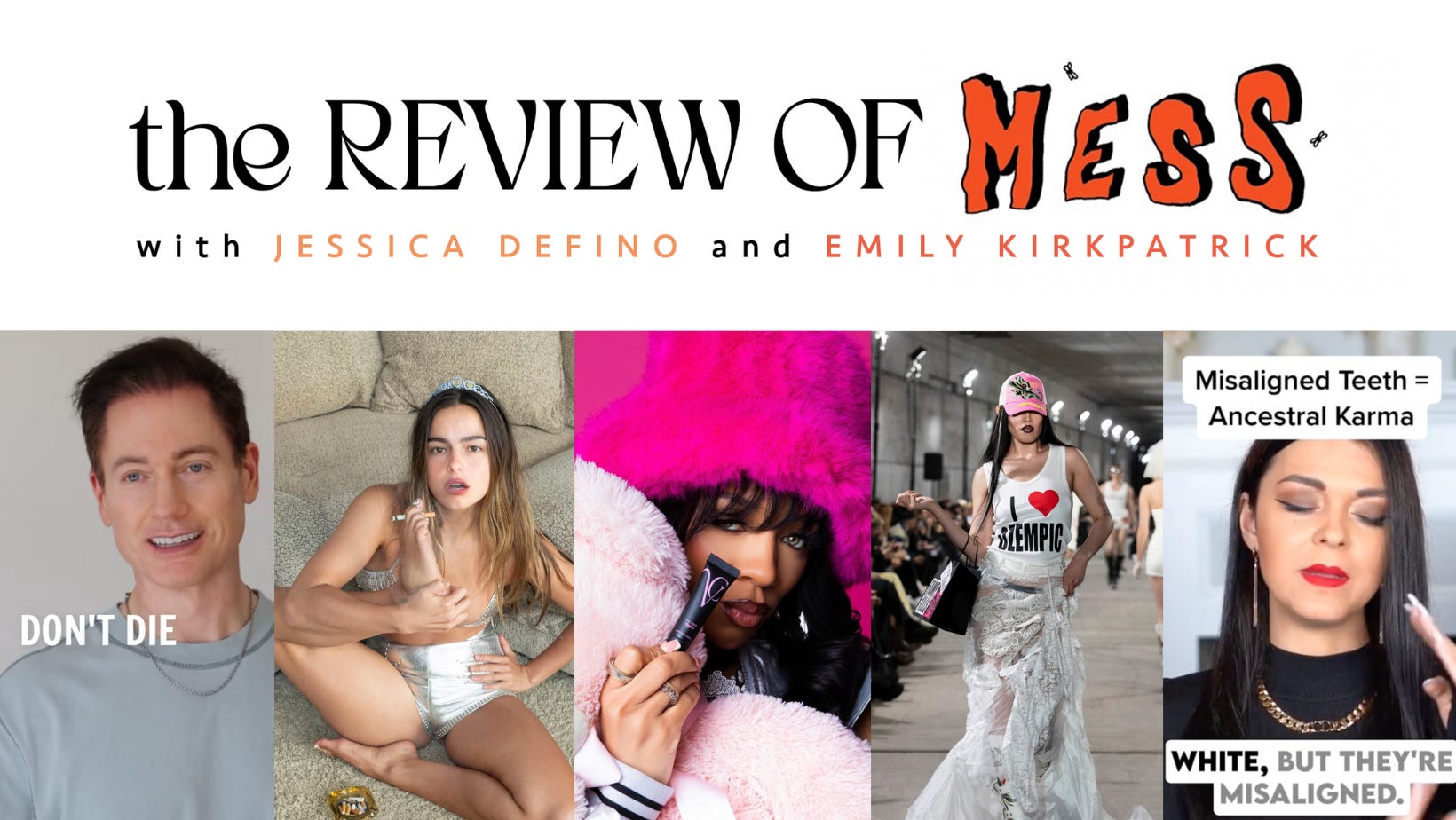
It is. It is. Another powerful frontier of insecurity and beauty products that I want to talk about today is Ozempic for sure. Specifically the I Heart Ozempic tank top.
- [43:52]
B
Oh, yeah.
- [43:53]
A
That went down the Runway a couple weeks ago.
- [43:55]
B
Really sent shockwaves through the fashion industry.
- [43:58]
A
It was huge. I had not heard of this brand. I think they're called Namilia. Do you know them?
- [44:04]
B
I'm familiar with them, but yeah, they are, I believe, Berlin based. So I. I don't know them super well, but I've seen the name around and I've seen their designs before.
- [44:13]
A
Yeah. So they put a, you know, just a white tank top shop printed with I heart Ozempic on their Runway a couple weeks ago.
- [44:21]
B
Kind of jacking my branding, to be honest.
- [44:24]
A
Honestly, it was very mess adjacent. And I. Okay, I might. I guess I'm naive, but I was, like, very surprised at how, like, swift and negative the reaction to this tank top was. Like, if you look in the comments on their Instagram, people are very upset that they would dare to put this kind of a. A T shirt on the Runway with this kind of a statement. And I just outraged. I just can't get my mind around why this would be, like, shocking or bad. Like, if you look at the statistics, and I'm not, like, endorsing it, obviously, but, like, people do heart Ozempic. Everyone hearts Ozempic. Or more broadly, like, glorifies thinness. Absolutely. Thinness is a mass.
- [45:10]
B
You're talking about the fashion industry. Like, if there's anyone who glorifies extreme thinness, I mean, look at the model that is wearing the I Heart Ozempic teeth. Like, there's bigger fish to fry than loving Ozempic in fashion. You know, it's just kind of stating the obvious.
- [45:25]
A
It felt like a kind of a hypocritical reaction I mean, because I don't know the specific people who are leaving these comments, but I mean this is just sort of like a major value of our society is, is thin and. Yeah, and so I started looking into the statistics and it's like prescriptions for Ozempic and like other GLP1s, you know, Ozempic is kind of just the umbrella term that everyone's using now over the past five years are up 40 times and they're like continuing to grow. Dan Frommer of the New Consumer just did a big report on Ozempic. More Americans are googling Ozempic than keto. Half of pharmaceutical company Eli Lilly's American revenue comes from GLP1s.
- [46:12]
B
Damn, that's wild.
- [46:14]
A
Between 8 and 20 million Americans are using GLP1s either for diabetes or to lose weight. But I have to imagine losing weight is a significant portion of that.
- [46:24]
B
So we really do love it. Like we're kind of underselling it with love. It's like we're obsessed.
- [46:29]
A
We are obsessed. We worship Ozempic.
- [46:32]
B
Yeah, it's the new God.
- [46:34]
A
And of the people interviewed who don't take Ozempic yet, the biggest reason for not taking it was that it was too expensive. Like not for moral reasons.
- [46:44]
B
Sure.
- [46:45]
A
And then 28 of people said they're worried about long term impact. Only 2% of people in this survey said they'd be like embarrassed to take it. So like by and large like people love it. Like use of Ozempic and similar drugs is expected to like like more than double in the next couple of years. You know hers, the cosmetic like Telehealth company, hers and hims, they sell it now like alongside retinol and that hair loss prescription. I never remember how to pronounce it. So this is like a big mass thing in like the beauty industry, the fashion industry, like a lot of fashion brands have said they're seeing a huge bump from people on Ozempic, like buying the same things they already have but in smaller sizes.
- [47:30]
B
That's a great point.
- [47:31]
A
The beauty industry has seen a huge boost from Ozempic from Ozempic related plastic surgeries.
- [47:37]
B
Right.
- [47:37]
A
Like what happens to your skin when you suddenly lose a lot of weight. Yeah, Facelifts are becoming a big part of like Ozempic face. A lot of skin care to compensate for like the loss of fat. Like you need fat in your face to have just like healthy functioning skin.
- [47:53]
B
Very interesting. All this also coming off the back of the buccal fat removal trend where it's like not only did you suck all the foul your face. It's like, now you're taking it out of your body, and now you're trying to, like, plump it back up again. With filler, I presume, and Facebook with filler.
- [48:06]
A
With collagen. With all these. I mean, collagen banking is now huge where it's like you're trying to fill your body with other sources of collagen because you're losing your own, like, fat cells. Adipose tissue is, you know, fat. It includes, like, the, like, compounds responsible for producing collagen and elastin and all of these things that we really sort of glorify in our skin. But when you take the fat out, you cannot produce those things which, like, exist for other reasons and aesthetic reasons.
- [48:37]
B
Right, sure.
- [48:37]
A
Like joint health. It's for wound healing.
- [48:39]
B
But most importantly, you look really pretty.
- [48:42]
A
How young you look.
- [48:43]
B
Right?
- [48:45]
A
Yeah.
- [48:46]
B
So, I mean, it doesn't seem like an accident to me that, like, we're creating problems and solving them. And solving them and create. You know what I mean? Like, these are all, like, very hand in hand of, like, you get yourself on this treadmill of kind of you fix this problem and it causes this one. So you have to, like, redo the thing that you took out and.
- [49:03]
A
Exactly. But only in ways that profit giant corporations. Like.
- [49:09]
B
Right. Only in ways that make everyone money. Right.
- [49:12]
A
So, yeah, I think just, like, looking at all of that and seeing how the fashion and beauty industries have been, like, almost revolutionized by the. The widespread use of Ozempic and other drugs, I'm just like. Like, I really don't understand the reaction to the T shirt. I think people are just more resistant to, like, showcasing their. Their values as revealed by their actions. You know, I think it makes it obvious that it's something we should be thinking about.
- [49:42]
B
Right.
- [49:43]
A
You know, and we don't want to think about it. We just want to, like, push it under the rug or something. I don't know.
- [49:49]
B
To me, having such a strong negative reaction to the tank top is also like. Like, considering all the stats that you just laid out before me, seems a little bit like virtue signaling, you know, like, it's like we should be against Ozempic or something. But, like, the reality is we straight up are not. We are, like, embracing it with two open hands.
- [50:08]
A
Yeah. And I mean, I just want to say, like, obviously there are medical uses for these.
- [50:12]
B
Sure, of course.
- [50:13]
A
Drugs. So I'm not like, nobody should ever use Ozempic. I'm sure they can be great when used for a specific purpose. But it's the same as with botox. You know, 15 years ago, it was developed for a medical purpose, had a side effect that was mostly aesthetic and visual, and then just became glorified as this aesthetic. It's a cure all cosmetic intervention rather than for like the actual important medical things that it could do.
- [50:40]
B
Right. Botox, like Ozempic, I think, has become just kind of a shorthand for like this quick fix of like, Botox undoes aging, Ozempic undoes fat. And like, that is what they're being applied for.
- [50:52]
A
And it makes me wonder, like, I mean, Botox is obviously way more popular than Ozempic. It's like very democratized. So many people use it. Would people wear a shirt that said I heart Botox? I think we're like a little closer there in the culture because it's also.
- [51:10]
B
Like beyond the literalness of these T shirts, like, fashion is referencing early aughts trends, right? Which are like these kind of like, how do I even put it? It's like ironic slogan T shirts, but it's also kind of like provocative slogan T shirts. Like, even if you think back about saying like, Jesus is my homeboy, like, that's a little provocative, especially for like, what kind of a Christian nation we were at the time. Still are.
- [51:35]
A
But oh, I had that T shirt.
- [51:37]
B
Oh, me too. Of course, every urban outfitter has carried like 500 million of them. Very important piece of cultural.
- [51:44]
A
Yes.
- [51:45]
B
But yeah, I don't know, it's so it's like, right? I just see the brand is kind of. They're referencing those early odd teachers. Or you think about the photoshopped T shirt that they always share of Paris Hilton where it's like says, stop being poor.
- [51:58]
A
Stop being poor.
- [51:59]
B
Right? It's like, to me, I love Ozempic is that, you know, it's like, provocative. It gets people talking. We have social media now, so it's like super viral, super shared. It's outrage bait, right?
- [52:10]
A
Yes.
- [52:10]
B
And it did a really good job of it because people were really raging.
- [52:14]
A
And like, I don't think the outrage of like a weight loss drug that's now being like counterfeited and sold unregulated. Like, I don't think outrage about that is wrong or misplaced. But I, I would love to see, like, our outrage align a little bit more with our actions, which I just don't think it does. Like, the whole thing just feels like, hypocritical. It's either like, accept the T shirt because this is a pretty accurate reflection of our Nation's values or, you know, put your money where your mouth is sort of thing.
- [52:48]
B
But also, like, what is your anger at Namilia gonna change? Like, how is this fashion brand gonna, like, fix the problem?
- [52:54]
A
Like, get mad at Eli Lilly?
- [52:56]
B
Exactly. Like, they. They actually don't have control over Ozempic or you're taking of Ozempic. They are merely pointing out a trend and making a joke about it. It.
- [53:04]
A
Yes.
- [53:05]
B
And you got. Y'all didn't get the joke. So, like, that's part of the problem. I don't know. It also just makes me think, like, I don't know, like, what is kind of the end goal? Like, what happens when we are all on Ozempic and we are all, like, the tiniest versions of ourselves we can be? Then. Then where does the goalpost move to? I guess, like.
- [53:29]
A
Right. Well, that's where. See, this is kind of my theory with, like, beauty stuff too. I think that's where, like, beauty rises up to meet it. Because when we are. Are all the tiniest versions of ourselves, it causes a lot of issues with, you know, aesthetics, skin care, you know, sagging skin, blah, blah, blah. Like, there's always going to be another thing to fix, and then the way that you, like, quote unquote, fix those things is going to create a whole new set of problems. And, like, this is just how the beauty and diet industries have been operating together for decades and decades. Decades and decades.
- [54:02]
B
Yeah.
- [54:03]
A
Which is. Yeah, I wish.
- [54:05]
B
I just. Yeah, I wish there was a way to liberate. I feel similarly about kind of like the. The cult around celebrity and, like, following them and believing in them and thinking they're your friend. It's like, I feel like if we could just liberate ourselves from these mentalities even a little bit, just to, like, see and, like a bird's eye view of how they're operating. Like, you start to free your mind from it and you start. It starts to have less of an impact and control over your life and wish that for everyone.
- [54:34]
A
I. I agree. I think that's a beautiful thought.
- [54:37]
B
Thank you.
- [54:37]
A
I wish that. You know who I wish that for?
- [54:39]
B
Who?
- [54:39]
A
I wish that for Brian Johnson.
- [54:41]
B
Oh, baby.
- [54:41]
A
I want to get some perspective.
- [54:43]
B
Me too. I would. If not perspective, at least like a certified therapist is what I've been thinking about lately for him. Yeah. I would love. Amongst all the medical professionals he's seeing, I would love one of them to be a. A psychotherapist. But so far, no dice.
- [55:00]
A
Not yet.
- [55:01]
B
So tell me about Brian Johnson. Tell me about what brings him to you today?
- [55:05]
A
I have been like thinking about this man for months, maybe years. Over a year. Yeah. Years now. Okay, so Brian Johnson is a very wealthy entrepreneur. I think he was the founder of Braintree, which acquired Venmo in 20 2012, which was then acquired by PayPal. So he's sort of like this financial entrepreneur and multimillionaire. Yeah, multimillionaire. And he's sort of made it his mission to not die.
- [55:37]
B
So simple.
- [55:39]
A
Yeah, to not die and to just completely reverse age.
- [55:44]
B
Yeah. And like the natural aging process in the body via a lot of experimental treatments. He really is just kind of treating himself like a lab rat and seeing, you know, throwing a bunch of stuff at the wall and seeing what sticks when it comes to like, his health and longevity. And yeah, he has a lot of rules about how he lives his life that to me personally make life not worth living.
- [56:07]
A
I agree. It's like this, this focus on longevity at the expense of just everything, the thing that make a life meaningful. It's like, why would you want to live longer if you're living that way, devoid of, of certain types of pleasure and human connection or even like filling your days with things you enjoy rather than like blood transfusions from your 18 year old son, which was one of the things that he does.
- [56:35]
B
Yeah. I mean, let me just list some of the other interesting things that he's adapted his lifestyle to in order to live forever. He claims he's improved certain biomarkers via caloric restriction, like extreme caloric restriction and intermittent fasting. He eats his last meal at 11am I believe he starts at like 4:30am okay. He takes over a hundred supplements and medications every day. He has a strict sleep schedule, which is bed at 8:30, rising at 4:30, I presume, or 4. And he also always sleeps alone and he is frequently like, tested. Like all of his biomarkers are tested. He said that he gets stuck with up to 60 needles a week.
- [57:23]
A
Oh my gosh.
- [57:24]
B
Yeah, yeah.
- [57:27]
A
So much of this too is sort of like aesthetically focused or at least like aesthetically apparent. Like if you look at how he's changed in terms of what he looks like from like, I don't know, when did he start this?
- [57:42]
B
2021, I believe.
- [57:43]
A
2021 to now. I mean, it looks sort of like, like a typical celebrity makeover where it's like he's clearly lost a lot of weight.
- [57:53]
B
Yes. He looks very gaunt.
- [57:55]
A
His jawline is like more sculpted. His skin is very tight and clear and shiny. It's Very waxy. He, he looks like a wax figure for sure.
- [58:06]
B
The dream.
- [58:07]
A
Yeah.
- [58:09]
B
The goal.
- [58:10]
A
It makes me sad, but at the same time I have like, like a soft spot for this man. I do. And I do think he is sort of like unfairly treated like a freak for all the things that he does in the name of anti aging teacher.
- [58:31]
B
Camila Cabello of longevity.
- [58:33]
A
Yes. Well, it's just that like, I don't think what he is doing for a man of his like income and status is that different than the anti aging interventions like the average young woman who is into preserving her youthfulness or the average old woman who is into preserving her youthfulness is doing. I, I think like, if we were honest with ourselves, like a lot of our own very normalized anti aging behaviors would sound as ridiculous as like what he's doing.
- [59:07]
B
Totally. And is also quite often as experimental as some of the stuff that he's doing.
- [59:12]
A
Exactly. So it's like if we just rephrased some normal like anti aging behaviors that are very common, like Botox. If we were like, they're injecting themselves every three months with a neurotoxin that freezes their facial muscles so that they can't actually like express what they're feeling and has like these neurological consequences of diminishing like emotional capacity to connect with other people, that would sound literally insane. But that's what, you know, millions and millions of people do every day.
- [59:46]
B
Right. It just has a different framework to it, which I think is a point that he often, I mean, he does it in a little more of an extreme way, but it's a point that he often makes in his own work where he talks about like Paleolithic man and how like Paleolithic man could have never possibly conceived of. Like, you know, you take a pill and your infection is gone. You know, like they couldn't have understood it. And so he claims he's doing similar like, experimental medical practice that today we couldn't possibly understand but in the future will be like totally normalized part of healthcare.
- [60:15]
A
I mean, honestly might be not like that that will necessarily be like good and useful to the project of human flourishing. But it might be true. But like, yeah, like I remember a couple years ago those like platelet rich plasma moisturizers that celebrities were having made for themselves and like regular people could get it. Like Hailey Bieber had like her blood taken out.
- [60:36]
B
Yes, the vampire.
- [60:39]
A
Not even the facial. The facials for sure, they're different.
- [60:41]
B
Right.
- [60:41]
A
There was also ones that like they were injected into a custom made moisturizer. Like, Dr. Barbara Sturm did this, of course. And they had, like, a moisturizer that was like, I don't know, 500 to a thousand dollars or something, made with their own platelets from their own blood. Like, if you repeated that as something that, like, people were doing, it sounds crazy. Or just like, imagine being like, oh, I drink a smoothie that's spiked with, like, some pulverized cow cartilage every day to keep looking youthful. Like, that's what collagen is.
- [61:13]
B
Right. Or what's the new one that everyone's using? That is, like, something that you produce when you're lactating Colostrum.
- [61:20]
A
Colostrum, yes, exactly.
- [61:22]
B
Even just like 10 years ago, telling someone you were drinking colostrum, I feel like they would have been like, you are a freak right out of here.
- [61:30]
A
It was like, pretty much just Kourtney Kardashian probably.
- [61:32]
B
Right. Alone.
- [61:33]
A
But yeah. I just feel like if we reframe some of these things that have been normalized, like, what he's doing is not as wild, or it's just. It is wild, but it's fairly normal. Especially I think, when you consider his, like, net worth and the percentage he's spending on anti aging. Like, so the last time I checked, which was probably like a couple months ago, year ago, he's worse, worth 400 million, and he's spending 2 million a year on this, like, longevity project.
- [62:03]
B
Okay.
- [62:04]
A
So if you scale that down and you calculate your own net worth, which, like, for a lot of millennials is negative because of, like, loans and everything, and then compare that to how much you spend on, like, youth centric products and procedures, which, like, on average is like 1300 a year. Like, a lot of us are probably spending more proportionally on anti aging as he is. So it's not that I, like, think this is totally fine or support his cause. I just wish that, like, we could take our framework for how ridiculous and, like, kind of sad some of the things that he's doing to his body are and be like, oh, related back.
- [62:44]
B
To ourselves and our own behavior.
- [62:46]
A
Yeah.
- [62:46]
B
I also think, like, honestly, for someone this rich, there's a lot of people with his net worth who are doing a lot worse things. Things than, like, doing weird lab experiments on themselves in the hopes of, like, coming up with some scientific health breakthrough that will, like, change humanity, you know?
- [63:05]
A
Yeah. And I also think, like, something that doesn't get mentioned in the longevity conversation enough is, like, the reason a lot of the people invested in longevity are invested in longevity which is just to like see their own, like, value and investments and net worth grow. Like they have a lot of money invested in things that like, will not come to fruition until after they die. And so it's like this very weird, like, financial aspect to wanting to live a longer life as well, which upsets me. Like he even hosts, he calls them don't die dinners.
- [63:44]
B
I do love his branding. I think he's done such a funny, genius job with this whole don't die thing. I don't like it, but I do think he's done a really good job of like packaging it up in a way that I think people really, I don't know, it's very palatable to people, especially rich people, especially famous people who are kind of doing all these like surface level things so they don't die. And he's offering them kind of like the internal package. Not only do you look ageless, now you're going to be ageless. I think that's very compelling, especially to someone like Kim Kardashian.
- [64:15]
A
It is compelling. But I also think, like, looking at him, I would not be compelled, I'm.
- [64:22]
B
Not compelled by any aspect of his.
- [64:24]
A
Life because he looks undead. Not to judge, not to appear in shame. But it doesn't necessarily look like the picture of health and well being.
- [64:36]
B
It's just a life where I never get to have a slice of pizza again. Is not a life I want to live. Just straight up, I'll tell you that. And it's also, I don't know, there's some very sad. It feels very isolating to me to be the man who does live forever. Like, didn't we learn from all these sort of like Rip Van Winkle or Dorian Gray or whatever, you know, that's like, it's actually very tragic. Even Twilight, you know, even vampires, I feel like, always talk about, right. They always talk about how they had to like watch all their loved ones die. And like time changes and they don't. And it's like, it's very devastating. And I don't think, like, okay, let's say you do achieve this. Like, what are the psychological ramifications of living forever and having to experience all this stuff and experience. Can you even.
- [65:17]
A
Right.
- [65:17]
B
Can your mind even wrap. Think about where we were a hundred years ago. I don't know. So much has changed. Can your mind even adapt to that much change? Can it even evolve with the time? Like, I'm not sure. It's very interesting.
- [65:31]
A
Those are such great questions. And I, I hope Brian's thinking of them.
- [65:34]
B
And he wants a partner too, which makes me very sad. And he like can't have one. He's, he's self professed. Like he cannot have the partner that he desires because he is impossible to live with. Like he can't even sleep in the same bed as his partner.
- [65:47]
A
You know, that's so sad because like again, I know we're, I'm just saying the same thing over and over. But like that's the thing that would make life worth living.
- [65:56]
B
Yes.
- [65:57]
A
Like if you don't have that, I don't understand what the draw is to live forever because presumably you're going to have to continue these like experiments and daily treatments forever and ever and ever. Like there will never be another point in your life where you will have room in your life for a partner. So what?
- [66:13]
B
Or that there's like ever a cheat day to any of this. Like you never get to take a day off from any of this and like live the life of a regular unhealthy person in his mind. Unhealthy. And also I think you start to see, I mean his father is aging and you can, I don't know, he makes me very sad because you can see kind of the panic that he's coming up against with his father who is I believe like 71 or in his 70s and like, you know, didn't live a particularly healthy lifestyle before now and he's doing kind of all of these blood transfusions and like experimental practices on his father and he said that they've been effective and he's like decreasing his age but at the same time, you know, he's still a 71 year old man. Presumably the technology isn't going to come fast enough that we're going to save him as well.
- [66:58]
A
Right.
- [66:58]
B
And what happens again, what happens to the man who lives forever when his father dies? When? I don't know, he's doing these tests on his, as we said, his 18 year old as well, so. So presumably they'll get to live together forever.
- [67:11]
A
You know, I know he's 18, but it does feel like kind of, I don't know, it's abusive. Too much of a big word?
- [67:18]
B
No, I think it's walking a very complicated line because yes, again he is 18, he is legally an adult, but he's also grown up in a home and in an environment that's prioritized this type of stuff and you know, a father who has encouraged it and shown him that like, I don't know, that or normalized it or like, made it seem, like, safer than maybe it actually is to him, even to the point of, like, getting him to do all these blood transfusions with him that ultimately were a failure. Like, he admitted himself that there was no positive result. So great. It's like, so you took a liter of your kid's blood like once a week, every week for like six months. Like, maybe it was a good bonding experience. I don't know.
- [67:56]
A
I mean, I hope. I do think that one interesting thing that could come out of this is like a new definition or a new understanding of aging. Because the thing that kind of like boggles my mind anytime I'm reading these stories is when you're talking about, like, reduced your biological age by X amount.
- [68:18]
B
Right?
- [68:19]
A
So it's like he's technically lived, however, 40 something years, but his body's reacting as if he's only lived like 39 years or whatever those numbers are. It. It calls to, like, the question is like, okay, then what is age? Is age different than bio? Like, is your biological age different from.
- [68:37]
B
Your, like, lived age, like, lived time on this planet? He seems to think yes. He's been celebrating his birthday every 19 months. So I'm going to say for him, biological age is the only determinate age. And, like, actual time spent on Earth is irrelevant.
- [68:55]
A
Yeah. So it would suggest this really interesting relationship between how we conceive of time and how we conceive of age. Does age even exist if it can reverse your biological age? Like, what does that matter if you can't stop time sort of thing?
- [69:12]
B
Yes, but these are also kind of like heady philosophical questions that are already related to the nature of time to begin with. We created the concept of time. We gave it this artificial structure for us to understand its passing. But that's not like we know scientifically, that's not actually how it works. Like, there is proof that time passes faster in certain instances and slower in other ones. And we like.
- [69:33]
A
Yes.
- [69:33]
B
I don't know, it's. It's interesting. And also it's like, according to regular science, non Brian Johnson science, it's like age is entirely based on genetics. Right. And so, like, you just cannot. There's just these fundamental genetics that you cannot change.
- [69:53]
A
You can't override them. Yeah, yeah. I mean, I think the, like, tragic thing about this, aside from like, this one man's personal experience is going to be like, if it really does, like, trickle down eventually and become something that is more normalized and really changes, you know, in a pretty negative, bleak way, the conversation about, like, anti aging, not dying, living forever.
- [70:22]
B
And I. I don't know. He talks a lot about kind of like the panic humans experience in the face of death and that he's trying to like, ameliorate that. And it's like, okay. But also, like, does this not to me, reading all this stuff gets me hyped up. Like, it makes me more afraid of death. Like, really, I don't know.
- [70:40]
A
And there's something about, like, it makes me so depressed. I'm like, I'm ready to go. I'm not.
- [70:43]
B
You're ready to shuffle off the mortal coil. Okay. Yeah. I think it's like one of two. I don't know. To me, knowing this much about yourself, like, planning, plotting against the inevitable demise. Like, you. You've built an entire life around death, you know, and so it's just like there is no kind of like, there's no element of things that give me the relief that is like, you know, that like, makes me really embrace life and be like, wow, life is really worth living. I'm really loving it. I'm not afraid of death because I'm living so fully.
- [71:13]
A
I do feel like he's got maybe a little bit of like a martyr thing where he might realize, like, this might not all work for him, but he's like, serving the future of humanity.
- [71:25]
B
He talks about that a lot. Yeah, for sure. But he's just kind of like, yeah, the guinea pig that is going down in history to save everybody else. No, I don't know about that.
- [71:36]
A
To me, I also think there's, like, an interesting relationship here to be explored between, like. Like, if longevity is the goal, if living longer and never dying is the goal, it would follow that we would have to normalize the look of aging if we're going to be existing on the planet for longer and longer and longer periods.
- [72:00]
B
Right.
- [72:02]
A
It would follow that we would have to embrace. You know, cheesy word, but embrace to a degree.
- [72:08]
B
What, what that looks like.
- [72:11]
A
A person who never dies is going.
- [72:13]
B
To look like, or even just like 150-year-old person. Like, that is going to look very different than a 100 year old person.
- [72:20]
A
Exactly. Like wrinkles are going to be part of that. Yeah, sagging is going to be part of that.
- [72:27]
B
Not if Brian has other things to say about it.
- [72:29]
A
Well, that's why I'm like, this doesn't track as a project of longevity to me. Because if it was a true enthusiasm for longevity, living like a really long, fulfilled life, it would have to include an acceptance of what A really old person is going to look like and it does not.
- [72:48]
B
Yeah, that's very interesting.
- [72:49]
A
So that feels to me like a very, that's like an ideological break that I just can't, I can't get with.
- [72:55]
B
That's true. Because I remember when he posted some because you know, he posts pictures of himself all the time, is like before and afters to like show the effects of stuff. And I remember he posted one and literally everyone on Twitter, Twitter was clowning on him because he looked bad. Like, just visually. Like they weren't talking about his health, they were talking about fully aesthetics. Like your face is uglier to me now. And he really took that feedback to heart and he like went and like invested in all of these again, like anti aging red light technologies and whatever micro needling I'm sure was what he loves needles and like to make himself visually more appealing to people. And it's like, well, is your goal to be visually attractive to people or is it to live forever? Because I think the are very different.
- [73:37]
A
They're completely at odds. They're like completely opposite values.
- [73:41]
B
It shouldn't matter what people think you look like. Like whether they think you're hot or not. Like that's not the goal. You're. You're supposedly aging backwards and that's kind of should be the only thing that matters.
- [73:52]
A
And it is kind of sad that this seems to be like his one point of like connection with people in the outside world because this is such an, like an individualist project and he's sleeping alone and he can't have a partner and the only points of connection he seems to have to other people are them like ragging on what he looks like.
- [74:08]
B
Yeah, but he, yeah, he said he loves, he loves his haters, he said many times because they bring attention to the whole conversation and you know, I guess so. But like when your only relationships seem to be digital, right? Outside of your son, I guess, and.
- [74:23]
A
Your, your son's friend, I mean, who knows? We're just speculating on personal life like based on quotes he's actually given. But I, I do think like it is good to point out he is very involved in the online coverage of what he's doing and this whole project. Because I remember like probably I guess again over a year ago now when I first wrote about him and this anti aging project and I was like, give him a break. Because the things we do in the name of anti aging are not any better. He actually personally emailed me. He somehow saw the post, found my email and emailed me and said thank you.
- [75:00]
B
He has always struck me.
- [75:01]
A
Which I couldn't believe.
- [75:02]
B
Yeah, he has always struck me as like one of the most weirdly hyper online individuals ever. It's like, who has the time? Like you. I guess him waking up at 4:30m has the time, but it's like, don't you have medical lab procedures to be engaging in? Like, why are you on Twitter right now? And yes, he truly. Every person I've ever known who's spoken about him, he has found it and he has responded to it personally.
- [75:24]
A
Wow.
- [75:24]
B
And that's like, I don't know, like, is it good to be that. That hyper aware of your. I guess he thinks he's thinking about it as like a movement, you know, and he's like spearheading a movement. So the more people that talk about it, the better. And if he responds to them, you know, it's another, another. It's another headline. It's another press story. It's, you know, it just generates more press. So I get it. But also, yeah, seems like log off maybe a little bit less about yourself. I think we could all be consuming less about ourselves.
- [75:51]
A
I think, I think the thing that I'm just like settling in on the more we talk is like, he can do. He can feel the way he feels in his life and whatever. I think the value in this conversation is being like, does this like, project that he's embarked on? Like, will this be the future for the rest of us? Will this become increasingly one of the values of our society? Is this where anti aging is heading? And if so, we can look at him and what he said about like, how he feels, what his life is like to sort of say, okay, this is what it might be like. And is this a future we want to like, invest in for ourselves?
- [76:35]
B
Totally. And I, you know, another.
- [76:38]
A
For me it's a no.
- [76:38]
B
Yeah, for me it's a no as well. But it's an interesting option. I guess it's also interesting to me that he's like, he's commercializing this whole lifestyle now. I mean, I know he's always said that he wants to make his like $2 million a year health things more readily available to the masses. But he started selling like olive oil and supplements and nut butters and quote, unquote, longevity mixes. And I, I don't know how I feel when it starts getting into the e commerce space of all of this. I don't love that about that. Right. Like, test on yourself all you want. Like, show me the Lab results, you know, show me the scientific studies or whatever. But, like, why are you selling me a nut butter?
- [77:17]
A
Exactly. It's all. I was just like, these things exist. You're not really introducing anything new. I don't need your bundled package of olive oil and nut butter. If that is truly helping you, I can get that elsewhere. You don't need to profit off of this. You're, like, not adding anything of value to the world. You're just sort of kind of corrupting your. Your move, your own movement by turning it into, like, something for personal gain.
- [77:43]
B
Yeah, yeah. It's the one aspect of this that, like, actually, like, for as weird as all of this is, it's the one part that actually strikes me as, like, oh, you know what? I don't think you actually need to be selling T shirts that say, don't die. And, you know, Omega 3.
- [77:57]
A
I predict a Brian Johnson Beauty brand by 2025. I think he's going to get into.
- [78:04]
B
Once he finally gets his face right and tight with all that red light, all those microneedles. I can see that, too.
- [78:10]
A
It's going to happen. That's where it's going.
- [78:12]
B
I mean, I assume it's like a full lifestyle rollout at a certain point. Right. Like, as he figures out how to make each aspect of his health available, it will become available on his e commerce website. But he also. I don't know, he says in interviews as well that, like, you can do everything he' doing by just like, sleeping and intermittent fasting and that it is kind of like controllable, beyond supplements, and you can, like, be on par with him.
- [78:39]
A
Interesting.
- [78:39]
B
Yeah. I don't know about that, but yeah.
- [78:42]
A
I don't know how much I believe him there, but I do think, like, if the goal is health, there are so many free interventions that we could all be incorporating into our lives a little bit more.
- [78:52]
B
Sure.
- [78:52]
A
I just. I guess I'm skeptical that his ultimate goal is, like, true health.
- [78:56]
B
Right. When you could just be telling people to, like, drink water and go to sleep at a reasonable hour. And that's kind of like the basis of everything that he's doing.
- [79:04]
A
Yeah, yeah.
- [79:05]
B
I don't know. To me. Yeah, to me, there seems like a lot of psychological issues at play.
- [79:11]
A
I know.
- [79:12]
B
Here.
- [79:12]
A
I know, I know. Should we move on to a more lighthearted topic?
- [79:17]
B
Yeah. Is it lighthearted?
- [79:19]
A
Should we move on to the mess of the month?
- [79:22]
B
Go through on the mess of the month. Let me start with my mess of the month. It is Derek Blasberg, who I don't know if you've seen the headlines this month, but he allegedly really had a catastrophic pooping event in Gwyneth Paltrow's bed. And I just think that's fabulous. As someone who has been a Derek Blasberg hater for years, decades even. Yep. This feels like real karma justice. It feels like real comeuppance.
- [79:48]
A
It does. I like, I remember as a teen knowing who Derek Blasberg was and reading his book. Didn't he have a book called Classy?
- [79:56]
B
Yes, he sure did.
- [79:57]
A
I read it.
- [79:58]
B
Yeah. I did not.
- [79:59]
A
I had it and I read it. I don't think I would call myself a fan, but I was just, like, very interested in that sort of, like, Vogue, model editor crowd.
- [80:09]
B
Yes. I was always interested in Derek because I didn't understand why he was being, like, foisted upon me at every term. Like, he seemed like he was always being. Being photographed at parties with, like, models or, like, mentioned in articles and all this stuff. I think it's. Tom Ford called him the Truman Capote of our generation, which is so insane. I know, it's like the. Maybe my one quibble with Tom Ford. We agree on so much, but, like, certainly not that at all. First of all, Derek doesn't write.
- [80:41]
A
Right.
- [80:41]
B
Despite being a writer. I haven't read a whole lot of his writing outside of classy, of course.
- [80:46]
A
No, no, definitely not.
- [80:48]
B
But mostly, I think for those who don't know Derek, he's kind of known, at least within New York and LA circles, probably not outside of that, as kind of a socialite, social climber, kind of just a hanger on to, like, very famous people. And so he's always getting invited to, like, exclusive parties and events and vacations and hanging out at celebrities home and such, which is how he found himself in this current predicament. He was invited as a guest to Gwyneth Paltrow's Hamptons home and apparently, yeah, overstayed his welcome in a pretty serious way. Having a disastrous diarrhea incident in her guest bedroom and then fleeing the scene without alerting anyone or bothering to clean it up in any capacity whatsoever. There's so many questions to me about this. Like, I don't know, I was talking with my friend Tate about it, and it's just like, the shame. Like, first of all, I would be gathering up all the sheets in that bedroom and in the dead of night, sneaking out to a dumpster. I would not let anyone ever see those sheets.
- [81:49]
A
There is no part of me that could leave that mess behind.
- [81:52]
B
No one is seeing that, like, I'm going to do as much as I feasibly can to mitigate this problem before leaving it. And then after I took these sheets out and hid them in a dumpster, I would be emptying my bank account of every penny that I am worth. And I would be leaving it in an unmarked bag outside the door for the housekeeper with a profuse letter of AP apology Being like, I cannot believe that you have to face it. I am desperately sorry. I've had a horrible incident. Like, I hope that this money puts your kids through college, like, and that we never have to find ourselves here ever again. Because the piece about the story, like, the pooping was already good to me. I was already sold on that. And then there's been further reporting since that came out.
- [82:35]
A
I've also been surprised that, I mean, at least in what I have seen, there has not been a good, like, like, goop poop joke. It feels like such an easy opportunity.
- [82:46]
B
I know, like, where's the New York Post? They seem like they would be all over a punny goop poop.
- [82:52]
A
Like, it's a perfect rhyme.
- [82:55]
B
So this story was first reported in the newsletter pop, which apparently is a super popular gossip newsletter that I was not aware about before now, but I'm going to have to sign up for immediately. So they originally reported that Derek had pooped in this bed, but he feels bad about it. And at first everyone was reporting that it was Ozempic related and that's why he had this incident.
- [83:17]
A
I do remember that going back to.
- [83:18]
B
Our I heart Ozempic talk. But then a day later, everyone retracted the Ozempic aspect of it. And I don't know why, but everyone made a real point of being like, actually it is not Ozempic related. And I was like, what are we implying? Like, what are we trying to say about Derek? But by like taking that out and like, does that make it better? No, you know what I mean is that his PR pushing back and being like, actually it wasn't Ozempic. It's like, I think that makes it more explainable.
- [83:47]
A
That makes it more explainable. And it also kind of gives it the heft of like a medical issue, right?
- [83:55]
B
It's a medical emergency. Some of the, like, you had no control, right? It's like not intentional, like, couldn't be avoided.
- [84:02]
A
Like, I would have thought that would be better. And you know, but apparently everyone thinks all celebrities are on Ozempic anyway, so I think it would affect his image in that way.
- [84:10]
B
Right? And I remember when it came out. No one was surprised. Everyone was like, oh, yeah, he has been looking like a lot thinner lately. That makes sense. And then they were like, no, no, it's not Ozempic. Nobody knows why. And so then this week, a new piece of reporting came out about Gwyneth. The Gwyneth of it all.
- [84:25]
A
I can't believe this story is like, so long in the news cycle. Side note, like, love it. The fact that there's still new stories.
- [84:32]
B
I know. And there's new details breaking is so beautif. And this to me is like, what tabloids should be like. These are the stories that I do want and they're the only stories I want, in fact. And I want them reported out like this piecemeal. And so I get to find new juicy details every week. Anyway, so this week a new story came out talking about how Gwyneth feels about it. And at first, apparently she was horrified. She was horrified and now she's found the humor in it. But she does feel bad for Derek and they are still friends, but she has told him that they need to, like, take a break from being seen in public together or like, doing anything together, because she doesn't. Why she doesn't want the, like, the poop stories to keep coming because, like, inevitably if they're photographed together, it's going to be poop related. And so she's trying to like, let the poop cycle die down and then they can like, revive their friendship again.
- [85:23]
A
I feel like that's interesting for her because she's always sort of like, leaned into like, like humorous sort of things. She doesn't really take her.
- [85:30]
B
Yeah, like this smells like my vagina candle. Like, she's the number one person of, like, laughing about bodily stuff.
- [85:36]
A
She's not shy about that. So that's kind of interesting to me. I also feel like if she had made like a statement or a joke about it or if they had together.
- [85:45]
B
It would be over.
- [85:46]
A
Died down really quickly.
- [85:48]
B
Agreed. Also, I just want to say this is the woman who like, sold America on the concept of like, animals cinemas. So the idea that she's skittish around poop is like, absurd.
- [85:58]
A
Yeah, I know. I. I don't buy it and I don't believe it. And I also just don't understand why Derek Blasberg wouldn't say anything. Just tell her.
- [86:07]
B
Yes, tell her number one.
- [86:08]
A
Like, that seems kind of like the odd part about this story. Like, yes, if this was me, I would be very embarrassed. I'd be very shameless. I would do Everything I could to clean it up. And then I would take my host aside and be like, I am so sorry I've done something going on in my body. What can I do?
- [86:25]
B
Yes. How do I make this better?
- [86:26]
A
And like this probably just wouldn't have gotten out.
- [86:30]
B
Well, I'm going to get to the part about how it got out, which is absolutely incredible to me. But. But also, as you said, I think this is something that really could have been easily squashed and turned into like a great joke, if not like a merch or a branding opportunity.
- [86:43]
A
Oh my God. Exactly.
- [86:45]
B
Seems really available for that.
- [86:46]
A
Like Derek Blasberg needs to be wearing that I heart ozempic TikTok ex immediately.
- [86:52]
B
Exactly. That's what I'm talking about. Or like come out with like a poop scented candle or something. Like, I don't know, like he could do some weird goop poop collaboration that I feel like everyone would be like.
- [87:00]
A
Ahaha, A goop enema by Derek.
- [87:03]
B
Exactly. And what is Derek doing anyway? Like, he's available. He does not have like work he needs to get it to anyway. So I feel like a lot of missed opportunities here. But yes. So they're taking a break from their relationship. And then we also found out how everybody found out about this and why it was. Because what I was most struck with when it was reported is like the like the sureness with which it is. It was reported. Like there were no alleged, there were no like hearsays. It was like this absolutely 100% happened.
- [87:34]
A
As soon as I read one article about it, it stuck in my head. Like there's no doubt.
- [87:38]
B
Yeah, right. And it's. And I will say tabloids don't usually report things like that that they didn't witness firsthand with their own eyes that like this happened, you know, so it already struck me as like very. We reported. So apparently Gwyneth was out to dinner with Oprah and Jerry Seinfeld.
- [87:58]
A
That's so funny, by the way.
- [88:00]
B
Yeah, so they were eating dinner and she got. Oh yeah, here it is. Oh, it's actually more people than I thought it was. Gwyneth told Oprah, Jerry and Jessica Seinfeld and Larry David because they were all at dinner. And when they were at dinner, she got this phone call from her housekeeper and her housekeeper is screaming at the top of her lungs. So people around them can also hear it coming out of the phone. And she said, that fucking friend of yours and revealed that he had left this disastrous mess behind and that he had done. He had told no One, he had done nothing to clean it up.
- [88:34]
A
This is a curb your enthusiasm episode. Like, I need to know what Larry David said.
- [88:38]
B
We need another season just so Larry can. Like, we need a special, like, holiday edition or something. Just so Larry can address Pooh Gate. And so. But what. Actually, this is the best detail to me and the craziest because the reason I said I would empty my bank account is because the real reason the housekeeper was so furious at Derek Blasberg is he didn't leave a tip. He left her nothing to clean up his poops. And I find that unforgivable.
- [89:02]
A
No, that's bad.
- [89:04]
B
Especially as a rich person. As a non rich person, I would.
- [89:07]
A
He wrote a book called Classy.
- [89:09]
B
Yes. This is not classic. Nothing about this is classy. No etiquette. Emily Post would not be pleased with his behavior on any level. Yeah, but I love that that's. That was the new development this week is how we all found out about this happening. And I just think that's so perfect.
- [89:26]
A
Oh, man. It, like, it got. It does give me a stomachache just knowing that I feel about this a similar way as when I heard that story. That was like, this was years ago. It was like a plane had to make an emergency landing because someone used the bathroom on the plane and it smelled badly that they had.
- [89:43]
B
Yes. I remember.
- [89:44]
A
Like, I just. My stomach hurt for hours after reading that because I was like, what would it be like to be that person? Like, that's.
- [89:51]
B
And to be trapped.
- [89:52]
A
That's.
- [89:53]
B
Just to be trapped in the plane with all the people that you've, like, made their lives horrible.
- [89:57]
A
I, like, feel horrible. Even I'm enjoying it. And I feel horrible because I'm like, I just. I can't imagine what it must be like to be that person. But also, yes, you're right. If anything like, this happened to me, like, I would handle. Handle it.
- [90:11]
B
Yeah.
- [90:11]
A
More politely.
- [90:12]
B
Also, bless this housekeeper for just airing his business, for how poorly behaved he was and how poorly he treated her, because people do need to know that that tells you a lot.
- [90:21]
A
It's true.
- [90:22]
B
About not only his diet, but his.
- [90:24]
A
No, you're right.
- [90:25]
B
His constitution. Also, I will note, as someone who's just been personally monitoring the situation, that he has absolutely banned all, like, poop emojis, all mention of poop from his Instagram comments, because I haven't seen a word of it. And there's absolutely no way that no one is commenting about this on his. He's banned the word. And again, that's. You have to Have a better sense of humor about pooping yourself. You simply must.
- [90:53]
A
Yeah, it would have blown over by.
- [90:55]
B
Now and everyone would just laugh with.
- [90:57]
A
You if there was like a little bit of acknowledgement, a little bit of a joke and it would have been done.
- [91:01]
B
Yeah. No levity. There's no levity in the situation.
- [91:04]
A
Oh my gosh. It's the true mess of the month.
- [91:07]
B
It really is a quite literal mess of the month. Yes.
- [91:10]
A
My, my mess of the month is a little bit more of a bummer.
- [91:16]
B
It's good to balance.
- [91:17]
A
My mess of the month is about the Scentbird CEO Maria Neuroslimova. Tell me about her moonlighting as a spiritual guru on TikTok.
- [91:27]
B
Oh, wonderful.
- [91:28]
A
Yeah, so Scentbird is kind of like, they call it like the Netflix of fragrance. You get like a selection of, of fragrance samples sent to you from all like the top fragrance plants. So there are a lot of brands, brands associated, a lot of like designer brands associated with Scentbird. Which is why it's kind of shocking that she feels comfortable having an online presence right like this.
- [91:49]
B
So that's a lot of liability relationships. Yeah, a lot of relationships with very lucrative high end brands that I would assume wouldn't love a spiritual guru.
- [92:00]
A
Exactly. So I mean, the, the things that she's saying remind me a lot of what we saw, like a lot of wellness influencers like pivot to at the start of COVID like anti vax sort of thing. So some of some examples are she said people with like blue eyes feel closer to God.
- [92:18]
B
I do feel that as a blue eyed person, I. I actually do feel closer to God. So I'm gonna back her on that one. I believe you do feel like a chosen one.
- [92:27]
A
She's talked about like obesity having like spiritual causes. Like there's like a, like a negative spiritual reason. Reason to be fat as a fat person.
- [92:38]
B
I agree. I'm sorry. So far she's speaking the truth. Jess, you have something you'd like to say about my obesity and my blue eyes?
- [92:46]
A
Get to that. I will get to it. She said like, miscarriage is a choice that your body makes. She is anti abortion. She said, you can cure yourself of cancer and aids.
- [92:58]
B
That's a classic.
- [92:59]
A
By simply aligning with your true self. She's also said, like Hitler has been a great source of spiritual knowledge. Like his soul came here to learn certain lessons that humanity needed to learn. Like these are.
- [93:13]
B
Okay, I'm off. I'm not supporting her.
- [93:14]
A
Yeah, we're not supporting Maria Neuroslimova. We don't Agree with what she says. These are, like, not good things to say.
- [93:23]
B
This is big. Yes.
- [93:24]
A
Horrific things to say and just surprising things to say as the CEO of a pretty big fragrance company that is, again, aligned with a lot of big influential brands. So, yes, this has been a big story. A lot of people are very upset about this.
- [93:43]
B
I have a question. Does any of this have to. Does she have any theories about, like, scents? Like, does any of this have to do with fragrance? Like, how does that play on the spiritual plane? Like, is that negative energies, positive energy?
- [93:54]
A
It's a great question. And I don't think she is bringing her, like, beauty beliefs into this at all.
- [94:00]
B
So these are totally divorced.
- [94:02]
A
I think it's kind of just two separate things. You know, I'll link to the article to confirm, but I believe what I read was that, like, she considers this part of her personal life and she has said things like, oh, like, my investors and employees, like, know who I am and this doesn't bother them sort of thing.
- [94:17]
B
I think that's a troubling admission in and of itself is that your business partners are aware of these thoughts and opinions and are still fine with still supporting you, participating in this with you. Yeah, it seems like a tacit endorsement to me.
- [94:32]
A
And like, what is interesting to me about the public reception of this is that there are, like, direct lines you can draw from some, like, like the magical thinking in the beauty industry and general beauty beliefs. Two very problematic direct statements that she's making. And, like, it doesn't surprise me that she has, like, gone to this sort of place. I feel like a lot of, like, beauty beliefs are just like a hop, skip and a jump away from some of these extreme statements.
- [95:09]
B
Yeah.
- [95:09]
A
So, like, when you think about, like, spiritual or moral reasons for, like, obesity or ugliness, like, there are statements about that all of the time. Like, one very simple example is like, a lot of articles about Ozempic are calling it, like a quote unquote miracle drug. Like, there's a lot of. Of, like, spiritual language and belief embedded in this. And I don't think anyone would say, like, there isn't moral judgment on fat people in our society for sure.
- [95:37]
B
And even just like the. You just had me think, like, yeah. The way that people position beauty products, it's always like, miracle cures, you know, it's like very snake oil language.
- [95:48]
A
Exactly. Everything's a miracle. A Holy grail product.
- [95:52]
B
Yeah.
- [95:53]
A
A skin savior. There is so much religious language, like, embedded in beauty. Beauty. The first thing that came to mind, like, in terms of like, the spiritual morality cancer stuff is like, do you remember when Jonah Hill, when it came out that he had, like, emotionally abused his girlfriend? His girlfriend released like a lot of like, text messages.
- [96:12]
B
Yes.
- [96:12]
A
A huge thing in beauty was like, people were posting pictures of his face with a sunburn and being like, and he doesn't use sunscreen. Like, we should have known this.
- [96:22]
B
Right? Like, Equal Crimes.
- [96:24]
A
And that was very, like, a popular post in that time.
- [96:27]
B
And that's crazy.
- [96:29]
A
It's very easy to draw a line from that to saying bad people don't use sunscreen and therefore, like, deserve skin cancer. And. Or you could prevent skin cancer by being a good person and using sunscreen.
- [96:44]
B
Right. Like, both are moral failings that are examples of. It's very. I mean, it's similar to, you know, the internal health versus the external beauty of Brian Johnston as well. Whereas it's like completely. You're conflating the two as though they're the same.
- [96:58]
A
And we saw a lot of this with like, remember Amy Schumer recently was on. Or like a couple months ago was on some late night talk show and she had looked like she gained a little weight. And people all over Twitter were like, well, she's ugly because she's a Zionist.
- [97:13]
B
I've seen a lot of that.
- [97:14]
A
And it's like, no, no, no, no. Like, you can critique her, like, political stances. Please do.
- [97:19]
B
But.
- [97:20]
A
But like, it's just so wild to draw a line from bad person to ugliness or fatness. And these are just like, very like, these are beliefs that are really embedded in our society and they seem wild when someone says them the way the Scentbird CEO is saying them. But, like, what she is saying, I think is like, sort of like an extreme version of a reflection of like, every day.
- [97:44]
B
Definitely. I mean, you just got me thinking. There's a huge trend on social media where, where you know, people will post a picture of like an older, usually white, an older white woman who looks really good. And they're like, the reason she looks really good is she's an unproblematic queen who minds her own business.
- [98:00]
A
That happened with Anne Hathaway. Everyone was like, anne Hathaway looks amazing. This is how you age when you're unproblematic.
- [98:06]
B
Yes. And they say that a lot.
- [98:07]
A
I mean, even aura maxing, like, a lot of like, this aura maxing, which is like, increasing your spiritual energetic field, has to do with beauty and skin care. Like, I just saw a TikTok the other day that was like, taking care of your Skin is or good for your aura. The big one that really, that I really thought of with this Scentbird CEO example is like, her statements about miscarriage and about abortion and not supporting abortion. Like, literal politicians believe these things and are working hard to write these beliefs into law. And the beauty industry is financially supporting these politicians. And I would love to see a similar outrage that's directed at Maria Nuroslamova, directed at these big giant beauty industry players who are financially supporting politicians who not only believe those things, but are putting in a concerted effort to make that the law of the land.
- [99:12]
B
Yeah, because they're, they're doing, doing propaganda work. You know, they're like creating the language. They're couching it in terms exactly like really appealing and really benign.
- [99:21]
A
Right.
- [99:21]
B
And really it's like that's the exact language and framework that's going to be used to sell these ideas and to.
- [99:26]
A
Legislate on these ideas 100%. So it's like my take is like, yes, let us not support Maria Neuroslimova. The things she is saying are horrible. And a lot of the beauty industry believes the same things and is couching it in like, less extreme language. And we should be equally upset about that. I'll link it in the show notes. But I did reporting a couple of years ago about how like Amazon Walmart are two of the top beauty retailers in the nation and they donate a lot to politicians who want a national abortion ban, as well as AbbVie, which is the owner and maker of Botox and Juvederm, they donate to these politicians as well. So it's like these beliefs are really embedded in beauty and they're not stated as explicitly as the scentbird CEO is is stating them, but they are like, underpinning a lot of the industry. And I like, just wish we could have equal outrage for that.
- [100:25]
B
Yeah, that's super interesting. With people don't talk a lot about kind of like how political beauty is and like, can be made as a tool. Like, you know, even her talk about all this Hitler stuff, it's like, right, Hitler was very interested in appearance, very interested in beauty and how to sell, like, ideal beauty. And you know, the language of that. And is that not just beauty industry marketing to a different end?
- [100:50]
A
Right. There's so much like eugenic undertones to a lot of especially plastic surgery getting. I got it. I got an email not too long ago. I may have even mentioned this on the podcast because it's burned in my brain from a plastic surgeon. And the subject line was not your grandmother's nose.
- [101:08]
B
Yeah, yikes. Yeah, yikes.
- [101:10]
A
Yes. Yes. And it's like, there are direct lines there to, like, eugenics and erasing certain genetic traits.
- [101:18]
B
Certain noses for sure.
- [101:20]
A
And certain noses. And it's really disturbing. And I would love to see the outrage that we're clearly all capable of directed at this all of the time, rather than when it's just like this kind of Zane TikTok influencer.
- [101:39]
B
Yeah, definitely.
- [101:41]
A
Like, because it's there. It's there, baby.
- [101:44]
B
Yeah.
- [101:44]
A
So, yeah, that's. That's my mess of the month.
- [101:46]
B
That's a really good one. And like I was telling you, it. This lady reminds me a lot of. In 2017, there's a new Yorker article about essential oils and basically the two companies that make all of your essential oils and kind of the wacky leaders behind them. But they use a lot of the similar. Similar. I don't know, they use a lot of similar language. It's almost biblical. Right. Like, you're anointing. You're using these kind of, like, centuries old, you know, oils instead of modern medicine. And it's that same kind of. I forget what the technical word is, but it's like new age crunchy to alt right pipeline. Right. Like, it slips into, I don't know, some fascist stuff really, really quickly.
- [102:28]
A
Well, what I was gonna say before, and I forgot when you were like, does scent play into this at all? Is like. Like, that really is the origin of, like, the perfume industry. There's a lot of, like, moralizing involved in. In that. There's a lot of, like, spiritual things. So, like, the beginning of the perfume industry, like, distilling the essence of, like, a flower into something that could be used. It was thought to be like you were extracting its life force.
- [102:54]
B
Oh, interesting.
- [102:55]
A
It's spirit. And the word before it was known as aroma, the word for aroma was like spiritus rector.
- [103:03]
B
Wow.
- [103:04]
A
Which is life force, like the actual spirit. So, like, perfume really was this spiritual concept where you were extracting the source of life and using it for yourself and putting it on yourself. So there's a lot of spirituality stuff embedded in that, and then there's a lot of morality stuff. Because perfume became, like, more expected and widespread. One, after the bubonic plague because it was seen as, like, a health measure, and then two, in the hygiene revolution. Sure. And so smelling a certain way became a class marker. It became a morality marker. People who didn't smell great, who didn't have access to these things, were poor and therefore bad. And therefore you didn't associate with them. And the people who could afford perfumes and soaps were good and high class and they were good people to associate with and connect with. Cleanliness is next to godliness. Like that's all wrapped in the origins of the perfume industry. And so to me it makes perfect sense that. Well, I don't want to say that. I don't want to be like anyone who likes perfume is into this. I just mean that there is, there is a through line there for people of like, extreme, who, you know, enjoy extremes. To go back through that timeline and sort of apply that to like modern day issues. It's, it's pretty fascinating. Fascinating.
- [104:27]
B
That makes so much sense. And then you also think about today. The beauty industry's obsession with, I think we've talked about this on here, even maybe is like the elimination of scent entirely from the human body. Like natural scent. And when you start thinking about that in the, in the lens that you just provided so perfectly, I think that's super problematic.
- [104:46]
A
It's extremely problematic. It's extremely problematic. And there are like classist, racist undertones to it for sure. And yeah, like, this is the foundation the industry is built on.
- [104:59]
B
Right.
- [105:00]
A
You know, there are certain ways in which it's evolved away from that and then there are a lot of ways in which it hasn't.
- [105:06]
B
But like, it's, it is just this kind of like given and like you said, it's treated as though it's a hygiene thing, it's a cleanliness thing. Like it's couched in this language of like, don't you want to be clean? Don't you want to be the clean girl? Yeah.
- [105:20]
A
Pure purity. There's so much purity language in skincare and soap specifically. Yeah, it's wild. And yeah, for someone whose brain works like this woman's brain works, there's so much history to go back through and be like, oh, okay, yeah, I'm going to make this the, the most extreme, problematic interpretation of, of history as possible.
- [105:42]
B
But like she's, the history does kind of support her in this like problematic interpretation of like what she's doing and like, what. Yeah, so weirdly she is just drawing from like the original text of the beauty industry history.
- [105:57]
A
She really is. And like, in some weird way the reaction to her gives me hope because I'm just like, I just feel like people don't know this.
- [106:04]
B
I did everything you just said. It's like I had no idea.
- [106:07]
A
Like, don't know the history of a lot of beauty stuff. And if we did we would be much more critical of it because we're clearly critical of her when it's stated, like, plain and obvious.
- [106:17]
B
Yeah.
- [106:17]
A
So, like, let's peel back some of these layers. Let's, like, really understand the foundation. I think people would be more quick to criticize rather than, like, consume.
- [106:27]
B
Bring those undertones up to the forefront.
- [106:30]
A
Yes. Yes, exactly.
- [106:32]
B
Beautiful. On that light note, I know that uplifting story you just told.
- [106:38]
A
We had a real mix.
- [106:39]
B
We had a real mixed bag today. Yeah. Heavy, frivolous, poop, fascism, poops. Yeah. A little bit of everything. Everything.
- [106:48]
A
I love it.
- [106:49]
B
Great grab bag. That's what we're here for.
- [106:52]
A
I thought we were going to talk for less time today.
- [106:55]
B
Somehow. We've talked for more than ever.
- [106:57]
A
I really did try, you know, but.
- [107:00]
B
People have been nice about it. They say they like it, but, you know, it is a lot.
- [107:03]
A
I mean, it's once a month, so.
- [107:05]
B
But yeah, we really can't stop ourselves.
- [107:08]
A
No, I don't think so.
- [107:09]
B
We could go longer.
- [107:10]
A
I can't wait for Thursday for messing.
- [107:12]
B
Oh, yeah. We're gonna talk all night long.
- [107:15]
A
We'll be done by the time this airs, but it'll be fun.
- [107:17]
B
I'm gonna do more in the future, I think.
- [107:19]
A
I'm so excited. Yeah.
- [107:20]
B
Depending on how Thursday goes and if people. People have fun, but I think they'll have fun.
- [107:25]
A
Yeah, I think so, too. All right, well, that's it for today. Subscribe to our newsletters to get this in your inbox every month. Emily's is I heart Mess. Mine is the review of Beauty. And. Yeah, we'll. We'll see you there.
- [107:40]
B
Yeah. Thanks for listening.
- [107:44]
A
Ha.