
Podcast
The Road to Autonomy
Hosted by Grayson Brulte | AUTNMY AI · EN
Hosted by Grayson Brulte, The Road to Autonomy delivers institutional-grade intelligence on autonomous vehicles, autonomous trucking, robotaxis, and the capital flows shaping the market.
Every episode combines primary field research, proprietary data, and conversations with the operators, investors, and policymakers building the autonomy economy.
Three shows comprise the feed:
- The Road to Autonomy (Tuesdays): Flagship, in-depth conversations and analysis with the architects of the autonomy economy.
- Autonomy Signals, presented by KPMG (Thursdays): AUTNMY AI co-founders Grayson Brulte and Rob Grant analyze the underlying technical and regulatory signals moving the market.
- Autonomy Markets (Saturdays): Grayson Brulte and Walter Piecyk, Partner & TMT Analyst, LightShed Partners and General Partner, LightShed Ventures break down the week in autonomy from a Wall Street and investment perspective.
With over 400 episodes, The Road to Autonomy has become the trusted source for hedge funds, analysts, and executives who need to understand the emergence of the autonomy economy and the growth of physical AI.
79episodes
Episodes
Newest firstAll episodes

Episode 419 | Parallel Systems Is Building the Internet of Freight
Jun 2300:36:04Tap to summarizeMatt Soule, Founder and CEO of Parallel Systems, joined Grayson Brulte on The Road to Autonomy podcast to discuss how Parallel Systems is building the internet of freight by combing autonomy and rail.To date the company has raised nearly $100 million and secured Federal Railroad Administration clearance to test its autonomous rail vehicles on 160 miles of track in Georgia. Parallel’s technology integrates directly into back-office railroad dispatch networks, operating like air traffic control so vehicles respect unique track authority and never conflict with traditional freight trains.By replacing mechanical couplers with software-managed bumpers, platoons of up to 50 vehicles form and break apart on the move, splitting off to separate destinations or peeling away to keep grade crossings open. Today, Parallel is now ramping production of its commercial Gen 3 vehicle, which advances past the Gen 2 prototype by hauling up to 160,000 pounds at speeds over 60 mph on an innovative, low-cost bent steel chassis. TThe electric propulsion system is built to revitalize unprofitable short-haul routes under 500 miles by lowering the lane density a railroad needs to justify service. Shifting heavy freight to rail gives shippers pricing stability against volatile diesel spikes, delivers granular tracking visibility, and creates a new ecosystem of local maintenance and remote supervisory jobs while decongesting highway traffic around major ports.To address a growing 300-vehicle backlog, Parallel is expanding manufacturing to a contract facility in Michigan while eyeing international expansion.Episode Chapters00:00 Parallel Systems Raises $100m2:33 Autonomous Rail5:14 Reviving the Inland Ports, Jobs, and Manufacturing10:37 Diesel Volatility12:31 Gen 3 Vehicle17:08 Why Rail21:54 Commercial Operations25:57 The Internet of Freight31:54 What's Next35:28 AUTNMY AI--------About The Road to AutonomyThe Road to Autonomy is the leading applied intelligence platform covering the convergence of automation, autonomy, and the Autonomy Economy.™.Through our podcasts, newsletter, Indices and proprietary applied intelligence, we set the narrative for institutional investors, industry executives, and policymakers navigating the convergence of automation, autonomy, and economic growth.Join institutional investors and industry leaders who read This Week in The Autonomy Economy every Sunday. Each edition delivers exclusive insight and commentary on the autonomy economy, helping you stay ahead of what's next.Sign up for This Week in The Autonomy Economy newsletter: https://www.roadtoautonomy.com/ae/Follow The Road to Autonomy Indices See Privacy Policy at https://art19.com/privacy and California Privacy Notice at https://art19.com/privacy#do-not-sell-my-info.
Transcribe →
Episode 418 | Autonomy Signals: Why Is Mobileye Suddenly Building Its Own Robotaxi?
Jun 1800:47:20Tap to summarizeThis week on Autonomy Signals, Grayson Brulte and Rob Grant discussed the launch of The Road to Autonomy Indices and break down Mobileye's pivot from licensor to robotaxi operator.The Road to Autonomy Indices score 38 companies on commercialization, deployment, and operational maturity across robotaxi, autonomous driving licensing, autonomous trucks, and delivery bots. Built with OMEGA on public and licensed data only, every update is cryptographically sealed to the RFC 3161 standard with an open-source verification layer, making the benchmark a transparent market barometer rather than a capital catalyst.On June 16th, Mobileye announced plans to launch a direct-to-consumer robotaxi service in a major US city in 2027, starting with roughly 100 vehicles and scaling to approximately 17,000 over five years. The press release named no city, disclosed no permits, and left no SEC filing trail, which is why the indices did not move on the headline.The open question is not whether Mobileye can build the technology, but whether its investors have the cash and the conviction to fund billions in below-the-line cost while standing toe-to-toe with Waymo and Tesla.Episode Chapters00:00 Signal 1: The Road to Autonomy Indices Launch23:44 Signal 2: Mobileye Pivots from Licensor to Robotaxi Operator56:42 AUTNMY AIFollow The Road to Autonomy Indices --------About The Road to AutonomyThe Road to Autonomy is the leading applied intelligence platform covering the convergence of automation, autonomy, and the Autonomy Economy.™.Through our podcasts, newsletter, and proprietary applied intelligence, we set the narrative for institutional investors, industry executives, and policymakers navigating the convergence of automation, autonomy, and economic growth.Join institutional investors and industry leaders who read This Week in The Autonomy Economy every Sunday. Each edition delivers exclusive insight and commentary on the autonomy economy, helping you stay ahead of what's next.Sign up for This Week in The Autonomy Economy newsletter: https://www.roadtoautonomy.com/ae/See Privacy Policy at https://art19.com/privacy and California Privacy Notice at https://art19.com/privacy#do-not-sell-my-info.
Transcribe →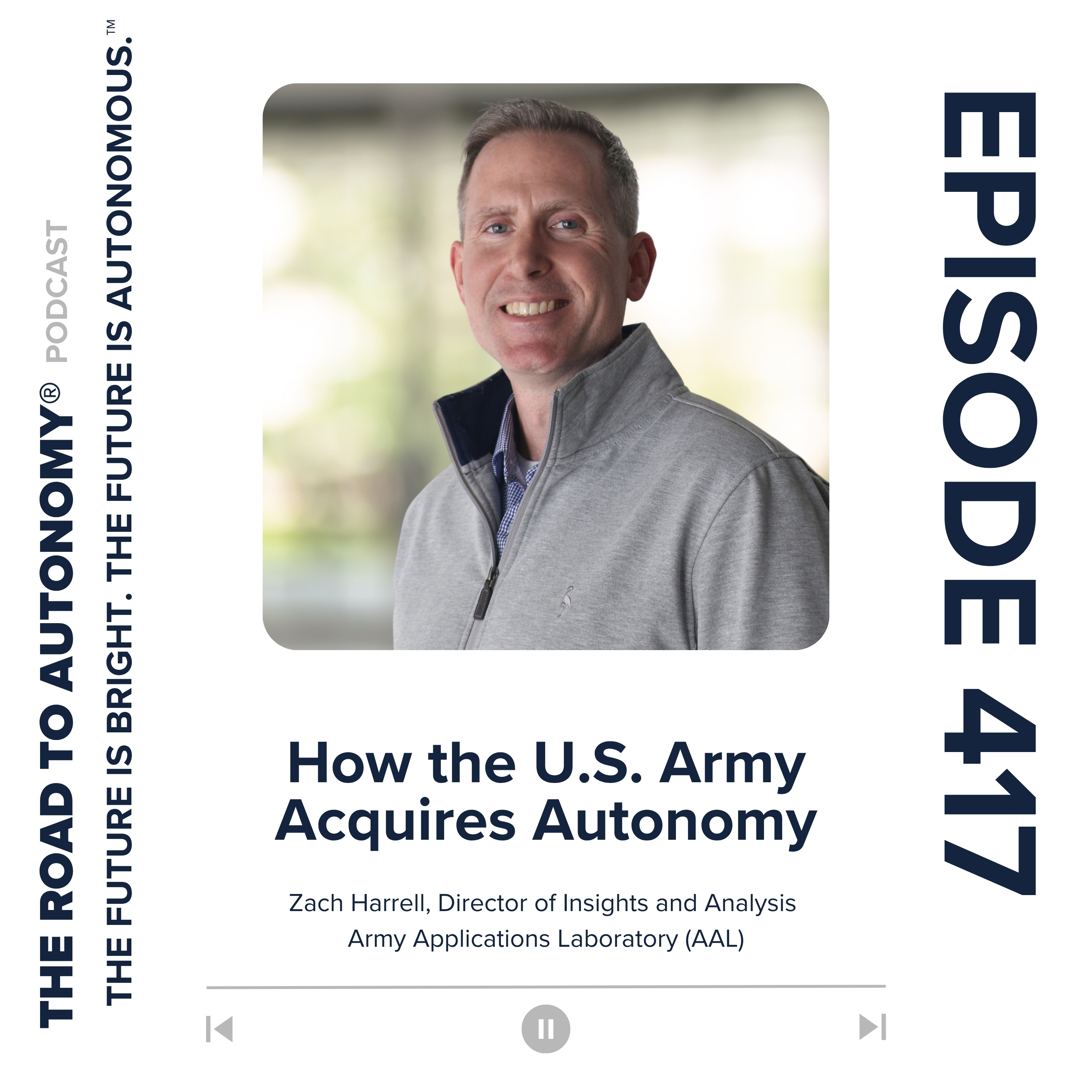
Episode 417 | How the U.S. Army Acquires Autonomy
Jun 1600:44:29Tap to summarizeZach Harrell, Director of Insights and Analysis, Army Applications Laboratory, joined Grayson Brulte on The Road to Autonomy podcast to discuss how the U.S. Army acquires autonomy and brings cutting-edge technology into the hands of soldiers as fast as possible.The bottleneck in defense autonomy is rarely the technology. It is the acquisition process, the decades of requirements documents and program cycles that slow everything down. AAL exists to break that pattern, broadening the Army’s access to the commercial industrial base and capitalizing on the agility of small and non-traditional companies that have never worked with the Department of War.To do that, AAL experiments with process rather than hardware. Their DevX Marketplace lets any company upload a six-minute pitch video, no military ID required, and a passing submission satisfies the competition requirement for contracting, opening a door for the rest of the Army to potentially buy that technology without running a separate solicitation.Autonomous bridging is the proof of what that approach unlocks. Rather than building a new system, AAL backed an autonomy kit that retrofits the Army’s existing bridging equipment, letting sections steer and link themselves into position. The payoff in human terms, is a roughly 90% reduction in the soldiers exposed during one of the most dangerous tasks combat engineers perform.With the FY2027 budget requesting $54.6 billion dollars for autonomous warfare and Austin emerging as a defense tech hub, the future of Army technology will depend less on what gets built and more on the Army’s willingness to adopt it at the lowest burden and lowest cost, to the greatest effect.Episode Chapters00:00 The AAL Mission: Getting Technology to Soldiers Faster03:44 Inside the DevX Marketplace and the Six-Minute Pitch07:41 Autonomous Bridging12:17 The Connected Battlefield16:01 Department of War $54.6 Billion Autonomy Budget21:37 Learning from the Battlefield29:19 Supply Chain Risk31:57 How AAL Invests: Technical Risk, Military Utility, and Moonshots40:55 How to Work With AAL43:12 The Future of Technology in the U.S. Army44:29 AUTNMY AI--------About The Road to AutonomyThe Road to Autonomy is the leading applied intelligence platform covering the convergence of automation, autonomy, and the Autonomy Economy.™.Through our podcasts, newsletter, and proprietary applied intelligence, we set the narrative for institutional investors, industry executives, and policymakers navigating the convergence of automation, autonomy, and economic growth.Join institutional investors and industry leaders who read This Week in The Autonomy Economy every Sunday. Each edition delivers exclusive insight and commentary on the autonomy economy, helping you stay ahead of what's next.Sign up for This Week in The Autonomy Economy newsletter: https://www.roadtoautonomy.com/ae/See Privacy Policy at https://art19.com/privacy and California Privacy Notice at https://art19.com/privacy#do-not-sell-my-info.
Transcribe →
Episode 416 | Autonomy Markets: Robotaxis Get the Hype, Autonomous Trucks May Get the Profits
Jun 1300:29:42Tap to summarizeThis week on Autonomy Markets, Grayson Brulte and Walter Piecyk discuss autonomous trucking reaching an inflection point, Waymo acquiring Apple's Arizona proving ground and Tesla filing for a robotaxi permit in Las Vegas.As Gatik expands its middle-mile freight operations with PepsiCo across Texas, Arizona and Arkansas, Volvo Autonomous Solutions told investors it is targeting $3 billion in autonomous transport revenue within five years through its transport-as-a-service (TaaS) business.On the robotaxi side of the business, Waymo acquired Apple's former 5,500-acre proving ground in Wittmann, Arizona for $220 million, a facility with a high-speed oval an hour from its Mesa up-fitting plant. Grayson views the acquisition as a signal that Waymo is preparing to test at highway speeds away from prying eyes, while Walt notes that satellite imagery sees everything.Before the segueing into the Foreign Autonomy Desk, Grayson and Walt debate Tesla's Clark County permit application for up to 5,000 robotaxis in a Las Vegas market with roughly 6,500 Uber drivers, Einride going public and Rivian beginning R2 deliveries.On the Foreign Autonomy Desk, Chinese robotaxi continues to accelerate into Europe with Pony.ai in Luxembourg and WeRide in Slovakia.Episode Chapters00:00 Gatik Goes Driver-Out with PepsiCo02:51 Volvo Targets $3 Billion in Autonomous Transport Revenue06:54 Einride Goes Public08:58 Tesla Files for Clark County Robotaxi Permit11:52 Waymo Acquires Apple's Arizona Proving Ground13:39 Wayve and Uber Open the UK Interest List16:20 Baidu Added to the Pentagon's Designation List18:31 Foreign Autonomy Desk27:13 Nebius Launches a Physical AI Lab28:14 Next Week--------About The Road to AutonomyThe Road to Autonomy is the leading applied intelligence platform covering the convergence of automation, autonomy, and the Autonomy Economy.™.Through our podcasts, newsletter, and proprietary applied intelligence, we set the narrative for institutional investors, industry executives, and policymakers navigating the convergence of automation, autonomy, and economic growth.Join institutional investors and industry leaders who read This Week in The Autonomy Economy every Sunday. Each edition delivers exclusive insight and commentary on the autonomy economy, helping you stay ahead of what's next.Sign up for This Week in The Autonomy Economy newsletter: https://www.roadtoautonomy.com/ae/See Privacy Policy at https://art19.com/privacy and California Privacy Notice at https://art19.com/privacy#do-not-sell-my-info.
Transcribe →
Episode 415 | Autonomy Signals: Tesla Bets Big on Las Vegas as Waymo Buys Apple’s Proving Grounds
Jun 1100:57:19Tap to summarizeThis week on Autonomy Signals, Grayson Brulte and Rob Grant discuss Tesla’s application to operate up to 5,000 robotaxis in Las Vegas, Waymo’s $220 million purchase of Apple’s former proving grounds, and Neolix’s partnership with Quickbot to solve the last 50 meters of autonomous delivery.On June 3rd, Tesla expanded their unsupervised robotaxi geofence to cover the entire 245 square mile Austin metropolitan area, even as its active fleet contracted to an estimated 20 to 25 vehicles. That same week, Tesla filed an application with the Nevada Transportation Authority for an Autonomous Vehicle Network Company permit to operate up to 5,000 robotaxis in Clark County within the next 12 months.With expanding service areas and a contracting physical fleet, Tesla is optimizing for a coverage narrative while software readiness remains the critical bottleneck to commercial scale, and the path to Las Vegas still runs through individual casino property agreements.Waymo purchased Apple’s former proving grounds in Wittmann, Arizona, originally the DaimlerChrysler proving grounds, for $220 million. The site is larger than Waymo’s existing California and Ohio testing grounds combined, featuring a 115 acre city course, a four mile high speed oval, and a dedicated freeway loop, and it sits roughly an hour from Waymo’s Mesa vehicle integration facility.By securing a closed loop validation pipeline adjacent to its manufacturing hub, Waymo is converting capital into validation velocity as it targets one million weekly rides by the end of the year and up to 20 additional cities by the end of 2026.Then there is Neolix, the Chinese autonomous delivery company, which announced a strategic partnership with Singapore-based Quickbot to co-deploy an end-to-end autonomous delivery solution. The integration pairs Neolix’s Level 4 logistics vehicles with Quickbot’s autonomous final mile delivery platform, which manages secure entry through doors and elevators without human intervention.Anchored in Singapore’s Punggol Digital District and timed to the country’s regulatory transition from sandbox to commercial operations, the alliance creates the first commercially viable human-free continuous delivery chain from road to door, with the Asia-Pacific and Middle East as the real targets.Episode Chapters00:00 Signal 1: Tesla's Big Austin Expansion and Las Vegas Robotaxi Ambitions22:47 Signal 2: Waymo Buys Apple's Former Proving Grounds44:07 Signal 3: Neolix Partners with Quickbot to Solve the Last 50 Meters56:42 AUTNMY AI--------About The Road to AutonomyThe Road to Autonomy is the leading applied intelligence platform covering the convergence of automation, autonomy, and the Autonomy Economy.™.Through our podcasts, newsletter, and proprietary applied intelligence, we set the narrative for institutional investors, industry executives, and policymakers navigating the convergence of automation, autonomy, and economic growth.Join institutional investors and industry leaders who read This Week in The Autonomy Economy every Sunday. Each edition delivers exclusive insight and commentary on the autonomy economy, helping you stay ahead of what's next.Sign up for This Week in The Autonomy Economy newsletter: https://www.roadtoautonomy.com/ae/See Privacy Policy at https://art19.com/privacy and California Privacy Notice at https://art19.com/privacy#do-not-sell-my-info.
Transcribe →
Episode 414 | Hertz Isn't Just a Rental Car Company Anymore
Jun 900:37:40Tap to summarizeGil West, CEO of Hertz, joined Grayson Brulte on The Road to Autonomy podcast to discuss the launch of Oro Mobility and how a century of fleet operations is helping robotaxis to scale.A robotaxi parked is a depreciating asset, and the attention goes to the driving while the margin hides everywhere else. Cleaning, charging, maintaining, and positioning the vehicle is the part nobody wants and the part that decides the economics.Oro Mobility was built to own that work. It is an asset-heavy operating company sitting on Hertz infrastructure, 2,700 chargers, more than 11,000 service locations, and a footprint across roughly 160 countries. Oro owns and operates fleets, human-driven and autonomous, and supplies them turnkey to B2B partners including Uber and Nuro in a manner that Gil frames as the connective tissue between the demand aggregators, the technology companies, and the OEMs, the supply layer for the future of mobility.That positioning reshapes how the autonomy economy scales. A robotaxi company no longer has to build depots, charging, and a service network from scratch, something Mr. West says could take decades and billions of dollars to replicate.Over time, Hertz plans to hold robotaxis on its balance sheet as both owner and operator, sweat each asset through the peaks, service it through the valleys, and run the same footprint across rideshare, delivery, and autonomy.Episode Chapters00:00 Hertz's Turnaround1:18 Oro Mobility4:43 Hertz's Infrastructure Advantage13:29 Robotaxi Technicians15:36 Robotaxis and Rideshare are Complementary19:27 Infrastructure Permitting22:26 Peaks and Valleys of Assets Ownership25:47 Inspiration for Oro Mobility28:28 Hertz as a Platform Business30:28 Managing the Turnaround34:21 Defining Success for Oro Mobility35:22 Hertz Over the Next Century37:03 AUTNMY AI--------About The Road to AutonomyThe Road to Autonomy is the leading applied intelligence platform covering the convergence of automation, autonomy, and the Autonomy Economy.™.Through our podcasts, newsletter, and proprietary applied intelligence, we set the narrative for institutional investors, industry executives, and policymakers navigating the convergence of automation, autonomy, and economic growth.Join institutional investors and industry leaders who read This Week in The Autonomy Economy every Sunday. Each edition delivers exclusive insight and commentary on the autonomy economy, helping you stay ahead of what's next.Sign up for This Week in The Autonomy Economy newsletter: https://www.roadtoautonomy.com/ae/See Privacy Policy at https://art19.com/privacy and California Privacy Notice at https://art19.com/privacy#do-not-sell-my-info.
Transcribe →
Episode 413 | Autonomy Markets: WeRide Is Catching Up to Waymo Globally
Jun 600:31:07Tap to summarizeThis week on Autonomy Markets, Grayson Brulte and Walter Piecyk discuss WeRide trying to catch up to Waymo globally, Waymo preparing to deploy Chinese-made robotaxis in Texas and the CEO of FedEx Freight's open embracement of autonomous trucking.As WeRide and Uber continue to expand throughout Europe and the Middle East together, Waymo continues to work towards deploying the Chinese-made Zeekr robotaxis now called the Ojai, with data suggesting they are now in Texas, in a politically risky move.FedEx Freight CEO John Smith declared autonomous trucks ready for prime time, a signal Grayson reads alongside Amazon entering the freight business and Uber selling down another stake in Aurora. With Amazon running one of the most sophisticated freight networks in the world and FedEx now a standalone public company, the pressure on Uber Freight is building.Wrapping up the conversation, Grayson and Walt Uber's continued European push by partnering with Autobrains on a Munich robotaxi service pending regulatory approval, and Saudi Arabia's PIF-backed Humain partnered with NVIDIA to deploy robotaxis in the Kingdom of Saudi Arabia.Episode Chapters00:00 SpaceX IPO3:53 WeRide and Uber Expand Across Europe7:39 Waymo Registers 45 Zeekrs in Texas10:30 Waymo's New Tampa Depot15:36 Uber Sells Down Its Aurora Stake16:33 Why Amazon Hasn't Bought an Autonomous Trucking Company?23:04 Avride Robotaxis in Texas25:26 Serve Robotics Moves Into Laundry26:29 Ferrari Rules Out Autonomy28:56 Foreign Autonomy Desk30:27 Next Week--------About The Road to AutonomyThe Road to Autonomy is the leading applied intelligence platform covering the convergence of automation, autonomy, and the Autonomy Economy.™.Through our podcasts, newsletter, and proprietary applied intelligence, we set the narrative for institutional investors, industry executives, and policymakers navigating the convergence of automation, autonomy, and economic growth.Join institutional investors and industry leaders who read This Week in The Autonomy Economy every Sunday. Each edition delivers exclusive insight and commentary on the autonomy economy, helping you stay ahead of what's next.Sign up for This Week in The Autonomy Economy newsletter: https://www.roadtoautonomy.com/ae/See Privacy Policy at https://art19.com/privacy and California Privacy Notice at https://art19.com/privacy#do-not-sell-my-info.
Transcribe →
Episode 412 | Autonomy Signals: Uber's Europe Strategy, FedEx Freight Flips the Script, Undersea Autonomy Accelerates
Jun 401:10:03Tap to summarizeThis week on Autonomy Signals, Grayson Brulte and Rob Grant discuss Uber's OEM-agnostic robotaxi strategy in Europe, FedEx Freight CEO's declaration that autonomous trucks are ready for prime time, and the AUKUS alliance accelerating undersea autonomy.At GTC Taipei, Uber, Autobrains, and NVIDIA announced a strategic collaboration to launch a robotaxi program in Munich, pending regulatory approval, built on Autobrains' agentic AI and the NVIDIA DRIVE Hyperion Level 4 platform. With no German OEM attached and Stellantis the likely production partner, the move extends Uber's asset-light playbook of contributing its demand network while pushing vehicle CapEx off its balance sheet and onto its partners.On June 1st, FedEx Freight began trading as an independent standalone company, and CEO John Smith stated that its autonomous tractor-trailers can run yard to interstate to facility with 99.9% autonomy. By framing the primary barrier to commercialization as regulatory rather than technical, Mr. Smith flipped the industry narrative from can we build it to will we be allowed to use it.Then there is AUKUS, where Australia, the United States, and the United Kingdom formally initiated a trilateral project to develop unmanned undersea vehicles with an aggressive 2027 delivery target. The UUVs are designed for reconnaissance, strike, anti-submarine warfare, and protection of critical infrastructure like undersea cables, signaling that autonomy is no longer just a commercial endeavor but a core pillar of national security, though trilateral interoperability and contested deep-sea environments pose real execution risk.Episode Chapters00:00 Signal 1: Uber's European Robotaxi Strategy33:19 Signal 2: AUKUS Accelerates Unmanned Undersea Autonomy56:16 Signal 3: FedEx Freight CEO Flips the Script01:09:26 AUTNMY AIAutonomy Signals is presented by KPMG.--------About The Road to AutonomyThe Road to Autonomy is the leading applied intelligence platform covering the convergence of automation, autonomy, and the Autonomy Economy.™.Through our podcasts, newsletter, and proprietary market intelligence, we set the narrative for institutional investors, industry executives, and policymakers navigating the convergence of automation, autonomy, and economic growth.Join institutional investors and industry leaders who read This Week in The Autonomy Economy every Sunday. Each edition delivers exclusive insight and commentary on the autonomy economy, helping you stay ahead of what's next.Subscribe today: https://www.roadtoautonomy.com/ae/See Privacy Policy at https://art19.com/privacy and California Privacy Notice at https://art19.com/privacy#do-not-sell-my-info.
Transcribe →
Episode 411 | From Tracking Terrorists to Tracking Trucks: How a Former CIA Officer Built the Ground Truth Layer
Jun 200:45:40Tap to summarizeRyan Joyce, Co-Founder and CEO, GenLogs joined Grayson Brulte on The Road to Autonomy podcast to discuss how the intelligence community’s playbook is being applied to trucking, building a ground truth layer for freight.For nearly two decades, Ryan recruited assets inside terrorist networks as a CIA case officer, validating in the physical world what sources claimed in the digital one. The trucking industry runs on the same data gap. Carriers self-report, telematics that can be modified, and bad actors claim trucks that are not on the road, with no one able to prove otherwise.GenLogs closes that gap with a nationwide network of privacy-enabled roadside cameras capturing just shy of twenty million images a day. The system uniquely fingerprints every truck in America and tracks it through changed DOT numbers, new decals, and swapped plates, exposing the chameleon carriers that burn down one identity and spin up another.That ground truth is reshaping how insurers underwrite risk, how brokers vet carriers, and how law enforcement recovers stolen freight. In one case, partial trailer data was enough to track and recover a trafficked minor. The same correlation engine now maps where every autonomous trucking company operates, which lanes they run, and whose trailers they pull.The future of freight will not be won by the operators who trust the digital record. It will be won by the operators who verify it against the ground truth.Episode Chapters00:00 From Tracking Terrorists to Tracking Trucks04:10 Building the Ground Truth Camera Network07:32 The Verification Layer for Insurance11:01 The Scale of Cargo Theft and Fraud14:16 Anomaly Detection and the Intelligence Playbook18:34 Combating Human Trafficking21:41 Fingerprinting Every Truck in America26:22 90-Day Snapshot of Six Autonomous Trucking Companies34:48 Protecting High-Value Loads41:13 The Future of GenLogs in an Autonomous Fleet45:04 AUTNMY AI--------About The Road to AutonomyThe Road to Autonomy is the leading applied intelligence platform covering the convergence of automation, autonomy, and the Autonomy Economy.™.Through our podcasts, newsletter, and proprietary applied intelligence, we set the narrative for institutional investors, industry executives, and policymakers navigating the convergence of automation, autonomy, and economic growth.Join institutional investors and industry leaders who read This Week in The Autonomy Economy every Sunday. Each edition delivers exclusive insight and commentary on the autonomy economy, helping you stay ahead of what's next.Sign up for This Week in The Autonomy Economy newsletter: https://www.roadtoautonomy.com/ae/See Privacy Policy at https://art19.com/privacy and California Privacy Notice at https://art19.com/privacy#do-not-sell-my-info.
Transcribe →
Episode 410 | Autonomy Markets: Is Waymo's Lead Becoming Insurmountable?
May 3000:40:55Tap to summarizeThis week on Autonomy Markets, Grayson Brulte and Walter Piecyk discuss Waymo’s widening lead, the Ojai (Chinese-made Zeekr robotaxi) rollout’s political fault lines, and the new Texas autonomous vehicle and truck database.Waymo is actively preparing to deploy a fleet of Chinese-made Zeekrs across California and Arizona, now renamed Ojai, in blue and purple states, not a red state, at least not yet. Sticking to his original call that the Zeekr is an unforced error, Grayson lays out the emerging split where Jaguars head to red states and Zeekrs head to blue and purple ones.With Magna now producing roughly 250 vehicles a month, Waymo is on pace for 6,000 cars by year-end, and Walt argues the real unlock comes when the sensor stack gets cheaper and Waymo begins to add more than 1,000 new vehicles a month on the road.In Texas, the Texas Department of Motor Vehicles launched the Automated Motor Vehicle Lookup, where any member of the public can look up the fleet size of any AV operator in the state along with any complaints that might be filed.Wrapping up the conversation, Grayson and Walt discussed the launch of Wayve Labs, Zoox getting an undeserved pass thanks to Amazon and BYD’s willingness to compensate owners when God’s Eye is engaged during an incident.Episode Chapters00:00 Waymo Deploys the Ojai06:40 Waymo Production Math08:55 Waymo's Expanding Lead15:15 Texas Automated Motor Vehicle Lookup25:00 Wayve Labs32:10 3,760 Miles Across Canada. No Interventions.36:15 Zoox Gets a Pass39:15 Foreign Autonomy Desk40:20 Next Week--------About The Road to AutonomyThe Road to Autonomy is the leading applied intelligence platform covering the convergence of automation, autonomy, and the Autonomy Economy.™.Through our podcasts, newsletter, and proprietary applied intelligence, we set the narrative for institutional investors, industry executives, and policymakers navigating the convergence of automation, autonomy, and economic growth.Join institutional investors and industry leaders who read This Week in The Autonomy Economy every Sunday. Each edition delivers exclusive insight and commentary on the autonomy economy, helping you stay ahead of what's next.Sign up for This Week in The Autonomy Economy newsletter: https://www.roadtoautonomy.com/ae/See Privacy Policy at https://art19.com/privacy and California Privacy Notice at https://art19.com/privacy#do-not-sell-my-info.
Transcribe →