Podcast
The Road to Autonomy
Hosted by Grayson Brulte | AUTNMY AI · EN
Hosted by Grayson Brulte, The Road to Autonomy delivers institutional-grade intelligence on autonomous vehicles, autonomous trucking, robotaxis, and the capital flows shaping the market.
Every episode combines primary field research, proprietary data, and conversations with the operators, investors, and policymakers building the autonomy economy.
Three shows comprise the feed:
- The Road to Autonomy (Tuesdays): Flagship, in-depth conversations and analysis with the architects of the autonomy economy.
- Autonomy Signals, presented by KPMG (Thursdays): AUTNMY AI co-founders Grayson Brulte and Rob Grant analyze the underlying technical and regulatory signals moving the market.
- Autonomy Markets (Saturdays): Grayson Brulte and Walter Piecyk, Partner & TMT Analyst, LightShed Partners and General Partner, LightShed Ventures break down the week in autonomy from a Wall Street and investment perspective.
With over 400 episodes, The Road to Autonomy has become the trusted source for hedge funds, analysts, and executives who need to understand the emergence of the autonomy economy and the growth of physical AI.
79episodes
Episodes
Newest firstAll episodes

Episode 429 | Autonomy Signals: Baidu's Hong Kong Expansion Unlocks Right-Hand Drive Markets
Jul 1700:49:26Tap to summarizeThis week on Autonomy Signals, Grayson Brulte and Rob Grant discuss Baidu's Apollo Go robotaxi expansion in Hong Kong, the first combat strike using Saronic autonomous vessels on an Iranian naval base, and autonomous drones mapping volcanic gas clouds off the coast of Sicily.Hong Kong issued Baidu three pilot licenses covering 50 vehicles and cleared cross-district driverless trials using its sixth-generation RT6 robotaxis. The city-state's right-hand drive, left-side traffic system turns it into a proving ground for Japan, the UK, Singapore, and Australia, advancing China's Autonomous Belt and Road Initiative and setting up Baidu to export validated autonomy into left-side traffic markets.On July 12, 2026, US Central Command (CENTCOM) executed the first ever combat strike using unmanned surface vessels, deploying three Saronic-built Corsair vessels against Iran's Bandar Abbas Naval Base. The strike marks a doctrinal shift in naval warfare, altering the cost-exchange calculus of maritime conflict as tier one primes reposition themselves as mission integrators and treat autonomous hulls as expendable peripherals to their combat systems.Closing out the show, Grayson and Rob discuss researchers at the Technical University of Munich deploying an autonomous drone on the Italian island of Vulcano to map volcanic gas concentrations at a 5% margin of error, eliminating the need to fly into corrosive plumes.Episode Chapters0:00 KPMG Sponsor Introduction01:34 Signal 1: Baidu's Apollo Go Expansion in Hong Kong18:55 Signal 2: First Autonomous Maritime Combat Strike37:16: Signal 3: Autonomous Drones Mapping Volcanic Gas CloudsFollow The Road to Autonomy Indices--------About The Road to AutonomyThe Road to Autonomy is the leading applied intelligence platform covering the convergence of automation, autonomy, and the Autonomy Economy.™.Through our podcasts, newsletter, and proprietary applied intelligence, we set the narrative for institutional investors, industry executives, and policymakers navigating the convergence of automation, autonomy, and economic growth.Join institutional investors and industry leaders who read This Week in The Autonomy Economy every Sunday. Each edition delivers exclusive insight and commentary on the autonomy economy, helping you stay ahead of what's next.Sign up for This Week in The Autonomy Economy newsletterSee Privacy Policy at https://art19.com/privacy and California Privacy Notice at https://art19.com/privacy#do-not-sell-my-info.
Transcribe →
Episode 428 | Scale Not Technology Is the Real Constraint in AI Manufacturing
Jul 1400:34:32Tap to summarizeTodd Deaville, VP, Advanced Manufacturing Innovation, Magna, joined Grayson Brulte on The Road to Autonomy podcast to discuss how artificial intelligence and advanced robotics are transforming global manufacturing.To Deaville, AI is a highly powerful tool set optimized for recognizing complex patterns, making quality-control decisions, and analyzing massive data flows. Applying AI to robotics introduces unprecedented flexibility to the physical world, moving beyond historically rigid, defined programming to enable machines that can adapt and make operational changes in real time.With manufacturing facilities spanning 28 countries, Magna’s primary challenge is deploying these advanced technologies at scale. To achieve this, the company clusters its solutions around specific product and process archetypes, relying on a playbook approach with practical guides to help local plants succeed.This shift toward more complex digital workflows is being further accelerated by a new generation of workers whose gaming backgrounds have trained them to navigate highly interactive, realistic three-dimensional simulations.. By continuously feeding operational data back into its systems, Magna is elevating the skills of its workforce, streamlining its design-for-manufacturing processes, and building a highly efficient, autonomous future.Episode Chapters0:00 Defining AI in Manufacturing2:40 Robotics4:42 Open Source Models & Data Sovereignty8:34 Deploying Tech Globally11:07 Labs vs. Active Factory Floors13:06 Scale Is the Real Bottleneck16:56 Humanoid Robots21:13 Gaming and the Evolving Workforce28:57 Magna Data Flywheel31:06 The Future of Robotaxi Manufacturing32:32 Future of Magna33:56 AUTNMY AI--------About The Road to AutonomyThe Road to Autonomy is the leading applied intelligence platform covering the convergence of automation, autonomy, and the Autonomy Economy.™.Through our podcasts, newsletter, Indices and proprietary applied intelligence, we set the narrative for institutional investors, industry executives, and policymakers navigating the convergence of automation, autonomy, and economic growth.Join institutional investors and industry leaders who read This Week in The Autonomy Economy every Sunday. Each edition delivers exclusive insight and commentary on the autonomy economy, helping you stay ahead of what's next.Sign up for This Week in The Autonomy Economy newsletterFollow The Road to Autonomy IndicesSee Privacy Policy at https://art19.com/privacy and California Privacy Notice at https://art19.com/privacy#do-not-sell-my-info.
Transcribe →
Episode 427 | Autonomy Markets: Three Robotaxis in Miami, Four New Waymo Markets, One New NHTSA Letter
Jul 1100:37:02Tap to summarizeThis week on Autonomy Markets, Grayson Brulte and Walter Piecyk discuss Tesla‘s unsupervised robotaxi launch in Miami, Waymo preparing to bring four new markets online, and NHTSA Administrator Jonathan Morrison’s letter to autonomous vehicle operators.On July 3rd, Tesla launched unsupervised robotaxi in Miami, their first market outside of Texas and California. We were there on the ground conducting field research with no safety monitor and no chase vehicle in sight, riding through torrential downpours and flooded streets. The fleet grew from two vehicles on day one to three vehicles by day three, and it was the best unsupervised robotaxi experience we have ever had.While conducting field research, we counted over two dozen Cybercabs staged in Miami, every single one with a steering wheel and a Florida license plate. We believe these are validation vehicles and that Cybercab will be Tesla’s major robotaxi launch vehicle. Notably, Tesla’s operating domain extends further west than Waymo’s, wrapping around the back side of Miami International Airport.As Tesla scales in Miami, NHTSA Administrator Jonathan Morrison sent a letter to autonomous vehicle operators on July 8th citing a pattern of driverless vehicles interfering with police, fire, and EMS. The timing was notable, as our Tesla robotaxi flawlessly pulled over for an ambulance during our Miami rides. Mr. Morrison’s approach of loosening hardware rules while tightening behavioral scrutiny is the regulatory framework we believe the industry needs to scale.Waymo opened employee rides in Las Vegas, San Diego, Tampa, and Denver, the final gate before public service. Tampa confirms the call The Road to Autonomy made three weeks ago when we uncovered Waymo’s 100,000 square foot warehouse lease near Tampa International Airport.Beyond the four new cities, OMEGA uncovered corporate filings pointing to potential Waymo deployments in France, Spain, and the Netherlands, along with an Alphabet entity in Singapore holding $21 billion that we verified as a wholly owned Waymo subsidiary through the Delaware Chancery Court.On the Foreign Autonomy Desk, Grayson and Walt discuss Baidu publicly disclosing 143,000 autonomous driving miles in Hong Kong and Zelos securing Malaysia’s first L4 public road permit for driverless delivery.Episode Chapters0:00 Tesla Launches Robotaxi in Miami8:50 Tesla's Miami Service Area Compared to Waymo's14:35 NHTSA Administrator Jonathan Morrison's Letter to Autonomous Vehicle Operators19:13 Waymo's New Markets: Las Vegas, San Diego, Tampa, and Denver23:02 Denver: Waymo's First Snow and Ice Market26:41 OMEGA uncovers Waymo's European Grand Ambitions29:32 Waymo's Playbook32:01 Uber's Autonomy Partners Struggles34:27 Foreign Autonomy Desk35:21 Next WeekFollow The Road to Autonomy Indices--------About The Road to AutonomyThe Road to Autonomy is the leading applied intelligence platform covering the convergence of automation, autonomy, and the Autonomy Economy.™.Through our podcasts, newsletter, and proprietary applied intelligence, we set the narrative for institutional investors, industry executives, and policymakers navigating the convergence of automation, autonomy, and economic growth.Join institutional investors and industry leaders who read This Week in The Autonomy Economy every Sunday. Each edition delivers exclusive insight and commentary on the autonomy economy, helping you stay ahead of what's next.Sign up for This Week in The Autonomy Economy newsletterSee Privacy Policy at https://art19.com/privacy and California Privacy Notice at https://art19.com/privacy#do-not-sell-my-info.
Transcribe →
Episode 426 | Autonomy Signals: Tesla Launches Robotaxi in Miami, Waymo's July 4th Stumble, Momenta IPOs in Hong Kong
Jul 1001:22:57Tap to summarizeThis week on Autonomy Signals presented by KPMG Grayson Brulte and Rob Grant discuss Tesla’s Unsupervised Robotaxi launch in Miami, Waymo’s July 4th stumble in San Francisco, and Momenta’s oversubscribed IPO on the Hong Kong Stock Exchange.On July 5, 2026, Tesla launched Unsupervised Robotaxi service in Miami, its first unsupervised market outside of Texas, with retrofitted Model Ys operating through heavy rain and flooded roadways during the heart of hurricane season.Grayson was on the ground for launch day, riding through South Florida’s mini lakes without a single hesitation from the vehicle, and uncovered a Cybercab staging lot near Miami International Airport with dozens of vehicles ready to deploy. The Miami launch is a deliberate stress test of Tesla’s camera-only system against the exact adverse weather conditions currently under NHTSA engineering analysis, and the receipts reveal a premium pricing experiment running 3X to 4X the base fare of Tesla’s Texas markets.Then there is Waymo, whose vehicles bricked across San Francisco on the 4th of July as fireworks, road closures, dense crowds, and connectivity failures overwhelmed the fleet. Vehicles idled until their batteries depleted and had to be towed, one Waymo burned, and San Francisco officials have launched inquiries into the incident.The July 4th stumble potentially exposed a remote assistance bottleneck that makes Waymo’s lean human supervision model the critical scaling constraint in burst demand emergencies, threatening the path to one million weekly rides as regulators eye special event requirements and remote operator staffing ratios.Closing out the show, Grayson and Rob discuss Momenta’s listing on the Hong Kong Stock Exchange as the market’s first physical AI stock, with the retail tranche oversubscribed 414 times and 14 cornerstone investors including BlackRock, Fidelity International, GIC, Mercedes-Benz, and BYD.With its software running in over 900,000 vehicles and licensing revenue growing 42-fold over three years, Momenta’s IPO signals that institutional investors are shifting their preference away from speculative capital-intensive deployments towards proven physical AI providers.Episode Chapters00:00 KPMG Sponsor Introduction01:16 Signal 1: Tesla Launches Unsupervised Robotaxi in Miami38:38 Signal 2: Waymo's July 4th Stumble in San Francisco1:11:27 Signal 3: Momenta IPOs on the Hong Kong Stock ExchangeFollow The Road to Autonomy Indices--------About The Road to AutonomyThe Road to Autonomy is the leading applied intelligence platform covering the convergence of automation, autonomy, and the Autonomy Economy.™.Through our podcasts, newsletter, and proprietary applied intelligence, we set the narrative for institutional investors, industry executives, and policymakers navigating the convergence of automation, autonomy, and economic growth.Join institutional investors and industry leaders who read This Week in The Autonomy Economy every Sunday. Each edition delivers exclusive insight and commentary on the autonomy economy, helping you stay ahead of what's next.Sign up for This Week in The Autonomy Economy newsletterSee Privacy Policy at https://art19.com/privacy and California Privacy Notice at https://art19.com/privacy#do-not-sell-my-info.
Transcribe →Episode 425 | Bot Auto's Playbook for One Billion Autonomous Miles
Jul 700:48:12Tap to summarizeBrett Suma, President and COO of Bot Auto, joined Grayson Brulte on The Road to Autonomy podcast to discuss Bot Auto’s playbook for autonomously driving one billion autonomous miles in four years.On April 29th by completing its first humanless run from Houston to Dallas. To achieve long-term growth and commercial success, Bot Auto is rejecting the standard driver-as-a-service intermediary model used by its competitors. Instead, the company is building direct relationships with shippers and designing a utility grid of capacity focused on solving network sequencing, lane selection, and utilization.As the company focuses on capital-efficient deployment, Bot Auto plans to sidestep raising large funding rounds to purchase depreciating operations assets. Instead, the company will rely on traditional financing methods, established banking relationships, and an experienced sales force to scale its tractor and trailer counts. With a comprehensive five-year financial roadmap in place, Bot Auto is positioning itself to scale organically based on market demand, setting a disciplined target of one billion autonomous miles within the next four years.Episode Chapters0:00 Why Bot Auto4:56 April 29th Humanless Houston to Dallas Run9:52 Economics of Humanless Miles14:36 Building a Trucking Business17:17 Capacity as a Utility Grid, Not Truck Counts24:19 Bot Auto's Business Model29:34 CapEx and Financing Trucks32:15 Hidden Risk of Operating a Mixed Fleet41:49 Staying Disciplined as Bot Auto Grows44:24 One Billion Autonomous Miles in Four Years47:36 AUTNMY AI--------About The Road to AutonomyThe Road to Autonomy is the leading applied intelligence platform covering the convergence of automation, autonomy, and the Autonomy Economy.™.Through our podcasts, newsletter, Indices and proprietary applied intelligence, we set the narrative for institutional investors, industry executives, and policymakers navigating the convergence of automation, autonomy, and economic growth.Join institutional investors and industry leaders who read This Week in The Autonomy Economy every Sunday. Each edition delivers exclusive insight and commentary on the autonomy economy, helping you stay ahead of what's next.Sign up for This Week in The Autonomy Economy newsletterFollow The Road to Autonomy IndicesSee Privacy Policy at https://art19.com/privacy and California Privacy Notice at https://art19.com/privacy#do-not-sell-my-info.
Transcribe →
Episode 424 | Autonomy Markets: Waymo and Uber Divorce in Phoenix. Are Austin and Atlanta Next?
Jul 400:34:43Tap to summarizeThis week on Autonomy Markets, Grayson Brulte and Walter Piecyk discuss the end of Waymo and Uber's partnership in Phoenix, Tesla's Cybercab hitting the streets of Austin branded for America 250 and Waymo's "Because they're everything" World Cup campaign.As Tesla gets closer and closer to putting the Cybercab into service, the U.S. Government is inching toward a national framework that would allow vehicles with no steering wheel and no pedals to deploy across all 50 states and charge for rides.It is the regulatory environment that we believe Tesla is waiting to change before deploying Cybercab into the fleet, even if the rides are free. As Tesla waits for regulatory certainty, The Road to Autonomy broke the news that Waymo and Uber quietly ended their Phoenix partnership, noticing an update on the Uber autonomous vehicle site.The Phoenix partnership, which lasted 948 days, consisted of a fleet of 12 vehicles that serviced a 180 square mile area. Important to note that this was a dedicated fleet for Uber and the vehicles were not part of the traditional Waymo fleet.Now that Waymo and Uber have divorced in Phoenix, we believe it is only a matter of time until they divorce in Austin, where the service has been live for 482 days, and Atlanta, where the service has been live for 370 days. Both partnerships could unwind by the first quarter of 2027.On the Foreign Autonomy Desk, Grayson and Walt discuss the global growth of FSD and Volkswagen and Bosch ending their automated driving partnership, the latest in a long line of stalled autonomy efforts at the German automaker.Episode Chapters00:00 Happy 250th Birthday, America1:15 Waymo and Uber Phoenix Divorce5:47 Dara, Nuro and Wayve Signals8:24 Who Could Backfill Phoenix for Uber?13:52 The Fizzling Demand Narrative17:51 Cybercab, Branded for America 25021:53 Regulatory, Not Safety, Is Holding Cybercab Back24:50 Tesla Semi25:54 Waymo's World Cup Because They're Everything Campaign28:06 Robotaxis at Airports29:32 Chinese Made Vehicles31:11 Foreign Autonomy Desk34:15 Next WeekFollow The Road to Autonomy Indices--------About The Road to AutonomyThe Road to Autonomy is the leading applied intelligence platform covering the convergence of automation, autonomy, and the Autonomy Economy.™.Through our podcasts, newsletter, and proprietary applied intelligence, we set the narrative for institutional investors, industry executives, and policymakers navigating the convergence of automation, autonomy, and economic growth.Join institutional investors and industry leaders who read This Week in The Autonomy Economy every Sunday. Each edition delivers exclusive insight and commentary on the autonomy economy, helping you stay ahead of what's next.Sign up for This Week in The Autonomy Economy newsletterSee Privacy Policy at https://art19.com/privacy and California Privacy Notice at https://art19.com/privacy#do-not-sell-my-info.
Transcribe →
Episode 423 | Autonomy Signals: The Era of Being Measured
Jul 201:04:56Tap to summarizeThis week on Autonomy Signals, Grayson Brulte and Rob Grant discuss the pending Uber-Waymo divorce, Agility Robotics’ $2.5 billion SPAC merger with Churchill Capital XI, and the launch of The Road to Autonomy Confidence Indices.As of May, Waymo and Uber concluded their robotaxi partnership in Phoenix after roughly 948 days, with Waymo going exclusively direct-to-consumer in that market and Uber seeking a replacement partner, with a Nuro / Lucid partnership as the leading candidate.Uber’s value to select autonomous vehicle operators is highest during market entry, and once an operator builds density and consumer trust, Uber’s value diminishes as the robotaxi provider’s brand grows in that market.Then there is Agility Robotics, whose $2.5 billion SPAC merger with Churchill Capital XI targets over $620 million in gross proceeds to become the first pure-play humanoid robotics entity in the public markets. The listing could be perceived as a forced transparency event, as SEC disclosures will stress-test the contested 98% task success rate, the $300 million contingent backlog, and a warehouse data moat that risks becoming a depreciating asset as the industry pivots to foundation model generalization.Closing out the show, Grayson and Rob discuss the launch of The Road to Autonomy Confidence Indices, a first-of-its-kind benchmark tracking the market’s confidence in the global commercial adoption of robotaxis, autonomous driving licensing, autonomous trucks, and delivery bots.Each index is a single zero-to-100 reading, cryptographically sealed and independently verifiable, and the early divergence is telling, as robotaxi confidence is rising while the market continues to be unsure about autonomous trucking.Episode Chapters00:00 Signal 1: Waymo/Uber Divorce: Predictable and Repeatable34:29 Signal 2: Agility Robotics' $2.5B merger with Churchill Capital XI55:06 Signal 3: The Road to Autonomy Confidence Indices Launch1:04:19 AUTNMY AIFollow The Road to Autonomy Indices--------About The Road to AutonomyThe Road to Autonomy is the leading applied intelligence platform covering the convergence of automation, autonomy, and the Autonomy Economy.™.Through our podcasts, newsletter, and proprietary applied intelligence, we set the narrative for institutional investors, industry executives, and policymakers navigating the convergence of automation, autonomy, and economic growth.Join institutional investors and industry leaders who read This Week in The Autonomy Economy every Sunday. Each edition delivers exclusive insight and commentary on the autonomy economy, helping you stay ahead of what's next.Sign up for This Week in The Autonomy Economy newsletter: https://www.roadtoautonomy.com/ae/See Privacy Policy at https://art19.com/privacy and California Privacy Notice at https://art19.com/privacy#do-not-sell-my-info.
Transcribe →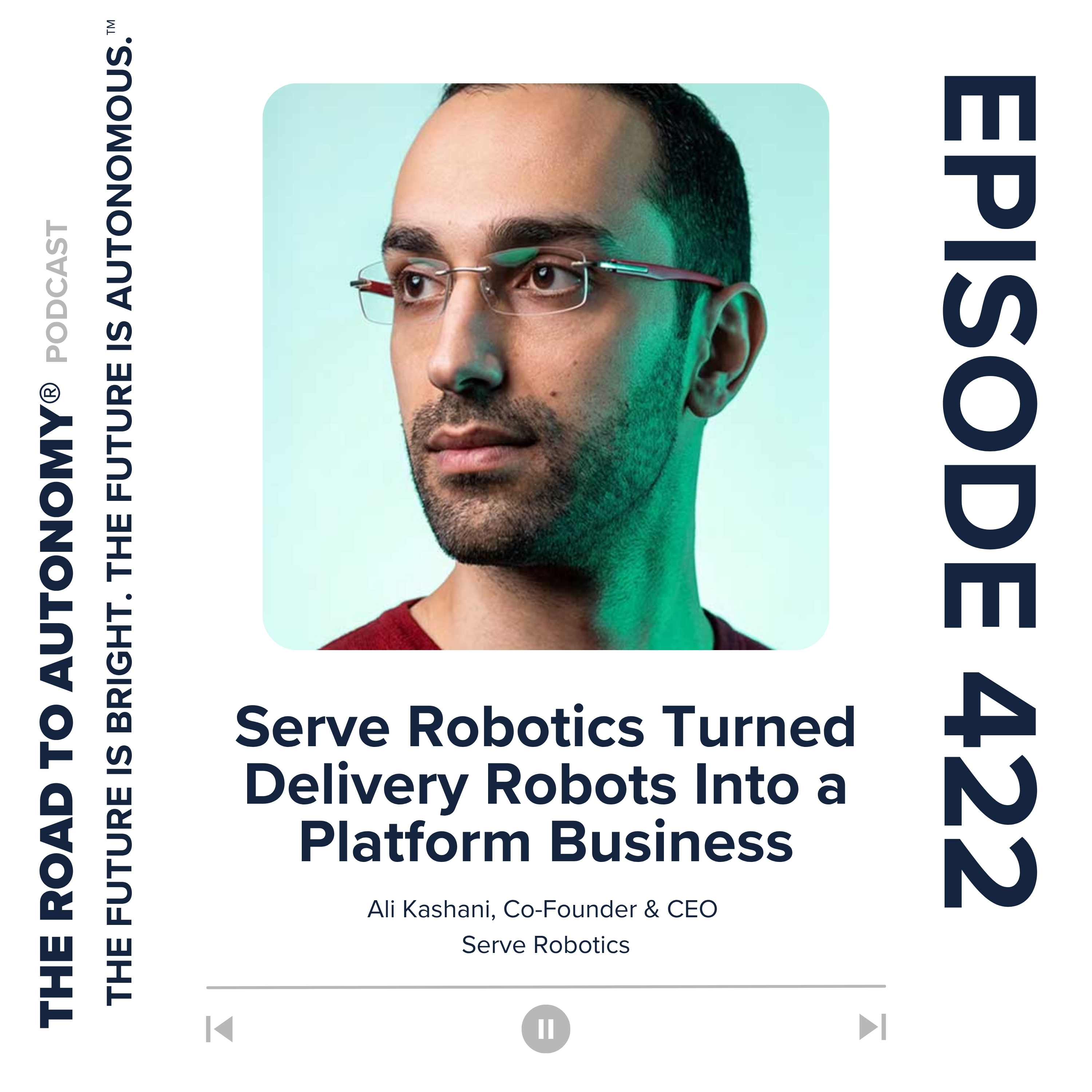
Episode 422 | Serve Robotics Turned Delivery Robots Into a Platform Business
Jun 3000:37:31Tap to summarizeAli Kashani, Co-Founder and CEO of Serve Robotics, joined Grayson Brulte on The Road to Autonomy podcast to discuss how Serve Robotics scaled its delivery fleet into an operating layer for physical AI.Over the past year, Serve Robotics has grown from roughly 50 robots to 2,000, and in Q1 2026 the company reported $3 million in revenue with 45% coming from recurring software licenses.To achieve that growth, Serve is now selling their stack as modular layers, letting other companies license the connectivity, data infrastructure, or hardware piece by piece rather than build everything from scratch. This includes a freemium version of Autonomy Assist, its version of remote assistance.As the company continues to grow Serve is ramping production of their Gen 3 vehicle, which runs at one-third the cost of Gen 2 while delivering five times the compute, a 48-mile range, four-wheel steering and suspension, and the ability to operate in heavy rain.The vehicles are sub-assembled in Asia with the completed final assembly occurring in with Magna International in Michigan. This give the company the flexibility to manufacture end to end in Asia for markets where US tariffs make domestic production uneconomical. With international expansion underway in Tokyo and Sydney this year and a larger push planned for 2027, Serve is positioning to follow demand across the APAC region and beyond.Episode Chapters0:00 Growing and Scaling Revenue8:51 Licensing the Platform11:17 World Models14:59 The Laundry Vertical16:52 Expanding Internationally22:39 Gen 3 Vehicle26:17 Edge Cases28:43 Future Form Factors30:09 Diligent Robotics Acquisition34:06 The Operating Layer of Physical AI36:21 Future of Serve Robotics36:54 AUTNMY AI--------About The Road to AutonomyThe Road to Autonomy is the leading applied intelligence platform covering the convergence of automation, autonomy, and the Autonomy Economy.™.Through our podcasts, newsletter, Indices and proprietary applied intelligence, we set the narrative for institutional investors, industry executives, and policymakers navigating the convergence of automation, autonomy, and economic growth.Join institutional investors and industry leaders who read This Week in The Autonomy Economy every Sunday. Each edition delivers exclusive insight and commentary on the autonomy economy, helping you stay ahead of what's next.Sign up for This Week in The Autonomy Economy newsletterFollow The Road to Autonomy IndicesSee Privacy Policy at https://art19.com/privacy and California Privacy Notice at https://art19.com/privacy#do-not-sell-my-info.
Transcribe →
Episode 421 | Autonomy Markets: Qualcomm Sells the Chip While Mobileye Eyes the Fleet
Jun 2700:44:49Tap to summarizeThis week on Autonomy Markets, Grayson Brulte and Walter Piecyk discuss Qualcomm and Mobileye‘s differing robotaxi strategies, NHTSA removing the physical brake requirement for autonomous vehicles and the New York State Legislature failing to advance an autonomous driving bill.As Congress moves on the Build America 250 Act to legalize autonomous trucking and advances a national framework for autonomous vehicles, Grayson and Walt note that federal action could preempt the hostile policies blocking deployment in New York, New Jersey and Massachusetts.On the robotaxi side of the business, Mobileye signaled it wants to own and operate a fleet, a press release Grayson flagged for having no city permits and no SEC trail. Walt likened the pivot to BlackBerry building its own product to validate the technology, while Qualcomm took the opposite path at its Investor Day, positioning the company as a low-cost autonomous driving solutions provider that will only supply the Snapdragon automotive platform to enable OEMs to scale their businesses as Qualcomm’s automotive business climbs toward $10 billion by fiscal 2029.Before segueing into the Foreign Autonomy Desk, Grayson and Walt debate Tesla’s robotaxi turning one year old still short of 100 cars in Austin, Uber’s week of deals and Waymo pausing service around a World Cup stadium, on highways and in some cases heavy rain, leading the hosts to wonder if there is a sensor issue.On the Foreign Autonomy Desk, China’s Autonomous Belt and Road Initiative continues to accelerate across the globe with Pony.ai launching commercial service in Singapore, Baidu partnering with Swiss Post and WeRide and Uber preparing to launch commercial service in Switzerland.Episode Chapters0:00 Back from Hiatus01:46 New York Continues to Be Hostile to Autonomous Vehicles 05:07 Uber Continues Global Robotaxi Expansion 06:56 The Rise of Non-Binding MOUs10:28 Waymo Opens Nashville Market12:16 Waymo's On-Going Sensor Issues 14:53 Tesla Robotaxi One-Year Launch Anniversary16:12 Mobileye's Robotaxi Fleet Ambitions21:04 Qualcomm's Growing Automotive Business28:50 May Mobility's European Expansion35:36 China’s Autonomous Belt and Road Initiative Continues 36:47 Zoox Design Update38:27 Nvidia's Neibus Investment41:20 The Road to Autonomy Indices Launch43:58 Next WeekFollow The Road to Autonomy Indices --------About The Road to AutonomyThe Road to Autonomy is the leading applied intelligence platform covering the convergence of automation, autonomy, and the Autonomy Economy.™.Through our podcasts, newsletter, indices and proprietary applied intelligence, we set the narrative for institutional investors, industry executives, and policymakers navigating the convergence of automation, autonomy, and economic growth.Join institutional investors and industry leaders who read This Week in The Autonomy Economy every Sunday. Each edition delivers exclusive insight and commentary on the autonomy economy, helping you stay ahead of what's next.Sign up for This Week in The Autonomy Economy newsletterSee Privacy Policy at https://art19.com/privacy and California Privacy Notice at https://art19.com/privacy#do-not-sell-my-info.
Transcribe →
Episode 420 | Tesla FSD Goes Coast to Coast in Canada With a Little Help
Jun 2500:57:22Tap to summarizeThis week on Autonomy Signals, Grayson Brulte and Rob Grant are joined by David Moss, Devin Olsen, and Spencer to break down the first-ever FSD coast-to-coast drive across Canada with no interventions and what 3,782 miles exposed the limits of the Tesla's current consumer hardware.For their journey across The Great White North, the team used a Tesla Model 3 running FSD 14.3 on a journey that took them from British Columbia to Halifax, Nova Scotia with zero driving disengagements, across driving environment that the team has never experienced before.The route threw everything at the car. Two lane roads through the middle of nowhere, fifty mile stretches with no markings, construction flaggers holding stop signs, and Supercharger lots with no lines and no visual reference. The trip became a public stress test of the AI4 hardware suite.Over the six day journey, rain and road grime blinded the cameras and triggered occlusion warnings, throwing a red hands takeover as they pulled into a Supercharger. Across the full run, not a single inch was driven by hand. When the weather turned, the team stopped to clean cameras every fifteen minutes, the exact failure mode the Cybercab teardown answers with onboard air and liquid washers.Tesla FSD Supervised is the best Level 2+ system in the market today. As Tesla's robotaxi ambitions grow, the question now is whether camera only hardware can clear weather, occlusion, and the absence of self-cleaning to truly unlock FSD Unsupervised, or whether that threshold rests on AI5 and a washer equipped sensor stack as Tesla scales toward FSD version 15.Episode Chapters00:00 Signal 1: 3,782 miles Across Canada11:11 Camera Occlusion17:04 What FSD Unsupervised Actually Requires32:44 OMEGA's Take45:09 Where's Next?56:45 AUTNMY AIFollow The Road to Autonomy Indices --------About The Road to AutonomyThe Road to Autonomy is the leading applied intelligence platform covering the convergence of automation, autonomy, and the Autonomy Economy.™.Through our podcasts, newsletter, indices and proprietary applied intelligence, we set the narrative for institutional investors, industry executives, and policymakers navigating the convergence of automation, autonomy, and economic growth.Join institutional investors and industry leaders who read This Week in The Autonomy Economy every Sunday. Each edition delivers exclusive insight and commentary on the autonomy economy, helping you stay ahead of what's next.Sign up for This Week in The Autonomy Economy newsletter: https://www.roadtoautonomy.com/ae/See Privacy Policy at https://art19.com/privacy and California Privacy Notice at https://art19.com/privacy#do-not-sell-my-info.
Transcribe →