Podcast
The Road to Autonomy
Hosted by Grayson Brulte | AUTNMY AI · EN
Hosted by Grayson Brulte, The Road to Autonomy delivers institutional-grade intelligence on autonomous vehicles, autonomous trucking, robotaxis, and the capital flows shaping the market.
Every episode combines primary field research, proprietary data, and conversations with the operators, investors, and policymakers building the autonomy economy.
Three shows comprise the feed:
- The Road to Autonomy (Tuesdays): Flagship, in-depth conversations and analysis with the architects of the autonomy economy.
- Autonomy Signals, presented by KPMG (Thursdays): AUTNMY AI co-founders Grayson Brulte and Rob Grant analyze the underlying technical and regulatory signals moving the market.
- Autonomy Markets (Saturdays): Grayson Brulte and Walter Piecyk, Partner & TMT Analyst, LightShed Partners and General Partner, LightShed Ventures break down the week in autonomy from a Wall Street and investment perspective.
With over 400 episodes, The Road to Autonomy has become the trusted source for hedge funds, analysts, and executives who need to understand the emergence of the autonomy economy and the growth of physical AI.
79episodes
Episodes
Newest firstAll episodes

Episode 439 | Autonomy Markets: Waymo's Expansion Exposes Uber's Robotaxi Risk and Opens the Door for Lyft
Yesterday00:48:37Tap to summarizeThis week on Autonomy Markets, Grayson Brulte and Walter Piecyk discuss Zoox Las Vegas pricing, Waymo’s post-Uber divorce Phoenix expansion and WeRide saying the quiet part out loud, regulatory permits can create moats.Zoox launched paid rides in Las Vegas with a $12 base fare, $1.50 per mile, and 40 cents per minute, premium pricing paired with 15 to 30 minute wait times and select destinations. Walt calls it a Disney ride, not a premium product, and once Waymo and Tesla enter the market, that pricing gets hard to defend, especially if wait times continue to be high.Staying in Vegas, Waymo announced a dedicated pickup and drop-off zone with Allegiant Stadium while Zoox has a deal with the Sphere, which might cost riders a $40 drop-off fee, opening a new battleground in Vegas where every casino and venue deal becomes a potential competitive advantage.Weeks after Waymo and Uber divorced in Phoenix, Waymo added 55 square miles of service area, increasing the total to 350 square miles. On the WeRide earnings call, management said the quiet part our loud, regulatory permits are an asset.Over in Europe, OMEGA uncovered a Waymo incorporation in Zurich registered to Google’s largest engineering office outside the United States, one week after the president of Switzerland rode in a Waymo in Mountain View.On the Foreign Autonomy Desk, Uber and Wayve are preparing a supervised Tokyo launch with Nissan LEAF vehicles, with the word supervised buried in the last paragraph of the press release.Episode Chapters00:00 Zoox Launches Paid Rides in Las Vegas07:19 Fleet Fragmentation and the Lyft Opportunity11:24 Waymo's Dedicated Zone at Allegiant Stadium19:16 Waymo Adds 55 Square Miles in Phoenix21:07 Waymo's Upcoming European Expansion24:06 WeRide Earnings28:06 Mercedes, NVIDIA, and the Compute Question31:44 Uber Serve Robotics Divorce40:47 7,200 Waymo Vehicles44:03 Foreign Autonomy Desk47:56 Next WeekFollow The Road to Autonomy Indices--------About The Road to AutonomyThe Road to Autonomy is the leading applied intelligence platform covering the convergence of automation, autonomy, and the Autonomy Economy.™.Through our podcasts, newsletter, and proprietary applied intelligence, we set the narrative for institutional investors, industry executives, and policymakers navigating the convergence of automation, autonomy, and economic growth.Join institutional investors and industry leaders who read This Week in The Autonomy Economy every Sunday. Each edition delivers exclusive insight and commentary on the autonomy economy, helping you stay ahead of what's next.Sign up for This Week in The Autonomy Economy newsletterSee Privacy Policy at https://art19.com/privacy and California Privacy Notice at https://art19.com/privacy#do-not-sell-my-info.
Transcribe →
Episode 438 | Autonomy Signals: The Demand Aggregator Trap
2d ago01:22:40Tap to summarizeThis week on Autonomy Signals presented by KPMG, Grayson Brulte and Rob Grant discuss Uber fully exiting its equity position in Serve Robotics as the delivery partnership ends, CaoCao launching robotaxi operations in Hangzhou, and Boeing offloading Wisk, SkyGrid and Insitu to Archer Aviation in a deal that trades equity for cash flow.Uber recently liquidated its entire remaining stake in Serve Robotics, as Serve announced on their Q2 2026 earnings call that the company will not be renewing its delivery partnership when the contract expires in 2027, exposing the pitfalls of being reliant on a demand aggregation platform.While Uber and Serve prepare to part ways, CaoCao launched public road testing without a safety driver in Hangzhou’s Binjiang District with a fleet of roughly 100 vehicles, backed by parent Geely’s manufacturing might and a purpose-built EvaCab robotaxi with a sub $35,000 BOM cost targeting 100,000 units by 2030.As China’s robotaxi industry grows, Boeing exited autonomy by selling Wisk, SkyGrid and Insitu to Archer Aviation for a 19.75% equity stake, immediately re-anchoring Archer’s valuation on defense cash flow rather than eVTOL speculation while pushing autonomous certification down the line.Episode Chapters0:00 KPMG Sponsor Introduction01:32 Signal 1: Uber and Serve Robotics Get Divorced31:40 Signal 2: CaoCao Vertically Integrates Robotaxis1:00:10 Signal 3: Boeing Exits Autonomy with Archer Aviation DealFollow The Road to Autonomy Indices--------About The Road to AutonomyThe Road to Autonomy is the leading applied intelligence platform covering the convergence of automation, autonomy, and the Autonomy Economy.™.Through our podcasts, newsletter, and proprietary applied intelligence, we set the narrative for institutional investors, industry executives, and policymakers navigating the convergence of automation, autonomy, and economic growth.Join institutional investors and industry leaders who read This Week in The Autonomy Economy every Sunday. Each edition delivers exclusive insight and commentary on the autonomy economy, helping you stay ahead of what's next.Sign up for This Week in The Autonomy Economy newsletterSee Privacy Policy at https://art19.com/privacy and California Privacy Notice at https://art19.com/privacy#do-not-sell-my-info.
Transcribe →
Episode 437 | Autonomy Markets: Can Uber's Robotaxis Scale?
1w ago00:48:18Tap to summarizeThis week on Autonomy Markets, Grayson Brulte and Walter Piecyk discuss Uber’s Waymo hangover, Zoox launching paid rides in Las Vegas, the Teamsters suing California over driverless trucking, and NVIDIA’s Alpamayo 2 open model.Uber is nursing a Waymo hangover. Revenue came in light on take rate, management finally owned the $10 billion autonomy spending number first reported by The Financial Times, and the stock sold back into the sixties as the autonomy overhang weighs on the story.After 12 years, Zoox begins charging for rides in Las Vegas on August 10. An NHTSA filing surfaced by OMEGA reveals the catch, the vehicles cannot operate above 45 mph while average traffic out of Harry Reid International airport runs 55, complicating the airport unlock.With 105 vehicles as of June across seven approved cities, pricing 20% to 40% above rideshare, and wait times stretching past an hour, Walt calls it tourism pricing for a Disney World attraction. Meanwhile, Waymo returned to freeways after a two-month pause, and OMEGA is picking up new Waymo corporate filings around the world.Lucid burned over a billion dollars in the quarter but declared the Uber and Nuro robotaxi program a must-win project. The Teamsters sued the California DMV in Alameda Superior Court to repeal driverless trucking rules as autonomous trucking companies continue to rack up supervised miles in the state.On the Foreign Autonomy Desk, Wayve received a TfL license to carry paying passengers in London with safety drivers across 15 vehicles, but the APS permit is the asset that controls every relationship in the market.If Baidu secures one, it holds a clear off-ramp from Uber and FreeNow by Lyft to launch Apollo Go on its own. Meanwhile, Pony AI is targeting 500 to 1,000 Gen4 robotrucks in mainland China with CATL over the next two to three years, with a hint of foreign ports expansion.Episode Chapters0:00 Uber's Waymo Hangover4:52 Zoox Prepares to Go Paid in Vegas12:19 Waymo Returns to Freeways14:13 Uber, Nuro, Lucid Robotaxi Timeline20:30 DoorDash and the Market for Autonomous Food Delivery26:08 NVIDIA Alpamayo 232:22 The Teamsters sue the California DMV over Driverless Trucking Rules35:50 Tesla's China Business Question39:00 Foreign Autonomy Desk45:35 Next WeekFollow The Road to Autonomy Indices--------About The Road to AutonomyThe Road to Autonomy is the leading applied intelligence platform covering the convergence of automation, autonomy, and the Autonomy Economy.™.Through our podcasts, newsletter, and proprietary applied intelligence, we set the narrative for institutional investors, industry executives, and policymakers navigating the convergence of automation, autonomy, and economic growth.Join institutional investors and industry leaders who read This Week in The Autonomy Economy every Sunday. Each edition delivers exclusive insight and commentary on the autonomy economy, helping you stay ahead of what's next.Sign up for This Week in The Autonomy Economy newsletterSee Privacy Policy at https://art19.com/privacy and California Privacy Notice at https://art19.com/privacy#do-not-sell-my-info.
Transcribe →
Episode 436 | Autonomy Signals: NVIDIA's Grand Robotaxi Ambitions Are Coming Into Focus
1w ago01:22:17Tap to summarizeThis week on Autonomy Signals presented by KPMG, Grayson Brulte and Rob Grant discuss NVIDIA open sourcing its Alpamayo 2 foundation model to capture the entire autonomy stack, WeRide expanding into Denmark through a partnership with GreenMobility, and Aurora sidestepping PACCAR with a Roush retrofit pathway to hit its 200 truck year-end target.NVIDIA released Alpamayo 2 Super, an open source 34 billion parameter vision language action foundation model for Level 4 autonomy, giving away the model to sell the silicon and lock developers into Drive Thor hardware and NVIDIA compute, raising the question of whether a Foxconn and Taiwan Semi partnership to build a bespoke NVIDIA robotaxi is next.While NVIDIA powers the autonomy economy, WeRide announced a partnership with GreenMobility, Denmark’s leading shared electric mobility provider, to deploy its EU-compliant GXR robotaxi with public service targeted for the first half of 2027. The strategy being deployed by WeRide in Europe is the Autonomous Belt and Road Initiative, using Chinese domestic cash flow to finance a foreign expansion.As WeRide expands across Europe, Aurora turned to Roush to retrofit International trucks as a way around PACCAR’s refusal to allow driverless operations, targeting 20 trucks per week to reach 200 driverless trucks by year-end. With Kodiak moving towards Daimler Truck and Bot Auto already there, PACCAR is watching the entire autonomous trucking industry sidestep its factory line while Aurora burns roughly $200 million a quarter racing to scale before its $1.2 billion in liquidity runs out in a little over five quarters.Episode Chapters0:00 KPMG Sponsor Introduction01:11 Signal 1: NVIDIA Open Sources Alpamayo 2 as their Grand Robotaxi Ambitions Come into Focus40:16 Signal 2: WeRide Expands into Denmark with GreenMobility1:01:25 Signal 3: Aurora Sidesteps PACCAR with Roush and InternationalFollow The Road to Autonomy Indices--------About The Road to AutonomyThe Road to Autonomy is the leading applied intelligence platform covering the convergence of automation, autonomy, and the Autonomy Economy.™.Through our podcasts, newsletter, and proprietary applied intelligence, we set the narrative for institutional investors, industry executives, and policymakers navigating the convergence of automation, autonomy, and economic growth.Join institutional investors and industry leaders who read This Week in The Autonomy Economy every Sunday. Each edition delivers exclusive insight and commentary on the autonomy economy, helping you stay ahead of what's next.Sign up for This Week in The Autonomy Economy newsletterSee Privacy Policy at https://art19.com/privacy and California Privacy Notice at https://art19.com/privacy#do-not-sell-my-info.
Transcribe →
Episode 435 | Autonomy Markets: Is ADAS the Trojan Horse Into Autonomy?
2w ago00:42:11Tap to summarizeThis week on Autonomy Markets, Grayson Brulte and Walter Piecyk discuss the Waymo/Uber divorce going public, Zoox receiving NHTSA approval to charge for rides, Aurora earnings, and Qualcomm's BMW win as ADAS becomes the Trojan horse into autonomy.The Waymo/Uber relationship is unraveling in public, with The Financial Times confirming Waymo will launch its own app in Austin and Atlanta in January 2028 before the contract expires that May. Both sides are airing grievances, from dirty cars and bad routing to weather no-shows and unsustainable financial terms. Grayson goes on the record that the relationship terminates early, calling for a Waymo app in those markets by June 2027, while Walt takes the under.After 12 years and billions of dollars, Zoox can finally charge for a ride. NHTSA granted an exemption capped at 2,500 vehicles per year for two years, a ruling that also creates a potential viable deployment path for Tesla's Cybercab.In autonomous trucking, Aurora is targeting 1,000 trucks by the end of next year against 200 this year, a heavily back-end loaded ramp that depends on truck supply, Roush capacity, and unresolved questions about how the Volvo Autonomous Solutions margin split works. Meanwhile, Qualcomm's selection by BMW as lead compute for next-generation ADAS confirms the growth of the L2+ market and positions Snapdragon as the Trojan horse into autonomy compute.On the Foreign Autonomy Desk, Baidu began RT6 robotaxi testing in London with both Uber and Lyft on the outskirts of the city, received a full driverless permit in Hong Kong, and China resumed issuing robotaxi permits once again.Episode Chapters0:00 Waymo/Uber Divorce Goes Public5:45 Uber's Autonomous Vehicle Partner Problem10:28 Waymo's OEM Partner Signals12:25 Zoox Gets the Golden Ticket16:52 Advancing America’s Safety and Competitiveness for the Evolution of National Deployments20:16 Aurora Q2 2026 Earnings27:43 How Big Is the OEM Risk?30:38 ADAS as the Trojan Horse Into Autonomy35:42 Ford BlueCruise Falls Short37:23 Foreign Autonomy Desk: Baidu RT6 Testing in London with Uber & Lyft41:33 Next WeekFollow The Road to Autonomy Indices--------About The Road to AutonomyThe Road to Autonomy is the leading applied intelligence platform covering the convergence of automation, autonomy, and the Autonomy Economy.™.Through our podcasts, newsletter, and proprietary applied intelligence, we set the narrative for institutional investors, industry executives, and policymakers navigating the convergence of automation, autonomy, and economic growth.Join institutional investors and industry leaders who read This Week in The Autonomy Economy every Sunday. Each edition delivers exclusive insight and commentary on the autonomy economy, helping you stay ahead of what's next.Sign up for This Week in The Autonomy Economy newsletterSee Privacy Policy at https://art19.com/privacy and California Privacy Notice at https://art19.com/privacy#do-not-sell-my-info.
Transcribe →
Episode 434 | Autonomy Signals: Tesla FSD Supervised Goes Coast to Coast as Baidu Robotaxis Arrive in London
2w ago01:23:48Tap to summarizeThis week on Autonomy Signals presented by KPMG, Grayson Brulte and Rob Grant discuss the latest Tesla FSD Supervised Cannonball Run record, seniors adopting FSD as a mobility preservation tool, and Baidu beginning robotaxi testing in London on both the Uber and Lyft networks.David Moss, Spencer and Owen Sparks drove a Tesla Model 3 running FSD Supervised 14.3.6 from the Red Ball Garage in New York City to the Portofino Inn in Redondo Beach, California in a record-setting 47 hours, 15 minutes and 39 seconds without ever touching the wheel.While the young kids break Cannonball FSD Supervised records, older individuals are actively embracing FSD as a mobility preservation tool. With no AARP partnership and no marketing spend, word of mouth is pulling seniors into a $47 billion a year senior transportation market that remains underserved, creating a structurally high-retention customer for Tesla.As Tesla FSD adoption grows with seniors, Baidu launched supervised RT6 robotaxi trials in the London borough of Brent on both the Uber and Lyft networks, with Lyft utilizing FreeNow's existing Transport for London private hire operator license.Baidu's deployment in London is a regulatory choreography play, not a technology demonstration, with driverless commercial authorization targeted for 2027 remaining the single binary event that either validates or collapses Baidu's Western expansion thesis.Episode Chapters0:00 KPMG Sponsor Introduction01:30 Signal 1: Tesla FSD Supervised Cannonball Run Record26:23 Signal 2: Seniors are Embracing FSD51:47 Signal 3: Baidu Begins Robotaxi Testing in LondonFollow The Road to Autonomy Indices--------About The Road to AutonomyThe Road to Autonomy is the leading applied intelligence platform covering the convergence of automation, autonomy, and the Autonomy Economy.™.Through our podcasts, newsletter, and proprietary applied intelligence, we set the narrative for institutional investors, industry executives, and policymakers navigating the convergence of automation, autonomy, and economic growth.Join institutional investors and industry leaders who read This Week in The Autonomy Economy every Sunday. Each edition delivers exclusive insight and commentary on the autonomy economy, helping you stay ahead of what's next.Sign up for This Week in The Autonomy Economy newsletterSee Privacy Policy at https://art19.com/privacy and California Privacy Notice at https://art19.com/privacy#do-not-sell-my-info.
Transcribe →
Episode 433 | Autonomy Markets: Tesla’s Robotaxi Ramp Comes Down to One Number
3w ago00:38:28Tap to summarizeThis week on Autonomy Markets, Grayson Brulte and Walter Piecyk discuss Tesla's Cybercab validation timeline, Tesla Semi FSD Supervised, Alphabet's quiet quarter on Waymo, and the Mobileye CEO stepping down after 27 years.Tesla disclosed 380,000 unsupervised miles, but those miles were logged on Model Y and do not transfer to Cybercab. The new chassis has to earn its own validation miles before commercial service begins, and Tesla is pacing production to that validation rather than building a fleet ahead of it. The ramp is slower than the market expects.Best case, that puts Tesla at 100 cars in Austin or a Florida market by year end. Elon Musk also offered an aggressive timeline for autonomy on the Semi, where Tesla is the OEM and removes the largest structural risk in autonomous trucking, creating an overhang for Aurora and every capital dependent competitor.Alphabet reported Other Bets revenue of $380 million against a loss of $1.8 billion, with the smallest amount of Waymo commentary from Sundar Pichai in roughly six quarters and no milestone announced. Mobileye is abandoning its asset light model for full vertical integration, putting it in direct competition with the OEMs it needs as customers.On the Foreign Autonomy Desk, Momenta secured approval for driverless commercial operations in Shenzhen as China resumes issuing robotaxi permits.Episode Chapters0:00 380,000 Unsupervised Miles and What That Number Leaves Out03:13 The 250,000 Validation Miles Cybercab Still Has to Earn05:22 Cybercab Production Is Pacing to Validation Miles10:20 Tesla Semi FSD Coming Soon (Maybe Year End?)14:29 The Case for Vertical Integration16:24 Reading the Fine Print on Aurora's Driverless Announcement22:22 Alphabet's Other Bets and the Waymo Spin Non Answer25:50 How Tesla Runs Airport Curbside Pickups in California27:44 Zoox Recalls Software That Could Not Handle Smoke30:15 Mobileye Abandons Asset Light for Vertical Integration36:14 Foreign Autonomy Desk: China Resumes Robotaxi PermitsFollow The Road to Autonomy Indices--------About The Road to AutonomyThe Road to Autonomy is the leading applied intelligence platform covering the convergence of automation, autonomy, and the Autonomy Economy.™.Through our podcasts, newsletter, and proprietary applied intelligence, we set the narrative for institutional investors, industry executives, and policymakers navigating the convergence of automation, autonomy, and economic growth.Join institutional investors and industry leaders who read This Week in The Autonomy Economy every Sunday. Each edition delivers exclusive insight and commentary on the autonomy economy, helping you stay ahead of what's next.Sign up for This Week in The Autonomy Economy newsletterSee Privacy Policy at https://art19.com/privacy and California Privacy Notice at https://art19.com/privacy#do-not-sell-my-info.
Transcribe →
Episode 432 | Autonomy Signals: Tesla Expands Robotaxi Across Florida as Amazon's Zoox Falls Behind
3w ago01:17:19Tap to summarizeThis week on Autonomy Signals presented by KPMG, Grayson Brulte and Rob Grant discuss Tesla expanding robotaxi to Tampa and Orlando, Zoox recalling its entire 105 vehicle fleet after driving into an active fire scene in Las Vegas, and China embedding autonomous truck manufacturing in Kazakhstan.Tesla continues their robotaxi expansion launching service in Tampa and Orlando, establishing their third Florida market alongside Miami. All three Florida service areas are next to the airport, signaling Tesla's ambition to secure airport service, while Tampa marks the first market where Tesla launched commercially ahead of Waymo.With Tesla moving from ground validation vehicles to driverless operations in roughly three weeks compared to Waymo's 30 week timeline in Charlotte, Tesla's deployment velocity is running approximately 10X faster than its main competitor.A company that has struggled to scale, Zoox voluntarily recalled its entire US fleet of 105 autonomous vehicles after an unoccupied robotaxi drove into a smoke-obscured fire scene in Las Vegas, requiring a remote teleoperator to reverse the vehicle after its sensor suite was blinded.The recall arrives as NHTSA escalates enforcement around autonomous vehicles interfering with first responders and as Zoox's FMVSS exemption petition for 2,500 driverless vehicles remains pending. With nine vehicles operating in Miami and no Amazon branding anywhere on the vehicles, rider lounges, or website, questions are mounting about Zoox's commercial direction and Amazon's willingness to stand behind its bet.Closing out the show, Grayson and Rob discuss China and Kazakhstan formalizing an agreement to establish domestic assembly lines for autonomous SITRAK heavy trucks, turning Kazakhstan into a regional production and deployment hub for driverless freight across Eurasian trade corridors and accelerating China's Autonomous Belt and Road Initiative.Episode Chapters0:00 KPMG Sponsor Introduction01:34 Signal 1: Tesla Expands Robotaxi to Tampa and Orlando27:15 Signal 2: Zoox Recalls Its Entire 105 Vehicle Fleet57:15 Signal 3: China Embeds Autonomous Truck Manufacturing in KazakhstanFollow The Road to Autonomy Indices--------About The Road to AutonomyThe Road to Autonomy is the leading applied intelligence platform covering the convergence of automation, autonomy, and the Autonomy Economy.™.Through our podcasts, newsletter, and proprietary applied intelligence, we set the narrative for institutional investors, industry executives, and policymakers navigating the convergence of automation, autonomy, and economic growth.Join institutional investors and industry leaders who read This Week in The Autonomy Economy every Sunday. Each edition delivers exclusive insight and commentary on the autonomy economy, helping you stay ahead of what's next.Sign up for This Week in The Autonomy Economy newsletterSee Privacy Policy at https://art19.com/privacy and California Privacy Notice at https://art19.com/privacy#do-not-sell-my-info.
Transcribe →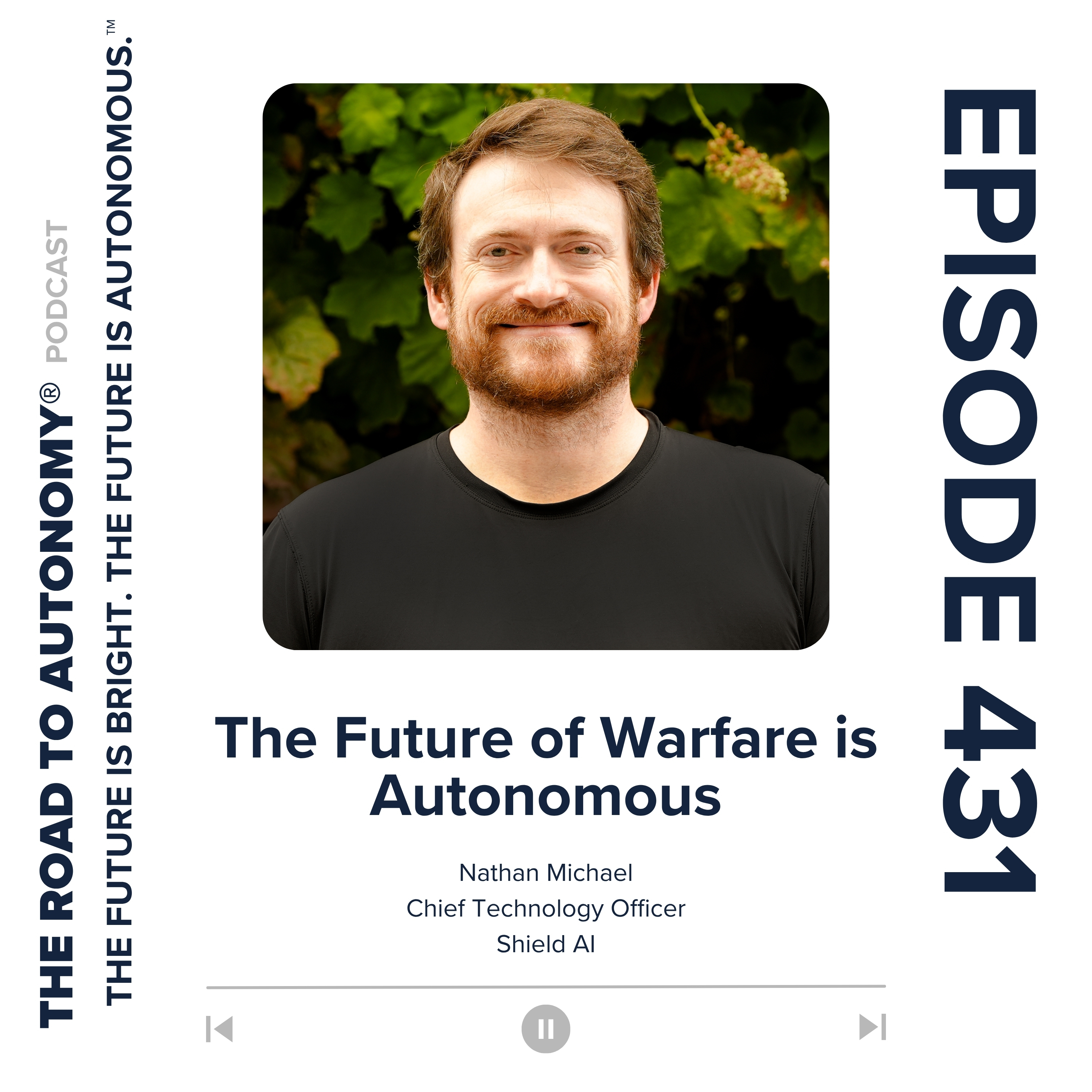
Episode 431 | The Future of Warfare is Autonomous
4w ago00:41:10Tap to summarizeNathan Michael, Chief Technology Officer, Shield AI joined Grayson Brulte on The Road to Autonomy podcast to discuss why the future of warfare is autonomous.The conflicts in Ukraine and Iran have made the case for autonomy abundantly clear. Drones create asymmetric advantage by driving down the cost per effect, delivering outcomes at reach without putting pilots and service members into harm’s way. As trust in these systems grows through engineered performance and assurance, autonomous systems will increasingly engage in combat and change the face of modern warfare.Shield AI’s solution to the future of warfare is Hivemind, an AI pilot designed from the beginning to be platform agnostic, mission agnostic, and domain agnostic. This architecture aligns with the Air Force’s autonomy government reference architecture for the Collaborative Combat Aircraft program, which mandates modularity and no vendor lock-in.No vendor lock-in is becoming a global standard, with nations demanding sovereign autonomy, ownership of data, and the flexibility to swap in the most performant AI pilot as the technology rapidly improves. Hivemind is now expanding beyond the air and maritime domains into space through a series of defense partnerships.Episode Chapters0:00 How Shield AI is Thinking About Autonomy in a World Full of Conflict1:56 Are Drones the Modern Equivalent of the Abrams Tank?4:09 Is Society Ready for Autonomous Warfare5:58 Developing Hivemind and the Aha Moments Along the Way10:50 Deploying V-BAT in Ukraine and Integrating Hivemind on One-Way Attack Drones13:59 The Autonomy Factory and Adapting Hivemind Across Platforms17:41 Going from Air to Sea with Huntington Ingalls22:39 Deploying Hivemind on the Airbus Lakota Helicopter for Contested Logistics25:52 Winning the U.S. Air Force CCA Mission Autonomy Production Contract29:37 Autonomy Government Reference Architecture and No Vendor Lock-In35:34 Expanding Hivemind into Space38:17 X-Bat, the World's First AI-Powered VTOL Fighter Jet40:34 AUTNMY AI--------About The Road to AutonomyThe Road to Autonomy is the leading applied intelligence platform covering the convergence of automation, autonomy, and the Autonomy Economy.™.Through our podcasts, newsletter, Indices and proprietary applied intelligence, we set the narrative for institutional investors, industry executives, and policymakers navigating the convergence of automation, autonomy, and economic growth.Join institutional investors and industry leaders who read This Week in The Autonomy Economy every Sunday. Each edition delivers exclusive insight and commentary on the autonomy economy, helping you stay ahead of what's next.Sign up for This Week in The Autonomy Economy newsletterFollow The Road to Autonomy IndicesSee Privacy Policy at https://art19.com/privacy and California Privacy Notice at https://art19.com/privacy#do-not-sell-my-info.
Transcribe →
Episode 430 | Autonomy Markets: Has Robotaxi Begun to Scale?
4w ago00:29:17Tap to summarizeThis week on Autonomy Markets, Grayson Brulte and Walter Piecyk discuss Tesla increasing their robotaxi inventory in Texas, a controversial autonomous vehicle bill in Washington DC, Uber’s acquisition of Delivery Hero, and WeRide‘s global expansion strategies.Data from the Texas DMV shows that Tesla has 175 robotaxis registered in Texas, a quadrupling in just six weeks from 42 on June 1st. This is a trend that is not isolated to Texas, as Grayson has noted in his Robotaxi Miami Field Report that Tesla is also ramping up operations in that market as well.In Washington DC, a new district bill introduced by Councilmember Charles Allen aims to update the 2012 AV Act to allow commercial autonomous operations. However, the bill introduces highly restrictive mandates, including a requirement for autonomous vehicle operators to log over 250,000 testing miles within the district before receiving a commercial permit that could lead to regulatory capture for incumbents.Shifting to the delivery sector, Uber made a major move by earmarking approximately €2 billion through 2031 for European expansion, explicitly including autonomous vehicle initiatives alongside its acquisition of Delivery Hero. Meanwhile, Uber’s autonomous delivery partner, Avride, launched sidewalk street robot operations in Miami via Uber Eats, having already completed 60,000 trips.On the Foreign Autonomy Desk, Grayson and Walt discuss WeRide’s global Level 2++ on-road validation testing alongside Bosch in Germany, France, and Japan. Additionally, government data from Hong Kong reveals that 63 autonomous driving licenses have been issued across seven companies, with Baidu logging 149,129 miles with safety drivers on pre-approved roads.Closing out the show Grayson and Walt analyze Baidu‘s expansion into Kazakhstan and predict local robotaxi manufacturing could begin there within the next 12 to 18 months.Episode Chapters0:00 Tesla's Growing Robotaxi Fleet4:52 Washington DC's Autonomous Vehicle Bill12:03 Uber Acquires Delivery Hero and Bets on Autonomous Delivery18:07 Lucid's Selloff and the Nuro Partner Risk23:19 WeRide's Level 2++ Expansion24:57 Foreign Autonomy Desk27:10 Next WeekFollow The Road to Autonomy Indices--------About The Road to AutonomyThe Road to Autonomy is the leading applied intelligence platform covering the convergence of automation, autonomy, and the Autonomy Economy.™.Through our podcasts, newsletter, and proprietary applied intelligence, we set the narrative for institutional investors, industry executives, and policymakers navigating the convergence of automation, autonomy, and economic growth.Join institutional investors and industry leaders who read This Week in The Autonomy Economy every Sunday. Each edition delivers exclusive insight and commentary on the autonomy economy, helping you stay ahead of what's next.Sign up for This Week in The Autonomy Economy newsletterSee Privacy Policy at https://art19.com/privacy and California Privacy Notice at https://art19.com/privacy#do-not-sell-my-info.
Transcribe →