← The Rosary in a Year (with Fr. Mark-Mary Ames)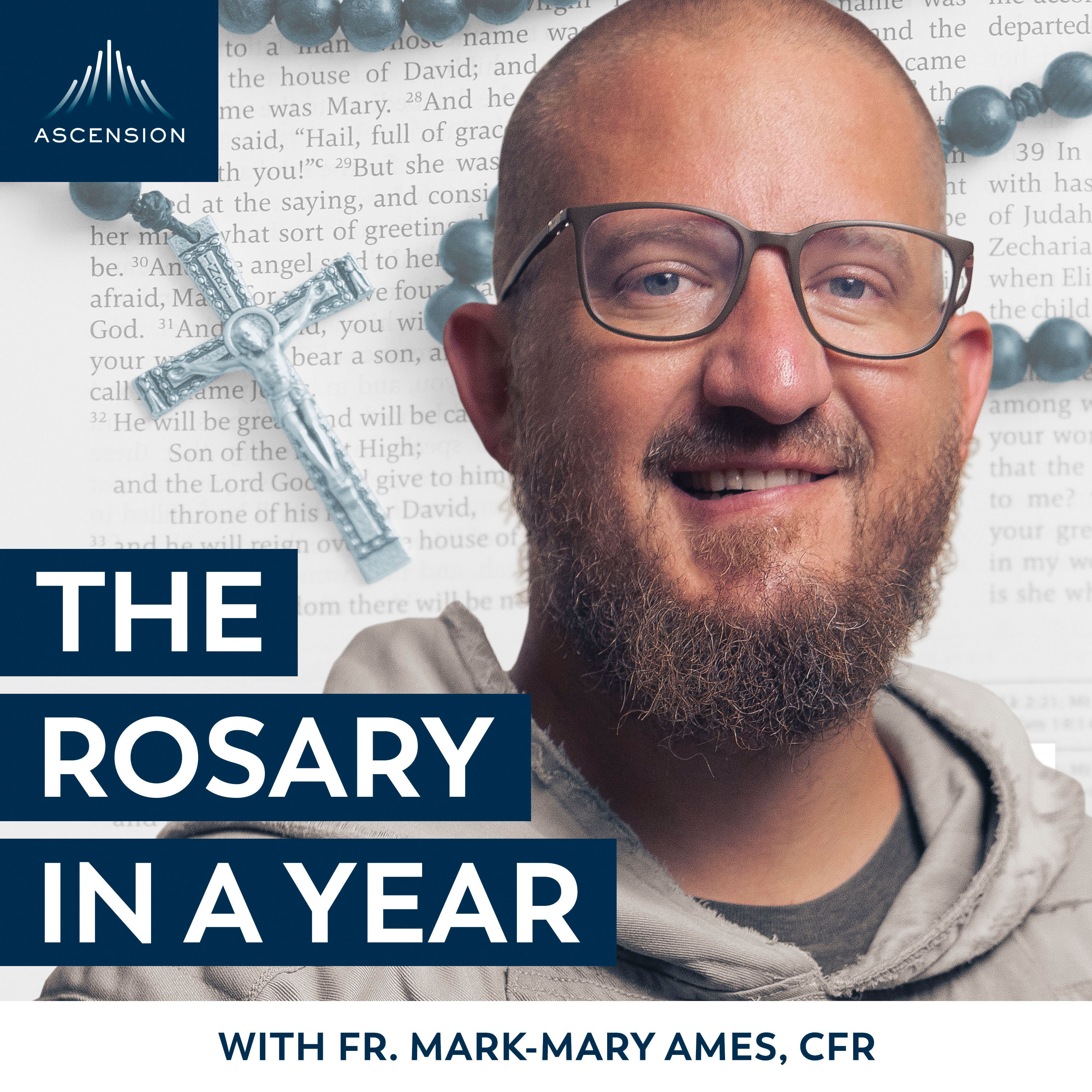
The Rosary in a Year (with Fr. Mark-Mary Ames)
Day 18: Our Sweetness, Our Hope
00:07:23
Jesus gives us not only what we need, but in his abundance, gives us more than what we need so that we might have joy. Fr. Mark-Mary meditates on the Hail Holy Queen, exploring the relationship between the Eucharist and Mary, the mother of God, to help us meditate during the Rosary. Today’s focus is “Hail Holy Queen, mother of mercy, our life, our sweetness, and our hope,” and we will be praying one Our Father, three Hail Marys, and one Glory Be.
Loading summary
Transcript1 lines
- [00:00]
A
Foreign Mark Mary with the Franciscan Friars of the Renewal and this is the Rosary in the Year podcast where through prayer and meditation, the Rosary brings us deeper into relationship with Jesus and Mary and becomes a source of grace for the whole world. The Rosary in a Year is brought to you by Ascension. This is day 18. To download the prayer plan for Rosary in a year, visit ascensionpress.com rosary in a year or text Rye to 33777. You'll get an outline of how we're going to pray each month and it's a great way to track your progress. The best place to listen to the podcast is in the Ascension app. There's special features built just for this podcast and also recordings of the full Rosary with myself and other friars. I'd encourage you to pick up a copy of the Rosary in a Year Prayer Guide, a book published by Ascension that was designed to complement this podcast. You'll find the daily readings from Scripture, Saint reflections and beautiful full page images of the sacred art will be reflecting on Hail Holy Queen, Mother of Mercy, our life, our sweetness, and our hope. Over the next couple days we'll be taking a look at the Hail Holy Queen, often referred to in Latin as the Salve Regina. And to begin our reflection on these opening words of the Hail Holy Queen, I'm going to share with you some words that I have been reflecting on in Scripture, rightly so, especially these last couple years of my priesthood. And this is from Matthew 26, verse 26. Now as they were eating, Jesus took bread and blessed and broke it and gave it to the disciples and said, take, eat, this is My body. And he took a chalice, and when he had given thanks, he gave it to them, saying, drink of it all of you, for this is the blood of My covenant which is poured out for many for the forgiveness of sins. All right, Father, Mark, Mary, make it make sense. We're talking about the Hail Holy Queen and you are talking about the institution of the Most Holy Eucharist. Here's where I think they're connected. Jesus gives Himself to us, and the way he gives Himself to us in the Most Holy Eucharist I think is important and worthy of paying attention to. Firstly, he gives Himself to us in the form of bread. And on my reflecting on the matter of bread, what's interesting to me is that it's simple bread, it's plain bread. You can't add anything to it. You can't make it sweet, you can't make it more hearty. It's what you need. Like the very Very basic nourishment that you need to make the journey to survive. It's going to help you get to the next day, but that's about it. He also gives himself to us in the form of wine. And wine is different in some ways I see where there's differences, but in some ways I feel like the equivalent to bread would have been water to the natural body. And so far as it's what, like again, there's not, there's nothing added to it, but it's what you're going to need for the body to survive. The body though, could survive without wine. Wine feels like it's a little bit more than is needed, more than extra. And one characteristic of wine is that it's sweet, right? There's something particularly rich and sweet about wine in many cultures. It's a celebratory drink. It's what you bring out to commemorate a birthday or an anniversary, etc. There's something extra, not totally necessary, something extra about wine. And I think this is also going to be true about how God loves us and interacts with us. He gives us both bread for the supernatural life and wine. And what I mean by that is this is he gives us what we need for salvation. He gives us the grace we need to remain in relationship with Him. He gives us what we need to ultimately make the journey to eternal life. And God could just give us what we need to make it to the next day. But also the Lord Jesus desires that there is a sweetness to our life. He gives us what we need through the grace of the Holy Spirit, that we may have joy, that our day to day may have these tastes of wine, this sense of sweetness. God doesn't just give us the very basics. He doesn't just give us what we absolutely need, the bare minimum, but in the abundance and the graciousness of his love, he desires it also to be sweet. And the sweetness can be found in this relationship with Him. And where why I begin with this in reflecting on the Holy Queen is I believe that in Jesus giving us the Blessed Mother, he is giving us something that will make our life particularly sweet in sort of an existential sense, like God didn't have to give us his mother to be our mother as well. But I believe he did this again for the same reason that he gives Himself to us in the form of wine. For the same reason that he desires us to experience joy in his life. He desires us to experience in the Blessed Mother in her love, a sweetness. And so as we pray, Hail Holy Queen, Mother of mercy, our life, our sweetness and our hope. I believe this is what we're celebrating that in Jesus giving us His Mother and the love that she offers us, he is giving us an experience of sweetness for the journey. Hopefully, my brothers and sisters, in this ongoing praying of the Rosary and growing more and more in love and deeper in relationship with the Blessed Mother, we may experience the sweetness that we acclaim and pray about in the Hail Holy Queen. Let us pray in the name of the Father and of the Son and of the Holy Spirit. Amen. Our Father who art in heaven, hallowed be Thy name. Thy kingdom come, Thy will be done on earth as it is in heaven. Give us this day our daily bread and forgive us our trespasses as we forgive those who trespass against us. And lead us not into temptation, but deliver us from evil. Amen. Hail Mary, full of grace, the Lord is with thee. Blessed art thou among women and blessed is the fruit of thy womb, Jesus. Holy Mary, Mother of God, pray for us sinners now and at the hour of our death. Amen. Hail Mary, full of grace, the Lord is with the Blessed art thou among women and blessed is the fruit of thy womb, Jesus. Holy Mary, Mother of God, pray for us sinners now and at the hour of our death. Amen. Hail Mary, full of grace, the Lord is with the Blessed art thou among women and blessed is the fruit of thy womb, Jesus. Holy Mary, Mother of God, pray for us sinners now and at the hour of our death. Amen. Glory be to the Father and to the Son and to the Holy Spirit. As it was in the beginning, is now and ever shall be, world without end. Amen. In the name of the Father and of the Son and of the Holy Spirit. Amen. All right, thanks everybody for joining me and praying with me today. I look forward to to continuing the journey with you tomorrow. Pocoapoco Bye friends.