← The Rosary in a Year (with Fr. Mark-Mary Ames)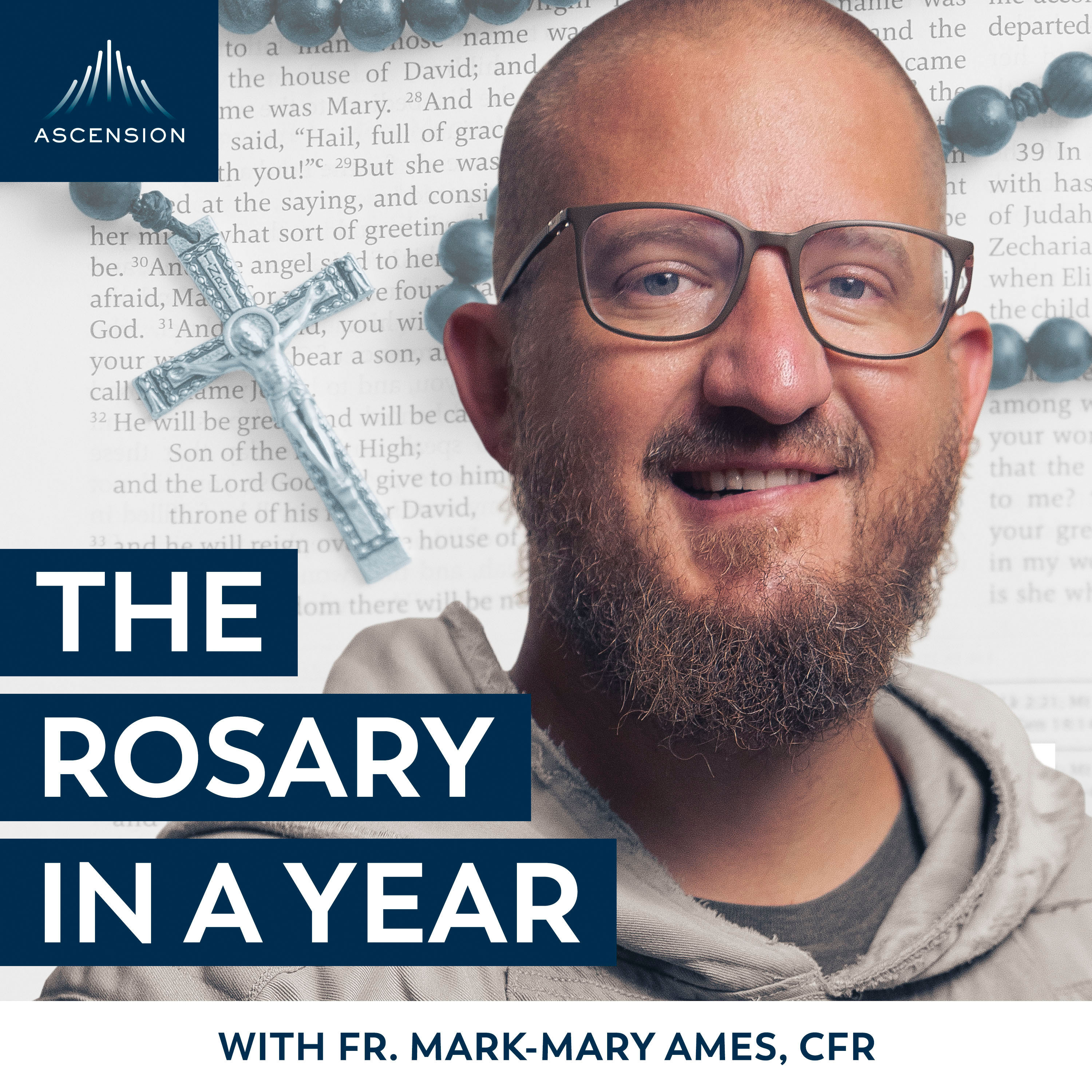
The Rosary in a Year (with Fr. Mark-Mary Ames)
Day 199: What the Garden Reveals
00:15:38
The Agony in the Garden reveals deep truths, shared by Fr. Mark-Mary, as we return to three prior meditation topics. The nature of sin is unveiled, as we draw the connection to the prodigal son. Jesus sets an example for us, staying in dialogue with the Father despite his suffering. And finally, through the example of Judas, we’re reminded that Jesus is always calling us back, no matter how dim we think our halos are. Today’s focus is the mystery of the Agony of the Garden and we will be praying one decade of the Rosary. For the complete prayer plan, visit https://ascensionpress.com/riy.
Loading summary
Transcript30 lines
- [00:00]
A
Foreign Mark Mary with Franciscan Friars with Renewal and this is the Rosary in Year podcast, where through prayer and meditation, the Rosary brings us deeper into relationship with Jesus and Mary and becomes a source of grace for the whole world. The Rosary in the Year is brought to you by Ascension. This is day 199. To download the prayer plan for Rosary in a year, visit ascensionpress.com rosary in a year or text R I Y to 33777. You'll get an outline of how we're going to pray each month, and it's a great way to track your progress. The best place to listen the Podcast in the Ascension app. There are special features built just for this podcast and also recordings of the full Rosary with myself and other friars. No matter what app you're listening in, remember to tap, follow or subscribe for your daily notifications. Today we will be meditating upon and praying with the first sorrowful Mystery, the Agony in the Garden. And so let's go ahead and dive into our review we have covered to this point. As you may recall, in one of our journeys through the Sorrowful Mysteries, I kind of overlaid and interwove some reflections on the Prodigal Son and for our mystery today, the Agony in the Garden. What was highlighted is what we could call the nature of sin. What we do when we sin. And we looked at the younger Son in the parable of the Prodigal Son, and what does he do? He goes to his Father and says, give to me my inheritance. And then he goes to a distant land. He wants his inheritance, but he doesn't want his Father. And again, it's his inheritance. It's all that the Father has sort of saved up for Him. And so it's basically like, make mine what is yours so that I can use it by myself. And that's what we're doing with sin. Okay? All of the good things that you have given us, all of the good things that you've prepared for us, the gifts that you have given us, I'm going to take them into my own hands. I'm going to use them all for my own means, for myself, for my self aggrandizement, my self protection, etc. And I don't want relationship with you. So we saw this is the nature of sin. In contrast to Jesus, Jesus in the garden comes to His Father and says, you will be done. Everything's going to be taken away from Jesus, but But what? But his relationship with His Father, he's going to stay there. He's going to remain Obedient. The one thing he wants, relationship to his Father. Because Jesus inheritance that he wants to receive and not take to use on his own is his sonship. And that's what he invites us to share in. So we contrast, right? Like the obedience of Jesus who says, father, thy will be done. Like, here I am, I'm going to stay in relationship. No matter what's going to happen, I'm going to stay in relationship. That's number one most important thing versus sin, which says, okay, all the good gifts that you've given me, I'm going to take them and I'm going to go to a distant land, I'm going to go into isolation, I'm going to go and break this relationship and use them for my own devices, which ultimately ends up right, with the prodigal son broke and desperate, fighting pigs for slop. So there's an invitation here to recognize what we're actually doing with sin in contrast to Jesus and his obedience and his remaining abiding in the Father's goodness and the Father's will. And the second sort of review today is when we were, we were looking at Saint Alphonsus Liguori's writing on the passion and death of Jesus Christ. And Saint Alphonsus writes this prayer, take upon thee our fearfulness in order to give us thy courage. And what we see Jesus doing in the garden, right, is he's not focusing on like the pain, the suffering, the betrayal. Where is his attention? His attention is on his Father, who he goes to in the garden and prays to, like three times, right? Saying, my father, my father, my father. At that point, I shared the story of one of the brothers who was rappelling in the desert and he was nervous and afraid with his attention being drawn to the heights, being drawn to the worst case scenarios as he's about to sort of on this rope, rappel down, climb down this mountain. And one of the guides just saying, hey, look at me. Like, look at me, look at me. Calling him not to focus on the heights, not to focus on, like, what could happen, but to focus on the one he trusted, right? The one who set this up, the one who had won his trust. Like, look at me, look at me, pay attention to me. Don't focus on the other stuff, pay attention to me. And we see Jesus doing this in the garden, keeping his attention on the Father. And in this, we can experience this invitation. There's so many things that are going to be calling for our attention, trying to undercut us, discourage us, lead us even to despair. All of these can be causes of fearfulness. But what Jesus does is he receives courage, if you will, by just focusing on the Father. And the invitation to us is to receive courage from looking at Jesus. Looking at Jesus Christ risen, looking at Jesus Christ victorious in him is our hope. If the brother rappelling in the desert can trust this human guide, like, how much more can we trust Jesus? How much more can we trust the Father? And so in our difficulties, like, we focus on Him. Thy will be done, my Father your will be done, my Father your will be done. And lastly, for today's review, if you recall, in the painting by the artist Vicente Massip, he included this interesting detail of Judas on his way to the garden with half his halo gold and hath his halo black. In my interpretation at least, of the art, was that what the artist is saying or is being communicated is like, hey, Judas, there is still time to repent. Even now you can stop the trajectory that you're on. Even now you can turn back. Even now you can throw yourself upon the mercy of Jesus and receive mercy and receive forgiveness and repent. And my invitation for us on how to pray with this is that there's ways in which we can experience our own halos dimmed and darkened. And we can kind of respond in two ways to that. Maybe discouragement, despair, like, oh, well, I've already gone this far. I've already made these mistakes, like, and kind of giving up as Judas did. Or we can say, okay, you know what? Like, even now I've experienced the ways I've fallen. I've experienced the ways in which my halo is darkened. But even now I'm going to, like Peter did after he denied Jesus, I'm going to throw myself upon the mercy of Jesus. I'm going to return. I'm going to trust not even in my own history of sin, but I'm going to trust more in the history and the fullness in the present invitation of Jesus mercy. And we see Jesus in the garden pleading on our behalf. Come back to me. Come back to me. Trust me. Come back to me. Even now, my brothers and sisters, even now, there's time for you and me to begin again. There's time for you and me to return to Jesus. There's time for you and me to become saints. So we'll just sit with these for a moment and see where the Lord's inviting you to spend this time of prayer. Is he inviting you to sit and to linger with the nature of sin? With the invitation that Jesus models to Keep in dialogue with the Father, to keep our attention on the Father, especially during suffering and trial. Is he inviting you to look upon his tears as he prays and cries in the desert, calling us back to him, inviting us to begin again even now? Or perhaps there's another invitation and prompting of the Lord. So, my friends, what is the grace? What is the truth being revealed that you are being invited to receive Sam? How can you respond? What's the grace that you would like to request now? Rejoice. Give thanks to the Lord for this time of prayer and the graces bestowed upon you. And now, together with Mary, let us pray in the name of the Father and of the Son and of the Holy Spirit.
- [11:05]
B
Amen.
- [11:08]
A
Our Father, who art in heaven, hallowed be thy name. Thy kingdom come, thy will be done on earth as it is in heaven. Give us this day our daily bread and forgive us our trespasses as we forgive those who trespass against us. And lead us not into temptation, but deliver us from evil.
- [11:33]
B
Amen.
- [11:35]
A
Hail Mary, full of grace, the Lord is with thee. Blessed art thou among women, and blessed is the fruit of thy womb, Jesus. Holy Mary, mother of God, pray for us sinners now and at the hour of our death.
- [11:54]
B
Amen.
- [11:56]
A
Hail Mary, full of grace. The Lord is with the Blessed art thou among women, and blessed is the fruit of thy womb, Jesus. Holy, Holy Mary, mother of God, pray for us sinners now and at the hour of our death.
- [12:14]
B
Amen.
- [12:16]
A
Hail Mary, full of grace. The Lord is with the Blessed art thou among women, and blessed is the fruit of thy womb, Jesus. Holy Mary, mother of God, pray for us sinners now and at the hour of our death.
- [12:35]
B
Amen.
- [12:37]
A
Hail Mary, full of grace, the Lord is with the Blessed art thou among women, and blessed is the fruit of thy womb, Jesus. Holy Mary, mother of God, pray for us sinners now and at the hour of our death.
- [12:56]
B
Amen.
- [12:58]
A
Hail Mary, full of grace. The Lord is with the Blessed art thou among women, and blessed is the fruit of thy womb, Jesus. Holy Mary, mother of God, pray for us sinners now and at the hour of our death.
- [13:18]
B
Amen.
- [13:21]
A
Hail Mary, full of grace, the Lord is with thee. Blessed art thou among women, and blessed is the fruit of thy womb, Jesus. Holy Mary, mother of God, pray for us sinners now and at the hour of our death.
- [13:40]
B
Amen.
- [13:42]
A
Hail Mary, full of grace. The Lord is with the Blessed art thou among women, and blessed is the fruit of thy womb, Jesus. Holy, Holy Mary, mother of God, pray for us sinners now and at the hour of our death.
- [14:02]
B
Amen.
- [14:04]
A
Hail Mary, full of grace. The Lord is with the Blessed art thou among women, and blessed is the fruit of thy womb, Jesus. Holy Mary, mother of God, pray for us sinners now and at the hour of our death.
- [14:22]
B
Amen.
- [14:25]
A
Hail Mary, full of grace. The Lord is with the. Blessed art thou among women, and blessed is the fruit of thy womb, Jesus. Holy Mary, mother of God, pray for us sinners now and at the hour of our death.
- [14:43]
B
Amen.
- [14:45]
A
Hail Mary, full of grace. The Lord is with the Blessed art thou among women, and blessed is the fruit of thy womb, Jesus. Holy Mary, mother of God, pray for us sinners now and at the hour of our death.
- [15:03]
B
Amen.
- [15:05]
A
Glory be to the Father and to the Son and to the Holy Spirit. As it was in the beginning, is now and ever shall be, world without end.
- [15:16]
B
Amen.
- [15:17]
A
In the name of the Father and of the Son and of the Holy Spirit.
- [15:22]
B
Amen.
- [15:24]
A
Thanks so much for joining me and praying with me today. I look forward to continuing this journey with you again tomorrow. Poco Poker. Friends. God bless y'.
- [15:32]
B
All.