← The Run-Through with Vogue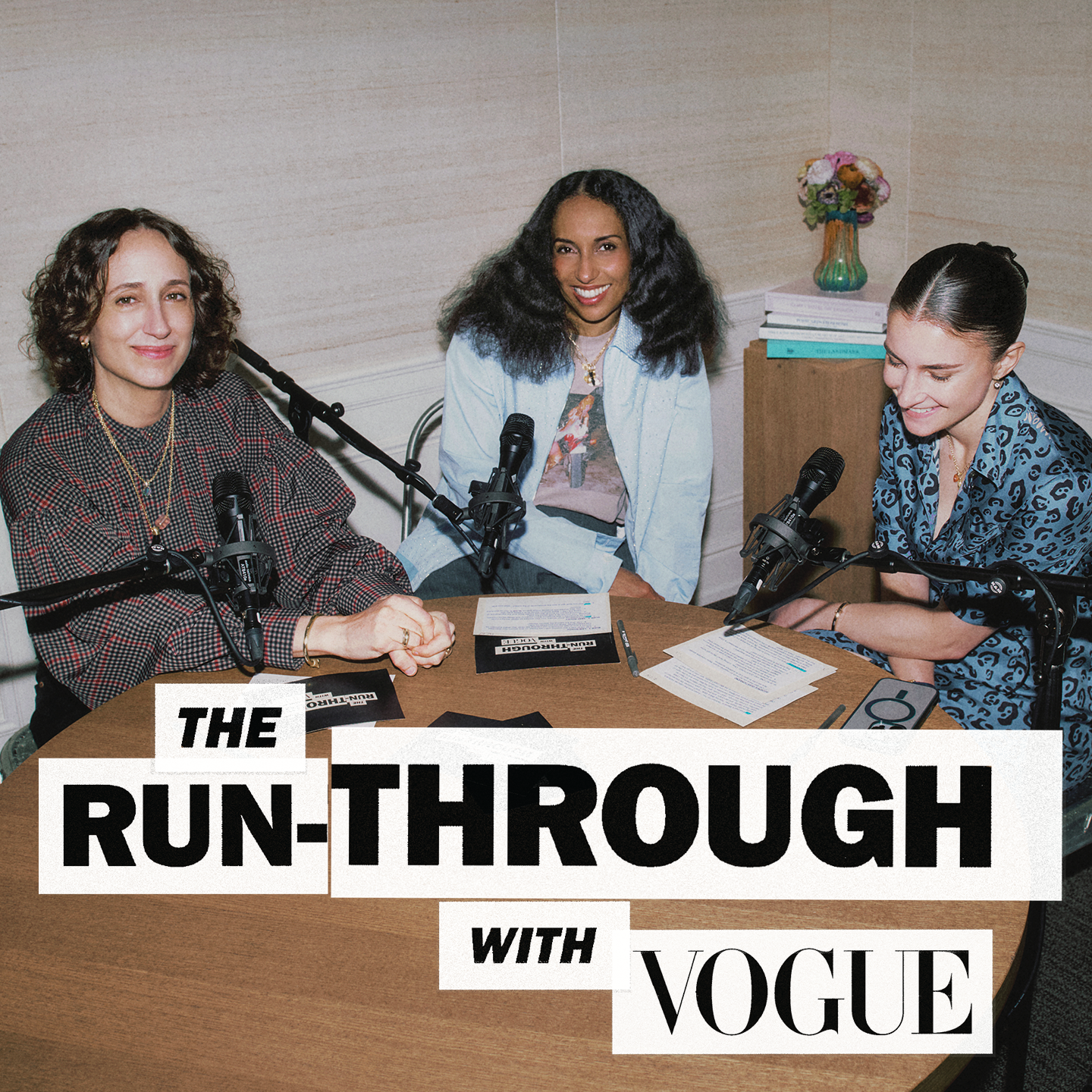
The Run-Through with Vogue
Simone Bellotti On His New Jil Sander Collection and Lifelong Shoe Obsession
00:35:49
Loading summary
Transcript81 lines
- [00:01]
A
This episode of the Run through is brought to you by Bumble. One of the reasons why so many of my friends are on Bumble is that it makes conversations feel that much more natural and easy. This is partly thanks to the app's guidance tools, which help you put your most confident self forward, and partly because my friends are also amazing people. Bumble offers tips on writing and filling up prompts, sparking more conversations instead of stale small talk. You'll never be left chatting about the weather again. If you're looking for someone who gets your vibe, refresh your Bumble profile today.
- [00:39]
B
This is the Run Through. I'm Nicole Phelps. Today I'm joined by Simone Bellotti, the creative director of Jill Sander and a very talented designer. He just showed his second collection for the label today in Milan. Following a very strong debut back in September. He joined us in New York a couple of weeks before the show to tell us about the new collection, why 90s fashion is still such a cultural touchpoint, and his lifelong obsession with shoes. Ciao, Simone. It's great to see you here in New York.
- [01:08]
C
Thank you. Thank you for having me here. It's like a big honor to be here with you.
- [01:16]
B
Well, thank you. You are two weeks away from your second show for Jill Sander, and so you have to tell us, why are you actually in New York at this crucial time in the development of your new season?
- [01:30]
C
Yeah, luckily we almost finalized everything a month ago, more or less. I came here first of all because we just went out with the new campaign and so we wanted to introduce this new project. We had a very nice talk yesterday at Marianne Goodman Gallery. I was with the legendary Guinevere Vincinis. That was part of the first show. She opened the show and I thought it was a very good. She's not in the campaign, but I think it was good to have this exchange with her because she is really part of the DNA of the brand.
- [02:27]
B
So Guinevere, for people who don't know, is a model who modeled for Jill sander in the 90s, correct?
- [02:32]
C
Yes. Yes. And she was the face of the iconic campaign shot by Craig McDeen that are so inspiring still today for everyone and for me, of course. And it's interesting to hear her point of view. And yesterday she was saying no, that she start in a very naive way. Everything was very. She mentioned and she said naivete. And it was good that interesting to hear that something that became so visually relevant started in probably was not even planned.
- [03:19]
B
You know, it's interesting though, because when I think about Those images, naivete is not what comes to mind. I think of confidence, sophistication and strong, you know, strong woman. And so what. What words do you associate with. With Jill Sander at the moment?
- [03:40]
C
What I'm trying to do in this brand is like studying the brand. That was also one of the most important content in the first show. Like, trying to express my feeling about what I want to learn from this brand. Because, first of all, it's very different from my previous experience. And so it's a brand that you really have to study. Understand. I was lucky that I met. I'm lucky that I met in the office. Some people that are in the company since many, many years, they had the chance to work with Jill Sander herself and all the other creative directors, including Raf Simons. And so I really listened to them and I learned. I was very curious to learn about the way of working, even if it was a very different time compared to now was for sure, much slower. So I'm trying to keep and learn to work in this way, to concentrate on and dedicate time to something that can be seen as a small detail. But in the end, it's really part of the DNA of the brand. And so focus on the. On something that is less visible is what really interests me a lot. And then, yeah, I always say, you know, some collections are made to be great on the phone and some collection, they can be great when you experience in real life. And that was the. I was very happy about the result of the first show because many people who came to the show and then they came back to see the collection in the showroom, they really appreciate the attention that we put and the amount of work that we did to create something that apparently looks simple, but it's not.
- [06:12]
B
Give us an example of one of those things.
- [06:14]
C
Yeah, one example for sure. Let's talk about Guinevere. The first look, it looks very simple. It's like a very short sweater and a white skirt. So you don't get it immediately if you look at the phone, but then when you see it, you see that behind these apparently simple white skirts, there is a very special construction. And there are many ideas behind this construction. One of the reference in the show was these works of Richard Prinz.
- [06:57]
B
The hoods.
- [06:58]
C
The hoods, yeah. And the idea behind the hoods was how can I create a kind of a protection, a kind of armor? And behind the idea of the armor was this idea of the Castello's Francesco, which is just in front of us, which I think it's really part of the dialogue between the modernity of the brand and the classicism of the brand. This is what I like to think. I like to think that that office is not there for a random reason. There is this dialogue which I love. If it's true or not, I don't
- [07:41]
B
know, but it's true. If you.
- [07:43]
C
Yeah, exactly.
- [07:45]
B
So you mentioned Richard Prince's car hoods as a reference for. For your first car.
- [07:50]
C
Yeah, that was an industrial, let's say an industrial armor, you know, with this angle and corner. So I said, what can be more modern than a medieval armor? So I said, maybe a hood for a car. And so the skirt was cut in a way, and there was an inner construction that create all these angles. It's a lot of work for something that is not immediately visible.
- [08:17]
B
It's quite subtle.
- [08:18]
C
Yes. And I love this to have the opportunity to go and explore more about this.
- [08:25]
B
So tell us something that's on your mood board for fall 2026.
- [08:32]
C
Yeah. The idea is like at the moment still very articulated, but I can say I start on a reflection about home and home or a house and how do we feel about. In relation to a house. And I started to think about a house as a place where you feel comfortable and is a place where you want to stay, where you want to feel good. But sometimes a house can be something that you want to live and you want to explore something else outside. And I put in relation this idea of this house with the idea of respecting a code of a house or do something that goes far from these codes. So the initial thoughts was about this idea, a visual reference where some images from some Fassbender movies. He used to pay attention, a lot of attention to the interiors and the house. The interiors in his movies were like spaces where you felt fear and strong emotion. So a house was seen was useful to represent this idea of like not being so comfortable in the place where you live.
- [10:41]
B
Which. Which Fassbender movie should I watch to prepare for your show?
- [10:46]
C
I watched, which is a very weird story. Third Generation.
- [10:53]
B
I don't know that one.
- [10:54]
C
Yeah. And Maria Brown Wedding. I thought they were visually quite exciting. And yeah, visually are the colors, the use of the carpets and the atmosphere. It really makes you feel this tension and very, very interest.
- [11:25]
B
More with Simone Balati after the break.
- [11:36]
A
This episode of the Run through is brought to you by Bumble. Okay, so you've set up your Bumble profile, you filled in your prompts and you've added your favorite pictures. But how do you make sure the People you're meeting are who they say they are. Bumble's profile verification features are super quick and easy to use and give you the confidence that the people you're meeting are as authentic as you. It's just an extra helping hand so that you can feel more comfortable getting that first date into the diary. So download Bumble and verify your profile today.
- [12:09]
B
Let's go back to Balli for a moment because you were not there for very long, but very quickly you developed a following. And when you look back at that moment and you ask yourself, wow, how did I do that? How. How did you do that? And what would the lessons be from Bally that you think you're taking to Jill Sander?
- [12:34]
C
What I would like to take and keep with me is this idea, which is very important to have fun. And the difference is that Gill Sander, of course, is a very different brand from Bally. Bali was a. Is a shoemaker. And Gill Sander has quite a following, big following for his Ready to Wear. And it has a specific code. Then everyone has his interpretation of. Of these codes. Everyone. What I like is that everyone has his own idea about what is Gill Sander or not, which makes the things even more complicated. But. And what I like about Gill Sander is that really, to me, was one of a few brands that really influenced so many of us, many designers, many other brands. Basically, they create a new vision in that moment of the 90s that is still modern today. So I feel a very big responsibility to try to. To do an interpretation of what can be Gill standard today. What I tried to put and to try to express was this idea of this sensuality that I find very strong in the DNA of the brand that was always very subtle, very sophisticated. So, for example, in the campaign, it was very interesting to try to create this sense of proximity between the characters that were in the pictures. I was trying to create this sense of. To let them being close to each other and through the body. And. Yeah, so this is what I would like to keep going and go deeper in this research of mixing these beautiful sartorial tailorings and beautiful cut together with a sense of, in a way, humanity.
- [15:32]
B
What you're saying is really resonating with me. Cause I'm thinking back to the 90s and what my vision of Jill Sander was was taking the escalator at Barney's, I think, up to the third floor. And at the top of the escalator you saw the wall of dark suits. And, you know, from a distance it could have been all the same suit. But of course, you went up close and that's when the subtleties were revealed.
- [15:56]
C
Yeah.
- [15:57]
B
I wanna ask you one question about the 90s, because this is such a fascinating thing to me, how the 90s just live on and on. You know, right now we are days away here in the US from Ryan Murphy's new show about JFK Jr and Carolyn Bessette Kennedy. So it has sparked a whole new round of talk about their 90s style. Why do you think as a designer, fashion and sort of the culture at large keeps going back to that decade?
- [16:29]
C
I think probably because that was the last moment in fashion, I would say, until the beginning of 2000, where the different houses had very different personalities. It was very different the products that everyone was making. And so I think it's still strong in our mind. And it's still. And it's very interesting even for someone which is very younger, because you can really feel that every brand had a very strong personality with their own specific products for a very different clients. And this was, I think, what makes that moment very strong. The, in a way, unicity of every brand that was more recognizable and there was less communication. We were not like, how do you
- [17:45]
B
say, bombarded with images.
- [17:47]
C
Exactly. And probably the fact that we had less images, those few images became so iconic because you don't have the chance to look at hundred of these. It was just that image. When you look at the Craig McDan campaign, I mean, it's so unique. And you don't have 300 version of that. And so probably is this idea, let's say, you know, of scarcity that makes something stronger. I think.
- [18:25]
B
Can. Can we adopt. Can we go back to that? Like, is there a way to make Scarcity work in 2026, do you think?
- [18:33]
C
Yes, Yes. I mean, I think scarcity makes you dream. It's when you don't have something at every corner in front of you that makes you desire something. It's when you don't know something that you are curious to discover. So probably we just maybe need to reduce a little bit or filter more what we want to know. It seems that we know everything today, but it's in a very superficial way. So we must probably start to be more selective in this and not to have this fear of not knowing something. Sometimes not knowing something is good because it makes you, in this way back to this naivete. It's good that when you don't know something and it's always like a chance to discover something new. So I think it's yeah, probably is a bit tricky to explain, but it's. It can work for this, I think.
- [19:54]
B
Well, let's go back to very early in your career. I believe that one of your first jobs in fashion was at AF and Divorced in Antwerp.
- [20:03]
C
Yes, that was the real first.
- [20:04]
B
And this is like 2001 or so. So not many people know much about Anne and Philip anymore. But what do you remember from that period and you know, what was it like to. To be a young designer starting out then 25 years ago?
- [20:21]
C
You know, that was, I would say, the best, one of the best moment of my life because I really went to Antwerp with my luggage, not knowing anything, not knowing anyone. And I really had the feeling to be in the right place, in the right moment. Because, you know, everyone in that moment, at least in my group of people, friends, everyone had this dream about London and me too. But I was so attracted by everything that was coming from Antwerp at that time. I almost loved every designer from there and they were all very different, but there was this kind of a common, I don't know, feeling and aesthetic between them. So I really love all of them, from Margiela to Raph to Veronique Branchino to Ivan Van de Vorst to Walter Dries. I really love Ande Milimester. I really love all of them and their specific aesthetic. So I don't know how, but almost immediately I became in touch with someone at Van de Vorst and they hired me immediately because probably they were curious to have this Italian guy, young guy at the time. And it was really a very, very important experience I did with them. I was there to help, to do everything like cleaning the floor, checking the quality of the fabrics, working on the production, put the plastic bag on the clothes, send it to the clients. I really did all this experience through them and they were so good also for the shoes. Amazing. And those beautiful boots. And then with them I went the first time to. And I was part of the show they did in Paris. And so it was quite, very nice experience for me.
- [22:59]
B
I'm glad you brought up shoes because of course you had a great success at Bally with the boat shoe, the deck shoe, and already I think a lot of people noticed the shoes you were doing at, you did at your first collection for Jill. So yesterday at this talk, you, you told a very sweet story about how you became personally obsessed with shoes. Can you tell the run through audience? Do you mind telling it again?
- [23:27]
C
Yeah, no, I'm. Yeah, probably I'm a bit obsessed about shoes because even when I Was young, very young. And my mom used to buy me new pair of shoes especially I remember when I bought not because she decided to buy it. I wanted those pair of new burgundy New Balance. And I was so in love with those new New Balance that I went to sleep with the shoes and I didn't want to take it off. And she had to wait that I was when I was sleeping to remove it. And not just with the New Balance. Even with other Now I don't remember.
- [24:23]
B
What was it about shoes that sort of captured your attention so much?
- [24:28]
C
I think. I don't know. I think it's a very strong object that really defined a silhouette more than a bag. A bag sometimes can break the silhouette and the shoes are really part of the look. So I think it's very strong for that. And I really think is a very important accessories because you can really define a person through the shoes.
- [25:01]
B
What shoes are you wearing today?
- [25:03]
C
I'm wearing the new Jill Sander. Yeah, this hood. So, yeah, I think is the first thing.
- [25:12]
B
The first thing you notice about people.
- [25:14]
C
You know, probably it's such a strong accessories because it is really create this contact with the floor, you know. Yeah, I think it's really the most important accessories.
- [25:31]
B
So talk about the fall accessories, the fall shoes that you're working on now for Jill Sander. Will, you know, are you iterating on what we saw for spring? Will we see something brand new?
- [25:42]
C
Yes, many new styles. Of course there will be some styles that I will still keep, like this one I'm wearing in new version, new animation. But I'm really working a lot on, especially on women's wear, trying to make even something that I'm not very used to into it, you know, like hills, kind of some extreme style, like heavy platform. Let's see if I will use it also because in the Ready to Wear collection, I'm trying to explore new silhouettes. As you know, I come from menswear and so I have the tendency to always go in this, let's say very straight, precise kind of silhouette. But as a gill, Sander is a very different brand. I think it's. I need to explore the movement, the lightness. And so this is also translated in very different shoes from what I was doing maybe in the past. That gives you a different movement, a different way of walking. Yeah, I'm exploring.
- [27:26]
B
Well, you've made me very excited for the show. We'll be right back with Jill Sander creative director Simone Bellotti.
- [27:46]
A
This episode of the Run through is brought to you by Bumble A picture tells a thousand words, but there's no need to stress over choosing the right ones for your profile. Whether you feel your best self submitting a picture of yourself on a mountain or all dressed up, Bumble's personalized tips will help you choose the pictures that show the real you, attracting people who get who you are right from the start. So download the app or refresh your Bumble profile. Today
- [28:14]
B
we were doing some research. Our producer and she discovered an old article about Jill Sander in Vanity Fair that Bob Colicello wrote. And he was describing some of Jill Sanders top clients. He said her clothes are for women who don't need to be decorated, who are sure of themselves. And he quotes a princess whose name I'm not going to try to pronounce. When I have a prickly business meeting, I wear Jill Sander. I feel so comfortable and confident. You're never overdressed, but you feel important. Does that resonate with you?
- [28:49]
C
I mean, this is the final goal of, of everything, I mean about the meaning of this brand. And if I would be able to find someone today that would say the same things about what I'm doing, I would be very proud of this.
- [29:10]
B
Do you think of a typical Jill Sander customer today? I mean, who is she or who is he?
- [29:17]
C
Let's see in a few months who's gonna be. I'm very interested in refinement and making things better and better. So it would be nice to see and to have of course a type of clients that is really appreciating this, that is really get excited to see something that is less visible but tangible in a way.
- [29:48]
B
Yeah. I was talking to another designer who said that the materials that he was choosing, he actually thought they got better as the person wore the piece that actually, you know, he's choosing such special materials that, you know, the age makes them better, not worse. Which, which reminded me of our talk back in September and you were really focused on quality. You know, you talked a lot about the materiality of the clothes.
- [30:16]
C
Yeah, like probably he was talking about, you know, leather, but even denim I think, you know, are these type of materials that the more they age they become better and better? Of course it must be very good quality. And so yeah, it's like long term project and it's. Yeah, even me as I'm also a big fan of vintage clothes. Of course I'm what the reason why I love this type of clothes is because they age in such an amazing way that are unique. So back to the idea of scarcity yeah.
- [31:07]
B
So on the the flip side, do you use AI in your work at all? And what do you think about AI in fashion?
- [31:15]
C
No, I don't use AI. It's too. It's already complicated like this, I don't think. You know, our work luckily is still very analog and it's still made by hand, it's still made by process. It's still, I think for what I'm doing at the moment, I don't need those tools. I think it's a bit even scary to think about something that don't make mistakes.
- [31:54]
B
Yeah, well, of course it does make mistakes too, because it's only as good as whatever's being input. So, yes, I'm skeptical about AI too. So I obviously know how busy you are with this new job, but talk about what you do outside of work
- [32:11]
C
that you like, you know, I mean, during the Christmas holiday, I did a beautiful trip to Argentina. Me and my wife, we went to the north of Argentina. And it was really fantastic to be in that really, let's say, wild nature with this super high altitude. It was surreal and it was a long time. I didn't do a trip like that. So we were very excited. And then we went to Chile in the desert of Atacama.
- [33:01]
B
Good stargazing there, right?
- [33:02]
C
Belize. Belize. We were. We were in for New Year's Eve. We had this dinner. We were like 3,800 meter high in this kind of canyon with this. So really the moonlight, you know, and there were these huge cactus, like 5 meters tall, probably. They were like 400, 500 years old, but really like big like this table, you know. And so to experience that being in the middle of nowhere, I think it was really helpful to forget about all the stress, you know. I'm a bit scared always when I travel. I'm a bit scared of airports in general. They make me nervous. I feel like being a bit in trap somewhere, trapped somewhere. But then when I arrived, I feel better, you know, and then probably I'm repeating myself. But I really love, you know, and I find very relaxing to listen to music at home.
- [34:29]
B
Well, I know you have for that little teaser you did before the show in September, you released a music video.
- [34:36]
C
Yes.
- [34:36]
B
And so we want to know what you're listening to now. What's on repeat.
- [34:43]
C
I found two friends. I was in Paris last week and I found some friends. Play for me this album of this artist that I think is really amazing. Mohammad Reza Mortazavi. He played percussions. It's quite strong, the music he made. I think he's from Iran and he's based in Berlin. But his music is so strong. And these friends, they. They did an event with him in Paris, and they told me that when he's playing music, it's kind of possessed by the music. And so I love this kind of obsession about some artists and about the music they play.
- [35:40]
B
Yeah, me too.
- [35:42]
C
Yeah.
- [35:42]
B
All right, well, last question. And this is a. A quote from Jill Sanders. She said, every collection, every season has a different mood. Was like a clear glass of water. This season is more like a glass of red wine. So what is the mood of your fall collection?
- [36:01]
C
Probably is the. Is the olive in a martini cocktail. So this extra thing that apparently is superfluous, not necessary, but that makes you the cocktail perfect.
- [36:17]
B
That makes it even more delightful.
- [36:20]
C
Yeah. I wanted to work on something which is kind of also contradictory to what I did in the first season. Adding something instead of removing this idea of contradiction I love. So there would be extra fabrics, something that apparently is useless, but in the end, with the right dose, maybe can be interesting.
- [36:46]
B
That's great. Very much looking forward to it.
- [36:49]
C
Yeah, me too.
- [36:50]
B
Thank you.
- [36:51]
C
Thank you.
- [37:02]
B
The run through is produced by chelsea daniel, alex depalma and alex john burns, with help from emily elias. It's engineered by pran bandy and james yost. It is mixed by mike kutchman.
- [37:19]
A
This episode of the Run through is brought to you by Bumble. Okay, so you've set up your Bumble profile, you filled in your prompts, and you've added your favorite pictures. But how do you make sure the people you're meeting are who they say they are? Bumble's profile verification features are super quick and easy to use and give you the confidence that the people you're meeting are as authentic as you. It's just an extra helping hand so that you can feel more comfortable getting that first date into the diary. So download Bumble and verify your profile today.