← The Shit No One Tells You About Writing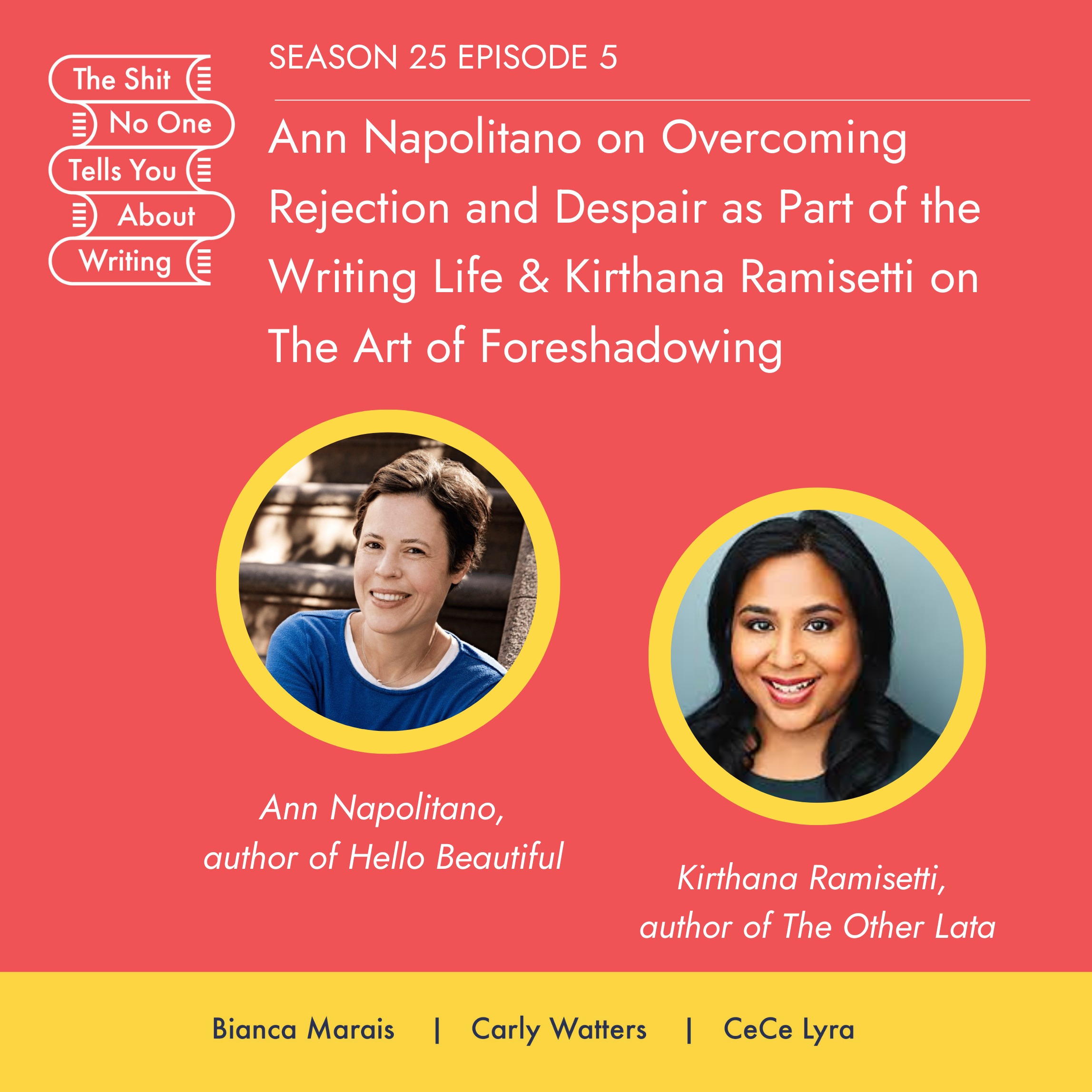
The Shit No One Tells You About Writing
Ann Napolitano on Overcoming Rejection and Despair as Part of the Writing Life & Kirthana Ramisetti on The Art of Foreshadowing
01:05:46
Author Interviews Ann Napolitano & Kirthana Ramisetti
Loading summary
Transcript74 lines
- [00:00]
Bianca Marais
You've heard me say it all the time on the podcast that you need to circle the building of your work to find the best entry point into it. But this process doesn't just ensure strong opening pages, it allows you to navigate the whole building with confidence, knowing which doors to throw wide open and which ones to keep locked, which walls to smash down and which ones to reinforce as you create a space you'd like to live inside. In my Circling the Building of your Work webinar, I'll guide you through the transformation of my latest work in progress, showing you examples of my constantly evolving pages in my quest to find the best way into a story I've always wanted to tell. In doing so, I'll highlight the intentionality you need to bring to your decision making. How to play around with point of view, structure, timeline, voice and other essential elements of craft how to frame a narrative and choose the lens through which you'd like to view it the questions you'll need to ask yourself throughout the process how to circle back from false starts and how rewarding the entire process can be. You'll also be assigned to other delegates to work with after the webinar to gain objectivity, input and fresh perspectives as you circle the building of your own work in progress. This course will be run on the 13th of May from 7 to 10pm Eastern Time. For more information and to register, go to Bianca Marais and look for the Courses tab.
- [01:23]
Ann Napolitano
Foreign.
- [01:29]
Bianca Marais
Hi there and welcome to our show the Shit no one tells you About Writing. I'm Bianca Murray and I'm joined by Carly Waters and Cece Lera from PS Literary Agency. Hi everyone. Today we have an incredibly special guest joining us. She is the New York Times best selling author of Dear Edward, which has sold in 27 territories as and has been adapted into an Apple TV series that aired in 2023. She is also the author of the novels A Good Hard look and Within Arm's Reach. She received an MFA from New York University and has taught fiction writing from Brooklyn's College MFA program, New York University School of Continuing and Professional Studies, and for Gotham Writers Workshop. She was long listed for the Simpson Joyce Carol Oates Literary Prize. She lives in Brooklyn with her husband and two children. It is my incredible pleasure to welcome Ann Napolitano and welcome to the show.
- [02:33]
Ann Napolitano
Thank you for having me. I'm happy to be here.
- [02:36]
Bianca Marais
I've been trying forever to get you on the show when I first read hello Beautiful. So for everybody watching on our YouTube channel, this is the incredible book we're Discussing today, when I first read this, when it came out, I was blown away. I listened to it on audio. I read the book. I actually first started it on audio and loved it so much that I was like, I need to read these sentences on the page. So then I bought a physical copy and I was listening to the two backwards and forwards and I tried to get an interview then, and I wasn't able to. So when your publicist reached out recently and said, would you like to have Ann on? It was a wonderful excuse to read the book again.
- [03:16]
Ann Napolitano
Okay.
- [03:17]
Bianca Marais
And it's amazing how rereads just emphasize different things that you didn't notice the first time. So for our listeners, for the books that you love, I would highly recommend you reread. And don't even wait a year or two in between the reread. Sometimes just a month or two is all you need to dive back in. So I'm going to read the flap copy for those of you who've been living under a rock and don't know what this book is about. So here we go. Best friends and sisters. The four Padovano girls are seen as inseparable by everyone in their close knit Italian American neighborhood. Julia, the eldest, is the rocket of the family. She always has a destination in mind and clear plans for how to get there. Sylvie is happiest with her nose in a book, dreaming of the kind of love you only read about in literature. Cecilia and Emmeline, the twins, are the artist and the caregiver. From childhood, the four sisters complete one another. When Julia falls in love with William Waters, a history student and college sports star, she's delighted by the way her plans for adulthood are coming to fruition. A husband, a house, a family of her own. But when darkness from William's past begins to block the light of his future, it's Sylvie, not Julia, who becomes his closest confidant. And the ensuing betrayal tears the sisters apart. So who better to have on the podcast to talk about the long game of writing than you? Because I remember seeing Dear Edward everywhere at the time. Read it, loved it, was obsessed with it, and thought this is an incredible debut novel from someone who is having immense overnight success. And then I did some research on you and realized, okay, no, that was not the case. Your journey to publication was quite long. That was not your first book, and that you'd had quite a bit of rejection along the way. So can you take us through that?
- [05:10]
Ann Napolitano
Sure. Yeah. So Dear Edward came out when I was 48 years old and it was my third published novel. And. And I wrote two novels in my twenties that were not published. So I wrote my first novel while I was getting an MFA at New York University in the 90s. And I sent it out to agents, said the section of it that you send out, and 80 agents rejected it. And so I ended up putting it in a drawer. And I went out, I got a job working as personal assistant to support myself after having an mfa and I wrote another novel and I sent that one out and I was like 27 years old at this point. I am basically a novelist. I mean, I never say never, but I can't write short fiction. So I had not published anything up until this point in my life, despite like devoting myself to becoming a writer. So When I was 27, I finished the second novel. I sent it out to agents. I had three agents that wanted to represent me. I was very excited. I chose the one that I felt the best fit for me. And she sent that novel out to publishers and no one bought it. There was like one editor who almost bought it, but like her boss went on maternity leave and so she wasn't able to complete the deal or whatever. And so I put that novel in a drawer too. And at that point I got really depressed. Basically where I was just like, well, this is not working. My father was sending me brochures for law school in the mail. He paid for me to take a very expensive all day long career aptitude test to try to find some other career for me. And the result of that test told me that I should be a park ranger. Yeah, I lived in New York City. It was not particularly outdoorsy, so like, it just made me more depressed. Cause I was like, my God, there's like nothing I am suited for at all. I was still a personal assistant, obviously, but while I was depressed from that, I started writing a story at my kitchen table. And really I did it. I felt better. While I was writing, like for the first time, this like depressive fog lifted. And so I tried it again the next day, really just because I needed to feel better. And I ended up starting to write another novel, really, in order to climb out of the depression that failing at writing had put me in. And so that novel ended up being my first published novel, which I published when I was 31, called Within Arm's Reach. And like five people read it. But I was thrilled because I had published a novel. And then I went on to write another novel which took me eight years to write. And that one was called A Good Hard Look. It Came out when I was like 39 and like 10 people read that. And then I started writing Dear Edward. But while I was writing it, that book also took me eight years. But I actually thought while I was writing it that it wouldn't be published because I was what's known as a mid list writer at that point, which basically means middle aged and that your prior novels have not sold. So like, you're not a. You're not a good bet for publishers. They're not going to be excited about you. So while I was writing it, I was thinking, well, this is probably not going to be published, so I might as well. I was really loving writing it. So I kind of wrote that book for like two years longer really than I should have because I didn't want to leave the world of the novel to find out that I was going to be disappointed on the other side. So I finished it when I was 46 and no one was more surprised than me. When went to auction there was bidding on it and then it became a Jenna Read with Jenna Book club pick for the Today show. It came out when I was 48 and I didn't think it was going to be published. So, like, all the success, the success that I've had since then, I'm incredibly grateful for. And I can't really believe it, like, can't permeate me because I think I was like so fully formed by the time it happened and I was so set on, like I write because it makes me feel like a full human, not for the publication and certainly not thinking any success, you know, would ever come. I think I'm in the best case scenario in a way where I've told friends that if this success had happened to me when I was like 27, I would have thought I was really hot shit. And at 48, I knew I wasn't, you know, like. So I'm able to really appreciate it and feel extremely grateful and not believe it at the same time.
- [09:13]
Bianca Marais
Yeah, yeah. It is funny because you do wonder, had you had that amazing success at 27, how would that have changed you? How would that have shaped you as a writer going forward? Because you speak about the gratitude and gratitude is important because there is so much luck in this industry. Like you say, you know, like the first book didn't sell because somebody's boss went on maternity leave. And that's completely out of your control as a writer. You can't control who's not going on maternity leave or who is. But what you can control is the writing and the fact that you kept coming back to it time and again, because that is a place of joy. Whereas I feel like the joy of writing dies on this mountain of despair when it comes to querying and trying to turn it into a viable, marketable book.
- [09:58]
Ann Napolitano
Right, yeah, yeah, I agree. I mean, for me, the joy and the meaning and the purpose comes within the work. It's struggling with the work over the years that it takes for me to write a novel. Struggling within myself like tiny victories in that I got a paragraph where I wanted it to be. And then this constant anxiety that I carry that I won't figure out what this book needs to be and what these characters need from me, that's what drives me to my desk every day. These are the things that are meaningful to me, the most meaningful to me, and that's why I do it. And I thought that I was going to keep doing it only for that, for the rest of my life. The fact that then there was external validation. I feel very aware that it's not the point and it's not, you know, it's not what going to fill my bucket, et cetera. And it's not why I'm doing it. And that allows me to, I think, really appreciate it and feel grateful for it, if only because the success of my last two books has allowed me to be, to live the dream, the absolute 1% dream of making my living writing fiction, which that alone I never would have dreamed I could live. And I'm so grateful to do that, you know, to have the chance to do that. Yeah.
- [11:24]
Bianca Marais
And it's also so. It's so rewarding to be able to say this is what I wanted to do. And even though my dad was scrambling and trying to send me to law school and people were trying to make me a park ranger, I was right. Intuitively, at the gut level, I was right about, this was my calling and this is what I was meant to be.
- [11:43]
Ann Napolitano
Yeah, I don't know, I feel a little conflicted about that because I feel like. I feel like what I learned was that I am a writer, like, and I am a writer inside myself. And that I have to write in order to feel whole and to feel engaged and to be alive and not depressed. My 20 something self for sure wanted to publish so that I could prove to my parents and prove to the people around me that I'd been right to bet on myself in that way. And the 53 year old version of me feels I was really right to bet on myself being the complete and like Fulfilling my own potential. And I feel really like I got lucky as far as the external success. Like you said, there are so many elements. I have an amazing agent, and that cannot be discredited from, you know, the success that I've had because I would sell my books for, like, $12, you know, and not put it out in the world in the way that my team engenders. So, yes, I absolutely think you need to bet on yourself and your dream and what that voice inside of you that's like, this is what I'm supposed to do. And then I feel like I got lucky in other people agreeing.
- [12:55]
Bianca Marais
Did you have the same agent throughout the whole process, or did you change agents along the way? Because I'm asking. Because of the fact that when you don't. When your first book doesn't sell that well, and then you potentially have to move to a different publishing house, and then if the book doesn't sell that well as well, like you say, they keep judging you by the success of the last book, which makes the next book harder every time. So did you lose an agent along the way, or was this someone who stayed with you throughout?
- [13:23]
Ann Napolitano
No, my first agent died shortly after selling my second book, so I had to find another agent to. In a weird, awkward time because that agent wasn't going to make any money for me because this book had been sold by my prior agent, but I've now been with her, so she sold. Dear Edward, my. My first agent sold my first two books that didn't do as well, but, I mean, obviously that was happenstance. I don't know what have happened.
- [13:53]
Bianca Marais
Something else that, as writers, is completely beyond our control is, you know, you've just. You've got to roll with those punches. So this leads to the next question, which is about how much discipline and patience is required to sustain a writing career. Because on the podcast, we really try and encourage emerging writers as much as possible, but we also really want to give them realistic expectations of what a writing career involves. You know, many of them want to just skip ahead to pub day and the excitement of pub day and all of that. But so much of writing is being alone. It's facing down the fear, it's the terror. Like you said, it's figuring out how you can do justice to these characters and really bring them to life in a way that, you know, makes them shine. And there's so much anxiety around that, and there's so much. I don't know if you ever suffer from imposter syndrome, but just. Can we speak about the what. What is required to bring us back. But in chair, facing down the blank page every day.
- [14:54]
Ann Napolitano
Yeah, I mean, I think that one of the predominant characteristics I have that kept me going for so long is I'm very stubborn. Like, and it's not like a loud stubbornness. It's not like, I don't think people. My husband would put stubborn in a leading adjective for me, but I don't think anyone else that is in my life would because he knows me very well. But I just, like, refuse to give up. And I'm not going to give up for, like, a flimsy excuse, you know, like, and I'm not going to give up for my characters. I'm not going to give up on this thing that I feel like I need to have inside of me. But that doesn't mean it wasn't really hard. Like, there are years, like, years, really my entire 30s, where I was writing my second novel, which took eight years and was a very difficult novel for me to write. And I learned a lot about process and changed the way that I worked. It's via writing the second novel. And I had both of my children while I was writing that book, so I couldn't afford childcare. You know, like, it was very hard. It was a lot of despair. But I wouldn't give up. And actually, the piece of advice that I give to beginning writers most often is what I learned during that period. And I think I took the part of this from something I read that Ann Patchett said a long time ago. But there were periods when I was writing my second novel where I had two small kids and I had a job and I just had no time and I had no energy and I wasn't sleeping well and all this stuff. And I would make a deal with myself that I had to write for five minutes a day. And once I wrote for five minutes, I would put an X on my calendar. And my only job was to string together as many X's as possible. And obviously, a lot of those days I would write for more than five minutes, but I could always do five minutes. And that's how I got through the periods of despair where you just do not believe in yourself. You do not believe in your ability, you do not believe you'll ever be published, you do not believe you'll finish this storybook, whatever. If you keep doing five minutes a day, the work stays alive and something. The thing inside of you stays alive as well. And if you do that, you will find that you exit the despair at some Point. And the work will have moved out with you, even if it moves slowly. So there are mechanisms like that that I used to get through when I was four years into a book that was going to take eight years, and it was a hot mess. And nobody thought, nobody was waiting for this book. You know, nobody was like, thought I was a good writer even. You know, they didn't think I was a bad writer. But, you know, my parents were full of doubt, like I wasn't contributing to my family the way that I wanted to. You know, it's very hard. This is a very common phrase as well. But my college writing teacher, writer named Blanche McCrary Boyd, told us, you know, in college, that if you could do anything else other than be a writer, then do that. But if you couldn't do anything else, then it was a wonderful and wild ride that you were in on. And I can't do anything else, like, I can't not write. So there's been a lot of. Really, I've had more not success than success by far. And I'm so grateful, like, to my stubbornness, that I kept going.
- [18:11]
Bianca Marais
Yeah. Well, sometimes the failure is that box of darkness. Right. Which takes you a while to figure out is also a gift.
- [18:17]
Ann Napolitano
Yeah, 100%. I'm great. I'm grateful for the failure that I had. I mean, you know, ideally I would have taken like six years of failure out of the, you know, 20 or whatever. I think like 14 would have been okay. But, you know, you, you deal with what you have and you, you create an internal. Part of being a writer is creating an internal life for yourself and, and living, you know, having a real life there. And that requires moving through the dark periods, you know, and also I will say, too, and I say to students, which I'm sure you obviously, you know as well, like, publication day is fraught. Like, like you said, once you hand your book over to the machine, whatever machine, small, medium or large, it is out of your hands. And there, you know, there could be a presidential election. That means no one reads fiction for the two months I had that happen to a friend, you know, whose book came out right around the time Trump was first elected. No one was read fiction for, like, six months. And almost every novel that came out during that time just disappeared. So, like, you don't know what's going to happen in that thing that you're headed towards, but you are in control of sitting down at your desk every day and trying to make a world come alive.
- [19:28]
Bianca Marais
Yeah. Most writers that you speak to say that they found publication day or everything around it an anti. Climax.
- [19:36]
Ann Napolitano
Yeah.
- [19:36]
Bianca Marais
I remember reading an article by Marianne Keys, who is, I mean, so successful and who's writing I love. And I remember her saying on her debut day, she went out, I think it was in London, and ran to a bookstore expecting her book in the window, and the bookstore didn't even have her book, etc. So, yeah, there's. There's all of those things as well. Something that you said earlier stuck with me and, and it's a question we get so much from our listeners is how do you know when a book is done? Because you said you spent two extra years on Dear Edward just because you wanted that time with it and you were just. It was, you know, just didn't want to put it out into the world yet. Do you feel like in those two years you really elevated the book or do you feel like that was more procrastination? Emotional procrastination?
- [20:25]
Ann Napolitano
Yeah. In that particular case, I think it was procrastination because I actually wrote like, the book ends when Edward is a certain age. And I wrote like three years further. And if I allowed myself to really think about it, the natural ending of the story was earlier. So I really. I wrote him, like, going through college basically, and I ended up cutting all of that. So, like, it's very. It's a very clear sign. So it's not like I was rewriting and revising and like, you know, tightening and tightening and tightening. I had kind of done that and I did continue to do that, you know, through selling it, etc. For me, that was like a unique experience, though normally I can feel the end. Like, I feel the book building towards it and then I sometimes like, the actual page. The actual scene that it ends will be a surprise, but I'll feel it and I'll be like, oh, this is. We're here. It's like. It is like a. An arriving home feeling.
- [21:24]
Bianca Marais
I love that. An arriving home feeling. So for our listeners, when you get the arriving home feeling, that's a good sign. It's always great to obviously get other eyes on it, Beta readers, et cetera, et cetera. But there comes a point at which you may be just holding it back from fear. And speaking about beta readers, Ann, I read in your acknowledgments that you've had certain people in your writing group from one of the first writing classes you did, and you say that they read your work continuously. Can you speak a bit about that?
- [21:53]
Ann Napolitano
Yeah. So when I was at nyu, I took Two workshops with the writer Danny Shapiro. And in the first one, I guess I just ended up sitting next to two women, one of whom I had gone to college with but didn't really know that well. So two writers named Hannah Tinty and Helen Ellis. And we were, you know, in our early 20s, and we kind of recognized each other as, like, sort of type A personalities, but in a writing class and that, like, we actually, all three of us had a parent who was a lawyer. We had sort of grown up in, like, we'd all grown up Catholic. We had a certain strand between us that connected us, although we're very different people. And we started meeting. Danny Shapiro suggested to our class that, like, over the summer, it would be smart if we, you know, turned to a friend in class and read each other's work over the summer. So we kept moving forward, and so the three of us did that, and we just never stopped. So it's now been. I have no idea. It's like 28 years or something. And they are. They are the first people who read my work. We show each other what we consider, like, ugly pages. Like, so they read my work before I would give it to my agent. And I do think, like, that feeling that I said about coming home, that's one. But there. And no matter what level, I think, I mean, there are geniuses, but they're rare. And I'm not a genius. So, like, I do think that when you're writing, you're in the river with your work, you're like, oh, this is going so well, or terribly or whatever it is. You need someone standing on the bank of the river who can look down at it and be like, oh, there's a fork coming up ahead. There's a waterfall. There's a big rock. I think that you missed your turn back there. So they provide that feedback to me. And the three of us are very different writers, which I think helps. So we know each other's work, but there can be no sense of competition because we couldn't write the kind of fiction that each of us writes.
- [23:42]
Bianca Marais
Yeah, I love that. I'm big on beta readers. I'm big on collaborating with other writers. But, yeah, the competition can sometimes be a problem. So I think approaching it that way is super smart. We're an educational platform, and what we do a lot is listeners will submit query pages and the opening pages to us with our co hosts, and we critique them. And often we'll see writers tending to make the same mistakes. And so we generally give them basic rules for Avoiding those pitfalls. But what I love best is when I read a book that breaks all of those rules, does it so beautifully that you wouldn't even have noticed unless you were paying really, really close attention. And Ann Patchett does that so well as well. And I was lucky enough to get to chat with her. And the things that you did in opening as well also broke a lot of those rules. And I want to discuss that for our listeners who are interested in breaking those rules. So one of the things we say is that your opening pages should generally align with your plot, paragraph or your flap copy. So if your flat copy focuses on character X, sort of setting them up as the main character, then you should generally begin with that character. But your flat copy focuses on the four Pot of Honor girls. When your opening chapter focuses on William, was it always structured that way? Was that always the opening? And why, the intentionality to that decision?
- [25:12]
Ann Napolitano
Yes. So the first idea I had for the book was an image, which is often how it works for me, where I start. And it was an image of a lonely little boy dribbling a basketball. And I had become obsessed with the history of basketball. And when I teach, I tell my students to pay attention to their obsessions because, particularly if you find yourself become obsessed with something that doesn't make sense. And my becoming obsessed with the history of basketball made no sense. Like, I grew up playing soccer. I'm married to an Englishman who is obsessed with soccer. I have two sons that play soccer. Soccer would have made sense. Basketball did not. Often it has to do with, like, the themes or something in your work. And so, because that was the first image I knew I needed to start the book with this lonely little boy. And then I think, actually, that's interesting, what you said. I've never heard it termed that way. That, you know, the flap copy should mirror the beginning. I think what happened was that once I finished the book and handed it in and proper beta, readers read it, you know, like, the publishing house will have people read it to see what they respond to. And everyone really was excited about the sisters and the sort of parallels between the four Padovano sisters and the four March sisters in Louise May Alcott's Little Women. And so I think that's why they leaned into that for the jacket copy. But there was no. My editor didn't have any doubt that the book should start with William. It was just that he was headed towards the Patobano sisters, and so was the story. And I don't think it would have been right for Them to begin the book. It was like we all needed to be drawn by them both. The reader, William, me, et cetera.
- [26:48]
Bianca Marais
Yeah. I mean, he's the connective tissue, so it makes complete sense. And as well, you didn't write a query letter for this book. You wrote the book, and then it was up to the publisher to figure out the flap copy, et cetera. So it makes sense that the publishers were excited about the Padovano sisters, and that's what they focus on, on the flap copy, as opposed to. You were a debut author, and this was your plot paragraph. Something else we generally say is open with the scene, immerse the reader in the scene for us to really get to know who the character is, what the stakes are, what the character wants. And we generally say show, don't tell. Don't give too much backstory or exposition or try and cover too much time. Just dive into a moment. And then again, your opening scene with William is completely different to that, your scene with Julia. The very next chapter is taking us into a moment in Julia's world with her mother and her sisters. And we go through a whole scene, which is incredible. But with your opening chapter with William, it spans his life from the first six days of his life until four months into college. And I would say to an emerging writer, do not do that.
- [27:59]
Kirthana Ramisetty
But.
- [28:01]
Bianca Marais
But you painted him in these brush strokes in that period of time in a way that we knew what he wanted. We knew what his wound was. We knew what his misbelief was. We knew what would drive him his entire life, what he would desperately seek out. So how the heck do you do that, Anne, without making the reader feel like they mired in backstory or exposition?
- [28:23]
Ann Napolitano
Well, thank you, I guess. Okay, so what I would say is my process at this point is somewhat quirky in that once I get my idea, which I said to you is my idea for this book, was this image of this lonely little boy dribbling a basketball. I set, like, a timer inside myself for nine months, and for the next nine months, I don't let myself write what I call pretty sentences. So I don't let myself write scenes, which is what I really love to do. I love to go into a scene, and then someone will walk into the room that I didn't expect, and they'll say something I didn't expect, and something will happen. But when I am writing like that, I'm following a musicality underneath the language that, like, pulls me along. I cannot think at all. I can't figure anything out. So what I have found is if I set this timer where I'm not allowed to write for the first nine months after I have an idea, all I can do is think, research and take notes for nine months. And then when the timer goes off, I get to start writing. And so during that nine month period, I try to figure out as much as I can about the book and what I think is going to happen and who's in it. And so in the case of hello, beautiful. One of the things I knew that these four Padovano sisters were going to be in the book, and I knew that two of the sisters were somehow going to become involved with William, the lonely little boy. I didn't know what that was going to look like. I didn't know if that was going to be romantic or whatever. And then I also knew that something was going to happen to one of those sisters that happens when she's like in her 40s. And so I knew going into the book, I knew what was going to happen in the first paragraph, which happens to William as a baby. And then I knew that this book was going to go like 40 years, basically. And I knew I had to get to the Padovano sisters. So when I started writing the first chapter, I was like, I have got to get like 20 years into this story. In the first chapter, I got to get to the Padovano sisters, but I need to share William's story and how he gets to them. And also, like, we have to get there with William. So it was really like trying to write a chapter. It was a very challenging chapter to write and to try to like, not make boring and feel like summary and all of these things. But I knew I had to get to Julia Patovano by the end of that chapter. And that was the challenge. The thing is, when I'm writing, obviously I don't know if it's gonna work. I'm just like, I'm gonna try and if it doesn't work, then I'll figure out some other way. So, like, I try to hold it lightly while I'm doing it so that I will still take risks and I'll try to do something that doesn't make sense, like writing this chapter. And if it just doesn't end up working, that's fine. I feel like part of the thing of becoming a more mature writer, not just age wise, is like, I am able to make brutal decisions quickly. I don't get stuck wanting to keep something because it's well written or because I really love that Scene or I love this character. I try to really be clear eyed about what this story needs and where it's going and what is best. And then like, I will cut 150 pages and I'll be sad for like a day, but I'm doing it. I'm not going to try to make it work for another six months or something like that. But that means I'm willing to take risks. So writing that first chapter was a risk and I did not know if it was going to work. And it took a lot of revision, et cetera, to get it to where it was. But I also felt like it was the right thing. So my stubbornness kept me trying.
- [31:42]
Bianca Marais
It was incredible. I remember finishing it and I was like, hold on a second, you know, and this is something for all of our listeners to do. We need to read like writers. We need to enjoy something and be swept away as the writer intends. But we also need to stop and go, how the heck did they do that? And be aware that that is what they have done and that it's worked when it shouldn't have worked. And then we sit and we go back and we reread it and we like, how did they do that? Because it was technically perfect. We got everything we needed to in a way that we generally say to people, don't do that. Which I loved. And I've got two more questions that we're going to have time for. One is it was only in rereading and that I realized how much foreshadowing you did in those early pages when the sisters are together and they are dreaming about their future and they are talking about what they want for their lives, and especially with Sylvie and Julia, they are talking about this great love that Sylvie wants. And Julia's being like, oh, you, you know, you're not being very practical and this will lead to tragedy, etc. You know, there was a lot of that. And you are clearly a panther, which I love because I do not plot. I write to find out what's going to happen in a story and to see who my characters will become. And so did you find yourself foreshadowing as you were writing that and then subconsciously that came to fruition? Or was it that you kind of knew that's where you wanted to go, or did you have to come back and put in those parts?
- [33:11]
Ann Napolitano
A little of both. Like, some of it is, I'm figuring stuff out as I go and the foreshadowing will happen and I'll be like, like, I wonder what that means. But it'll add another thread to, like, the river that I'm going down. And it'll help steer me in some way because I'm like. That feels true. What I feel like when I'm writing is that I'm like. I'm writing with, like, an emotional tuning fork. And I'm like, is this true? Is this true? Is this response true? Is this thing that Julia. True. Emotionally true. I don't have to understand it, and I don't have to know where it's going. But if it feels true, then I keep following it. And then some of it is that when you get to the end and you're revising, you're like, okay, well, I know what happens. And, like, I think there's some scenes that I end up writing often. Like, there is a scene in the first, I don't know, third of the book where William and Sylvie are sitting on a bench together and they have a conversation. And that scene didn't exist for a long time. And then my editor was like, I think you need a scene with just Sylvia and William earlier in the book. And so I wrote that scene, but it was like a placeholder for a long time. The conversation didn't do what it needed to. But, like, the deeper I wrote myself into the book and the more I understood it, I would keep going back to that scene and trying another line and trying a different exchange. And very slowly I got there. So for me, it's all a mixture. I'm a pantser who won't let myself write for nine months when I try to figure stuff out. And then I am trying to follow the truth. And then I also am constantly revising. The ideal day for me is I'm writing a new chapter, and then I go back to the one before it and try and make it better, because that's more satisfying. It's terrifying, kind of, to write a new chapter. So, like, mixing those two together in a day allows me to, like, do all of the things and scratch all of the itches and keep trying to make it better.
- [35:11]
Bianca Marais
Our processes are so similar, it's insane. But I love when you say you kept coming back to that scene, inserting a line here and there. That was the tune, you know, the tuning fork that you're talking about. Because each time you're doing emotional calibration in that scene until you got to the point where it was right. And I love the sort of symbolism in the nine months. Right? I mean, that's how long it takes to grow a baby. And that's how long it takes you to grow your story, which I love. Last question, which we have time for, is you present us with multiple POV characters in the third person close, but we also see peripheral characters really closely through the eyes of those third person characters. So I actually, after reading it, is only when I came back to it that I realized I think there's only four POVs. I think I thought there were much more because I felt so much closer to Rose, to the twins, etcetera, That I thought I was in their point of view. So how do you approach characterization? You know, because there are times that each of these characters, I love them so much. I felt like they were my best friend. I wanted to be them. My heart broke for them. And there were times that I just wanted to, like, tough love, smack them upside the head and be like, you are your own worst enemy. What the hell are you doing? And that's true of our friends and our relatives. So how do you approach that?
- [36:29]
Ann Napolitano
I love going into different characters heads. That's both like a strength and a weakness for me. Basically, I would like to go into everyone's heads. So with this book, because it started with the lonely little boy, I knew I needed to start in William's point of view. By the time I got to the end of the first William chapter, I had met Julia and I knew she was one of the key sisters. And I was like, I need to write a chapter from Julia's point of view so I can go into her head and figure out what makes her tick and what she's doing. And by the end of the first Julia chapter, I had realized that it was Sylvie that was going to be the other critical sister. And I was like, okay, well, I need to write a chapter from Sylvie's point of view to figure out how she ties into this. And then by the time I finished the Sylvie chapter, I was like, oh, these three are the engine of this story. And so while I was writing, I actually did write a chapter or two from Rose's point of view. And I wrote a chapter from Izzy, who's the cousin of Alice, point of view. But my agent and editor were like, that's too many heads. And like, you really. I think because there's so many people in this story, the most effective thing is to stay with the engines. And so Alice, who is the daughter of Julia and William, she becomes a point of view later on because she is part of the engine of the story. So that's how I ended up focusing it. That Way, I would have loved to go into, like, the twins, Emeline and Cecilia's heads. I love them, but they weren't moving this story along, so that was how I made that decision every time. Basically, though, like, same thing with Dear Edward. I went into too many heads. And then someone will be like, you know, it's more effective if you just go into Edward. And so it's part of my process is, like, going too far in that way. And I think that's fine. It's part of how I figure out the story and how I find out what makes different people tick. And then it's. I do think asking the question to yourself as the writer, to being like, who's moving this story along and then being in their heads and their heads alone is a good, you know, question to ask as an organizing principle.
- [38:28]
Bianca Marais
Yeah, no, that's really smart because your secondary characters can distract you, and they have worlds of their own and they think they're the main characters, so they keep trying to hop onto the page. Right. But, you know, you've written an excellent secondary character when they could be the protagonist in their own story. Because I feel like the twins Rose could have been the main characters in their own stories, and I would read the hell out of those books as well.
- [38:50]
Ann Napolitano
Yeah, that's nice. Yeah, I think that's true. That is a good mark of a good secondary character. But of course, I like. I don't think of them as secondary characters. I just. Because whatever. In my head, I'm also not writing a book. I'm, like, creating a world. And so, you know, at the end, I'm like, this is an emotionally true world. And then, you know, my editor, etc, will talk to me about it as a book, and I'll be like, oh, yeah, okay. I started thinking about this as, like, a structure, and there are themes and things like that that don't come to me, which I'm not aware of and I don't really particularly want to be aware of until I'm done.
- [39:23]
Bianca Marais
Yeah. Amazing. And thank you so much for your time and your generosity in sharing all of this wisdom with us. For our listeners, we linking to hello beautiful on our bookshop.org affiliate page. If you get the book there, you support an independent bookstore and the podcast at the same time. And if you haven't read this book yet, please go and do it, study it. Get your underliners and your markers ready because you're going to need them. Thanks, Anne.
- [39:46]
Ann Napolitano
Oh, thank you so much, Bianca. I appreciate it.
- [39:49]
Cece Lera
This weekend we were at a birthday party and our Francophone friend asked my son a question in French and he was able to converse with her. This felt like a huge parenting milestone. Immersion education for the win, but a bit of a womp womp on my part because I only learned English as a kid and I'm still getting my French up to conversation level. I'm always looking for the best tools that I can keep up with my friends and my kids in their French speaking Rosetta Stone is the most trusted language learning program available on desktop or as an app, and it truly immerses you in the language you want to learn. A trusted expert for 30 years with millions of users and 25 languages offered that Spanish, French, Italian, German, Korean, Chinese, Japanese, Dut, Arabic, Polish. So many more with that fast language acquisition, Rosetta Stone immerses you in so many ways. There's no English translation, so you can really speak, listen and think in that language. It's an intuitive process. You pick up a language naturally, first with words, then phrases, then sentences. There's the speech recognition. The built in True Accent feature gives you feedback on your pronunciation. It's like having a personal trainer for your accent. It's convenient, flexible learning anytime on the go, on the app or on the desktop and it has amazing value. Lifetime membership for 25 languages for any and all trips and language needs in your life. That's lifetime access to all 25 language courses on Rosetta Stone for 50 off. That's a steal.
- [41:14]
Ann Napolitano
Don't wait.
- [41:15]
Cece Lera
Unlock your language learning potential now. The About Writing listeners can grab Rosetta Stone's lifetime membership for 50 off. That's unlimited access to 25 language courses for life. Visit Rosetta Stone.com today to get started and claim your 50% off today. Don't miss out. Go to Rosetta Stone.com today and start learning now.
- [41:36]
Bianca Marais
Hi everyone. Today's guest is the author of Advika and the Hollywood Wives and Darva Shastri's Last A Good Morning America Book Club selection optioned by Max. Her novels have received acclaim from Time, Cosmopolitan, the Washington Post, buzzfeed, Associated Press, and more. Besides co founding the newsletter Ministry of Pop Culture, her writing has appeared in many publications including the New York Times, the Wall Street Journal, the Atlantic, Elle, and Salon. She lives in New York City. It's my pleasure to welcome Kirtana Ramazetti. Kirtana, welcome to the show.
- [42:13]
Kirthana Ramisetty
Hi. Thanks for having me on again. I'm so happy to be here.
- [42:17]
Bianca Marais
It's such a joy to welcome you back. It's lovely to have our favorite people back when they bring out new books. So for those of you who are watching on our YouTube channel, I am holding up the other latter, which is the book that we are discussing today. Such a fun read and there's so much that I want to actually dive into here. But let's start first. I'm going to read the opening paragraph because I want to establish something that Katherine has done here that is included. Incredible. So it's called one Zara. I should have never opened the email. If I needed to pinpoint the exact moment my life went from forgettable to flaming disaster, it would be clicking Invite Elephantine Presents Galaxy Unknown. Even though it wasn't intended for me, it was meant for her, of course. But the invitation had landed in my inbox latamurtimail.com and didn't that make it officially my property? Right. So immediately, Kirthana, what you are setting us up for here is a looking back vibe. As soon as a character is regretting something from the past, we know that they are telling this story from some point in the future. They have experience of everything that's happening and they're busy relaying it to us. So can you speak a bit about this intentional frame for the entire story and why you chose that?
- [43:45]
Kirthana Ramisetty
It's so interesting that you call it intentional because it really wasn't. I literally sat down, I had the idea in mind, the story in mind, and just started writing. And to my surprise, it came out as first person point of view, which I've never written before, as she was speaking from the past, as if something already happened. But it felt so natural and it felt so right. So I really leaned into it and decided that she would be telling the story from the perspective of this huge thing in her life that already happened. But also I thought I'd do something interesting is that in the latter half of the novel, it's actually in a present tense point of view. So she's reflecting and then after something significant happens, the rest of the novel happens in real time. And I just thought it'd be more fun for her to kind of reflect on this crazy adventure she has, think about the choices she made, why she made them, have some regrets. And that was just a really fun way to write this novel.
- [44:42]
Bianca Marais
Yeah, so it's like chapter 22, when we suddenly go to the first person. So now we, I mean we not the first person when we finally catch up to the present tense. So it goes from everything being in the past tense with this looking back vibe to near the end of the book. We back to the present tense and we go, aha. This is the point at which she's reflecting on everything that's happened to her. And this is now where she is now. I know the last time we spoke, we spoke about how a panther becomes a plotter to tell a story. When you started with that first person voice that just came out and it was a looking back vibe, did you know where her story would end up and the point at which she was looking back on everything? Or is that something that came as you were writing?
- [45:24]
Kirthana Ramisetty
I knew the final scene of the novel where she would be reflecting on and why specifically there would be a turning point where she'd go from reflecting on what happened to her to living in the moment and experiencing the aftermath and the consequences. One of the interesting things about this novel, for me, I think, Bianca, you can relate to this and most authors can, is every novel is its own different distinct writing, it's experience. And in this case, because I sold this novel on proposal, which means you sell, you know, sample chapters and a synopsis. Usually when you write a plot synopsis of what happens in your entire book, it's about two to three pages long. In my case, it was seven pages long, which is very long for a synopsis. But for me, it was really important to get this plot right because there are so many twists and turns and plot machinations that I didn't want to figure it out on the page while I was drafting because I'm on deadline. And it made for a much easier writing process and also made very much easier knowing just all the story beats and everything that goes along with writing a novel. It just made it much easier for me to do.
- [46:31]
Bianca Marais
Yeah. And just for our listeners, so some of you are like, what, you can still, you can sell novels on proposal and just a synopsis. Let's clear that up. Kathana, in terms of did you have like a three book deal, a two book deal, and then that had to go to your editor? Just explain to our listeners how that worked for you.
- [46:49]
Kirthana Ramisetty
So once you've been published and published a novel with your imprint, you have the option of doing another book with them and it's in your option clause. And so your editor has the right of first refusal on your next project. And so you can, once you've published your first book, you have the option of selling your second book on proposal. And again, what that means is sample chapters and a synopsis. So what I did with my editor with my second book and my third book is I submitted A few ideas. She decided the one that she liked the most, which luckily aligns with one I like the most. And then I fleshed it out into a proposal.
- [47:26]
Bianca Marais
Awesome. Thanks for that information. Right, so when I sit and look at the framework of a novel and how an author has decided whether it's present tense, whether it's past tense, whether it's a looking back vibe or it's not, I go, okay, how does this change our approach to the story? And how does it change the storytelling? Because even though Kirtana said she didn't do it intentionally, it does change everything about the story. And if it wasn't working, she would have stopped and gone, okay, I'm going to change it. But it happened to really work well for this story. Now, had she written this character throughout the book in the first person present tense, the character would have been sitting there, the email would have come through, she would have clicked it open, and she would have followed all these things. But the one thing that the looking back vibe allows for is foreshadowing. Right? Because if a character is in a point in the future and they're like, oh, man, shit happened from the second that email arrived, I should never have opened it. That is foreshadowing, because there's this tension. The character knows something that the reader doesn't yet know. And the reader, it's an instant curiosity seed. And the reader keeps reading to find out what the character knows from whatever point they're at. And throughout the book, there was things, moments of foreshadowing that you were able to do because Latte knows what's coming, but the reader doesn't know. So can you speak a bit about using that technique and using foreshadowing effectively?
- [48:49]
Kirthana Ramisetty
Sure. I just know whenever I read a novel, that's one of my favorite things to do, is those foreshadowing and those clues. So once you've read the whole story, you can go back and think, oh, that's what that part meant, or that's what this significant thing meant. And for me, it was just about really being in let this head as she is sitting and reflecting about what has just transpired over the past, I think, year and a half, and citing moments where she could have made a different choice. And that different choice she made means different events occur. And so I think all of us kind of live this too. If you're ever reflecting on something that that's happened in our lives, you're always thinking of those moments of the fork in the road where if I went this direction Something different could have happened, but I chose this direction and this is what happened. So that's how I thought of these moments when I sprinkled moments of foreshadowing. It's her thinking back. I'm like, if I had done this, maybe something else would have happened. So that's really fun for me as a writer.
- [49:46]
Bianca Marais
And these kinds of things happen in every book. I mean, if you think of causality and dominoes tipping over in a story, the character does X, which leads to Y, which leads to Z, and so they go through the maze of the plot. So every book has moments whereby the reader can go, oh, if that character didn't do this, maybe this would have happened. But it's so much stronger when the character themselves is going, and then I did this and it turned out to be a big mistake. And the reader's like, ooh, why did it turn out to be a big mistake? What happened? So, you know, when the character brings that knowledge and is able to foreshadow, it heightens tension in a novel immediately. The character is able to point out the moments that was like, oh, I should have done this, or this is what happened. But also, can you speak a bit, Kithina, about how it helps in terms of the character's arc? Because remember, for our listeners, who the character is at the beginning needs to be very different to who they are at the end as they have this character arc and as they evolve, etc. So, you know, we, we get to see her making stupid mistakes, but it gets us to a point where she's older, wiser, and she's able to ruminate on that.
- [50:56]
Kirthana Ramisetty
Sure. I think in the case of my novel, specifically, my character starts out just feeling really not happy with her life and thinking of all the reasons why her life is not as, not in the place she thought would. She's in New York City, she's in her 30s, she really wanted the Sex in the City, Carrie Bradshaw lifestyle. But instead she, you know, she has a dead end job, she has roommates, she has credit card debt. And so when she gets the moment where she can actually change her life and like try on someone else's life by accepting an invite not meant for her, but someone else who shares her name as she looks back on herself from all the choices she makes, I feel like as a reader you can see the moments where she is maturing and growing from this experience and realizing that wanting such aspirations like her kind of far out of her reach and maybe kind of superficial, she actually matures and grows to understand what's really important to her and what's really of value to her, which is really a part of the journey I wanted to share in this novel.
- [51:57]
Bianca Marais
And because she's telling the story from a point in the future, she's even able to point out the moments that were, like, transformative for her. And that's another amazing thing because she comes to the story with the wisdom already of being in the future. And so that shapes our approach to the story as well. So I just thought it was genius that you started off with the looking back vibe because it allowed for the heightened tension, for the foreshadowing for that kind of character arc. I love as well how the inciting incident was referred to in the first paragraph. So many of our listeners are like, when they phone in for the Q and A, they're like, is it okay if the inciting incident is on page 15 or 20? And we were like, no, it needs to be as early as possible. Look at this, how Kithana referred to it in the opening paragraph.
- [52:43]
Kirthana Ramisetty
Again, I think it's important to let people know why you're starting the novel, why this story starting now. This story could have started at any moment in time. There's a moment where she goes to her first party impersonating the other. Let them worth be. But instead, I thought it was important to show her opening that email and reading this invite at a very low moment in her life, because this is a moment where she's at her lowest. She's feeling alone, she's feeling poor, she's feeling sorry for herself. And all of these things make her realize. Let me click this email. Let me see. Let me decide to actually RSVP and attend in this place of this other woman and kind of try to have her Cinderella moment. And if that was really important, to kind of show a little bit of background backstory of her motivation. And why? Because she's been getting these emails for a while. Her inbox has been raining emails for very fancy events meant for this other Let them war them. But this was the moment she chose because she was at her absolute lowest and she just decided she needed to do something to change her life.
- [53:42]
Bianca Marais
That's so important what you just said now. Because again, the inciting incident needs to answer the why now, why today Question. And she's been getting these emails. She's constantly been getting them and she's been ignoring them. So why is today the day that she replies? And like Kith said, she's feeling particularly low. We get some of her Emotionality, some of her interiority. And so that answers the why now, why today? Question. And that's really important in storytelling. Like, why did the story start now? Why didn't it start a month ago? Why doesn't it start two weeks from now? And the author really has to answer that every single time. Right. Something I want to chat about here is the incredible sort of genre blend you've got going here. You know, in terms of genres. It can straddle different genres. And you yourself have been surprised by people's reaction to the book. People have been calling it a comfort read. And on socials, you're like, I didn't consider it a comfort read, but this is great. So can we speak a bit about that?
- [54:40]
Kirthana Ramisetty
Yeah. That has been one of the most pleasurable, surprising things of hearing the reception to this book. And also because I had so much fun writing this book. More fun that even I expected after coming off my sophomore novel, which, you know, was a challenge in a lot of ways because it's my first time writing on deadline. It's my first time writing as an author who kind of knows what the publishing roller coaster is like. So I remember that being a very stressful experience. And when it came time to write this book, I just felt like a little more like, well, I'm already here. I already wrote two books that I love, that I feel like I did really successfully and say a lot about who I am as a writer and a person. So now, like, let me just have fun. Let me just have fun writing a book. And it was really liberating to be like, this is the idea. This is the concept. I did it. I wrote it in one month. I tried NaNoWriMo for the first time. Yeah, I know. I wrote it pretty much in a month. I created, like, a word tracker. I just had. It sounds weird, and I don't want to set myself up because. Because writing can't always be this fun. But in this case, it was just fun. And I think part of it was because it was a very straightforward story. My previous two novels, there were multiple characters, multiple timelines, and in this case, it was just a very straightforward story. I knew exactly where it was going to go. I had my synopsis roadmap, but at the same time, there were so many fun surprises and moments of kismet along the way. And so I think it's a fun read. I didn't know it'd be seen that way. I just had so much fun writing it, but I never thought of it as an escapist read or a pleasure read. So that's been very lovely to hear.
- [56:20]
Bianca Marais
If you had to say what genre you think it is. I mean, it's so interesting because you and I were even discussing like comps titles to this, you know, a while back when we were discussing this book and I came up with all these different comp titles and you were like, well, what about these? And it could be comp to so many different things, including TV shows, etc. So where do you think this sweet spot is? Or do you think the sweet spot is that it doesn't fit perfectly within any one genre?
- [56:47]
Kirthana Ramisetty
I've been giving this a lot of thought too and I think for. For a longest time authors were expected to slot into very specific genres and boxes and readers expected it, publishers expected it. But now for the first time we're seeing there's a little more fluidity and readers especially don't mind having different elements of.
- [57:05]
Bianca Marais
Of.
- [57:06]
Kirthana Ramisetty
You know, you could have a bit of a thriller, you could have a bit of like and a family story, you can have some romance and they can all live together well. And when one book, and I think my book is kind of like, I would just say has aspects of a thriller, it has aspects of a romance. My first time running a romantic storyline. So I don't know if it can slot into any specific genres, but I feel like it covers more than one and hopefully again in a fun way.
- [57:31]
Bianca Marais
Yeah, you could see you had so much fun writing it because I had so much fun reading it. And you, you, you know, I always say if there aren't tears by the author, if the author's not crying when they're writing something, you cannot expect the reader to be feeling that. In the same way, if the author's not killing themselves laughing and having an awful lot of fun with something, then the reader is not going to be enjoying that either. What I loved and it was so you was the pop culture references and the fashion references etc throughout. So that was something that are things that you are personally interested in, that you enjoy, that you were able to intersperse throughout. So can you speak a bit about that?
- [58:08]
Kirthana Ramisetty
Sure, yeah. I'm a big pop culture super fan and one of the things I tend to do while I'm working, especially when I'm writing, is having something on in the background, usually a television show that I'm just kind of watching. It's just having that company with me while I'm working. And so when I was coming up with this third novel, Project Runway was just the whole series is available to stream. I'm like, perfect. It's something I've seen before, but I don't have to pay attention to. But it's always fun to be at your keyboard typing and look up and seeing these incredible fashions. And so I love how the things I kind of use in the background and company while I write kind of filter their way into my work. And that was the case with Project Runway, because I decided this was going to be my New York City novel. I've lived in New York city for about 20 years. I thought it would make sense to write about something that, you know, I'm very familiar with, which is moving to the city, hoping you'll realize your life's dream, whatever it is, having this glamorous, exciting lifestyle, and then the hard crash of reality of when you can't measure up. So I thought it'd be fun to. Because my character Leta loves fashion so much, and she uses it as a passport in a way to like, enter these elite circles where she doesn't feel comfortable, usually because she, you know, she likes lives paycheck to paycheck and like, she's not used to being around such glamorous, exciting people who have untold amount of wealth. So I thought fashion would be a really good way, kind of as her armor and her passport to infiltrate these worlds. And then I thought, well, she needs a love interest. Why not make him a fashion designer Again, the project One way influence came through. So, yeah, that's. That's the fun thing for me. Just like, I feel like of all my three books to date, this has a lease least pop culture in it. But yet you can still get the element that I always draw from different pop culture elements. And this was that case.
- [59:55]
Bianca Marais
What you do so well as well is writing very complex characters. You know, sometimes they're the kind of characters that can be so frustrating, and sometimes as a reader, you want to kind of throttle them. You're like, oh, man, get your shit together. You're driving me nuts here. But then in the next, next sentence, you'll be feeling so empathetic towards them, and you're like, oh, yeah, I can see why this is so hard for you. Can we speak about your approach to characterization? You know, when you sit down and decide, especially with this, like you say you normally write multi POV novels, it's much more complex. And now suddenly you're like, oh, I'm just with her. And what is your approach to building her up so that she feels 100% real to you. Is it an exercise you do before you begin writing? Is it like. Like, by the end of that first month, you were like, oh, I'm finally starting to understand her. How does that look for you?
- [60:47]
Kirthana Ramisetty
That's a really good question, because it makes me think about something. I actually wrote this character from a sort of pet peeve I have in mind, which is I am not a fan. And this is kind of funny because this novel involves, like, con artists and fraudsters, which, of course, are having a moment right now with Inventing Anna and a whole other lot of books, books and TV shows. But I find it hard to take when you're watching something or reading something, and it's just one thing after another. Everything is bad is happening, and the character, the main character, just kind of has to withstand it until it's time for the ending. Basically, I'm like, I don't like it when a character does not have agency, when they know something bad is happening to them or something they don't want to happen to them, but they kind of just have to stand back and take it, because that's the purpose of the plot. So with this novel, you know, Leta gets herself in a real bind when she takes on these invitations and starts impersonating this other woman, because eventually the other Leta returns, is not happy with what Leta did, and inflicts some very interesting revenge on her that Leta has to deal with and eventually try to extricate herself. And I decided early on that Leta wasn't just gonna be this woman who got. Who gets, you know, blackmailed essentially, to do all these different things and just kind of take. Takes it and takes it until the climax. At a certain point, she was gonna have agency, she was gonna make decisions, and she was gonna fight back. And it wasn't gonna be until the end of the novel. It was gonna happen at the midpoint. And that, for me, is what the core of this novel was about to me, is that sometimes you make decisions which there are other decisions, like take the consequences and keep taking your limps. There's a point where you have to stand up and fight back. And so I really think of this novel as a cat and mouse game rather than, you know, inventing Anna. Anna just does all these terrible things, and people just kind of have to take it until basically she's in jail. And I didn't want that. I wanted to let that. To fight back earlier in the story. So you really feel like you see how she changes over the course of the novel because she decides to, like, push back and doesn't just take things as they happen to her.
- [62:50]
Bianca Marais
Yeah. Giving your characters agency is so important. It propels plot forward. It makes them more accessible to readers because it is frustrating to sit with a character that, you know, doesn't have agency and just is pretty much a punching bag. And what I liked is that while she was being tortured, I mean, I don't want to give too much away, while this other woman was kind of torturing her, she was taking these punishments, but turning them into learning moments, into enjoyable moments and to, you know, these big character arc moments. So remember, for our listeners, when a character changes through the course of a story, you know, you've got to see those incremental changes in their mindset. You have to see their world expanding, their viewpoints broadening. You've got to see those little changes along the way so that as the reader comes to the character at the end, they go, aha. I know this character has changed. And that was done so brilliantly. Each time she gets kind of tortured along the way, she takes this torture, but she turns it into something that she's able to learn and grow from and enjoy and discover something about herself so that we hit all those beats and we can be like, yes, we can see her changing. We can see her growing. Something you also do well, Kithana, is that you have empathy for your villains. There were moments with the villain even that I was like, I kind of felt sorry for the villain in certain instances. And that isn't always true of so many books. Can you also tell us how you approach writing the antagonist?
- [64:20]
Kirthana Ramisetty
Sure. I read somewhere, I heard somewhere that. That every character is the main character in their story. And so if you're the villain in this particular story, you're not going to think of yourself as the villain. So that was what I brought to writing the perspective of Other Letta. It's just like you have to have empathy. She's gonna have her point of view that's sympathetic to herself. But I think what's interesting, as the novel goes along, Leta and Other Letter literally doubles for each other. In a lot of ways they're easily mixed up on, which is why Leta is able to take over other leftist lifestyle and identity. But in doing so, Leta also find some empathy for her because she realizes her motivations for taking over Other Letha's life is not too dissimilar to Other Letta's. The whole thing that she has going on, which I won't try to spoil, so I feel like the empathy comes from the fact that even though one is doing much more illegal, illegal and cruel things, it's still coming from a place of pain, which most, you know, most villains operate from a place of pain. So I think that was the way for me to kind of characterize her. And even I was kind of surprised as I was writing it how much towards the end let that actually had some sympathy and connection for with her. So it's also really interesting for me to learn as a writer too.
- [65:38]
Bianca Marais
So what we often say on the podcast is beware when you have multiple POVs, because there's only so much time you can spend in each POV to develop that charact character. And so the average novel is 80,000 words. And if you have two POV characters, we're only spending 40,000 words with each of them in their interiority, etc. And so that makes it harder, but in a way, and I'm about to, I think I'm writing my first novel in which I'm just spending time in one pov. We will see how that goes. Because I am fascinated by multiple POVs. I want to see how that camera turns 360 and how everybody's affected by certain things. So I can imagine there must have been challenging as well to come back to just one pov when what you've been writing is ensemble cast. You are known for ensemble casts.
- [66:28]
Kirthana Ramisetty
You know, I thought I'd struggle with it, but honestly, I think because the first two books were so big, so big in scope, I think it was like kind of like taking a vacation and trying something completely new. So I didn't mind it this time. But I do miss writing those big casts. And I love a multiple point of view story where you get different angles on the same scene. I'm definitely gonna go back to that one day, but for me, this was a chance to actually, really, truly live in someone's head. To the point I'm basically speaking her words out loud through the pages. And that was really fun too, because it really gave me a chance to really dive into her character and her thought process in a way that is different when you do multiple point of view.
- [67:08]
Bianca Marais
Last question was about writing this book in a month. I mean, that's like a fever dream, people. That's a fever dream. So, okay, writing it in a month, but then how long to rewrite it after that? What was that approach like? And will you ever try and write a book like that again after?
- [67:24]
Kirthana Ramisetty
I would say, like a couple of months to rewrite I think. And again, I feel like this book is a unicorn. I feel like I knew this book so well and the ins and outs and the plot and the characters so well. Usually it'll take me a good like 8 months to revise it. And I I feel bad to say this, it didn't take that long to revise it, but I did spend a lot of time revising so it was very in depth work. But because I spent a lot of time every day in revisions, I was done in like four to five months. So it didn't take that long. Again, it's also a shorter book, I should say. My other two books were much longer. This is a much shorter read. But I think again, it was just because I had figured out the plot so clearly before I started writing that I think that was what made the.
- [68:09]
Bianca Marais
Process streamlined to not feel bad about a wonderful writing experience. It doesn't happen with every book. Some books make you sweat for every word on the page and when you get a gift of a book like this, you just enjoy it. So we are now our time is up. Unfortunately for our listeners, we are linking to the other latter on our bookshop. Org affiliate page. If you buy it there, you support a independent bookstore and the podcast at the same time. Kithana, thank you so much for joining us and we hope to have you back again soon.
- [68:40]
Kirthana Ramisetty
Thank you so much for having me. It was so much fun to talk.
- [68:42]
Bianca Marais
With you, Bianca and that's it for today's episode. I hope you'll join us for next week's show. In the meantime, keep at it. Remember, it just takes one. Yes, you've heard me say it all the time on the podcast that you need to circle the building of your work to find the best entry point into it. But this process doesn't just ensure strong opening pages, it allows you to navigate the whole building with confidence, knowing which doors to throw wide open and which ones to keep locked, which walls to smash down and which ones to reinforce as you create a space you'd like to live inside. In my Circling the Building of your Work webinar, I'll guide you through the transformation of my latest work in progress, showing you examples of my constantly evolving pages in my quest to find the best way into a story I've always wanted tell. In doing so, I'll highlight the intentionality you need to bring to your decision making. How to play around with point of view, structure, timeline, voice and other essential elements of craft. How to frame a narrative and choose the lens through which you'd like to view it. The questions you'll need to ask yourself throughout the process how to circle back from false starts and how rewarding the entire process can be. You'll also be assigned to other delegates to work with after the webinar to gain objectivity, input and fresh perspective as you circle the building of your own work in progress. This course will be run on the 13th of May from 7 to 10pm Eastern Time. For more information and to register, go to Bianca Marais and look for the courses tab.