Loading summary
Transcript102 lines
- [00:00]
Tyler
Between school drop offs, hitting the gym and diving into client calls, I don't have the mental bandwidth for a wardrobe crisis. I need pieces that feel effortless and comfortable but still look sharp. Quince has been my go to for that, especially now as I'm counting the down the days until the summer finally hits. Their elevated fabrics make me feel put together without any overthinking. It's that rare combo when I know I look good whether I'm chasing around my kids or sitting down for a meeting. Right now I'm in the thick of balancing client work and triathlon training sessions, so my spring wardrobe has to do double duty. Quince makes that transition really easy with pieces that feel feel as good as they look. They're using high end quality 100 European linen, organic cotton and ultra soft denim, which is exactly what I need when I want to look sharp without feeling restricted. I'm a huge fan of wear on repeat items and Quince's linen collection is the gold standard for that. Their lightweight pants, dresses and tops just started $30. They're breathable and effortless, which is a lifesaver. Whether I'm recording an episode, headed to the gym or just keeping up with my kids. It's an instant outfit that makes it getting out the door so so much easier. If you're like me and appreciate a smart financial move, you're going to love their model. Because everything at Quinn's is priced 50 to 80% less than similar luxury brands. They work directly with ethical factories and cut out the middlemen so you're actually paying for the quality and craftsmanship rather than a brand markup. It's a high end style that actually makes sense for a busy budget. I'm so eager for the weather to warm up so I can get my linen shorts on machine. Washable linen I can wear every day. Sign me up. I bought them in black so they'll look classy with a black slide sandal. Or I can pop on some running shoes and chase after the kids to the park. And the price I had to double check because I was shocked at how affordable they are. I can't wait to wear my black linen shorts. Refresh your every day with luxury you'll actually use. Head to quint.com TYA for free shipping on your order and 365 day returns. That's Q-I-N C E.com TYA for free shipping and 365 day returns. Quince.com TYA
- [01:56]
Cece Lehrer
what's up everyone? This is Cece. So I recently grabbed lunch with an acquiring editor from HarperCollins who told me that the number of submissions she's been getting has nearly doubled. And I wasn't surprised at all, because every agent and editor I know has been talking about how the volume of submission keeps increasing. So, personally, that is a wonderful thing because it's more reading for me, but it also means I have more chances of matching with authors. I consider it a privilege to review queries on books with hooks and of course, in my submissions inbox. But at the same time, I talk to writers who tell me that they wish agents would read more than a few pages because, and I quote, my story gets better in chapter two. I have to be honest, this kills me. It's like me wanting chocolate chip cookies to have the nutritional value of kale. It's just not realistic. Like it or not, no agent, no acquiring editor is going to stick around to see if a submission gets better. It's not because we're mean. It's because we get dozens and dozens every day. I know it's harsh, but ambitious writers embrace harsh realities. So here it goes. It's your job to make your opening pages irresistible, to make agents crave it, to make agents want to read more. That's why I'm so excited about my upcoming course. Starting it right how to begin your story in the best place and in the best way I created this course after studying hundreds of books. I've mapped out elements that are present in the beginning of all successful novels and memoirs. And I've designed checklists, actual checklists that you can use to ensure that your story's beginning is seducing your reader. We'll cover how to write a great first line, different types of beginnings, and how you can choose the best one, the best place to start, and the best way to start. Yes, these are totally different things. When it makes sense to add a prologue and when it doesn't. How to frame your inciting incident in an appealing way. How to balance exposition and mystery. How to include context but not weigh it down with too much backstory. And what to do if your story has more than one POV or timeline. Most of all, I'm going to show you how to make readers want to turn to Chapter two. Join me for this multi day course designed to help you break through the noise. You'll leave with a clear, actionable breakdown of exactly what goes into a terrific beginning. If you've already signed up, come prepared to take lots of notes. We're talking hundreds of slides with real world examples and Specific techniques, plus a super fun surprise that I can't wait to share. I hope to see you there.
- [04:57]
Bianca Marais
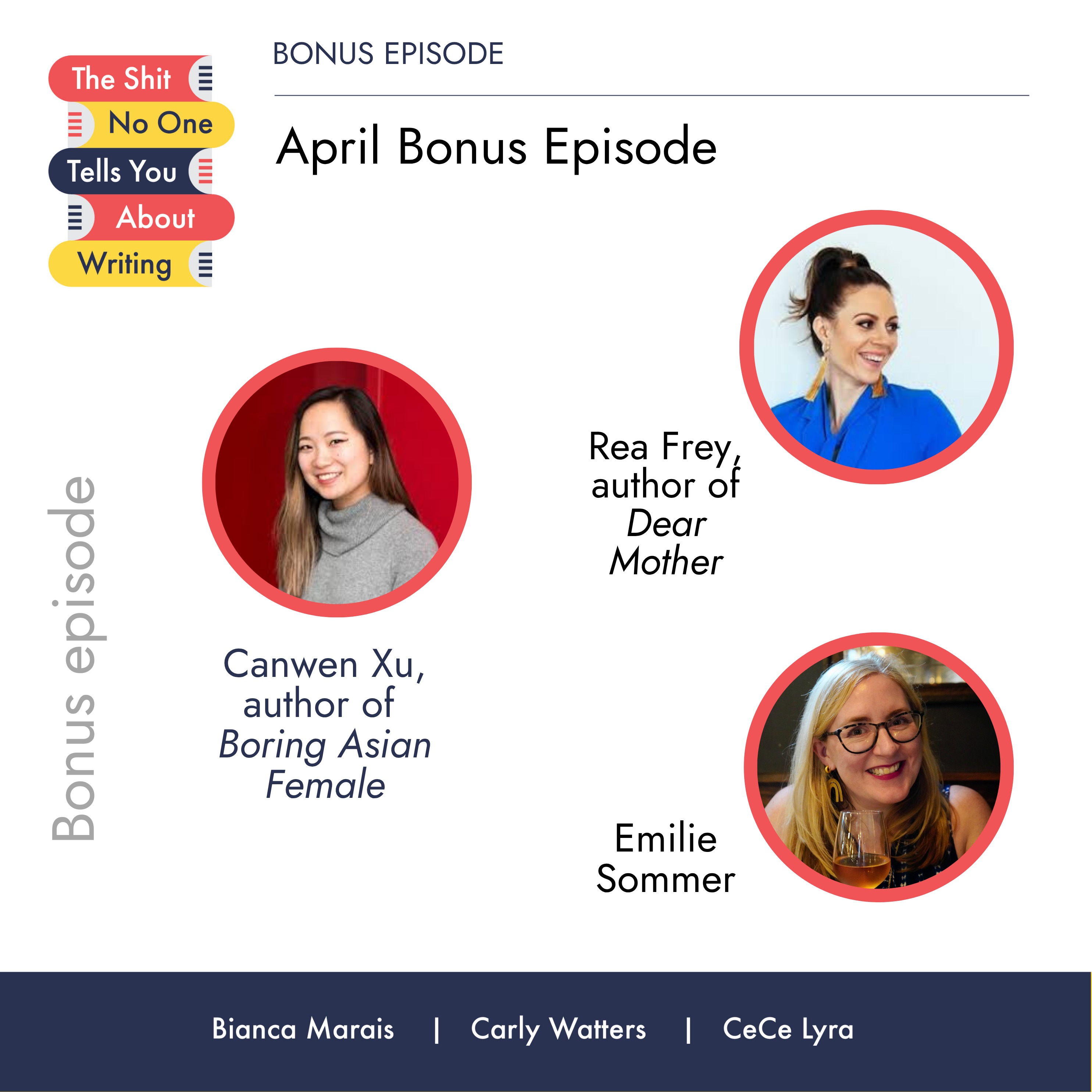
Hi there and welcome to our show, the shit no one tells you about writing. I'm best selling author Bianca Marais and I'm joined by Cece Lehrer of Wendy Sherman Associates and Carly Waters of Pictures. Hi, everyone. Today's guest is a debut author whose writing has appeared in the Washington Post, the Kansas City Star, Chalk Beat, Era magazine, and more. She is a graduate of Columbia University. It's my pleasure to welcome Kanwyn Shu. Kanryn, welcome to the show.
- [05:30]
Kanwyn Shu
Thank you.
- [05:31]
I'm so excited to be here. I actually listened to this show when I was querying and preparing to query. So it's really exciting for me to kind of be on the other side now.
- [05:42]
Bianca Marais
Oh, wow, that's amazing. We love hearing those full circle moments. That's incredible. Well, for our listeners, we are actually going to have Kanwyn read us her successful query letters shortly, which is always exciting, and we're going to put that in our substack. But let me just firstly tell you about the book we're discussing, those of you who aren't watching on YouTube. I'm holding up the COVID of the book. It's called Boring Asian Female. Very striking cover. And we're going to link to it on our bookshop.org affiliate page where if you buy the book there, you can support an independent bookstore and the podcast at the same time. Yeah, pre orders, all orders are so important. So please go there to support our authors. Okay, let me read you the flat copy and then we're going to dive in. Elizabeth Zhang knows her place in the world. She knows she's in the 10th percentile for likability and the 70th percentile for attractiveness. But she's also in the 99th percentile for academics. So when Harvard Law School rejects Elizabeth for not standing out enough, which she knows means she's just another boring Asian female, her carefully constructed life falls apart. What shocks her even more is that Laura Kim, a classmate at Columbia, got in. At first she follows her because she's just curious what Laura orders for lunch, where Laura shops, what Laura's hobbies are. All of these things must contribute to her overall package. What makes her an acceptable, interesting person to Harvard. But still, Elizabeth can't see it. The only thing she sees is that Laura has taken her spot at Harvard, a spot she knows she deserves after working so hard. A spot she'll simply have to take back. Dun, dun dun. Guys, this is one of my Favorite reads of the year. I. I couldn't put it down. I'm a menopausal woman who wakes up at 2am all the time. And this book was my go to. I just flew through it. So highly, highly recommend. And there's a lot that we are going to discuss. So before we dive into the actual book itself, Carmen, I would love for you to tell us the genesis of the story. I always love knowing where a story idea came from and how it developed from there.
- [07:56]
Kanwyn Shu
Yeah. So I knew when I started writing that I wanted to write a story that took place at Columbia, my alma mater. And the reason is that it was just such a unique experience with so many different characters, so many people who seemed so confident, but at the same time really insecure. And it was just at this very transitional point of everyone's lives where looking back, I'm like, you know, I felt I was trying to find my place in the world and everyone else was actually trying to find their place in the world as well. But back then I thought everyone else had it figured out and I was the only person who, who didn't have it figure figured out, so. And I knew I wanted to write about a female friendship. I'm kind of putting that in quotation marks, as I know that term is. Is overused. But I wanted to write about, you know, the, the dynamic between two young women. One who maybe has her life figured out a little bit more. One who has her life figured out a little bit less, even though on paper it might seem the opposite. That was just kind of. I think I started with kind of a vibe. And I also wanted to incorporate these elements of, you know, being on a college campus where, you know, most people don't have access to a ton of disposable income. But then you're in this big city where you also just get access to all these people who are so much older and so much more established and seeing it their world from an aspirational lens. So that's why I opened the book with, you know, with the protagonist at an art gallery, since it's. It's kind of juxtaposing her dorm room where she lives, where there's, you know, rats and it's small and dingy with this really rarefied world that she hopes to enter. So that was kind of the genesis of the story.
- [09:45]
Bianca Marais
Yeah, I love that. And I think. I think I read somewhere as well that you said you wanted to deal with, with failure, you know, someone who should be successful by all means and has this huge Setback. And I think you said that that was based on something that you personally went through as well. So it was an exploration of that as well. Can you speak a bit about how something personal can become a book, even though the book is not about that personal thing?
- [10:14]
Kanwyn Shu
Yeah, for sure. Well, you know, I. I was attending this New Yorker panel with Sandra oh and Min Jin Lee. And one thing that they said that really stood out to me and I think I had maybe just started writing the novel or I was thinking about writing it. One thing they said was to tell the truth. And I didn't really understand what that meant because I was like, well, if I tell the truth, I took it in a very literal sense. If I tell the truth, then aren't I just writing a memoir or something like that? But when I thought about it a bit more, what I realized was they meant telling kind of like an emotional truth. So my emotional truth was that, you know, when I was in college, so I, I had grown up in, in the Midwest and I had gone to high school in Idaho. And then I had gone into this world where it's like so many of the people around me, they had gone to boarding school or they had lived, you know, internationally. And I always felt kind of. I always felt a little bit less than or like I didn't belong. I wanted more than anything to just feel like I belonged in this world and not feel so much like an outsider. And I think that my path to trying to kind of resolve that conflict, and I think a lot of people at these types of universities feel the same way, was I decided to go into Wall Street. So I figured, you know, if I worked a Wall street job, if I made a ton of money, then I would finally feel like I belonged. If I finally would feel like I, I wasn't an outsider. And that was kind of, you know, how I tried to resolve these conflicts. So I got this very, very prestigious internship in private equity. I worked my ass off during the summer. I, I was like, I was working, you know, 9:00am to 11:00pm regularly. I would go in on the weekends. And it was one of those internships where, you know, everyone knew if you got it, it was like people on campus would come up to me and they would be like, how did you get this internship? Whatever. And kind of the point of the internship was that at the end of the summer you get a return offer, which means that you get a full time job. And generally speaking, it was like, if you get the internship, there's a very good chance you're going to get a return offer. So when I got the internship, I was like, my life is set. I'm going to get the return offer. I'm going to be super rich. I'm going to be so successful, everyone's going to want to be my friend, whatever. And then at the end of the summer, I didn't get. I didn't get the return offer. And it basically sent me down this spiral where I didn't become obsessed with someone else, but I felt like I had to completely rebuild my identity from scratch in that process of rebuilding my identity. What I also realized was that the building blocks for that identity were fickle in the first place, because even if I hadn't gotten the return offer, then you never know when something in your career is going to suddenly change. So I wanted to kind of speak to that emotional truth of that failure. I never applied to law school, but I wanted to kind of take that emotional truth and put it onto a different situation that maybe would be a little bit more fun for me to write about. Since, you know, law school admissions, it's like a lot of people know about them. A lot of people are talking about just college admissions generally. So I kind of put that emotional truth on that situation that makes me think of the.
- [13:35]
Bianca Marais
I think it's a quote from Cool Runnings. So it's the Jamaican bobsled team. It's especially. It makes me laugh today because Jamaica just beat Canada in the bobsled in the Winter Olympics. And you're like, wow, Canada, good one there. But I think someone there says, if you're not enough without it, you'll never be enough with it. And I think that's so true in so many things. And I see that even with writers, you know, it's like, I'll be happy when I get an agent. I'll be happy when my book gets published. I'll be happy when I make the New York Times bestseller list. I'll be happy once my book becomes a movie. And so it goes. And the goalposts keep shifting because so much of your value is placed on external things that are so much outside of your control.
- [14:21]
Kanwyn Shu
Yes, for sure. And it's so funny that you bring that up, since I was having the same exact conversation with my husband last night, which is that, for me, I have started to hold all of these external achievements almost at an arm's length distance. So obviously, I am so happy about the press that the book is getting. I'm so happy about readers who are really enjoying it at the Same time, I am focusing my own fulfillment on the fact that I wrote a book I'm very proud of. And I wrote. I wrote the story that feels true to me. I worked really hard on it, and I'm just really. I'm really happy about that. So while it is nice to see people sharing the book, people complimenting it, I have started to hold some of that external validation at an arm's length distance where I let myself feel happy about it, but I don't let that define me as an author.
- [15:18]
Bianca Marais
Yeah, Excellent advice to all authors and, I think, to everybody in general. So let's look at the journey to publication. I mean, it took you, what, four years, 25 drafts, and a genre change to write this book. Take us through that.
- [15:34]
Kanwyn Shu
Yes. Well, so I first. I sent a first batch of query letters to about 20 agents, and this was when I had been working on the book for about six months, which was way too early. I had finished the first draft in maybe like, a month and a half, and I spent, you know, the rest of the time just editing. So I was like, well, I've done a lot of editing, and I feel like it's good now. You know, I sent it to 2020 agents. I got two full manuscript requests, and both of them were rejections. But one of the rejections actually came with a lot of feedback. And this agent, who I'm so grateful to for her feedback, she. She also kind of gave me a solution to what she saw as a problem in the book, which was kind of the lack of momentum, especially in the first two thirds of it. So I kind of went back to the drawing board, and I was like, you know what? Her feedback bothers me a lot. And the reason it bothers me is because she's right. So I was like, you know what? This wasn't ready. This wasn't ready. I'm gonna go back and I'm gonna edit it until I feel it's ready. And I took another year just editing it, and then I edited it to the point where I just felt intuitively, I was like, this is ready. This is as good as it's gonna get. I mean, obviously, I've edited. Edited further, but I really felt intuitively like, you know, someone's. Someone's gonna like this, and if they don't, that's their problem. That's not mine, because I really. I really like that. So that's kind of. Kind of going back to the internal validation part.
- [16:58]
Emily Sommer
So.
- [16:59]
Kanwyn Shu
And then that was. That was when I found my agent, Rachel. She Was very, very quick to send a full manuscript request. She was very quick to, to ask for a call. And immediately I just felt like there was so much chemistry between us. We love all of the same books. That was a huge thing for me. I was looking at her list of favorite books. I was like, oh my gosh, I haven't seen a single other agent who has the same. Has such a similar taste in books that I do. And we just really hit it off. And I'm really grateful. But I will say that when I was querying the book, the book was a lot different than the version that's coming out now. So it was originally very contemporary fiction, women's fiction type book. My comps were Sally Rooney, Lily King. It was not a thriller at all. It was not a suspense book at all. It was just about these. This girl who has to deal with rejection and kind of spirals. And then when I went on submission, I had a call with Angela at Berkeley. And again, it was like we had a lot of chemistry at the beginning of our call, but she then kind of, you know, put something out there. She was like, well, the issue is this is not quite a women's fiction novel because there's not really any romance in it. And we don't want to make you turn it into a romance. Would you be open to changing this to suspense? And I had never considered that before. I never considered myself a suspense writer. It was not something on my radar. But the more I thought about it, the more I was like, you know what, she's right. This would actually work really well as a suspense novel. Since it is, there was suspense in it. It just didn't quite get to that level that is needed for the genre. So then after that call, you know, Berkeley ended up preempting the book in a two book deal, which I was so happy about. And I just spent I think three or four months completely writing the book into a suspense novel. Laura, the antagonist, didn't exist up until that point. But then I essentially wrote in an entire obsession plot and the book just, it just completely changed. So even though I had gone through two rounds of editing, two very large rounds of editing myself, I then went through probably an even larger round of editing with my publishers.
- [19:16]
Bianca Marais
That is, I mean, that is fascinating. But honestly, it speaks to, and this is what I say time and again, how as authors we need to be open to these kinds of suggestions. Because the problem is you spend that much time on a book and it begins to feel true to you. It feels like No, I can't change this because that's not how it happened. Right. And again, you're not writing a memoir, you're writing a novel. And so things can change. I mean, it's fascinating to me that it's. That this started off as women's fiction. I can't imagine this is women's fiction. I mean, this is like. It is so intensely psychological that. And I'm going to discuss some of those things shortly. So the fact that you turned that around and did such a big genre change is fascinating. Before we move on to that, will you read us that query letter?
- [20:05]
Kanwyn Shu
Yes, yes, absolutely.
- [20:07]
Rhea
Thank you.
- [20:07]
Kanwyn Shu
So again, the queer letter is going to sound very different from the current synopsis of the book. So you guys can see just how much it has changed. So I'll start. Start now. After Yale Law School's admissions committee rejects Elizabeth Zhang for being just another boring Asian female, she starts having panic attacks and pushes away her friends, including her half white best friend, Eun Jin, who she has always envied as a slightly whiter, slightly prettier, slightly better version of herself. Yale was Elizabeth's one chance to prove to everyone in her life, her blond haired, blue eyed high school bullies from South Dakota and her wealthy college classmates from the Upper east side, that they were wrong for overlooking her. With that gone, all Elizabeth has left is her new situationship. David is a white finance bro who gives her access to his credit card, buys her an $8,000 Chanel bag, and whimsically flies her to London. Elizabeth also has a secret that no one knows about. For years, she's been creating fake profiles of attractive people on dating apps, a harmless social experiment to keep her entertained. But after her longtime crush asks for her advice on asking out Eun Jin, a jealous Elizabeth creates a profile using Eunjun's pictures. When her pregnancy test comes back positive, she considers succumbing to David's wish to keep the baby. Maybe she doesn't need a prestigious law degree to prove to everyone that she's made it in life. After all, how many other law school applicants can say they're going to law school with a baby? But after Untrun discovers her catfishing, their friendship may never recover. And Elizabeth has lost the only person in her life who can warn her that David's motivations are more nefarious than they seem.
- [21:49]
Bianca Marais
Dun, dun, dun. I mean, I can understand why the agents wanted it because it's compelling, but when I just compare it to how the book is now, it really fascinates me. So something I want to chat about is how Elizabeth Zhang is probably one of the most fascinating protagonists I have read in a long time because I was sitting going, okay, most narrators are unreliable even if they think they're reliable. We as human beings are unreliable because we don't see ourselves clearly, etc. Etc. But Elizabeth has got so much self awareness, even when she's being awful, she's self aware of it. But then she's so delusional in other aspects. Just like a fascinating character. I mean, she's obsessed with numbers and facts. And there's a part in the book where it says numbers and facts. So abstract and sanitized from the individual experiences of real life, making her feel more alone. So can we speak a bit about the process of creating her? Because you had to create her the first time around when this was women's fiction. And then you had to like, create her all over again when this became sort of a thriller. I mean, it's like dark academia and a thriller at the same time. So can we speak a bit about that process of like, really getting into her head? Because you did it so well that there were times I felt claustrophobic. I was like, elizabeth is freaking me the hell out. I need to, like, put this book down and I need to take a walk.
- [23:25]
Kanwyn Shu
Yeah, for sure. I mean, so even though the genre changed so much, it's almost like the same character, just in parallel realities. So when it was still a women's fiction novel, she was still someone who was very obsessed with percentages. She was still just very obsessed with external validation. It's almost just I just transported her into a darker. A darker reality where for some reason the neurons fired a little bit differently in this reality. And she became obsessed with this person named Laura Kim. And then this, this goes back to what I said about emotional truth. Because one thing that was really important to me when writing this character was I think it can be easy to just fiat your way into saying this character's a sociopath. All her motivations can be explained by the fact that she's a sociopath. She just doesn't think like normal people. She's just weird. And you can kind of let yourself. You can basically have your reader just, gosh, what's that term? Where it's like, oh, suspension of disbelief. Basically you just make that the suspension of disbelief for your reader. This person's just psychologically different from everyone else. But I wanted it to be that all of her actions are kind of explainable just in a very twisted way. So Even though she probably is a sociopath, that isn't the thing that explains all of her behavior. So that was something really important to me when writing this character. And I think the reason that I cared so much about that was I still wanted her to be a relatable college student. Even though she clearly has a lot of issues. I think that she really just has a heightened version of what many people at this point of their life feel. You know, they feel like they're constantly comparing themselves to others. They feel all of this pressure to. To find their place in the world. So all of those kind of were, were my drivers for, for creating this character. And then this also goes back to, again, emotional truth. So I essentially took out the worst, most toxic parts of myself, and I was like, what if, you know, I blew up, like, the tiny seed of, you know, let's say I feel jealous sometimes, I just really blew that up. So it's still that truth, but just a magnified version of it. Effy.
- [25:51]
Bianca Marais
Yeah, I think it would have been easy to write her as a stereotypical kind of psychopath sociopath, but you, you give her guilt. There are times that she feels intense guilt. She really does feel guilty, but then she rationalizes the guilt. So what's so interesting is, you know, on the podcast, CeCe especially is always talking about interiority and emotionality. You need to put us in the character's interiority. We need to feel those emotions. And she has these feelings, but then she completely rationalizes the feelings so that even that emotionality becomes interiority. And we spend so much time in her head, which I didn't realize until much later because there are interactions with other people. She does have friends. She does go out. You know, she parties, she takes drugs. She does all these things that you would expect a college student to do. And, you know, she'll go, I should date this guy, because it's the kind of thing that will make me feel normal. Or it's the kind of thing college students do do. So she does dates and all of that, but then rationalizes so much of it. And so in that respect, I think you make the reader do a lot of heavy lifting as opposed to just spoon feeding them, because I kept going. But a psychopath or sociopath wouldn't necessarily feel this way. And yet she does, which makes her even more fascinated.
- [27:21]
Kanwyn Shu
Yes, exactly. And that's where I wanted that relatability to come in. So even though she is probably a lot more toxic than, you know, the average person reading this book, I wanted you to still be able to see glimpses of maybe your worst version in her. And if you really let yourself feed into your own delusion, since everyone feels jealous at some point, everyone feels like, you know, they want to trade lives with someone else. And what would happen if you just really, you know, let those feelings blossom and just acted upon them and let yourself rationalize all of the terrible things that you feel?
- [27:58]
Bianca Marais
Yeah, there was a lot that you did that I could relate to. And, I mean, social media, you know, I remember leaving high school. What I'm giving my age away here in, like, 1993. We didn't know what any of our classmates were doing for the longest time. There wasn't Facebook, there wasn't Instagram. It was like, if you didn't run into them somewhere, you had no idea what was happening in their lives. Like, if you. If you wanted to, you know, stalk people, you had to drive past their houses to see what was happening. You couldn't. You couldn't, couldn't, you know, stalk them on socials. And it did make me think that if I'd had all of these things at that age, would I have given into a lot of that? And even as adults, we look at people's socials and we're like, oh, my God, this person is always happy and they're always on vacation and they always so well put together. And I'm such a schlub, and why am I such a mess compared to other people? But again, it isn't real. So much of this isn't real.
- [28:50]
Kanwyn Shu
Yeah, for sure. And I. I think that, you know, particularly when I was going to college, Instagram felt like everything. It was like, you know, the first time you meet someone, you're going to their Instagram, and that became just a representation of your personhood, where sometimes you would see someone in person that you had only known through Facebook and Instagram, and it almost feels like the person on their social media is more real than the person that you're seeing in real life, where you're so used to forming an image based on the type of photos they post that when you actually see them in real life, you're like, well, like, they're not. Like, that's not what they look like. They look like this photo that, you know is on their profile or, you know, they, okay, I'm seeing them in class now. But that's not their actual life. Their actual life is them going on really nice vacations on their Instagram. And it's something that, you know, is talked about a lot at the same time, I think we can't ever talk about it enough, which is that social media is just not. It's just really not real.
- [30:00]
Bianca Marais
Yeah. I remember with a younger friend of mine showed me something. I don't know, it was on a story or something of somebody, and he said, don't click on it or don't do something. And I did exactly what he said I wasn't supposed to do. And he freaked out. And he was like, now they're going to know that I was stalking it. And then I saw the story and I was like, who the hell looks to see who's seen their stories? I said, I post stories all the time. I don't look to see who's looked at my stories. And he's like, everybody looks to see who's looking at their stories. And it was just like, oh, my God, is this whole world I didn't know about. Which was fascinating as well. We don't have much time left. Something that I want to say as well is that the social commentary in this book is so brilliant. There were so many times that I stopped to go. That's so interesting. Like, there's the scene where she's with the. With her doctor or gynecologist, and she comments on how this woman knows the most intimate details of her life. She knows the secret that she's told none of her friends, and yet she can't ask this doctor about why she parts her hair that way. And it was. It was just like, fascinating. There's these little tidbits. There's the specificity in her thinking that makes her come alive even more on the page.
- [31:15]
Kanwyn Shu
Yeah. And I think this is one of the most fun parts about being an author. It's that you start to notice your details about your own life more, since those are the details that ultimately get fed into your writing. So I think ever since I started really taking writing seriously, it's almost like I see the world around me in a more precise light. It's really interesting. Or I. Even during social interactions, I think to myself, that is interesting. Why? Why do we talk about topics like this or. And I think. I think that's one of the most fun parts of being an author. It's that you become more introspective as well. You have to dig deeper into your own psyche since, you know, if you don't understand yourself, how are you going to be able to understand a character enough to write them in a compelling way?
- [32:06]
Bianca Marais
Yeah, no, Very, very much true. As writers, I think we're in the moment, but we're also observing the moment and we're analyzing the moment. And certainly at 2am when we're lying awake, we're overanalyzing the moment. Which is which is interesting. Kenwin, it was so lovely speaking to you once again. I'm holding up the book Boring Asian Female. Please get it from our bookshop.org affiliate page, support the podcast, Support an independent bookstore, and we wish you so much success with this.
- [32:33]
Kanwyn Shu
Thank you so much. I'm so excited that we were able to do this.
- [32:37]
Tyler
As a literary agent, you know, there's only one thing I like talking about more than books, and it's money. More importantly, cash that stays in your pocket. I'm on the lookout for our listeners at all times. I am always combing deal memos and book publishing contracts for hidden ways that writers are on the hook. And that's why we are thrilled to partner with Chime who is changing the way people bank? They offer the most rewarding fee free banking. They're not like traditional old banks that charge you overdraft monthly fees. Their customer service is real humans 247 and if you're like me and travel a bunch and love travel perks like airport lounge access, you've got it. And there's 247 travel concierge included with your Chime card. They have Spot Me which lets you overdraft up to $200 fee free. If you've ever been on the hook for a post writers conference drink and stuck with the tab. Plus get 5% cash back on Chime card in a category of your choice like groceries for when you're hosting book club and want to rack up the bonus. This is the free banking built for you. Chime is not just smarter banking. It's the most rewarding way to bank. Join the millions who are already banking fee free today. Head to chime.comtsnatya that's chime.comtsnatya it only takes a few min to sign up Our primary bedroom suite was feeling pretty empty. It was big, which sounded great, but it's a blank canvas to pull together into the cozy and organized space I was looking for. Then I found Wayfare and the pieces that actually match the modern, clean aesthetic I was going for. I got a console table that has a hidden storage and shelving that I can display when I want to show off and when I want to hide the mess. It's gorgeous. White oak finish finishes my room perfectly and has rounded edges which are pleasing to the eye. I couldn't Imagine a better fit that matches my style. I'm excited to tackle our outdoor space in next. Wayfair helps us narrow down our choices in ways that accommodate everyone's individual opinions in our family. Plus has options at every price point. Our outdoor space is ready for some new seating and I love an outdoor rug. It really pulls a space together. It makes you feel like you get an extension on your square footage each summer, which is a homeowner's dream. When we're thinking of a remodel or a redesign, we think Wayfair as our one stop shop for home. We used Wayfair Verified when we chose the piece for our bedroom. Wayfair's team of product specialists vet everything by hand using a 10 point quality inspection. So you know you're getting a quality piece no matter your budget. I can't recommend it enough. Look for the Wayfair Verified dropdown menu on the site or the Wayfair Verified sticker on the item you're searching. You can't go wrong. Get prepped for patio season. For way less head to Wayfair.com right now to shop all things home. That's W-A-Y-F-A-I R.com Wayfair every style, every home.
- [35:04]
Bianca Marais
Hi everyone. Welcome to another awesome author interview. Today's guest is the number one best selling author of a dozen books. As a book doula, she has helped over 500 first time authors, land agents and publishing deals. A Silver Falchion finalist, Book Pipelines film adaptation winner and voted one of Marie Claire's best fiction writers. Her work has been optioned for film, featured on Good Morning America, CBS Saturday mornings and in the New York Times. To learn more, go to her website. Let me spell that for you guys. So it's R E A F R E Y.
- [35:45]
Tyler
Right?
- [35:46]
Bianca Marais
Rhea, it's my pleasure to welcome you to the show.
- [35:48]
Rhea
Thank you so much for having me.
- [35:50]
Bianca Marais
Yeah, thanks so much for joining us. So for those who aren't following on YouTube, I'm holding up the book cover. Dear Mother, this is the book we're going to be talking about today. It's an advanced reader copy. Lovely atmospheric cover there, right? So Rhea, before we go in, I know that our listeners immediately heard Book Doula and their brains are all on fire and they will not forgive me if I do not begin there. What is a book Doula? Please take us through that.
- [36:21]
Rhea
Yes, I love that. So this is not a term that I coined. My clients started calling me a book Doula. So I think a lot of People have heard of a book coach where someone is helping you through, you know, all different sorts of writing processes. But as a book doula, I am really helping writers birth their books into the world. Whether they come to me with a nonfiction idea, they want to write the next great American novel, they need an editor, they need coaching, they want me to pitch them to agents and editors. They need a ghostwriter. I literally tailor each individual's needs and take them from concept all the way, usually to publication sometimes. So I am with someone, can be with a client for sometimes a year or more. So it's even longer than a real birth. But I've been working with authors for 20 years and I feel like I love writing, I love being an author, but I feel like it is my duty to help authors navigate this space because, as you know, it is such a difficult world to navigate. There's so much that we don't know, there's so much that we're not taught on the business side of publishing. And that's what I'm most interested in is the business side and how to make a living at this, how to again, customize your own journey so it's on your own terms and you feel in control as the author. So that's kind of what I do with, with people. And I, I absolutely love it.
- [37:53]
Bianca Marais
I love the sound of all of that because I believe in good literary citizenship and this helps writers feel so much less alone. So one question that I want to ask is you said that you will pitch agents and editors, so it's almost like you're so you're not an agent yourself, but you can act as an intermediary and it's the first time I've heard about that. So tell us about that as well.
- [38:16]
Rhea
Yeah, it's funny, I've been asked to be an agent so many times. Like, isn't that basically what you're doing? But I'm kind of the pre agent. I like to call myself a matchmaker. And in a world where there's so many gatekeepers, I'm a gate opener. I am really trying to help the author, like jump over that slush pile. Because if you are an author who has ever pitched yourself to agents or straight to publisher, you know that you send these emails out into the void and then you just sit back and you wait and wait and wait and sometimes never hear from anyone at all. And so what I've learned in my career is this is a relationship driven business and I wanted to utilize my relationships with people that I've met. I have a wonderful arsenal of top literary agents that I've just come to know throughout my business. Same thing with editors. So when a fiction author or a nonfiction author comes to me on the nonfiction side, we create their book proposal, which is what you actually need to sell the book. You don't write the book first. On the fiction side, you know, we go through a developmental editing process. And then I create their pitch letter or their query letter, and I pitch to agents in my arsenal. It's usually about 10 to 15 agents that I pitch. I have about a 95% success rate with landing, matching people to an agent. It's not a guarantee, but I really, really, really try to make those appropriate matches. It's the hardest part of my job, though, because it's like managing expectations. We can do everything we can, but I can't dictate what an agent really wants to see. It's. It's very subjective, but. But yeah, it's. It's a really interesting part of my job. I love it. I think that's what people come to me the most for is relationships. They want those open doors. And it just thrills me. Like, I get more excited when one of my clients lands a deal sometimes than when versus when I do. Because I'm in the business of helping people make their dreams come true. And it's just. It's such a privilege, like, to walk that path with someone.
- [40:17]
Bianca Marais
Yeah, no, I. I love all of that. Door opener. Gate opener instead of a gatekeeper, which is wonderful. Okay, so now. Yeah, our listeners don't say that I don't get you the information that I know you want. So now we're gonna get to talking about the book Dear Mother. So you said that this story was a long time in the making since like 2017. So take us through that process. Because I'm always so fascinated by books that kind of get put in the drawer and then pulled out again and dusted off.
- [40:51]
Rhea
Well, this one is. I'm gonna give you the truth about this one because. Yes. So my debut novel that came out in 2018 was called not Her Daughter. That book went to auction. Different publishers wanted it, and I envisioned that book as having a sequel, which would have been Dear Mother. One publisher wanted that two book deal. They wanted Dear Mother. The other publisher that I ended up going with did not. They just wanted my standalone novel. They were not interested in a second book. So I had about 70 pages written of Dear Mother. And just. Just I did. I shelved it. I put it in a drawer didn't really think about it again. And I started with a current publisher that I'm with now. It was time to come up with another book concept. Dear Mother is my third book with this publisher, and I kind of dusted that story off, brought it out and pitched it to her, and she really liked it, But I had to make it completely different. It couldn't have anything to do with the original. With the original story. So this has never happened to me before, but I was like, okay, great. I know exactly where I'm going with this book. I'm going to tweak it. I wrote the book, turned it in early. My agent loved it. You know, I had a couple beta readers, and I was like, my editors are going to love this book. I actually have two editors with my publisher. Right before I was supposed to get my editorial letter back, I get a message saying, hey, can you hop on a zoom call? We need to talk about this book. And I said, oh, that's not a good sign. I've never had an editor request a call. So I said, just tell me, is this book going to be a total rewrite? And they said, yes. So I was like, oh, if you're an author who gets to the editing stage, you know that there is a difference between preparing yourself to edit a book versus potentially having to rewrite a book from scratch. So, long story short, we hop on this call. They proceed for 10 minutes to tell me everything they hated about the book, that it just didn't work for them. And I was really shocked because, again, I was like, I nailed this book.
- [42:56]
Kanwyn Shu
This is great.
- [42:56]
Rhea
And they. For whatever reason, they just. They did not like it. So I could not salvage anything from that book. And they were like, we're gonna scrap it. What other ideas do you have? And on this call, I was just like, I. I don't know. I'm gonna have to think about it. So I came up. The only thing I kept is the setting, which is Cedarlock, Washington, and my character's name. Everything else shifted, and I rewrote. The book that you are holding in your hands is literally a book that was cobbled together in two weeks. And my editors, I wrote everything in a Google Doc and they were in there with me live. As I'm writing my first draft, they are editing, like, right behind me. And I do that with my clients, but I've never done that before. And it's going to sound weird. I actually kind of liked it because it's the most attention I've had from them. Like, actually Getting live feedback. But as a writer, your first draft, like, you don't really want to. Not only do you not want anybody to see that, you don't really want to publish that, but we were in such a pressure cooker and we were so behind. I did it. I learned that I'm a very fast writer. Anyway, my editors were really complimentary. But I joke, like, if you don't like this book, it's literally because it was written in two weeks. So sorry. Not sorry.
- [44:13]
Bianca Marais
I actually got chest pain as you described. The thought of busy writing and having an editor live behind me busy fixing. Oh, my God, that actually gave me chest pain. And I think there'll be listeners out there who it's the same thing. I can't believe you turned around such an excellent book so quickly. Well, thanks.
- [44:33]
Rhea
I mean, they were very kind about it. And it's just one of those things. I joke that it's karma because I offer a container for my clients. It's called a collaborative container, where I assign them a certain number of chapters for their book. They write like a chapter or two a week, and then I am actually in there editing live behind them as they move on to the next one. So I'm like, oh, this is payback. I actually get to know what this feels like. But it taught me resiliency. This is my 10th book, and it's such a humbling industry, this industry, because you would think I like, oh, I know what I'm doing by now, but. But this taught me that, no, not every book is a hit, and you have to be to be malleable in this industry. And I was really proud of myself that I did not crumble and just refused to do it because, again, I was not in that head space to write. To write a book from scratch. But I actually think this one turned out better. It's a different story, but ultimately, early readers are enjoying it. So there's always that.
- [45:33]
Bianca Marais
Yeah. Wow. Okay. Mind blown, right? So for. For our listeners who have got that, like, manuscript that's somewhere in the drawer, and I'm sure you have that with your own clients as the book doula. Like, at what point do you say to somebody, it's time to put this aside and move on? Because I think that's one of the hardest thing for writers, especially. The more time you've spent on it, the more invested you are in it and the less inclined you are to go, okay, it's time to move on. So what's your advice there?
- [46:03]
Rhea
That's such a tough. Because Again, it's so subjective, right? Like, who am I to say whether this is sellable or not? But I think if you've been tinkering with something for years and years and years, the next step, if you don't want to just shelve it, is finding a few very high level beta readers. Not, not your mom and not your partner. Not people that are just going to tell you it's great. But actual, maybe potential readers or someone with an editorial eye to see if it has legs, if people are interested in it before you decide, you know, to shelve it or you know, if you've had it. I cannot stress enough, like making sure your book has been professionally edited, that it has gone through a developmental edit. Even if you can't afford that, finding someone with that really great sharp editorial eye. And then, you know, if you go through the pitching process, if you're someone who wants to traditionally publish, and let's say you've tried to pitch it here and there, maybe to five or ten agents, and you're not getting any sort of feedback or no one's jumping at it, that might tell you that it might be time to shelve it. And when you shelve a book, doesn't mean you're never going to revisit it. But it's always hard to remember that the books you see out today were acquired likely one to two years ago. So, like, what is popular now? Like, let's say your book is so in line with what's out right now, that's not necessarily what editors are buying right now. So you almost have to predict, you know, the trends and what's, what's really going to be popular. So it's also figuring out like what is selling, what are people reading? Not that you want to fit your books into those genres, but it does matter because it is a business and you want to see how you can sell your book. But again, if it's something that you're just tinkering with and haven't shown it to anyone, I think that's the obvious next step is letting a few people read it and see what kind of feedback you get.
- [48:03]
Bianca Marais
Yeah, something that I also found really interesting. I interviewed Liara Tamani quite a few years ago. Shout out to Liara. She's actually got a new book out at the moment. So for those of you who loved her first one, go check out this new one is that she had written a book, been trying to query it for I don't know how long, just put it in the drawer gave up, wrote something else. And then later, I think she said it was like three or four years later, she pulled out that exact manuscript and was like, yeah, let me just try and query it again. She did nothing to it, didn't even change the query letter. And suddenly agents were fighting over this book because that topic was, you know, something that people wanted to hear about.
- [48:45]
Rhea
Exactly. And that's what I love is like, you know, a lot of us have many different manuscripts, you know, sitting around or maybe partially written. And you never know when the time is going to be right. And that's something too. If people are listening and let's say they do want to get traditionally published, a lot of times if you do land a book deal, you'll get a two book deal. So I remember when I started out my novel, not her daughter came to me in a flash. I wasn't trying to write in a specific genre, it was just a story that like I channeled. I was so excited about it. Got a two book deal and then another two book deal with the same publisher. I did not have another idea. So great advice too is just like, keep writing. You never know when you can use one of those manuscripts. And having a few books ready to go saves you a lot of like mental stress and time so you don't have to manufacture something out of thin air.
- [49:39]
Bianca Marais
Yeah. And I know that most of our listeners always sort of glorify two book deals because they like, right, it's the certainty, the safety net and whatever. With my last book, I turned down a two book deal and I'm so glad that I did because the whole publishing house disbanded. It became, I lost my editor, it became a romance, you know, publisher. It was such a mess. And to have had to be contractually bound to write a second book, I would have like freaked out. So in this instance, I'm really glad my agent was like, I don't think we go that route.
- [50:13]
Rhea
I love that you said that. And I give that advice too. I actually really regret doing a four book deal. You know, I did that two book deal initially. I was with St. Martin's Press, so it's an imprint of Macmillan, the Big Five. I was so excited. And then my last two books with them and I was on the fence. I was like, oh, do I really want to lock myself in for another two years? Because if I'm being honest, I wasn't overjoyed with their marketing efforts. And then those last two books came out during COVID and they just, I feel like, just didn't really care. And it really affected my career. I was so excited about this third book. I think it could have really launched me in a new way. And they just didn't put it was a 2020 book, you know, And I was in the same boat as so many other authors, but because I was locked in, there was nothing that I could do. So I pivoted to a different publisher again, signed a two book deal, left after the two book deal. And then because I write in two genres, the one with that Dear Mother came out with, it's a single book at a time. I've done three with them. But I think that's so great to do one book at a time, see if you're happy, see if the publisher is happy or like what you said, your editor could leave, the publisher could shift. You just have to really do your due diligence. And a lot can change in a year. So I know people want that safety net. But I agree with you. I think it's nice to just check in after the book to see if both parties are happy.
- [51:43]
Bianca Marais
Yeah. There was, there was another author I spoke with who stayed with one publisher, I think for five books and the book stuck. Did okay. But the publisher had now decided that they were an extra next type of author. Right. They weren't gonna launch anything big. And then when, as soon as she took her next book to another publisher, she launched hugely with them, you know, so sometimes it is good to have that change.
- [52:06]
Rhea
Absolutely. Definitely.
- [52:08]
Bianca Marais
Yeah. Okay, so back to the book. So you put in what we call. Well, it's not even a sneaky prologue. We call it sneaky prologues because it's not called a prologue. But. So this is an announcement, so I just want to read it for our listeners so they can see a really effective prologue that plants a lot of curiosity seeds. So beloved foster mother or secret monster, Gail Archer dies under mysterious circumstances 25 years after deadly fire. That's an article in the paper by Eliza Harrell. May 11, 2026. The Cedarlock Sentinel. So it says. Cedarlock, Washington, 25 years after the fire that killed three children and shattered a community, Gail Archer, the woman at the heart of it all, has died. Cause unknown. Once hailed as a generous foster mother, opened a home to children in need. Archer's reputation took a dark turn when one of her foster children, Marcus, age 15, went missing in the Cedarlock woods, never to be recovered. Only a few Years later, a 2001 fire claimed the lives of Celia, 12, Ben, 15, and Jude, 17, siblings. Through foster care, the Fire late ruled accidental, broke out in an underground bunker on Archer's 20 acre property, trapping the children inside.
- [53:27]
Unidentified Caller
Died.
- [53:28]
Bianca Marais
Two surviving children, Archer's biological daughter, Isabel, 13, and Harper West, 13, another foster child of the same age, were found safe at home. Archer was never charged with the crime, but questions lingered. Why were the children in that bunker? How did the fire start? Where was Gail? And why did she do nothing to save them? For years, Cedarlock has been divided. Some defending Archer as a misunderstood woman trying to do good in a broken system. Others convinced she got away with something unthinkable. Now, with her sudden death, the town is left to wander. Did Gail Archer take her secrets to the grave? Or is the truth finally about to surface? It was always just a matter of time, says retired sheriff Theo Mullins, who led the regional investigation and now consults privately. There were pieces that never fit. Maybe now we'll find out why. Isabel Archer, now in her late 30s, returned to Cedarlock this week to settle her mother's affairs. When asked for comment, she declined, but sources confirm there are more questions than answers. Here in a town still haunted from these losses, one thing is certain. The past isn't finished with Cedarlock. Not yet. Dun, dun, dun. And I love that. And then we start with Isabel standing over the graves, and she's back again. So was that sneaky prologue always in there? Was it something.
- [54:52]
Rhea
Yeah, you see, because.
- [54:54]
Bianca Marais
Because sometimes we just need something really smart to give context and backstory so that, boom, we're off to the races.
- [55:00]
Rhea
Exactly. And I love starting. Actually, this book is not as, like normally. I'm just like. We drop right into action and we're. We are off to the races. And this one was a little bit more of a slow burn, but I love that it's not a gimmick, but, like, just using. I love the. The newspaper article. I was a journalist for a really long time. I worked with inmates on death row. I used to write newspaper articles. And love, like you said, it just kind of fills in some of the backstory and the details, you know what's at stake. You are introduced to the characters, to the victims, and it just fills in some of those blanks so I don't have to speak. Spend so much time on the page. And hopefully by reading that, the reader wants to know what happened to the kids. Was Gail a monster? What is Isabelle gonna find? So I love it. I think it's a great device to use.
- [55:52]
Bianca Marais
Yeah. I mean, it sets up the setting. It sets up all these curiosity seeds. It sets up who the Players are we, we get who all the characters are, etc. So, you know, on the podcast we're often saying, don't use a prologue, because many people use a prologue as a band aid to fix bad opening. And we're like, if the prologue's there, it's really got to elevate it as opposed to, you know, being that band aid. And this is an excellent example of that.
- [56:19]
Rhea
Thank you.
- [56:20]
Bianca Marais
Now, the multi POV in multi timelines. Take us through that structure again. Was, I mean, was this part of one of the rewrites? Was it there originally? Wasn't there originally?
- [56:33]
Rhea
Nothing was there originally. I mean, what is on that page was constructed within two weeks. However, I love. So I write kind of time bending women's fiction as well. So I play with time. I play with dual POVs. I play with alternate timelines. I'm a big fan of. I love a multiple pov, but in two different timelines because I feel like you almost have two mysteries going on that we have to figure out. So while we have the current timeline with Isabel trying to get to the bottom of, I'm not giving anything away, but her mother's autopsy comes back maybe suggesting that she was murdered instead of dying of, of natural causes. So we already have one thing that we're trying to figure out and also was it tied to the children dying? And then the book takes place when Isabel was a teenager, the night all of the kids died in this fire in the bunker. So we know that we're creeping closer to hopefully finding out what happened. And so if I'm going to make the reader flip back and forth, I want them to be interested and not just want, see, to want to skip one section. I want them to learn something about the characters, get closer to figuring out what happened. So, you know, the, the kids kind of came to light. I mean, it's sad ultimately, but I actually really enjoyed going back in time and trying to, to construct that the night that they died.
- [57:55]
Bianca Marais
Yeah, it's. It's interesting because we get the prologue and we understand there was this tragedy. And you go, it is a tragedy. And that's sad. But it's only one. Once we start seeing the kids in the backstory, interacting, etc, and then they come alive for us, which is, you know, enhances that tragedy as well as we get to know each of them through the past multi POV narratives. So with Isabelle, we've got a character who doesn't want to think about the past or their trauma, which is great to write in third person. Close, because you can keep the reader at a bit of a distance. Because every time this character is triggered, they can be like, I don't want to think about that. I don't want to go there. Which allows you to withhold certain things until the point where the character has to face them. So when it comes to choosing third person, close or first person, again, I'm always saying there needs to be intentionality. So what was your intentionality here?
- [58:54]
Rhea
Well, again, the first version of this was actually first person. So when I scrapped the whole book and started over, I was like, this has to be third person. I have to have a little bit of distance. And I tend to be, I've written in both, I tend to be a little bit more first person. But I think for Isabel's character and then also with the children, it just made more sense. It gave me perspective as a, as a writer and I, I wanted, you know, to have a little bit of distance there. But I tend to prefer actually first person when I' writing because I feel like you can get a little bit closer to the character. But for this type of book, I don't know, that just dropped in for me and I wanted to kind of keep it clean. Clean that way. With third person.
- [59:39]
Bianca Marais
Yeah, no, it worked really well. And, and like I say, that works especially well when the characters withholding information from themselves and not just from the reader. You know, you can have an unreliable first person narrator who's withholding things from everybody. But in this, like, often when it comes to trauma, people are like, I don't want to think about that. I don't want to deal with that right now. Which, which allows you to sort of stretch that out a bit. Let's talk about second acts or muddling middles, as a lot of people deal with it. Because again, as a book Doula, you must see that a lot because you start off with a lot of tension. We know that. You know that there's this question looming over it. It's this woman. Evil. Was she misunderstood? Did something happen to her? And so you've, you know, you set up Act 1 really well, but then you cannot have a dip intention or pacing in the second act. So for you, do you sit and plot out all of that? Are there action beats that you know, you have to hit? How do you deal with your, with your second act?
- [60:41]
Rhea
Yeah, for, you know, it's funny, I call myself kind of like a plantser. Like I, I'm not one of those people who does like a 40 page outline, but with this One, I had to know where I was going because I had such a short period of time to write it. And in the past, when left to my own devices, you know, I could get through that first act and then, yeah, would almost, like, stall on the second act. But there, without giving anything away, there's an introduction of. Of something that happens in the second act to you know, hopefully keep the tension and the action moving forward. And, you know, really trying to figure out what this tether is between, you know, what happened to these kids. There is a discovery that propels the narrative forward. So, yeah, I tried to kind of map that out a little bit so we don't lose too much action or tension. And again, this one. This one doesn't move as fast as some of my other thrillers. So that was challenging to me. Just. Just not make it like one thing after another and hopefully still keep the reader's attention.
- [61:47]
Bianca Marais
Yeah, I think that's where characterization is so important, because when you're getting to know a character so much and there's layers there, you know, there's layers of backstory, there's layers of. Of. Of the history, etc. Then you don't need the propulsive. And then this happens. And then this happens, because you do reading to really understand character and who they are and how that affects the plot. So I think that helps with pacing. And, I mean, every book teaches you how to write it. And there's some books that need that propulsive. Boom, boom, boom, boom, boom. And then there's other books where you can. It's almost like an exhale where you can spend some time with this character. Right. As opposed to dragging them through a scene.
- [62:26]
Rhea
Yep, completely. And I, you know, with all these characters, because my main character, she shifted so completely. Like, my first version was. She was like a school teacher and very, you know, compulsive sleepwalker. And, you know, had all these, like, different issues. And this. This person. This version is just a stronger protagonist, way more, you know, sure of herself. But I did not get to spend time with these characters like I typically would to really get to know them. I mean, it was so fast and furious. But I still, along the way, felt like I got, you know, I got to know who they are, but just not in a typical. Not. This is nothing about this book was typical for my typical process.
- [63:12]
Bianca Marais
Yeah. And I mean, sometimes that's a good thing because I feel sometimes I can overthink things. I'll sit with a character for, like, six months, completely overthinking them, and they'll probably end up being the character who I thought they were in, in week two, you know, so sometimes this is a good thing, as you know, to rush us. One last question, Maria, before we let you go. What are the biggest mistakes that you see writers making as a book doula in terms of advice? Just, just advice for our listeners?
- [63:42]
Rhea
What a great question. I mean, I feel like so many people talk about craft like, you know, oh, just write the best story that you can, or, oh, they're making this mistake or that mistake. The biggest mistake I see on that side, the craft side, is actually pitching your book or if you're indie publishing, publishing it before it is actually ready. You've either skipped a step, it has not been professionally edited, you've become really precious about the material and don't want it to change in service of the story. I always say, especially for fiction, if you're not willing for your work to change at all, traditional publishing is not going to be for you because it's going to go through so many hands, so many iterations, and at some point, like, you have to have a little bit of distance from that and not just cling so tightly to it.
- [64:29]
Bianca Marais
It's amazing that point, because people will cling to it as if it's really true. And with memoirists, memoirs, I'm like, okay, it's really true, that's fine. But you can approach it from a different angle. But when it comes to fiction, I've said to writers, well, can it not do this? And it's like, no, this is the way it happens. And it's like, but you made shit up so you can make other shit up.
- [64:52]
Rhea
Exactly. And I, and I say, I say this all the time. If you aren't willing, if you love your story and you're like, no, this is it, indie publishing, self publishing all the way, you can put out whatever you want. But if you are going to be in this business and you, and you do want book deals and you want an agent and all of that, like, there has to be the understanding that any sort of feedback is about the work and not about you. And as a professional, you do have to be willing to shift things. However, sometimes it is your work. So you, you know, don't just make every concession, there has to be a balance there. But the number one mistake I see all writers make, whether they're nonfiction, fiction, first time authors, 10 books in, is not learning about the business before you ever have a book to sell. Learning everything, not only where your readers are, how you're Going to connect with them, what it means to build an author platform. But on the business side, how much do you want to get paid? Do you know how to negotiate a contract? Do you know how you get paid? Do you understand how the business works? What do you want your book for? What's your, what's your main goal? When I work with clients, we always start with what they actually want a book. Book for, which sounds obvious, but it's actually not. And then we kind of go through which publication path is the right thing, the right path for them based on those goals. And then the process to getting it out into the world, how to market your book, how? Like, you have to understand that I'd say 90% of the sales effort, the marketing effort falls on the author's shoulders. I don't care if you're with the biggest publisher and they paid you a million dollars or you're putting it out yourself. That's the biggest shock that, that I, my clients come to me with is they, you know, their books are out there with these, these great publishers and they're always shocked that how little their publishers actually did for them. And I always push back. I'm like, I signed up to be a creative. I want to sit in my pajamas and write all day. I did not sign up to be a salesperson, a marketing guru, a social media genius. And to me, in my opinion, that is the publisher's job. I did my job. Now it's time for you to do your job. So I always try to help authors figure out ways to be very comfortable when it comes to marketing because so many of us don't want to be. But really taking that time to figure out what you want, how this business works on both sides of it, whatever publication path, what is expected of you and what your publisher is going to do. And a lot of times we just need to ask more questions. As authors ask all the questions, so many of us are afraid to ask any questions. We don't want to rock the boat. We don't want to look at our numbers. We don't want to know. But it's a business. You're an entrepreneur. Your book is a product. So that is my biggest piece of advice, is figure out who you can talk to about the business or where you can learn about it so you can be successful on your own terms.
- [67:54]
Bianca Marais
Absolutely. Love that. Perfect place to stop. Thanks so much, Rhea. I'm holding up the book again. Dear Mother, we're linking to it on our bookshop.org affiliate page. You get the book there. You support an independent bookstore and the podcast at the same time. Thank you so much for joining us.
- [68:10]
Rhea
Thank you so much for having me. Hi everyone.
- [68:29]
Emily Sommer
Thank you for joining us for our monthly comps segment. My name is Emily Sommer. I am the book buyer at East City bookshop in Washington, D.C. and I am as always very glad to be here. I love it the most when I'm here to talk with my friend Bianca, but I am recording by myself today as they let me do sometimes. So Bianca, thank you for having me and everybody else, thank you for listening. We will dive in to our comps. We've got 10 today, so we'll start with number one.
- [68:58]
Kanwyn Shu
Hey there, I'm looking for comps for my dystopian novel. I think it's ya with crossover potential. 19 year old Adrian accidentally portals herself to an alternative Earth where all the people are different but the buildings are the same. She becomes a fugitive and finds the people chasing her, split the population in two, sent half to this new Earth and erased everyone's memories of the other halves. She must decide if she will speak out and try to reunite everyone, putting her and her family in danger, or if she will accept their bribes and stay silent. But then she'll have to forget all about the cute boy that's helped her on this new planet. There's also themes of grief, coming of age, romance and memory. Some comps that come to mind are the Ugly series by Scott Westerfeld. The Giver Lois Lowry fits the best, but it's too big and too old. Or the TV show Stranger Things minus the monsters and set in the future. Would love to hear any more ideas and current comps that you have. Thank you all so much at the podcast. You're the best.
- [69:52]
Emily Sommer
Okay, I think you're right that the comps that you have suggested uglies is probably a little bit old. The Giver, I think too big. Although I'm right there with you because what a fantastic book that is. I like the idea of Stranger Things minus the monsters set in the future, but that might be too many caveats. So in thinking about more recent young adult dystopian that might work in place of those, the first one I thought of is Cold Wire by Chloe Gong. That's a great recent YA dystopian. She has a very strong name in ya, but it's not Lois Lowry. Big and that's a new one. I think there's a sequel coming out. We did an event with her that was very popular so I would look at Coldwire and I just read about a book in Book Riot, I think, called the Danger of Small Things by Carol Lewis. It sounded very interesting. It sounds like a classic YA dystopian with a lot of intrigue, a very strong female main character. So maybe take a look at that one as well.
- [70:53]
Unidentified Caller
I'm seeking comps for a memoir titled how to Love a Hellhound that follows my journey from isolated, widowed mom to avid dog musher. After a scary encounter with a naked man while running, I decide to make my daughter's dream of having a dog come true. A big dog who could also run with me. But I adopted the world's worst dog, and the story that follows is a comedy of errors. I don't find any success with the hound until accidentally discovering a group of dog mushers in Atlanta, Georgia, of all places. They convinced me to train the hound as a sled dog by strapping her first to my body and then to a bike. We take a deep dive into the quirky sport of dryland mushing and rescue a manic coonhound to add to the team. After I fool myself about how well it's all going to. If I've done it right, the story will convey how the quirky sport saved me and my dogs, while at least half convincing you to give it a try yourself. Chris McDougal's running with Sherman, I feel like, is a great comp in terms of topic and tone, but maybe too old and too big. Rick Bragg's the Speckled Beauty and Marcus Zusak's Three Wild Dogs and the Truth could also work, but maybe too big. Blair Braverman's writing may also work, except she's an expert and I'm a novice in comparison to her. Thank you.
- [71:53]
Emily Sommer
Okay, for our second one.
- [71:55]
Rhea
Wow.
- [71:56]
Emily Sommer
I'm so impressed because one, this sounds like such an interesting story for a memoir. I mean, it's. It's so specific. It's so unusual. I'm. I'm right there with you. And two, your comps are, to my mind, absolutely perfect. So I was thinking about the Speckled Beauty and Three Wild Dogs and the Truth, before you mentioned them, I had not thought about Running with Sherman, although I think that's great. So that's exactly what I would have suggested. And I don't think these are too big, even though obviously Markus Zusak, Rick Bragg are big names. It's such a specific topic and such a specific type of book that I think the comps are naturally going to be fairly limited. I think these are right on the money and I wish you the best of luck.
- [72:41]
Unidentified Caller
Hi Bianca and Emily, I'm looking for comp titles for my new adult Coming of age dramedy about a 20 year old high school dropout in Stoner who tries to get his life back on track by taking a job at his old high school. The story loosely explores themes of the failing education system, county drama, generational anxiety and messy family dynamics, mainly drifting brothers in terms of tone and thematic overlap. Jonathan Evison's Lawn Boy is similar but too old, and Margaret's Got Money Troubles has the right energy but is too big. There's some similarity to the workplace dynamics in Natalie Sue's I hope this finds you well. The mind isn't really a rom com into the new adult angst and dark humor in Emily Austin's We Could Be Rats. The My book does not include LGBTQ themes. Thank you for any help you can provide. It is greatly appreciated.
- [73:25]
Emily Sommer
Okay, we need more dramedies in my opinion, so I'm glad that you have this one coming out in the pipeline. Hopefully we'll keep out. We'll all keep our fingers crossed. The first book that I thought of is this Is Where I Leave you by Jonathan Tropper. It's such an excellent book. It's so it's full, you know, just the exact rightness mix of comedy and drama and just a messy family dynamics. But I think it's too big and too old, so that doesn't really take us where we need to go. The next book I thought of is called We're All Damaged by Matthew Norman. Also too old, so that doesn't really help us. One that I think is good, timely and could work is help Wanted by Adele Waldman. For the workplace setting of it all. This one feels right to me. So maybe after the ones that you've listed start here. In terms of an additional possibility, I often mention Linda Holmes's books because I think hers are really good adult coming of age, but her protagonists are women. They are a little older, but they are also very funny with a lot of heart and figuring things out. So it's possible that there could be something there that feels like it's in the same general family. I also along those lines thought about Mame by Jessica George. So that main character is a black British female, so not probably the same demographics, but she's so lovable. She's younger than Linda Holmes's character so it feels a little more new adult than than adult adult. I would at least look at that to see who blurbed it and see if that provides any hints. And at the very least, it's a
- [75:03]
Unidentified Caller
wonderful A wonderful book look hey team, I'd love some help with finding comps for my grounded speculative romance novel. It's about a 30 something year old career woman who feels very behind in life and yet somehow finds a way to travel to a parallel world where all of a sudden she's living the life she's always dreamed of, including a surprising relationship with her on and off professional nemesis. It would appeal to fans of Ashley, possibly Austin's the Seven Year Slip because of its elements of magical realism, whimsical and introspective tone, and single POV focus on one woman's journey towards love and healing. Another possible comp would be Taylor Jenkins Reid's maybe in Another Life, which similarly explores the what if scenarios of life and how different choices lead to very different outcomes. However, both of these feel too big for a debut novel, so I'd love more options. Thank you in advance.
- [76:00]
Emily Sommer
So anytime I hear that someone is looking for comps for a grounded speculative romance novel, I think. And if you've listened to any of these segments before, I think you're right on the money with Ashley Poston. I think she's still helpful. She is big now. Her books have done really well. To my mind, she is not too big to be helpful and useful and she's just the best at that grounded speculative romance. Her book sells so well, so I think that's a great one. I would probably skip maybe In Another Life by Taylor Jenkins Reid just because Taylor Jenkins Reid is, I think, so much of a brand and a machine and a superstar. Right now that feels a little big and that one is old, so I would skip that. But I think you should go with Seven Year Slip in my humble opinion. I will also suggest the memo by Rachel Dodes and Lauren Meshling that is a speculative feminist time travel novel. It absolutely interrogates the questions of like what's a good life? What's the right life for you? It's super fun. I flew through it really solid in a really different book that could be right here, so definitely check out the memo. Lauren Mashling also has a really good substack, so I would subscribe to her substack as well.
- [77:14]
Unidentified Caller
I'd appreciate your input on comps from my upmarket novel in which a man with a severe mental illness finds himself involuntarily committed to a mental health facility far from home. Set in New Orleans, this first person POV novel is a bleak exploration of the internal and external damage wrought by mental illness, an overstressed mental health system, and the assumptions we make about who can be abused and who can be the abuser. My current comps are the River Is Waiting by Wally Lamb for the institutional setting and the overall tone and more or less Maddie by Lisa Genova for the strong mental illness component as well as the self hating inner voice. I know the Wally Lamb book is already huge, but it's a spookily close comp considering I didn't know about the book until a beta reader turned me onto it, so I'm conflicted. I would love to hear any suggestions you may have.
- [78:02]
Emily Sommer
Okay, I think both of the books that you mention are are useful. I would suggest both of those. Yes, Wally Lamb is huge, but I think if the content is similar enough, if it feels right enough, you can use it. Caveat I am not an agent. We've got agent experts here at the Shit. No one tells you about writing. I am not one of them. But this is just my instinct as a reader going on the vibes and trying to find similar audiences. So I would stick with Wally Lamb if that feels right to you. And I think more or less Maddie is probably more upmarket than that, so if that feels right too, not too large, that that seems like a good one. One additional novel I will mention, a personal favorite of mine is Sorrow and Bliss by Meg Mason. Absolutely a brilliant novel about a character struggling with an unnamed mental illness. I actually can't remember if or how much of the book might take place in an actual hospital, so TBD if it if it really fits well. But it is at the very least a brilliant book about struggling with your own mind struggling with an illness. It has an incredible voice. I think everybody should read it. And Meg Mason has a new book coming out this year that is one of my Most anticipated of 2026. Just on the street of how great sorrow and bliss was Hi, my name
- [79:21]
Stacy
is Stacy and I'm looking for a comps for my YA Supernatural murder mystery. Eileen o' Neill is a Banshee. It's about a teenage girl who gets Banshee powers and starts seeing visions of people before they die and she uses her newfound powers to solve a string of murders at her high school. The best comp for the mystery elements is the Agatha's for its found friendship and odd couple detective pairing, but I'm really looking for a comp or two for the supernatural elements with the Banshees. And there's also an Irish headless Horseman called the Dullahan. I think Ginny Meyer Sane's Dark and Shadow Shallow Lies is almost there, but it's a little darker than what I'm doing in my book. So if you can give me any ideas for something supernatural but in our world that's a little lighter and has a little more heart, I would be so appreciative. Thank you.
- [80:15]
Emily Sommer
Hi Stacy, thank you so much for calling in. I love your pick of the Agatha's. That is one of my favorite YA mystery books. Love it. I think A plus. And for one that has a supernatural element but is lighter than dark and Shallow Lies, I will suggest the series the Naturals by Jennifer Lynn Barnes. So this is a series about teen detectives with special abilities. I actually don't know how much of it is magical and how much of it is just that. They're very, very, very talented. They have exceptional, exceptional gifts. They are very special, very advanced, but I think it would probably fit in the same niche. It's definitely not that dark. There's plenty of heart. So take a look at the Naturals by Jennifer Lynn Barnes.
- [81:06]
Unidentified Caller
Thank you, Emily, for helping us with comp titles. I'm writing a thriller, psychological thriller that I would compare to Wrong Place, Wrong time by Gillian McAllen Alister, maybe yesteryear, which hasn't come out yet, but really the most. I think the best comp is an older TV show called Dead to Me. The main character inherits her aunt's lucrative MLM business, but she also believes that she's living in the wrong timeline. She joins a timeline support group to prove it, makes a reckless choice to fix it, and repeatedly wakes up in the wrong body. Her and her bestie from the support group go on a journey to try to figure out what happened to the teen that the main character is inhabiting before they completely lose touch with real reality.
- [81:59]
Emily Sommer
Okay, I love a thriller, so I'm very interested in this. I also the only kind of like speculative that I read personally on my my free pleasure time is some time travel or like wrong timeline multiverse stuff. So I'm very intrigued here. I think this sounds really great. To me it sounds like Quantum Leap, which is a compliment, also might be a very dated reference. But in Quantum Leap for our younger listeners, I think there's a new version of it, but in the original version it was an 80s show where Scott Bakula wakes up in somebody else's body and has to figure out what happened to the, you know, while he's inhabiting someone else's self. So it sounds. It sounds Quantum Leap to me, and that is a compliment. I think Wrong Place, Wrong time by Jillian McAllister is a great comp. I would absolutely stick with that because it's got that, that like wrong timeline over and over again. Like trying to figure out solve the mystery that way. I think that feels very appropriate. Weirdly, I think yesteryear might already be too big, which is crazy to say because it came out, what, last week? But you're absolutely right. It shows people are extremely open to the wrong timeline plotline. So maybe it, maybe it's perfect. An older book that is probably too old and might not have quite enough of a thriller or mystery feel to it. But it's called All Our Wrongs Today by Ilan Mastai, and that's a, that's a good, like time travel, I'm living in the wrong timeline book. That's worth a look. And to that end, I would say Dark Matter by Blake Crouch is also worth considering. You know, I cannot get through a comp segment without mentioning Blake Crouch, so here is the Blake Crouch mentioned for today. If you're if you're playing the Emily's Comps drinking game, you can take a drink every time I recommend Blake Crouch.
- [83:51]
Unidentified Caller
Hi Emily, I would love help with comp titles for my campus novel with the psychological thrill of the film Black Swan. Told in epistolary format, this story follows Maggie Rivers, an aspiring surgeon secretly battling the twisted voice of her eating disorder. As cultural beliefs surrounding mental health, looming med school entrance exams and a physician who declares she's not thin enough to be in danger push her toward collapse, Maggie writes and receives letters to the five main people in her life, all of whom she keeps at various levels of distance. Since there are a few novels that explore the reality of eating disorders among black people, I'm very open to comps that individually touch on other aspects of my book, like navigating relationships while struggling with mental health challenges, medical gaslighting mother daughter relationships like in Jennette McCurdy's I'm glad my Mom Died, even though that's a memoir or another angle that may better make sense when trying to comp. Thanks so much for your help.
- [84:44]
Emily Sommer
Okay, for a campus novel with the psychological feel of Black Swan, I'm so intrigued for that. I immediately thought about the Belles by Lacey Dunham. Like just a new really good campus gothic novel that I think might feel right. But I know you are also looking for the relationships and the other aspects of your story. I'm sure that the care and feeding of Ravenously Hungry Girls by Anissa Gray is on your list because that is about a black cat character with an eating disorder. It's a little old, but it did well. So on the off chance it's not on your radar, I would look at that in terms of the medical aspect of your work. The memoir the Beauty in Breaking by Michelle Harper is about a black doctor and it covers her experience in the medical profession and also examines the systemic biases, the racism, the misogyny that do exist in medicine that she and we come up against. So I think that's a possibility for the the medical aspect. But yeah, I would say the Bells for the campus part. Anissa Gray for the eating disorder and the Beauty and Breaking by Michelle Harper for the medical aspect.
- [85:59]
Kanwyn Shu
I'm looking for comp titles for my book club fiction novel about a waitress in a small town diner who just wants to keep her head down and her heart protected until Billy mo Mullins, the 16 year old son of her nemesis, shows up on her doorstep drunk and with nowhere else to go. I had been thinking that Alison Larkins the People We Keep for the Found Family Dynamics and Gabrielle Talent's Crux because of the damaged female protagonist in both. I'd love to hear any suggestions you might have.
- [86:27]
Bianca Marais
Thanks.
- [86:29]
Emily Sommer
Okay, if we were doing the Emily drinking Game comps. Drinking game. I think anytime I suggest the people we keep or mention the people we keep since you suggested it first, we drink. We can just drink a diet Coke. It doesn't have to be an alcohol drinking game. So to the People We Keep. Yes, definitely one of my favorites. I thought of that one immediately. It is probably my favorite found family chosen family novel since Tales of the City by Armistead Maupin, which is not a comp here, but truly a classic for a reason. Also a total hoot. A pleasure to read for Crux. I would say. I would actually say no to Crux, if only because the two real perspectives that we get in Crux are the teens themselves. So it's a friendship between two. Two down and out struggling teenagers. The adults in their lives are very much present. Well, they're very much. They're present in the text, if only for the reason that they are so absent in the teens lives. So they loom large because of their negligence and how their issues impact these teenage characters. But the story really belongs to the teenage friends, which doesn't feel like exactly what you're describing if we've got the waitress as the first, although maybe if she's a teen too, that was not how I heard your voicemail. But if it is a teenage, if it's two teens, then I would say yes to crux. If it's an adult helping out a teen, I would say just stick with the people we keep. I was also reminded of the book where the Heart Is by Billie Letts, which is way too old, but it was really good and it was also made into a movie a long time ago with Natalie Portman and Ashley Judd. If you catch yourself on a Sunday afternoon flipping channels, I guess that's not what we do anymore since everything's on streaming and but if you, if you have a a free afternoon and you that one comes across your way, it's worthwhile watching. I'm also reminded of an even better book and even better movie adaptation which is about a boy by Nick Hornby. Also probably too old, too big, but it's so wonderful. So if it's new to you, check it out. And if it's not new, then it's worth revisiting both the book and the movie. So good. A book that may be too old, probably is too old, and honestly is probably too under the radar and too small to be effective in getting someone to look at your work. But it's called Stray City by Chelsea Johnson. It's a wonderful chosen family book about breaking out of one comfort zone when something or someone unexpected pops into your life. I really liked it. If you find a copy of that that's a pleasure to read. And something more recent that I think does fit really well and is is a comp to consider is called sky falling by Mia McKenzie and that's about a protagonist who also delights in being fiercely independent. She's not settling down, she travels as a career and then a teen shows up in her life unexpectedly, very much uninvited, and throws everything for a loop. Changes everything. It's a great book. Mia McKenzie also has a new book out since then called these Heathens and it doesn't fit here, but it was very enjoyable and I liked it very much. So I'm throwing it out as a bonus wreck.
- [89:38]
Caro
Hi everyone, I'm Caro. Really looking forward to getting some ideas for comps from my young adult fantasy and romance titled Opal. When a white raven lures her younger brother Finn into another realm, 17 year old alchemist Opal follows without hesitating, she's captured in a hostile kingdom where she learns about a prophecy centered on a rare wielder of three forms of magic. She's convinced her brother was taken because of this prophecy. And she strikes a desperate bargain with a royal sentry who was meant to hunt her to help her find Finn within three days. Along the way, she uncovers the truth. The Queen's consort has orchestrated everything to control the prophecy. And the prophecy does not belong to her brother. It belongs to her. To save Finn, Opal must decide who she is willing to become. The weapon others expect, or someone who chooses to her own fate, even if it means risking the one person she's come to trust.
- [90:38]
Emily Sommer
Okay, for our last one, the first thing I thought of was Conform by Ariel Sullivan, which is recent, but it also has just its sequel has just been released Beneath. I think that those are adult books, but they look YA to me and I think they have a lot of crossover appeal. So in this space, as you know, there's a lot of crossover. I also think this Woven Kingdom by Tahereh Mafi is a great YA fantasy with a prophecy. So I would absolutely look at that one. I would look at Danielle Jensen's A Fate Inked in Blood, which again, I think that might be an adult fantasy, but it also has a prophecy at the center and a lot of intrigue. And for another YA for Sure series, maybe look at Stephanie Garber's Caraval series. She could be too big, but I think it might work because it starts out with the main character trying to save her sibling. In that case, it's a sister. But still it's like I gotta go save my sibling and you know, everything. All the danger and risks in the plot ensues from there. Thank you everybody for tuning in. Thank you for sending in your questions, thank you for listening to the podcast and thank you to Bianca and everybody for letting me me do this month after month. I appreciate it and I will see you next time.
- [91:57]
Bianca Marais
And that's it for today's episode. I hope you'll join us for next week's show. In the meantime, keep at it. Remember, it just takes one.
- [92:05]
Rhea
Yes.
- [92:11]
Bianca Marais
Have you been sitting on the fence about signing up for the Beta reader matchup? Or have you signed up before but haven't yet found your right hand? Soulmates the next matchup is the last one for the summer, so don't snooze on it. Get matched up with those writing in a similar genre and or time zone so they can critique your work as you critique theirs. Your manuscript doesn't have to be complete to sign up for this 3,000 word evaluation. This particular matchup will be open to registrations from now until the 1st of June with the matchup emails going out on the 2nd of June. For more information and to register, go to Biancamarae.com and go to the Beta Reader Matchup page.
- [92:55]
Cece Lehrer
What's up everyone? This is cece. So I recently grabbed lunch with an acquiring editor from HarperCollins who told me that the number of submissions she's been getting has nearly doubled. And I wasn't surprised at all because every agent and editor I know has been talking about how the volume of submission keeps increasing. So personally, that is a wonderful thing because it's more reading for me, but it also means I have more chances of matching with authors. I consider it a privilege to review queries on books with hooks and of course, in my Submissions inbox. But at the same time I talk to writers who tell me that they wish agents would read more than a few pages because, and I quote, my story gets better in chapter two. I have to be honest, this kills me. It's like me wanting chocolate chip cookies to have the nutritional value of kale. It's just not realistic. Like it or not, no agent, no acquiring editor is going to stick around to see if a submission gets better. It's not because we're mean, it's because we get dozens and dozens every every day. I know it's harsh, but ambitious writers embrace harsh realities. So here it goes. It's your job to make your opening pages irresistible, to make agents crave it, to make agents want to read more. That's why I'm so excited about my upcoming course. Starting it how to begin your story in the best place and in the best way. I created this course course after studying hundreds of books. I've mapped out elements that are present in the beginning of all successful novels and memoirs. And I've designed checklists, actual checklists that you can use to ensure that your story's beginning is seducing your reader. We'll cover how to write a great first line, different types of beginnings, and how you can choose the best one, the best place to start, and the best way to start. Yes, these are totally different things. When it makes sense to add a prologue and when it doesn't. How to frame your inciting incident in an appealing way, how to balance exposition and mystery, how to include context but not weigh it down with too much backstory and what to do if your story has more than one POV or timeline. Most of all, I'm going to show you how to make readers want to turn to Chapter two. Join me for this multi day course designed to help you break through the noise. You'll leave with a clear, actionable breakdown of exactly what goes into a terrific beginning. If you've already signed up, come prepared to take lots of notes. We're talking hundreds of slides with real world examples and specific techniques. Plus a super fun surprise that I can't wait to share. I hope to see you there.