Loading summary
Transcript95 lines
- [00:00]
Bianca Murray
Beta Reader Match Up Time Is happening Again. It's been so gratifying over the summer to be tagged in so many posts about beta readers who've become writing besties and who are still going strong many years after they were first matched. Some even travel to meet up and do writing weekends together. Which sounds incredible. I can't guarantee any of that. That's entirely up to you. But what I can guarantee is that you'll be matched with a group of people working in your genre and or time zone who will critique 3,000 words of your work as you critique theirs. In return, you can sign up from now until the 31st of August with the matchup emails going out on the 1st of September. Head to my website Biancamarae.com and look for the Beta Reader Matchup tab.
- [00:51]
Cece Lehrer
What's up everyone? This is cece. If you're a writer, then chances are you've wondered if your story is good enough. Maybe you're wondering that right now. I get it. Here's what I can tell you. As long as your story is making the reader curious, you're good. Now, I'm not saying you won't have to make edits when working with an agent or publisher. Edits are part of the game. But I am saying that you will get ahead in your career if you know how to make the reader curious. The best way to do that? Infuse your story with plenty of tension, conflict and stakes. Which is why I'm so, so excited to invite you to join my four day course, Writing Tension Creating Tension, Conflict and Stakes in youn Story. It starts on October 13th. My favorite part about this class is that there are formulas. Yes, formulas for tension, for conflict, for stakes. And for the first time ever, we're having two optional interactive components including a query letter studio and live critiques of select first pages. I'm super excited about this new format because I've seen it yield results in writers works and it works for writers of any genre as long as you're serious about improving your work. So if you're ready to take your writing to the next level, join me for this four day course. Don't worry if you can't attend live, the sessions will be recorded. For more information, check out my bio on Instagram or the podcast's website. I'm looking forward to seeing you there.
- [02:30]
Bianca Murray
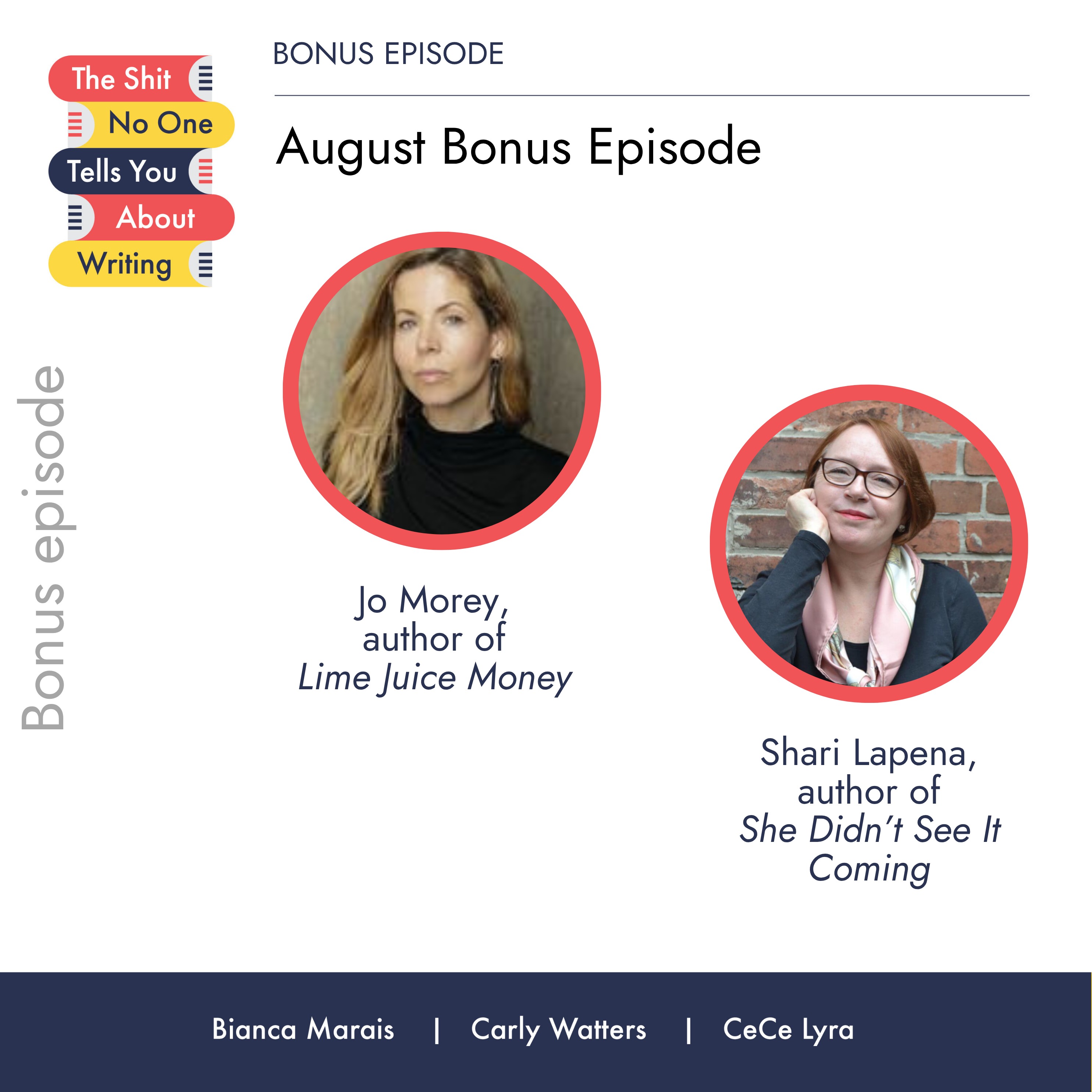
Hi there and welcome to our show the Shit no One Tells you About Writing. I'm best selling author Bianca Murray and I'm joined by Cece Lehrer of Wendy Sherman Associates and Carly Waters of P.S. literary. Hi, everyone. It's author interview Thursday. And joining us today is an author who has a BA in English Literature and French. She has lived and worked in Paris and New Zealand and now lives at the foot of the South Downs in the uk. Like her protagonist, she also suffers from a hearing impairment and Constantinitis. Lime Juice Money is her first novel. It's called that in the US but in the UK it's called the Night Lagoon. Joining us is Jo Mori. Jo, welcome to the show.
- [03:17]
Jo Mori
Thank you so much for having me. I'm delighted to be here.
- [03:20]
Bianca Murray
It's wonderful to have you here. So for those of you who are watching on our YouTube channel, I am holding up the American version, the Lime Juice Money. One really stunning art design here for the COVID And we will discuss a little bit later why the different names and the different covers. But just before we begin for our listeners, I'm going to read you the flap copy. With the sultry atmosphere and ratcheting tension of the White Lotus, the Mosquito coast, and nine perfect strangers, Lime Juice Money is an intoxicating, sensuous debut that follows a woman trapped in an increasingly volatile relationship. 5,000 miles from home in a Central American jungle. When disaster strikes, hearing impaired Leyla Wilde leaves London with her new partner, Adrian, and her young children, hoping for a fresh start in the verdant jungle of Belize. There she can be closer to her botanist father, get away from her sister, and maybe find a way to open the restaurant she's always dreamed of. While the jungle is mesmerizingly beautiful, it is also unforgiving and brutally hot. Filled with deadly creatures and sinister magic, Laila's fragmented recollections of the past are increasingly bewildering. The gunshots she hears at night through her worsening tinnitus seem to be getting closer. And she still doesn't understand why her father tried to turn her against aid when they first met. Though maybe she just misheard. Uncovering long buried secrets that threaten to derail everything, Layla must somehow find the courage and resilience she needs to survive. Or is she destined to disappear into the shadows like the orchid her father named her after? Dun Dun Dun. Right. So, Jo, I love chatting with debut authors because I love highlighting all the different journeys to publication that they are. So can you please take us through it from starting writing the book, how long that took, how many people you queried, and how we got to this point? Sure.
- [05:15]
Jo Mori
Okay. So it took about two years to write the novel, and I had quite a clear strategy to enter some competitions by way of getting a line to write in my query letter that would be hopefully, you know, having been long listed in something. So I entered competitions when I had written about half of the manuscript, you know, with the opening pages and things, sort of first pages competitions, Killer Nashville's Claymore Award and the Cheshire Novel Prize in the UK and some others as well. And I didn't expect to, but I miraculously got long listed and shortlisted in a few. And then I came runner up in the Cheshire Novel Prize and won a little literary festival in the UK as well, a prize there, and came runner up in another of their prizes. So everything sort of happened at once and I had interest from one of the judges who was an agent on one of the prizes, and they contacted me and wanted to chat. By that point, I'd finished the manuscript and I had a conversation. But, you know, finding an agent is a lot like dating and I think you've got to find the right person and that, you know, chemistry has to be there. And I got on with her, but I didn't feel like she had the same vision for the book as I did. So I used that momentum to then target agents that I had always had on my wish list. So even though I maybe wasn't ready, I didn't feel like I would have been ready for another six months or so. I would have kept polishing it and working on the manuscript. I used the momentum to go then while there was agent interest. And so I think by the end of that week, I had about six or seven full requests and three offers by the end of the weekend, which was amazing, all of whom were brilliant agents. And I went with Maddie Milburn, who is just fantastic, and I'm super excited to be. To be with her.
- [07:07]
Bianca Murray
I love so much of that. There's a lot to unpack there. So one so important to not just go with the first agent who offers, because we get so excited and it's like, oh, my God, someone's interested in me. And a lot of authors will just jump at that. And it's good to be strategic and go. It's great that they like it, but if we don't share a common vision, they're not the right person for this project. So really smart there. In terms of the contests, Jo, for our listeners who don't know how to enter these contests or what the process is, is it expensive? Do they have registration fees to enter? How does that work?
- [07:42]
Jo Mori
Yeah, so there's a real mixture. Some of them are quite low entry fees, so you can Find things that are, you know, sort of $10, 5 pounds, 10 pound to enter. There are others that are significantly more. But so I was quite strategic about which ones to enter. I kept an Excel sheet with a list of them on, with the price next to each one, the dates and so on, and the progress I was making. Short story competitions are also good to enter. They can often be a bit more cost effective as well. So I did enter some short story competitions with other work as well, just to sort of, again, just have something to write in a query letter and to stand out a bit from the crowd when that time came. The other thing I did that I think is really helpful to think about is I kept an ongoing query letter. So I had listened to all your podcasts religiously from, from day one and absolutely loved them. And I think I sort of assimilated all that information over time. And I kept an ongoing query letter that I tweaked with over the course of a year, maybe even a year and a half. And so it wasn't just, you know, dashed off in a weekend or over a course of a couple of weeks. It was really a live document that I would return to and add things in as. As they came to me. So my comps, you know, I didn't even put my comps until right at the last moment because I was changing them all the time and making sure that they were the most effective comps for what I was trying to do.
- [09:03]
Bianca Murray
Yeah, and making sure they're relevant because if you're querying over an extended period, you want to make sure that the comps are constantly relevant as well. I love that you had the spreadsheet for all of that. It's a very organized approach to querying as opposed to, I'm just going to send out as many things as I can and hope shit sticks to something. It's a much better way of doing it. So something I do want to ask is, were you personalizing the queries? Because that's something so many of our listeners go, is it important? Should I be doing it? Should I just put a line in or not?
- [09:33]
Jo Mori
Absolutely critical. So my background's in headhunting, So I spent 20 years helping people get jobs and interviewing and helping with CV writing and cover letters in the last sort of five or six years freelance. So I took that insight into querying because it's the same principle, really. In your query letter, you want to be telling the agent, you know, making it really easy for them, you know, telling them really succinctly. What you are, what your book's about, the comps, positioning it for them and just doing the work for them. So they, you know, they get hundreds of these things every week, and you want to stand out and make it clear. So I definitely took that into how I wrote the letter. And big, big part of that is making sure that it's individualized each and every time. So that means doing research, doing homework, going online and looking at that agent's other clients, you know, doing your homework about them, perhaps reading some of those books, but also thinking about where that agent has appeared, if they've been on podcasts, listen to those podcasts, if they've been at events, you know, a couple of agents, I may be caught at events in London or whatever years ago. So I would say that. And, you know, that's a way to have an in, if you like, a little. A little comment that's, you know, this is how I know you, and this is why I would love to work with you.
- [10:51]
Bianca Murray
Yeah, and that's just human nature, isn't it? If you get something that just says dear Agent, and it's a standard pitch, a person doesn't feel like they're special or that, you know, you specifically want to work with them. So I think that's just, you know, that should be common sense. But I know a lot of writers are like, I'm not going to mess around with that. And there's tons of agents who don't need it. But I do think just a line or two to is really, really helpful. So you've told us, Jo, how you landed your agent. What did it look like after then? Were there revisions? How did it look like when you went out on submission?
- [11:21]
Jo Mori
Yeah, so I signed with Maddie. I think it was August time a couple of years ago, and then she wanted to take it to the Frankfurt Book Fair. So we were quite fast at turning around the edits that she suggested. There weren't hundreds. It was quite a quick process to get it that far. And then in the event, it was preempt by HarperCollins in the US and separately by Harper Fiction in the UK. And then, you know, that's where the real work began, if you like. There was quite a bit of structural editing. My editors worked brilliantly together, so they were super sort of thoughtful about putting their heads together before they ever came to me with their notes. So it was one set of notes, one set of thoughts, and then we would get on zoom calls, the three of us, a few times, and just sort of chat about the ideas that we had. But they were really clear that whatever changes that they suggested, it was really up to me if I wanted to make them, which that was the first thing they said to me. And that was brilliant because it gave me such freedom to feel like what we were doing was just making the manuscript better, making the book better. And so I really appreciated that. There was quite a bit of structural editing in the middle part of the book where one of the character arcs wasn't sort of working as well as it could have done. And I definitely remember spending, I think it was about three or four days in a hotel in Scotland where I printed out that whole middle section and put it all over the bed, all over the floor, had Pritt Stick glue and scissors and just cut it to pieces and stuck it back together again. So I could see it, what I was changing. Because when you're doing those structural edits, you know, you change one little thing and the repercussions that it has elsewhere in the document can be huge. So it was really helpful for me to restructure it in that way so I could see what I was doing all in one place. And I'm quite physical like that. I quite like getting down and dirty with the document in real life on paper. And then it was. Yeah, just lots of copy editing and all the usual stuff, but a really enjoyable process. So I really enjoyed that. And I think just because, you know, at the end of the day, we were all working to make it as good as we could make it together as a team.
- [13:37]
Bianca Murray
Yeah, I mean, that's what the whole process is about. And for our listeners who are interested in the editing process, pulling a manuscript apart, putting it back together. You should already be following Courtney Maugham on social media. You should already be subscribed to her newsletter. But it's really fascinating at the moment to see Courtney really ripping apart her latest manuscript, which has already sold to a publisher, but she's busy turning it around for edits. And she does the same thing as you. It's like press stick. It's cutting the thing apart, putting it back together. Kind of looks like a Frankenstein document at this point, but it really works. So follow that as well, guys. So, something else I want to ask is the change in the titles and the change in the covers. So quite often we do see that in the uk, it's a different cover to what it is in the us. Not as often do we see the title changing. So can you take us through that? The intentionality about that?
- [14:32]
Jo Mori
So the original title was always lime juice money. And it comes from a little phrase in the novel that lime juice money is set in the Belizean jungle. And one of the phrases that comes up that's heard over and over again is champagne dreams with lime juice money. And lots of people who've read the novel have said to me, you know, they love the intrigue of it and the sort of uniqueness of it. My UK editor came to me fairly late in the day and said in the UK they wanted to change the title and how did I feel about that? And I was, you know, open to it. You know, that's her expertise. And she had a very clear vision for the UK and the UK market, which is, I believe, increasingly difficult, actually, especially for debuts. And she really wanted to lean into the more family saga aspects of the novel, its dual timeline. Part of it's told in the 1980s, where my main character, Leilia's father, Ellis, is a. An orchidologist, a botanist who goes out into the jungle and, you know, finds a jungle lodge. His marriage in England is falling apart and, you know, he falls in love, passionately in love with the. With the flowers and other things there. And so the jewel narrative was really important to me. And leaning into that family saga aspect was something the UK really wanted to do. You know, sort of really riffing off the Paper palace kind of feel about it. Whereas the US were really keen to go with the original title and lean much more into the sort of suspense crime element of it and pitch it more like a sort of slow burn thriller. So I'm really happy with both packages. They're just different and, you know, and that sometimes happen, and I think increasingly happens more and more for the different markets.
- [16:16]
Bianca Murray
Yeah, it's. It's really fascinating how the same book, it's the exact same book, how it can be positioned completely different in different markets, depending on what's selling in those markets, what people like. I know when it comes to aesthetics, you know, there's a certain kind of look that the UK market prefers to the American. So that's always really interesting. Another question I have for you is you said that the inspiration for this novel started as an image, and I'm always fascinated by that because often with my own writing it's the same. Can you take us through that?
- [16:47]
Jo Mori
Yeah, I'm a very visual writer and I think I see everything that's happening and I feel it that through the different characters. And this novel came to me initially as a visual of a woman sort of trapped in a jungle, and she was Lonely, but not alone. And I didn't know who she was or why she was there or what was going on. And I, all I did was wrote a page or so on a piece of paper, just sort of, you know, thinking about that and I put it to one side. And it wasn't until maybe six or seven years later when I went to, to start writing the novel and I found that piece of paper. And it was at the time I had a shed in the garden that I used to work in and it was sun dried, you know, sun yellowed and really crumply and you know, really old bit of paper now. But there was something in it that sort of had obviously captured, captured my imagination before. And I just went with that and sort of carried on exploring who she was and what she was doing there and everything sort of evolved out of that. Leilia has a hearing impairment in the novel and that very much got fed in later on. Lots of people ask me, you know, was that the initial seed of the novel? But I have a hearing impairment myself and I thought it was a great way to layer in the isolation that she feels and add in a bit more unease and tension into her experience of being in this increasingly volatile relationship. So I wanted to play on that as well.
- [18:10]
Bianca Murray
Thanks so much, Jo. Just before we move on, I have a follow up question for that, but just a quick word from our sponsors.
- [18:18]
Sponsor
Did you know that your calendar age doesn't always match how old your body truly is? I recently took the true age test from True Diagnostic to discover my biological age. And I know it's going to completely change the way I think about my health. You guys know I take my health very seriously. From training for triathlons to wanting to live a long time to raise my boys and watch them grow. Health is such an important part of my life and family. Biological age is a powerful indicator of how fast you're aging internally, which directly predicts your risk risk for serious diseases. Here's why that matters. Research shows that if your biological age is even just five years older than your actual age, you risk developing diseases like cancer or heart disease, and they can jump by as much as 30 to 50%. That's a big deal and it's completely avoidable. The good news is nearly 90% of biological aging is in your hands. Yes, it's driven by things like your lifestyle, habits, environment, which means you have a lot of control over it. I recently sent in my sample and I can't wait to see what the results are. I'll keep you posted about what my true age is and what other health indicators I found. The Truage test doesn't just give a number. It quickly shows your heart, brain and liver immune system and how they're aging. I'm looking forward to getting these results back. I can't wait to get my actionable strategies from academic scientists at Harvard, Yale and Duke to help me slow aging and reduce my risk of disease. The test itself is super easy and convenient. I did it from home. No doctor visit or big needles, just a quick painless finger prick. Send off that tiny sample in a prepaid package. In about two or three weeks you'll get a detailed online report about your aging and health fast and hassle free. If you care about protecting your health and want to find out out what your real age is, head over to truediagnostic.com and use my code TSNATYA to get 20% off your entire order or subscription. That's truediagnostic.comand use T SNOTYAW at checkout to get 20% off your future self will. Thank you.
- [20:00]
Bianca Murray
Okay, yeah, you know what, in terms of the writing, the hearing loss and the hearing impairment, it was almost like writing a completely different language, you know, because there were instances where she couldn't hear what people were saying and she was hearing bits and pieces and obviously in really loud settings, in loud restaurants or whatever, had made it that much harder for her. And so we see her kind of struggling to put two and two together and try and figure out in terms of context what people are saying. And something she hears later, I don't want to give anything away, becomes really important. And did she mishear that or did she hear it properly? So can we speak a bit about using your own experience to write those sections and pretty much almost create your own language in terms of what gets left out and what syllable she hears as opposed to which ones she doesn't hear.
- [20:52]
Jo Mori
Yeah, it was a really interesting kind of problem to solve, really. So I have a similar sort of hearing loss. I've worn hearing aids since I was 30 and I've got tinnitus. And Leilia has a similar hearing loss. She wears hearing aids and she's got the sort of excruciating, ongoing sort of screeching in her ears. Really what that means as a, as an experience of interacting with other people is that you have to work harder to decode and to understand, particularly in busy environments. But often just words get missed or syllables get missed. And so your brain is working overtime to really piece together what's going on lip reading and filling in the gaps, and I wanted to get that across on the page. So I experimented with different ways of doing that, but eventually ended up with blanking out certain words and syllables as parts of words, which, you know, I think is. People say that's quite effective on the page. It was a whole different thing when I got the conversation from the editors about the audio. Obviously, that's a different medium to experience the novel through, and they are going for a very different way of doing that. So they're putting in the original word as is, and then they're dampening down the sound around it so it's sort of muffled almost to make that work more effectively. But I think that leaning into the senses was really, really important to me from the beginning because, you know, as a suspense novel, playing with all the different senses, especially in the jungle, where you've got these amazing sounds and colors and sights, that was always going to be really important. But playing with sound and the lack of sound, I think was, you know, the main thing that I wanted to get across.
- [22:34]
Bianca Murray
Yeah, I mean, there was a part that you mentioned that sound is an important part of experiencing taste. And I was like, I did not know that. So can you tell us a bit about that?
- [22:45]
Jo Mori
Yeah. So Lay is also a chef, so she's very interested in taste. And, yeah, there's. There's research around, you know, the linking of all the senses and how they relate and that. And there are restaurants now where you can experience taste differently by sort of muffling your sound out a bit. And so that's something that she thinks about and discusses through the novel as well. Yeah, all the senses are just fascinating to me. I love. I love really leaning into that and so really tried to do that through the writing.
- [23:15]
Bianca Murray
The language is so evocative. It's really lush. I mean, I've said before in interviews for my latest book, A Most Puzzling Murder, that, you know, a book issues you an invitation. It's almost like a dress code, and you need to dress up the writing to match that dress code or the tone. This book is just really lush, really evocative. It appeals to all the senses. I'm going to get Jo to read her prologue so that you can all hear what I'm talking about. But just before we go into that, that I was very surprised, Jo, to hear, you know, looked at your bio, that you were not a botanist. I 100% thought, okay, she is a botanist. Because the way you write this is so authentic. I was like, there's no way she could write this without being a botanist. So can you take us through that? Have you. Is that a separate sort of part that you've studied, or was it just a ton of research?
- [24:06]
Jo Mori
I have to tell you something so funny. So my parents came over to my house about a week, two weeks ago, and they came into my garden to water my flowers for me. And because I kill everything, literally kill everything. And my dad said to me, oh, you need to deadhead those roses there on that bush. And I looked at him and I said, how do I do? What do I do? I don't know how to deadhead razors. And he looked at me aghast. He said, because he had a copy of my novel at that point. He had the proof. And he said, how have you managed to write a novel with a botanist in it and you don't even know how to deadhead raises? So it's all imagination. It's a lot of research. I loved immersing myself in that sort of academic botany world. So I read a lot of academic papers about orchids, particularly from the 1980s, because Ellis's timeline is set then. So I really wanted to get a handle on, well, what was going on, you know, what was being talked about in academia at that time in terms of the discovery of orchids. It was a fascinating subject. They are such an exquisite flower to learn about. You know, they're really, really strong and they're being discovered all the time. But with smugglers, they're often discovered by the smugglers before the academics who are going out trying to find them in the field. So it's just a rich and fertile area to explore. But, yeah, no, I've got absolutely no, no, no expertise at all.
- [25:33]
Bianca Murray
Fascinating. You did an amazing, amazing job. I mean, I remember years ago loving the orchid thief and being obsessed with that book, and I haven't read anything like that until now, so that was incredible. So, Jo, will you please read us your. I mean, it's not written. It doesn't say it's a prologue, but it's definitely a prologue. If you can read that for us, of course.
- [25:54]
Jo Mori (reading prologue)
Awakening the jungle thrives as it has for millennia in wild shadows, even in the basking light of day, shrouding its secrets in a tangle of leaves and roots and vines A majesty of evergreens cast their shade overseeing all like wise counsel Chicletrees and cacao trees and saber palmettos of silver and cahoon palms A frenetic trilling of birdsong pulses its backdrop Frogs Croak and bark and groak. BEES HUM A screech owl drills into the dusk.
- [26:30]
Bianca Murray
Go.
- [26:31]
Jo Mori
Go. Go. Go. Go.
- [26:33]
Jo Mori (reading prologue)
A fer de lance, camouflaged amongst leaf litter, sleeks under a log. It's an abundance of lush self protection, teeming with life upon life upon life. But everything rots faster in the heat. The body has lain here since Tuesday, a bloated invitation under unforgiving suns and a murmuring haunt of flies. From the cavities of dead trees, vultures soar, their wings spanning like black cloaks, their pupils eagerly searching. They circle on high, sailing the winds, surveying until they descend into a wake. Smaller raptors scatter, arguing with breathy grunts. Birds in bishop's clothing. They gather one by one and wait. They start with the eyes. The first slits in with its beak, inaugurating the feast. The second and third join in remorselessly ripping, cleaving into skin. Rasp like tongues, tear at tendons, rip flesh from honeycomb bones. Intestines are pulled like strawberry laces, shared sweet canapes. Grim guests keep on arriving, diving from on high, wing over wing over wing, devouring entrails of a life. The sun bleeds into the sky as the breeze slowly dies. The jungle rouses another octave, cheeping, whirring, croaking. A final cleansing. The vultures piss down their legs before one by one, they set off, ascending with their secrets back into the sky, back to the hollows of their skeleton trees. The body remains just a carcass. The bones of four fingers are curled stiff, clutching at the torn single bloom of an orchid, a bright orange cattleya, its color screaming brighter than the sun.
- [28:35]
Bianca Murray
Amazing, amazing. Just so evocative. So many senses are being appealed to in the reader. Just incredible. So one was the prologue always there. Was it something that was added later? Take us through that.
- [28:48]
Jo Mori
So I had written a similar prologue quite early on, but I didn't include it in my manuscript actually, when it was sent out. There's always this debate of about prologues. I know you love the conversation about it on the program, so I was hesitant about it, but I kept it in my back pocket. And then later on, in conversation with my editors, I showed it to them and we talked about it and they basically said they liked it and, you know, we should lean into that. And I wanted to have it there as a way of sort of, you know, giving that ambiance of the jungle from the beginning, because the next scene is contrasting quite specifically with the paradise of a Caribbean beach and a sort of relaxing holiday scene. And so I really wanted to play with that. Keeping it short, but having the intrigue there and the curiosity from the off of, you know, the body and the orchid in the jungle.
- [29:38]
Bianca Murray
Yeah, absolutely. You're immediately intrigued. Who's the body? It creates. It sets the tone, which is so important in a novel like this. The language clearly sets the tone. You use such interesting verbs, Jo. Like, throughout, I was looking at verbs that you would use that would perhaps generally be nouns that you had turned into verbs, which were incredible because it was so interesting and so different. Was this something you set out to do with intentionality, or is this just how you play with language?
- [30:08]
Jo Mori
It's quite interesting now because I'm writing Book two at the moment, which is very different and obviously got different voices. And it's, again, well, Layla's first person in this and Ellis's third person, but the first person in the book that I'm writing at the moment is very, very different kind of tone and voice. So I think it is quite distinct to Lelia and her way of thinking. You know, she's quite creative. She's a chef, you know, so it was leaning into that a lot, I think. But I do really love the line level. You know, I really love playing with language and with words, so I'm always doing that. Even if I'm, you know, on a train journey or in a car or something. I'm always sort of writing something, sentences in my brain, because I just love playing with words. So a bit of an Achilles heel, actually, sometimes in terms of writing the thing, because I will get so stuck on a line, you know, making it sound nice before actually just plowing on and getting the words down. So I'm learning to get a bit better at that with. With Book two.
- [31:03]
Bianca Murray
Yeah, well, we can see that you had a lot of fun with the language. It comes through. And what Jo said is so important in terms of. When capturing a character's voice, especially in the first first person, you really have to think about who that person is, their psychological acuity, their life experience. Are they creative? Are they not, so that you can capture all of that in the language as well? And while this book's really lush and the language is so evocative, this tone may not work with something that's very different. So, so important to play around with all of that as well. Jo, thank you so much for joining us. For our listeners, we are linking to Lime Juice money on our bookshop.org affiliate page. If you get the book there, you an independent bookstore and the podcast And Jo, at the same time. We wish you much success with this.
- [31:50]
Jo Mori
Thank you so much. Thank you for having me.
- [31:52]
Bianca Murray
Hi, everyone. I am so excited to have today's author joining us. I've wanted to have her on the show for a very, very long time, so I'm bouncing off the walls that it's happened. She is the internationally best selling author of eight thrillers, including the Couple Next Door, which have all been New York Times, Sunday Times and Globe and Mail bestsellers. Her books have been sold in 40 territories around the world. She lives on a farm outside Toronto. She Didn't See It Coming is her ninth thriller. And yeah, you must see this cover. So sparkly. The Indigo exclusive. It's my pleasure to welcome Sherry Lapina. Sherry, welcome to the show.
- [32:31]
Sherry Lapina
Thank you. I'm excited to be here.
- [32:33]
Bianca Murray
I'm so excited to finally have have you here. And for our listeners, Sherry and I met at Montreal Mystery a few months ago. Was so awesome to connect with her and to see her a few times since and to lure her onto the show. So before we discuss the book, Sherry, I'm just going to read the flap copy so our listeners know what we're talking about. So when a beloved wife and mother disappears, a luxurious condo building transforms into a potential crime scene. Can the detectives find her before it's too late? Bryden and Sam have it all. Thriving careers, a smart apartment in a luxury condominium, supportive friends and a cherished daughter. The perfect life for the perfect couple. Then Sam receives a call at his office. Bryden, working from home that day, has failed to pick up their daughter from daycare. Arriving home with their little girl, he finds his wife's car in the underground garage upstairs in their apartment. Her laptop is open on the table, her cell phone nearby, her keys in their usual place in the hall. But Bryden is nowhere to be seen. It's as if she just walked out. How can she have disappeared from her own home? And did she even leave the building at all? With every minute that passes, and as questions swirl around their community, Bryden and Sam's past seems a little less perfect. Their condominium left safe, their friends, neighbors and relatives no longer quite so reliable. Okay, so before we dive into the book, Sherry, I want to ask because as someone who's pivoted quite a bit between genres, I'm interested in authors who've managed to do the same, but who achieved massive success with one of those pivots, which I've never quite managed. So you wrote two literary comedies before the couple Next door. What made you switch genres? Can we discuss that a little bit?
- [34:25]
Sherry Lapina
Yeah. So I started off writing literary comedies because I didn't know what I wanted to write. And I thought that if I didn't have any idea of what my plot was going to be, I would just start with the character. So I just sat down one day and I started with this character, Harold. And I just went along every day seeing what happened to him. And by the end of the year, I had a novel with a plot. And that's how I started writing. I started writing just as an experiment to see if I could do it. So I have always liked thrillers and crime novels, but I always thought they had really elaborate plots, which they do, but I thought you had to plan them out, and I didn't think I was capable of that. And I know I still am not capable of that. So I didn't try to write a thriller for many, many years. And then one day I just thought, you know, that's what I'd like to write. So I thought I'd just try it. And I started with just an idea and no plan, and I wrote it that way. And it turned out that I could, in fact, write a thriller without any plan. So I think it was what started me off was just experimentation to see what my voice was. And I do have a pretty good comedic voice, but it's not what I really wanted to do. So the switch was easy for me in a way, because I think the suspense is more my natural bent.
- [35:42]
Bianca Murray
Yeah. So just discussing that, because something I'm hearing more and more is I'm hearing from authors who wrote a first novel that sort of did not do very well or did well in one particular market. And then they wrote another novel, and the publisher was considering giving them a lot of money for it until they established that they weren't a debut author. And then suddenly it's like, no, we're not offering you anything at all because your track record isn't good.
- [36:11]
Sherry Lapina
Oh, I know.
- [36:13]
Bianca Murray
It's terrible. Because it should be on the merit of the book. Right.
- [36:16]
Sherry Lapina
It's so hard now. Yeah, yeah.
- [36:18]
Bianca Murray
Even if your fourth book is amazing, it should be okay. We're selling on the fourth book. So was it a case that the first two did well enough that it was fine, or do you think it was that you changed genres completely that, you know, stood you in good stead there? Because I know you've said in interviews that nobody was expecting that book to do as well as it did and that people were just so interested. There was so much about does.
- [36:44]
Sherry Lapina
Yeah. So I think what happened was when I wrote my literary comedies, they were the Canadian small press. No one really noticed them. They sold a couple thousand copies each, which is pretty standard for a small press literary book. I think it was the change in genres and the change in focus. So with thrillers, you're looking for an international audience. And my agent didn't even bother with the Canadian publisher. She just went right to New York and sold it there as a New York type thriller, like as a global type of book. So for me, it was definitely the change in genres that made the difference. You know, I think it's a shame what's happening with writers where everything's based on your track record. And it's what I was told recently. I was just in London, you know, went to Harrogate a week ago, and the buzz around there is the debuts are struggling now. People are less interested in debuts than they used to be. So maybe that will help writers who have had one book out that didn't do that well, because, you know, publishers used to stick with writers and help them build a career and that doesn't seem to work anymore. They want big, fancy debut that sells a lot of copies. So my advice to writers is don't get too big in advance because if you don't earn it out, you're a pariah afterwards. So I don't know, it's tough right now for sure, and I don't know what my advice would be.
- [38:04]
Bianca Murray
I agree with that in terms of the advance, and I've said that to a whole bunch of writers and they look at me like I'm a little bit, you know, cray cray. Because they. They're going, no, but the more money they give you, the more money they're going to spend on marketing. But I don't see that happening necessarily.
- [38:19]
Sherry Lapina
I mean, it's true that if they put a lot of money into the book, they will spend more on marketing, but if the book bombs, then they'll just. They'll print your second one because you're usually under contract or two, but they're not going to want to keep you after that. And that's the risk of taking a big advance. There's nothing worse, I think, than having a big advance and having the book flop and then where do you go from there? The only way around it really is to switch genres or come up with a different name and then you can sort of pretend to be a debut under another name. Now, I never claimed to Be a debut author. When I did mine, it was certainly my first thriller. But. But I don't think they promoted me as a debut. I can't remember, to be honest. But I was debut thriller writer. So I think you just write the genre that you most love. And if you want to do a switch from. A lot of people will change their names. I've seen it quite a bit. Yeah.
- [39:09]
Bianca Murray
Yeah. And some of them will hide their identities as well.
- [39:13]
Sherry Lapina
Yeah. And it's a shame to have to do that just because you're trying to hide your backlist that it didn't sell that well. It's.
- [39:21]
Bianca Murray
Yeah. It's not like you have some nefarious past, you know, you're just trying to hide your. Your backlist. But I mean, even books that did do well, because I think of. I think it was about two years ago that Terry McMillan tweeted that she had finally got her first royalty check after selling How Stella Got Her Groove Back. And I mean, that book changed so many conversations. It was made into a film. I considered that book wildly, you know, successful, but it took her something like 20 years to earn the first royalty payment on that, even with a book that was so, you know, well known. Just because her advance was so enormous.
- [40:01]
Sherry Lapina
Yeah. Well, lucky for her, though, it sold and sold and sold. Because if it didn't, then she'd be doing something else now.
- [40:08]
Bianca Murray
Yeah, no, absolutely. Did you get a new agent when you switched genres or did you not have an agent with the indie product press? Like, I'm trying to understand that.
- [40:17]
Sherry Lapina
Yeah. So I did have an agent for my comedies, and when I decided to do thrillers, I went somewhere else to someone who just did thrillers or specialized in thrillers. Because you can't have a literary agent who doesn't know thrillers trying to sell the thriller. Right. You have to go to the agent who's right for the kind of work you're doing, just like you have to go to the publisher who's the kind of book you're doing.
- [40:40]
Bianca Murray
And sometimes you need to be cutthroat, you know, because I feel like I'm a very loyal person, which sometimes, you know, will stand in the way of, like, career aspirations. It's a case of, okay, I need to end it with this agent, and that's going to be hard because I feel very loyal to them, etc. But, you know, you've. You've got to think of your career first.
- [41:00]
Sherry Lapina
Yeah. Think of it as a business, and everyone should understand that you need to do what you need to do for your business. You just be polite about it.
- [41:08]
Bianca Murray
Yeah, always polite. Because you never know who you're going to have to work with next, right?
- [41:12]
Sherry Lapina
Yeah.
- [41:12]
Bianca Murray
It's a small, small industry. So, Sheri, you're a pantser like me, which I absolutely love. And it can mean a lot of slog during edits to bring it all together. But I really want to focus on all the pros and upsides of pantsing. Like, what are the things about pantsing that enhance your work that would never happen if you were a plotter?
- [41:37]
Sherry Lapina
For me, a. I can't plan. I just don't have any ideas unless I'm actually working inside the characters to move the story along. But I think for me, I love the first draft because it's like, you know, writing a story is just like reading a story. I want to know what's going to happen next. So I'm actually looking forward to writing it every day because I want to see where it goes. And it's fun and it's fresh and to me, it feels really playful. So if I knew what was going to happen, then I don't think I would, you know, approach it with the same sort of glee and energy. And I don't think I. I don't think I personally would get the same result, which to me, I like to be surprised by my work. I'm sure you're the same if you're a pantser, you love to see it take off in different directions. You love to get to know people, you're surprised by twists that arise, and so on. For me, that's the fun and excitement of it. I. I write to explore, so I don't want to know what the end is. So for me, it's the fun of it. That's the fun of it, the energy and the excitement.
- [42:39]
Bianca Murray
But I also think there's something. When you come up with a plot and you use your characters as puppets to go through the obstacle course of the plot, I think you can lose a lot of authenticity in terms of the character actually driving something. Whereas if you create these characters and you just follow them them, and you're just wanting to see where they go, it allows for these characters to drive a plot very authentically through the stupid decisions they make. Because, let's be honest, as writers, we create characters and then we throw rocks.
- [43:12]
Sherry Lapina
At them, we torture them. Right, I. I agree. I wouldn't want to say that to a plotter because I don't want to offend anyone. But, yeah, I think if you. If you know, where it's going. It can feel wooden or feel forced, especially twists that have to feel completely natural and organic to the plot, which, you know, if you're not planning, they are completely natural and organic to the plot, and I think that's so important. So I. Yeah, I'm a huge fan of pantsing, but I have nothing to say against plotters because if they do it well and they write well enough, everything feels just as alive and, you know, unexpected as it should be. Right.
- [43:48]
Bianca Murray
I think a lot of pantsers feel insecure because they get told so often that they do need to play plot.
- [43:53]
Sherry Lapina
Well. I'm here to tell them they don't have to because there's lots of people like you and me and Lisa, Jewel and other people who do not plot, and our books turn out just fine. Plus, I think we have more fun.
- [44:04]
Bianca Murray
Yeah, I think. I think so, too. We do have to reverse a lot of times because we drive down dead ends, I think. But, you know, there's fun in accelerating while you're reversing and figuring out where the heck that's going to go, so long as you don't hit a wall or a bad reverser like I am. But, yeah, I feel like your process is your process and you need to lean into it and whatever the pros of that are, do that, you know, I agree. So you're also the queen of domino's tipping, which is so propulsive in your work. It's so important to have one thing leading to the next thing. To the next thing. Because we say on the podcast, you don't want satellite plot points. You don't want. This is just kind of happening over here and this is happening over here. But it doesn't affect the PL plot in any way. It needs to be that this happens. The character makes a bad decision, that leads to repercussions, that leads to them becoming desperate, etc. So how do you keep the dominoes tipping from one scene to the next? If you aren't a plotter, do you sit down as you begin each scene and go, okay, I need to up the tension here? I need to create a red herring? Or is it just so intuitive at this point that you're able to go, okay, I know what the scene needs in terms of documentation.
- [45:22]
Sherry Lapina
Yeah, I actually don't think in terms of, you know, do I need a red herring here? Do I need a twist here at all? I just tell the story as it comes to me, and the red herrings arise organically, just like the twists do. I will sometimes think, oh, is this slow? Is it getting slow? Is it flagging a bit? And my answer to that is always changing point of view. If I'm in a point of view, this is why I love local point of view so much. So I usually have several different points of view. So if something is slow, then I, I just like, you know what, I'm going to take this from another person's point of view and get more energy in it because someone might be, it just may not be exciting from their point of view. And I think, oh, I think this person is going to really have fun with this little bit of information. So I go into that point of view. So yeah, if it's getting slow, I will do something to change it up. But I don't, I don't actually plan red herrings and things like that, but I find shifting multiple point of view every four pages brilliant for pacing. That is, I think, my secret. Like, because if you're in one point of view and nothing. Not to take anything away from people who do whole books in a single point of view, but that's a long time to be in one head. It's so fun for me. And I get to manipulate so much when I take it from different points of view because different people know different things and they're all affected by different ways. And I, I love that. Like, I love to offer attention by getting in other people's heads. So that's my pacing secret. I think my most important basic secret. Yeah.
- [46:48]
Bianca Murray
And we'll discuss that more shortly because there's something as well that you do that very few people can get away with that I do want us to unpack even more. But in terms of, you know, when you change those POVs, the nice thing is one character can do something that can complicate the life life of another character. They can say something to the police accidentally. Right. Which then makes the other character's life difficult. And so you're seeing that in real time as you're going backwards and forwards as well, which means stakes keep getting upped, the tension keeps getting upped and it creates obstacles. Because I think, especially for act two, you know, I, I feel like writers are made in Act 2. People say they made at beginnings and endings, but for me, that, that, you know, muddling middle is really difficult and that's where you have to keep up in the stakes. New things need to be revealed, characters need to complicate each other's lives, etc. So changing the POV all the time really helps with that, it does.
- [47:48]
Sherry Lapina
And I have to say, I've never had problems with difficult middles, ever. I find with my books, the tension, it starts, you know, fairly high when something happens, and then the tension gets higher and higher and higher and higher. And I. I've never found my middle slow. I find as the book goes on, everything is building. So I don't know if that's because I don't plan or whether, you know, it's because the function of changing points of view and complicating things more and more for every single person. I don't have a problem with middles. If I have trouble with anything, it's with the end. Because when I get to the end, it's like, oh, so I've got all these suspects, and they could all equally have done it, and they all have reasons to do it. And I have to decide which is the most, most satisfying one, like, who really did it. That's. Yeah, but the middles never give me any grief.
- [48:35]
Bianca Murray
I love that as well. In terms of the ending and going, okay, who the heck did it? Why did they do it? How can I complicate this even more? Do you then go back? Because I've said in interviews that I reverse engineer. I don't plot, but I get to the end, and then I figure out who did it. And then I've got to go back and plant some curiosity seeds or some clues along the way so that it doesn't feel like it came out of nowhere. And yours always feel like they're building very organically to this natural ending. Even though the ending's a wonderful surprise. I never feel like, what the hell, Sherry? Where the hell did that come from? So how do you make it feel like it's been building to that?
- [49:14]
Sherry Lapina
Well, because I do it organically as I go on, so I actually don't have to go back and plant clues. Because as I'm doing it, I'm assuming all the way through, oh, I think this person might have done it. So I'm building it as if that person did it. The whole book, I want you to think, oh, it could be this person. No, no, it's that person. So I don't have to. I'm putting clues in all along that they might have done it. So I never have to go back and add those clues. What I go back, usually to do is to tighten and strengthen and, you know, build in description and, you know, tighten the motivations and the characters and that sort of thing. But the story. The story doesn't really Change for me.
- [49:55]
Bianca Murray
Well, with this book, which I found very interesting, is you start with the dramatist Persona, which outlines all the characters and kind of like how they fit together. This one is this one's husband, this is this one's wife or whatever. But when you do that, you have to be so careful to not give too much away. So I'm always saying we need to be so intentional with every decision we make for a novel. So when it comes to being being intentional with this, what made you include that and how did it come right at the end? Did it come at the beginning as you were, like, getting to grips with the characters? Tell us more about that.
- [50:29]
Sherry Lapina
So the Dramatis Personae is something that's only available to the Indigo exclusive edition. So that's a special feature just for that edition. So it is a really fun feature. Usually in special editions, you'll get a Q and A or whatever. And I can't remember who suggested doing the Dramatis personality, but it's a really fun one to do because you can't give anything away. You can say so and so is worried about whatever and appalled at such and such. But it's fun because it's like a teaser for every character. And it's nice to have that because you can look back and go, oh. So I really enjoyed that. I think it should be in every book, but I'll keep it for the Indigo special.
- [51:06]
Bianca Murray
But it also helped because there's a big cost. You know, we've got quite a few people. So I know at one point I got there and I was like, hold on, who's this person again? And I went back and. And I was like, oh, okay, this is so. And so. So it does help you keep track of all of that, but it was like a little teaser. It's like an amuse bouche, and then you can go on from there. And I'm kind of sad that it's not in every book, but I guess for the Indigo exclusive, you have to give exclusive content. So let's come back to writing multiple POVs within the same chapter as you give us a 360 as we move through the action of a chapter, because so often in these kinds of books, we have one POV character to each chapter. And like you say, you can give us a page and a half, and then, boom, we're in someone else's perspective. And something else you do so brilliantly is that you give us a very limited third person because every one of your characters has got something to hide. And so you can't get us too close to them. Because if you get us too close to them, we're going to know all their secrets. Secrets. And you don't want us to know all these secrets, but you want to hint at their secrets. And just before we had this interview, we actually did a books with hooks on the podcast in which Carly and Cece, who are agents, are critiquing query letters and opening pages. And we had a submission in which there was a prologue in which the author was very clearly trying to hide so much of that character, their identity, their interiority, their emotionality, that we were so distant from the character that it just. We weren't connecting in any way. And the agent Cece, said, in order to connect with the character, you need access to their psyche. Now, what you do so brilliantly is you give us a bit of access to the psyche, but not so much that we know what their secrets are, et cetera. So what is your advice to writers who are trying to do something similar that will make us still connect with the character but not give so much away that we can figure out early on who did it and why they did it, etc.
- [53:05]
Sherry Lapina
Well, I think. I think I actually have quite a hot point of view. Like, I get quite into the emotions of the character, but I am not revealing everything. So that is a tricky thing to do. It's a balancing act, you know. But there are ways to mislead the reader. One thing I do all the time, and I don't know if people pick up on it, is when you're in someone's point of view and you're feeling their emotions and so on. And if they say something in dialogue, the reader will think it's true, but it may not be. That's what they say in dialogue. It's what's in their head. That's true. And they may not be thinking everything. So you can hide a lot of things and mislead people quite easily by changing these points of view. And to answer your question about how you get deep enough in without giving it all away, I don't even know how to answer that. It's like it's a balancing act. You have to get enough into their heads to know what they're feeling. Feelings are, but you can't convey all their thoughts. So I guess that's what it is. You have their feelings, but you don't give all of their thoughts. And you can give misleading thoughts and dialogue.
- [54:09]
Bianca Murray
Right? So you do give their thoughts and. And you give feelings, but the feelings are kind of messy because I feel like you can feel guilty about something but also justify your shitty behavior. Right? You can be like, oh, I did this. But you know what? It's fine because. Because actually the ends justify the means. And so you can mask the guilt with this kind of indignation or whatever. And the same goes for thoughts because, you know, you can focus on some of their thoughts, but not the more guilty thoughts. They can be thinking one thing, but not necessarily focusing on the hot topic. And something else that you do so well is that you have your characters observing each other. And so we get misled by one character's sort of perception of another character. We'll see one character crying their eyes out, they are so upset. And we're like, oh, that poor woman. That poor woman. She's clearly not the person, but it's viewed through another character. So can you speak a bit about that as well? Because I think we mislead the reader a lot with that as well.
- [55:13]
Sherry Lapina
We do. We often do. The whole thing about truth is it's based on your perspective. So everyone sees in any given scene, people will view it in different ways and see it differently and interpret it differently. And my characters do that all the time. So the poor reader is left with many different views of what's happened. And they're all true to the person watching, but it's not the objective truth. So this is what's so great about being in different people's heads all the time. If you're. I think it would be difficult to write a book where you're in one person's head all the time. You have to sustain that without giving anything away. But if you're moving in different people's heads with all those different perceptions, it gets so engrossing. And you're not sure if what's right, what's true, because you're getting a lot of different angles on it.
- [56:04]
Bianca Murray
I don't even think there is such a thing as objective truth, quite honestly, because in terms of. Of the psychology of the characters, every person has got their own biases. You know, you might decide that someone who's really well dressed is someone who's shallow and not very smart. And so you don't give a lot of credence to what they say, but you'll give more credence to somebody who's more intellectual, for example. Or you could be someone who's misogynistic. And so you look at a woman and you're like, well, she's not that smart. Or, you know, Women are manipulated, speculative. And so when we get into each character's psychology and how they perceive other people, that's where it gets so, so interesting.
- [56:46]
Sherry Lapina
It's all about psychology, all of it. I mean, the psychology of the characters, and it's so fun to do. That's. I think that's why I like writing crime fiction. You know, I just really enjoy that everybody's different, and they all have their little quirks and their things that they're trying to hide, and. And the characters are what really make the book so interesting, I think, for anyone.
- [57:09]
Bianca Murray
Yeah. And this is what domestic suspense or domestic thrillers are so interesting because, you know, as human beings, we can live next door to somebody or we can see people in our family, and all we ever have is, you know, what we can see from the outside unless that person confides in us or unless we witness something. So, I mean, I've said before the one thing that really made me realize how much people. I don't want to say lie, but how they misrepresent reality is I had a friend once who, on Facebook, it was always, my darling, my love, you know, in terms of their spouse, how much they loved them, how amazing they were, et cetera. And my husband and I were invited to dinner one night, and I'm always early. Shari, don't invite me anywhere unless you expect me to be there 10 minutes early. And I was early. And we heard them having the most vicious fight in which they said the most hideous things to each other. And we stood outside, and I was like. And then 10 minutes later, I knocked, and they opened the door, and they had their arms around each other, and they were, like, welcome. And the whole night it was, my darling, my love. And so, you know, that is the thing with. With, like, domestic suspense, because you don't know what's happening behind closed doors.
- [58:22]
Sherry Lapina
Have you used that in a book?
- [58:25]
Bianca Murray
No, I haven't clarified. They're gonna read it.
- [58:28]
Sherry Lapina
Oh, okay. But that's a great device to use.
- [58:33]
Bianca Murray
Well, and I think this is why I don't trust people who, on social media, always, like, this is the love of my life. This is how much I love this person. I'm like, what are you hiding? You know what? Covering up here with all of this.
- [58:45]
Sherry Lapina
Then you find out they're getting divorced the next week. You go, oh, I know. That was true.
- [58:49]
Bianca Murray
Yeah, yeah, yeah, yeah. But I mean, this is as the genre, because you really get to scratch below the surface. And I feel like it's like an excavation as you write you look at this perfect couple, and then suddenly there's a slight excavation of one layer. And then we're like. And then you excavate again. And then we're like. Until we get to the point, we're like, oh, my God. Nothing is as it seems.
- [59:11]
Sherry Lapina
No, that's what I enjoy about it, too.
- [59:14]
Bianca Murray
Okay, before we go, I think our time is almost up. Can you speak about prologue? So on the podcast, we're often saying, try and stay away from prologues because so many emerging writers use them as a band aid to fix a shitty first chapter. You use your, your prologue so incredibly well, and it goes back three weeks. Right. So give us an example of when that works so well going back in time as opposed to a flash forward prologue.
- [59:40]
Sherry Lapina
Yeah, I use prologues fairly often. I don't think. I always use them them and I don't. I think it has to do with, you know, the publishers, the editors, they want a book to start with a bang. And sometimes if you have a slow burn before the body's going to be discovered, you need to have something at the beginning showing there's going to be a body that will be discovered. So that's. That's really why I do it is sometimes if it's going to be too long and people aren't going to be invested enough, then I, I'll put a prologue in. In to sort of set things up so that you want to read to see what. How you got to throw on.
- [60:17]
Bianca Murray
Yeah. And you don't want to just start with a dead body because then no one cares about the dead body. They have to know the person to care that they did and to care that somebody's going to figure out what happened to them.
- [60:25]
Sherry Lapina
Yeah. I mean, as long as you still have to have a really good first chapter. I'm trying to think. I mean, I certainly. She didn't see it coming as a prologue, be sure. And I think there's a. I guess I do prologues quite often and I think it's because I will often want to show what leads up to something. So I need to have that little hook for the people getting. Yes, there will be the payoff of the dead body. Yeah.
- [60:48]
Bianca Murray
Amazing. Sheri, thank you so much for taking the time to chat with us. It's been as amazing as I knew it would be for our listeners. We linking to. She didn't see it coming on our bookshop.org affiliate page. If you get it there, you support an independent bookstore and the podcast and Sherry at the same time. Time. Thank you, Sherry.
- [61:06]
Sherry Lapina
Thanks, Bianca. That was fun. And I'll see you soon.
- [61:10]
Bianca Murray
And that's it for today's episode. I hope you'll join us for next week's show. In the meantime, keep at it. Remember, it just takes one.
- [61:18]
Jo Mori
Yes.
- [61:23]
Bianca Murray
Beta Reader Matchup Time Is happening Again. It's been so gratifying over the summer to be tagged in so many posts. Posts about beta readers who've become writing besties and who are still going strong many years after they were first matched. Some even travel to meet up and do writing weekends together. Which sounds incredible. I can't guarantee any of that. That's entirely up to you. But what I can guarantee is that you'll be matched with a group of people working in your genre and or time zone who will critique critique 3000 words of your work as you critique theirs. In return, you can sign up from now until the 31st of August with the matchup emails going out on the 1st of September. Head to my website Biancamarae.com and look for the Beta Reader Matchup tab.
- [62:14]
Cece Lehrer
What's up everyone? This is Cece. If you're a writer, then chances are you've wondered if your story is good enough. Maybe you're wondering that right now. Now I get it. Here's what I can tell you. As long as your story is making the reader curious, you're good. Now, I'm not saying you won't have to make edits when working with an agent or publisher. Edits are part of the game. But I am saying that you will get ahead in your career if you know how to make the reader curious. The best way to do that Infuse your story with plenty of tension, conflict and stakes. Which is why I'm so excited to invite you you to join my four day course Writing Tension Creating Tension, Conflict and Stakes in youn Story. It starts on October 13th. My favorite part about this class is that there are formulas. Yes, formulas for tension, for conflict, for stakes. And for the first time ever, we're having two optional interactive components including a query letter studio and live critiques of select first pages. I'm super excited about this new format because I've seen it yield results in writers works and it works for writers of any genre as long as you're serious about improving your work. So if you're ready to take your writing to the next level, join me for this four day course. Don't worry if you can't attend live, the sessions will be recorded. For more information, check out my bio on Instagram or the podcast's website. I'm looking forward to seeing you there.