← The Shit No One Tells You About Writing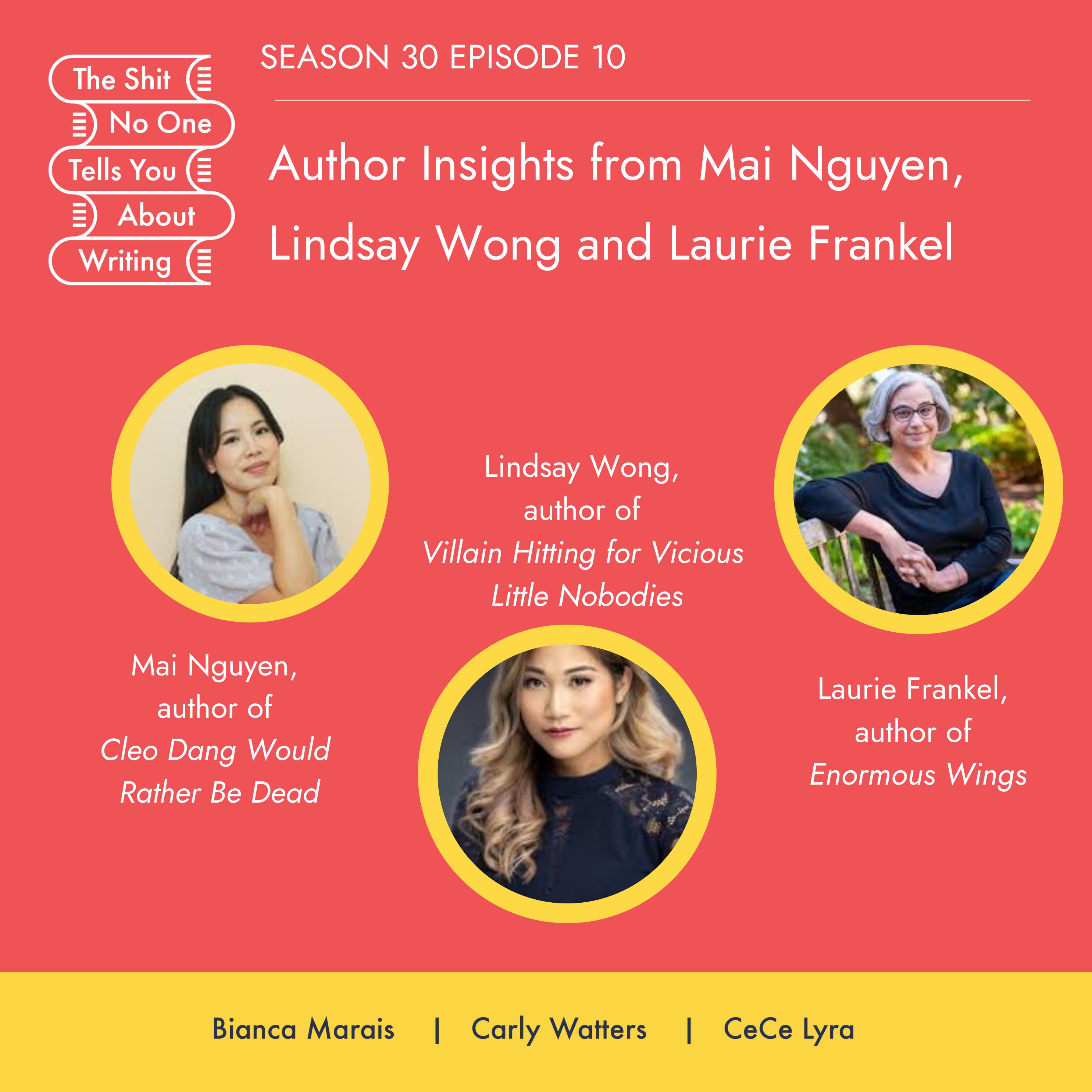
The Shit No One Tells You About Writing
Author Insights from Mai Nguyen, Lindsay Wong and Laurie Frankel
01:39:16
Author Interviews
Loading summary
Transcript142 lines
- [00:01]
Bianca Marae
Have you been sitting on the fence about signing up for the Beta Reader matchup? Or have you signed up before but haven't yet found your writing soulmates? The next matchup is the last one for the summer, so don't snooze on it. Get matched up with those writing in a similar genre and or time zone so they can critique your work as you critique theirs. Your manuscript doesn't have to be complete to sign up for this 3,000 word evaluation. This particular matchup will be open to registrations from now until the 1st of June, with the matchup emails going out on the 2nd of June. For more information and to register, go to Biancamarae.com and go to the Beta Reader Matchup page.
- [00:45]
Cece Lera
What's up everyone? This is cece. So I recently grabbed lunch with an acquiring editor from HarperCollins who told me that the number of submissions she's been getting has nearly doubled. And I wasn't surprised at all because every agent and editor I know has been talking about how the volume of submission keeps increasing. So, personally, that is a wonderful thing because it's more reading for me, but it also means I have more chances of matching with authors. I consider it a privilege to review queries on books with hooks and of course, in my submissions inbox. But at the same time I talk to writers who tell me that they wish agents would read more than a few pages because, and I quote, my story gets better in chapter two. I have to be honest, this kills me. It's like me wanting chocolate chip cookies to have the nutritional value of kale. It's just not realistic. Like it or not, no agent, no acquiring editor is going to stick around to see if a submission gets better. It's not because we're mean, it's because we get dozens and dozens every day. I know it's harsh, but ambitious writers embrace harsh realities. So here it goes. It's your job to make your opening pages irresistible, to make agents crave it, to make agents want to read more. That's why I'm so excited about my upcoming course. Starting it how to begin your story in the best place and in the best way. I created this course after studying hundreds of books. I've mapped out elements that are present in the beginning of all all successful novels and memoirs. And I've designed checklists, actual checklists that you can use to ensure that your story's beginning is seducing your reader. We'll cover how to write a great first line, different types of beginnings, and how you can choose the best one, the best place to start and the best way to start. Yes, these are totally different things. When it makes sense to add a prologue and when it doesn't. How to frame your inciting incident in an appealing way, how to balance exposition and mystery, how to include context but not weigh it down with too much backstory. And what to do if your story has more than one POV or timeline. Most of all, I'm going to show you how to make readers want to turn to Chapter two. Join me for this multi day course designed to help you break through the noise. You'll leave with a clear, actionable breakdown of exactly what goes into a terrific beginning. If you've already signed up, come prepared to take lots of notes. We're talking hundreds of slides with real world examples and specific techniques. Plus a super fun surprise that I can't wait to share. I hope to see you there.
- [03:46]
Bianca Marae
Hi there and welcome to our show the Shit no One Tells you About Writing. I'm best selling author Bianca and I'm joined by Cece Lera of Wendy Sherman Associates and Carly Waters of P.S. literary.
- [04:02]
Carly Waters
Hello everybody. You have Carly here today. I know Bianca normally does our author interviews, but I get to do them every once in a while, especially with the lovely authors that I work with. So I'm very thrilled to be chatting with one of my authors today. I have Mai Nguyen here with me today. Mai is a Vietnamese Canadian author whose debut novel Sunshine Nails was long listed for Canada Reads, was named one of the best books of 2023 by NPR CBC. Her journalism has appeared in Wired, the Washington Post, and the Toronto Star. She was raised in Halifax. She now lives in Toronto with her husband, her daughter and her French bulldog. And we are here today to talk about her new novel, Cleo Dang Would Rather Be Dead. And so I'm so glad to have you. I'm going to do a quick kind of blurb about what the book is about itself and then I'm going to ask you to tell us a little bit about the origin story of the book. And I have questions for you and I'm excited for you to be on this journey. So welcome to the show. Mai.
- [04:55]
Mai Nguyen
I'm so happy to be on Carly. I have to say this book would not have existed without you. It wouldn't have been a book. So I'm so happy we get to chat and talk about how this book came to be.
- [05:06]
Carly Waters
Absolutely. Okay, so let's tell everybody Cleo Dang Would Rather Be Dead. So the logline for the book is a Darkly humorous yet uplifting novel about a grieving mother who starts working at a funeral home and discovers that the best way to honor the dead is to live. All Cleo Dang has ever wanted to be was a mother. The day she discovers she's pregnant is the happiest of her life, especially when she learns that her best friend Paloma is also expecting. It's a wonderful surprise and together they enjoy their pregnancies. But when they both go into the hospital in labor, something goes very, very wrong. Paloma comes home with a baby. Cleo does not. Now a grieving Cleo must navigate life. After losing her baby, she alienates herself from the world, especially her best friend, who is living the life she so desperately wanted to. Forced to quit her demanding job as an actuary, Cleo manages to find a job at a funeral home where she meets a revolving door of bereaved locals and discovers the power of confronting grief. And before we dive into a bit more about the book, I want everybody to know I'm going to just put my agent mom like ragging hat on. We have multiple starred reviews for this book, so Kirkus, who is notoriously tough reviewer Kirkus said Nguyen is brilliant in her depiction of the agony of grief as well as its absurdity and surprising capacity for tender connection. An astonishing portrait of grief and ode to the beauty that manages to live in its mist. And Booklist, another starred review from Booklist said Nguyen, who wrote Sunshine Nails 2023, writes with raw, unflinching honesty about the agony of losing a child. Balancing pathos with dark humor, Cleo's messy, non linear yet ultimately hopeful story of rebuilding proves that while some wounds may never heal, they can be transformed into something unexpectedly profound. So I think the book is great. We have multiple reviewers saying the book is great. I hope that you feel really excited about the book coming out into the but it, you know, it's been a journey to get here and you know this is one of the first interviews that you're recording, kind of talking about the book and the origin story. So for everybody listening it might be an emotional ride today. But we're so glad that you're here to be here with us. So I'm going to turn it over to you Mai, to tell us as much or as little as you want about the origin stories of this one.
- [07:08]
Mai Nguyen
Yeah, it is so weird to be on the other side of the writing journey and have this book go into people's hands now because for so long this book lived inside my head and my heart and then Eventually I opened it up to you. You were the first person to read my book. Like, my husband never even read the book. Friends, family, never even read the book. I just. It was so personally emotional for me to write that. I really wanted to keep the initial audience really small. And so, yeah, Cleo Dang. It was actually, I have to say, the idea for it came during the promotion period of Sunshine Ale as my first book. I actually had a whole other second book in mind that was very similar to Sunshine Nails. I had this whole family drama, multiple narrative story that I wanted to write for my second novel. But then, unfortunately, in 2022, I had lost my daughter through labor complications. The pregnancy had been going very well. I had gotten to my due date. I was actually five days past my due date. And then everything just sort of went downhill during delivery. It was something that none of the midwives or doctors had ever expected, certainly not anything that I or my husband knew could happen. But essentially what happened was I had given birth to my daughter and then they realized something was very wrong. Next thing I knew, I was at Sick Kids Hospital at the nicu and my daughter was strapped with all of this cords and wires. And they essentially said that she had suffered a severe brain injury during delivery and that she had been constricted of oxygen during delivery. And it was nothing any of the baby books ever warned me could happen, certainly nothing that my healthcare team warned me could happen because everything had been tracking so smoothly. I remember one doctor said my pregnancy was unremarkable, which is like the medical term they use to let you know everything is normal, everything is perfect, you don't have nothing to worry about. And so I was just so blindsided by her death and that loss because it's such a happy time in a person's life is giving birth, bringing home the baby. And I never got to bring home my baby. So it was just a really sad and dark time for me in what otherwise should have been a very happy time. And I knew I could not go on with that second book that I had in mind. I just, all of me needed to write a book about what I was going through. And so I poured it into a fictional novel about a woman named Cleo Dang, who basically just served as like a vessel for all the grief and agony and pain that I was going through. And I hadn't really read very many books. I mean, there's tons of novels with grieving characters, but I hadn't read one that covered a grieving mother who was newly grieving the loss of an infant, especially in the acute phases of grief, I find a lot of media portrayals of grief. The grief is sort of pushed to the background while, you know, the a plot serves as the main story driver, or either the timeline gets fast forwarded one year, two years ahead, when the character is much happier and chippier and up and about. But I hadn't really found any books where the. Where we stay with a character in the acute phases of grief. You know, the day after the death, the day of the funeral, the day after the funeral. Like, I really wanted to write a story about the kind of drudgery of grief. I mean, there's probably a reason why there's not a lot of media portrayals about the acute phases of grief. Because it is very slow and sad and not much happens. There's a lot of bedrotting. And I remember when we were talking about this book, when we were working on the first edits, there was almost too much bedrotting and not enough forward momentum. And I remember we had conversations like, okay, we need to move the story forward. There's only so much she can stay in bed for without us losing the readers. And I was like, I get it, I get it.
- [11:10]
Bianca Marae
Yeah.
- [11:10]
Mai Nguyen
After all, we are writing a story for people's entertainment and enjoyment.
- [11:16]
Carly Waters
Yeah.
- [11:16]
Mai Nguyen
It was. It was definitely a way for me to process my grief. This book.
- [11:22]
Carly Waters
Yeah. Yeah. Oh, my gosh, I have so many things to say. I mean, wow, it's such a tragic story. And for so many people who have tragic events that happen in their life and often they think about like, I want to write through this to help me process it. And some people write memoirs and people write novels, and there's a lot of ways to kind of process that grief. But grief is really hard to write on the page. And Cece and I say all the time on this show for anybody that listens to the Books With Hooks segment, where we will get pitched things about grief all the time. And grief is such a bedrotting action. Right. Like, there is so much bedrotting. And I actually went back through our notes, our emails, back and forth, me and you, to kind of track back of like, you know, when did I first read this draft and what notes did I give you? Because I have some questions about, you know, I want to talk about your copywriting and things like that as well, because you write really great pitches to me. But I was looking back through one of the notes that I gave you was we have to move up the baby shower because it Was like, a lot of bedrotting. It's like, okay, we just got to bring up more events, more things to happen. But, you know, I never wanted you to shy away from the tough parts of this novel, because I think that's what makes it so human and so real. And, you know, you did. You've done such an incredible job. I want to talk a little bit about how you balance out the funny. Right, the dark humor, because this is. Parts of this book are very funny, and your voice and your wit are extraordinary, and you do such an incredible job with that. So do you. Did you find that it came naturally to be funny, or you just had to kind of figure out a way to, I don't know, work through the grief with the humor? Because Sunshine Nails is also really funny. So is it just your voice, like, your writerly voice just happens to kind of be darkly funny in that way?
- [12:57]
Mai Nguyen
Yeah, I think it definitely comes natural to me. Anybody who knows me knows I'm a delusional optimist. I'm a really happy, go, lucky person. So it's not like me to write a very sad book. But then again, this tragedy was just thrust onto me, so I kind of had no choice but to embrace the darkness, embrace the sadness. But what came naturally to me was the humor. I do think that grief and humor go hand in hand. You can't have one without the other. Just like you can't have darkness with lightness. And I did find the humor I would find I injected it in places where the writing became really hard. So say I'd write a scene where Cleo is stuck in bed all day, milk is gushing out of her, snot gushing out of her, urine is leaking from her. And then I just. I was like, this is a really sad scene where Cleo is really struggling. So then I just put in a quick line, like, it won't be long before her anus betrays her, too. You know, like just a little quick moment of levity to. For one, to help me not be so sad, but also to help the readers, like to just bring them out of the drudgery a little bit. Because I think writing about grief and reading about grief can be really hard to process. But I think just inserting quick little moments of levity and humor and laughter can make that grief a bit more palatable.
- [14:29]
Carly Waters
Yeah, absolutely. And one of the things that this novel does so well is, you know, as an agent, I, you know, got this pitch from you, and then I pitch it to the editor, and then whenever I'm kind of talking about books I'm working on. I'm always kind of loosely pitching things, whether it's, you know, to our TV film agent, Addison over at uta. It's just as you know, right. With whether you're an author, whether you're an agent, we're always kind of like lightly pitching books to talk about them anyway. So all this to say, the other part of this book that's really important is the funeral home. And when I think about this novel, I also think about this kind of as a workplace novel with like a workplace setting because our protagonist Cleo goes to work at a funeral home. So can you talk a little bit about, like, why you chose the funeral home device and some of the kind of like, workplace banter that you were able to fit into this novel? Because I think that balances it out really well too.
- [15:14]
Mai Nguyen
Yeah, I love the funeral home aspect. For one thing, it was a tool to get our main character out of bed and out of the house. Like, I needed her to do something other than stay in bed. And so I thought the funeral home would be the perfect place for her. So what happens is she actually works at a high powered insurance company and she has a pretty high status role there, but she clearly is not very mentally well or physically well enough to go back to work. But she can't stand staying home. She can't stand the silence, being alone. So she takes up a job as a funeral home assistant at the very funeral home where she had the funeral for her infant daughter. And so I like the oddness of that, the odd choice in that. But I have always been fascinated with the death industry ever since my daughter died. I remember when we had her funeral, I was just so enamored by the warmth of the attendants that worked at the funeral home. They were just so warm and friendly and just so very steady in the face of death. It was just so, I think I was just so fascinated by, one, why do they work here? And two, how do they do it? Like, how do they face death on a daily basis as their main job? And so I thought that would be a fascinating challenge for our character to be thrust in the world of death and grieving while she herself is experiencing her own personal loss. And I loved adding, like, all the quirky characters that work in the funeral home. I think I had a very incorrect idea of who worked at funeral homes, but I think I've come to learn after doing lots of research, is that they are actually more human than any of us all because they've come face to face with death, and they treat the dead with such reverence and tenderness in ways that we never actually ever get to interact with. For most of us, death is hidden behind a veneer, so we don't actually get to see the nitty gritty of what it takes to get a dead body into a casket, into the crematorium, or into the grave. And so I just thought it would be a fascinating challenge for Cleo to be thrust into this world and see what she learns about the grieving process. I think what helped me, at least in my healing journey, my grieving process, was knowing that other people were going through the grieving process too. I think that's one of the sad things about grief, is that it makes you feel like you're the only person going through it, and it's such a lonely journey. But the reality is there's so many other people that have lost loved ones that are grieving something that are grieving probably also an infant as well. And so I wanted Cleo to know that she was not alone in her grief. And so I think throwing her in a funeral home was a way for her to feel alive again and to be in love with being alive, because she's in a really dark spot right now.
- [18:13]
Carly Waters
Yeah. No, that's so beautiful and so well said. Through exploring all these feelings through the book, did you come to any kind of conclusions maybe, about why you think our culture is so bad at dealing with death? I don't know. Did you come to any realizations you can enlighten us with?
- [18:28]
Mai Nguyen
I think we are bad at dealing with death because it's just hard. I think we all know we're gonna die, but we don't want to confront the reality that we're all mortal and that our day will come. And why think about it when you don't have to right now? So we tend to not see it. And now we have a whole industry that caters to our comfort levels of death. You know, like, once our loved one passes away, there is a whole industry of people that will ship that body to the mortuary fridge that will, you know, embalm the body so that it looks. That the body looks as close to our loved ones. Yeah, we have a whole industry set up to make death a bit more comforting for us. And I guess, yeah, I think we are just uncomfortable around it because it's just such a hard thing to talk about. It's so emotional to talk about, and a lot of people avoid it for their whole lives until it it happens to them. I know for sure. Like, before my daughter died, I knew nothing about death or grief or funeral homes or cremations or burials. Like, I just never thought about it because like I said, I'm a happy go lucky person. Like, death was the last thing on my mind. But then that tragedy happened to me and I was forced to think about it. So I think a lot of us avoid it until we. We have to think about it because it's easier to live that way.
- [19:56]
Carly Waters
Totally. Yeah. And it makes me think about the whole, like, longevity industry and how we're always anti aging. And it's like anything we can do to put the brakes on that at all possible is kind of what we like to do as a. Okay, I want to switch gears to kind of talking about the difference between the debut novel and the sophomore novel. So Sunshine Nails, such an incredible book. And you know, I loved it so much and it's had such a great Runway and now this is your next novel. And so how did you feel about that? You know, there's a saying that says you have your whole life to write your first book and 18 months to write your second. Like, did it feel like that? Like, you know, there's no eyeballs on you when you're writing the first book and then in the second book, like, I have a contract and I have this and I have that. Can you talk a little bit about the headspace you were in moving from book one to book two?
- [20:40]
Mai Nguyen
I know from a lot of authors I speak to that the second book is much harder. That is the reason why there's that term sophomore slump. It's like you have all of this. At least with a debut, no one has any expectations of you, so you can reach for the stars or not. But here everyone is like, okay, you put out this book and we expect you to create something of equal or higher caliber. So there is more of pressure there for the second book. But I didn't find that pressure this time around. I actually found the second book was easier to write than the first book. Even though the topic of the second book was emotionally and emotionally harder and more gut wrenching. I actually found the second book much easier because for one, I had a deadline. I am such a deadline driven person. Like, I work way better when someone is expecting something from me. Whereas with Sunshine Nails didn't have a deadline, I could have written that. I could have worked in that book for 10 years, you know, and then like, I. It was so nice for you to have pitched the book and Then we got a deal from Atria, and Etri was like, this is due on this day. And I was like, perfect, I have nine months to write this. This book. And it just got my butt into gear and I had. It was such a easier time for me to write the second book this time around. I also. The other thing was Sunshine Nails was written in a multi POV narrative, whereas Cleo Dang is written in first person narrative. And oh, my God, it's such a world of difference writing one POV versus five POVs. I kind of wish I had written it the other way around because first person was just. It was such a linear way of writing and the stream of consciousness was a lot easier to follow. I didn't have to come up with five different personalities and try to meld their plot points together. I just had to write through one person's point of view. And. And that was just such an easier task for me. So if there's any, like, new authors out there that are trying to write, first person I found was just like, writing on easy level, to be honest. And so that's why I found my second book was just much easier to tackle than my first book.
- [22:50]
Carly Waters
Yeah, you. I always feel like you've always been a pro. Like, you know, from when you first pitched me to when you worked on the book, you know, we sold Sunshine Nails and then you pitched me this one. And some of it just comes from, like, I'm in utter awe of you from, you know, so many reasons. I think you're an incredible writer. You're an incredible mom. You know, you're so detail oriented and you're just. I don't know, you're just like one of those people that very much impresses me with your. With your professionalism and your. Your abilities.
- [23:20]
Mai Nguyen
That's so sweet. I love the external validation. That's what we authors need.
- [23:25]
Carly Waters
That's what this podcast is for, to externally validate everybody. Yeah, no, I think. I think you're just. You're absolutely such a pro. And so can we talk a little bit about your copywriting backgr, how that maybe informed some of your understanding of, like, how you write and who writing is for and how you tailor things. Because I kind of alluded to earlier, you write me such good pitches. Like, I actually went back and I looked at the Cleo Dang copy that you wrote for me. As, you know, because as you. As I mentioned, right. My clients pitch me to be like, this is what my book is about. So the. The copy that you wrote me I then kind of took and wrote the pitch for the editor. And then a lot of that is still in the jacket copy. I don't know if you looked at that, but, like, the jacket copy is a lot of, like, what you actually wrote. And I will also note that both of your titles never change. Sunshine Nails and Cleo Dang Would Rather be Dead. Which anybody listening who's an author knows how rare that is. For the book to be pitched as something from the author to the agent, agent to the editor, and for that title to be the title that is ending up on the printed book, that's actually incredibly rare. And that happened for two of your books. Like, that's why I think of you as, like, such a professional. I just. I feel like your head is on straight in a way that, you know, you're always meant to be a writer.
- [24:34]
Bianca Marae
Okay.
- [24:34]
Carly Waters
So my actual question was the copywriting. Like, do you feel like that base of that part of your career did help you? Because I feel like it did.
- [24:44]
Mai Nguyen
Well, I actually had no idea that it's rare for your proposed book titles to stay that way through the whole process of editing. I guess I just got lucky. I mean, I actually thought you guys would change Cleo Dan would Rather be Dead because I literally had a really long notes app with. There's got to be like a hundred titles in there. Like, I had the Destruction of Cleo Dang, Cleodan Won't Stop Crying. Like, the Downfall of Cleo. Like, I had so many different versions of that. And I was just like, whatever, I'll just. I was on deadline. I think I had to send something to you. So I was like, whatever, I'll just send them Cleo Dang Would Rather be Dead, and they'll probably change it. I think at one point I doubted my title. So I was like, I sent you another one. And I was like, can we actually change it to Milk and Tears? And you were like, no, let's keep it as is for now. I like that first one and let's see if it sticks. And that conversation never came up to change the title. So I was like, okay, I guess we're. We're really going with this. It's kind of long and morbid, but. But you guys stuck with it. And I'm really glad you did because I've always loved really long titles, especially titles that have the character names on it. And, you know, anytime you can put the word dead or death in there, I think that's always nice marketing tip there. But yeah, I think my Background, Actually, not so much in copywriting, but prior to copywriting, I was a freelance journalist, and so I had to do a lot of pitching to a lot of media publications and send story ideas to them in the hopes that they'll want to take my stories. So I had actually a lot of background in writing short, quippy, two, three paragraph pitches where I have to get my idea down to a couple sentences, because editors, especially editors of, like, newspapers and magazines, they're just inundated with so many pitches. So, like, agents, they only have, like, maybe, like, a minute of their time to grab their attention. So we had a lot of experience in getting story ideas down to a short amount of time. And so I think maybe that's where you're seeing some of my pitching skills come through when I was pitching you my book, and yeah, that's true. I did notice that they kept all the jacket copy, too, that, that I wrote to you. I'm like, is anybod gonna change anything I'm writing?
- [26:59]
Carly Waters
No, you did such a good job. No, the log line that I read at the top of the show, I looked back, and that was in the original pitch that you sent me. That was the bottom line of what you wrote to me. And now that's the top log line of the jacket copy. And anybody watching us on YouTube over my shoulder, my. Can you give my point there? There it is right there. It's such a great cover. And obviously, the Cleo Dang would rather be dead. And on the COVID we have her just, like, laying down, and there's, you know, and on the grass with some daisies. And anyway, it's just such a great cover. So I think sometimes when we think about COVID we also think about package. And I think that cover just led to such a great package as well, which was, which was great.
- [27:36]
Mai Nguyen
Oh, my God, I love that cover. Like, I, I, I had, when they send you the COVID PDFs, they're like, do you want to make any changes? Now's the time. And it literally had no notes. Where Sunshine had a bajillion notes, but with Cleo Dang, I had no notes. I was like, everything is perfect, down to the, you know, the ankle socks, you know, and the little daisies covering the face. I, I just, I just loved everything about it, and I love pink and green. So it was.
- [28:02]
Carly Waters
Yeah, no, the colors worked. Yeah, no, it just, it really, really worked as, as a unit. Okay. So I don't want to kind of spoil the whole book for everybody, but is there a scene or A moment in the book that you're most proud of. Is there a scene where you're like, I, that's my favorite scene in the book. Do you have a favorite scene?
- [28:19]
Mai Nguyen
I do, but I think it would be a spoiler. Not really a spoiler, but there. So the, the story, there is asides from Cleo grieving the loss of her. Her baby. There is a whole other storyline where Cleo is struggling to be friends with her best friend who has also given birth to a baby. A baby who did survive and who did get to go home. And so Cleo is just really struggling to be present with that friend because it's very hard. That's one thing about grief that I was never prepared for. That I feel like no one really talks about is the envy side of grief, the why me? Part that just can make you spiral and wonder, why did this happen to me? Why did they get to keep their baby? Why does their life get to stay intact? And I think Cleo is just really struggling to maintain that friendship when she has all this envy wrapped up in her grief. And so one of my favorite scenes that I wrote was when the friends finally get together and have that honest conversation about how each other are feeling, which is a really hard conversation to have between two best friends when one has lost their baby and one has not. And so that, that comes in the later end of the book. But I was really proud of that scene and really happy that I got that in there.
- [29:40]
Carly Waters
Yeah, absolutely. Yeah. One of my favorite scenes, and again, won't spoil it, is just about her and her relationship to her funeral home boss and how she. She kind of understands more about why he works there and, you know, his relationship to death and grieving. So there's just so many wonderful parts of the book, like, it's a friendship novel, it's a grieving novel, it's a workplace novel. It's, you know, it's so many things also set in Toronto where you live, and kind of encompasses that as well. So the book has been out for a couple of weeks. We obviously record these things in advance, but is there anything for people who haven't read the book yet, is there anything that you really want them to know about the books? I feel like we've talked about some of the things that we love about it and some of the things, the grief, but it's such a funny human novel. And so is there anything else that you feel like we haven't kind of explained about the book or the heart of the book or the theme of the book that you want to make sure everybody knows about?
- [30:27]
Mai Nguyen
Yeah, I think. I think what I've heard from early readers so far is that it's very important to take care of yourself while reading this book. I know we talked about how this book has a lot of humor in it, but I think we also have to stress it's also just a very sad book with issues that I think we as a society have always failed to address, which is the death of children. I think it's a topic that is quite taboo and that we don't really talk about much. And this book really gets into the heaviness of what it's like to be a parent that has lost a child. And I know I have lived through it, but then I've realized that people who have or haven't lived through it, it might actually be harder for them to take it in. So I think I just want to warn readers that it can be a heavy book, and so take care of yourselves while reading it. I had questioned whether I should put, like, a content warning in the front of the book. I know. I know some authors go back and forth on whether they should do that. Ultimately, I decided not to do that because I think it's written all over the COVID as well as the copy. This book deals with heavy subject matters like infant loss, suicidal ideation, intense grief. And so I think readers can manage for themselves and know what they're getting into. But, yeah, I'm a big believer that, like, the things that make life really hard to live are also some of the things that make for really great art. And so I encourage people who feel like they're worried or scared to read this book, to take a chance and give it a stab.
- [32:03]
Carly Waters
Yeah, yeah. It's one of those things where I find that it's. It's the completion of it. It's reading it beginning to end. Right. Because it's like there is a healing and a catharsis in creating art that has a beginning, a middle, and an end. Like, we go on a journey with her. You, as a human, who is the person that wrote this book, who is the author who experienced this? There isn't really an end to grief, but, like, there is, like, a cap that you can put on it in the novel in a way that compartmentalizes it in a way. And it can, like, live inside the novel as a piece of art, which is beautiful and healing. And I loved this book. I know so many people who just, like, bawled their eyes out, but it's One of those things where, like, a lot of books that move us, like book club books, books you want to talk about. It's something that you do want to share with people, to feel the full expression of all human feelings and grief is. Is one of those feelings. My last question for you is, you know, we have a lot of writers who listen to the show, of course, so is there anything that you think in particular that can learn from reading your book from, like, a writerly perspective? Is there anything that, you know, when writers are reading this that you think, like, pay attention to the way I did this?
- [33:06]
Mai Nguyen
So if you're a writer and you want to read my book for certain technique, skills, one thing I did in my book is so there is, like, a surprising plot twist in the end, which is something that I wanted to add just for the. The sake of the book and moving the plot forward. And to get to that plot twist, I sort of had to write this character in a way that threw people off. Like, he has really quirky tendencies, and he does things where you're. You're assuming, okay, he's just a big weirdo. He's just. He's just so mysterious, and there's lots of holes to his character. And when you're first reading the book, you might think, okay, he's just like a bumbling weirdo idiot. But then the payoff, I think, is so satisfying in the end when you find out, oh, these quirks aren't just quirks for a reason. They actually tell a whole story of this person's history. And so I think I did that intentionally make him so mysterious and odd, and not for the purposes of making a mod, but to reveal something at the end of the book that shows him as a more complex and nuanced character. And so I think that's something that writers can take in and read for themselves, is that if you're going to add certain quirks to a character, maybe explain why those quirks are there, just not just for the sake of being quirky, but maybe it tells a deeper story of who that character is.
- [34:38]
Carly Waters
That's a great answer. And he is one of my very favorite characters, so yay. We won't spoil it anymore for everybody. But the book is out. You guys can buy it now. Cleo, dang. Would rather be dead. I adore this book so much. As I have explained, I am so in awe of Mai, from the writing to her personality to just the author. She's come. I'm so proud of you as your. As your agent, so everybody go grab this one because I think it's gonna be incredible. Pick it for a book club pick. You know, get into it because there's so much heart and life in it, you know, it's beautiful. Congratulations.
- [35:09]
Mai Nguyen
Thank you so much, Carly.
- [35:11]
Carly Waters
Hi everybody. Welcome back to the Shit no one tells you about writing. We have a back to back Carly author episode today and we are going to be talking with my client, Lindsay Wong. Lindsay, thanks for coming on the show.
- [35:23]
Lindsay Wong
Thanks so much for having me. I'm excited to be here.
- [35:26]
Carly Waters
All right, well, this is the part where I brag about you and talk about how wonderful you are. So I'm going to read everybody your bio. For anybody that hasn't met Lindsay at an event or read her books, here we go. Lindsay Wong is the author of the critically acclaimed award winning and best selling memoir the Woo Woo, which was a finalist for Canada Reads 2019 and won the Hubert Evans Prize in nonfiction in 2019 and was a finalist for the Hillary Weston Prize for nonfiction in 2018 and long listed for the Stephen Lee Cognitive title in 2019. She has written a YA novel entitled My Summer of Love and Misfortune. Her critically acclaimed short story collection, Tell Me Pleasant Things About Immortality was released in February 23 and was shortlisted for the Jim Deva Prize for Writing that Provokes. Her literary horror novel, Villain Hitting for Vicious Little Nobodies is out now. Her reviews, short essays, columns and profiles have appeared in the Toronto Star, Vice Magazine, Globe of Mail, Horizons Magazine, cbc, BC Arts, and among others, including a notable mention in the Best American Essays of 2021. Lindsay holds a BFA in Creative Writing from the University of British Columbia and an MFA in Literary Nonfiction from Columbia University. You can follow her on Instagram and she is now a Professor of Creative Writing at the University of Winnipeg. And so today we are going to be talking about her new book, Villain Hitting for Vicious Little Nobodies. And it is a very complicated novel in all of the best ways because it has so many dark twists and turns as your projects do. I'm going to read the jacket copy but after that I would love for everybody to hear from you what the book is about. I also have to do some bragging because we had a starred review and as everybody knows who listens to our show, that's an author or, you know, works in publishing, knows how important starred reviews are. The starred review said keenly observant and Riley funny, a vital, utterly unexpected novel, Villain Hitting for Vicious Little Nobodies has a fresh and riotous gif of fiction and that was a starred review for from Quill Enquire. Alright, so villain hitting for vicious little nobodies, a young woman signs her life away in the ancient Chinese tradition of corpse marriage. In this wickedly hilarious novel about class, ambition and the burden of being an impoverished model minority. Poor vicious Lucinda Low is a nobody with a powerful witch for a grandmother and an undead corpse kid sister as her only friend. A broke MFA dropout living in Vancouver with six roommates and zero job prospects, she's buried so deep in debt she might as well be six feet under. And her family's in danger of being buried along with her. Desperate to escape her financial woes and save her grandmother and sister, Lucinda signs a contract with a nefarious company, Joyful Coffin and Co. Matchmaking services, to be auctioned off as a corpse bride to the highest bidder. Next thing she knows, she's being smuggled underground to the damp caves where her training coffin awaits. As Lucinda prepares for a rich, dying, dearly beloved to claim her as his bride to be in the afterlife, her past becomes twisted with that of her grandmother Bouchie, a feared and revered villain hitter or witchy cursemonger, Bauhai's legacy stretches from 1920s China to the Battle of Hong Kong in the forties to New York City thereafter. Across the generational divide, one thing becomes achingly clear to both of them. You can't outrun your ghosts. And that is the wonderful story we're gonna. We're going to talk about today. I have so many questions for you. You know that is the jacket copy of the novel. Is there a version of the novel when you're at a writer's event that you're like, this is how I pitch it? Or is that. Is the jacket copy how you pitch it too? I think it summarizes it pretty well, but there's a lot going on in this book.
- [38:48]
Lindsay Wong
Yeah, I was really impressed that they were able to distill the novel into, you know, three paragraphs and a jacket copy. When I'm at a writer's conference, I always just call it my Frankenstein monster book, where there's a little bit of everything. There's a little bit of auto fiction, there's a little bit of horror, real life. Right. History. And so I think it's one of those books where it just doesn't really fit into a genre or category. But if I had to describe the novel, I call it a book about choicelessness and intergenerational trauma when. Especially when Asian women have no choice. When you're sort of reduced to, you know, being not able to make a choice and you kind of have to do whatever you can. So with Lucinda's story, she's sort of this. She's an MFA dropout, but she's. She has no prospects, so she ends up sort of selling her body as a corpse spouse. So it's a really comment on late stage capitalism. And then with Bao Chao's story, she's a concubine. She's also someone who also has no choice. So she ends up also sort of turning to villain hitting. And I can talk more about villain hitting later, but villain hitting is this sort of witchy curse mongering where you take a shoe and you end up cursing someone. And it's usually really old women who do it. And it happens in Hong Kong.
- [40:02]
Carly Waters
Amazing. And so for everybody listening, this is a factual, true thing that happens.
- [40:09]
Lindsay Wong
Absolutely, yes. There's a lot of historical practices in this book.
- [40:14]
Carly Waters
Yeah. One of the things that you always do so well is that you weave these kind of stories and worlds in ways where even as your agent, I'm like, what part of this is real and what part of this is made up? And like, what part of this is mythology and what part of this is history? And I think it's so fun and keeps all the readers on their toes. How do you decide what parts you're going, like what parts you're going to pull from history and what parts you're going to mythologize and. Yeah, and like, where that creativity comes from? How, how does your brain work to pull all of that together?
- [40:43]
Lindsay Wong
Sometimes for me it's about thinking about, like, superstition, for example. So I took corpse marriage, Minghan, arranged death marriage, and then I ended up in Hong Kong and I saw these women hitting pictures with shoes and cursing people. And I thought, you know, this pairs together perfectly because the themes of, you know, women and not having any power and having all this anger, because in, you know, Asian culture, you're not supposed to, you know, express that sort of rage and grief. You're supposed to be very stoic. Right. You're kind of, especially if you're a woman. And so I thought, you know, these are themes that should be paired together. And then what else can I do in terms of showing that in modern society? So again, it's about, you know, taking that mythology and how do we apply it to real life and thinking about being a millennial, being contemporary. And I think for me, it's always about drawing the parallels. I think I always get really excited. And I end up trying to do a lot in a book. And so for me, it's just about choosing like, well, what are the most compelling themes and can I, as a writer put it together?
- [41:41]
Carly Waters
Yeah, I love that. Yeah, I had. We'll get into all of that because I have a list of questions about, you know, status and class and late stage capitalism. So we have so many things to get into today as a literary novel. And you are such a of pro. I feel like you are saying so much about culture. So I want to start with class and status and wealth. To me, like, the premise of the novel is that some people are better off than others, you know, by situation or by choice. But there is a way to climb out of debt and poverty, but we have to be willing to provide labor to climb out of it. Like, there is nothing without sacrifice. And so you embody the sacrifice as the Corpse Bride. Can you talk a little bit about, like, how you decide in your novels how you're going to encompass all of these themes and how you think about labor and sacrifice and what women do to. To survive?
- [42:28]
Lindsay Wong
Yeah, I think for me, a lot of it is physical labor, right? A lot of unseen labor and emotional labor. So when little Cinda is in the caves, you know, she is performing that sort of, you know, physical labor that she has to practice dying together with a stranger. So she's in a very uncomfortable situation. So you're thinking about, you know, space and bodily autonomy. Of course, there's also emotional labor. As, you know, a woman of color, you're expected to kind of just take that in sometimes, right. And be that source. And often in Chinese culture and also in Western culture, women are supposed to be secret keepers. And so when you go against that, you know, you're sort of pushing against that stereotype. And so for me, I think it's really about. I want the reader to feel uncomfortable. Right. When they're reading that discomfort is really part of the whole experience. You know, it's not a really a feel good read, but you're there with the characters and you're kind of embodying that consciousness. So for me, a lot of it is interiority, thinking about the sensory details. I like to focus a lot on smell because I think that's something really important that we don't really write about in literature, especially thinking about the maggots, thinking about what does a dead body smell like? And so that for me became sort of like this is that labor? Imagine you have a really, really good nose and you're so stuck in this coffin with someone, a stranger. Like the body odors in this cave?
- [43:47]
Carly Waters
Yeah, absolutely. You know, there's so much kind of that, like, body horror in this book. But you. I'm just. As you were talking, I was thinking about the. All of the ways that you describe the ways that bodies work and don't work and how they function at the best and the worst of times. And so you're. You're so good at all of that. Another thing that kind of comes with all of these themes is status, right? There is this, like, hierarchical nature of our culture, and there's also differences in the east versus in the West. How does this book kind of encompass the way that you think about status as earned or unearned?
- [44:18]
Lindsay Wong
That's a really good question. I think especially in Western culture, if you're an artist, if you're an editor, if you're doing something arts related, there is really no. There is status in it if you've made it and you've sort of gotten the reviews, but there's also no money associated with it. And I remember, and this is a true story, it's also. I wrote about it in the book. When I was living with six roommates in Vancouver. There was this theater director, and she was sleeping, she had a mattress on the floor, and she was in her 50s. And she said to me, like, we're successful. We've made it. And I kind of looked at her, and for me, success was not living with roommates right, in this old dilapidated house, but for her, she thought, you know, this was what it was like to be an artist and have that Wikipedia page and all those reviews and acclaim, right? And that's very separate. And then in Asian culture, if you're not, you, a lawyer, accountant, a doctor, you or have not made it at all, right? So there's all this sort of, you know, clashing expectations of what is success, right. And what is. Who has money and who doesn't. And that's something I really wanted to explore because, you know, I grew up in Vancouver. I kind of grew up, you know, I'm Chinese diaspora. I have very traditional conservative parents, but I'm also part of, you know, the literary class, whatever that is.
- [45:39]
Carly Waters
Yeah, absolutely. No, I think you. You encompass it so well. Another theme that I find, you know. So this is your fourth book, right? Fourth book. So over the, you know, years, I've seen your work transform from, you know, the memoir to the YA project, you know, to the adult novel. You also had your short story collection. So it's really interesting to me to see, like, what themes that you are starting to work with and what kind of comes back. And so one of the things I think a lot about with your themes is I. In your stories, I find that the past never leaves us, not in memory or in our bodies. And so is that something that you think you carry, or are there other themes that you feel like you're trying to explore across the whole body of your work?
- [46:19]
Lindsay Wong
That's a really good observation. I think, you know, a lot of diasporic literature, a lot of us are being haunted. You know, the past is following us. There's family history. There's a lot of intergenerational trauma. I think that's something I also really write about a lot. And I think in villain hitting for vicious little nobodies, the trauma is actually embodied in the ghost of a zombie. Right. This person never lets the characters go. And so for me, I think, you know, we can't really move forward as, you know, about Chinese culture, as, you know, people writing about the Chinese diaspora without thinking about the past and how it's going to shape us. Right. A lot of Chinese Canadian literature is strictly about the past. It's not really about millennials writing about contemporary day lives. And I think so for me, it was sort of like a nod to the books that came before me.
- [47:10]
Carly Waters
Yeah, absolutely. Yeah. That kind of leads into my next question, because I was thinking about so much of this book is about, like, transactions and trades and money and bartering and a lot about bodies and what women owe others, especially, you know, in a forced, subordinate situation. So I was really curious about how you felt the role of women. I don't know, like, how. How that kind of shaped in your mind in the story, because there's a lot of strength and weaknesses of just her being a female character, but also that society. And obviously in this world, you know, there's value that is placed on women that is less than from the male characters who, you know, because the women are supposed to be the Corpse Bride and the men get to choose. So anyway, all this to say, like, your women are so haunting. They're haunting in the present, they're haunting in the past, and they're gonna haunt into the future. And there's not really any escaping the women and their wrath. And so I. I think the. The everything from, like, how women shape their role in this world to how they're kind of, kind of building the future is really interesting to me. And I wondered if you thought about how much haunting women need to accomplish to kind of. I don't like, is haunting the ultimate goal? I guess. Like, what do you think that the ultimate revenge for women is? I guess because it feels like haunting is something that you kind of again, come back to.
- [48:23]
Mai Nguyen
Yeah.
- [48:24]
Lindsay Wong
I think haunting is a pretty terrible fate, but it's pretty powerful, right?
- [48:28]
Carly Waters
Yeah.
- [48:29]
Lindsay Wong
You have that power to come back and haunt your ancestors. Right. And you're, you know, you can never rest in peace. So it is a. Both a curse and a blessing, I think.
- [48:38]
Laurie Frankel
Yeah.
- [48:38]
Lindsay Wong
Yeah. And it is really just that intergenerational curse. Right. The past doesn't let us go. It just holds on and we're just going to be haunted by our mothers, you know, for the rest of our lives. I think that's pretty terrifying.
- [48:49]
Carly Waters
It's also like a form of longevity too. Right. Because you're just like, you know, obviously in our lives we have this beginning,
- [48:55]
Mai Nguyen
middle and an end.
- [48:56]
Carly Waters
But in your world, and especially I feel like in your stories, there isn't really an end. It's like, you know, there's a curse and there's a haunting and there's a ghost and there's a body. And there is a way for these stories to kind of live on outside of the bodies and outside of the book in a way that I find like, very experiential in your work, which I love.
- [49:12]
Lindsay Wong
Thank you. Yeah. Immortality, Right.
- [49:14]
Carly Waters
It's absolutely going away. I know. And I think it's also really interesting in our culture when we're just, you know, constantly bombarded with all of like the anti aging and everything like that. And I was talking about that on another interview recently where anything that I think explores mortality and immortality in this age feels like it's trying to create a lot of friction against, you know, what we're dealing with. Women having to never age. Yeah. Anyway, I think it's really interesting.
- [49:39]
Lindsay Wong
And stay the same way forever, right?
- [49:42]
Carly Waters
Yes, exactly. It's like freeze angry and yet all of your characters are so angry. I love it. Another thing that comes up for me when I read your work is, and I was kind of talking about this a little bit earlier, but I feel like you do such a great job of like creating worlds within our worlds. Meaning your books are generally contemporary. Obviously sometimes we're moving into other settings. They're generally contemporary. But you always create such an incredible world within the world. For example, the families. Anytime you write a family, it's so just like world driven within that family having their own identity. Like you write about in this book, caves and there's this whole kind of setting of the caves where it is contemporary, but it's also feels otherworldly. There's also the different social stratas of worlds within worlds. Anyway, I just think there's so many layers to your book, even when it's contemporary. And even the settings that are contemporary feel very otherworldly to me. So all this to say, how do you know when a world feels right for a Lindsay Wong book? Like, what is. What does the world have to have in it?
- [50:44]
Lindsay Wong
I think for me, it's really about that interesting power dynamic. Right. There's always someone at the head of a world, whether, you know, it's a clique or a larger institution. And there's always other people that kind of follow this person. So it's kind of like a galaxy. I'm always imagining, okay, what rotates around this person and who controls what and who says what and who makes the rules. There's always rules in my world, which I think is really interesting. And sometimes. And then there's always someone who's going to break that rule. And that's where the friction lies, right? There's always tension. And I always remember you telling me, escalate the stakes. Escalate the stakes. So what happens when this sort of world building, usually I give it 10 different types of rules, for example, and someone breaks the rules and they go against us and all chaos is unleashed. And I think that's really interesting for me. And whether I'm writing a family unit or a friend group dynamic. That's the hierarchy, right?
- [51:39]
Carly Waters
Yeah, no, totally. Yeah. It makes perfect sense to me. It's just interesting. As you write more books and as I said, as I get to work with you on them, I am really seeing all these themes emerge, which I absolutely love. So let's talk a little bit about your role as a professor and as a teacher of creative writing. I'm really curious about what are the kind of two or three most common questions your students ask you? What is it that you know, your students, or creative writing students in general, like, what do you think they're really trying to grapple with? What are the common questions they come to you with?
- [52:09]
Lindsay Wong
I think a lot of them really want to know if they have talent or not. I think that's something, you know, a lot of writers, whether, you know, they're newer or older, we always, we have imposter syndrome, and we want someone who is established to tell us, do I have talent? Can I make it? You know, do you see something special in me? And that's something that they really want to know. And then a lot of them, I think, really just want to know, how do we make it in this economy as a writer? Because it is really hard if you come from a middle class or an immigrant background because no one sits down to give you the rules. And they don't say, like, this is how you, you know, that there's no straight path to being a writer. And so a lot of them come to me and say, like, can I do this? Is it possible? What if I were to be a teacher and write on the side or if I worked as a cocktail waitress? Right. And I think it's really important to prepare students for the realities of what it's like to leave the institution and. And it is really, really hard to make a living as a writer. I think especially on the gig economy, as I write in the novel, it's not an easy undertaking.
- [53:08]
Carly Waters
It seems like the questions haven't changed. Maybe, I don't know, maybe I thought maybe modern students were having more existential questions. But it seems like it is always the question. It's like, do I have the talent to somebody who has made it think that I have what it takes? And also, what does it take? Right. And I think those are everybody's questions.
- [53:27]
Lindsay Wong
And I always say, you know, it's honestly about revision. Right. Can you sit down? And last, and are you willing to make those changes? Because a lot of people can write a book, but a lot of people can't revise a book. And that's the difference, I think, between.
- [53:39]
Carly Waters
Oh, that's really interesting. Yeah, that's really interesting. So my next question for you is, as you know, our audience is a lot of authors, a lot of writers, a lot of aspiring authors, and also published authors. So if a writer was going to study villain hitting kind of as a project, what lessons would you want them to take from your work? What would you want them to pay attention to? What do you think that a writer would learn from reading your work?
- [54:01]
Lindsay Wong
I think with this book, what was really interesting is the point of views. So when I first started writing, I could only do first person. I don't know if you knew this, Carly and I found it so hard to write in third person. I mean, there were some stories I wrote, but it was a more of a awkward or it felt very clumsy to me. So with this book, I ended up learning how to kind of just head hop. So I would go from first person and then slide to another character's point of view. And there's Four different points of views in this book. There's, you know, Lucinda in the first person. There's third person Bocchi. There's also, like a spirit point of view as well, which. Which we added in to open the narrative. And then there's also Lucinda's first person childlike point of view. So then there was that switching of voice. So I think if you were to look at the book from a writerly perspective, it would be helpful to kind of think about, you know, how. How does the author jump from points of views? Because I think that was something that I was really proud of in terms of learning, in terms of craft.
- [54:58]
Carly Waters
Yeah. Yeah, I love that. Okay, so my last question for you is after four books. So we have spanned memoir, ya, short stories, and adult fiction. What has gotten easier and what has gotten harder?
- [55:09]
Lindsay Wong
Oh, gosh. So I always say that every time I stunt, right. It becomes harder because I think I forgot how to write. So I'm. I'm currently looking at the new book that I'm supposed to write for you, and I'm just like, do I know how to write? Like, what am I doing? Right. But also, sometimes you don't want to do something that you've done before, Right. You don't want to fall into the same sort of voice. Right. Because I'm very much in Lucinda's voice right now, especially because, you know, I've been doing book promotion. I've been thinking about villain hitting, but I don't want to emulate it again. So now I have to think about a new voice and how do I carry that voice forward. Because, I mean, I think themes aside, I think authors are going to carry some themes over, but you don't want the book to sound the same.
- [55:56]
Carly Waters
And so what has gotten easier over time then?
- [55:59]
Lindsay Wong
I don't think anything has gotten easier over time in terms of writing. But for me, I think just being able to let go of a book, I think that's gotten easier. And just to move on to the next project, I think writing is very much exercise in being compartmentalizing. So I'm thinking about this book, promoting this book, but I'm also writing this book, right? And I can't let myself get too involved into one process or something won't get done. Right. There's a very much, you know, there's Lindsay the writer, and then there's Lindsay the person who's going to promote, right. And when I'm writing, I'm not very sociable or pleasant, and I can't be taken out in public. But when I'm, you know, in that promotion mode, I have to be friendly to everyone. I have to be a human being. Right. You have to wear pants and go outside. So it's a very much different sort of public and private Persona. And I don't know if some of other writers feel like this. Maybe I'm just very strange.
- [56:54]
Carly Waters
No, I think that's an incredible answer. Well, thank you so much for spending time with us. I'm so excited for everybody to read your new one. Villain hitting for vicious little nobodies. Lindsay's body of work is incredible. She's a great teacher, a great writer, and I'm just so honored she's my client. So congratulations on the new book, Lindsay.
- [57:11]
Lindsay Wong
Thank you so much, Carly. I love working with you and it's just been like an Incredible journey since what, 2013.
- [57:19]
Carly Waters
I know.
- [57:20]
Lindsay Wong
Genre together.
- [57:22]
Carly Waters
What's left?
- [57:23]
Lindsay Wong
I know. I feel like you're gonna come back as a ghost and haunt me as you. If you go first, you're going to be that agent ghost because you're never going to leave. And you're just going to have your audience and be like, where's your, you know, your book?
- [57:36]
Carly Waters
You know, TikTok tick tock.
- [57:39]
Lindsay Wong
So that's.
- [57:39]
Carly Waters
That's you.
- [57:40]
Lindsay Wong
You're going to be forever.
- [57:42]
Carly Waters
Oh, I'm immortal. I'm the immortal literary agent.
- [57:45]
Lindsay Wong
That means you're gonna have to work forever. It's like your blessing and your curse.
- [57:50]
Carly Waters
I love that. I'll accept that as my curse. Well, thanks for tuning in, everybody, and we'll see you next time.
- [57:55]
Lindsay Wong
Thank you.
- [57:56]
Bianca Marae
Hi, everyone. Welcome to today's Author.
- [57:59]
Carly Waters
As a literary agent, you know, there's only one thing I like talking about more than books, and it's money. More importantly, cash that stays in your pocket. I'm on the lookout for our listeners at all times. I am always combing deal memos and book publishing contracts for hidden ways that writers are on the hook. And that's why we are thrilled to partner with Chime, who is changing the way people bank. They offer the most rewarding fee, free banking. They're not like traditional old banks that charge you overdraft monthly fees. Their customer service is real humans 24 7. And if you're like, be in travel a bunch and love travel perks like airport lounge access, you've got it. And there's 247 travel concierge included with your chime card. They have Spot Me, which lets you overdraft up to 200 fee free. If you've ever been on the hook for a post writers conference drink and stuck with the tab. Plus get 5% cash back on chime card in a category of your choice like groceries for when you're hosting book club and want to rack up the bonus. This is fee free banking built for you. Chime is not just smarter banking. It's the most rewarding way to bank. Join the millions who are already banking fee free today. Head to chime.com teessnotya that's chime.com teessnaytya it only takes a few minutes to
- [59:06]
Bianca Marae
sign up interview which is a beloved returning guest. Welcome to the New York Times bestselling award winning author of the novels Family Family the Atlas of Love. Goodbye for now. 1, 2, 3. Theresa's Book Club pick. This is how it always is. She lives in Seattle with her husband, daughter and border collie. She makes good soup. It's my pleasure to welcome Laurie Frankel. Laurie, welcome back.
- [59:34]
Laurie Frankel
Thank you. I love to be back. I'm so happy to be here. Thank you so much for doing this.
- [59:39]
Bianca Marae
Yeah, I'm thrilled to have you back. So for those of you who aren't watching on our YouTube channel, I am holding up the book cover. The book we're discussing today is Enormous Wings. I'm going to read the flat copy so that you're all oriented in terms of what we're talking about and then we're going to dive in. At 77, Pepper Mills is too old to be a stranger in a strange land. She didn't choose the Vista View retirement community of Austin, Texas. That would be her three grown children. But when she grudgingly moves in, she not only makes new friends, she also falls in love. Then the exhaustion, vomiting and confusion start. Her children and grandchildren worry it's cancer, dementia, or a stroke. But a raft of tests later, the news is even more shocking. She's pregnant. Once word gets out, everyone wants a piece of her. The press and the paparazzi, activists and medical researchers all descending on Vista View as Pepper tries to determine her next move. Soon, Pepper has some hard decisions to make and some she's not allowed to make. Enormous Wings is an urgent novel about female agency and bodily autonomy, morality and mortality. It's about what happens when you don't get to choose. It's about motherhood and family, sex and love and friendship and how these bedrocks, even so late in the day, can still change and then change everything.
- [61:06]
Mai Nguyen
Yeah, a lot.
- [61:08]
Bianca Marae
Hefty. Hefty book. Okay, so before we carry on, Laurie, I'm going to ask you to please Read us first chapter. It's short. I just want our listeners to hear what I say when I'm talking about a voicy narrator.
- [61:24]
Laurie Frankel
Okay, I'm gonna read it. It is very short. It is very beginning, the very first page of the book, so it doesn't need set up. But I will say that it it does require an accent, which I cannot do. And I do feel that this is probably going to be a pretty good demonstration of why they hire professional actors to read novels instead of letting the authors do it. But I'll do my best. And I should say also this. This is the first time I've ever read this aloud, though I've read it in my head maybe 500 times. So we'll hope for the best. Chapter one. You know how it ends. Everyone in the whole world knows how it ends. Of course that's true anyway, for all of us, no matter what. Ironically, stories rarely start at the beginning, mostly because the beginning's so much harder to find. This story, however, started quite abruptly one June morning when I hit a priest with my car. I didn't mean to, and it was just a tiny fender bender and no one got hurt. Also, if you think about it, bending is the entire point with fenders. But it's true that this fender had been shiny and flawless, like a mirror you would find in a mirror store. Then I ran into it, and all at once it became crumpled and scratched and non reflective, like a mirror you would find in hell. I learned after 52 years in Texas that it's the big white men in big white hats you have to watch out for. But under this hat I spied a clerical collar notwithstanding, I had just been concocting a metaphor featuring hell. I thought probably he'd go easy on me because yelling at an old woman isn't for you, Christian mind. Neither am I. But I was hoping it wouldn't come up. I waited while he picked his way along the shoulder over two empty takeout containers and another that was spilling leftover pad Thai onto the road. There were some geese in the median strip, honking at us for stopping or maybe warning us away from their noodles. When the priest arrived by my side. Finally, what he said was, so is it a special day, or are you always out here driving around like some kind of asshole? I was so relieved. Oh, I said. Flatbush. What? I'm from Booking, too. I laid a hand on my chest. Flatbush born and bred. How about you? He looked taken aback. Beverage? How'd you know? Recognized your accent, I said. Also your Vocabulary. Then I added, please forgive me for damaging your bumper. I thought maybe if I emphasized that the only part of his truck that was harmed was the part put there for that purpose, he might be less upset. But what he said was not Catholic. Pardon? I'd just turned 77 the week before, but my hearing was still fine. This just didn't make sense. Don't let the dog collar fool you. I'm an Episcopal priest. I see, I said. But I did not. So confession is a lesser sacrament. Plus, forgive me for damaging your bumper doesn't really count. I'm Jewish, I explained. Ah, he said. You shouldn't be driving. Jews are fine drivers, many of them. Not you. Give me your license. Well, he's supposed to exchange insurance information, I protested. You're not a police officer. Hire authority. Then he took a knife out of his pocket, so I handed over my entire wallet. He deployed a scissor and cut my license into tiny pieces, then let them fall onto the side of the road. You shouldn't litter, I called as he picked his way back over the takeout containers. He made a hand gesture I remembered well from my Brooklyn days. Didn't seem very Christian to me. But then, I'm not an expert. My middle child, Alice, is a lawyer, so I thought maybe we could sue. But after I drove home unlicensed and told her this story, she said, he's right. You shouldn't be driving. By September, my house was sold, my car was gone, along with my license, my independence and a state of affairs in which I told my children what to do instead of the other way around. Around. And I stood before the automatic sliding doors of the Vista View retirement community, contemplating my new home.
- [65:13]
Bianca Marae
Excellent. Excellent. And this is what we always talking about. And so difficult to define voiciness, right? Because you go, it needs to be voicy. And then people are like, what do you mean by voicy? But voicy, you know it when you're reading it, right?
- [65:27]
Laurie Frankel
Yes, voicy, you know when you're reading it. Exactly. That's. That's exactly what I think. It's also the. It's something that I find comes between drafts, like 150 and 200. It isn't there at the beginning, but you edit, you revise and revise and revise and revise. And I find eventually it comes.
- [65:47]
Bianca Marae
Yeah, that was going to be my next question. If you hear the voice first. Because, you know, a lot of authors I speak with say their characters speak to them, they hear the voice first. A lot of, like, no, they see the character first. So you don't channel a voice at first. You get to know the character, and from there, the voice in.
- [66:06]
Laurie Frankel
Yeah, that's exactly what I would say. I would say that the problem is that in early drafts, I haven't met this person yet. So I don't. I don't. I don't know who they are or what they sound like or what they say or what they're going to do or any of those things. And then I write them for a while and I. And I get to know them, and then, yes, eventually that's exactly what it is. I can hear them talking to me loud and clear and. And not even necessarily talking to me. To me, it feels like it comes out of my fingers. It is almost as if I don't hear it. I just channel it. Or. What it feels like to me is I read it on the screen just like a reader, and it's surprising to me or moving or funny or whatever it is, because to me, it feels like the first time. But I don't get it at the beginning. And it is something of a chicken egg problem, which is like, you can't write the character until you meet the character, but the character doesn't exist until you write them. So. So then for a few hundred drafts, I'm just throwing stuff at a wall until, you know, until I figure out who these people are, and then we're sort of set and they can, you know, and they can do their thing.
- [67:12]
Bianca Marae
Yeah. I'm always fascinated by author's process because for me, I call it circling the building in the beginning. I have got to find my entry point. Like I said, sometimes it's the chimney, sometimes I'm digging up through the basement. But until I have the voice, I can't continue. So I'll just rewrite chapters one to five like 50 million times. And then once I have the voice, then I move on from there.
- [67:36]
Laurie Frankel
Yes, that's exactly. That's exactly what I feel like it is. And in fact, often through that process, I'll kind of come along the ending and realize, oh, everything I have written up until this isn't working. Like, doesn't belong in this book, basically. Isn't these people, isn't these characters. And then I got to go back to the beginning and right through to the end and back at the beginning, right through the end. And indeed, you know, you'd like to. I mean, I. I definitely hear writers who say, like, oh, yes, I. You know, I go through it three or four times and I would say go through it three or 400 times before I can. Before I finish circling Billing.
- [68:09]
Bianca Marae
Yeah. Yeah. No, that is miraculous. Okay, so a question that I want to ask you. And this comes to flap copy. And I've asked a few authors about this, because one, when your publicist pitched me your book, I. I did not read what the book was about because I don't care, because it's Laurie Frankel, and I'm going to read it. And the book then arrived, and again, I did not read the flap copy because, again, I don't care. It's Laurie Frankel. So when I got to the spot In Roundabout, page 50 60, when it turns out she's pregnant, that was a huge shock for me. And I wonder why the publisher put that on the flap copy. Because you didn't start with her pregnant. It was something that was that. That you wrote in a way that was meant to be kind of shocking to the reader. So is that something that the publisher just decides, boom, we're putting that on the flap copy, or was it a case of there was no way to write this flap copy without saying that up front?
- [69:13]
Laurie Frankel
Yeah. Okay. First of all, I can't move on without telling you. Thank you so much. Those writers, those, like, first day by is, no matter what they. They write, I will read it. That's a really special thing. Those are really special writers for me, and I'm honored and thrilled to. That was a very kind thing for you to say, Bianca, so I appreciate it. And then, yes, we debated that question at every turn. In fact, you know, I started debating with my agent when she was going to shop this book. It was something that. And then, you know, and then we had this qu. This conversation in house, and we had this question, you know, with marketing and publicity and what is the best way forward. Some of it is just the reality of the fact that. One of the things is, I think it doesn't come late enough to be a twist. One of the things is there was just no way we were going to be able to keep it quiet. It's the kind of thing that people know, and I think that people are better about not sharing twists when they come later in the book. This is really. It's pretty early, and it's entirely formative. It's very difficult to talk about this book at all without knowing that it's hard for a flap copy at all. It's hard to talk about this book at all without knowing that going in. That said, I am a reader like you. I don't want to know anything going into a book. So I don't. And for this reason, I don't read the flat copy and I don't read reviews. And I like to go into a book hold. And for people who do like to go into a book hold, I hope, I hope they will be stunned and thrilled. I mean, I think if you don't know, it's quite a twist. And I'm thrilled for those people. But for people who, who are going to find this through other people talking, through word of mouth, through social media, whatever, just seemed impractical. I will say that I think you're going through the motions of the beginning of this book. Many people are knowing what's going to happen and that drives it in a different way. It gives a different weight to those early scenes if you know what's going to happen and it only gets better or worse. It's a very different reading experience. But I think the short answer is really just a practical one. There wasn't enough to say without saying what it was and there wasn't enough chance that we were going to be able to keep it quiet.
- [71:20]
Bianca Marae
Yeah, I was looking at it, trying to see if I could rewrite it without revealing it, but it became difficult. And the thing is, bookstagrammers and reviewers, our friends are going to be like, this is about a 77 year old woman that gets pregnant. So boom, it's out there anyway. Right? Right.
- [71:35]
Laurie Frankel
So, yes.
- [71:36]
Bianca Marae
Yeah, yeah. Something I also want to ask you is. So on the podcast we give advice obviously to emerging authors and we say, try not to do this because it's difficult to pull off. But a lot of really good authors can do it. And one is starting a scene with a character who isn't going to play a huge part in the novel. So the priest is. Is in the novel, not a huge part of it. So, I mean, it was a hilarious scene. I absolutely loved it. And when, when I got to the part where I hit a priest, I actually started laughing because I almost once hit Archbishop Desmond Tutu with my car in, in South Africa so that I was like, oh my God, I can relate. But now the priest, the priest, like comes back in and out, but he isn't a main character. So again, the choice of that, because I know you would do it on purpose. So what was the choice for that?
- [72:34]
Laurie Frankel
As a reader? I guess I like being eased in. So I don't want to be bored at the beginning. I don't want to have to do a ton of backstory. I don't Want to have to do like page after page about coming to understand the setting and the time period and this kind of thing. It doesn't really work for my brain. That's not my cup of. I definitely want to start with character, and I want it to be interesting from the get go. But I also don't want to have to take in too much information. Or I may. It's not even that I don't want to, but I made uncomfortable by having to take in too much information before. Like, I've got my feet under me in a novel in the first pages of which you're getting to know everything. And so I definitely want you to get to know Pepper. She's the narrator. She is in every way the heart and soul of this novel. She's the protagonist, no question. But I didn't want to also introduce her family and her love interest and the people who are going to come to be really important to her until we get into it a little bit. I want to give you a character
- [73:37]
Mai Nguyen
who
- [73:39]
Laurie Frankel
you don't need to hold in your heart just yet. And then I want to bring him back a few times. I don't want him to go away forever. I want to be able to bring him back. I also like that character in particular. He's. It's true he's only in a handful of scenes, but they're all important. And so then when he comes back, you. It's like an old friend that you don't see that often, but you love every time you see them and you pick up right where you left off. And that's how I feel about characters like that as a reader, is that they show up again and you're like, you, I loved you. I'm so glad you're back. And with characters like that, I want you to meet them as early as possible so that I can see them throughout. They're only going to appear in four or five scenes, but if those scenes are all at the end, that's no good. I want it to be more or less evenly spaced throughout so that when he shows up again, you're kind of surprised, but also delighted. Like, oh, you forgot about that guy. But not so much that you don't remember who he is, because that also drives me crazy as a reader when minor characters disappear for 50 pages and then they show up and I'm supposed to remember who this is and I don't. Unless. So I want to give him to you really carefully so that you can track him throughout. I'm also always really Interested in where stories start. And sometimes that's my call. And in this particular case, I really liked it to be Pepper's call because this really is a story about the many, many ways she is denied agency owing to being an old female human in the world. And so for her to say this is where this all starts for me seems like a really important way to begin.
- [75:23]
Bianca Marae
Yeah, well, I mean it is the inciting incident. Like if you think about it, you know, some novels take a while to get to the inciting incident. This is what leads to the dominoes tipping over right after this. Her kids are like, you should not be driving, you should be going into our home, etc.
- [75:40]
Laurie Frankel
Yes, right, exactly. Yeah, for sure. It is very much the inciting incident. And. And sometimes the inciting incident is not an incident as such, but this one is. I mean she's literally in a car accident. It incites everything. And it also allowed me to introduce or for her really to introduce herself very, very quickly, as you say voice. We get into it immediately and she defers to a lot of people in her life because she has children. And that is what parents do. And the fact that she is an old lady and the fact that her children are grown does not mean that she is not having them at the center of her life and making a large percentage of her decisions around their comfort and well being. And I don't want to do that until chapter two. I want to get her in as herself first.
- [76:27]
Bianca Marae
Yeah. Yeah. Loved it. So you have so much fun with characters names, Laurie. I mean we've Pepper Mills. I think her parents names were Basil and Rosemary. We've got Moth. The names are so much fun. So is this also something that will change as the novel changes or do you know up front what the names are going to be?
- [76:51]
Laurie Frankel
Both often changes. The novel changes. And also I often start by making lists of names and what I'm going to do with them and what they're going to buy me. I mean, two things. One is what we were just saying that I don't. It's hard to keep track of characters, especially if they have similar names. And it's not that they sound alike, it's that they're the same kind of name. I don't know whether everyone's brain works like this, but mine definitely does where like Matt, Josh, Doug, John, Mike, like that's all one name in my brain. It's like short normal boy's name. And so when those characters go away and come back again, I can't remember who they are. Or I'm doing a lot of work to keep track of who's who in my brain. And so I try to vary the names and it doesn't work if they're all weird or they're all weird in the same way. And so they have to be varied. And I have to give you something to hang on to tell you a little story about the name so that you will remember it as a reader. But the other thing about names is that it's free character development. Not necessarily of the character, but definitely of their parents and sometimes of the character because they've chosen their own nickname. Or in Pepper's case, it gives her an excuse.
- [78:09]
Bianca Marae
Both.
- [78:09]
Laurie Frankel
Or gives me an excuse, I guess, both to introduce her parents and to tell you a little bit about them really, really quickly. These are people who named their child after a spice. So they're not in. They're already passed. They're not in the book. But it tells you, it gives you something to hang on to. It tells you something really important and interesting about them in half a sentence. And then she's very unhappy because she's married a man whose last name was Mills. And this has made her name very silly. And where she used to have this, you know, this very reasonable name. Her name was Pepper. She married a man named Mills, and now she's stuck with the silly name. But it's not just a joke because it also gives me an opportunity to talk about what choices were available to women when she was young. And it gives her time to reflect on, well, now she wouldn't have had to take his name, but at the time she did. And so then we learn what kind of a person she is. She's a person who anymore wouldn't take her husband's name. And it leads her to an opportunity to have a tirade about her ex husband and how everything is his fault. And so then I get to introduce all of those things and it's all show, don't tell. And all of that comes from naming. And you get it for free because you had to have to give him a name anyway. So it's not taking any extra words or extra pages. I love shit like that. Because that's what keeps your novel from being like 900 pages long.
- [79:32]
Bianca Marae
Exactly. And also, I mean, like Martha is short for Timothy. You could have called him Tim. How boring. Martha was just. Yeah, it was just incredible. So I'm. I'm constantly learning from you in terms of naming characters. So this is, this is a very funny book. I mean, I Highlighted. I stopped highlighting the funny parts because I was just highlighting constantly. But there is also so much in it. We are dealing with, like, women's health care rights. We're dealing with abortion. We're dealing with grief. We are dealing with this. There's just. We're dealing with cancer and recovering from cancer and dying from cancer. So there's a lot of heavy stuff in here. I always say I write from a place of rage. Like, whatever is pissing me off about the world, that's what I want to write about. So despite the fact that this is so funny, was there a part of you that was writing from a place of rage?
- [80:28]
Laurie Frankel
Yes, almost all of me. I would say exactly the same thing. I'm always writing novels about what's pissing me off. And so many things are pissing me off. So I have a lot of things to write down. Yes, that is always true. And that's exactly how I would put that. I am. I am always writing about what is pissing me off. But I also. I mean, you know, some of it is like, if I want people to read it, and I do, I. I don't want them to be unhappy. I don't want them to be enraged. I. I'm not trying to talk anyone into anything. It isn't didactic. It's not a lecture. I want us to have fun. I want you to give me 10 hours of your time so we can have a conversation. So if I'm gonna ask that from you, then I'm also gonna make sure that it's fun and funny and interesting, that you're turning pages, that you're interested in these characters and their relationships, that it's. That it's an enjoyable read. I think, like, the first thing novels have to be is enjoyable. And so I hope that it is. And there's an extent to which, I mean, I definitely believe that to the tips of my toes. And I am. I'm certainly strong striving for it in one way, but I think it's also back to that thing that you're talking about, about voice. These characters are funny. It feels like it has nothing to do with me. I am interested in funny people. I think that humor is how. And kind of finding joy and love where it is available is the way any of us are getting through at the moment. And so then once I let them start talking, they're funny. And who am I to stand in the way of that? I think it's great. So, you know, so I. So I feel like it kind of Happens by the by almost. I set out to write about these things that I'm pissed off about via characters who are full of love and happy and amusement, and then they kind of meet in the middle, I think, when I'm lucky or eventually after I've. After I've edited it 400 times.
- [82:26]
Bianca Marae
Yeah, I think it was Phoebe Waller Bridges, the writer of. Of Fleabag, and I'm gonna butcher her comment now, but she said something about disarm them with humor and then sort of sucker punch them with. With the emotion. You know, get them thinking, this is so funny. And then when you hit them with that really poignant, like, moment where you just feel your throat swelling up, it's so much more impactful.
- [82:54]
Laurie Frankel
Yeah. Yeah, I think so. And two, that's what I want as a reader. I want. I want to be happy while I'm reading, but I also want to learn something.
- [83:02]
Bianca Marae
I want to.
- [83:03]
Laurie Frankel
I want to laugh and, you know, but also I want to, you know, learn and grow. It sounds very cheesy, but I, you know, but I think, yeah, that's. I mean, in fact, I think that's probably what everybody wants from fiction, is just where you draw those lines, you know, vary so much person to person.
- [83:21]
Bianca Marae
Yeah. Two pieces of fiction that played a part in the book was the short story A Very Old man with Enormous Wings by Gabriel Garcia Marquez and then Hamlet as well. So with these things that beforehand, when you were thinking about the story you were wanting to weave in. I mean, the title is Enormous Wings, so I know that that was impactful for you, but, like, how do you take source material, be inspired by it and use it without becoming too entrenched in that.
- [83:55]
Laurie Frankel
Yeah, it's such a. Such a good question. It's such a hard thing. In the case of the short story, I was sitting around talking to my husband about the book when I was drafting it and explaining to him what I was trying to do with this book. And, you know, in fairly early days, and I was saying, it's like the short story A very old man with enormous wings. And he didn't know the story, short story. So that didn't help us. But the more I was explaining it to him, it was one of those things, like, as soon as it came out of my mouth, I was like, wait, wait, wait, wait, wait, wait, wait. This is the. This is the title. This is the perfect title for this book. Titles are so hard and so often. I mean, I've written five books before I got to pick a title. But even aside from that, And I suppose in those brainstorming places, you're like, oh, here are three pages worth of titles. That sort of work was this one. I knew it immediately. This is the title. This is going to buy me all of the things that I need a title to buy me. And then I needed to figure out a way to explain the short story in case it's widely anthologized. And lots and lots of people read it in high school. But first of all, that doesn't mean they remember it. And second of all, you know, can't count on that. So then I had to figure out how to get it in there in a way that wasn't. That wasn't boring, you know, and basically, like, I got three sentences, you know, I couldn't belabor that. And that, too, I think, is editing. It starts off, I've written a whole page about this thing, and then I need to whittle it down and down and down and down. Hamlet. It's funny that you call that out, because I think I'm trying to think whether I've ever written a novel that didn't have Hamlet in it one way or the other way. Hamlet, it comes up for me anything. You know, it's fairly canonical. Even if you haven't read it or you haven't seen it, it's pretty likely that you know something about it. And so that makes it kind of, you know, useful as a cultural touchstone or whatever. But I often find that when I've written myself into a corner, the answer is Hamlet. And I'm always like, oh, yes, obviously it's Hamlet. Like, of course it is, because it's always Hamlet. And in that case, then the. The. I got it in there by putting it in dialogue and having it be in this very funny scene between Pepper and her granddaughter. And that's what you're talking about before I can have it. But I can't give you a lecture about it. And I can't assume that you were a diligent student in high school. So I got to get it in there in a way that is funny and also doing character and also doing relationship and not just tablet. Otherwise I have to get rid of it. And I do all the time get rid of things where I feel like. Like this would be really interesting if you're sitting in my classroom. It is not interesting if you were sitting in this world I have made up. It's gotta go. Unless I can make it do all of these other things too.
- [86:39]
Bianca Marae
Again, this is why it's so important that the character's occupation is chosen with care because you would think she's retired. It doesn't matter what she used to do because she's now retired. But she was an English teacher, and so this leads towards her quoting from these stories. She's quite pedantic about grammar. There are some hilarious scenes with her granddaughter, who's texting, and she's trying to get her to write in full sentences and use proper punctuation. And the granddaughter just sends emojis, which was hilarious.
- [87:14]
Laurie Frankel
Yes, yes. And this is exactly what it is. And that's another really good example. At the beginning. I don't know what these people do for a living because I don't know what I'm going to need. And I really. I mean, sometimes it's part of their character. It's very important for character reasons that a character is whatever they is. Or as an example, like the priest, he's a minor character. What he does for a living is really important at a character level. But with main characters, almost always, it isn't a question of them, it's a question of me. It's a question of what do I need them to do? What am I going to need them to talk about? Am I going to need this protagonist to tell us a bunch of medical stuff? So then I need to figure out a way not only to make them a doctor, but also to make me sound like I can write a doctor when I am absolutely not a doctor. Or, you know, in this case, it wasn't clear to me at the beginning, but eventually I realized, okay, I'm going to need her to be an English teacher. That's going to give me an excuse to bring in all of these things that I need some way of telling the reader in a way that feels natural. And that is one of the reasons why drafts one through 150 are really messy. I mean, I think that authors. I think that's true for lots of authors and that I think what they often mean and I think what readers and beginning writers often hear is like, oh, the sentences are bad, the writing is bad. And it's not that that's not true too, but really, it's just I'm flailing because I don't know what she does for a living. I don't know her backstory because I don't know what I'm going to need until I get pretty far in. And once that stuff starts to clarify, then I can go back and fill in all of these things that I've been really, really vague about or flat out wrong about. Like, for a while I thought it would be interesting for her to be a therapist. And that was gonna buy me some stuff. And it did buy me some stuff, but it didn't buy me enough stuff. So then it had to go. And it's. I find it's very difficult that stuff to be able to see it going in.
- [89:22]
Bianca Marae
Yeah, yeah. I mean, she's a English teacher, but I mean, for the therapy part, she's very self actualized. So so long as she's self actualized, she doesn't need to be a therapist.
- [89:32]
Laurie Frankel
Right, Right. Yes, right, exactly. And I've. The problem with therapists is that they. They are often telling you things that I want, that I want to be showing instead because they're analyzing. Because they're analyzing other characters. And that can sometimes work and it's sometimes necessary and would certainly be interesting in a retirement community. I imagine that the psychoanalysts who live in retirement communities are very interesting. Both share and hear interesting stories. But in this case, that was the wrong path. And so it's just something that I have to leave open patiently until I figure it out. And it is the kind of thing that leads to big revisions, but they're the really gratifying kind of revisions because you know something and so many things fall into place. And so then you have the freedom to go back and make these scenes do what you wanted them to do all along and they weren't doing it. And then you can make them do it and you're like, hooray.
- [90:35]
Bianca Marae
Yeah, it's funny, like with her son when he asks who. And she's like, it's who. And correcting the granddaughter as well was hilarious. Something you do exceptionally as well. Well, as well. Lori is writing like. I don't know whether to call it an ensemble cast because it's very clear who the main characters are, but you give these secondary and tertiary characters that are excellent. So, I mean, Macy and Dot, these are the friends that she makes there and she eats with them. And then there's hilarious stuff, but there's also heartbreaking stuff. Each of her children is so, you know, different and their reactions to things are so different. And I must be honest, I'm at the point now with my parents who still live in South Africa, where I'm trying really hard to get them into a retirement village. And they are pushing back so hard and we loggerheads. And this really made me stop and reframe and go, okay, this is how they are feeling. Because I know how frustrated as shit I'm feeling. But this, like, made me go, okay, I am one of these daughters. I couldn't decide. I think I'm. Who's the lawyer? Alice.
- [91:47]
Laurie Frankel
Yeah.
- [91:47]
Bianca Marae
I was like, oh, my God. I think my parents think I'm Alice. So it was great to re. Sort of re. Look at that and reframe that. So how. How do you form these secondary characters without letting them take over the scenes? Because sometimes they're like jazz hands. This is my moment to shine. And you kind of have to elbow them off the page.
- [92:10]
Laurie Frankel
It was really, really, really funny. I mean, I almost. I guess I didn't literally elbow them off the page, but I did definitely, figuratively elbow them off the page. They used to have point of view chapters, and they were doing exactly what you're saying. They were taking over. They were taking over the scenes, and they were take. They had too much. Pepper already has to give up too much agency to them. And so that wasn't fair to her. And so eventually I had to get rid of their point of view chapters. And then eventually. Eventually I had to let Pepper narrate. This thing was in the third person, close third for a really long time, like, years before I realized it wasn't fair to her. It was important to let her speak for herself as much as possible so that absolutely everything could have basically a reaction shot. That all of the exposition, that even the speech tags are an opportunity for Pepper to claw back a little bit of agency, and that there was no way around that. And so that's really what shut her kids up, is that we sense. I think, as readers, they are living. They have opinions, they have frustrations. They're ones that. I mean, I, too, have aging parents. And I think that those anxieties are going to be familiar to lots and lots of people. And the ways in which the decisions presented. There are no good options for anybody. Everyone is compromising and compromising for one another, which is, on the one hand, very frustrating, and on the other hand, very loving. And then it was just a matter of not letting them talk too much, among other things. Especially the daughters are very mouthy. And, I mean, I have a mouthy daughter myself. They'll take over if you let them. So it was really good for Pepper to be able to narrate and roll her eyes with us a little bit. 2. She bonds, really. She's very, very close with her granddaughter, and that, too, allows her to have these relationships that go beyond just the relationships with the children and the romance relationship. And she has Relationships in lots of ways. I love minor characters, protagonists, antagonists. I mean major characters of all stripes are very weighty and you make decisions for them and they make decisions for themselves that you cannot make lightly. They change the whole book, everything hinges on it. Minor characters can come in and do their thing and then leave again. And you can rewrite those scenes as many times as you want and change all of the details up as amuses you and is useful in the moment. And it's fine because they're not load bearing and, and they, you know, and so I find it very freeing. They're much easier and much more fun to write and to rewrite, to screw with, to say like what happens if I change all of the. If I do this scene that I need to get to the same place but in four different ways and see which one I like best. And that's much harder to do with people who are carrying the load of the whole book. And so I find minor characters to be a delight.
- [95:18]
Bianca Marae
Yeah, no, yours always are. So I'm going to ask you two more questions. We've way run out of time, but I need to us. I love it. I love it when we get given an antagonist or a villain and Dr. Blankman. Oh my God, I wanted to kill this man. Like I was so infuriated. I think it like made my blood pressure go up. So talk a little bit again about because, because villains in their own story never think they're the villain. They think they're the hero. And he very clearly in his own story, if he had his own book, he would see himself as, as the hero. But I mean you set him up that we just despise this man.
- [95:56]
Laurie Frankel
Yes, absolutely. And I think you're exactly right. I mean, in fact, I think this is a character who thinks he's the hero of everything. If he were a person, he would absolutely think he was the hero of his, of his day to day life. And Pepper has a very, very supportive doctor who I absolutely needed as a character because there's a lot of medical stuff that the reader needs to hear and we need it from, from a sympathetic character. Couldn't have that from a doctor who we hated. Nor could we have it from just a friend, from a layperson. Right. It needed to be a medical professional, it needed to be her medical professional and it needed to be a sympathetic character. And so that's great, but not realistic. I think that a lot, a lot, a lot of people have great difficulty these days, especially finding good supportive medical care. I don't Know, I feel like hearing that out of my mouth, it's a little snarkier than I intend. It's not necessarily that, like, doctors are enraging. It's just that the medical establishment is enraging. The way that people get and access care is so extremely difficult in so many ways. And Pepper has this extraordinary medical condition and extraordinary legislation surrounding that medical condition. And so to have her smooth sail through all of that was not. Was not going to be possible. It is also true that the position that Dr. Blankman takes, which is essentially, you are not, despite being 77, you are not high risk enough in your pregnancy to qualify for a medical exception to an abortion. And that position is held by, I mean, it is officially held by 13 states in this country. And so it isn't a fringe position. That character isn't. You know, sometimes you get villains and you're like, well, okay, this person is a psychopath. Or, you know, this person. This person is a serial killer. So, like, okay. And that isn't the case here. This guy is, in fact, speaks for a significant number of people, a significant percentage of the legislative, medical establishment of a not insignificant percentage of the states in this country. And that seemed also really, really important to talk about and give voice to. And one of the things that is interesting to me is you hated him, and Pepper's terrified of him and confused by him. But I wonder whether that character is hateful to. I mean, one of the things I have tried very hard to do in this book is not. Is to leave this debate open. I'm not trying to talk anybody into anything. I am not. It's not really a book about abortion. I want to hold space for the. And not even hold space. I want there, like, I want there to be a wider, bigger conversation happening in this book. And so one of the things that I wonder is whether most people will react to him that way or whether people who agree with him are also going to find him to be a really compelling and appealing character. And I. And I do not know the answer to that question, but I'm interested to find out.
- [99:02]
Bianca Marae
It's going to be dependent on who's reading it. And that comes to my last question because. So, two books ago, I wrote a book about six witches who were in the 80s, bringing down the patriarchy. And quite early on, there's a scene where one of the witches is masturbating. And it's probably like 20 pages in. She's 80 years old. Do you know how many people gave my book one star Reviews because they said that's the most disgusting thing they have ever read in their lives. And they were horrified. And I'm like, this is ageist. It's ageist. And that's a prejudice. Just so, by the way. So you have written such a lovely. I don't want to call it a sex scene. It's. It's a. I mean, making love sounds ridiculous, but you've written such a tender scene that, like, I thought you were going to gloss over it. You didn't gloss over. And I love that. So for me, it's going to be interesting to see the response to that, because people are so ageist, it's insane.
- [100:04]
Laurie Frankel
People are so ageist, it's insane. And I. I'm totally with you. I have no idea how people are going to react to that. But. So one of the things that. So what Pepper says about that scene is, I know no one wants to hear about this part, but I don't know why, because we talk about sexual all the time among all sorts of people in all sorts of ways everywhere. In ways which are ways and places inappropriate and no one bats an eye. But as soon as it's old people, everyone is like, that's. And not just. I'm offended. You've offended my sensibilities. But that's disgusting. That's gross. And I am offended, first of all, by that reaction. But also, it seems silly to. Silly. I'm gonna go with silly. I don't know. There are worse words that I could say. But I was wed to that scene. I knew going in that we were gonna linger over it. I mean, because you're right, you know, it's as they do it on network television, where it's like they're making out and then the camera goes over here and the music gets fuzzy and we fade out and we just assume what may or may not have happened. And first of all, we can't assume what may or may not have happened because she's gonna get pregnant. So we know exactly what happened. And it was very, very important to me that we see it and look at it and I don't know, like, revel and luxuriate in it. I mean, it's not super graphic. It's not pornographic, I wouldn't say. But like, yeah, they're gonna have sex. And it isn't gonna look like sex on TV or sex in the movies or sex on the pages of. Of most. Most books. And. But. But what it is going to look like is sex. That is happening a lot. And so this. This thing that we see Mrs. Society be pretending, which is that people over a certain age, and Lord knows what that age is, aren't having sex. That's not true. Old people are having lots and lots and lots of sex, not least because they're in these, you know, like, closed off, almost all communities together. Of course they're having sex. Of course they're having sex. And any suggestion that they're not is. Is a suggestion of, like, well, these people aren't really human. They're something different. There's something subhuman, something less than. And that's wildly offensive in addition to laughably untrue. So, yeah, I. I did not. I did not want to fade to black on that one. I definitely, definitely wanted to narrate. And indeed, it will be very, very interesting to see how grossed out, you know, And. And I also want to say it's very surprising to me that people are willing to say, this is. This is gross. This is just insane. I think that this kind of like, oh, I didn't believe. I didn't buy it. Whatever. The things that people say what. That. What they mean is, this is disgusting. But they know they shouldn't say that, but they're absolutely full on saying it. I just, I think is. Well, what I think, really what I want to say to them is, like, well, we'll see how you feel when you turn 77 and see whether you're willing to give this up forever for no reason other than, you know, than your age.
- [103:10]
Bianca Marae
Yeah, well, I mean, if I got to reply to these things, I would have gone. Do you understand that you are being prejudicial against your future self?
- [103:17]
Laurie Frankel
That's right.
- [103:18]
Bianca Marae
It's one of the prejudices that it's your future self you're being prejudiced against. And yeah, yeah, it was interesting. So we'll talk again after. After you start getting your Goodreads, Lori, and we'll see what everybody already said about that. Okay, I'm holding up the book cover again. Enormous wings. We're linking. Ah, there we go. We're linking to it on our bookshop.org affiliate page. If you get it from there, you support the podcast and an independent bookstore at the same time. Thank you so much for joining us, Lori.
- [103:47]
Laurie Frankel
Thank you so much, Bianca. This is amazing, as always.
- [103:51]
Bianca Marae
And that's it for today's episode. I hope you'll join us for next week's show. In the meantime, keep at it. Remember, it just takes one. Yes. Have you been sitting on the fence about signing up for the Beta Reader Matchup or have you signed up before but haven't yet found your writing soulmates? The next matchup is the last one for the summer, so don't snooze on it. Get matched up with those writing in a similar genre and or time zone so they can critique your work as you critique theirs. Your manuscript doesn't have to be complete to sign up for this 3,000 word evaluation. This particular matchup will be open to registrations from now until the 1st of June, with the matchup emails going out on the 2nd of June. For more information and to register, go to Biancamarae.com and go to the Beta Reader Matchup page.
- [104:50]
Cece Lera
What's up everyone? This is cece so I recently grabbed lunch with an acquiring editor from HarperCollins who told me that the number of submissions she's been getting has nearly doubled and I wasn't surprised at all because every agent and editor I know has been talking about how the volume of submission keeps increasing. So personally, that is a wonderful thing thing because it's more reading for me, but it also means I have more chances of matching with authors. I consider it a privilege to review queries on books with hooks and of course in my submissions inbox. But at the same time I talk to writers who tell me that they wish agents would read more than a few pages because, and I quote, my story gets better in chapter two. I have to be honest, this kill kills me. It's like me wanting chocolate chip cookies to have the nutritional value of kale. It's just not realistic. Like it or not, no agent, no acquiring editor is going to stick around to see if a submission gets better. It's not because we're mean, it's because we get dozens and dozens every day. I know it's harsh, but ambitious writers embrace harsh realities. So here it goes. It's your job to make your opening pages irresistible, to make agents crave it, to make agents want to read more. That's why I'm so excited about my upcoming course. Starting it how to begin your story in the best place and in the best way. I created this course after studying hundreds of books. I've mapped out elements that are present in the beginning of the all all successful novels and memoirs. And I've designed checklists, actual checklists that you can use to ensure that your story's beginning is seducing your reader. We'll cover how to write a great first line, different types of beginnings, and how you can choose the best one, the best place to start, and the best way to start. Yes, these are totally different things. When it makes sense to add add a prologue. And when it doesn't. How to frame your inciting incident in an appealing way, how to balance exposition and mystery, how to include context but not weigh it down with too much backstory. And what to do if your story has more than one POV or timeline. Most of all, I'm going to show you how to make readers want to turn to Chapter two. Join me for this multi day course designed to help you break through the noise Noise. You'll leave with a clear, actionable breakdown of exactly what goes into a terrific beginning. If you've already signed up, come prepare to take lots of notes. We're talking hundreds of slides with real world examples and specific techniques, plus a super fun surprise that I can't wait to share. I hope to see you there.