← The Shit No One Tells You About Writing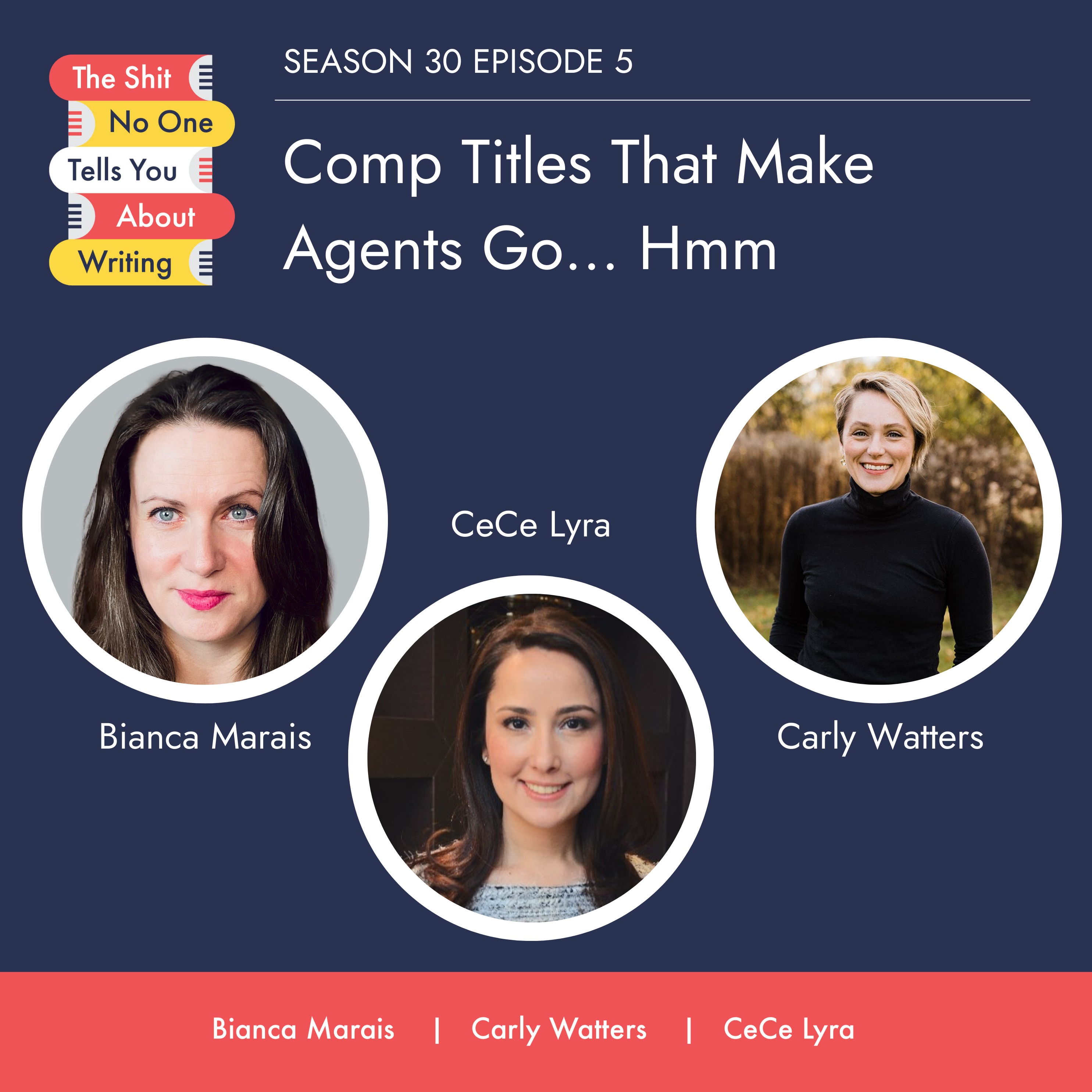
The Shit No One Tells You About Writing
Comp Titles That Make Agents Go...Hmm
00:41:29
Books with Hooks, Bianca, Carly and Cece
Loading summary
Transcript100 lines
- [00:00]
Host 1
You guys know I am all about quality over quantity. I've worked on books about fashion and making the most of your wardrobe, so I feel pretty strongly about making my clothes work for me. They have to be versatile and high quality with durable fabrics that feel elevated. And that's honestly why I love Quince. They make high quality wardrobe staples from premium fabrics like 100% European linen, 100% silk and organic cotton poplin. I've been living in their heather gray and camel Mongolian cashmere sweaters. They're light enough for layering as the seasons change but still feel incredibly luxe. I'm new to their jewelry but wear
- [00:32]
Carly Waters
their gold hoops daily.
- [00:33]
Host 1
Quince works directly with ethical factories to cut out the middlemen so you aren't paying for brand markups. Their pieces are built to hold up season after season, from the stitching to the fit. Stop waiting to build the wardrobe you actually want. You don't need a closet full of options. You need pieces that work right now. Go to quinn's.com teessnatyaw for free shipping and 365 day returns. That's a full year to wear and love it and you will now available in Canada too. Go to Q-U-I-N-C-E.com tsnatyaw for free shipping and 365 day returns. Quince.com Teasnaya hi everyone.
- [01:06]
Bianca Marae
I'm going to keep this short because I know how busy you are. I just wanted to let you know that the next beta reader matchup is almost upon us. Submit your 3,000 words by 12pm Eastern Time on the 1st of April and you will get your beta reader matchup emails on 2 April. For more information and to register go to Bianca Marae. Hi there and welcome to our show
- [01:38]
Host 2
the Shit no one tells you About Writing.
- [01:41]
Bianca Marae
I'm best selling author Bianca Murray and I'm joined by Cece Lera of Wendy Sherman Associates and Carly Waters of P.S.
- [01:50]
Host 2
literary. Hi everyone and welcome back to another books with hooks. As per usual, we are going to dive straight in. Cece, how about you kick us off with your query letter?
- [02:04]
Cece Lira
Let's do this. Dear Cece, Our Wives under the Sea meets Love Lies Bleeding when Billy Xu finds her girlfriend eating someone they both loved. Nothing But Skin is an adult horror novel complete at 72,000 words. It blends the rural cannibalism of Lucy Rose's the Lamb with Julia Armfield's sex Sapphic exploration of grieving a partner who's still alive but will never be the same in Our Wives under the Sea. Billy, an ex convict working at a lesbian bar in Idaho, would do anything for her girlfriend, Jasmine. So when the cops say Jasmine's sister is missing, Billy drops everything to search. It doesn't take Billy long to find the body. The part she's unclear on. Whether Jasmine killed her. The bloody knife nearby is Jasmine's. But Billy won't risk sending the woman she plans on marrying to prison. Not if Jasmine's innocent. Billy decides to get rid of the evidence, then figure out who's responsible. But when she takes a closer look, the body parts are missing. Someone butchered the corpse. Terrified, Billy disposes of what's left. Questioning her girlfriend is fruitless, though, because Jasmine won't stop cooking dinner long enough to talk. She doesn't seem to grasp that her sister is dead. If Jasmine did kill her, she's in no state to be held responsible. Then, mid meal, Jasmine tells Billy. Billy is horrified. But since she got rid of the body, now she's an accessory to murder. What's worse, Billy's own sister saw her do it and took pictures she's threatening to share. As Billy's secret spirals out of control, Jasmine grows delirious with hunger. And when Billy starts to give Jasmine pieces of herself, a chunk of skin, a finger, there's no going back. But eventually, that's not enough to satisfy Jasmine anymore. Far she'll go to follow the woman she loves and where it's going to end. I'm a queer woman who lives in Southern California, where I obtained a bachelor's degree in English and work in content marketing. In my spare time, I haunt my local lesbian bar and volunteer at a cat adoption center. Thank you so much for the work you do with your writing classes and the podcast. All the best, Cassie.
- [04:20]
Host 2
Thank you so much, Cece. It interests me that there was no trigger warning there, Carly.
- [04:26]
Carly Waters
I definitely thought there should have been a trigger warning. So anybody who is listening, chime in. Let us know if you think horror sapphic cannibalism books maybe need a trigger warning. I mean, this is Cece's one to tackle first. It was very, very interesting, but I think trigger warnings were needed. Cece, what do you think?
- [04:46]
Cece Lira
I mean, if you're a child, sure. Let's put the trigger warning for the children, okay? No, I don't need a trigger warning for horror cannibalism. It's horror cannibalism. Like, it's expected. It's horror. Do you know what I'm saying? Like, it's the horror genre. Everything's gonna be disturbing. The fact that it's horror is enough. Warning again, it's like my duel and duel.
- [05:07]
Host 2
Horror and horror sound very similar, people, and I'm also struggling with that. Is this the whole genre or the horror genre? So we need to.
- [05:19]
Cece Lira
Horror. Horror, please. I am saying horror. No, but listen. Roxane Gay once wrote something, an essay in which she said, you know her, she has an opinion on trigger warnings. And her opinion is, she finds it really surprising that people still think that safety can be achieved because she is someone who does not feel safe in the world. And I'm very much like that too. Like, I don't feel safe when I see trigger warnings. I don't feel safe. Prefer. But I think that when it comes to trigger warnings, if it does make someone, even one person, feel safe, great, let's do it. It wouldn't bother me at all to see a trigger warning here. I would make that clear. But do I personally need it? No, because it's the genre and also because I'm a disturbed person.
- [05:59]
Host 2
Well, no one can disagree with that, Right? Two things. Just a reminder to our listeners that this show is always marked as having adult content, which is why we don't preface the episodes with this kind of thing. We do have it in our show notes, so always assume that we are gonna either be inappropriate or there's gonna
- [06:19]
Carly Waters
be trigger warnings or a lot of swearing. So, I mean, take your, oh, gosh, MFs and.
- [06:26]
Host 2
And this kind of stuff. So just. Just that as well.
- [06:29]
Cece Lira
Okay. I have a friend's mom. I have a friend's mom who listens to our show, and this is what she wants. She didn't know that her daughter was my friend. She once showed her the screen of her phone with our podcast and said, I don't agree with this word. Obviously talking about shit. Right? But the show's really good. So to everyone out there who usually doesn't like salty language, but you still listen to us, we love you. Thank you. We love everyone, but we also love you.
- [06:52]
Host 2
We appreciate it. Cece, did you give us how many words was in that query letter before you tell us what you thought?
- [06:59]
Cece Lira
So 376 words. I love this hook. Like, I started reading this paragraph, and I go, oh, our wives are under the sea meets love, lies bleeding. Oh, Billy, yada, yada, finds her girlfriend. And then there's the verb. Eating. Eating. She eating dinner? No, she's eating someone they both loved. This is great. I love this. I'm obsessed. Great hook. I'm very sorry. Because I'm going to be totally useless here. But I have no notes. I love this. I'm completely obsessed. I am hungry for more. Terrible pun intended. And if this were in my query inbox, all I would be doing is just canceling my calls and reading this. This is one of those queries that I would not flag to read the pages later. I always often do that, like, to. I separate queries where genres I represent from genres I don't. Queries that aren't actually for me. This is one of the situations where I'd be like, I'm going to read this immediately because I'd be so obsessed.
- [07:53]
Host 2
Ooh. So the pressure's high for when we get to the pages to see if the pages measured up to the query. But we will get there. Okay, Carly, what was your take?
- [08:03]
Carly Waters
Tension is building. Okay. I really like this. I'm not a big horror reader. I have represented horror in the past. My client, Lindsay Wong, definitely has hints of horror throughout her literary fiction. So I'm probably not the exact target audience for this, but I totally loved it. I am somebody where, for the purposes of the show, I probably would have been like, maybe we need a trigger warning. But in terms of, like, what comes in my inbox, I think the trigger warning thing is so interesting because when I was coming of age and publishing, there were no trigger warnings. Right. It's something that has evolved over time. And I agree. If it makes somebody safe, that's important. Especially if it's somebody. An intern or an assistant or somebody, like, under my care that I'm mentoring, that I want to create a safe workspace for them we can go into. I mean, this isn't shooting the shit. So we don't have to go into all the pros and cons of trigger warnings. But it is a really interesting thing to think about. You know, how do we feel surprised? And which ways. And which ways are we trying to feel safe? And can the word trigger warning actually make us feel safe? All that said, I think this is really interesting. The only note that I kind of had was around this concept of, you know, Billy won't risk sending the woman she plans on marrying to prison. Billy has already been to prison. So I just thought, like, maybe an interesting line, you know, something really small, just to say, like, doesn't want to send her to prison where she's already been and knows isn't a good place. I don't know if that's kind of alluded to already or the. Or, you know, you wouldn't want to send somebody that you love to prison. But I love that, like, she's already been there and doesn't want to send somebody that she loves back there. I thought that could have been a little bit harder hitting there. But overall, I think it's really good. You know, I don't. I don't really have a lot of notes. Oh, the other thing I wanted to talk about, and we're not really going to be able to get into this necessarily, because the pages are. Obviously, we only see, you know, the first five pages, but the only kind of thing I've read in this space is more like dark romance. So I was kind of wondering, is there. If there was kind of like, relational scenes, you know, between them, intimate scenes between them, then it could also be dark romance. But, I mean, I trust that the author knows what they're doing here, and it is very firmly in horror, but it is about their relationship. So I was like, okay, is it dark romance potentially? I don't know. I'm just throwing that out there as a question mark. But I trust that this person's done their research and they know what they're talking about. But to me, because it's all about relationships, intimate relationships, potentially, it is dark romance. But anyway, I'm not trying to throw a wrench in the plane here. I trust the author.
- [10:26]
Host 2
Okay, so what's the difference between dark romance and horror romance? Horror.
- [10:34]
Carly Waters
Remember we tried to say this on the pod one time? Her romance. I'm like, guys, it's a really silly name.
- [10:40]
Cece Lira
It's the hardest word. It's the hardest one.
- [10:43]
Carly Waters
Like, Horatio. Like, is it.
- [10:46]
Host 2
But, like, are they the same thing or are they actually different things?
- [10:48]
Carly Waters
So it's. They're really just like, whatever's prioritized. Right? So dark romance, it's like the romance is the priority. Horror romance, as horror comes first there. That would be like, the horror takes preference over the romance. Right. So, cece, do you have thoughts here?
- [11:04]
Cece Lira
There's also the element that in horror romance, or however we're saying it, you don't necessarily need the love interest to be dark in any way. Like, think of Vampires of El Norte by Isabel Kanye. That's horror and romance and Nestor and. Oh, my God, I forgot the protagonist's name. There's nothing dark between them. Like, the horror is the dark. Right? But in dark romance, often the relationship, like, it's. It's a guy that you shouldn't necessarily want to be with or a woman that you should necessarily want to be. Like, there's. There's the darkness coming from the relationship.
- [11:33]
Carly Waters
I would argue that this is an example of that. That you shouldn't be with someone.
- [11:36]
Cece Lira
No, no, your. Your comment makes sense. I'm answering like, what's the difference between the two?
- [11:41]
Carly Waters
Yeah, yeah, yeah. Anyway, we're obviously throwing a wrench into this plan here. So anybody listening on YouTube, you know, you can pop in the comments down below. I'll do the classic YouTuber thing where you do this comment down below to let us know what you think. Her romance or dark romance. And obviously the author isn't on the show today to pick their brain a bit more, but I'm here. I think, potentially, if you're looking for another angle here, there is another angle.
- [12:05]
Cece Lira
Does also, I think another element is dark romance needs a little bit of spice for that to. To meet the genre's conventions. And I don't know how much spice there's here. So. So much of it is the treatment. Right? Like, you have to feel the story in the first five pages. I did not feel it was dark romance, but. But the setup, 100%. Yeah.
- [12:23]
Carly Waters
Yeah.
- [12:24]
Host 2
Okay. Right now we're going to see if the pages lived up to the query letter. Ooh, I'm quite nervous here. Okay, Cece, tell us what's in the pages.
- [12:33]
Cece Lira
Okay, so the protagonist, Billi, is in a car with her sister. Her sister's driving. We know that as soon as Billie left in September, her girlfriend started not responding to her texts or responding in very, like, yes or no answers. Something was wrong. Billi doesn't know what. Then Jasmine's mom, Jasmine's the girlfriend, calls Billi and asks Billi to come home. And now Billy's almost there, right. Her sister's driving, and she asks her sister, do you know what's wrong with her, her being the girlfriend? Her sister's not helpful at all. Billi shares that her. That her girlfriend has barely spoken with her. Her sister's really surprised. Her sister. They have a difficult relationship. Clearly, we know that the sister, Billie's sister, is neighbors with the girlfriend, which is why Billi might be asking her sister, like, if she knows anything. There's a very good amount of interiority comparing Billy and. And her sister, which is. Which is really well done. Her sister says even if she's sick again, she shouldn't ghost you. So we have a hint that, you know, there's. There's a potential illness. We don't know what that illness is. They start arriving into town, which we know is a town where the protagonist does not feel comfortable. The Protagonist alludes to the fact that Seattle and was loving Seattle, but had to leave. She dropped out of a program, which was a really big deal for her. It isn't said that she dropped out of the program because of the girlfriend, but that's what we assume, an academic program. And her sister says, actually, I'm not going to take you to your home. I'm going to take you to the bar because there's a surprise party for one of our friends. And Billy is like, well, will my girlfriend be there? And obviously the sister doesn't know because the girlfriend's not being super responsive. So when they arrive at the bar, the girlfriend's there and, yeah, that's it.
- [14:20]
Host 2
Okay, so now your take on it.
- [14:23]
Cece Lira
As I said, I love the premise, and this is a very polished scene with very strong writing. This is one of those situations where I go, yep, this person can write. What I think needs work is the storytelling. I always say you need two things to make it. Well, you need two types of talent to make it in this industry. You need a talent for storytelling and a talent for writing. You definitely have the talent for writing. I also think you have the talent for storytelling, but I think the storytelling execution here needs polishing. Specifically in regards to this one thing. We have a protagonist in a car driving home with anxiety. I assume one can only assume because there's something wrong with her girlfriend. Like, there's a big, big mystery here, which is what is wrong with her girlfriend? We know why the protagonist is wondering this. The girlfriend doesn't answer her texts. The girlfriend's been acting distant and strange. We don't see the protagonist running through a single theory in her head, not a single one. And that is not realistic. And that is also not something that develops character. A lot of writers think, hey, if the reader's about to find out the reason pretty soon anyway, why does my protagonist need to run through theories that's just going to drag the pace? It won't. It won't. When we see your protagonist theorizing options, A, they're sounding like a real human, which means that we connect with them because they become real in our minds. Two, it's a really good opportunity to drop curiosity seeds, to show us the go to options that their mind goes to, which is very unique for each person. As an example, Billie's sister mentions that it could be cheating. And Billi immediately goes, that's not something she even considered. And that speaks so much about their relationship. It says so much about the kind of person Billy is, because the Reader, I guarantee you'll be thinking, I would probably think it was Billy. One of the options was cheating. Most people would think that. And the fact that the protagonist doesn't, again, inform so much about their relationship. So Billi's interiority isn't making sense. It isn't making sense because of this example I mentioned, but other examples, too. For example, she is about to get home and solve this really big mystery of what's wrong with her girlfriend, hopefully. And then her sister says she's taking her to a bar. I do not believe that anyone would be like, okay, bar, yeah, like, it doesn't make any sense. She'd be like, so stop the car. I'm gonna go home. And if she wouldn't, then I want her interiority to informed the reason why. That's not her reaction. It's not just her interiority that's not working. Her behavior also doesn't make any sense. And this is something that's very common in first pages. Billi is asking her sister, do you know what's wrong with her? This is on the first page. That is not a question that makes any sense. Any sense. Why would she be asking this now as they're about to get home? Why not when they first got in the car? Why not before, since. Especially since there is later in the next page, interiority saying that Bailey caved and asked her sister if she knew what was wrong with her a week ago. So why is she asking it again? And if she's asking it again because people ask the question more than once, then again, there would be interiority reflecting. Probably my sister's tired of hearing me say this question. And her sister's reaction would be, you have to stop asking me that, or something like that. Reason why I'm picking on this, I promise is not to be annoying, but I read setups like this all the time. As an agent, I read setups where the behavior just doesn't add up because it doesn't make sense that this would be the first time someone's doing something. Because the story might be beginning on page one, but the protagonists have been alive and well for many, many pages. And when I read a setup like this, I think to myself, the writer hasn't done the work of thinking through the fact that this human has existed for a long time before the setup story started. And they're just putting information that the reader needs to know and not. And not adding story that would make sense for the protagonist. Yes, the story's for the reader. Of course it's It's a book that's going to be out in bookstores and people are going to buy it, but in order for the readers to want to buy it, it actually should be a story that makes sense for the protagonist, since we imprint with the protagonist. I. I also noticed that she said jail and not prison at one point. And I think that people who have been to prison say prison and not jail. There is a distinction. I know this from having lots of prison shows. So, as you can see, this is very good. First, primary source material. It's. It's really not. But, hey, another thing that got me curious was there's the line that says she texted her academic advisor this morning, dropped out of the program. It isn't said that she dropped out of the program because of her girlfriend, but if it was, that's huge. Where are the messy emotions? You know, where. Where's the resentment for having to drop out of the program because of her girlfriend, but at the same time, guilt for feeling resentment and at the same time, total devotion to her girlfri. And she loves her girlfriend so much, or something else. Maybe these wouldn't be the emotions, but it's just not realistic to me. Another element. Speaking of realistic, her girlfriend's mom called Billy, you have to come home. Did Billy not ask why? Like, is it also because the girlfriend isn't answering the mom's texts? And if so, what theories did they, the two of them, talk through this? Do you see what I'm saying? Like, there's a lot of. There's this huge problem, which is the girlfriend isn't responsive, and it's about to get answered because the girlfriend's at the bar. But if I don't have the protagonist thinking like a proper human being and acting like a proper human being, I don't believe it. I just don't believe that it's actually happening. Yeah, that's. That's my note. I. I did really enjoy it, and I love the premise. I'm just not sure that it's believable to me. And then not to throw a wrench in everything. I also don't know that her driving to see her girlfriend is the most active of scenes or the best place to start. It could work. It could work, but only if her interiority is doing more work. But I am also giving you all these interiority and behavior notes, and you might choose to start someplace else because there might be some.
- [20:07]
Host 2
Some.
- [20:07]
Cece Lira
Some other starting point that could make more sense.
- [20:11]
Host 2
Thank you, Cece. Okay, Carly, handing it across to you,
- [20:15]
Carly Waters
I Thought this was really strong. You know, I think when something is pitched as horror, you wonder a bit, like, where is the horror? Or where's the atmosphere? Or like, when does the horror part click in? Because that happens A submissions People think that I don't know that the horror is very active. But what I really liked about this was how there were just really subtle references and word choices that I thought were really, really smart. You know, things like set Billy's teeth on edge. Just these little things where I just. I could really tell there was an intense amount of intentionality with each word choice. So I really. I found this really sophisticated in that sense, and I thought that they did a good job. One of the things that was a bit unclear to me was this whole, what, where was home and what was Seattle's relation to home and how all of this connects? Because it took me a little while to figure out home was Idaho and Seattle was where she was in school. I don't know if it was just the way that I read it. So that's another reason why I don't know if the car makes the most sense, because if somebody is all kind of set up at school and trying to make that their new home, I do think there'd be a ton of more resentment with the idea of, like, I have to come home, but for what? And why is her sister encouraging her potentially to come home and abandon school? I don't know. As Cece alluded to, it's very complicated here. I don't know if that is, you know, hitting the exact right. Nope. There was a joke that was like a 10 out of 10 joke, and I wanted to read you the 10 out of 10 joke because I loved it. So they're going to a bar to meet up for this party, and so they said, why don't we go to the bar? Billy hesitated. A few years ago, she'd been flat broke when she spotted a neon sign advertising the bush. This was a name she could get behind or underneath. She wasn't picky. I'm like 10 out of 10 joke. I'm like claps for that joke. That was just like, fantastic. Top to bottom, I loved it. Any other notes I had, I potentially a bit overwritten, but I really did
- [22:12]
Host 1
think it was sharp.
- [22:13]
Carly Waters
I did think it was sharp.
- [22:15]
Host 2
Wonderful, Carly.
- [22:16]
Cece Lira
Thank you.
- [22:17]
Host 2
Okay, before we move on to Carly's query letter, we'll just stop for a word from sponsor.
- [22:23]
Host 1
It is my 10th wedding anniversary this year, and my husband and I are planning on what we want to do to celebrate. When we got married to 20 somethings fresh out of grad school just starting their careers, we did not want to invest in a big honeymoon. It felt kind of irresponsible when we wanted to buy a house and all
- [22:37]
Carly Waters
those grown up things.
- [22:38]
Host 1
Fast forward to 2026 and we are planning a wine tour in Italy. If you have travel coming up then join me in using Rosetta Stone to learn some new local languages. There's something about spring that feels like a reset, fresh energy and that motivation to try something new and imagine arriving for your trip, actually understanding the lang I'm talking about, ordering confidently, connecting with locals and feeling immersed instead of just visiting. Rosetta Stone has been a trusted leader for over 30 years. Their immersive, intuitive method helps you naturally absorb the language without memorizing random vocabulary lists. You learn by connecting words, visuals and meaning in context. Plus their true accent technology gives you real time feedback on your pronunciation so you sound more natural. Whether you have five minutes or an hour, you can access lessons from your desktop or the mobile app. Ready to start learning a new language this spring? Visit rosettastone.com today today to explore Rosetta Stone and choose the language that's right for you. Go to Rosetta Stone.com today now and begin your language learning journey. Hello there writers and publishing folks.
- [23:35]
Carly Waters
The one and only Wayday is finally here at Wayfair.
- [23:38]
Host 1
From April 25th through to the 27th, you can score the best deals in furniture, decor and more. We're talking up to 80% off with free shipping on everything. Wayfair makes it so easy to find what fits your style and your needs, whether you're looking for a new writing desk, SP decor or outdoor essentials as the warm weather starts to ramp up. If you've been following along with me, you know I've been slowly and intentionally replacing some older pieces in our home. I finally retired a table that we've had for 15 years. I found the perfect replacement on Wayfair, a beautiful console table for my bedroom. It's exactly what I needed to hide away all those little knickknacks and finally giving me a place to display my lovely shoe collection.
- [24:14]
Carly Waters
Wayfair made it so simple to narrow down exactly what worked for my style and my budget because I'm being really selective with these upgrades.
- [24:20]
Host 1
I love shopping with Wayfair Verified. It's like a shortcut to the good stuff. I love an editor's choice. Their team of product specialists vet everything by hand using a 10 point quality inspection, so I knew I was getting
- [24:30]
Carly Waters
a quality piece that was going to last.
- [24:32]
Host 1
Plus everything ships fast and free during weigh day. I got my table a mere days from ordering and they kept me informed every step of the way. Instead of locking my shoes away in the back of my closet. I love having them on display. Thanks Wayfair Verified for helping me narrow down my choice so quickly. Wayday is the sale to shop the best deals at home. We're talking 80% off with fast free shipping on everything. Head to Wayfair.com April 25th through to the 27th to shop Wayday. That's W-A-Y-F-A-I-R.com Wayfair every style every home
- [25:03]
Host 2
okay Carly, handing it over to you.
- [25:06]
Carly Waters
Dear Carly and the T snotya crew. What can I say but thank you, thank you, thank you. Your wisdom, insight and humor are a wellspring of motivation and connection for all of us dreamers and storytellers toiling away in obscurity. You help me not give up. I'm seeking representation for my debut novel, Never the Same Love Twice Women's fiction 81,000 words for readers of Before We Were Lovers and Hearts and Lovers, this dual timeline mid lit story explores the many forms of love that shape a life with a musical undercurrent reminiscent of deep cuts. In 2002 New York, Ash arrives with no plan beyond experiencing the city when she's drawn into a consuming love with Kai, a hardworking MBA student whose balancing is fine finance job with night classes. His sincerity stands in stark contrast to the rarefied world Ash navigates in her day job as a personal assistant to the ultra wealthy Gableman family. As Ash moves between the opulent Upper east side universe, the pulse of early 2000s Manhattan and a growing devotion to yoga, she begins to see that love is not singular, it can be romantic, communal, spiritual and self forged. When Ash is offered a coveted spot at an overseas yoga training, she's hopeful that Kai will see the same possibility she does. He doesn't and they part ways 20 years later in Charleston, Ash is a wife, mother and yoga studio owner. But when a routine exam reveals a pelvic mass, the past resurfaces with new urgency. To protect her husband, who's become distant to not derail their college bound sons, Ash keeps her health concerns private. In the meantime, she returns to New York for a yoga workshop and sees Kai. One last night together reveals that all of the love that shaped Ash theirs have been born of hope, yearning and not strength and devotion. Back home, Ash is diagnosed with ovarian cancer. But just as she prepares for surgery, her story takes a shocking twist and a car accident takes her life. Never the Same Love Twice is a story about the choices that define us, the love that marks us, and the ways a life continues to echo long after it ends. I worked as a professional copywriter and copy editor for 22 years, including the last eight, writing software architecture and user
- [27:05]
Host 1
interface copy in the automotive and insurance industries.
- [27:07]
Carly Waters
I live in South Carolina with my husband and three sons.
- [27:10]
Host 1
Warmly, Manny Tyler.
- [27:12]
Host 2
Thank you, Carly. Did we get a word count with that?
- [27:16]
Carly Waters
We sure did. Thank you, Manny, for writing that out for us. 364 words.
- [27:21]
Host 2
Okay, great. What was your take on that?
- [27:24]
Carly Waters
All right, so starting at the top here, I am not familiar with the book Before We Were Lovers. I'm a bit confused here. I tried to look it up. I'm like, is this a movie? I'm potentially wondering if this is a self published title. So I think this just starts a conversation potentially, you know, for the sake of the podcast, about whether you would include a self published title or a trad pub title in your comps, I really suggest not including a self pub title in your comps because your comps are all about signaling where you want to be in the marketplace. And for the sake of querying an agent, we're presuming that you are seeking traditional publishing and not self publishing. So just make sure that you remember that your comps are framing where you believe you are in the market. And so again, if an agent sees that you're comping to a self published title, we might be confused about maybe what some of your aspirations are. So I just wanted to flag that, that I also think we need to unpack what you wrote here called mid lit story. Very interesting. I'm assuming you mean kind of that like middle brow thing, right, where it's like, you know, low brow versus high brow. This, this concept of like a mid brow. So you say mid lit but you also call it women's fiction. So I was a little, I don't know, I was very intrigued by you calling it mid lit. Potentially doing the job of saying what we would say is upmarket. So then is it's not women's fiction, It's a market fiction, I would argue. But again, your book to decide there. Okay, so a few things. It's very interesting reading queries and then reading them aloud on the podcast. The only time I ever read queries aloud is for the podcast. Like when I am reading queries for my day job. I don't read them aloud. So when I see things on the page, it's actually very different than reading them aloud. So sometimes I pick up things when I'm reading from the show in a way that I don't pick them up when I'm actually reading. Reading what I didn't love when I was reading it, when I was making my notes. I don't like all this definition of love. I don't like this. Maybe it's just me being cynical, but this like begins to see that love is not singular. It can be romantic, communal, spiritual and self forged. I feel like that's obvious. I don't know if we need that many words to describe that version of love that she's trying to signal with this devotion to yoga. When I read it aloud, it made a little bit more sense to me. But I don't think we need that many different words about love. I think you could just find a way to say the multifaceted love or you know, trying to do something like that I think will do the job because then again below you say, you know, theirs have been born of hope and yearning, not strength and devotion. I don't know again, reading it aloud, I liked it better than I did when I was reading on the page. But somehow I just don't think we need to define love in that many different ways for the sake of the query letter. Because I think the query letter should do the job through the plot of explaining this. Again, these are just my personal thoughts on this last paragraph. I don't like that you tell us the ending. Maybe there is another twist after this that we don't know and you are are saving something to be revealed. But I don't like that you tell us what happens. It wasn't my favorite thing, so I don't think we need to spoil the ending. Also, it is very long, you know, in terms of paragraphs, that's essentially I believe I scanning properly, but four paragraphs of, you know, just what the book is about. So I think we need to kind of make the last paragraph in the ending of the query letter a bit more punchy about, you know, what happens when Ash and Kai reunite and kind of make that, that explosion as opposed to and then probably telling us about the cancer, but don't tell us about the car accident. I did not like that I knew the ending because I don't know, it just took away that suspense obviously. Right. This is trying to sell me on why I should request it, why I should read more. And this is kind of giving me everything I'm really curious about, actually, both Bianca and Cece's thoughts about the comp to Hearts and Lovers. What do you guys think about.
- [31:10]
Cece Lira
Sorry, what is Hearts and Lovers?
- [31:13]
Carly Waters
Oh, I think they mean Hearts and Lovers. Right? Yeah, yeah, yeah.
- [31:15]
Cece Lira
That's the thing, though. Like, it's called Heart the Lover, not Hearts and Lovers. Like, I spent five minutes Googling what is. Because she used two comps that I had never heard of, and my brain's like, I'm being haunted by a technology ghost. No, I thought it was me. I thought, well, I can't find books. I'm a terrible agent. I can't search for books. I don't know how to find titles. I was on Goodreads. I was on Amazon. I was on bookscan. Like, I was like, there are two titles. And then. And then I did the whole. Oh, she probably means Lily Kane.
- [31:45]
Carly Waters
Like, yeah, yeah.
- [31:46]
Cece Lira
Do you want to torture me? Author writing this? Is this. Is this a secret ploy to torture me? If so, good job.
- [31:53]
Carly Waters
So, I mean, I think we should obviously point out the obvious, which is potentially sloppy, right? That we're not writing the actual proper title of this. It could be that, again, these are books that we don't know about. And, you know, Cece went through the. The hoops to kind of find these books. But if you meant Heart of the Lover, which is what I think based
- [32:12]
Cece Lira
on reading this, not Heart of the Lover, you're also saying it wrong. Heart the Lover. Heart the Lover. People. Lily King. Guys, come on.
- [32:22]
Host 2
Are you thinking of the Lily King one, Kali, or are you thinking of another book?
- [32:26]
Carly Waters
Lily King one, yes.
- [32:27]
Host 2
Then it's Heart the Lover.
- [32:29]
Carly Waters
Yeah, yeah.
- [32:29]
Cece Lira
Heart the Lover.
- [32:31]
Carly Waters
Heart the Lover. I meant to go grab it from upstairs. Yeah, okay, can we just stop with the semantics and discuss how close this is actually to Heart the Lover? I'm muting myself so I'm not getting annoyed with you. Guys, guys.
- [32:45]
Cece Lira
Oh, can you please stay unmuted so we can see Annoyed Carly? Annoyed Carly is a lot of fun. I love Annoyed Carly.
- [32:51]
Carly Waters
Okay?
- [32:52]
Cece Lira
They're usually so levelheaded that whenever I have, like, a spike of emotion, like, come on, give me, give me, give me.
- [32:57]
Carly Waters
I meant to go grab the book so I could double check the actual title. So I had it beside me, but I left it upstairs.
- [33:03]
Cece Lira
Google. Google. It's a great tool. No. Okay, so here's the thing about titles. So, first of all, author, I love your title. Never the Same Love Twice. Great title. As a very minor note, I would not italicize all caps titles Written in all caps. Like, I love titles written in all caps. You just don't have to italicize it. It's such a minor thing, but it actually helps with readability. I would also like to start a petition to everyone listening to our show, if you're going to mention a book as a comp title. I repeat, if you are going to mention a book as your comp title, you must say the author's name. You must. First of all, it will avoid situations like this where I'm going down a rabbit hole in case you end up slipping up and saying the title wrong. But more importantly, it's really, really essential for name linkage. Name linkage is when people are able to link an author's name to a book title. A lot of people can say lessons in chemistry. Not too many people can say. Or at least not as many people can say Bonnie Garmus. Right. So you really want to create name linkage because that empowers authors. So petition for every single query letter sent to our show to include author names when citing a comp title. Very, very important. Another thing I want to say, when I read Mid lit, my brain autocorrected to mid list, which is not a good thing. And again, this is my brain. This is a my brain issue. But I feel like a lot of people would make that mistake, or at least potentially could. I don't know what Mid list is. Maybe it's a thing. Maybe I'm just not aware of it. I'm usually the last to know about this sort of stuff. But because of the autocorrect and because Carly also didn't know it, I would just strike that from your query letter like that. It's very deeply confusing. I didn't know if you meant stories about people who are in the middle age. It made me think of middle grade also. Like, it's just very confusing. I would strike that plot paragraphs. The plot paragraph is very. All the plot paragraphs are very internal. You know, you're mentioning things like the pulse of early 2000 Manhattan patents after already telling us the year 2002. You're mentioning things like his sincerity stands in stark contrast to the rarefied world. Or, you know, the fact that she is hopeful and the fact that there's devotion to yoga. It's all very internal. And I do get the feeling this is a story where interiority, and I love interiority, does a lot of the heavy lifting. And that's awesome. But we still need plot. Plot with causality. I want to buy a little Dominoes or something. So I can have a prop whenever I ask people to. Please, guys, dominoes, causality, plot points. Maybe it's intentional, but to me it's way too internal. And the fact that we know not just the ending to Carly's point, but the fact that she dies in the end. Like our protagonist is going to die. No, guys, we can't pitch a book like this. No, we can't pitch a book saying and then she dies. Unless this is a story about the afterlife, I suppose. And then midway through the book, she goes to the afterlife. But that's not.
- [35:56]
Carly Waters
Not.
- [35:57]
Cece Lira
That's not super clear. So my big picture note, and I know this was not sent for me, so probably you're like, cece, this is not for you. So totally fair. But my big picture note is, please rewrite this with a focus on external plot points, causality, and dear God, if this book exists, this Heart and Lovers book, please tell us what it is.
- [36:17]
Host 2
Carly, I want to throw it back to you because I think what you were trying to say earlier is that. That there's black story similarities between the two books, not just in terms of the title. Is that what you were referring to?
- [36:30]
Carly Waters
Yes. Yeah. And I was curious about your thoughts, both of your thoughts about this, because it can be really hard to just pitch a book that already exists. And even though there are differences, of course. And I would never suggest that anything untoward happened in terms of the crafting of the book or not accusing anybody of anything. I just mean that when books come out around the same time that are similar, it's just the framing of them could be. Can be really challenging. And when I see something that's very similar to a book that already exists, then I have to think, how am I going to pitch this in a way that is different or can't compete with that, or is it coming off of a trend of these kind of dual timeline, upmarket love stories? I don't know. I just. I think that's a really complex thing to think about as an agent, about whether I'd want to take something like that on. Bianca, did you find it. First of all, did you find it similar to Heart the Lover and cc? What does your agent brain tell you when you see something that's similar like that?
- [37:24]
Host 2
I mean, when I heard the story, I did immediately think of Heart the Lover. I don't want to give stuff away for people who haven't read Heart the Lover. There was, you know, I definitely don't want to ruin that, but I was definitely thinking Major similarities.
- [37:40]
Cece Lira
Cece, it's a really interesting discussion that Carly brings up because to me, at the same time, publishing wants more of the same, you know, with twists, with a fresh take, with a fresh voice. But we hear this all the time. We go, can we please have the next wedding, people? Can we please have the next insert big book here. And of course, Heart the Lover would be a wonderful example. I think that this is one of those situations where an agent can really add value, because if you read pages and the pages are really grabbing you, it'll be up to you as the agent to have a conversation with your client and be like, okay, okay, I totally see the Heart the Lover thing, but here's how this is different. And we can actually pull out threads and angles and twists that really position it as for fans of this, but with this fresh, original angle intake. And it does come down to having to read the pages, because at the query letter. I agree, the query letter doesn't actually tell me what's different about it. But that personally would not make my agent brain worried or anything, because so much of what makes a book special is the execution. I also want to say that, you know, something that's really hot right now is life affirming stories. Everyone's going on and on about how they want life affirming stories. Think Theo of Golden. And there is something, in my opinion, very life affirming about Heart the Lover, which means that there could potentially be life affirming here as well. Which is another reason why we should not be talking about the protagonist dying at the end. Just say that again.
- [39:04]
Carly Waters
I think what I think about is anytime something is comped to something, and it is very similar, it has to be as good as, if not better than, that other one. And that is what I kind of think about. So when I read that, I'm like, okay, in order for me to sell this comp to that, it has to be that good. And I think that's one of the reasons why we emphasize comp so much and why they're so important.
- [39:27]
Host 2
Those of you who are watching on YouTube will see me doing my wrap it up, ladies and gentlemen, doing the throat thing, etc. Etc. We have to be finished in 10 minutes. So that's just my. Just my warning.
- [39:40]
Cece Lira
So, okay. We've been very chatty.
- [39:41]
Carly Waters
We've been very chatty the last few episodes. All right, guys, here we go. Okay. October 2002. Our protagonist has moved to New York. She has moved in with two other roommates. We learn about the job that she got. She has moved from Washington state, where she's kind of missing that bit of nature. She ends up at a party where she meets Kai. And that is our summary.
- [40:06]
Host 2
Okay, what did you take on that?
- [40:08]
Carly Waters
All right, so my take on this, a few things. And everybody who gets our subscriber notes will see my margin notes here. I think one of my main issues is that this kind of looking back style of writing ends up being very factual. It ends up being, you know, it was autumn in New York. The towers had fallen a year ago. The city was reeling, you know, getting into her moving in with the roommates. And I don't know, I just found, like, very. All very, like, factual things. I didn't really find a lot that was very surprising. Like, even the mention of opening by talking about, you know, the Twin Towers falling a year ago. She didn't say that she's surprised that there's not a more somber atmosphere in the city. She's kind of just saying, you know, it was just a beautiful cobalt sky, October day. So I don't know, I just wasn't really finding where the surprises were, where the tension was. It was a lot of like. Let me just bring you up to speed about where we are in, you know, early 2000s New York. So, you know, even from the descriptions of what they were reading, again, like, because the author's trying to paint a picture of what early 2000s life was like, it ends up just being factual. So, like, what they were wearing, you know, the finance guys, the parties that they would go to, I don't know. I just really felt like it was very factual information, which, you know, didn't really lead me to be very curious. I also felt like I don't know anything about our protagonist other than she came from Washington state. And the way that she talks about nature makes me think that she misses nature, which is what I kind of summarized to the group. I also found the dialogue a little bit obvious. You know, it's like, you know, who are you? And I'm so and so. This is, you know, my last name. And then Kai gets cut off by a friend because they want to introduce them, says, come meet Mark from Blue Sky Capital. He closed a similar deal to Dixon last year. I just feel like if finance bros were speaking, it'd be like, come meet this guy from Blue Sky. It wouldn't be like, Blue Sky Capital. I just felt like the dialogue was a little bit stiff, and, I don't know, I was just having a bit of a hard time really feeling like, swept away about the story, because everything happened exactly the way that it was laid out that it would happen. Girl moves to New York, girl goes to a party. Girl meets boy. You know, that's a story that I've read numerous times, and I think we all have. And it's not an unlikable story. It's more just how do we make it more surprising to the reader, which will make us want to turn the pages. And with something like that, a lot of it is hinging on the love story. Right. We're hoping that the reader is going to kind of come to these two characters and want to watch them fall in love. And the tension that's going to. That it's going to create. But it's a very basic meet cute. And so we're. We're having a very straightforward beginning here, so not a lot of surprises, unfortunately.
- [42:54]
Host 2
Thanks, Carly.
- [42:55]
Cece Lira
Okay, Cece, I want to echo everything Carly said. It's like she was in my brain. And speaking of being inside someone's brain, I did not feel like I was inside a protagonist's psyche. The protagonist is reading more like a pure narrator as opposed to a protagonist, you know, and the difference comes down to a pure narrator is giving you a bird's eye view. It's more focused on, you know, to Carly's point, being factual as opposed to being tethered to someone's unique socio emotional framework and interiority and having everything filtered through those lenses of what makes a human being, you know, unique and special. I also felt like the story setup was fairly obvious and that the tension was leaking. There's a line which I can't find, but it essentially reads, you know, this was before I met Kai, you know, before Kai changed my life or something like that. And then a couple pages later, there's a line, an isolated line, very good, that says, I didn't see him watching me at first, and we know she's about to talk to someone a him. And in my brain, I was like, the storyteller wants us to think that the him is Kai, but I bet it's not going to be. I bet this is how she's going to surprise us. Because this is how you torture readers in love stories. You promise they're going to meet this person, and then that person leaves with their best friend, or you meet someone else, you meet his best friend or his brother. And to make it messy, to make it complicated. But no, we actually met Kai. And it was a dialogue where we met Kai. And I'm like, again, it's a taste thing, but for me it's too obvious, it's too passive. I'm feeling like a passive passenger and I don't want to. I want to feel like an active co pilot. So yeah, didn't work for me.
- [44:36]
Host 2
Okay, thank you so much Carly and Cece, as always, for your brilliant and helpful insights. For anyone who wants to submit full Books with Hooks, go to our website theshitaboutwriting.com and you can submit your work there. And we look forward to critiquing it. Next week we'll have another author on the podcast and after that we'll have another Books with Hooks.
- [44:59]
Bianca Marae
Bye everyone.
- [45:01]
Host 2
Cece Lira is a literary agent at Wendy Sherman Associates. If you'd like to query Cece, please refer to the submission guidelines@www.wsherman.com. carly Waters is a literary agent at P.S. literary Agency, but her work on this podcast is not affiliated with the agency and the views expressed by Carly on this podcast are solely that of her as a podcast co host and do not necessarily reflect the views, opinions, policies or position of PS Literary Agency.
- [45:37]
Bianca Marae
Hi everyone. I'm going to keep this short because I know how busy you are. I just wanted to let you know that the next Beta Reader matchup is almost upon us. Submit your 3,000 words by 12pm Eastern Time on the 1st of April April and you will get your beta reader matchup emails on the 2nd of April. For more information and to register, go to Biancamarae.com.