← The Shit No One Tells You About Writing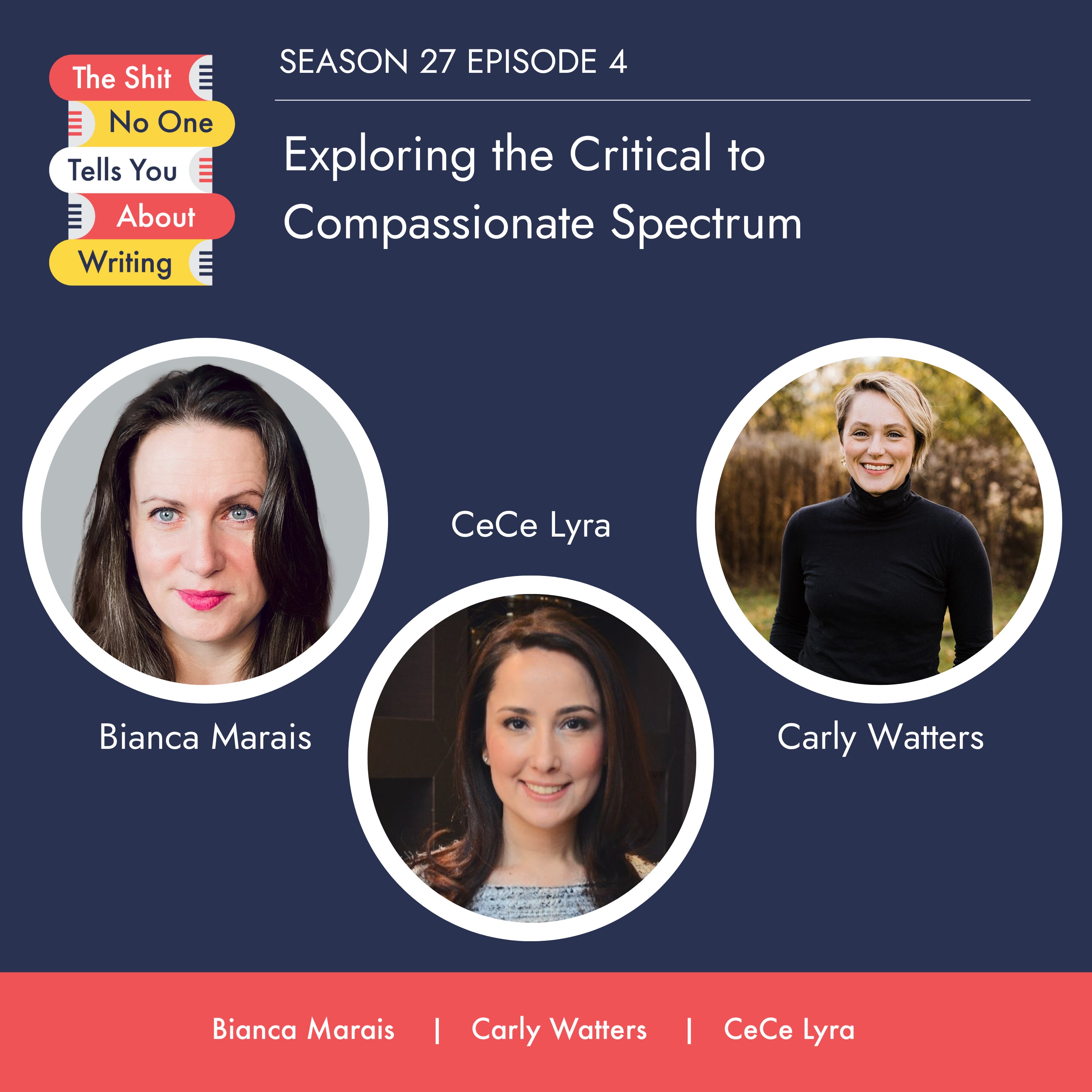
The Shit No One Tells You About Writing
Exploring the Critical to Compassionate Spectrum
00:38:55
Books with Hooks, Bianca, Carly and Cece
Loading summary
Transcript88 lines
- [00:00]
Host/Podcast Co-Host
As summer winds down and we get back into back to school mode, thinking cozy interior decor is top priority. From layering fabrics and textiles to extra pillows and fresh sheets and plush bath towels, I can't stop thinking about being enveloped by my home. Whether it's by the fireplace or a piping hot bath or making sure the kids are tucked in their beds. We recently redid our bathrooms in our house. Goodbye 1990s and I love how they've come together, but one thing that always solidifies the look is the towels, soap bottles, hooks and more. Whether it's hand towels or guest bath towels, I like to make sure the textiles, textures and our handpicked items and they feel like a hotel bathroom or spa and each detail is considered Wayfair has the perfect options for us. Wayfair always delivers so quickly so you don't have to wait and second guess any decision making. It's already at your door. You can make confident choices that suit your style instantly. I like luxe, detail oriented, minimal, individual and stylish pieces and Wayfair's got me covered. I think about how the pieces of my house communicate with each other while also being unique and Wayfair is the best place to shop because your house is not going to look like everybody else's. It's going to reflect you if you're thinking of a room or a space that needs a refresh for fall as we get back to routine, Wayfair's huge selection is easy to navigate with detailed filters to make sure you're getting the best selection for your taste and your budget. Wayfair makes it easy to tackle your home goals with endless inspiration for every space and budget. Get organized, refreshed and back to routine for way less Head to Wayfair right now to shop all things home. That's W-A-Y-F-A-I-R.com Wayfair every style every Home what's up everyone?
- [01:29]
Cece Lira
This is Cece. If you're a writer, then chances are you've wondered if your story is good enough. Maybe you're wondering that right now. I get it. Here's what I can tell you. As long as your story is making the reader curious, you're good. Now, I'm not saying you won't have to make edits when working with an agent or publisher. Edits are part of the game. But I am saying that you will get ahead in your career if you know how to make the reader curious. The best way to do that? Infuse your story with plenty of tension, conflict and stakes. Which is why I'm so excited to invite you to join my four day course Writing Tension Creating Tension, Conflict and Stakes in youn Story. It starts on October 13th. My favorite part about this class is that there are formulas. Yes, formulas for tension, for conflict, for stakes. And for the first time ever, we're having two optional interactive components including a query letter, studio, video, and live critiques of select first pages. I'm super excited about this new format because I've seen it yield results in writers works and it works for writers of any genre as long as you're serious about improving your work. So if you're ready to take your writing to the next level, join me for this four day course. Don't worry if you can't attend live, the sessions will be recorded. For more information, check out my bio on Instagram or the podcast's website. I'm looking forward to seeing you there.
- [03:07]
Bianca Murray
Hi there and welcome to our show the Shit no One Tells you About Writing. I'm best selling author Bianca Murray and I'm joined by Cece Lera of Wendy Sherman Associates and Carly Waters of P.S. literary.
- [03:23]
Carly Waters
Hi everyone, welcome back to another Books with Hooks segment. As per usual, we are diving straight in. Carly, can you please kick us off with your query?
- [03:32]
Host/Podcast Co-Host
Dear Carly and Cece, thank you for hosting such an insightful podcast for emerging authors like myself. As someone with a background in scientific and technical writing, I found your discussions invaluable in learning how the fiction publishing world works. From structuring a strong query to creating.
- [03:46]
Carly Waters
Characters that truly resonate on the page.
- [03:48]
Host/Podcast Co-Host
I'm seeking representation for a Body at Rest, a historical mystery complete at 94,000 words. I'm pleased to share the first five pages of the manuscript.
- [03:56]
Carly Waters
The query below is 304 words. It's 1945 and Dr. Robert Franklin, a physicist falsely accused of espionage and ousted from the Manhattan Project, arrives at Cornell.
- [04:08]
Host/Podcast Co-Host
Desperate to start anew. Haunted by his role in the creation of the atomic bomb and the recent death of his wife, Franklin struggles to find purpose in his scientific work. But when a student appears in his office with news of her roommate's suspicious death and a sensitive technical document bearing his name, he's drawn into a murder investigation that threatens both his career and the university's future.
- [04:27]
Carly Waters
The body of Ruth Wharton, daughter of silent film pioneer Theodore Wharton, is found.
- [04:31]
Host/Podcast Co-Host
Beneath a frozen gorge and her death is quickly passed off as an accident. But William Marshall, Ithaca's long serving police chief, believes otherwise. As Marshall investigates Ruth's death in his final case before retirement. Evidence is discovered in Franklin's office leading to Franklin's arrest. Released but under surveillance, Franklin teams up with Freeman Dyson, a brilliant young British mathematician, to uncover how Cornell's involvement in nuclear research he intersects with long buried secrets of Ithaca's silent film history. Told through alternating perspectives between Robert Franklin and William Marshall, A Body at Rest blends academic politics, Cold War paranoia, and long buried secrets from Ithaca's silent film past. Inspired by real post war events at.
- [05:11]
Carly Waters
Cornell, the novel will appeal to readers of Joseph Cannon's the Good German, Donna.
- [05:15]
Host/Podcast Co-Host
Tartt's Secret History, and Louise Penny's the Nature of the Beast. I'm an associate professor of mechanical and aerospace engineering at the University of Michigan with a PhD from Cornell, 60 peer reviewed papers in scientific journals and a widely used textbook on fluid mechanics. A longtime reader of mystery and noir, I drew on both my academic background and my years at Cornell to write A Body at Rest, my debut novel. Thank you for your consideration. Sincerely, Jesse Capel Tranto.
- [05:43]
Carly Waters
Thank you, Carly. Okay, so they gave us the word count there, which was thoughtful. Thank you so much.
- [05:48]
What was your take on Alrighty? So I'm just going to start at the top like usual. So the title sounds a little bit like nonfiction to me. You know, there's that book that's extremely popular called Body Keeps the Score that's been on the bestsellers for like 20 years. So it's kind of reminds me of that, like A Body at Rest. I'm kind of like, oh, what am I going to learn about, I don't know, productivity or something like that. So I don't know if we maybe need to think about a different title. It might be worthwhile. So general kind of thoughts on the subject matter. So I think this is all very interesting. I recently worked on a Cold War project with my client Jane Healey.
- [06:23]
Host/Podcast Co-Host
You guys have heard on the show, she was on the show just a couple weeks ago talking about her Cold.
- [06:27]
Carly Waters
War novel, the Women of Arlington Hall. So I think this is something that's like very topical, always timely, very interesting. Obviously with the espionage piece and all that sort of thing. I guess what I'm failing to understand is how this connects with the silent film history. Again, another very interesting world. But I don't see the connection really between these two things. And again, it could come through much stronger in the actual book. It just doesn't come together in the query letter. But I definitely want to see the connection to get more excited about this project. I guess I was just feeling like these were Two separate worlds, and I had no idea how they're going to connect. It's kind of like when we read a pitch letter about two separate characters. Kind of like this one where they have two separate worlds.
- [07:06]
Host/Podcast Co-Host
I'm like, why are we reading a book with the same people?
- [07:09]
Carly Waters
Like, what's this plot that's bringing these two people together? And it's kind of an example here where, again, there are two separate people, but they do actually connect with the mystery. I just have no idea what any of this has to do with the silent film history. And again, it's a very interesting history. So I just don't know why we're not delving a bit deeper into it. I don't know if it's a case of the writers not wanting to tell us too much. You know, one of those. Those cases of people keeping things a.
- [07:33]
Host/Podcast Co-Host
Bit too close to the chest here. Maybe that's what the author, Jesse, is.
- [07:36]
Carly Waters
Doing, or they just felt like maybe they spent too much word count on everything else, and then they didn't have any word count left to get into.
- [07:43]
Host/Podcast Co-Host
The silent film history.
- [07:45]
Carly Waters
I'm speculating at this point, but those are some of the things that are kind of running through my head. Let's talk about the comps. So none of these are within the past three to five years again. So makes me think, is this person so focused on finding the exact plot comp or this exact something, you know, vibe comp that they. They're having trouble thinking about what is its contemporary cohort? That's kind of what's coming up for me. You know, Donna Tartt, Louise Penny are obviously iconic authors. I'm not familiar with Joseph Cannon, but I did look it up, and this was an older title as well. So I think a little bit more research needs to be done into what are the contemporaries for this title, because I just don't think we're there. But the bio is great.
- [08:27]
Host/Podcast Co-Host
Obviously, you have an incredible breadth of.
- [08:30]
Carly Waters
Research and technical skills, and you understand this world and Cornell as well, very deeply. So I appreciated all of that backstory.
- [08:39]
Host/Podcast Co-Host
That's my take.
- [08:40]
Carly Waters
Thank you, Carly. Okay, Cece handing it over to you.
- [08:43]
Cece Lira
So I started reading this, and I thought to myself, what a fantastic first plot paragraph. Because we get the story set up right. Like, we get the fact that he was accused of espionage, but it was a false accusation. And he's haunted by that. He's also haunted by the fact that he helped create the atomic bomb. That's very compelling. And that's all done in one sentence. So kudos to the author. And then we have a really compelling inciting incident, compelling story setup, compelling inciting incident, the death. And then a really compelling escalation because he is arrested. And of course because he's arrested, he needs to solve this murder or else he could potentially be arrested again because there's a mention of him being released. But I, I'm assuming that's on bail. I don't actually know. But I guess my point is you've done this great job of really focusing in and zooming in on the plot points, really showing us the dominoes tipping over effect. But then you stop. Then we have a line that reads, which is essentially the last line of the second plot paragraph. Franklin teams up with Dyson, a brilliant young British mathematician, to uncover how Cornell's involvement in nuclear research intersects with long buried secrets of Ithaca's silent film history. And to piggyback on Carly's great note, not only what does the silent film history have to do with the nuclear research program, but also what does that have to do with the murder? I think that what you did is you zoomed out. And by the way, sometimes zooming out can be great, but I think you zoomed out too much. You know, maybe zoom out less. Like after he is released and he has to find out what actually happened in terms of the death, what suspects does he have? What obstacles does he face as he's investigating these specific suspects? Is there a ticking time date? So, for example, perhaps a trial date? If he doesn't uncover the truth by the trial date, he could be convicted, like, something like that. Right? So I just think that this is a classic example of author starting off really strong and then zooming out too much. And this happens a lot, by the way, right? Like, we review lots of query letters. There are a few common mistakes when it comes to the plot paragraph that a lot of you guys do. It's coming from a great place. It's coming from a place of knowing the major themes in your story. And I appreciate that, but you can save that for later. And for now I would delete that line and I would just focus on the next complication and stop right before the climax. I don't know what the climax to your story is. This is one of those situations where I kind of wish I could ask you, but whatever that is, stop right before that. I will also add that I thought it was really cool that you shared a little bit about your professional background and how evident it is that it's going to inform your story. So that's always really promising. As an agent, I get really excited when I hear someone say, you know, my character's a librarian and I'm also a librarian, or I have this background and it's not needed by any means. Like, it's totally fine for you just to have researched a different profession, but it does excite me. It does make me go, huh? I bet I'm going to learn a lot about this in a way that's not, like, on the nose. I bet this is going to be really subtle and authentic and interesting. So congratulations on that, too.
- [12:06]
Carly Waters
Thank you, Cece. Yeah. Just for our listeners, listen out for our interview. My interview with Jo Mori, who wrote Lime Juice Money, and our discussion where I came into the interview fully expecting her to be a botanist because she had written this botanist so well, and she said that she can't even keep her indoor plants alive. She doesn't even know how to water them properly. So research goes a long way, everybody. But, yeah, it is great when authors really know their stuff. Okay, Carly, will you give us an overview of what's in those opening pages?
- [12:39]
Host/Podcast Co-Host
We start with something called a prologue.
- [12:41]
Carly Waters
Friday, Dec. 14, 1945, in Ithaca, New York. We are in the Chief William Marshall's point of view. It is third, but we're kind of in his world, as opposed to the scientist world. So right away, it is basically a dead body situation, which we know from the query letter. They found the girl. They're down in the gorge. They're kind of investigating the situation. They're checking out, you know, the surroundings. How did it happen? What are people's theories? Who found her? Running through all of that, one of the detectives feels pretty strongly like it's an accident. She just fell. And then by the end of the prologue, our protagonist, Chief William Marshall, is kind of like, something's not right here. It's her footwear that doesn't match with the situation, and starts to think that maybe it wasn't an accident. And that is where we end.
- [13:32]
Ooh, prologue. It's like saying, ooh, Mufasa. Okay, what did you think, Carly? Did the prologue do what it was meant to do?
- [13:40]
You know, it was interesting to me because. So the query letter starts with Dr. Robert Franklin. And then the second paragraph, we get into the William Marshall character. So I kind of went into the pages thinking that we were going to start with the physicist and then move into the detective. I mean, I was just, again, my expectations based on how the query letter was written. So it surprised me a little bit that we Were starting with the murder. But again, it was called a prologue. And so I'll give, like, a little bit of grace here. I think this was a really well written section. Like, I felt very, like, very atmospheric. I felt like I was there. I'll read you guys a little bit of the opening. They found her just after sunset, sprawled at the base of Van Nattis Dam.
- [14:24]
Host/Podcast Co-Host
Where Six Mile Creek runs wild.
- [14:26]
Carly Waters
She lay face up, inches from the water, the stillness of death stark against.
- [14:30]
Host/Podcast Co-Host
The rush of the current.
- [14:32]
Carly Waters
So, like, there's some really just, like, great atmospheric work that's done here. I felt like I was there. I felt like the detectives were pretty realistic in terms of how I imagine detectives in 1945 might be. One of the things that definitely frustrated me was the. The back and forth between the detectives of, like, is it an accident? Is it not an accident? The fact that right away they were like, it's obviously an accident. The fact that they would be like, why was this woman wandering? You know, I think they thought maybe she had some drinks and kind of, like, wandered away into a gorge. And then it wasn't until the end of the prologue that they were like, she's wearing platform shoes. That is not the right footwear for this event. I don't know. I just would have liked a little bit more kind of internal tension from our kind of hero, so that it.
- [15:20]
Host/Podcast Co-Host
Just made a little bit more sense.
- [15:21]
Carly Waters
To, like, what he was thinking about. I don't know. I just. I was at the end of the sample, and I was. I wrote, truly, no one has another theory. Like. Like, no one has another theory. I don't know. To me, like, again, where's the internal work of the detective really thinking hard about this situation? So I think maybe we leaned a little bit too much on, like, the atmospheric side and not enough of the interiority of how a detective would actually.
- [15:44]
Host/Podcast Co-Host
Think in this situation.
- [15:47]
Carly Waters
Also, we know it's his essentially last case. So then is he, like, I want to go out on a high of, like, I want to solve this thing?
- [15:55]
Host/Podcast Co-Host
Or.
- [15:55]
Carly Waters
Or is he like, I'm ready to phone this in. Like, my wife wants to hop on a cruise to the Mediterranean. I gotta get this done, that type of thing? I don't know.
- [16:03]
Host/Podcast Co-Host
I just.
- [16:04]
Carly Waters
I was just a bit surprised with the level of focus and attention to detail. That. That was just one of the things that I thought was, I don't know, a little. A little bit missing. I have some more notes in the margins for our substack supporters and obviously the author, some thoughts that I had about his thought process and potentially some work that we could do there. But overall, it was really well written. Like, I was in the scene. I felt like I was there. I felt like we were true to the genre, and I thought overall, it was good.
- [16:31]
Thank you, Carly. Yay, a prologue that works. All right, so let's hand it across to the queen of interiority to see how she felt about the interiority.
- [16:39]
Cece Lira
Yeah. So this was really well written. This was really well written. I think the author should be very proud. The writing's really polished. The scene work was very clear. I knew whose head we were in. I knew what movements were happening. And again, really strong writing. I do think it's starting in the right place. I do think that the prologue works here because it's establishing a mystery and it's establishing mood, and a good prologue does these two things. However, the prologue needs work. So I'm not saying scrap the prologue. I am saying, like, we gotta work on the prologue. It's essentially the same notes as Carly's. I'll just zoom in a little bit more and perhaps share ideas on how you can achieve that. So the first idea I have is notice how we are in the chief's head, right? And he has two officers who work for him. He thinks about these officers in the exact same way. They are almost interchangeable. He doesn't think of one officer in a way that's different from the way he thinks of the other officer, and that is neither believable nor intelligent to the story. Because you want contrast. You want different characters to serve different purposes. So perhaps, you know, he could have more patience with one versus the other because one of them, you know, has whatever, for whatever reason, deserves more patience. Does he have favorites? Like, these are all things you can explore right now. His external treatment of them and his internal references to them are the same. There's something that I like to call the compassionate to critical spectrum. It's an interiority technique by which the protagonist reveals whether they are thinking about someone compassionately or critically. And it's a spectrum. No one is ever on the far extremes of the spectrum unless they're like a truly heinous villain all the time. Right? But, for example, so, for example, we have Officer Doyle say, cause of death is that she was stupid enough to wander out here this time of year. That's dialogue. That's something that the non POV character is saying. How does the POV character, the chief, react to this? We have no reaction right now. Like, there's no interiority so his interiority could reveal where he falls on the critical to compassionate spectrum. Regarding what Officer Doyle says, does he think that that's an okay thing to say? Is it typical of Doyle to say that? Has he reprimanded Doyle for saying that in the past? Did he used to say that when he was young? And maybe now he's learned that you can't say these types of things, that every victim perhaps deserves a bit more dignity? Or is he like, yep, that was stupid. Kids are stupid. He's assuming she's a college student that's established. So maybe he's like, yep, all college students are like that. There's no right answer to this. You, as the author will know where your protagonist falls on the compassionate to critical spectrum. But it's really important to show that and it's really important to have diversity in your story when it comes to this spectrum. Another idea I had is we do learn about his retirement because he thinks about the retirement letter that's sitting at his desk. But we learn about that basically on the last page. I think that in page one or two, you should plant a curiosity seed about that. He could maybe think a juicy thought about how pretty soon those two are going to have to fend for themselves. And you can find a way to shape that line so that it makes the reader go, wait, what? Why? You know, and then when we get the reference to the letter, we'll go, oh, that's why. And that's a very small curiosity seed, as you can see. It's not bombastic. But if you plant these seeds before revealing story forward information on the protagonist, in this case the fact that he's going to retire, you can really elevate your story. I'm gonna say this. There's a clear mention to her outfit. This is in the chief's interiority. He says, like most in Ithaca, she was thin and fair skinned. But her tailored wool skirt and fur trimmed coat were no match for an Ithaca winter. Maybe it's just me, but there is no way someone is noticing the fur trimmed coat and not also looking at the shoes. Like the fact that we wait till the end of the scene to get, oh, no, he saw the shoes. The shoes aren't right. I think that's a little bit like what Carly was getting to, right? Like if you're watching us on YouTube, she's nodding. It's just not plausible in my opinion. You, the author, you wanted to have a ding ding at the end, but that's not landing. Maybe her feet can be covered Right. And maybe they can uncover her feet or something. I don't know, maybe one of the officers can trip and accidentally uncover her feet and I don't know. You're going to figure this part out. But like, unless her feet are covered, it's just not plausible. It's just not believable. So, yeah, big picture note, definitely agree. This needs more interiority right now. It's really well written, but it's closer to a well written screenplay. And then there's also the plausibility issue. So yeah, those are my notes.
- [21:18]
Carly Waters
Thank you so much, cece. Okay, before we move to cece's query letter, let's hear from our sponsors.
- [21:26]
Host/Podcast Co-Host
Did you know that your calendar age doesn't always match how old your body truly is? I recently took the True Age test from True Diagnostic to discover my biological age. And I know it's going to completely.
- [21:36]
Carly Waters
Change the way I think about my health.
- [21:37]
Host/Podcast Co-Host
You guys know I take my health very seriously. From training for triathlons to wanting to live a long time to raise my.
- [21:42]
Carly Waters
Boys and watch them grow.
- [21:44]
Host/Podcast Co-Host
Health is such an important part of my life and family. Biological age is a powerful indicator of how fast you're aging internally, which directly predicts your risk for serious diseases.
- [21:52]
Carly Waters
Here's why that matters.
- [21:54]
Host/Podcast Co-Host
Research shows that if your biological age is even just five years older than your actual age, you risk developing diseases like cancer or heart disease and they can jump by as much as 30 to 50%. That's a big deal and it's completely avoidable. The good news is nearly 90% of biological aging is in your hands. Yes, it's driven by things like your lifestyle, habits, environment, which means you have a lot of control over it. I recently sent in my sample and I can't wait to see what the results are. I'll keep you posted about what my true age is and what other health indicators I found. The Truage test doesn't just give a number. It quickly shows your heart, brain and liver immune system and how they're aging. I'm looking forward to getting these results back. I can't wait to get my actionable strategies from academic scientists at Harvard, Yale and Duke to help me slow aging and reduce my risk of disease. The test itself is super easy and convenient. I did it from home. No doctor visit or big needles, just a quick painless finger prick. Send off that tiny sample in a prepaid package. In about two or three weeks, you'll get a detailed online report about your aging and health fast and hassle free. If you care about protecting your health and want to find out what your real age is? Head over to truediagnostic.com and use my code T Ya to get 20% off.
- [22:59]
Carly Waters
Your entire order or subscription.
- [23:00]
Host/Podcast Co-Host
That's truediagnostic.comand use T Snotyaw at checkout to get 20% off your future self. Will thank you. This spring watching everything outside bloom, I'm also watching my kids blossom in their French Immersion program at school. It's amazing, but also a big motivator for me, especially because we're headed to France next month. I want to be able to join in more.
- [23:22]
Carly Waters
You know.
- [23:25]
Host/Podcast Co-Host
If you want to connect more with your kids language journey or maybe prep for your own adventure this season. Rosetta Stone helps build those skills Rosetta Stone is the trusted leader in language learning for over 30 years, offering an immersive and effective approach that helps you absorb and retain new language naturally on desktop and mobile wherever and whenever it fits your lifestyle. It is a trusted expert for 30 years with millions of users and 25 languages offered. Spanish, French, Italian, German, Korean, Chinese, Japanese, Dutch, Arabic, Polish and so many more. There's fast language acquisition you can immerse in so many ways. No English translations. It's an intuitive process. And don't forget the speech Recognition True Accent feature. It gives you feedback on your pronunciation. It's very convenient, flexible learning anytime, anywhere on the go with the mobile app or on your desktop at your schedule. And there's amazing value Lifetime membership for all 25 languages for any and all trips and language needs in your life Lifetime access. So don't wait. Unlock your language learning potential now. The shit about writing Listeners can grab Rosetta Stone's lifetime membership for 50% off. That's unlimited access to 25 language courses for life. Visit RosettaStone.com today to get started and claim your 50% off today. Don't miss out. Go to RosettaStone.com today and start learning today.
- [24:48]
Carly Waters
Okay Cece, will you please read us your quiz?
- [24:51]
Cece Lira
Okay Dear Agent, I'm thrilled to present Beneath the Waves of the Labyrinth Sea, a 97,000 word epic fantasy with adult crossover potential. Emphasizing a dark atmosphere and complex world building, this standalone with trilogy potential combines the twisted elemental magic system from Blood Air with the heist plot, multi POV and secret mongering Found family from a tempest of tea and the epic action sequences and adventures from the Pirates of the Caribbean films. Four criminals, four wishes, one artifact After a diving accident leaves Vesper's brother comatose in their skyless seaside city, she struggles to care for him by scavenging and selling underwater treasures. She never expects to find a compass filled with forbidden dangerous power. But when Alexander, a nobleman, claims that the compass leads to an artifact that can grant a person's deepest desire, he makes an offer she can't refuse. Find it and he'll pay her enough to fund her brother's care. Joining Alexander as he recruits an enslaved warlock, a pirate she betrayed, and a smuggler she once loved, she's forced to survive the most dangerous sea in the world, as well as her companions when they're told that a traitor lurks among them with the intent to sabotage their expedition. Vesper must decide if saving her brother is more important than the others lives. Everyone wants the artifact for themselves, but obtaining it comes at a steep price. Abandoning each other. I'm a neurodivergent author and this manuscript was shortlisted for the 2025 Rev Pitt Mentorship Program. The novel is based on my father's experiences as a free diver, scuba diver, and professional commercial diver, alongside his retired career as a boatswain. Boatswain. I think it's boatswain. Retired career as a boatswain. He helped edit this narrative for authenticity. I appreciate your consideration. The full manuscript is available upon request.
- [26:57]
Carly Waters
Thank you so much, Cece. Okay, can you give us the word count there and then you'll take on it?
- [27:02]
Cece Lira
So this one came in at around 300 words. Okay, I have a lot of thoughts. So did the author at any point mean to say this was ya? Because there's a line that reads with adult crossover potential, but I didn't see a reference to YA before, so maybe that just is a typo that's missing. So perhaps add that if that is indeed the intention. I think it is. I really liked the first paragraph. Like you have the diving accident, which establishes a vulnerable she needs to protect. That is an excellent storytelling hack. The motivation behind the quest is specific and relatable. It's larger than herself. The goal is super crystal clear. You did a great job with the first paragraph. It's the second paragraph that made me confused because it starts with joining Alexander. So first paragraph establishes that Alexander recruits her, but then the second paragraph establishes that she's joining him. And I'm thinking to myself, why does he need her? Like, why does Alexander need Vesper? I don't get it. Maybe I don't have to get it. Which is okay. Like, it's not something that would make me go, oh, I can't read this query letter. Not at all. But like, I was confused. I thought like, she'd go on a quest to bring back what Alexander needed. The framing of the. I guess the twist is a little passive right now. It reads, when they're told a traitor lurks among them, like, they're told by who? Is it intentionally vague? I just feel like it could be a little bit more specific and also just share a little bit more agency and action on the part. Like, who uncovers this? What's the plot point that's happening when they uncover this revelation? The line that reads, vesper must decide if saving her brother is more important than the others lives. I've said this before on the podcast, and maybe it's just me, but, like, I don't get it, because to me, it's like, yeah, save your brother. Like, I just don't get it. To me, it's very obvious. You have all these people that you just met, and then you have your brother save your brother. You clearly love your brother, so I'm sure there's more to it in the story. And again, I'm mindful that you're probably like, all I had was 300 words, but I just. I just don't think it's working. Like, it just, you know, if she had, like, fallen in love with someone in the crew, right? Like, and then it was like, oh, my God, my great love and my brother, like that, fine. But there's no reference to anything. She's doing it as a job to save her brother, so of course she's going to save her brother. The line that reads, everyone wants the artifact for themselves, but obtaining it comes at a steep price. Again, maybe it's the cynical heart. Cece's deep, deep, cynical heart. But I'm going, these people don't know each other. Like, how is this a steep price? You know, these are not college friends who are working together. I don't know. I don't know what the setup would be in order to make me believe that this is compelling, but to me, I'm going, she went on a quest with a very clear goal, and her goal is still available to her. And I don't see the complication here. I just don't. I suspect that there is actually a very clear complication that would answer all of my questions. And if this were a situation where the author were here, the author would be like, oh, no, but do you know what it is? X. Xyz meaning saving her brother isn't that simple. And actually, there's a conflict of interest. You know, you're at the intersection of love and Trust. And there's a messiness there. Amazing. But I don't know that based on the query letter. And I would love for you to find a way to, like, flesh that out and really reveal that to us. Because, like I said the first paragraph, you were killing it. I was like, yes, I know exactly who this protagonist is. I know exactly what the mission is. I'm getting the vibes. And then I felt like we got derailed a little bit. So I would revise that. And thank you for sharing.
- [30:41]
Carly Waters
Thank you, Cece. Okay, Carly, your take.
- [30:44]
Pretty much all my notes are the same.
- [30:46]
Host/Podcast Co-Host
CeCe and I are on the same page.
- [30:47]
Carly Waters
Today I made a note about the missing YA mention. I want to delve into the comps a little bit. So one of the titles I wrote, I looked them up because this isn't a category that I work a lot in, but the Blood Heir is an older title. Tempest of the Sea is a newer title. And then there's the Pirates of the Caribbean. Obviously iconic, but quite dated. I mean, I don't even know when the first one would have come out. I don't know, maybe there's a revival that I've.
- [31:12]
Host/Podcast Co-Host
That I've missed and haven't paid attention to.
- [31:14]
Carly Waters
So I would try to make sure that this is as up to date and relevant as possible. Like this day and age with so many fantasy novels and romantasy and all this stuff, I just. I can't imagine that we can't find more up to date comps here. So just flagging that this is a great log line. Four criminals, four wishes, one artifact. That's a really good logline. So well done on that. I think the biggest thing that's standing out to me, which is I kind of highlighted the whole body section and wrote, I'm still not seeing how they need each other. How does Alexander find her? The compass. Not seeing how the dominoes are tipping over. So I just, again, not seeing how any of this is intersecting. It does feel like a lot of interesting things happening. And again, we'll get to the pages shortly and talk about those. But to me, this is just a classic case of what makes fantasy so hard to pitch is that, like, there's a world to build. There's characters introduced, you know, there's drama, there's action. How do we kind of put this together in a cohesive way? We're just not there. We're just not there. You know, it's not bad. It's just. I just don't think we're where we need to be. To, like, really see the dominoes take over and really focus on how they need each other. I always say, you know, why can't they just walk away? Why can't they just save the brother? Like, what is it about this world and this situation, this drama, this inciting incident that is different than every other.
- [32:32]
Host/Podcast Co-Host
Situation this character has been in and.
- [32:34]
Carly Waters
Every other book out there, Right? Because think about how many fantasy pitches we get like this, where interesting characters, interesting world drama happens, but it's all about the heart and, you know, the connection between the characters and the why of it all. And so I just don't think we've, like, completely pinpointed those.
- [32:50]
Host/Podcast Co-Host
Those issues.
- [32:51]
Carly Waters
Really great author bio paragraph. This is another example of somebody kind of pulling in some personal history kind of explanation, explaining what's interesting about the subject matter and what their personal connection to it is. So well done on that.
- [33:02]
Thank you, Carly. Okay, Cece, what was in those opening pages?
- [33:07]
Cece Lira
So we begin with a prologue. Another prologue. It's not called a prologue, but it's clearly a prologue. It is a sneaky prologue. This is happening 25 years ago. We have a thief who is dying, but on the run. The traitor is behind him. The thief is unnamed. The traitor is unnamed. We are in the thief's head. He knows he needs to keep running. He has the artifact and he has to toss it. So he does. And it's not easy for him to do that, but he does. And then the traitor calls him a fool. Do you have any idea what you've done? And then he smiles and I've made you lose. And he knives himself and. And essentially dies by suicide. Falls into the ocean and the water turns red. And I guess that's how the Red Sea comes to be. And then we have chapter one. We are in Vesper's point of view. We'll remember from the query letter that Vesper is the protagonist. She is diving. She's thinking about what it's like to drown. And she hasn't found anything. So her luck has not been good this time. She's treasure hunting. She has found anything. And then she gets like a 10 minute warning, you know, 10 minutes left of bottom time. She has to ascend, but she is not doing it. She has the choice of, like, ascending and, you know, doing things properly or risking something that she might have spot amid the coral. So she risks it, but doesn't find anything. And, you know, she keeps thinking to herself, she should be back by now. But there's no returning above ground without something to Sell, not when she only gets a few chances at diving. And however, she's not. Like, she has no luck. So, you know, we're still with her when. When the pages end.
- [34:54]
Carly Waters
Okay, Cece, thank you. What was your take on those opening pages and the prologue?
- [35:00]
Cece Lira
Okay, so a lot of. A lot of opinions. I think the prologue needs to go. I don't think the prologue is working because you are intentionally. It's very clear that it's intentional withholding who this thief is. And you're not just withholding his name, because that part's fine, but you're also withholding, really, any specific interiority. And I think you're doing it because you don't want to reveal spoilers, because even though this takes place in the past, probably if we find out who he is through his specific thoughts, something spoilery will happen. That's my assumption. That, however, puts us in a really tricky predicament, right? Because we. We can't connect without interiority. Like, the reason why readers connect is because we have access to a person's psyche. Emotions are part of that, right? Like how we process emotions is a part of our interiority. And so we have. We have a lot of action here. I think there's a misconception in storytelling that if you start with action, readers are going to be, like, drawn into your pages. And we have plenty of action here. We have man being chased, man knifing his own chest, man dying. Like, man, you know, being. Tossing himself into the sea, the sea changing color, action. Heavy, but without interiority, without that real level of depth and psychological acuity. It just doesn't work, especially not for a beginning. It is short, but, like, in my opinion, it has to go. So if you want to keep it, let us in. And if you're like, ah, I was on the fence. Anyway, about the prologue. I vogue that the prologue goes, okay, so now Vesper's pages. I like that Vesper is treasure hunting, because I think that's a good place to start. It did remind me of A Court of Thorn and Roses by Sarah J. Maas. You know, that also begins with the protagonist hunting. And I. Actually, if you haven't read that book already, I really recommend that you do. And if you have, please reread the first chapter, because I think my notes. I think that reading that will make you understand my notes on a whole new level. So here's my big picture note. You've given us a lot on the mechanics of the world in a way that's so subtle and so clear, yet not overwritten at all. So many writers who need to world build, it's so artificial and they mean well, but they just dump so much story explaining into the pages. And I'm like, please stop explaining to me how your world works. I don't need the explanation, I need the story. And you're not doing that. And that's like by far the most common problem with this type of genre. So that's amazing. You know what you're not doing. And it's the same thing that you're not doing in the prologue. You're not giving us access to her psyche. Like, I'm very clear on the scene work, I'm very clear on the world. Clear enough that I have a shape to it, but not so much that I'm like, I feel like you're explaining it to me. I don't have context on the protagonist. I'll give you an example. There's a line that reads, she should have been heading back by now, but there was no returning above ground without something to sell. Not when she only had four hours every four high tides to scavenge for profit. That reads a super generic. Why does she need something to sell specifically? What is she catastrophizing specifically? Like, if I only have four chances a year of finding this treasure that I need to sell and I can't find anything and I only have 10 minutes to go above ground, I'm going to be specifically catastrophizing in my mind. I'm going to be thinking of my brother's face and his disappointment. Or maybe my brother trying to hide his disappointment because he's so compassionate. Maybe I'm going to be thinking about the last time that I didn't have anything to sell and what I had to do something else, right? Like, I'm obviously not going to guess what your protagonist is going to be thinking about, but it can't just be. This can't happen. What specifically is she thinking about with story forwardness? Is she picturing finding something and having something to sell? And what. What will that bring her? And the reason why I mentioned Sarah J. Maas first novel in the Court of Thorn and Roses series is, is because the protagonist there, when she is hunting and she spots a deer and then she spots a wolf, we see sharp stuff, specifics in her interiority about what she's going to do if she's able to kill that wolf. Like she thinks about how the fur could be used for a coat for one of her sisters. She thinks about her family's face if she arrives home empty handed, she thinks about the fact that it's been. And I don't remember now because it's been a long time since I read it, but X months since they've eaten properly. The stakes are very, very clear with specificity and story forwardness. And it's not just the hunt that occupies her mind. She also thinks about her stolen moments with Isaac at the barn, or the fact that once upon a time, she was into art and she saw beauty in the world, but she's so hungry and, like, depleted that she doesn't even have that impetus anymore. So I just think it's really important as a test for all storytellers listening. In your first scene, whatever is happening in front of your protagonist, their interiority should absolutely reflect that, but it should also connect and zoom out into something larger about their socio. Emotional, emotional framework. Whatever is happening in front of them needs to connect with something they're catastrophizing, something they're dreading, something they're hoping will happen, something they remember happened. That's really, really important because that's how you build a person's interiority, and that's how you make a protagonist feel unique and not generic. So those are my notes. I hope they're helpful. I really did enjoy the premise here very much.
- [40:28]
Carly Waters
Thank you, Cece. Okay, Carly, handing it across to you.
- [40:32]
All right, so I really liked the writing. I agree. I mean, I think I could really take it or leave it with this prologue, which means that it should probably go if it's a take it or leave it situation. The first line was, the thief was dying, but he still ran. That's a great line. You know, just like, okay, why is he dying? Why is he running? I really love that. Do I think that we need to keep the whole prologue just because I like that one line? Probably not, but I think there was some really elegant writing. For an example, there was a line that said, as a dark clad figure raced toward him, he pressed his lips against the artifact and then tossed it outward. I love that he's like. It's not like, oh, he kissed the artifact, or he kissed the compass. It was like, pressed his lips against the artifact. I just thought that was really elegant and a nice way of writing that. In terms of vespers section, I. You know, I thought of Acotar as well. Cece, when you were talking about some. Some notes for this, I also just thought of Little Mermaid, you know, just like a. You know, between the two of them, that was kind of the. The World that I was creating in my own head. I thought it was really charming the way that she described the. What was lighting up the water so she could see. She calls them light blooms growing on the walls of each tunnel, illuminating the path. Kind of like a bioluminescence is kind of what I'm imagining. So I don't know.
- [41:49]
Host/Podcast Co-Host
I found it very.
- [41:50]
Carly Waters
I found it all very, very charming. One of the things that I think that I was confused about and again, up to the author about how much you kind of want to get into this, but I needed to know, I think, for my own sanity, what the relationship was between this world and technology. Because whenever there's like a fantasy or a sci fi element of it, I just really wasn't clear. So it says right off the top, it said, 25 years ago is how we started it. But that was the point. Prologue. So we're assuming like 25 years ago was when this compass slash artifact was dropped. And then we're kind of in the present of whatever this fantasy world is. But we talk about the intercom within the diving system, and yet, you know, again, there's like bioluminescence on the walls. I guess I was just trying to figure out how all of this worked. And I don't know if we need an info dump, but I was feeling like I wasn't grounded in this world at all, which is kind of what the balance between an info dump feel versus feeling grounded and safe and comfortable, suspending my disbelief so that I can enjoy what's happening here. So I don't know, I just would have liked, like, a little bit more explanation about how all of this world works in a very subtle way, in a very built into the plot way. You know, she calls it her oral nasal mask. I don't know, I was just like, okay, like, is there an oxygen tank? I don't know. I just couldn't really understand. Was she part fish? Again, Little Mermaid reference. I just wanted a little bit more to feel safe and comfortable and grounded in the story. One thing I really did like was how fast she found something. So the very last line of the sample is, instead, she pulled herself through the narrow gap where the coral grew and broke off several massive chunks of it to reveal a golden, glittering object. I love that we found something. Whether this is or isn't the compass, you know, the special artifact, you know, remains to be seen. But I do like that she found something interesting in this first dive that we are witnessing with her as the reader. So that's kind of what I liked. And then.
- [43:42]
Host/Podcast Co-Host
Yeah. What I think maybe needs some work.
- [43:45]
Cece Lira
Okay. But I just want to say really quick, only add a little bit. Okay. Lovely author who's listening to our notes to Carly's point. Yes. Baked into the story like she made that very important caveat, but just a little. Okay. Don't go too far. It's a dosage issue and it's working.
- [44:02]
Carly Waters
Yeah, yeah. Titrate. Okay, so on Monday we're going to have two author interviews in our bonus episode. One is Gloria Chow, who wrote the Ex Girlfriends Murder Club, which is doing extremely well at the moment. And the other one is Jo Mory's Lime Juice money that I mentioned earlier. And then on Thursday we have two heavy hitters again for a double up author interview. One is Annie Harkness and the other is Shari Lapina. So make sure you don't miss those and we'll see you in two weeks time for another books with hooks. Thanks, Carly and Cece. Bye.
- [44:42]
Bianca Murray
Cece Lira is a literary agent at Wendy Sherman Associates. If you'd like to query CC, please refer to the submission guidelines@www.wsherman.com. carly Waters is a literary agent at P.S. literary Agency, but her work on this podcast is not affiliated with the agency and the views expressed by Carly on this podcast are solely that of her as a podcast co host and do not necessarily reflect the views, opinions, policies or position of PS Literary Agency. Beta Reader Matchup time is happening again. It's been so gratifying over the summer to be tagged in so many posts about beta readers who've become writing besties and who are still going strong many years after they were first matched. Some even travel to meet up and do writing weekends together. Which sounds incredible. I can't guarantee any of that. That's entirely up to you. But what I can guarantee is that you'll be matched with a group of people working in your genre and or time zone who will critique 3,000 words of your work as you critique theirs in return.
- [45:55]
Carly Waters
Return.
- [45:56]
Bianca Murray
You can sign up from now until the 31st of August with the matchup emails going out on the 1st of September. Head to my website Biancamarae.com and look for the Beta Reader Matchup tab.
- [46:09]
Cece Lira
What's up, everyone? This is Cece. If you're a writer, then chances are you've wondered if your story is good enough. Maybe you're wondering that right now. I get it. Here's what I can tell you. As long as your story is making the reader curious, you're good. Now I'M not saying you won't have to make edits when working with an agent or publisher, edits are a part of the game. But I am saying that you will get ahead in your career if you know how to make the reader curious. The best way to do that Infuse your story with plenty of tension, conflict and stakes. Which is why I'm so excited to invite you to join my four day course Writing Tension Creating Tension, Conflict and Stakes in your story. It starts on October 13th. My favorite part about this class is that there are formulas. Yes, formulas for tension, for conflict, for stakes, and for the first time ever, we're having two optional interactive components including a query letter studio and live critiques of select first pages. I'm super excited about this new format because I seen it yield results in writers works and it works for writers of any genre as long as you're serious about improving your work. So if you're ready to take your writing to the next level, join me for this four day course. Don't worry if you can't attend live, the sessions will be recorded. For more information, check out my bio on Instagram or the podcast's website. I'm looking forward to seeing you there.