← The Shit No One Tells You About Writing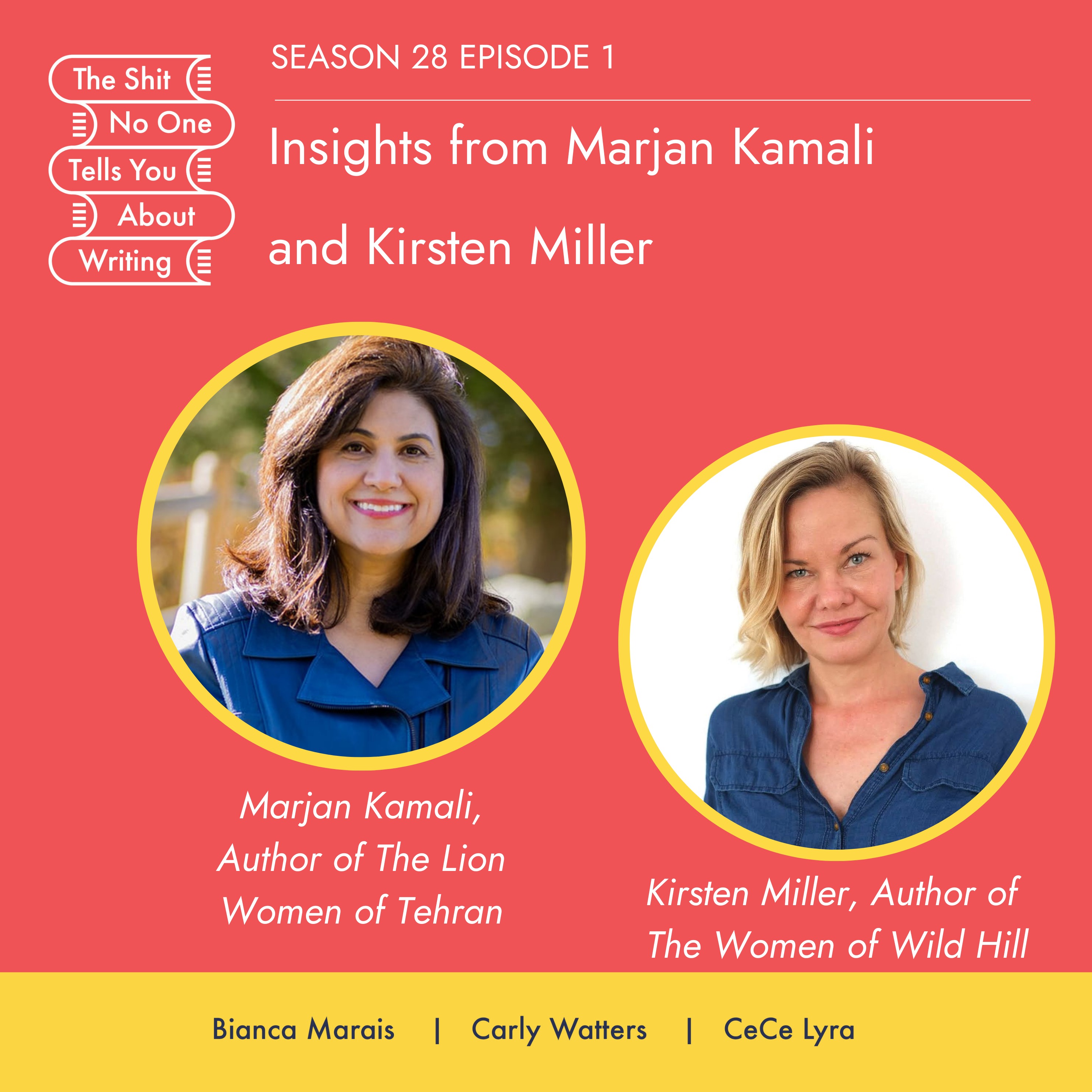
The Shit No One Tells You About Writing
Insights from Marjan Kamali and Kirsten Miller
01:11:39
Author Interviews
Loading summary
Transcript183 lines
- [00:00]
Cece Lehrer
I just got back from my work trip to New York City where it was still very much a summer and when I landed home I was finally able to say it's sweater weather. Yes, and of course we all know that cooler days call for layers that last. And Quince is my go to for quality essentials that feel cozy, look refined and won't blow your budget. Think $50 Mongolian cashmere premium denim that fits like a dream and a new collection of luxe outerwear that you'll be wearing year after year. These are the pieces that'll turn into your fall uniform. I'm eyeing the new wool coats and leather coats. They look designer level but cost a fract of the price and the quality. Honestly, just as good, if not better because Quint partners directly with top tier ethical factories and cuts out the middlemen. They deliver luxury quality pieces at half the price of similar brands. It's the kind of wardrobe upgrade that feels smart, stylish and effortless. I want to reach for my Quint options every time. Both of my Mongolian cashmere items are staples in my wardrobe. I have the cashmere tea in gray. It still blows me away at how soft it is and the Mongolian cashmere mock neck sweater vest in oatmeal. There's something so classy about a sleeveless sweater look because it doesn't bump bunch up in your coat. It is seamless, classy, warm. At these price points, I'm happy to wear them to the hockey rink to watch my kids and out to dinner with friends. The timelessness of them makes them so functional. If you want to be effortlessly chic and warm, I recommend these two picks. Find your fall staples at quince go to quince.com teessnotyaw for free shipping on your order and 365 day returns. Now available in Canada too, that is quince.comtsnatyaw to get free shipping and 365 day returns. Quince.comteessnaya have you been sitting on the.
- [01:37]
Bianca Murray
Fence about signing up for the Beta Reader matchup? Or have you signed up before but haven't as yet found your writing soulmates? The next matchup is the last one of the year, so don't snooze on it. Get matched up with those writing in a similar genre and or time zone so they can critique your work as you critique theirs. Your manuscript doesn't have to be complete to sign up for this review. 3000 word evaluation this particular matchup will be open to registrations from now until the 2nd of November with the matchup emails going out on the 3rd of November. For more information and to register, go to Biancamarae.com and look for the beta reader matchup tab. Please spread the word. Even if you aren't signing up this time, the more writers we have registered, the better the matches will be, which means you'll be paying it forward to your fellow authors. Hi there and welcome to our show, the shit no one tells you about writing. I'm best selling author Bianca Murray and I'm joined by Cece Lehrer of Wendy Sherman Associates and Carly Waters of P.S. literary.
- [02:51]
Cece Lehrer
Hi, everyone. Today's guest is the author of the Change, a Good Morning America book club pick, Lulu Dean's little library of banned books and the groundbreaking YA series starring Kiki Strike. She lives in Brooklyn, New York. It's my pleasure to welcome back Kirsten Miller. Kirsten, welcome to the show.
- [03:09]
Kirsten Miller
Thank you very much for having me.
- [03:10]
Cece Lehrer
Thank you for joining us again. I love your books. I love the Rage. We're going to discuss all of that soon. For our listeners who are not watching on YouTube, you should actually be watching on YouTube. I'm holding up the COVID of the book. It is absolutely glorious.
- [03:28]
Kirsten Miller
I just got the hardcovers yesterday. They're even prettier. It's, it's.
- [03:32]
Cece Lehrer
Yeah, look at that. Oh, my goodness. There's something so special about getting your hardcovers for the first time, right?
- [03:39]
Kirsten Miller
My daughter was like, ooh, they're really pretty.
- [03:41]
Cece Lehrer
Can I, can I actually ask before we actually even go on? So the book we're talking about is the Woman of Wild Hill. Did you ever stay in the COVID Did you get to pick? Because a lot of the times we don't. So I'd love to know if you had any say in this. I did.
- [03:54]
Kirsten Miller
Well, so I've kind of made fire my personal symbol. So all of my books, starting with the, the paperback of the Change, but through Lulu Dean and now the women of Wild Hill, they've all incorporated fire. But I just, I loved the idea of, you know, the whole book is about a family tree and sort of the, the secrets and the, you know, and the gifts and the curses that are, are passed down from one generation to the next. So it's sort of a nice witchy bonfire that also symbolizes the Duncan family tree. I have had in the past more of a say over covers than I think, you know, I have in the past with my young adult books. But they got a brilliant artist to come in and do this. You know, she knew that I wanted to have something that Looked like a bonfire. She knew about the book, so this was what she came up with. And the person who really made the final decision was my daughter, who saw it and. And loved it. And she has good taste, so we went with her.
- [04:52]
Cece Lehrer
I love it. And also at the beginning of the book, we have the Duncan family bloodline. And I like how the bloodline could be like veins, but also could be like lava, which is the same as the COVID image. It could be fire or it could look like lava, which is stunning. So, yeah, I did that.
- [05:10]
Kirsten Miller
I actually made. I made that myself.
- [05:13]
Cece Lehrer
In terms of the bloodline.
- [05:15]
Kirsten Miller
Yeah. No, I. I just. I love the idea of having it, you know, because the. The first chapter is called Blood, and it's all about the things that are passed down from mother to daughter. And so I don't know, it just occurred to me, like, wouldn't it be cool to have a family tree in the form of sort of a, you know, a blood vessel?
- [05:35]
Cece Lehrer
Yeah, that's.
- [05:38]
Marjan Kamali
And.
- [05:38]
Cece Lehrer
And like I say, it could be love as well. So for those of you who are not looking at YouTube, go and look at YouTube. I'm holding it up and it's absolutely gorgeous. And you can see how that's followed through in terms of the COVID Okay, I've gone off on a bit of a tangent. Let me read the flat copy so that everybody knows what we're talking about and then we'll dive in. There are places on earth where nature's powers gather. Girls raised there are bequeathed strange gift. A few are given power so dark that they fear to use them. Such a place is Wild Hill on the tip of Long Island. For centuries, the ghost of a witch murdered by the colonists claimed the beautiful and fertile Wild Hill. Until a young Scottish woman with her own strange gifts arrived. Sadie Duncan was allowed to stay. Five generations of Sadie's descendants called Wild Hill home, each generation more powerful than the last. Then, in the aftermath of a terrible tragedy, the last of the Duncans, once prophesied to be the most powerful of their kind, abandoned their ancestral home. One of them, Bridget, moved to California and turned her dark gift into fame and fortune. Her sister Phoebe settled on a ranch in Texas where women visit in secret for her tonics and cures. Phoebe's daughter Sybil has become a famous chef. Seemingly powerless, Sybil has never been told of the Duncan bloodline. Now Bridget, Phoebe and Sybil have been brought to White Hill to discover their family legacy. The old one, furious at the path mankind has taken, has chosen these three powerful witches to turn the Tide the Duncans will fulfill their destinies, but only if they can set aside their grievances and come together as a family. Don't.
- [07:19]
Kirsten Miller
Don't go.
- [07:20]
Cece Lehrer
Okay, so we're going to get to that soon. We'll discuss the book in more detail. But something I want to discuss first, Kirsten, is how I write from a place of rage. And it's clear you let theory fuel your own writing. And there's lots to fuel it because you bring out a book every year to two years. Can you talk us through your process from when that fury sets in and you have an idea for a book until it gets submitted to your agent or to your editor?
- [07:49]
Kirsten Miller
Yeah, so, I mean, it was, it's. The last three books have come out very quickly. And what's interesting is it seems like I wrote them all very fast, but I actually only wrote. Lula Dean's little library banned books really quickly. The other two took a couple of years, two or three years to write. But yeah, I mean, it's. When you said rage fuels your writing. Yes. And that's what I always tell people. The other day somebody asked me what advice would I give to, you know, aspiring writers. And mine was, you know, you have to, you have to write something that you're passionate about. You know, you have to have something, a subject of vendetta or whatever it is that is going to push you past, you know, all of these self worth doubt, all of the pain and suffering that goes into writing on a daily basis. And you have to have, it has to be a powerful emotion. And for me, rage and revenge are the things that work best. The change was 100% about revenge and Lula Dean was about really sort of, you know, pushing people like women like me who are from the south to sort of get off our butts and do the right thing that we know needs to be done. So it's just you have to find that powerful emotion that's going to give you that energy, is going to give you the fuel to get through the doldrums that happen in every writing process. So for me, it's rage and revenge. For you I guess it is too. But it could also be passionate love. It could be all sorts of different things, but it has to be something powerful. Otherwise, you know, it's just, you're going to peter out somewhere in the middle. It's happened to me before, so I'm speaking from experience.
- [09:27]
Cece Lehrer
Yeah. So it's interesting that you said Lulu Dean was the one that was fast and then the others were a bit slower. Like, I don't know, some books feel like they arrive fully formed, and you're just kind of there to act as a conduit to get the words down on the page. Other books, it feels like, man, you having to dig and toil and work your ass off to get anything on the page. Was the Woman of Wild Hill harder? Was it more of a struggle?
- [09:52]
Kirsten Miller
I wouldn't say it was harder. It did not come out fully formed like Lula Dean did. The change, I really knew what I wanted. So the first draft of the change came out very, very quickly. And then I went back and made a lot of revisions to it and added a lot to it, and that's why it took a little bit longer than I thought it would. Originally. The Women of Wild Hill was. It was. I wouldn't say it was more difficult. It just wasn't fully formed in my head. I was really discovering a lot as I was writing, which is a wonderful experience. I love that. You know, I love the idea of getting to know these characters as you're writing. I mean, like, you know, would do this, and you go off onto a tangent and, you know, discover something new. So I would say that it was more of an exploration than Lula Dean, which was me really kind of sort of spilling out thoughts that I had been thinking about for a very, very long time and just hadn't gotten around writing about.
- [10:54]
Cece Lehrer
Yeah, it's amazing how every book sort of teaches you how to write it. Every book, you think the next one's going to be easier. You know, some of them are easy, and some of them are just really difficult.
- [11:05]
Kirsten Miller
So, yeah, it's always different, and each book is its own. It's. It's like having children. Each one of your children is very, you know, is unique and different and wonderful and problematic in their own special ways. And, you know, books are very much like that. You kind of have to treat them individually.
- [11:23]
Cece Lehrer
Yeah. Yeah, I love that analogy. We'll discuss the ensemble cast a little bit later. In the meantime, I would like to talk about the prologue, because we're always saying on the podcast, you know, a prologue needs to add to the story. It needs to be put there very intentionally. Often, writers will say that they started writing without a prologue, and then it came afterwards. So can you first read us the prologue, please, because it's incredibly powerful. And then I'd like to discuss how it came about and the intentionality behind it. Sure.
- [11:55]
Kirsten Miller
So the prologue, it's called Blood, and it's in the voice, the Witch who was murdered by colonists, she says. Every morning when I was a wee girl, women would come knocking at our cottage door. They came to see my mother, who was known far and wide for her tonics and potions. In the iron cauldron over our fire, she would cook whatever was needed. A remedy for a persistent fever, a salve for a bothersome rash. If she deemed her guest trustworthy, she might fashion a filter to entice a reluctant suitor. A draft that could empty the womb. Or a poison to rid the woman's house of a troublesome pest. Even as a child, I knew what could happen to women like my mother. Her very own sister was put to death by order of the king. When it came time to begin my training, my mother told me what made us different. A powerful elixir flowed through our veins. By then, I knew blood was essential for life to flourish. Spill too much and death would follow. My mother pricked her finger and showed me the drop. Inside were thousands of years of our family history. She told me it held our treasures and secrets and fatal flaws. All of it was passed from mother to infant in an exchange so perilous, it often proved fatal. But if the child lived, it would inherit a unique set of gifts. If it was a girl, she would learn our ways. I wanted nothing more than to follow in my mother's footsteps, but she knew from the moment I was born that I was meant for something different. My gifts would carry me far away to a land we hardly knew existed, to a place called Wild Hill. The Old One had chosen me for a special mission. I was to watch over six generations of the Duncan family and wait for their bloodline to produce the most powerful of our kind. So, yeah, it came after. It was not the first thing I wrote. I wouldn't say it wasn't the last thing I wrote either, but I wanted to begin with that because this is that whole idea of blood and this idea of sort of these treasures and curses being passed down through a family line. It's, you know, at the heart of the book. It's the. The idea that ties everything that you read going forward together. So it was just a wonderful way to kind of make sense of everything that you read after that and introduce us to this character who ends up being incredibly important to the story, even though she's not one of the protagonists. Yeah.
- [14:26]
Cece Lehrer
And, you know, it's so interesting to begin a story with a character who isn't one of the protagonists, but who is so essential, because generally, readers become attached to one of the first characters they see. And in an ensemble cast, we generally say, begin with one of the most important characters and then you flip that on its head. But it gives such brilliant context, especially in terms of a book about witches, because so much about the whole witch law is that this magic is passed down through the maternal line, mother to daughter to granddaughter. And so it goes. And that just sets it up so perfectly.
- [15:02]
Kirsten Miller
Yeah. And also, you know, in that, I mean, it's only a page long, but it foreshadows a lot of what happens in the book. Sort of the dangers that these women face from the outside world, the punishment that society will often deliver to them. You get a sense of a lot of what's going to happen just in that one very short passage.
- [15:24]
Cece Lehrer
Yeah. It's amazing how this gift gets handed down, but you get punished so much for having this gift. Right. It's such a double edged sword.
- [15:33]
Kirsten Miller
Yes, yes. This is one of the other sort of themes that kind of recurs throughout the book is this idea that blessings always come with sacrifice. The concept that most people would understand is this sort of yin and yang. There's the dark and the light, everything is in balance. And so this idea of gifts being sort of given to these, you know, to these women who've been chosen as special. They've also learned, you know, throughout their childhood, those blessings come with sacrifices as well.
- [16:06]
Cece Lehrer
It also speaks to so much about what it is to be a woman because women are raised to be, you know, self sacrificing in the name of motherhood, in the name of so many things. Whereas men are allowed to pursue something because they want it for themselves and they will get the benefit of it. But women are taught to constantly sacrifice themselves for the greater good and for everyone else's happiness. And so I love how that ties together with so much of the story.
- [16:33]
Kirsten Miller
Yeah, there's. There's actually a passage in the book at one point where it's the witch Bessie, which by the way, I named her Bessie because that is. I mean, she's a. She's Scottish and she, she comes from the time when women and witches were persecuted in Scotland by the king.
- [16:48]
Cece Lehrer
Yeah.
- [16:48]
Kirsten Miller
Now there's a. There's a part of the book where she talks about how men's sacrifices are sung about. You know, they're monuments of built, there are statues erected, and yet every time a woman goes to give birth, she stands right on that threshold of life and death. And a lot of women don't make it even today. And, you know, these are the sacrifices that we make to keep the world, to keep humankind going. And it's something that we do quietly without the statues and without the songs and without the. The glorious epics. But it's every bit as courageous as anything else that's ever been done. And we do it all the time.
- [17:37]
Cece Lehrer
Yeah, absolutely. So, okay, you break the novel up into parts like weird sisters, the three, etc. How does that help the structure of the story? Was it something that was there up front? Was it, as you wrote, you decided to split it up in terms that kind of structure? Again, I'm thinking about the intentionality in terms of how that helped you frame the story.
- [18:01]
Kirsten Miller
So the upfront section is where you meet the. The three modern protagonists. You know, the. The final two generations of this family are meant to do something. There's a prophecy that's been around for 100 plus years that the final three were going to turn the tide. And so you meet them and you get a sense of who they are and what has happened to them. And then there. There's a break. There's a terrible TR that ends up tearing this family in these final three apart. And then in the second part, you go back into the family's history and you meet the other generations of the Duncans. And it's really, It's. It's funny because somebody described it as backstory, but it's not backstory at all. You are finding out how the gifts that they are going to use to do what needs to be done are handed down from generation to generation. And you see. See it pass from line to line. And you see what their mission is going to be becomes clearer and clearer as you sort of meet each of these women who's come before. And then by the time you're out of that period where you're sort of learning about the previous four or five generations, you know what it is that they're supposed to do. And then the third part is them taking action, finally coming together and doing what needs to be done.
- [19:25]
Cece Lehrer
Yeah, I loved how you jumped back and forth in time. So it's definitely not backstory. It's like multiple timelines and it's like a braided narrative and it weaves together and we have some chapters in the first person from the old one's perspective that are interspersed throughout. It's like this connective tissue throughout. Did you write it the way we see it now, or did you write it in a more linear way and then decide to move things around in terms of maintaining tension in the story in terms of what the reader knows and what the reader doesn't know.
- [19:58]
Kirsten Miller
I knew that I wanted it to sort of to work the way that it does, but it's just, you know, you never get it right the first time. You're constantly moving things around and especially with these interstitial chapters which are the witch Bessie talking, but she's basically explaining how this world works. She's explaining sort of, you know, why things are the way they are. And so she's giving this very, very powerful sort of information about how this sort of world of powerful women works, what they're meant to do and her role in it all. So I knew that that was how I wanted it to work. But especially when you're writing something that has as many moving parts, you end up rearranging things. Throughout the course of writing, I never ever just sit down and get it perfect. And it's, it's not just about the story either. It's about, it's about maintaining the momentum and making sure that any lulls and the action are kind of filled in so that you get this sense of the pace. But also, you know, you know, you don't forget any of the main characters. You're constantly sort of moving forward. And that's a tricky thing to do. It does require sort of making sure that everything's exactly where you need it to be.
- [21:15]
Cece Lehrer
Yeah, it's like a tuning fork. There's a lot of calibration that needs to happen because, you know, you want a lot happening in the present day timeline. And every time you move back, you want to make sure that that is not slowing down the pacing, that it's revealing things that help the narrative move forward. So, yeah, I can imagine it's a lot of moving parts. And I want to read just one section here. It's called the Old One. In my time, men believed witches worked for Satan. They didn't think women could wreak mayhem without a man giving orders. They claimed we were doing the devil's bidding when we made the butcher's pecker stop working. Or the farmer's heifer birth a two headed calf. Now, when faced with misfortune, most men turn to science for an answer. They don't burn women these days, which I reckon is progress. And often there is a rational explanation for their woes. But sometimes, to be honest, a witch is to blame when their dicks go all soft. I've been around for a very long time and I've eavesdropped on many a learned man. The truth is, women will always confuse Them witches or not, they're not sure how we work. Women are clearly in league with nature. Even our cycles follow those of the moon. We create life out of little and intuit things that men don't. We terrify them because we possess powers they aren't able to plunder because they'll never be able to do what we can. They decided long ago to declare us inferior. Oh, my goodness. If that doesn't just, like, sum up everything. How long did that take you to write? Please tell me that took you a while. Because I swear, if you wrote that in, like, one sitting like that, I'm going to have to hate you for all eternity.
- [22:53]
Kirsten Miller
No, I'll tell you what it was. It was something that I worked on. There were a couple of those chapters like that that I really am proud of because they very much. I mean, they explain my view of witchcraft, which I think everybody's got their own definition. I didn't just sit down and write them. These were things that I had been thinking about for a very long time. In fact, the whole idea of this book came from something that I wrote. I was asked to write for an art exhibition where the theme was female. And I was asked to write the opening of this exhibit on that theme. And so I wrote. I think part of that came from that and part of it is used elsewhere, but just this idea that we have these powers that men don't, and that. That the fear of those powers and the sort of insecurity that comes from knowing that they aren't quite as powerful as we are is. Is kind of the origin of a lot of our problems. You know what I mean? So it came from that. So it was an idea that I had been thinking about for a long time, and it actually was kind of the inspiration for the book itself.
- [24:08]
Cece Lehrer
Yeah, it's like the bedrock for it, which was incredible. I want to read another one here as well, which, again, for our listeners, we constantly talk about curiosity seeds. You know, you need to make the reader actively curious about something so that when they get to it later, it feels like a payoff. And there's just this one paragraph. It's called the Trespasser. Five years after the girls left, a young man slipped over the wall in the dead of night, snuck into the caretaker's house and walked through all the rooms. He didn't take anything. He didn't rifle through drawers. I doubt he knew what he was after. Then he found it. He stood on Flora's grave with his hands shoved in his pockets and studied the Name etched into the stone. I hadn't spoken to a man in almost 400 years. As a rule, I avoided them. That one should allow for exceptions to every rule, and made an exception for him. And it was just over there. And then we move on to the three. And it just incites so much curiosity. You're like, okay, who is he? Why did she make an exception? Et cetera. So, again, that's something that. Did you have to calibrate where you were going to put that, because the kind of thing that needs to be put at the perfect space because if it's too late, it's not as effective. If it's too early, the reader might forget it. Yeah.
- [25:23]
Kirsten Miller
I mean, it's one of those things. It was not in my outline. It was not something that I had originally had in the kind of the grand plan of the book. But it was just. It felt so right at that moment, because he does end up being a very important character. And I wanted him to have the witch's stamp of approval. And it was just sort of. It was one of those. It was. It was one of those things that you discover in the course of exploring this world that you're in, these people that you've met and from everything that had happened, which, you know, would require spoilers.
- [26:00]
Cece Lehrer
Give those. Yeah.
- [26:01]
Kirsten Miller
So I think that I ended up writing that after I got to know who he was, what his personality was like, and it had really fleshed out the events that kind of led up to that moment. It just made absolutely perfect sense that he would break into this estate to try to figure things out, and he would come across the entity that had had sort of set the whole narrative in motion. So. But I like that. But it's also fun. Like, I love that, you know, half of writing is just keeping yourself entertained. And I've always said that I know something's gone off when I'm bored. And I think originally, like, when I first started writing, if I would, you know, get to a point in a book where I was just bored to tears, I would set it aside. I think that's kind of the natural inclination is like, ah, this is going nowhere. I'm going to get rid of it. But if you sit back and you think about it and you say, okay, what would I want at this moment?
- [27:02]
Cece Lehrer
Like, maybe.
- [27:03]
Marjan Kamali
Maybe.
- [27:04]
Kirsten Miller
Maybe the energy has dipped a little bit. What kind of punch can I give at this moment that would, you know, excite me if I were reading? That would make me want to move on to the next chapter. And if you sit back and you think about it. You know, you will often come up with something like that. You know, it's the perfect moment for. You're like, oh, what the hell is going on? Who is this person? What's going to happen? So.
- [27:30]
Cece Lehrer
And I love the thought of, you know, moving ahead, then coming back, because that's how I write as well. So, you know, as you get to know things, you're able to come back in, plant some curiosity seeds, refer to the person in a way that feels organic, so that when we get to that person, we prepared for them. You've foreshadowed them. The reader is, like, ready for them. So. Okay, Kirsten, we have time for, like, one more question. I want to speak about the ensemble caste. People with different powers, differentiating them on the page, naming them. Can you speak a bit about that process?
- [28:02]
Kirsten Miller
Well, they're all named after goddesses and powerful women, which was, you know, intentional and also my favorite names. I love Phoebe and Bridget and Sybil and Lilith. But I think I had the names before I had the characters, and each of the names really helped inform who these characters were. Lilith is exactly what you would kind of expect Lilith to be. And Sadie is very carefree and wild and just sort of completely untamed. But I thought about it. You know, I kept. I wanted to. I always had my own family in mind as I was writing this and that sort of experience of discovering things that had been passed down. And so as I was creating these characters, because they're all related, they're all in this bloodline, you know, I wanted to make sure that they were very different, but that you. But you kind of got a sense of where they were getting everything from. You know, it was very much a family. It wasn't just eight. I think it's eight in the end, you know, completely unique individuals who have absolutely nothing in common. They're all informed by this family history. They're all informed by the tragic events that have taken place in their lives. And they all have, you know, these gifts that they've gotten from earlier generations. So as I was coming up with these characters, I was very, very careful to make sure that it felt like a family in the end more than anything.
- [29:37]
Marjan Kamali
Yeah.
- [29:38]
Cece Lehrer
And so many of them, who they are is in response to who the other people are. Right. And that's so true in life because we get forged by all the people who we come into contact with, and sometimes we'll become a certain way in response to somebody else's influence over us. So it was Really a wonderful exploration of that.
- [29:58]
Kirsten Miller
Yeah. It's also about how you're not defined by. I think we all grew up in families where we're given labels, you know, as little kids, like, you're the sweet one and you're the smart one and you're the talent, you know, and. And as you grow older, it's, it's you. You find yourself still wearing these labels that no longer apply. And that's what's kind of happened in this family. And so it's, it's about how family defines us, but also how it gets us wrong.
- [30:23]
Cece Lehrer
Yeah, yeah. And then how we correct that as well. Oh, Kirsten, it was wonderful, wonderful chatting with you. For our listeners, the woman of Wild Hill, we're linking to it on our bookshop.org affiliate page. If you get the book there, you support the podcast and an independent bookstore at the same time. Get this book. It is one heck of a ride. I absolutely loved it. And we can't wait to have you back again, Kirsten. Thank you.
- [30:45]
Kirsten Miller
Thank you so much.
- [30:47]
Carly Waters
Welcome, everyone.
- [30:49]
Cece Lehrer
Hey, everybody. Guess who's back from France. I was thinking of you guys listening to me talk about getting ready for the trip and practicing my French while I was doing my best to order a francais at the cafes. It went well. I was a bit nervous, but when we were in the countryside and I could take my time thinking about what I wanted to say, I was able to say it. Being a bilingual family is high on my list of things that are super important to me as a parent and a mom. If we're going to show them the world, we also need to appreciate and respect the language and culture by learning it. Imagine how much richer your travel experience could be if you could speak the local languages. When you travel with Rosetta Stone, you'll gain the confidence to have real conversations and create deeper connections wherever you go. Rosetta Stone is the trusted leader in language learning for over 30 years. Their immersive, intuitive method helps you naturally absorb and retain your new language on desktop or mobile, whenever and wherever it fits your summer schedule. With 30 years of experience, millions of users, and 25 languages to choose from, including Spanish, French, German, Japanese, and more. Rosetta Stone is the go to tool for real language growth. You can learn faster and retain longer. There's no English translations. You truly learn to speak, listen and think in your chosen language. There's an intuitive learning process. You start with words, build the phrases, and progress to full sentences. It's designed for long term retention so it sticks with you. You can work on your accent with the built in truaxent speech recognition technology so help you sound more natural. You can learn anytime, anywhere. It fits with your lifestyle with a flexible on the go learning style desktop or mobile app and there's incredible value. A lifetime membership gives you access to all 25 langu so you can learn as many as you want whenever you want. Don't wait. Unlock your language learning potential. Now the shit about writing listeners can grab Rosetta Stone's lifetime membership for 50% off. That's unlimited access to 25 language courses for life. Visit Rosetta Stone slash Visit Rosetta Stone.com today to get started and claim your 50% off today. Don't miss out. Go to Rosetta Stone.com today and start learning today. You know I am not exaggerating when I say my coffee is my life. My brain doesn't come online until I've had that first amazing cup in the morning. And as writers who spend so much time and staring and thinking out of screen, you need that moment of ritual and focus more than anyone. For years I was chasing that perfect cup, but between messy presses and clunky pour over setups, I was spending more time on the brew method than at my desk. And if you haven't tried coffee made with an Aeropress yet, you are absolutely in for a treat. The AeroPress is a manual coffee maker, kind of like a French press, but frankly it's just better. It uses completely unique brewing methods that combine the best of all the worlds. A little French press, a little pour over, and a little Espresso. This patented 3 in 1 technology gives you an exceptionally delicious and unique cup of classic coffee that you can only get with an AeroPress. And here's the coffee secret you need to know. Aeropress coffee is less bitter than coffee made with other methods because it brews faster. You can actually taste the delicious notes of the coffee you bought. Things like the roast and the country of origin and that flavor profile instead of bitterness, you get incredibly smooth richness and body coming through that unmatched. This is the ultimate lifestyle hack for a writer because aeropress was designed to fit your life. For the audience who spends hours in front of their computers, here's why the Aeropress Clear model is what you need. First, convenience. This is the fastest single cup coffee maker I've ever used. It takes about two minutes to brew and clean. That means less time futzing with gear and more time on your pages. Secondly, it brings consistently great coffee wherever you are. Maybe you're traveling for a conference in a cabin for a writing retreat or just working out on your deck. The AeroPress is compact, durable and reliable, and it puts an end to bad coffee when you're on the road. It's the perfect, easy to clean solution for the office, your home desk, or anywhere your writing takes you. The AeroPress is shockingly affordable. Less than 50 bucks and we've got an incredible offer for our audience. Visit aeropress.com t s n o t y a w that's a e r o p r e s s.com t s n o T Y a w and use the promo code T Snotya to save 20% off your order. That's Aeropress.com/T Snotyaw and be sure to use the code T S N O T Y A W at checkout to save 20%. It's time to ditch the drive thru, toss the French press and say yes to better mornings fueled by Better Coffee. AeroPress ships to the USA and over 60 countries around the world and we thank AeroPress for sponsoring our show.
- [34:57]
Carly Waters
Welcome to a very special episode of our podcast. I am very, very happy to introduce a guest that I have been wanting to interview for the longest time. I will read her biolog so Marjan Kamali is the New York Times Best selling author of the Lion Women of Tehran, an instant national bestseller, the Stationery Shop, a national and international bestseller, and Together C a Massachusetts Book Award finalist. Marjan's novels are published in translation in more than 30 languages. She's a 2022 recipient of the National Endowment for the Arts Creative Writing Fellowship. Marjan holds a Bachelor's Degree in English Literature from the University of California, Berkeley, a Master's of Business Administration from Columbia University, and a Master's of Fine Arts in Creative Writing from New York University. Her essays have appeared in the Wall Street Journal, Literary Hub and the Los Angeles Review of Books. Born in Turkey to Iranian parents, Marjan spent her childhood in Turkey, Iran, Germany, Kenya, and the us. She lives in the Boston area with her family. Welcome Marjan.
- [36:12]
Marjan Kamali
Thank you so much. Cece, thank you so much for having me.
- [36:16]
Carly Waters
I am especially excited to have you. And you know, we talked a little bit about this before we started recording, but because I mean, I feel like I have plenty of special connections to your book. But I'll share two. The first is that back in December when my mother in law came to visit, she comes to visit usually around Christmas. Every year she and I always read a book together and the book we read last year was of course the Lion Woman of Tehran. And we kind of have a little mini book club thing going where it's so fun and it's a great way to spend time together and, you know, get to read at the same time, but also get to connect through a book. And we did that through your novel and it was really special and it spurred some really interesting conversations. I know she's listening because she listens to every episode. So, Ana, thank you for doing that with me. And then of course, the second connection that I should highlight is that you are Wendy Sherman's client. So everyone knows that I've moved agencies. Marjan, I don't know if you're the first Wendy Sherman Associates author, but yay. Whether you are or not, yay. We're excited to have you.
- [37:15]
Marjan Kamali
Thank you so much. I'm so excited to be here because I've been following you and seeing your tremendous energy and passion and I think sometimes you can just tell a person's spirit. And I felt sort of in simpatico. So I'm very excited to be here. And I love that you read the book with your mother in law. That is beautiful. Yeah, yeah.
- [37:38]
Carly Waters
It's a great way to connect. I think, you know, we. We just need more connection in our world. Would you agree? I think we do.
- [37:45]
Marjan Kamali
I would agree. I would agree. And this is the best way to connect through stories because I feel when people can connect to characters in a book, it's a way of them feeling less alone and seeing just how universal so many emotions and experiences are. And it's kind of the opposite of, I feel, what's being driven today through social media, which is more dividing and more making people feel as though they're in these siloed communities. So it's an antidote to that division.
- [38:27]
Carly Waters
I love that stories as an antidote to division. That is a great point. So Lion Women of Tehran is your latest novel, but it is not your first novel. Tell us about your experience putting out your first novel versus your most recent one. What has stayed the same? If anything, what is different? Like, take us to that journey, you know, for context. Our listeners are. We have publishing professionals who listen to us. We have, you know, accomplished authors who listen to us. But I feel like it's fair to say that most of our listeners are aspiring authors. They're writing, but they haven't published yet. And so I know they would be really interested in hearing from someone who has your track record what stays the same, what's different. Could you talk a little bit about that?
- [39:12]
Marjan Kamali
Well, for me, it's A world of difference. Because my first novel between when I wrote the first few sentences in my spiral notebook at the back of a business school lecture hall, I'll have you know, to when it actually was being sold in bookshops, that time period was 13 years. So it took me 13 years to get it published, and six of those 13 years, I took off. But I think the most different aspect between then and now is when you're first starting out and I'm speaking to your aspiring writers, your aspiring authors, because deep in my heart, I'm always that, you know, no matter how established you become, what level of success you achieve, you never forget that feeling. It's always with you. And what I would say to those listeners is, we're often told that life is short, and we're often told that, you know, we need to hurry it up. But I would say to them, please remember that life is long and you need to throw away the clock. Stop putting pressure on yourself. I need to be published by 30. I need to be published by 40. None of that is true. You just have to tell the story you want to tell in the best way you possibly can. If that takes 13 years, so be it. If I were to tell you today, Cece, that my first novel, together, Tea, came out in 2013 versus 2010 versus 2007, would you really care? I mean, would you be like, oh, my goodness, no. Because what matters is that the book is good. But at the time, you know, those timelines really seem to matter to me. But I learned to let go of that pressure.
- [41:01]
Carly Waters
I feel like people are going to think that I asked you to say that. I did not everyone, if you are listening, I did not ask. I had no idea she was about to say this. It's just that, you know, my big thing on the podcast is always ambition over anxiety. Like, put your ambition first. You know, it's your anxiety that's making you say or determine that you have to be published by 30, 40, 50, whatever it is, it's. It is all nonsense. You are so.
- [41:24]
Marjan Kamali
It is all nonsense. All nonsense.
- [41:27]
Carly Waters
I love that. And I think that you'd agree that the reason why you are so successful is, in part, it's always a combination of factors. But the fact that you did put your ambition over your anxiety. Right? The ambition to tell the best possible story. I love that.
- [41:41]
Marjan Kamali
It took some trials and it took some stops and starts and great advice from wonderful teachers for me to get there.
- [41:48]
Carly Waters
Yeah.
- [41:49]
Marjan Kamali
I don't want to pretend that was my mindset in my twenties. But I learned. I learned that just the deep importance of patience. Wow. Okay.
- [41:59]
Carly Waters
I'm like, touched by this. So what would you say was the single best decision that you've ever made that contributed positively to your writing career other than honoring patients? It could be like an investment. It could be like getting an mfa. It could be joining a writing group. It could be, I don't know, reading books intentionally. I don't know what it would be. And I also don't mean to kind of give you a multiple choice answer, because that would be ridiculous. But what would you say was, like, the very best decision you've ever made? Looking back, you'd be like, ah, that was really smart, Martin.
- [42:32]
Marjan Kamali
The best decision I made was to listen to my inner core above all else. Because for a long time I kept waiting for other people to come on board with my desire to become a writer. I kept waiting for my mother to throw her arms around me and say, fantastic, What a beautiful idea you have. Or I kept waiting for the other moms in the school at the pickup line to be like, you know what? I'm really excited that you want to write a book and I can't wait to read it. Things like that, those things may happen for you, they may not happen for you. It's completely irrelevant. You don't need anybody's encouragement, nor their permission, nor their approval. All you need is to know inside yourself, this is what I want to do. This is what I need to do. This is something I will give myself and as long as it takes. And I think once you realize that, at the end of the day, it's really not about the other people. They're wonderful. They can be incredible sources of support and encouragement, perhaps. But that is really irrelevant. You have to trust your inner core, and you have to listen to that and know that that's sort of your moral compass.
- [44:02]
Carly Waters
So interesting. And eventually, though, you started working with an agent and editors and a team, right? Like, eventually it wasn't you in isolation, I suppose. How did you reconcile that? Like, did you ever get advice, perhaps editorial direction, perhaps something else that you were, like, struggling with that you disagreed with? How do you maintain that balance, I guess, is my question.
- [44:25]
Marjan Kamali
Well, it's sort of part and parcel of the same philosophy, obviously, in order to get your books published and in order to have them reach an audience. You cannot do it alone. You do need a team. You need a good team. But it's part and parcel of the same philosophy because you hopefully are in a position of privilege where you align yourself with people who share that same vision and who share your same sort of long term goals. Early on in my career, Cece, I got some terrible advice. I was told to do things to my first book very early days, you know, when I was still workshopping it, for example, in classrooms. And I just, I remember sometimes you can just tell. Your instinct tells you no. You know, I remember in one of my workshops, somebody said, well, we don't need another Iranian American story that's about, you know, a young woman who's supposed to get married. And I thought, but actually we could have a hundred of those. And that's okay. You know, every step of the way, more and more people join your team, and that's a beautiful thing. It's a little like when Dorothy is going through her journey in the wizard of Oz, and first she meets the Scarecrow and then she meets the Tin Man. And all along you gain characters in your journey, but if they're aligned with who you are, that is, I think, a very important thing. And I'm so blessed right now to have an amazing team. And it is a team. I do not get the line women of Tehran, for example, out into the world alone. There is an entire team of line women who work so hard to make it happen.
- [46:18]
Carly Waters
Love that. Speaking of the book being out in the world, I feel like the average person, not our listeners. Our listeners are very smart and know better. But the average human on the street would think of writing as a solitary profession, as like, oh, this writer sitting down, typing away in their laptop. You know, maybe they have tea with them, maybe they have, I don't know, a glass of wine. But like, it's just writing. It's just you and the muse and everyone else does all the other stuff. You know, the editor does the editing, the publicist does the publicizing. And we know that's not true. We live in a world where authors are expected to promote their book, to come on podcasts such as their own, to tour, to use their connections and really leverage sales. Because the artner is expected to be a partner in all things. Not just a partner who produces the material, the writing material. How has this changed throughout your career? And how do you. I guess, how do you see that part of being a writer? Because you're very good at it. I've heard your videos, you know, like, I've seen you speak. You're very good at it. Do you struggle at all? Are you a secret introvert? How do you approach that?
- [47:22]
Marjan Kamali
Part of has changed since I first started out. Because when I first started out, for example, social media wasn't as huge as it is now. Podcasts were not a thing the way they are now. The truth is that a lot of authors, when they're writing the book, there is a lot of solitary time. You have to be comfortable with being by yourself a lot, but you're not really ever by yourself because if you're doing the writing, you're with your characters and you are usually very interesting company. So for example, for the line Women of Tehran for two and a half years, I was writing the first draft. A lot of it was during the pandemic, you know, the lockdown days. And I, I didn't feel alone because I was with Ellie, I was with Homa. And then once the book comes out, it's as though you emerge from your little writing cave and you're out into the bright sunshine and into the world and suddenly there's crowds and you're shaking hands and you're giving talks. I think I'm lucky because I like all of it. A lot of my colleagues, a lot of my friends who are authors, they love, for example, the writing part, but they hate the promotional part. I kind of like both and I enjoy both when I'm sitting alone and with the characters and sometimes it can be very rough because I am very much in this cave. But when I'm out there on book tour and meeting people, God, I adore that too. I cannot tell a lie because it's as though this magic trick has happened. People come up to me and they talk to me about the characters and I keep thinking, how did you know about that? Because I was making them up in my room. And then, you know, it incredibly fulfilling to think that figments of your imagination have touched people and helped shape them and made them even sometimes have a good cry or heal, have a catharsis. So, yeah, I do enjoy all of it. And to your aspiring author listeners, I would say, why would you just contain yourself to one aspect of is harder, I think for introverts that I get. But it's different when it's your book you're talking about. It's somehow a little easier to go out there.
- [49:56]
Carly Waters
For sure. No, for sure. It has to be easier because like you said, you're talking about figments of your imagination that through the power of a collective shared consciousness and imagination become real, right?
- [50:11]
Marjan Kamali
Yes.
- [50:11]
Carly Waters
It's like you said, it's magic. It's amazing. So on the subject, since we're getting a little woo woo, which I like, I'm A little bit of a woo woo person.
- [50:20]
Marjan Kamali
I am, too.
- [50:20]
Carly Waters
Evil eye.
- [50:21]
Marjan Kamali
Yeah, evil eye.
- [50:22]
Carly Waters
The evil eye is a big thing in this book, guys. The evil eye. If you've not read the Lion Woman of Tehran, what are you doing with your life? Go read it now. I'm not ruining anything and asking this question, but let's just say that the protagonist, Ellie, has heard her whole life from her mother that the evil eye is real and that she should watch out for the evil eye. My question is evil eye real or not?
- [50:45]
Marjan Kamali
So when you've been raised with this concept of the evil eye, even if you can embrace its fallacy and acknowledge it's just a superstition, it's still at the back of your mind and there's a part of you that thinks it's real. In the Persian culture, the idea of the evil eye is very prevalent, and once it gets into your brain, it's very hard to remove it. And I've learned through meeting readers, it's. It's prevalent in so many different cultures.
- [51:15]
Carly Waters
So many cultures. Yes, I was gonna say that.
- [51:17]
Marjan Kamali
Yeah, yeah. I mean, it's in so many cultures, believe me.
- [51:21]
Carly Waters
Yeah.
- [51:22]
Marjan Kamali
And you know what? I think that. I mean, obviously Ellie's mom goes a little overboard, and poor Ellie can't seem to shake that inner insecurity that it creates inside of her. But I think it is partially real. I do. I hope you forgive me. On my good days, I know it's fake. Okay. Okay.
- [51:44]
Kirsten Miller
Okay.
- [51:45]
Marjan Kamali
I just think, how could it be in so many cultures across this globe that there's a reason.
- [51:52]
Carly Waters
Of course it's real. Like, if you had told me that it wasn't, I'd be like, oh, Marjan, what are you talking about? Like, it's real. And by the way, listeners, my grandma has a great recipe to ward off the evil eye. You take salt. Salt, okay. And throw it over your left shoulder. I do this all the time. All the time. All the time. Okay. Salt, left shoulder. And also try. Whenever you think of the person who you think is thinking of you uncharitably, think of them with. Filled with happiness and love. Think of them being imbued by the most, by the bluest of lights, because I believe that everything we put out comes back twice, you know, comes back doubled. And so if we are thinking beautiful thoughts about others, then beautiful thoughts come back to us. And anyway, I. I have. I have a lot of thoughts on the evil eye.
- [52:39]
Cece Lehrer
I feel like.
- [52:39]
Marjan Kamali
I love that. I love the tip about thinking of that person with such goodwill. That is very Good.
- [52:46]
Cece Lehrer
And.
- [52:46]
Carly Waters
And, you know, I. I'm not trying to pretend like I'm not human and I don't have uncharitable thoughts because I do. I just force my brain. I go, okay, do it intentionally. And I picture the person and I picture them really happy. Like, really, really happy. Filled with love. Filled with, like, happiness and joy and to a level, like, elated, like, beatific. Right. I think of them really happy, and I imagine them being healthy and being filled with love. Filled with love is very important. A person who's filled with love isn't casting the evil eye on anyone else.
- [53:14]
Marjan Kamali
Right.
- [53:14]
Carly Waters
Because they're filled with love.
- [53:15]
Marjan Kamali
They're too busy doing that.
- [53:16]
Kirsten Miller
Yes.
- [53:17]
Carly Waters
So very important. Very important. Now, not to get off track because our listeners are very much used to my woo woo ways, but I want to ask about something that's totally different. I want to ask about something that's very practical, very pragmatic, very real. Success. How do you measure success? When you first started writing and you were, like, picturing yourself as a successful author, I know you were, because every writer does. Did you think, if this happens, I'll be successful? If this happens, I will have made it, and if so, what was the thing or things?
- [53:53]
Marjan Kamali
Oh, my goodness. I thought, if I get an agent, that's it. And then I thought, if I publish my first book, that's it, I'll be happy for the rest of my life. And then I thought, if my book wins an award, that's it. Or if, you know, but the goalposts keep moving. It's human nature. So sometimes my husband makes fun of me because in my current state, obviously now the ambitions are far loftier, the goalposts have moved. And I'll say something like, oh, I can't believe I was in the New York Times bestseller list only for this amount of time. And he'll say, listen to yourself. Listen to yourself. You thought if you got an agent, that was. You were done. It was great. So, you know, it's human nature to do that. We always adjust, don't we? We adjust to what we have. But true success, quite frankly, and no spoilers. But at the end of the line, Women of Tehran. Homa. I won't say who she's writing to, though I suppose I just gave a bit of a spoiler away because some people may not know she's still there at the end of the book. But regardless, Homa says, I don't wish success for you. I don't wish all these lofty things for you. I just wish for you, the ability to be free. And I think that's true success. And when I think of the ability to be free, it doesn't mean I can go march in the streets, per se, or freedom of speech, freedom of religion. Those are all so important. But inner freedom. Inner freedom to be free from constantly worrying about what other people think, or to be free from always, you know, feeling like you have to strive or perform. That's true freedom. So that's real success. I think, Cece, we keep trying not to be woo woo. And I keep reeling us back into it, but it's beautiful.
- [55:59]
Kirsten Miller
I love it, though.
- [56:00]
Carly Waters
Like, I'm getting emotional right now because I have never thought about it this way. And as soon as you said it, I knew it was true. Like, I had never been able to put it in these words. And God knows I talk a lot, so I put a lot of things into words. That is so true. Okay, I was gonna say, well, the real success for our listeners is the fact that you sell copies so steadily. Like, I feel like a lot of writers have these goals. New York Times bestseller list, USA Today bestseller list, six figure deal, whatever. And these are all great goals, amazing goals. Please continue to have all these goals, people. But the thing anyone in publishing, agent, editor, publicist, publisher, anyone wants most of all is a book that keeps selling like a book where every week thousands of copies are being sold. And that's your book. Your book sells thousands of copies every single week steadily. And that is amazing. Now, I had this whole spiel, as you can see about this, but no, you're so right. Never mind. Never mind the constant selling, people. Let us listen to inner freedom. This is beautiful. This is beautiful. We can have both.
- [57:08]
Cece Lehrer
We don't have to choose.
- [57:08]
Carly Waters
I know. We don't have to choose.
- [57:09]
Marjan Kamali
We can have both. And dare I say, Dare I say, if you focus on your inner freedom and sort of that truth, maybe it might reflect a bit more in your writing and speak to people. So it's not unrelated, I think. I don't know. It's hard to say.
- [57:33]
Carly Waters
I love this. I'm like, this is the most emotional I've ever gotten in an interview. Get it together, Cece.
- [57:38]
Marjan Kamali
Get it together.
- [57:39]
Carly Waters
I wanted to talk about specific writing techniques you rely on. I guess I'll start by asking. This is not a spoiler because it's in the very beginning of the book, but lion and Woman of Tehran starts with. It's not called a prologue, Marjan, but I'm just gonna be honest with you. It's a Prologue. Chapter one is a prologue. Ellie is an adult in New York in the 80s, right?
- [58:00]
Marjan Kamali
Yes.
- [58:00]
Carly Waters
And then chapter two, she's a seven year old child. So you can call it chapter one. I call it a sneaky prologue, which I'm totally in favor of. We are pro sneaky prologues.
- [58:09]
Marjan Kamali
You're so observant. Because for the longest time it was the prologue. So I did name it the prologue initially. So wait, then why did it change?
- [58:16]
Carly Waters
Why did people make it chapter one then?
- [58:18]
Marjan Kamali
We just made it chapter one. Yeah.
- [58:20]
Carly Waters
Just no big behind it. Yeah.
- [58:23]
Marjan Kamali
Just did it. No, yeah, yeah. But in my mind, it was in my draft, always prologue.
- [58:28]
Carly Waters
Interesting. Okay, well then my question is, has it always. Because you could have just started the book with Ellie as a seven year old, where you start chapter two. Right. Like, have you always had this prologue? Was that something that you added? What we always say on the show is the job of a prologue is to add mood and. Or mystery. So one or the other. The best ones do both. Your prologue definitely adds mood, like so much, but it also adds an overarching mystery to the story, which is, why did Ellie and Homa. Why are they no longer in speaking terms? Because in the prologue, Ellie is in New York and she gets a letter from Homa. She hasn't heard from Homa in a long time. And her mom says, and I'm not reading from the book, but her mom says something like, you know, it's good. It's good that she reached out because it's about time that you two talk it out. Something like that. You know, indicating a potential conflict, a falling out.
- [59:24]
Marjan Kamali
Her husband says that. Actually, her husband says, Ellie says, totally.
- [59:28]
Carly Waters
Thought it was Ellie's mom.
- [59:29]
Marjan Kamali
Yeah, he says it. He says it's time. It's time for you guys too.
- [59:34]
Cece Lehrer
Yeah.
- [59:35]
Carly Waters
So with that simple prologue, what are we adding in terms of layers of relationship? We're adding that her husband knows what's going on, which is. Which shows the strength of their relationship. That's really important. We're adding there's an overarching mystery between Ellie and Homa. So when we see Ellie and Homa become friends when they're seven, we know something's gonna go wrong at some point. We don't know when. My question is, when you added that prologue, were you trying to add that Microsoft history, like, what was the goal? Has it always been there? How did this evolve? I am fascinated by how the finished product. Right. And YouTube listeners can see me holding it up. What, like, what were the previous iterations of this Finished product. I think that's really fascinating.
- [60:14]
Marjan Kamali
So many previous iterations. It's such an evolving process. Here's the thing. I've written three novels so far, and in all three of these books, we start a little bit into the future and then we go back in time. That's just my thing. I love the prologue. And you are correct in the line, Women of Tehran. The prologue, chapter one, is really the prologue. Here's what I'm trying to do. I want the reader to be introduced to these characters to understand we're in this current situation because of something that happened in the past and things are awry. There is a certain conflict, something unresolved. And then what I do is I go back in time and we see what led us here. But then I never, ever end the book back where we started. In all three books, we get back to where we started. Here we are back to where we were in the prologue, and then we go further. I love this structure. This is my current structure. I'm not letting go of it anytime soon. Maybe I will one day in the future, but it does for me everything I want. I want the reader to be invested. I want them to be invested right away. I want there to be a question right away. Because I think reading and, ergo, writing is all about questions. You raise a question, and that's in the reader's mind, and then they read in order to find out the answer. And it's not as though they always get a pat answer, but people who read, people who choose to read rather than watch TV or play games on their phone or what have you, they want an interactive experience. If they wanted to veg out, they would sit in front of the tv. And I've done that. There are times I want to veg out.
- [62:14]
Kirsten Miller
Yeah, yeah.
- [62:15]
Carly Waters
That's passive, right? TV is passive.
- [62:17]
Marjan Kamali
Yeah, Correctamundo. And sometimes we need that. And it does something different to your brain waves. Yeah. But when you read, sometimes, you know, when you're. When you are reading a good book, you want to sink your teeth into something, and you want to have that satisfaction of discovery. And so that's why I want to take the reader along for the ride. What I try not to do is I try to always write to my most intelligent reader and to not write to the lowest common denominator. Because if I were to write to the lowest common denominator, my goodness, there would be a lot of explaining I would do. But I give my reader credit. I think to myself, the person who's picking up this book is curious and wanting to go on a journey with me and it is my job to give them that satisfaction and to give them that experience. I'm not going to rob them of any of it by spoon feeding them too much.
- [63:21]
Carly Waters
Again, listeners, I did not ask her to say any of this. I promise. I am just as surprised as you are. Thank you, Marjan, for validating what we've been saying. But you're here hearing it from a New York Times best selling author who sells so many copies. This is so great. Like people are. Now I will finally be able to say, don't listen to me, listen to Marjan. What I think is genius about the prologue is it imbues the reader with both dread and hope. Dread because I know they're going to fall off, but hope because there's still more. Like I know that I am going to see what happens after Ellie gets the letter. So there's still hope.
- [64:02]
Marjan Kamali
It can't just be.
- [64:04]
Carly Waters
Because if it's just dread, I mean, I suppose it can, but it wouldn't be. This book, like this book is still, at the end of the day, a.
- [64:10]
Marjan Kamali
Book that gave me hope.
- [64:11]
Carly Waters
It dealt with some very difficult themes for sure, but it did make me feel very. Actually, it's not even hopeful. It's hopeful as well, but it's more than hope. I felt empowered reading this book.
- [64:22]
Marjan Kamali
Oh, I love that.
- [64:23]
Carly Waters
I wanted to be a lion woman too. You know, I was like, yes, do this.
- [64:26]
Marjan Kamali
And I love empowerment.
- [64:28]
Carly Waters
It's so, it's so precious to me as a reader. So how did you make the POV selections in your novel? Like, why'd you start with Ellie? How did you take it from there?
- [64:40]
Marjan Kamali
Well, when I set out to write this novel, I always set a challenge for myself with each book. So my previous two books had been all close third POVs. In Together T, you have the mother and the daughter. Close third in the stationery shop, you have a few characters, you have the two lovers, you have the stationery shop owner, the mother of fat man, our hero. Close third POVs. My challenge for myself with this third novel was to write first person POV for a book. I had done it for short stories, but never for a novel. And I had written a fair amount of the first draft when I just knew in my soul something was missing. But I couldn't pinpoint what it was. And one day I went on a long walk. Walks are, for me, very integral to the writing process. I don't listen to anything when I walk, just walk and meditate. And on my walk, it hit me like a ton of bricks. Oh, my gosh. I need to add Homa's pov. But I had resisted it because Ellie and Homa are the same age. Ellie and Homa are in the same city at the same time, and I was worried they'd sound alike. But once I admitted to myself, I need to do that, which I was resisting, which is to write Homa's pov, and I forced myself to sit down and write it, guess what? She took over, as of course she would. And she was so easy to write because she took over. Of course she would. She has such a strong voice, and they don't sound alike. Now, writer to writer, I can tell you and your listeners there are certain things I did. For example, Ellie's POV is always in the past tense. Alma's POV is always in the present tense. So there are little things I did to distinguish them. And then, if I may say down the line, I, even towards the end of the book, added one more POV just for one chapter, which was Homa's daughter, Bahar.
- [66:51]
Carly Waters
That's true.
- [66:53]
Marjan Kamali
We also have one chapter from her.
- [66:56]
Carly Waters
That's true.
- [66:56]
Marjan Kamali
However, hers isn't first person. Hers is closer. POV is so much fun, and you should just let yourself do whatever the heck you want with it. I feel writers constrain themselves. I can't introduce his POV towards the end of the book. Yeah, you can. You can do whatever you like. There are no rules with it as long as there's some structural consistency. Like you can't introduce a POV mid scene or, you know, mid paragraph. You can't switch around unless you're doing omniscient. And then, of course, you can do it all.
- [67:33]
Cece Lehrer
Yeah.
- [67:34]
Marjan Kamali
But I think POV is one of the most delicious and fun ways. Playing with POV is one of the most delicious and fun ways to tell a story.
- [67:44]
Carly Waters
That's great advice. Just be free. I think that the struggle is that when you are writing a novel that has more than one pov, usually the first. First protagonist you meet is the protagonist the reader most imprints with. And in this case, like Homa, has a much stronger personality than Ellie's. It's not that Ellie does. And Ellie does too, but I don't like the word dominant, but I'm going to use it like home is. Home is a force.
- [68:08]
Marjan Kamali
Right.
- [68:08]
Carly Waters
Like you. She's in a room. You have to look at Homa. You're not looking at anyone else. She's. She's very much A force. She is very unusual. She's very opinionated, and the contrast between them is fantastic. I think also, if you're writing more than one point of view, to your point, you said this. They can't sound alike. Or else it's like, well, they're interchangeable. And if they're interchangeable, you know, I don't have strong opinions. Yeah. And also, like, no spoilers. But there is a very bad thing that happens to Homa, which Ellie blames herself for, kind of as she should. I love you, Ellie. I do. But, like, as you should.
- [68:42]
Kirsten Miller
And.
- [68:42]
Carly Waters
And if we didn't have Homa's point of view, we wouldn't. We wouldn't know what that experience was like. Right. Like, we. It would have had to be Homa telling Ellie. And again, even that telling would have been complicated because of their dynamics. But I don't want spoilers because I'm a big no spoilers person. But, yeah, we would need her point of view because we would need to go there with her, so.
- [69:02]
Cece Lehrer
Interesting.
- [69:02]
Marjan Kamali
Yes. And when the bad thing happens to Homa, we hear all of it from Ellie's point of view. Homa's POV doesn't come in until halfway through the book, but at that point, I feel the reader is devastated, hopefully, and hungering for Homa's pov, like, thinking, oh, my gosh, girl, yeah, how are you? And then she comes in and she's like, okay, so let me tell you what happened to me.
- [69:32]
Carly Waters
Yeah, but see, it works because Ellie is the cause. Right. In her mind, anyway. Like, yeah, if it was just Ellie. Yeah, it works, because then there's a tie between them. That's really interesting. So we are nearing the end of our time, but I wanted to ask if you can tell us anything. If you can't tell us officially, I will stop recording and you will tell only, or I'll harass Wendy. Wendy, I can also harass you if you're listening.
- [69:58]
Marjan Kamali
Yes.
- [69:59]
Carly Waters
Can you tell us about your next book?
- [70:02]
Marjan Kamali
I can tell you that I'm in the very early stages of discovering the story and writing it. And I don't know if you know this, Cece, but I'm very old school in my creative process, the writing of the books. I love to write longhand, especially for parts of the first draft. Yes, ma'. Am. I mean, we're at my desk. So for your. Your audience members who are seeing this on YouTube, I am now. Well, and podcast members, I'm holding up an ink. Well, this is a box of ink. Yep. And look this is, this is a fountain pen. And what I do, my process for each book is at the very beginning. I go to cvs. I don't go to a fancy shop in Florence, Italy to buy a leather bound journal. I go to CVS and I buy a spiral notebook. This is my notebook for the stationery shop.
- [70:59]
Carly Waters
Look at all those tabs. Look at all those tabs. Oh, my God.
- [71:04]
Marjan Kamali
This is the notebook for the stationery shop. And look, this is the notebook for the line, Women over Tehran. It even has stickers. You guys, I want that notebook. It is.
- [71:17]
Carly Waters
Guys, we must find a way to. To get that notebook.
- [71:21]
Marjan Kamali
Well, this, this notebook, I mean, I. If you only. All my process is in here. I. On the first page, I write my themes. You can see for the line Women of Taron. I've written Girlhood, friendship, betrayal, Joy, loyalty, sacrifice, school, letting go, recipes. So I like to make the process fun, visceral. I was a kid who loved notebooks. I wrote a book called the Stationery Shop. You know, I love stationery. So I do this for myself just to make it a little more fun. And so to answer your question, here's our book for the next one, the Untitled as of now. And it does have some blank and some filled. And then there's also stuff on my laptop. So this is the playing in the sandbox part of life and just coming together with the themes. I like to think about the themes first and then go in that direction. And sometimes what I think is what the book is about is not what it's about. But.
- [72:24]
Carly Waters
But wait, you start with theme, then character. Like map that out for me. Typically, I know it can change.
- [72:30]
Marjan Kamali
I start with theme, and it's usually themes, plural. So in this next book, I will share with you, Cece. I don't know if I've said this publicly, but one of the themes is going to be grief. And I have several other themes that I know of so far. And then I start with the characters. So I know, I know. I know my protagonist. I'm getting to know her. And I know a few of the other characters. There's a bunch of them.
- [72:58]
Carly Waters
Look at her knowing smile. She has a knowing smile. Everyone as she's speaking. It's a Mona Lisa smile. Very knowing, very. I know something you don't.
- [73:08]
Marjan Kamali
Yes, because I. I don't want to say too much because it's such early stages, but yeah, you know, it's. It's like discovery. And I think you figured out by now that I don't outline ahead of time. So when I sit down and I start to write, whether it's with my pen or on my usually laptop, I just think to myself, I sit down, I'm like, what's going to happen? What's going to happen? And then at the end of the writing session, I'm like, oh, my goodness gracious. Wow, that's the first draft. Please believe me when I tell you that in revision, it's like I'm a different person in revision. I'm what my daughter would call a girl boss in revision. I come in, I'm like, all right, we're going to get this in order. We're going to reassess the whole entire thing, get rid of anything that doesn't work out. You go, and I'm going to rearrange the order of events so that they have the maximum emotional impact on the reader. Because that's my kind of writing. So not everybody needs to do that. But for me, I'm going to change the chronology from maximum emotional impact. And then I become vicious in revision. It's like a different person walks into the room, you know? Yeah, yeah. The first draft is like, ah, yeah.
- [74:32]
Carly Waters
But you get to honor the loosey gooseiness, I guess, right? The untethered, you know, open field, if you will, part of the creative process. But then you also become this army general who's like, let's put these ducks in a row.
- [74:45]
Marjan Kamali
Like, that's right, that's right. And. And then it becomes very intentional, like putting together a puzzle or. Or I love to say weaving a rug, like a Persian rug. Like, yeah, the strand are. Okay, here's a piece of red, here's a piece of purple. But then it creates a hole.
- [75:05]
Carly Waters
I love that. Okay, I'm obsessed. I'm obsessed. And I want every listener out there to think about reordering your scenes for maximum emotional impact. The lovely Marjan just said, you don't have to do that. That's my process. Yes, you do. I'm giving you homework. Everyone has to reorder their scenes now.
- [75:21]
Marjan Kamali
Okay?
- [75:22]
Carly Waters
I am not as gracious as Marjan. Let's just put it that way. Just try, try, play with it. You can always go back to the old order of events if you don't like it. Marjan, I. As a final question, this is something I ask of everyone I interview. Could you please recommend us a book? It could be a book that you have recently read and loved, or a book that you it that maybe that's maybe on your tbr, you know, a big value of the podcast is promoting Storyteller. So this is your moment to plug in a book that you are excited about.
- [75:50]
Marjan Kamali
Okay. I'm gonna plug a book that's out of my usual reading planet. I read a lot of adult contemporary fiction, but I recently read a middle grade. Full disclosure. The author is a distant cousin of mine, but it has stayed with me because it's like a combination of Harry Potter, the old Enid Blyton books, the Secret Garden, A Little Princess, all these childhood classics. It's called Green Wild. And this is coming from a person who doesn't normally read this genre, but you know how some books stay with you and it's a series and I just think it's good to sometimes read outside of your normal, you know, genre and just say, I wonder, you know, what the fans of this kind of genre, what is it they experience? So, yeah, I really love that book. I love books that make you just happy to be reading and just like, don't interrupt me. I'm in my joy right now.
- [76:55]
Carly Waters
Yes. Because they demand all your attention. Because they're that good.
- [76:58]
Marjan Kamali
Yes, I love that.
- [76:59]
Carly Waters
Thank you, Marjan. Thank you so much. This was so.
- [77:02]
Marjan Kamali
Thank you so much.
- [77:03]
Carly Waters
I want everyone. I'm gonna again, if you're on YouTube, this is when you get to see me hold it up. Up. Marjan's most recent novel line, Women of Tehran. I want to know, as you're listening to this, please share in the comments. Which cover do you like better, guys? Do you guys prefer the paperback cover or the hard copy? Oh, man, I like both. This is hard. Okay, I'm gonna go with hard copy, but I like both because it's really hard. I like the fact that they're from.
- [77:28]
Marjan Kamali
The two friends are in the paper. I feel like they both have very different vibes, but they both. Both work really, really well in capturing the book. So I'm very lucky. Yeah, you really are.
- [77:43]
Carly Waters
And we are lucky too, to have you. And your readers are lucky to have you. So thank you. Thank you so much and to all our listeners, thank you for tuning in. If you have any questions for Marjan, make sure to share your questions on social media on our substack. I'm going to be monitoring your comments. So thank you again until we see each other next next time.
- [78:02]
Marjan Kamali
Thank you, Cece. Thank you.
- [78:05]
Bianca Murray
And that's it for today's episode.
- [78:07]
Cece Lehrer
I hope you'll join us for next week's show. In the meantime, keep at it.
- [78:11]
Bianca Murray
Remember, it just takes one.
- [78:13]
Marjan Kamali
Yes.
- [78:19]
Carly Waters
What's up?
- [78:19]
Marjan Kamali
Everyone?
- [78:20]
Cece Lehrer
This is Cece. If you're a writer, then chances are you've wondered if your story is good enough. Maybe you're wondering that that right now I get it. Here's what I can tell you. As long as your story is making the reader curious, you're good. Now, I'm not saying you won't have to make edits when working with an agent or publisher. Edits are part of the game. But I am saying that you will get ahead in your career if you know how to make the reader curious. The best way to do that Infuse your story with plenty of tension, conflict and stakes. Which is why I'm so excited to invite you to join my four day course Writing Tension Creating Tension, Conflict and Stakes in your story. It starts on October 13th. My favorite part about this class is that there are formulas. Yes, formulas for tension, for conflict, for stakes and for the first time ever, we're having two optional interactive components including a query letter, Studio and Live critique Weeks of select first pages. I'm super excited about this new format because I've seen it yield results in writers works and it works for writers of any genre as long as you're serious about improving your work. So if you're ready to take your writing to the next level, join me for this four day course. Don't worry if you can't attend live, the sessions will be recorded. For more information, check out my bio on Instagram or the podcast's website. I'm looking forward to seeing you there.
- [79:51]
Bianca Murray
Have you been sitting on the fence about signing up for the Beta Reader matchup? Or have you signed up before but haven't as yet found your writing soulmates? The next matchup is the last one of the year, so don't snooze on it. Get matched up with those writing in a similar genre and or time zone so they can critique your work as you critique theirs. Your manuscript doesn't have to be complete to sign up for this 3,000 word evaluation. This particular matchup will be open to registrations from now until the 2nd of November, with the matchup emails going out on the 3rd of November. For more information and to register, go to Biancamarae.com and look for the Beta Reader Matchup tab. Please spread the word even if you aren't signing up up this time. The more writers we have registered, the better the matches will be, which means you'll be paying it forward to your fellow authors.