← The Shit No One Tells You About Writing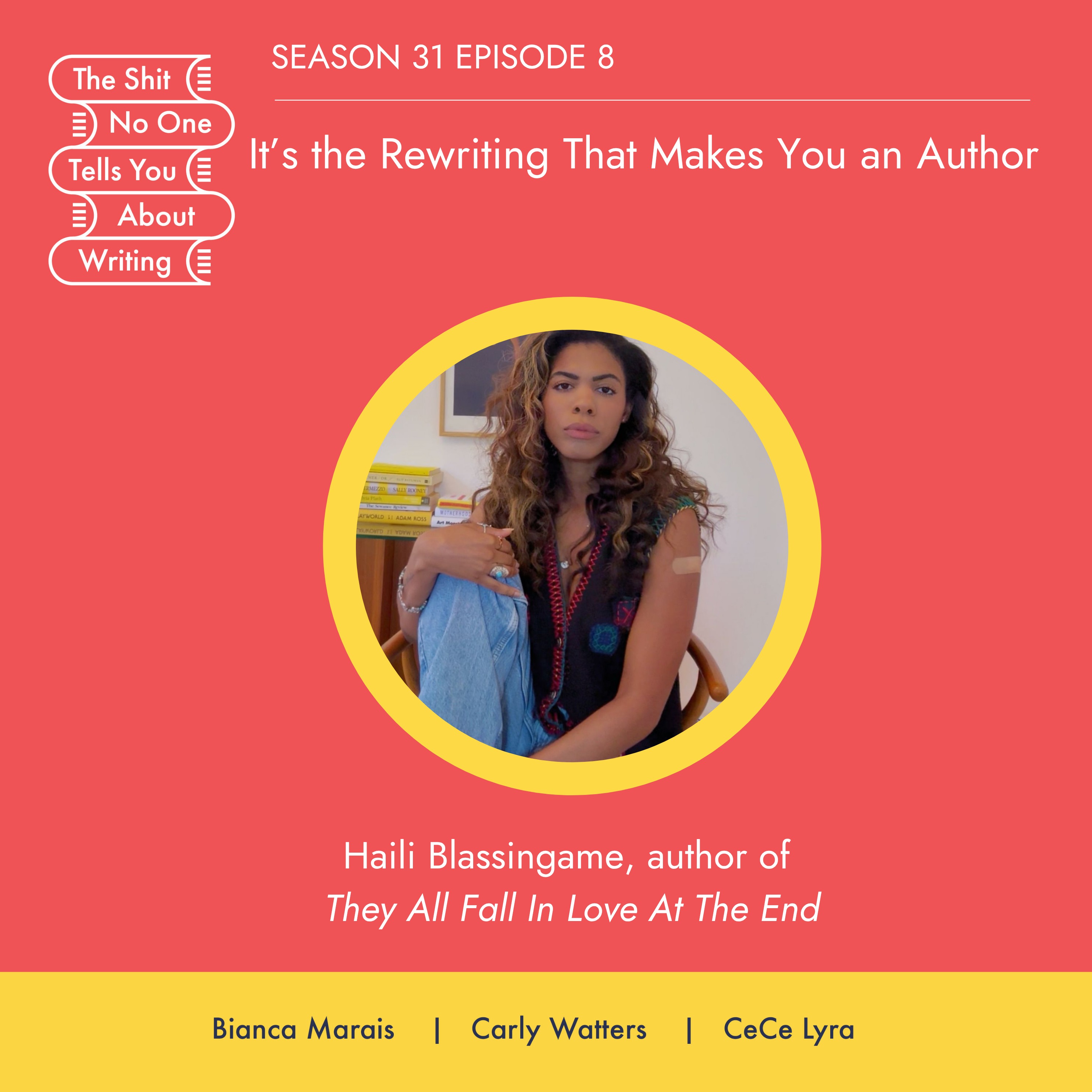
The Shit No One Tells You About Writing
It's the Rewriting That Makes You an Author
00:31:10
Author Interview
Loading summary
Transcript45 lines
- [00:01]
Quince Brand Spokesperson
I'm not gonna lie. This was a brutal winter, guys, and after a brief spring, we have landed in summer. Thank goodness. I'm ready to pack up the sweaters and get out the linen. I want those light fabrics that make us feel good the moment they're on our bodies. And that is why I love my Quince products. Did you know that Quince has elegant everyday pieces like 100% European linen pants, dresses and tops with styles starting at $32. Remember that quince is 50 to 80% less than similar brands because you're paying for quality, not brand markup. If you haven't checked them out in a while, they're now a destination for home kitchen, bedding and beyond. So make sure you get their pieces that bring a premium feeling to everyday life. I am newly in love with my 100% European linen shorts, something I can wear to the park or dress up. They're thick enough to have some structure, but light enough to feel wearable all summer long. I'll be in mine every week. I have them in black, but there are 11 colors to choose from. There are 4261 reviews, all averaging stars. Made with European flax and machine washable. I'm going to need another pair. Elevate your summer wardrobe. Go to quince.com tsnotyaw for free shipping on your order and 365 day returns. Now available in Canada too. That's Q-U-I-N C E.com T Snotyaw for free shipping and 365 day returns. Quint.com teasnot yes, what's up everyone?
- [01:26]
Cece Lehrer
This is Cece. So I recently grabbed lunch with an acquiring editor from HarperCollins who told me that the number of submissions she's been getting has nearly doubled. And I wasn't surprised at all because every agent and editor I know has been talking about how the volume of submission keeps increasing. So personally, that is a wonderful thing because it's more reading for me, but it also means I have more chances of matching with authors. I consider it a privilege to review queries on books with hooks and of course, in my submissions inbox. But at the same time, I talk to writers who tell me that they wish agents would read more than a few pages because, and I quote, my story gets better in chapter two. I have to be honest, this kills me. It's like me wanting chocolate chip cookies to have the nutritional value of kale in it's just not realistic. Like it or not, no agent, no acquiring editor is going to stick around to see if a submission gets better. It's not because we're mean, it's because we get dozens and dozens every day. I know it's harsh, but ambitious writers embrace harsh realities. So here it goes. It's your job to make your opening pages irresistible, to make agents crave it, to make agents want to read more. That's why I'm so excited about my upcoming course, Starting It Right. How to begin your story in the best place and in the best way. I created this course after studying hundreds of books. I've mapped out elements that are present in the beginning of all successful novels and memoirs. And I've designed checklists, actual checklists that you can use to ensure that your story's beginning and end is seducing your reader. We'll cover how to write a great first line, different types of beginnings, and how you can choose the best one, the best place to start, and the best way to start. Yes, these are totally different things. When it makes sense to add a prologue and when it doesn't. How to frame your inciting incident in an appealing way, how to balance exposition and mystery, how to include context but not weigh it down with too much backstory and what to do if your story has more than one POV or timeline. Most of all, I'm going to show you how to make readers want to turn to Chapter two. Join me for this multi day course designed to help you break through the noise. You'll leave with a clear, actionable breakdown of exactly what goes into a terrific beginning. If you've already signed up, come prepared to take lots of notes. We're talking hundreds of slides with real world examples and specific techniques. Plus a super fun surprise that I can't wait to share. I hope to see you there.
- [04:25]
Bianca Murray
Hi there and welcome to our show the Shit no one tells you About Writing. I'm best selling author Bianca Murray and I'm joined by Cece Lehrer of Wendy Sherman Associates and Carly Waters of P.S. literary. Hi everyone. Today's guest is a producer for the NPR program 1A. She has written for publications like the New Republic and the New York Times, in which she published the viral My choice isn't Marriage or Loneliness for Modern love. She was one of 12 SAs selected to write a follow up piece for the column's 20th anniversary in October 2024. She's also been a guest on the Modern Love podcast, NPR's Life Kit, and NPR's 1A. She previously worked on NPR's Code Switch and Weekend Edition. She is pursuing an MFA in creative writing from American University. She lives in Washington, D.C. it's my pleasure to welcome Hayley Blasingame. Haley, welcome to the show.
- [05:24]
Hayley Blasingame
Thanks so much for having me. So much NPR in that bio.
- [05:27]
Bianca Murray
Gosh, I mean, you know, you've got to use everything you can in your bio, right? And we say exactly to authors all the time. Up your author bio. Love to saying NPR so much. Okay, so for those of you who are not watching on our YouTube channel, will you also hold up your copy, Hayley, because you've got the hardcover. There we go. That with the book we're discussing is they all fall in love in the end. It's a stunning, like hot pink cover kind of paintings. Almost like it sort of made me think of Blue Sisters.
- [06:00]
Hayley Blasingame
Yeah, yeah.
- [06:01]
Bianca Murray
Vibe, right? But. But it's, it's its own work. It's just absolutely stunning. The COVID is stunning. So for those of you are not watching on YouTube, make sure you look up the COVID Okay? I'm going to quickly read you the flap copy and then we're going to dive in. It's the fall of 2024, and 24 year old Kat isn't asking for too much. All she wants is three boyfriends to write her little novels and to survive another chaotic presidential election. She's in an open relationship with her college sweetheart, Jay. But non monogamy isn't just a hot trend she's trying to. It's her sliver of freedom in a world eager to wrestle it from her for being a black woman, going after what she wants with reckless abandon. While political tensions roil the campus where Kat is slowly earning her creative writing degree, she finds herself drawn to Jay's best friend, Tristan, who's smart, super hot, and in a monogamous relationship. And then she meets Tristan's girlfriend, Nia, a captivating art student with her own gravitational pull. Friends and family urge her to just be happy with Jay, but Kat is determined to have it all or blow up her life trying. As she falls for all the wrong people, racking up lies, betrayals, and terrible drafts of her novel, she tries to write her way to a happy ending. But in art, politics, and love, true liberation may take more than rewriting the old scripts. It may mean inventing something entirely new. So. And you know what? I read a lot of books for the podcast. I read a lot of books to blurb, etc, and this is like one of the most unique stories that I've read. So you know what, it's so funny in publishing, publishers are always like, I Want something completely different. So, yeah, it's exactly the same as X, Y and Z. And so I want you to take us to. Through the inspiration for this and your journey to publication, please.
- [07:55]
Hayley Blasingame
Oh, God. Do you have 10 hours? Okay, so first, the inspiration. I was in an open relationship for several years in my early 20s, and I really just stumbled into it. It was like my college sweetheart. You'll. You'll notice some similarities. And I just remember being like, we should be in an open relationship. I was excited. And then I started telling people in my life, and they're like, girls, what are you talking about? Like, I got a lot of communal pushback that I hadn't anticipated. And this is around the time that Sally Rooney wrote conversations with friends, 2017. So you had some books that gesture at non monogamy, but weren't necessarily dealing with what it means to exist, not in a vacuum with it. And so I think as a black woman, that was what I was saying. I went to school in the south and hbcu, and so my experience was entirely different where it was like coming out and I hadn't. I was not trying to come out as anything. And so I really was trying to look for models on how to. How to be in an open relationship. And like many writers, I turned to stories. So I was like reading novels, I was watching movies. I was just trying to find anything to sort of locate myself in this kind of relationship modality and could not find anything. And I was like, okay, well, I'll write a book and this will help me figure it out. Because as one does, right? So what happened was I had started this book in like January 2020, which is a great time to start a book, right? That set quote, unquote, now, which. Then the pandemic happened. I was like, okay, you can never set a book now again if it's realist fiction. So I've been working on it. I ended up writing a Modern Love essay at the end of the year that was about my experience in an open relationship and just trying to figure out myself through that relationship and why it ended. And that is a funny story because I had recently purchased a house because interest rates were so low and I just, like, was out of money and I needed a new couch. So I was like, what can I do to make money? Oh, I'll write a Modern Love essay. Which, like, thinking about it now, I'm like, that's like, I don't know. I was 25, but they picked it up. I had heard of Modern Love, but I Didn't understand the scale of it. So I had. When I knew it was being published, I was reading things like, oh, you could get an agent or a book deal from this. I'm like, okay, I'm not going to get an agent from this essay. Then the essay came out and I got an email from my current agent saying, have you ever wanted to write a book? Hello from book agent in the subject line. And I was like, yeah, so it's charmed. That's how I got my agent, based off of that Modern Love essay. And so I always do tell writers, like, get yourself out there. You don't know what is going to be the thing. So we'd started working on a memoir because that was sort of the pipeline. You'd write a Modern Love essay and then you'd write a memoir. Bell Burden did that, but she's a unique case. I think that pipeline has kind of dried up a little. Memoir is very difficult if you're not a celebrity. So. But like back then in 2021, I think we were kind of at the tail end of it, but. But still, it still existed. So I started working on a memoir and I was just like, I'm 25, who cares? Like, I just didn't feel like I had anything to say in the memoir form. I had already had that novel I had started working on right before the pandemic. And so I revisited that and I was like, I funnel these questions into that in a more interesting way. I'm not bound to the events of my life. And so that's essentially what I did. I revised it for years because again, I wrote the novel while I had an agent, which means she got the first draft from a 25 year old writer who had never revised. I'd written books and I was like that person who wrote a book and was like, okay, I'm done. I don't know what to do now. So I had, you know, all those starter novels that I never revised. And that was really when I learned to revise, which is kind of what makes you a writer, an author. And so we worked on that for years. I rewrote it from scratch. I always say that CC's webinar on stakes, tensions and conflicts actually totally changed the way I wrote story. And that was really fundamental in rewriting this book. And so it was like 2024. And I mean, the other big thing that happened was, remember how I said I had started right for the pandemic? And I was like, oh, I'll just set it when this is all over in 2024. And of course, it was the presidential election, and I'm in D.C. and I was like, okay, you gotta talk about this. Like, you can't. That. That if it's a realist novel, that wouldn't make sense. And so I had to rewrite it to incorporate that. And it was before Trump won. So I was. I mean, thinking back, it was this wholly crazy process. So we basically wrote it as, like, it might be alternative history, or it might be actually what happens. But I. I knew that it on submission before the election. Like, I just felt in my gut, like, we gotta go out with this. We went out, like, two weeks before the election or something. It was like we were cutting it really close. I just had a feeling that there were gonna be too many questions if the outcome was different from the novel. And I didn't wanna feel those. And it sold in, like, it sold in a week, the week before the election, to my wonderful editor, Anne Spiret Scribner. So that was my journey.
- [13:20]
Bianca Murray
I love that. And we're always focusing on the many different paths to publication. And like you say, put yourself out there, you never know who's going to reach out. I mean, I feel like this is specific to then, because I don't know about you now, Hayley, but the amount of spam I get that's directed at writers, and it's like, oh, it's. I mean, I've had Jane Austen email me to tell me what an incredible writer I am. I'm like, thank you, Jane. Thank you so much for that.
- [13:44]
Hayley Blasingame
She had to come back to life just to tell you.
- [13:47]
Bianca Murray
Exactly. Exactly. I'm glad I have my Ouija board so that her and I were able to have this conversation. But, like, at that point, like, writers now are getting emails saying, I want to represent you, and it's all spam. So, again, like, you know, this stood out there because this is before we were getting all this slop. Right? So it is amazing how all of that came together. And what I agree with Hayley, is that writing is rewriting. I also didn't understand that with the first two books I wrote. I just wrote them and sent them off. And I was like, these are amazing. And if you haven't revised the book extensively, you have not written a book. It is such an essential part of the process. So let's talk about the sneaky prologue. Yeah, the sneaky prologue. Because it's not. It doesn't say it's a prologue. It's just there. Can you read it? For us. And then I'd love for you to discuss if it was there all along, if it was added later.
- [14:38]
Hayley Blasingame
Yes, all right. Sometimes we don't tell the story, sometimes it tells us. That was just one of the many ass backward aphorisms my grandma used to say that I never forgot. Later I understood how a saying like that could stick, how it could haunt my grandma's stories. Never made sense. The endings were lopped off, plots unfolded, backward characters died, then were resurrected. It used to kill me the way her endings felt like being shoved off a cliff. The way threads got dropped like dirty pennies. The way capital M meaning never materialized. I wanted Disney Channel. I wanted rom coms with Ryan Reynolds. I can see her now braiding her white hair on that plastic covered sofa trying to teach me a lesson. One I practically ruined myself trying to relearn years after she died.
- [15:36]
Bianca Murray
Absolutely lovely, lovely.
- [15:38]
Hayley Blasingame
Thank you.
- [15:39]
Bianca Murray
Tone of the novel. There's so much there. So was it there at the beginning? Was it one of the things that came about in the review?
- [15:45]
Hayley Blasingame
No. If I could send you the first draft, you'd be like, what is this? I mean, it was totally different. I mean. And that sort of, you know, the novel is a lot about writing a novel and how you have to write it to learn what it is. And that was very much this process. And I think I couldn't have written that prologue from the start because I didn't know what I was trying to say with the book. And I. So I learned. Sneaky prologue. I think it was from Rebecca Mackay. I think she talks about this because I think she has one in her mystery novel. I have some questions for you, and I love that because it's sort of like. It doesn't brace someone for a prologue. But. Yeah. So when I got to the end of writing the book and I understood that this was also a book about our dependence on stories to understand who we are and how that can be dangerous. Especially when you talk about, you know, politics is really who told the better story. You know, it doesn't have to be true. And it's about sort of the beauty of locating yourself and inserting yourself into a story where you're. You don't exist, but also the limitations of a story that they, you know, the resolutions we get in the story are not the resolutions we get in life. And I think I needed a way to set that insight up in the beginning or else I don't think it would have paid off in the way. And also it's a tone thing as well. Just looking at the COVID and the way that the. That the book is framed, a lot of people are calling it a romance, and we can maybe get into the romances versus love stories. But I knew that I needed people to know that this is gonna be a bit more than the love story that you got on the back cover. And I felt like that was the most efficient way to say, okay, there's a bigger idea here about just, like, the value, but also the danger of our over reliance on stories to tell us who we are. So, yeah, that's how that came back. It came pretty late in the process.
- [17:38]
Bianca Murray
Yeah. I always, always love seeing how these things get picked apart and stitched back together. Becomes like a quilt. So there's another excerpt I'd like you to read and how it ends with a sucker punch, especially for writers.
- [17:52]
Hayley Blasingame
Okay, great. I found an interview with janine from the 70s on YouTube. She's in her mid-20s, her black, feathery hair rippling away from her face. Many critics didn't know what to make of your first novel. The interviewer says, legs crossed in his armchair. It was controversial, to say the least. What was it you were trying to say? I wanted to write about love and being young, but also rebellion. Janine aggressively smokes a cigarette in luxuriant bell sleeves. I guess I was writing against respectability. Bonnie. At one point, she argues with her professor that racial uplift is a sham. She does? Why is it a sham? Maybe sham isn't right, but it's certainly a trap. You can't moralize your way out of a racist system by, say, getting married, being a good Christian, adopting white nuclear family practices. But black people have and continue to believe this, that they just do this or that. Equality will be attained, though it's never about what you do or don't do. You don't attain equality. It's yours already. It's the claiming of what's already yours that's the struggle. Bonnie understands this, so she does what she wants. The novel didn't do well. JANINE LAUGHS Define well. Your publisher dropped you, and as far as I know, your second book hasn't found another publisher. That's because I don't keep my mouth shut. Howard wasn't thrilled about your novel taking place on their campus. They proved my point about respectability. The interviewer says not many people liked Bonnie. That was maybe the biggest critique of the novel. Her character. Janine laughs a throaty laugh. I could almost see her anger in the wet pink of her gums. You think Bonnie cares? I doubt It. You rarely see black women like Bonnie in literature, but we exist. We're all over. You're a teacher now. What do you tell your students? Janine pauses to smoke Every writer has that project. They don't have the words to write, but they must write in order to find the words. That's why you have to write it, to learn what it is. You set it on the page. You set it free. You set yourself and others free, too. Ms. Janine Ford, thank you for your time. Thank you, Robert. When the interview went dark, I rushed online to buy her debut novel. It was out of print. I couldn't even find it secondhand. The shimmering pink hope I'd had adopted a gray cast, like, ruined footage that couldn't be restored. It was like she never sat down to write the book at all.
- [20:43]
Bianca Murray
So that gave me goosebumps, really gave me goosebumps. So can we speak a bit about using a technique like that so that you can find a video of a character like Janine and why it's necessary for her to watch that and for the reader to have access to that information in a way that, you know, the main character wouldn't just be able to access that information?
- [21:05]
Hayley Blasingame
Yeah, I mean, I was also. I was thinking about during the pandemic, a lot of old videos of writers like James Baldwin were resurfacing. And I think it was actually his also his sort of conversation with Nikki Giovanni, which is a lot about gender. And so I was thinking about these old 70, you know, these, like, glamorous writers who are very profound, but they were coming back up because of the moment. And so I was thinking, okay, like, she would, you know, could easily probably find this clip. She's. This is her professor and sort of. I love playing with medium and the different mediums that exist. Obviously, we have text, News notifications and YouTube, which is like, I think. I don't. I'm going to butcher this, but I think the most watched streaming platform ever is YouTube. And so I think the way I was thinking about this was also seeing Janine at, you know, almost Kat's age, not exactly, but young. And I think when you have someone you look up to and you see them around your age, it can be a quite sort of intense emotional experience. So I think I wanted to show us that Janine had always been confident. Like, you know, she didn't change, but also what she would have been up against in the 70s as a black writer and how that has shaped her into the type of teacher she is now. So it's sort of a little bit of an origin story. I also wanted to. The other thing with the. When you. When you're online, you're getting these little clips, and they're out of context, too. So I think with this, it's like, you would see her. You would see this confident woman smoking in bowel sleeves. But there's almost always some sort of sad story behind these clips where you find out, like, I mean, Zora Neale Hurston is an example where you find out they died, you know, in poverty. You know, you know, it's never that clip. And so I think having her watch that video and feel, like, a sense of pride and connection and then finding out the story behind, you know, the story that you see made it the most impactful. And also, you know, being a young black writer herself and, like, already feeling unsure about, you know, what is the point of me writing the story? And that was the reality for, you know, many writers who. Some who we don't have, we wouldn't have heard of at all.
- [23:23]
Bianca Murray
So, yeah, I love the way that this thing that happened a long time resonates with her now. It shows that golden thread between generations and what past generations have fought for. You've got a lot of how things are politically in that conversation as well. There's just so much to love there. And I love how she says, bonnie wouldn't care. Like, Bonnie wouldn't care what anybody thinks of her. And so, you know, that takes us, again to the challenges of writing a character like this, because when you write about Kat, and like I said, this is one of the most unusual books that I've read in a long time.
- [23:58]
Hayley Blasingame
Thank you.
- [23:59]
Bianca Murray
But that is difficult to do because you are writing a character that people generally don't see in the mainstream. That people generally don'. And that a lot of people are immediately going to have their backs up and be like, why does she have to be dating three men? Because people bring all their morals and all their own bullshit to every story. Right? So you must have realized when you sat down to write this that. To make her. And again, I hate. I hate saying female characters need to be likable because male characters don't need to be. But she needs to be relatable, and she needs to be vulnerable enough that the reader connects with her. So what was your approach to that?
- [24:34]
Quince Brand Spokesperson
The best part about where I live is that when spring and summer comes, your outdoor space is an extension of your living space. When we moved in, we kept our deck the way it was, which meant that we needed to get creative about how to maximize its use. The layout was a bit wonky, but with Wayfair you can find pieces that fit your outdoor space no matter what the size and dimensions. When you have the right pieces from Wayfair, your space fits your style and your budget. If you don't have an outdoor rug yet, you need to get one now. It frames your space and makes it feel like a living room and very intentional. You can bring your interior style design into your outdoor space, making it a seamless transition for hosting or just enjoying for yourself. If you haven't tried Wayfair yet, you're missing out on the experience of options that fit your space, style and budget like no other. Outdoor seating, grills, major appliances, storage, patio lighting, rugs, decor Wayfair is your one stop shop for home. My favorite Wayfair feature is Wayfair verified your shortcut to the good stuff. Their team of product specialists that everything by hand using a 10 point inspection, testing things like quality of materials, functionality and features and even how long it takes to build. Take the guesswork out of ordering online and have complete confidence Patio season is here and these deals won't last. Head to Wayfair.com right now to get your outdoor space ready for weightless. That's W A Y-F-A-I R.com Wayfair Every style, every home. I am currently packing right now for the Alps and if you're like me and have travel coming up, whether it's summer vacations, an international work trip, weddings that require a flight to get to, imagine arriving actually understanding the language, ordering confidently at restaurants, connecting with locals at museums, feeling immersed instead of just visiting. I'm off to Germany and Austria right now and I am so glad that Rosetta Stone is here to lend a hand. Rosetta Stone has been a trusted leader in language learning for over 30 years. Their immersive, intuitive method helps you naturally absorb your new language. No memorizing random vocabulary lists and no relying on translations. Instead you learn by connecting words, visuals and meaning in context. That's the way language is meant to be learned. My German will get better soon because of the top rated True Accent feature which is designed to give real time feedback on pronunciation via native speakers. The new Chat Missions feature will let you put your new language skills to test and immersive and practical scenarios related to work, travel and more. Speak like Local the lessons are simple to add to the regular schedule of your day with the app or desktop. Fit it in whether you have five minutes or an hour the app now has learning games where you can get writing tips and more. Learn faster and retain longer. Rosetta Stone immerses you in your new language naturally, helping you think, communicate with confidence. Ready to start learning a new language this summer? Visit Rosetta Stone.com today to explore Rosetta Stone and choose the language that's right for you. Go to Rosetta Stone today now and begin your language learning journey today.
- [27:09]
Hayley Blasingame
Well, I think I had a lot of practice. I think it helped having written the modern Love essay with such blindness, because I got a lot of online hate from that. And I was. I kept, like, stumbling into things, like, not even understanding the scope of things. And I think with the novel was the same thing where, like, I don't see her as unlikable. I mean, now I'm getting reviews where people found her challenging, and I'm like, she's fun to me, but I don't know, maybe my definition of unlikable is different from everyone's. So I actually didn't think about how do I make her likable? Because to me, likable is interesting. So I don't want to read a character about a character who goes to church every week and does everything for charity unless there's, like, some secret evil that they're hiding and that's why they're doing it. But if it's literally just that, that's not interesting to me. And I think fiction has a certain imperative to go certain places in the psyche. Like, you know, just because someone does something in a novel doesn't mean I think they should do it in real life. Like, I don't hold the same standards that I with real life. And so I was more interested in making her compelling. And I think the most compelling characters are the ones who are complex. And that means they're going to have good and bad. That means that they're going to be likable and dislikable, just like any. Any flawed human. And she is very similar to me. She's younger than me now. I'm 30. So I don't necessarily act like this anymore, but, like, it wasn't super difficult to be inside her brain because it's like, you know, and I also like. And this is a taste thing. I also like bold, brash female characters, like, who have a lot of agency, even if their agency is restricted. They're acting. They're using as much agency as they can within the box that they're in. Like, those are my favorite female characters.
- [28:54]
Bianca Murray
Yeah. And you know what? When we say unlikable characters. This is how readers bring their expectations to something. They'll be like, I didn't like this character because she did this, and I didn't like this character because she did this, and I would never do this. But this is why we read is to experience other lives that we would not necessarily inhabit something else. And I mean that she was so layered. Like this was such a multi layered character. Each time I felt, okay, I knew her, I knew whatever, there'd be another layer introduced. So like you say, you made her compelling. And for our listeners out there, that's something. If you are portraying a character that's kind of different to what what readers expect or what they see on the page, make them vulnerable, make them compelling. Hayley absolutely nailed that. I want to discuss dialogue, which you do so brilliantly. So page 74 to 75. It's just like a whole page of dialogue? Oh yeah, if you can just read just page 74 to the end of page 75.
- [29:55]
Hayley Blasingame
All evening at the restaurant, I was frazzled. The jitters had broken through this morning's torpor, the outcome of the election looming now with menacing height. I rushed to the fire escape on my break to call Jay, my voice of reason. But when the phone stopped ringing, it wasn't Jay's rasp on the line. Hello? I held my breath. Hello? Tristan said again. Did you mean to call? My hand tightened around the phone. Oh, hi. He paused. Why do you sound so happy? I'm not happy. Did you mean to call me? I was actually trying to call Jay. Weird. How'd you end up calling me? I don't know. I waited for one of us to hang up. So you have a girlfriend. She's cool. Yeah. I mean, it's new. She's completely out of my league. I wondered what league he thought he was in, whether I was in it or not. He paused for a long time. Should we. Do you want to talk about the last time we saw each other? When we were getting chased with a chainsaw? He didn't laugh. No. At the coffee shop, my hearing went out like someone had cupped earmuffs over my ears. I don't know what to say. How did you feel about it? I. How did you feel? I asked you first. I know, but I don't know. I don't know either. You wanted to talk about it, so you must know. It's not that. It's not simple like that. He paused. Did you tell Jay? No.
- [31:30]
Bianca Murray
That's perfect. It just shows how conversations get interrupted and people jump in and People have shorthand for certain things, and if you give too much information, it feels like exposition for the sake of the reader, and you just. Just, like, get into the flow. You teach the reader how to read that kind of choppy dialogue, and it's just really excellently done. I love that we're almost at the end of our interview, so now I'm freaking out because there was so much that I wanted to ask. So. So Hayley plays around with scripts, emails. She plays around with structure, which worked brilliantly throughout. I loved the political backdrop to this. I loved her own struggles with this. Can you just. As we wrap it up for our listeners, talk about writing something when you have a message and there's something you want to convey, but not belaboring it, just making it organic to the story so it doesn't feel like you're standing on a soapbox, how do you sort of convey that without beating people over the head? Because this was so organic, it was so natural, and the restraint you showed was incredible, especially for a debut.
- [32:39]
Hayley Blasingame
Thank you. I mean, I think my goal with this wasn't to sort of wade into the political discourse. My goal was almost archival. I was thinking about the fact that we are living in a singular moment in history. And obviously, there's always something going on in history, but really to be in the nation's capital and at this point, 2025, where the book takes place, it was. I don't want to use the word unprecedented, but we understood that we were living history as it happens. I'm not sure that it's always like that for people when they're living. And I do think the work of fiction is archival, is to be able to have people look back and to not just know, in a dry historical sense what happened, but how people were living. And I think because that was my goal, I didn't have to stand on a soapbox. I just captured what it felt like to be in D.C. and it felt insane. My mom was a federal worker, so she's been. Was a federal worker for 38 years. So she was getting all these emails about. Show us your work. I was a journalist at Public. A public radio station that lost its funding. I mean, this is what it was like. A plane crashed into the Potomac, like, two weeks in. I mean, it really felt. I was like, okay, this is one of those moments in history where, you know, D.C. as a place was sort of ground zero for the second Trump administration. And what we were going to see happen, we were. We were seeing it before the rest of the country in many ways, and of course, the most vulnerable as well, around the country. And so that was, I think, because that was my focus, I was able to just simply show things as they were. And of course the characters have their own opinions, but it really was a portrait of a period in time and a specific place. Yeah.
- [34:36]
Bianca Murray
Seeing your character interact with the moment in time is so important because a lot of times the story will just happen and we don't know when it's taking place and there's nothing to differentiate it. But, like, even the biggest love story takes place in the context of that time, you know, And I loved how you worked that in. Last question. Have you got time for one last question?
- [34:57]
Hayley Blasingame
I have, yes, I have time for whatever.
- [34:59]
Bianca Murray
Okay, so let's talk about your Palestinian sensitivity reader. You know, we say on the podcast all the time you need sensitivity readers, you need authenticity readers. So can you speak a bit about that, the necessity of it, and how you found them and how you worked with them?
- [35:16]
Hayley Blasingame
Yeah, so I. This was a very simple process. So I just found this, like, organization that connected people with readers. And Fatim was. I sort of gave her the gist of the book and I sent her the sections that had Anwar, who is the Palestinian character in the book, and I told her what I was looking for. Just let me know if there's anything that feels untrue that sticks out to you. I mean, the real thing is, I feel like as a black writer, I was able to write that character because the most important thing is that they're a person first. So you're not centering their identity and the way that they talk, like, they're not always talking about their oppression. Like, I was able to draw from that what would sort of off put me.
- [36:01]
Bianca Murray
And then.
- [36:02]
Hayley Blasingame
Then you have the nuances and the specifics and the language. And that's sort of how my sensitive reader helped me. And she didn't have a ton of notes. So. Yeah, I mean, I think it's important. I think it's important to know that you will probably get things wrong in a novel, but you have to give yourself permission to get it wrong. But you do the best that you can. And I think. I think Rebecca Mackay also talks about this as sort of like, it's worse not to do it, to only write characters like yourself because you're afraid, but you do the best you can and you recruit help where it's needed.
- [36:33]
Bianca Murray
So, yeah, and you do it with vulnerability and respect. I think those are the two most important things. Right. So. Okay. So we are holding up the book again. They all fall in love at the end. We're linking to it on our bookshop.org affiliate page. If you buy the book there, you support an independent bookstore and the podcast at the same time. Haley, please tell me you are having an event at East City Bookshop.
- [36:56]
Hayley Blasingame
So I'm having an event at Lost City Books on June 4th. Yep. And then I'm doing something at Politics and Pros in August.
- [37:03]
Bianca Murray
Okay. So for our listeners, but if you go and visit East City, please, yes, blow all the kisses and send all our love to the booksellers there. We absolutely adore them.
- [37:13]
Hayley Blasingame
Yes. Oh, so you know East City Bookshop?
- [37:15]
Bianca Murray
Yeah, yeah. I. For each of my books I launched there. The only time I didn't was last year when I canceled all of my US Trips, thanks to the Canadian elbows up saying, we are not coming to the US and we're not spending money there. And it broke my heart to not get to go on tour with my last book. But, yeah, absolutely. Adore everybody at East City Bookshop. They're just the best.
- [37:38]
Hayley Blasingame
Yeah, they're amazing.
- [37:40]
Bianca Murray
Yeah. So we wish you so much luck with this, and hopefully our listeners can come out to some of those events. And, yeah, we can't wait to see what you come up with next.
- [37:48]
Hayley Blasingame
Thank you so much, Bianca. This is so much fun.
- [37:51]
Bianca Murray
And that's it for today's episode. I hope you'll join us for next week's show. In the meantime, keep at it. Remember, it just takes one. Yes.
- [38:07]
Cece Lehrer
What's up, everyone? This is Cece. So, I recently grabbed lunch with an acquiring editor from HarperCollins, who told me that the number of submissions she's been getting has nearly doubled. And I wasn't surprised at all, because every agent and editor I know has been talking about how the volume of submission keeps increasing. So, personally, that is a wonderful thing, because it's more reading for me, but it also means I have more chances of matching with authors. I consider it a privilege to review queries on books with hooks and, of course, in my submissions inbox. But at the same time, I talk to writers who tell me that they wish aging would read more than a few pages because, and I quote, my story gets better in chapter two. I have to be honest, this kills me. It's like me wanting chocolate chip cookies to have the nutritional value of kale. It's just not realistic. Like it or not, no agent, no acquiring editor is going to stick around to see if a submission gets better. It's not because we're meek mean. It's because we get dozens and dozens every day. I know it's harsh, but ambitious writers embrace harsh realities. So here it goes. It's your job to make your opening pages irresistible. To make agents crave it, to make agents want to read more. That's why I'm so excited about my upcoming course Starting it right how to begin your story in the best place and in the best, best way I created this course after studying hundreds of books. I've mapped out elements that are present in the beginning of all successful novels and memoirs. And I've designed checklists, actual checklists that you can use to ensure that your story's beginning is seducing your reader. We'll cover how to write a great first line, different types of beginnings, and how you can choose the best one, the best place to start, and the best way to start. Yes, these are totally different things when it makes sense to add a prologue and when it doesn't. How to frame your inciting incident in an appealing way, how to balance exposition and mystery, how to include context but not weigh it down with too much backstory and what to do if your story has more than one POV or timeline. Most of all, I'm going to show you how to make readers want to turn to Chapter two. Join me for this multi day course designed to help you break through the noise. You'll leave with a clear, actionable breakdown of exactly what goes into a terrific beginning. If you've already signed up, come prepared to take lots of notes. We're talking hundreds of slides with real world examples and specific techniques, plus a super fun surprise that I can't wait to share. I hope to see you there.