Loading summary
Transcript69 lines
- [00:00]
Unknown Speaker 1
Did you know that your calendar age doesn't always match how old your body truly is? It's true. Your biological age, the age of your cells and organs is actually the number one predictor of your risk for serious diseases like heart disease, cancer, dementia, and more. That's why learning your biological age can be truly life changing. And that's what the true age test from True Diagnostic helps you do. With just a simple at home test, you can uncover your true biological age and get personal personalize insights into your true biological age and take control of.
- [00:29]
Unknown Speaker 2
Your health like never before.
- [00:31]
Unknown Speaker 1
No doctor's visits, no labs, just a quick finger prick from the comfort of your home. As you guys know, I care a lot about fitness and lifestyle because I do triathlons and it's really important for me to take care of my health. So here's the thing that really inspired me. Up to 90% of biological aging is driven by lifestyle. That means the way we eat, move, sleep and manage stress is a massive role in how fast or slow our bodies age. True Diagnostic just doesn't tell you your biological age. It gives you a personalized report of full, clear science back steps you can take to actually slow down aging and improve your health over time. I'm really excited to see the results and see what they have to say about my health because as I said, I do take it variously very seriously. The test itself is super easy, just a quick painless finger prick. You send in your sample using a prepaid mailer and about two, three weeks you get detailed online reports with actionable insights that you can use. If you care about protecting your health and want to find out what your real age is, head over to TrueDiagnostic.com and use my code T Snotya to get 20% off your entire order or subscription. That's true. Tru Diagnostic.com and use T Snotya at checkout to get 20% off your future.
- [01:44]
Bianca Murray
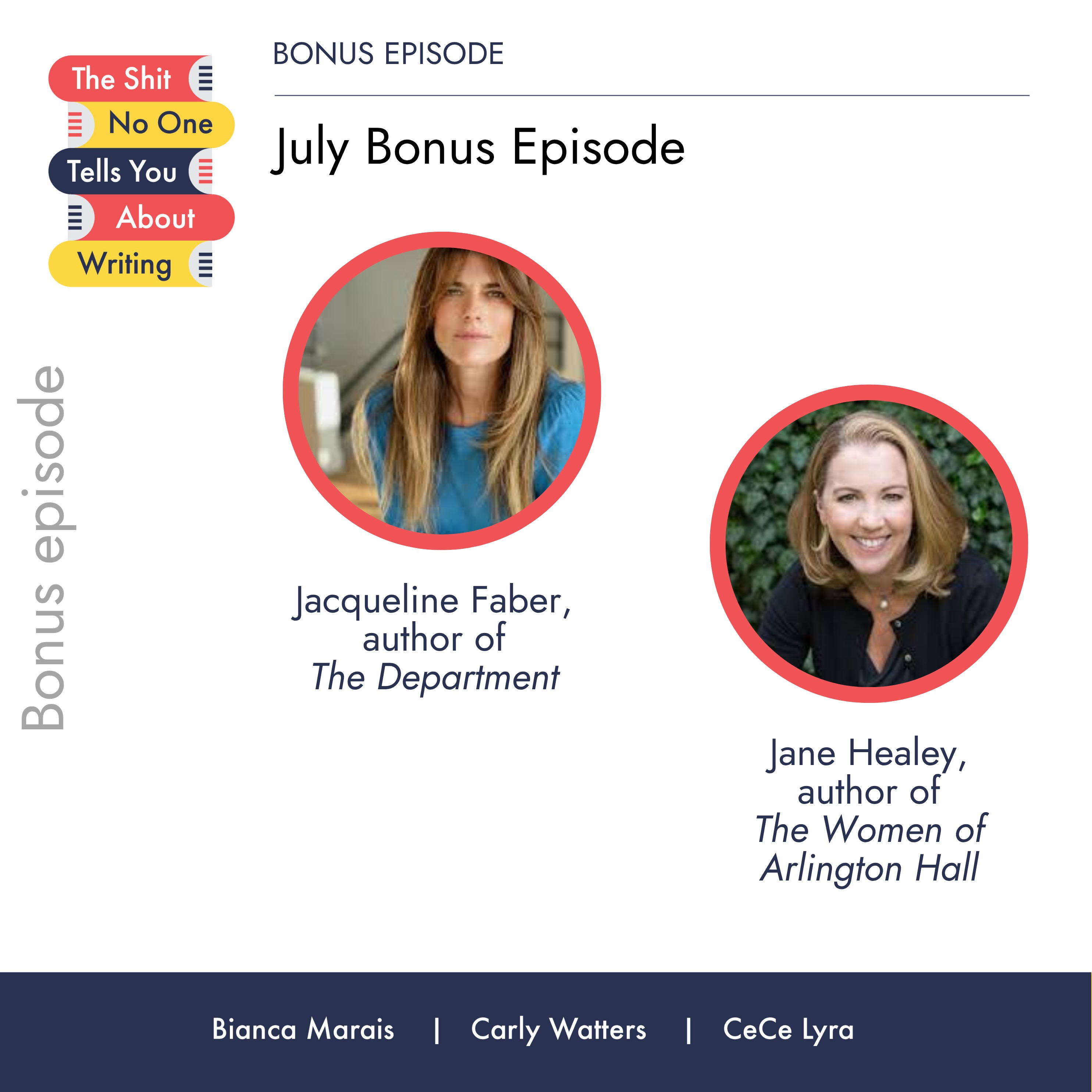
Self will thank you Beta Reader Matchup time is happening again. It's been so gratifying over the summer to be tagged in so many posts about beta readers who've become writing besties and who are still going strong many years after they were first matched. Some even travel to meet up and do writing weekends together. Which sounds incredible. I can't guarantee any of that. That's entirely up to you. But what I can guarantee is that you'll be matched with a group of people working in your genre and or time zone who will critique 3,000 words of your work as you critique theirs. In return, you can sign up from now until the 31st of August. With the matchup emails going on the 1st of September, head to my website Biancamarae.com and look for the Beta Reader Matchup tab. Hi there and welcome to our show, the Shit no one Tells you About Writing. I'm Bianca Murray and I'm joined by Carly Waters and Cece Lira from PS Literary Agency. Hi, everyone. Today's guest is an author and freelance writer. She holds a PhD in Comparative Literature from Emory University, where she was the recipient of a Woodruff Scholarship and taught in the Expository Writing Program at New York University, where she received an award for excellence in teaching. She studied philosophy in Bologna, Italy, and received a dissertation grant from Frei University in Berlin, Germany. She writes across genres, including thrillers, rom coms, and essays. Her work explores questions about trauma, loss, language, and desire. Steeped in philosophical, psychological, and literary themes, her writing is grounded in studies of character. As a freelance writer, she writes for various companies, including a fair trade marketplace for global artisans, where she helps bring their unique stories to life. She lives with her family in Los Angeles. It's my pleasure to welcome Jacqueline Faber. Jacqueline, welcome to the show.
- [03:56]
Jacqueline Faber
Thank you so much for having me. I've been such a huge fan for so long. I'm really honored to be here.
- [04:01]
Bianca Murray
It's amazing to have you here. And for our listeners who are watching this on our YouTube channel, I'm holding up the COVID of the book, the Department. It's a really, really striking cover. And this is what we're going to be chatting about today. Okay. So, Jacqueline, to kick us off, I would love to hear about your journey to publication. That's the thing most emerging authors want to hear about. Yes.
- [04:24]
Jacqueline Faber
So like many authors, it was a sort of fraught journey. As you mentioned, my background's in academia, so most of the writing I had done was academic writing. And at some point when I was actually living in Berlin, I started transitioning to freelance writing. And when I took a stab at writing my first novel, which was many years ago, I queried it and got a lot of feedback, like, I really like your writing. I'm not sure what to do with this project. And so eventually I tabled that project, tried another one, couldn't quite pull it together. And then when I wrote the department, I just. I could sort of feel that it came out of me in a different way. But still, you know, the journey to finding an agent was challenging. It took me many, many months, many queries, many rejections, and then I finally found one who really understood what I was trying to do. But then, of course, you're not finished. Then you go on submission, and that is its own beast. And that took a while to find my publisher. So it's not a simple sort of linear journey. There's a lot of starts and stops.
- [05:32]
Bianca Murray
Yeah, completely. And that's where the frustration comes in. Can you tell us a bit about while you were querying, were there instances where you were getting back anything that was useful that could help you revise your query letter? Was it mostly form rejections? How did that look?
- [05:48]
Jacqueline Faber
Yeah, I mean, there were form rejections, of course, but sometimes people would say something like, I'm not identifying with this character enough. And I sensed that something was not working with the beginning of the book. And so the book that exists now is. The opening is quite different from what it had been. And I realized that, you know, the characters in this novel make a lot of bad decisions and act in ways that are morally suspect. And so I knew that I had to tinker with the opening in a way to pull them in enough to give these characters a chance. But, you know, when you start receiving feedback that's sort of consistent. I mean, when you write a book, there's this sort of push and pull between maintaining your artistic vision and staying true to that and also being very receptive to feedback that comes in. And there is no simple formula, but really paying attention and asking yourself, not is this good? But does this work in the way that I really want it to work? And if you find that it's not working because people aren't responding to it in a certain way, then you really have to dig back in.
- [06:58]
Bianca Murray
Yeah, that's the thing is consistency with feedback. Because the problem with beta readers, or even when you get feedback from agents, or even at the point when you are pitching editors. I mean, I remember with my debut novel, we were out with editors, and one editor would be like, I love this character. She's amazing. This character I could not get on board with. And a day later you'd get feedback and they would love the exact opposite character. And they were like, this character didn't feel real to me. So when you have those kinds of contradictions, it's impossible to do anything with it. But when people are honing in on something and are like, this is a particular problem, but like you say, it's up to you as the author to decide how to fix it, you know, it doesn't mean you need to change it completely. Sometimes it means you need to change your vision. But Sometimes it's saying, I have a vision. It's not creating the effect I want. So how can I tweak that vision to create the effect I want? Do you feel like you finally nailed the beginning before you got an agent? Or was that something that even happened, like, at the editing stage?
- [07:59]
Jacqueline Faber
I think my agent responded to the beginning as I had it, but editors were not necessarily responding to it. And so, you know, we had sent it out on a first round of submissions, and I think we were getting certain feedback, like, again, not totally connecting with these characters. And my agent had said at the time, like, let's just keep going. And I said, I don't know. I feel like I sort of understand what they're saying and I want to dig back in. And so, you know, this beginning as it is now probably went out on my third round of submissions. And for some, surely they finish it, it goes out, it immediately finds a home. But many authors I've spoken to, that's not what the trajectory feels like at all. So it certainly didn't for me. And even now, I mean, I think the beginning achieves. And I know we'll talk about the beginning a little bit, and there were very intentional decisions behind why I started this way. But, you know, there are other beginnings I could imagine for this even now.
- [08:58]
Bianca Murray
Yeah, well, that's the thing with beginnings. There are infinite number of beginnings. Right. Because the further along you move in a novel, you keep closing of options. It's like closing doors. And you're like, okay, I can't go that route anymore because the character did X, Y and Z. But the beginning, you can literally open anywhere. And I think that's what makes beginnings so hard. But the problem is, as writers, we stubbornly cling to that first idea. It's like, that was the first idea. That was the vision I had. And so we cling to that for so long before we finally able to go, okay, let me let it go. Let me try something else. So, yes, I would like you to read the first three pages because I'd love for our listeners to hear how you frame the narrative. But just, I'm going to read the flat copy just so that everybody gets a context first. So it starts with some secrets we keep, even from ourselves. Philosophy professor Neil Webb can't think of one good reason to get up in the morning. His wife has left him, his academic research has sputtered, and the prospect of tenure is more remote than ever. Until Lucia Venotti vanishes, a college student at the Southern University. When Neil teaches Lucia has a secret of her own, one that haunts her relationships and leads to destructive, reckless behavior. When Neil is drawn into the mystery of her disappearance, he finds himself suddenly relevant again. But at what cost? Each clue pulls him deeper into Lucia's past, but also into the hidden lives of his closest friends and colleagues. What drove Lucia to risk everything? And why does Neil, a professor who hardly knew her, care to find her? From campus classrooms to sex dens to backward highways, the department shows the world through the eyes of Lier and Neil as they descend into obsession, delusion, and the dangerous terrain of memory, uncovering the trauma that drives them to behave in ways even they themselves could never have predicted. Okay, so read us those first three pages.
- [10:55]
Jacqueline Faber
Okay, so it starts in Neil's perspective. Now, what can I say about Phaedra Lewis, except from the moment I met her, I wanted her. I still remember the early days, sitting at the bar, burning down cigarette after cigarette like we wanted to inflict real damage. Gin and tonics on the counter, swiveling on our stools in the dim orange light. Why are you here? She asked me one night. Like here at the bar, Here at school? It was our first year as graduate students in philosophy. I was already wasted, but I poured back the rest of my gin. Guns of Brixton came on the jukebox and a group of girls stumbled in. I think because I watched a woman die once. I had never uttered the words out loud before. Phaedra's eyes widened and I felt her lean in. That's not what I was expecting. Wisps of her blonde hair floated like strands of a spiderweb in the blurred bar light. Truth be told, most of my memories are fragments, broken bits, cut glass. But this one, this memory of the woman drowning, was different. It was summertime. I must have been six years old, my brother Ethan only four. Our family had piled into my dad's Oldsmobile Cutlass, and we'd driven across the country, from Indiana to California. Rows and rows of crops, sun scorched fields that touched the sky. My comic books spread across the backseat, motels and fast food chains. Then one day we sat on a beach in Los Angeles, hot sand beneath us, waves crashing, seagulls overhead, like we'd been cast in a commercial for something that looked like real life but wasn't. Ethan and I dug a trench that filled with water when the tide came in. My mother was lying on a towel, a T shirt draped over her face to block the sun. From somewhere down the beach, someone started shouting. We all leaped up, my Mother grabbed our hands and held on tight. The sun bounced off the ocean and I could see a woman swimming out past the breakers. One minute her head was bobbing, the next it slipped below the waves. It was like a video game. There, gone there again. Up and down the beach, people ran into the water, but no one dared to swim out. The riptide was too strong. When help eventually came, they carried her body out of the surf and laid her in the sand. They did chest compressions and affixed a breathing apparatus, but even I could see it was too late. Ethan and I stood in front of our trench, the water filling and draining, while the dead woman lay on the beach. You know what I think about all these years later? I said to Phaedra that night? The quietness, all of us just standing there. She looked at me, a sheen to her eyes. You think someone should have done more? I don't know. I smashed the butt of my cigarette into an ashtray and tugged another from the pack. Later we found out that the woman's husband was on the beach, and her kids, two boys, same ages as me and Ethan. Jesus, phaedra said. That's horrifying. It was then that she told me about Kitty Genovese. In 1964, a young woman was raped and stabbed to death in Queens, New York, while 38 people watched from the safety of their apartments. I mean, what does that say about who we really are? She asked. 38 sets of eyes. You know how many called the cops? None. Phaedra shook her head. We all think we'd be different, that we'd be the ethical one. Five years later, I would be married to Phaedra Lewis and writing my dissertation on bystander apathy. Kitty Genovese, the center of my work. Even now, all these years later, it's hard for me to separate the smell of gin, Phaedra's beautiful face, the drowning woman, and Kitty Genovese. All those pieces seemed to find each other that night, and I felt certain of only two things in the entire world. I was falling in love with this beautiful girl, and I would never be a bystander.
- [14:45]
Bianca Murray
Goosebumps stuff, man. So I know this was a very intentional opening to frame the narrative. So take us through each decision in terms of that intentionality. Why you set it up this way?
- [15:01]
Jacqueline Faber
Well, as I mentioned, Bianca, I mean, this opening was so hard for me to get right. Originally, I started it with, I know, the terrible word of a prologue. But I had started with a prologue, pulling something from closer to the end. I wanted to Ramp up tension early. But it wasn't really working because it was sort of confusing, and you really had to have certain information going into it. So. So I knew I needed to abandon that. And I ultimately made this decision to begin here in Neil's perspective. Although the book does sort of move back and forth between their two perspectives, Lucia's and Neil's. I knew I wanted it to be in Neil's perspective, the time of now. And that was gonna sort of drive the story that kept the pacing up. But also, you know, this is a thriller. And I think when you have an opening of a book, that opening is making a certain kind of a promise to readers. Right. And so with each book, you're looking for who your readers are and also who your readers aren't. And so I wanted to signal to my reader, like, yes, you're about to read a thriller. You know it from the back copy. But this is not going to be a certain kind of thriller. This is going to be a different kind of thriller where we're going to be engaging with certain kinds of questions. There's going to be a certain kind of language. Philosophy is all over this book. And so, to me, this opening acknowledges that there are heavy themes that are going on, and someone is going to be missing, but it's going to be rooted in questions of memory and witnessing and trauma and really what we can ever offer one another in terms of being bystanders. So I sort of felt like this made the right kind of promise, and it was a promise that I could fulfill with the book. You know, this is not a police procedural, for example. So if that's what you're looking for, and you come to this opening like you're going to get the message that it's probably not going to move in that way.
- [17:07]
Bianca Murray
Yeah, there's so much here in terms of what defines us, what shapes us, what can happen in our childhood that haunts us for the rest of our lives and makes us believe certain things? How reliable is memory? How reliable are our versions of events, especially scarring ones, that shape us for the rest of our lives? So I loved that you did that. And I want to read for our listeners the endings of the last paragraphs in two different chapters. It goes. Later, I would look back and marvel at the day when Lucia was just the name of some girl I did not know. Soon, of course, she would be everywhere. On the news, in the papers, whispered about in the hallways. And I would struggle to remember a time when Lucia Bonatti did not consume my Every waking moment. And then we have it later here, another chapter ending that goes. As Phaedra disappeared around the corner toward the bathrooms, I watched him watch her go, then leaned down, his ear close to the brunette's mouth, as if he was having trouble hearing her. His thin lips broke into a smile and then a laugh. He put his hand on the small of the brunette's back and held it there for a moment before pulling it away. When Fedra returned, he left the brunette and stood by his wife. At the time, there were things I didn't understand, things I would eventually learn, like the fact that Fedra accused Tim beforehand of being separate from his work. It doesn't keep you up, she had said. It's just a logic game to you. To Fedra, there was no greater insult. Tim's lecture had been an answer of sorts, proof of just how personal it was. Of course, I didn't know that then, as I stood there downing my third glass of wine, watching them circle each other like sharks. At the time, there was only one thing I felt with any certainty at all. Tim Janek was having an affair. Okay, so this looking back vibe throughout the book, again, that was very intentional because you could write a book in a linear time frame, either in past tense or in present tense, but not from a point in the future where this character is constantly looking back. So we have Lucia now and then we have Neil now and then. So my question to you is, how does this dual timeline narrative and this looking back vibe, how does that enhance the story rather than writing it linearly? What was the intentionality there?
- [19:35]
Jacqueline Faber
That's a great question. Well, first of all, I do just want to draw attention to those sections that you picked out, and they impact the timeline, but they also impact the tension. And so I think that sometimes for those of us who write sort of very character driven novels. So in a work you can have what I like to think of as sort of an organic tension, right? There's tension that builds just through the action of the present tense. Sometimes if you need a kind of hit of tension, that looking back, and you can't do it all the time, I think a reader, it starts feeling sort of manipulative in a way. And I'm thinking of it as a kind of inorganic tension, a tension that you're sort of constructing for the reader, but you're signaling to that reader. You've just been immersed maybe in a chapter or a section that's very character driven. Maybe the pacing isn't super high and you can sort of leverage the. That feeling of looking back and signaling to the reader something really significant is happening here. And it's sort of like a trust me on this one feeling. It affects the timeline, but it also affects that kind of unspoken relationship you have with that reader where they turn the page at that point. And so I don't. For listeners who are finding themselves, like, if you're getting feedback, like the beginning is sagging or the beginning isn't, the pacing isn't working or something like that, these are devices that you can try to see if it. If it gives that hit of tension that maybe a chapter needs in terms of the timeline of this book. I mean, it was really challenging because, as you mentioned, there is a time of now and then. There's a time of then, and Niels exists in the now, and Lucia's exists in the then. However, as you mentioned, both of them have paths that go even further back than that. And because this is a book, it's a book about a missing girl, but really it's a book about memory. And even that opening, when I wrote that opening, I really wanted it to be the case that if you finished the book and went back and read that opening again, every single thing in that opening, you know, from his introduction to Phaedra to the memory of California and even how he talks about California, they're all relevant. And so it really became a kind of, like, tricky thing for me to create a story in which memory feels sort of dislodged in a way, and time has a kind of linearity because that's how a mystery works, but also where we're being pulled out of a kind of linear time and shuffled around. But I do think that those moments that you read are really kind of orienting for a reader and telling them, pay attention to this thing here. This is relevant.
- [22:32]
Bianca Murray
So, yeah, it allows for foreshadowing as well. It allows with playing that tension because you know that the narrator knows more than what you as the reader know. So it creates that tension between the reader and the narrator, et cetera, et cetera. And it also creates the sense that things can happen in the past but still have such immediacy that we can have things that happened 10 years ago but feel like they happen today in terms of the echoing effects that they still have on us. And. And that makes sense in this kind of story. So I love the way you went backwards and forwards on that and played around with that tension, because, as you say, there are many ways to up tension. Tension is not just a car driving On a dark night, and they can't see very far in front of them and all the zombies following them. Right. Tension can be created in 10 so many different ways. And this novel did it brilliantly when it came to actually writing the story like this happened and then this happened in terms of causality and knowing how the dominoes. Tip. Did you have to put up like a board with all your post it notes so that you knew this is what happened from start to finish and then move those pieces around, or was it very clear in your mind that you would start with the now, move to the past, come back to the now, et cetera? How did you outline all of that?
- [23:53]
Jacqueline Faber
Well, you know, initially, when I conceived of this book, I had this sort of visual of this young woman's face on a missing person poster, and it was sort of haunting me. And I originally thought I would just write it from Neil's perspective. Neil, like me, was trying to access this woman and her story. But Lucia, her voice felt very strong in my head. And at some point I realized I wanted to move back and forth between the two of them. But on my first draft, I really didn't. I didn't know what happened. I didn't know what happened to her. I knew that she was missing. That's all I knew. And, like, one of her opening. I think her opening chapter, she's, like, at a frat party and she's hooking up with some guy, and she goes downstairs and her boyfriend is there. And so I had these glimpses into her, into some of her choices and a certain kind of, like, I call it recklessness, but I didn't understand what was driving all this. So really, the first draft, which there was no board, there were no notes, it was just a mess, was me really trying to write my way to understand what happened to this girl and along the way, what happened to some of these characters. And once I figured out what had happened to her, because, again, I'm more comfortable writing characters, so I needed the onus to be on me for plot. I was like, I need to get through this first draft to figure out, like, can I move a story along? And once I figured out what happened to her and who was involved, I was like, why would these characters behave in this way? So then subsequent drafts were going back and really trying to lay down the foundations for these other characters. So it would have been very helpful for me to have a board as you described. That's not how this book came out. And then really, it became a kind of tricky Thing where I was like, all right, what would the timeline be? And anchoring it in a certain moment in history and writing down, if this happens on this day, then this would have to happen on this day. And, you know, that became some of the minutiae, the logistics that had to get worked out. But I have found in the past, I mentioned a book that I tried to write that I couldn't write, which hopefully one day I'll come back to. But that book was sort of heavy on research. And what I have found is when I get too bogged down in logistics or research, some of that energy that I need to really propel me through the writing of a book gets lost. And so I sensed in an early draft of this, like, just follow it as far as you can with just this energy. You can always go back and work out those details, but grab hold of this because this book is going to work or not work on the characters.
- [26:31]
Bianca Murray
Listen, as a panther who really hates plotting, I feel you completely like it's. It's very organic. For me, it's not the most efficient way of writing by any means. I think the people who put up their post IT notes are much more efficient writers. But, I mean, that's the thing. The writing doesn't have to be efficient. It just has to be done. And I feel like when we get surprised, the reader gets surprised.
- [26:53]
Jacqueline Faber
I do want to say one thing on that note, because I'm now writing in Scrivener. I don't know if you use Scrivener, but Scrivener sort of allows you to have the best of both worlds. So right now, a project I'm working on where I'm like, I don't know, I'm sensing something's coming down the line. And because I'm using Scrivener as opposed to a Word document, I can just sort of go down, make a note of it. And so it feels like I can maintain that energy but be a little bit more of a plotter at the same time.
- [27:20]
Bianca Murray
Yeah, I use Scrivener as well. I find it a very useful tool. I used to sing their praises from the rooftops. And then one day I had a word, the word snigger, which is similar to Snicker, but not the same word, which is why I chose the word Snigger, changed it to the violently offensive N word. And when I have spent months reaching out to Scrivener to ask them to please change this, and they haven't really been very bothered by it, and then they Try to blame Apple for their software and correcting it, etc. So now I no longer recommend Scrivener for that reason, but it does have. Very helpful.
- [27:57]
Unknown Speaker 2
Interesting.
- [27:57]
Bianca Murray
Yeah. So. So if anybody from Scrivener is listening, if you could please sort of fix the inherent racism that is in your. In your software, that would be great. It'll make it easier for us as writers to endorse it and to work on it. It wouldn't go to. Somebody actually gave a. About that, but it's been a year now, and I'm kind of giving up on that. Okay, so I think I've got time for, like, one last question. Neil's struggle with his past and his memories and how that drives this narrative forward rather than mirroring us in the past was nothing short of masterful. It was just incredible to see somebody keep coming back to the past, to the past. And you set it up so early on. And often when I see that in novels, it's like it just drags down the pacing. It keeps dragging us back. But we needed. It was like an undertow that needed to pull him back, to finally set him free. Was that something you were planning, or was that one of the things that came out in the multiple rewrites as you were figuring things out?
- [29:00]
Jacqueline Faber
I don't think anyone's ever asked me that. Great question. You know, I think Sir Neil, like, the thing I went in understanding about him was that he was a figure who. Whose life did not turn out the way he had expected it. And that is something that I think so many people can understand. And I didn't really know why. And it. It happens for certain external reasons, but I sensed that that wasn't the whole story with him. And I didn. I think on the first draft, I didn't know what had happened to him. I didn't know what kind of sort of baggage he was carrying around. But I knew that his fascination or obsession with being a bystander with Kitty Genovese, who. There's a much more complicated story about Kitty Genovese in here and what happens with that sort of actual narrative that is in the sort of popular vernacular. But I knew that his fixation with this would have to be rooted in something that was probably, like, repressed in some way. But I don't think it fully took shape until one of the many drafts. And really what I have found is the closer you can get to a character, the greater specificity you can bring to a character. The feeling of a character sitting in a dining hall looking across a space and seeing his ex wife sit at a table with her new husband, who is also in your department, like to really inhabit that feeling. All of these things that bring you closer to character are at the same time building a backstory that you might not even realize at the moment. And they start becoming very real to you. And so it's almost like you're interrogating their backstory in a way. Like a psychiatrist would be better. A psychologist might be interrogating their backstory. I don't know if you've had that feeling, but you're nodding, so I think you have. And I do think that once a character hits that level of truth for you as the wr, like, they start coming with all this stuff and offering it up to you in this really amazing way.
- [31:09]
Bianca Murray
Yeah. And it does feel weird, but it does almost feel like they're not going to tell you everything up front. They don't trust you yet. Right. It's like a relationship with time. They're going to be like, oh, by the way, I'm actually kind of fucked up about this, and this is how I feel about it. But I wasn't going to tell you the first day I met you at the bar. So to me, that's the magic and the alchemy of writing in this very organic way.
- [31:31]
Jacqueline Faber
I love that. I love that. I think that's really great.
- [31:33]
Bianca Murray
Okay, well, we're at the end of our time, so for our listeners, we are linking to the department on our bookshop.org affiliate page. You get the book there, you support an independent bookstore and the podcast at the same time. Jacqueline, it was such a joy chatting to you. I know I'm interviewing you long after the book sort of came out. It's just because it was a book that I got to later, but I loved it so much that I had to have you back on. And I'm so looking forward to seeing what you come up with next.
- [32:01]
Jacqueline Faber
Thank you so much. This was such a pleasure.
- [32:03]
Unknown Speaker 2
Hi, everybody. With summer in full swing and packing for different getaways and vacations, I feel that familiar pull to refresh my closet for all the different versions of myself I'm going to be this summer. But I'm trying not to waste money on pieces I'm only going to wear once or just for one season. It's best to get things that we can wear in as many ways as possible. And that's where Quince comes in. Their clothes are timeless, feel luxurious, look elevated, and the quality is way beyond what you'd expect. For the price. It's the kind of wardrobe upgrade that just sticks. Think 100% European linen tops starting at $30. Washable silk dresses and skirts and soft cotton sweaters. Versatile warm weather pieces you'll reach for again and again. The best part? Everything with Quince is half the cost of similar brands. By working directly with top artisans, cutting out the middlemen, Quince gives you luxury without the markup. And Quince only works with factories that use safe, ethical and responsible manufacturing practices and premium fabrics and finishes. I purchased the Mongolian Cashmere Tea in heather gray. So soft, so chic. The quality and price blew me away. I don't know why I would pay mall prices when I have quints. And I've worn it in so many ways since I got it. I have a funky look where I pair it with leopard print shorts or I can go clean and classic with dress pants or a mini skirt or layer it with a white T shirt underneath for a Gen Z look. I highly recommend the versatility of their well made basics. I also grabbed a pair of blue kids swim trunks with sharks on them. Super cute. So if you're listening to this, we are in the south of France and my son is wearing them right now. Give your summer closet an upgrade with quince. Go to quince.com T S N O-T Y A W for free shipping on your order and 365 day returns. That's Q-U-I-N-C-E.com T S N O- T-Y-A W to get free shipping and 365 day returns. Quince.com Tea this spring watching everything outside bloom. I'm also watching my kids blossom in their French Immersion program at school. It's amazing but also a big motivator for me, especially because we are headed to France next month. I want to be able to join in more. You know. Je commande un cafe Paris. If you want to connect more with your kids language journey or maybe prep for your own adventure this season, Rosetta Stone helps build those skills Rosetta Stone is the trusted leader in language learning for over 30 years, offering an immersive and effective approach that helps you absorb and retain new language naturally on desktop and mobile wherever and whenever it fits your lifestyle. It is a trusted expert for 30 years with millions of users and 25 languages offered. Spanish, French, Italian, German, Korean, Chinese, Japanese, Dutch, Arabic, Polish and so many more. There's fast language acquisition you can immerse in so many ways. No English translations. It's an intuitive process and don't forget the speech recognition True accent feature. It gives you feedback on your pronunciation. It's very convenient, flexible learning anytime, anywhere on the go with the mobile app or on your desktop at your schedule. And there's amazing value lifetime membership for all 25 languages for any and all trips and language needs in your life. Lifetime access. So don't wait. Unlock your language learning potential. Now the shit about writing. Listeners can grab Rosetta Stone's lifetime membership for 50 off. That's unlimited access to 25 language courses for life. Visit RosettaStone.com today to get started and claim your 50 off today. Don't miss out. Go to RosettaStone.com today and start learning today, everybody. Welcome to another episode of our podcast. It's Carly. Today as your author interviewer, I'd like to take my turn in Bianca's chair and talk to my clients. So today we have Jane Healy, a historical fiction author, a lovely, talented client of mine who is a friend of the pod. She's been on before. But we have a new book to talk about, Women of Arlington hall, which I am so excited about. I cried through like almost the entire middle of it because it's just so emotional in so many ways. So we're gonna get into everything that makes a Jane Healey book a Jane Healey book. And we're just so glad to have you on the show. Welcome, Jane.
- [36:12]
Jane Healy
Thank you so much for having me, Carly. I'm so excited to be on and as you know, I was a fan of the POD before I was a client, so it's such a thrill. Thank you.
- [36:21]
Unknown Speaker 2
Yeah, we're so happy for you. So tell us about the women of Arlington Hall. What makes this new book so special and such a Jane book.
- [36:28]
Jane Healy
So the Women of Arlington hall is based on the true stories of a group of female code breakers in the early days of the Cold war in Washington, D.C. and they were responsible for tracking down Soviet spies in the United States by decoding Russian telegrams from the war years. And I was inspired to write this book. Actually, there was an article in 2018 by the brilliant historian and author Liza Mundy. She wrote about the last living code breaker. Her name was Angeline Nanny. And Angeline was this. She was in her, I think she was 99 and she was this amazing woman. She had kept these secrets of her code breaking years her entire life. And she talked about it in the friendships that she formed and how brilliant and amazing these women were and how they were ahead of her time. And so I. This was an article from 2018. And I held on to it because I was like, I have to find a way into this story and tell these women's stories because they were so extraordinary. And it took me a little while because the book's coming out very soon. But, yeah, that was the, the original inspiration and I finally kind of figured out how I was going to write this book.
- [37:40]
Unknown Speaker 2
Yeah, I love that there's a line in the book where they're kind of in their code breaking room and they're having a big meeting and they're like, I'm so excited to tell you this big news, but you'll never be able to tell your grandchildren about it. Like, that's how like, deep, deep top secret these cases were. And it's all, as you said, true story. So do you want to run us through, you know, how you fictionalize something that is real? You have an incredible author's note at the back where you say, like, you know, this was true and this timeline was adjusted a bit. How do you give yourself that creative freedom, obviously, over the course of many books? I mean, I don't. Is this book six? Are you on book six?
- [38:11]
Jane Healy
It's book five. Yeah, Book five.
- [38:14]
Unknown Speaker 2
So how do you decide how you're going to massage the truth in historical fiction like that to make it work for the narrative?
- [38:20]
Jane Healy
That's such a good question. So as biographical fiction. And so the main character in the story, Drew Leighton Tartier, was a real person in history. And this time out, as I was doing the research, I decided that I wanted the main characters, including Catherine Killeen, the protagonist, to be fictional. So they're all, all the main characters are composites of the various women I read about in my research. And the reason I chose to do that is because I wanted the creative freedom to tell a story about these strong group of women, the friendships they form, the romances. Because, let's be honest, like, this is fairly recent history. So I knew that there are people out there who are related to these code breakers. In fact, Nancy, my editor, is. Has a family member, her husband's grandmother, I believe, who was one of these women. And so I didn't want to use, you know, real people in history as, as the main characters. I wanted that creative freedom to create a narrative arc that was fun and thrilling and high stake. So that's why I chose to make the main character and her surrounding, close friends fictional.
- [39:26]
Unknown Speaker 2
Yeah, I love that. So this is the type of book where it's like, if you loved Oppenheimer, if you loved our woman, In Moscow. Like the. This is such an incredible mashup of those two things. It's such a page turner because you obviously want to figure out, like, what's happening. But it's also one of those things where we kind of all know what happened in the Cold War. We understand the concept, but there's still something so urgent about it. And the way that you wrote it felt so pressing. And we want to know what happened to these characters in that situation in a way that you brought it to life in such an incredible way. And the horrific parts of it still hit so hard. Again, in your author note, you talk about, like, these are things that, you know, in terms of nuclear bombs and things that actually happened and, you know, was. Was a real health challenge for so many people, you know, in these environments who are exposed to these toxins. So, you know, there's just so many levels to this. And you keep it obviously, like fun. We have the female friendships. One of the things that really stuck out to me in this latest read, I read obviously the proposal that we submitted this and sold it on and read a draft, and I just finished the final manuscript. The one thing that really stuck out with me in this draft when I was reading it was this idea of like, what is women's work and how we define women's work, especially in a time where a lot of women didn't work. And I think you tackle it so head on. You're just like, these are women that wanted to work and wanted jobs, and they're incredibly smart, intelligent women. There's also a lot of women that worked in this office. And so because it was secretive, maybe they were quote, unquote allowed to have these secretive jobs because they weren't like front of office, FBI, CIA type of jobs. Just talk to me a little bit about how you. You structured that and you didn't over intellectualize it to the reader of like, I don't know, kind of like pontificating about women's work. I just found it so interesting that they were just so unabashedly passionate about their careers and their intelligence and they knew who they were.
- [41:16]
Jane Healy
Yes, thank you. Thank you for all those kind words. One thing that you know, this is Post World War II, right? So all the men are returning home. So these women were ending up in these amazing jobs that were really fulfilling professionally while all the men were at war. But then they found themselves marginalized again when these men got home. And in the 40s and 50s, what could you do if you were a really smart woman who Went to college, you could be a nurse, you could be a teacher. That was like pretty much your path. And like I said, they're all inspired by real women, many of whom went on to be CIA and FBI executives in the top, top, top echelons of those organizations. But at the time they found their way into this organization and they discovered a true passion for the work. Many of them, you know, they stayed friends their entire lives. A lot of them didn't marry because the work was so secretive. I mean, this project, it was called the VENONA project, this code breaking of the Soviet telegrams to track down Russian spies and it was not declassified until 1995. And so a lot of these women's, you know, grandkids or nieces and nephews after the fact, found out that these women were working on this, like when they were in their 80s and 90s or had passed on. And they were like, what do you mean? You know. So I think that they were really trailblazers in all the way as women in these professions and they paved the way for, you know, all the FBI and CIA female members today.
- [42:42]
Unknown Speaker 2
Yeah, it makes me teary eyed to think about, like, could you imagine being so good at your job, so passionate about your work, like literally making a difference in your nation's security? I mean, you can't, you can't mistakenly tell a spouse or a partner. And as noted in the book, like, these women live together, right? Because it's so much easier to be kind of contained in that environment where it's like, okay, at least I know I can talk to these women in my household about this. And there's a really exciting part in the book where they think maybe the house is bugged. And it's like very dramatic and they have to like write notes to each other back and forth so like, Bug doesn't hear. I'm like, ah, so exciting. But yeah, I just want to read one line on this topic which I thought really highlighted it. You said in the end there was only one obvious choice to make. And this is our main character deciding what job she's going to take. Say yes to this job. And finally, for probably the first time in my life, say no to what was expected of me. I realized that the most important before and after moments in life don't happen to you. They're the ones you make happen. I just wish it hadn't taken me until my wedding day to know for certain what I wanted. So this character, she's a runaway bride. She leaves her fiance behind and starts this new path and career. And so it's just really incredible and empowering. And I think no matter how many times you've maybe like, quote unquote, like, heard a story, obviously about women who kind of step into these roles, there's something really powerful about the way that you told the story that I think is really special.
- [43:58]
Jane Healy
Oh, thank you very much. Once again, too, it comes down to the source material. Like, the real women who this story is based on were just so inspiring. Their stories so incredible and all true. So having that type of research and reading about all these profiles, Gene Grabil was one of them and many others who did go on to have careers in the CIA and FBI, but that primary source material was. Was huge. It's what made the story.
- [44:24]
Unknown Speaker 2
Absolutely. I also want to talk about office culture a little bit. So I've had. I've actually never technically worked very long in an office because I've always worked from home. And so I've had internships at offices and. And like, when I was starting out my career in an office a few times. But the way that office culture works in this kind of, like, Mad Men era is also so fascinating to me. But, like, they're literally working six and seven days a week on these very intense projects. Another thing I really liked about this book, anybody that's a fan of the television show Slow Horses, which was also a McCarran novel series. And so I just love that you, like, kind of have this, like, misfit office environment. So there are so many characters, and Jane does an incredible job. I know obviously a lot of you guys that are listening are writers. Jane does an incredible job with a very large cast of characters. If you are curious about how to create differentiations and all of that type of, like, uniqueness between a huge cast, Jane does an incredible job of this. So definitely make sure that you read this with an eagle eye for that type of thing. Like, speaking of things Jane does. Well, one really small thing you did that I really loved was so in the break room, there's, like, this Coke machine. And so instead of being like, everybody goes to the Coke machine, puts their money and gets their Coke. And Jane created this Coke machine that doesn't work. So they get to just, like, whack it. It's like a free machine, and they all get, like, free Cokes. I'm like, it's such a subtle thing. Like, have you ever. Has this happened to you where you're just like, I'm going to make the Coke machine not work. And that's what's going to be interesting.
- [45:48]
Jane Healy
About this environment that was actually based on a true story. There's a few great sources for, like, the office culture of Arlington Hall. And one of them was FBI KGB wars by the FBI agent who was involved. The other one was Inside the Enemy's House by Howard Bloom. There was a lot of other sources as well, but there were some great stories about the office culture there. And these were brilliant people. But often brilliant people are kind of quirky, you know, like, really geniuses are quirky. And one of them had rigged the Coke machine so that everyone could get the Coke. They broke the code on the Coke machine and were so proud of themselves. And so I'm like, oh, that is. That's so going in the book.
- [46:28]
Unknown Speaker 2
That's such a nerdy thing to do. I love it.
- [46:31]
Jane Healy
Such a nerdy thing. And in terms of characters, too, you know, and thank you for the kind words about that, but I really, you know, this was a group of characters reading about the real ones that were definitely what would be called neurodivergent today. You know, adhd, maybe on the spectrum. Because, again, brilliance is sometimes quirky. You know, people who are really brilliant have different personalities and different quirks. And I wanted to show that range of personalities and people and humanity.
- [47:01]
Unknown Speaker 2
Yeah. And like, you don't define it. We didn't have a definitions for, like, these people are neurodivergent. Like, they wouldn't have used those terms back then. Right. And so the way that you exhibit it so well. And the boss, Meredith, he goes, my wife told me I need to do it this way. He's like, my wife says I should bring in donuts for you guys on a Saturday morning if you're working. Like, I can just imagine him being like, my wife said, I need to be nicer to you guys.
- [47:21]
Jane Healy
What? Exactly. So Meredith Barner, who was head of the VENONA project and was a genius, like, by all accounts, he's historically a genius and responsible for this whole project. He spoke something like 11 languages. He, you know, he led this team, but he was certainly someone who would probably be considered on the autism spectrum today. And they just didn't have the language for it at the time. So you talk about he didn't pick up on social cues. He didn't care about social cues. You know, he cared about getting the job done. And he married the love of his life, who also was a code breaker, actually, at Arlington Hall. That's how they met. And she was the one who kind of helped finesse him and helped him with those, like, social cues and things like that. But he was really a fascinating character to research and to write about.
- [48:10]
Unknown Speaker 2
Yeah, he was. Anyway, I could, like, totally picture him. And again, like a throwback to, like, the slow horses mentioned, too. Like, you know, when there's like, an enigmatic boss where it's like they're just beaten, you know, they're going to the beat of their own drum. Yeah. In a very different way. Obviously, Meredith isn't an alcoholic, like the slower boss, but. Yeah. So. Oh, I would talk about the love story. So obviously we've tackled historical elements, some of the characterization. I want to talk about the love story, which is obviously a huge element of this. And obviously in historical fiction, there's so many things to juggle. Right. Again, you have the setting and we need a lot of plot and often there is a love interest here. And I think what's so special about this love story was the 10 that you're able to create by keeping them apart. One of the hardest things in a romance novel, again, for you guys writing romance novels or writing a love story, is how do we keep these people apart? Like, what is the reason for these two not getting together if they're obviously meant to be together? So there's a lot of really subtle ways that you do such a great job of keeping these two wonderful people apart. So one of them is a female code breaker. The other one was a kind of classmate. So one was at Radcliffe, one was at Harvard. They had one class together. And so he goes off to. It's the FBI, right. Or is he CIA?
- [49:18]
Jane Healy
Yes. He joins the FBI. Yep.
- [49:20]
Unknown Speaker 2
Yeah, he joins the FBI. And so it's like, yeah, we have to bring these two together, keep them apart. So do you want to talk about the dance of again, how you bring these two people together and separate them tragically, the star crossed lovers.
- [49:29]
Jane Healy
Yes. So I wanted, you know, the last book, again, Goodnight from Paris, had kind of a bittersweet ending because that's what happened in her real life and Drew Leighton's real life. And so this time I'm like, oh, I want a big, swoony, slow burn romance. Like, how do I do this? And I kind of took myself back to school before I started writing this. I. I took a, like, online virtual class through BBC Maestro with JoJo Moyes. I read some of my old craft books. I was like, how do I do this in the best way I can? And so the Origins of Jonathan, who is the FBI agent Pat, who is the code breaker, was the fact that the FBI and Meredith Gardner's group at Arlington hall formed a partnership to try to track down these Soviet spies in the US that really happened. And it was kind of this odd couple. There's Meredith Gardner, who's head of the project, and then there's Robert Lamphere, who's the FBI guy in charge of the Soviet group. And so my origin story was like, what if one of the FBI guys, agents working underneath Robert, falls for one of the female co breakers because it was predominantly female team besides Meredith, and end up together somehow. And so that was my origin for Jonathan and Katie. But like you said, I wanted it to be slow burn. And so they first run into each other in Washington D.C. they were kind of rivals in class. He's dating someone else, one of her friends from Arlington Hall. And so then I kind of was like, okay, how do I pull this thread and keep them apart? So he ends up being transferred over to the UK for some time. So that was another distance issue. And then he shipped up to New York. So it was all like, will they or won't they? And keeping that tension going and not, you know, giving just enough, but not too much, you know, and that's a balancing act. And in fact, when I was editing it with my editor Faith, there was a couple times I'm like, I think I need to pull this back a little bit. I think I need to not let them get together yet in the way that everyone wants them to, you know, because that's the fun. You know, I just read an Abby Jimenez book I like that is the fun of romance. Right? Like, will they or won't they? What's going to happen with them, you know, cheering them on. But then it's like, like Ross and Rachel and friends. You almost don't want them to get together yet because it's so fun to watch.
- [51:39]
Bianca Murray
Yeah.
- [51:40]
Unknown Speaker 2
And it means the end is coming when they get together. Right. So there's like so much plot that has to happen. Obviously, I won't spoil it for everybody, but there's a lot of plot that happens and they have to work together. And sometimes working together means they can't be together romantically because they have to work together to solve this huge larger than life, you know, national, international problem. And then again, there's time for them in the end to have their moment in the sad. Another theme that came up a lot in this book for me was the blood versus chosen family theme. Like, we talked a little bit earlier on about obviously the women living together. And you Also have a female. Female relationship between two of the code breakers in there. And so there's so much just like, you know, chosen family because of the nature of the business and the women working together. But then there's also the blood family theme here as well, to kind of balance out. I don't know. Again, I'm trying to work around my words so I don't spoil the ending for anybody. But do you want to talk about, you know, how you kind of wrestled with the blood versus trust chosen family trope?
- [52:36]
Jane Healy
Yeah, I think that the protagonist comes from a big Irish family in Boston, but she has a tragedy, you know, when it's. This is not a spoiler. Like, her mother died in childbirth with her. And so she has this whole other side of her family, her mother's family, that she never knew. And it's kind of this black box, and her father doesn't talk about it. So that added an element of mystery of, like, what was going on with her side of the family. And that actually ends up being part of the story moving forward. The Women of Arlington hall story. And then in terms of chosen family, I think, you know, like, my older daughter just graduated from college, and she has this amazing group of girlfriends, and they're everything to her. And I remember that feeling in my 20s, like, that is everything. And because these women had to, you know, swear an oath of secrecy or end up in prison, they became close, you know, by default, because they were living together, they were working together. The romance between the two women in the story is based on a true story of two women who were in these jobs. And one of them went on to be, you know, one of the top heads of the CIA later on. So, yeah, I just wanted to capture that feeling of, like, when your friends are your everything, and when they do feel like family and you lean on them more than your actual family for all the reasons at that stage of your life.
- [53:53]
Unknown Speaker 2
Yeah, it felt so real. And obviously, Kat had spent so much time in all female environments, like having gone to Radcliffe and that sort of thing, and it did feel like a natural extension of them working. I don't know. In your research, did you figure out why there were so many women working in code breaking in your research? Or was it just like the men wanted more, I don't know, more like, adventurous jobs? Like, again, I'm being sexist, but I'm just curious about why. Why there were so many women in the code breaking side of things.
- [54:19]
Jane Healy
I think part of it, it was, you know, Liza Mundy wrote The nonfiction book Code Girls, about code breakers, female code breakers during World War II, which is another source that I relied on. And after the war, a lot of these women were highly trained and loved the work and weren't. Were not willing to give up those jobs, you know, and. And the fact that they had training and such a base of experience, this was not easy work. I think, you know, one of the things I talked to you about in terms of writing it is code breaking was incredibly complex and dense and also tedious and boring. And I'm like, how do I write about code breaking and explain it without boring my readers? You know, so these were highly trained females, and they. A lot of them just were legacies from World War II and stayed on. But also, I mean, you know, a lot of them recruited in various ways through friends, through taking the civil service exam and finding that they had. I mean, it wasn't necessarily intelligence. It was a certain kind of intelligence. You had to be very good at puzzles. They found that people who were musically talented were really good code breakers. You know, people who were pros at crossword puzzles were ultimately really good code breakers. So it was when they found people that were a fit, didn't matter if they were women, they often ended up with the job.
- [55:33]
Unknown Speaker 2
That makes sense. Yeah. In the name of national security, they're willing to let women into.
- [55:36]
Jane Healy
Exactly.
- [55:37]
Unknown Speaker 2
Into that world. Yeah. And it makes sense. Yeah. If they learned the skill, they don't want to give up that skill, then the next time a national emergency comes around, like, they're the best person for the job, so.
- [55:46]
Jane Healy
Yes. Yeah, exactly.
- [55:47]
Unknown Speaker 2
That makes a lot of sense. So what was your favorite part of writing this book? Again, five books later? You know, every book creates its own challenges, and it's a fun. What was. I guess what was the most challenging part of writing this one and the most fun part of writing this one?
- [55:58]
Jane Healy
The most challenging, and this remains through all five books, is getting that first draft down. For me, is the most challenging. Because of the research, because of that, like, fear, uncertainty, and doubt on my shoulder. Like, can I do this again? I've done this four times. What if I can't do it a fifth time? And just making sure the narrative arc is all holding together and not letting my perfectionist tendencies get in the way of getting the draft down. I think that's always the most challenging for me. And like I just mentioned, code breaking is hard. Like, it's. It's complex and hard. That's one of the reasons I kind of sat on this story for A while. I'm like, how do I write about this? Because you can't just say, oh, she was a code breaker without, you know, showing that she was a code breaker. So that was a challenge, you know, for me. I always enjoy the revision process. I enjoy my own revisions. I enjoy working with Faith, my editor, Faith Black Ross. I've worked with her for all five books. And Nancy is a new editor. But she was amazing. So that whole process, I always love it. It's not always easy, but I love it.
- [57:05]
Unknown Speaker 2
Yeah. Yeah. That's amazing. Yeah. There's so many, so many parts of this book I, I just loved and I'm so excited for everybody to read it. Like if you liked Oppenheimer, if you liked Our Woman in Moscow, if you like Slow Horses, which I talked about. A bun. I think you'll, you'll really like this one. It's a complete page turner, has the love story. As I already said. I, I cried through the middle because it's very, it's emotional. Like the stakes are so high for them and, and it feels really real. And I want a Coke machine that I get free Cokes from as well.
- [57:33]
Jane Healy
Oh, thank you so much for all that you do and all your support. I'm so, so grateful to you, Carly. And I'm, I'm so thrilled. I feel like it's, it just means so much that you loved it because I know your taste is so amazing. So I'm just so excited for everyone to read it and I'm really grateful for your support.
- [57:52]
Unknown Speaker 2
Yeah. Yeah, I'm excited. So Women of Arlington Hall, I think it's just about out by the time this episode goes live. Obviously we record ahead of time. So Women of Arlington hall, you're either pre ordering it or you're buying it. It's such a great book, whether it's book clubs or giftable. Just so everybody knows that the love scenes are kind of like not completely open, not completely closed door. So you can like, you can give it to a mother in law, you can, you can buy it for your mom, your mother in law. But really has a lot of just like emotional heft and weight and such a, such a beautiful story and heartbreaking. So I really hope everybody enjoys it.
- [58:28]
Jane Healy
Thank you. And I also have to give a shout out to the audiobook narrator, Gael Shailen. She was incredible. She sent me some samples. If so, if you're an audiobook fan, she's. She did a beautiful, beautiful job. Audiobook narrators are just so incredibly talented and she just nailed it. So if that will also be out by the time this podcast comes out, I think so. I'm excited for people to experience that as well.
- [58:51]
Unknown Speaker 2
Absolutely. In all the formats. So, yeah. Congratulations, Jane, on another incredible book. And I will see everybody online.
- [58:58]
Jane Healy
Thanks for everything, Carly. Thank you, everybody.
- [59:01]
Bianca Murray
And that's it for today's episode. I hope you'll join us for next week's show. In the meantime, keep at it. Remember, it just takes one. Yes. Beta reader matchup time is happening again. It's been so gratifying over the summer to be tagged in so many posts about beta readers who've become writing besties and who are still going strong many years after they were first matched. Some even travel to meet up and do writing weekends together, which sounds incredible. I can't guarantee any of that. That's entirely up to you. But what I can guarantee is that you'll be matched with a group of people working in your genre and or time zone who will critique 3,000 words of your work work as you critique theirs. In return, you can sign up from now until the 31st of August with the matchup emails going out on the 1st of September, head to my website Biancamarae.com and look for the beta reader matchup tab.