Loading summary
Transcript180 lines
- [00:03]
Cece Lehrer
What's up, everyone?
- [00:04]
This is Cece. So I recently grabbed lunch with an acquiring editor from HarperCollins who told me that the number of submissions she's been getting has nearly doubled. And I wasn't surprised at all, because every agent and editor I know has been talking about how the volume of submission keeps increasing. So, personally, that is a wonderful thing because it's more reading for me, but it also means I have more chances of matching with authors. I consider it a privilege to review queries on books with hooks and of course, in my submissions inbox. But at the same time, I talk to writers who tell me that they wish agents would read more than a few pages because, and I quote, my story gets better in chapter two. I have to be honest, this kills me. It's like me wanting chocolate chip cookies to have the nutritional value of kale. It's just not realistic. Like it or not, no agent, no acquiring editor, is going to stick around to see if a submission gets better. It's not because we're mean. It's because we get dozens and dozens every day. I know it's harsh, but ambitious writers embrace harsh realities. So here it goes. It's your job to make your opening pages irresistible, to make agents crave it, to make agents want to read more. That's why I'm so excited about my upcoming course. Starting it. How to begin your story in the best place and in the best way. I created this course after studying hundreds of books. I've mapped out elements that are present in the beginning of all successful novels and memoirs. And I've designed checklists, actual checklists that you can use to ensure that your story's beginning is seducing your reader. We'll cover how to write a great first line, different types of beginnings, and how you can choose the best one, the best place to start and the best way to start. Yes, these are totally different things. When it makes sense to add a prologue and when it doesn't. How to frame your inciting incident in an appealing way. How to balance exposition and mystery. How to include context but not weigh it down with too much backstory. And what to do if your story has more than one POV or timeline.
- [02:24]
Most of all, I'm going to show
- [02:25]
you how to make readers readers Want to turn to chapter two? Join me for this multi day course designed to help you break through the noise. You'll leave with a clear, actionable breakdown of exactly what goes into a terrific beginning. If you've already signed up, come prepared to take lots of notes we're talking hundreds of slides with real world examples and specific techniques, plus a super fun
- [02:49]
surprise that I can't wait to share.
- [02:52]
I hope to see you there.
- [03:04]
Bianca Marais
Hi there and welcome to our show, the shit no one tells you about writing. I'm best selling author Bianca Marais and I'm joined by Cece Lehrer of Wendy Sherman Associates and Carly Waters of P.S. literary. Hi everyone. Today's guest is the author of seven novels and a winner of the Whiting Award and an NEA Creative Writing Fellowship, as well as a finalist for the Young Lions Fiction Award, the PEN Robert W. Bingham Prize and the Dayton Literary Peace Prize. A frequent contributor to the New Yorker and a former columnist for the New York Times. He has taught at Columbia University and Washington University in St. Louis. He lives in Brooklyn with his family. It's my pleasure to welcome Teddy Wayne. Teddy, welcome to the show.
- [03:53]
Teddy Wayne
Thanks so much for having me.
- [03:55]
Bianca Marais
It's wonderful having you. And for our listeners who are not watching on the YouTube channel, I am holding up the book cover of the book we're discussing today, the Au Pair. Very dark and broody cover. I'm just going to read the flap copy so everybody knows what we're talking about and then we're going to dive in. So Stephen Hammer was once an acclaimed literary star. Now his career is floundering, his marriage to a high power woman is crumbling, and the only bright spot in his life is Astrid, the Norwegian au pair who cares for their children and reveres his neglected novels. But what begins as a secret infatuation soon spirals into a scandal that makes them both infamous. As a headline grabbing trial captivates the world with the salacious story of sex, power and betrayal, Stephen must confront the wreckage he's created and the deeper insecurities that fueled it. Is Astrid an innocent young woman caught up in a case beyond her control or calculating femme fatale? And how far will he, driven by desperation and obsession, go for her professed love? With breakneck pacing and daggershot prose, Teddy Waynes the Au Pair is an electrifying literary thriller about desire, deception, and the unraveling of a man as he grapples with fading relevance, where nothing is as it seems and the truth may be more fantastical than the lies we tell ourselves. Okay, so diving in here, Teddy. First, before we discuss the structure of the au pair, I would like to discuss literary thrillers in general, how you define them and the challenges of selling them.
- [05:32]
Teddy Wayne
It's a tricky genre classification. I think the name itself suggests what it is. It's something that's not quite the airport thriller with the huge blocky titles and probably a picture of a desolate house somewhere or something like that. Nor is it the quiet novel of interiority that is completely more or less character based, prose based and plot as an afterthought, if there at all. It's trying to bridge those two. I've always liked books that move at a fast pace, clip that have pace, maybe not ones that are a twist every single page. That's a little bit too much for me. But I like a novel with characters that's with prose, that has depth to it, that still tells a real story. This is my attempt to do that. The winner of my last book came out two years ago, was my first stab at the literary thriller territory. This is even more so, more pronounced in that direction, I'd say. So the first half of the au pair is more so literary. It's domestic buildup. There's tension, there's suspense, but nothing untold has happened yet. I won't reveal what happens, but halfway through something big happens. And the second half is much more of a thriller. There's a courtroom sequence, there's a police detectives sequence, a procedural part. And then I'd say the last fifth of it really is this kind of hybrid of the two. It's now mashing the two parts together, the literary and the thriller, and creating, I hope, a suspenseful ending that is really based around the character psychology still. So the book is also something of a commentary on the state of publishing in America, perhaps worldwide as well, in that the literary novel is losing its influence. I don't think anyone could really argue opposite. It just does not have the shame cultural gravity it had even 10 years ago, certainly not 20, certainly not 40 or 50 years ago, where the novel was the center of a lot of discussion and a lot of discourse. And now it's shifted to TV and movies to an extent, but Internet's going away, or it's shifted even more just to online videos and so on. This is a very self conscious metafictional look at what that's done. And the book itself is something of a self of a reflexive interrogation of that idea. And that the COVID looks as you saw, very much like a kind of like airporty thriller, something of a 1990s movie, perhaps starring Rebecca De Mornay or something like that. But it's doing that with a slight wink and a nod because it's, I hope, more than that too. Some might disagree, but it's also the way you can Get a book read these days, sadly. And there's. I don't think it's like a cynical move on my part of the author so much as a. An acknowledgement that this is what people are reading now and what does it say about the culture that this is what we're reading?
- [08:32]
Bianca Marais
There's so much to unpack there. I mean, I think of somebody like Megan Abbott who's working in the space, absolutely adore her literary thrillers. Do you think the audience is that different, Teddy, in terms of commercial thrillers and literary thrillers? Who do you imagine your audience to be? Do you ever imagine your audience? I mean, you meet them when you're going out on tour, etc. So how would you define that differentiation in audience?
- [08:57]
Teddy Wayne
The pure thriller audience is not my audience yet at least. And my publisher is certainly trying to make a push for that. I went to something called Thriller Fest last week. They sent me to Thriller Fest in New York City last week. And it was a very different world from what I'm used to. The writers were all different, the audience is all different. The things they talk about are very different from what I would see at a more literary minded festival. So I'm not there yet. And I don't think I'll ever get really there because it's not the way I read books or write books certainly. And I don't really have much interest in it. And I also don't think I could do it. It's harder than it looks. Just because it's commercial does not mean it's simple. I have great respect for what those authors do. They really have to plan things out and plot things out meticulously. And there's no leeway given for boring a reader or losing momentum. So, yeah, maybe the Megan Abbott thing, but even that is maybe further over, I think, toward the thriller side. I think my audience remains kind of, you know, the literati who likes things that move still, who like books that have pace, or the literary readers who are into characterization and prose, certainly, but also want a story that grips them.
- [10:08]
Bianca Marais
Yeah, Thriller Fest always looks like so much fun. I must be honest, whenever I see writers at Thriller Fest, it looks so much more fun than any literary festival, which seems a lot more serious. So I was looking at the pictures of Thriller Fest last week and I was like, man, that like a lot of fun. Okay, so can we speak a bit about your process? Because we speak a lot on the podcast about intentionality and everything you speak of speaking speaks of very strong intentionality in terms of the Structure of the novel in terms of its self awareness? Do you hectically outline and plot beforehand? Do you find your way into the story organically? How does that work for you?
- [10:45]
Teddy Wayne
I usually have a bit of an idea of what I'm writing about to begin with and a broad idea. I start writing a few pages just to see does this have legs? Do I want to keep writing this? Do I have a sense of what the voice is, who the character is? Once I determine I do, I start filling out the plot much more so in advance. It's not so meticulously done that every single scene is written out. It's broad swaths of it are there the checkpoints? As I keep writing, I keep filling it out in more and more details as those checkpoints get closer and closer to each other. So that if I had point A to point B at some point, I might have point A to point A1, point A2, point A3, and then point B as I keep going. Because a lot of what you write, you discover a lot of your story as you write it. And there's no way to know until you start writing a scene on page 25 that might influence what happens on page 75. Then once I'm done with the entire book, I go back and of course revise. But part of that revision is the plot holding together. Is the story holding together structurally? Is this making sense? Do I mean more? There's a big backstory for Astrid, the au pair in this that was not in the first draft, for instance. It came out later on. I've also had the very strange situation circumstances for both the au pair and the winner of selling the screenplays simultaneously for film adaptation and adapting them myself. And in both times writing the screenplay concurrently with the novel. I ended up coming up with things in both media that end up going crossing over to the other side too. So a poem or a scene I write in a novel will find its way back into the screenplay.
- [12:30]
Bianca Marais
Oh, wow. That's a really interesting approach to it. Yeah. So you're writing both at the exact same time?
- [12:39]
Teddy Wayne
Kind of, yeah. I mean, not the whole way through. But I wrote the novel first. The first draft, certainly first, then would sell the screenplay. And then as I'm revising the novel, I write the screenplay and that helps feed into the revisions of the novel.
- [12:55]
Bianca Marais
And there's so much interiority in novels in general, this novel specifically. And again, whereas the screenplay is so limited in terms of what you see on the screen in terms of dialogue. So I'm always fascinated by how authors find that balance between the interiority and emotionality in the novel and then style sticking to something else in the screenplay.
- [13:15]
Teddy Wayne
It's difficult. It helps that for both the au pair and the winner, and my last in the book before that as well, it's third person narration, which is a much easier translation to the screenplay form because it's a camera eye view of someone anyway. Certainly you have subjective, subjective access to their interiority in third person, which you can't do in a novel. But you've got an actor who's expressive director who can have music, play and so on to fill in for what your third person indirect discourse prose can't do. And you just hope that it somehow you get enough of a sense of what they're thinking and feeling visually that you can't do the approach.
- [13:55]
Bianca Marais
I'm gonna read just one, one paragraph now just for our listeners. This is in chapter one, just to show you how much heavy lifting one paragraph can do. So listen to this now. At last, he was out of his tuxedoed straight jacket and in his T shirt from a young writers festival that had featured him once upon a time. Even after nine years and all the nights wagyu sliders and truffled pommeseuffles, the tattered shirt lay flat over his stomach. Just think how much we have there. We get a sense that he's a writer. That he was once a big deal is no longer a big deal. We've got that he's got this flat stomach. So we've got character description. We know that the fact that he considers his tuxedo a straight jacket that reveals so much about character and the kind of person he is. So, Teddy, can we speak a bit about that kind of writing on the line level that does so much heavy lifting?
- [14:54]
Teddy Wayne
Yeah, good example, because the first page, and you always sweat over a first page more than another page, I think, just because you wanted it. All right. My editor had in fact suggested the tattered lay flat over his stomach line because Steven, we learned later, was overweight as a child and lost a lot of weight at age 17 with a fanatical regimen of exercise and diet. And he has stayed trained ever since. And he's, you know, both proud about it but also insecure and feels shame over what he used to look like. And it's kind of one of the guiding forces of his character. So my editor thought it was important to get that on the first page. I agree with her. I wanted to indicate that he is a former. That he's a writer, obviously, but as you said, was once a big deal and is not. And I actually have a Young Writers Festival T shirt I occasionally wear. I actually don't know where it is now, but I still have it from, like, you know, whenever I was a young writer, which was, I think, 12 or so years ago, a little bit more. And that he's clinging to this. To this identity that he was once this. This hotshot with the first book out. I made it so he was 36 when he had his first book. So, you know, on the older side of young writer, but still certainly young writer. And he's now 45 and his second book has failed and he's not making any money. He's dependent on his wife, his corporate wife, for what they call a stipend, but it's just an allowance. So I wanted to get all in without having him, without having to reveal that. And what I always tell students when I teach is try to embed your exposition. Don't have exposition be told to us. Find a way to work it into the scene, into the dialogue, into the objects in the scene. However you do it, make it so it feels seamless and organically within the scene, rather than the authorial voice telling us Stephen had published a book nine years earlier. Blah, blah, blah. That's a flat, boring way to do it. We love the pleasure of figuring this out for ourselves.
- [16:54]
Bianca Marais
Yeah, we'll come back to a lot of that shortly. I also just want to read something else here because I'm going to read it at the end of chapter two, because I really love power dynamics and conflict in relationships. So it goes. Unlike his brother, he wasn't too proud to accept help. He could sense her dismay, not imparting with the money, which she could easily afford, but at what it said about his diminishing prospects. She never lauded her breadwinner status over him, which encompassed everything in their lives. The titanic mortgage and maintenance on their condo, the private school tuitions, the living nanny. But she didn't have to. Even unspoken, it was the arbiter of all family decisions. And should they enter this arrangement, it would now resurface not only with every check place before Stephen that he, after the waiter left, then slid over to his wife, but each shirt, cocktail and hardcover he independently purchased, for which she ultimately footed the bill. There's, like so much there that sets us up immediately for that. That power dynamic.
- [17:59]
Teddy Wayne
Yeah. And by the way, that sentence in hearing, it's quite a mouthful. It took a long time to say that sentence, I guess it's what I mean about the first half of this being more of a literary novel that has long paragraph, long sentences like that. The second half, the sentences get shorter and more clipped. The chapters get shorter. I think there are 50 chapters total. They get very brief halfway through. It has that kind of cliffhangery pacing for the prose and for the chapters that is also setting up this ultimate dynamic in the book, which is that Stephen is economically neutered, let's say, to use a chart, a loaded word. He's not an earner anymore at all. His wife is. And this seems to be more of a common occurrence now than it was 20, 30 years ago in America by far. A lot of women are the breadwinners now. Nothing wrong with that. I think a guy like Stephen might feel insecure and might feel like he's not professionally validated and he's looking for validation. Therefore, elsewhere you can guess where it is if it's the book called the Au Pair. But it's. He's not feeling he's getting the love and attention from the world or from his wife anymore. So he's seeking it in other places.
- [19:11]
Bianca Marais
Yeah, you've said since the heyday of Roth and Updike, readers no longer unquestionably accept male gaze prose, especially when, as in the Au Pair, it's directed by a 45 year old man towards his 24 year old nanny. So can you speak a bit about writing that and kind of the balance you have to strike with that and about writing about masculine decline?
- [19:35]
Teddy Wayne
It is a fine line to write about the sexual mind of this guy and as I said, the male gaze, because the book is third person, but it's a few through his eyes. You don't want to go too far and turn people off and repel readers, but you also don't want to play a do with kid gloves on and not be honest with what this guy would actually be thinking and feeling, which is his lust is reignited for the first time in years and he's now driven by this lust, by sexual desire. And to not write about that in a real way would be untruthful. And so how do you do that? Write something truthful, but not be gratuitous about it, is how I would think about it. And maybe make the prose a little bit more elegant in those moments. There's advice when you're writing about violence, make it beautiful. Don't make the violence itself look ugly in your prose. Maybe when you're writing about this really primal, animalistic lust drive, write about that too, in a somewhat elevated way, so that it cuts against the baseness of the desire. There's also a bit of a meta thing going on too, in that this kind of writing is more migrated to female authored novels. I'd say that books like All Fours by Moana July feature female sexual awakenings and consciousness and desire. It's not anathema to do it anymore with men. Certainly there are books like that, but when Philip roth did it 50 years ago, it was the default. No one blinked an eye at it. It was unquestioned that this is how you write about sex. Now, to write in a Rothean style would raise eyebrows. And so you have got to find a way to do it. And also just it's outdated. The Rothian viewpoint is very archaic and shouldn't be aired anymore. It's just sort of an antiquated way of seeing the world, at least the sexual world. So I'm trying to find a way to thread the needle here and hopefully I've done it. But I'm sure some people will be still turn off by too much sex. I think with the winner that was occasionally the case. My sense is that a lot of people thought it was a sort of wish fulfillment on the part of the author to write sex scenes like this. And I don't think that's what I was going for. I was going for trying to represent male desire in all its glory and lack of glory. And to do so in a way that is truthful and honest, but also part of the book is not just superfluous and therefore the sake of titillation.
- [22:21]
Bianca Marais
Yeah. And this is where I want to bring it back again to genre writers and really say again how they can make certain things look really easy. Because writing eroticism, writing sex scenes is incredibly difficult. And you'll read a romance and somebody does it really well and you go, okay, that's easy. But I remember reading a while back, there was, what is the award? It's for really bad sex scenes. What is it?
- [22:44]
Teddy Wayne
I think it's called the Bad Sex Award. I read about that before too, and.
- [22:48]
Bianca Marais
And I think like in the top three was very literary male writers. The one paragraph I read was something about during the sex scene, it was something about a monkey's hand grabbing onto some piece of fruit or something he likened. And it was so awkward and it was just so awful. So I think the whole thing there is doing it well. Right. If you're gonna write eroticism in sex, you've got to do it well.
- [23:13]
Teddy Wayne
To be fair. I think any sex scene taken out of context would look bad. Right. If you've not read the book or the scene surrounding it and you see a monkey's hand clutching something and that's supposed to be erotic, somehow it's going to look bad. Then again, when you look at Nabokov in Lolita, and as third rail of a sex scene as that could possibly be, he does it in such a way that you're like, this is good writing. No one could accuse him of being. Of winning the bad sex award for his writing. And so to find a way to do that. And I think the problem is, yes, when you elevate it too much and becomes. You suddenly deal with monkey analogies, it can get absurd and look silly and become like a visible description. With Stephen, because of that, his aforementioned weight when he's a kid and the fact he's very abstemious. Now, a lot of this book is about the sublimation of his desire, of his appetite for food onto other things. Either a claim from the literary world or his sexual appetite that relocates onto Astrid. So a lot of the descriptions of her or of him, his desire for her, are rooted in appetite, devouring, things like that. He wants to devour her flesh. Body parts are somewhat, I hope, subtly analogized to pieces of food. The ripeness of her. Things like that. She's got a very strong body odor as well. That's revealed during the book. But even that feels sort of like a food. So that's what I was going for there. And I feel like if you got. Have an idea for something. Another way to metaphorize the sex, to make it not just about sex but about something else. That's one way to get away from the bad sex rather than into a more interesting realm.
- [24:58]
Bianca Marais
Yeah, it was more like a feast of the senses. You know, when. Yes, feasting.
- [25:03]
Teddy Wayne
I think even the word feast is there too. Yeah. I was looking for every. Every verb that could possibly use to be described to describe both eating and. And some kind of sexual exploration. I tried to get that verb or
- [25:16]
Bianca Marais
noun in and it's so important that those two are linked. So his backstory in terms of being overweight and he's. It's made obvious early on he doesn't accept desserts. He will eat a meal. When everyone else has dessert, he says no to it. So was that something you knew about him very early on, or is that something that came about when you were trying to grapple with what drives him?
- [25:40]
Teddy Wayne
It was also a later Eurovision. It was not in the first draft, he didn't have that kind of a deep backstory that would inform why would he make all these bad choices? And I hit upon the fact that he was an insecure kid growing up who, when his novel came out, suddenly had female attention. Or maybe when he lost weight too, and in college and beyond, he got more attention. But then his novel landed him this. This alpha female, Lucy, his wife, someone he would have otherwise considered out of his league. So it was a. It was certainly well into the revisions. And I had not seen many portrayals of men with this kind of hang up, this kind of psychological hang up in fiction. It's obviously all over female fiction. It's not much for male. For male characters. And I thought it'd be an interesting one to explore and that it would make sense too, for why he'd be so obsessive about Astrid and her, as he calls it, immaculate body.
- [26:36]
Bianca Marais
Yeah, I love that layering in writing. So you. You can have a very clear vision of something and like you say, you'll get to a point and you just can't explain his motivation or, you know, as well, what's so important is that this kind of character, even if to a female reader, even if he's not likable per se because of what he's doing, he needs to be vulnerable. Like, you need to connect with something with him that you are able to say, okay, I may not particularly like this man, but I'm prepared to be with him for the rest of the novel because there's something about him that's vulnerable that I can relate to.
- [27:12]
Teddy Wayne
Yeah, he's not someone you're rooting for so much as interested in seeing what happens to him. And that seems to be what I've been doing the last maybe five novels. Even characters that we may even be repelled by or and dislike, but we kind of are invested in their story. And part of what you do is create. Yes. Identification points of access early on in particular, before they've done anything too bad. Make us feel like we at least understand them, we identify a little bit with them. And then once you create that bond, we're willing to watch them make that bond fray with their decisions.
- [27:49]
Bianca Marais
Yeah. And as well, you know, his wife is not the most likable character, which does help you sort of understand his decisions more and kind of feel more sympathetic towards what he's going through.
- [28:01]
Teddy Wayne
But I also have to watch out for the Philip Rothian style, writing her as this harpy. And she's not. Doesn't like Stephen very Much now. But she's also portrayed as incredibly competent, ambitious and hardworking. Loves her children, too, just shows it in a different way, and is supporting him financially, which is a big part of her contempt for him. So, yes, we had to give us, the reader, a little sympathy for Stephen, but also not portray her in such negative terms that they don't like the port, that feels like the death is loaded against her, that she's a villain, and that excuses him somehow, which doesn't.
- [28:39]
Bianca Marais
Yeah, yeah. No, again, very fine balancing act. One last question, because our time is pretty much up. So we were talking about point of view in terms of choosing the third person for him instead of first person point of view. Can you speak a bit more about that intentionality of that?
- [28:56]
Teddy Wayne
Yeah. I did this for the winner as well. In the previous book was also third person. My first four books were all first person. And I felt like for these ones that are moving, the fifth one, called the Great Man Theory, is also moving toward thriller terrain or literary thriller terrain. I felt we had to have a little bit of distance, a little bit more of a gap between the character and us, and that putting us directly, the reader that is directly in their thoughts would actually not work, that we need to be looking over their shoulder the whole time, peering perch on their shoulder as we watch them make their mistakes. It just seems like it gives us a bit of sympathy with them. But I'm not expecting the reader to think we're meant to have full sympathy either. We're meant to judge them for their misdeeds and their thoughts and actions, and third person seems like a better way to invite that judgment. I've written my third book, called Loner, also something in the literary thriller at points was first person, but the writing style was exaggerated enough. A sort of hyperbolic portrait of almost purple prose from a Harvard freshman who's trying to win you over. Again, somewhat influenced by Lolita. That made sense because of the way he's writing it. And the only way you could actually tolerate that guy is if his voice is interesting enough that you're. You're drawn in this. I didn't think the voice would be that compelling from Steven, but third person I can write is myself, inflected by him. And there's still that gap of judgment that invites the reader to be along for the ride. But I'm signaling to the reader, I don't expect you to be rooting for this guy from page one.
- [30:35]
Bianca Marais
There's that wryness, sometimes almost that tongue in cheek sort of tone, which you can bring into the third person that you can't do with with first person.
- [30:45]
Teddy Wayne
You could do it first person, but it would have been a different kind of book. It would have been a that kind of book works with someone who's a more sympathetic protagonist and narrator, who we feel like they're telling us a story. I think once you throw in these dark turns that something like the au pair the winner has, we want a little bit more of an aloof point of view.
- [31:06]
Jenny Jackson
Yeah.
- [31:07]
Bianca Marais
Well, Teddy, be at the end of our time for our listeners. I'm holding up the au pair again. We'll link to it on our bookshop.org affiliate page. If you buy it there, you support an independent bookstore and the podcast at the same time. Teddy, thank you so much for coming on the podcast and for your great insights.
- [31:23]
Teddy Wayne
Thanks for having me. Galca.
- [31:24]
Podcast Host (possibly Alicia)
I am currently packing right now for the Alps and if you're like me and have travel coming up, whether it's summer vacations, an international work trip, weddings that require a flight to get to, imagine arriving actually understanding the language, ordering confidently at restaurants, connecting with locals at museums, feeling immersed instead of just visiting. I'm off to Germany and Austria right now and I am so glad that Rosetta Stone is here to lend a hand. Rosetta Stone has been a trusted leader in language learning for over 30 years. Their immersive, intuitive method helps you naturally absorb your new language. No memorizing random vocabulary lists and no relying on translations. Instead, you learn by connecting words, visuals and meaning in context, the way language is meant to be learned. Mygerman will get better soon because of the top rated True Accent feature, which is designed to give real time feedback on pronunciation via native speakers. The new Chat Missions feature will let you put your new language skills to test in immersive and practical scenarios related to work, travel and more. Speak like local the lessons are simple to add to the regular schedule of your day with the app or desktop. Fit it in whether you have five minutes or an hour. The app now has learning games where you can get writing tips and more. Learn faster and retain longer. Rosetta Stone immerses your new language naturally, helping you think, communicate with confidence. Ready to start learning a new language this summer? Visit rosettastone.com today to explore Rosetta Stone and choose the language that's right for you. Go to Rosetta Stone.com today now and begin your language learning journey today. As a literary agent, you know there's only one thing I like talking about more than books, and that's money. More importantly, cash that stays in your pocket. I'm on the lookout for our listeners at all times. I'm combing deal memos and book publishing contracts for hidden ways that writers are on the hook. And that's why we are thrilled to partner with Chimes. Who's changing the way people bank? They offer the most rewarding fee free banking built just for you. That's right, built for you. Not the 1%. Chime members can benefit from up to $1,150 in annual rewards fee. Free direct deposit unlocks the most rewarding
- [33:12]
Jenny Jackson
way to bank at Chime.
- [33:13]
Podcast Host (possibly Alicia)
Chime is rated five stars by USA Today for customer service. That's real humans 24. 7. You're not just switching banks, you're upgrading to America's number one choice for banking with a Chime checking account. They're not like traditional old banks that charge you overdraft and monthly fees. And if you're like me and travel a bunch and love premium travel perks like airport lounge access, you've got it. And the 24. 7 travel concierge included with your chimecard, my younger self would have loved a fast track to airport lounge access. You get 5% cash back on Chimecard in a category of your choice like gas or groceries for your next writer's retreat. You get savings that grow faster with 3.75 APY. That's nine times higher than the national average. You can even get up to $500 of your pay. When you say with my pay. They also have SpotMe, which lets you overdraft up to $200 fee free. Chime is not just smarter banking. It's the most rewarding way to bank join the millions who are already banking fee free today. Head to chime.comtsnotya that's chime.comtsnatya it only takes a few minutes to sign up.
- [34:11]
Cece Lehrer
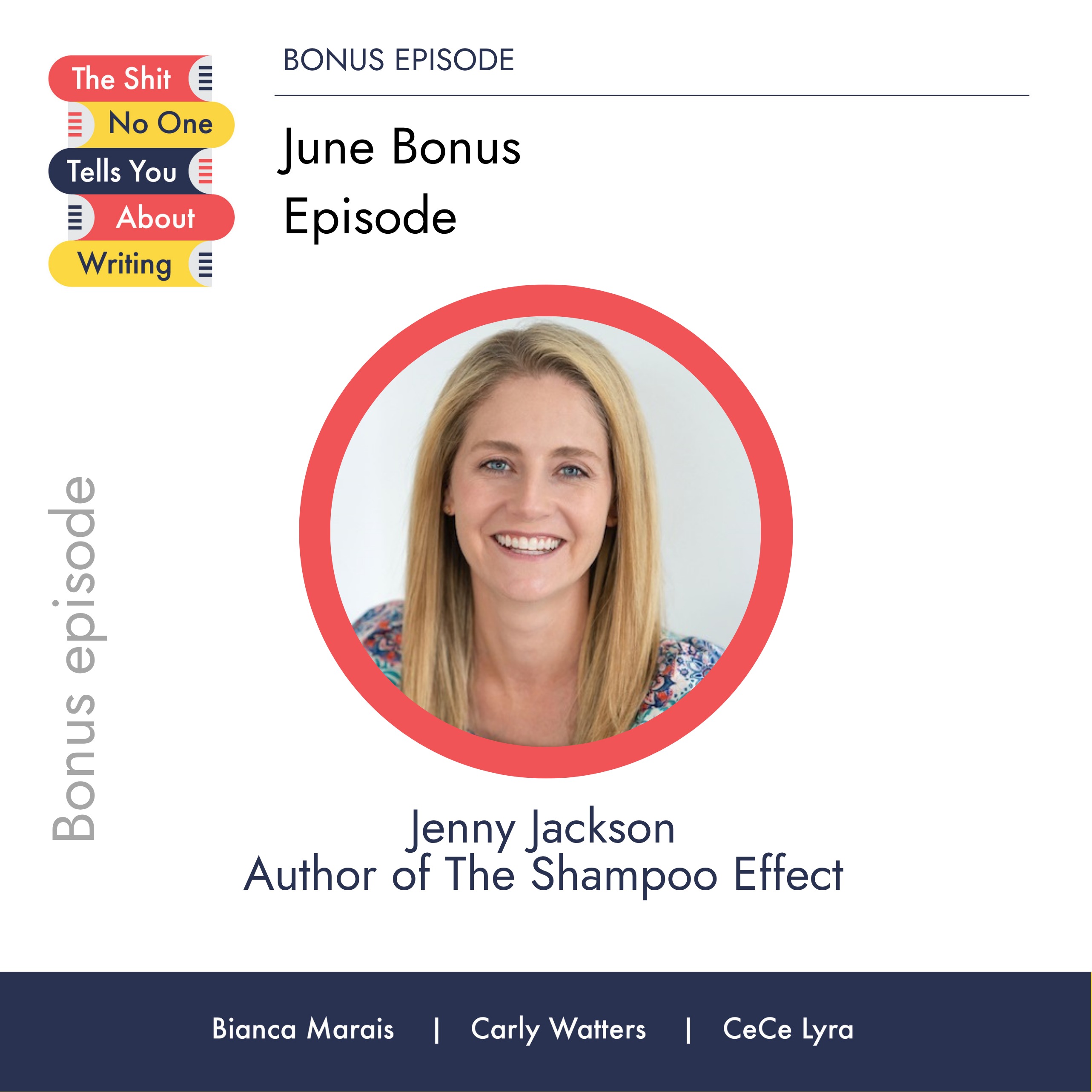
Chime is a fintech, not a bank. Banking services for MyPay and Chime card provided by Chime's bank partners. Optional products and services may have fees or charges, stated annual percentage yield and cash back for Chime prime only. No minimum balance required. Checking account ranking Based on the J.D. power Survey published October 20, 2025 for more information on APY rates, MyPay, Spot Me and travel perks, go to Chime.com disclosures Welcome everyone to a very special episode. Before we begin, I have a housekeeping reminder. Starting it right begins on July 9th. It's a course that's all about how to begin your story in the best place and in the best way, we're going to cover all the elements that are present in the best starting locations for novels and memoirs. And we'll cover how storytellers can deliver the three Cs. We're talking, of course, about curiosity, context, and connection. It's a really intense experience, so come prepared. We're talking four days, with each day ranging from three to four hours, with clear checklists so you can audit your existing beginnings to make sure they're working or craft a whole new beginning if you're like, I want to start over, plus, lots and lots of practical examples from your favorite works. But without further ado, I am so thrilled to welcome to our show our very special guest, the one and only Jenny Jackson, author of the Shampoo Effect. Welcome, Jenny.
- [35:25]
Jenny Jackson
Thank you for having me.
- [35:26]
Cece Lehrer
I'm.
- [35:27]
Jenny Jackson
I'm a frequent flyer now, right? If I come more than once.
- [35:30]
Cece Lehrer
Yes, absolutely. You can have your little card. We can start collecting miles. We should do that. We should actually do this. Yeah. Yeah. Okay.
- [35:39]
Jenny Jackson
So you.
- [35:40]
Cece Lehrer
You obviously came for the first time to chat about your first, your debut book, and this is now your second. So your second baby. How is it like Pineapple street, your first book, the Shampoo Effect, your second book, how does it feel to have two books out? How different were the experiences?
- [35:59]
Jenny Jackson
Incredibly, incredibly different. I mean, it's so funny because I've seen this forever from the editor side of things in my day job as an editor at Knopf. And the sophomore slump is real, and second novel syndrome is real. And know, for me, the hugest difference is that when you're writing a first novel, nobody knows you're doing it. Nobody cares that you're doing it. You have no idea what anybody might think of it. And so you're free to just give it a whirl and, you know, see what happens with the second novel. I briefly got in a really bad headspace, which I don't recommend to anybody, where my whole way of approaching the writing of the Shampoo Effect was, I want to write a book that people who liked Pineapple street will also like. And I want to write a book that people who did not feel the Pineapple street was for them will want to come to. That is no, wow, big goal, Big goal. Basically, I'm trying to say, like, I'm trying to seduce the haters while, you know, retaining the lovers. And that's not a productive way to write a book. Yeah, you shouldn't actually at all be thinking about your critics when you're writing a book. And so I had To. I had to kind of get over that at some point so that I could really just let it flow and not second guess myself.
- [37:19]
Cece Lehrer
I love that you are essentially discovering the advice that you've imparted. Right. Because you're discovering it as an author. Because I'm sure you've told your authors that. I'm sure you've been like, don't compare. Don't try to bring in the haters.
- [37:34]
Jenny Jackson
Don't read bad reviews. Yes, all these things. But it's just kind of when it comes to the psychology of writing, you really do need to live some of it to understand exactly the sort of texture of neuroses that pop up inside a writer's body and brain.
- [37:55]
Cece Lehrer
So true. So true. You just have to live it. I actually remember at our first interview, I asked you, like, what, if anything, was different about your editing process now that you had written a book and you had been edited? And I remember your answer. Your answer was so thoughtful. You. You said multiple things, but one of the things you said was, I pay way more attention to compliments now because I know the importance of just reading those little comments in the margins where it's like, I really loved this. This is working. Not just from a psychological perspective, but also from a. Like, a reinforcement of this is working. So I think my question to you
- [38:28]
now is, you've written two books, so
- [38:32]
second time around, did you learn anything about. Maybe it's the editing process, maybe it's the author agent relationship, maybe it's with the relationship with the publicist. But, like, have you learned anything that you're like, huh? And now I'm gonna do things differently as an editor?
- [38:46]
Jenny Jackson
Well, I think that I have learned, and it really quickly came back to me on the editorial side. But as a writer, one of the funny things that happened to me with Pineapple street is that after, you know, I sold the book to Pamela Dorman, I then had a bunch of conversations with Hollywood with different film companies and tv, you know, production companies that wanted to adapt it. Smart people, interesting conversations. The biggest theme of those calls was, well, we need to have the action up front when we're doing a pilot, when we're doing a script. You know, you do all of this scene setting and world building and character development, but we'd have to figure out where the story starts for TV or film. And so I really took that to heart. And when I sat down to write the Shampoo effect, I was like, all right, I gotta get. I gotta get the drama from the jump. I'm really gonna have sort of the big thing happen right away to set the course of the novel. And so I wrote it. And this isn't a spoiler because it's. It is really like the end of chapter one. I wrote that, you know, the. The central conflict, which is that this woman, Caroline Lash, falls in love with this guy, Van Whitaker, and discovers that his ex girlfriend is pregnant with his baby.
- [40:06]
Cece Lehrer
Messy people. It's very messy.
- [40:09]
Jenny Jackson
It's very messy. And I was like, laid the mess out on the stage in the. In the first draft. And after my agent and editor read my first draft, they were like, love it. Great compliment sandwich. But you have this pregnancy news before we know the characters. So, like, the stakes aren't high enough and we don't care enough when we get this news. And it was sort of like, duh. Writing a book is not writing for television. It's not writing for the movies. Or writing a book is its own beast. And I let too much feedback from too many other people get in my brain. And I should have really been writing for me, my editor, my agent, and not try to again please all these other voices. Hilariously, I would say. Six months later, I. I bought Yesteryear by Carol Claire Burke as an editor and fell in love with the book. Caro did maybe 15 conversations with different editors, and then, you know, we prevailed in the auction. And then after that, she did a gazillion conversations with Hollywood. And so after she sold it for films and Hathaway, Caro got my first editorial letter and she went off. But she also had all these voices from the other 14 book editors and all the film editors.
- [41:38]
Podcast Host (possibly Alicia)
And.
- [41:38]
Jenny Jackson
And she really wanted to take in all of the comments that she got from everyone. She's so smart and she's such an amazing student. And she came back with a draft that I think she knew was way, way too busy, too full, had not moved in the direction we needed to go. And so we then sort of had to like, say, okay, wait, let's go back to what we had before and try this again. And then Cara was such a genius, and she went on to do several revisions that just got smarter and smarter and better and better and better. But it was a classic case of too many cooks in the kitchen trying to serve all masters, taking too much feedback that wasn't parallel and making kind of a hash of it.
- [42:23]
Cece Lehrer
Yeah, that makes total sense to me. It's such a smart way to put it because sometimes if there are too many voices, if there's too many directions coming from all sides. It's almost like by doing more, you're giving the work less shape.
- [42:36]
Jenny Jackson
Yes.
- [42:37]
Cece Lehrer
Which is so interesting to me. But your. I mean, obviously I didn't read the first draft. I. I'm reading. I read the arc. But your starting place is great because we get Caroline's foundational wound. We learn that Caroline, you know, her mother is larger than life. Her mother is this very famous author who is magnetic and charismatic and, you know, big personality. And she's always felt like she's lived in her mom's shadow. And then she is an acquiring editor at a publishing house. And she always has that little, like, nagging feeling of, huh, nepotism, you know, but she's actually really good at her job. Like, she's so good at her job, yet when she places a short story in the New Yorker, which come on, the most impressive thing that could happen to someone, right? Like, so impressive, she decides to leave that successful job behind and move to Greenhead, Massachusetts. And people are like, what are you doing? Like, it's just one short story, you know, like, it takes so long to build an author career. Like, like what? And she's gon, Like, I'm going to work on my novel. I'm going to write this novel. So I guess my question to you, like, the practical question is, did you decide on this foundational wound in this. In this. In this protagonist, you know, with her interiority, her trauma, her desires, her fears, her hang ups, you know, but also, like, all the wonderful things about her. Did you decide this before you started writing, or is it something that, like, revealed itself and then you had to go back and edit?
- [43:59]
Jenny Jackson
So I knew that this character Caroline was going to be a little younger than the group that she falls in with in Massachusetts. I knew, you know, the other character, she falls in love with a guy who is 34, and his friends are sort of 32 and 34. I knew she was going to be a little younger, but I also needed her to be sort of malleable. I needed her to be a little bit unformed as a person. And that's what allows her to get so swept up in his group of friends. That's what allows things to get so out of control because she's not totally confident in herself. And. And so she's 28, but she's a very young 28. And for me, it made a lot of sense that she would have someone really domineering in her life, and that's why she wouldn't have really formed this incredibly strong sort of Sense of identity. I also think I'm sort of fascinated with the people in the book world, whether it is, you know, writers, publishers, editors, who have family in the business. Because, you know, like many, many, many industries, there are some dynasties in publishing. There are some, you know, very, very famous writers. Stephen King. Who have. Who have children, who are writers. And I think that would be so incredibly difficult. You know, I don't have any family in publishing. And so for me, again, it was like, landing an editorial assistant job was so exciting and impressive to everyone in my family that, you know, I could have probably stayed an assistant for 30 years, and they would be like, you are a success story. And I would have felt good about it. But for Caroline, like, the bar was so high that getting out from under her mother's shadow was going to be difficult. And then I also loved writing this famous thriller writer. For me, I have. I've created this, like, outrageous character in her mother. And I love to, once in a while have. My main characters usually are not so extra. They're not usually so over the top. But I like to have some secondary characters that sort of have the volume at an 11, because writing their dialog is just so much fun for me.
- [46:14]
Cece Lehrer
Yeah. And also offers great contrast with the protagonist. Right. Like, it's a way to really put the pressure on. Like, and this is true of all mothers. I'm remembering a scene where, in Bailey's point of view, I'm pretty sure it has to be. So Bailey's talking to her mom, and her mom's like, you shouldn't do that, or else Van's gonna think you don't want to get married. And she's like, I don't want to get married, Mom. That's correct. Like, Bailey does not want to get married to the baby daddy. And her mom's like, well, things might change. And that kind of, like, antagonistic force. So it's an antagonistic force with. With loving intentions. Right. But it's pressure. It's pressure on the protagonist that creates such good fodder for storytelling. Okay, so I have a question. You mentioned your POV characters. So we have in this book, Caroline, Bailey, Fran. Oh, why am I blanking?
- [47:00]
Jenny Jackson
Augusta.
- [47:01]
Cece Lehrer
Augusta. Okay. Was it always going to be these POVs, or did you at one point think of just Caroline? Just Caroline, Just Bailey? Did you ever think about adding Van? Like, how do you decide that?
- [47:14]
Jenny Jackson
So of course, Bailey and Caroline were always going to be the. You know, they're two sides of the love triangle. But I wanted to explore marriage with this book, and I wanted to explore different kinds of relationships. I think it is so interesting right now to be an elder millennial who is navigating marriage and parenthood with sort of a generation that has. Has pretty different ideas about partnership than our parents generation had. And I, you know, like all of us, I have several friends who have done it alone, women who have had babies on their own and who are single mothers. And I have friends who, you know, have gotten divorced or are going through divorce. I have friends who. Who have adopted. I have friends who've done surrogacy. And so I've really wanted to think a lot about how different partnerships can look. And so for me to get into that, I wanted to bring in more than just, you know, one character, Bailey, who's having a baby on her own, one character, Caroline, who does not have a child. I wanted to bring in Fran, who has a partner but is unwilling to marry him even though we have children. And then Augusta, who is so traditional and kind of just wants everybody else to be really traditional also. And so these other characters let me sort of take a prismatic look at marriage and relationships from different points of view.
- [48:35]
Cece Lehrer
I love that. And what about, like, real life? Inspiration? So Caroline is an author, and she. There's a. There's a moment where she says that she feels ashamed to admit that her work isn't pure fiction. So.
- [48:51]
Bianca Marais
Meaning.
- [48:51]
Cece Lehrer
The implication is that, you know, if she's a fiction writer, it should all come from her imagination. But actually, the short story she placed in the New Yorker, the one that, you know, was already there when the story began. If you've read the book, you know, there's another one. We're not gonna ruin it too much, but that first story, it was based in real life, you know, so she's like, hey, am I. Am I even a real writer? So does that. I mean, I'm sure that imposter syndrome can't happen to you, Jenny. You can't tell us that you have imposter syndrome or else you will depress everyone. So tell us you don't have imposter syndrome because you're not allowed to have it, I assume. Come on, you're Jenny Jackson.
- [49:23]
Jenny Jackson
And.
- [49:23]
Cece Lehrer
But also, like, do you feel like authors have that? Like, is that something that people get hung up on?
- [49:30]
Jenny Jackson
I mean, I think that no matter what your process is as a writer, you sort of suspect you might be doing it wrong, honestly, whether you're writing from real life or you're making things up whole cloth, and then that makes you Feel like you're, you know, not being realistic enough. To me, it's that it is so very morally tricky to write about real people. And that's something that I have run into as a writer and very much as an editor. And so even though writing from real life can make characters incredibly realistic and can give the reader this incredibly visceral experience, it can also be quite ethically challenging for a writer. And Caroline can only do it that way. She can only write. That's her process. She pulls from real life and she has, you know, she talks about how when she was younger, she took. She wrote a story about her best friend and she put it towards her senior thesis, but her best friend still doesn't know about it because she knows that if she ever published it, that would be harmful. So this is something that she walks around feeling guilty about, but it is her way.
- [50:42]
Cece Lehrer
Yeah.
- [50:43]
Jenny Jackson
And I think I really wanted to sort of discuss some of these scandals that we've seen in the publishing industry. You know, Robert Kolker's amazing article, the bad art friend, or, you know, the scandal around cat person. Or we've. I mean, there's more than we could possibly count. People sort of coming forward and saying, you wrote about me. Or, you know, even like Ann Patchett writing about Lucy Greeley in Truth and Beauty. I mean, some of the most incredible, incredible works of art have been drawn from real relationships and real people. But it always treads the line of sort of a moral gray area. And it's juicy. Who's allowed to tell what story? If you go out to dinner with a writer and you both witness something, who does it belong to? If a writer friend tells you something and you put it in a book, but they didn't say they were gonna write about it, is that allowed? If you're out with another person, they tell both of you, is it whoever gets there first? I mean, and like God forbid you're, you know, married to a writer and you break up and you both write about it. It's like, hit publish faster. You know, this is like really juicy stuff that all writers have to contend with. The rules.
- [51:50]
Cece Lehrer
Absolutely.
- [51:51]
And how much do you draw from real life?
- [51:54]
Jenny Jackson
I draw a lot from real life. I am sort of a crow who is like, goes out and collects shiny things and brings them back to her nest. I'm constantly making notes in my phone, just eavesdropped conversations. Stuff my sister in law tells me, stuff my friends tell me. I mean, I'm an eavesdropper. And it's. It's Pretty shameless. I. Yeah. Don't trust me. I'm going to. I'm going to put it in a book.
- [52:20]
Cece Lehrer
I love it. Don't trust me. I'm going to put it in a book. Can we put that in a T shirt?
- [52:24]
Jenny Jackson
Like, no.
- [52:25]
Cece Lehrer
I love that. It's just fair.
- [52:28]
Jenny Jackson
In all honesty, if you tell me something. If you're. If you tell me something serious and tell me not to tell anyone, I won't. I'm a really good friend and I don't gossip, but if it's, like, if it's harmless or if I can disguise it and disguising is a huge thing. I'm so fascinated with the way, like. I mean, one of my writers says if you swap the gender of someone, then they never see themselves. And so you can kind of get away with a lot if you swap the gender.
- [52:55]
Bianca Marais
Yeah.
- [52:56]
Jenny Jackson
Some people joke that, like, if as long as you make the subject, you keep talking about how beautiful they are, you can get away with it because the person will be like, I can't believe they wrote about me, but I'm gorgeous.
- [53:06]
Bianca Marais
You know?
- [53:07]
Jenny Jackson
So there are ways, if you give them a lot of money, too, like, they could. Yeah, they could get comfortable because they won't recognize themselves.
- [53:13]
Cece Lehrer
Not that they'll forgive you, but they probably won't because it. It's stuff that changes the power dynamics, like, whatever changes the power dynamics.
- [53:19]
Bianca Marais
It's.
- [53:20]
Jenny Jackson
I mean, it's incredibly fascinating. And, like, I even. Not about my book, but about other books I've published or have worked on. I've had fascinating conversations with our lawyers about how writing fiction about a real person is actually more dangerous than writing memoir.
- [53:37]
Cece Lehrer
That is really interesting. That is very interesting indeed. We should have you on just for a different episode.
- [53:43]
Jenny Jackson
Whole episode on that one.
- [53:45]
Cece Lehrer
Whole episode. I don't want to get sidetracked on the shampoo effect. So. Okay, I have a. What is kind of like, I think, a delicate question, which we can totally edit it out. But you're saying you write this based on real life? Like, you write in general based on real life. And as I was reading this book, okay, one thing I kept thinking to myself, and it's a very CC thing to think. Like, I don't know if you'll agree, but this is. This is how I felt. I'm like, man, all these husbands are useless. Like, all these husbands. Even the.
- [54:14]
Like.
- [54:15]
I'm not saying they're like bad husbands. Like, all in all. I'm just saying, like, loving, caring husbands. A lot of them that we like, root for them. I'm just going, these men are useless. They're just like, they're not doing anything. Like, they are not picking up the slack.
- [54:31]
They're not carrying their weight.
- [54:33]
Did you use this on any of your friends husbands? That's my question. Say no, say no. Even if the answer is yes, deny it.
- [54:41]
Jenny Jackson
Absolutely not. No, no. No husbands were harmed in the making of this product. I think that I wanted to contrast a lot of the husbands in this book with Van, the not husband. So the one that Caroline falls in love with, who wants to, you know, to be a good guy. He would really like to be a good father to this baby he's having with Bailey. But Bailey is putting pretty firm guard rails on in terms of what he's allowed to do. But you can see the way that he treats Caroline, the way he treats his friends. Van is, he's a golden retriever, but he's also, he's an environmentalist. You go for a walk and he's picking up litter the whole way. His love language is caretaking. He is checking the oil on your car. He is, you know, gonna fix that creaky step out front. I'm. I don't have it in the book, but I'm just gonna tell you. He definitely, like, does her laundry. He is, he is a full 50, 50 guy. He would be an amazing partner. He's just not necessarily the partner that Bailey thinks she wants for herself. And so I'm contrasting this guy who honestly reminds me a lot of my husband, who does my laundry and who picks up trash and is the full 5050 with, with these other relationships. You know, Fran, who is one of the characters in this book. Fran was raised with wild brothers. She has two little boys of her own. She's surrounded by boys all the time. Her partner is rj and she hasn't been willing to marry RJ Partly because she just can't stand to tie herself to another boy, but also because she can see that he is not going to be a full 50, 50 that he is.
- [56:27]
Cece Lehrer
And he really wants to marry her. He's been wanting to marry her for a long time.
- [56:31]
Jenny Jackson
He does. He loves her very much. But he is also living for pleasure still. He is staying out late, drinking. He is a big proponent of cognitive liberty. And even though he is physically doing his 50, 50. Yeah, I have the kids on Saturday. I took them to soccer. He's not doing all the emotional labor. He, you know, he's not signing them up for camp. You know, he's not like Arranging the parent teacher conference. He thinks he's doing his share, but he's not. And she cannot fully commit to somebody who's not going to give her what she deserves.
- [57:05]
Cece Lehrer
Well, I loved the moment in the story where she realizes this bit about the mental load, you know, this bit about the partnership she's in, because I feel like it's very. It would be very easy for you to have written a marriage where it's like, well, I'm not rooting for them, but I'm still rooting for them, you know? So I think that's a very beautiful balance to strike, because at the end of the day, if. If we want, you know, to. To give every love story that the chance it deserves, then it can't just be, these husbands are useless, which they are. I stand by it. Let's abandon them. It has to be. Let's reform the husbands. Another thing. Put on a T shirt. We could just come out with all these T shirts.
- [57:42]
Jenny Jackson
Yeah, totally.
- [57:43]
Cece Lehrer
Let's reform the husbands. Let's do it. Okay. So did you have a favorite character to write?
- [57:49]
Jenny Jackson
Yes, but it has been so interesting because just because somebody is my favorite to write does not mean it's readers favorites. And I really learned this the first time around with Pineapple Street. Georgiana was my favorite. And so many people were like, oh, my God, I hated Georgiana. She's so spoiled. And I'm like, yeah, I loved writing her this time around. My favorite is Bailey. And Bailey is an alpha, and she is a flirt, and she thinks of herself as sort of kind of like a man eater, and she's unapologetic about it, and she's independent, and she's gonna have this baby on her own. And she's beautiful and bossy, and I had a blast writing everything about her. And then I had this hilarious conversation with a journalist who was writing for Elle magazine, and she said, but Bailey's such a pick me girl. And I was like, oh, that's the other side of the coin there.
- [58:47]
Cece Lehrer
Okay. I didn't think Bailey was a pick me girl at all. I loved reading Georgiana, and I loved reading Bailey. I love how Bailey is unbothered. Did you watch White Lotus? You do, right? Everybody watches White Lotus. I feel like Bailey was a little Daphne in a way. Like, in a. In a very. There's a. There's an unbotheredness to her, you know, where she's just not going to. I loved reading them.
- [59:12]
Jenny Jackson
I loved it.
- [59:12]
Cece Lehrer
It was so much fun. I could tell that you had fun, but she was not my favorite. I have to say. My favorite was still Caroline. No, because. Because I think we imprinted with Caroline first. And also because I feel like the whole, like, mother relationship, that just added so many layers of vulnerability to it. Loved them all. But yes, Caroline was my favorite. Okay, so there's a moment where. And I'm not going to say where in the story because I don't want to ruin it, but there's a moment where there's a line that reads. It was a funny thing. Publishing a book was sort of like getting to experience your own funeral. People you hadn't thought of in ages came out of the woodwork. Old teachers, camp friends, and second cousin's ex girlfriend you'd met once at a wedding. Where did this brilliant insight come? How did it come to you? Like, was it through one of your authors or was it through your book? Like, were you like, I'm at my funeral?
- [60:03]
Jenny Jackson
My book tour was exactly that experience. I mean, at one point, my first grade teacher came to my book reading and she said, jenny, it's Ann Marie. And I was like, hi, Ann Marie. And she said, what's it like, you know, being here in your hometown? And I said, oh, it's incredible. I mean, it's just so cool to see like old teachers, you know. And she's like, well, that's why I'm here. I was like, mom, who is Ann Marie? And she said, that's Ms. Tamaki. And I was like, oh. Oh my God.
- [60:34]
Podcast Host (possibly Alicia)
Hi.
- [60:35]
Jenny Jackson
It's like, you can't go if you're a first grade teacher. You can't go around saying your first name.
- [60:38]
Cece Lehrer
No, like that's. You really can't. It should be.
- [60:40]
Jenny Jackson
I did not know she had a first name, but it was so mind blowing and so sweet. And then also there's this hilarious event where this girl came through and she said, oh, you know, I. We went. I went to Williams College. Oh my God, me too. And she said, can you make it out to Lauren? I said, sure. And then I said, lauren, what's your last name? She told me and I said, we used your fake ID all the time. So I, my friend had memorized her address, everything, because we had. So it's like, I mean, it was really. It was like your second cousin's ex girlfriend.
- [61:11]
Bianca Marais
It was.
- [61:11]
Jenny Jackson
Everybody comes out of the woodwork, and it's so incredible. But also, if you suffer from even mild social anxiety, it's also incredibly stressful because you're just worried the whole time that you're blanking. On names of people that you should remember or know. Which is why I love it at book events when people do the post it. And I always make sure my authors get the post it, so people write it ahead of time so that when the poor author is socially overwhelmed, it's just like, for Brian. And they're like, brian, hey, you know, 100%.
- [61:42]
Cece Lehrer
It's kind of like the Devil Wears Prada, the original version where Anne Hathaway had to whisper, yes, 100%. We just need that. We just need that. My God, I love that so much. Publishing, like, a book was like, experiencing your funeral. Like, that was such a good insight. I loved it. Let's talk about place. Like, place is a big, big deal in this novel. Green Head, Massachusetts. I understand it's based, loosely based, maybe in your hometown. Can you tell us about that?
- [62:09]
Jenny Jackson
Yes. I mean, it is thinly veiled. Basically, the street names are correct. The, like, the clam box and the coffee shop. It's all my hometown. So I started writing a draft, calling it Ipswich, Massachusetts. And then I started getting stuck because I haven't lived in Ipswich, Massachusetts, in 20 years. You know, I grew up there, but I don't live there. And I started feeling like, oh, my gosh, like, what do I have that corner? Exactly right? And in the book, I say there's only one bar, but, like, I know there's more than one, but I. It just sounds better if it's only one. And I started just really getting, in my own way, feeling like this need to be painfully accurate with every detail. Once I changed the name on the page, I all of a sudden had, like, infinite freedom to write the place that I wanted to write. And so it is 98% true to Ipswich. And then that 2% is an imaginary place called Greenhead. But calling it that gave me so much liberty. I mean, it is so interesting, like, talking about this, realizing how much of the writing process is making psychological rules for yourself that let you continue to stay in the flow.
- [63:25]
Bianca Marais
You.
- [63:25]
Jenny Jackson
You know, it's like identifying speed bumps and saying, like, okay, well, we don't need that. Okay. You know, just like, changing these little things that let you get out of your own way can just be such a difference between pulling it off and not, you know.
- [63:40]
Cece Lehrer
Yes, yes, I love that. I love that. I hope every writer listening just feels, you know, free to give themselves permission to create those little psychological rules. What a great way to put it. So writing a book is an exercise in, like, seduction. We always say this on our podcast. We always say Storytelling is seduction. It's the art of knowing when to reveal, when to withhold.
- [64:02]
Little things.
- [64:03]
Big things, of course, speaking first of little things. An example, we find out very early in the book why Caroline decided to leave New York to get away from the shadow of her mom, who she adores, but who is larger than life. But then later in page 78, we learned that there was more to the story, that there was a second reason. No spoilers here. There was another. Not a second reason, but there was a deeper reason, let's just say. So you give the reader a first, deep reason, right? Like, not just to write a novel, but to get away from the shadow of her mother. And then later, you give them more. And this is, you know, a big thing, psychologically speaking, but it's not a big twist in the book or anything like that. So my question is, how do you decide when to. When to, like, dole out the information, the context, in a way that honors curiosity and honors connection? Like, what's. What's your process? Do you do it based on instinct because you obviously know story, or do you have, like, a way you map it out or something else?
- [65:00]
Jenny Jackson
I mean, I think some of it is that my books are not as plot driven as they are character driven. And so, you know, there's no. Not like an alien invasion, and there is not, you know, like a. A discover of treasures under the sea in this book. And so the place that I go for twists, the place that I go for, you know, narrative pull is like little reveals, like, and there's more to the story. And there's more to the story. And. And so I like to. I like to sort of tease it out that way. I also think that, like, when you're doling out information, if you. If you give the reader everything at once, then they can't tell what's important, you know, and so for me, it was more important that as we first got to know Caroline, her family story and her, like, you know, her professional hopes and dreams, that's really the driver for her. But then this other storyline is secondary, important, but secondary to, like, her foundation. And so I think, like, trying not to just do, like, a backstory info dump. It's also. That's one of the, like, funny little dances of. Of storytelling, right? As you do, like, backstory, front story. Backstory, front story. And so you just. You can't. You can't get it all out there. You can't do the whole backstory at once, or it's not going to give the reader A strong sense of momentum.
- [66:26]
Cece Lehrer
Yeah, you have to bake it in. I mean, you. You bake it in amazingly. What about the bigger things? Like, for example, the twist, what Caroline does. It's referenced in the back of the book as Caroline is cast out of the circle. And what she does next, in a potent mix of fury and heartbreak, exposes long held secrets, and works the entire town of Green Head into a lather. Did you always know what the twist was going to be? Because it was such a good twist. Like, it made so much sense when it happened, but I was like, did not see it coming. Not because, again, not because it made perfect, perfect sense. But I think I was so caught up in the moment with Caroline that I just wasn't trying to figure out the next piece of the puzzle. I was living the experience with her. And then when she does what she does, which will not ruin I could I. The reason why I wasn't surprised is because I came to the realization with her. Like, I. Like I experienced the visceral emotion with her. It wasn't something she planned. It wasn't premeditated, which is why I didn't see it. Does that make sense? How do you decide that? How do you decide the twists?
- [67:26]
Jenny Jackson
I mean, this is like, the worst part of my process. So both times, both with this book and with Pineapple Street, I knew the twist. I knew the. I knew the pivot before I knew anything else. And I wrote to get there. The problem is you can't talk about it, you know, when you're in the jacket copy, you can't talk about it right away. And I felt, with Pineapple street, so frustrated because for me, like, the. The most interesting thing about Pineapple street is when. And I feel okay to give, like, some minor spoilers away on that book.
- [68:00]
Cece Lehrer
Oh, yeah. Years in the past, all our listeners have read it. I can promise.
- [68:05]
Jenny Jackson
I felt okay. I felt like the most interesting thing about Pineapple street for me was that this rich girl has a terrible loss and decides to give all her money away. But it's harder than she thinks. But I couldn't write on the back of the jacket or talk about on my press tour, this girl decides to give her money away because it happened three quarters of the way through the book. And it was frustrating because for me, that was the idea I was writing to. And yet it would have ruined the reading experience to talk about it too much. And now I've done it again. For me, one of the central ideas of this book is the thing that Caroline does and I've made it so that I can't talk about it and promoting it. So good job, Jenny.
- [68:47]
Bianca Marais
But.
- [68:47]
Jenny Jackson
But I will say that both times around, I sort of enter into the novel writing process with a few big ideas and themes in mind. And this is the action theme.
- [69:01]
Bianca Marais
But the.
- [69:01]
Jenny Jackson
But the other themes I knew that I was writing into, I wanted to write about how Ipswich, Massachusetts, where I grew up, was the childhood home of John Updike. So this is a place where writing is kind of baked into the community, where having a famous writer in their midst is sort of part of the town ethos. So I knew that was going to
- [69:22]
Cece Lehrer
be part of it.
- [69:22]
Jenny Jackson
I grew up in Massachusetts where, you know, the New England patriots are actually the state religion. And I knew that I found Tom Brady having a baby with Bridget Moynihan while he was dating Giselle part of my, like, foundational understanding of marital and child having dynamics. And so I wanted that to be part of it. And then I wanted to think about. The other big theme that I was excited about is like the final coming of age that happens when you have kids. Because there are all these various sort of comings of age that we talk about, that we experience, that we write about. And that can be the, you know, when we leave high school for the first time, it can be when we fall in love for the first time, it can be when we get our first job, it can be when we
- [70:07]
Podcast Host (possibly Alicia)
learn how to drive.
- [70:07]
Jenny Jackson
It can be the loss of a parent. There's so many things that can be the coming of age for me, the most like day to day, bone deep, life changing, growing up thing I have done is have children because you no longer live for yourself anymore. You don't go to sleep when you want to, you don't wake up when you want to. You never the person who takes the first bite at the table. Every single thing in your life, you do for someone else before you do for yourself. And so I wanted to get this cast of characters who have grown up together, who have always sort of lived joyfully for each other with a sense of fun, who now are becoming parents together and trying to figure out what is childish and they need to leave behind and what is fundamental to their happiness as humans and they can continue with. So this is like the. This was the coming of age I really wanted to explore is like the midlife coming of age when you go from being the kid to being the parent.
- [71:07]
Cece Lehrer
Oh, I love that. Oh, what a good. What a good. See, you don't have to talk about the big reveal. This is how you talk about your book. Like, Jenny needs my validation. But that was perfect. Oh, my gosh, that was perfect. Okay, so usually our last question is, will you please recommend us? A book can be a book you're excited to read, a book you just finished. In your case, I suppose it could be a book you bought because you also buy books in addition to writing them. But we're going to make an exception here. I am going to ask you this question right now, but then we're going to have a final secret question. I don't recommend people listen to the final secret question until they've read the book because it's something I have to ask. I just have to. It's been eating away at me ever since I read this because this book takes care of place in publishing. And I read this and I was like, how dare Jenny do this? So you've been warned, people. I will ask now the question about, you know, which book Jenny recommends, and then later I will ask the super secret question because I can't let her off the hook. So, okay, Jenny, first recommend us a book, and then I'm going to grill you.
- [72:07]
Jenny Jackson
Okay. In August, there's a book coming out by Chris Bajalian. It's called the Amateur. And you know, Chris and I've worked together. I am his editor. But I'm recommending this as just an absolute banger read. Chris and I have worked together for 25 years. 20 years, a very long time. We have this writing process in place. He writes, he pitches me an idea for what he wants to do. We chat about it. He writes the first, third I read it. We talk more. He goes back, he writes a draft, we edit from there. This time around, Chris and I hadn't even talked about what he was going to do next. And he delivered a finished manuscript on my desk. And it was because he. A voice came to him and he knew what this book was. So it's set in 1960s in Westchester, north of New York City in this sort of moneyed bedroom community. And it follows a young woman who is a golf prodigy. She's an astonishing golf player. She's going to join the lpga. She has just finished her senior year and she'll be leaving for college. And one day she's standing at the country club.
- [73:15]
Bianca Marais
She.
- [73:15]
Jenny Jackson
She's at the practice net and she swings and hits the ball. And the ball rips through an invisible hole in the net and strikes a caddy, a boy in her class who is sitting nearby on the ground waiting for his turn. And the ball hits him in the head and kills him in an instant. And the novel is the fallout. It at first seems like a freak accident, but soon the insurance agents are circling and the club doesn't want to take fault for it, and the net maker doesn't want to take fault for it. And they begin to see a pattern of erratic behavior in this young woman. And soon they discover an affair she's been having with an older man. And they discover something she did to another boy's car with her golf club. And as the sharks circle, her entire life changes. So it's called the Amateur, and it is spellbinding. It is a beautiful novel about old money, golf clubs, men, and one woman sort of at the vortex of this moment in American culture. It is phenomenal.
- [74:22]
Cece Lehrer
Oh, wow. Now I want to read it right now. Yes, everyone, read the Amateur. Done. Okay. All right, everyone, so now it's our official goodbye. Jenny, stay on because I am asking you a bonus question. It's our official goodbye. Bye. Thank you so much for joining us. Now is when you stop listening to the episode in case you have not read the Shampoo Effect. Yes. Okay. So welcome back. If you are here for the second time after reading the Shampoo Effect, this is a spoiler. I actually don't think it's that big deal of a spoiler, but I'm going to be super careful because I do not like spoilers. Jenny. Jenny Jackson. Jenny. Okay. One of the most famous acquiring editors of our generation. The protagonist is a writer. The protagonist is an author. The protagonist writes a novel. Okay? The protagonist, the a novel gets published. This is what I'm trying to say. Sorry, Alicia, I'm going to say this again. There is a novel that gets published one year after the protagonist decides to write it. Explain yourself, Jenny. That timeline is not adding up. That is not how fast a book comes out. We tell all our little listeners, all of them, Jenny. We tell them it takes two years, you know, it takes one year of editing and then one year of production, sometimes more. You want a long Runway for publicity? We. I say this to my clients. We say this to our listeners. What. What did you do here? Why one year later, Jenny?
- [75:45]
Podcast Host (possibly Alicia)
What.
- [75:46]
Cece Lehrer
What is this? Is this poetic liberty? What is this?
- [75:49]
Jenny Jackson
So I really, really wanted to toy with the reader's expectations of what the book is, you know, so I have her at the end drive up and, you know, she's getting out of the car at the. At the literary festival. She's at the New York. No, I'm Sorry. She is at the Newburyport Book Festival in the final scene and she, you know, takes her book out of her bag and is like, wow. You know, it's incredible to see my first book. And as a reader, you're supposed to think, you know what that book is. You're supposed to feel, sure, she has written about.
- [76:25]
Cece Lehrer
I see why I did it now.
- [76:27]
Jenny Jackson
And then it flips and you realize she didn't. She got. She. She tossed out.
- [76:32]
Cece Lehrer
But if it had been two years, I would have figured that out. That's why you made it one year. Okay, that actually makes a lot of sense.
- [76:41]
Jenny Jackson
She's just trying to be tricky here.
- [76:43]
Cece Lehrer
No, this. This is devious. It's devious, Jenny. Devious and tricky and brilliant and. Okay, okay, okay. But to everyone listening, this is not going to happen to you guys. Please do not expect two years. Please.
- [76:56]
Jenny Jackson
Yes, you heard it here.
- [76:58]
Cece Lehrer
Okay. No, this is actually super brilliant. I. I thought you were gonna say it's because her mom called in a favor and was like, make it happen fast, guys.
- [77:05]
Jenny Jackson
Yeah, I mean, she could have done. Could have done. Yeah. Ned Clark can get it done. That he is a power agent.
- [77:11]
Cece Lehrer
Yes.
- [77:11]
Jenny Jackson
Not based on anyone real. Let me tell you. I was.
- [77:15]
Cece Lehrer
I was. I was gonna say. I hope not.
- [77:17]
Jenny Jackson
No, I hope not.
- [77:18]
Cece Lehrer
For reasons that will make. Will be clear when people read the book. Although I do appreciate a lot of the Ned Clarkness towards the end I thought that that was. That was lovely.
- [77:28]
Jenny Jackson
A lovable cad is like kind of my jam.
- [77:31]
Cece Lehrer
Yes, well, also, people need to be messy or else it's. Or else it's boring. Thank you, Jenny. Officially. Thank you. Now, thank you so much for joining me.
- [77:39]
Jenny Jackson
You're the best. I so appreciate it. I can't believe what an amazing reader and conversationalist you are.
- [77:44]
Cece Lehrer
Lucky. All of us, I feel really lucky. We all feel really lucky to have you. I am like completely obsessed. I loved this even more than I loved Pineapple street. And I was quite obsessed with that one. I made my mom read it and my mother in law and we had
- [77:57]
Podcast Host (possibly Alicia)
a little book club.
- [77:57]
Cece Lehrer
So we're gonna do it again this time.
- [77:59]
Jenny Jackson
Oh. Let me know how it goes.
- [78:01]
Cece Lehrer
Okay, I will.
- [78:02]
Podcast Host (possibly Alicia)
All right.
- [78:03]
Cece Lehrer
Thank you.
- [78:03]
Podcast Host (possibly Alicia)
Thanks, Cece.
- [78:04]
Jenny Jackson
Talk soon.
- [78:05]
Bianca Marais
And that's it for today's episode. I hope you'll join us for next week's show. In the meantime, keep at it. Remember, it just takes one.
- [78:13]
Cece Lehrer
Yes. What's up, everyone?
- [78:22]
This is Cece. So I recently grabbed lunch with an acquiring editor from HarperCollins who told me that the number of submissions she's been getting has nearly doubled.
- [78:32]
And I wasn't surprised at all because
- [78:34]
every agent and editor I know has been talking about how the volume of submission keeps increasing. So personally, that is a wonderful thing because it's more reading for me, but it also means I have more chances of matching with authors. I consider it a privilege to review queries on books with hooks and of course, in my submissions inbox. But at the same time, I talk to writers who tell me that they wish agents would read more, more than a few pages because, and I quote, my story gets better in chapter two. I have to be honest, this kills me. It's like me wanting chocolate chip cookies to have the nutritional value of kale. It's just not realistic. Like it or not, no agent, no acquiring editor is going to stick around to see if a submission gets better. It's not because we're mean, it's because because we get dozens and dozens every day. I know it's harsh, but ambitious writers embrace harsh realities. So here it goes. It's your job to make your opening pages irresistible. To make agents crave it, to make agents want to read more. That's why I'm so excited about my upcoming course. Starting it right how to begin your story in the best place and in the best way. I created this course after studying hundreds of books. I've mapped out elements that are present in the beginning of all successful novels and memoirs. And I've designed checklists, actual checklists that you can use to ensure that your story's beginning is seducing your reader. We'll cover how to write a great first line, different types of beginnings, and how you can choose the best one, the best place to start, and the best way to start. Yes, these are totally different things. When it makes sense to add a prologue and when it doesn't. How to frame your inciting incident in an appealing way, how to balance exposition and mystery, how to include context but not weigh it down with too much backstory. And what to do if your story has more than one POV or timeline.
- [80:42]
Most of all, I'm going to show
- [80:43]
you how to make readers want to turn to Chapter two. Join me for this multi day course designed to help you break through the noise. You'll leave with a clear, actionable breakdown of exactly what goes into a terrific beginning. If you've already signed up, come prepared to take lots of notes. We're talking hundreds of slides with real world examples and specific techniques, plus a
- [81:07]
super fun surprise that I can't wait
- [81:09]
to share I hope to see you there.