← The Shit No One Tells You About Writing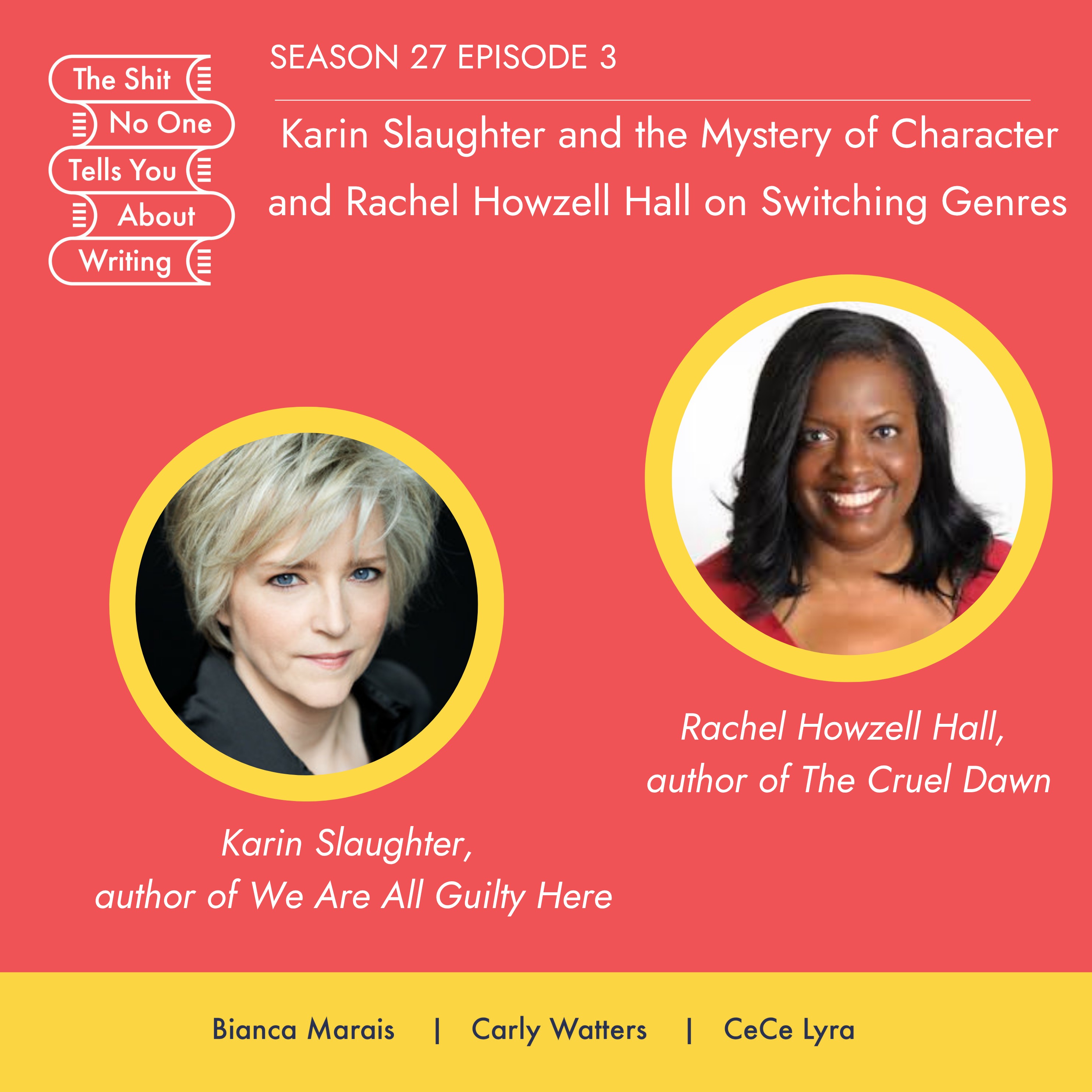
The Shit No One Tells You About Writing
Karin Slaughter and the Mystery of Character and Rachel Howzell Hall on Switching Genres
00:53:47
Author Interview Karin Slaughter and Rachel Howzell Hall
Loading summary
Transcript70 lines
- [00:00]
Bianca Murray
Beta Reader Match up time is happening again. It's been so gratifying over the summer to be tagged in so many posts about beta readers who've become writing besties and who are still going strong many years after they were first matched. Some even travel to meet up and do writing weekends together, which sounds incredible. I can't guarantee any of that. That's entirely up to you. But what I can guarantee is that you'll be matched with a group of people working in your genre and or time zone who will critique 3,000 words of your work as you critique theirs. In return, you can sign up from now until the 31st of August with the matchup emails going out on the 1st of September. Head to my website Biancamarae.com and look for the Beta Reader Matchup tab. Hi there and welcome to our show the Shit no one tells you About Writing. I'm best selling author Bianca Murray and I'm joined by Cece Lehrer of Wendy Sherman Associates and Carly Waters of P.S. literary. Hi everyone. I'm really, really excited about today's guest who is one of the world's most popular storytellers. She's the author of more than 20 instant New York Times bestselling novels including the Edgar nominated Cop Town and standalone novels the Good Daughter and Pretty Girls. An internationally best selling author, she has published in 120 countries with more than 40 million copies sold across the globe. Pieces of her is a number one Netflix original series, Will Trent is now a hit television series starting Ramon Rodriguez on ABC and further projects are in development. She is the founder of the Save the Libraries Project, a nonprofit organization established to support libraries and and library programming. A native of Georgia, she lives in Atlanta. It's my pleasure to welcome Karen Slaughter. Karen, welcome to the show.
- [02:05]
Karen Slaughter
Thank you.
- [02:06]
Bianca Murray
It's so wonderful having you here. Now, before we go into the interview for our listeners, I'm going to give you the flat copy for the novel we're discussing today, which is we are All Guilty Here. Welcome to North Falls, a small town where everyone knows everyone. Or so they think. Until the night of the fireworks when two teenage girls vanish and the town ignites. For officer Emmy Clifton, it's personal. She turned away when her best friend's daughter needed help. And now she must bring her home. But as Emmy combs through the puzzle the girls left behind, she realizes she never really knew them. Nobody did. Every teenage girl has secrets. But who would kill for them? And what else is the town hiding? Now, Karen this is the first book in the North Falls Series. I have to ask, is any part of this based on a previous novel or a previous series?
- [03:00]
Karen Slaughter
No, not at all. I mean, Emmy is a completely new character. The town is fictional. So there's a lot of world building going on there. And it's really mostly about this family, this Clifton family, who controls this one county. Clifton county in southwest Georgia.
- [03:16]
Bianca Murray
Yeah. I mean, I was blown away. I could not believe that this was the first novel in a series in terms of the world building. It felt like it was the 10th novel in the series. There was backstory for multiple characters that you would just drop in. It wasn't important to the plot. Like, for example, we get told that Emmy almost died in childbirth. That's really not important to the story or plot development. But you've got it in there. And it feels so real that it felt like this town was real. It felt like these characters were real. And I know an author of your caliber can do this easily. But what we wanting to pick your brain here now for is for emerging authors who are trying to do the same, what is your process or when it comes to world building? Because so many people think world building only applies to fantasy. But this novel required a lot of world building. So can you take us through that from start to finish?
- [04:12]
Karen Slaughter
Yeah. You know, world building happens a lot, particularly in standalone novels, where you've got to immerse the reader completely in this world you're building in a believable way, even if it is fantasy or romance or whatever your genre. But I've always been an author who believes in giving the details. Right. And so there's never a character who's like the typical, you know, in Star Trek, we always know that the guy wearing the red shirt is going to be killed in the first 10 minutes of the show. Right. And I think the way around that is to make everybody's life in a book matter and give them something that makes them memorable or important or a detail that feels familiar. One thing you said early in your question is it implies that it's easy and it really isn't. Even after writing 25 books, coming up with new, different, interesting characters is the challenge of being a writer who's done this many books. And it's also the great joy, because I've always wanted to, particularly when writing about gendered violence, make sure that everyone's life seems important. Everyone's life matters. And even the smallest character who's connected to a crime has some sort of detail about them that makes the reader know that they're a real person or connect with them on a real level.
- [05:33]
Bianca Murray
So in terms of the process, what comes to you first when you're coming up with a new series? Is it that the character comes to you first, like Emmy, for example, and then you start fleshing her out? Do you do character worksheets? Is it a case of, you know, first the town comes to you and the premise, and then you try and find the characters who will best serve that story?
- [05:53]
Karen Slaughter
Well, it just depends on the novel. You know, when I'm writing a Will Trent novel, that world and those characters are pretty well built. And the challenge is to say something new and interesting about them that rewards new readers and old readers alike. But when I was thinking about this story specifically, it started with Emmy and thinking about the world she lives in. My first series of books was Grant County. I wrote six books in that series. And, you know, when I started out, I didn't know there was going to be a series. And sort of the same with Will Trent. I hoped there would be a series. But with this, I knew North Falls would be a series. And so I was able to make the town a little larger than Grant county, because one thing I ran into was, why would anyone live in this small town where there were rapists and murderers and pedophiles and cults and, you know, so I was very conscious this needed to be more in America, what we would call a medium sized city. And there's a factory that gives a lot of good jobs. There's an outlet mall, there's a technology college. I mean, there's all different areas, socioeconomic areas. So it gave me a bigger palette from which to draw stories from. But also I was able to plant these seeds in this first novel that will later grow into stories for books.
- [07:14]
Bianca Murray
Yeah, the seeds are incredible for our listeners. We are always talking about curiosity seeds. Plant the seeds, water them slowly. Later, when you reveal whatever it is, it feels like a payoff. And there were so many things in here that Karen did that I was like, oh, my goodness, she would drop something tiny. Like, for example, there was just a throwaway line about Myrna's affairs, just like a throwaway line. And I was waiting for that to become relevant. And it never became relevant in terms of the plot. And you just sit there and your brain's exploding because you're like, this author knows these people so well and she's giving us this and it's not even important. But when you think about it, you understand how this affected hers and Gerald's relationship and his drinking without you even telling us about it, we filling in those blanks. So those curiosity seeds are so important in terms of the writing. Karen, do you first sit, create the whole world, understand who all the characters are, understand what the town looks like, have a map before you begin writing? Or do you write and create the world as you need to as you're going along?
- [08:17]
Karen Slaughter
Well, I do a lot of my writing in my head, so I was thinking a lot before I started even writing the first word about what this town would look like, what Emmy's world would look like. And, you know, it really sprouted out from that first moment. You know, in the first chapter, you get the perspective of a teenage girl, and she is looking at this town. That's sort of an idyllic. You know, in America, we idolize these small town communities, but most of us don't live there. Right. We just have this idea about how great this pastoral setting is. And it's really not great if you're a teenager and you want to do things. I mean, you're interested in stuff outside of this town. And so I wanted to talk about North Falls in Clifton county from the perspective of a teenage girl. And then you get into Emmy's head and you see a different side of the county. And then as she interacts with people like Hannah, you get a deeper understanding about how screwed up the Clifton family really is. Emmy grew up with it thinking it was normal, and it's actually not normal. So all of those things came to play when I was thinking about the story. But really having these young girls at the center of this mystery gave me the opportunity to open up a greater understanding of what the town is like, how they responded to the crime specifically. And that introspection that goes on when a bad thing happens in a small town.
- [09:43]
Bianca Murray
Yeah, yeah. Talking about beginning with Madison. So often on the podcast, we say, try not to begin with a character who you're not going to see later on. Try not to introduce a POV character later on who was not there early. You did both. We get Jude, who comes in quite a bit later, and we just get thrown in without any context, which was incredible in terms of starting with Madison. I'm always wanting to pick an author's brain in terms of intentionality, because you could have started with Madison, and even though she's the one who disappears, we could have stayed in her POV occasionally just to up the tension or to try and figure out what where she was or, you know, a little bit later in the story. Well, earlier in the story, but you chose not to do that. So you chose to start with Madison and then move across to Emmy, and then later it's Emmy and Jude. So in terms of that intentionality, was it that you wanted the focus to be on the search and on Emmy? Why rule out that as a possibility for the story?
- [10:42]
Karen Slaughter
Well, that's just not how the story unfolded for me. I mean, I think primarily, I don't really believe in rules, because if you're good at what you do, then rules don't really matter. You can always break them. I mean, look at Cold Mountain, which is a phenomenal story, and the way that the format in which it was written was just completely unconventional, but it worked as a story, you know, so the reason I started with Madison is I wanted to be squarely in her worldview as we start this crime. And I'm a big believer in the mystery of character in my writing. And, you know, you touched on that a little bit with Myrna. I mean, there's a mystery to what their lives were like. There's a mystery to their loss of children. There's the mystery of what's Emmy going to do next, and how is she going to figure this out, and how is this going to affect her relationship with Hannah and with her father and her mother and, you know, all these little pieces that come into play. And I think if you understand mystery of character and you. You trust yourself as a writer to rely on that, there's a lot of tension that can be built just from what are they going to do next?
- [11:49]
Bianca Murray
I really love that for the listener as well, in terms of these little curiosity seeds. We were getting things all the time in terms of knowing that Emmy's upbringing was different to her brother's who's older than her. And it's kind of hinted that her father, Gerald, wasn't a really good person, but now he's the pillar of the community. And you constantly are trying to fill in the blank to try and figure out how did they get from there to where they are now. And this is how the reader becomes actively engaged in a story when they are coming up with theories to try and explain things. And every time you give us one little thing like Myrna, the throwaway line, we're like, ooh, this is interesting. Is this why, you know, the father had these issues in the past? So study this book in terms of curiosity seeds and in terms of specificity and continuity, which is also something Karen does so brilliantly. So there's a line of Myrna she puts on the shower, and then she answers a call, and she's got to deal with that, and then she's got to go and switch off the shower. And that does nothing for the plot, but it immediately gives us something to imagine at specificity. And there's that continuity as well. Every time a character gets hurt or they wounded or they stiff from running, Karen brings that through in the rest of the writing so brilliantly, and this is what makes us believe these characters are real. How do you pay attention to all of that? Is that something you come back to later, or is it just something you pay attention to in the first draft?
- [13:20]
Karen Slaughter
I always pay attention to it because it informs what their next choices will be. You know, and in order for it to be believable, you have to. You know, if somebody gets injured or they're stiff from running or whatever, you have to have the physical memory of their body impact the choices they make in the present time period you're working in. You know, and as far as believability, I think there are so many things that happen every day that feel mundane, but later, you know, if you look back on them, you think they actually had a huge impact on how your day turned out. And that's what I always keep in mind as I'm writing is, okay, well, it's not just one of these things happening in isolation. It's all of these things. You know, Emmy has a fight with her husband. She needs a moment to cool down. She ignores Madison. You know, all these little, small choices she makes add up to one big mistake. But, you know, if you look back at it, you think, well, how would she know? Right? How would she know that these were big mistakes when they all just felt like little, small choices she was making?
- [14:30]
Bianca Murray
Yeah. And this is what we're always talking about on the podcast in terms of the dominoes tipping over. You cannot have a series of satellite events that don't affect each other. Here. The. The dominoes tipping over was so obvious. She has a fight with her husband, she ignores Madison, and it leads to everything else. So we can see how each thing tips over and creates this much bigger thing. Karen, when it comes to writing your characters, do you use a form of, like, method acting technique in that each time you sit down and begin a new scene, do you put yourself in Emmy and go, okay, in the last scene, she was injured. She's feeling bleak, she's feeling hopeless, and you kind of put yourself in that headspace as you begin the new one? Or are you more an author who views your characters from the outside, I'm.
- [15:18]
Karen Slaughter
Definitely more internalized in my writing because I think it's important to try to feel what they feel, particularly if you're talking about writing a crime novel. I mean, as a woman, I'm very conscious the crimes I write about happen every single day, every minute of the day, you know, for particularly gendered violence against women. And so I know that when I'm writing Madison or Cheyenne's story, our Emmy's story or Jude's story, there are women out there who are living this life right now, and I want to make sure that I am being as involved in that and that I'm honoring their experience, but I'm also making sure the character makes choices that are true to their character.
- [16:01]
Bianca Murray
It's clear from your writing as well, because this feeds off from that, is that you really understand the psychology of criminals, the psychology of victims. There's a lot of statistics and studies that you bring through in terms of predators, children who are kidnapped, school shooters, etc. Can you speak a bit about incorporating that research into your work or letting it actually inform your work in terms of plot and character development, etc.
- [16:31]
Karen Slaughter
Well, I would say to any writer, you can't be precious about research. I mean, a lot of times I'll spend weeks or months looking into one topic and it's one sentence in a book. I'm not writing textbooks, so I have to make sure that the story is moving forward. It feels propulsive. You're not stopping to just download a bunch of data. I do talk about the statistics with child abductions because I think that's really important. And a police officer will be hyper aware of that kind of thing. Right. You know, we all. We all know about stranger danger, but fewer than 1% of all child abductions in the United States are actually at the hands of a stranger. Usually it's a parent or an uncle or a neighbor or pastor, someone who's already in the child's life. So it's very rare to have this, you know, stranger come from outside. We should be telling children to be more careful of Uncle Bob than the guy in the pickup truck. But, you know, it's something that I felt was really important to Emmy to have in her back pocket as she's investigating this disappearance, because it also puts a clock on it. You know, if, you know, statistically a child's chances of being found alive diminish with each tick of the clock, that really puts pressure on the investigation. And, you know, we have that happen again at a second point in the novel. And that's when Jude comes in. And she's actually someone who wrote the book on these statistics. So she's highly informed about the probability of a child being found alive.
- [18:01]
Bianca Murray
And also telling the reader that in terms of the character knowing, that also creates opportunities for red herrings. It creates opportunity for surprise because the reader knows, okay, these are the statistics, and this is perhaps what the police are focusing on. But then all of that gets subverted in terms of finding out, okay, it wasn't that. So that gives you another opportunity for that. But something that I was just blown away by, and I read them over and over was like your interrogation scenes. It's just masterful in terms of the back and forth, in terms of pacing, tension, upping the stakes, while also incorporating the psychology of the character and the different ways in which police interrogate people. Can you speak a bit about that?
- [18:46]
Karen Slaughter
Well, you know, it helps that I've got a character who's a criminal psychologist. And, you know, when you have investigator from the FBI, at which Jude is. The training they go through is much more sophisticated than what you would find in a local police force. You know, in the state of Georgia, you have to have far more training to be a hairdresser than you do to be a police officer. And that's true in many, many states or in the country, if not all states. You know, the training that we give police officers is very scant. And we give them funding to do courses so they can do secondary education. But a lot of these courses are not scientifically accurate, so they're getting a lot of wrong information. And one of those things that's very popular in policing now is interrogation, right. And giving police a certain list of words that someone uses that you would interpret as they're being guilty. So if someone calls 911, which is emergency services, and says, oh, my boyfriend has been murdered, as opposed to saying, my boyfriend is dead. Well, if they say murder, that means they're a suspect. If they say dead, that means they're not a suspect. I mean, which is just junk science. So, you know, a lot of times when the FBI comes in, they're dealing with people who interrogate who don't necessarily know what they're doing, but they're very sure that they do know what they're doing. So with Jude, I wanted to show the difference that that training offers and just how nuanced that could be, you know, in less subtle hands or less educated. I mean, there is such a thing as expertise. We've sort of forgotten that in the age of the Internet, you know, the person who is an auto mechanic and goes online at night and posits about constitutional theory and all these other things is not an expert. The person who has gone to school for it and spent decades of their life doing it is the actual expert. And that's very important as a writer, to talk to those experts. So with Jude in particular, I wanted to make sure I was showing what an interrogation looked like, particularly when, you know, it's a tough call to rule someone in or rule someone out. And police are not very good at questioning their gut. You know, they might feel someone is guilty, but there's a difference between feeling they're guilty and being able to prove it. And how you interpret the information they give you can be distorted through that lens.
- [21:17]
Rachel Howzell Hall
Yeah.
- [21:17]
Bianca Murray
Do you get in authenticity, readers, in terms of people to read it, to see that it is an authentic scene, or is it that you've done so much research and spoken to the experts beforehand that you are able to write it authentically?
- [21:30]
Karen Slaughter
Yeah, I don't let anyone read my work until it's published, other than my editor, obviously. I talk to the experts. I mean, the thing to remember is I have to speak with authority in my books, and so I need to know the rules before I break them. I'm not writing a textbook, but I am writing a thriller. And, you know, this comes to play in my Will Trent series because I have a character, Sarah Linton, who's also in my Grant county series, who's a medical examiner and she's a pediatrician also. And even though I know quite a lot as an armchair detective about forensics and about medicine, I absolutely defer to my doctor, who's the expert, when I say, okay, well, how would this happen? And, you know, he might send me five pages that explain the different steps for this one procedure. And I've got to figure out how to put that in half a paragraph or a paragraph and make it, you know, explosive and pulse pounding and all these things. And that's where the work of being a writer comes in. But it's so important to know what you're starting from before you can turn it into something. That's a gripping reading.
- [22:41]
Bianca Murray
Yeah, very much so. And the more research you do, the more tempted you are to throw everything in to prove that you did all your research. But it is about using those five pages and turning it into a paragraph or a sentence to really give that specificity and authenticity. We're almost at the end of our interview, Karen. I want to Ask what you did so brilliantly with Gerald in terms of distinguishing his speech patterns and his dialogue from other characters was incredible. Like, he doesn't use pronouns. He doesn't go, I'm going to do this. He's just, like, going to need to do this or whatever. And so you don't even need dialogue tags or action beats to figure out who's speaking because he speaks so differently from the other characters. Can we speak a bit about that as well? In terms of intentionality? Is that something that comes up front? Do you edit after the fact for consistency, to make sure that his dialogue is completely different to the other characters? How do you approach that?
- [23:36]
Karen Slaughter
Well, I mean, he's like Emmy. He's fluent in silence. Right. And so he lets things sit with him for a while. But it's so important when you're writing to make sure each character has their own voice. And, you know, as the book moves on, there's something very horrible that happens. Obviously, this is a thriller in the first part of the book, and Emmy does a bit of code switching when she's with her father. You know, she kind of mimics how he talks as opposed to how she talks to her son, how she talks to her best friend, how she talks to Jude, how she talks to her brother. But when she's talking to her father, she picks up on the cadence in a way that, you know, they've spent so much time together, she has so much respect for him, and so she does pick up on that. So that's something that it takes just paying attention to how people speak. You know, I love Aaron Sorokin, but every show he writes, like the West Wing, everyone talks the same way. And after a while, you think it's not possible, even for, like, the most educated people in the entire world to talk the same way. The same cadence, the same, you know, six paragraphs of dialogue. And so I want to make sure in a book that everyone has their own specific way of speaking. And, you know, sometimes you're dealing with a bad guy who speaks a certain way, or, you know, there's this code switching that goes on. And to me, that's the fun of being a writer, is figuring out whose voice speaks to what strength.
- [25:02]
Bianca Murray
Yeah. And they've got their shorthand. Just the word okay. It's loaded with so much meaning throughout. And if you're paying attention later, you'll start to realize that the okay word is important. I don't want to give too much away there. Are you a big eavesdropper, Karen? In public. Do you listen in on other people's conversations to get that cadence? Not really because I love eavesdropping.
- [25:24]
Karen Slaughter
Not on purpose, but people are very loud lately. I don't know if you've noticed, people have had started having very private conversations on speakerphone in public, which is crazy. So I would say I listen, but not by choice. But I've always been someone who loves when someone is doing something really bad and I get to witness it because it's something that I'm going to incorporate into a character down the road.
- [25:48]
Bianca Murray
Amazing. Okay, so for our listeners we are linking to We Are All Guilty here on our bookshop.org affiliate page. If you get it from there, you support an independent bookstore while supporting the podcast at the same time. Karen, thank you so much for this amazing conversation. I really appreciate you taking the time.
- [26:04]
Karen Slaughter
My pleasure.
- [26:05]
Bianca Murray
Hi everyone.
- [26:07]
Cece Lehrer
This spring, watching everything outside bloom, I'm also watching my kids blossom in their French Immersion program at school. It's amazing, but also a big motivator for me, especially because we're headed to France next month. I want to be able to join in more, you know, if you want to connect more with your kids language journey or maybe prep for your own adventure this season. Rosetta Stone helps build those skills Rosetta Stone is the trusted leader in language learning for over 30 years, offering an immersive and effective approach that helps you absorb and retain new language naturally on desktop and mobile, wherever and whenever it fits your lifestyle. It is a trusted expert for 30 years with millions of users in 25 languages offered. Spanish, French, Italian, German, Korean, Chinese, Japanese, Dutch, Arabic, Polish and so many more. There's fast language acquisition you can immerse in so many ways. No English translations. It's an intuitive process. And don't forget the speech Recognition True Accent feature. It gives you feedback on your pronunciation. It's very convenient, flexible learning anytime, anywhere, on the go with the the mobile app or on your desktop at your schedule. And there's amazing value. Lifetime membership for all 25 languages for any and all trips and language needs in your life. Lifetime access. So don't wait. Unlock your language learning potential now. The shit about writing Listeners can grab Rosetta Stone's lifetime membership for 50% off. That's unlimited access to 25 language courses for life. Visit RosettaStone.com today to get started and claim your 50% off today. Don't miss out. Go to Rosetta Stone.com today and start learning today. Did you know that your calendar age doesn't always match how old your body truly is. I recently took the True Age Test from True Diagnostic to discover my biological age and I know it's going to completely change the way I think about my health. You guys know I take my health very seriously. From training for triathlons to wanting to live a long time to raise my boys and watch them grow. Health is such an important part of my life and family. Biological age is a powerful indicator of how fast you're aging internally, which directly predicts your risk for serious diseases. Here's why that matters. Research shows that if your biological age is even just five years older than your actual age, you risk developing diseases like cancer or heart disease and they can jump by as much as 30 to 50%. That's a big deal and it's completely avoidable. The good news is nearly 90% of biological aging is in your hands. Yes, it's driven by things like your lifestyle, habits, environment, which means you have a lot of control over it. I recently sent in my sample and I can't wait to see what the results are. I'll keep you posted about what my true age is and what other health indicators I found. The True Age Test doesn't just give a number, it quickly shows your heart, brain and liver immune system and how they're aging. I'm looking forward to getting these results back. I can't wait to get my actionable strategies from academic scientists at Harvard, Yale and Duke to help me slow aging and reduce my risk of disease. The test itself is super easy and convenient. I did it from home. No doctor visit or big needles, just a quick pain painless finger prick. Send off that tiny sample in a prepaid package. In about two or three weeks you'll get a detailed online report about your aging and health fast and hassle free. If you care about protecting your health and want to find out what your real age is, head over to truediagnostic.com and use my code T Snotya to get 20% off your entire order or subscription. That's truediagnostic.comand use T Snotya at checkout to get 20% off your future self. Will thank you.
- [29:28]
Bianca Murray
Today's guest is the New York Times, Wall Street Journal and USA Today best selling author of the 15 novels including the best selling thriller Fog and Fury and the Good Morning America Book Club selection the Last One. She is also the author of best selling thrillers including what Fire Brings, what Never Happened and these Toxic Things. She is a two time finalist of the Los Angeles Times Book Prize for and Now She's Gone and we lie here. It's my pleasure to welcome Rachel Howzell Hall. Welcome to the show, Rachel.
- [30:04]
Rachel Howzell Hall
Thank you so much. I'm so happy to be here. Thank you for inviting me on.
- [30:08]
Bianca Murray
Thank you so much for being here to chat with us. We're going to be talking about a lot today because here is the thing. Rachel has got so much experience in this industry, and she has longevity in an industry in which a lot of authors are like one and done, and people are like, thank you, move on. So we are really going to pick her brain because also she writes across different genres, so there's a lot to unpack. But the book that she is promoting is the Cruel dawn, which we will link to on our bookshop.org affiliate page. Get the book there and you support an independent bookstore and the podcast at the same time. So, Rachel, we're going to start first with crime fiction, because that's what you started with. So what drew you to that and how did you find your voice within the genre?
- [30:58]
Rachel Howzell Hall
Well, I've always been fascinated with people and why we do the things we do. And I remember, you know, I was a reader, like so many of us, and reading way ahead of schedule, so reading things that I probably shouldn't have at 10, 11, 12 years old. But that's how it is. I kept a diary. And like most third graders here in America, you're introduced to that kind of writing by reading the Diary of Anne Frank in third grade. And now, you know, I kind of understood what the Holocaust was. But third grade, you don't really understand what that is. But I was fascinated that this girl my age was keeping a diary of her life. And oh my goodness, is my life this interesting? I want my own diary. So I got a diary and started taking notes and, you know, entries of what my day to day was, probably in hopes that, you know, when I was gone, someone would discover my diaries and went on to publish it. But that started my entry into being observant and couple that with where I grew up. I grew up in a very, very working class neighborhood and it was, you know, had some active crime going on. And we lived in an apartment near an alley. And so there's always bad stuff happening in alleys. I don't think anything good has ever happened in an alley. And I would hear that, you know, screams of women and the helicopters, the police helicopters and shooting and all the rest of it. And I, a very religious kid, could not understand why people were doing these bad things that would send them to hell. Right. It's like, you don't do that. You'll go to hell. That's a bad place. You don't want to do that. And so that made me even more observant than what I was. And with crime, it helped me see the stories and hear the questions that I always ask, but in a way that had an ending. The crime that I experienced for life had no ending. I didn't get to see, you know, the bad guy arrested or the woman's family finding some kind of ghosis. And so all of this was like this big swirl of things that wanted to live somehow in my head. And writing was the way I always spoke out. It was the only way that I felt I could communicate without being interrupted. And that's why I chose it. It was kind of a natural thing, a way of looking at life that allowed me to tell the stories and share my own fears and discover that I was the only scared of these things.
- [33:43]
Bianca Murray
Yeah, because it's so tidy and satisfying in a way that life isn't like you say, the bad guys get their comeuppance. You see some kind of justice prevailing. And I think that's really what draws so many people to the genre who love reading the genre. Right. So that's, like, very different from the fantasy genre. So what made you want to write in that space? And what have you found the biggest difference or difficulty in terms of that kind of storytelling?
- [34:12]
Rachel Howzell Hall
Well, it was initially, it was opportunity. I was asked by the publisher of Redtown, who had been following my career all this time and was to launch a new imprint. And she asked if I was interested in writing Romanasy. And I didn't know what it was. But, one, I wanted to work with her, and two, I'm always looking for a new way to tell stories. And this offered me the opportunity to learn to reach new readers and to actually, you know, infuse crime writing into fantasy. I mean, I think crime can be anything. I mean, the Bible in some ways is a big crime novel, so why not this? And I was familiar with romance, but more so fantasy. I am a gamer. So when we. When I got the deal, I was playing the witcher in Elden Ring. So I've always been in the world of fantasy and as an English American literature major, you know, familiar with the worlds created by Tolkien and even going further back with Chaucer and, you know, all. All those writers back then. So it was. Yeah, it was a challenge, an opportunity, the chance to tell the stories that I enjoyed in a new kind of way. And I would say the biggest challenge for me was the romance part. I mean, I write crime scenes, not sex scenes. And, you know, when there is romance in my stories, it usually turns out bad because he's the guy who killed her. You know, it's that kind of thing. So learning the pacing of a romance and not being cynical about it, that was the biggest challenge for me. And that still remains the challenge for me because I do look at human behavior with an eyebrow cocked, and I see how people use romance and love as a weapon. And so I am learning how to, you know, be cool about romance and having it be a good thing instead of, you know, a means to an end for some poor, unsuspecting victim.
- [36:25]
Bianca Murray
Yeah, People can be so flippant about romance, but it's so tough.
- [36:30]
Rachel Howzell Hall
It is tough. Yeah, it is tough. I've always respected writers who. Anyone who dares to sit down and write, you know, lots and lots of words in a way to get other people to read it. I always respect that. And my respect for romance has increased a lot because it is a gift. I mean, all of it's a gift. But I hadn't really paid much attention to the romance realm until studying and looking at the books and the writers and their skill set until I started writing Romanticism.
- [37:02]
Bianca Murray
Yeah. Yeah. People think it's frothy and frivolous, and, you know, there's people who are terribly snobbish about it. But honestly, I think it's. It's one of the hardest genres to write. So how did you feel, Rachel, about the world building? Because. Because normally when people move from crime or something that's so entrenched in reality and et cetera, they struggle when it comes to the world building. Was that something that came easy to you?
- [37:25]
Rachel Howzell Hall
In a way, it was a little difficult because even though I create worlds and, like, in Fog and Fury, the whole town that exists in that story is an amalgamation of, like, thoughts of different towns. And so it doesn't really exist, but it does. But at least in crime, you commit murder. You know what the rules are, you know, you know, up is down. You know, that's a zebra over there, and that's a wolf over there. These creatures exist. I have touchstones for those. So being told that, yeah, if you're writing fantasy, high fantasy, you have to create this world. And it's like, well, what does that even mean? And, you know, it was challenging. It was fun. After I accepted the challenge, after I stopped rebuking the whole, what do you mean? I have to come up with the philosophy and the religion and the sociology of this place. It really became a fun thing because again, my education and being reading since the beginning of my birth, I got to pull all the stuff that I've ever learned ever into building this. I got to finally really create this system where I am God, which you can't do really in. Well, you can't do it all in crime because crime is very, you know, fact, true world based. And so, yeah, once I moved past the challenge and just even thinking of surrounding something like creating a whole universe, it became really, really fun. And for the second book, the cool dawn, it was great coming back to the world I created for the last one and building it out even further. So yeah, it was, it was a ball.
- [39:09]
Bianca Murray
That leads to the next question. So you've written both standalone thrillers and series and now you writing a series in the fantasy space as well. What are the different challenges or the different freedoms of each? And do you prefer one over the other?
- [39:24]
Rachel Howzell Hall
I can't figure out if I prefer one or the other. One of the great things about series is building that world out. And I like building characters who are dynamic. My characters, my series characters do grow from book to book. I do have them hearken back to a hard lesson learned in the prior books. They're constantly growing and nothing is ever forgotten. And I like that because I see my world like the real world where we grow up and we learn lessons and we make the same mistakes and, you know, we're different people from day to day. And that's the best thing for me about series is constantly creating very dynamic characters. I love that. But I also like the new start of a new issue. I like seeing something. I keep an Evernote file of all the crime stories that have ever interested me. And I know one day I will get to all of them. And I look forward to that. Where it's like I have figured out that weird story about, you know, seeing that random thing in Time magazine and it interests me. And now I know what story I'm going to write about that weird one off. And I like that about standalones. Being able to go here and there and over there to, you know, uncover new kinds of life. And how would a character who always my characters tend to be me in some ways. How she will go about in this world that is just really, really crazy and upside down. How will she write that world? So, yeah, both, I guess I just like. I love writing, I love storytelling. And if anyone lets me do it any way they want me To. I will do that for them. It's like you want it done in, you know, in limericks. I'll write it in a limerick. Whatever you want me to do. I will do a haiku. Yeah, I got you. I'll do that, too. I just love the opportunity to tell stories and to, you know, in. In the new world way, sit around the campfire with people and tell them, don't go over there. There's dangerous things over there.
- [41:34]
Bianca Murray
Yeah. And I think that speaks to your longevity because there are a lot of writers that are very precious about being edited, that are very precious about writing a story, specific kind of literature, and who are like, I'll only write in this realm, and I won't muddy my hands on these things. And I feel like this speaks to why you've been successful for so long, because it is a love of write and prepare to play in the sandbox, you know.
- [42:02]
Rachel Howzell Hall
Yeah. And part of that also is my daytime job. I still work a day job and I'm a fundraising science writer for large, large medical academic center. And part of my job is to ghostwrite for some of the executives and writing proposals where it has to sound scientific but very lay friendly. So I'm used to switching hats and switching voices, and I get paid to do that. And, you know, when we send something out to a donor or to a family member, they don't see Rachel Howzell hall wrote that. They see the institution wrote that letter. And so I am used to and comfortable with not having to, you know, have a signature thing that Rachel does, because the point is communication. The point is telling the story and engaging people so that they, you know, go along for the ride. And in my day job, that means making gifts to improve the lives of patients. And in my novel writing, it's to listen to the story I tell about something that concerns me and probably concerns you too. So, yeah, I don't want. I want to bring people in and I want to meet them where they are. And books and writing have allowed me to do that for, you know, 15 books now.
- [43:24]
Bianca Murray
Yeah, it's a privilege to do this, and it's lovely to speak to somebody who, who agrees with that. Before we continue, here is a message from our sponsor.
- [43:34]
Cece Lehrer
As summer winds down and we get back into back to school mode, thinking cozy interior decor is top priority. From layering fabrics and textiles to extra pillows and fresh sheets and plush bath towels, I can't stop thinking about being enveloped by my home. Whether it's by the fireplace or a piping hot bath or making sure the kids are tucked in their beds. We recently redid our bathrooms in our house. Goodbye 1990s and I love how they've come together. But one thing that always solidifies the look is the towels, soap bottles, hooks and more. Whether it's hand towels or guest bath towels. I like to make the textiles textures and are handpicked items and they feel like a hotel bathroom or spa and each detail is considered Wayfair has the perfect options for us. Wayfair always delivers so quickly so you don't have to wait and second guess any decision making. It's already at your door. You can make confident choices that suit your style instantly. I like luxe, detail oriented, minimal, individual and stylish pieces and Wayfair's got me covered. I think about how the pieces of my house communicate with each other while also being unique. And Wayfair is the best place to shop because your house is not going to look like everybody else's. It's going to reflect you. If you're thinking of a room or a space that needs a refresh for fall as we get back to routine, Wayfair's huge selection is easy to navigate with detailed filters to make sure you're getting the best selection for your taste and your budget. Wayfair makes it easy to tackle your home goals with endless inspiration for every space and budget. Get organized, refreshed and back to routine for way less. Head to Wayfair right now to shop all things home. That's W A Y F A I R.com Wayfair Every style, every home right?
- [45:03]
Bianca Murray
So can you tell us, after having done this for so long, was there a moment that felt like you had made it as an author? Or has that moment even come yet? Because I find as a writer that the goalpost keeps shifting constantly. So tell me, does it eventually stop or is it always going to be that way?
- [45:22]
Rachel Howzell Hall
It never stops. You think by now that it would stop? I would look up and say done. Let's go over there. But it is done. And what's next on the list? Now there are more I am better at saying this is pretty cool now than what I used to be. When the last one was selected for the Good Morning America December book club pick, that was, I would think, the culmination of all good things have happened to me and I have proven myself now relax. And for a moment it almost worked. That feeling quickly wore off and I was off again saying, oh, why can't I ever be blah blah blah. Oh I need to keep doing this to feel, blah, blah, blah. To help me with that, though, I keep a wind jar. It's a pink mason jar on my desk over there. And all the winds that come over the year, from big things like talking to you on this podcast, to going on tour to San Diego Comic Con, I write that on a post it note, fold it up and put it in my jar. And it's a visual cue to me that you actually have done something. You've done really cool things. You're farther along than so many people celebrate. And at the end of the year, I take all my little wins, put it in a, in a baggie, put the date on it, and I put it in my desk. Now, if I ever needed to, I can open those up and look through them to make me feel good. But it's more seeing that collection over the year and that jar having something in it that serves as a reminder that, you know, I am doing something because, you know, neurotic people and I'm a list checker. It's always about what's the next thing that. I mean, I have literally three to do lists on my desk right now, along with post it notes. So I have an issue. I have an issue.
- [47:25]
Bianca Murray
What did writers do before post it notes? This is what I want to know.
- [47:29]
Rachel Howzell Hall
I don't know. I don't know. And we were. At least I know I was born before the post it notes. So maybe, oh, we had the memo pads, little scratch pads and you just insulate be everywhere.
- [47:43]
Bianca Murray
And I guess like thousands of years ago, they had a rock face and some paint, the writers had chisel and. And we will always find something as writers. We will always find something to scribble on. Always, always for our listeners. I really love what Rachel said and I really want you to take away from this because all the wins, the small wins add up. Whether you wrote a paragraph that you're damn proud of, whether you got something back from your beta readers that they absolutely love, whether you got rejected by an agent, but they wrote something encouraging. You know, this, this whole journey is full of so many pitfalls and disappointments and soul crushing moments that it's so important to celebrate every single win. And I'm actually now going to steal this from you, Rachel. I'm getting myself a job. I'm going to be doing this because I think I need to be reminded as well. So can you tell us a bit? What does your writing routine look like on a typical day? And are you more of a plotter or are you more of a Pant.
- [48:46]
Rachel Howzell Hall
I am a plotter again, control free checking lists all the time. And because I am a day jobber and I am a mom, even though my daughter is now in her last year college, you know, I am still trained to do mom things. So I get up every morning except Christmas morning. And when I'm on true vacation, I get up at 4 o' clock every morning to write. From 4 o' clock to around 6:30 I write. And then I do the business of writing, you know, emails and all that, social media and all that. And then I go to work from, you know, 7:38 to about 3 now that I don't have to do all the soccer practices and leadership and all that, you know, stuff for my daughter, I will do some writing that doesn't require thinking. So transcribing, editing, something like that. And that's it. I go to bed at 9:17 every night because I've been up since 4 and I do that every day except like I said, Christmas morning I don't. And when we go on actual vacation away, then yeah, otherwise I am a outliner, besides being the control freak. But the outlining helps because you know, I only get so many bites of the apple a day and I want to be able to cross off. Yeah, I wrote that chapter. I fixed that thing over there. To feel like I've advanced some in the creation of this book. It's worked. You know, I'm looking forward to one day doing novel writing full time. But until then, even when that happens, I will still wake up at 4 o' clock because at 4 I can't do the dishes or the laundry or any of those things that make you feel guilty for just sitting and doing something you enjoy. Because I actually do enjoy it. And four o' clock is when my mind is the freshest. I give myself the best words and then I give my employer what's left of that. And those are still pretty good, good words. But I make sure that I tend to my own writing needs first.
- [50:50]
Bianca Murray
And also the muse will show up when you show up, you know, and I think you train yourself to that, right? So if you're showing up every morning at 4:00am, the Muse knows, okay, I've got to sit down with Rachel. I gotta be there.
- [51:02]
Rachel Howzell Hall
Yep, yep. And I'm giving her plea of time to rest by going to bed at 9:17 every night.
- [51:08]
Bianca Murray
Gets a beauty sleep, right?
- [51:10]
Rachel Howzell Hall
Falling asleep to the Golden Girls, which I watch every night. And she has no excuse. And when she is tired or whatever is having a problem, I Still write, because I know I'm going to get to come back to it and I'll be able to fix it. And she'll be with me on that journey if she decides to, you know, sleep in and just let me flail. Yeah. Walter Mosley, who's one of my writing heroes, said something about the reason why he writes every day. And that's because something new happens or we learn something new every day. And when you're writing every day, you get to capture that thing you learned and it's reflected in your writing. And if you don't get it down, then a lot of times it'll go and it's like, oh, I want to. I want to capture that stuff. I learned. I learned. I mean, the world is, especially for crime fiction. So much happens that I don't want to miss anything. I don't want to, you know, neglect that part of discovery if it's going to make my story shine and be more authentic.
- [52:12]
Bianca Murray
I love that. So how do you approach building suspense in your stories? What's the key to keeping readers on edge, regardless of the genre?
- [52:22]
Rachel Howzell Hall
I want to make sure that I'm breathless when I'm writing. Even though. Have you ever seen a movie or documentary where you know the ending but you're still like, oh, my God, is it going to happen now? It's going to happen now. And I want to do that. And that's part of my outlining process. Some of it is things like that looking at the outline and, you know, graphing when it's a calm moment and. And making sure that, you know, the green turns to red and that kind of like mathematical thing. But also it's just, I would say, feeling. And that feeling comes from reading a lot of other people's stuff. Like I am reading screenplays all the time. When I'm feeling secure in myself, I will read my friends stories. I say when I'm feeling secure myself because, you know, when you read someone else's stuff and you're feeling like you're hacked so you don't ever want to pick up a pen again. So when I'm feeling secure and confident, I will read my friend's stuff, who are very good at that, and I will go through forensically how they did that. So a lot of it is educating myself, watching movies, screenplays are, you know, really, really incredible because they are formulaic. And for someone like me who likes outlines and checks, boxes and all the rest of it, studying a screenplay is a perfect kind of way of getting that formula down Knowing that on the page, it needs to not be so dense. The words can't be so dense if you're trying to, you know, go for a certain vibe. So I would say for writers who are trying to figure out how to do suspense, one, reading other people's stuff, reading screenplays, but also pay attention to your own life. Like, I was just sitting in a hotel parking lot because I was visiting somewhere and I was putting directions in to my phone and the building next door to me, empty vacant lot. There was no reason why anyone would be in this lot. And a car pulls in there into this vacant lot. The guy gets out and goes looking for something over by the perimeter of the fence. And I started recording because, like, there's no reason he should be here. What is he looking for over at the fence? And he comes back finally with the book bag with a knapsack. And he puts the knapsack in the trunk of his car and drives off. And I'm like, what's in that knapsack? Probably nothing. He may have lost it. He may have. You know, who knows? But I took that opportunity to just stop what I was doing and pay attention to this random thing that was happening on Sunday and, you know, capturing that down in my evernote and remembering when it comes time for a scene where my character needs to just be doing something regular and every day that actually happened to me. So minding your own life and the suspenseful moments in your own life helps with creating suspense on the page.
- [55:25]
Bianca Murray
I love that. Because if you're actively engaging and forming theories about something in your own life, like when you see something and you're like, okay, this is my theory. This is why they're doing this, etc, then you know the reader is going to be doing the same thing. And once you've got them actively engaged, coming up with theories, you've hooked them. They no longer passive recipients of story.
- [55:45]
Rachel Howzell Hall
Exactly, exactly. And I think, you know, many of us think, oh, my life is so boring. No, no, even the most boring person, I could find something weird and random and exciting and terrifying about them. And as writers, we have to train ourselves to think that way, that it is a natural thing. Like, I was always curious as a kid, but you have to keep that part of your brain, you know, going. And, you know, sometimes it gets exhausting because you're seeing phantoms and shadows everywhere. But, you know, that's why I sometimes drink, to make the voices stop. Also, that's why, you know, when I go on vacation, vacation, I tend to read non Fiction when I go on vacation because I don't want to figure out the trip as I'm trying to relax.
- [56:33]
Bianca Murray
Yeah, that is the part with writers. We've forgotten how to just read for pleasure. We've forgotten how to be just led along. You know, we're always like, where's the trick? Where's this going? She's mentioned this on page whatever. So it's going to be important later on. I know. Yeah, right. We have time for one more question. Rachel. So your characters often feel very real. They're flawed, they're complex, multi layered. How do you craft characters like this?
- [57:00]
Rachel Howzell Hall
I look to the people around me. I look to women around me. I look at. To myself. And how we go into spaces all the time. Women do, and we have to be concerned about our appearance, you know, our politics, the color of our skin. Do these jeans make me look fat? Am I being too aggressive? And as a black woman especially, you're always constantly, when you're going into a new space, checking yourself and making sure that you present and represent not just you, but your family and your community and your race and every and God and all and the queen. You're very much aware of how people are looking at you. And so I am always taking notes on how we interact with each other. I want women when they're reading a scene to say, that's happened to me. Even something tiny like wearing white and spilling like the smallest speck of coffee on your white pants. Not anybody can see it, but you're aware of it. And now this tiny speck is now the size of Canada. You know, just understanding how that feeling translates into every interaction you have with someone else, with even yourself. I am always auditing myself and the people around me and again, being observant in how we deal with each other. That's how I do it. Turning to the real thing, and as.
- [58:34]
Bianca Murray
A Canadian, I want to just say thank you for saying it was the size of Canada and not the size of the 51st states.
- [58:41]
Rachel Howzell Hall
Wow.
- [58:42]
Bianca Murray
All our Canadian listeners will. Will thank you for that. Right?
- [58:45]
Rachel Howzell Hall
Yes, yes, yes.
- [58:47]
Bianca Murray
Rachel, thank you so, so much. It was wonderful chatting to you. We got to unpack so much, which I really appreciate. Again, for our listeners, we are linking to the Cruel dawn on our bookshop.org affiliate page. And don't forget to get the first book called the last one in the series and then go back and read all of Rachel's backlist because that's the amazing thing of discovering a new author who has so many books out. Rachel, thank you so much for your time.
- [59:12]
Rachel Howzell Hall
Thank you.
- [59:14]
Bianca Murray
And that's it for today's episode. I hope you'll join us for next week's show. In the meantime, keep at it. Remember, it just takes one yes, Beta Reader Matchup time is happening again. It's been so gratifying over the summer to be tagged in so many posts about beta readers who've become writing besties and who are still going strong many years after they were first matched. Some even travel to meet up and do writing weekends together, which sounds incredible. I can't guarantee any of that. That's entirely up to you. But what I can guarantee is that you'll be matched with a group of people working in your genre and or time zone who will critique 3,000 words of your work as you critique theirs in return. You can sign up from now until the 31st of August with the matchup emails going out on the 1st of September. Head to my website Biancamara.com and look for the Beta Reader Matchup tab.