Loading summary
Transcript220 lines
- [00:01]
Bianca Marais
Have you been sitting on the fence about signing up for the Beta Reader matchup? Or have you signed up before but haven't yet found your writing soulmates? The next matchup is the last one for the summer, so don't snooze on it. Get matched up with those writing in a similar genre and or time zone so they can critique your work as you critique theirs. Your manuscript doesn't have to be complete to sign up for this 3,000 word evaluation. This particular matchup will be open to registrations from now until the 1st of June, with the matchup emails going out on the 2nd of June. For more information and to register, go to Biancamarae.com and go to the Beta Reader Matchup page.
- [00:45]
Megan Abbott
What's up everyone?
- [00:46]
Cece Lera
This is cece. So I recently grabbed lunch with an acquiring editor from HarperCollins who told me that the number of submissions she's been getting has nearly doubled.
- [00:57]
Carly Waters
And I wasn't surprised at all because
- [00:59]
Cece Lera
every agent and editor I know has been talking about how the volume of submission keeps increasing. So, personally, that is a wonderful thing because it's more reading for me, but it also means I have more chances of matching with authors. I consider it a privilege to review queries on books with hooks and of course, in my submissions inbox. But at the same time I talk to writers who tell me that they wish agents would read more than a few pages because, and I quote, my story gets better in chapter two. I have to be honest, this kills me. It's like me wanting chocolate chip cookies to have the nutritional value of kale. It's just not realistic. Like it or not, no agent, no acquiring editor is going to stick around to see if a submission gets better. It's not because we're mean, it's because we get dozens and dozens every day. I know it's harsh, but ambitious writers embrace harsh realities. So here it goes. It's your job to make your opening pages irresistible, to make agents crave it, to make agents want to read more. That's why I'm so excited about my upcoming course. Starting it how to begin your story in the best place and in the best way. I created this course after studying hundreds of books. I've mapped out elements that are present in the beginning of all all successful novels and memoirs. And I've designed checklists, actual checklists that you can use to ensure that your story's beginning is seducing your reader. We'll cover how to write a great first line, different types of beginnings, and how you can choose the Best one, the best place to start and the best way to start. Yes, these are totally different things. When it makes sense to add a prologue and when it doesn't. How to frame your inciting incident in an appealing way. How to balance exposition and mystery. How to include context but not weigh it down with too much backstory. And what to do if your story has more than one POV or timeline. Most of all, I'm going to show you how to make readers want to turn to chapter two. Join me for this multi day course designed to help you break through the noise. You'll leave with a clear, actionable breakdown of exactly what goes into a terrific beginning. If you've already signed up, come prepared to take lots of notes. We're talking hundreds of slides with real world examples and specific techniques.
- [03:30]
Carly Waters
Plus a super fun surprise that I can't wait to share.
- [03:34]
Cece Lera
I hope to see you there.
- [03:46]
Bianca Marais
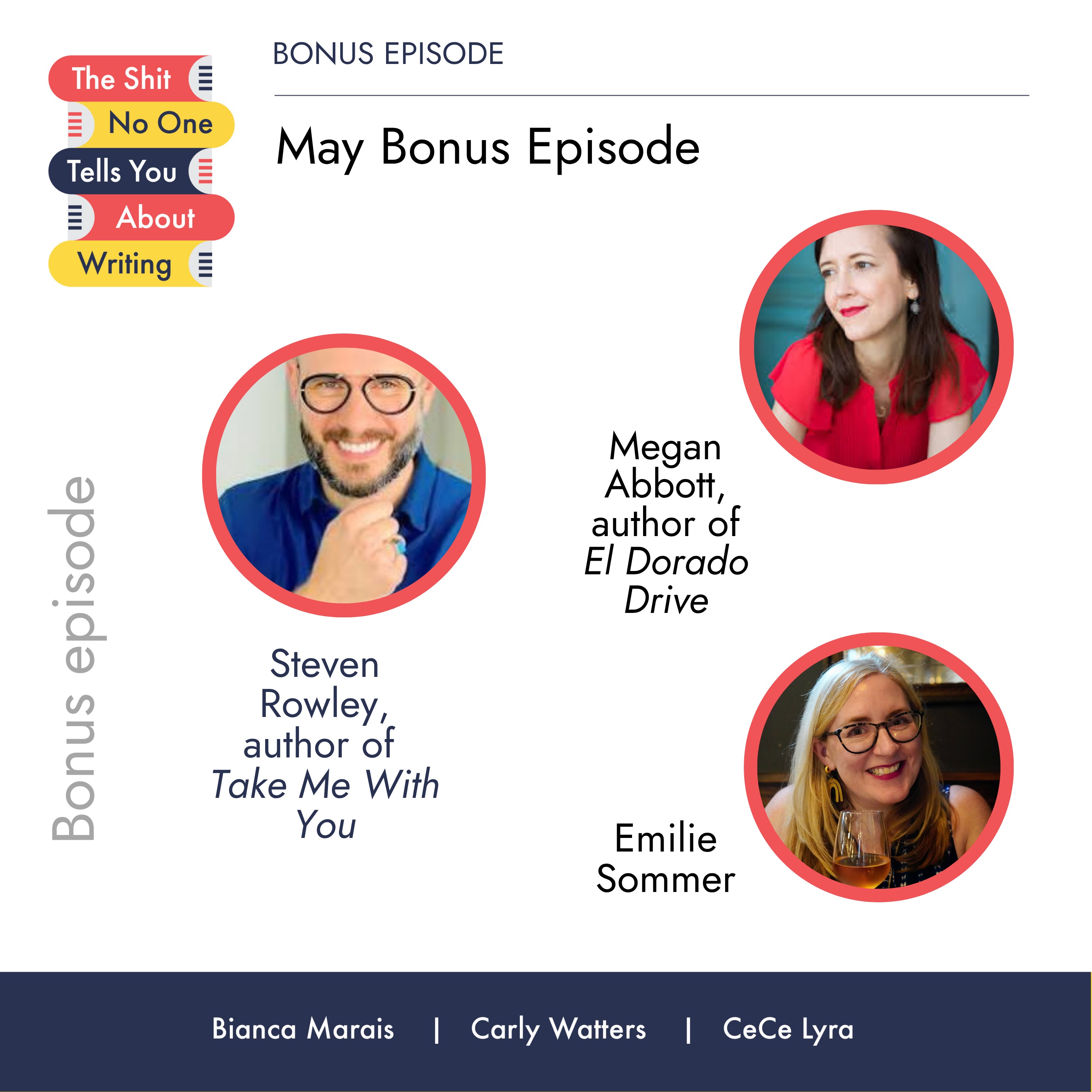
Hi there and welcome to our show, the shit no one tells you about Writing. I'm best selling author Bianca and I'm joined by Cece Lera of Wendy Sherman Associates and Carly Waters of P.S. literary. Hi everyone. Today's guest is the New York Times best selling author of Lily and the Octopus, a Washington Post Notable Book, the editor and NPR Best book of the Year, the Guncle, winner of the Thurber Prize for American Humor and Goodreads Choice Awards finalist for Novel of the Year, the Celebrants, a Today show read with Jenna Book Club Pick, the Guncle Abroad, a USA Today bestseller, and the Dogs of Venice. His fiction has been translated into 20 languages. He resides in Palm Springs, California. It's my pleasure to welcome back Stephen Rowley. Stephen, welcome back to the show.
- [04:40]
Stephen Rowley
I'm thrilled to be back. Thank you for having me.
- [04:43]
Bianca Marais
It's always wonderful having you. We are huge, huge fans. So, Stephen, will you show the COVID of the book? Because I didn't get a galley or a hardcover. There we go. So for those of you who are watching on YouTube, look at that beautiful, beautiful cover. Absolutely stunning. I'll be getting my hard copy soon.
- [05:01]
Stephen Rowley
We'll make sure that happens.
- [05:03]
Bianca Marais
Yes, I will just read the flat copy so everybody's on the same page before we dive in. So college professor Jesse Delruth has been abandoned. Thirty years into their relationship, Jesse witnesses his husband Norman get out of bed late one night, walk into their Joshua Tree backyard, step into a strange beam of light and disappear. How could Norman desert him after a lifetime together? Where did he go? And most confoundingly, will he ever return? Jesse knew that they were both Feeling stuck, longing for something they couldn't quite name. But was their rut so deep that Norman's only option was to leave Jessie behind? As Jesse struggles to understand Norman's disappearance, he tries to piece together his new reality. Is he expected to wait patiently for a partner who may never come back? Or is this an opportunity for reinvention? He is, after all, alone for the first time in his adult life. Should he return to the classroom, put in a pool, get a dog? Call his estranged mother? What does it mean to be alone when you've always been one half of a whole? When Norman's sister Lally lands at Jessie's doorstep with an urgent request, Norman's absence becomes even more profound. Add to Jesse's grief and confusion, the conspiracy theorist neighbor, a strange man following him, and suspicions that he may have had a hand in Norman's disappearance. And Jesse starts to crack under the pressure. With his husband missing and the world closing in, all eyes are on Jesse. Before he can understand how Norman could leave it all behind, Jesse must confront what it means to stay the questions. Yeah, so Lily and Octopus was your debut novel, which was considered a form of, like, magical realism, speculative fiction, with a blend of emotional realism, like imaginative, non realistic plot points. I feel like this is your kind of return to that genre, though obviously not in the same way. Can you speak about that a bit?
- [07:03]
Stephen Rowley
Yeah, it is my first sort of return to magical realism. And it's interesting that it sort of lands almost exactly 10 years to the day after Lily came out. And, you know, so to be revisiting this, you know, a decade later with these other books under my belt and more writing experience, I was sort of interested to see how I would tackle some of those magical twists now with more experience. And so it was, it was a great joy to revisit something that felt a little bit familiar, but also to be freed by, you know, not the constraints of having to write exactly what happens in the real world.
- [07:40]
Bianca Marais
I don't know about you, but I'm finding each book harder and harder and harder. And I, I forgot how much freedom there was in writing a debut because you don't know what you don't know. And so you just dive in and you just. Full force and then. But as you learn craft and as you learn to become a better writer, like, you start to overthink things. Does that happen to you as well? Or is each book, you know, subsequently easier for you?
- [08:07]
Stephen Rowley
Oh, definitely not easier. It's a combination of several things, I think. One is we've used Our, we've used up the tricks in our bag, you know, and so the bag doesn't refill as quite as quickly as we need it to all the time. Two, the constant pressure to come up with new ideas. Three, we want to challenge ourselves as writers. You know, I, I, I, I'm sure you feel this way. I know I do that. I just don't want to do the same thing again and again and again. And maybe I'd have a better career or more successful career if I did. You know, that we don't have to name names, but there, there are writers who have very successful careers writing on just a slightly different version of the same trope or book again and again. So I always want to try something new, and I always want to grow as a writer, and I want to push myself, you know, as a reader. I'm an aspirational reader. I try to read books by writers more talented than I am so that I can reach for their level of skill. So it does become harder. I remember somebody coming through a signing line with one of my first two books and saying, you know, you know how people love to pitch you ideas and you always try to cut them off. I said, no, no, no. But, you know, maybe. He said, maybe you could do this for your tenth book. And I remember my thought was, like, I have to write 10 of these. Like, it just seems so impossible. It seems so impossible. And so, yeah, I do think it, it gets harder and harder. And that's why this is, you know, maybe a bit of a departure for me, the people who know me from the Gunkle books or from the celebrants per se. But it is a return to form, hopefully, you know, in the sort of magical realism that existed in my debut.
- [09:37]
Bianca Marais
Yeah, I'm always fascinated by the evolution of stories because, like, my Witches of Moonshine Manor was meant to be a very serious examination of, you know, dysfunctional relationship and losing your identity. And then it went off the rails and it became fantasy and, you know, witches in the mansion for you. Was this always going to be this kind of story? You knew it was going to have the magical realism elements, or was there ever a point at which it was just a husband kind of leaving, walking out, and then it developed from there?
- [10:11]
Stephen Rowley
No, I approached it. You know, it's based on an argument that my husband and I have, although we shouldn't say argument, conversation that we have, my husband, Byron Lane, who's also a novelist. But, you know, we love to put these sort of questions to each other. And one that was sort of recurring was if a UFO showed up over our backyard and the beam of light shone down and you had the opportunity to go, you couldn't pack, you couldn't say goodbye, you couldn't think about it, just go or stay. And he was always, he would always go. It was without hesitation he would go. And I'm like, well, wait a minute, what about, you know, me, our life, our dogs, our house, you know, was. Am I not enough to stay for? But what I love about that as a, as sort of a moral question is that I think both answers are defendable, morally defendable. Right. I do think the purpose of life is exploration. And so how can the lure of, you know, the answers to a noble questions of the universe by a potentially more advanced species, how could that not be something that you would be drawn to? But at the same time, our job as writers is also exploration. Right. It's, it's. But our exploration is more internal. I think you could spend an entire lifetime with a person and not know everything there is to know about them. You know, in some ways, marriage is, Is a very brave form of exploration too. Or certainly what we do as writers, exploring the human condition will never understand it all entirely. So there's, there's endless amounts of exploration to be done here. So it's just which are you kind of drawn to? And so I thought it would be fun to write a novel from that standpoint. I didn't know it would be quite as literal when I began. I thought it would be more metaphor. I write a lot at the intersection of grief and humor. So it is, you know, the humor in this is a bit absurd, the premise, but also, you know, I thought it would be a metaphor for loss, for a breakup, for divorce, for. For a partner's, you know, suicide perhaps, or death. When you, when you want to ask questions of your partner and they're no longer there to be able to answer them.
- [12:14]
Bianca Marais
Yeah. And an examination of who you are without that person anymore. Because, you know, I think a friend pointed out to me, I don't know, 10 years ago, that when they asked me how I was, I would just say, we are fine. And they were like, you, you always put the couple. It's like, you know, it was like, I'm asking how you are. And it. I never realized that I did that. So after so many years, you. You so integrated into each other that it is an interesting thought to go, okay, well, if that person's not there, then who am I?
- [12:45]
Stephen Rowley
Yeah. First of all, we're Talking in decades here, how we're so young and vibrant. How. How are we talking in these great expanses? Don't understand it. But, yeah, I do think, you know, that you can lose yourself a little bit in a relationship. And in this book, this couple has been together for 30 years. Jesse was quite young when they met. Norman was a little bit older, but he was drawn to someone who is a little more experienced, a little more stable. But over those 30 years, he's stepped into his own, and he no longer wants to be in Norman's shadow. So he didn't really want Norman to leave, per se, but he is ready to stretch and really come into his own, and so it's an interesting cross section for him. It was very fascinating to me to explore this within the concept of a queer relationship, because marriage is something that is relatively new. Certainly commitment is not, but marriage itself is. So to explore that institution a little bit, and what it means is from someone who didn't grow up expecting to be married or expecting that this was the path that their life was gonna take was very interesting, as well as the thought of aging. For me, as. As a gay man, I don't know when I came out in the early 1990s that I would live to see this age. And so what does it mean sort of middle age and late middle age for gay men when. When the generation above ours is, you know, tragically and largely missing? They're not a lot. We were robbed of so many beautiful examples of what aging gracefully as a gay man should be.
- [14:16]
Megan Abbott
Yeah.
- [14:17]
Bianca Marais
Yeah. I mean, this brings us to the next question, because your work deals, and this is across the board, your work deals so much with. It deals with grief. There's joy, and there's also celebration, also perfectly balanced. And I love the reference to Dolly Parton's line in Steel Magnolias. Laughing through tears is my favorite emotion. And that perfectly encapsulates your work.
- [14:39]
Stephen Rowley
You know, I think, you know, and we've met and we've hung out, and, you know me, I am hopefully a joyous and happy person. I think people who read my books are worried that maybe I lost, like, a whole busload of people off a cliff in a fiery crash at some time. And that is certainly not true. But I do. I may have mentioned this last time was on. I do think grief and grieving is one of the more universal human experiences that we have. And we so often go through it in isolation. You know, particularly in a Western culture. We're so bad at reaching out. We think we need We're a burden if we're, if we're grieving. And the irony being it's something we all will have to deal with. And so I like to approach it with humor and I like to explore different relationships. You know, we lionize romantic love. Right. There's so many love stories and romances and it's strange that this is my sixth novel and it's my first time exploring romantic love. I did the love between someone and their, and their animals. A mother son story. You know, the goncal is extended family and the sibling story that celebrates friendship love. And so this is my first time really tackling romantic love and it gave me a whole new relationship to explore.
- [15:57]
Bianca Marais
Yeah, but it, I love the authenticity of the romantic love because after 30 years things do change. The passion isn't there. People, they, they're not who they were when they first got together. Maybe they don't feel as appreciated. I was so like really enjoyed the representation of an open gay marriage because I think a lot of times a lot of people when they write gay stories are more sort of, I don't know, it's like they don't want to freak out straight people so they make it more like straight people relationships. And I love that this was, it showed like a really realistic portrayal of two men who'd been together for this long.
- [16:38]
Stephen Rowley
Yeah, I, you know, but I think there's great romance in that too. I do think there's something really special about being together for a long time. And yes, some of the passion fades and some, you know that when we're sort of ignited with, with passion for someone because they're kind of a stranger, what happens to that passion when they become and feel very familial and yeah, sure I'll, I'll freak straight people out, but it is one of the advantages of being in a same sex relationship is you can both sort of ogle the same person, you know. And so it is, is fun and no one's feelings necessarily have to get hurt. And so yeah, it was fun to look at romantic love. 30 years in we write, you know, there's so much about the meet cute when we talk about romance. And there is a meet cute in this because I did think it was very important to see this couple at the start so that we could see how different they were 30 years, 30 years ago.
- [17:37]
Bianca Marais
Yeah. So I don't know about you, but I never really know what my books are about until I've written them. And then generally other people will tell me what my books are about.
- [17:46]
Stephen Rowley
I say the same thing. I count on readers to tell me what the book is about. Absolutely.
- [17:50]
Bianca Marais
But it seems like you are in perfect control with both hands on the wheel when it comes to knowing exactly what you're wanting to explore, whether it's themes, whether it's certain topics. I mean, does that come through in the rewrites, figuring all that out?
- [18:07]
Stephen Rowley
Definitely. The rewrites, it's not. Well, I'm in an interesting spot right now because I am pitching a book, what I want to write next, thinking about when that book will come out. I was fortunate to have been contracted to a two book deal of which this is the first. So I have a delivery date for a second book. I have a pub date for another book. It'll be in the year 2028. And I approach the story, I think for the first time thinking about what do I want to say about the world in 2028, which for better or worse, America's going to be turning the page on a really dark chapter and hopefully there's something brighter ahead, but that's not guaranteed. And so, you know, I have been sort of approaching. It's not a contemporary story, but can I find a story that with some echoes of what I might imagine the world to be in 2020 with this? I do think yeah, the themes sort of presented themselves within rewrites and reimagined the story. But, you know, if I thought too heavily about theme, I would trip over the plot, I would trip over the characters. You know, I'm a character centric writer. I'm not a plot centric writer. I love to put people together in awkward situations and see how they relate to one another and how they react. And that's usually where I start. That's where the fascination is. That's where the exploration is that we, that we talked about. It's very human, it's very small and something very big happens in this. But we are tightly focused around the people it affects the most.
- [19:35]
Bianca Marais
Yeah, yeah. Well, I mean, yeah, you make it look flawless. So.
- [19:40]
Stephen Rowley
Well then I've done my job, but I'm sweating bullets.
- [19:44]
Bianca Marais
I needed to ask, so. So, okay, so you're a brilliant comedic writer who's won awards for writing comedy and now you give us a character Jesse, who teaches comedic writing.
- [19:55]
Stephen Rowley
I put myself on the therapist couch.
- [19:57]
Bianca Marais
But no, besides the psyche of the character, it read like a master class in writing comedy. Like I was highlighting bits and going, oh my God, I never thought about that in terms of writing comedy before. It feels like you've taken everything, you know from writing all of these books, and you have Jesse teaching his students
- [20:15]
Stephen Rowley
this for the first time. Last year, I had the opportunity to teach humor writing. And I'm not a teacher by trade. Many writers are. This was my first time teaching and it was really an eye opening experience. But I'm going to share with you and your listeners. I think the most important lesson that I shared with my students last year and that is this. If you take nothing else from me, write this down. Humor is nothing but a mode of engagement with the truth. That's all it is. It's a way of looking at something, hopefully, and finding that detail and finding something so specific about it that a reader can't help but recognize some sort of universal truth when they read it. Humor is a mode of engagement with the truth. It's just one of many tools that we have as writers to try to create something real and say something important. And so, you know, if you think about it in that effect, then it doesn't have to be so overwhelming. I think people are like, I've got to set up jokes, I've got to set up. There needs to be set up, set up. Punchline. You know, we're not writing sitcoms. In novel writing. Humor can just be an interesting observation. It can be a strange setup like this is. It can be, you know, irony there. There's so many different tools we have to work some humor into, into our, our books and our writing. But I think it's appreciated by a reader too. I do think without that humor, my books would be too dark and daunting to pick up. And so I'm grateful for somehow I. I found a balance that seems to work for me and that also readers seem to appreciate.
- [21:59]
Bianca Marais
Yeah, I really like the exploration of tenderness in humor and how a lot of male comics feel like it needs to be inappropriate and you need to say shitty things about people and, you know, pull them down. But comedy doesn't have to be that way. So it was a really great take on that.
- [22:17]
Stephen Rowley
I do think that there is room to be riotously funny and also kind. You know, I hope the Gunko books feel that way. Which isn't to say that a character doesn't have a bad moment or that they don't lash out and feel bad about it afterwards. We don't have to write Pollyannas. I'm not saying that. But who humor is directed toward, you know, Patrick is never in the Gulkhol book making fun of the kids. You know, that would be punching down In a way. And there are so many people right now trying to seize power by standing on the necks of the most vulnerable around us. And those people don't need to be pointed at and laughed at. Those people need a hand. Lift it up. But it is our job to punch up. It is our job to mercilessly mock those trying to seize power in that way. And so it's just where humor is directed, I think. But I do always try to aim for kindness in my humor, which, you know, there's an easy laugh to be had. Sometimes by making fun of somebody, it's harder to surprise a reader with a different take that they may not have thought of themselves. But I think, you know, it just challenges us to work a little harder. But it hopefully makes for a more kind and empathetic world.
- [23:31]
Bianca Marais
Yeah, true. But I did enjoy the punching up at Elon Musk. I'm not gonna lie.
- [23:35]
Stephen Rowley
I love it.
- [23:40]
Bianca Marais
Yeah, it's big game. And that description of him was hilarious. I really, really enjoyed that. So a few tricks here that I want to make our listeners aware of. When you have, like, a lot of people, as you do in a classroom with Jesse, you know, it's difficult for the readers to keep track of people's names if their names are John and Lily and whatever. And what you do so brilliantly is that Jesse gives all of his students nicknames in his head in the first day of class based on certain things, which is such a brilliant tool to help the reader figure out who all the different characters are.
- [24:15]
Stephen Rowley
Yeah, it's because I have a hard time keeping track of people's names. So there you go. There's the universal truth. I just wrote it into the end a very funny way. Now. I don't think I. I give people weird nicknames like Shoelaces or Backpack or Mountain Dew or whatever their names are. I forget offhand, but. But, yeah, it's. It stems from a very true place. I get overwhelmed. You know, we meet a lot of people as writers, you know, in a signing line, at a book, you know, at a conference or whatever. And I can't keep everyone's name straight. So that stems from that. But hopefully it's also a lot of fun. It's also very challenging. There's a dinner party scene in this that sort of. The book sort of culminates. And I love these big, messy group scenes. I love writing them. I love writing them, but they're a challenge.
- [25:00]
Bianca Marais
Yeah. Yeah. So what you do brilliantly. And I've realized that it's in a Lot of your books is writing characters who spend a lot of time alone. And that's really tricky to do because if it was on screen, it would be super boring because you don't have access to the interiority, their emotionality, their psyche. But on the page, you tend to have the character alone, but they're moving, they're driving, they're doing something. So can you give us some tricks of the trade there in terms of making that interesting? Because often on the podcast, we say don't begin with the character alone or don't let the character be alone too much.
- [25:37]
Stephen Rowley
Yeah, I think it's. As a writer, I spend so much of my time alone, and I, you know, I'm married to another writer. We're very. We live a lot in our own heads, sadly. And so that's sort of what I'm used to. In Lily and the Octopus, I wrote that in the first person. So I think I was afraid of not there not being enough material for a book if I didn't have full access to the character's interiority. I now write in the third person. And it's much harder, as you mentioned, that interiority is harder to access. And I have to remember, am I doing an omnipotent narrator or a close sort of narrator? And what they know, it's. And then it's, you know, you're relying on the character to show you through action and through where they're. Where. Where they're stumbling and where they're succeeding and all of that. So it does become a challenge. I don't. I realized I was doing that purposefully, but it's interesting to hear that pointed out.
- [26:26]
Bianca Marais
Yeah, no, I just took notice of all the times Jesse was alone or someone was alone. But it's still so riveting, you know, because we. We have access to the psyche. And I mean, at one point, he's driving to see his mother, and so it's not like he's just, you know, sitting on the couch or whatever. You. You give motion and you give us interiority. I think I have time for, like, one or two more questions. We talk a lot about specificity on the podcast, and using real life experiences can add that degree of authenticity. Please tell me that the Benora story is real. That has to come from somewhere.
- [27:04]
Stephen Rowley
It's not, except that I have a friend who has a banora or was given a banora as a joke gift. So we're talking about a banana menorah for Hanukkah that you would light your candles. I didn't know if it would be like eight banana shaped candles that you would light or if it's one ceramic banana that the candles go in. And that's ultimately what it is. But I will say I took some pictures at Hanukkah last year. We used the banora. We lit the banora. And so I'll be posting some of those pictures on my Instagram when the book comes out.
- [27:33]
Bianca Marais
I knew that thing had to exist in the world.
- [27:36]
Stephen Rowley
Some things you just can't make up. But, you know, but the banana, a time honored symbol of comedy or at least clowning or pratfalls or whatnot. So how could I resist?
- [27:45]
Bianca Marais
Yeah, no, it was wonderful. Okay, so last question. Giving the reader something that they can relate to. And you had a part with Lally where she talks about how often, as you know, flight attendants, they have to deal with crying passengers. And that, like, took me back. For the very first time I cried on a plane was while I was reading Lily and the Octopus. And my. And my dachshund had just passed away and this poor flight attendant had to, like, come and check on me. And last time was when my mom was sick and I was going to South Africa. But I feel like there are so many people who can just relate to that, to being in a public space, whether it's a plane, wherever, and just crying and you just can't stop.
- [28:25]
Stephen Rowley
And there's someone, you can't stop it. You're trying so hard to control yourself and to hold on to some dignity, and you can't stop it. And I think flight attendants do deal with that a lot. But what a full circle moment that it was. Lily and the Octopus. I've heard from several people who read it on planes, and I hope I'm responsible for people getting some free drinks or something as an apology for making you cry in public.
- [28:49]
Bianca Marais
I think I did get a wine for it, so it was different.
- [28:51]
Stephen Rowley
Yes. Success.
- [28:54]
Bianca Marais
Stephen, we've run out of time. It is always such a joy to chat with you. For our listeners we are linking to Take me with you on our bookshop.org affiliate page. If you buy the book there, you support an independent bookstore and the podcast at the same time. Go out, get the book again. Masterclass in Comedic Writing and emotionality and so many other things. Thanks for joining us, Stephen.
- [29:16]
Stephen Rowley
Thank you. I recommend the podcast to everyone. I met CeCe at the Kawaii Writers Conference. Tell Carly I'm coming for her. But I love chatting with you always, so thank you for having me.
- [29:26]
Bianca Marais
Thanks, Steven.
- [29:27]
Wayfair Spokesperson
Our primary bedroom suite was feeling pretty empty. It was big, which sounded great, but it's a blank canvas to pull together into the cozy and organized space I was looking for. Then I found Wayfare and the pieces that actually match the modern, clean aesthetic I was going for. I got a console table that has a hidden storage and shelving that I can display when I want to show off and when I want to hide the mess. It's gorgeous. White oak finish finishes my room perfectly and has rounded edges which are pleasing to the eye. I couldn't imagine a better fit that matches my style. I'm excited to tackle our outdoor space next. Wayfair helps us narrow down our choices in ways that accommodate everyone's individual opinions in our family, plus has options at every price point. Our outdoor space is ready for some new seating and I love an outdoor rug. It really pulls a space together and makes you feel like you get an extension on your square footage each summer, which is a homeowner's dream. When we're thinking of a remodel or a redesign, we think Wayfair as our one stop shop for home. We used Wayfair Verified when we chose the piece for our bedroom. Wayfair's team of product specialists vet everything by hand using a 10 point quality inspection so you know you're getting a quality piece no matter your budget. I can't recommend it enough. Look for the Wayfair Verified dropdown menu on the site or the Wayfair Verified sticker on the item you're searching. You can't go wrong. Get prepped for patio season. For way less head to Wayfair.com right now to shop all things home. That's W A Y F A I R.com Wayfair Every style, every home Travel season is almost here. I've got my packing list and I'm ready to go. We just got back from a family weekend trip to Quebec to work on our French. Up next, a summer trip to Germany to introduce the kids to the Alps and hear a new language. Plus our 10th anniversary trip to Italy later this year. I love hearing my Italian husband speak Italian. If you have travel coming up, join me in using Rosetta Stone to learn some local languages. There's something about summer that just feels like travel. Shake off the winter and get ready to move. Learning a new language is the perfect way to channel that momentum into a skill that opens up the world. Rosetta Stone has been a trusted leader in language learning for over 30 years. Their immersive, intuitive methods help you naturally absorb your new language without memorizing random vocabulary lists or relying on translations. Instead, you learn by connecting words, visuals and meaning in context, the way language is meant to be learned. Working in the publishing business means my days are often packed with meetings and manuscripts, but I love how simple these lessons are to fit into my schedule. Whether I have five minutes between emails or an hour on the weekend, I can access my lessons from my desktop or the mobile app. App since we're heading to Italy, I've been using my True accent, which gives me real time feedback on my pronunciation so I can sound more natural when we're visiting local vineyards. It's like having a personal coach to help me communicate with confidence. Rosetta Stone offers 25 languages to choose from, including Spanish, French, German and Japanese, so you can find one that fits your next big adventure. Ready to start learning a new language this summer? Visit rosettastone.com today to explore Rosetta Stone and choose the language that's right for you. Go to Rosetta Stone.com todaynow and begin your language learning journey.
- [32:17]
Carly Waters
Welcome everyone. I am here with best selling and award winning author Megan Abbott, author of multiple novels, including of course, her latest, El Dorado Drive, which is now available in paperback. Described as an atmospheric novel of friendship and betrayal, El Dorado Drive is one of the those novels that does it all. It offers the reader a super unputdownable story that's propulsive and fun, and it contains layers of social commentary on a topic that I am very passionate about, women and money. It explores power, vulnerability, the desire to regain control of one's life through the allure of wealth. So without further ado, welcome. Megan, we're so glad you're here. Will you give us your little elevator pitch for your book?
- [33:04]
Megan Abbott
Yeah. Well, you did the best job right there. That was a great description. But yeah, I really thought of it essentially as a story about women and money and their relationship to it. But it's about three sisters who grew up in wealth and the and the wealth went away and now they're at midlife and dire straits when they get an enticing invitation to join a new female investor investment club, as it's called. And they it's referred to as the wheel and it sort of sucks them in and turns out to be not
- [33:35]
Carly Waters
exactly what it seems, not exactly as it seems as are the best thrillers. Right? Like on the surface it's one thing, but then it's really another. And I love how setting is a huge part of the novel. The sisters, like you said, they grew up in Privilege. But then after the auto industry declined and decided destroyed, like their luck ran out, Right? Like, so to speak. So how did you decide on the setting? It's my understanding that you grew up there, but I don't know if I'm right.
- [34:01]
Megan Abbott
Yes, no, that's correct. And I've never really done that. I've never set a book even anywhere near my hometown, which is Grosse Pointe, just outside of Detroit, which, you know, it was famous for all the heads of the auto industry during its heyday. You know, in the 20s, 30s, 40s, 50s, 60s, they all lived in Grosse Pointe just outside of the city. And, you know, when I was growing up in the 80s and 90s, the auto industry was in this dramatic decline. And so I never knew it during its heyday. And it's, you know, you never realize that the world and the place you grew up with is specific until later. And then you realize it is. Because this was all around me, the sense of people losing their. In many ways, their cast. You know, they were just used to a life of country clubs and comfort, you know, and horses and boats and. And that's all sort of gone away when I, you know, originally the story was sort of inspired by a real life case in Connecticut about a woman got involved in one of these investment clubs. And when I was sort of reconceiving it as about these sisters, and I thought, oh, I should set it in Grosse Pointe, because this is a place where money was a constant source of discussion in my household. You know, it was the kind of place where no one owned a foreign car and everybody's family was connected in one way or another, except for mine, with the auto industry.
- [35:28]
Carly Waters
Do you think that sense of being an outsider gives you a vantage point? Because I would imagine that growing around it, like growing up around it, would give you a huge competitive advantage when talking about it, or not talking about it, but writing about it.
- [35:43]
Megan Abbott
Yeah, no, I think that is true. I think most writers are most comfortable on the outside, you know, are a little bit of a voyeur in US Mostly we're observers. But in this case, yes, truly on the outside, because that aspiration, I mean, inside, to the extent that, you know, I had some of the, you know, good schools, safe community, et cetera, but I felt very. There was no keeping up with the Joneses. Where I grew up, my dad was a teacher. And, you know, we. He did not have that life at all. We belonged to no country clubs. So I think that position, I could view it with a little bit of perspective even then, and of course now especially so over the years and sort of seeing in the way its impact on me too, it was very, you know, it was really about what did you have the new polo sweater? How many colors did you have then? When I was growing up, and of course I never had any polo sweaters. So I think, yeah, it's, it's that kind of in between space, you know, close enough to be in the inside of these houses and in these conversations, but you're on the outside enough to have some distance percent that makes so
- [36:55]
Carly Waters
much sense to me. You know, something that strikes me about your novel, like the protagonists, they're very different. The sisters, I should say, they're very different. But one thing they have in common is they need money for various reasons. And I remember one, one scene where they're like sharing their financial struggles and it's almost like they're trying to one up each other. And I think it was Harper who says, what is this, bankruptcy poker? Like, I see you're this. And I raise you this, you know, which I think is something people can relate to. The struggle, commiserating. Women. Women talk a lot, right? We typically have friendships. We typically commiserate with our, with our friends. And the idea of like, I need money, I don't know where I'm going to find no money can be very scary. And of course, that's where the novel's plot comes in, the pyramid scheme. I mean, is it a pyramid triangle? I don't know. The wheel. The wheel which promises financial freedom. And you mentioned it's based on a real life idea. So can you walk us through how the genesis of the story went from idea to full fledged plot?
- [37:58]
Megan Abbott
Yes, yes, that's always the question too, because you have so many ideas that don't become a book that you think might. And you sort of, you know, toy with them sometimes for a long amount of time. But you, you can't really, you know, there's a true crime that, that is the initial inspiration. And then I take it, somewhere in this case, the real story. There was this documentary on HBO called Murder at Middle beach, which is about a woman who was involved and lived in this, you know, very nice Connecticut community, but had a, you know, really bad divorce and was in dire financial straits. And so she became involved in what this essentially turned out to be a pyramid scheme. It ends up to be a much more complicated story about her family relationships, her relationship to substance abuse and her children, and all elements that kind of float through the book in a Different way. But I was really interested in how the women interacted with each other in this club, and I really wanted to explore that and sort of having the three sisters that. That grew up in the same. They had to share the same childhood. But how money was treated in their childhood affected them very differently, which is
- [39:09]
Carly Waters
always the case, right, with siblings.
- [39:11]
Megan Abbott
Yes, totally. And, you know, for all women, money is never just about money. You know, it's about safety, security, power, freedom. So I wanted to have these three sisters that could sort of exemplify all those different versions, and that became a way to do it. And, you know, I almost always write. Write about complicated relationships between and among women. I'm just endlessly fascinated by it. I don't have any sisters, so I think sisters are an ongoing preoccupation for me for just.
- [39:43]
Carly Waters
Do you want to have sisters growing up?
- [39:45]
Megan Abbott
Probably not. Interesting, because, you know, I had really intense female friendships.
- [39:52]
Carly Waters
Yeah.
- [39:52]
Megan Abbott
Which often feel like that. But that's true. I do. I, you know, I. Very close with my brother, who's a year older than me, and. And, you know, your siblings in general, I. I do feel like you're kind of veterans from the same war. You know, you all had the war being your childhood, so you have all this stuff you went through and you handle it differently. But I think with. With different. Different genders, it. It, you know, there's a little bit of nice buffer. I think it gets more complicated with. With women and in this case, how they, you know, how they choose to marry, if they choose to marry at all, what. How much prestige and appearances matter. Because, you know, for the main sister who we follow, Harper, that stuff doesn't matter to her. And. But for the other sisters, it does. And so sort of anything, you're always looking for anything to make it meteor and to make it your own and to sort of become this thing that has a life of its own beyond the premise, you know, because that initial idea is really just a premise, and sometimes it just stays that. So it has. Slowly, slowly, as it builds and you find their voices, it becomes your own.
- [40:58]
Carly Waters
It's so interesting. You remind me so much of my client, Laura Loeffler, who. She's also the youngest, I believe, also an older brother. Laura, I'm sorry, if you're listening, I don't remember. I actually have a theory that birth order affects authors so much. Like, it affects everything. But, like, if you're the youngest, I think that you become more observant because you observe not only your parents, but you also observe your Eldest sibling, even if it's just a year. And it's not to say that the eldest, I'm speaking as the eldest, doesn't observe people, but like, we're sometimes more,
- [41:26]
Cece Lera
I think in a.
- [41:27]
Carly Waters
In a world. And I think that you have to be a good observer to be an author. So there you go, guys. That's my theory.
- [41:32]
Megan Abbott
I think there's truth to that. I think, you know, I. Because you, especially if there's many kids, you know, you're. You're kind of not parented in the same way, so you often are this voyeur in your own home because no one's really paying attention to you. Where the oldest child gets a lot of attention and therefore especially different genders too. Right?
- [41:53]
Carly Waters
Interesting.
- [41:53]
Megan Abbott
Yes, I think it's a good theory.
- [41:56]
Carly Waters
I wanted to scream, like, scream when I was reading your book. I wanted to tell Harper, get out of there. I'm sure many readers wanted to scream, get out of there. Like we're supposed to feel that way.
- [42:06]
Megan Abbott
It's a success.
- [42:07]
Carly Waters
Novel or thriller, I don't actually know the genre. Going to talk about genre in a second. But at the same time, like, I understood the appeal of the wheel. I, I think I get it, like, depending on where you are in your life and how much you need money and like what you're up against and how, I guess paint it into a corner you might feel, I understand, like, because you humanize the characters so much. And then I guess my question is when you were, when you're writing, do you like, live vicariously through your characters? And do you have a favorite? Is it Harper, Pam, Deborah?
- [42:39]
Megan Abbott
Like, yeah, they do. Always do. I mean, I always like the least likable one. The one that other people might consider the least likable.
- [42:48]
Carly Waters
Wait, who do you think is the least likable one?
- [42:51]
Megan Abbott
I mean, I kind. I mean, I love Pam, but she's. She's a, you know, she's a complicated person. You know, I love her ex husband, Doug, who's definitely.
- [43:02]
Carly Waters
Wait, Pem is middle?
- [43:04]
Bianca Marais
Yeah.
- [43:05]
Megan Abbott
Yes. But she's, you know, she's the most contentious, I think, and the most divisive. Deb has her own problems, of course, but, you know, she. But I like larger than life women. And I really like Doug because I always, you know, he's the antagonist. He's the ex husband who's making Pam's life miserable. But, you know, I never want any character to just be one thing. So the more I started, you know, giving him other qualities and other sympathies. Then I started to like him more. You know, going back to what you were saying about the appeal of something like this. I read so much about women that become involved in these, like, dozens of real life cases and. And a lot of why they do is not just the money, though. That's the impetus, initial impetus, but they like the community and the connection to other women. They like being a part of it. I thought that was. I found that kind of moving, that after, you know, after your youth or sororities or even like PTA or something, once that's all gone, there's often not an occasion to be around other women and to. To talk about your stuff together. And so a lot of them found that solidarity, especially, I think, under, like,
- [44:22]
Carly Waters
with a sense of protagonism. Because women are, especially as we age, we're taught to, like, support our children, support our spouses, support our family members. We're not supposed to crave the spotlight. And I feel that, you know, with the wheel, maybe in addition to the money, of course, like you said, initial impetus, maybe it's also like, it gets to be about me. I get to have a sense of being a protagonist. And we're humans, we need that. You know, the most selfless, lovely woman still needs that.
- [44:47]
Megan Abbott
Yeah, yeah, absolutely. And they're allowed to want things and to, you know, not just be the person everyone counts on, which I think a lot of women become in, you know, in their 40s, 50s, and beyond.
- [44:59]
Carly Waters
I mean, this is why this book is resonating with readers so much. Okay, so speaking of, of books resonating with readers, I ask this of every author I interview. I have seen your novels be referred to as thriller, suspense and noir. Like, how do you think of genre?
- [45:16]
Cece Lera
How do you think of mood?
- [45:17]
Carly Waters
Because I don't think noir. To me, anyway, it's not a genre. To me, it's more of a mood than anything. Atmosphere.
- [45:22]
Megan Abbott
Yeah.
- [45:22]
Carly Waters
Like, when you're sitting down to write a novel, do you go, I know what genre it is, or do you like, I'm just writing a story and people position it however they want.
- [45:31]
Megan Abbott
Yeah. I'm always, always surprised at where I end up. You know, mystery, domestic suspense. I don't even know what that is. Thriller, you know, noir. I agree with you. I think noir is more of a mood than a genre. But, you know, I think of it as when I'm being, you know, giving someone a shorthand. If they require the designation, I just say it's a crime novel because there is a crime that's a good one. You know, and it sort of keeps it simple.
- [45:56]
Carly Waters
Yeah.
- [45:57]
Megan Abbott
And I really only say that because I just can't conceive of myself writing a book without a crime in it, though often the crime is not. Usually the crime is not really my interest. It's what the crime elicits in the characters.
- [46:11]
Carly Waters
Yes.
- [46:12]
Megan Abbott
You know, that's really my interest, what it brings out in them. Yeah. Yeah. And that's.
- [46:17]
Carly Waters
Thank you for saying that. It's not the heart of your novels. Like, it's so essential. Yes. But, like, there's murder, but.
- [46:23]
Megan Abbott
Right. It's sort of the engine, you know, it's a plot, you know. You know, in your work that you're always looking for that plot engine to keep the story going and to, you know, and it. I always tell people, when I used to teach writing students, you know, I said, the benefit of a crime novel is you have an engine. You don't have to figure out the plot solves itself, by and large, because if you do certain things, certain things are going to happen, you know, so. But then you put your character situation, and then you see how they're going to respond. I figure that out for the most part before I start really writing.
- [46:58]
Carly Waters
Interesting.
- [46:58]
Megan Abbott
But, you know, there's still responses that the characters have that I can't anticipate because I don't know them really yet when I start the book. So I don't bend their character to suit the plot I've worked out, and then I start to bend the plot a little bit to suit the character.
- [47:15]
Carly Waters
I love that notion of bending the plot to suit the character. I predict listeners will be like, should I add a crime in my novel?
- [47:20]
Cece Lera
Maybe you should.
- [47:21]
Carly Waters
Listeners just saying, maybe you should. You've heard it from the one and only Megan Abbott. Okay, how long does it take you? Because you're describing a process that involves, like, research in terms of, like, what happens in real life so you can draw inspiration. You're describing a process where you, you know, figure out the plot. You're describing a process where you make sure characters aren't one thing, which is something you said that I loved. I love that, you know, you're thinking about meaty, contradictory characters because human nature is filled with contradictions. How long does it take you to write a book? Like, do you have a secret twin? Do you have a secret twin working alongside you? Tell us. Tell us the true story.
- [47:53]
Megan Abbott
I mean, I benefit from being a compulsive person who needs to write all the time and needs to have a book going at all times, and has, like, several working ideas. You know, it. And most writers I know in my genre, whatever that is, crime genre, let's just say, are the same way. Like, it just. But, you know, it does take a long time. And so, so often, you know, the projects I abandon or put on pause are ones where I can't stay obsessed with this for a year and a half, two years. However, you know, first draft's generally going to take under a year. But then you're revising for yourself, then you're revising for your agent, then you're revising for your editor. So you have to. It has to fascinate. It has to be so rich that it fascinates you. Not. Not that you fascinate yourself, but that you created something.
- [48:42]
Carly Waters
Fascinate yourself. Oh, let's own it it a little bit.
- [48:46]
Megan Abbott
You know, you sort of. The world you created is. Feels rich enough that you can dance in it for, you know, up to two years. For me. And now I have friends who write much faster, but I am a fiddler with sentences. And, you know, I can get lost in the research and have digressions, but. But also I. I have friends who takes them, you know, three, four years, five years to write a novel, and I could not live with anything that long. So I guess that's in between.
- [49:14]
Carly Waters
Everyone has their own time.
- [49:15]
Megan Abbott
They do. They do. Absolutely.
- [49:18]
Carly Waters
And your fans appreciate the care you put into it. I can say this as a fan myself, thank you. Okay, so you mentioned you once taught creative writing. Would you ever teach it again? I know people are gonna kill me if I don't ask this question. Like, would you ever teach it again? Please say yes.
- [49:32]
Megan Abbott
I mean, yes, I definitely would. I mean, I, you know, I taught in an MFA program. I was a John Grisham writer in residence for one year. And. And it was. I don't know if I would teach an MFA program again because. Well, it's changing now, but then. And for the long time, there was not a lot of attention to genre. I mean, I think all fiction, fiction, but, you know, I think it's changing too.
- [49:55]
Carly Waters
But I see what you're saying.
- [49:56]
Megan Abbott
Yeah. And so it felt a little like I would want to teach. I would definitely teach crime fiction again, let's put it that way. And I would teach writing again. You know, I do. I love working with people that are developing manuscripts, and I. I find that fascinating and. And helpful to me. I think. I feel like I gain from every time I read someone else's work. So. So I would consider it. I. You Know, in the right circumstances, I would definitely do it. And I would love to do one where you read book together and then write and then, you know, something that would balance the two, because I think that's sort of lost art right now is how that book books can actually inspire. Reading books adjacent to the thing you're working on can actually inspire you.
- [50:42]
Carly Waters
People are gonna think that I asked you to say all the things you're saying, because I'm a big believer in, like, obsession as a personality trait. The most important personality trait. I always talk about the fact that, like, if you want to be a fantastic writer, you have to be a voracious reader, because that's how you develop a palette. Like, you would never tell a chef, chef who's, like, cooking dishes and has to taste their own food. Don't worry about developing your palate. No, they have to. They have to know what the food tastes like. So they're fascinated by their own food, right?
- [51:07]
Megan Abbott
Yes.
- [51:08]
Carly Waters
Guys, I promise I'd never asked Megan to say any of these things. Okay, actually. Actually, you're just hearing from her.
- [51:15]
Megan Abbott
This was not plotted out. This was not. This is just organic. Yeah, No, I completely agree. You gotta read all the time. And, you know, you really do learn. I learned from.
- [51:25]
Emily Summer
From.
- [51:26]
Megan Abbott
I'm always going back to the books that. And writers that meant the most to me and try to almost, like, work backwards to figure out how they achieved certain things, you know, how does this book work? Go backwards? Like, how did they decide it? You know, I guess something like secret history. Donna Tart. I've gone back to that book so many times.
- [51:44]
Carly Waters
How does this work so well to reverse engineer it?
- [51:47]
Megan Abbott
Yes, exactly. Exactly.
- [51:49]
Carly Waters
Thank you, everyone. Okay, actually. Actually, now I'm thinking that we might. Might have met in a dream. Now I'm even thinking that. Yes.
- [51:57]
Bianca Marais
Okay.
- [51:57]
Carly Waters
I love it. Do you have. Do you have critique partners that you work with on your stuff? I know you mentioned, like, sending it to your agent first, which I love as an agent myself. Thank you. Do you first work with critique partners, beta readers, and then send it to your agent? Like, what's your own process in terms of feedback?
- [52:11]
Megan Abbott
No, I never do that. And I feel like I'm the only person that I know who doesn't do that. But I feel, I guess, super vulnerable. I don't want. I know anyone that I would share it with would be completely great, but I feel like it's. It's still in its tender stage, and I trust my agent so much and my editor, and I feel like the longer I can keep it in that cone, I guess, you know, without too many outside voices. Oh, that's sort of always what I'm looking for. And I really admire people that will trade manuscripts and be so comfortable with it. I've just never done that. I'm always worried about being maybe discouraged or thrown. So I think that's a big thing for me.
- [53:01]
Carly Waters
It works for you. And listen, I don't know if you've ever read the Creative act by Rick Rubin. He describes. It is a beautiful book. Like, it's a meditation.
- [53:09]
Megan Abbott
I know of it because I. And I know his podcast where he talks about it. Some sort of. You.
- [53:13]
Cece Lera
You would love the book, I promise.
- [53:15]
Carly Waters
I like. He describes, you know, that one of the most important things you. You have to do as an artist in any creation. That goes for writers, I'm sure, is
- [53:22]
Cece Lera
knowing when you're in the cocoon phase.
- [53:25]
Carly Waters
Like, it's not meant to be shared. You know, like, you have so much in the tank because you've read all these great books and you've studied all these great books and you've lived a full life and you've done research and you've thought about your character. Like, you have so much in the tank that you're like, I'm living with my own work world. And then, you know, the time, you know, sharing it with the agent, obviously, and knowing the difference between the two is one of those, like, wisdom things that you really need as an author, because if you do it too soon, you're right.
- [53:49]
Megan Abbott
Like, there.
- [53:50]
Carly Waters
It could lead to discouragement.
- [53:51]
Megan Abbott
I love that video. I like that cocoon metaphor. I think that's perfect, because I think that is sort of one of the dangers. And I often think that in writing workshops can be. Especially because they can be very critical of writers, can be very critical of other writers, you know, and can damage you in that nascent stage, you know, when everything feels very tender. Because a lot of this stuff you will figure out yourself the longer you work with the material. And then once you have your first reader, whoever they are. But, you know, I like a fit. I don't even send a partial. So I'm really. I'm extreme. But, yeah.
- [54:28]
Carly Waters
Do you outline at all? You mentioned that you figure it out before going, is it an outline? Is it, like, what? Like, how do you do it?
- [54:34]
Megan Abbott
It's not an outline. And I. I like. I do a lot of screenwriting, and I always outline screenwriting, but I never outline. But I do really know the three acts, so to speak. And I know the Ending, I just don't know a lot of the in between. And then once I'm in towards the middle of the book, you know, the messy middle, I do start to plot out beats, you know, like things I still need to do. And then it becomes a little closer to. To an outline. I think it's closer to what I. What they would call on tv, a beat sheet, which is like, these things need to happen. I, you know, I need to get to these things. And that's, that's really just to rescue you from that part in the middle of the book where I think a lot of writers, myself included, feel a little lost in the sauce, as they say.
- [55:21]
Carly Waters
So I like that. I really like that. I mean, you've been doing this for a long time, so obviously it works, works, and you've had tremendous success. Is there something about being a writer that you feel has changed since you started? Remind me when your first book was published.
- [55:35]
Megan Abbott
Yes. Oh, my gosh, 2005. So it's been 20 over 20 years. Yeah, yeah, yeah. And as you know. But you're too, you're too young to know a lot of this, but the business changes.
- [55:47]
Carly Waters
Like, I think we're the same age.
- [55:49]
Megan Abbott
I also grew up. Okay, so, you know, the business, publishing change changes every five years or so in dramatic ways. Yes. And there's, you know, there's. There.
- [55:59]
Carly Waters
I. I haven't been agenting my whole life, like, for context. I used to be a lawyer.
- [56:03]
Megan Abbott
Okay.
- [56:04]
Carly Waters
So, yeah, I'm not gonna say new at this point, but I started with the pandemic, so.
- [56:09]
Megan Abbott
Okay.
- [56:10]
Carly Waters
Okay.
- [56:11]
Megan Abbott
So. And, but, and I'm sure you've heard tell of, like, different sort of things that were shook up the business or people thought would shook up the business and then acted when everyone thought that there would be no more physical books. I mean, that was really a thing. And, you know, all these sort of. And then, you know, book talk. And the one thing I've learned is that, you know, I mean, I think that there's larger concerns with corporate consolidation, et cetera, things that are out of our pay grade, but as writers, but that are, you know, definitely ongoing challenges. But a lot of the other stuff I think they are trends and phases and, you know, you just have to think of the long haul and there's going to be ups and downs and it's, you know, you just kind of ride it out and believe in yourself, you know that. Because it's, you know, there's never, it's, it's always. I feel like calling it A business isn't even quite right publishing, because. No, I guess, yeah, it is a little more, you know, and people are in it for a love of it, which is the best thing about it, but that you got to kind of ride out that those big waves and trust yourself and the people that you work with that you trust.
- [57:18]
Carly Waters
I love that. So I had a call today with my mentor and boss, Wendy Sherman, from Wendy Sherman Associates, which is where I work. And I was like, wendy, this is happening in publishing. And this is happening in publishing. She was like, you know what, cece? For every contraction, there's an expansion. For everything that closes, there's another thing that opens. And I have been in this business long enough, enough to know that it all works out in the end. And she didn't say it in, like, a toxic optimism way. She said it in a very thoughtful, like, earned, optimistic sort of way. And I take. I love that. I love hearing about people who have been doing this for. For decades, because I have not. And even though I came into publishing, like, older, like, as a mature student when I went back to school and I was learning, and I know I wasn't a kid straight out of. Out of college, I think that it's this weird disconnect between, like, so many of my friends are so young, but at the same time, I've lived many lives, and when I hear from someone who's older, like, this is the reality, but it works out. It can feel very inspiring and encouraging.
- [58:19]
Megan Abbott
Yeah, I think that's right. No, I think that's exactly right. And you just sort of. You get kind of shock guards about it when you've been through it a few times and, you know, it's. It does work out. And opportunities that you just to sort of probably you can't anticipate their opportunities and exciting new things that you can't anticipate.
- [58:39]
Carly Waters
Oh, my gosh, I love that. So what's your favorite thing about being an author? And your least favorite thing?
- [58:45]
Megan Abbott
Okay, well, so I'll. So I'll have the. I'll do the positive one second. So we get least favorite. Oh, gosh. I suppose I. You know, I still carry. I mean, I can't believe this, given I've written, like, 12 books or something. So much anxiety. Publication never stops being anxious for me, and I really try to shutter myself. You know, I don't read reviews. I don't go on Goodreads. I do, you know, which is, I'm sure, the thing you always tell all your authors. Never go on Goodreads. Because you, you know, and I. So I really try to just like lock down and think about connecting to readers and on tour, which is always so great, you know, and to not get lost in the stuff I can't control. But every time it happens, you know, every time I find it very frustrating, fraught and nerve wracking. You know, most writers are basically introverts, so I think that that part where you're just exposing yourself and really all our books are very personal, even if they don't seem it, even if they don't reflect directly our lives. I haven't murdered anybody. But they're still personal, they still come from our heart. So I think having them out, the emotional truth is. Yeah, it is.
- [59:54]
Carly Waters
You're pushing someone who's real to you to the limit.
- [59:56]
Megan Abbott
Absolutely.
- [59:57]
Carly Waters
That has to come from within.
- [59:59]
Megan Abbott
Absolutely. You know, and the best part is really just talking to people about books all the time, you know, and I can, you know, least of my own. But I love just, there's just always more, you know, I've been a compulsive reader since I was a kid and I feel like, I feel like, haven't scratched the surface. I'm always, you know, getting great new recommendations. There's always like, I just finished a new, new Tom Parada book that just came out, which I just loved. And you know, and that you read something like that and it's so perfect and you think like, wow, this is, you know, this is a reminder of why books matter and you don't. Yeah, yeah. And so, you know, we get to be surrounded by other people that love books all the time.
- [60:39]
Carly Waters
It's the best, honestly. Like, I'm an introvert as well. And I remember my first London Book fair being really stressed out when I saw my schedule because I had like back to back meetings from like 9am to what I don't even remember, 6pm or something. And I thought, oh, I'm going to die. But then I didn't because it was book meetings, it was me. Yes, it was tiring, of course, but like talking about books with book people, like, I had never done that before in my life. Like my former job was so boring and now I'm like, I found my people and it was so energizing.
- [61:06]
Megan Abbott
It's the best feeling. Yes, absolutely. Okay.
- [61:09]
Carly Waters
So speaking of finding my people, as I said, my client, Laura Loeffler, huge fan, she compelled me to ask a question on her behalf. She's like, you have to ask her about. She also loved El Dorado Drive. She Loved all your books, is obsessed with all your books. So I'm going to read a question that she sent in. On my first read, I almost thought I was reading an omniscient narrator because of the immersive way Megan writes. I had so much insight into the sisters characters, which makes it truly remarkable to me that she never switches out of Harper's pov. Wait, is this how you see it? That was my question. This is critical to the story. I won't say more because spoilers. I wonder if this is always the case or if there was ever a time that she wrote each sister's point of view just to understand them. I read it twice to see how she does it and I still don't know. So Laura is also trying to reverse engineer your book.
- [61:57]
Megan Abbott
Yes. That's amazing that, that's. Thank you so much, Laura. That's so flattering because I, you know, I, I did want, want that to be the case. I never want to be too tricky depending on the book, but most books I'm not really playing a game and I love reading those books. I'm not really playing a game with the reader, but I really wanted to do the close third. Just. I did not think ever of going into either of the other sisters head, but I really did want them to feel real and vivid and. Yeah, so that's one reason why it wasn't first person for me instance, because close third gives you a little more wiggle room, you know, and you can almost sort of lose track of who's. It's interesting because I'm developing it for a TV show now and so you're, you're not in one point person's point of view in a TV show. You, you know Harper's the protagonist. Right.
- [62:52]
Carly Waters
It's not a tearity based.
- [62:54]
Megan Abbott
Yes, yes. But it is so interesting how easy it is for me to write the other sisters, you know, to fall into their pov. And perhaps because of the, of just what Laura is saying, that it felt like you understood them. And that's always, that's always what you're hoping for. You know, figuring out the POV is the big thing that. Oh yeah. So much of the early part of the book is making sure I'm in the right one. And I spent a lot of time changing it, rewriting, you know, it is, it is one of the unspoken. I think they don't talk about that enough in writing classes, but that is like the big decision, you know, make early on and it affects everything. So true.
- [63:32]
Carly Waters
I don't Think I've ever realized that. But now that you're saying it like so true because it informs everything. Like, yes, if the crime is the engine, this is the soul, like a hundred percent. Because it's the eyes through eyes through which you see the world. You know, Laura and I were talking about this because again, obsessed. I think that a huge part of it too is that they're sisters. So like I, I don't know that this might, maybe you could still do it. Of course it's you. But like the fact that Harper can know so much about her sisters in a way that like it's hard still. Harper, it works too because of their relationship. Like if, if it had been a stranger, like I didn't feel that way when she was, when we were in the scene with other people, you know, I felt that way with the sisters.
- [64:11]
Megan Abbott
I think that's really true. I think because they also talk so much about their childhood together, you know, you have a sense of their experiences of it and you, you get them for that reason and Pam's, you know, daughter and you have different perspectives on them that make, make sure they're three dimensional and that you can feel an intimacy. I think that's, that's very true. That's a good point.
- [64:33]
Carly Waters
Okay, so are you able to tell us what you're working on next?
- [64:36]
Megan Abbott
Is it too early?
- [64:38]
Carly Waters
Like there's no pressure to share, but you know, our listeners are huge fans. Like I am too.
- [64:42]
Megan Abbott
Yes, well, I just turned it in, so. Yes. So yes, it'll be coming out I guess sometime next year. And it's, it's the story of. I don't have a good elevator pitch for it yet, but loosely it's good.
- [64:55]
Carly Waters
Our listeners will see the Megan Adam struggle.
- [64:57]
Megan Abbott
See, you'll understand the hardest part. Yes, it's about, it's about a town where that feels that other people feel is cursed because there's a series of calamities that befall all the young people in the town and, and no one can figure out how to break the curse.
- [65:16]
Bianca Marais
So
- [65:19]
Megan Abbott
it's inspired by a real life story as well. And it's different and yet the same would be what I would say. It's similar to my past books in that I'm dealing with teenage girls again in large part. But it's a little different because I dealt with something like that, like this sort of larger, you know, once you feel you're cursed, you're cursed.
- [65:41]
Bianca Marais
Right.
- [65:41]
Megan Abbott
You know, it's sort of a self fulfilling prophecy because your belief is what powers the Curse. Exactly, exactly. So the whole town is sort of under the sway of this. And. And try, like, how do we escape it?
- [65:51]
Carly Waters
Where's the town? Can you share?
- [65:53]
Megan Abbott
It's an unnamed location which, which, but like New England, Midwest, you know, I really wanted the reader to be. Be able to plug in their town. So I tried to keep it as vague as possible, but it is a small town. It's a small town only, you know, 20,000 people. So dealing with that, a real. A real small town of the, like, Twin Peaks variety, let's just say.
- [66:18]
Carly Waters
Interesting.
- [66:19]
Megan Abbott
Okay.
- [66:19]
Carly Waters
You didn't struggle at all with that. That was really good. Just saying our listeners are not having the cathartic experience that I had promised them. I'm sorry, listeners, I'm very sorry. This is the final question I ask of everyone on the show. Can you recommend us a book? It can be a book you're excited to read but haven't read yet. It can be a book you just finished and you just want to tell everyone about it. It can be a book you're still reading. It can be a book you read a million years ago. But, like, recommend us a book because we're all about uplifting writers.
- [66:43]
Megan Abbott
Yes, I'll recommend a book that just came out last week, which is Patrick Radden Keefe's London Falling, which if you like true crime, he's the best there is. He wrote say Nothing. He's just the book about the Sacklers that became the TV show. And say Nothing became a TV show too. He's a New Yorker writer. He. And exactly.
- [67:06]
Carly Waters
It's the Purdue pharma.
- [67:07]
Megan Abbott
Yes, that's right. That's right. So he's brilliant in every way. And this book is based on one of his articles about this young man in London who fell or was pushed off a balcony of this upper middle class, you know, upper middle class kid. And he gets. You would not believe how wild the story is and how moving it is because he talks to the family extensively as they try to figure out what happened to their son. And to say anymore would spoil it. But if you're looking for a can't, but can't put it down. You cannot put it down. It reads like a thriller, but like, with huge heart and meaning and political resonances. It's all. It's everything you want. So I couldn't put it down when I read it.
- [67:51]
Carly Waters
I could read it.
- [67:52]
Megan Abbott
It's great. It's great.
- [67:54]
Carly Waters
See, you did the job.
- [67:55]
Megan Abbott
You did the job.
- [67:56]
Carly Waters
Excellent, Megan. Thank you so much. It is truly an honor to have had you on our show.
- [68:01]
Megan Abbott
It's such a pleasure anytime to talk
- [68:04]
Carly Waters
about your next book. We are huge fans over here and yes, please stay in touch because this was truly an honor.
- [68:09]
Megan Abbott
I loved it. Thank you so much.
- [68:12]
Bianca Marais
Hello and a big welcome to Emily Summer from East City Bookshop who is joining us as per usual to give us our comp titles. Welcome, Emily.
- [68:20]
Emily Summer
Hi Bianca. Hi everybody.
- [68:22]
Bianca Marais
Well, we've only got four today, so I feel like Emily has really trained you all pretty well. And just keep in mind we're going to be taking a computer comps break for June, July, and August and we'll be back again in September. So we expect a flood of comp requests by then.
- [68:40]
Emily Summer
Make me work for it. Yeah, yeah. More than four.
- [68:43]
Bianca Marais
Exactly. For now, let's kick off the first one. Here you go.
- [68:47]
Caller - YA 80s Novel
I've been an avid listener for a long time and love your comp segments. Thanks in advance for your help with finding comps. For my YA 80s novel my name is Andromeda, whose horror Horse girl protagonist is dealing with the aftermath of her twin brother's drunk driving accident. 16 year old Andromeda Andy Summers is marked as an outcast. The whispers that follow her in the school hallways are hard enough, but being the only Jewish girl in her tiny Indiana hometown and having her twin brother Leo charged with homicide solidifies her place as pariah. Her only solace is her beloved horse Comet. When she rides him, she's no longer chained to her reputation. She imagines that she's soaring on the back of Pegasus when the rodeo comes to town. Inspiration for the Jackpot strikes. But after the space shuttle Challenger explodes, can she ever forgive her twin brother for the wreck he caused? The book is a reimagining of the Andromeda myth in which the heroine rescues herself, told in a dual timeline with romantic elements. One comp I've thought of is Dear Medusa and another is I Dream of Space, but neither is quite right for my story. Thanks again for your help.
- [69:45]
Emily Summer
Hi Wendy. So I like the comps that you've suggested. I think Dear Medusa is a good one because it's a serious book about real teen struggles and it's recent and it's not too big. The Medusa Andromeda connection I think makes sense and is intuitive. And I like I Dream of Space Too because of that 80s setting, the discussion of the Challenger explosion, the household struggles. That's middle grade. But I do think that there is some crossover appeal. I'm never too bothered by crossover between middle grade and YA or YA and adult. I will add the book when the World Tips over by Jandy Nelson and I thought about Jandy Nelson immediately because she writes the sort of heart tugging YA novels and she deals particularly well with siblings. I'll Give youe the sun is her most famous and it is my favorite of hers and it's about siblings, but it's, it's too old I think and it's been made into a movie, so maybe too big. But when the World Tips over is her most recent. It's 2024 I think it was recent and it also has siblings and family drama in it. It is not a mythological reimagining, but it does have some inventive and fantastical elements to it that might resonate a little. So I think the two that you have make sense to me. And I would add maybe look at Jandy Nelson.
- [71:14]
Bianca Marais
Yeah, I'll give you the sun is like one of my favorites of all time.
- [71:18]
Emily Summer
So good. It's so good.
- [71:20]
Bianca Marais
So, so good. Okay, here we go. Here's our next one.
- [71:24]
Caller - Dystopian Novel
I'm seeking comps for my dystopian novel written in third person limited Abel is the scientist in the Nation of Nazareth, a theocratic government headquartered on the shores of Lake Superior, controlling territory dividing the states. In the nation, water is woven into its worship and political power, but it is also toxic. When Abel develops a breakthrough in water purification that could save millions, the nation refuses to let the Discovery or Abel leave their borders. To bring his knowledge to the world, Abel must escape. Zephyr, a soldier of the States, is sent across Lake Superior to extract Abel, but when a storm destroys her team, she becomes the sole survivor. Stranded inside enemy territory, Abel and Zephyr must work together to find another route to freedom before the nation's militia closes in, led by the father of Abel's late wife, a man determined that Abel never leave the nation alive. As they flee, the barriers between them break down, forcing them to question the beliefs that shaped them, the enemy they were taught to hate in Weatherland. Love can transcend both. My novel feels like a mix of the following comps, but I'm wondering if they are too big. The Handmaid's Tale TV series Thematically similar and more fast paced and high stakes than the novel. Walt Dark Shore with themes of self sacrifice, the impacts of environmental collapse, and the attraction between the adult characters and Station 11, but only parts and not sure if relevant enough. Thank you for any other comps.
- [72:23]
Emily Summer
Okay, I totally get where you're going here with the comps, because when I hear you know the Handmaid's Tale, Wild Dark Shore and Station 11. I feel like I know what I'm getting and it sounds like what you describe, so I think tonally all that makes sense. I do think you're probably right that the Handmaid's Tale and Station 11 are too big. Wild Dark Shore is heading that way too. It's gotten so much acclaim and attention, deservedly so. I worship Charlotte McConaughey. I do think that one might be worth mentioning, or mentioning Charlotte McConaughey in general, because of the way she weaves in ecological disaster in all of her works. She does it so deftly and so well that I think when you're talking about something like water purification and ecological dystopian, that it makes sense to think of her if you think that the work resonates otherwise. I also thought of maybe Red Rising by Pierce Brown. So Red Rising is older, but the series continues to do very, very well. It's sci fi, but the themes and setup seem similar. I don't think it has to be. It doesn't have to be in space for it to work. Likewise, I would suggest Silo by Hugh Howey. So that one is not space, it's there in an underground bunker. But both of those fit that sort of dystopian action adventure. Our characters need a route to freedom. I think that the pacing and the high stakes survival would really work. So I'll suggest those.
- [73:57]
Bianca Marais
Perfect. Thank you so much. Okay, here's number three.
- [74:01]
Emily Summer
Hi Emily, Hope you can help me find some comps for my women's fiction novel about a middle aged woman who is exploring a kink that she's been hiding and is now deciding to explore with someone she's actually paying unbeknownst to her husband. There is definitely titillating content and things keep pushing me to All Fours or fifty Shades, which fifty Shades is too obvious and too big. All Fours is not emotional at all and mine is. There's themes of, you know, leaving a long marriage, navigating empty nest, embracing who you are, overcoming shame. So while there's definitely some titillating content, it has a lot more heart and I'm just having a very hard time finding anything like that. So any tips you have would be much appreciated. Thanks. And how many books a week do you read because you know so many titles. Love your segment. Thanks.
- [74:56]
Hi, thank you so much for calling in. I think that you are right on trend with this book about a middle aged woman exploring some kind of kink or sexual freedom. Fifty Shades. No, I agree with you that that is not the way to go, particularly because of what you said about All Fours. But I will say that I think that All Fours is a great combination for all the things that you said your book does. Emotionally. I thought that All Fours did that. I think it does have a lot of emotional heft. And I have described it in many of the same ways that you describe your book. I don't think it's just the salacious bits or the graphic bits. You know, everybody who reads a book reads it differently. I also find Miranda July hilarious. And I was telling. I've told people before, like, oh, I thought. I think she. She's so funny. I thought All Fours was so funny. And people look at me like I'm crazy. They're like, I didn't think it was funny at all. I told one of my best friends, you know, I think All Fours might be too out there for you. Like, I think it might just be too weird. The setup's too weird. And then she read it and she was like, I didn't think it was weird at all.
- [76:05]
Bianca Marais
So.
- [76:06]
Emily Summer
So I found All Fours surprisingly emotional. Lots of emotional heft. So, I don't know, consider it. It is still maybe too big to. To work, work, but it definitely kicks off this sort of women expressing themselves sexually. We're going to talk about menopause, we're going to talk about midlife. And I'm seeing that elsewhere now too. So Miranda July was onto something and I think you are too. I will also mention Same As It Ever Was by Claire Lombardo. So that one is not about an open marriage or a kink or anything of that nature, but it is about a woman in midlife. It's about a near empty nester. It's about what do we do in a long marriage when we're in the midst of a long marriage or we're maybe toward, you know, the latter days of a long marriage. And in that book, the main character's thinking back about a lost friendship and what it might have led to it. I don't want to give too much away, but I think the sort of emotional, like, inner workings of what the character's going through that you describe there might be something insane as it ever was, that feels right, even without the. The sex part. I'll also suggest a forthcoming novel called Skin Contact by Elisa Faison. I have just dipped into it. It comes out this summer. I think maybe it might be later in the year coming out from Cardinal. And it, it features younger couples, but it's about open relationships. So it could have the same reader, the person who, you know, people want to read novels right now about non monogamy and, and people finding sexual fulfillment in perhaps unexpected or under discussed places. So I think that could work. And I'll also mention a forthcoming memoir by Pamela Druckerman. She is best known for her parenting memoir, Bringing Up Bebe, about being an American raising kids in, in France. And she's written a new memoir coming out late summer or early fall called the Monogamy Prize. And basically I think this one is really right on the money. Even though it's a memoir, the premise as I understand it, is that she is married, she's got maybe teenage kids, I don't know exactly how old the kids are. And for her 50th birthday, she decides to give herself a present of just a little affair. So she's gonna have a little affair. So I haven't read it yet, so I don't know how, where it goes, but that's the setup and I think that that could work. And then I'll also say maybe. The Paper palace by Miranda Cowley Heller. One of my favorite books of the last five or six years. Again, it's not about kink or necessarily sexual exploration, but it is about that midlife moment of deciding what you want, what you want in a marriage and what you want in love and, and sex in general. And you asked how many books a week I read. I read usually 2 to 3. And I end up reading, I don't know, somewhere between like 130 and 150 a year. I, I dip into more, but I just count the ones that I. That I finished to completion. But lots of the books that I talk about on this comp segment, I have not read. I do not claim to have read them all. I just know about them because I buy them for the store.
- [79:18]
Bianca Marais
Yeah, I'm also on about three to four books a week, Emily. So we're.
- [79:23]
Emily Summer
See, you're, you're beating me. You're beating me by a lot.
- [79:25]
Bianca Marais
Us stats are there. Okay, so was there one more? Was that it?
- [79:29]
Emily Summer
There's one more. Yes, one more.
- [79:32]
Caller - Upmarket Women's Fiction
Hello, I'm looking for comps for my upmarket women's fiction novel in which a young woman escapes dystopian 2071 by time traveling to a near utopian far future where no human is ill, but her inherited time travel device is there. She finds found family and an intimate and certain love, as well as a career in which she is uniquely qualified to see injustice hiding in plain sight. What she doesn't see are the many secrets those who care for her are keeping and the existence of an ancient ancestor and a future daughter who act to protect her late reveals. Reframe everything. Like in the Sixth Sense, the novel novel is frequently playful and joyful. Becky Chambers could work for the hope punk found family sensibility. The movie About Time conveys the central love story and time travel element, but that's not a book. I'm thinking it would be useful to find a comp that conveys the warmth of emotionally healthy characters to love and culminates in an uplifting ending. But any advice is much appreciated. Thank you so much.
- [80:32]
Emily Summer
Okay, I think that you're absolutely right about Becky Chambers. When you're talking about the playful and joyful and enjoyable like Far future book. I think Becky Chambers is absolutely right. I would say anytime I'm I someone likes Becky Chambers. I also recommend Martha Wells. She writes the. Oh wait, now I've lost the. The name. It's the. The nice robot. Anyway, you know which ones I'm talking about, so I would say Becky Chambers. Absolutely. Martha Wells as well. And for a comp that conveys the warmth of emotionally healthy characters and characters who love and that where we're going to have an uplifting ending, TJ Klune is absolutely the way to go. That's cozy fantasy. It's not that far future like post dystopian, but it is absolutely lovely. Found family, playful, joyful. I think it would have that same reading experience and appeal to the same readers. So definitely take a look at T.J. klune. And that's it for our for our short comps month.
- [81:39]
Bianca Marais
Amazing. Emily, thanks so much for joining us. We hope you have a lovely summer off. For the rest of you, get in all your comp requests over the summer and then we'll tackle them in September. Go to the shit about writing. Go to the Ask Question page and you can record your message there. There. Thank you again, Emily. We'll see you in September.
- [82:00]
Emily Summer
Thank you so much. Have a great summer, everybody.
- [82:02]
Bianca Marais
And that's it for today's episode. I hope you'll join us for next week's show. In the meantime, keep at it. Remember, it just takes one.
- [82:10]
Carly Waters
Yes.
- [82:16]
Bianca Marais
Have you been sitting on the fence about signing up for the Beta reader matchup? Or have you signed up before but haven't yet found your writing soulmate? The next matchup is the last one for the summer, so don't snooze on it. Get matched up with those writing in a similar genre and or time zone so they can critique your work as you critique theirs. Your manuscript doesn't have to be complete to sign up for this 3,000 word evaluation. This particular matchup will be open to registrations from now until the 1st of June, with the matchup emails going out on the 2nd of June. For more information and to register, go to Bianca Marais.com and go to the Beta Reader Matchup page.
- [83:01]
Megan Abbott
What's up everyone?
- [83:02]
Cece Lera
This is cece so I recently grabbed lunch with an acquiring editor from HarperCollins who told me that the number of submissions she's been getting has nearly doubled.
- [83:12]
Carly Waters
And I wasn't surprised at all because
- [83:14]
Cece Lera
every agent and editor I know has been getting talking about how the volume of submission keeps increasing. So personally, that is a wonderful thing because it's more reading for me, but it also means I have more chances of matching with authors. I consider it a privilege to review queries on books with hooks and of course in my submissions inbox. But at the same time I talk to writers who tell me that they wish agents would read more than a few pages because, and I quote, quote, my story gets better in chapter two. I have to be honest, this kills me. It's like me wanting chocolate chip cookies to have the nutritional value of kale. It's just not realistic. Like it or not, no agent, no acquiring editor is going to stick around to see if a submission gets better. It's not because we're mean, it's because we get dozens and dozens every day. I know know it's harsh, but ambitious writers embrace harsh realities. So here it goes. It's your job to make your opening pages irresistible. To make agents crave it. To make agents want to read more. That's why I'm so excited about my upcoming course. Starting it how to begin your story in the best place and in the best way. I created this course after studying hundreds of books. I've mapped out elements that are present in the beginning of all successful novels and memoirs. And I've designed checklists, actual checklists that you can use to ensure that your story's beginning is seducing your reader. We'll cover how to write a great first line, different types of beginnings, and how you can choose the best one, the best place to start, and the best the best way to start. Yes, these are totally different things. When it makes sense to add a prologue and when it doesn't. How to frame your inciting incident in an appealing way. How to balance exposition and mystery. How to include context but not weigh it down with too much backstory and what to do if your story has more than one POV or timeline. Most of all, I'm going to show you how to make readers Want to turn to chapter to join me for this multi day course designed to help you break through the noise. You'll leave with a clear, actionable breakdown of exactly what goes into a terrific beginning. If you've already signed up, come prepared to take lots of notes. We're talking hundreds of slides with real world examples and specific techniques.
- [85:46]
Carly Waters
Plus a super fun surprise that I
- [85:48]
Cece Lera
can't wait to share. I hope to see you there.