← The Shit No One Tells You About Writing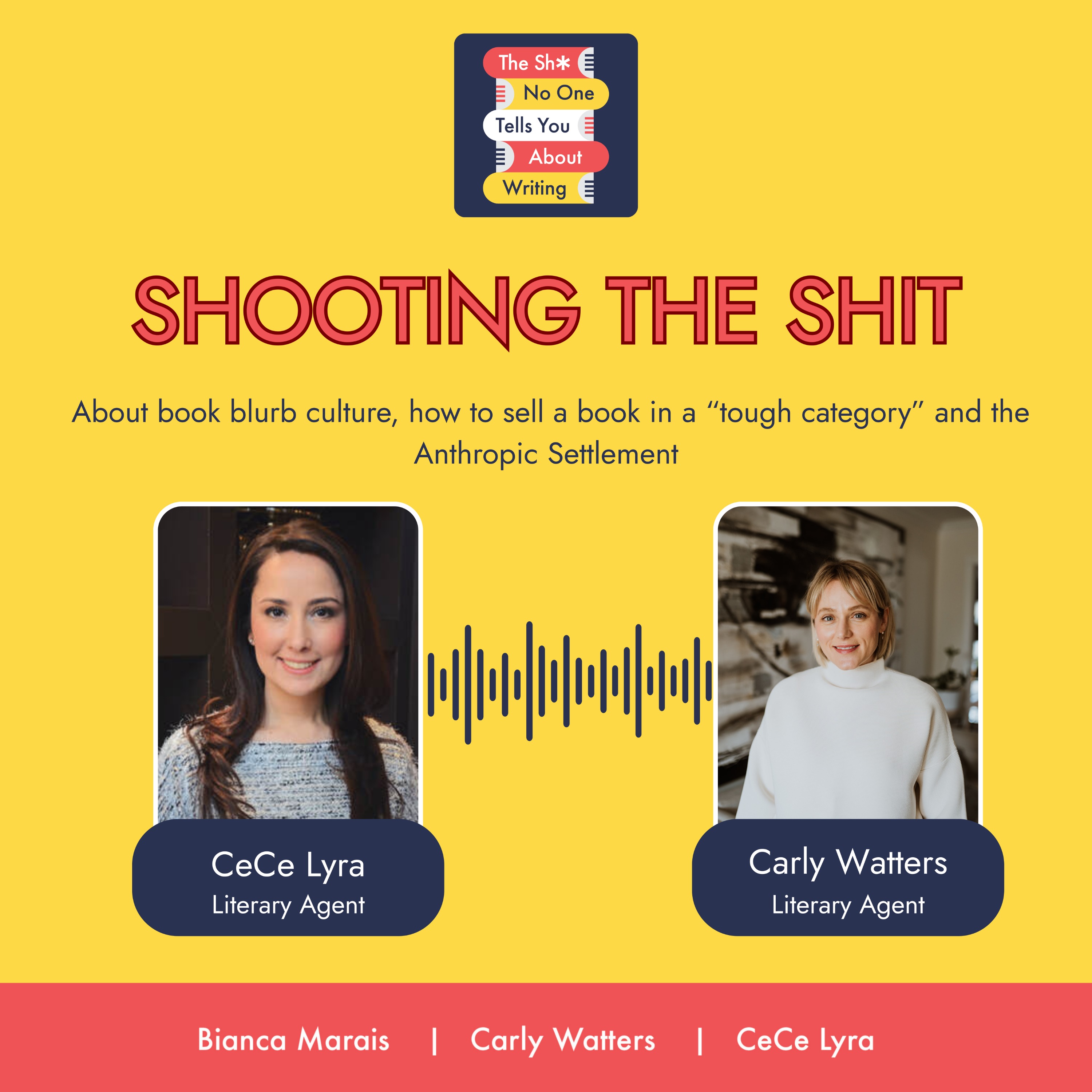
The Shit No One Tells You About Writing
Shooting The Shit: About book blurb culture, how to sell a book in a “tough category” and the Anthropic Settlement
00:51:47
Loading summary
Transcript116 lines
- [00:01]
CeCe Lira
What's up everyone?
- [00:02]
This is Cece. If you're a writer, then chances are you've wondered if your story is good enough. Maybe you're wondering that right now. I get it. Here's what I can tell you. As long as your story is making the reader curious, you're good. Now, I'm not saying you won't have to make edits when working with an agent or publisher, edits are part of the game. But I am saying that you will get ahead in your career if you know how to make the reader curious. The best way to do that? Infuse your story with plenty of tension, conflict and stakes. Which is why I'm so excited to invite you to join my four day course, Writing Tension Creating Tension, Conflict and Stakes in youn Story. It starts on October 13th. My favorite part about this class is that there are formulas. Yes, formulas for tension, for conflict, for stakes, and for the first time ever, we're having two optional interactive components including a query letter, studio and live critiques of select first pages. I'm super excited about this new format because I've seen it yield results in writers works and it works for writers of any genre as long as you're serious about improving your work. So if you're ready to take your writing to the next level, join me for this four day course. Don't worry if you can't attend live, the sessions will be recorded. For more information, check out my bio on Instagram or the podcast's website. I'm looking forward to seeing you there.
- [01:33]
Bianca Marae
Have you been sitting on the fence about signing up for the Beta Reader matchup? Or have you signed up before but haven't as yet found your writing Soulmates the next matchup is the last one of the year, so don't snooze on it. Get matched up with those writing in a similar genre and or time zone so they can critique your work as you critique theirs. Your manuscript doesn't have to be complete to sign up for this 3,000 word evaluation. This particular matchup will be open to registrations from now until the 2nd of November, with the matchup emails going out on the 3rd of November. For more information and to register, go to Biancamarae.com and look for the Beta Reader Matchup tab. Please spread the word even if you aren't signing up this time. The more writers we have registered, the better the matches will be, which means you'll be paying it forward to your fellow authors.
- [02:28]
Carly Waters
Welcome to another episode of Shooting the Shit with literary agents Carly Waters and CeCe Lira, where we dissect publishing gossip, discuss book industry trends, and the overall state of the book business. If you've ever wanted to grab a coffee with two literary agents, grab your mug and pull up a chair. Hi, everyone. You are watching Slash Listening another episode of Shooting the Shit. I think we've come to love our title. I mean, I think it encompasses what we're trying to do. We've heard from so many of you guys, whether it is on social media or voice notes, people have left me to say that they. They love the show. And I know Cece's got a lot of messages too. So thank you guys for tuning in.
- [03:13]
CeCe Lira
Yeah, thank you. We love it. And shout out to Bianca because. Well, to Bianca and Carly, because when Carly first came up with the idea for this segment, Carly, you told us about it, me and Bianca, over just the zoom. And you were like, yeah, you know, and the idea is to make it casual. We'll just shoot the shit. We have to come up with a name. And Bianca was like, tell me that's going to be the name. Shooting the Shit. So it was so awesome. Like, I had nothing to do with it is what I'm saying. But I benefit from it, so yay.
- [03:42]
Carly Waters
Yeah. I've come to really love this time. As I think I mentioned this, I can't remember where I share information, whether it's social media or the show, but I think one of the things that's really helped me do is synthesize what I want to say and how I'm framing and thinking about the issues in the industry that are happening. Because one of the things I loved about having a blog when I blogged for years and years and years is like, every Monday, I just would like open the draft and just be like, I have to post something today. It's kind of like, the show must go on, you know, with us doing this. Right? The show has to go on. So it's whatever the news is that week and helped me kind of think about it, keep up to date on things. So it's really serving me in terms of, you know, my thoughts. I get to hang out with CC because we don't work together on the agency side anymore, so we get to keep in touch with each other. And, yeah, so one of my heartfelt pleas to you guys is also to watch us on YouTube because I don't want to kind of get into the weeds too much about the behind the scenes of everything. But this is supposed to be our gossipy show where we just kind of Tell you what's what. You know, we didn't start this show to run a business or kind of create something larger than ourselves. It was really just to hang out and obviously entertain and inform you guys as much as possible in the educational platform that we've created. But it has turned into a business and we love paying people for their work. We love the people that we get to pay to edit our show and upload our show and all of those wonderful things. And we love to keep paying them. A couple of the ways I want to shout out the ways that you can support us. So obviously you guys, I'm sure have heard us talk about our incredible newsletter. We have over 55,000, like 555000. 55,000 subscribers on our newsletter. We have a subset of those that are paid. Not as many as the total amount. That's for sure.
- [05:27]
CeCe Lira
A depressing amount only is you guys. Only a depressing amount of you guys are paying very little. I just want to say that.
- [05:33]
Carly Waters
Very, very little. And we love you guys. Listen, we are so glad you get to get so much great information. But if you are looking for a nominal way to support the show, there's a few ways. There is paying for the subscriber fee on substack, I believe. Cc, correct me if I'm wrong. I think this is like prorated per where you are in the world in terms of your currency. I think it's around $8 US a month is where we're at right now with the fee you could also pay for the year. That's a wonderful thing you can do if you are a published author or any author that is creating revenue. This is actually a business expense because this is an educational platform. So you know you can add this on your line items with your taxes. I am not.
- [06:15]
CeCe Lira
Please check your own tax.
- [06:16]
Carly Waters
Yes.
- [06:17]
CeCe Lira
People did it at the same time. Please check. Please check with your own accountant. Carly's not giving out tax advice.
- [06:23]
Carly Waters
I am. Cece the lawyer is stepping in. I am not giving up tax advice. But when you talk to your accountant you can ask for educational things that I consume within my industry. Can I use this as an educational event? And I believe the answer is yes. So therefore the answer is yes. But CC's right.
- [06:42]
CeCe Lira
Generally yes. Generally yes.
- [06:44]
Carly Waters
Check with your professionals in your life. So that's something that you can obviously do to support us. Another thing you could do is listen to the ads. Support our wonderful sponsors. Rosetta Stone has been such a long term sponsor of us. We have ads coming up with quints you guys know that we're a huge fan of them as well, so we obviously want to support them. We also have YouTube, which we've been trying to create some content on there. So you guys can watch us kind of getting to the level soonish, where we might be able to get some AdSense revenue from Google would be great. So those are some of the highlights of, and, you know, stuff that every podcast kind of has to go through. But we love doing this for you guys and, you know, we really believe that we're. We're creating some great content here. So we would love to see you guys continuing to support the show. So thank you, and thank you to.
- [07:29]
CeCe Lira
Everyone who supports in every single way, whether it's paid or not. We are super mindful that not everyone can support the paid way, and that's totally fine. Oh my gosh. Obviously I maintain my comment that it is a depressing low number of people who pay for the newsletter. I am grateful for every single one. And I understand that not everyone can. If you can, this is kind of like the whole, like, library versus buying, like, yes, support libraries. That's so great. Check out books from the library. But if you can buy books, buy books. It's the same principle.
- [07:59]
Carly Waters
Yeah, yeah, exactly. And, you know, sharing our stuff on social media also gets the job done. So thank you. Okay, let's move on to some things we want to talk about today. So I've tentatively called this episode Shooting the Shit about blurb culture, how to sell a book in a Tough category, and the anthropic settlement. We also have some other juicy things to follow up on from last week's episode because you guys sent us some messages that we need to go through. So that's what we're going to get into. So first thing on the list is to talk about agents offering rep with short notice windows and all the intel that we learned in our DMs. You guys definitely had a lot to say on this topic. So if you didn't listen to last week's episode, obviously you can go back and listen or we can kind of give you the tldr, which is there are agents out there that are offering rep with very small windows, up to like a minimum of like 24 hours to decide, like one day to make your decision. Whereas normally the industry standard is, you know, anywhere from kind of that like 10 to 14 day window, again depending on holidays and other things that are going on. But generally two weeks is the standard. So, cece, do you want to run through some and this is all going to be anonymous. You know, we're not here to kind of call anybody out. But, cece, do you want to go through some of the DMS that you got or general intel that we can kind of report back on?
- [09:13]
CeCe Lira
Yeah, I mean, I never know when the podcast is airing just because, again, we record on a different day. But I knew when this episode aired immediately because our DMs just started to go off, right? Like, we just started to get messages from various different people saying, I mean, sharing these horror stories. There was. There's one agent who offered on the phone and said that the person had to decide on the spot. So there wasn't even a 24 hour situation. And then there was, you know, names shared of agents who are giving 24 hour notices. There was a name or two that was mentioned more than once. But the thing is, it's more than one agent, right? Like, it's not one human out there who's doing this. Not a lot. We didn't get a lot of names, but we did get a lot of messages mentioning the same names. And it's actually really interesting because I got a message from an agent colleague, an agent who does not work at my agency, and reached out to me and said, hey, I heard that this person's doing this. And I said, oh, we already got her name off someone else. And then this agent said, oh, that's good news because it means it's only one. And I was like, oh, no, sorry, hon, I didn't mean that. I meant this name has been repeated. But there were other names too. So, I mean, I laugh because when I'm nervous, I laugh. But honestly, it's sad, right? We don't want that. I especially feel for authors who shared the anxiety they experienced. And I could see their rational brains competing with their emotional brains. They were saying things to me like, I knew that wasn't okay, but I still felt like I had to answer within that timeframe because what if that was my only offer? And I've been trying for so long, and that's just so, again, so predatory and not okay. And it was. I so appreciate everyone sharing, but it was just really discouraging to see. How about you, Carly? How about. How are your DMs? I mean, I know we shared them.
- [10:59]
Carly Waters
With each other, but, I mean, yeah, we. So cece and I kind of went back and forth and sharing some information. I'm super conflicted. Not conflicted in whether I think this is good or bad. I generally think this is bad practice I guess, like, I'm a little bit worried that this is starting to, like, catch on a little bit. You know, it's like, oh, well, this agent's doing that. Is that the new industry norm or. We're creating a new standard and therefore people are able to conform to this new quote, unquote standard. So that's, I guess. Yeah. I'm not surprised it's more than one person. Yeah. I guess I would just be concerned that this is going to continue. And this is the thing is, like, you know, I'm not here to. To name and shame in terms of, like, telling you guys who the names are, because, I mean, we're a podcast, we're not investigative journalists. And that's just not what we're. What we're about here. But it is a number of people who. A number that work at reputable agencies. Yeah. So I guess all we can do in this situation, in this role, is to kind of let you guys know that it's not industry standard. Clearly there are people out there that are doing this. But yeah, it's. I don't know, just disappointing, I guess.
- [12:06]
CeCe Lira
For sure, for sure. And there was. Ooh, how should we put this? There was one name that was very unsurprising to both Carly and myself. We will leave it at that.
- [12:17]
Carly Waters
Yes, yes, yes. The person who I thought was doing this was the person. And so that confirmed my thought. But there was lots of. There were some names that surprised me as well. So. Yeah, anyway, so all that to say, do your research, do your due diligence. The industry norm is that two week window. If something feels wrong, you know, obviously listen to. Listen to those gut feelings, and we'll leave it at that. So other thing that we asked you guys about was to send us in stuff about blurbs. And this was very interesting. I got some messages. I also put a little box in my Instagram stories to kind of solicit some information from you guys about what do you think about blurb culture? And I also want to talk about the culture of like, pre writing blurbs for people. Cece, maybe we can start with that one. So this happens a bit more on the nonfiction side, but basically the editorial team or the agent or whoever kind of comes up with this basically is like, oh, here's a list of people who are really well known, or they're experts or they're very busy, but, like, they're contacts of yours. We could just either start off by saying, you know, are you interested in this? We can. Again, you have to kind of finesse the language. But, you know, here are three samples that you can tweak or, you know, provide your feedback on. If you do want to blur but you're too busy, you know, we can support you by, you know, offering these three different blurbs for you to select. And this happens again, as I said, more on the nonfiction side, on the fiction side. I don't think I've seen this happen on the fiction side personally, just because especially literary authors, they care a lot about their word choice and that kind of literary sense. So if they are going to blurb something, it's usually that they want to put their own word spin on it. But I don't. Cece, have you heard this happening on the fiction side? Because I've mostly heard this just on.
- [14:00]
CeCe Lira
The nonfiction side, so 99% of the time, nonfiction. And then it's like you're saying like pre written blurbs on the fiction side. I have seen a situation where we were on. It was like a rush job. There were issues with production and so we only got to blurbs just a few moments before pub a couple months. I don't remember when it was, but it was like a rush job. And we sent elements that could be highlighted to the authors. It wasn't like a pre written blur, but it was like, you might want to highlight this element of the story or highlight this other thing and mix and match. And it was quite helpful. Everyone that I spoke to really liked it, but again, it was a situation where the relationships were already established. You don't want to create the impression that you're putting words in people's mouths especially. And for fiction, for nonfiction, people are just busy. People are super busy. No one has time. And they often want to support and they will read the book and they will stand by their endorsement. It's not like they're pretending, but they're like, I don't know what you want me to highlight. And they also, they've been on the other side of this. Right. So they know, is there something you want me to highlight because you feel it would help your publicity team more? Because if the same element of the angle is highlighted by five different people who are blurbing this book, that's not helpful. You want different angles to be highlighted. So I think, I think that was my experience so far. Yeah.
- [15:21]
Carly Waters
Yeah. No, that makes a lot of sense. Yeah, it's. It's so tricky. I will say. So there's kind of two different routes to the blur process. Obviously there is. These are people that, you know, whether it's friends or colleagues or acquaintances or like, you have a direct relationship with them. And then there's the cold, you know, let's shoot our shot. Blurb outreaches, right? And so you kind of have to have a route for both. Sometimes the agents reaching out, sometimes it's the editor reaching out. It's usually based on relationship with the person or the contact or who in that orbit, does somebody know? But you wouldn't like, send a cold outreach being like, hey, I don't know, famous author, here's three blurbs you can give me. I mean, that just obviously that would get you to nowhere, Right? So I think it's all about reading the room in terms of whether it's a good practice or not. But it's anyway something that happens. So I just want to run through some of the responses to the Instagram box that I put out on my Instagram about blurb culture. So somebody had said, is it taboo to ask authors you admire for a blurb via cold call slash email? How should I ask? So this is all done generally, like in conversation with your publisher and your agent. So there is like a process where, like, this is the quote, unquote, like, blurb letter that you sent to them kind of, you know, talking about, like, what you love about their work and how it reminds you of your work or, you know, what you want to highlight about your story and a deadline, essentially. And it's just a very nice. Everybody knows how busy everybody is. So it's not necessarily apologetic, but it's like, we all know we're going through this blurb process together and obviously we could talk a little bit about how everybody feels about blurb culture and how things have changed, but it's a very, I don't know, kind of common thing that happens. There was a huge movement not that long ago for certain publishers said that, like, they weren't going to do blurbs anymore because blurbs are very useful and, like, why are we doing this? But even in some of those cases, I've heard that they still kind of wanted the author to do the blurbs. They just didn't want the publisher to have to do the blurb. It was like taking the pressure off of the publisher to supply blurbs. So it's kind of like a PR move about blurbs as opposed to us actually not needing blurbs anymore, if that makes sense.
- [17:24]
CeCe Lira
Yeah. The thing is, people are cognizant of the fact that moving copies in this industry is really hard. And so, you know, say what you will about Blurbs, whether they move copies or not. I don't think we'll ever reach a point where authors will stop trying because everyone's trying to find a way to stand out. In fact, this is something we should also talk about. Sometimes blurbs happen before the book has even sold, before we know if the book will sell. You know, agents sometimes submit proposals with blurbs already pre written on the proposal, of course, and manuscripts with blurbs. It is not super common, but it does happen because again, we are all competing against so many other fish in the sea and we're trying to find ways to make our work stand out. Now, having a really big blurb doesn't actually guarantee anything. I know of a novel who had a blurb by a really huge, huge novelist who was hot at the time. So it wasn't my project, but I remember the, the agent is my friend and it's not a category I represent, so it's ya. And the novel didn't sell despite this huge blurb. And the agent was really disappointed, but not surprised. And you know, it helps. It'll get people to read your work faster, most likely, but it's not going to sell the book. That's just not how it works.
- [18:42]
Carly Waters
Yeah, yeah. So more feedback I got was somebody said, I hate blurbs and I think they're super outdated. As an author and, and a reader, somebody said, fiction blurbs, like sucking up to each other. Nonfiction blurbs are more about credibility. Right. So I think it's like, okay, what are we trying to do with this blurb? Is, is the fiction blurb just about people being like, oh, this person knows so and so. This person knows so and so. But on nonfiction, that's actually a really good point about credibility. Right? Because if you want to read a book by a certain expert, you also want to know that they're probably also seen as an expert by other experts. So that's a really good point.
- [19:17]
CeCe Lira
It is, at the end of the day though, an economy on both sides. Like a lot of people say this, they say this to me. They say, I don't want to blurb this book. Not because the book is bad, they have no time to read it. But I'm going to because I need them to blurb my book next fall or next winter. Like it's, listen, it's. It's an economy is what it is.
- [19:34]
Carly Waters
I was just going to say you want to be seen as a member playing in the field of that world. So it's also good for your brand sometimes. Right. If you want to be associated with a certain author or a certain genre because that means your name is on somebody else's book. Like, that's why I know some authors. You'll see their names plastered as blurbs everywhere. It's like, oh, that person blurbs everything. Because they get to plastered their name all over all these other books in their category. Like, that's also seen as a huge play. Somebody that I know who is a published author said, what if I agree to read it and don't like it? This does happen sometimes where somebody's like, you know, oh, oh, sure, like I'll see if I have time. Or there's always the vagueness around blurbs too, because it's like, okay, how can I make sure I have an out if I want it? Sometimes it's going through the agent, right? Because then the author can say, okay, maybe I'm under deadline or I do have all these X, y, Z other things going on. You know, my copy edits are due and da da da da da. So you can kind of use the agent as that screening process to kind of make sure that the agent is doing their due diligence and kind of tiptoeing around the language of like being polite but making sure that they're kind of respectful of everybody's time. But yeah, if you don't like something, don't blurb it. Is like, generally my advice, get your agent to get you out of that, because it doesn't help at all. I heard of a story where somebody blurbed something and then they actually weren't that like, crazy about it. And then also this author went through like, cancel culture. And then this person's name is on this person's book. And it's like, you know, now you're connected to this person who you didn't love that book anyway. And there's, you know, all of that, that type of stuff going down. Another note from somebody I'm pretty sure this is an agent said, what are our thoughts on whose job it should be? The author or the publisher? I mean, I think we kind of already answered that. Which is like depending on who has the contacts.
- [21:19]
CeCe Lira
Yeah, I think should, if the word is should, it should be the publisher, because publishers should do more. But realistically, a lot of it falls on authors. You should always talk to your agent and publisher at the same time. You should never just go out and get blurbs on your own without that conversation. But more and more things fall on authors to do it. And the publisher might help. Agents might also help. But yeah, like, it does depend on who has the context. It's actually, you know, just being really transparent here. It's one of the reasons why I love doing this podcast so much. Like, because of the podcast, I have expanded my network because I don't come from, like, I wasn't an English major, I didn't work in publishing as an intern. Like, I didn't grow up in publishing. And so for me, doing this podcast has allowed me to interview authors and connect with people. And I am now able to secure blurbs for my clients that I probably wouldn't have been able to if I hadn't done, you know, the shitting on. Tells you about writing. So it's. There you go. It's. It affects so many layers.
- [22:19]
Carly Waters
That's a very, very good point. Somebody asked, are authors ever paid to do a blurb? And not officially. There. There is no, like, transactional event. That said, we kind of described this earlier as an economy. Right. So there is this relational element between things where you do this for me, I'll do this for you. So you can see it as like a trading economy if you want, but I've never seen money exchanged.
- [22:43]
CeCe Lira
Yeah, I don't think you'll have an invoice for it, but it is. I mean, I guess it depends. Do you consider barter to be payment? So if so.
- [22:49]
Carly Waters
Oh, yeah, there you go. So next part. This is a. So this is from a very well known author. If I said their name, you'd be like, oh, they said make it go away.
- [23:00]
CeCe Lira
I was drinking water.
- [23:02]
Carly Waters
CC almost spit over water there. If you're not watching us.
- [23:04]
CeCe Lira
Oh my God, it would have been so embarrassing. It would have been so embarrassing if I had become Fountain cece right now.
- [23:09]
Carly Waters
Like, what am I going to clip? That would have been the clip. So, yeah, make it. Make it go away is what this author said.
- [23:16]
CeCe Lira
Because it does feel like again, if.
- [23:18]
Carly Waters
You'Re a bookie year author, it's like every year it's like, okay, who didn't we tap on this one? We tapped them two books ago. Like, as a bookie year author, how important is it to get a blurb every time? It is important because it is a new product and a new project that you need to launch. So yeah, for bookier authors, it can be a lot. Somebody said, what matters more, who blurbs it or what they say?
- [23:41]
CeCe Lira
I mean, who. Because the what is always positive. No one prints a bad blurb, you know, so. So who. I suppose the only exception to this in my opinion is if the what is a comp. So, for example, if the blurb reads, this is for fans of Lessons in Chemistry, in that case, the what might be more influential and persuasive than the who because you're referencing another book.
- [24:12]
Carly Waters
But they need to be in cultural alignment. Like, all of that has to be in conversation with each other.
- [24:17]
CeCe Lira
The comp and the book. Yes, but the who is saying it. People will gloss over it with their eyes.
- [24:21]
Carly Waters
I think that person's supposed to be relevant.
- [24:24]
CeCe Lira
Again, relevant, yes, but not huge. Do you know what I'm saying?
- [24:28]
Carly Waters
Yeah, yeah, yeah. Relevant, but not huge. I agree. Okay. Yeah.
- [24:30]
CeCe Lira
Relevant, but not huge. Because usually the who matters so much more. And except for this one trick. So publishers aren't allowed to say to put names of other books on the COVID of their book. They're not allowed to say, this is for fans of Lessons in Chemistry, but they are allowed to print blurbs that say this. So if you get other people to suggest this is for fans of. Insert huge book here. That is actually a really smart publicity trick to get around that and to get people to. Because, I mean, everyone read that book, right? So they'll be like, oh, lessons in Chemistry. Maybe I will take a look at this.
- [25:02]
Carly Waters
Yeah, Yeah. I mean, the only other, like, the only way to best that would be for the author, Bonnie of Lessons in Chemistry, to then give you the blurb. Because then you get her name and the blurb and the book title, right? So it's like, yeah, that's why. Kind of why I'm saying. It's like, it's an economy. It's all in conversation with each other.
- [25:18]
CeCe Lira
You're right.
- [25:18]
Carly Waters
It's that balance between, like, what are they saying and how long is the blurb and what are you taking from it and how are you using it as a marketing tool? So.
- [25:24]
CeCe Lira
And also, you're right that the who at the end of the day wins. Because if it is Bonnie doing it, then it's Bonnie. She's saying it's for fans of her novel. She wrote it.
- [25:33]
Carly Waters
Exactly. That's why the who matters. And there's also a bunch of comments that was like, you know, not needed for me to read it, that sort of thing. So some people feel like, nah, it doesn't matter to them, but it matters to booksellers. It matters to the sales staff. And even if people say it doesn't matter, you need at least one on the Amazon page. You know, like on the E tailer retail page.
- [25:54]
CeCe Lira
It's. Honestly, can I say something? There's a lot of Stuff about publishing that's super unfair and exhausting and tiresome to the authors. This is one of them. But of the list, it's actually quite benign. Like, blurbs are annoying, guys, we get it, but you need them. You need them. Let's learn to do it. Let's get over it.
- [26:13]
Carly Waters
There just isn't a shortcut to this type of relationship building and the type of economic outcome. Cece, did you just fill your water? Yes. I heard a thump, and then I was like, that looked like your water spilling.
- [26:31]
CeCe Lira
Nothing happened here. Nothing happened here. It's all good. It's all good.
- [26:35]
Carly Waters
Do you need to stop?
- [26:36]
CeCe Lira
No, it's all. It's actually all good because I didn't actually spill it. I just almost spilled it and I almost dropped my computer at the same time. So it's. It's fun, guys. It's shooting. Shooting the shit with Klutz cc.
- [26:48]
Carly Waters
Yes. Okay. And I was mid thought, but I think everybody gets the gist, which is that blurbs are a requirement. Yeah. And no distractions will get away from. Oh, hold on.
- [27:03]
CeCe Lira
Did you drop stuff now? Are you dropping things? Is everyone dropping things today?
- [27:06]
Carly Waters
Oh, my God.
- [27:07]
CeCe Lira
What is happening?
- [27:08]
Carly Waters
The computer ghost came and played a podcast while I was talking to you.
- [27:12]
CeCe Lira
So the computer ghost is haunting you too?
- [27:15]
Carly Waters
Not just me. Okay, well, it's clearly telling us we're too long winded and we need to move on from this. Okay, okay.
- [27:21]
CeCe Lira
Moving on. Moving on.
- [27:22]
Carly Waters
Moving on. Moving on from this. So we wanted to talk very briefly because, you know, this is not probably the place to go on a super deep dive on this, but we did want to address the anthropic settlement, which is basically, you know, the AI companies versus authors, figuring what's going to happen in terms of compensation for all of the works that were essentially fed into these machines. So you might be familiar with it, you might not. What we are going to be referencing is largely from two different sources if you want to go check this out on your own. One of them is Publishers Lunch, who every time there's news on this, they're publishing it in their daily newsletter and also Jane Friedman's newsletter. Is it called the Bottom Line now, cece? Is that what it's called?
- [28:04]
CeCe Lira
The Bottom Line? We love. We love the Bottom line.
- [28:06]
Carly Waters
Yeah. So she had. We're just opening it just as we were coming online today. But the bottom line from September 10th, if you want to check that out, has a great summary as well. And I know I've referenced her reporting on this before, so, you know, CeCe do you want to give a quick overview of where we're at with this?
- [28:24]
CeCe Lira
I mean, sure. Like, so if you guys aren't familiar, Anthropic is an AI company, right? And they were using books to feed their LLMs. Is it large language models? I think that's what LLM stands for. And authors got together and said, hey, you can't do that. And essentially what has come out of this, our understanding, based on things we've read, is that the courts have ruled that using books to train LLMs is totally valid under the fair use doctrine. That means that the company Anthropic in this case is taking the books and turning into something else, and therefore it is fair use, and that's totally fine. Which is obviously not what authors wanted to hear, not what I wanted to hear. However, a lot of these books were fed into their LLMs. A lot of these books had been pirated. They had been stolen, essentially, right? Like, they were not acquired legally. And so courts have ruled that using pirated books or stolen books, or however you want to call it, is not legal because copyright guys, copyright matters. So that's also unsurprising to me.
- [29:32]
And yes, a win, but.
- [29:35]
And we'll get to that at the end, whether I think it's actually a win or not. But yes, it's a win that, you know, copyright is being upheld. And so there's been a settlement. Anthropic has settled the copyright infringement lawsuit brought by this class of authors. And the settlement amount is 1 point billion, which sounds like a lot, but remember, there's lots of people, right? There's lots of people who are going to get this money. And if approved by the courts, this will be split among all the rights holders. However, the settlement has not been approved by the courts yet. Last update I read had been that proposed settlement was on hold or paused or postponed or whatever the term was, but not denied. The judge had a few concerns, and so we're gonna wait to see what happens.
- [30:20]
Carly Waters
I think some of the concerns were around how complicated it is, and there's a lot of pushback because the judge is like, well, I need all of these names and all this information, and how are we going to disseminate this money to all these authors? And then the writer's side of things is like, okay, this is a lot of names to organize. This is very complicated. And so the judge, I believe, set a date in the fall where they want all this information. And so I think what the author side is now worried about is what if we don't get the judge all of this stuff by this date, or he's not happy with how it's organized, and then all of a sudden, are they not going to agree to this? So there's kind of like, some extra hurdles and hoops to jump through here at this point. And that was kind of what I understood.
- [30:58]
CeCe Lira
We never want judges to say they're disappointed, and I believe this judge did say that. That was my understanding. But at the same time, like, if it is because details weren't given and those details are needed to actually ensure that the remedy is going to be effective, then it could be a good thing. This is just really, like, to everyone listening, it's really complex. I know Andrea Bart, who's, you know, often when people cite the case, it's Bart's v. Anthropic. And I know we all know Andrea Bartz really well, and I remember grabbing dinner with her and my client, Laura Lefler in New York months ago, and her telling me that she was going to California because of this case. And I just, you know, to everyone who's involved, like, thank you for your bravery. Thank you for doing this. I think it's really important that you're fighting the good fight. We're really thankful. I will say everyone is celebrating this so much, and I'm glad people are celebrating, and I'm so happy. I think it's important to understand, though, that this does not mean that anyone is saying that books can't be fed into large language models. That is not what's happening. AI can use books, at least, you know, as of right now, to. To train their LLMs.
- [32:11]
Carly Waters
This is just giving Anthropic a clean bill of health. Right. They're using this to kind of, like, wash themselves of the situation. Right. So if all of this. So they pay their 1.5 billion. Their, you know, their market valuation is huge. They're making a big deal about, like, this is so much money. It's like, it's actually not that much money to them. But anyway, this is not a market podcast. This is a books podcast. So. Right. So there. This is a lot of money to authors divided amongst a lot of people. And then this will give anthropic clean bill of health so that they can go on and do whatever they want. So it is like, the resolution here is actually really important. So we kind of got to stick with this to the end. And this is just one company. There are all these other companies who have gone through this as well.
- [32:52]
CeCe Lira
Yeah, exactly. And there's I think there's just a lot, you know, when you're watching a show and it's like to be continued. Like, I just think there's going to be a lot in the to be continued. Like this is. Even as we were about to record this, we got an email from, from Jane Friedman. Like we, we were both subscribers to the Bottom Line Curly, and there's an update on that too. And we haven't read that yet. So I guess my point is there's just a lot happening and I am all for celebrating. Don't get me wrong. I just think we should be super clear on the fact that AI is still going to use books. They're just going to.
- [33:26]
Carly Waters
And they're already in there. Like, we can't put this back in the box.
- [33:29]
CeCe Lira
The genie can't go back in the bottle. Yeah.
- [33:32]
Carly Waters
So we're not going to be doing updates every week on this because it is so ongoing. Obviously if there's some calamitous news, we will, but, but we, you know, really encourage everybody to look at where they're getting their knowledge from, subscribe to newsletters and you know, pay attention to news that is, is balanced. And hopefully they can get all the information that they need because we are following it very closely over here as well.
- [33:55]
CeCe Lira
For sure, for sure.
- [33:57]
Carly Waters
All right, so next thing on our list to talk about was kind of this like age old question. What is selling? What is not selling? Why are things hard to sell, et cetera, et cetera. So somebody had asked me after a recent reel or post that I had made about like, you're talking about what is or isn't selling, but like what is actually moving the needle here. And I mean, I have a very simple answer to this which is, you know, you guys can check out the bestseller list every week. If you want to be a student of this, go to the bestseller list. Right. Every week. Whether it's USA Today, New York Times, indie stores also have their own bestseller lists. Just go see what is selling. Because there's, there's no magic like what is selling. Like system behind the scenes that you mean. You might want to call that Bookscan, but Bookscan is just a reflection of what is happening on the Bestseller list. So just be a student of the industry. If you want to know what's selling, that's obviously the quick answer. There's lots of things that are selling, like commercial fiction anytime there's like a lead title, mind, body, spirit, business, self help authors who have their own sales funnels on the nonfiction side to see their own successes. There's a lot that is doing really well. So I think writers just want to. Other than romanticy, what's working? It's like there's a lot of things that's working. You know, last week we talked about how it's a multi billion dollar business. There are pockets of the industry that can be successful in lots of different ways. So that's just my preamble to the next link we're going to talk about. Cece, do you have any more thoughts before we move on to the link?
- [35:25]
CeCe Lira
Just that if you are a writer at the querying stage, what's selling is super important to know. Absolutely. Be a student. Just remember that, that, that is different from what's selling in terms of book deals. Right. Like by the time the book comes out, all that. So there's just a lot of moving parts. Like if you expect simple answers from publishing, you're going to be a miserable human being. Just saying.
- [35:45]
Carly Waters
Yeah, that is very true. Okay. This was an article I came across which was fantastic. And this substack is really great.
- [35:53]
CeCe Lira
So good. So good. Carly, thank you for sharing this. It's so good.
- [35:56]
Carly Waters
Oh, yeah, I'm excited to talk about it. It's a really. I think, I feel like we might have talked about this substack before, but it is Aaliyah Hannah Habib's substack and it is called Delivery and Acceptance. So if you want to look it up, obviously we'll link to it as well, but delivery and Acceptance. And this is from a nonfiction agent, an agent that mostly focuses on nonfiction. She has this great substack. So what she called the kind of article we're talking about today is tough categories. Five top Book editors on Publishing Memoir and Essay Collection. And I can't, like, I can't emphasize enough how everybody needs to read this in full. Whenever Cece and I kind of talk about what we're going to talk about on the show, we have a Google Doc. And so I like pumped a bunch of quotes in here that I want to talk about, but I can't emphasize enough how. How much I think everybody should go read it. So Delivery and acceptance. The article is from September 3rd of this year, just last week. Tough categories. Five top book editors of Publishing, Memoir and Essay Collections. Because I think one of the best things about this article is how it touches on so many overarching themes of our show and what CC&I about. And I'm just, I'm excited to get into it. Do you want to talk about some things that stood out to you or do you want to go through some of the quotes I pulled?
- [37:07]
CeCe Lira
Yeah, I think we can go through the quotes. You have some really? I added one one too, because I really like it. Okay, so we can just go through the act. I think the premise, right, like the premise is Aaliyah got together with editors she trusts and was like, let's talk. Let's talk about this. And I thought that was a really cool way to frame the discussion.
- [37:25]
Carly Waters
So we have 1, 2, 3, 4, 5. Five different editors, all at Big Five publishing houses, essentially, most of them, as I said, working in that kind of narrative nonfiction memoir space. But some of them do platform driven nonfiction as well. So one of the things that I thought was great was this quote off the top from Hillary Redmond, who's an editor and talking about voice. Because this is something everybody asks about, or if it's like they get a pass. Some people pass because they didn't connect with the voice or what does voice mean? How do you develop voice? And I thought this was a great quote from Hillary. So she said, and yet voice is so important. Maybe it's better to break down what we. Or at least I mean by voice. When I read something really any kind of nonfiction, I come away with an indelible sense of having had a frank, personal encounter with someone. That's what I think of as voice. It's not about being showy. A writer's voice should leave a mark, just like an honest conversation does.
- [38:17]
CeCe Lira
Yeah, I loved that. I loved that. And voice is one of those things where I know it when I see it. We can reverse engineer it a lot. There can be good definitions to it. I thought you did a really good job of explaining it, but at the same time, like, you know it when you see it or when you hear it, Because I'm hearing it in my head when I'm reading.
- [38:36]
Carly Waters
So yeah, yeah, yeah, I loved, loved that. So if anybody needs a what is voice? I don't know, lesson frame that put it up on your bulletin board. And that was great. She.
- [38:47]
CeCe Lira
That being said, though, aside from voice, and this is a quote, I loved voice aside. In memoir, I'm either looking for a writer who has experienced something extraordinary, a near death experience, a solo hike along the Pacific Crest Trail, a psychotic episode, being kept out of school in Idaho, and can not only recount these experiences in vivid detail, but make them recognizable to the rest of us. And I think that she touched on something that I think is so important to highlight, which is, yes, something incredible probably has to have happened to you for you to be able to write a story. An incredible has many definitions. It could be quiet incredible. It could be big incredible. But just as importantly, you need to be able to tell that story. A lot of people, everyone probably has a story inside of them. Not everyone is a storyteller, though. They are different things. The fact that you have lived an interesting life, the fact that interesting things have happened to you, the fact that you have grown as a person, the fact that you have faced adversity, these are all so cool and so wonderful. But can you frame that in a narrative? Can you frame that in a tale that will keep people absolutely riveted? And, yes, that includes vivid details like Hillary highlighted, but it also includes an emotional investment, which I think is what she's getting at when she says. And make it recognizable to the rest of us. Like, I have not. I have not had the experience of Tara Westover, right. Who were educated. I was not kept out of school in Idaho, but I did absolutely relate to her experiences in the book because the emotions were framed in a way that were so juicy and compelling and turned the personal into universal. I could relate to family dynamics, even though my family's completely different. I could relate to feeling confusion and anger and envy, even though, again, I have not felt those emotions about the things she has felt. And that is so powerful and so important. And when you're writing a story, people often think, this cool thing happened to me, so all I have to do is sit and put words on a page. No, those words need to be a story, and the story requires processing yourself from the outside, and that's really hard to do.
- [41:04]
Carly Waters
I just want to pinpoint that a little bit. So you said everyone has a story. Not everyone has a storyteller. Because the thing is, every life is a story, right? Every life has these things and these events in them that make them feel larger than life, so to speak. Right. But there's a difference between experiencing a life and writing a book and telling a story. And that's where I think cece and I probably both had this experience where we go to a writer's conference and we meet all these people, and everyone's like, this is my life story. This is my. Like, they're just coming at us like, do, do, do, do. This is my story. And yes, your life is a story. You have had something happen to you that. That feels like a story, that feels like a movie, that feels cinematic, and that's because it's your life, and there's a difference between taking that cinematic experience and turning it into a book. And that is where kind of the experiential part turns into a writer. And that's kind of the bridge that not everybody can cross. And that's a lot of what this article is about. So the next quote was, how do editors know something is good? And this is something that Cece and I have also talked about on the show. So this is a recurring theme about whether it's an editor, whether it's an agent, how do we as professionals know? And it's a very professional answer. Kate Napolitano says, this is going to sound a little wild, but the first indicator that I found something truly compelling or unique is that I feel it in my body. That sort of electric shock through the veins buzz that hits when I become captivated by writer's prose is an invaluable barometer for me. It's how I know I found something fresh, vibrant, and attention grabbing. I completely agree. There is, like a sizzling in the veins. That is. That is our professional response. That is our professional barometer.
- [42:36]
CeCe Lira
It's 100% true. It's in the body. It's. It's. It's the feeling of curiosity hitting your body. You're being like, oh, my God, this is so good. Yeah.
- [42:44]
Carly Waters
Yes. So very, very important. Our professional. We'll call it our professional barometer, which I think is very important. Cece, do you want to read the next one?
- [42:51]
CeCe Lira
Yeah. So this is about getting people to buy memoir. A really funny thing that the author of this substack says is that she's convinced there are more people trying to write in the memoir genre than there are readers of the memoir genre. Anyway, that's not the quote, but I thought that was really funny. So this is from Maria Goldberg. We're all human beings and we all have stories to tell, whether they're tragic or inspiring or humorous. But this isn't the moth. And we publishers are not actually in the business of storytelling. We're in the business of trying to convince people they should spend 30 of their hard earned dollars on your book while also reordering their supply of diapers on Amazon. That was fail. Yeah, that one hit hard. Yeah. Like, we are not in the business of storytelling. Like, part of me wants to go, yes, we are. And yet she is right. We are. We are all in the business of trying to get people to spend $30 or however many dollars the book will cost. Yeah, she's right.
- [43:48]
Carly Waters
Yeah. It's the transaction. Right. Like, we are in the sales Business. I've always thought of myself as a salesperson, and not everybody is comfortable with thinking themselves as a salesperson person. But I know that I am in a sales job. I know that in my blood, and it is in the arts and creative industry. And I'm so glad I get to work in such a creative industry. But I feel like I am definitely in a sales role. So anyway, I thought that was great. And. And this is coming from an editor, right? So, yeah, you know, agents can obviously are often thought of as like the business people, but editors are also business people because they have to make decisions for their own list and their own editorial budget. Some of these people in this substack are editorial directors. And, you know, they have to oversee budgets and people and things like that. So. So there's a lot to unpack there. Right. But it's, you know, how can we distract people enough, entertain them enough for those $30? Yeah, that's kind of the age old question here. All right, the next one is another quote about why this business is tough. There are so many great nuggets in this article, guys. Like, obviously you need to go read the whole thing yourself. But Kate Napolitano said we're living in an era of constant stimulation and cultural consumption. If anything, I think that our industry as a whole is finding it increasingly challenging to captivate readers. And that's not just limited to memoir. There are real existential threats to culture, of reading, to our attention spans, to our emotional and physical safety. But I do think at this moment, there's legitimate desire for escapism, which is why we're seeing a profound gap in sales between fiction and nonfiction. Nonfiction and memoir in particular may not feel like a portal into a different universe for readers, which is why I think it's critical for authors to one, write with vividness and authenticity, and two, to think about what motivates their potential readership. Get curious about who your potential readers are.
- [45:27]
CeCe Lira
I think that she touched on something that we've talked about before, which is reading requires all of your attention span. All of your attention span. If you're sitting down and digesting a book with your eyes, you are doing nothing else. At the same time, someone's gonna go, I listen to music, too. You're a weirdo. But seriously, most people are only doing that, and yes, audiobooks, while you are.
- [45:48]
Carly Waters
Driving or you're cleaning. It's like a mindless thing. Yeah, yeah.
- [45:51]
CeCe Lira
If you are enjoying them with your ears still reading, you are able to do rote things like do the dishes. Or walk or whatever. But it's still not the cognitive, like the cognitive power that we are demanding of readers, that we have always demanded of readers. And as a society, we have less of that. We have less attention span. Like, we're not. We are not as present as we once was as a species. And so it's. This is hard. This is definitely part of the challenge. I thought it was a great.
- [46:19]
Carly Waters
Yeah, no, I think it's. I think it's a great quote. There's just, there's so much going on in terms of our leisure time. Who has leisure, the privilege of leisure? You know, there's a lot we can unpack there. Okay. And I think we're getting down a couple. Few more quotes. One of this I thought was really great. And we talk about this all the time as a theme on the show, which is like, do you write for the. Do you write for the market? Do you not? What does it mean to write within a fandom or what happens in these fandoms, like Romantasy or these specific kind of niche, necessarily niche, but like these, these kind of like rabbit holes, I guess that we go down in terms of our interests. This was a quote from Maria Goldberg as well. I'd also warn against making the mistake of thinking that if you choose to write about something that's popular, an existing fandom will become a built in audience for your book. And that's not true. Think about how you consume your favorite media at this point. I've seen every episode of Survivor there is. I've listened to too many podcast recaps, I've watched the YouTube videos, but not once have I ever considered buying a book that's about Survivor. And why would I? What would I get from it? If you write an essay collection about Survivor, it needs to tell me something about Survivor that I don't already know. And that something needs to be significant enough that I will be willing to pay for it. That to me is huge. I talked about that recently on the show of how are we going to pay for something where if we get so much of it for free. I mean, I'm using free loosely there, right? But if you get streams of it in other medium, why are we gonna pay for something? But Cece, go ahead.
- [47:39]
CeCe Lira
Especially when the streams and other media don't require as much cognitive power. You are paying dollars, you're paying those $30 and you're required to use more of your brain. Your brain that's tired, your brain that, you know, went to school all day, went to work all day, had to deal with chores when you got home, you know, issues with whatever's happening in your family. And then you. Like, that's hard. Like, that's really hard. People often say, oh, this. This is about a really great show. So everyone who watches the show will buy the book. No. And you know that's not true because you don't buy those books, right?
- [48:12]
Carly Waters
Like, you know there's a whole bunch, right?
- [48:14]
CeCe Lira
Yeah.
- [48:14]
Carly Waters
Flip it on yourself. Flip it on yourself. Just like you have a hobby doesn't mean that you consume everything in that space. Right. You're also a discerning consumer. All right, Juicy, what do we have next?
- [48:25]
CeCe Lira
So there's a really great answer about what platform means in nonfiction. Kate Napolitano was saying, it would be disingenuous for me to say that platform doesn't matter, especially in this era where traditional media isn't necessarily breaking through the way we have in the past. We no longer live in a monoculture. So I would encourage writers to think about how they can be most effective, the most effective hype, man, woman, person for their work, and to then become an expert to whatever niche of readers they can curate. She does go on to say that, look, if you're going to start a newsletter or a podcast or whatever it is, like, there's no exact science, but. But your product needs to be discovered, right? So how are you going to do this? How are you going to discover and build a community of people? And I thought that was really interesting.
- [49:08]
Carly Waters
Yeah, Yeah, I thought that was great. I thought that last line about, like, how will you, as an author, become an asset to that process of discovery? Because when we think about, like, who has platform and who doesn't and how big is it? It's more like, how are you an asset in that process of discovery? What can you bring to the table to help facilitate that discoverability? And I think that that's. That's super important, and that can be.
- [49:26]
CeCe Lira
Really crushing to a lot of authors. I have heard from wonderful authors. There's this one, this 1 Author who. Man 1. So I was at a conference, and he was asking me, like, is it normal for my publisher to expect me to have media connections? Is it normal for my publisher to expect me? And he was asking for things that were totally normal. And I was like, yes, all these things are normal. Your publisher will expect you to have this. So he turns to me and he says, cece, can I ask? Like, his voice was so sweet. So kind of, what do they do? Then? You know, he was like, so I'm writing the book, I'm promoting the book. What do they do? And again, remember, this is how to think of nonfiction. No one becomes an expert because they write a book. They write a book because they're an expert. You have to bring the audience. You have to bring the readers. I'm not saying the publisher won't also add to that, and they should, and many great publishers do. But you need to be, to Kate's point, an asset. An asset in the process of discovery. That's really great. Are we going to wrap up by saying the harshest thing you can say to any memoirist? We are. We're going to be so mean today. So mean.
- [50:31]
Carly Waters
This was another. Another great quote. And Ricky is an editor that I've sold a book to, and she's fantastic editor. So she says the harshest and truest thing you can say to memoirists. Rekia Clark says most writers aren't creating work that's as distinctive as they think it is. Is. Sorry. So to stand out. I don't expect the theme or subjects to be revelatory, but I do expect the writer's approach to be. And that's. That's it.
- [50:54]
CeCe Lira
That's. This is why this is so harsh. Every day we get queries that say, this is the memoir of my parents divorce and how it messed with me. This is the memoir of how I discovered that I had cancer and I had to battle through it. This is the memoir of any. And again.
- [51:13]
Carly Waters
How I healed my inner child. How I did this long bike ride. Yeah.
- [51:19]
CeCe Lira
And as a human. Awesome. All the applause. Truly all the applause. So proud of you. Like, that's hard work. Healing from any of these things. Like all the things that we get pitched all the time. It's so impressive. So cool. No one's curious about that. That's not unique. It's not as distinctive. I'm so sorry. I'm not saying people can't get curious about it. People can. But you have to. Again, going back to the previous quote, format it and package it in a way that is curiosity inducing. So don't expect the line, this is a memoir about. And then insert something that's super common here to stand out, because it won't. Okay. Grinch hat. I have to get my Grinch hat.
- [52:01]
Carly Waters
You know what we're bringing the realism. There's the Grinch hat. There it is.
- [52:05]
CeCe Lira
I got one. I got one. Yeah, I got one.
- [52:07]
Carly Waters
Good. If you guys aren't watching on YouTube, it's. It's a fuzzy bucket hat with like the Grinch's yellow eyes and distinctive eyebrows.
- [52:16]
CeCe Lira
It will be really useful in winter because I will be cold, and then I'll. Right now it's gonna be grumpy all winter. No, no, not grumpy. Just, you know, I'll get to be. I'll get to be warm. My ears will get to be warm. Yeah, I can be a happy Grinch.
- [52:31]
Carly Waters
You know, I think one of the things I'm enjoying also about doing this, this version of our show, is that all of the themes that keep coming back through the industry, you know, through all the things we talk about through the articles, through everyone's experiences, there's just all these recurring themes. But I think one of the themes today was really just about how it's the writer that makes the book. You know, it's not the story necessarily. It's the writer that makes the book. And so that's why it's so, so important. Work on your craft. Work on your story. This is all you. And again, this comes from a lady that's never written a book. So it's on you. It's on you. I can sell your book. It's on you to write it.
- [53:06]
CeCe Lira
It's all on you. And I hope if you're listening and you're a writer, that this feels empowering to you. It might also feel overwhelming and scary, and that's okay, too. But I hope it ultimately feels empowering because it means that you hold the power. It means that you get to work really hard, work on yourself, invest in your craft, invest in your connections, and hopefully live the dream. The dream of walking into a bookstore and seeing your book there, hopefully in the bestseller table. I'm hoping that for you.
- [53:33]
Carly Waters
Yeah, we're. We're definitely hoping that for you. Thank you guys for hanging out and we'll see you next time.
- [53:38]
Bianca Marae
Cece Lira is a literary agent at Wendy Sherman Associates. If you'd like to query CeCe, please refer to the submission guidelines at www.wsherman.com. carly Waters is a literary agent at P.S. literary Agency, but her work on this podcast is not affiliated with the agency. And the views expressed by Carly on this podcast are solely that of her as a podcast co host and do not necessarily reflect the views, opinions, policies, or position of PS Literary Agency.
- [54:14]
CeCe Lira
What's up, everyone?
- [54:15]
This is cece. If you're a writer, then chances are you've wondered if your story is good enough. Maybe you're wondering that right now. I get it. Here's what I can tell you. As long as Your story is making the reader curious. You're good. Now I'm not saying you won't have to make edits when working with an agent or publisher. Edits are part of the game. But I am saying that you will get ahead in your career if you know how to make the reader curious. The best way to do that Infuse your story with plenty of tension, conflict and stakes. Which is why I'm so excited to invite you to join me. My four day course Writing Tension Creating Tension, Conflict and Stakes in youn Story. It starts on October 13th. My favorite part about this class is that there are formulas. Yes, formulas for tension, for conflict, for stakes and for the first time ever, we're having two optional interactive components including a query letter, studio and live critiques of selected first pages. I'm super excited about this new format because I've seen it yield results in writers works and it works for writers of any genre as long as you're serious about improving your work. So if you're ready to take your writing to the next level, join me for this four day course. Don't worry if you can't attend live, the sessions will be recorded. For more information, check out my bio on Instagram or the podcast's website. I'm looking forward to seeing you there.
- [55:47]
Bianca Marae
Have you been sitting on the fence about signing up for the Beta Reader matchup? Or have you signed up before but haven't as yet found your writing soulmates? The next matchup is the last one of the year, so don't snooze on it. Get matched up with those writing in a similar genre and or time zone so they can critique your work as you critique theirs. Your match manuscript doesn't have to be complete to sign up for this 3,000 word evaluation. This particular matchup will be open to registrations from now until the 2nd of November, with the matchup emails going out on the 3rd of November. For more information and to register, go to Biancamarae.com and look for the Beta Reader Matchup tab. Please spread the word even if you aren't signing up this time. The more writers we have registered, the better the matches will be, which means you'll be paying it forward to your fellow authors.