← The Shit No One Tells You About Writing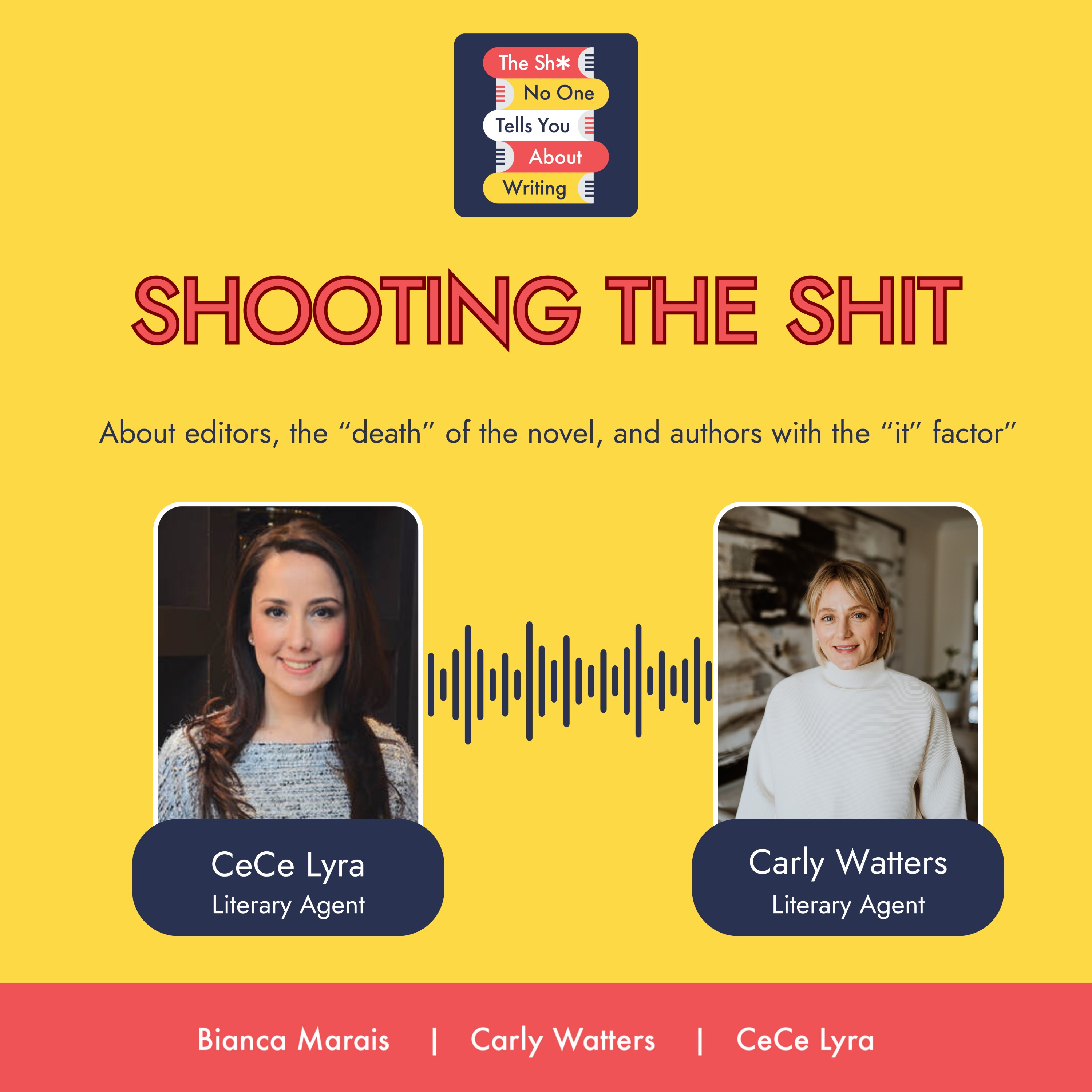
The Shit No One Tells You About Writing
Shooting The Shit: About Editors, The "Death" Of The Novel & Authors With The "It" Factor
00:52:07
Shooting The Shit
Loading summary
Transcript109 lines
- [00:00]
Bianca Marae
Beta Reader match up time is happening again. It's been so gratifying over the summer to be tagged in so many posts about beta readers who've become writing besties and who are still going strong many years after they were first matched. Some even travel to meet up and do writing weekends together, which sounds incredible. I can't guarantee any of that. That's entirely up to you, but. But what I can guarantee is that you'll be matched with a group of people working in your genre and or time zone who will critique 3,000 words of your work as you critique theirs. In return, you can sign up from now until the 31st of August. With the matchup emails going out on the 1st of September, head to my website Biancamarae.com and look for the Beta Reader matchup tab.
- [00:53]
Carly Waters
Welcome to another episode of Shooting the Shit with Literary agents Carly Waters and Cece Lira, where we dissect publishing gossip, discuss book industry trends, and the overall state of the book business. If you've ever wanted to grab a coffee with two literary agents, grab your mug and pull up a chair. Hi, everybody. We are so glad that there was a positive response to cece and I having our little one on one duo conversation. You never know when we're going to set out for a new venture with the podcast or spoiler, spending some time working on something, whether it's going to work out. But we're just so glad you guys enjoyed it, so we really appreciate that. Thank you.
- [01:36]
Cece Lira
Yeah, it's been so much fun just to see people on social media being like, yes, more Carly, more Cece. And I'm like, people want to hear more from us.
- [01:43]
Carly Waters
Okay.
- [01:43]
Cece Lira
I. I'm still in shock over this, even after all these years. I'm flattered and thankful.
- [01:48]
Carly Waters
Yeah, well, I think, you know, I mean, not to speculate what other people are thinking about their parasocial relationships with us, but obviously they listen to us in a more technical way when we're on books with hooks, you know, or author interviews, obviously in a more like, agent capacity. But they follow on socials and they've been to our workshops. A lot of you guys have taken our courses at this point, been to our deep dive, so you know what we're about on a slightly more personal level. But yeah, we thought we'd bring a little bit more kind of flavor and intimacy to the conversation. Talk a little bit about our thoughts behind the thoughts. Yeah. So I'm. I'm excited for today's topic, so I have tentatively called this episode Shooting the Shit. About editors, the quote, unquote, death of the novel, and authors with the quote it factor. So lots of stuff to talk about. Let's start off with. Did we read the Blackbird and the Butcher? So a lot of gossip about our gossip on dark romance. And so I'd read, I don't know, maybe like 40% of the novel when I started this conversation. I finished it last night, and then I had to go and buy lights out, because again, once you start going down these rabbit holes of these sub trends and sub genres, you kind of just gotta get on the bandwagon. And I really wanted to see the difference. That's kind of what I did with Acotar and then Fourth Wing. Oh, no, I think I did Fourth Wing and then Acotar. But, you know, once you're starting to go down these sub trends, you got to think, okay, what's the difference? The subtle differences between these sub trends. And so that's kind of where I'm at. So, Cece, did you read a butcher in the Blackbird?
- [03:10]
Cece Lira
I did. So it's the second time, Carly, that you've referred to as Blackbird and the butcher. And I think it's because the Blackbird is the woman. So I think your unconscious is being feministy. So I approve. I approve.
- [03:21]
Carly Waters
Is your butcher in the Blackbird? Am I saying it wrong?
- [03:24]
Cece Lira
No, no. So now you said it right, but then before you said Blackbird, but then also when we were chatting before we recorded, you also said Blackbird first. And I'm like, ooh, unconscious. You know me, I like to psychoanalyze.
- [03:34]
Carly Waters
I'm just looking at, like, our notes that I wrote in Google. And one time I say butcher and Blackbird, and the next time I say blackbird and butcher. But I think everybody knows what we're talking about.
- [03:41]
Cece Lira
No, no, no, People know. People know and they're loving the feministy change edit, I guess. So I did. I haven't finished it yet. Okay, my thoughts. I am a big believer in when it comes to books, specifically books I usually don't share when I don't love something in a public forum, just because you never know how it's going to come across. And there are exceptions. There's a very famous memoir that I once mentioned I didn't like because the memoir is so big, I'm sure the person doesn't care. So I will say this was not my taste. I was expecting everything that I get from a dark comedy plus romance, and I didn't get that. I think that the writing's Strong. There were lots of, like, really smart storytelling beats that were followed, like, tension, escalation, all that. But there were things I really struggled with that I was expecting to struggle with, like, suspension of disbelief. But then when it comes to, like, the stuff that I like about Dark, which is really, like, the complexity and the depth and the contradictions, it was too tame. Like, what I am saying is that this story that has, like, accidental cannibalism is too tame. I'm sorry.
- [04:50]
Carly Waters
It is.
- [04:50]
Cece Lira
Like, it's all writing on the plot, you know? Like, first of all, she's a serial killer who hunts serial killers. That is too easy. Everyone wants serial killers to die. Nobody goes, save the serial killers. You know? Like, it's not like dolphins. So too easy. Too easy. I wanted more mess. Also, the attraction between them, like, excuse me, just get together. There's no reason why they shouldn't get together. She's into him, he's into her. They both want to be with each other. So if I were to give her edits, I think she should do what Vampires of El Norte did. I think she should do what Meet Me at the Lake did what Emily Henry did in. Which is the one. What's it called? Beach Lovers. Beach Read. Beach Read.
- [05:32]
Carly Waters
Beach Read.
- [05:33]
Cece Lira
Beach Read.
- [05:33]
Carly Waters
Yeah.
- [05:33]
Cece Lira
Yeah. Where the two people who meet and who have the. Will they or won't they know each other from before in the story setup? They have. They had something like some frictiony thing, and that complicates the present because that I could get behind. Like, they're both single, they're both hot, they're both attractive. They're both clearly into each other. Just get together, people. But then if there had been something in the past that would have helped with the plausibility. Clearly I have issues because this book is doing so well. The author does not need my notes. I'm sure a lot of you guys are listening and going, hey, I loved it. Cece, that's so awesome. I'm so happy for you. I did not love it. I loved reading it. I loved that Carly recommended it because I love studying these new genres. And I'm definitely going to read Lights out, but I was just too, like, too tame. Too tame. I needed more.
- [06:20]
Carly Waters
Okay. Yeah. So I also felt like there's just so much suspension of disbelief required that it takes a while to be like, okay, are we going all in on this world? One of the things, like, I just want to speak to the larger trend for a second. Like, one of the things I think really is really interesting about this quote Unquote trend is, like, the women taking the violence into their own hands in a way that is very, like, forward, and they're just, like. They're just going for it. I mean, I don't want to do too many spoilers, obviously. And these are two, like, number one New York Times bestsellers, USA Today bestsellers. Half of the people listening have probably already read these, so I don't need to worry about spoiler alerts necessarily, but I. I can totally appreciate that. I also really think there's quite a blending between the lines of horror. Right. We talked about this, obviously, on our other episodes of our books with Hook. This, like, horror romance. Horror romance, yeah. Like, yeah. Why? What's the difference between dark romance and horror romance? Number one. So maybe we need to go in a deep dive of horror romance because, like, the goriness and the grossness of Blackbird and the Butcher, and I'm not super far. Well, actually, I'm pretty far into Lights out, actually. But it's not as gross, if that makes sense. It's, like, gross in its own way, but not really the same. And so that, like, shock factor is really interesting to me. But I. I'm very interested in this theme of, like, women taking this situation into their own hands, you know, not feeling like the victim, you know, rising to this, like, serial killer or, like, murderous level. I think all that as a trend is very interesting, especially when you counteract that with the trad wife movement. Right? It's like, what are these two things that are hot right now? It's like trad wives studying this, like, simplicity, quote unquote, soft life. And then there's like, feminist rage, like murderous heroines. Right. And heroes. So this, like, duality between tradwives and again, these, like, serial killer, murderous female characters is really interesting to me, all this to say. I actually think you're going to like Lights Out. It reminds me a bit more of you. And are you a you fan, Caitlin Kepnes?
- [08:18]
Cece Lira
I thought you meant it reminded you of me as opposed to the title, you. And I was like, is it deeply disturbed like me?
- [08:26]
Carly Waters
No, I don't think of you as the nurse character in Lights out, but, yeah, no, like you. Caroline Kepnes is you.
- [08:32]
Cece Lira
I do. I do enjoy you.
- [08:34]
Carly Waters
Yeah, yeah, yeah. So do you like yourself? Like, do you like you? Yeah. No, I think you're gonna like Lights out. So finish that. Turning into a book club, I think more than either of us anticipated it to be. Yeah. But read Lights out and then let's talk about that. One, because I'm really enjoying the. And somebody actually put this in the comments for one of our reels about shooting the shit, which is. Yeah, there's. There's this, like, contradiction in the hero that is very layered and very interesting.
- [09:01]
Cece Lira
Which I think that seems way better.
- [09:03]
Carly Waters
Psychological. You're gonna like the psychological implications of why the hero is the way he is. So I. To your take on fun. Lights out.
- [09:11]
Cece Lira
Fun.
- [09:12]
Carly Waters
Yeah.
- [09:12]
Cece Lira
Oh, man. So hard. My life. I have to read for work. Poor me.
- [09:17]
Carly Waters
Such a bummer. Yeah. So what else did I have my list of things to talk about. Oh, the email drama. So, yeah, we talked last week about the email drama. I just. As I said, I'm not naming names.
- [09:28]
Cece Lira
So. Wait, can you, like, can you catch us up on that? Like, what happened?
- [09:32]
Carly Waters
What did you do?
- [09:33]
Cece Lira
What ripple effects were set off? How did the plot escalate?
- [09:37]
Carly Waters
As I said, I'm not naming any names here, so I'm going to be vague as possible. So anybody that missed the first episode of shooting the shit, I explained that an editor accidentally sent me an email that was not for me. It was a rejection for my client written to the intern in a teaching way that was accidentally sent to me instead of the intern. So what I did was. And I think I kind of mentioned what I was thinking I was going to do, which is that I wanted to wait a couple days because I like to wait and see people make the. They realize their own mistake. And then it's kind of not like a gotcha moment. It's like, oh, again, we all make mistakes, especially in email culture, which I totally understand. So this is what I wrote back. I wrote, dear Editor's Name, I don't think this version of this email was meant for me, but the rejection is noted. Thank you for reviewing. And that was my email. I actually had an interesting conversation with my assistant about this because she formerly worked as an editor, and so I've really always worked as an agent. And so I'm always, as you know, 15 years of doing a job, like, your brain is always in agent mode. And I was like, okay, my system ram, like, when you were an editor, like, how would you have handled this situation from your side and how would you have thought about it? So I also used it as a teaching moment with my own assistant who was formerly an editor, for us to talk about this. And she was like, what this editor is going to be worried about is you taking her off her sub list. And so. So when we started into the dialogue.
- [10:53]
Cece Lira
About this, oh, I didn't Even think about that.
- [10:55]
Carly Waters
Yeah, yeah. So now this editor's like, oh, no, this agent's going to blacklist me. Which is, again, what my assistant was talking about. And so the editor wrote back, being, like, obviously deeply apologetic, like, sincere apologies. How can I make this up to you? And so this is again where I got into the teaching moment with my own assistant to talk about this. And I said back to the editor. I understand we all make mistakes. My hope is that you also looked at this. Right. Because my worry as an agent was like, oh, maybe the editor didn't even look at this. It's like, only their intern looked at it. So I said, my hope is that, like, you also looked at this, not only the intern. I'll certainly keep you on my sub list, and I hope we can connect on a project in the future that's a fit, you know, so just keeping it, like, mostly upbeat. Again, we all make mistakes. And. And she reassured me that she did read it. It wasn't just the intern that read it. And, yeah, so she said I was using this as a teaching moment, which we assumed. And, yeah, so we both said, well, hope we'll connect on a project soon. So, obviously, no bad blood. This is a very, like, personal business, but that's what happened.
- [11:51]
Cece Lira
Okay, well, I like how you handled that, and that's such an interesting insight from Raya. Like, I love that she shared that with us. It had not occurred to me, and now I have been taught.
- [12:01]
Carly Waters
Yeah, yeah, It's. You know, we do this job in our. Like I always say, you know, it's like, I have been trained as an agent for so long. I have this mentality. It's important for us to think about, you know, other perspectives of the situation, which I thought I was pretty, you know, understanding of the situation, but, yeah, it's like, what would the editor be thinking in that moment Was very different than what I was thinking in that moment. And. Yeah, yeah, yeah. So, CeCe, tell me about what you've been up to. What did you do last night?
- [12:26]
Cece Lira
Okay, so last night, I went to a Soho House. Okay, so, context. Last week, I opened the Soho House app, and I saw that Penguin Random House was starting a book mixer. And I was like, wait, what? I have to go to this? And so for context, for people who've never used the app, you have, like. Like, you. You are alerted that an event will open, and then when the event opens, it can sell out as quickly as, like, one second later, or it can just take days, and it just depends on the popularity of the event. So I was all set to, like, rsvp. And I even texted my friend Emma. I'm like, the app, maybe you want to go? Emma's also a reader. So I was like, yes, let's go. So then on the day, I log in one minute after the event goes live, and of course, it's sold out. So then I was like, oh, man, bummer. I'm not going to get to go. But then Emma had RSVP'd with a guest because Emma was thinking ahead, and she was like, maybe CC won't get a spot. And so she let me go with her. And so yesterday I was there, and it was essentially various people from the marketing and publicity team from Penguin Random House, like, different imprints, and they were all, like, all talking, you know, to a group of us. Gonna be honest here. There was, like, one guy. It was mostly women. I think there may be two guys. I don't know. That's publishing.
- [13:47]
Carly Waters
Yeah.
- [13:47]
Cece Lira
And reading, too, I guess. But, you know, essentially they were, like, asking us questions about, like, what do you like to read? And for the first half, I was just incognito, like, just as a reader. But then when we took a break and we all grabbed our drinks and started mingling, I did out myself, and I was like, hey. And I'm so glad I did, because one of the people who was organizing it knew who I was. And she was like, we follow each other. And she's like, I'm a secret bookstagrammer, too. And I'm like, we follow each other because, like, her face isn't on her account. And so, yeah, I don't know. It's just a fun reminder of, like, why we all got into this business, at least most of us, I think, is because we love books. Right. And so sometimes going back to basics and just having a moment of I'm going to sit in a room filled with people who really enjoy books, and we each read different genres and all that. There are people who love stuff that I don't love, and I love stuff that other people don't. And it's just fun, and it feels very meaningful and rewarding to do that. And it's always kind of cool to see publishers investing in. In different ways of reaching readers. Right. So that was nice.
- [14:46]
Carly Waters
Totally. Yeah. That's just a great way they've, like, we have this target audience, these people who love books and the fact that it sold out so fast, like, hopefully they'll get that feedback back to them and think, like, we should do More events like this, because clearly we have.
- [14:56]
Cece Lira
Well, there's already another one. Yeah. For next month. Yes.
- [14:59]
Carly Waters
Amazing. I love that. I love that. What else is new in your agent life?
- [15:04]
Cece Lira
Oh, not too much. Not too much new in my agent life. I was thinking that maybe this would also be fun to share, but I had a client reach out. She's at the stage where she's filling out the author questionnaire. So, you know, for all our listeners, essentially, the author questionnaire is something that publishers ask authors to fill out pretty early on, right after you, you know, you secure the book deal and you essentially go through, like, everything you can bring to the table in terms of, like, connections. And truly, you are meant to really dig deep. Everything from, like, where you went to school. Do you have, like, any alumni connections that could help? No thing is too small to mention. Right. Like, you really have to really take the time to fill out that questionnaire. And my client was like, this seems like a lot. Like, is this normal? It's her first book, right? So I'm like, this is totally normal. And she was asked, like, how would you position your book? What are some questions that you would want media to ask you? This is so we can have, like, the canned Q and A. Don't just put the questions, also put the answers. And she's this brilliant, brilliant woman. So smart, like one of the smartest people I've ever met. And yet she was, like, paralyzed. She was like, I don't know what to write about my own book. I know. I know my own book, but I don't know because I feel like when authors are put on the spot like that after so many years of working in isolation. And so, as an interesting exercise, if anyone wants to try answering your own author questionnaire, let us know if you would like us to share kind of like a fake sample author questionnaire so you can know what typically goes into one of these. We'll create our own. Obviously, we won't take it from any publisher, but I think it's super fun. I think it's super fun to know, like, what happens later, like, after the book deal. Have any of your clients ever been like, carly, I don't know what to write.
- [16:43]
Carly Waters
It's more just really overwhelming. They're like, oh, this is actually going to take a long time. You know, it is a lot of kind of deep work and thinking about in the positioning of their own work, which they don't normally contextualize themselves, like, within that. I think it's a lot of things, like you said, that they know is coming, but not all. Some of them will ask for like multiple versions of a logline, which again is if you're a debut, you probably worked on your query and your agent worked, obviously worked deeply on the pitch and you probably have some log lines. But if you're an option project, you maybe haven't thought as deeply about what your log lines are and maybe your agent didn't write like a super in depth like pitch letter proposal if it was an option project. Sometimes that's just how these things go. So it is always super important for every single project, not just like again like the first book at a multi book deal to think about like how this project in this situation, in this moment and the zeitgeist, how it's going to hit. So I totally agree with you. I think it's a sexual kind of framing of your work within the context of everything else in my author's publishing playbook I have like, you know, these like brand sheets you can do. And there's just so many different ways to, as you said, to think about how you want to tackle it. But at any stage, at every stage, everybody kind of needs to realize we're selling a product. You know, in this industry we have to think about all those unique selling points. And honestly, you know, we're actually going to talk about this as our first linked article today, which is everybody in the publishing industry is doing so many different jobs. And so if we can simplify, streamline this author questionnaire, which will help marketing, which will help publicity, which will help sales, which will help rights, which will help editorial, like that you're just helping everybody do their job better and better for you because their job is to serve the projects obviously as well as the business. So super important to do as much as you possibly can because if you leave things blank, nobody's going to tap you on the shoulder and think like, oh, you need to fill this out. They'll be like, oh, she doesn't have anything to write there. And you're just, you're leaving opportunities on the table. So super, super important to write it very in depth.
- [18:36]
Cece Lira
Yeah, for sure. That that last line really is the big takeaway. I think too often authors don't realize this. They don't realize that like if they're not doing a good job and not really like rising to, to, you know, and doing what they have to do, I think unconsciously we assume like people are going to tell me if this isn't good and like they won't necessarily like it really is up to you to really just put your best foot forward. There's no wrong way to pull out the author questionnaire. I mean, I guess you could. Lying is wrong, but other than something like that, there's no wrong way. Right? Like, be honest and share every information you have. But like the quick way to do it, which is the least time consuming way, might seem appealing to you because you might think, well, they'll fill in the rest. You know, they'll make up the difference. And they absolutely will not. That is not their job.
- [19:25]
Carly Waters
No.
- [19:25]
Cece Lira
Would love for that to be the world we live in. That sounds like an awesome world, but it's not. If anyone does live in that world, let me know where you live. I'm going to check out the visa requirements and I will move it. In our world, we have to do it like, in terms of like authors doing it, agents supporting them. But that's just. Yeah, that's just reality. In other publishing news, how was New York? How was your trip?
- [19:46]
Carly Waters
It was good. Yeah, thanks for asking. It was, it was a completely like sold out event. It went so well. The conversation was so deep and interesting.
- [19:56]
Cece Lira
I loved your outfit. Just loved your outfit. So cute. So perfect for the book.
- [20:00]
Carly Waters
Yeah, thank you. I know, I loved it too. I had my pack, my cowboy boots and obviously cowboy boots take up a lot of room in the luggage and I was like, should I wear my cowboy boots on the plane? Is that like plane appropriate footwear? I ended up packing them, wore them to the event and yeah, no, it was, it was great. I had my, my black cowboy boots, my garni shorts, and then I think I just had like a white top on. But they also had like cowboy hats for everybody to wear and bandanas. And it was like an incredibly branded event. 8:31 stories. Put it on in conjunction with McNally Seaport location, which is gorgeous. If you haven't been to the McNally Seaport location, it's super stunning. So I highly recommend everybody make a pilgrimage out there. And yeah, it was to celebrate my author, Bailey Hannah with her Wells Ranch series. And yeah, it was great. We had awesome turnout from the publisher that was there and it was, it was great. So, yeah, I also got to hang out with my assistant. I had lunch with an editor that I recently sold a book to. So yeah, it was, it was a good working vacation. And I also. So I just got back from New York and then I'm getting FOMO again because I just found out my client, Jane Healy, who's been on our show, Jane Healy is getting a billboard in New York. Her publisher has paid for a week right outside Penn Station. A week. Every 12 minutes, her book is going to show up. So the women of Arlington hall will be on a billboard. And I'm like, do I need to turn around and go back to New York so I can, like, get a picture of this? But I think enough people will send me pictures, and I think it'll be after this episode's airing, after the billboard's already gone out, so I can't have you. I normally would ask you guys to send me pictures, but I think it will already have happened. So, yeah, if you see me posting.
- [21:40]
Cece Lira
That is so cool. Okay. So cool. And it's probably, like, a huge author dream for her, too, because it's not normal, right? Most authors don't get this treatment, but it is a common dream. Not normal. Okay. Please don't go to your agents and go, hey, how come I didn't get this? You know, like, that's not normal. We hope it happens to everyone. Because of course you're gonna hope for that. But I don't know, it feels like even though it's not common in terms of reality, it is a common dream. Like, kind of like New York Times bestseller. That's also a common dream. You know, having your book made into a movie, that's also a common dream. So that's awesome. Like, good. Good for you. Good for you. Good for your client. That's awesome.
- [22:16]
Carly Waters
Yeah, it's very. It's very cool. I don't have any other words to describe it other than cool. So that's another fun AJ And a thing that happened to me. Okay, let's get to some articles we've been talking about and sharing. So, cece, do you want to introduce the first article that we were going to chat about today?
- [22:30]
Cece Lira
Yeah, let's do it. So the first article is. I mean, I thought it was so interesting. It's all about how editors these days have three jobs. But then plot twist. There's more. And it's from the substack, Dear Head of Three jobs of the Modern Editor. It's. I mean, Carly, you pulled this quote, and I think this is such a good quote. If you hear authors and literary agents gripe that editors don't edit anymore, it's because it's becoming more and more common. But essentially, you know, it talks about how editors are project manager, which is just, you know, project managing. It sounds boring, and it probably is. It's just dealing with a lot of people, following up with A lot of people holding people accountable, making sure that things stay in schedule. That's tiring and exhausting. And then they also have like their job of like actual editing. And so many of them do it on weekends. Like, I hear it from so many editors during the week. It's too noisy, too busy. I have to edit on weekends. And then they're also investors. So this for all of our, like, die hard fans. I on our very first episode of books with Helix, or maybe it was like the one of the first few episodes, I don't remember now, but I mentioned how, you know, Carly and I had both fallen in love with Aquarius, so we would be like the agent Shark Tank. This is like the actual Shark Tank, though, like, not the cute little shark Tank that I'm mentioning. This is when the role of investor is essentially when an editor has to decide what to spend the money they have on. You know, they have a budget, they have a certain number of projects they have to buy for the future, books that are going to come out two years from now. And they have to decide what to invest in. So imagine being an editor and unlike the Shark Tank, it's not people walking in and talking to you, but it's like getting all these emails from agents. They get hundreds if not thousands of emails from agents a year and they have to choose, let's just say, 12 books to buy. And it's a really big decision. And in fact, one of the reasons why it's so exhausting and we don't talk about it enough is because you have to taste something before you know whether you want to, you know, continue tasting it and potentially investing in it. But tasting a book. I'm using air quotes here. It requires so much brainpower. You know, reading is something that requires sustained periods of lengthy introspection. You know, if I'm tasting a cookie to decide if I want to invest in a cookie, that takes me, what, I don't know, 10 seconds. Like with my palate, especially my palate is great for cookies. But even things like, do I like a TV show? Like, how much brain power am I actually investing in the first few minutes to see if that show grabbed me? It's much more passive. But reading, you just really need to focus your all of your attention span. So these editors are essentially doing like all these jobs. So project manager, editor, and then investor, but then plot twist. They also have to like deal with everything that happens with the book in their backlist, you know, plus stuff like their colleagues leaving and them inheriting titles I don't know. To me, that article did a really good job of explaining why it's overwhelming. Did you feel that way too? Carly, I'm curious to hear your thoughts.
- [25:25]
Carly Waters
Yeah, I mean, I just really appreciated Sean's honesty in this article. I thought Sean Delon was the. Is the editor who wrote this, like for an editor to write. If you hear authors and literary agents gripe that editors don't edit anymore, it's because it's becoming more and more common. There's a lot of editors that push back against that sentiment. It's like, we still edit your books. Of course you guys edit the books. Like, I know that. Cece knows that we work intimately with editors. We know that. But to he's talking about that like relaxing, like have a cocktail at lunch. You know, you're working with such a select number of authors per year and it's like you get to kind of like languish in that. In a romantic, indulgent editing. Yeah, totally.
- [26:02]
Cece Lira
Yeah, totally.
- [26:03]
Carly Waters
Yeah. So I totally felt that. I think one of the ways to kind of heal this part of the industry. And again, he, he talks about capitalism in the article, which he's very realistic about corporate nature of publishing and how this all works. But I think one of the ways to kind of solve this and it isn't an anti capitalist idea, but we separate what these different jobs of the editor like at some publishing houses, especially in nonfiction, this also happens in the UK with commissioning editors is there is an acquisitions editor. Their only job is to network with agents, buy the titles, like do the auctions, all of that sort of stuff. They, they probably help with the sales conference and everything like that when it comes time to pitch the books they bought. But that's their job. They're the acquisitions editor. Then it goes to like the editing editor, right? Like the developmental editor. Then it goes to copy editor. And so I think separating the job of the acquisition slash commissioning editor from developmental editor is so important. And I work with two different publishers that do this and I always appreciate it because it's so much more streamlined about what everybody's job is in house. I think there is a bit of a mentality for the author who feels like, oh, the person that wooed me on the call isn't the person that carries through this project with me because it is a very much like a quarterback kind of mentality where the editor is the person who's like everybody goes to for everything all the time because they always have the answers because it's their book. So you Lose a bit of that, like, quarterback energy a little bit. But I think it's for the health of the project. I think it's for the health.
- [27:23]
Cece Lira
It really is.
- [27:24]
Carly Waters
I think it's the health of the editors, the literal health of the editors. So I am huge proponent of that. But another interesting quote from Sean's article was, he says, now this is a joke, but remembering our axiom, the more culturally desirable and interesting a job is, the more work it is. You really have to love the work work and find energy in it. Right. It's like, because you guys listening to this are probably like, why are these guys doing this? It really is just like, it's a passion, it's a calling. Like I, I believe my job is a calling. Absolutely. Like point blank. Just because of the level of risk and attention and commitment and what my skills and talents are like. I feel like this is a calling. I think a lot of editors feel that it's a calling as well. Would you agree, Cece?
- [28:06]
Cece Lira
A hundred percent. It's the only way to do this job. It doesn't make sense otherwise. And similarly, being an author too, I've heard from enough authors that I do this not because it makes sense. I do this not because it is the path that, that is most comfortable or most predictable or, you know, easiest to, to, to figure out my life. It's really just because it's a calling. And so I think we're all doing this because it's a calling, honestly. And that, that means a lot. That, that also makes it hard too, because I think I love your idea. I love your idea of separating that. I also think that hiring, you know, having making sure really good support staff, I can tell, like, there's a difference when it comes to like the editors I work with, with my clients, the ones who have really good assistants who are like always on top of things, even in terms of, like, sometimes I need stuff from them. I won't even like email the editor. I'll just directly email their assistant because I know it's fine to do that. Just like to ask for files and stuff like that.
- [29:02]
Carly Waters
Yeah.
- [29:02]
Cece Lira
Like, it just helps so much with the project management part. And you know, pay people well. Like, that's obviously really important. Publishing is a lucrative business. Carly loves to say it. And she's right. Like, it is a multi billion dollar industry. Like you, we can afford to pay people and unfortunately not everyone is super well paid in publishing. And so that's, that's definitely important too. And I, I so appreciate Sean's honesty. As well. I thought that. I thought he did a really good job of explaining it in a way that someone who's not in the industry understands. And in fact when I'm talking to my non publishing friends from now on I will forward the this article. I'll be like hey, just read this, read this so you can understand the people I deal with, the people I have to sell to.
- [29:44]
Carly Waters
Absolutely. And now a word from our sponsors. This spring, watching everything outside bloom, I'm also watching my kids blossom in their French Immersion program at school. It's amazing, but also a big motivator for me, especially because we're headed to France next month. I want to be able to join in more. You know, if you want to connect more with your kids language journey or maybe prep for your own adventure this season, Rosetta Stone Helps build those Skills Rosetta Stone is the trusted leader in language learning for over 30 years, offering an immersive and effective approach that helps you absorb and retain new language naturally on desktop and mobile, wherever and whenever it fits your lifestyle. It is a trusted expert for 30 years with millions of users in 25 languages offered Spanish, French, Italian, German, Korean, Chinese, Japanese, Dutch, Arabic, Polish and so many more. There's fast language acquisition. You can immerse in so many ways. No English translations. It's an intuitive process. And don't forget the speech recognition True Accent feature. It gives you feedback on your pronunciation. It's very convenient, flexible learning anytime, anywhere, on the go with with the mobile app or on your desktop at your schedule. And there's amazing value Lifetime membership for all 25 languages for any and all trips and language needs in your life. Lifetime access. So don't wait. Unlock your language learning potential now. The shit about writing listeners can grab Rosetta Stone's lifetime membership for 50% off. That's unlimited access to 25 language courses for life. Visit RosettaStone.com today to get started and claim your 50% off today. Don't miss out. Go to RosettaStone.com today and start learning today. Did you know that your calendar age doesn't always match how old your body truly is? I recently took the True Age Test from True Diagnostic to discover my biological age and I know it's going to completely change the way I think about my health. You guys know I take my health very seriously. From training for triathlons to wanting to live a long time to raise my boys and watch them grow. Health is such an important part of my life and family. Biological age is a powerful indicator of how fast you're aging internally, which directly predicts your risk for serious diseases. Here's why that matters. Research shows that if your biological age is even just five years older than your actual age, you risk developing diseases like cancer or heart disease and they can jump by as much as 30 to 50%. That's a big deal and it's completely avoidable. The good news is nearly 90% of biological aging is in your hands. Yes, it's driven by things like your lifestyle, habits, environment, which means you have a lot of control over it. I recently sent in my sample and I can't wait to see what the results are. I'll keep you posted about what my true age is and what other health indicators I found. The true age test doesn't just give a number. It quickly shows your heart, brain and liver immune system and how they're aging. I'm looking forward to getting those results back. I can't wait to get my actionable strategies from academic scientists at Harvard, Yale and Duke to help me slow aging and reduce my risk of disease. The test itself is super easy and convenient. I did it from home. No doctor visit or big needles, just a quick painless finger prick. Send off that tiny sample in a prepaid package. In about two, three weeks, you'll get a detailed online report about your aging and health fast and hassle free. If you care about protecting your health and want to find out what your real age is, head over to truediagnostic.com and use my code T Snottya to get 20% off your entire order or subscription. That's truediagnostic.comand use T Snotya at checkout to get 20% off your future self will. Thank you. Okay, the next article I wanted to talk about was from this substack. I think the substack is called Instead of doom scrolling and the article is called where to Find Media to Consume Instead of doom Scrolling. It came out on July 13th and so I got me thinking about how I consume content, how I find new content to consume. There's just so much. I mean, we've been referencing a bunch of substacks, right? And it's like there's just so much to follow all the time. Cece and I have different brains and they work in different ways. So I'm also interested in how CeCe thinks about doom scrolling. Are you a doom doom scroller? Do you at all?
- [33:44]
Cece Lira
I was gonna ask the same thing. Do you doom scroll? Yeah, I. I don't know at all.
- [33:49]
Carly Waters
I. I think I. I don't mean we can like, loosely define, I guess, what doom scrolling is. But, like, I think doom scrolling is when you don't have, quote unquote, anything else to do, or you just have that moment where you like, plunk down, sit down or lay down, you're, like, on your phone and you're just like, going through TikTok, going through reels. Like you're just looking for something on your phone, but, like, you can't think about what the thing is. And that's what I'm trying to question because I really only quote, unquote, doom scroll, if we want to call it that, kind of before bed. And because, like, obviously I'm a busy working mom, like, and my kids, I have one kid that's like a night owl. He doesn't go to bed till pretty late. So I don't have a lot of like, quote, unquote me time. So my doom scrolling is kind of like when I pick up my phone before bed. And I always think, lately I'm trying to be better about this of, like, what am I looking for? Because it's one thing just to be like, I'm on Instagram, following whoever I follow, scrolling through my scrolls. But I'm really trying to question what is it that I'm looking for? And you can scroll down for 10 minutes, you can scroll for 30 minutes, you can scroll for like two hours, obviously. But it's like, are we looking for the dopamine hit? Are we looking for a solution to a problem? Are we looking for a feeling? Are we looking for companionship? Are we looking. You know, I, I'm trying to be better about questioning that. So that's my.
- [34:54]
Cece Lira
I really like that. That's like, so mindful. Like, yeah, to me, doom scrolling is exactly that. It's like when you pick up your phone and you scroll and it's mindless and you don't even realize the time that goes into it or what you're even doing. Like, it's not mindful, it's not intentional. When I say I don't doom scroll. I don't doom scroll in the way that people use the word doom scroll. So by this definition, I do not. What I do is I CC doom scroll. I have a very vivid imagination and a really, really fantastic memory, episodic memory. And so I, by myself, I don't need a phone, guys. It's like CC 3.0. Like, I am way beyond phones. I just catastrophize in my mind. I doomsday in my mind. I. I think of every Scenario that can go wrong in my mind. And, like, I've been okay. So I, I'm like a big believer in therapy. And like, something my therapist always tells me is, okay, you're really good at being vivid and specific and detailed about the worst case scenario. Now can we talk about what it's going to look like if it's the best case scenario? So I do sometimes manage to catch myself and I go, okay, now let's think of the best case scenario. And so I do, like the positive version of doom scrolling. Like happy scrolling or, you know, eat whatever the.
- [36:01]
Carly Waters
That that word should be a positive mindset.
- [36:04]
Cece Lira
Yeah, but that only works if I do it out loud. Because if I do it only in my mind, my mind starts creating plot twists, but then something's gonna go wrong. And my mind is very creative, guys, let me tell you, very creative. So if I talk to myself, like I will frequently talk to myself if, if there were ever, like a hidden camera in my house, they would have so much fun with me. I would be so entertaining. And I'm creating these scenarios, like, with a lot of specificity, and I imagine, like, what people are wearing, what they're saying, saying what's happening, all these amazing things. And if anyone also self doom scrolls, I find that it really helps to do this positive shift. But I don't recommend starting the positive scenario that you're predicting with something about yourself. There's just something about the self that makes, you know, us pessimists too prone to going back to the doomsday. I recommend choosing someone you adore. It can be your pet, it can be your sister. It can be anyone in your life that you love, love so much, someone that you consider a vulnerable, someone you want to protect. And I recommend imagining a fantastic thing happening to them with great detail and great specificity. Something in the future. And that really helps my mind. So there you go. That's my antithesis to doom scrolling.
- [37:13]
Carly Waters
That's like Cece's mental health tip of the day. Tip of the week. I love that.
- [37:17]
Cece Lira
Not sure I'm qualified to give anyone mental health tips. Although I struggle with it, so I guess I am qualified.
- [37:21]
Carly Waters
Listen, we have a podcast. Therefore, we are allowed to say whatever we want. And it's the truth, obviously. Okay, so the next one I sent you, which is like such an interesting, like, cultural conversation. And you guys, speaking of doom scrolling, speaking of spending time on the Internet, so I get the New York Times paper Sunday subscription, so I don't always read it on Sundays because life. But I had picked up the article, which you guys probably, again, those of you who are super online, maybe like, read it online instead of print. But David Brooks, an opinion columnist from the New York Times, wrote this opinion piece titled When Novels Mattered, and then goes on this, like, long diatribe. Like, if you want to click the listen to the article button, it's like a 10 minute long opinion piece about the death of the novel, essentially being like. And he doesn't mean, he doesn't mean all novels. He means literary novels. He means serious novels. He talks about, like the best selling novels of 1962, J.D. salinger. Da Da da da da da. And so, yeah, it's kind of like, like, is he just, like trolling for hate? Like, really, like, he thought this was a great article to put out. So the, the line that really got to me because again, like, novels encompasses so many different genres and categories. Like, what a blanket statement to just say, like, we're only gonna talk about literary fiction, but so he's talking about things that are on the bestseller list. And then in the next paragraph he goes, today it's largely Colleen Hoover and fantasy novels and genre fiction. And I wanted to scream because I'm like, this is your own. I'm trying not to swear, but, you know, we swear on this podcast. This is your goddamn newspaper, the New York Times, who prints the bestseller list. You can literally pick up your own freaking paper and look. And right now there are so many other novels that are on the list anyway. Just this, like, Colleen, like, are you picking up a paper from like three years ago? No shade to Colleen Hoover. She's still selling lots of copies, but there are other authors, genre authors as well as fantasy novels and genre fiction. And like, anyway, the just.
- [39:22]
Cece Lira
And also, so what, so what if it's genre on the bestseller list? So what if it's no longer literary fiction as it once was? Like, like, why does this bother you so much, sir? Like, I think that you need to examine this. I think you need to examine why this bothers you so much whenever you look at the world and you're like, oh, change. I don't like it. Try to examine why. That's what I think.
- [39:41]
Carly Waters
Oh, absolutely, yeah. He goes into a super long diatribe about, like, the decline of literary fiction, a story about social pressure and conformity. Anyway, I was just like, rolling my eyes through the whole thing. I obviously read the whole thing. I'm like, maybe somewhere in here he's making a point that's like, legitimate in the year 2025. It was hard to find one. Couldn't really find one. But I did read the whole thing. And so the other thing that I had sent cece in response to this was I came across Ann Patchett's response to this. So Ann Patchett is a novelist and a bookstore owner, pronounces books in Nashville. Great. Obviously super talented author, great businesswoman. She's actually really great on social media because a lot of people don't think of authors of her caliber being on social media a lot. She's great on social media. So she does this super long Instagram reel posted on Threads. I'm sure it's on TikTok as well. And on Threads, Susan Prbo said, one of the greatest literary yous Ever from a lady who looks so sweet and unassuming. Ann Patchett takes David Brooks to school and takes his lunch money, too. So do you want to summarize the response?
- [40:49]
Cece Lira
Go and patch it. Like, I just loved it. I thought it was the best thing ever. Can we please give her a crown, a scepter? Just make her queen of the responses. Like, no, she just goes through all these books. She's like, well, you think literary fiction's dead. And then she literally picks up one book after another. And then at the end, she's like, these people you're saying were more interesting and that literary novelists are no longer interesting. One of them murdered his wife. The other one had all these problematic things. And it's just. It's so silly. It's such a silly article. And you know what? If you were to examine it without the judgment, like, why literary fiction no longer holds such a large percentage of the pie, that could actually really be an interesting thing to dissect, but without the literary snobbery. Right, because that's just silly. The idea that literature is only literary fiction. Thrillers are literature. Romance is literature. It's all literature. If this is how you feel, it's just so silly, so silly. Please eat a cookie.
- [41:51]
Carly Waters
Yeah, a number of things I wanted to comment there, but. And also, again, opinion pieces are meant to create some discussion, some fodder. More opinion pieces will be in response to the opinion piece. We're spending time on our podcast, you know, dedicating time to talking about it. But yeah, it's just really silly. So if you want to check it out, obviously, as we said, New York Times opinion Brooks when novels mattered. But go watch Ann Patchett's response, which summarizes everything that we want to say. Everything I think a lot of people.
- [42:17]
Cece Lira
Have to say But, Carly, let me ask you. Why do you think literary fiction holds a smaller piece of the pie? Because in the article he says you might. I think it's the Internet, but it happened before the Internet became big. And like, I checked out when it happened, like the 80s, 90s, actually 90s, more than 80s. I think it's because digital cable became so prominent, like, I'm old enough to remember, like I was a kid when Cartoon Network became a thing. And all of a sudden they had cartoons, like, cartoons the whole day, not just, you know, one hour a day or whenever it was. And I think that because of cable, our brains started getting more used to, like, genre storytelling. Like typical storytelling beats, you know, and we just. That's Our tastes change depending on what culture feeds us. And I think it has way more to do with that than with, like, the Internet or any type of political thing that's happening. And I don't, again, don't think it's a bad thing at all. But more importantly, I think it has to do with that. Do you have theories?
- [43:12]
Carly Waters
My theory is, and this is obviously untested and unresearched, but I think it has to do with the brandification of authors. Literary fiction authors are often a bit harder to put in a box, other than this is a literary fiction author who are. Is very serious and we're supposed to take them seriously and very, you know, this, that, and the other, which, again, sometimes we're going to get different things from that author. But some authors actually write a bunch of literary novels about different things that speak to some of the larger trends of what they're doing. But that's harder to package in a neat and tidy way, as opposed to Janet ivanovich's, you know, 40 book series, where she's publishing a book a year into that's really interesting series. So I think it's like how we are able to kind of summarize and brand things and market things in the era of the Internet, competing with other things, how our brains like to package things and put them in little neat boxes. We're able to kind of wrap our heads around the marketing campaigns and the brandification of authors as consumable products. That would be my take.
- [44:09]
Cece Lira
Interesting. And does that also coincide with the timing? Like, does the timing add up for that theory?
- [44:15]
Carly Waters
I mean, potentially. I'm not an advertising and marketing, you know, expert of the 80s and 90s.
- [44:20]
Cece Lira
What are you talking about? You are. You're an expert in all things Carly.
- [44:24]
Carly Waters
Oh, you're. You're too nice to me. There was one other thing I sent you that I thought was interesting from a. You know, I think we can't go through an episode of this show without talking about AI in some way. But I follow an influencer. Her name's Brit Morin and she posted her stories, a book. And a lot of times influencers will get book marketing. They'll get book boxes, they're going to open them and I'm always curious about obviously like how they post them and how they talk about them and because obviously some influencers can move a lot of units. And what she posted was a copy of a book called Super Agency. This was published by Authors Equity, which is a newer publisher. And you can kind of look up all about them because they have an interesting history, backstory and kind of marketing campaign behind the newer business model. But basically they are using AI to make each edition individual to that person. So for example, Brit's, you know, free copy had her on the jacket, had an introduction with her in the book and was using AI to talk. You know, the book is about AI. So it was using in the marketing campaign AI to individually put together the book. So for any like Cece getting a copy of the book and having like CC's picture in the back and like a forward or an author's note from cc and so they're making these for all of these influencers. And so I have a lot of questions about like, like consumption and production and like obviously there's cost. There's a high cost individually produced items. That's why we.
- [45:51]
Cece Lira
It sounds, it sounds cool at the same time, but at the same time kind of like cool and scary. And I have so many questions like, but I love that you shared that.
- [46:00]
Carly Waters
Yeah, it was really interesting. Yeah. And it was in her stories. So it's probably disappeared, obviously, but she might post about it in her grid. But it's Brit Morin M O R I N the book Super Agency by Reid Hoffman and Greg Beato called Super Agency. What could possibly go right with our AI future? So obviously, as we said, it's on trend for that. It stopped me in my tracks in terms of marketing. Clearly I was like, whoa. Yeah, I just thought maybe it's kind of excessive, as I said, cost wise to produce these. But book boxes actually cost a lot of money. I don't, a lot of authors have it on their wish list. Like they would love a book box to go out with the marketing. Really expensive to like get all this product, individualize each of these, the labor, the cost of the items, the shipping actually is usually the most costly thing anyway.
- [46:45]
Cece Lira
But, you know, it made me add the book to my tbr, like, so I think it did the job. Right. Like, that's the job. The job is to make me curious about the book, especially because, like, what could go right in the subtitle and agency in the title. So I'm just thinking it's going to help with my positive thinking, you know. Positive thinking that US agents. I know that that's not what it's about, but US agents are going to have a good time with the AI in the world.
- [47:07]
Carly Waters
Well, I think, again, we're just creating a little book club here, but if you read it, obviously report back and let us know if it lives up to the market, because I thought that was interesting. Oh. One of the things I was going to make a reel about and then I thought, I'll just talk to Assisi about this on. On the show was I was kind of noodling and thinking about this concept of, like, how do you know whether an author has, like, the it factor? What is an it factor? It could be like an author you've worked with or somebody followed, like, from their nascent stages of, like, their platform, and then you're like, that person has the thing. Because as agents, that's part of our job, is to kind of curate this and think about this. So, yeah. What does it feel like to you or look like to you?
- [47:44]
Cece Lira
I think that, you know, there's a really great line I love that says sales is transfer of energy. That's what a sale is at the end of the day. And I think that the it factor is really when we recognize that someone is sellable. Right. And I mean this in the best way possible. And so when you have that energy, when you have that je ne sais quoi, like, it really is special and unpinned down, able in a way, but at the same time very clearly recognizable. Like, I know when someone has the it factor, and I know other people know it too, because it's always like a beauty contest for people like that. And at the same time, like, if you had to point to it, like, it's so hard. Like, it's energy. It's something about the person's presence. Charisma is definitely a part of it. It's just so cool. It's so cool when you meet someone, someone who has. Who has that sort of thing, who has, like, star power. Right. Like, what. What does it feel like for you?
- [48:38]
Carly Waters
Yeah, it's. It's an interesting question because I think also it slightly changes over time because the eras of marketing, again like using social media for example, it's like we were in a very like clean curated era of marketability. And so there were author books, like influencer books where it's like, oh, they were selling this like super curated version of, of lifestyle and then they were selling like an equally curated version of lifestyle. Like for example, like Lauren Conrad for all you millennials, right? Like she never really ever let anybody in super personally after being on tv, but would still was able to kind of sell and market something like lifestyle without letting people in. And I think her brand star powers faded over time because she never was able to let people in because now it's all about like the storytelling and the authenticity and because with so much being able to be created by AI kind of coming back to AI right now and this is a trend we talked about on the shooting the shit episode last time, which is so important for us to just like be authentic, show the behind the scenes and that. So kind of, I think right now that's what charm and charisma is. Charm and charisma is the authenticity is the behind the scenes. Because not only do you have to show the behind the scenes, you also have to be kind of charming and charismatic while you're doing the behind the scenes and the authenticity. Obviously talent, I think goes without saying. There's a lot of super successful people that maybe are the most talented people in the room, which some people get upset about. They're like, well they're not the best writer but like they're getting these multi million dollar deals and it's like, well they're doing something that you're not doing, you know, and it's not there's anything wrong with what you're doing. But what they're doing is something that is not uniform, but it's packageable and understandable like within the genre and the category and the context. So it's not uniform, it's something special and something unique, but it's kind of comprehendable and understanding, understandable to what we're looking for. So yeah, I think there's, there's a lot of different things when I think about the it factor and sometimes it's just slowly revealed over time. I don't also think it's like an instant thing all the time, but it's a lot of drive, it's a lot of talent, it's a lot of charm. And like I always say, if you give up, you're not going to make it to that. That point. Right. It's like. It's also the people that, like, persevere through all of these ups and downs that are able to say, like, hey, I've had this charm all along. I've been this talented all along. But you have to kind of lean and ride the waves with the zeitgeist. So, yeah, it's like, the charm.
- [51:00]
Cece Lira
I love that idea that it changes, right? The definition changes with the culture. You're so right. Like, it's so true.
- [51:05]
Carly Waters
We can bring that back to our conversation about literary fiction earlier, too. Yeah, right.
- [51:11]
Cece Lira
Like, we want people who are vulnerable but still aspirational. It used to be that to be aspirational, you had to be perfect. Right? But now it's like, no, no, no. Like, that fake. We don't believe that. Like, we want that vulnerability, but we still want to feel that aspirational quality in a, you know, more updated way. I really like that. That seems.
- [51:28]
Carly Waters
That seems like something that, like, even thinking about, like, Sarah J. Maas. It's been a while since she put out a book, and everybody's, like, banging down her door about it. She posts, like, in her stories that she finished a draft, and everybody's like, oh, my God. Right? It's like this little insight into her. Her life and her psyche and, you know, the process. It's like, that's what we want. We don't want her to just be like, everything's perfect and it's so easy. You know, it's like she's working really hard on this draft to make sure that all the fans are really gonna love it and people are gonna be so excited when it comes, because they know the, like, care and attention and through her Instagram stories, her storytelling through social media, that she's able to kind of convey that to us. So, anyway, I'm still kind of thinking about that topic and the idiot factor and all of that, but I was curious about your take. Take. The last question I want to throw out to you before we let everybody go and I let you go is, so I'm. We're not planning on doing, like, a huge, like, call in Q and A kind of section with this Shooting the shit. But one question somebody posted, Anna Harbor, M. Author, which I thought was interesting, she said, I have a question for Shooting the shit. Do agents have reading slumps? What do you do when that happens? Is it like the agent version of writer's block? And as I said, I'm not planning on taking a lot of questions, but that was a good question. So, Cece, what do you do?
- [52:36]
Cece Lira
Wait, so is a reading slump when you can't get into reading? Is that what. Is that how you see it too?
- [52:42]
Carly Waters
So I see a reading slump as you're picking books up, they're not really grabbing your attention, so you're putting them down. You don't like, getting out of the slump is like reading an awesome book where you're like, wow, that blew my mind open again. You're like, out of the slump.
- [52:54]
Cece Lira
No, no, I've never had that in my life. I don't know what a reading slump is. Sounds terrible. Please, please never come to me, the gods of the slum. No, that sounds terrible. I have reading hangovers where I finish a book. I finished the Compound recently, and it's so good. I read it in one sitting. Like, it's so addictive, so amazing. And when I finished reading it, what a reading hangover for me is when you're like, but the book is done. There's no more book. Like, surely, surely there are more pages that are hidden and I can't see them. Right. And then you kind of, like, really want it to be true, but you know it's not true, and that gives you a hangover. But I find that the best way to cure reading hangover is to pick up, you know, another great book and to start reading it. I still, still. I still kind of miss the world of the compound. I wanted more. That was such a great book. But, yeah, I don't have slumps. Do you have slumps?
- [53:38]
Carly Waters
I would say yes. I would say yes. I think there's also a difference between, like, a work slump. Like, I'm going through the slush pile, I'm not really seeing anything that's jumping out at me. And like, a personal slump.
- [53:47]
Cece Lira
Yeah.
- [53:48]
Carly Waters
Rarely do those two things ever happen at the same time. So it's not, you know, I'm not like in a forever slump or anything like that or everything kind of not working.
- [53:56]
Cece Lira
I was talking about personal slump, like reading published books.
- [53:59]
Carly Waters
Yeah, yeah, yeah, yeah, yeah.
- [54:01]
Cece Lira
So that happens to you where you, like, can't find one that you love? You should call me when that happens. Yeah.
- [54:06]
Carly Waters
Sometimes what I'll do is I'll just switch because I read a lot of fiction and non fiction. Like, I'll just switch between what I'm reading. If I get in a fiction slump, then I will just read a ton of nonfiction and slump meaning, like, I don't know, just. Again, nothing really grabbing me immediately. Yeah, I don't know. Or I'll What I do often is, is I use a Kindle scribe, which I love my Kindle scribe. I'll just download the samples to a bunch of stuff where I'm like, I'm just gonna see what grabs me. And then when it does, I'll just go buy it and. And go off and run with it. But I'll just download a ton of samples on my Kindle. That helps with.
- [54:36]
Cece Lira
That's how I normally read because I read mostly on my E reader and so I always try samples. If it grabs me, I buy it. If not, stop reading it. And it's like a not even dnf, right? Cause if all you read is the sample, I don't even consider that dnf.
- [54:48]
Carly Waters
Yeah, totally. All right, well, there you have it. Some agents have slumps, some don't. I would think most of us do. In some cap, Cece, like usual, is a bit of an anomaly.
- [54:59]
Cece Lira
You are allowed to call me. Everyone is allowed to call me. I will get you out of that slump. I will make it my mission. I'll make it my mission to be like, you have to read this amazing book. You're going to love it so much.
- [55:09]
Carly Waters
Awesome. Okay, well, that's another episode of Shooting the shit.
- [55:12]
Cece Lira
Bye, everyone.
- [55:14]
Carly Waters
A reminder that this is an unscripted program and our conversations have been edited and condensed and is not a full picture of our feedback or conversation directly with each author. As always, refer back to our written notes for the fulsome picture. Carly Waters and Cece Lira are agents at PS Literate Agency, but their work on this podcast is not affiliated with the agency and the views expressed by Carly and Cece on this podcast are solely that of them as podcast co hosts and do not necessarily reflect the views, opinions, policies or position of PS Literary Agency. A reminder about all the ways that you can support us as a show. Rate us five stars on Apple Podcasts. Tell your writing friends about us Us. We'd love to help as many writers as possible and follow us on our Substack newsletter. Get our stacked newsletter on a weekly basis. Bonus videos, articles, essays, advice and more. You can find it@the shitaboutwriting.substack.com that's the shitaboutwriting.substack.Com and that's it for today's episode.
- [56:09]
Bianca Marae
I hope you'll join us for next week's show. In the meantime, keep at it. Remember, it just takes Takes one.
- [56:15]
Cece Lira
Yes.
- [56:20]
Bianca Marae
Beta reader matchup time is happening again. It's been so gratifying over the summer to be tagged in so many posts about beta readers who've become writing besties and who are still going strong many years after they were first matched. Some even travel to meet up and do writing weekends together with which sounds incredible. I can't guarantee any of that. That's entirely up to you. But what I can guarantee is that you'll be matched with a group of people working in your genre and or time zone who will critique 3,000 words of your work as you critique theirs in return. You can sign up from now until the 31st of August, with the matchup emails going out on the 1st of September. Head to my website biancamarae.com and look for the Beta Reader Matchup tab.