← The Shit No One Tells You About Writing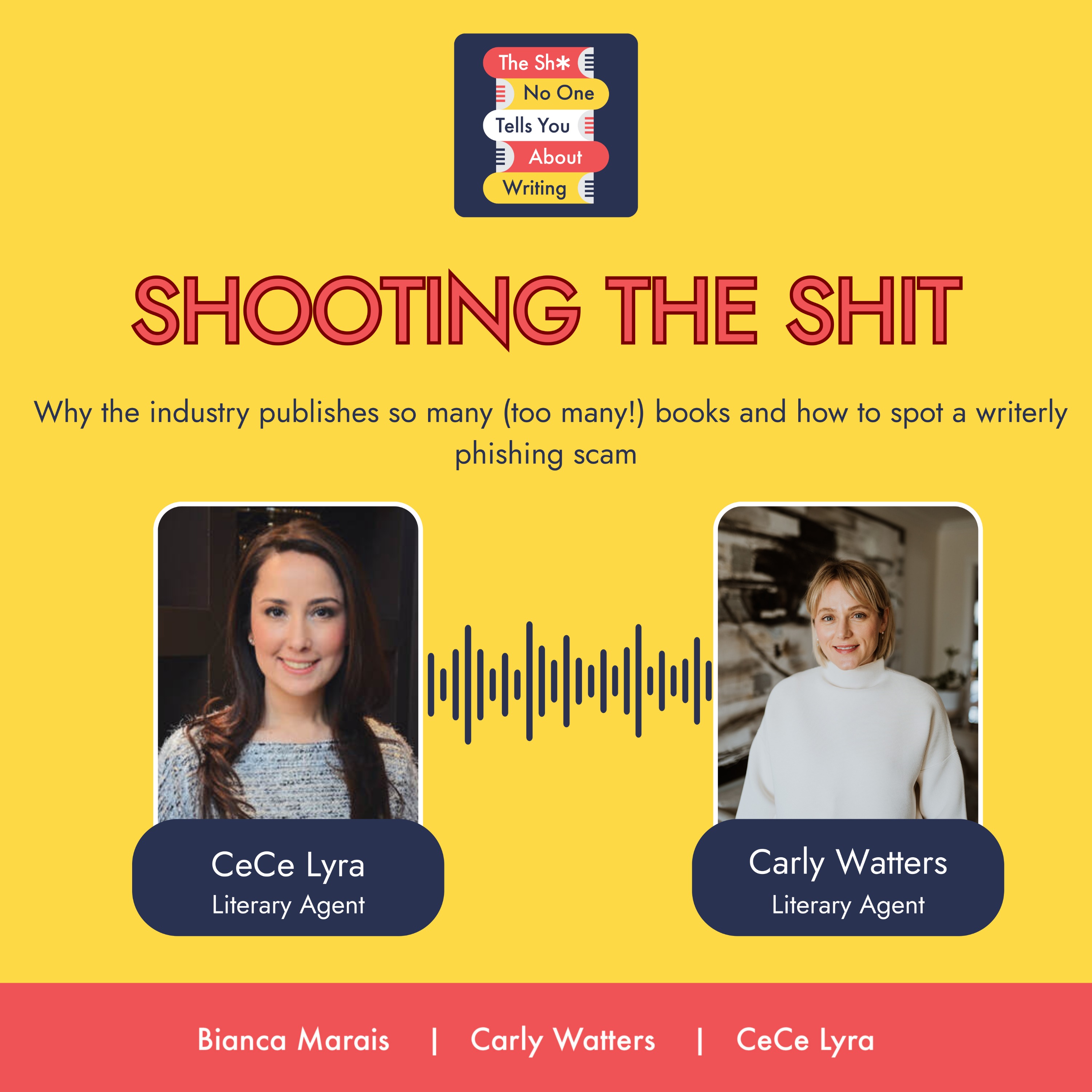
The Shit No One Tells You About Writing
Shooting the Shit: Why the industry publishes so many (too many!) books and how to spot a writerly phishing scam
00:43:38
Loading summary
Transcript122 lines
- [00:01]
Cece Lira
What's up, everyone? This is Cece. If you're a writer, then chances are you've wondered if your story is good enough. Maybe you're wondering that right now. I get it. Here's what I can tell you. As long as your story is making the reader curious, you're good. Now, I'm not saying you won't have to make edits. When working with an agent or publisher, edits are part of the game. But I am saying that you will get ahead in your career if you know how to make the reader curious. The best way to do that, Infuse your story with plenty of tension, conflict and stakes. Which is why I'm so excited to invite you to join my four day course, writing Tension. Creating Tension, Conflict and Stakes in youn Story. It starts on October 13th. My favorite part about this class is that there are formulas. Yes, formulas for tension, for conflict, for stakes. And for the first time ever, we're having two optional interactive components, including a query letter, studio and live critiques of select first pages. I'm super excited about this new format because I've seen it yield results in writers works, and it works for writers of any genre, as long as you're serious about improving your work. So if you're ready to take your writing to the next level, join me for this four day course. Don't worry if you can't attend live. The sessions will be recorded. For more information, check out my bio on Instagram or the podcast's website. I'm looking forward to seeing you there.
- [01:35]
Carly Waters
Welcome to another episode of Shooting the Shit with Literary Agents Carly Waters and Cece Lira, where we dissect publishing gossip, discuss book industry trends, and the overall state of the book business. If you've ever wanted to grab a coffee with two literary agents, grab your mug and pull up a chair. Hi, everybody. Happy Monday. That means it is shooting the day with me and CeCe. Every time we step on to record, I'm always like, oh, Cece, I want.
- [02:08]
Cece Lira
To tell you this, tell you this.
- [02:08]
Carly Waters
And I'm like, okay, I need to hit record so that we capture all of this in our segment so that we don't like chit chat off stage, basically. And then, come on, we're like, oh, yeah, what are we gonna talk about? So we have not chit chatted about our long weekend. We're recording after the long weekend. Cece, how was your Labor Day?
- [02:24]
Cece Lira
It was great. I spent it doing what I like to do, which is working.
- [02:29]
Carly Waters
That is.
- [02:30]
Cece Lira
You know, I have a problem. No, you know I have a problem, but it's only a problem if it's bad. And it's not.
- [02:35]
Carly Waters
It's great.
- [02:35]
Cece Lira
I loved it. I spent my weekend working. How about you?
- [02:39]
Carly Waters
You know what? I guess I can't. So this is the thing about our job, right? Like, I can't say, cece, that was bad. And then say, I read two client manuscripts this weekend, because that is my job, and that is reading. I think, like, when I picture people working on the weekends, I'm like, people grinding away on their computer, doing reports, Excel spreadsheets. I don't know the data stuff or the technical stuff. Whereas part of our job is the joyful reading part. So I did work weekend. Did you do joyful work weekend stuff?
- [03:05]
Cece Lira
So joyful. So joyful. I was reading a manuscript, finishing up. Okay, so this is actually part of my news. I thought I was going to spend the whole weekend reading a manuscript that is going to be, I guess at this point, has already been my first official offer of representation under the Wendy Sherman Associates. So I'm so excited. But I didn't spend the whole weekend reading that because I read it so fast on, like, Friday. So I spent the weekend reading a client manuscript. So just joyful stuff. Awesome stuff. Which you, too, did, Carly. So you also worked.
- [03:42]
Carly Waters
Okay.
- [03:44]
Cece Lira
None of this telling me, oh, Cece, that's awful. Like, thank you for calling out your own hypocrisy.
- [03:49]
Carly Waters
Just saying yes, you know, And I think that's just one of these things where how I envision my own job is also different than how I envision other people's job. Like, I do feel like a unicorn in the sense that I do like my work. I think, just having children. Also, I'm trying to be like, this is my line, of course, weekend versus non weekend. But another thing I try to do. Segueing kind of off topic here, Cece, but one of the things that I try to do when I'm reading in front of the kids is, like, not being on my phone. I really try to, like, be on my Kindle. And then they know. It's like, oh, mom is reading for work or for fun. But this idea of, like, mom's not staring at her phone or staring at her computer, she is reading. And even though reading is my work, they get to witness me doing something in that space. So to me, I don't know if that makes me feel, quote unquote, better, but it just makes me, like, contextualize my work within my family on the weekends in a way that makes sense.
- [04:39]
Cece Lira
To me, that makes perfect sense to me. And I think that's. That is a beautiful thing and so smart. And I'm really excited to see your boys as adults one day because they're going to be. No, they are. They're going to be the best men. Like, they are. They are. Because look. Look at everything that they have witnessed growing up, you know, it's going to be the best. It's going to be so cool. That's awesome.
- [05:01]
Carly Waters
Yeah, they're special. They're back in school this week, which was great. We're back into routine, which is great. So I feel like we talked about last week about how we get to go full steam into fall, which I'm really excited about. I'm scheduling all my meetings for when I'm going to be in New York working on the projects that I'm going to pitch this fall. I'm really, really excited about that. Yeah, I have lots of client manuscripts. I made a list of, like. So I think you guys also know I'm a bit of a generalist. So I have, like, past, present, historical that I'm working on. A YA project I'm working on Domestic Suspense and two nonfiction proposals. Then, because cece mentioned this on the show and other people recommended this to me, I've been reading the Compound by Aisling Raleigh. Really good R A W L E. I started it and it's really great. Like, really different. You kind of think you know what you're getting into. So for those of you that don't know, the premise is kind of like a Big Brother style reality show, but there's also some sort of, like, post apocalyptic dystopian element that's coming in that I'm very interested to see where it goes. And it was a GMA pick, I believe. I don't want to misspeak, but I'm pretty sure it was a GMA pick. And yeah, so I'm really enjoying that.
- [06:11]
Cece Lira
Wait, I just want to say one thing, that for our listeners, think of it as like, Love island meets Lord of the Flies. It's like, amazing. Like, amazing.
- [06:19]
Carly Waters
Yeah. Yeah. I haven't made it that far in yet, so I'm like, oh, where's it gonna go? But yeah, the, like, the atmosphere and the kind of, like, distance between the characters. It's a very great, like, narrative style.
- [06:30]
Cece Lira
Do you watch Love Island? No.
- [06:33]
Carly Waters
No, I.
- [06:34]
Cece Lira
You don't look like you watch Love Island. Okay, Okay.
- [06:37]
Carly Waters
I do not. I watched the Bachelor for years and years and years. I was a Bachelor.
- [06:41]
Cece Lira
Girly, but not anything I Watched Love Island. I binged watched it after reading the Compound.
- [06:46]
Carly Waters
Oh, interesting.
- [06:47]
Cece Lira
Because I had major like, like hangover craving, withdrawal symptoms. So I'm like, I have to do something. So I started watching Love Island. I didn't finish because it, it got, it got boring. By the time there's nobody left, it gets boring. But anyway, this is my Love island origin story.
- [07:01]
Carly Waters
Okay. No, I love that. Yeah. My problem with the reality TV is I only have so much free time. This is my problem with TV in general. I only have so much free time and if I'm gonna think about, like, what am I going to spend my free time on? I really have to be super intentional about it. I actually like Dancing with the Stars. That is my reality tv. If I'm gonna do a reality show, it's Dancing with Stars. I don't know why. I just like athletes out of their elements. I like people just not where they're supposed to be trying to pull this off. And as a non dancer, I have so much respect. So that's my reality show go to. Yeah. So that's what I've been reading. That is what I've been working on. So I heard this person on forgetting what podcast they were on now. Oh, it was Death, Sex and Money. I'm pretty sure they were on the Death, Sex and Money podcast. Evan Osnos wrote this book called the Haves and the have Yachts. And it's just about like rich people shenanigans on the nonfiction side of things. I know we all love to read books about rich people on the fiction side of things, but this was interesting. So the first chapter is about yachts and like this like billionaire yachting culture and all of that. Some of the chapters, I'm like, I think I, I, I know a little bit about this space. Some of the chapters, I didn't learn that much about certain things, but I overall I'm like really enjoying the, the sneak peek into billionaire yachts and, and worlds. So I've enjoyed that.
- [08:19]
Cece Lira
On the nonfiction side, I read that one, I did the audio. And the reason why I picked it up is because the publisher was it Simon and Schuster. Am I remembering this right?
- [08:32]
Carly Waters
Look it up.
- [08:33]
Cece Lira
We're gonna look it up because we don't remember. But the publisher on their social media account had the author talk about. These are the tips for when you go into a yacht for the first time in a very like quirky, funny, poking fun at himself sort of way. And then he talked about his book and I saw that and I was like a Genius publicity. Love. It immediately grabbed my attention, made me stop scrolling on social media. Just hooked me right away. Love that the publisher did that. So smart. But also, the author is so. Has such presence, such charisma in this low level sort of way. Like, not like flashy or anything. Just perfect guy to write this book, honestly. So I'm like, I want to read this book. And I read it and loved it. So.
- [09:14]
Carly Waters
Yeah, yeah, yeah. No, it's. It's so great. Yeah, it is. Simon Schuster that published it. One of the things I liked on the Death Sex and Money podcast was that he talked about his upbringing and his, like, relationship to wealth in terms of growing up in Connecticut and Greenwich, Connecticut. So anyway, it was. All of it is just. It's fascinating. So if you are interested in this kind of world on the nonfiction side, it is. It was a really interesting deep dive. So I enjoyed that one. Yeah.
- [09:38]
Cece Lira
Yeah, that was awesome. That was awesome.
- [09:41]
Carly Waters
Cece, what have you been reading? So you've read the Compound? You read the Havenhave Yachts? We're really on the same page with our reading right now. Yeah. What else have you been working on?
- [09:52]
Cece Lira
So I, like I said, I read the historical fiction that I fell in love with, like, just fell in love with, and there's actually a really cute origin story behind this book. This author submitted to the podcast in. I want to say it was either 2021 or 2022. I don't remember. Let's just say 2022, but I don't know. It was not 2023 for sure. And this was one of those situations where I freaked out with the first five pages and I was like, this is amazing. I have to read it. Please send it to me. Dear God. Like, and usually what happens after I have one of my episodes, right, Where I'm, like, fangirling over the poor author is. I email the author and I say listen, if and when you are querying, if you are interested, obviously no pressure. The podcast is an educational platform, but please think of me, because this book is amazing. Loved your pages. Loved your voice. The writing is superb. The pitch made it clear that it was a story about two sisters. We obviously got one point of view with the five pages, right? But I love stories about sisters. So I was just enthralled and completely hypnotized by this book. And I mean, the author spent years. Because, again, assuming it was 2022, we're in 2025. And she finally sent it to me, Carly.
- [11:08]
Carly Waters
And it's so good.
- [11:10]
Cece Lira
Like, so good. I Love that it needs editorial work. I have a vision for it. Like, it's so important to have a vision.
- [11:19]
Carly Waters
Right.
- [11:19]
Cece Lira
Sometimes I read things and I go, okay, it's so good. I know it needs work, but I don't know what kind of work it needs. And so when that happens, I'm not super comfortable offering representation because I don't think it's fair to tell someone, this needs work, but I don't know what that is. Like, that's just not helpful. But in this case, I know exactly what needs to be done. I have a very clear vision for it. And I chat with the author. And anyway, this is going to be, fingers crossed, nothing signed yet. My first Wendy Sherman Associates client. And I'm just happy. I'm just happy and excited because it's historical fiction, which is not a genre that I typically gravitate towards. I love it as a reader. It's just. It's hard to write historical fiction. There's so much world building that goes into it. Yeah, I'm really excited.
- [11:59]
Carly Waters
I love that. So let's talk about a few things. We. We've got a few kind of articles we want to go through, but one thing that has really come to our attention is something we gotta warn people about. And I try to do this on social media from time to time, but we gotta warn people about all these phishing scams out there. So, cece, do you want to start with which. Which. Which of the phishing scams or which of the scams should we start with? You know, honestly, some of them are kind of like, you know, there's people, I think, that are impersonating me online that are reaching out to writers, saying, I don't know what they're saying, but they might be saying, like, hey, you know, pay me money and I'll review your manuscript. Or I think what happened with one of these was somebody thought that I was a part of a contest or something like that or a conference, and they were again, maybe they said this f money. And then they emailed me personally. Like, me Mimi, saying, oh, are you sending back the critiques that you were supposed to send in? Or something. Like, we're waiting on the thing that we paid you to do, or you said that you were going to do, and I was like, I have no idea what you're talking about. So I think there's, like, conference scams out there. I think there are query scams out there. I think there's marketing scams out. Like, whatever the scam is. There's a Lot of them out there. So those are just some of the ones. Yeah. And just people impersonating agents, like, really got to be careful out there, guys.
- [13:21]
Cece Lira
Yeah. Please, please be careful, everyone. I. I know that this has happened to wsa too, that there's been emails sent, essentially, like, asking for money, which the agency would never do. And it's important to check email addresses to make sure they're coming from the right place. But sometimes, you know, good scammers can even mask that. They can even mask an email address. So I don't know if an agent's asking you for money. That is concerning. And I once got a DM from someone asking me, there's this contest that people say you're judging. Are you really judging this contest? And in that case, I was. I was judging the contest and I just appreciated the skepticism. I was like, yep, that is me. That is correct. Thank you for checking. I think when in doubt, being skeptical is a good thing.
- [14:04]
Carly Waters
Yeah, exactly. So, you know, check your sources, check your email addresses, confirm with conferences, and if you're at conference organizers and you're reaching out to agents, make sure that you are going through publishers, marketplace, getting their actual email address. Because what could happen is you could DM who you think is Mircci on social media, and it's actually a fake US Account. Right. So it's like really triple check everything. Get referrals from, again, agents, you know, editors, you know, and talking about the book world, there's. Yeah, there's like, unlimited opportunities for scams right now. And with AI, all these bots, things are getting smarter, which sucks.
- [14:39]
Cece Lira
Gonna say our voices are out there.
- [14:41]
Right.
- [14:41]
So people could take our voices, the, you know, we're speaking now, and they could, like, make that into a deep fake or whatever it's called. But you told me about a very scary one. Like one that involved pictures of your kids.
- [14:54]
Carly Waters
I know. So, yeah. So somebody made a fake Twitter. Yeah, fake Twitter account of me impersonating me. Went through my social media, took pictures of me, myself, and there was some. And I don't post my kids faces on social media, but it was like pictures of, like, the back of my kids and me. Anyway, it like, freaked me out to no end. Solidified my choice not to post my kids on the Internet. And I do it even less, actually after that because, you know, it's kind of, you know, when kids are small, they're kind of like their blobs or kids. They all look, you know, like kids. But as they grow up, it's like, you know, they should make their own choices about whether they're on the Internet and how they feel about it and building their own autonomy and their own digital footprint. And I feel strongly about that. So, yeah, I definitely don't post them on the Internet anymore. But, yeah, that was. That's so really brutal. One. Yeah. And it's scary, you know, and I've talked about this before on the show. Right. It's like, you know, we are vulnerable peoples in the sense that, you know, people want a lot of us in terms of, like, our time and queering us. And I talked about an agent friend of mine who was physically attacked in terms of, like, physical violence towards her. Nightmare somebody. Yeah, nightmare scenario. I talked about that on the Books with Hooks segment before. Or maybe it was our Q and A. But, yeah, it was the books with hooks.
- [16:07]
Cece Lira
Yeah, we got a query letter that had a killer going after an agent and which is fiction, obviously, but, like, yeah, we talked about it then.
- [16:17]
Carly Waters
Yeah. So anyway, don't need to recount that, but you guys know how I feel about that stuff.
- [16:22]
Cece Lira
I mean, that just sounds super scary. And I think, too, that since we are talking about scams, we could seg into red flags. I got a DM from a follower, a podcast follower. I'm going to read it for you guys. They did ask to be kept anonymous, so here's what this person wrote. Hi, Cece, Hope you're well. In case this matters to y'.
- [16:47]
Carly Waters
All.
- [16:47]
Cece Lira
On shooting the shit, I received an offer from an agent and only had 24 hours to respond. I've been following Teess Not Yaw for long enough to know that this is a no no. But I also don't want to miss an opportunity because this is the only offer I have. How can I let other agents know they only have a day to read my full manuscript without sounding like it's a scam? So I wanted to talk about this because in a different scenario with agent friends, I heard from an agent who's a friend of mine that she got.
- [17:23]
Pinged from a writer she knows.
- [17:25]
She knows this writer really well. So it's not, you know, just a random writer that she also got an offer of representation that she had to answer in 24 hours. And this is not a genre my friend represents at all. And she was just asking my friend, like, is this normal? Like, you know, we've been friends. I'm not a literary agent. And my friend was like, no, this is a red flag. You should run. So, anyway, there is someone. I don't know who it is because I don't know their name. It might be more than one person because it might not be the same human, you know that this person's referring to. But there's an agent out there who's giving people 24 hours notice to reply to offers of rep and two thumbs down, right? That's just not okay to put that kind of pressure on a writer. It's truly just not cool. And I wouldn't want to work with someone like that. At the same time, look at how this person framed the question. And I understand she is probably really worried that it'll be the only offer she gets and so she's nervous. So what I would say to you person who's listening is, I understand the anxiety so much, but please don't tell other agents they only have 24 hours to read. You can decline this offer if you want or you can tell her, hey, I will take two weeks and see how she responds. But don't accept her premise. Like this premise that she is proposing. I don't know if she's proposing so much as demanding, but this premise of you only have 24 hours, do not accept this premise. This is not a fair premise. You deserve better than that. It's not okay. There's no reason why an agent would only give someone 24 hours. It takes so long to read a book. It takes so long to consider whether you want a book or not. This industry moves slower than slow. Like I once had a teacher in publishing school say publishing moves slower than a glacier or something like at a glacier space and the glaciers are melting now. So like, that's not the best analogy. But back when, when it was, yeah, it's a slow moving industry. So there's just no, no reason for this urgency. That's not okay. And I just wouldn't allow this pressure to get to you. I know that's easier said than done, but please put your ambition before your anxiety.
- [19:27]
Carly Waters
There's like so many reasons why this is a terrible, terrible idea. Clearly they are preying on you. Like, there is no outcome in which you would feel good about this. Because even if you were to accept this, you'd be like, I was coerced into this knowing this person's preying on my vulnerabilities. I didn't get an opportunity to discuss this with other agents. I have no idea what the other outcomes would be. Now I'm bound to this person.
- [19:49]
Cece Lira
So.
- [19:50]
Carly Waters
And also, if somebody's going to say this to you, what does their rep agreement look like? Like, oh yeah, if they're willing to kind of, you know, back you into a corner with this offer, what does this rep agreement look like? A lot of questions there. Are they only going to give you 24 hours to look at that when they get you a book deal? Are they only going to give you 12 hours to, you know, accept it? How are they going to strong arm you into other situations in your career if they're willing to strongarm you into representation right from the jump? So you gotta, when somebody shows their cards like this is who they are, this is how they behave. If they behave like this with you, they're going to behave like this in other environments. So this is probably not the person that you want repping you just because of all, all, all the reasons. So many, so many red flags. Yeah, I could go on and on, but this is a, this is a bad idea. So I don't know if this is an inexperienced agent doing this. I don't know if this is somebody who just thinks this strategy is going to work, but they don't have your best interest at heart because why would they want to stronger you into the situation?
- [20:48]
Cece Lira
Yeah, I'd be really curious to know who this person is and whether they are, they're a member of the ALA and like, I just. Anyway, it's, it's bothering me that I've heard about it from like three different people now.
- [20:59]
Carly Waters
Yeah. If anybody's listening and wants to DM us who this person is, we won't out you. We may or may not have this person, but if you just want to let us know, that way we can frame the like, oh, this is, hey, this is maybe why this is happening. There's no good reason for it. But I have some theories. None of them are good.
- [21:18]
Cece Lira
None of them are good. I mean, it's never okay. But yes, I guess context is important. An experienced agent. We just want to know more. Yeah. Anyway, I hope you don't accept this offer. I hope you haven't at this point because this message was sent to us a while ago.
- [21:32]
Carly Waters
Yeah. But our DMs are open for any more knowledge on this situation.
- [21:38]
Cece Lira
Okay, so now should we talk about the thing that made us go, what, at the end of last episode?
- [21:44]
Carly Waters
Yeah. The cliffhanger.
- [21:45]
Cece Lira
The cliffhanger. We have to talk about the Cliffhanger.
- [21:48]
Carly Waters
Finished our episode with an email that pinged into our inbox. And the email was that the CEO of Simon and Schuster, John Karp, is leaving. He is leaving his role as CEO and he is moving back into an editorial role where he is now going to run an imprint. I believe it's called the Six or just Six.
- [22:05]
Cece Lira
Is it Simon six?
- [22:07]
Carly Waters
Simon Six, right. So as fall ramps up and we go into back to school mode, thinking cozy interior decor is a top priority for all of us. From layering fabrics and textiles to extra pillows and fresh sheets and plush bath towels, I can't stop thinking about being fully enveloped by my home. Whether it's lattes by the fireplace or a big bath towel after I had a piping hot bath, or making sure the kids are tucked in their beds with flannel sheets, Wayfair is the place you'll go, your trusted destination for all things home. Wayfair's got you covered. As you guys know, we've recently redone our bathrooms and we got the perfect vanity from Wayfair. With a wood fluted textured front, it fits in with the modern look I was going for and couldn't find anywhere else within our budget. It looks sharp and catches everyone's eye. Wayfair always delivers so quickly. You don't have to wait and second guess any decision making. It's already at your door. You can make confident choices that suit your style instantly. I like luxe, detail oriented, minimal, individual and stylish pieces and Wayfair's got me covered. I think about how the pieces in my home communicate with each other while being unique. And Wayfair is the best place to shop because your house is not going to look like everybody else's, it's going to reflect you. Wayfair has all your essentials for fall warm linens, Halloween decor, storage indoors and out, espresso machines, cozy reading chairs for homework time, ottomans to rest your feet after a long day and unwind at home. There's something for every style in every home, no matter your space or budget. Cozify your space with Wayfair's curated collection of easy, affordable fall updates. From comfy recliners to cozy bedding and autumn decor. Find it all for way less@wayfair.com that's W-A-Y-F-A-I R.com Wayfair Every style, every Home Things I wanted to talk about. Obviously it's, you know, big publishing news when there's some turnover with the CEO. I think he made some, you know, great kind of quotey tidbits in the articles that were mentioned about him when he talked about, you know, he says I asked for advice from other CEOs and what did they say would be the best advice was like try to make the most impact you can in five years. You know, do what you can and then move on. And so he said, I did my five years, you know, obviously made it through the sale to kkr. Savannah Schuster, did big business in the time that he was CEO. There was the COVID years and so much happened in that time that he was CEO. And so now he is moving on back to his editorial roots. He always said that he was an editor at heart and. Yeah, so a few things I want to talk about. I think the thing that really stuck out to me was him going for the role of CEO where he managed, I don't know how many thousands of titles we want to say a year. Right. But thousands of titles a year where he's not directly overseeing him, but he is helping to publish and create pathways for all of these books to working on six books a year. Six S I X six books a year. Right. Like not 16, not 60, like six books a year. Very interesting. And so I don't know if I find. I don't want this. I want this. I want to be very clear. I actually think John Karp was a great CEO. I think he did very good business. He, you know, in his role, did write by my clients books. I don't want to call him hypocritical necessarily, but to go from like managing this huge list and then for him to go now in my next act, I want to focus on six books a year. So clearly, was he seeing all these books he was publishing, how hard it was maybe to like make noise for all of these books that he was publishing as CEO, now having to move to publish six books a year, to like really focus on those six books is really interesting to me. To like narrow that lens so much and really, I think just speaks to how many books we publish in publishing, how much attention any one individual can give to a book, how much attention any imprint can give to a book, how much the marketplace can withstand in terms of the amount of volume of books that are being published. So to me, it just spoke to a really interesting trend of like him overseeing obviously a huge business and now moving to six books a year. Really, really interesting.
- [26:01]
Cece Lira
Yeah, I thought it was really interesting that the operation is going to be basically him and an assistant. And he framed it as, I used to be an executive. So I appreciate the value of low overhead. And I mean, that's really smart, business wise. I get that. But at the same time, can you imagine going from that role with that much going on and then Going to publish six books a year. I'm really curious to know what titles he's going to publish. I am looking forward to the first announcement. Right. Of the first book that gets bought. We'll definitely share it here when it comes out. Do you remember what happened before we met him, Carly?
- [26:43]
Carly Waters
We met him when we met him in drama.
- [26:44]
Cece Lira
Do you remember? Yeah. Do you remember this? It was the day you saved my life. You don't remember this? Remember? You remember you saved my life?
- [26:52]
Carly Waters
See, the thing with Cece and I having a gossip column show was I'm like, what part of this are we talking about? So it was okay, well, there's lots.
- [27:00]
Cece Lira
That happened that day, but that day you saved my life.
- [27:02]
Carly Waters
Yes, I did save Cece's life. We were on the way to the Simon Schuster party where John Carp flew in from New York to Toronto to celebrate. I believe it was the. What year anniversary was that? Was it 15 year anniversary?
- [27:16]
Cece Lira
I don't know.
- [27:16]
Carly Waters
Or 10 year anniversary of Simon Schuster Canada? So we flew in and also there's new publisher Nicole Winstanley. And so he was welcoming her into the fold. Anyway, so we are. It's raining and so obviously everybody's trying to get Ubers, trying to get cabs, and cece calls us an Uber. We walk out. Cece literally almost gets hit by a car. Like, I had to do the mom move where I whacked her with my arm to be like, yeah, get back. Literally, she almost walked into traffic on a rainy day because of the umbrella. It was a lot going on. The Uber was across the street. We had umbrellas. It was raining.
- [27:49]
Cece Lira
There were cars parked along the road. Yeah, no, but it really. Seriously, I would not be here talking to you guys because I would not be here, like, in. In. In this place we call Earth. Like, it was. It was wild. I still think about it.
- [28:04]
Carly Waters
My sister, they slammed on the brakes and I was like, mom. Like, mom, are you.
- [28:07]
Cece Lira
Yeah. You were like, proof you're strong, man. Like, your arm is strong. I was like, what happened just now? Like. And I remember telling my sister this, and my sister's response, in typical my sister fashion, was, if she ever needs a kidney, I'll give her one. That's fine. If she ever needs a kidney. I'm like, she won't need a kidney. She's very healthy. Maybe she'll need a kidney. My sister's like, O negative. And so her whole thing in life is I can to anyone, which, again, it's complicated. I don't know if that's Legitimately true. I'm sure there's other compatibility issues, but in her head, if you ever need a kidney, you can call her. So thank you.
- [28:36]
Carly Waters
Yes, I did save Cece's life on the way to that party on the.
- [28:39]
Cece Lira
Way to meeting Jonathan Karp. So I will forever associate Jonathan Karp with getting saved by Carly.
- [28:46]
Carly Waters
Yeah, yeah, yeah, yeah. No, I had a great chat with John that night, got a picture with him, and thanked him for all the great work he did for my client's book. So, as I said, I think he's a really great human being in publishing, and I'm glad he is continuing to stay in publishing and now that his tenure is up. Okay. So, yeah, I'd love to hear what you guys think about this whole, like, are we publishing too many books? Things. I feel very strongly, actually, that we are publishing too many books in publishing. It's so hard. We talked about this not that long ago in terms of the blockbuster model, the venture capital model, about how in order to kind of make the economics work, we need some blockbusters that are going to pay for the rest of the book. But does that mean that we're just publishing too many books? Like, what is the threshold to make a blockbuster model work? How many titles do we need? Because there's just a lot of titles out there that aren't getting the support and attention that they need. So I'll be really curious to see how Simon Six does. I'm sure, again, it will do well. He, you know, has great taste in books, and I. I have, you know, no doubt that he's going to get great submissions from agents and. And publish really great books. So, you know, there. There are other instances of publishers who do very limited numbers books per year, and generally, as those. Those imprints become successful because they're working on a few books a year, and then the higher ups say, oh, this imprint's doing really well. Let's add more editors, let's add more titles. And then as it grows, it just becomes one of those kind of super imprints that ends up publishing a lot of books. It's also harder to stay, like, singularly focused on what you want to accomplish as an imprint when you have so many titles and so many slots you're trying to. To fill. So, yeah, I don't know. I. I think the answer in general to much of publishing's woes is to publish fewer books a year. They should publish all of my clients books.
- [30:33]
Cece Lira
So I don't know our clients, Carly.
- [30:36]
Carly Waters
Our clients whose books they're not going to publish anymore. I don't know.
- [30:41]
Cece Lira
Not ours. Not ours. Some other person's books. Okay, yes, but keep publishing our book.
- [30:47]
Carly Waters
Books. This agent who was giving people 24 hours to respond, maybe not.
- [30:53]
Cece Lira
Maybe it's not her. Maybe it's him. I don't know. Maybe not this person.
- [30:56]
Carly Waters
Yeah, but our books should obviously, yes, be published.
- [31:00]
Cece Lira
We good people. We're good people. Just saying. Just saying.
- [31:02]
Carly Waters
Great taste. Good people. Great taste. All right, so next up on our list of things to talk about was the official 2024 sales figures. So these are generally shared in a couple different places, but publishers are lunch republishes, those from stat shots, which is BookScan's sales data. And so if you pay for Bookscan, you can obviously have access to all this stuff. And they do reports, but this is kind of what they have published about how the year went. Cece, was there anything that really stood out to you in terms of how the year went?
- [31:34]
Cece Lira
I mean, I just. I just. I think this is a nice seg with our conversation about publishing too many books. Right. Because this is a multi billion dollar industry, which you love saying. And I love that. I love that you always remind us all the time. Yes. And I love it when you do, because it's important to remind authors that publishing is a very lucrative business. I was actually speaking to an author. I don't know if she'd be comfortable with me mentioning who she is, but I was speaking to an author. Not my client, but super accomplished New York Times bestseller, and her latest book isn't doing well. And she was talking to me about it, and in our conversation, she discussed the business model, and I said, well, but they make a lot of money. They have money to spend. And she's like, you know what? You're right. They do have money. But, like, why do I think of them as like, poor little. And then she mentioned her big publisher's name. Like, oh, poor little. Like, imagine poor little Simon and Schuster. Poor little Penguin Random House.
- [32:23]
Carly Waters
Like, like, why.
- [32:25]
Cece Lira
Why do I think of them as. As like, essentially poor people.
- [32:29]
Carly Waters
Right.
- [32:29]
Cece Lira
Yeah. When they're making all this money. And, yeah, I think part of it is just how we treat and talk about publishing. But, I mean, trade sales, and I know sales. Sales is different from profit, but, like, trade sales totaled almost 9 billion, which is a 2.2 increase from 2023. Domestic trade sales rising 3%. Audiobooks are up 4%. That was incredible, right? Children's book sales didn't do super well. But anyway, just the fact that this is Such a healthy industry in so many ways and yet we don't internalize that in so many of our conversations. Is interesting to say the least.
- [33:13]
Carly Waters
I think what it does is it just serves who is in power. Right. Like this mentality serves the publishers. So publishers aren't going to go to their way to be like, hey everybody, we got lots of money. Because then we're all going to bang on their door and be like, where's the money? Show us making it rain. Yeah, that's why these need to be watched on YouTube for all of our hand signals and hand actions here. But yes, this is a multi billion dollar business. Somebody is getting paid. Guess what? That somebody could be you. It could be any of us. Right. Because of how the nature of this blockbuster model works. But people are making money. Obviously. As we said, the children's market was down a little bit. You know, digital audio is holding really strong. Ebooks are staying relatively strong. There was a lot of growth as well as Cece said. So like it's not huge growth, it's not double digit growth, but like in this economy, for this industry to continue to thrive and survive is doing a lot. So this is just to let everybody know, if you want to go find the stats shots, you can find them from the association of American Publishers. They publish them on a monthly basis. But these are the big numbers. And so, you know, just as a summary, everything is doing well. We are, we are in the billions here with the B. So if you want to drill down into your different segments, obviously, you know, go ahead. Yeah. Think things are good.
- [34:32]
Cece Lira
Yeah, things are good. And I think you highlighted two figures that I thought were really interesting. One being that digital audio outpaced ebook sales. And it's so interesting, right? Because like I feel like more and more people have become audiobook readers. I personally didn't used to do fiction and audio. Now I do. I still read more with my eyes than with my ears, but I do a lot of audiobooks. And also trade paperbacks were the highest selling format and years ago, Carly, I still remember you predicting that one of the things that would happen was more and more. Remember this one of your publishing trends predictions more and more trade paperback originals would become a thing, which I know is not the same as the statistic because this isn't about trade paperback originals, it's just about trade paperback, which usually comes after the hardcover. But still really cool, really cool to see.
- [35:19]
Carly Waters
I don't think they differentiate between originals versus like they don't.
- [35:23]
Cece Lira
It includes everything.
- [35:23]
Carly Waters
Yeah, but even hardcovers grew 1.4%. Right. So, like, we're not saying, I understand 1.4% isn't a lot, but it's not negative. Like, we're still maintaining. It's not growing. And obviously, as CC said, there's a difference between sales and revenue and all of that sort of stuff. And we don't have insight into the back end of the business. But anytime things go up, that's good. And especially in this economy. Yeah, yeah.
- [35:47]
Cece Lira
Adult fiction went up. That's really cool too. Yes, adult nonfiction is down, but like by 2 million units. Given this 300 million unit or whatever the number is situation. This is good. This is a healthy, healthy market. And I get happy. I am a big believer that in order for us to get the changes that we want in publishing, we need more readers. Not just people reading more books, but non readers becoming readers. It's still so great to see. It's so great to see so many healthy numbers. It's exciting.
- [36:18]
Carly Waters
Yeah, yeah. So if you want to dive into those, you know, where to go stat shots, aap, Publisher's Lunch Newsletter. That's where you can go to get these, these types of numbers. But yeah, everybody should be feeling good. And I know, you know, kind of going back to one of my predictions, as I said, about how when I made my prediction, I think this probably my 2023 prediction about more books will be in trade paper and trade paper originals. A lot of authors have to, like, take a breath because they, you know, they imagine that they're going to be published in hardcover. It's one of these, like, dreams that they have about themselves. But. But as the market evolves, as the industry evolves, publishers have noticed where they can move more copies. And their goal is always going to be to move more copies, not to make sure that you just get published in hardcover. So the goal is always to move as many books, reach as many readers as possible. And trade paper can do that.
- [37:04]
Cece Lira
Yeah, absolutely. Absolutely.
- [37:07]
Carly Waters
All right.
- [37:08]
Cece Lira
I think NETS is a nice segue into the other article.
- [37:13]
Carly Waters
Yes. Cece, do you want to introduce us to the article that you shared?
- [37:17]
Cece Lira
So it's called the Cruelty and possibilities of 21st century book promotion by Michael Castleman. It was shared with me by Laura Loeffler McLian, who wrote Tell Them youm Lied. Go check out Tell Them youm Lied. I had to do that. But no, seriously, Laura, thank you for sharing this because it was a really interesting article. So. Okay, context. Michael wrote a book called the Untold Story of A Writer's History of Book publishing. Right. It was published last July. And he is very transparent in this article about how much he paid to promote his book. We will talk about the promotion strategies. He essentially frames it as, these are the marketing strategies for the 99.9% of authors who aren't bestsellers. And he is framing bestseller in the traditional sense because I know that sometimes you can make it as an Amazon bestseller for a little while. He's using bestseller in the more, I guess, traditional sense of the word. But anyway, before we get into that, I thought that really interesting stats that he shared in the beginning of the article and I'm going to read it a little bit for you. In 1980, the first year my book appeared, Americans, American publishers released 45,000 titles. I want you to picture this. We're in 1980, 45,000 titles, guys were published. Continue reading? Since 2000, releases from Big Five publishers, indie publishers pay to publish. Hybrid houses and self publishers have averaged more than 2 million annually. And then he goes on to say, like, during the entire 20th century, 2.5 million titles were published by publishers. And now that's basically the number that comes out in a year. And I mean, I'm sure he knows his stuff because he wrote a book about it. But I'm just going, I'm looking at this and I'm going, this can't be right.
- [39:01]
But it can be right.
- [39:02]
Because if you do count like self published titles, like hybrid, if you do count this entire market, and why wouldn't you? They're all books. It's bananas. It's a banana situation. How many books we publish a year, no wonder it's so hard to break out. No wonder it's so hard for people to stand out among all these titles. What did you think?
- [39:22]
Carly Waters
Yeah, I really liked it. So this author also, for context, I think has written 21 books over a very long career in various genres. So I also really appreciated the contextualization of this person being a published author for so long. I don't know who the publishers are for all of the titles, but clearly, you know, they've been around. Two things that stood out to me. So there was a quote that said, Fordham University professor Albert Greco estimates that 79% of new releases, four out of five sell fewer than 100 copies. Only 6% sell 1,000. So there's been a various, you know, versions of these numbers floating around. I actually shared some on social media not that long ago of these stats of like, this is what's published, this is what actually books, copies, this is the threshold of like, who sells this many copies? I think you guys have got the gist now that like, the bottom line is not a lot of authors are moving a lot of copies. Right? But there, but again, coming back to this blockbuster model, there are copies that are going to stand out. The other quote, I guess I, I picked three things. The second thing that I picked out of this was talking about blurbs because I know blurbs are one of those like, love them slash hate them things. So if you guys have any, like blurb drama, DM us. If you have any blurb stories or blurb questions that might be interesting in terms of our gossipy segment of our show, let us know because I think we could, we could do a lot of, a lot about blurbs. But the, the quote here was, there's one moment when blurbs may make a difference. It happens in bookstores. If browsers are interested in a title, they pick it up, read the blurbs. Good ones just might close sales. Of course, bookstores only stock a tiny fraction of trade titles and virtually no self published books. Meaning these blurbs. We all spend all this busy body work being like, are these actually going to move on your copies? Generally, no. But in those moments of, you know, somebody teetering on the fence, there is conversion that happens because of blurbs. I also think booksellers care, I think librarians care, and obviously some readers care. But yeah, let's table this for a future segment. Love to hear more gossip about blurbs.
- [41:21]
Cece Lira
Do you buy books based on blurbs? Like, does that make you buy a book? I know you work in the industry, so you're not your typical reader, but is that something that you've done?
- [41:29]
Carly Waters
I would say no. But I guess in the instance that he used where it's like, if you're on the fence about something, does a blurb matter? Probably. I think for that reader on the fence, the answer is always going to be yes.
- [41:41]
Cece Lira
Yeah, for me it's interesting because. So my personal experience is this. Before I was an agent, whenever I went into bookstores to buy books, and I would visit bookstores all the time before E readers became a thing, blurbs would encourage me to buy. Like, if I saw a blurb by an author, I adored saying that the book was amazing. It was, it was probably gonna make me buy a book like 90% of the time. But then once I stopped going to bookstores because, like, again, I would go every day. Like, I'm not even kidding. I remember walking back when I lived in Boston, like literally every day. Because the bookstore was right, right next to my apartment. But anyway, point is, once I started using E Readers. No, because that's not how the experience works when you're browsing books. Goodreads started to tell me when the books by the authors I like are coming out and books that are similar to the books that I've rated browsing because I read on my iPad, browsing the ibook store, you don't see blurbs. I mean, you can. If you click on the fine print you can, but it's not something that catches your eye.
- [42:45]
Carly Waters
It speaks to the thumbnail. How much work a thumbnail has to do in this day and age.
- [42:48]
Cece Lira
Right, versus like, and also like classification. Like, is it in the, like a book club I adore, for example, I always check out their picks. It's called Beltrist. Am I getting the name right? Yeah. So I, I adore their picks. They have great taste. Like things like that. Like, I go to the Beltris shelf on my iPad, I go to the new releases and I check out what's new this week. And I'm someone who like, I could theoretically get books for free. I can call up my editor friends and be like, hey, can you send me this copy? I still buy tons of books. A, cuz I'm impatient. But also B, I want to support authors.
- [43:18]
Carly Waters
It's a business expense.
- [43:20]
Cece Lira
I mean 100%. It's market research.
- [43:21]
Carly Waters
And it's also like, it's like, it's a write off. It's a write off.
- [43:25]
Cece Lira
I want to support writers, you know, like I want to do that. And so it's one of those things where I don't know. To me, a blurb used to make such a big difference and now I still absolutely understand why we get them and all that. But as a reader, I have to be honest. No, it doesn't make me buy a book. It's impressive, but it doesn't make me buy a book. We keep coming back on the show to like, what makes someone like, how do we move copies? Right. Like that's what we keep coming back to. Yeah, yeah.
- [43:54]
Carly Waters
Every day we ask ourselves. Every day. Oh, the last thing in the article that stood out to me was they talked about investing in an external publicist. That's another topic for this show, I think as well. So feel free to send in DMs about this experiences. Good, bad, gossipy, non gossipy otherwise. Because actually an agent friend of mine sent me a voice. She's somebody that loves sending voice notes. So she sent me like a voice Note DM on Instagram being like, hey, I haven't talked to you in a while. I have a question for you. And we'd like. She voice noted me about external publicists. Like, she's been in the business a long time, and she's like, what are you. Like, what's going on right now? Are you noticing the moving copies? What's working? Da, da, da, da. So it's one of these conversations that just always keeps coming back. And so in this article, this author, Michael Castleman, said that he spent $6,500 in a publicist with a strategy is what he said. In a publicist with a strategy was the exact quote. What he paid them for was only to work on npr. Like, he literally paid somebody this amount of money. So you might think, oh, $6,500. Like, when I saw that number, I was like, that's actually a really low number for an external publicist. Normally, external publicists can be upwards of, you know, 10 to $20,000. Again, depends on what you want them to do. But he spent. He spent a significant amount of money, but on a very focused thing. So this person must be really good at getting writers on npr. Right? And that was the job, and that's what they paid them for. And. And so when you're thinking about external publicists, to me, the point here is just find somebody who can work on exactly what you want to do. Because a lot of writers will think, like, I just need to hire a publicist. This will solve all my problems. And it's like, okay, what is your problem? Let's start with that. What do you want? What are your goals? How is this actually going to solve this? Because throwing money at something with a completely, you know, unclear goal is just really not helpful at all. So that was my take on that.
- [45:44]
Cece Lira
Yeah, I thought it was really interesting. I like that we chatted about it. Thank you for doing that.
- [45:49]
Carly Waters
Yeah, so that's everything we had on our list of things to cover today. And yeah, as I said, send us any juicy stuff on blurbs. I want to get into that a little bit more. I think there's room to explore that. And then I also want to hear a little bit more about your publicist strategy. Thank you, everyone.
- [46:06]
Cece Lira
Bye. Cece Lira is a literary agent at Wendy Sherman Associates. If you'd like to query CC, please refer to the submission guidelines@www.wsherman.com. carly Waters is a literary agent at P.S. literary Agency, but her work on this podcast is not affiliated with the agency. And the views expressed by Carly on this podcast are solely that of her.
- [46:34]
Carly Waters
As a podcast co host and do.
- [46:36]
Cece Lira
Not necessarily reflect the views, opinions, policies, or position of PS Literary Agency what's up everyone?
- [46:45]
This is Cece. If you're a writer, then chances are you've wondered if your story is good enough. Maybe you're wondering that right now. I get it. Here's what I can tell you. As long as your story is making the reader curious, you're good. Now, I'm not saying you won't have to make edits when working with an agent or publisher. Edits are part of the game. But I am saying that you will get ahead in your career if you know how to make the reader curious. The best way to do that Infuse your story with plenty of tension, conflict and stakes. Which is why I'm so excited to invite you to join my four day course Writing Tension Creating Tension, Conflict and Stakes in your story. It starts on October 13th. My favorite part about this class is that there are formulas. Yes, formulas for tension, for conflict, for stakes. And for the first time ever, we're having two optional interactive components including a query letter studio and live critiques of select first pages. I'm super excited about this new format because I've seen seen it yield results in writers works and it works for writers of any genre as long as you're serious about improving your work. So if you're ready to take your writing to the next level, join me for this four day course. Don't worry if you can't attend live, the sessions will be recorded. For more information, check out my bio on Instagram or the podcast's website. I'm looking forward to seeing you there.