← The Shit No One Tells You About Writing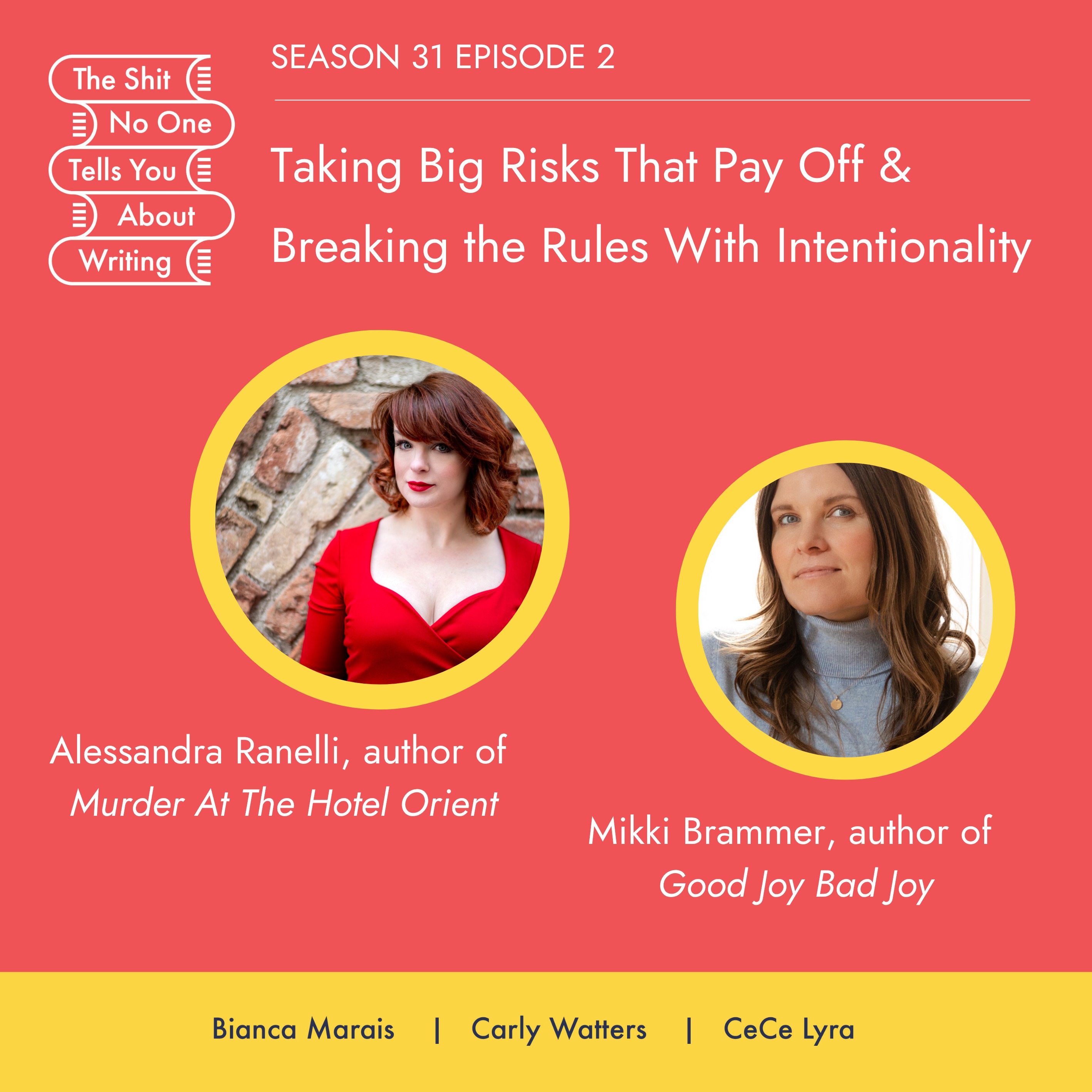
The Shit No One Tells You About Writing
Taking Big Risks That Pay Off & Breaking the Rules With Intentionality
00:58:44
Author Interviews
Loading summary
Transcript69 lines
- [00:01]
Bianca
Have you been sitting on the fence about signing up for the Beta Reader matchup? Or have you signed up before but haven't yet found your writing soulmates? The next matchup is the last one for the summer, so don't snooze on it. Get matched up with those writing in a similar genre and or time zone so they can critique your work as you critique theirs. Your manuscript doesn't have to be complete to sign up for this 3,000 word evaluation. This particular matchup will be open to registrations from now until the 1st of June, with the matchup emails going out on the 2nd of June. For more information and to register, go to Biancamarae.com and go to the Beta Reader Matchup page.
- [00:45]
Cece Lehrer
What's up everyone? This is cece. So I recently grabbed lunch with an acquiring editor from HarperCollins who told me that the number of submissions she's been getting has nearly doubled. And I wasn't surprised at all because every agent and editor I know has been talking about how the volume of submission keeps increasing. So, personally, that is a wonderful thing because it's more reading for me, but it also means I have more chances of matching with authors. I consider it a privilege to review queries on books with hooks and of course, in my submissions inbox. But at the same time I talk to writers who tell me that they wish agents would read more than a few pages because, and I quote, my story gets better in chapter two. I have to be honest, this kills me. It's like me wanting chocolate chip cookies to have the nutritional value of kale. It's just not realistic. Like it or not, no agent, no acquiring editor is going to stick around to see if a submission gets better. It's not because we're mean, it's because we get dozens and dozens every day. I know it's harsh, but ambitious writers embrace harsh realities. So here it goes. It's your job to make your opening pages irresistible, to make agents crave it, to make agents want to read more. That's why I'm so excited about my upcoming course. Starting it how to begin your story in the best place and in the best way. I created this course after studying hundreds of books. I've mapped out elements that are present in the beginning of all all successful novels and memoirs. And I've designed checklists, actual checklists that you can use to ensure that your story's beginning is seducing your reader. We'll cover how to write a great first line, different types of beginnings, and how you can choose the Best one, the best place to start and the best way to start. Yes, these are totally different things. When it makes sense to add a prologue and when it doesn't. How to frame your inciting incident in an appealing way. How to balance exposition and mystery. How to include context but not weigh it down with too much backstory. And what to do if your story has more than one POV or timeline. Most of all, I'm going to show you how to make readers want to turn to Chapter two. Join me for this multi day course designed to help you break through the noise. You'll leave with a clear, actionable breakdown of exactly what goes into a terrific beginning. If you've already signed up, come prepared to take lots of notes. We're talking hundreds of slides with real world examples and specific techniques. Plus a super fun surprise that I can't wait to share. I hope to see you there.
- [03:46]
Bianca
Hi there and welcome to our show the Shit no one tells you about Writing. I'm best selling author Bianca and I'm joined by Cece Lehrer of Wendy Sherman Associates and Carly Waters of P.S. literary. Hi everyone. Today's guest is an American writer living in Vienna, Austria. She is known for her New York Times Modern Love essay Two Kisses We Never Talked About. As part of extensive book research, she left her career as a pastry chef and became a receptionist at a traditional hotel. She has the full support of the real Hotel Orient and has been granted access to all of its rooms, even the hidden ones. Dun dun dun. Murder at the Hotel Orient is her debut novel. So here's a bit of flap copy for you. Don't be shy, darling. Ring the bell. In modern Vienna, American Sterling Lockwood is the loyal concierge at the infamous Hotel Orient, where cameras are banned, aliases are required, and every guest has something to hide. After a double murder, Sterling must turn detective to clear her name. But uncovering the truth will require breaking the Orient's sacred code of secrecy while keeping a few secrets of her own. For those of you who aren't watching on YouTube, I'm showing you a very battered, very lived in copy of this book. And I know there's a lot of people out there who will think it's sacrilege and are gasping at how I could mishandle a book like this. But this is what a book looks like to me once I've loved it and have lived in it and let it live in me. So there we go. We will link to it on our bookshop.org affiliate page. Oh yeah, we go. And Alessandra is holding a much neater cover. That's. I love. I love both covers. They're stunning. Okay. So you guys must watch on YouTube so you can see them. Okay. So I loved this book. We're going to dive into this book as much as we possibly can, but I want to go through this whole journey with you from when you got the idea to write this book to when it's sold. Take us through everything.
- [05:54]
Alessandra
I don't think we have time for everything. It's a great story, but it really begins in the, like, one of the worst weeks of my life. I had been fired in German, dumped via text, and then rejected from grad school by ghosting via email. So things were not looking great for me in Austria. When you lose a job, this was the first time I really got fired from a job. When you lose a job, you still work two weeks. And so I had my last shift, and then I decided to go out on a high note. I put on a cute dress, this polka dot dress that kind of demanded trouble. There was a cute line cook, and I was like, maybe, maybe I'll. I'll get some luck on the way out. Did not get the line cooking. But I got home and I thought, this dress needs more fun. And I went out to the Los Bar, which is an American style cocktail bar in Vienna. And I had this really wild evening with a bunch of weird characters. And at the end of that night, this theater director in his 70s said, you know, if I were a younger man, I would invite you to the Hotel Oriented. And I assume that he assumed I didn't know what that means. So I said, first of all, I'm assuming you think I don't know what that means because I'm American, but I do, so how dare you? And second of all, would you please take me? I won't have sex with you, but, like, would you take me? And I think he really thought that he would stand a chance. Once we got there and all of the romance took over, he was like, you know what? Fine. Why not live a little? I'm in my 70s. So we took a taxi over to the Hotel Orient. He held my hand the whole way, and we walked in. And I had heard about the legend of this place for a long time, but I'd never been brave enough to go because I knew that they weren't very welcome to outsiders or if you're too curious. And while he booked the room, and it was the room I dreamed of seeing, which was the Arabian Night Suite, I just kind of took a look around, and then we went into the Arabian Night suite, which is modeled after the book, and it has this mural of Scheherazade and this big marble bathroom with a domed ceiling that looks like the night sky. And I took off my stockings. He took off his socks and rolled up his pants, and we soaked our feet in the tub. And he told me legends of old Vienna in the hotel and said the last time he'd been there was 20 years earlier, and it was exactly the same. And we had this really interesting night. Eventually, like, he put a real move on me, and he had violated the terms of our agreement. So I was like, I'm out of there. Because I realized when we checked in, no one took our names. And this guy could have murdered me, taken my wallet, and walked out of the hotel. And I would have just been a nameless body in a room. And, you know, that would be the last anybody ever heard of me. So I realized I had to go. I grabbed my shoes and my stockings, and I ran into the hallway, and I stopped at the front desk to chat with the concierge while I put my shoes on. And I remember I said I had a great time. It's amazing. I didn't sleep with him. I didn't sleep with him. And she looked at me like, sure. And she wouldn't have cared, But I think my. My protestations just made it sound like I was lying. And I said, you must love working here. She smiled really big and said, I do. And I was like, you must see a lot of things. And she got more serious, and she was like, I do. And I left, and the sun was rising, and I wandered home. I fell asleep, and I slept four hours, and I woke up with a champagne headache. And the idea for a book.
- [09:45]
Bianca
Amazing, Amazing. You never know where these things are coming from. And this is why I always say to people, to be a writer, you need to live. You've got to go out into the world. You need to interact with the world. You need to get messy with the world, because this is where some of your best ideas will come from. Okay, so how long did it take you to write this book? Was this the first book you ever wrote? And then after that, I want to find out, like, getting your agents, getting your publisher. Take us through that.
- [10:13]
Alessandra
Yeah. So the very first draft of the book took me 13 months to write. Now, at the time, I had just been fired, and I assumed I'd been rejected from this grad school program I'd been working for years to get into, because the acceptance date had come and came and went, and I didn't hear anything. And I sat with the idea for a few days because I had never written a novel before, kept a blog. I did live storytelling and wrote poetry, and I did professional storytelling, but as a side project, never as a main source of income. But I'd never written anything long form or that wasn't autobiographical in some way. So after sitting on the idea for a few days, what I actually did was I called my father, who is an Italian American accountant, and he's very tough love. And I said, I need you to sit down. I have to tell you something, and you're going to be mad at me. He was like, oh, God, what did you do? And I was like, everything's fine, but I need you to listen to the whole story. And then, you know, I need your advice. And then I said, there's this love hotel in Vienna that I went to the other night with a stranger. It's fine, it's fine, don't worry.
- [11:30]
Bianca
And he's having a heart attack.
- [11:32]
Alessandra
Yeah, yeah. And then I'm telling him, like. And I realized I could have been murdered. The place feels like walking into an Agatha Christie because your cell phones are banned and the entire place is like a time machine. They actually have rotary phones in all the rooms and a switchboard system. And I was in love. So I explained just the initial seed of the idea, which was a murder in the hotel because it solves the cell phone problem and would feel like an Agatha Christie mystery, but could be set today. That was it. And then my dad got very quiet and he said, eventually, start saving your receipts because they're going to be a tax deduction. Which was his way of saying he believed in me. So with his blessing, I took my. My mother died when I was 19, and she had a life insurance policy that left me something that I had been very careful not to use up. And this was what I used it on. So I, with my dad's blessing, took some time before jumping into a new job and tried to write the book. And because I'd never written a novel, the first thing I did was for about a month, I spent time just reading how to Write a Novel. And it was the following week I was sitting at a cafe called Kleine's Cafe, which is in the book, and it's one of my favorite spots in Vienna. And I was sitting at the counter writing the character sketch for who would be Fernando, who is the bellhop, and I think a character that Everybody loves in the book. And I had showed it. I'd showed the paragraph to the bartender. And while I was sitting there, I got an email that I'd been accepted to the grad school program. And I asked the bartender, I was like, do you have champagne? And he said, no, we have Prosecco. Why? And I said, I guess. I guess I'm celebrating. I got into that grad school program. And he said, I thought you were writing a book. And he poured himself a little Prosecco. Are you gonna go? I thought you. He said, are you gonna go? I thought you were writing a book. And I said, yeah, I thought I was writing a book, too, but I guess I. I should go. You know, I've worked for this for years. And then we clinked glasses and he said, I think you're going to write the book. So, yeah, I did it. It was the biggest risk I ever took. I threw away or I asked them to hold my spot for one year. I gave myself a year to try and get it together. But when that year came up, I still didn't have an agent. I still hadn't quite finished the book. But I had just published an essay in the New York Times. So I felt confident enough at that point to take the risk. But it was the biggest gamble I've ever taken in my life.
- [14:24]
Bianca
Yeah, I love all of that. Was it that the essay in the Modern Love, did that make it easier for you down the line to find an agent or. Not really, no.
- [14:35]
Alessandra
I really thought it might. But my Modern Love essay, which I'm very proud of, is autobiographical. It's closer to the work I'd been doing as a storyteller. And it's obviously a more moving subject matter, but I think Murder at the Hotel Orient is what I call a spicy whodunit. And it's deeply unserious, it's humorous, it's over the top, it's reality amplified and put in a vintage soft focus glow. And the. So the Modern Love piece did earn me one agent who requested the full. But when I sent it, it was A, an early draft, but B, I think if you came into the project from reading the essay, the book was not. Was always going to disappoint because the essay was seven and a half years of a marriage boiled down into 1500 words and confronting mortality and what it means to love someone and be married. Like, it was a huge thing in a small amount. And I do think Mathem has some things to say under all the humor, but it's a very different Beast. And I found as well, that later on, I had a wave of requests before I got an agent. And many of them requested, I think, because they were curious because there'd been such a big wave. And a lot of them started by reading my essay. And any agent who emailed me and said, my God, I've just read your essay ultimately didn't sign me because they were expecting something different. They were expecting me, not Sterling.
- [16:19]
Bianca
Yeah, it is interesting how sometimes that works in your favor and sometimes it actually works against you. Okay, so when you landed your agent, what did that look like?
- [16:29]
Alessandra
So I finished the book. It took about 13 months, and in that time, I did won a pitch prize, the Blue Pencil Agency pitch prize, which gave me a half hour meeting with an agent I loved. And I had entered the prize specifically because that agent was judging it. And she had been recommended to me as a potential match from the only writing course I ever took, which was a Curtis Brown crime writing class, which was taught by Vaseem Khan. And then they had a bunch of mentors who kind of managed the class. Vaseem recorded the lectures. That's the only writing class I've ever taken. And I met with her. She believed in the project. She. She mentored it a bit on the way and took a peek at some of the drafts. And by the time the book was ready, she was pregnant and about to go on maternity leave. So that was a heartbreaking moment. And I'd had some people who said they'd like to see it after the Dragon's Pen pitch contest as well at Harrogate, where I got four yes votes. So I sent it to them when I had earlier drafts, but I think I hadn't quite figured it out at the time. And it was actually your podcast was part of the aha moment that really changed things. So in summary, I had. Halfway through querying, I had queried about 30 agents. I'd had four full requests, one near miss with this agent who I adore, and things just weren't quite clicking. And I wasn't able to figure it out. So I said, okay, I'll take the 500 bucks I got for the Modern Love essay. And I decided to hire two editors just to look at the opening chapters, because that agent had given me feedback that there were some character inconsistencies. And I was looking and I could not see them. And I just wanted to be honest about this with the listeners. I do not think you need to hire an editor. But I hired one. Her name was Sarah Desalza. She was Amazing. And I hired two. One did nothing. It was like, this is good. And fix some grammar. Maybe what she did was interrogate the opening chapters with the relentless curiosity of a toddler and pointed out that the book was supposed to be modern with a golden age feel. And because the setting is so old fashioned and there are no phones, it was confusing because it felt historical. Yeah. And that wasn't cheeky and different. It was actually just unclear to the reader. So that was one change I made was I signpost that in the beginning that Sterling crosses off the date on a calendar that sits between a rotary phone and a typewriter. A Rheinmetall typewriter. And yeah, what happened was I sent it off to the editor. And then a week and a half later I had a breakthrough and realized what I was doing wrong and I restructured the chapters. By the time I got her notes back, I had a completely different structure and I had to look at her feedback fundamentally. So that's my advice when taking feedback, is don't focus on the small picture. Focus on the big picture. But the two points she made were this feels historical. Or three points were this feels historical. I want more. And I put back a lot that I had cut out based on other readers who had looked at things or being told it was too slow. I had pretty much everything there in my drafts and I threw it back in. And she said, why is Sterling, my main character, judging this couple for having an affair? And it's because I am judging them. So I am monogamous. And I think you should ideally not cheat on your partner. There are options. We live in a modern world. There are open relationships. That's fine. I think consent is important. I was judging the characters and it was so my worldview. I could not see it. But Sterling is what I would call an unethically non monogamous pansexual lust demon.
- [20:46]
Bianca
So I love it.
- [20:49]
Alessandra
Probably feels accurate. You've read the book. So she wouldn't care. It's her job to protect. Protect adulterers. It's an anonymous love hotel. That's the majority of the clientele who are going to be going there. So.
- [21:02]
Bianca
Yeah. So once you took your views out of it and made sure it was hers, then it felt more organic.
- [21:09]
Alessandra
Yeah. And it was really just that I didn't change much of the rest of the book because I tried to look for inconsistencies because the timing worked out that I won another pitch contest. And I had also been the aha moment I had was listening to the podcast your Podcast. And somebody was talking about, how do you say it? It's like, where you're meeting the pitch. Does it. There's a phrase. I think you're the one who says it, but it's that you're fulfilling the promise of the pitch to the reader. And that really sat with me, where I was like, what am I missing? Because the pitch was going over and winning contest after contest, and I realized I wasn't quite hitting it on the head. And I just restructured the chapter to add more curiosity seeds. Love that term. It's always on the podcast as well. And basically, by having Fernando having one character come in and their conversation be interrupted by the action that happened, so that it created some natural suspense.
- [22:17]
Mickey Bramma
Yeah.
- [22:18]
Alessandra
Little changes. And it changed everything. After the pitch prize, I had a few requests at the same time. My now agent, Harry Illingmerth, reopened, and somebody slid into my DMs and was like, you should query this agent. I was like, oh, he's on my list. He's right on my list. Top of the. Thank you for letting me know. He reopened. And I had had, I think, three requests at the time. So I said that in the first line of my email to him. I was like, great timing that you've reopened. I've had a wave of requests, blah, blah, blah. Gave him the query letter. He requested it right away. And I was shaking when that happened because I really wanted to work with him, but I knew it was a long shot. And suddenly the wave of requests got bigger. And then I realized something was happening because I used to not get any responses. And almost 100% of the agents that I reached out to were responding within hours, suddenly requesting it. And then I started. I realized what was going on. I talked to my friend, and at that time, I had been having such trouble querying. I'd almost given up, but it seemed like it was hap. And I had said, I'll send it off to this last wave of agents, and if nothing happens, that's it. I'm just going to give up on the book. But everything was totally different this time. And I sat down and over one day, I queried all of the agents on my list because I just had a feeling that somebody was going to offer. And I felt like, you can't really query after you've had an offer, and now is the time to reach out. So out of those 30, I think it was 30 queries, and I had about 26 full requests at the end of it.
- [24:02]
Bianca
Wow.
- [24:03]
Alessandra
And it turned into, I had Nine offers when I signed with Harry, and then one came in after the deadline. And, yeah, Harry was the last. He was one of the first people to request. But then it was London Book Fair and then he got sick and then he was like the last one to offer. So I was glad I waited. Wow.
- [24:24]
Bianca
It feels like it was completely meant to be. So I want to just touch quickly on the actual selling of the book to publishers. But then in our time left, I want to really pick your brain about how smart and how intentional you have been with everything you've done since announcing the deal announcement. Like, you have run this like a professional in terms of everything. So I want to pick your brain about that. But first, tell us about the selling of the actual book to the publisher.
- [24:54]
Alessandra
Well, actually, that started before we sold it to the publisher. And I really have to credit Harry for that. I had a friend who had made a trailer for his book that was coming out, and I really liked it and I, you know, I love doing creative things. So I made a little trailer for Murder at the Hotel Orient. And then I was proud of it. So I sent it to Harry and I said, what about? I planned that. We planned that I should go on Sub right after Capital Crime because it would just give me a chance to maybe talk to a few people in person before. And that was really our last chance to go on Sub in the summer because things shut down. So it was a risk as well to take the book out in June because you're just at the end of that time and things can start dragging on and you lose momentum. But I think we just had a feeling it would go fast. Maybe that was bold, but I guess we were right. And I went to Capital Crime. I met some really lovely editors, and one of. One of them was just on your podcast, Leodora. I met her at Capital Crime. She's so nice in person and had this interesting weekend. And what I planned was that I know London trains get delayed all the time, and I asked Harry, can I put this trailer out? And he sort of thought, this isn't really done. You know, this isn't really a thing. But he watched it and he was like, you know what? Why don't we do it? Let's do the thing that at that time was just not done because you were supposed to very quietly go on sub and say nothing about it. And I said, okay, let's put it out on the first morning of Capital Crime, when everybody's trains are delayed and they're stuck waiting and scrolling on Twitter. So I was very strategic about the timing of putting the trailer up and we shared it and it seemed to go over quite well. And I think my, my now editor was already messaging Harry saying like, you know, send me a private message the second that you've sent out the, the submission because I want to jump on it. So I think that was great that he let me take the risk and he let me post a few graphics from Sterling's perspective kind of in the lead up to the book going on submission. And we talked about how, and we did it all in character that it would be a check in to the hotel and that the reservation started on the date that we went on submission. And as well also just I was being cheeky. When I sent my agents the edited draft. I sent them a little invitation for a private tour of the Hotel Orient because I, I like doing creative things and they love that so much that they asked to use that when we also went on submission. And I spent, I worked until 7 in the morning customizing every invitation for each publisher so that it had their logo worked into the design. Because I decided to be very extra about it.
- [28:00]
Bianca
I mean, it paid off everything I saw. After you let me know that you had your book deal, because we always say on the podcast, if you listen to the podcast, you land your deal, you have good news, please let us know. And then, you know, I started following you and it was just amazing to see that the buzz you were building. And I knew it was you. I knew it wasn't your publisher and so much of you was coming through in that. And honestly, you are your greatest asset as an author and you have written this incredible, incredible book with these amazing characters. I mean, we're at the end of our time. I haven't even gotten to read from the book. Guys, this book is marked up like everywhere. I have killed myself laughing. I've chuckled so much. It's. It's been sexy. It's been insane. Sterling is amazing. There are so many characters here who are my favorites. Like, I was just like loving everyone. I mean, okay, I think we've got like time for me to maybe. Yeah. So just funny lines like this. Oh, yeah, just like that, said the Russian woman. The man immediately sped up. Spring squeaking at jackrabbit pace. Typical. Couldn't follow simple instructions. It's just these throwaway lines that had me laughing. And this whole, like this whole. Okay, let's see. Her voice was sultry and deep, but loud. Her entire personality was loud. He thought, realizing what was wrong with her. She was American, which was, much to his chagrin, still legal. There's, like, these little bits in there, and the point of view when it comes to the detective, you know, we change POVs between her and the detective, and he begins with everything, with so. But I love how you built so much of the culture of the place into the book so that not only does the hotel become a character, setting becomes character as well, because we learned so much about this culture of this place. And I was constantly Googling, is this place real? Is this place real? Where is this place? Where would she walk from here to there? It was amazing.
- [30:05]
Alessandra
The map and the locations are all real, except for the Swingers Club. I've changed the name of the club because I give a slightly less than stellar representation of it. And it's a combination of locations. And the theater as well is also not a real theater name, but 95% of the locations are real. And during research, I became the writer in residence of the Hotel Orient. So I've seen every one of the rooms, and I worked in them as my writing space. I. I don't know if readers will be so interested in the book. They're probably more interested in the marketing stuff because they're right. Or listeners, rather, if listeners will be interested. But it's a spicy whodunit that is my one warning for anybody who's reading it is it's not your typical crime novel. From romance standards, I think it's like two or three chilies on a one to five scale. From crime standards, it's like six. So, no, it's.
- [31:08]
Bianca
It's one of my favorite books of the year. So please, everybody, add it to your lists. We're gonna link to it on our bookshop.org affiliate page. You end up falling so desperately in love with Sterling, with the Detective, with Fernando. I was just, like, obsessed with all of these people. So I'm afraid that we didn't get to chat much about the book. But I knew that Alessandra could add a lot of value in terms of her intentionality, the campaign she came up with, and how masterful that was. We wish you so much luck with this. Please keep us posted on how it goes.
- [31:41]
Alessandra
Okay, thanks, everybody.
- [31:43]
Sponsor/Ad Voice
Our primary bedroom suite was feeling pretty empty. It was big, which sounded great, but it's a blank canvas to pull together into the cozy and organized space I was looking for. Then I found Wayfare and the pieces that actually match the modern, clean aesthetic I was going for. I got a console table that has a hidden storage and shelving that I can display when I want to show off and when I want to hide the mess. It's gorgeous. White oak finish finishes my room perfectly and has rounded edges which are pleasing to the eye. I couldn't imagine a better fit that matches my style. I'm excited to tackle our outdoor space next. Wayfair helps us narrow down our choices in ways that accommodate everyone's individual opinions in our family, plus has options at every price point. Our outdoor space is ready for some new seating and I love an outdoor rug. It really pulls a space together and makes you feel like you get an extension on your square footage each summer, which is a homeowner's dream. When we're thinking of a remodel or a redesign, we think Wayfair as our one stop shop for home. We used Wayfair Verified when we chose the piece for our bedroom. Wayfair's team of product specialists vet everything by hand using a 10 point quality inspection so you know you're getting a quality piece no matter your budget. I can't recommend it enough. Look for the Wayfair Verified dropdown menu on the site or the Wayfair Verified sticker on the item you're searching. You can't go wrong. Get prepped for patio season for way less head to Wayfair.com right now to shop all things home. That's W A Y f a I r.com Wayfair Every style Every home travel season is almost here. I've got my packing lists all and I'm ready to go. We just got back from a family weekend trip to Quebec to work on our French. Up next, a summer trip to Germany to introduce the kids to the Alps and hear a new language. Plus our 10th anniversary trip to Italy later this year. I love hearing my Italian husband speak Italian. If you have travel coming up, join me in using Rosetta Stone to learn some local languages. There's something about summer that just feels like travel. Shake off the winter and get ready to move. Learning a new language is the perfect way to channel that momentum into a skill that opens up the world. Rosetta Stone has been a trusted leader in language learning for over 30 years. Their immersive, intuitive methods help you naturally absorb your new language without memorizing random vocabulary lists or relying on translations. Instead, you learn by connecting words, visuals and meaning in context, the way language is meant to be learned. Working in the publishing business means my days are often packed with meetings and manuscripts, but I love how simple these lessons are to fit into my schedule. Whether I have five minutes between emails or an hour on the weekend. I can access my lessons from my desktop or the mobile app. Since we're heading to Italy, I've been using my true accent, which gives me real time feedback on my pronunciation so I can sound more natural when we're visiting local vineyards. It's like having a personal coach to help me communicate with confidence. Rosetta Stone offers 25 languages to choose from, including Spanish, French, German, and Japanese, so you can find one that fits your next big adventure. Ready to start learning a new language this summer? Visit rosettastone.com today today to explore Rosetta Stone and choose the language that's right for you. Go to rosettastone.com today now and begin your language learning journey.
- [34:33]
Bianca
Hi everyone. Today's guest is an Australian journalist based in New York City by way of France and Spain. She is the author of the Collected Regrets of Clover, which has been translated into 25 languages. She also writes about design, architecture and art for publications such as Architectural Digestion, Dwell in Elle Decor. It's my pleasure to welcome Mickey Bramma. Mickey, welcome to the show.
- [35:00]
Mickey Bramma
Thank you, Bianca. It's such an honor. And can I just say, on the record, thank you to you for this podcast, because I've been listening since before I was even querying my first novel and it's helped me so much and I have so many friends that I know it's helped. And I know that you put so much time and thought and effort and probably your own money into it, so I just wanted to appreciate you on the air, so to speak.
- [35:22]
Bianca
My goodness. Okay, so now you've made me weepy before we've even started. Thank you so much for that. It really, really means a lot to me. This is exactly why I started the podcast in the first place. And I absolutely adored the Collected Regrets of Clover and I adored the book we're chatting about today. So for those of you who aren't watching on YouTube, I'm holding up the COVID which is beautiful. The book is called Good Joy, Bad Joy. I'm going to read you the flap copy and then we're going to dive into a whole bunch of different things. Okay, so here we go. For more than 80 years, Joy Bridgeport has followed the rules. Devoted wife, loving mother, steadfast neighbor in her small Hudson Valley town. But when her best friend Hazel is given only months to live, Joy is forced to confront the truth Hazel has lived fully with. While she has only played it safe, determined Joy vows to live boldly in the time she and Hazel have left together. What Begins as small rebellions, soon snowballs into petty crimes. And Joy must decide whether she can embrace the freedom of Bad Joy without losing the life and legacy she's built with humor, heart and irresistible mischief. Good Joy, Bad Joy is a wise, big hearted celebration of friendship, second chances, and the courage to become who we were always meant to be. So goosebumps reading that. Before we go into the book itself, there's a whole bunch that I want to ask you, Mickey, because one, our readers love a good journey to publication story. So can you take us through your starting before the collected regrets of Clover up until this point?
- [37:04]
Mickey Bramma
Yes, sure. So I am a journalist by trade and never actually planned to write a book. And ever since, since I was a kid, I'd had quite an intense fear of death. And as part of that I was trying to, instead of avoiding everything, I tried to get curious about it. And part of that was going to a lot of talks and things like that and events in New York City, listening to podcasts. And that's when I came across the concept of a death doula. And I was just fascinated. And I thought, who would do that? You know, who would dedicate their life to all the profession to essentially watching people die? And then I thought, oh, actually, who would do that? That would be a really interesting character, like what would lead someone to do that? And then I wanted to incorporate everything I'd learned from this kind of immersion that had helped me overcome my fear. And I thought, what if I could do that with a later coming of age story? Clover is 36 and make her coming of age as a bit of a Trojan horse. So as she kind of has this awakening, I'm also weaving in all of these themes that I learned from the death cafes and all of that sort of thing. And then, yeah, I was querying in the pandemic, a lot of people said, you know, I don't think a book about death can sell right now. A lot of agents said that. And I was like, really? You know, maybe this could be the time. And then luckily the agent who was my dream agent, Michelle Brower at Trellis, she knew exactly what I was trying to do and that I was writing an uplifting, hopeful book about death. And she sent it to the editors that went to auction. And I got a two book deal with St. Martin's and it's sold in a lot of territories. I think it's actually 27 languages now that it's in, I'm not sure, but. And it's been great. The response has been Amazing. The word of mouth, you know, that's kind of the one thing you can't orchestrate. And it's been really nice to see that three years later, people are still talking about it and connecting with it. And then the second book, Good Joy, Bad Joy, you know, I thought I was actually done with death and turned F wasn't. So it has a little bit of that, but hopefully it's, I would say, more existential than, you know, there is, there is that theme of her losing her friend, but hopefully there's still that uplifting. And this is a very late coming of age. She's 89. But again, I believe that, you know, coming of age doesn't have to be that traditional. Late teens, early 20s, venturing into the world for the first time. I think life sometimes delays when you get to be a coming of age, especially if you become a mother or wife young or you're parentified, if you lose a parent and have to kind of take care of the other parent or your younger sibling. So I'm really interested in that. And yes. And it's coming out on May 5th.
- [39:39]
Bianca
Wow. I mean, I can be really petty sometimes. I let it motivate me. So when, you know, when your book went to auction, I think for me there would have been a part of me. There was like these agents who were like, yeah, you turned me down. But now my book's gone to auction. It's been, it's been translated into 27 languages. So clearly people wanted a book about death. So there we go. But I think you're a nicer person than I am. So I wanted to ask the. The Collected Regrets of Clover was so successful, especially for a debut, you know. So did that put a lot of pressure on you for your sophomore novel or was it that you started writing this before? The Collected Regrets of Clover was so successful. How did, how did that work for you?
- [40:23]
Mickey Bramma
Yeah, that's an interesting question. Because two book deals, you know, everybody wants a two book deal. And it is a wonderful thing because, you know, you get a second shot regardless of how your first one does. But the, the other side of that is that you've kind of already, you know, I sold the second book just on like a two line synopsis when I sold Clover. And then when it came time to write that, which I, I did try to start before Clover came out, but it was kind of around that time and it wasn't really working, but I was like, well, I committed to this idea, so I'm going to have to see it. Through. I did it, sent it to my editors, because I had three editors at once. Uk, us, Australia, because they all bought it simultaneously in two book deals, which, again, is a great thing. But also you have three cooks in the kitchen. And so they were kind of like, you know, this isn't quite it. Do you want to have another go? And I did. And then still wasn't it. They're like, do you want to try again? And my heart wasn't really in it. So I said, no, actually, I have this other idea I'd like to try. And I am quite a quick writer, so that is helpful. I think that comes from journalism. And so I did this one, goodjoy, badjoy, which was something I'd had in mind for, like, I didn't really want to do the two death books in a row, but I did this one. And I think, you know, I believe things happen as they should, not necessarily for a reason. So, you know, maybe I needed to have that time between the books in order for this one to come into being. So I kind of trust that. The journey was hard, but I learned a lot from it. I learned a lot about publishing and what two book deals mean. And, you know, that can be challenging. And how when a publisher does essentially own your book before you write it, there are strings that come attached to that. You know, it's not the freedom of. When I was writing Clover, I actually didn't know anything about publishing. Your podcast was the first thing I listened to that helped me dip my toe in. And so I wasn't really writing it with the idea to get published because I'd never really planned on writing a book. And then. So I think there was no pressure on me. I was writing it just to explore my own fears, essentially, and to see if I could write a book for someone like me, who wouldn't write, read a book like that normally. And so it's a lot different with that pressure of. I didn't feel pressure because Clover had done well. I felt very satisfied that the book I wanted to write was out there and people were connecting with it. And I think that's a nice thing to have. And also, it wasn't like stratospheric success, which I think that can be different. You know, when someone's book is, for example, the Correspondent, which is everywhere, you know, there's a whole different pressure. Like mine did well, but, you know, not that well. So I think there's different kinds of pressure that come with a successful first book.
- [43:05]
Bianca
Yeah, you know what the whole two book Deal thing is so interesting because most authors do want that. They do want that, you know, safety net or that assurance that the next book is going to sell. I've never had a two book deal. My last book, the Most Puzzling Murder, they tried to do a two book deal and I was over the moon with it. And you know, Cece and I really went over it and we were like, publishing is in so much flux at the moment. And I had very specifically chosen the editor that I wanted to work with for the Witches of Moonshine Manor. She was my editor on the Most Puzzling Murder. But at that point, cece was like, we're not quite sure what's going to be happening in the publishing industry. I think you should take a one book deal. And it was very hard to say no to that, you know, two book deal. But I'm so glad I did because I lost my editor, the publishing house completely rearranged. My imprint became Romance only it would have been, wow, quite messy. So, you know, it's wonderful that it worked out for you, but I do just want listeners to keep that in mind. You know, there's some things where it really works out and it's great and there's others that it can be quite messy. How did you feel writing to a deadline the second time? I guess that's where you're being a journalist just kicked in. And you were like, I got this, I got deadlines.
- [44:21]
Mickey Bramma
Yes, I do love a deadline. I feel like I don't work as well if I don't have a deadline. So that was helpful, even with, I will say, even with the story, you know, I did get to write this book that I had the idea for, but it, you know, it was directed by the editors in a way that I, you know, I love the finished product, but it's not, you know, something that I would have written had I not been under contract. I probably would have written a different book. And I think what they were bringing to it was their awareness of the market and, you know, making it more sellable in this climate where publishing is very uncertain. So I understand all of that logic, but it does. That's another thing to keep in mind. You know, if you're very attached to a certain idea and you want it to go a very certain way, a two book teal doesn't always give you the room to do that because you've got these people who along the way are weighing in on your decisions. Whereas if you're selling a book that's completed, yes, obviously there's going to be edits, but if you don't agree with their vision for it, you can potentially go somewhere else.
- [45:29]
Bianca
Yeah. And also, you know, a lot of the times, well, for me, I don't know what the hell the book's about until I finished it, you know, and I need to be able to write the book and make the mistakes myself and go, okay, this isn't what it's about, etc. So it would be interesting to see what that book would have been had you not had so much early feedback if you'd just been able to write it. So maybe I don't know if it's something you're going to come back to later, but I have also never had the experience of working more than working with more than one editor at a time. So can you speak a bit about that? Like, do they have completely conflicting views or is it that they are pretty much aligned? How does that go? Depends, it kind of varies.
- [46:08]
Mickey Bramma
I think with Clover, they were mostly aligned. Being Australian, I kind of wondered whether Australian, which is very similar to British humor and I think maybe South African humor.
- [46:18]
Bianca
We Australians and Brits, we all got the same humor.
- [46:22]
Mickey Bramma
And I always wondered how that would trans. I was wondering how that would. That would translate to American humor. So that was interesting. But mostly with Clover, everyone was aligned. There were kind of differences of opinion with a good joy, bad joy. And. But when that happens, you kind of do have the opportunity to say, well, these are my options. Like, I see your feedback. Here's what I think we can. How we can accommodate that, or, you know, you can. Like, as with any editor, you can, if you strongly believe in something, say, you know, I don't think this is the right direction. But as a journalist, I'm so used to being edited. I love being edited. I actually don't think everybody is a great writer alone. I think that and having worked as an editor as well, you know, you have that objective perspective that can make your writing even better. And I think that's definitely what's happened with my books. I really appreciate. These are veterans of the industry. I'm very lucky to have three in three different markets and they all have different perspectives on life. So I think it is challenging kind of to have so many voices sometimes. But overall, you are getting three expert eyes on your book too. So there's the positive of that.
- [47:36]
Bianca
I wonder if, like, books have ever changed depending on which market they're in. Like, maybe the UK wants a happier ending or the US wants this or that. So I'd Be interesting to see if there are books out there that are in different markets, edited by different editors who request slight changes according to those markets.
- [47:58]
Mickey Bramma
Yeah, I'm not quite sure if that. Do you mean that they would have different endings depending on the market? I mean, that would be very interesting. But then you've also got like all of the translations, and so it's interesting
- [48:09]
Bianca
to see, like, which one are they choosing? But then the translations, you know, maybe a place that's translating is like, we prefer the happy ending. So we can go with that. It would be an interesting experiment, I think. And then there are readers who collect every version of the book.
- [48:24]
Mickey Bramma
Exactly.
- [48:25]
Bianca
So then they'll collect each of them. So, okay, so getting into this book now, what I love is when I see authors breaking so called rules and doing them really well. Because I hate on the podcast that we so rule prescriptive. It's like, well, do this and do that, because those are tried and true methods and really good authors pull things off. And. And so an emerging writer is like, well, so and so did it, so I can do it. And it's like, yeah, but so and so has written 20 books, you know, so what we generally say to begin with is either conflict or giving the character something that they desperately want. And we generally say open, opening pages must have conflict of what they desperately want. And yet you begin kind of with neither. There is no burning, burning thing that Joy wants. There isn't huge conflict. She's just this lovely, kind person who adapts to everybody else. So let's speak about the intentionality of that choice, especially considering her character arc, because who she is at the end is rightfully so, very different to who she is at the beginning. So you started herself more with a stasis than the character wanting something or there being conflict. So. And I know you would have done that intentionally. Yeah.
- [49:41]
Mickey Bramma
And actually, I will admit that I thought of you when I was writing the opening chapter, because she wakes up and I'm pretty sure you've said, don't start a book with a character waking up. And so. But in her case, it's very particular because she's 89 and every time she wakes up it's a surprise, a pleasant surprise that she's still alive.
- [50:02]
Bianca
And in that vein, to message her friend, and her friend messages her, and everyone's great, we're all alive. This is great.
- [50:08]
Mickey Bramma
Yes, exactly. And so there's a reason why her waking up is meaningful other than just like, here's the average day in her life. And also, I Started it slow because, you know, when you're 89, you've, you. One of the themes of the book is how elderly people, especially elderly women, are rendered invisible by society or useless. And so she's kind of. She's outlived pretty much everybody. She's, you know, society doesn't take much notice of her anymore because she's an old woman. So her life is very slow and she is in that reflective stage of her life. And so it does. I feel it is that gentler time. You know, I don't. There are go getters at that age, but generally people are more in a looking back phase and I really wanted to capture, capture that, especially to contrast where she is at the end. And the final line of the book is also about waking up, but it's about waking up to life rather than physically waking up.
- [51:07]
Bianca
Yeah, it's, it's lovely when you brought those two things together. So for our listeners out there who are like, I need my damn character to wake up. And these hosts keep saying they can't read this book. And you can see how it's done really well and with intentionality. So one thing Mickey, I also want to read at you is writing descriptions about things that tell us about the main character. So often when we have a main character describing things, other people, settings, etc. They just describe those things. And you have a way of writing, which it took me a while to figure out, and then I became obsessed with it. So it goes. Here it goes. A wet nose nuzzles at my arm as Hetty's head sticks out of her bag. Delighted, I scratch her ears. Hello there, little one. She snuffles at my open palm. Hetty has great taste in people, Rowan says, stroking her wiry coat, which is almost the same color of my morning coffee, just a dash of milk. That is a genius description because she could have just have said the dog is a light brown color, but she says, the same color as my morning coffee, just a dash of milk. So this is ways to show how descriptions of other characters, settings, etc, tell us more about the main character as. As opposed to just focusing on different things. And there were like multiple times throughout the book that I saw that and I was like, I'm going to need to steal that from Mickey. And focusing more on describing characters that way, Was that something that you set out to do? Is this maybe part of the journalism that comes through?
- [52:52]
Mickey Bramma
You know, I think it actually comes from. I was a travel journalist for a while, and I was also a photographer and so part of travel journalism especially, I wasn't too much like a straight reporting. It was more creating the experience of being in this. And the stories that I would write for a particular magazine would be in the first person. So really trying to make the reader feel like they were in this destination with you. And part of that is, you know, really, which I think you often speak about in podcasts, is tapping into the senses. You know, what can you see, feel, hear, taste. And for me, it's just more interesting. I'm a very visual person, so I love reading books where I can, you know, really imagine something. Conversely, if someone goes a little bit too over the top with a description or the metaphor doesn't quite work, I find that really hard because I have to stop and really try to think about it because I am such a visual person. I also think it helps to have been a photographer as well, because you're always looking for, you know, patterns or colors or geometry or just the simple beauty. And I think being able to bring that into writing is. To me, it just makes it more interesting. But I often, you know, when I'm walking out and about, I'll look at something and think of how I can describe it. But also when I'm editing, sometimes I will just say, how can I make this more interesting? Because it's just a lot of descriptions at this point. I. I think evocative is the word. I want to stimulate people's imaginations.
- [54:22]
Bianca
Yeah, yeah. But also. Okay, you said that you wrote from, like, first person. Was that more like auto fiction reporting or. No, like your journalism.
- [54:32]
Mickey Bramma
It was just like a travel magazine. And so writing, it was still journalism, but with that, it was just their style of their travel. You know, I would do most. That's the only time I've ever written in first person in journalism. But they really did want to create that. It was kind of like a day in the life, wherever you were, and you were walking through a space and just to really make the reader feel present rather than here, you know, listing all of the things you can do and stuff like that.
- [55:00]
Bianca
Yeah. I've spoken to a lot of journalists who went on to write fiction, and they found it really difficult because, you know, writing journalism is one thing. It's sticking kind of to the, you know, the facts, etc. It's not a lot of emotionality. It's not a lot of interiority. And so their writing tends to be quite dry. And it's the same for people who've written academically. You know, you look at Their work. And you're like, okay, no, you are not writing a thesis. You are writing a story. And we need entry into the character's psyche and their feelings, etc. And this is something you've never struggled with because you just throw us right into this character, and we feel like we've known them forever.
- [55:41]
Mickey Bramma
I think also, like, I was a magazine journalist, I think we do have a bit more leeway than if you're a newspaper journalist. But I do apply a few things from journalism to that. You know, you're taught to keep your sentences quite short and economical to vary the length. And so I always try to do that. I think a lot in rhythm. I'm always reading for rhythm and cadence, and just intuitively I can tell when a rhythm is off, and then I'll tweak it. And I think that might come from the journalism as well, because you're looking at the article as a whole and you want to make sure you end on that right note. And for a similar reason, I keep my chapters very short so you can kind of have that feeling of satisfaction and propulsion as you move. As a reader, I love to, you know that feeling when you're in bed and you're like, I should go to sleep, but I'll just finish this chapter. And you see you only have 3 pages left, but then the chapter leaves you on a note where you want to read the next chapter, and then you've read five chapters. Whereas if it's a really, really long chapter, you know, you're like, oh, well, I may as well stop here because I'm not gonna read 50 more pages. And so I love that feeling. And I try to create that for the reader as well. And I want them to have that feeling. Like my books, both books, I think, start off slow. And people mention that. I know that's a thing. Some people say they don't, but I think a lot of people do. But I do like that contemplative start, especially in both cases, these people are feeling out of step with the world, and really they're a little bit lost.
- [57:09]
Bianca
And that's also their inciting incident, right? I mean, if you think about it, when we talk about inciting incidents, we tend to think of big things like a phone call in the middle of the night, blah, blah, blah. But, like, you know, they're inciting incidences are, will I wake up tomorrow? Like, what am I grappling with here? And so it can be a little bit quieter.
- [57:29]
Mickey Bramma
Yeah, exactly. And I do want to, you know, you Talk a lot about likable, unlikable characters. I love unlikable characters if they're written well. You know, I love a woman who's navigating a mess of her own making. But I think also I do want my characters to frustrate you like I do want you to. In both cases, I want you to be like, oh, why can't she realize that she can, you know, this is in her control when she's kind of like, oh, no, society's put me in this box. I'm not like. And so you really are frustrated and you really want her to break out of it. And that is the journey that you're about to see, hopefully, if it pulls off. But I do try to increase the pacing as the book goes on. So you do feel like it's a kind of. Not a sprint, but it's a very easy ride to the end rather than plowing through it. Because I do understand what that's like as a reader.
- [58:22]
Bianca
Yeah, I like. I like being frustrated a bit in the beginning, so long as I'm starting to see changes. And Joy was just lovely. She was so lovely, but so self effacing. So would give up something she desperately wanted, like the lemon cake. She would give that up for the woman behind her who barely even thanked her. Like, the amount of this book is so much about how women have to keep giving up parts of themselves, giving up their wants and their needs to constantly serve other people. And so she's doing that so much in the beginning, even as a mother, as a grandmother, all these kinds of things. And I was like starting to get frustrated with her because I was like, come on. You know, because I'm probably hazel in the book. So the Hazels of the book are like, come on, man.
- [59:09]
Mickey Bramma
Yeah.
- [59:10]
Bianca
I mean, I don't want to give away plug points, but as soon as Joy starts going off the rails and she starts doing these, well, illegal, naughty things, I was like, yes, now I'm here for it. This woman is like finding herself and. And then we were off to the race.
- [59:26]
Alessandra
Yeah.
- [59:26]
Mickey Bramma
And I do. That's it. I'm glad you picked that up because it was very much about how women, you know, make themselves small or put everybody's needs. Yeah. But I also did want her to have a tiny bit of a martyr complex, you know, that comes through. That is a bit frustrating that she's like, oh, well, I'm a good person. Not that she consciously thinks that, but, you know, there is that validation that comes from giving up the lemon cake. As well. Which, again, I want it to be frustrating. Like, I don't want you to, because I think a protagonist that you just love the whole way through and you're cheering for them, everything they do is not that interesting because then you don't get to experience their growth. And to me, like, the growth is always the most interesting part of the novel. Even if they don't necessarily get the thing they want, as long as they've evolved, then that makes that satisfying for me.
- [60:20]
Bianca
Lovely seeing older characters on the page, like you say, coming of age, doing their thing. Really, really love that. So you've structured it so that we have a few flashback chapters. As opposed to having a flashback in a scene, they become their own chapter. So that's what I would call a sort of dual timeline novel. Although it's not, like, equally balanced. So those decisions where you're like, okay, I can't just do a flashback in the scene. I really have to go back and really contain this piece from the past in its own chapter.
- [60:54]
Mickey Bramma
I think that, again, comes from the travel writing thing of really immersing you in that moment. Whereas if it's in the scene, then you kind of have to move into it. They become reflective. And like, I remember when. Whereas here, you just turn the page and you're in that moment. And I did the same in Clover. And I just wanted to make those feel like really vivid reflections and moments. And even in the audiobook of Good Joy, Bad Joy, there's two different narrators. So there's a younger person who does the younger ones. And I think also just in a way, because they provide context, especially to the friendship or to all of her relationships that you're seeing in the present. And so I liked to kind of have those as little snippets like flashbacks, I think, because I think so visually like flashbacks in a movie, rather than, I think when they're in the chapter, you know, in those old movies, they used to do, like, the wiggly lines when someone would flashback. Like, I kind of. Yeah, I feel it. I just find that those separate ones are much more efficient. And then, you know, like, when the chapter ends, you're out of that and you're back in the present.
- [62:00]
Alessandra
Yeah.
- [62:01]
Bianca
Okay. One last question, which we have to do quickly, is I loved your exploration of tricky family dynamics and how good intentions don't equate to good outcomes. Because we have Joy, who tried really hard to be a good mother, but her daughter really resents her for a whole bunch of things. And so they have to figure that out. Can you speak a bit about, like, writing that?
- [62:27]
Mickey Bramma
Yeah, I'm very interested, and I touched on it a bit in clover. But I love thinking about how our parents shape us. And I, when I came to the realization that I was the age and now I'm older than that, my parents were when they had me and just realizing how much. How little I knew about life and how I was winging a lot of things, like, wow, they were probably winging a lot of those wisdom they gave me, but I took it as gospel and it really shaped me. And, you know, I still. A lot of the things my mother told me still do come through in my daily life. And, you know, I have a great relationship with her, but I'm like, well, she probably got that from her parents when they were really young and didn't know that much. And it's a generational thing. And so. So often we parent the way that we wish we were parented, but that's not necessarily how that child needs to be parented because you're not taking into account different personalities. And so I love that conflict. Especially Joy comes from a generation where if we speak in love languages, acts of service are really important, and that's how she showed her love. But she also comes from a generation that don't express their love verbally very often. So. But that's what her daughter needed, and her daughter. And she also tried to teach her daughter to think on the positive side. And that whole toxic positivity thing that, you know, it doesn't leave room for vulnerability or to express your emotions. And that's what her daughter really needed. And so that created this conflict. And now Joy sees, because she lost her mother young and kind of had to grow up quickly and take care of her father. She sees the way her grandson is having to take care of his mother, who's a single mother, and wants to stop that from happening. And so she's parenting or grandparenting him in a different way, and then that causes conflict. So I really love that, you know, we're all just winging it. And I love to see what the emotional aftermath is of that.
- [64:18]
Bianca
Yeah. And I loved as well that there was this jealousy that her daughter rather wanted to speak to her best friend and, you know, then her. And. Yeah, it was just. It was really fascinating. So we are at the end of our time. So I am holding up the book again. Good Joy, bad Joy. We're linking to it on our bookshop.org affiliate page. If you buy the book there, you support the podcast and an independent bookstore. You don't have to read the two books together. They are not, you know, sequel or whatever. But if you haven't read the Collected Regrets of Clover, read it. And read Good Joy Bad Joy. We wish you so much success with this, Mickey.
- [64:58]
Mickey Bramma
Thank you so much, Bianca. I really appreciate it.
- [65:01]
Bianca
And that's it for today's episode. I hope you'll join us for next week's show. In the meantime, keep at it. Remember, it just takes one. Yes. Have you been sitting on the fence about signing up for the Beta Reader matchup? Or have you signed up before but haven't yet found your writing soulmates? The next matchup is the last one for the summer, so don't snooze on it. Get matched up with those writing in a similar genre and or time zone so they can critique your work as you critique theirs. Your manuscript doesn't have to be complete to sign up for this 3,000 word evaluation. This particular matchup will be open to registrations from now until the 1st of June, with the matchup emails going out on the 2nd of June. For more information and to register, go to Biancamarae.com and go to the Beta Reader Matchup page.
- [65:59]
Cece Lehrer
What's up everyone? This is Cece. So I recently grabbed lunch with an acquiring editor from HarperCollins who told me that the number of submissions she's been getting has nearly doubled. And I wasn't surprised at all because every agent and editor I know has been talking about how the volume of submission keeps increasing. So personally, that is a wonderful thing because it's more reading for me, but it also means I have more chances of matching with authors. I consider it a privilege to review queries on books with hooks and of course, in my submissions inbox. But at the same time, I talk to writers who tell me that they wish agents would read more than a few pages because, and I quote, my story gets better in chapter two. I have to be honest, this kills me. It's like me wanting chocolate chip cookies to have the nutritional value of kale. It's just not realistic. Like it or not, no agent, no acquiring editor is going to stick around to see if a submission gets better. It's not because we're mean, it's because we get dozens and dozens every day. I know it's harsh, but ambitious writers embrace harsh realities. So here it goes. It's your job to make your opening pages irresistible, to make agents crave it, to make agents want to read more. That's why I'm so excited about my upcoming course Starting it How to begin your story in the best, best place and in the best way. I created this course after studying hundreds of books. I've mapped out elements that are present in the beginning of all successful novels and memoirs. And I've designed checklists, actual checklists that you can use to ensure that your story's beginning is seducing your reader. We'll cover how to write a great first line, different types of beginnings, and how you can choose the best one, the best place to start, and the best way to start. Yes, these are totally different things when it makes sense to add a prologue and when it doesn't. How to frame your inciting incident in an appealing way, how to balance exposition and mystery, how to include context but not weigh it down with too much backstory and what to do if your story has more than one POV or timeline. Most of all, I'm going to show you how to make readers want to turn to chapter two. Join me for this multi day course designed to help you break through the noise. You'll leave with a clear, actionable breakdown of exactly what goes into a terrific beginning. If you've already signed up, come prepared to take lots of notes. We're talking hundreds of slides with real world examples and specific techniques. Plus, that's a super fun surprise that I can't wait to share. I hope to see you there.