Podcast
The Signal - The Ultimate Health and Fitness Nerdout
Hosted by Andy Feltovich · EN
The Signal questions everything—except questioning.
Hosted by a health and fitness thought leader and rebel, this show puts every dogma on trial—guilty until proven innocent.
From the latest in evidence-based methods to raw conversations about the story behind the glory—addiction, mental illness, trauma—we explore the intersection of policy, politics, public health, and faith.
This is mandatory listening for high-performing 35+ year-old men of purpose who embrace hard work, reject the wrong work—and don’t have time to figure out which is which.
11episodes
Episodes
Newest firstAll episodes

Real Clinical Toxicity vs. Hollywood Detox Shakes and the Fetishization of Testing in the McWellness Industry
Jun 201:03:25Tap to summarizeIn this episode of The Signal, host Andy Feltovich sits down with Dr. Joe Mather — board-certified family physician and independent functional medicine doctor in New Orleans whostudied under Dr. Neil Nathan and wrote the foreword to the second edition of Nathan’slandmark book, Toxic. This conversation starts with a confession: Andy read Nathan’s books,got gung-ho about toxicity and testing, and called Dr. Mather ready to run every panel he couldfind and tear the drywall out of his house. Dr. Mather talked him off the ledge. What followedreshaped how Andy thinks about testing, healing, and the difference between a patient who isgenuinely sick and one who’s been sold a cayenne-and-lemon detox shake. This episode isabout that difference — and why getting it wrong can cost you thousands of dollars and yourhealth.What You’ll Learn:• The distinction almost nobody makes — toxin vs. toxicant — and why lumping themtogether is the first step toward bad medicine• Mold, who actually gets sick, and the four criteria Dr. Mather requires before diagnosingmold toxicity• Why ordering more tests makes a doctor less likely to help you — the false-positivemath, the interpretation gap, and why the patient still hasn’t gotten results after 20 bloodpanels• Toxins in the urine: why a “positive” result could just mean that your detoxificationmachinery is working beautifully — eliminating toxins in your urine!• The dark underbelly of functional medicine: marked-up labs, supplement-festconferences, and the financial incentives quietly steering your care• Dr. Mather’s three-part healing framework — fundamentals, then gut, then disease-specific — and why probiotics may be doing more of the work than anyone realizes• The heart-disease workup every man over fifty should have• The Goldilocks Principle of Testing: not so early it scares you, not so late nothing can bedone• Aging buildings that make people sick and the mold test that allows landlords to claimthat everything is fine• The thyroid epidemic: why Dr. Mather believes 21 million Americans are on a hormonethey don’t need — and what it’s quietly doing to themIf you’ve ever felt genuinely unwell and been told it’s all in your head — or felt fine andwondered if the executive blood panel your coach is pushing is worth it — this episode givesyou the framework to tell the signal from the noise. Real environmental illness exists, but sodoes the industry built on convincing you that you have it.Guest Links:• Dr. Joe Mather — Functional Medicine, New Orleans: drjoemather.com• For practitioners — Learning Functional Medicine: learningfunctionalmed.com
Transcribe →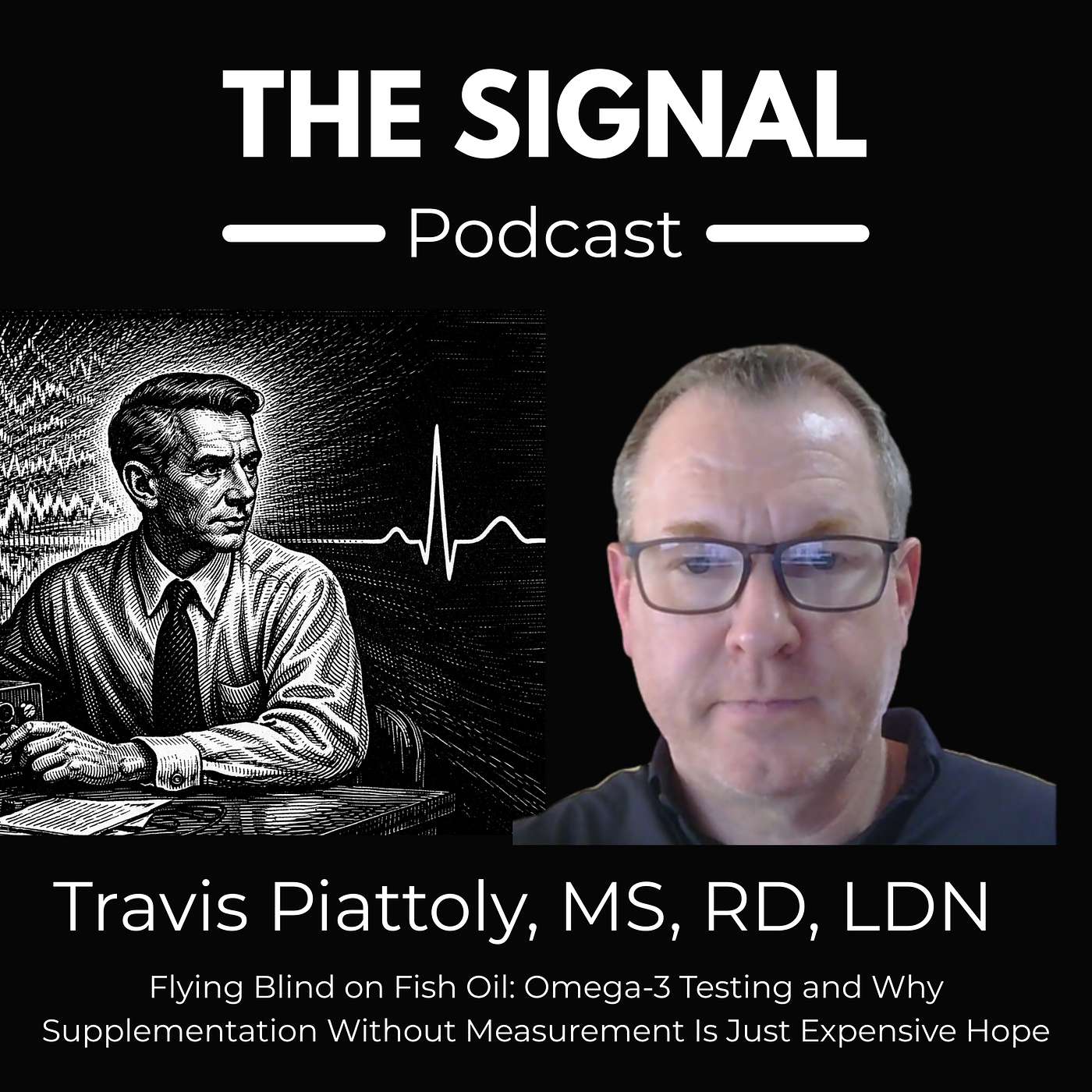
Flying Blind on Fish Oil: Omega-3 Testing and Why Supplementation Without Measurement Is Just Expensive Hope
May 2100:59:39Tap to summarizeIn this episode of The Signal, host Andy Feltovich sits down with Tavis Piattoly, MS, RD, LDN— credentialed sports dietitian, veteran of the New Orleans Saints, Pelicans, and TulaneAthletics, and Director of Sales and Dietitian at OmegaQuant Analytics, home of the Omega-3Index developed by Dr. Bill Harris. The conversation opens with a confession: Andy has spentyears as a vocal critic of the fetishization of testing in health and performance — get tested andget the dopamine hit from “doing something!” instead of doing the hard things that actually movethe needle: sleep, move, eat. Tavis changed his mind. This episode is about why omega-3 isdifferent — and what to do about it.What You’ll Learn:• Why omega-3 deficiency is unlike almost every other deficiency in medicine: no signs,no symptoms, no signal — 90% of people are walking around below optimal and feelcompletely normal. The only way to know is to test.• What the Omega-3 Index actually measures: EPA and DHA as a percentage of redblood cell membrane fatty acids, why membranes specifically, and what the resultsmean• The four omega-3s — EPA, DHA, ALA, and DPA — and why only two of them move theindex. What that means if you’re relying on plant-based sources.• The omega-6 story is more complicated than social media is painting: what a studyfeeding humans highly oxidized omega-6 fats reveals about real-world peroxidation risk• Make, model, vintage: how to evaluate a fish oil supplement — triglyceride form vs. ethylester, the matrix (gel cap, blister pack, liquid), EPA-to-DHA ratios, and the GOED qualitystandard and IFOS third-party certification• Heavy metals, molecular distillation, and what the purity standards mean• The practical playbook: which OmegaQuant test to order, what the finger-prick processlooks like — tested live on video! — and how to act on the resultIf you take fish oil, have thought about taking fish oil, or have ever assumed you were probablyfine — this episode will tell you whether that assumption is worth making. The test is simple.The data point is easy to fix. The only reason not to know is that nobody told you to look. Nowyou know.Guest Links:• OmegaQuant Analytics: omegaquant.com• Tavis Piattoly / MySportsDietitian: mysportsd.com
Transcribe →
Protein Is Not Protein: Amino Acids, the Starck Factor, and What Your Body Actually Does With What You Eat
Apr 2901:11:02Tap to summarizeIn this episode of The Signal, host Andy Feltovich sits down with Dr. Carlene Starck — proteinbiochemist, metabolic nutrition scientist, and founder of Starck Science. Carlene holds a PhD inBiochemistry from Massey University, spent her postdoctoral years at the Hospital for SickChildren in Toronto, and trained under two of the giants of protein metabolism research:Professor Paul Moen and Dr. Robert Wolfe. She recently published a landmark factorial modelof amino acid requirements in the Journal of Nutrition — a paper nine years in the making. Thisconversation starts with a provocation: the gram of protein you ate and the gram of protein yourbody used are not the same thing. And most of what you think you know about protein qualitystops exactly where the interesting science begins.What You’ll Learn:• Why protein quality scores like DIAAS are a useful step — and where they stop tellingthe story: first-pass metabolism, liver handling, and what ‘utilization’ actually meansbeyond the gut wall• The Starck Factor: the practical conversion rate between essential amino acidsupplements and whole protein targets — and why the ratio is not 1:1• Glycine — the smallest amino acid and the most overlooked: why the factorial modelfound it may have the largest obligatory losses of any amino acid, including the essentialones, and what that means for glutathione production, methylation, and the real reasoncollagen supplementation might actually work• How amino acids build more than muscle: tryptophan, tyrosine, serotonin, dopamine,and the cognitive case for protein that nobody is making loudly enough• Why catabolism is just as important as anabolism — and why resistance training’s mostimportant job may be the constant remodeling and quality control it runs on your body’sentire protein inventory• The plant vs. animal protein debate, stripped of ideology: what the science actuallyshows about digestibility, amino acid composition, and why ‘you can get everything fromplants’ is true — with an asterisk that matters• Fiber: what it actually does (digestive health, gut lining integrity, short-chain fatty acids),what it doesn’t do (the observational associations are heavily confounded), and whyfibermaxxing may be solving the wrong problem• Bioactives and phytonutrients — the final frontier: why the colors of your vegetables aretelling you something, why isolating them tends to fail the same way isolatingantioxidants did, and why the answer keeps coming back to the whole food• The politics of protein: why a landmark model took nine years to publish, howinstitutional inertia keeps outdated requirements in place, and what actually has tochange for the science to catch up with the evidenceIf you’ve ever tracked protein grams without asking what your body does with them — orwondered whether the plant-based protein on your shelf is doing what the label implies — thisepisode will change how you think about the question. The science is more complicated thanthe guidelines. It’s also more actionable.Guest Links:Starck Science: starckscience.comLinkedIn: https://www.linkedin.com/in/drcarlenestarck/
Transcribe →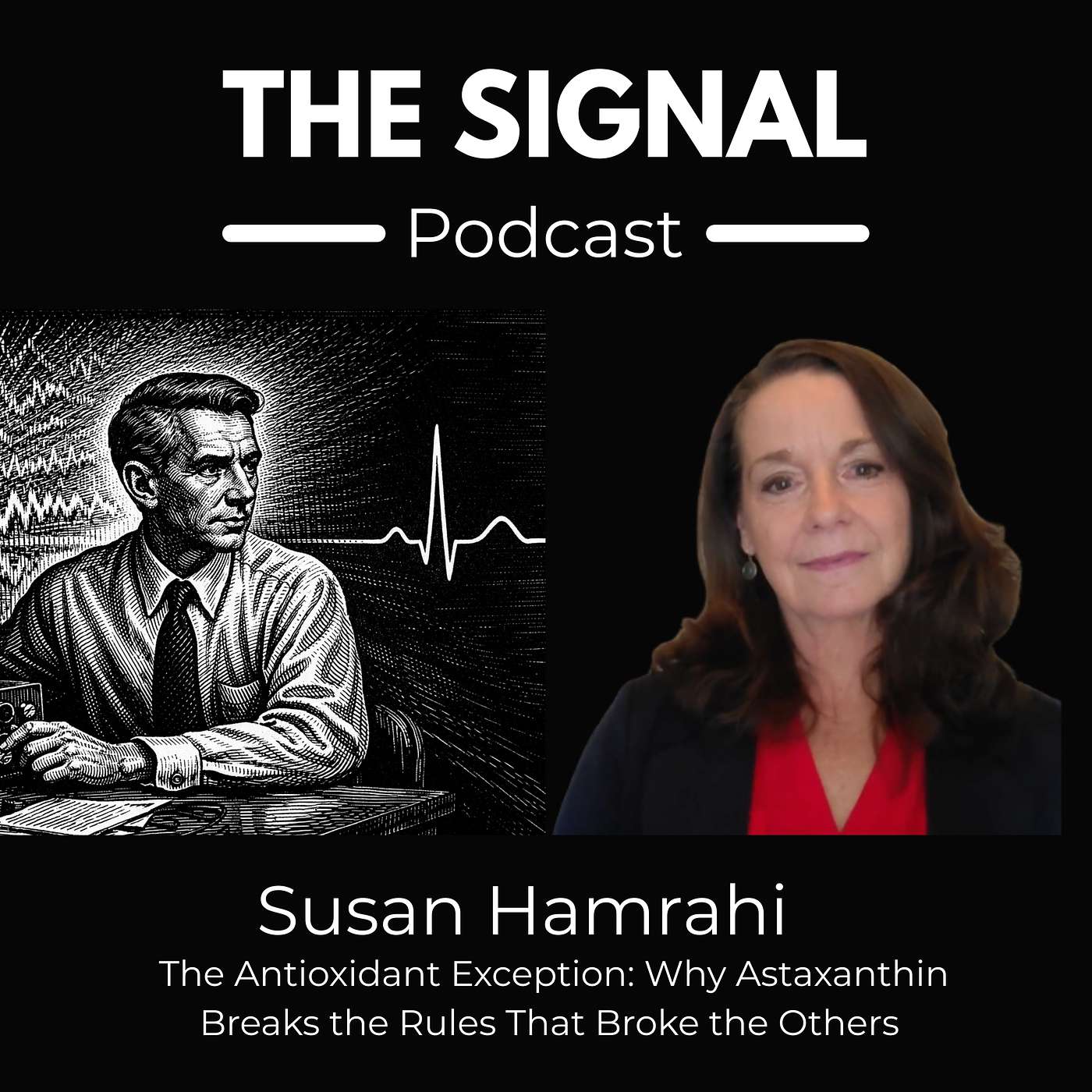
The Antioxidant Exception: Why Astaxanthin Breaks the Rules That Broke the Others
Apr 2000:44:21Tap to summarizeIn this episode of The Signal, host Andy Feltovich sits down with Susan Hamrahi, ND — naturopathic doctor and Scientific Communications Specialist at AstaReal, Inc., the world's leading producer of natural astaxanthin. The conversation opens with a confession: Andy rolled his eyes when he first saw Susan's presentation at the International Society of Sports Nutrition. He'd been down this road before. Identify an antioxidant that looks miraculous in observational data, isolate it, supplement it, watch it fail — or worse, cause harm. Some of those trials had to be stopped early. Susan convinced him this time is different. This conversation is about why — and what it means for every high-performing man trying to recover faster, stay sharper, and not get sold another miracle that isn't. What You'll Learn: The salmon story: how a fish that stops eating, swims 900 miles upstream, and leaps seven feet in the air to spawn became the origin of thirty-five years of astaxanthin research Why astaxanthin appears to thread the needle every other antioxidant failed — knocking out pathological oxidative stress while leaving the adaptive signaling your muscles need to grow intact What astaxanthin means for delayed-onset muscle soreness (DOMS) What a firefighter fire ground test reveals about astaxanthin and stress physiology The aerobic and endurance findings: fat oxidation, carbohydrate sparing Early cognitive performance data: faster working memory, faster recall, faster reaction time How astaxanthin crosses both the blood-brain barrier and the blood-retinal barrier — and what that could means for eye health and cognitive performance Product integrity: how AstaReal grows astaxanthin indoors and third-party testing What it means that the International Society of Sports Nutrition (ISSN) included astaxanthin in its position statement If you train hard, recover imperfectly, manage high-stakes stress daily, or have ever wondered whether the antioxidant aisle has anything worth your time — this episode gives you the evidence to decide for yourself. The science is still maturing. But the signal is real. Guest Links: AstaReal USA (research, blog, newsletter): astarealusa.com Consumer product finder: astaxanthin.net
Transcribe →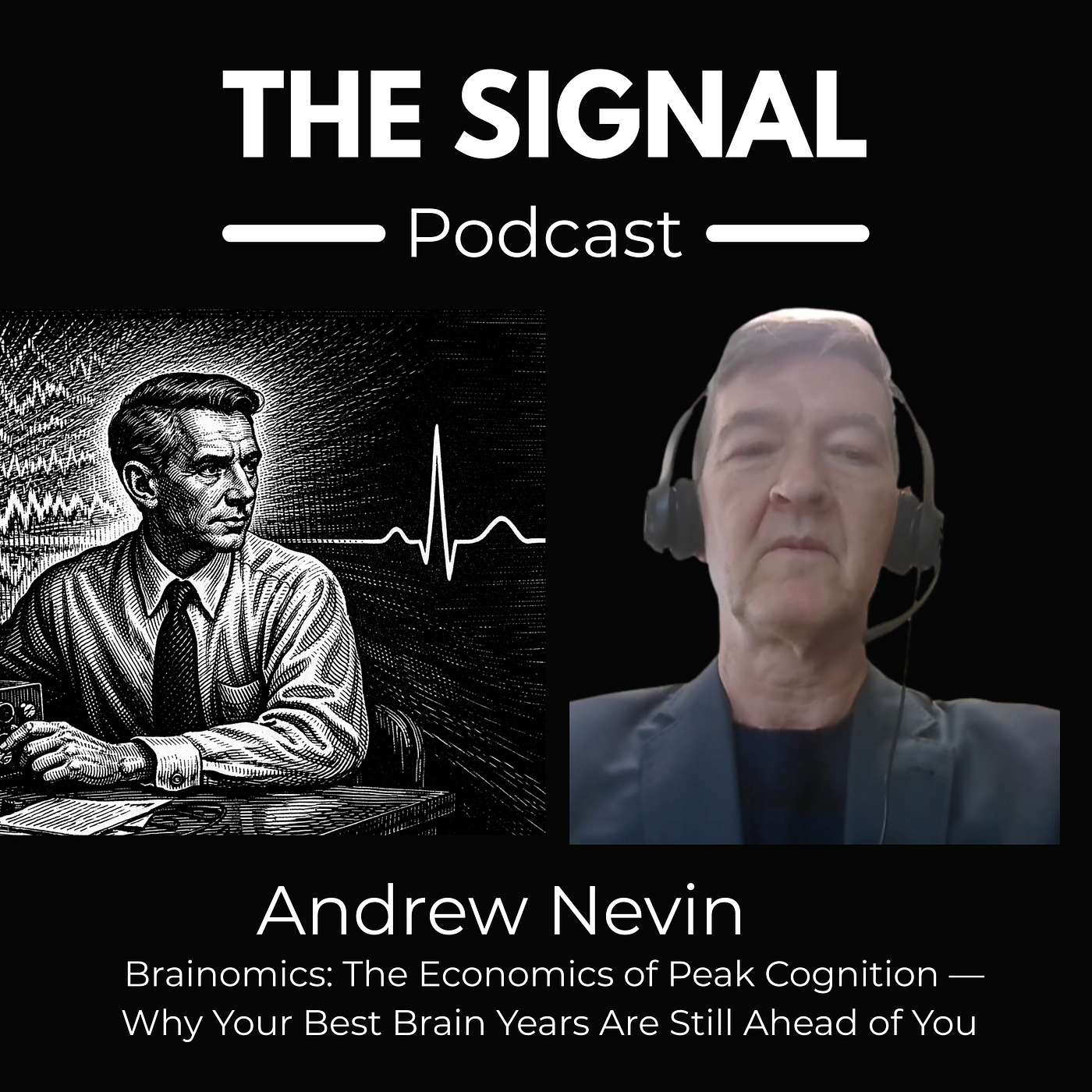
Brainomics: The Economics of Peak Cognition — Why Your Best Brain Years Are Still Ahead of You
Apr 1300:54:53Tap to summarizeIn this episode of The Signal, host Andy Feltovich sits down with Andrew Nevin — Research Professor and Inaugural Director of the Brainomics Venture at the Center for BrainHealth at the University of Texas at Dallas, Harvard PhD economist, Oxford Rhodes Scholar, and 36-year veteran of McKinsey, private equity, and global strategy consulting. This conversation starts where most brain health conversations are afraid to go: the flawed economic theory underlying how we think about human decisions, and what happens when neuroscience blows that model up. Nevin doesn't traffic in supplements or shortcuts. He traffics in the architecture of the brain — and the hard truth that you are the only one who can build it. What You'll Learn: Why the utility theory you learned in Econ 101 is incomplete — and what neuroscience reveals about where preferences actually come from Why cognitive peak at 40 is a myth, what actually changes with age, and why you need t to mix up your brain training: "rote is rot" The Zoom In, Zoom Out, Zoom Deep and Wide framework — and why you don't need specialized “brain apps” or exercises, just a better way of engaging with mental challenges you already have Brain breaks, prioritizing (elephants vs. rabbits), and why your organization is probably scheduling meetings during your most valuable cognitive hours What actually moves the needle: the hierarchy of interventions from cognition training to sleep to movement to connectedness — and why there's no pill at the top of that list The Brain Health Index: what 22 dimensions across clarity, emotional balance, and connectedness actually measure — and why the best outcome is when you no longer need the test Why age-appropriate neuroscience in schools — from age three through the workforce — is the highest-ROI public policy intervention nobody is talking about If you lead a team, manage your own performance, or have ever wondered whether the app, the nootropic, or the wearable is actually doing anything — this episode will give you the framework to answer that question yourself. Agency is the point. Your brain health is your responsibility. Guest Links: Center for BrainHealth: brainhealth.utdallas.edu Brain Health Project (free Brain Health Index + coaching): join at brainhealth.utdallas.edu
Transcribe →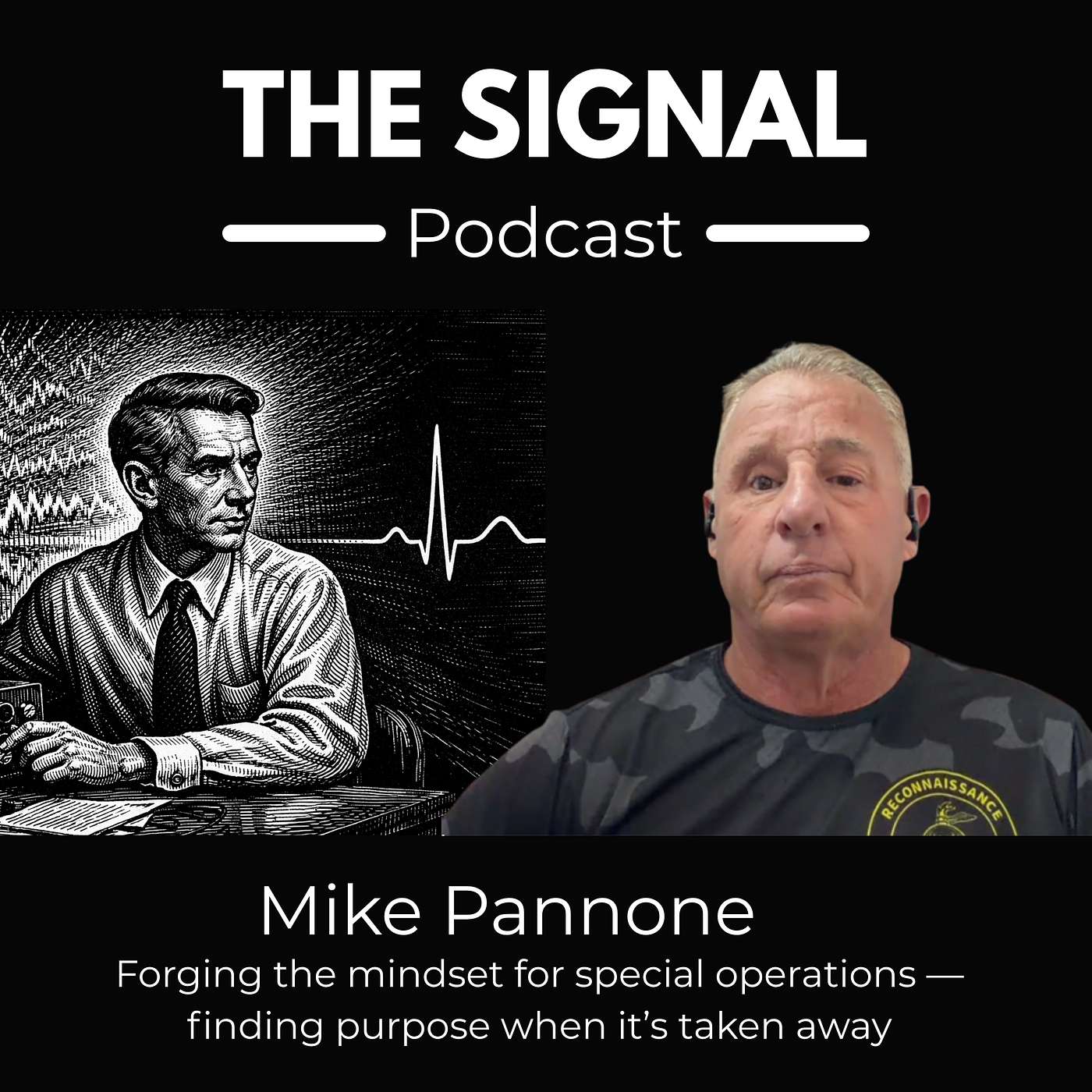
Forging the Mindset for Special Operations--Finding Meaning When Tragedy Takes It Away
Apr 601:00:31Tap to summarizeIn this episode of The Signal, host Andy Feltovich sits down with Mike Panonne — founder and head instructor of CTT Solutions, former Recon Marine, Army Special Forces operator, and member of 1st Special Forces Operational Detachment-Delta.This conversation covers the oldest questions in recorded history: what leadership actually demands, how culture is built and destroyed, and what happens to a man when everything he has built is taken from him in a millisecond.Panonne doesn't traffic in motivation. He traffics in standards — and the difference between the two is the entire point. What You'll Learn:What three elite special operations selection processes are actually looking for — and why the answer isn't who you thinkWhy culture lives and dies at the top: leadership by example, not leadership by exemptionWhat the jungle teaches you about mindset that no classroom ever will64 fractures, one eye, 141 pounds: how a man rebuilds identity and purpose after losing everything that defined himWhy motivational retreats are "serving you soda and telling you it's a protein drink" — and what actually worksThe neuroscience behind an ancient truth: you cannot achieve what you cannot first see and feelIf you lead a team, are building something difficult, or have ever had to pick yourself up off the floor and figure out what comes next — this episode will give you the language for what you already know.Mike is also active in the Marine Reconnaissance Foundation, a national 501(c)(3) nonprofit that provides financial assistance to wounded Reconnaissance Marines and Special Amphibious Reconnaissance Corpsmen (SARCs), supports families of those killed in service, and funds educational opportunities for their children.501(c)(3) and IRS 990 filings confirm that the Marine Reconnaissance Foundation reports no executive compensation or professional fundraising fees, meaning more of your donations go directly to injured Recon Marines, SARCs, and their families.501(c)(3) filing: https://apps.irs.gov/app/eos/ (search EIN 46-3009425)IRS 990: https://projects.propublica.org/nonprofits/organizations/463009425Guest Links:Instagram: @CTTSolutionsLLC [verify]Website: cttsolutions.com
Transcribe →The Truth About “Third-Party Testing” — THE Biggest Blind Spot in the Industry
Jan 2600:56:21Tap to summarizeIn this episode of Orthodox Apostasy, host Andy Feltovich sits down with Andy Holmes, Business Development Manager at LGC Group—the organization behind Informed Choice®, Informed Sport®, and Informed Protein®, widely regarded as the gold standards in independent supplement testing.This conversation tackles one of the most misunderstood phrases in health and performance: “third-party tested.” What does it actually mean? What does it not mean? And why do those distinctions matter far more than most consumers—and even professionals—realize?With nearly a decade inside LGC and experience working with professional sports leagues, the NCAA, and the U.S. Department of Defense, Holmes pulls back the curtain on how supplements are really evaluated, where contamination actually occurs, and why testing rigor—not marketing language—is what protects athletes, operators, and everyday consumers.🔻 What You’ll Learn:Why Good Manufacturing Practices are just a start—and why banned-substance testing exists at allYour protein might be tested for contaminants—but is it tested to ensure it actually contains protein? You’d be surprisedWhy testing lab details matter: compound-specific certification, parts per million vs. parts per billionHow contamination often occurs after manufacturing—and why blind, ongoing lot testing existsWhy “third-party tested” has become one of the most misleading claims in the supplement industryIf you care about supplement safety, athlete liability, or separating real quality assurance from marketing theater, this episode will permanently change how you read labels—and who you trust.Guest Link:https://www.wetestyoutrust.com/
Transcribe →Regeneration Rising: How Deanna Kanaman Is Redefining Accessible Wellness
Oct 1900:37:16Tap to summarizeIn this episode of Orthodox Apostasy, host Andy Feltovich sits down with Deanna Kanaman, Founder & CEO of NeoWell, a regenerative medicine and aesthetics company that’s reshaping how wellness professionals—and their patients—heal.A former banking executive turned wellness entrepreneur, Deanna’s story is a masterclass in courage, reinvention, and mission-led business. Through NeoWell, she’s empowering nurses, NPs, and PAs with the tools, training, and confidence to bring regenerative therapies to more people—without the gatekeeping or price tags that often accompany innovation.🔻 What You’ll Learn: • What regenerative medicine really is—and why it’s often misunderstood • How NeoWell bridges innovation with purpose through provider education and product access • The biggest misconceptions about PRP, exosomes, and “stem cell” therapies • Why ethics, SOPs, and quality control define the next era of regenerative medicine • How Deanna’s decade in banking shaped her leadership style (and why she left it behind) • The challenges of FDA oversight, insurance exclusions, and the patchwork of state regulations • Why consistency and transparency—not hype—build lasting patient trust • How NeoWell empowers clinicians to create both impact and income👩⚕️ Guest Links: 🌐 NeoWell.com — Learn more about regenerative medicine and training opportunities 📲 Connect with Deanna Kanaman on LinkedIn: linkedin.com/in/deannakanaman 📸 Instagram: @Neo.wellIf you’ve ever wondered where wellness ends and true regeneration begins—this conversation will change the way you think about healing, leadership, and purpose.
Transcribe →Sleep as a Superpower: Optimizing Rest, Wakefulness, and Longevity with Dr. Muhammad Usama
Sep 300:55:56Tap to summarizeIn this episode of Orthodox Apostasy, host Andy Feltovich welcomes Dr. Muhammad Usama — dual-board-certified sleep and wake physician, educator, and thought leader at the intersection of clinical sleep medicine, health tech, and innovation.They trace the evolution of sleep medicine from its infancy to the present, break down practical strategies for optimizing sleep, and explore the societal, economic, and safety consequences of chronic sleep deprivation. Dr. Usama shares red flags for when to seek medical help, debunks common myths, and discusses how to integrate wearables without becoming obsessed with the numbers.What You’ll Learn:How Dr. Usama’s residency led him to sleep medicine — the epiphany that many cardiovascular, metabolic, and neurological disorders had a common root cause — sleep!How the totality of sleep knowledge went from one book in 1939 — to 5,000+ new studies per year todayThe “three pillars” of sleep health — quantity, quality, and timing — and actionable steps to optimize eachRed flags for when to seek medical guidanceThe pitfalls of DIY diagnosis and treatment — how melatonin can backfire and how OTC sleep aids could contribute to Alzheimer’sThe price of poor sleep — $400 billion in annual economic losses!Public policy changes that work — later school start times and workplace flexibilityWearables as trend trackers — not diagnostic tools — and the law of unintended consequences: how obsessing over sleep data can cause… insomnia! (a specific form thereof called orthosomnia)Sleep as a skill — children as sleep geniuses — and how they morph into their sleep-dunce parentsSleep myths busted: why you can’t truly catch up on sleep over the weekend, and why “I’ll sleep when I’m dead” is a fast track to — deathBook and resource recommendations:Why We Sleep — https://amzn.to/41ygmWqSay Good Night to Insomnia — https://amzn.to/3HGmqFBSapiens — https://amzn.to/4lXavkIGuest Links:LinkedIn: https://www.linkedin.com/in/sleepwarriormd/ — for regular insights, clinical perspectives, and sleep innovation updatesMedium: https://medium.com/@Muhammad-Usama-MD-FACP — articles on sleep disorders, brain health, and digital healthcare innovationIf you’re a professional struggling with fatigue, burnout, or poor performance despite “doing all the right things,” this episode will give you the science, strategies, and mindset shifts to make sleep your most powerful performance enhancer.
Transcribe →Beyond Hydration: Disrupting Electrolytes with Gary Kleinman
Aug 2200:29:49Tap to summarizeIn this episode of Orthodox Apostasy, host Andy Feltovich sits down with Gary Kleinman, founder and CEO of Electrolyte Boost — a company reinventing one of the most basic sports nutrition categories. Designed initially for gamers, the product now serves diverse audiences from surgeons to fighter pilots — anyone who needs functional hydration without the bathroom breaks.They discuss how Electrolyte Boost starts where competitors stop, building on hydration with an added “hero ingredient”: Cognizin® citicoline for improved mental performance. The biggest innovation by far, though, is the delivery system: Waterless Delivery Technology™. In the tradition of "if I can dream it — you can do it," Gary shares how he partnered with the Founding Mother of sports nutrition and current Chief Science Officer of Electrolyte Boost, Dr. Susan Kleiner, to achieve the heretofore impossible: a waterless electrolyte delivery solution.🔻 What You’ll Learn: • How Waterless Delivery Technology™ works — and why it’s not just for minimizing potty breaks • The role of Cognizin® citicoline in boosting attention, memory, and focus — and why choline supplementation matters • Why third-party testing is critical in sports nutrition • Surprising real-world use cases — from POTS patients to truck drivers, disaster relief workers, and elite military units • Entrepreneurship lessons — owning your mission, resisting cost-cutting compromises, and getting comfortable with risk👨🏫 Guest Links: 💻 ElectrolyteBoost.com — Learn more about the science and shop products 📧 gary@electrolyteboost.com — Direct email to Gary KleinmanIf you think electrolytes are “just rocks you get off the ground”, this episode might change your mind — and show you how innovation can emerge from unexpected places.
Transcribe →