← The Speed of Culture Podcast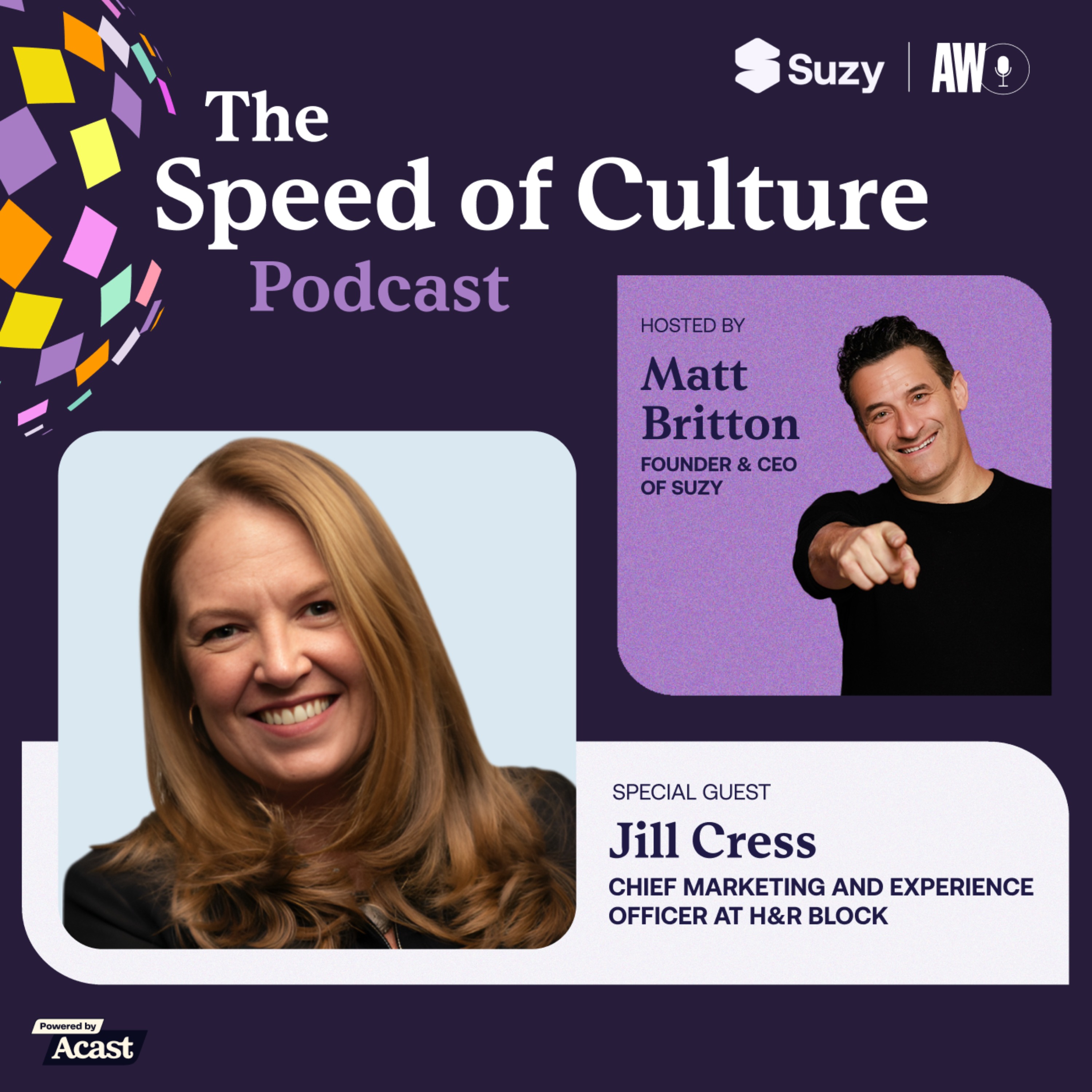
The Speed of Culture Podcast
Beyond April 15: How H&R Block’s Year-Round Strategy is Changing Tax Filing with Chief Marketing & Experience Officer Jill Cress
00:31:01
Loading summary
Transcript87 lines
- [00:00]
LinkedIn Advertiser
Does it ever feel like you're a marketing professional just speaking into the void? Well, with LinkedIn ads, you can know you're reaching the right decision makers. You can even target buyers by job title, industry, company seniority, skills. Wait, did I say job title yet? Get started today and see how you can avoid the void and reach the right buyers with LinkedIn ads. We'll even give you a $100 credit on your next campaign. Get started at LinkedIn.com results terms and conditions apply.
- [00:30]
Instacart Advertiser
If you're a parent or share a fridge with someone. Instacart is about to make grocery shopping so much easier because with family carts, you can share a cart with your partner and each add the items you want, since between the two of you, odds are you'll both remember everything you need. And this way, you'll never have to eat milkless cereal again. So minimize the stress of the weekly shop with family carts. Download the Instacart app and get delivery in as fast as 30 minutes. Plus enjoy $0 delivery fees on your first 3 orders. Service fees app for 3 orders in 14 days excludes restaurants.
- [01:10]
Jill Kress
Gen Z has 30% more purchasing power than previous generations had when they were their age. And so I think that is a really interesting connection to the thing we just talked about, which is risk and how they think about using that purchasing power to engage in the things that excite them and what they want to spend their time and money on.
- [01:32]
Matt Britton
To thrive in a rapidly evolving landscape, brands must move at an ever increasing pace. I'm Matt Britton, founder and CEO of susee. Join me and key industry leaders as we dive deep into the shifting consumer trends within their industry, why it matters now, and how you can keep up. Welcome to the Speed of Culture. We are live in New York and up today. I am thrilled to welcome the Speed to Culture podcast Jill Kress, who's a Chief Marketing and Experience Officer at H and R Block. You may remember Jill is back with us in May 2024, and a lot, I'm sure, has happened in Jill's world. Jill, it's so great to see you.
- [02:10]
Jill Kress
Great to see you too, Matt.
- [02:11]
Matt Britton
Absolutely.
- [02:12]
Jill Kress
Having me back.
- [02:12]
Matt Britton
Absolutely. So start of the year 2025, and for you and H and R Block, that means one thing. Prep for tax season.
- [02:19]
Jill Kress
We are in it. It's go time. It's our Super Bowl. It's the quarter for us.
- [02:24]
Matt Britton
So walk me through what that means for your organization in terms of how you plan, how this year is different than past years. Given all the changes that we've seen both a new administration coming in, which obviously has looming changes in tax law, as well as all the evolution we see in AI in 2024. What does that mean for your business you plan for this year?
- [02:43]
Jill Kress
Yeah, it's such a fascinating category. As someone who is a marketer, 150 million Americans must take an action by a certain date. And that's a really interesting dynamic. I've worked spent years working in financial services at MasterCard and Venmo. No one has to download the Venmo app. Right. Every American who has to pay taxes has to do it by April 15th. So it's a really fascinating sprint from January 1st to April 15th to reintroduce the brand into the category and to capture as much demand as we possibly can by bringing the work that we do grounded in our purpose, which is to provide help and inspire confidence around this really daunting and dare I say, taxing moment for most Americans. And so many people will ask me, well, do you just turn out the lights and go home in April or May and wait for tax season to fire up? It's not like that anymore. Maybe it was back in the day. We've been at this for 70 years. But it really is understanding who is the audience, how do we compete, how do we bring our differentiation to like and how do we really think about that through the lens of the experiences that we provide in tax season to make sure that we're ready when it starts.
- [03:49]
Matt Britton
Now, given the legacy and history of the HR Block brand, how much of your go to market strategy in the period between January and April is just about top of mind awareness versus driving promotional activity to get consumers to drive more engagement, to make sure that you're capturing data or action to ultimately drive growth and new people into the portfolio.
- [04:09]
Jill Kress
Yeah, get people into the brand. So we're in, you know, we're in a fortunate position in that our awareness is really high. Most people know of H and R Block. We have a little bit of a challenge in that many, many people associate H and R Block with our very extensive retail location. We've got 9,000 locations and 60,000 humans who provide expertise to Americans around this moment. And so a lot of what we think about is, you mentioned AI. What is the role of AI in the experience, in making our experience more digital, thinking about the transformation that plays out there. And so we really try to understand who is our audience and, and what matters to them. For many Americans, time and convenience ease really matters. So really leaning into those things, price, value, expertise, it is As I said, a very daunting moment for many Americans. And they want to make sure they get their best possible outcome. I'd love to just hit on how we think about those customers through the lens of the experience that we design. And that's really what we're working on, is how can we understand the audience and what jobs we're doing for them. And so there are 150 million Americans that pay taxes every year. About half of those want to do it themselves. And it's interesting to understand why. Generally, it's because they feel that no one is going to care more about the outcome, the financial outcome. Most Americans, 70% get a refund. So they don't think that anyone's going to care as much about that outcome as they will.
- [05:38]
Matt Britton
Right.
- [05:38]
Jill Kress
They really want to care.
- [05:39]
Matt Britton
They want to take care of their own hands.
- [05:40]
Jill Kress
That's right, absolutely. And get that refund. The other mindset around those who do it themselves is cost. They just can't afford to have someone do their taxes for them. And so they're using DIY solutions, which we have an incredible DIY experience. And as AI was presenting the opportunity to leverage large language models, we thought about the opportunity that we had to democratize our expertise. How do we take everything that we know about the tax code? Here's a doozy. The tax code has 10,000 sections, and each of those sections can have up to 174 pages. So like, you know, wow, like, do the math on that. And we've been doing this for 70 years, so we've got a corpus of knowledge to really understand what that means and how that does result in the best outcome. So last year when we went to market, we introduced a new AI Tax assist, which really solved for the most commonly asked questions. And we embedded that into the DIY experience. Here's why that matters and why it's such a game changer. Because for many consumers, they're doing their taxes at really odd hours of the day. People like they're busy. They're like part of the gig economy. They're hustling. They're really trying to find time to do their taxes. And we look at when people are logging into the product, it can be at midnight, it can be at 4 in the morning, it can be at 5 in the morning before they get the kids to school. And when they get stuck, that's not a great experience. And they get stuck because they have a question and they want to make sure they're getting it right. So embedding AI into The experience was a game changer.
- [07:07]
Matt Britton
Is it like a copilot? So they're going through the DIY software and there's kind of like something on the side which they can ask questions, or is that the core experience?
- [07:14]
Jill Kress
It is like a copilot. I mean, we've had, you know, kind of old AI chat, which is still there, but this is, you know, true conversational AI around some of these questions. So you're in the product, you can go to chat, you can go into the AI tax assist, and if you ever want live human help, that's something that really differentiates us, is you can do that at any point in the experience for no additional charge if live human help is available, which isn't always the case at forum the morning.
- [07:38]
Matt Britton
Right. And so you said that there's a big percentage of doing diy and the other percentage, I would imagine, still comes in your office the old fashioned way. So to speaks and has interactions with your team of people across the country.
- [07:49]
Jill Kress
Yeah. So again, 60,000 experts across the US, 9,000 locations. It's pretty massive. I think Walmart has less than 5,000. I think that puts us in the territory of big fast food brands like Burger King. Right. We are within five miles of most Americans. And so for Americans who again, really want to look someone in the eye and ask questions and make sure they're getting every credit, every deduction to maximize that outcome and learning about changes in their situation, maybe they got married, maybe they bought a house or sold a house like I did this year, and they really want to have that personal consultation. They will come into the office. We also have an amazing suite of virtual tools so that people can have a hybrid experience. You can download your documents into an app and get started that way and actually never have to meet face to face with a human being. But you get all that human expertise.
- [08:41]
Matt Britton
So on the DIY experience where you have this kind of traditional software, when do you see those experiences kind of merging together? Where the online DIY form of filing your taxes is just a chatbot is just something. It's a chatbot asking you information, you're pulling it together and it's doing everything in the background. Like, how far are we away from that reality?
- [09:02]
Jill Kress
Yeah, I mean, it's an interesting question. I think the most important thing for us is like, how can we make this experience easier for our clients? And so exploring things like what is the role of document capture to help accelerate and take the pain out of that experience is certainly something that we think about.
- [09:19]
Matt Britton
Yeah. And I Guess as technology evolves, it's only going to get better, only going to be more seamless for the consumer.
- [09:24]
Jill Kress
That's right. And we already have the ability to pull things. We do pull things forward from the prior year. If you filed with us, you really get a jump start and we'll ask questions, have things changed, what's new? And so it is really about getting people in and out of the product, giving them a lot of confidence while they're there. But they want it to be easy and they want it to be simple.
- [09:43]
Matt Britton
Sure.
- [09:43]
Jill Kress
Technology is a big part of continuing to think about our roadmap and how we can do more for the client to improve their satisfaction and make it easy and make them feel really great about that outcome.
- [09:54]
Matt Britton
Yeah, I know a big part of your role, Jill, is also continually having your finger in the pulse of the consumer.
- [10:00]
Jill Kress
Yeah.
- [10:00]
Matt Britton
Because obviously taxes is sort of a mirror to consumers life in terms of how they're feeling about the economy, their spending, their job security, etc. And with that you had an initiative last year called the Outlook on American Life where you basically dug deep into the consumer. I'd love to hear about that project and what some of the findings were.
- [10:18]
Jill Kress
Yeah, we love Outlook on American Life because it gives us an opportunity to really take that front row seat that we have into tens of millions of Americans and get a sense as to what is on their mind and how they think about their relationship with money, finances and how that impacts their decisions. And this was our third year of doing Outlook on American Life and it was our most robust effort. It's kind of like our version of Spotify wrapped like what's on the minds of consumers and a couple things like it matters. We want to understand, well how does that impact how we think about our experience, like what are consumers looking for? And some interesting things came out of that, which is there's a general sense of financial optimism from Gen Z in particular. Gen Z is really important to us because they are one of the only big new entrants into this category every year. And so for example, like income is outpacing inflation for that demographic, so they feel generally optimistic about their financial future. Debt is the thing that's looming over them. But their confidence in being able to earn and weave together income through things like the gig economy gives them a lot of optimism.
- [11:31]
Matt Britton
When you say debt, you mean student loan debt?
- [11:32]
Jill Kress
Primarily credit card debt. Installment debt, like debt of all kinds is something that's looming not only on the minds of Gen Z, but on Americans overall. I think That's a bigger concern for most Americans than is kind of the current state of their wages and inflation.
- [11:48]
Matt Britton
Personally, credit card debt past a trillion dollars for the first time ever last year. And I think Gen Z has a risk on behavior with capital. We saw it during the pandemic where all this fiscal stimulus came in and you saw the boom of crypto and NFTs and GameStop stuff, all these things. It's like baby boomers had the complete opposite relationship of money. Theirs was one of scarcity. They grew up with parents during the Great Depression and World War II and many of them just held on their money very tightly. Yeah, but Gen Z is the polar opposite. Where when they get, and we're seeing this with the boom, sports, gambling right now as well and so many other things. What is your take overall? Not from nature on block, when necessarily, but just as somebody who's an ardent student of consumer behavior, what that overall kind of risk on attitude with money means for the future of the consumer? Because I think a lot about that.
- [12:38]
Jill Kress
Yeah, I mean I think it's such an interesting contradiction, especially as boomers go out of the workforce. I think they're about 15% of the workforce today. Gen Z's like encroaching on 13, so 13% of the American labor force. So they're going to be more dominant than.
- [12:51]
Matt Britton
And the wealth transfers can be coming from the boomers this generation.
- [12:54]
Jill Kress
Yeah.
- [12:55]
Matt Britton
Trillions of dollars of wealth transfers coming in.
- [12:57]
Jill Kress
Yeah, absolutely. And so I think we think about, well how do we give them more confidence? They do want more financial health. We launched a mobile banking app which is our Spruce mobile banking app product. And really ensuring that that is working hard to provide values, discounts, deals, helping them to learn how important it is for their dollars to go further. But yeah, I think, you know, it is definitely a less risk averse mindset. And so I think having the tools to help them understand what that means. Crypto is a great example, like the tax consequences of what it means to sell crypto are big. And so we look at that and think about, okay, what does that mean then in the way of our solutions and how we can be helpful. And it's an interesting category as astutely pointed out. You know it's January to April 15th and it's just all systems are go during that time but taxes are a year round event. It's just that consumers don't want to think about that, think about them all year long. And so things like crypto, things about like you just had a baby, you Decided to buy a house, inserting ourselves into content to provide useful tips, what they need to know, things to consider as they navigate the tweet. They will stay awake. Yeah, exactly. Yeah.
- [14:13]
Matt Britton
So you had mentioned a couple of findings from yeah, look American. Like one of which was Gen Z optimism. What were some of the other things that you uncovered?
- [14:20]
Jill Kress
Here's what's interesting. We looked at the orientation of Gen Z today versus boomers now who were Gen Z years ago. And the impact of purchasing power is really interesting as we look at wages. So gen Z has 30% more purchasing power than previous generations had when they were their age. And so I think that is a really interesting connection to the thing we just talked about, which is risk and how they think about using that purchasing power to engage in the things that excite them and that they want to spend their time and money on.
- [14:55]
Matt Britton
Yeah, I mean, we've seen such huge drivers of consumerism across the popular discourse where you see airlines full and hotels full and just the lines around the corner. And I guess it is because they have more disposable income and the ability to buy more things. And that was something that I think many people were worried about. Will Gen Z be worse off from their parents? But it sounds like from your study and from other data that we've looked at that they are better off than maybe we would have thought. Now, I don't know how much the stimulus and Covid still had to do with it. I do think that this country still has the work cut out for it as it relates to the economy. You look at debt, you look at savings as a percentage of income and that's down. Obviously inflation is still looming. We have a lot of geopolitical issues. There's a lot. But I guess in all that there is reason to be optimistic despite that.
- [15:47]
Jill Kress
Yeah, absolutely. And I think that we think a lot about that.
- [15:50]
Matt Britton
We'll be right back with the speed of culture after a few words from our sponsors.
- [15:56]
Instacart Advertiser
If you're a parent or share a fridge with someone, Instacart is about to make grocery shopping so much easier. Because with family carts, you can share a cart with your partner and each add the items you want. Since between the two of you, odds are you'll both remember everything you need. And this way you'll never have to eat milkless cereal again. So minimize the stress of the weekly shop with family carts, download the Instacart app and get delivery in as fast as 30 minutes. Plus enjoy $0 delivery fees on your first three orders. Service fees apply for three orders in 14 days. Excludes restaurants.
- [16:31]
LinkedIn Advertiser
Does it ever feel like you're a marketing professional just speaking into the boy? Well, with LinkedIn ads, you can know you're reaching the right decision makers. You can even target buyers by job title, industry, company seniority, skills. Wait, did I say job title yet? Get started today and see how you can avoid the void and reach the right buyers with LinkedIn ads. We'll even give you a $100 credit on your next campaign. Get started at LinkedIn.com results. Terms and conditions apply.
- [17:05]
Matt Britton
So what does ongoing. You mentioned earlier just putting out content for your consumers so they're in the know. When you look at just a brand that is of value to consumers. Because taxes is something that people always want to think about. Right. So it's almost like going to the doctor.
- [17:21]
Jill Kress
Yeah.
- [17:21]
Matt Britton
Paying your taxes, blah blah, blah. But at the same time, you want to be looked at as a brand that people have a lot of heart for. And you need to engage with consumers on an ongoing basis. So when it does matter, I. E. April or March, whenever they're getting a drug, you're top of mind. So what does kind of a year round engagement plan look like for H and R Block in terms of where you're spending your efforts and your time?
- [17:41]
Jill Kress
Yeah, well, you've talked a lot about this. The attention economy is really the thing that is so important to us and understanding where that attention is. And so we've talked a lot about Gen Z. It's a big important audience for us. So social is obviously something that we invest a lot in.
- [17:58]
Matt Britton
What works in social.
- [17:59]
Jill Kress
TikTok has been like big for us and engaging in that helpful content in a way that's entertaining, built for the flip.
- [18:08]
Matt Britton
Are you using creators to create creators?
- [18:10]
Jill Kress
We think a lot about platform specificity and really meeting those audiences with the kind of content that they want to consume. We have a whole new lineup of influencers for this season. One of the things that was really fun to meet Gen Z last year was we did a piece of branded content kind of looking at what was going on in culture, which was this obsession with reality television and things like Love island and even trends and going back to a content like Survivor. And so we did a parody on a dating show last year and it was called Responsibility Island. And you know, it was like semi scripted, Semi casted. Casted, definitely semi scripted. But the premise was that these young hot singles were going to an island to play and have fun. And the twist on it was they couldn't get off the island until they did their taxes themselves. And so it was a really fun into this moment and like broaching that subject of what it means to be adulting and previous relationships with your parents and them doing your taxes and now feeling really exposed. Well, you have to do them yourselves. And we introduced AI Tax Assist into the story and it was really, really well received and had tremendous results in the way of we aired it on Roku as a native piece of content. We put it on YouTube. So really put us into culture in a really fun way with this audience and increased awareness to your point, pretty significantly with that audience. Our awareness is really high, but awareness that you can do your taxes yourself with H and R Block. Like we do have an Achilles heel of having awareness with our kind of legacy and heritage experience. And so that was a fun way for us to get more top of mind with Gen Z. And we're doing a reunion episode this week. So we'll kind of see what happened with these folks that were on our responsibility island last year and catch up with them again.
- [19:59]
Matt Britton
It's interesting as you talk through this idea is that you mentioned earlier. Taxes is one of the only things everyone has to do at a certain time, et cetera. It also is something that hits an entire class age of consumers at the same time. Meaning that all of a sudden you're of a certain age and you have to file taxes. And it's not something that necessarily kids are taught about in school either. So their parents might tell them about it or maybe they'll forget. But all of a sudden you're expected to know this whole new thing in life that you were never really taught as part of the education system.
- [20:28]
Jill Kress
That's right. I mean, you see these things that go viral on social during tax season, which is. I'm really glad that I learned about parallelogram in high school, but never learned anything about my taxes and how to think about that. And so those are perfect moments for us to jump into social and have some fun with that and think about content that goes with it. But it's true, like our fundamental education and understanding of the tax system is it's not part of the common curriculum. Yeah, that's why I think what we do is so important because it is not a topic that Americans are really confident in in many ways that kind of dread it.
- [21:02]
Matt Britton
So you talk about social media and I totally get TikTok. Another area I know that you've been playing around and going deeper is in gaming and I'd love to hear about some of the efforts you've been doing gaming specifically with Minecraft, which obviously is a hugely popular title amongst Gen Z.
- [21:17]
Jill Kress
Yes. So we love what we're doing with gaming. I mean, what's interesting is I think we all, when you hear gaming, you think Gen Z, they're definitely very much engaged in gaming of all kinds. But like more than 70% of the American population has some affiliation or association with gaming. So when we insert ourselves into gaming in a fun, entertaining way, we can certainly attract Gen Z and drive awareness in a different way. But it's a nice broad message. And so yeah, last year we did an integration in Minecraft with a bespoke character called Sir Block and we were able to do advertising around a big event that they have that happens to coincide with a big moment for us, which is the opening of E file. And it delivered again really great results. Results. Having a captive audience and getting them to see and experience H and R Block in a different way that goes, wow, that's interesting. Didn't expect to see H and R Block in Minecraft. And so it's a little bit disruptive and puts us into culture and you'll see more of that this year. We're going to be doing more with Minecraft.
- [22:15]
Matt Britton
Very cool. So Besides that, in 2025, is there anything else that you're particularly excited about as you continue to evolve the brand in all these new ways? Obviously, given the overhang of all the change, the state of the consumer right now, where you focus on in 2025.
- [22:30]
Jill Kress
It'S really on maximizing the outcome for Americans. So one of the things that we're going to do with our content is tell the stories of the services that we provide. So we have this thing called Second Look. So Americans generally are leaving billions of dollars on the table in unclaimed credits and deductions. And so for new clients that come to H and R Block, we have this thing called Second look where we will look back at your prior three year tax returns to see if your previous tax pro missed anything. We think that's a real game changer, particularly given where the consumer mindset is today, where I think more than ever every dollar really does matter, given where they are thinking about spending, inflation, debt, et cetera. So a lot of our content is going to tell the stories of things like Second Look. We have an experience in DIY which is having the ability to have a tax pro actually review the work that you've done on your own. So a lot of our storytelling is we're going to try to illuminate the value that we bring in those product benefits in fun ways, optionality for the.
- [23:33]
Matt Britton
Consumer can work with a human, they can work with diy, they can use your AI tools.
- [23:37]
Jill Kress
And that's a big part of how we transform the brand. And so to do that, our campaign Better with Block is back and we're going to tell those stories of what makes it better. We've also got something which is a price match promotion. So this industry is all about switching. It's a set market, 150 million Americans. You've got a tax guy. I had a tax guy before I came to H and R Block. So the only way for us to grow is to capture new entrants into the category like Gen Z or get people to switch.
- [24:03]
Matt Britton
Right.
- [24:04]
Jill Kress
You know, cast out. So price and value matter so much. So matching the price that you would have paid from a previous tax Pro is something that we're talking about. So all of this is part of our Better with Block campaign and just telling the stories of all the ways that we're better giving you the value that you want through price match flexibility. If you start on your own and want to work with the tax pro, getting that second look, like how great are tax pros when they do second look for a client and they find money that you didn't know you had access to from the prior three years? Like, what a great confidence, trust building moment and experience. So we're excited to tell those stories and be functional and fun because those are the things that really will matter.
- [24:44]
Matt Britton
Yeah, for sure. So shifting gears, we wrap up here. I'd love to just get your take, Joe, as CMO of an iconic brand like H and R Block. You know, it's a big job and it's one that a major brand has been bestowed on you to steward for it. And I speak to many CMOs of iconic brands as part of this podcast and I'm always fascinated to hear what they believe is the role of the CMO in this day and age. Because as I hear you talk about doing things in gaming and social and custom content and all these things, obviously the approach to being a CMO is much different than it was 20 years ago when you were running linear TV spots and some billboards. It's so multifaceted, so much you have to think about, what do you define as the role of the modern CMO today?
- [25:26]
Jill Kress
Yeah, I feel really clear on that. Our role is to drive growth through bringing in more new customers and retaining our clients. And so it all comes back. It all goes back to. Yeah, I mean, all of this only matters as long as we're delivering results and we continue to strive to do better than we did before. I love Tax Season because the performance marketer of me loves the ability to optimize and look at the trends and where the demand is and what does that mean and what's happening. Like the laws on 1099K, for example, are going to change this year, where if you're selling stuff on Facebook, Marketplace, or you've got a side hustle, you're doing dog walking and you're getting income. On Venmo, the threshold is now decreased to $5,000. So all of these people are going to have 10, 99 cases.
- [26:10]
Matt Britton
Was it before?
- [26:11]
Jill Kress
It was. I believe it was $12,000.
- [26:14]
Matt Britton
Okay.
- [26:14]
Jill Kress
And so a lot more people brings a lot more people in. And so, like, what does that mean in the way of content and storytelling? And so that is really exciting. But it only matters if we're doing a great job for our clients, giving them a great experience and driving growth. So I think modern CMOs need to have a very, very strong command on what the financial ambitions are, what are the annual targets and objectives. I spend a lot of time with the CFO on how we can optimize dollars to deliver against those. And so I think it really starts with understanding the business. Long gone are the days of relying on things like brand awareness, but it's so much impressions, but it's so much more fun to be a marketer because you can really look at a dollar invested and what is the path to purchase and how do you really insert yourself at moments which are going to not only bring consumers in from an awareness and consideration standpoint, but through to the purchase, and then think about the role, loyalty and advocacy. And so I think being a modern CMO is a great balance of really cherishing what we did for a long time, which is making great brands, but now thinking about that, not so much through storytelling, but through the experiences we provide to our clients.
- [27:24]
Matt Britton
Yeah, I'm glad you said. I think in the advertising industry, over time, the notion of business results can get lost when you talk about Cannes lions, awards and fancy cocktail parties and impressions, all these things where ultimately we are in a world where there's much more attribution and there's much more of a correlation between dollar in to dollar out, so to speak. And I do think it's a world for CMOs that are very data driven, which clearly you are, and ones that really take the heart. The mission of driving growth for business. And I think anybody who's listening to this podcast is in the marketing world should know that, yes, you need to be creative, need to understand the consumer, but you also need to understand firmly the business goals of whatever it is you're out to achieve, whether you're working for an agency or the brand, because that's what funds marketing to begin with.
- [28:08]
Jill Kress
That's right. It's all about that growth for the company. And the other thing is competition. There's more competition than ever.
- [28:14]
Matt Britton
Buyers. Dashery.
- [28:15]
Jill Kress
Yeah, I love smarting the competition. And that's where I think we love social. It's not just creating content for TikTok, but it's responding to content. It's looking at Reddit and what are people saying? And this is where content on things like 1099 or leaving money on the table allows us to insert ourselves into those actual moments where consumers have questions and we know we can be a great partner to them.
- [28:37]
Matt Britton
Yeah, for sure.
- [28:38]
Jill Kress
Yeah.
- [28:38]
Matt Britton
So finally, I mean, where are you spending your time these days? Because obviously you need to be very well versed in all these areas. You kind of have to be a jack of all trades in order to play the role that you play. How are you able to personally keep your finger on the pulse of where culture and marketing is headed? Where are you spending your time?
- [28:56]
Jill Kress
I'm very passionate about the customer, the consumer, and also other clients that are important to us. So at this time of the year, when we are in tax season, I spend a lot of time out in the field observing clients, talking to clients, talking to tax pros who deliver all of that expertise. And so I think really getting a sense of we design experiences, we try to capture attention, we ask people to book an appointment, we invite them into our office, but are they being welcomed? What is the real experience that drives customer satisfaction? So there's a lot to be gained from actually being in the field. I love spending time with other CMOs. It's hard to do in more like informal environments. And I think you, like you said, we're always at these, like cocktail parties and fancy things, but almost leveraging like using the network of so many smart people that I've had the benefit of knowing to pick their brains, particularly on things like AI. And how is that delivering better content experiences and really spending time on other brands that I admire and going through their experiences, following them on social. And so yeah, there's never a dull moment. And about how do you use my time to understand the role of experience? Observing customers being out in the wild and connecting with many smart people that I have the opportunity to know and glean really great insights from.
- [30:11]
Matt Britton
Yeah, for sure. This is a great conversation, Joe. I'm so glad that we got the chance to catch up again. As you might know, when we wrap our podcast, we always ask our guests if there's a saying or mantra that kind of helps define their professional journey. I was wondering what might come to mind for you.
- [30:25]
Jill Kress
Yeah, mine has been and continues to be, slow down to speed up. I love results. I love getting things done. And so when I was a younger, aspiring executive, I was running so fast to try and get wins on the board that I sometimes would create a lot of wake or I would be moving so fast, people didn't know how to keep up with me. And so I would hear often, you know, Jill's got this big idea, but I don't know what she wants me to do. So I still work hard on slowing down to speed up. I also think that's important based on the question that you just asked. There's so much going on and we're getting thrown so many opportunities and ideas all the time, particularly around things like AI and what a game changer it is. And so there's a tendency to just keep wanting to do more. And I love the opportunity to test, to learn, to encourage my team to take risks, to fail fast, to learn fast. But I do think this slowdown to speed up is something that's even more important in today's environment, where there are so many options for us as marketers to really be thoughtful. And so that's important because I think you have to start with, like, to what end? Like, what is this activity intended to help us, us learn? Is it something that we can scale as opposed to just trying lots of things that maybe don't have the ability to impact our business? So I have to remind myself, slow down to speed up all the time.
- [31:44]
Matt Britton
I think it makes sense, especially in the context of what you talked about earlier in terms of focusing on business results. It's very hard to improve in business results if you're not optimizing. If you're onto the next new shiny object, well, then you can never improve what you did before. And then it's really hard overall to show improvements in efficiency in driving the business results that you're trying to do with marketing.
- [32:03]
Jill Kress
Yeah, I mean, I think long gone are the days of activity. It's really. To what end is the activity delivering?
- [32:10]
Matt Britton
Absolutely. Well, again, thank you so much for joining us. It's Always great to catch up with you Jill and wishing you a great tax season for HR block and full year in 2025.
- [32:18]
Jill Kress
Thanks so much for having me, Matt. It was great to see you. Great to be here in your space. It's so cool.
- [32:22]
Matt Britton
Thank you. On behalf of Suzy Hybrid Team, thanks again to the great Jill Kress, Chief Marketing Experience Officer at HR Block, for joining us today. Be sure to subscribe, rate Review the Speed of Culture podcast and your favorite podcast platform. We're here live in New York. See you soon everyone. Take care. The Speed of Culture is brought to you by Susie as part of the Adweek Podcast Network and a Guest Creator Network. You can listen subscribe to all Adweek's podcast by visiting Adweek.com podcast to find out more about Susie, head to Susie.com and make sure to search for the Speed of Culture in Apple Podcasts, Spotify or anywhere else podcasts are found. Click follow so you don't miss out on any future episodes. On behalf of the team here at Suzy, thanks for listening.
- [33:23]
Instacart Advertiser
Forever. Change the way you sleep with the softest 100% organic cotton bedding from Boll Branch. You'll fall asleep faster wrapped in the most luxurious comfort. You'll never sleep hot again with blankets, duvets and sheets that feel breathable to sleep in. You'll experience pure comfort on night one and feel your bedding get softer with every wash. Take 20% off your first order during Bole Branch's annual spring event at BollinBranch.com with code BUTTERY Limited time Only exclusions apply. See site for details.
- [33:58]
LinkedIn Advertiser
Does it ever feel like you're a marketing professional just speaking into the void? Well, with LinkedIn ads, you can know you're reaching the right decision makers. You can even target buyers by job title industry company seniority skills. Wait, did I say job title title yet? Get started today and see how you can avoid the void and reach the right buyers with LinkedIn ads. We'll even give you a $100 credit on your next campaign. Get started at LinkedIn.com results, terms and conditions apply.