← The Speed of Culture Podcast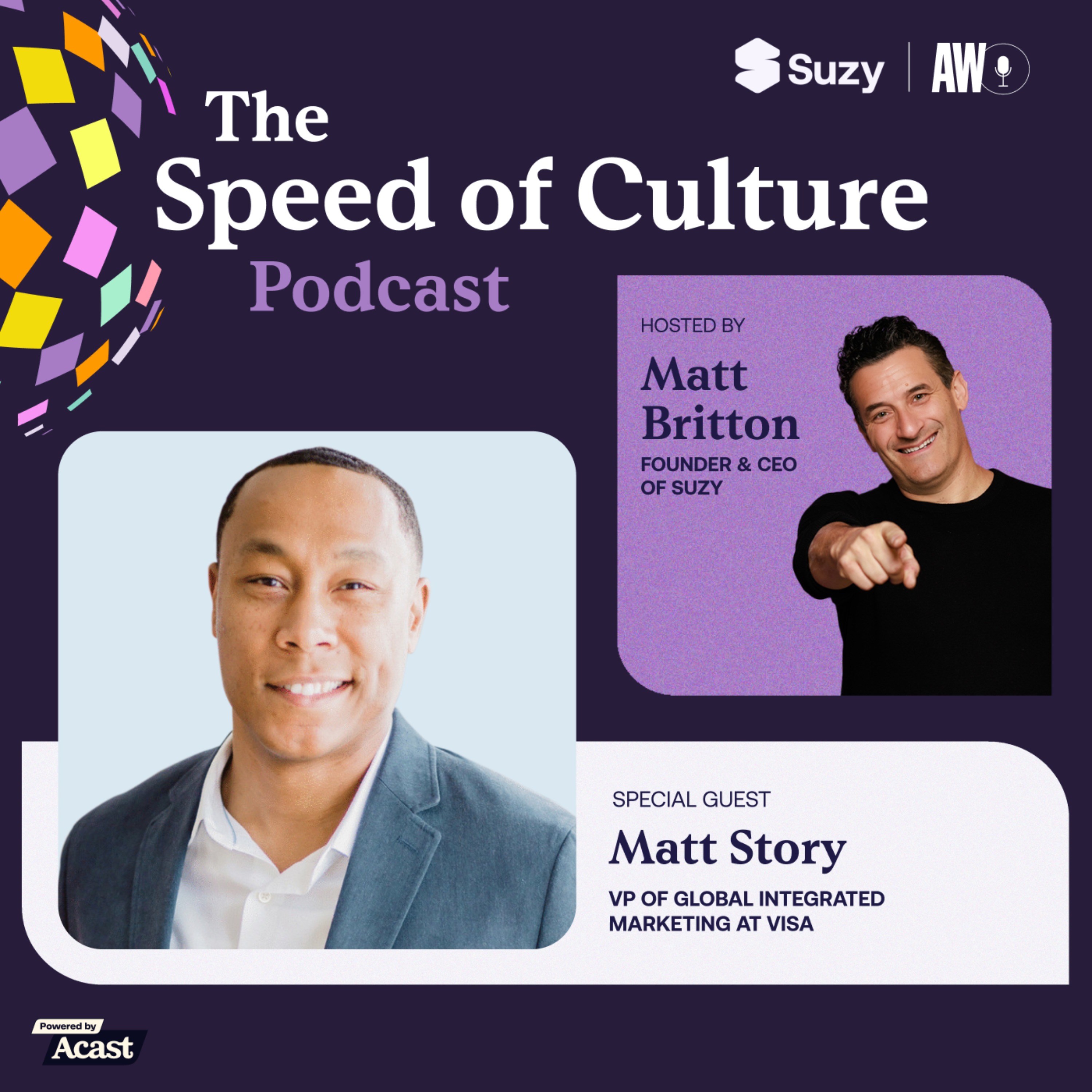
The Speed of Culture Podcast
Beyond the Swipe, Tap, Click: How Visa Is Betting on AI, Athletes, and Everyday Empowerment with Matt Story
00:30:02
Loading summary
Transcript46 lines
- [00:00]
Capital One Bank Guy
Banking with Capital One helps you keep more money in your wallet with no fees or minimums on checking accounts and no overdraft fees. Just ask the Capital One bank guy. It's pretty much all he talks about in a good way. He'd also tell you that this podcast is his favorite podcast too. Ah, really? Thanks Capital One Bank Guy. What's in your wallet? Term supply See CapitalOne.com Bank Capital One NA Member FDIC.
- [00:29]
Matt Britton
Epic Views, Waterfall mists, Summit sunsets. It's all better outside and with alltrails you can discover the best of nature.
- [00:37]
AT&T Business Narrator
With over 450000 trails around the world. Download the free app today and find your next adventure.
- [00:46]
Matt Storey
What all these technology advances are doing is it's introducing new ways for buyers and sellers to meet in ways that we've never seen before. You're having people that have never met in the real world and actually are able to transact and have commerce moments take place. And it helps to have someone like Visa that's able to ensure that that's best in class experience, most convenient, most secure, and also brings those innovations that.
- [01:07]
Matt Britton
People are expecting to thrive In a rapidly evolving landscape, brands must move at an ever increasing pace. I'm Matt Britton, Founder and CEO of susee. Join me and key industry leaders as we dive deep into the shifting consumer trends within their industry, why it matters now, and how you can keep up. Welcome to the Speed of Culture. Today we're excited to welcome Matt Storey, Vice President of Global Integrated Marketing at Visa. Matt's career lives at the intersection of storytelling, innovation and inclusive leadership, driving global brand strategies that not only shape the future of payments, but also uplift underrepresented audiences and create meaningful cultural impact. Matt, so great to see you today.
- [01:50]
Matt Storey
You too. Thanks for having me on.
- [01:52]
Matt Britton
Absolutely. Big fan, really excited to dive in. We had Frank Cooper, your cmo, on about a year ago and was telling us about all the exciting initiatives. You guys were diving into a Visa and you certainly have dived into quite amount of interesting opportunities over the past year. What are you most excited about sitting in your role right now about the future of Visa, a brand that's been around for so long but continues to reinvent itself.
- [02:18]
Matt Storey
That's a great question because it's a really exciting time to be a marketer at Visa, just given kind of the roadmap that we're about to embark on. I think if you just look at the calendar, there's so many key moments coming up for us as a brand and us as a business. You have The Winter Games that are quickly approaching in Italy and building off the excitement of what happened in Paris, looking to carry that baton, pun intended, with over 2 billion people that are going to tune in and engage in the Olympics and Paralympics. And then you have a handoff into the summer, into the FIFA World cup, which is going to be the biggest and best ever, given you have more teams participating. You've got it across three countries, 16 host cities. And so for us, it's just an exciting next year, 18 months. And so with those key moments and us having opportunity to really meet those fans where they are and hopefully provide value to their engagement with those properties, but more importantly, just their everyday life.
- [03:07]
Matt Britton
Yeah, I mean, I worked with Visa very deeply in the early 2010s, helping the brand get on social media. And I remember when I was working closely with Visa, sports were such a big part of the brand. And it sounds like it continues to with the Olympics, with FIFA, with the NFL. But how has it changed? How is activating large sports franchises and large sports leagues change over time in order for it to remain relevant with the end consumer?
- [03:32]
Matt Storey
Yeah, it's changed a lot. I would say, just to put it very bluntly, but for us, and our perspective is really trying to understand how can we think about these experiences as not just being focused on, hey, we're a sponsor, where does our logo go? But what can we do to actually enhance both the fan and, and the consumer experience? And that's both those that are attending these events live, but also those that are watching from home, that are having watch parties, that are following along even when the moments and times aren't taking place. And so for us, it's really about adding value for the athletes, the teams, the artists and the audiences. And I would say the one thing that's probably changed the most over that probably last 10 or 15 years is the intersections. And I think now we see so many intersections of sports with art, sports within to other cultural spaces like gaming, music. And that's really where there's an opportunity for us to bring the special spouse that is Visa to bear. Because we have so many relationships across those vectors that when you get those interesting intersections, I think that's really, you can really create that best in class experience.
- [04:28]
Matt Britton
Yeah, we've had on the podcast recently the CMO of the Philadelphia Eagles, of the Kansas City Chiefs, as well as the NFL, all of which said that another way the game has really evolved is in the way that the sport is consumed. Because you have, at least with the NFL, you have fantasy Football, you have gambling, you have social media clips. And I think what you're also alluding to is, like, you also get to see the athlete behind the helmet. And athletes now are their own brands and they have their own business ventures, and you get to follow them on Twitter and see what they wear when they're walking in through the tunnel. All that just creates different angles to the game, both off and on the field. And it's not so much just about the two and a half hours that the game is actually being played live on TV, but it's really about everything that surrounds it.
- [05:12]
Matt Storey
100%. We've been talking a lot about is that eye towards FIFA, this concept of the third half. And so it's like everything that happens on the pitch is amazing, and it's, like, great to be able to view and witness that. But it's almost as fun to be a fan of the sport, to think about what happens after the match, what happens when you're in the pub with your friends that you're debating what you just saw or what you're expecting to see. And again, those are the moments that we also want to bring value to, because they're as enjoyable as when you're actually engaging in the actual sport.
- [05:39]
Matt Britton
Yeah. And ultimately, sports is about stories, and the stories are about people and their achievements and their disappointments along the way and the journey of an athlete. And I think those stories are what makes us feel so relatable or make the athletes feel relatable to us. And why we talk about it in our free time and why we're so passionate about it, is that we really want to see them win. And we see a part of ourselves probably in the athlete journey.
- [06:03]
Matt Storey
100%.
- [06:04]
Matt Britton
Absolutely. So, obviously, as Visa continues to build its brand, it's also evolved its product and product evolution. And payments have been a space that's seen so much disruption over time. Obviously, there's cryptocurrency and there's the different modalities of paying. So many people right now are just tapping their iPhone when they're at the store, versus always pulling out their credit card. And then, more recently, Visa announced entirely new evolution of its product in the world of AI. So I'd love to kind of unpack where Visa is today in terms of its core business model and where you see the opportunities moving forward for growth in such a rapidly evolving space.
- [06:39]
Matt Storey
We could probably spend hours talking about all the various innovations and where the space is going, if I had to really distill it down to his most basic form it all goes back to our purpose. And we as Visa exists to be the company that uplifts everyone everywhere by being the best way to pay and be paid. So regardless of format, regardless of how you're paying, where you're paying, when you're paying, we want to ensure we're providing the best way we can pay to ensure that not only the person buying can have the best experience, but but you also got to think about the person selling and ensuring that they also have the best experience. Because what all these technology advances are doing is it's introducing new ways for buyers and sellers to meet in ways that we've never seen before. You're having people that have never met in the real world actually are able to transact and have commerce moments take place. And it helps to have someone like Visa that's able to ensure that that's best in class experience, most convenient, most secure, and also brings those innovations that people are expecting. And so I think that's really kind of what, what's at the core of it. But ultimately, as I think about it in my seat from a marketing standpoint, it's really ensuring that we're just adding value. And that value could be in the product experience, it could be in the actual, making it a little bit easier to tap, a little bit easier to get it and get out of that transaction. But it also could be, as we were talking previously, around what's the experience around that transaction? Because a lot of what I'm buying is usually a means to an end to enjoy something. So how can I add incremental value to that experience that I'm having? And then also how do I show as a brand that I'm aligned to the values you have as a person? Because as you said, there's so many choices you have on how you could actually transact and have those opportunities. And you're ultimately going to pick the brand that you feel like understands you. It understands what you're looking to do in life, it understands where you're trying to go. And so to me, that's really the special sauce of like giving those best in class experiences, but also being able to add value and show that we're aligned to the values of the end user and audiences that we're serving.
- [08:29]
Matt Britton
So let's unpack that. I mean, in terms of experiences, I'm sure you can interpret that a lot of different ways, but there's the experience of buying something, obviously, and people are buying things in store and they're buying things online and in the Past both of those modalities involved you taking your credit card out of your pocket. And now in a lot of cases, it doesn't. Like I mentioned, you tap your phone or there's like one click checkout online. So is it more challenging for Visa now that it's kind of like a payment layer versus like just about a physical product, or was it never about that? Because I think a lot of people, when they think about Visa, they think about the credit card, but I did on the inside of Visa to know enough that so much more than that. So how do you look at it? Is it a product? Is the platform, Is it both? And how does that evolve?
- [09:14]
Matt Storey
It's everything. Because it's not just about that in choice I'm making of using that particular card that whether it's represented by the physical card in store, it's represented by a digital version of that card or a token in an app or another experience that's saved card on file at a merchant. But it's really trying to understand that I'm not just getting access to that particular device, I'm actually getting access to so many other things that Visa provides. Whether that's thinking about things that we do from a risk standpoint, things we do from a security standpoint, or, you know, in those times where something goes wrong, where there's some type of mistake in the system, how do we show up and we can be there to help the end user. That's the full experience that we really think about and provide. And again, I think you're moving into a place where the ecosystem of players is so much more complex to ensuring that we're providing value to all parts of the ecosystem. Because, yes, that buyer is very important, but there's so many other people that are involved in that process that you want to ensure that they're all also receiving best in experience and the best in class, which I'm sure we'll talk about things like creators as you get into them being now basically small businesses that are providing services and products to end users.
- [10:18]
Matt Britton
Merchants, obviously.
- [10:19]
Matt Storey
Exactly. Merchants, entrepreneurs, digital partners, fintech. There's so many players that ensure they want to be able to provide and do what they do best with someone like Avisa.
- [10:28]
Matt Britton
Yeah, and we're going to get into creators in a second. I'm glad you brought that up because the media ecosystem is obviously evolving dramatically, but in the realm of AI, just curiously, like, how do you feel in the short term and also maybe medium term, because who knows about the long term, Right. We could be robots talking to each other, but at the rate we're changing right now. But will AI play in the buying process? Because a lot is being made right now about the notion of agents that are going to be doing your buying for you. I think Visa astutely has been leaning into this area of being the payment layer that powers the agentic framework, which I think is a really smart approach. What is your take on this evolution?
- [11:06]
Matt Storey
Yeah, well, you said it will be. It's already happening. I mean, you know, you even think about many of us that are using AI tools to really short circuit our purchasing process or thinking about research around a purchase we might be making, that's already happening. And I think what we're going to see is that you have more of these machine to machine interactions. It's really going to come down to how is I as a marketer ensure that I'm giving the right information that that machine can read to know to service up what it is that I'm providing. Because I think a lot of times we think about it as, yes, we're serving an end user and I need to think about what are the right words that's going to get that person to click. You're now serving a machine and they're scraping so many different sources. So really thinking about what is it the way that I can craft my message in a way that it will break through and will be served through those new interactions. I think the second thing that is really interesting is that we're going to move into a space because the AI is really speeding up these processes that there's going to be even more introduction of both trust and risk. And so we really need to understand that a single misstep we take with the machine will be very similar to a misstep we take with a consumer. Because I can then find a way that I've eroded all that equity I had with an end user because I didn't think about how to engage with that agent or that machine that's doing that scraping. And so really understanding that we need to build trust in the ecosystem across all the participants so that we remain to show up there. And then I also think about it from a marketing standpoint. We, we're going to move away from being responsible for managing campaigns. So a lot of times you think about, oh, I need to run this campaign needs to be efficient, it has these assets, I'm doing a B tests and AI is going to speed that process up for us, but we're really going to be responsible for the foundations of what the brand stands for, to ensure that that can be conveyed across those various iterations that are sped up and ensure that at the end of the day, what the brand stands for, whether it's the purpose, the values that that really comes through, all those manifestations which we'll be creating thanks to all these great AI tools.
- [13:02]
Matt Britton
Yeah, it's interesting too, because on one hand, the evolution we're seeing in AI is unlike anything we've ever seen in our career, just in terms of the rate of change, et cetera. At the same time, the future is far from evenly distributed. There are some people who still don't even use AI tools. There's some people that are living on the bleeding edge and everything in between. So to communicate with such a broad consumer base, which Visa serves, both one edge, which is basically Visa, is leading the future. It's the frontier of the future of payments. But at the same time, knowing that you also have to serve the masses also must be something that is hard to juggle, especially as things continue to evolve.
- [13:40]
Matt Storey
Yeah, and that's where we really lean in on the different experts within my ecosystem. I think the one benefit I have being at Visa is being able to tap into not only functional experts, but also our regional teams that are really on the ground. They understand what's happening in the markets. To be able to answer a lot of those questions, to say, hey, I'm really talking to an audience that is at this point in that adoption cycle and so these are the type of resources and solutions I need, or, hey, I'm on the bleeding edge in my market, I need to know kind of how are you doing providing that? And yes, there's a lot to really think about, but being able to have those partnerships that allow us to be able to say, okay, here's the biggest opportunity, here's that size of prize, if you will, that we can serve is really kind of how we're thinking about and going about it.
- [14:21]
Matt Britton
We'll be right back with the speed of culture after a few words from our sponsors.
- [14:27]
AT&T Business Narrator
And now a next level moment from AT&T business. Say you've sent out a gigantic shipment of pillows and they need to be there in time for International Sleep day. You've got AT and T5G, so you're fully confident, but the vendor isn't responding and International Sleep Day is tomorrow. Luckily, AT&T 5G lets you deal with any issues with ease. So the pillows will get delivered and everyone can sleep soundly, especially you. ATT 5G requires a compatible plan and device. Coverage not available everywhere. Learn more@att.com 5G Network.
- [14:57]
Capital One Bank Guy
Banking with capital One helps you keep more money in your wallet with no fees or minimums on checking accounts and no overdraft fees. Just ask the Capital One bank guy. It's pretty much all he talks about in a good way. He'd also tell you that this podcast is his favorite podcast too. Ah, really? Thanks Capital One Bank Guy. What's in your wallet? Term supply See capitalone.com bank capital1na member FT DIC.
- [15:27]
Matt Britton
So you'd mentioned earlier creators, and obviously some people thought it was going to be a fad, but it clearly is not. And the core reason, in my opinion, why it's not is that the core consumer in a household that's responsible for major household decisions, purchasing decisions, is becoming Gen Z. And J is of course the iPhone generation. They grew up with the iPhone in the household and they're always gravitating towards the phone and not the television and on the phone when they're consuming content. And usually not from traditional media, but from other people, which is where creators kind of live. So I think over time, I'm surprised most brands still look at their media planning like, okay, I'm going to use traditional linear broadcast television first and I'll work my way down. Whatever's left I'm going to spend on creators. But I think over time I believe that should be flipped because ultimately if that's the core consumer and their eyes are always on their phone and you want to reach them on their phone, creators is kind of where it's at. And just curious, where's your take on that and what are some of the initiatives Visa's leaning into to make sure that it is visible and continue to gain engagement on the most important screen there is right now?
- [16:28]
Matt Storey
Yeah. So there's a couple ways we think about creators. I think from a business perspective, we probably think about it differently than a lot of other companies. Because at the end of the day, creators are entrepreneurs, they're small businesses, they are people that we should figure out how can we again, back to that purpose of uplifting everyone everywhere? By being the best way to pay and be pay. We know when we talk to creators, two out of three of them say that they have issues with receiving payment when they're actually doing this great work, driving this great engagement. That is a solution that we can help solve for and we can help provide. So really thinking about them as a core audience for our products and services, that's why we recently announced that we were Allowing them to be designated as businesses within our products and services, which unlocks a huge number of things they can tap into as they're building their enterprise, as they're building what they're offering. And so I think that's from a very core to who they are as an audience, what we think about and how we can provide that. Now, if I put on my marketing hat and really try to think about like, how do I partner with creators to actually drive business results and business growth? I think you're spot on of thinking about them as a key channel, But I would take it a step further and say that it's one thing to think of them as a channel, as part of your media plan, but you also think about them the same way you would think about any type of ambassador, the same way you think about any type of sponsorship platform, because they kind of intersect all of those things. They have the ability, most of the creators out there have ability to amass a community around similar interest. And that's something that they do in a way that no other brand can really do. Because, you know, I'm Visa, I mean a lot of things to a lot of people. But most creators are able to really tie in on specific interests that people are really passionate about. And what we have to understand is that they've been able to amass that audience. How can I actually partner with them to deliver what they're already delivering in great content, engaging ways to keep that community together, but do it in a way that actually is unique to, to me, such that there's a reason I'm there, because the one thing I wouldn't want to do is just to go to a creator and say, hey, can you introduce my brand in your next reel or your next TikTok? And I expect you to get this many views like, that's not going to work for them and it's not going to work for us. It truly has to be something that is a common value driven partnership that allows them to do what they do best, but also allows us to show up in a way that supports them in a way that's differentiated based on what we can provide.
- [18:41]
Matt Britton
Yeah, I mean, not only are they experts in these passion points, but many instances they're living in these passion points and they're sharing their ups and downs in life around whatever it is they're focused on. And it just makes people have such a vested interest in their journey. And if brands can successfully weave themselves into those stories, they just become so much more powerful than traditional ads ever were 100%. Yeah. So obviously, storytelling stories is not just your last name. It's a huge part of marketing. And obviously there's different types of storytelling that works. And I know for you, a big piece is bringing emotion into payments, because payments is obviously by definition transactional, but you want to build that brand love. And as a really emotive differentiation, I know there's a variety of different ways that you lean into storytelling. I was particularly impressed with the typewriter campaign that you did at the Oscars and would love to hear kind of what the thinking was behind that and how that and other initiatives will continue to evolve over time in the realm of storytelling.
- [19:40]
Matt Storey
So I think first and foremost, brands are able to last a long time, have to evolve. They have to move and adjust to what's happening in the world and culture, in people's behaviors. And so that's something that we're always looking at. We're always trying to understand how that evolution needs to take place for the brand. I think secondarily, we had a very iconic tagline in everywhere you want to be that everyone remembers, everyone goes to. But what was interesting is that was really grounded in a time where everywhere was about the ubiquity, and it was about the ability to go to anywhere in the world, and visa was going to be accepted there. And what we found in a significant amount of research is the destination isn't really what this generation, this current next generation, but also across all generations are really interested in. We spoke to a number of people, whether it was CEOs, to creators, to up and coming students. And what we heard loud and clear is that everyone was really focused on this idea of the journey and really enjoying the journey to those destinations, those mountaintops, if you will. And what was really fascinating, fascinating about that is everywhere you want to be still applied. Because if you focus on the who you want to be, we still have a role in helping people get ultimately to who they want to be. And most people, if you talk to them, they're not looking for the monetary things from brands. They're not looking for that fulfillment from a brand perspective. They're really looking to choose brands and to prefer brands that help them to be the person they want to be. So that's why you and I would wear a logo on our clothes or on our bag or on our digital avatar, because it really represents the person we're ultimately becoming. And so what it meant for us was really to take a step back and think about what's the role we play in that Journey. And to your point about transactions, every transaction is a vote on becoming that person you want to be. So when I go out and for me, fitness, big thing, if I go out and I buy the dip bar, because I really want to add that to my regime, that transaction is important not because I have to have it in a certain amount of time, but it's a part of my fitness regime that I'm adding to. And that's a vote for me being a healthier person. That's a vote for me being a person that actually was able to live and have that type of fitness that plays out, and it goes on and on across all the interests that people have. So, again, if you look at what Typewriter really stood for, it was following the journey of our protagonist of being able to make those votes for who she wanted to be and ultimately landed in her being this amazing screenwriter, which really had a great contextual resonance to be released during the Oscars, where people were kind of in that mindset and what have you. And so really, what we're trying to do is help people understand that as you're on that journey of becoming who you want to be and you're taking those steps along the progress, Visa is there to really help you, and we're right beside you to really kind of allow you to become that person.
- [22:24]
Matt Britton
Absolutely. I mean, it's so interesting. I think, obviously, there's a lot to extract from that. But as I hear you talk, I'm thinking about the notion that every transaction, in some ways, is a story about your life. Right. And it's about a moment, whether you're going out to dinner or you're purchasing a gift for a friend or you're going to an NFL game or whatever it may be. So I think it's such a rich territory for Visa to really lean in. And ultimately, it's about what you love, what you care about, and how Visa can unlock that 100%. Yeah. So I know just to shift gears a little bit, you really have a big focus on diversity in the workplace and advocating for diversity and advocating for youth to be able to have opportunities. And obviously, you have your own own podcast called what's yous Story? So check that out if the audience hasn't heard it yet, but tell us about, obviously, why it's important to you and what some of the initiatives you lean into for progress in that realm in the workplace.
- [23:17]
Matt Storey
I think for me, one of the things that, you know, the podcast helped me, but also something I think I knew from an early age But I didn't necessarily have the words for it is our superpowers are developed by our unique experiences. So the simple fact of where you're from, how you grew up, what you're exposed to, you actually develop superpowers from that. Now what's interesting about that is it's kind of like Superman. Superman doesn't think flying is cool because he can do it. And so many of our superpowers that we've developed, we don't necessarily think they're unique because we can do them and they come natural to us or they're capabilities we've developed. But it takes you sitting across from someone that can actually show you a mirror and say, hey, you're really good at this. You excel here because of how you do this. And what I found through the podcast, and also what I find in the workforce is when you take the time to sit with someone and listen to their story, you're able to actually understand where their superpowers came from. You actually can see and map back to, oh, that's why you have the ability to be more empathetic in those scenarios. Oh, that's why you have the ability to connect dots that other people wouldn't have seen. Oh, that's why you're always coming up with new ideas and you can really tie that back. And so for me, the importance of having that diversity of thought, the diversity of background, diversity, experience is I'm able to tap into so many different superpowers because people are pulling from those unique experiences. And so for me, that's really whether it's the podcast, whether it's in the work world, whether it's with the kids all across, I'm always looking for being able to tap into as different of experiences as possible because again, someone like yourself and me that you get to sit across the mic from someone, I get to learn from you. And I don't necessarily have to go through the same thing you went through, but I can take away the lesson, I can take away the thing that you were able to pull from it in a way that allows me to advance in the journey that I'm on.
- [25:00]
Matt Britton
It's really interesting. We live in a world where so many people are just comparing themselves against other people's highlight films on Instagram and Tick Tock etc, and from that I think especially from younger ages, you lose the focus on like, hey, what am I good at? Put everyone else aside. Like everyone else has taken what about me? Who am I and what makes me different? And how do I actually lean into that. I also think a lot of parents push their kids to get A's in everything, but ultimately if you get an A plus in one thing, it almost doesn't matter in the real world if you're an F and everything else. And obviously you want to be somewhat well rounded. But I think really leaning into your superpower and what makes you different is really what unlocks success in people. And a lot of ways our society is kind of built against that notion. Yeah.
- [25:44]
Matt Storey
And there's two things I want to plot. What you said I had a really good friend of mine, his name is Brandon Roberts, who went to school together. He said something in one of my early podcasts that I listen, I pull from every day. He said, a lot of times we focus on the breakthroughs, but we don't talk about the been throughs. And I think when you sit with someone and you can actually understand what have they been through, it gives you a completely different perspective on the breakthroughs. And then the second thing you talked about of really kind of the uniqueness in each of us, I think that's the other thing is like taking the time to really reflect and do an audit of hey, what do you think I'm good at? And talk to the people close to you. Because you'd be surprised what you actually hear back. And it may not actually map what you've actually put into your head of what you're good at. And a lot of times that's actually gold because if you can talk to the people that are closest to you and they tell you and you start to hear there's some heat maps around this particular area that you're not tapping into, that could be a huge unlock for what you're doing, both personally but also professionally.
- [26:39]
Matt Britton
It's so true. And I think a lot of us are so reactive, especially in our professional career. Like the fire drills of the day, what's on my calendar, emails to respond to, and it's all focused on what's urgent and not what's important. And one thing that is important is having those conversations. But there's never a day where you're going to wake up and that conversation is going to be on your calendar. And then basically you just go through life and those superpowers are buried in the day to day hustle of you just responding to emails. And you never actually even get to lean into that. So I think it's so important that people establish whatever your personal board of directors is. Like I was part of something called YPO where I had A forum of like six other CEOs. And it was so impactful to my life because these were people that operated at my level and they were able to point out to me my strengths and my weaknesses and really open up my eyes. But the fact is, I think a lot of people don't have those opportunities and those initiatives. And I think it's so important, especially at earlier stages in your career, that you invest in that 100%. So to wrap up here, obviously it's been a great discussion. So many different points to your point earlier, that could be a podcast in their own right. But obviously we have only so much time. We'd love to hear from you. If you look back on your career to date, what are some of the areas that you think you leaned into that end up being fortuitous over time, whether it be relationships or topics of interest, or just, frankly, habits that you've undertaken professionally that have unlocked the success that you've had to date?
- [28:04]
Matt Storey
So I would say the one thing that has been consistent is I've never been afraid to take on something that was new. Now, I did have a filter on what I would take on as new. My filters were, one, I wanted to be surrounded by people that I would always learn from, and two, I wanted to be in environments that would allow me to uniquely contribute. So if I was able to uniquely contribute and I can learn from people, I'm willing to take on anything new. And I can say over the past probably 12 to 14 years of my career, every role I've gone into there was not a predecessor. I literally was going into a new role that I had to define and had to create and set the groundwork for what it would be and how it would contribute. And that's allowed me to bother remain impactful, but also to remain invigorated. Because I think the other thing we run into is the more time you spend in your career, you tend to get pulled into doing similar things that you've done before. And what I've been able to do is really take my previous experience and apply it in new ways that allow me to drive impact in ways that I hadn't seen before because I'm sitting in a new seat. And so that would be the one. I would encourage people to always try to lean into something that is new or something that you haven't done before. But you need to also have some form of a criteria so you know that you're not just kind of chasing the new flashy thing, which has been beneficial for me.
- [29:16]
Matt Britton
Yeah, I think that there is a definitely a predisposition for people to chase the shiny objects over time. And I think that definitely can be conflated with new. I mean, there's somebody who I joke with a friend about that. Launch is a new business idea every single day. Everyone loves the launch, but the real work is in the bin throughs, as you said. But at the same time, you do need to be constantly reinventing yourself, especially here in 2025, where the world is changing faster than what we've ever seen.
- [29:40]
Matt Storey
100% awesome.
- [29:41]
Matt Britton
Well, it's been such a great discussion. We wrap up our podcast with asking our guests if there's a saying or mantra that's helped to guide their professional journey today. And just wondering what might come to mind for you.
- [29:51]
Matt Storey
Yeah, this one's easy for me. So mine would be the Maya Angelou people. Forget what you said, they'll forget what you did, but they'll never forget how you made them feel. And one thing I try to always tell people is if you're in a position of leadership, don't forget that the people that work for you, their family will know your name. You can't control that. They will know your name, but what you can control. How do they feel when your name is said? Do they get excited? Do they cringe? Do they wonder what was going to kind of come? You have the ability to control that. So always remember when there's people sitting around a dinner table, they're going to have a thought about you. How can you ensure that that feeling, that emotion it evokes is one that's positive love?
- [30:27]
Matt Britton
That makes so much sense. And I think in that is our personal brands. That is how we're known and is what people say about you when you're not in the room. And obviously that is definitely hinged on how you make them feel. So awesome. Well, we're going to leave it at that. There's been a fantastic interview as I knew it would, and I'm a big fan of you and all the work you guys are doing at Visa and look forward to seeing what's up your sleeves for the rest of the year ahead into the future. So thanks so much.
- [30:52]
Matt Storey
Thank you.
- [30:52]
Matt Britton
On behalf of Susie and I, we Keane. Thanks again to Matt Story, Vice President of Global Integrated Marketing and Visa, for joining us today. Be sure to subscribe, rate and review the Speed of Culture podcasts on your favorite podcast platform. Till next time. See you soon, everyone. Take care. The Speed of Culture is brought to you by Susie as part of the ad Week Podcast Network and Agast Creator Network. You can listen subscribe to all Adweek's podcasts by visiting Adweek.com podcasts to find out more about Susie, head to Susie.com and make sure to search for the speed of Culture in Apple Podcasts, Spotify, or anywhere else podcasts are found. Click Follow so you don't miss out on any future episodes. On behalf of the team here at Suzy, thanks for listening.
- [31:52]
Capital One Bank Guy
Banking with Capital One helps you keep more money in your wallet with no fees or minimums on checking accounts and no overdraft fees. Just ask the Capital One Bank Guy. It's pretty much all he talks about in a good way. He'd also tell you that this podcast is his favorite podcast too. Ah, really? Thanks Capital One Bank Guy. What's in your wallet? Term supply see capitalone.com bank capital1na member.
- [32:17]
AT&T Business Narrator
FDIC and now a next level moment from AT and T Business. Say you've sent out a gigantic shipment of pillows and they need to be there in time for International Sleep Day. You've got at and T5G so you're fully confident, but the vendor isn't responding and International Sleep Day is tomorrow. Luckily, AT&T5G lets you deal with any issues with ease, so the pillows will get delivered and everyone can sleep soundly, especially you. AT&T5G requires a compatible plan and device coverage not available everywhere. Learn more@att.com 5G Network.