← The Speed of Culture Podcast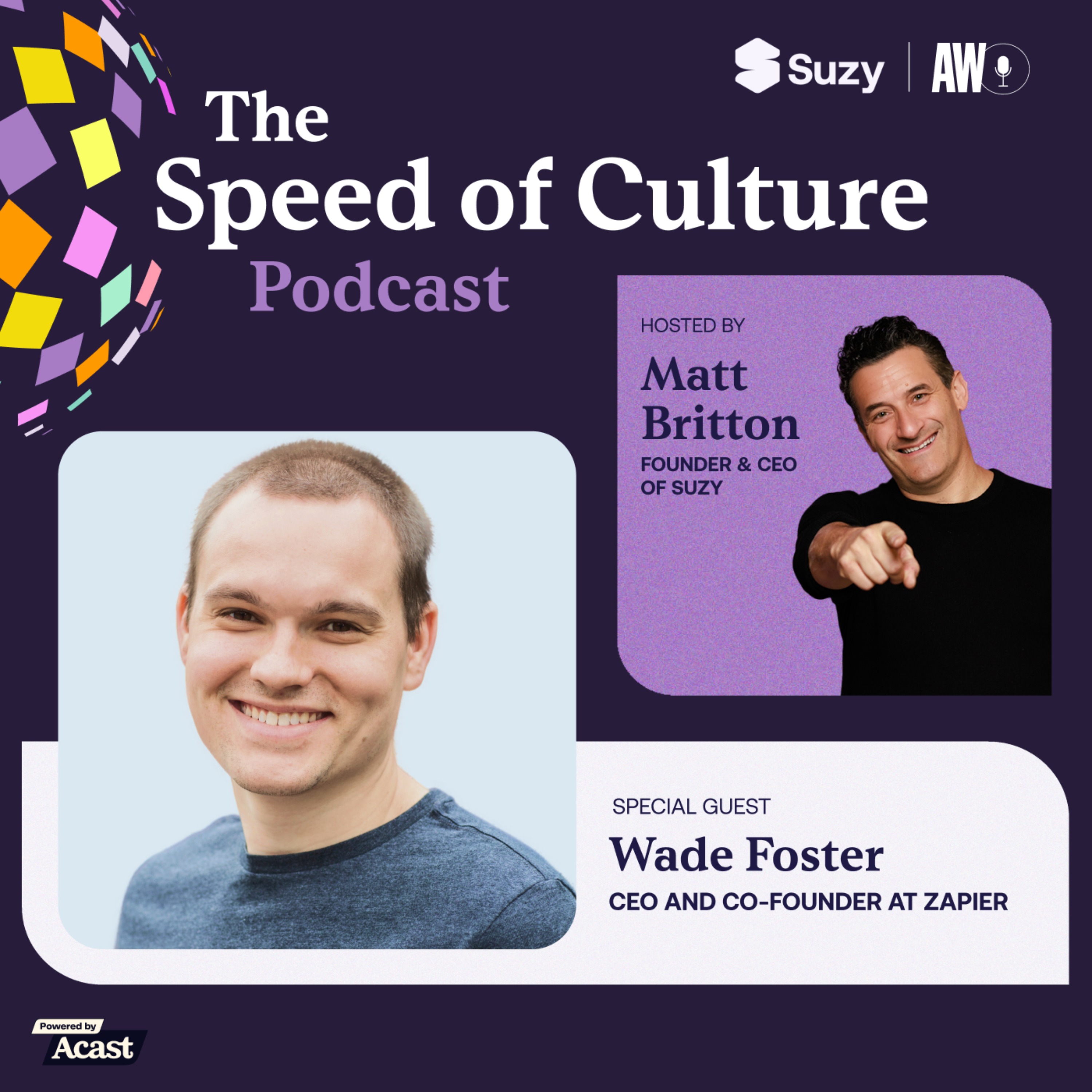
The Speed of Culture Podcast
Code-free: Zapier CEO Wade Foster is rewriting the rules of automation in the Age of AI
00:35:17
Loading summary
Transcript79 lines
- [00:02]
Captain
Race the rudders. Race the sails. Race the sails.
- [00:05]
Matt Britton
Captain, an unidentified ship is approaching.
- [00:07]
Wade Foster
Over.
- [00:08]
Captain
Roger, wait. Is that an enterprise sales solution?
- [00:13]
LinkedIn Ads
Reach sales professionals, not professional sailors. With LinkedIn ads, you can target the right people by industry, job title and more. We'll even give you a $100 credit on your next campaign. Get started today at LinkedIn.com results, terms and conditions apply.
- [00:31]
Matt Britton
Strap in. You're in the race with F1TV Premium. See what the race director sees with custom multiview. Watch every jaw dropping moment in Live 4K UHD across up to 6 screens. Uninterrupted experience. Ultimate live immersion with F1TV Premium available on selected devices.
- [01:04]
Wade Foster
And that moment I felt like if we can just make this easy to set up, if we can make this so that regular folks can do it, the sky's the limit.
- [01:14]
Matt Britton
To thrive in a rapidly evolving landscape, brands must move in an ever increasing pace. I'm Matt Britton, founder and CEO of Suzy. Join me and key industry leaders as we dive deep into the shifting consumer trends within their industry, why it matters now, and how you can keep up. Welcome to the speed of culture. Today we're thrilled to welcome Wade Foster, co founder and CEO of Zapier, the leading AI powered automation platform, helping over 2 million businesses, including Suzy, work smarter, not harder. Under Wade's leadership, Zapier is growing from a scrappy startup to a $5 billion company pioneering no code automation and now AI agents that empower teams to move faster and and stay ahead of consumer needs. Wade, so great to see you, my friend.
- [01:58]
Wade Foster
Yeah, thanks for having me, Matt.
- [02:00]
Matt Britton
So, as you know, I am just such a huge fan of your product and I have so much gratitude for you and the product you've built because it's really allowed me to do so much as somebody who is not a coder by trade, but has kind of creative instincts and really wants to build quickly in digital. I know Zapier began as a side project. Like what was the moment when you realized it would become a scalable business and kind of how did this whole thing get started?
- [02:24]
Wade Foster
Yeah, I think to answer that, I actually have to go to a company that I was at before Zapier. So I was at this other startup and I was ostensibly hired in to do marketing. I'd never done marketing before, but I was like, hey, how hard could it be? Like, we'll just try and figure it out. And I worked at trying to get people into this product for, I don't know, a year. I learned search, I learned email, I learned social, I Learned direct sales, I learned biz dev. Like I'm trying everything, nothing's working, like it's just not going well. I'm like surely they're going to fire me. Like surely they're going to fire me. There's no way I'm surviving this. The product I thought was great, like well designed, well engineered, super slick experience, et cetera. But yeah, just nothing happening. And eventually came across the lean startup from Eric Ries and I came to believe, I was like, oh, maybe we're actually building a product that nobody wants. Like maybe that's the problem. So filed that in the back pocket, just lived experience. Fast forward a year or two, we're starting zapier. We're working on it nights and weekends. We're hacking on this thing. The product is not very good yet, but we're like let's see if we can just get somebody to use it and see if it will actually work for them at all. And came across this forum online where Andrew Warner, the podcaster behind Mixergy, was asking for a PayPal high rise integration. So shout him a cold email and said hey, did you find somebody that are a product that could do this PayPal high rise thing? If no, like I might be able to help. And he responds back and he's like actually I don't need that anymore, but did you actually build something that does this? And so I'm like okay, doors cracked, let's see if I can get him interested. So I'm like well sort of like we can hook up PayPal and Highrise. Then I go look at his site real quick and I'm like what other tools does he use? And I noticed he uses wufu aweber. And I was like maybe there's something there. So I'm like Yeah, it does PayPal Highrise, it does wufu a Weber. And then I list off like two or three other things and he emails back and he goes actually I really need a wufu a Weber integration. Do you think I could use it for that? And so then I messaged my co founder Brian and Mike and I'm like we gotta get wufu at aweber. Like can we do that tonight? Yeah. And so we're building that that night and shoot him a note and say hey, here's access to this thing. It has a Wu Weber. Like check it out and see if you like it. About a day goes by, he mails me back and he's like hey wait, can you jump on Skype? Like show me how this works. And I'M like, sure, of course. So jump on Skype and walking him through the setup. And as we're going through setting up this app, he's having a bad time. And it's not his fault. Like the product is just not ready for primetime at all. Every step of the way. This is a painful experience and I'm taking copious notes. But I'm mostly like trying not to be too embarrassed because this is going rough. But we managed to get the zap set up and we go to chest it. So we say, hey, go to your site, fill out the Wufoo form, Smith Center. Okay, let's go to aweber. Refresh your list. Let's see if it's in there. Boom. Email addresses in Aweber. His face lights up. He's like, oh my God, Wade, this is gonna save me so much time. How much money do I owe you? And a light bulb goes off of me like, holy cow, this is a horrible experience. And yet, because the promise was fulfilled, he's excited about that. Right?
- [05:19]
Matt Britton
And once it's set, then he gets to kind of enjoy the benefits of that automation moving forward. It's one less thing you have to worry about every day.
- [05:25]
Wade Foster
Totally. It's the exact opposite experience I had the other company. And that moment I felt like if we can just make this easy to set up, if we can make this so that regular folks can do, the sky's the limit.
- [05:37]
Matt Britton
So then you obviously set out on a mission to do that. What was that process like going from that original aha moment to where we are lay, where you integrate with over 6,000 different third party applications? Obviously, I'm sure you had a lot of twists and turns in between. What were some of the milestones that stick out to you?
- [05:58]
Wade Foster
Well, yeah, I mean, it's mostly just a lot of hard work, like is what it boils down to. There's obviously like some pivotal decisions that come in the mix. We're working nights and weekends for like six, nine months. We applied to YC and then got accepted, moved to California. So that was a big pivot point. The first 50 or 100 integrations on the platform were built by us. Then we built our developer platform and now we started having all these other people building integrations. So that was a big pivot point. You know, we start growing the team, we decide we're going to do distributed. Only back at a time when that was like super weird and not normal. So there was like a lot of learnings around that. We went from being an integrations tool Zapier used to only have single trigger, single action to now you could do these full on workflows.
- [06:42]
Matt Britton
It's more like if this then that.
- [06:43]
Wade Foster
Exactly, yeah. And then we went from being something that you could only use by yourself to being able something to use in teams and organizations. Now we've gone from workflow to AI and agents and orchestrating like all these workflows across as a company. And so mostly every step of the way has just been trying to layer in something new, expand the capabilities, deepen the capabilities. But at the heart of it it's all just like ease of use. Like you mentioned like how much value you get out of this. As a non technical person who has some like creative horsepower, I'm the same way. And so that was the thing we are always fixated on is like how do we take these technical tools that are so powerful but give access to most people in the workforce. And I think we've made a lot of headway but I still think there's a lot more that can be done to like just make these tools much more broadly accessible. And I do think AI is going to be like a big unlock for a lot of new use cases.
- [07:38]
Matt Britton
I definitely want to spend time getting into that. But before we do, I mean 2 million businesses is a massive amount of companies. So obviously we were just talking about product market fit and you evolve into product through hard work. But sometimes hard work is not enough to get 2 million companies to adopt it. This is largely a podcast that has listeners in the marketing advertising world that obviously clamor every day to capture attention and market share of the end consumer and business they're targeting. What was some of the secrets to your success that allowed you to capture some scale in the B2B world?
- [08:10]
Wade Foster
I think one of the things we got right very early on was we had a at the time, somewhat novel approach to distribution. Now it's been copied over and over again. But we stole this. Stole, I say we borrowed this tactic from a guy who made bingo card sites of all things and he'd realized that he makes these bingo card sites. Teachers will buy this stuff. And if teachers search for like history card bingo, he could rank number one. If he had a page for history card bingo or physics bingo or insert like whatever bingo. Not a lot of people search for those things, but it didn't matter. He was number one in the rankings. And if he was able to spin up a landing page and got the cost to make a landing page for that low enough, all he needed to do was Generate one sale. And the cost of that page was profitable.
- [08:55]
Matt Britton
And anytime anyone would search for that unique combination or search again, you would be the one there.
- [09:01]
Wade Foster
Exactly. And so we looked at that and said, huh, that kind of works for us too. Most people are trying to do these integrations at the time. If you went and did a search for like integrating X and Y, the search results were abysmal. Like there was just nothing there for like scripts and GitHub repos and paste bins and API keys and just a bunch of stuff that like was not what people were actually looking for. And we're like, if we can give them just like an actual page that describes what they're looking for, a nice sign up button, make an app like that is going to be the ideal thing. And so we built out this app directory that allowed you to set up landing pages for every integration we supported. And so again, not that many people searched for the individual integration, but enough would. And then an aggregate, it actually works pretty good. And so as we added more apps to the platform, we had more keywords we could rank for more people we could pull in. And then over time we layered in new channels and new ways. But that set us up on like a really good and efficient foundation.
- [09:57]
Matt Britton
So interesting. So basically the use of your product essentially created a roadmap for content that you would optimize via SEO. And it was basically micro content for these micro use cases. But over time, in aggregate, you would own all these micro use cases and aggregate would own the notion of integration.
- [10:16]
Wade Foster
Totally. I think it was so integrated to the core product experience. Like, I think this is often what as an industry we get wrong when we talk about product market fit. I think a lot of folks treat that as like an ordered list where it's like, okay, do the product, okay, then do the market and then make the fit. But it's actually one thing where it's like the best products. You can't distinguish between what's the product and what's the marketing. It's just so integrally tied together. It's one and the same.
- [10:43]
Matt Britton
I think a lot of companies obviously got to overcompensate for the lack of product market fit with marketing. And that never tends to work well.
- [10:50]
Wade Foster
You just, it's really expensive. Right is what it boils down to.
- [10:53]
Matt Britton
Right. At a time when there is a zero interest rate environment, you saw a lot of companies grab growth because capital was everywhere. But then when capital became harder to come by, well then you really saw where the great products lied totally. So we mentioned you made decision to go remote, which obviously a decision you made before was trendy. Another decision that you made before it was trendy was the notion of bootstrapping. We went through a world where venture capital funding was everywhere. And I know that your company went a very long time without raising outside capital. What was behind that decision and how do you think it helped shape your culture?
- [11:29]
Wade Foster
Well, there was, like, a couple things, I think. One, we were probably naturally disposed to bootstrapping. We were at this company, Veterans United, that was owned 50, 50 by brothers. They had never raised a dime. When I joined, I was employee 500. And when I left, like 10 months later, starting zapier, they were already at a thousand employees. So we'd seen what was possible building companies this way. Then we're from the Midwest, we're not around venture capital. You hear the stories of, oh, man, this venture capitalist came in and replaced the founders, fired the CEO, like, took over everything. And we were just like, we don't want that. Like, we want to own our company and we want to make it great, and we want to control our own destiny. So we had that sort of probably, like, natural disposition. I think the second thing was we also felt like because we had the product well suited, we had that distribution curve, money was never the constraint to growth for us. There was always something else that was harder for us to figure out. So that was a thing in our favor. And then the third thing is, in software companies, the biggest expense you have is people. It's the number one thing on any. Go look at any software company's P and L and you'll just see, like, salaries is like, you know, a huge, huge expense for them. And we had a very different approach to hiring than I think most companies did, which was we just didn't hire till it hurt. And part of why we did that is we wanted to make sure that every person that joined the company, there was a very real and visceral need for them. And we knew exactly what tasks to assign them. Because you'd hear these stories of these companies that would raise a bunch of money and then they'd hire 10, 15 people. And then it was like a mess. Like, no one knew what each other was doing. They're all trying to figure all this stuff out. And it's not this thing where you can just take a small company and toss bodies at the problem and expect the machinery to all keep working. And so we were just a lot more meticulous about, like, adding new hands to the deck where it Was like very clear, hey, if we set two more hands on this problem, we're going to get the output from it at the other side. And so that just naturally kept our expenses pretty low and our output pretty high.
- [13:31]
Matt Britton
Yeah, it allows you to be much more efficient. I think a lot of companies, they raise money, you have to spend it, especially in a 0 rate, interest rate environment. And you just bring on more and more people thinking that throwing bodies of problems is going to solve them. But often throwing bodies of problems just creates more problems.
- [13:45]
Wade Foster
Yeah. Well, it's been interesting to see on the other side is now with AI, this is kind of becoming trendy. Like I heard this word seed strapping for the first time like about a month ago, which when we were doing it like that didn't even exist. But now it's a thing where it's like raise one round and then just grow from there. And a lot of more founders are paying attention to it and they're like, I think with the AI, with agents, with automation, with low burn rates, fewer headcount, like it feels like an actual vile path for a lot of companies in a way that probably hasn't really felt that way for the last 10 years in tech.
- [14:17]
Matt Britton
Yeah. I mean, one reason why I believe that used to be the gating factor of creating a software company was hiring a ton of engineers. And now many believe that you can just do it on your own without hiring any engineers. I don't think are quite there yet. But you look at tools out there like Lovable and Cursor, where you can build at least MVP for software products just by entering prompts. What is your take on that whole new movement of kind of do it yourself software engineering?
- [14:43]
Wade Foster
I think it's incredible. I think we're already seeing two really big use cases. One is just like the age of personal software, where you as a person who has a need, you can just make something for yourself and you can use it for yourself. You don't have to try and sell the thing. You don't have to do anything else with it other than it's just like it's software. For me, I needed this thing and so I built it and I'm happy. And I think that's really neat that you can kind of have that phenomena. I think the second thing that you're seeing is the way software gets built. Professional software gets built now is changing. You know, it used to be you would have a product manager that would go out and talk to customers, talk to prospects, collect all this customer feedback in Form a hypothesis on the market. Then they would sit down with the designer and they'd start to mock up all these pages and figure out what that could look like. And then they would go get the developers around and the bike, okay, let's go build a prototype. And then that whole process could take two weeks, four weeks, etc. And then they're finally able to show something working to the customer. Well, now you can do that first part where you go talk to customers, etc. But you can then feed that into an LLM and say, hey, summarize my notes. Then you can say, hey, create a PRD for me. And then you can feed the PRD into these tools like lovable boat, whatever, and say, can you actually go generate a prototype for me? And the cycle time on that whole thing is one person who just does all the work and it takes a day, two days, et cetera. And so now you just have short circuit this loop that every software company has had to go from and just meaningfully reduce the time to value. And so I think you're just going to see problems are being solved so much faster than they were even a year ago, to be honest.
- [16:17]
Matt Britton
Yeah, I mean, let's talk about that. I mean, we've talked offline just about how my experience as a customer of Zapier has just been elevated dramatically. Since AI is flowing through systems. It's almost like the best analogy I can give for those of you who haven't used it is I think pre AI Zapier is like a really well functioning factory, but there were robots on the floor and now it's like there's humans on the floor. Like, you know, it's not as mechanical anymore because now you have the power of AI that can kind of fill in the gaps with real intelligence. And because of that, the power of what you create is 10,000 fold.
- [16:55]
Wade Foster
Spot on. Like, I think the real unlock that AI brought to tools like Zapier is the ability to work with unstructured data and unstructured text. Before, to your point, everything had to be like very mechanical. And so there was use cases that that's great for. It's like when this happens, do this, do this, right.
- [17:12]
Matt Britton
You get a lead on LinkedIn or Google Ads, you want to put it to a Google sheet, it'll do that for you. Because it's very structured.
- [17:18]
Wade Foster
Exactly. But the moment you had to do take this PDF or take this big blob of text and do something interesting with it, it was like, ooh. I mean, we'll try for you, but you're probably not going to have a very good time with this type of use case. But nowadays you can say, you know what, actually, here's what I want to do. I want to take the lead that I got from my site. I want to go do a bunch of lead enrichment. Maybe I hit a lead enrichment service or maybe I go do a web search powered by ChatGPT or Claude or something like that and I want to pull in a whole bunch of context. There's then I want to take all that context and I'm going to run it through a bunch of different prompts and generate a bunch of different outputs from that. And at the finish line, maybe I'm going to send off an email to them or maybe I'm going to input all this stuff into a CRM. And those types of use cases are so common inside of the workplace, but had been a lot harder to do with automation tools prior to AI availability.
- [18:09]
Matt Britton
We'll be right back with the Speed of Culture after a few words from our sponsors.
- [18:16]
Captain
Race the rudders. Race the sails. Race the sails.
- [18:20]
Matt Britton
Captain, an unidentified ship is approaching.
- [18:23]
Wade Foster
Over.
- [18:23]
Captain
Roger, wait. Is that an enterprise sales solution?
- [18:28]
LinkedIn Ads
Reach sales professionals, not professional sailors. With LinkedIn ads, you can target the right people by industry, job title and more. We'll even give you a $100 credit on your next campaign. Get started today at LinkedIn.com results. Terms and conditions apply with the IHG1.
- [18:46]
Matt Britton
Rewards Premier Business Credit Card. Earn up to 200,000 bonus points. Limited time offer ending April 30th. Visit IHG.com BusinessCard cards issued by JPMorgan Chase bank and a member FDIC offer, subject to change terms apply. Now of course, here in 2025, we're entering a whole new realm, the role of agents. What does AI agents mean to you and what are the some of the more interesting use cases, especially in the realm of what your company can power.
- [19:17]
Wade Foster
So agents I think are really impactful because for the first time we're having like real work problems that you can truly delegate the whole thing to software where the software can make decisions for you. So a good example would be if you're using Zapier agents, a real common use case is, hey, I want you to go reply to my emails, which that's not a thing you would probably.
- [19:41]
Matt Britton
Do before you even think was possible a couple years ago.
- [19:44]
Wade Foster
Yeah, and now you can set it up and you can say, you know, you can give it rules, you can say, hey, I want you to look at, you know, Say, say a common, common email that I get is for folks that are looking for a job. And I can say, hey, anytime someone comes in and asks me about a job, I want you to go look at our job page. I want to match it up to the job requirement. Then I want you to reply to this person with a link to the job. Can you do that for me?
- [20:05]
Matt Britton
Great.
- [20:05]
Wade Foster
So now anytime someone emails in with something like that, agent takes over, does everything for you.
- [20:10]
Matt Britton
I hadn't even thought to do that. I probably spend 15 hours a week in Zapier and I haven't even thought to do that. And that's just an example. It's the first thing that comes to your mind. There's just so many use cases to unlock.
- [20:21]
Wade Foster
To me, this is where I get so excited because for the last two years, most of the attention has been on model sizes and the funding rounds and all the drama, the personalities of AI. But I think most companies and even the folks that are like, actually kind of on the cutting edge of this stuff, we are only tapping the surface around use cases. And so to me, more of this thing, this needs to happen, where it's like, tell me how you're using it, what did you figure out how to do? And I think we're going to see just a lot more knowledge sharing around how this happens, Agent marketplaces and whatever, you name it. But like, that to me is where if the technology stopped advancing at all today, if we just. That the servers got shut down, like, nothing could happen. I still think that there is enormous amount of value that society has just not yet figured out how to unlock because we just haven't thought like, oh, I guess I could make an agent for that.
- [21:13]
Matt Britton
So obviously it's going to have a massive impact on the workforce. It already is. Automation is sometimes another word for replacing people. It doesn't have to be. I think the good CEOs will tell you automation takes away the mundane tasks and their employees. They can be more strategic, but not every employee can be more strategic. So what is your advice to people that are listening to this podcast in terms of what they should do to future proof themselves so they can use tools like yours so they can be on the right size of this tidal wave of change that we're all experiencing?
- [21:44]
Wade Foster
I think I liken it to any sort of tech transformation. You know, I remember sitting down to talk to my mom where she works in a pharmacy at a hospital, and they used to do everything in the hospital by hand, pen, paper, et cetera. Computers come along and you know, hey, everything's going digital. That's how things are done. And so AI to me is just like another important technology shift where it's like, okay, you can be the person that still is like, hey, I'm going to do it. Pen and paper. But the reality is that whole industry, the whole world's moving to these tools. And so I think the best thing that I would advise to anyone is, like, build some fluency with these tools, play with them, mess with them, experiment with them, figure out what these things will be. Right now is like, one of the best times to do it, because with relatively low investment, you can stand out compared to everyone else in the market, compared to everybody else in your company, because you can kind of do simple things, and people's jaw will drop. They'll be like, how did you do that?
- [22:36]
Matt Britton
Right? Almost like an arbitrage opportunity right now because the knowledge gap is so wide. There are the 0.1% of people that really get it and understand where it's going, and the other 99.9% are just clueless. And if that 0.1% that understand this can leverage it and say, look at I just create it to the rest of society, it's like, did you spend months building this? And the reality is like, no, I spent an hour doing this. People don't really understand it. So it really gives you a disproportionate advantage if you can dive in right now.
- [23:05]
Wade Foster
Totally. So be curious, go explore things, don't wait for permission. Just, like, sign up for one of the tools and just start messing around with it. And it's so funny. I do think one of the skills that's most important and technology transformations, but candidly, any time period is just human agency. So often we are sitting around waiting for somebody to tell us, to give us instructions, to give me the command to tell me I'm allowed to go do this. But the most valuable skill in the workplace is just somebody who's, like, paying attention to the trends and saying, you know what? I think I can go solve that problem and independently just go take action, figure a thing out that never goes out of style. I don't care like, what technology shift hits. The person that's willing to independently think, go solve problems. I want them on my team. 10 out of 10 times.
- [23:51]
Matt Britton
Yeah, for sure. So the interesting thing about your product is you have 6,000 app integrations. So there are ways your product is being used in ways that you probably haven't even imagined it could. Right? Because there's Limitless ideas. What were some of the use cases that you heard of that you're like, wow, I had no idea that my product could do that. And it's massive.
- [24:13]
Wade Foster
Well, I'll tell you. So Zapier is built to be used in work. That was the thing we were always paying attention to is like, how do we help people do work better? And so our mental model was just like, so laser focused on how do you make marketing better, how do you make sales better, how do you make HR better, how do you make it better? So we had spent all this time thinking about those types of problems. And I remember one day going through, I think I was shifting through like a dashboard and I come across this app on the platform that I hadn't seen there before. And it's Eve Online. And for those who aren't familiar, EVE Online is this like niche online role playing game. It's kind of like World of Warcraft. It's not quite as big, but it's got like this fanatical following. And I was like, wait, what? Like one of these things is not like the other. So I end up reaching out to the guy who built it and like asking him like, hey, what's going on here? And it turns out EVE Online is known for having this like vibrant in game economy that is actually tradable in real life. So you can like take whatever the in game currency is and like swap those out for US dollars and all this sort of stuff. At least it was at the time. I don't know if it still is that way. And he was like, I have set up automation inside of EVE Online so I get notified about certain in game events and activities because if I do, I can create an arbitrage and like make more money out of this thing. And I was just like, holy cow. Like this is like we never even thought or considered that you would want to do something like that. And here is some random guy that's just like looking at the technology and saying, like, you know what, I can do something pretty cool with that without us. Like it was just not a thing that we ever even considered thought about. So that one was definitely pretty wild.
- [25:47]
Matt Britton
Yeah, I mean, I think to build on what you said earlier about playing around with the tools, I would say it's even a step further, which is you almost have to start with a problem that you want to solve and just be really focused on solving that problem and then going step by step using a platform like yours and figuring out what are the applications that can help you Solve it, understand what the data is behind it that can help you solve it, and have a good idea of what a solution looks like and then build towards it. Because in going through that process, it really kind of things start to click for you in terms of actually what's possible. I think sometimes what people do is they just play around too much and then they're grabbing onto anything because it's just like almost too many things. There's too many options. It's a paradox of choice.
- [26:28]
Wade Foster
Yeah, well, and the thing I also see a lot too is folks who played around with ChatGPT two years ago, and at the time they tried it and wasn't as good as it is. They were like, oh, AI is no good, it hallucinates all the time. Or like it does, da da, da, da. And at the time that was actually correct. It was like, yeah, but the thing is, this AI, the whole industry is not stasis, is like constantly improving and the pace is far beyond any industry I've ever seen in my career. And so I think the folks that I have seen that have, like, done the best work, they are pragmatic about what is possible today, but they're also thinking ahead. They're like, when the next model drops, when the cost goes down. Here are some things that I might be able to do. So I'm going to kind of try and play around and figure out how to do it today, knowing that it may not be great with this, but as soon as the thing gets better, I might be able to just lock in and have a great new ability.
- [27:18]
Matt Britton
Yeah, like today's the worst that I'll ever be, so to speak. Like, whenever you use an AI, today will by far be the worst it'll ever be. It's almost like you tried streaming video online in 2001. What would your experience be? And you would have written off Netflix and every other great company that's played in the entertainment space since then. YouTube, et cetera. Even today. So where do you see the company going? Obviously there's so many places you can take it. There's so much growth opportunity. It truly is, in my opinion, like the ultimate platform. Because as technology improves, as AI improves, as new applications are born, your company could just power those. So to me, it's like you're really just betting on innovation in the future. And as long as we continue to innovate zapier, we'll continue to grow in its use case and power. But given that, where do you focus?
- [28:04]
Wade Foster
Yeah, long term, the goal of the company is just make automation in all of its forms widely accessible, really easy for anybody to use. We started with integrations, we layered in workflow. Now the big area is how do you make AI orchestration really easy for everybody? And so we're looking across these major categories of workflows in every function. We're looking at how do you generate content inside of an organization? How do you orchestrate your customer journeys, how do you do employee onboarding and offboarding, how do you do your IT help desk? These are all really in crucial, like processes that exist inside a function. And many of these processes exist across functions. And they're all in data silos, they're in different tools. And the way in which it's done today is slow and fragmented and fragile. And I think there's a real opportunity for us to come in and help organizations at these critical business functions and reinvent those processes with AI at the center of them saying, like, hey, there's a new way to do this stuff and you're going to get outputs that you probably never thought were even possible here. And that's where I feel like the big opportunity is. And so our product portfolio, our product strategy, underneath that is we're building capabilities, the building blocks that allow you to mix and match these different styles of automation. You can do AI over here, you can do determinism over here, you can do workflows here, you can do agents there, you can do tables here. And so it allows that creator, that builder, to go, you know what, this is exactly how I want to solve this problem at my company. So you don't have to take this like one size fits all bespoke software off the shelf and just be like, well, I guess this is how the software is dying. So now that's how we're working. You can say, I want my company to work this way. And then you can fit the software to how you want to work.
- [29:47]
Matt Britton
For sure. Of course, in order to make that dream a reality comp, easy to hire the right people and then train those people on the right skill sets. What are some of those skill sets? Like, what have you seen to be true of people that really perform at a high level, Both at Zapier and other companies deploying tools like Zapier to drive this transformation?
- [30:08]
Wade Foster
I think coming back to the topic we were talking about before, high agency, like people who are naturally curious, natural surf starters who are just willing to like scratch an itch and go figure a thing out, they probably have some like, natural tinkerer like abilities. They're just sort of always like paying attention to how this stuff works. So that I think is one, two, they work hard, like they're just, they care, they're passionate, they own something I think that is like hyper crucial. The third thing is I think you will need folks especially right now who have creativity. Like when we started Zapier, you never wanted to be the idea guy in the startup. It was like you always wanted the technical founder. The technical founder got all the like is like that's the best person in.
- [30:48]
Matt Britton
The budge because nothing was possible without that person.
- [30:51]
Wade Foster
Totally. Yeah. And if you were the idea guy, it was like nobody wants to work with just the idea guy. But actually I think with AI now, like if you combine this with high agency, these tools, ideas actually really do matter. Like if you have good ideas, if you have great judgment around like ah, this is how this thing should work and you combine that with curiosity and hard work. I think that skill set is like a really killer one in just about any domain discipline anywhere.
- [31:17]
Matt Britton
Yeah, I think the notion of ideas being more valuable than ever before in this world is such a compelling one because I just think the path from making something a reality, from an idea is shorter and more possible than ever before. So in the past you'd have a shoebox of ideas, but it's like, yeah, how would you actually ever really get that done? You have to hire engineers from MIT and do this and do that where now in a lot of instances you don't. And in a lot of instances if you have the idea, you yourself can make it a reality a hundred percent. I mean it's a crazy time to be alive. And then you know, you look at the new people coming into this world with all these incredible tools and just think about how quick things are moving and where this world is going to be 5, 10, 15 years from now. It's kind of mind blowing.
- [31:58]
Wade Foster
Yeah. I have young kids and I used to hear my parents talk about that, my grandparents and I'd sort of roll my eyes and now I find myself kind of doing the same thing where I'm like wow, like what is the world that they're going to grow up in? Like it is going to be so different than the one I am. It's like you're going to have self driving cars. Maybe you do have robots in your house that are like folding laundry and doing meal prep. And what is even education going to look like in the future? Like it is a really exciting time, 100%.
- [32:24]
Matt Britton
So to wrap up here, love to just ask A couple questions about you in terms of how you spend your time. Obviously you're sitting on top of a very successful company that is quite transformational in so many different ways. Where are you spending your time? What does the pie chart of your week look like so you can make sure that you continue to progress even from the high levels that you're operating at right now?
- [32:45]
Wade Foster
Well, the idea and the reality are often farther apart than I care to admit. But I think at my best I really like to spend a lot of time at the center intersection of product and marketing. I think right now we're just such a unique point in time where you're trying to figure out like how do you make a product that stands out, how do you make a product that's valuable and how do you go tell that story out to the world? So folks actually get that like, ah, this is the product that I'm looking for when a lot of stuff sounds the same, looks the same, et cetera. So I like to spend a lot of time there and I tend to try and spend my mornings like free meeting free where I can sit down, think about these problems, work on the things that matter. And that could be everything from product roadmap to like a landing page to a campaign that work and literally down to like words on a page. Usually by the time lunchtime hits though, a lot of stuff is sort of going off the ropes and that's when I'm just like firefighting mode, reacting to this, that or the other. A lot of meetings, reviewing things, etc. Just the, a lot of the typical management of a 700 person company at.
- [33:43]
Matt Britton
The end of the day, of course. And how do you spend your time keeping your finger on the pulse of these rapid changes we're seeing in terms of AI technology in general, even consumer trends, how you spend your time capturing information.
- [33:56]
Wade Foster
A lot of it is just carving out a little bit of time for myself to go play around with these tools. So I find certain things that are now like ingrained in my workflow and then every now and then, probably a couple times a week, I'm just signing up for something new, messing around, doing some stuff and that helps. But the second thing is I'm also really lucky to be in a company where there's a lot of people doing that and are also sharing what they're seeing and they're observing. So I'll get like to see somebody be like, I signed up for this tool, here's all the things I learned. I don't think it's ready for primetime. But it had this really cool interaction pattern. And so, like, maybe there's something around this interaction pattern that, like, could be really interesting to learn from. And so that's just really nice to have so many different eyes trying so many different things to just see where there's interesting things being created right now, for sure.
- [34:40]
Matt Britton
And is there a tool that you use recently that just blew you away?
- [34:43]
Wade Foster
Well, I'll tell you the one that probably was the fastest into my personal productivity stack, and that is this tool Granola AI, which is a meeting taker. There's a million and one of these meeting taker notes at this point in time, but Granola just like, nailed it. Like, it's hard to express exactly, like, how intuitive and how natural this thing is. But I downloaded it and, like, right away I was just like, yep, I'm using this now. I can just. There was like zero friction to becoming, which that's not the case. Like most tools are you. You check them out. You're like playing around with it. You're trying to figure out the use case. That one was super fast.
- [35:18]
Matt Britton
Very cool. Awesome. Well, this has been such an amazing discussion. As you know, I'm a big fan and I can't wait for our audience not only to hear this podcast, but hopefully get inspired to dive in and use your product and really elevate their careers. We often end our podcast by asking the guests if there's a mantra or phrase that helps encapsulate their professional journey. Just wondering what might come to mind for you.
- [35:40]
Wade Foster
Well, maybe it's a little cliche, but I grew up in the 90s. I grew up a die hard Chicago Bulls basketball fan. They're the closest professional sports team basketball team to me and obsessed with Michael Jordan. So I wanted to be like, Mike, Mike's got Nike all the way through. And so just do it. Like, I think that is just an incredible mantra for entrepreneurship is just do it at the end of the day.
- [36:01]
Matt Britton
Well, there's no doubt, Wade, that you have just done it. So congratulations to you and all your successes, Zapier. And I can't wait to see what you continue to do to build your great company.
- [36:11]
Wade Foster
Yeah, thanks for having me, Matt.
- [36:13]
Matt Britton
Absolutely. On behalf of Susie and Edward Keen, thanks again to Wade Foster, the CEO and founder of Zapier, for joining us today. Be sure to subscribe Rate Review the Speed of Culture podcast on your favorite podcast platform. Till next time. See you soon, everyone. Take care. The Speed of Culture is brought to you by Suzy as part of the Ad Week Podcast Network and a Guest Creator Network. You can listen subscribe to all Adweek's podcasts by visiting Adweek.com podcasts to find out more about Suzy, head to Susie.com and make sure to search for the speed of culture in Apple, Podcasts, Spotify, or anywhere else podcasts are found. Click follow so you don't miss out on any future episodes. On behalf of the team here at Suzy, thanks for listening.
- [37:12]
E
Ryan Seacrest here. When you have a busy schedule, it's important to maximize your downtime. One of the best ways to do that is by going to chumbacasino.com Chumba Casino has all your favorite social casino games like spin slots, bingo and solitaire that you can play for free for a chance to redeem some serious prizes. So hop on to chumbacasino.com now and live the Chumba Life Sponsored by Chumba Casino.
- [37:36]
Matt Britton
No purchase necessary. VGW Group Void where prohibited by law 21 terms and conditions apply.
- [37:42]
F
Running a business is hard work. Building your website shouldn't be. With wix, you can express your ideas, give direction, then leave the heavy lifting to AI, from site creation to branded content and images. Have fun with the details, customize what you want the way you want, and manage your whole business from a centralized dashboard with expert AI tools. Build, scale and enjoy the incredible results. You can do it all yourself on wix.