← The Speed of Culture Podcast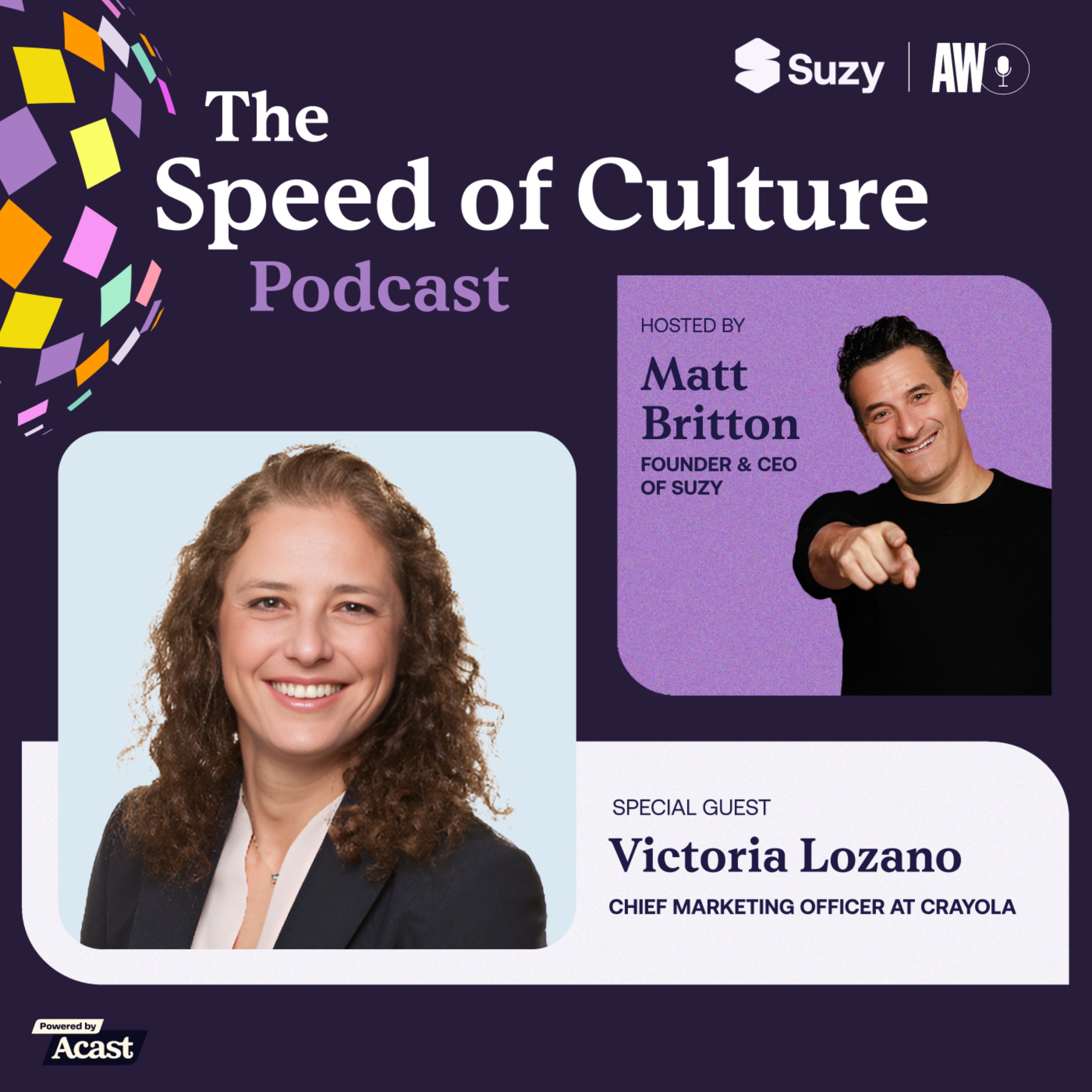
The Speed of Culture Podcast
Color theory: Crayola’s Victoria Lozano believes creativity is our greatest skill in an AI-driven world
00:32:31
Loading summary
Transcript61 lines
- [00:00]
Shopify Narrator
When you're starting off with something new, it seems like your to do list keeps growing. Finding the right tool helps. And that tool is Shopify. Shopify is the commerce platform behind millions of businesses around the world and 10% of US e commerce. And best yet, Shopify is your commerce expert with world class expertise in everything from managing inventory to international shipping. If you're ready to sell, you're ready for Shopify. Sign up for your $1 per month trial at shopify.com retail. Click go to shopify.com retail Race the rudders.
- [00:30]
TransUnion Narrator
Race the sails. Race the sails.
- [00:32]
Captain, an unidentified ship is approaching.
- [00:34]
Over Roger, wait. Is that an enterprise sales solution? Reach sales professionals, not professional sailors. With LinkedIn ads, you can target the right people by industry, job title and more. Start converting your B2B audience today. Spend $250 on your first campaign and get a free $250 credit for the next one. Get started today at LinkedIn.com Terms and Conditions apply.
- [01:02]
Experian Narrator
Finding the right audience shouldn't feel like doom scrolling with Experian. It doesn't Experian syndicated audiences help you reach holiday shoppers, car buyers and more across over 200 top platforms with over 2,400 pre built audiences. There's no more doom scrolling. It's audience targeting you can trust. Made simple. Learn more at experian.com adweek that's E-P-E-R-I-A-N.com.
- [01:30]
Victoria Lozano
Adweek There's no way to predict what the jobs are going to be in the future or how things evolve. But there's no question that things are evolving at an incredibly fast pace and that technology in one way or shape or form is playing an increasingly important role in our lives. And that is actually precisely why the importance of understanding what creativity is and how to nurture. So whether it's in kids and really kind of enabling that them to keep that creativity, the innate thing, that innate quality that kids are naturally just born with or have or whether it's an adult and really keeping it as a lifelong mindset. The importance of having creativity as a life skill precisely because it actually helps prepare ice individually and us collectively as a broader society and as a culture for whatever comes ahead.
- [02:28]
Matt Britton
To thrive in a rapidly evolving landscape, brands must move at an ever increasing pace. I'm Matt Britton, founder and CEO of susee. Join me and key industry leaders as we dive deep into the shifting consumer trends within their industry, why it matters now and how you can keep up. Welcome to the Speed of Culture. Up to the Speed of Culture podcast. We are thrilled to welcome Victoria Lozano.
- [02:53]
Podcast Host (Lei or Matt Britton)
The Chief Marketing Officer at Crayola. Victoria has played a pivotal role in Crayola's evolution, leading groundbreaking initiatives like the Campaign for Creativity and redefining how creativity and color can impact emotional and cognitive development. Victoria, I've been really looking forward to this. Great to see you, Lei. Thanks for joining.
- [03:08]
Victoria Lozano
Great to see you. Thanks for having me, Matt.
- [03:09]
Podcast Host (Lei or Matt Britton)
Absolutely. So we're going through such an interesting time right now in the evolution of the consumer, especially with AI. I mean, I speak everywhere about AI, and the first question I get asked is, what should I tell my kids to focus on? Like, what jobs are still going to exist? And I answer it in a lot of different ways depending upon the audience. But the word creativity is always mentioned in that answer because I think that is one of the traits and skill sets that in so many ways is uniquely human and AI proof. And just curious what your thoughts are in this changing evolution, where creativity fits in.
- [03:47]
Victoria Lozano
Well, I think some of the things you're asking is actually multiple $64,000 questions or actually quite more valuable, I think, look, there's no way to predict what the jobs are going to be in the future or how things evolve, but there's no question that things are evolving at an incredibly fast pace and that technology in one way or shape or form is playing an increasingly important role in our lives. And that is actually precisely why the importance of understanding what creativity is and how to nurture it. So whether it's kids and really kind of enabling that them to keep that creativity, their innate thing that can make quality that kids are naturally just born with or have, or whether it's an adult, and really keeping it as a lifelong mindset. The importance of having creativity as a life skill, precisely because it actually helps prepare ICE individually and us collectively as a broader society and as a culture for whatever comes ahead or whatever lies ahead, it doesn't matter what your job is, what industry you're in and what you specifically do within that industry, nor does it necessarily matter what the future jobs will look like. Because when you have creativity as a mindset, the way of thinking, the way of problem solving, the way of collaborating and coming up with innovative new ideas with other people, you, if you have that, you will in fact, be best prepared for whatever lies ahead.
- [05:18]
Podcast Host (Lei or Matt Britton)
Absolutely. I mean, it's really interesting because I think when you think of Crayola, you think of coloring first and foremost. And when we were kids, at least when I was growing up, I'm a Gen XER you were taught to color inside the lines. And I think now more than ever in the future, the world's going to reward those who color outside the lines, because AI can color inside the lines. And it's basically about really being deterministic in an output where I think what makes things incredible coming out of a human is people who color outside the lines who think differently. And I'm just curious, in terms of the overall approach to creativity, do you see that the same way, do you see the boundaries of creativity blurring when it comes to coloring inside the lines?
- [06:02]
Victoria Lozano
Sure. Well, I think what you're talking about is poking exactly at that, what is creativity at that exact question you, when you think about creativity just as coloring, that does tend to be how some kind of like the myths or some of the lingering perceptions. But what you're poking out at coloring Outside alliance is exactly what we're talking about. It is about a way of thinking, it's a way of problem solving. It's a ways that you could use those small creative moments as a way of building this lifelong mindset so that when you are faced with challenges, uncertainties, life's challenges, you are able to actually navigate them and navigate those uncertainties in a much better way. So absolutely, it is not about coloring. It is about expressing your creativity. It's about developing creativity as a soft skill. It's about developing a mindset that helps you do those kinds of things. And I think that's important as a child, it's important as an adult, and in fact, it is what makes us better as a society. And I will tell you just to kind of, as an example of how strongly Crayola, we, Crayola and me, myself as an individual, believe in this. Crayola was founded 122 years ago, little history story. And at that time, the founders who actually founded the business, who founded the brand, this is at the back end of the Industrial revolution. And they very much believed that America as a country was not gonna be successful based on what was made, but it was gonna be successful based on having the best inventors, solvers, innovators. And they believe that creativity and hands on creative experiences is what helped develop that as a life skill. So guess what, fast forward, we're now, 122 years later, that belief still holds. And that is exactly, I think when you use an expression like coloring outside the light, that is lines, that's exactly what you're talking about. And I think that that will continue to remain true. And those are the kinds of people that Ultimately the thinkers, the doers that will ultimately help lead and change the world for the better.
- [08:03]
Podcast Host (Lei or Matt Britton)
Yeah. I mean, right now some could make the case that innovation and creativity is really all we have as a global competitive advantage because it used to be manufacturing. But other countries around the world have proven to manufacture far more efficiently. People work longer hours in other places and other nations have won on productivity. But where the US has continued to be exceptional is around innovation. Where would we be without Google and Microsoft and Apple and these great companies? And those companies thrive not just on their ability to execute their supply chains well, but to continually come up with new ideas. And I agree that you can't come up with those new ideas later in life if you're not trained the right way at early ages in life.
- [08:46]
Victoria Lozano
Absolutely. That is just incredibly important. And as the world advances and as AI and other technologies continue to take shape, that naturally human ability of how do you use those tools but use it to even further advance how we innovate, how we think, how we, I think, is where the magic comes through for us to continue in the US and anywhere else in the world to continue to sort of thrive and advance as a human race.
- [09:13]
Podcast Host (Lei or Matt Britton)
I agree. And Victoria, you've kind of alluded to this several times already in our conversation that cradle is more than a crayon company. What's some of the bold innovations the company has brought to market over the last three to five years that really show the company's commitment to broader its aperture in terms of its product portfolio to appeal to new audiences and also take advantage of where the world is headed in the world of creativity?
- [09:38]
Victoria Lozano
Sure. Well, the way that we like to think about the Crayola brand in the business is really in the context or in a framework of products, experiences and content. And each one of the three pillars has its own things that we actually have in market and that we innovate around, but they also work together because at the end of the day, an average consumer will have a experience with all those as multiple touch points across the brand. And in the product world, we are of course, most well known for some of our iconic products, but an tremendous amount of resources and passion and innovation and breakthrough technologies that we bring to continuing to innovate on the kinds of products that we deliver to the market. So whether they are about hands on creative expression, on paper, whether they are around more of a toetic and toy kind of creative toy products, whether they're around competitive products like our color whirls, product innovation, product innovation continues to be an incredible Priorities. Because there's just so many different ways that you can express and experience creativity in a hands on way in the world of experiences. Some of the things that we really focus on is things such as our interactive business, like why should the canvas be always physical, why can't it be digital and why can't it be intertwined with storytelling or gameplay? Because all of that is actually sort of innate sometimes to how adults or kids express their creativity or location based entertainment. And the way that we create gated attraction experiences that really curate and create these immersive experiences that last hours on average in a single time and really enable us to immerse and engage people in everything creative so that people go home and they say, incredible experience. I made so many good family memories, I want to do this again. Whether it comes because they come back or whether they actually do it at home, that's okay. Or in the world of content, we focus very much obviously what we do in social and in our overall communication around Crayola campaign for creativity. We also do a lot around education and how you use creativity in the classroom to teach core subjects, things such as literacy or social, emotional learning, STEM subjects, sciences. So I think what happens through content or Crayola studios and how we think about entertainment content and how we showcase and celebrate creativity and the way that creativity could be part of engaging storytelling, I think what's really incredible and really powerful is ability to not only have a clear point of view and a way to go to market in each one of those areas, but again, bringing them together so that folks and parents, teachers, educators really experience them across the board. And what we have seen by being able to connect those dots, not only does it create a more meaningful experience, but it's actually broadening how people think about the brand. I know it's not going to surprise you around all the things that we do targeted at kids, things that we do with educators in the classroom. Because that's what you sort of know and love about Craig. Well, hopefully love, but certainly no. But I think what might surprise you is that Last year over 50% of our purchases happened in households with no kids present.
- [12:53]
Podcast Host (Lei or Matt Britton)
Wow, I knew you were targeting adults, but the fact that over 50% of the purchases, that that is shocking.
- [13:00]
Victoria Lozano
And while there's certainly aunts, uncles and grandparents in that mix, that is only a portion of that audience, a very large portion of that audience are buying it for themselves. And the question is why? Well, why is because this is a brand that is a. Offers an incredibly broad number of ways to Engage with the brand. It's a brand that offers experiences, products, content that is relevant, that is engaging and is really tapping into this fundamental human truth around the fact that creativity is an innate skill. We tend to be born with it. And as kids we're sort of not worried about some of the judgment and the limitations. We just do it. We do it for the sake of doing.
- [13:42]
Podcast Host (Lei or Matt Britton)
Over time we lose it though, because we're focused on every day, we're forced to follow the rules. And I guess the mysticism of creativity kind of gets pushed down on the priority list.
- [13:52]
Victoria Lozano
I actually think it's a couple things. A is the expectations of being really productive. Right. And what you do with your time and all the things that, that you as an adult need to accomplish and kind of finding room for some of these things without feeling guilty about it. And which by the way, there's nothing absolutely to feel guilty about it because it's actually an incredibly important part of our individual sort of emotional ecosystem. And we just need to give ourselves permission to just do it.
- [14:18]
Podcast Host (Lei or Matt Britton)
You can look at it like meditation or exercise, right. It's just something you're doing for yourself.
- [14:22]
Victoria Lozano
Absolutely. It's recentering, it's inspirational. And also frankly, we know that there's a lot of links to wellness involved in terms of doing it. But we also just as adults need to let go some of the judgment that as kids age they begin to learn. This is a learned behavior around judgment and around how what I create needs to be evaluated and the quality standard and what the expectations are. And I think as adults that tends to be so embedded in our brains that we don't as much focus on the process of creation and what actually it does to help refuel re energize recenter you. But we focus a lot on the output. And is what I created worthy of the time or being able to say that I just spent all this time doing it? And I just think that is a very learned behavior. And if we are going to have the best innovators and problem solvers and thinkers, us kids who are just growing up or as an adult, we need to just let ourselves do it and have the permission without the fear of judgment and have the permission that sometimes it's the process of doing that is the energizing and empowering and freeing elements to help really sort of rediscover in who you are and what you enjoy and reground you just as a human being.
- [15:42]
Podcast Host (Lei or Matt Britton)
It's so interesting. You say, I have a 4 year old daughter and before she Goes to bed every night we spend half an hour just doing a creative activity. It could be building Legos or it could be using one of your products, coloring, painting, whatever it may be. And it is centering for me and it's something I would never do if it weren't for her, just honestly. But I probably should otherwise. And as a parent you kind of forced sometimes, for lack of a better term, into that framework and once you're in it you're like, wow, this is really great for me. My question for you is, is the growth in this area, which almost seems counterculture, just reflective of people's need to escape from the chaos of modern day society and 24 hours scrolling and everything that makes our minds so jumbled. Do you find because of that there's more demand for what you're talking about? The area of creativity?
- [16:35]
Victoria Lozano
I think the area of creativity, I think a lot of the demand comes from the fact that people, especially some older generations, it's been ingrained in them that again that expectation of productivity, the expectation of quality output and I think what they're beginning to realize is that that has beyond the output and I think they're beginning to realize the value of doing it and the value of the experience. I think some people use it because it does help them to recenter and reground and it's really part of their well being and mental health and wellness. For some people it is about those bonding opportunities like you with your daughter, right? And it's creating these memories in this special moment that guess what, 10 years from now she might say to dad, remember when we did that? And it's actually becoming part of your shared experience. I think there could be a lot of different reasons you get involved in it, but I think what's really important is the incredible power of those simple creative moments and the incredible not only traditions that they might create for you as an individual, for you as a dad, but this an incredible value that they carry. And I like to think about in the context of these little C's little creative moments, simple 15 minutes that you might spend every day, but the incredible power and how they add up to this really big C as creativity as something that becomes part of the way you think, part of the way you act and sort of part of you just as a human being, the way that you express your thoughts and ideas and I just think that is so incredibly powerful.
- [18:09]
Podcast Host (Lei or Matt Britton)
We'll be right back with the speed of culture after a few words from our sponsors.
- [18:13]
Experian Narrator
Finding the right audience shouldn't feel like doom scrolling with Experian. It doesn't Experian syndicated audiences help you reach holiday shoppers, car buyers and more across over 200 top platforms with over 2,400 pre built audiences. There's no more doom scrolling. It's audience targeting you can trust. Made simple. Learn more@experian.com Adweek that's experian.com Adweek.
- [18:46]
Shopify Narrator
When you're starting off with something new, it seems like your to do list keeps growing. Finding the right tool helps. And that tool is Shopify. Shopify is the commerce platform behind millions of businesses around the world and 10% of US e commerce. And best yet, Shopify is your commerce expert with world class expertise in everything from managing inventory to international shipping. If you're ready to sell, you're ready for Shopify. Sign up for your $1 per month trial at shopify.com retail. Go to shopify.com retail Greg's Car Shopping.
- [19:15]
TransUnion Narrator
And since he lives in Florida, your marketing's probably pushing something a little sporty. Too bad you don't know he's planning a move to Alaska. Turns out marketing without a clear picture of your customer is like driving a convertible in the Arctic. A bad idea. Learn how TransUnion's 360 degree view of customer identity is bringing clarity to marketing chaos through deeper insights, smarter reach and precise measurement. @transunion.com clarity.
- [19:49]
Podcast Host (Lei or Matt Britton)
So obviously, despite the fact you're seeing growth with adults, obviously younger consumers still remain a core target for Crayola. And the core young consumer target right now is Gen Alpha, who's age 0 to 15 years old and their attention span is shorter than ever before. They're the TikTok generation. They're toggling between Roblox and Minecraft and all these activities that are super intense. Does that change the way that you look at your product roadmap at all in terms of the ways that you can engage and market to that audience?
- [20:22]
Victoria Lozano
I would say it already has because there's no question that there are some generational differences and like some examples that you've given are good ones. I think that is precisely why it's so important for Crayola and why we think our business around products, experiences and content because it is around that ecosystem and the various touch points. Some may come into the world of Crayola through products. Some might come in through digital experiences, some might come in through entertainment in animated movies or shows or live action work that we do as part of Crayola Studios Slate. However, no matter what your kind of Weigh in is it is still around, celebrating, nurturing, showcasing the incredible value and impact of creativity. So as new generations sort of come in, the mix of how we go to market and how the brand shows up is changing and it needs to change. But that is precisely why we've made that shift to think about it across product, experiences, content, and to recognize that in order for the brand to be as relevant and as loved as it has been over the last 122 years old, we have to find these unique and engaging ways of relating and engaging our audiences and doing it in a way that adjusts to how they might actually engage with brands and how they consume media and how they spend their time.
- [21:43]
Podcast Host (Lei or Matt Britton)
Right. And I know as a cmo, it's your job to package all this together in the form of a story that really reinforces the brand, as you mentioned, well over 100 years old. So you want to make sure the brand remains relevant. I think in that regard, continuing to evolve the messaging is important. I know a big campaign that you're involved in is called the Campaign for Creativity and it's really focused on brand purpose. And a lot of the things we've been discussing. We'd love to hear about that campaign and maybe some of the results you've seen thus far and why you're excited about it.
- [22:13]
Victoria Lozano
Absolutely. I think Campaign for Creativity is something that really encapsulates everything that we have talked about and it's really around focus on a broader societal, cultural conversation around what creativity is, why it matters, how we think about it as truly a life skill and something that takes shape through simple creative moments, but really add up to a lifetime of difference and lifelong creative mindsets. This campaign launched last year. We've had tremendous response to the campaign and we this year launching what we call the second chapter that is really focusing on the right now call to action of helping colorful acts of creativity. Inspired by one child's drawing, we found this incredible child. Her name is Cadence. She's nine years old and she's sort of the representation of this boundless creativity and aspiration that lives in all of us. She created this amazing piece of art that we've posted on social media and we're inviting creators and any person out there who wants to participate to please join and help us show Cadence what the colors that she used and how her creativity can inspire so many other moments of creativity around the world. And I think that's really the importance of this campaign. There is a bigger message, there is a bigger purpose around the brand and the brand's role in society, but it also comes down to us as every individual and each one of us, how we show our creativity and how we really create this as a social movement. This is not just a marketing campaign. This is truly an effort to change and impact culture. And we hope to be able to really inspire folks to join the movement and to start talking about it, because it is just so important.
- [24:02]
Podcast Host (Lei or Matt Britton)
It's fantastic. So, shifting gears a little bit as we wrap up here. Victoria, I know that you've been at Crayola for 16 years, and obviously, through everything we've been talking about and just looking at the state of the world, things have changed quite a lot in 16 years. I think what I'd love to know more specifically is how has Crayola changed since when you first walked into the doors of the company? And with that, how is the role of a marketer changed today versus at a point in 2009 when people were just starting to adopt the iPhone?
- [24:33]
Victoria Lozano
Sure. Well, the world has changed tremendously, whether it's around the brand and what it looks like and the size and the global footprint. And like I mentioned, the breadth of everything that we offer, products, experiences, and content, the way we go to market is absolutely different. It's so much more fragmented and is so much more faster moving than it's ever been before, and I think it's just going to continue to get even more so. So I think my kind of perception is Crayola has always had an incredibly clear point of view as to what it's for, why it exists, and it's not about just, we make this. Yes, we do make this. Yes, do we create this? But a larger purpose in the world and finding ways and giving a voice to that message, to how that shows up, I think is really what shifted quite a bit. And I think when you look at 16 years in the rear window, but if you actually look forward and look towards the future, what the brand means across, across all age groups is truly absolutely an exciting opportunity. And ways that the way that we go to market, actually, and being more social, being more fragmented, actually gives us the opportunity to reach different consumers differently and to personalize the conversation and the messages, frankly, in the way that wasn't possible 10 to 15 years ago. The way that you look at the global footprint and the tremendous opportunity Crayola has globally is actually really exciting. And again, the way the world has evolved, that respect has also been. Is quite enabling. So I think, for me, it's a lot of change, a lot of progress. But Also a lot more of those kinds of opportunities that have opened up that sort of open up our aperture for the brand as a business and create tremendous opportunities for us to continue to grow and to make a difference in the world of kids, adults, educators everywhere around the world to the same degree that we have already in the US As a country where obviously the brand had originally started out.
- [26:36]
Podcast Host (Lei or Matt Britton)
And in order for you to seize those opportunities and make that global impact, obviously you're not going to be able to do it all by yourself. And I know you guys have a great team at Crayola and you continue to look for great talent to come as an organization. For some of our younger listeners here on the podcast, what are some of the traits and skill sets do you think entry level marketers should focus on so they could maybe one day end up in the CMO seat like you're in today?
- [27:04]
Victoria Lozano
Well, I think having incredible, not team members and what we call Crayolians, having incredible partners and agencies is all an important part of our ecosystem. I think for newly coming in marketers, I think ways that you can stretch the thinking and go into different directions. I think there is as sort of a new in any career, you're obviously looking to learn a lot and you're looking to sort of get up to speed. But I think the people that really stand out are the people that are using that information to really challenge and push ideas, to come up with new ways of looking things, to be able to learn quickly. Not everything is going to go right. Sometimes we all make mistakes or sometimes we consider things that ultimately don't end up working out for whatever reason. But what have you learned from it? How quickly can you convert it to new ideas? What are different ideas that you consider? How do you problem solve? Because things will come up and there will be challenges throughout the process no matter what you're working on. I think it's a lot of times those softer skill set that actually make a difference between someone who is technically good and someone who could take that knowledge and really take it to the next level and come up with those incredible ideas or bring them to life and market in a way that is just better, stronger and more compelling. So I think for any new marketer that's what I would focus on is yes, learn what you need to learn, but use that creative mindset, use that new ways of thinking to really pushing the ideas, learning and taking that to new places and spaces in a way of helping redefine what the brand that you're working on actually means. Stands for the way it goes to market.
- [28:46]
Podcast Host (Lei or Matt Britton)
Yeah. And of course, softer skills are harder to learn later in life. So I think to your point, start to foster those skills. If you're a parent with your children early in life, and it's obviously never too late. But once you start to, I think, congeal your mind around a different way of thinking, it becomes easier to continue to grow as a creative professional than trying to bold it on as a soft skill set later in your career. Which I think, unfortunately, a lot of people are going to have to figure out as you continue to see companies just reevaluate their workforce in this new age of AI.
- [29:19]
Victoria Lozano
Absolutely. But I think sometimes people just need to give themselves a little credit and just to be able to pause for a second and say, hey, what am I not thinking of? What are my blind spots? How can I potentially approach this differently? Pick the most creative person you know personally in your circle, and when you encounter an issue, what would that person tell you to do? How could that person think about you differently? And it's always, always, always, no matter what. And I know this sounds so obvious, but I can't overemphasize it. Think about it from a perspective of your audience, not yourself. I think sometimes as marketers, we tend to get so focused on what we need to accomplish, and how do I convey what it is that I'm trying to say about my brand or my business or this particular initiative?
- [30:03]
Podcast Host (Lei or Matt Britton)
Right. Unique selling proposition.
- [30:05]
Victoria Lozano
Exactly. You're so focused on the marketing speak, and sometimes it's just the basic human. If you were the consumer and you heard this, do you know what that means? Does that mean anything to you? Is it compelling enough? Would you change your behavior, not just listen to, oh, isn't that great? And then move on with your day? Is it going to compel you to change your behavior, do something differently? It's when you put in that other hat that allows you to sort of pressure test what you're doing, that sometimes you sort of realize that, hey, we actually got it, or sometimes, no, you know what? We don't got it yet, and we're not quite where we need to be. Because if you actually think about it from what I need to hear, hear the things that are not clicking yet, and that's kind of like the critical thinking that sometimes really helps you get what you're doing to the next level and accomplish the results that you're looking for.
- [30:56]
Podcast Host (Lei or Matt Britton)
I think what you're articulating is really the shift from advertising to content. I mean, advertising was all about 350 horsepower, 20% more absorbent. Those USPs that you'd force into advertising that consumers would have to watch on 30 second spots because they couldn't skip it. And now we are in a world where we have to be consumer centric and we have to think about the consumer first. Otherwise we're not going to be able to engage them where they're spending most of their time, which is in platforms like social media where content rules the day.
- [31:24]
Victoria Lozano
It does. And it does it in a lot more personalized way because it's not just even on social media. Well, depending on what platform you end stating the obvious, but how that content is delivered, the kind of messaging, the kinds of things that resonates with people, is going to be different. So in this world of more kind of marketing fragmentation, it does get more complicated, but also gives you a lot more opportunity to relate to that specific audience in the way that makes sense for them and it really addresses their mindset and what they're looking for when they are as an example on that social media platform. So I think just having that understanding and keeping that in mind is that allows you to produce the most compelling campaigns and go to market plans in the way that ultimately makes your brand stand out. Because it is not just a. Let me tell you what I need to tell you. And it's a 30 second commercial and everybody's going to see the same commercial. And that's the bulk of the marketing plans. I mean, those days are long, long gone.
- [32:20]
Podcast Host (Lei or Matt Britton)
Yeah, I mean, I think to the contrary, with AI, you're going to be able to talk to a million different people a million different ways based upon signals that you know about them. And that's going to be where marketing is going to change dramatically. Is that hyper personalization which I think AI is finally starting to unlock.
- [32:36]
Victoria Lozano
Yeah, for sure.
- [32:37]
Podcast Host (Lei or Matt Britton)
Well, it's been such a great discussion. I'm so appreciative of you taking time out of your busy schedule to share your story and all the great work you're doing at Crayola with our audience today. Just finally, we always ask our guests to wrap up if there's a quote or mantra that guides their professional journey, is wondering what might come to mind for you.
- [32:54]
Victoria Lozano
This is a quote that actually someone had at one point told me when I was struggling with something and personal life, but it's just something that I've always remembered and this friend said to me, human capacity grows and when you feel that something you're tackling is uncertain or perhaps overwhelming, Or I think just knowing that your individual capacity and your ability to tackle whatever you are faced with is flexible and this ability that there's not a lot of these things, as I would say, elastic as the human mind or the human spirit. And I think whenever there is a particularly challenging project or particularly challenging initiative or anything like that, I always sort of take that pause and say, it's just one of those, we will figure it out. Let's just figure out what are the things that we think we need to solve for. And also I always look at it from perspective of what are the things that are the blind spots, the things that I'm taking for granted that I think we got. Because a lot of times the things that surprise you is those things you actually didn't worry about. So what should I be worried about that I'm not worried about that could end up being really fundamental. So I think it's those a little bit longer answer than perhaps the question. But I think that's for me, what sort of always grounds me and helps me sort of tackle whatever the next horizon is.
- [34:15]
Podcast Host (Lei or Matt Britton)
Yeah. I mean, a lot of what you're identifying is the notion of focusing on what's important and not necessarily just what's urgent. And that's where a lot of the opportunities are, as well as your blind spots.
- [34:24]
Victoria Lozano
Yeah. And just letting yourself feel that everything is possible as long as you approach it with that mindset.
- [34:31]
Podcast Host (Lei or Matt Britton)
Well, you're certainly proving it with your work at Crayola. It's incredibly inspiring to see. And again, thanks so much for taking the time today. It's been a great episode and I can't wait for our audience to hear it.
- [34:40]
Victoria Lozano
Thank you so much. I love being here with you.
- [34:41]
Podcast Host (Lei or Matt Britton)
Absolutely. On behalf of Suzy and I would teen, thanks again to Victoria Lozano, the Chief Marketing Officer of Crayola, for joining us today. Be sure to subscribe, rate and review to Speech, the Culture Podcast on your favorite podcast platform.
- [34:51]
Matt Britton
Till next time. See you soon, everyone.
- [34:53]
Podcast Host (Lei or Matt Britton)
Take care.
- [34:56]
Victoria Lozano
Of.
- [34:58]
Podcast Host (Lei or Matt Britton)
The Speed of Culture.
- [34:59]
Matt Britton
Is brought to you by Suzy. As part of the Adweek Podcast Network and a guest creator Network, you can listen subscribe to all Adweek's podcasts by visiting Adweek.com podcasts to find out more about Suzy, head to Suzy.com and make sure to search for the Speed of Culture in Apple Podcasts, Spotify or anywhere else podcasts are found. Click follow so you don't miss out on any future episodes. On behalf of the team here at Suzy, thanks for listening.
- [35:39]
Experian Narrator
Finding the right audience shouldn't feel like doom scrolling with Experian, it doesn't Experian syndicated audiences help you reach holiday shoppers, car buyers and more across over 200 top platforms with over 2,400 pre built audiences. There's no more doom scrolling. It's audience targeting you can trust. Made simple. Learn more@experian.com Adweek that's experian.com Adweek.
- [36:12]
TransUnion Narrator
Jen's.
- [36:12]
The mother of two teens. Her online shopping cart is always full of amps and auxiliary cables, so you might think she's funding her kid's garageband. But what you don't know is she's actually the one shredding on stage. With TransUnion's 360 degree view of consumer identity, you can get a clear picture of your marketing audience and reach people like Jen with messages that are more headbanger, less homebody. See how TransUnion is bringing clarity to marketing chaos through deeper insights, smarter reach, and Precise Measurement at transunion.com clarity@capella university.
- [36:44]
Capella University Narrator
Learning the right skills could make a difference. That's why our business programs teach you relevant skills you can take from the courseroom to the workplace. A different future is closer than you think with Capella University. Learn more at Capella Eduardo.