← The Speed of Culture Podcast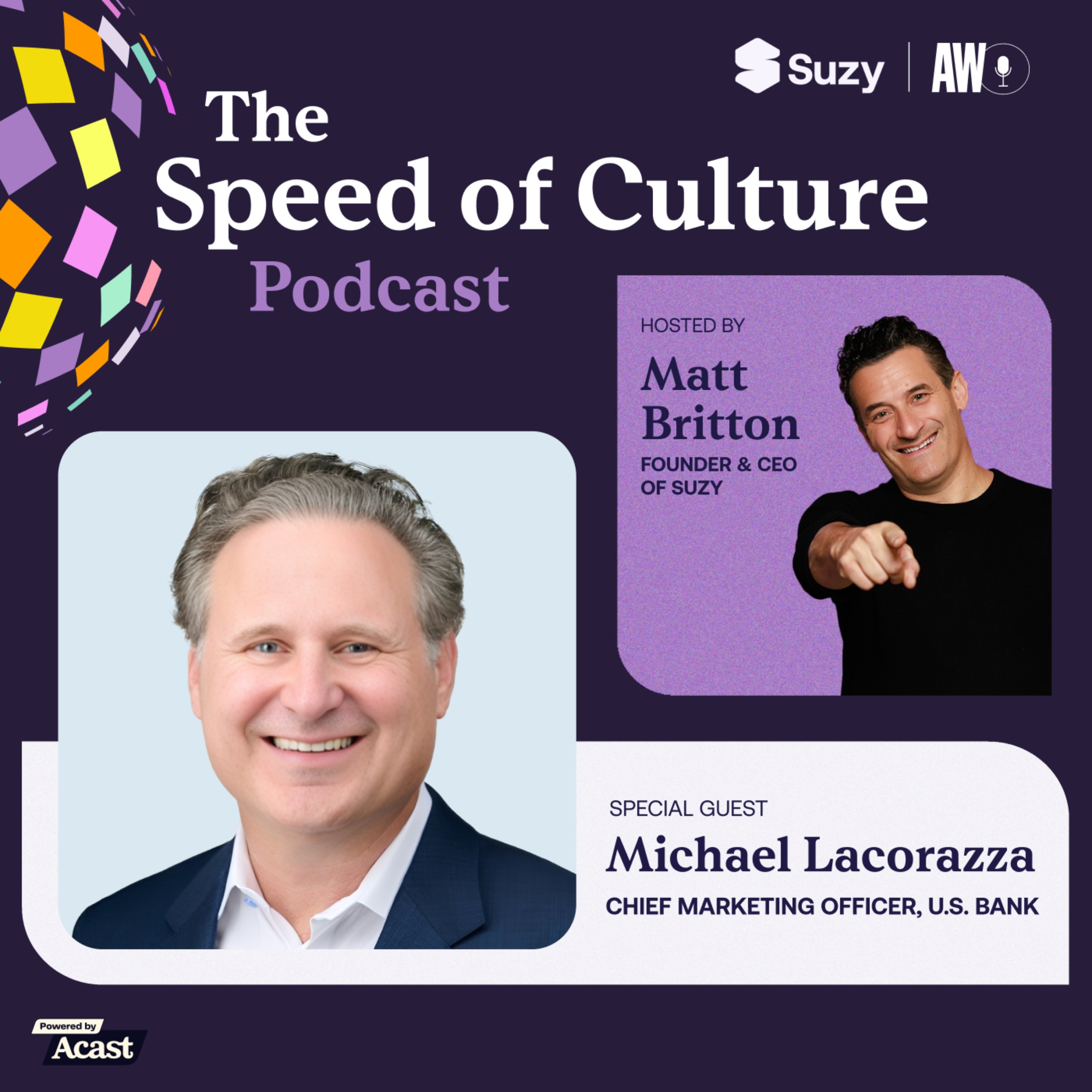
The Speed of Culture Podcast
Compound Growth: How U.S. Bank uses AI to drive revenue and results
00:27:55
Loading summary
Transcript145 lines
- [00:01]
Chelsea Bakken
Does using social media ever make you feel like you're just yelling into an algorithmic void? That feeds have started to feel a lot less, you know, social? Well, we're doing something about it. I'm Chelsea Bakken, Head of Audience Development and Social at Adweek, and I'm so excited to invite you to Social media week this April 14th through 16th. We're bringing together creators, marketers and social leaders in a vibrant IRL space in New York City for three days of connection, collaboration and learning. You'll get the chance to dish on the latest tools and tricks, hear fresh perspectives on the year's most viral moments, and get the slot free inspiration you need to connect with your audience and optimize performance. Head to adweek.com events to learn more.
- [00:41]
Progressive Insurance Announcer
This episode is brought to you by Progressive Insurance Fiscally responsible Financial geniuses, Monetary Magicians these are things people say about drivers who switch their car insurance to Progressive and save hundreds of Because Progressive offers discounts for paying in full, owning a home and more. Plus, you can count on their great customer service to help you when you need it. So your dollar goes a long way. Visit progressive.com to see if you could save on car insurance, Progressive Casualty Insurance Company and affiliates. Potential savings will vary. Not available in all states or situations does it ever feel like you're a marketing professional just speaking into the void? But with LinkedIn ads, you can know you're reaching the right decision makers. A network of 130 million of them. In fact, you can even target buyers by job title, industry, company seniority, skills and did I say job title? See how you can avoid the void and reach the right buyers with LinkedIn ads? Spend $250 on your first campaign and get a free $250 credit for the next one. Get started@LinkedIn.com Campaign terms and conditions apply.
- [01:47]
Michael Lacaraza
What I'm seeing right now is a couple of things. First is in terms of where it's driving. The most value for us is in the use of tools and techniques like synthetic audiences to be able to develop the strategies really quickly and develop creative ideas really quickly. We used that first with our brand campaign the Power of Us that launched in 2024 and it shaved the total cycle time development of the campaign in half from say six and a half months to about three months.
- [02:14]
Matt Britton
To thrive in a rapidly evolving landscape, brands must move at an ever increasing pace. I'm Matt Britton, Founder and CEO of Suzy. Join me and key industry leaders as we dive deep into the shifting consumer trends within their industry. Why it Matters now and how you can keep up. Welcome to the Speed of Culture. Up there on the Speed of Culture podcast. We are thrilled to welcome Michael lacaraza, the Chief Marketing Officer at US Bank. Michael is a transformational marketing leader who operates at the intersection of storytelling, technology, data, science and customer experience. Michael, thanks so much for taking the time here at CES to talk with us today.
- [02:51]
Michael Lacaraza
Thanks for having me today.
- [02:52]
Matt Britton
Absolutely. So it's interesting. You know, I've been coming to CES for the last 25 years, and when I started, it was truly just consumer electronics companies. You had companies that made TVs and dishwashers and, you know, this is MP3s. And now you have US bank here. Why is CES an important place for you as a CMO of US bank to start the year off?
- [03:12]
Michael Lacaraza
CES has become like a lot of other high profile events where the attendees live at the intersection of our world. A lot of marketers are here, brands, agencies, media companies, technology companies. So it becomes a place where we can actually accomplish quite a lot on the relationship building and the learning side in terms of getting outside input and outside thinking and fresh thinking. So that's what it's become for us. And it's amazing to see this year in particular how that leg of it has expanded so much.
- [03:44]
Matt Britton
Yeah, it's crazy to think about. I mean, I think that what you find to put at events like this is that no matter what industry you're in, people kind of share the same problems, the same challenges, same opportunities. Obviously, AI is something that goes across every category. And just curious, what are your Overall thoughts on AI's impact, both on your role as a CMO and U.S. bank's overall product, and how it touches and drives great experiences with your customers?
- [04:10]
Michael Lacaraza
Right. Well, that's a pretty big meta question.
- [04:13]
Matt Britton
Yeah.
- [04:13]
Michael Lacaraza
And I think maybe like a lot of other companies, we're on this journey to figure out how this is going to work for us and to plug in. And we have use cases in projects that are at various stages of development, some of which have been incredibly effective and promising, and some of which we just learned and said, oh, well, maybe that's not the right place to insert this. What I'm seeing right now is a couple of things. First is in terms of where it's driving the most value for us is in the use of tools and techniques like synthetic audio audiences to be able to develop strategies really quickly and just develop creative ideas really quickly. We developed that. We used that first with our brand campaign, the Power of Us that launched in 2024. And it shaved the total cycle time development of the campaign in half from say, six and a half months to about.
- [04:59]
Matt Britton
So you're creating synthetic audiences. And who's in the audience who doesn't know what synthetic audience is? It's essentially an audience that's modeled after a real audience that you would test advertising with, but. And it's made up of AI agents essentially, who are answering in a simulated form, like real consumers. And you're confident enough in that feedback that you're willing to use it as a key signal, as a guide for sure.
- [05:19]
Michael Lacaraza
And when we were first experimenting with this technology, we also ran human sort of parallel, answering some of the same questions. And with some refinement, we found, you know, it probably correlates like 95% of the time for what we're trying to do. So that's been really successful for us in terms of speed to market, getting insights, quickly, executing research.
- [05:39]
Matt Britton
Yeah.
- [05:39]
Michael Lacaraza
The other place that we're finding some success is in the growth space, which I find to be most exciting because the use cases for cost savings are more obvious in terms of automating processes and those types of things. But from my perspective, the real unlock is how do you leverage the technology to drive growth. So for us, number one is how are we using it to improve the actual customer experience, which then translates into higher satisfaction, which then translates into higher loyalty and retention, which has massive economic upside. And one example is we can feed data, behavioral data of our customers. Say they go onto one of our digital platforms and they get stuck somewhere. They're trying to move money or they're trying to do something. If something's not working for them, well, if they decide to call our call center, we can feed in insights that this customer got stuck here, and the call center rep banker can maybe intuit what the customer actually needs in a sense, when the call begins.
- [06:36]
Matt Britton
Right.
- [06:37]
Michael Lacaraza
And so it leads to faster problem resolution, better customer experience. Customer experience. And then of course, you want to have a situation where you never have any sort of problem whatsoever in your, in your digital channels, but it's just not, you know, it's not feasible like it's technology. Sometimes things aren't going to work quite right for a variety of reasons. But so when we incorporate those kinds of. And AI plays a heavy role in being able to synthesize this information and deliver it right through our CRM. The third way we're getting a lot of value and it's already now in the tens of millions of dollars, is through personalization. So it's as you can imagine, a company like ours, we have a tremendous amount of data on our clients, all permissioned, all transparent for how we use the data, and a very high expectation from our clients to say, hey, you know me, you should be, you should be like getting the advice and guidance.
- [07:25]
Matt Britton
Talk to me as an audience of many. Talk to me as an audience of one. Right, right.
- [07:28]
Michael Lacaraza
To the extent that's possible. So for us to be able to personalize content, advice, product suggestions, offers and so forth, that will resonate on a more one to one basis with people, we find that they respond by wanting to do more business with us.
- [07:41]
Matt Britton
Yeah, you talk about it almost like so matter of factly. And those examples are all really impressive for a company your size that you're actually putting it to work. Because many people I talk to on this podcast talk about what they're going to do. You're talking about things that you're doing, which is a big distinction. How have you been able to drive that transformation so quickly in your organization to give people confidence in synthetic audiences or confidence in using AI for personalization or customer experience? It's not easy because in doing so you have to change the way that many people work and get them to work together on that new way of working.
- [08:17]
Michael Lacaraza
That's a great framing of it. Right. So it's the journey is it requires huge commitments from cross functional partners to enable this. Right. So I would say are quite fortuitous to have a risk partnership and a legal partnership that's focused on, you can still kill it.
- [08:34]
Matt Britton
If you don't have the right legal team, you're dead in the water. Right.
- [08:36]
Michael Lacaraza
And the mental model is like, how can we help make the customer experience better? How can we help the business grow?
- [08:40]
Matt Britton
You don't want the same thing versus
- [08:42]
Michael Lacaraza
just saying, oh, that's too risky. It's a no. It's more like, okay, well it's how do we get to a yes? What considerations? What changes do we need to make? And that's been a really big unlock to have that sort of advocacy to make things possible. I would say the second thing is that for all the success or sort of opportunities that we've been able to unlock so far, we also know there's way more that we don't know than we know. So keeping a dose of humility and always being in learning mode is what makes it possible to move forward.
- [09:10]
Matt Britton
I also find, and I've experienced this in my own organization, when you roll out something new, there's people that feel threatened. There's people that feel threatened because they think it's going to eliminate their job. There's people that feel threatened because they don't understand it. And in order for you to deploy something new with AI you do need feedback from the organization because like even with synthetic, like you said, you tested it, but you don't really know how to build the right synthetic audience. And the first time it might be completely off and over time you trust the technology and you get there. Same with AI powered creative. And I find that it's hard sometimes to get people to go along with you on the journey because they're so quick to say, see, I told you it doesn't work. And those who know AI know that today is the worst it's ever going to be. And if it can do something just okay, today it's going to do that way in a mind blowing form a year from now. And you have to build your business to where the world's headed, not to where it was.
- [10:00]
Michael Lacaraza
That's a great point. Yeah, that's a fantastic point. I think you said it well.
- [10:04]
Matt Britton
Right.
- [10:04]
Michael Lacaraza
Yeah.
- [10:05]
Matt Britton
But like, but what do you do? I guess my question is, have you encountered that, you know, have you encountered people that in your organization that aren't willing to embrace change and how do you deal with that when you do?
- [10:15]
Michael Lacaraza
Well, a couple of ways. I think what I've learned in the course of my career.
- [10:19]
Matt Britton
Yeah.
- [10:20]
Michael Lacaraza
Having been at the nexus of many different change initiatives.
- [10:24]
Matt Britton
Sure.
- [10:24]
Michael Lacaraza
Is number one, you have to have a clear vision and a sense of where you're going and bring people along with it and bring people in to be a part of co creating it and crafting it.
- [10:35]
Matt Britton
Make them feel like they have a vested interest.
- [10:36]
Michael Lacaraza
Absolutely. You know, getting a sense of excitement about what the future brings. It's making maybe with the implementation of AI and so forth because it's potentially such a massively disrupted technology. You've heard it compared to industrial revolution and you know, these kinds of things. But you know, just because we got email and laptops doesn't mean that the world got decimated.
- [10:55]
Matt Britton
Right.
- [10:55]
Michael Lacaraza
We used to have to handwrite letters and send faxes. Like we don't really have to do that anymore. So it's number one bringing people on the journey for the vision that you have. And certainly there are going to be moments in time where you have to make some tough calls on do you have the right people and skills and leaders and mindset around you and you might have to make some changes.
- [11:14]
Matt Britton
Right.
- [11:15]
Michael Lacaraza
But from my perspective, if you can find that sort of formula where there's this inspirational tone and leadership and optimism about where it's taking you, it does help unlock it.
- [11:25]
Matt Britton
Yes.
- [11:26]
Michael Lacaraza
And I would say the last thing is that just being open and honest and transparent and acknowledging the anxiety that might exist, say, look, I know, I understand that there's potentially a fear about where this could go and what this could mean. And we know that that's a real fear. Right.
- [11:42]
Matt Britton
But we have no choice but to move forward.
- [11:44]
Michael Lacaraza
This is what we have to do. It's. It's a meta question essentially for the future of the business and of many businesses, people adopt this and you think about the various stakeholders that we support in terms of shareholders and employees and communities and so forth. I think in the board and so forth, that's helping guide us. You know, the expectation is that we're going to figure this out.
- [12:04]
Matt Britton
Yeah, absolutely. Let's talk about creativity for a second because that's one area, especially here at CES this year, that a lot of people are questioning. What is the future of creativity? We just had the CMO of Adobe here and we're talking with her.
- [12:15]
Michael Lacaraza
I love her, she's great.
- [12:16]
Matt Britton
Yeah. And talking about what creativity looks like in AI powered world. How do you look at AI's role in creativity Lay? And how does that change the role of the creative and how you're able to build effective stories for the brand?
- [12:28]
Michael Lacaraza
Yeah, well, in the current state, and I mentioned the synthetic audiences, it's more of like a tool to help you get insights and reactions.
- [12:35]
Matt Britton
Sure.
- [12:36]
Michael Lacaraza
And then for us, we also have some AI generation tool creative work that we use for like our in house teams that help us render images and so forth and do some things at scale that can be done maybe more quickly and efficiently than if we had to do everything through a live.
- [12:54]
Matt Britton
Especially if you're trying to do personalization.
- [12:55]
Michael Lacaraza
Yeah, especially if you're trying to do personalization at the same time. It's a very human business and there are humans predominantly making the content that we produce and there are humans that have to make the decisions and be accountable for what those outcomes are. So to my knowledge, the machines haven't really figured out how to take over everything that we do and what we bring to the table yet. And that may be further off than some people think for all the hype around it. I mean, I'll give you one example. Think about all of us that use various large language models, how you get hallucinations and you get wrong answers. So on Monday, I'm a huge NFL fan.
- [13:32]
Matt Britton
Yeah. As am I. What's your team?
- [13:33]
Michael Lacaraza
49ers.
- [13:34]
Matt Britton
I'm the Eagles. I don't know if we should be having this conversation. Yeah. By the signs this podcast comes out, one of us is going to be happier. Said. Right.
- [13:40]
Michael Lacaraza
Well, this is perfect then. Right?
- [13:42]
Matt Britton
Right.
- [13:42]
Michael Lacaraza
And we didn't plan this, by the way. No. But I asked Chad GPT on Monday, after all the games were complete, show me what the NFC matchups are. What were the seedings on the NFC? And I said, 49ers are playing the Carolina Panthers. And I went, I don't think so. I said, hey, the Carolina 49ers are playing the Eagles.
- [13:59]
Matt Britton
Right.
- [13:59]
Michael Lacaraza
And they were like. The device said, oh, yeah. Good catch, human. You're right. Pat me on the back. And I said, okay, so tell me more about the batches. We have some more dollar. I said, okay, so now summarize again. What are the matchups for the nfc? Because I just wanted to see, like, the list that I could just capture. Yeah. It played back to the false one again.
- [14:17]
Matt Britton
Wow.
- [14:18]
Michael Lacaraza
So I just use that as one small little analog. Because if the large language model, who is using massive amounts of compute power to even answer simple questions, can't get the simple questions right. Imagine when you extrapolate.
- [14:31]
Matt Britton
Yeah. Multiple data points.
- [14:34]
Michael Lacaraza
It's just.
- [14:35]
Matt Britton
You wish you were playing the Panther. Much easier matchup.
- [14:37]
Michael Lacaraza
When I first saw that, I was like, oh, that would be amazing.
- [14:40]
Matt Britton
Exactly. Right, Right.
- [14:41]
Michael Lacaraza
I don't know. That's not true. So in any case, I guess a long answer to a short question. I think humans have to be very involved in the creative process and the decision making, and we're ultimately accountable for the outcomes, not the machines. At least not right now.
- [14:55]
Matt Britton
I mean, so I'm glad you mentioned sports, because I know that US bank has been leaning in heavily into sports to build its brand. And passion points, obviously, are incredibly important. And we all know live sports is the last bastion of kind of live TV viewing at scale. And to bring people together. It's one of the few things actually in America right now where you bring people together and all cheering for the same thing as well.
- [15:18]
Michael Lacaraza
Yeah.
- [15:18]
Matt Britton
Right. So, yeah. What is your strategy around sports culture and passion points in general in terms of building the brand?
- [15:25]
Michael Lacaraza
Yeah. And it predated my arrival two years ago at U.S. bank. There was actually a pretty substantial investment in sports with various teams and so forth that we've been involved with. And when we do that sort of work, we're not only sponsors of the vikings and the 49ers and the Timberwolves and the Clippers, we're their bank. So we're doing business with them and we're supporting them. But I think because of what you just mentioned, which is the change in consumer behavior, especially for the younger generations, for how they're using social platforms and short form videos and doom scrolling and so forth, as well as the impact that streaming has had on consumption patterns and everything is sort of a la carte. You watch it when you watch it and you're not doing it collectively. Sports is one of the last communal based experiences that you can have. And even then for the younger generations, they're getting a lot of their sports through clips they're not necessarily watching.
- [16:15]
Matt Britton
They're consuming the songs, not the albums. Yeah, yeah.
- [16:18]
Michael Lacaraza
It's still.
- [16:18]
Matt Britton
It's fantasy gambling. It's like endless different, you know.
- [16:21]
Michael Lacaraza
Absolutely.
- [16:22]
Matt Britton
Points away points of entry into sports.
- [16:25]
Michael Lacaraza
Absolutely. And I have a teenage son and something that we do together. We love to watch sports of all different kinds. We have teams, we debate, we love these moments. But he'll sometimes like, send me a clip and I'm like, oh, did you see that game? He's like, no. But it was like he did because he got to consume the little piece of the game or pieces of the game that were the highlights and they feel like they're a part of it, even though they weren't actually part of the total experience. So the net of it is we're going deeper in that space. We're leaning into that as a major point of culture and cultural relevance. And we have what I think is a really authentic history and heritage to connect us with sports fans and, and our audience profiles align with those platforms really well. And so that's something that our teams will be going deeper in this year.
- [17:12]
Matt Britton
We'll be right back with the Speed of Culture after a few words from our sponsors.
- [17:16]
Progressive Insurance Announcer
Does it ever feel like you're a marketing professional just speaking into the void? But with LinkedIn ads, you can know you're reaching the right decision makers. A network of 130 million of them. In fact, you can even target buyers by job title, industry, company seniority, skills and. Did I say job title? See how you can avoid the void and reach the right buyers with LinkedIn ads. Spend 250 on your first campaign and get a free 250 credit for the next one. Get started@LinkedIn.com Campaign terms and conditions apply.
- [17:48]
Chelsea Bakken
Does using social media ever make you feel like you're just yelling into an algorithmic void? That feeds have started to feel a lot less, you know, social. Well, we're doing something about it. I'm Chelsea Bakken, Head of Audience Development and Social at adweek, and I'm so excited to invite you to Social media week this April 14th through 16th. We're bringing together creators, marketers and social leaders in a vibrant IRL space in New York City for three days of connection, collaboration and learning. You'll get the chance to dish on the latest tools and tricks, hear fresh perspectives on the year's most viral moments, and get the slot free inspiration you need to connect with your audience and optimize performance. Head to adweek.com events to learn more.
- [18:29]
Progressive Insurance Announcer
This episode is brought to you by Progressive Insurance. Do you ever think about switching insurance companies to see if you could save some cash? Progressive makes it easy to see if you could save when you bundle your home and auto policies. Try it@progressive.com Progressive Casualty Insurance Company and affiliates. Potential savings will vary. Not available in all states.
- [18:51]
Matt Britton
Let's talk for a second about the business of U.S. bank and the banking business. What are some changes you're seeing with your customer, your consumer, that is causing you to drive transformation in terms of your product offering, in terms of what consumers want in 2026?
- [19:09]
Michael Lacaraza
Yeah, well, one observation is that we're finding that oftentimes financial services companies will tend to approach the customer relationship at on an individual product at a time. Well, we're just, we're do a checking account and then we're going to do a credit card and we're going to do this and we're going to do that. And what we're finding is that the needs are more complex and there are these windows of decision making that customers have around their finances. And what they don't want you to do is to say okay, now I have a checking account and then for the next 90 days you're going to pound them to try and sell them up.
- [19:41]
Matt Britton
Sell them basically, right?
- [19:41]
Michael Lacaraza
Yeah, they've like they're making this decision, they're switching banks cover the needs that I have when I'm in the mindset of making this decision. And so what that's led to for us is a bundling of products together. So we have this smartly suite in our consumer franchise which is a combination of a checking account, a credit card and a savings account. And the more business that you do with us, the higher the interest rates that you learn on your savings and also the higher the rewards are for the cash back card, which is 2 to 4% depending on the balances that you keep and what we're finding, we rolled this out last year, is a couple of things. One, the sizes of the relationship that are coming in are larger, they're more loyal and stickier. And those customers are more satisfied to get a more complete solution right from the beginning. And so we've launched something really similar in the small business space where we have your money management, your day to day checking, but also you can accept payments like merchant processing. Right. So all in one. And so that's what's changed the nature of how we're kind of organizing our product set.
- [20:41]
Matt Britton
Yeah, I think as you look at also the customer, I would imagine they want to have new, easier ways to interact with the data behind their money, like chat based. How much money do I have in my checking account? Did this check clear? I would imagine over time that is going to be part of your product roadmap in terms of how consumers interact with their banking data.
- [21:01]
Michael Lacaraza
Yeah, that's a great point. And so that goes back to what we're talking about around personalization. Just how do you unlock insights for spending patterns, for things that are happening in their financial lives, credit scores, et cetera, and feed those into the digital experiences along the way?
- [21:17]
Matt Britton
Because you can benchmark and do all sorts of things to allow people. I mean, one of the big unlocks of AI is just data driven insights. Right. In a way that matters to you, but it's delivered in a conversational format. So you have all this data on a customer in terms of how they're spending their money, where they're spending their money, how that compares against other people like them or maybe a year ago. And that information can help guide their decisions in ways that are pretty meaningful. So now you're not just a functional offering, but you're an offering that can help them improve their life, improve their financial picture.
- [21:49]
Michael Lacaraza
Absolutely.
- [21:49]
Matt Britton
Yeah.
- [21:50]
Michael Lacaraza
Here's one really minor example where you can add value just by, by mining the customer data. So in our, in our mobile app, customers can give access to all the accounts that they have from other institutions, credit cards, accounts, whatever, and organize it. But then they can look at and see all the subscriptions that they have on all of their accounts, not just ours. If they don't do it, if they don't work with us exclusively, sure.
- [22:12]
Matt Britton
They can connect their other credit cards.
- [22:14]
Michael Lacaraza
They can connect it. And then we have like a function that says, like, here are your subscription services.
- [22:18]
Matt Britton
Right.
- [22:19]
Michael Lacaraza
So how many times do you want to pull up, I don't know, at least once a year and say, God, what did I Sign up for.
- [22:23]
Matt Britton
I do it all the time.
- [22:24]
Michael Lacaraza
Yeah.
- [22:25]
Matt Britton
It just creeps in. Yeah.
- [22:26]
Michael Lacaraza
And you see the bill come through sometimes the charger. Oh, I'll get to that. I'll get to that. And you never do. And then six months later, you've spent like 500 on subscriptions.
- [22:33]
Matt Britton
Right.
- [22:34]
Michael Lacaraza
So that's just a really small example of how we're using data in a personalized way that's adding value in the customer experience.
- [22:40]
Matt Britton
And it's also, I think, a roadmap for a lot of companies, regardless of industry, that one of the moats in the era of AI is data. If everyone's access to large language models, what's going to differentiate you is data. And the more customer data you can get, the more value you can offer and the stickier you're going to become.
- [22:56]
Michael Lacaraza
Absolutely, yes.
- [22:57]
Matt Britton
That's sort of.
- [22:58]
Michael Lacaraza
Yeah. And the key for us on that is I think the trust in the data sits at the center of it with the customer. So being really crystal clear about what's being permissioned, what you're opting into, what's the value exchange that you get in return for that, and then also responding to what they expect us to be able to deliver, having access to their data.
- [23:16]
Matt Britton
Absolutely. So, shifting gears as we wrap up here, Michael, it's been such a great conversation. We'd love to hear a little bit about you and your career journey. More specifically, when you look back at your career, what are some of the things that you think you did right along the way to put yourself in the CMO seat? We have a lot of listeners, the podcast, that are in earlier stages of their career that want to be a CMO one day and any wisdom you can impart on your journey. And obviously, we don't always make the right decision. So if you want to talk about maybe some things you wish you did, but just any learnings from your journey.
- [23:46]
Michael Lacaraza
Yeah, well, so if I were to summarize my journey so far, I've had the privilege of working across a number of different categories. So I started in automotive. I worked in hospitality at Marriott, I worked in real estate. I worked in the agency side. Then I went to financial services, and in between, Wells Fargo, where I spent about a decade and where I am now, at US Bank, I was the CEO of a consumer technology company. So really kind of varied experience, and the value of that, of just learning new businesses and learning new categories is the way it kind of expands your thinking and keeps you fresh, but also keeps you challenged. Because I had a great career when I was at Lexus and Toya. I love that company, but I took that risk to go work at Marriott and move across the country. And if I'd stayed in the automotive business, I'd probably still be doing that. I would be in a place where that's what I would be seen as only qualified to do.
- [24:39]
Matt Britton
Right.
- [24:39]
Michael Lacaraza
And so if you get more variability in terms of the businesses that you get exposure to, it gives you more options. How do you want to operate later in your career? And that's how I've constructed it. The second thing is a number of the decisions that I made in career choices were not linear ascension growth choices.
- [24:56]
Matt Britton
Right.
- [24:56]
Michael Lacaraza
So when I decided to go work on the agency side of the business, it was because I felt like I needed to have that sort of experience in making the sausage for clients, be on the service side, and also to accelerate my own immersion into the digital tools and experiences. Because this was 2005. Right. So 20 years ago, it was like two years before the iPhone. Google search.
- [25:20]
Matt Britton
Facebook launch.
- [25:21]
Michael Lacaraza
Yeah. So Facebook, you know, just launched. They were still basically in colleges until like 2007. So it was like, hey, I'm going to take either a lateral or maybe even kind of a step back in terms of compensation and title and so forth, but I'm going to learn a lot. And so not being afraid to make those choices that aren't always up and up and up is one of the hardest things to do, but it's one of the most valuable choices that I. Yeah.
- [25:46]
Matt Britton
And then, like, how do you gain the conviction to make the leap? So you're at Lexus and you take like those hard decisions and how do you know when it's right?
- [25:52]
Michael Lacaraza
That's a great question. Well, I think it's easier to do when you're earlier in your career because there's less to lose. You have less to lose. You might still be single, you probably don't have a family yet, you don't have as many kind of connection points that might anchor you or might introduce risk for change into the process. So it's much easier to do then, and I would say take advantage of that. Not be like a hopper, but get fresh opportunities. And then I'd say the next thing is being really honest about what you know about yourself and what is it that you need and what is it that you desire and where you want to go. And when you understand that, then it's not that difficult ultimately to put together the matrix of what the pros and cons are. And then once you make that decision, just commit and go and just don't look back. It doesn't mean if you made a bad decision, you can do something else. Like this is a great country. You have opportunities to make adjustments. It's not nothing set in stone.
- [26:49]
Matt Britton
That's right. I think that's great advice to wrap here. We often have to ask our guests if there's a saying or mantra to help sort of encapsulate their career journey. And you've been to so many great places. What comes to mind for you?
- [27:01]
Michael Lacaraza
Two things. And one, I just wanted to wrap up this last section as like a piece of career advice which I think is maybe even more important than what I said, which is learn the business, understand how your customers make decisions, understand how the P and L works, understand what the levers are, what the drivers are, the competitive landscape. When you know the business, it makes you so much more competent to make decisions in your function, but also gives you that credibility with your business partners to sit toe to toe and be able to speak their language. If you come in. If I came in with my CEO and started talking about impressions and clicks, right. She'd be like, what?
- [27:40]
Matt Britton
Yeah. Cause that's not what.
- [27:41]
Michael Lacaraza
That's not cares about.
- [27:42]
Matt Britton
Right.
- [27:42]
Michael Lacaraza
Our metric.
- [27:43]
Matt Britton
Right.
- [27:43]
Michael Lacaraza
Our metric is growth. Wall street doesn't care about it just says so. If I didn't have some semblance of how the P and L works, I wouldn't be able to have intelligent conversations.
- [27:53]
Matt Britton
And same with ad agencies. Ad agencies sometimes lose sight of the business they're working for and what their client really cares about and they focus on winning a can lie in or impressions. It's like that's not going to move the needle on the business. That's not going to drive shareholder return. Like that's where you need to focus.
- [28:10]
Michael Lacaraza
It's a great point. It's. And there were even one more step removed from it, which makes it even harder because they don't necessarily have access to the internal insights, although those.
- [28:17]
Matt Britton
But that data is more easy than get your finger on never before in the age of AI.
- [28:21]
Michael Lacaraza
Yeah. So that's what I just. My point is just learn the business. And especially as you become more senior role that that expectation that you're going to learn it is really important and it is something that you do every day. You don't come in like, you know, even having worked decades or decade whatever, you never know everything. There's always something more to learn, always something more to go deep on. And I think for me it's been really helpful and it's given me a lot of confidence in what I'm doing now.
- [28:49]
Matt Britton
Yeah, I think that's awesome. I'm glad you added that, because I think a lot of people do say that in the midst of them just trying to deliver whatever the test is,
- [28:57]
Michael Lacaraza
it's hard because, like, hey, this is what I'm accounting for, right? Yeah, like, this is what I've got to do. But at the end of the day, if growth is the metric, then what are you doing to drive growth? And how are you measuring that? And how are you demonstrating the value?
- [29:08]
Matt Britton
Yeah, absolutely. So, going back to my question earlier, is there a saying or mind that comes to mind?
- [29:13]
Michael Lacaraza
So I have one that it may be completely off? There's no wrong answer, but. So for me, my mantra is find gratitude in life every single day, especially when you're under great stress and adversity.
- [29:29]
Matt Britton
Pressure's a privilege, right?
- [29:30]
Michael Lacaraza
Pressure is a privilege. But all of us will go through moments in time where we have disruption in our families, tragedies, setbacks at work, setbacks in companies, health, et cetera. And every day that you can find just a little bit of gratitude in your heart, it will help propel you forward. I know that sounds like a no answer, but it's really true.
- [29:51]
Matt Britton
I think you take a lot of things for granted in life, and any moment where you would take a step back and you love what you do and you're surrounded by those that you like working with or your family. So many people in this world would kill for a situation like that. Right? So just be happy with where you are for sure. And nothing's ever perfect, right?
- [30:08]
Michael Lacaraza
No, it's not.
- [30:09]
Matt Britton
Well, I have a lot of gratitude for you taking the time today to take some time out of your busy CES schedule and share your story and your insights with us. I think our audience is going to get a lot of value. So thank you so much, Mike.
- [30:17]
Michael Lacaraza
Thanks for having me.
- [30:18]
Matt Britton
Awesome. On behalf of Suzy and Adwee team, thanks again to Michael Lacaraza, the Chief Marketing Officer of US bank, for joining us here live at CES in Las Vegas today. Be sure to subscribe, rate and review the Speed of Culture podcast on your favorite podcast platform. Till next time, see you soon, everyone.
- [30:30]
Chelsea Bakken
Bye.
- [30:31]
Matt Britton
Bye. The Speed of Culture is brought to you by Susie as part of the Adweek Podcast Network and a guest Creator Network. You can listen subscribe to all Adweek's podcasts by visiting adweek.com podcasts. To find out more about Susie, head to Suzy.com and make sure to search for the speed of culture in Apple, Podcasts, Spotify, or anywhere else podcasts are found. Click follow so you don't miss out on any future episodes. On behalf of the team here at Suzy, thanks for listening.
- [31:17]
Progressive Insurance Announcer
Does it ever feel like you're a marketing professional just speaking into the void? But with LinkedIn ads, you can know you're reaching the right decision makers, a network of 130 million of them them. In fact, you can even target buyers by job title, industry, company, seniority, skills and Did I say job title? See how you can avoid the void and reach the right buyers with LinkedIn ads. Spend $250 on your first campaign and get a free $250 credit for the next one. Get started@LinkedIn.com Campaign terms and conditions apply.
- [31:50]
Chelsea Bakken
Does using social media ever make you feel like you're just yelling into an algorithmic void? That feeds have started to feel a lot less, you know, social? Well, we're doing something about it. I'm Chelsea Bakken, head of Audience Development and Social at Adweek, and I'm so excited to invite you to Social media week this April 14th through 16th. We're bringing together creators, marketers and social leaders in a vibrant IRL space in New York City for three days of connection, collaboration and learning. You'll get the chance to dish on the latest tools and tricks, hear fresh perspectives on the year's most viral moments, and get the slot free inspiration you need to connect with your audience and optimize performance. Head to adweek.com events to learn more.
- [32:30]
Progressive Insurance Announcer
This episode is brought to you by Progressive Insurance. Do you ever find yourself playing the budgeting game? Well, with the name your price tool from Progressive, you can find options that fit your budget and potentially lower your bills. Try it@progressive.com, progressive Casualty Insurance Company and affiliates. Price and coverage match limited by state law, not available in all states.