← The Speed of Culture Podcast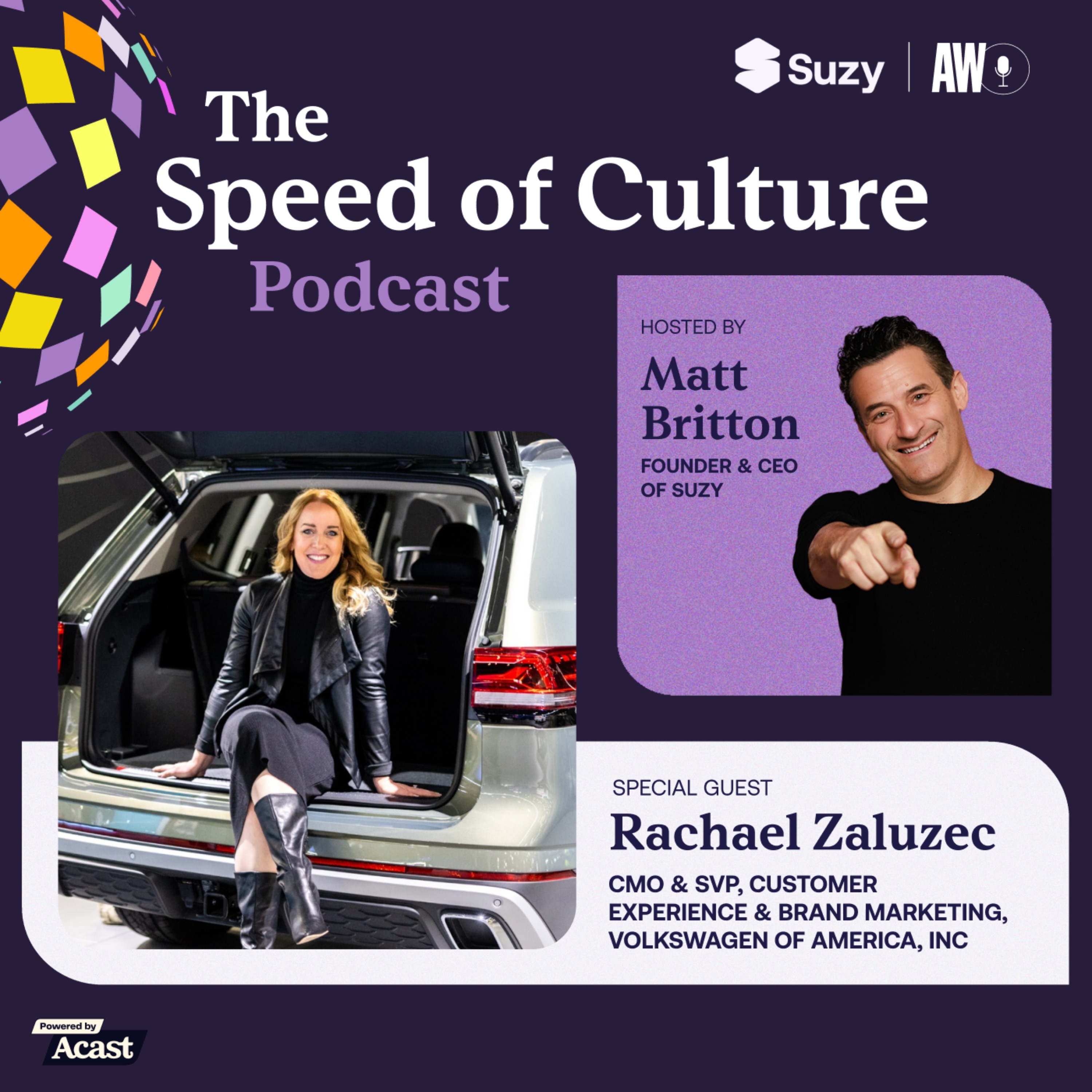
The Speed of Culture Podcast
Drivers Wanted (again): How Volkswagen balances automation with the human side of mobility
00:28:05
Loading summary
Transcript77 lines
- [00:01]
Chelsea Bakken
Does using social media ever make you feel like you're just yelling into an algorithmic void? That feeds have started to feel a lot less, you know, social? Well, we're doing something about it. I'm Chelsea Bakken, head of audience development and Social at Adweek, and I'm so excited to invite you to Social media week this April 14th through 16th. We're bringing together creators, marketers and social leaders in a vibrant IRL space in New York City for three days of connection, collaboration and learning. You'll get the chance to dish on the latest tools and tricks, hear fresh perspectives on the year's most viral moments, and get the slot free inspiration you need to connect with your audience and optimize performance. Head to adweek.com events to learn more.
- [00:41]
Expedia Advertiser Voice
Martha listens to her favorite band all the time.
- [00:43]
Matt Britton
In the car, gym, even sleeping.
- [00:49]
Expedia Advertiser Voice
So when they finally went on tour, Martha bundled her flight and hotel on.
- [00:52]
Matt Britton
Expedia to see them live. She saved so much she got a seat close enough to actually see and hear them. Sort of. You were made to scream from the front row.
- [01:02]
Expedia Advertiser Voice
We were made to quietly save you.
- [01:04]
Matt Britton
More Expedia made to travel Savings vary and subject to availability. Flight inclusive packages are atoll protected.
- [01:13]
Expedia Advertiser Voice
Does it ever feel like you're a marketing professional just speaking into the void? But with LinkedIn ads, you can know you're reaching the right decision makers. A network of 130 million of them, in fact. You can even target buyers by job title, industry, company seniority, skills and. Did I say job title? See how you can avoid the void and reach the right buyers with LinkedIn ads. Spend $250 on your first campaign and get a free $250 credit for the next one. Get started@LinkedIn.com campaign. Terms and conditions apply.
- [01:44]
Rachel Zaluzak
So putting this movement out there, this campaign out there was really intended to do just that. To remind people that there's a way that you can own the road. There's a way that you can own your own destiny, not just waiting on your phone for somebody else to come pick you up and take you along for the ride.
- [02:01]
Matt Britton
To thrive in a rapidly evolving landscape, brands must move at an ever increasing pace. I'm Matt Britton, Founder and CEO of Suzy. Join me and key industry leaders as we dive deep into the shifting consumer trends within their industry, why it matters now, and how you can keep up. Welcome to the Speed of Culture. Update on the speed of Culture PodC. We are thrilled to welcome Rachel Zalusek, the Chief Marketing Officer and Senior Vice President of Customer Experience and Brand marketing. At Volkswagen of America, Rachel leads marketing and customer experience for one of the world's most iconic automotive brands, with a focus on putting people, not just products, at the center of everything Volkswagen does. Rachel, so great to see you today.
- [02:42]
Rachel Zaluzak
Thank you so much for having me, Matt.
- [02:44]
Matt Britton
Absolutely. We're going to dive right in. The automotive space is so fascinating because used to just be about the steel and tires and the car. Used to just be about getting you from point A to point B, but now it's become so much more, and a lot of the car is really becoming a platform. Their software platforms or media environments, their data engines. So how do you see Volkswagen really redefining the product when the car is really increasingly AI powered and personalized and digital even?
- [03:10]
Rachel Zaluzak
It's a great question. Well, let's start with yes. Automotive marketing has always been about the metal. Unless you're Volkswagen. Volkswagen messaging has always been a little bit different. Right. It's always been a little bit more storytelling, talking about the fact that we're a brand with a personality, we're a brand with emotion. And that is what has, you know, historically, particularly, particularly in the US Drawn so many people to the Volkswagen brand and really makes us stand out and makes us a little different. But to get to your point, you're right. Vehicles are increasingly more complicated. It's no longer just the mechanical side of it. It's the technology, it's the software, it's the infotainment side of the vehicle. And that's where I think Volkswagen, and frankly, everybody else needs to lean in a little bit more to humanize. And maybe I'm biased because I've been with Volkswagen for so long, and Volkswagen is a driver's car. It's about experiencing it. So making sure that as we continue to innovate the vehicles just like everybody else needs to, you want to have the latest software, you want to have the latest tech, you want to have the latest AI, but you want to have it with the same type of personality and touch and feel that you get from a brand. So an example of that, some of the things that we're doing is we do have AI embedded into some of our products. For example, in our electric vehicles, you can say, hey, Ida, the car responds back to you. You can ask the vehicle questions. You can give the vehicle command. So you're almost talking to it like you have a relationship, which I don't know about you. I know so many people, particularly Volkswagen drivers, name their vehicles.
- [04:42]
Matt Britton
Right, right. They have for a long time.
- [04:44]
Rachel Zaluzak
Exactly. So making sure the Tech still has that level of personality, I think is critical, particularly when you have a brand like the Volkswagen brand.
- [04:53]
Matt Britton
Yeah. I mean, it's interesting you say that because that's kind of where all of technology is going. Right. I mean, if you look at Gen Alpha, they're going to be known as the AI generation, and they're never going to know a world where you can't interact with technology like another person. You know, people are getting into relationships with their AI chatbot and conversing with them like they are humans. And to the extent that people have always called their Volkswagen vehicles like human names, I think that's where the world is headed overall, and I think it's going to evolve. Humans relationship with technology.
- [05:22]
Rachel Zaluzak
Exactly. And again, giving that vehicle a personality is just one more way, particularly to your point with the younger generation, to make them want to participate in the vehicle, make them want to drive, make them want to engage in ways that to be kind of surprised, there's a lot of kids who generally are hesitating to get their first license, which blows my mind. And I mean, that's the first thing that at least when I was that age, that's the first thing anybody wanted to do is get that freedom, get that license and get out on the road. So enabling things like technology, like personalization, I think is going to really help move that forward as well.
- [05:56]
Matt Britton
Yeah, I mean, if you look at 10, 20, 30 years ago, there was no Uber and we had this huge urbanization boom where many more people live in cities now when they're teenagers than they did in the past, where it used to be that the city was more for professionals and when people had families, they would move out to the suburbs with the white picket fence. But now you find a lot of people who are 18, 19, 20 years old being in the city. In a lot of instances, even their parents never really had the drive and they're taking Ubers, et cetera. We are seeing a reversal of that, I think, post Covid, where you see secondary and tertiary markets where people are moving more to the suburbs. And I think that is driving a renewed interest in automobiles for younger consumers. Is that something that you're seeing? How are you looking at just broader consumer trends as it relates to more the entry level in the automotive industry?
- [06:42]
Rachel Zaluzak
Well, I think what you described is absolutely tied into why we wanted to relaunch drivers wanted and relaunch that campaign, really to recruit people back into not just the brand, but into that type of transportation, into that. The fact that they're in charge of their life. They're in charge of their mobility.
- [06:59]
Matt Britton
Make it yours.
- [07:00]
Rachel Zaluzak
Exactly. In terms of freedom. So putting this movement out there, this campaign out there, was really intended to do just that, to remind people that there's a way that you can own the road. There's a way that you can own your own destiny. Not just waiting for on your phone for somebody else to come pick you up and take you along for the ride.
- [07:17]
Matt Britton
Yeah, that's right. So one thing I'm sure you have to contend with as someone who's stewarding the Volkswagen brand Ford is just kind of this balance between leaning into the heritage and trust that's associated with Volkswagen, but at the same time contemporizing it for tomorrow's driver. And just in terms of the brand itself and the brand equity pillars and how you look at driving that along, no pun intended, how do you look at that balancing act?
- [07:40]
Rachel Zaluzak
Well, and it was a particular tightrope, I would say, with this campaign as well, because you don't want to just be nostalgia. You don't just want to be rinse and repeat. Something that, quite frankly, was brilliant the first time around. And I've been with Volkswagen long enough to have been here the first time that Drivers Wanted came around.
- [07:58]
Matt Britton
Right. So you're talking about the revitalization or the revival, I should say, of the Drivers Wanted campaign, which let's maybe zoom out and tell us about. For those who don't know the history of the Drivers Wanted campaign and why you think lineagenet nostalgia makes sense right now.
- [08:13]
Rachel Zaluzak
Absolutely. So for those who aren't as familiar. So Driver's Wanted was originally the campaign in the US between about 95 and 2005. And it really was on the heels of that campaign with, of course, some pretty revolutionary product like the New Beetle, that Volkswagen really had a big resurgence in the US and when you think about what that campaign was about, it was about targeting a slightly younger generation. It was about a mindset. Right.
- [08:38]
Matt Britton
It was very applesque the way that you guys brought that product back.
- [08:41]
Rachel Zaluzak
Yes, absolutely. So, again, look at the environment today, look at culture today. We needed that shakeup for all of the reasons that we were just talking about. There are people who are living a life that's really programmed, that's living a life that's somebody else is, be it AI, be it an Uber driver, be it whomever is making decisions for us is really laying that groundwork. So when we talk about reviving it, yes, there's a little bit of nostalgia there, but it's more than nostalgia because it's reclaiming what we stand for and not just recreating the past, but transitioning that spirit into today's world and transitioning that invitation into today's world.
- [09:21]
Matt Britton
I like that. I think we are in a world right now where we feel like the human is being lost in all of this, in a world that's increasingly automated and we're hearing about AI and robotics everywhere and, you know, the feeling of being a driver and being controlled, both in the realistic sense of driving a car, but also kind of the analogy of charting your own course, I think, in some ways is more relevant today than it even was back then.
- [09:44]
Rachel Zaluzak
Exactly. So that's why I really think it's going to resonate not only with those who aren't as familiar with the Volkswagen brand, Right, the younger generation who's looking for something to own, but that is also going to resonate with those of us who, quite frankly, do remember the first time around and think, you know what, Yeah, I liked it back then. I was motivated and I had that ownership back then to really kind of span the generation with this message.
- [10:08]
Matt Britton
It's not lost on me, though, that when you look at it tycoon, like drivers want it, we are entering an era of autonomous vehicles. And while it hasn't hit mainstream here in the us, you know, it's coming. And just curious, like, what are your thoughts about the future of autonomous vehicles and what is Volkswagen's published roadmap in that area?
- [10:28]
Rachel Zaluzak
I would say it's obviously coming autonomous driving for so many reasons. And I think that the piece about that, that is a great benefit, not only to the industry, but to everyone, is the safety element that comes from it. Because at the end of the day, in the driver's seat, you've got a human. But anytime you can enhance that with additional safety features, I think there's a benefit to it. When you talk about some of the autonomous driving that you see out there on the road today, where literally you'll have people hands off in some cases, in other products, you're reading books, not paying attention. In my mind, that's not what being in a car should be. That's not what being a driver should be. I'm all for all of the added safety features that ADAS systems, as we call them, they'll bring to a vehicle. But beyond that, for me personally, and particularly being in the suburbs of Detroit, being in a place where driving is an experience and not just being a passenger, it's something that I think we should use to enhance the experience not take over the experience for now, at least.
- [11:25]
Matt Britton
Right. Who knows where the technology is going to go and where culture is going to go? But yeah, for today, I do believe driving is a big part of culture and society and really the rite of passage and the experience of growing up and charting your own course.
- [11:36]
Rachel Zaluzak
But that said, you did ask about what is the Volkswagen roadmap in that regard. And there is a considerable amount of work that our organization is doing, and specifically when you talk about autonomous driving with the ID buzz, because in that space, autonomous driving does offer accessibility to individuals who may not otherwise be able to either have a vehicle drive a vehicle. So again, it's the enhanced safety features, but it's also the freedom and accessibility it gives to individuals who may not be able to completely take the driver's seat on their own. And that's where a lot of the research and the development and work that Volkswagen doing today can really be seen.
- [12:17]
Matt Britton
We'll be right back with the Speed of Culture after a few words from our sponsors.
- [12:20]
Expedia Advertiser Voice
Does it ever feel like you're a marketing professional just speaking into the void? But with LinkedIn ads, you can know you're reaching the right decision makers. A network of 130 million of them. In fact, you can even target buyers by job title, industry, company seniority, skills and did I say job title? See how you can avoid the void and reach the right buyers with LinkedIn ads. Spend $250 on your first campaign and get a free $250 credit for the next one. Get started@LinkedIn.com Campaign terms and conditions apply.
- [12:53]
Chelsea Bakken
Does using social media ever make you feel like you're just yelling into an algorithmic void that feeds have started to feel a lot less, you know, social? Well, we're doing something about it. I'm Chelsea, back in head of audience development and Social at adweek, and I'm so excited to invite you to Social media week this April 14th through 16th. We're bringing together creators, marketers and social leaders in a vibrant IRL space in New York City for three days of connection, collaboration and learning. You'll get the chance to dish on the latest tools and tricks, hear fresh perspectives on the year's most viral moments, and get the slot free inspiration you need to connect with your audience and optimize performance. Head to adweek.com events to learn more.
- [13:33]
Rachel Zaluzak
Try angel stuff for your tushy. It's made by Angels Soft and strong. Budget friendly the choices Simple. Pick up a pack today. Angel Soft Soft and strong Simple.
- [13:52]
Matt Britton
So back to the Drivers wanted campaign. We are now on the eve of the upcoming super bowl, which is taking place in Santa Clara, and your brand has made the decision to take advantage of the big game moment and activate this campaign around the Super Bowl. Just curious, what gives you conviction to make such a big investment and talk to us about the process of creating a campaign around it and how you're feeling leading into the game?
- [14:17]
Rachel Zaluzak
Yeah, absolutely, I will. Because it's never a small decision to go to a platform like that. And I'll be honest, the campaign was something that we always had in mind. We'd been working on it for several months about really talking about who Volkswagen is positioning the brand in the market, positioning us for a different audience. And that was outside of the Super Bowl. And this year was planned to be the year of this whole new messaging platform that we had. Then I saw the work and I said, there is nowhere else that we can possibly relaunch the brand than in that moment. I said it in 2024 when we went to the super bowl for the last time. You only take a step like that if you've got something to say and something critical to say, right?
- [15:00]
Matt Britton
Go big or go home for the Super Bowl.
- [15:01]
Rachel Zaluzak
Right? Exactly. And not since a significant time, since the last time we had a big meaningful moment like this from a brand perspective, not just a product perspective, but truly a brand message. There's nowhere else to launch it. So when the work was done, then we actually made the decision to go to the Super Bowl. It wasn't the other way around. And we were fortunate enough and we were let know that there was a spot available in something that was previously already sold out. So I think that's the universe telling us that this is the place for this spot to air.
- [15:32]
Matt Britton
So it's like it was an idea finding a Super bowl, not the super bowl finding an idea, which a lot of times, what brands do, they say, we're buying a spot, figure out what the place there. But what you're saying is as soon as you saw the concept and the creative, you knew that this needed to be on the biggest stage.
- [15:47]
Rachel Zaluzak
In fact, the creative was already done. And so 100%, you're right. It was too good not to get the eyes, to get the attention, to get the message across, not only for all of America, let's face it, but it's also really important for our dealer network, for our employees, you know, for something this big to really have the gravity to it as well.
- [16:05]
Matt Britton
Now, of course, the super bowl is never just about the super bowl game itself. When you're talking about advertising, there's so much that goes into the pre promotion and the digital extensions, social media, et cetera. How are you looking at this as kind of like a more integrated experience as you roll it out?
- [16:21]
Rachel Zaluzak
Fantastic question. Because just like I'd mentioned, this was a360 campaign before the super bowl was ever even an option. So the teams had already been building out a very social first approach and not just in linear in our social channels, in streaming, in podcasts, but also out of home. So you will see this full campaign and not just in this moment, frankly, throughout the whole rest of 2026. And one thing that I'm super excited about this One is the 30 seconds in the super bowl is intended as a moment to get attention and drive everybody to all of the rest of those mediums of those channels. Because then you get the full experience of all of the different ways that we're activating it. For example, we've got some social gorilla type tactics that are going to be talking about what does Volkswagen stand for? They'll be provocative enough to say, okay, that's interesting enough for me to follow. And we'll have messaging with different creators, different individuals who are already friends of the brand, who already are drivers, basically saying, look, I'm here, I'm already part of the club, come join us as well. So again, it's a movement, it's a message, it's not just a commercial, it's an invitation for everybody to engage with us in all of the different areas. That will be very cool.
- [17:41]
Matt Britton
I can't wait to see this all unfold. I'm glad you mentioned creators because obviously the super bowl is arguably the last bastion of live television. At scale, every year, 90 plus out of the top 100 watched live programs are NFL games. And obviously the super bowl, you know, is the penultimate moment of that entire trend. And outside of that, you really do have to rely on capturing consumers eyeballs in a lot of different ways. And as you look at Gen Z, which this year by the way, for the first time ever, a first time mother, the average age of first time mother in the US is Gen Z and Gen Z is the iPhone generation. If you want to reach consumers, you need to reach them on their device and on their mobile device. And when you're reaching them on a mobile device, it's generally through creators. So just curious like how you looking at the importance of creators and are we at the point where they are driving more influence over car consideration? And a lot of the Traditional channels. And just how is that evolution occurring in your mind from a seat of a cmo?
- [18:46]
Rachel Zaluzak
Absolutely. Creators and content in that format is becoming bigger and bigger and bigger. And particularly again when we're talking Volkswagen brand, when we're talking about a message like this, it's the human element of the message, so delivered with authenticity from somebody who's speaking from their own experience means so much more than your typical metal commercial on the road. Yes, we do still need to have feature first automotive work because a vehicle is a substantial investment. People want to know what is the equipment?
- [19:17]
Matt Britton
0 to 60.
- [19:18]
Rachel Zaluzak
Exactly. All of those facts matter. But what also matters just as much as somebody validating it and somebody that the person on the other end of the screen trusts to actually be speaking genuinely about it. So that's why you will see with this campaign, not only just the look and feel of the linear work itself, but all of the extensions are just that there are actual drivers speaking about what does either their vehicle mean to them or what does the concept of being a driver mean to them. The concept of creativity, of freedom, the concepts of confidence that we really want to convey throughout the message, it's less about a demographic and it's more about a value. And that's what I think is going to really resonate.
- [20:01]
Matt Britton
Absolutely. So you'd mentioned earlier the super bowl is not just for your consumer audience, but it's also for your entire ecosystem, including the dealers. And just want to double click a little bit on the dealership experience because obviously as time passes, consumers are going to increasingly expect like Amazon level simplicity when it comes to buying cars. But it still remains somewhat complex. And just curious, like, how do you think the dealership experience is going to evolve over time? I mean, everyone that works in the auto industry knows how important dealers are to their success in your dealer network. But in terms of the consumer experience, how do you see like elements like AI evolving?
- [20:39]
Rachel Zaluzak
That where I think AI can help most is in the education process, because you mentioned it. Buying a car is complicated and it's next to buying a home in terms of the degree of investment. But also you've got financing, you've got insurance, you've got all of of those other components beyond just the metal itself. So as much as dealerships or OEMs supporting the dealerships can help demystify and decomplicate that process for consumers who, you're right, they're used to transacting on things quick and fast with a button. That's not necessarily the way 100% that this shopping journey should be because you need to be comfortable, you need to feel safe, you need to understand how the product works. So helping streamline the technology, helping streamline the explanation of the process, helping streamline the application process, I think that is where the user experience, that's where the journey can really optimize. But what I will say is, in my honest opinion, there is nothing more important than truly having trust and confidence in the person that is handing that vehicle over to you. And that's where dealerships 100% are so very critical and are so essential to the Volkswagen brand. Because in many cases, like I said, it's a major investment. You might be moving your family and that investment, you may not turn a wrench on your own. So you want to know that there's some place to go to make sure that that product is taken care of. And that's where, in my opinion, AI is never going to step in to have that handshake, that trust element that is so critical.
- [22:15]
Matt Britton
Absolutely. So you've been at Volkswagen in various different roles for nearly or perhaps over 25 years. I was doing the math quickly, looking at your LinkedIn, but you've been at the company for a long time and we've talked about in ways how things have changed, but at the same time stayed the same. But when you look at your role as a cmo, what do you think is still true about what would have been a CMO role, maybe 10 to 15 years from now or ago, rather? And what is completely different and what's going to continue to change about the job? Because it's increasingly complex. Right. It used to be about having a big checkbook and buying radio spots on the few radio stations that controlled the airways, and same with broadcast tv. And now it is so fragmented, it is so data driven, so technologically infused. What does that mean for the role of the cmo?
- [23:04]
Rachel Zaluzak
It means you have to stay on top of everything.
- [23:06]
Matt Britton
So how do you do that? You listen to Speed of Culture podcast.
- [23:09]
Rachel Zaluzak
Exactly. Let's first talk about what's the same and then let's talk about what you need to do differently. I think the things that are the same are one, marketing is. It's about storytelling, but it's about storytelling in the right medium, with the right message to the right person. And so that, I don't think has changed now. The platforms have changed, the audience ability to target has changed, and frankly, to your point, the shopping experience has changed. But the other thing that is critical and I think for every CMO to remember, is we're not just here to tell stories. We're not just here to give moving messages, because those moving messages, those stories need to compel people to take an action. We're here to support the business in ways that are critical. So that also is no different in the pressure to make sure that you're demonstrating the result is also, in my opinion, no different than it's been. But the things to your point that make it easier and harder at the same time are the technology advancements that we have. We understand so much more from a data perspective of what works and what doesn't work. We can use information to better understand our audience, to better understand what they want to see and where they want to see it and how they're interacting with those messages. But again, to your point, that also means you've got all of these different options of channels, all of these different options in media. How do you decide, how do you decide where to show up? How do you measure all of those? And how do you explain it all to individuals in different boardrooms who aren't familiar with marketing and think, wait a minute, you just put a commercial on, where's the immediate result? So it's made. In my opinion, the role of the CMO has had to be a data architect. You've had to be an IT person in terms of understanding the pipes and the channels and how everything connects. Also have to do a good amount of sales and not selling literally the product, selling the reason for invest, selling the ROI of the work that we do because again, it changes so dramatically and so frequently that those who are not in this space, in this discipline, there's no way they would normally keep up.
- [25:17]
Matt Britton
Absolutely. I know another big part of your role is leading a team and as the world changes so much. Just curious. I know you've also spent some time in HR throughout your journey at Volkswagen. Just curious because we have a lot of younger listeners here on the podcast. What is some advice that you have for junior level people entering your career in terms of the areas that you think they should focus on to remain relevant in the marketing space as the world changes so fast?
- [25:44]
Rachel Zaluzak
It's a great question and I will say it and you saw it on my LinkedIn. I have pretty non traditional path to get to where I am and I think that has only benefited me. So I think I've got two pieces of advice that I would generally give. One is diversify yourself. You mentioned it. I started in human resources. After human resources I went to customer experience. I did some time in digital. Did some time supporting other functions around the organization. So that while I may not absolutely have touched every area, I know enough about the business to be able to use those different tools to make decisions. So just somebody who only sticks within a direct line in the marketing space may not necessarily have the context that the other business units have to make decisions. So really going sideways before going up I absolutely think is essential for career growth, particularly today, because resources are constantly going to get more constrained so you can rely on those different tools in problem solving that you wouldn't necessarily otherwise.
- [26:50]
Matt Britton
It's interesting because like so many people in this Instagram driven generation, just, I think especially younger people seem to be losing patience for the journey and they just want it all right now because they're looking at everyone else's highlight reels or mistakenly they think everyone else has it now. And that kind of goes against the path that you're talking about, which is go sideways, get different types of experience. You can be a little bit more of a generalist because things are emerging together. And I think it's such an important lesson that you shared.
- [27:17]
Rachel Zaluzak
Exactly. And then the second piece of advice is do hard stuff. And that's what I think so many people are afraid of. They're afraid to make mistakes or they're afraid of big scary problems, but in those big scary problems are where honestly some of the biggest lessons that I personally have learned that I've seen others learn as well. And not being afraid to run towards a challenge has really helped me get exposed to so many different things, get exposed to so many different people because it's in those pressure moments, it's in those intense moments that you have some major breakthroughs. So I think those are two things that I encourage my team to do that I encourage my daughter to do that. I encourage anybody who's really looking to expand and grow their career.
- [27:59]
Matt Britton
That's fantastic advice to wrap up here. And again, this has been such an amazing conversation and so thankful that you took time to have it during such a busy pre serve bowl week. But just curious, when you look back at your career journey, what was maybe the thing that you think you focused on that helped you the most in putting yourself in the CMO seat where you are today?
- [28:20]
Rachel Zaluzak
That's a great question. And particularly being in marketing now versus being exclusively in customer experience and now pulling them together, making sure that we understand or that I understood what was legitimately happening in our customer base, be our customer base, those who are driving our vehicles, or our dealer network themselves as a customer on the Team like.
- [28:42]
Matt Britton
Ears to the ground not being disconnected from it.
- [28:45]
Rachel Zaluzak
Exactly. And it's so easy for somebody to sit in an ivory tower at an OEM and come up with big ideas and have no idea if it's credible or if it's relevant or if it's going to completely fall on deaf ears because it's disconnected from what the actual experience that customers are having. And one thing that I often say is I want to make sure that any message that we put out there for somebody who's currently driving a Volkswagen, they've got that badge in their driveway. I'm speaking to them just as much, if not more, than speaking to somebody that we want to bring into the brand because again, they've got our logo, they've invested the money, they are showing up. If they're at barbecues, at work, at stoplights, representing us. So making sure we're thinking about the existing customer as much as the new customer, I think that's what's impacted me directly.
- [29:35]
Matt Britton
I love that. So the wrap up here, we always ask our guests if there's a saying or mantra that comes to mind when they think about their professional journey to date. So what do you got for us, Rachel?
- [29:44]
Rachel Zaluzak
I think I already told it to you. Don't be afraid of hard stuff.
- [29:47]
Matt Britton
Right on. Yep. And, you know, that is the whole thing where, like, everything you want is on the other side of fear and what's the worst that can happen. And I think people often don't bet on themselves. And I think ultimately betting on yourselves is what it's all about if you really want to optimize your potential.
- [30:03]
Rachel Zaluzak
I couldn't agree more.
- [30:04]
Matt Britton
Yep. Well, wishing you nothing but the best of luck with Super Bowl Sunday and a new revitalized campaign and continue to be a fan from afar of you and the Volkswagen brand and can't wait to see what's down the road for you. So thanks so much for joining, Rachel.
- [30:18]
Rachel Zaluzak
Thank you so much, Matt. This has been great.
- [30:19]
Matt Britton
You thank Absolutely. On behalf of Susie and I, we team. Thank you again. The Rachel Zaluzak, the Chief Marketing officer and Senior Vice President of customer experience and Brand Marketing at Volkswagen of America, for joining us today. Be sure to subscribe, rate and review the Speed of Culture podcast on your favorite podcast platform. Till next time. See you soon, everyone. Bye bye. The Speed of Culture is brought to you by Suzy as part of the Adweek Podcast Network and Agas Creator Network. You can listen subscribe to all Adweek's podcasts by visiting adweek.com podcasts to find out more about Susie. Head to Suzy.com and make sure to search for the speed of culture in Apple Podcasts, Spotify, or anywhere else podcasts are found. Click follow so you don't miss out on any future episodes. On behalf of the team here at Suzy, thanks for listening.
- [31:20]
Expedia Advertiser Voice
Does it ever feel like you're a marketing professional just speaking into the void? But with LinkedIn ads, you can know you're reaching the right decision makers. A network of 130 million of them. In fact, you can even target buyers by job title, industry, company seniority, skills and Did I say job title? See how you can avoid the void and reach the right buyers with LinkedIn ads. Spend $250 on your first campaign and get a free $250 credit for the next one. Get started@LinkedIn.com Campaign terms and conditions apply.
- [31:53]
Chelsea Bakken
Does using social media ever make you feel like you're just yelling into an algorithmic void? That feeds have started to feel a lot less, you know, social? Well, we're doing something about it. I'm Chelsea Backin, head of Audience Development and Social at Adweek, and I'm so excited to invite you to Social media week this April 14th through 16th. We're bringing together creators, marketers and social leaders in a vibrant IRL space in New York City for three days of connection, collaboration and learning. You'll get the chance to dish on the latest tools and tricks, hear fresh perspectives on the year's most viral moments, and get the slot free inspiration you need to connect with your audience and optimize performance. Head to adweek.com events to learn more.
- [32:33]
Rachel Zaluzak
Work moves fast. Every email, report and proposal counts. That's where Grammarly comes in. It's your one place to think, write and finish.
- [32:42]
Matt Britton
Grammarly's AI agents help you find natural phrasing, fine tune tone, and confidently write wherever you work. It's the premier writing tool that 93% of users trust to get more work.
- [32:54]
Rachel Zaluzak
Done in a world of generic AI.
- [32:56]
Matt Britton
Don't sound like everyone else. With Grammarly, you never will.
- [33:00]
Rachel Zaluzak
Download Grammarly for free@Grammarly.com.