← The Speed of Culture Podcast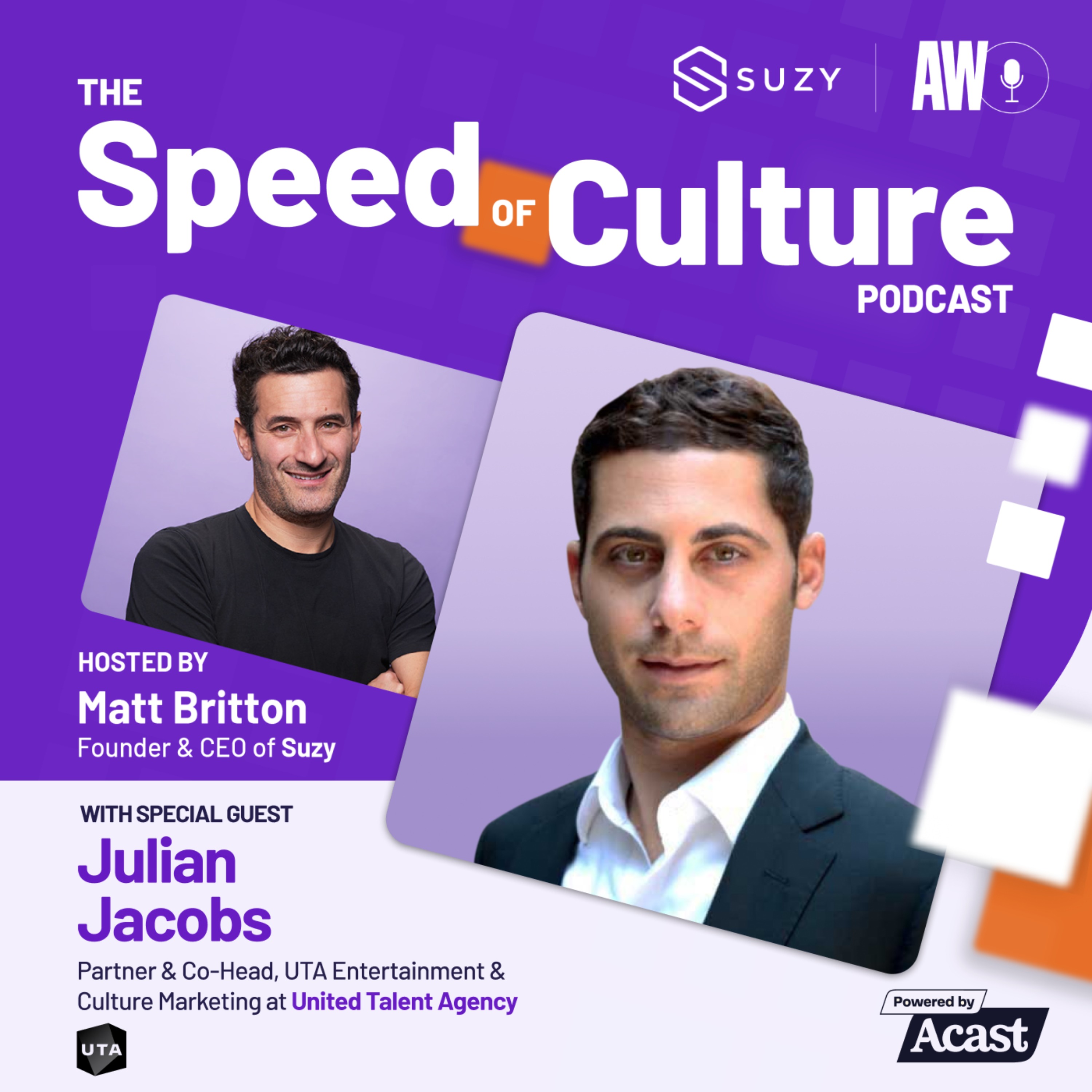
The Speed of Culture Podcast
Finding Comfort in Chaos: Julian Jacobs on Driving Impact with UTA
00:30:16
Loading summary
Transcript92 lines
- [00:00]
Julian Jacobs
To make switching to the new Boost Mobile risk free, we're offering a 30 day money back guarantee.
- [00:05]
Matt Britton
So why wouldn't you switch from Verizon or T Mobile?
- [00:07]
Julian Jacobs
Because you have nothing to lose. Boost Mobile is offering a 30 day money back guarantee. No, I asked why wouldn't you switch.
- [00:13]
Matt Britton
From Verizon or T Mobile?
- [00:15]
Julian Jacobs
Wouldn't. Because you love wasting money as a way to punish yourself because your mother never showed you enough love as a child.
- [00:22]
Matt Britton
Whoa, easy there.
- [00:23]
Julian Jacobs
Yeah.
- [00:23]
Matt Britton
Applies to online activations. Requires port in and auto pay. Customers activating in stores may be charged non refundable activation fees. Hey, corporate types. Billy Idol here. Just because you use workday to drive long term success, it doesn't make you a rockstar. Rockstars drive fast cars, not business operations. Be a finance and HR rockstar with workday.
- [00:50]
Julian Jacobs
How can we as a brand add value to not just the promotion, but to the creative experience you're trying to portray with your project? When we have been able to successfully broker those conversations, we see that those partnerships really not just sing, but also last.
- [01:09]
Matt Britton
To thrive in a rapidly evolving landscape, brands must move at an ever increasing pace. I'm Matt Britton, Founder and CEO of Suzy. Join me and key industry leaders as we dive deep into the shifting consumer trends within their industry, why it matters now, and how you can keep up. Welcome to the Speed of Culture. We're here live at CES in Las Vegas and today we're thrilled to chat with friend Julian Jacobs, head of UTA New York and co head of entertainment marketing. Julian is at the helm of some of the most groundbreaking work in entertainment, sports and culture marketing. From aligning global brands with cultural moments to expanding UTA's presence everywhere. Julian, great to see you today.
- [01:49]
Julian Jacobs
Great to see you. Thanks so much for having me today.
- [01:51]
Matt Britton
So you've been at UTA since 2009? It's a long time.
- [01:55]
Julian Jacobs
Long time.
- [01:55]
Matt Britton
Tell me about your earliest memories joining UTA and how the company has changed over the last 15 years. When you've been there.
- [02:02]
Julian Jacobs
Yeah, sure. I started my career in the mailroom at the agency.
- [02:05]
Matt Britton
You literally started in the mailroom.
- [02:07]
Julian Jacobs
Started in the mailroom. It still exists. We still have a mailroom today. But I came to the agency back then thinking I wanted to be a film agent. So came into the agency's motion picture lit department. Found myself immersed in the world of feature film back then and really loving, really starting to understand how a global talent agency works and the intricacies of the relationships and the intelligence that a platform like UTA has access to. And I also Started to realize that while I have a passion for film, that I wasn't really sure that's what I want to dedicate my career to.
- [02:44]
Matt Britton
Right.
- [02:44]
Julian Jacobs
And so I found myself playing the game of reading scripts and suggesting filmmaker ideas, although not sure exactly that's where I wanted to go to get to the next step, which was working for the. One of the leaders of the agency back then, who today is our CEO, Jeremy Zimmer. So I think one of the defining moments of my career as I look back inside of uta, was going into a role of supporting Jeremy during a time when the agency and the entertainment industry was really experiencing some pretty significant and rapid growth. And I really learned the art of agenting from Jeremy. And I was able to at that time, also sort of find my mentors inside of the company, which is so.
- [03:27]
Matt Britton
Important, which is really important.
- [03:28]
Julian Jacobs
You know, there's a Goldman Sachs executive named Carla Harris who talks a lot about finding your mentors. And I saw her speak during that time and there were some things she said about that that really rang true. And Jeremy and several others really took me under their wing and really taught me how to use and put to work a company like uta, whether it's for an actor, a filmmaker, or a brand. I took a bit of a left turn off the film track and started to go work in this amorphous role of business development during a time rapid agency and industry growth, as I mentioned, and didn't really know what I wanted to do, but I knew UTA really well. I knew how it worked, and I knew that there was opportunity to figure out how we could put the agency to work in different and unique ways for corporate clients, which is the sort of the beginning of what became the journey to build the marketing group.
- [04:20]
Matt Britton
It's interesting, there's a lot to unpack there, but I think a lot of people in this day and age, younger people look on Instagram, they see people, quote, unquote, killing it, and they just want to get there. But you started in the mailroom and then you worked for someone who would become the CEO of uta, Jeremy, and you basically just cut your chops and you understood that you had to learn a lot. And at the same time, it sounds like you also grappling with. You had this personal passion in film. And we all get to a point in our lives where we're like, okay, well, maybe that passion is not going to be our career. So that actually happened as well. And I think those are all good lessons for some of our younger listeners here is that, yes, you can be passionate about something, but that might parlay into a different part of the career. And yes, you have to do things that you might not want to do at the beginning to get to where ultimately you want to be.
- [05:02]
Julian Jacobs
Being open minded has been sometimes hard but rewarding. And there's been multiple times throughout my career inside of the company where I think having an open mind created opportunity for myself. I also think being comfortable in being uncomfortable is kind of the art of being an agent. And I really tried to embrace that. And not always needing to know the answer, but needing to know how to get the answer is something that I really tried to take to heart as well.
- [05:32]
Matt Britton
Yeah. The world of Hollywood itself has obviously changed over the last 15 years. Now I would argue the center of gravity has moved from Hollywood to Silicon Valley. With everything that's happening in the streaming world and big tech, etc. What is the state of Hollywood today? How are people feeling in the industry and where do you think it's all going to go in light of streaming AI, we'll talk about, etc. But just from your point of view.
- [05:56]
Julian Jacobs
Wow, that's a big question. I'm not sure I'm fully equipped to answer that question, but I'm going to do my best. I think we are definitely at a big inflection point in Hollywood and where we sit at uta. The company today is not just Hollywood. Although we started as a talent agency, we've evolved to be in sports and music and so many other parts of the business. But I think what's been exciting is where there's disruption and chaos, there's opportunity.
- [06:23]
Matt Britton
Yeah.
- [06:23]
Julian Jacobs
And even though there's a lot of pain being felt by some of the big media companies and budgets being down and still the entertainment industry coming off of what was a really challenging year with the Hollywood strikes, we have a positive outlook. And I think that the opportunity, quite frankly, for also brands and advertisers has never been greater. Not just to embark on finding ways to tell stories, get closer to content creators themselves, but also to partner with some of these media companies and streaming organizations to sort of innovate the way that they've been working together. And I think we're sort of at this really interesting time where there are no rules and new ideas and new innovations around how brands and content converge is happening. And so really excited to see that come to life.
- [07:11]
Matt Britton
So that leads to your role or what you're running today, which is obviously playing at the crossroads of entertainment and brands. So tell us a little bit about your role at UTA and how you spend your time every day.
- [07:23]
Julian Jacobs
Yeah. I have three jobs effectively within the organization. I oversee the entertainment marketing business at the agency in partnership with my partner, David Anderson. And that is the group at UTA that is leading the work that we do with corporate clients in the entertainment and culture space. We have a team of over 70 executives around the world. London, New York, Los Angeles, Atlanta. And we are focused on using UTA's intelligence as well as the company's relationships with the creative community to create strategies and partnerships for brands. In addition to that, I also am involved in other businesses that touch brands at the agency, working closely with our endorsements department, medialink, as well as other parts of the business. And as of March last year, I took a pretty big step in change and moved to New York to help spearhead our New York office, where I am overseeing sort of the operations of the New York office, where we have almost 400 executives from amazing divisions. Theater, news, speakers, music, and parts of our brand business. And really helping think about how the agency can grow its profile and presence in New York as well.
- [08:32]
Matt Britton
Of course, you're moving closer to Madison Avenue, which is the heart of advertising, and probably will enable you to be closer to the heartbeat that touches these brands and helps them close the gap and build awareness through entertainment. You guys are working with so many of the biggest brands. Delta, Google, General Motors, Coca Cola, et cetera. What are some of the major challenges that a CMO is facing right now when they come to your organization looking for the right types of partnerships to build relevance with consumers?
- [09:00]
Julian Jacobs
I think one of the biggest challenges that CMOs face today is the we all know the traditional ways of reaching audiences through media is getting harder, and the sliver of marketing that was the sliver of driving cultural resonance is becoming more important.
- [09:19]
Matt Britton
Yeah.
- [09:20]
Julian Jacobs
And I think that for a CMO today to try to understand what's coming in the cultural zeitgeist that may align with their brand, their products, their services, and understanding that intelligence, as well as thinking about how you make marriages with people, places and platforms across that cultural ecosystem, that sliver of marketing that was always just that sliver off to the side, has become a much more important part of the equation. And I think the hardest part for a marketer today, it's not easy to figure out the programmatic and where you're going to buy and place your media bets and the buys. But it's pretty hard and pretty risky at times to also navigate the world of culture. But I think today, as marketers look to connect With Gen Z Millennials, the next wave of young consumers, that sliver has never been more important.
- [10:16]
Matt Britton
Absolutely. I mean, you have to get it right. And obviously the brands are taking a leap of faith and trusting your expertise, because in a lot of ways they don't really know. And maybe you guys have seen it so many times before and maybe you have conviction about a show or an artist or an actor and you know they're going to be big, but they don't. And they have to trust your intuition. They have to trust your insight in that my brand fits this genre or fits this character, so I'm going to move forward.
- [10:43]
Julian Jacobs
Yeah. I think that there is also this big challenge right now for marketers not only to grasp an understanding of what they're going to do with that sliver of marketing that is meant to drive cultural impact that is becoming increasingly important, but also within that, how do you really navigate and develop direct relationships with a lot of the creative decision makers across that cultural ecosystem? Because as we talked about earlier, there's so much dysfunction going on, not just in Hollywood, but with media, legacy media companies. The creator ecosystem has become more convoluted and complicated and many more players. So we really believe that if we can bridge the relationship and the gap between a brand as well as the creative decision maker behind that project, whether it's a concert tour, whether it's a show, whether it is an athlete, we really are believe in building those direct relationships, because when we do that, we get that right. We've seen the partnerships around those relationships that come to life really sing. I mean, that's how, you know, we look at some of the work over the last 12, 24 months. I think we're really proud of the work for General Motors in the filmed entertainment space. And what was one of the biggest marketing partnerships between a brand and a piece of content with Barbie and gm? Yeah, that really started with a relationship we built between General Motors and Greta Gerwig. And through that and through the support of the film and some of the production elements, that partnership became what it became. And we've seen that time and time again. We're really excited just a couple of days ago around the return of White Lotus and some of the big marketing partnerships around that project, including two that we put together with American Express and Google. And I think those partnerships, while ultimately lots of different players and media that may inform those partnerships, there's also a lot of direct relationships between the creative decision makers that we help try to bring to life.
- [12:38]
Matt Britton
So, like in the case of White Lotus and American Express and Google and then when they enter, integrate into the show, Obviously you don't have creative control like Mike White, who is the producer, I guess, of White Lotus ultimately is going to decide how the brands go into the script. So the brands almost have to take a leap of faith knowing this show is right for me. We're going to give our brand to the creators of the show and let them kind of implement it as they see fit. Is that generally how it works?
- [13:04]
Julian Jacobs
Often that's how it works. And I think the spirit of what we're trying to do is really be able to have a conversation with Mike White about, hey, we really want to support the show. And whether that's in the show or around the show, how can we as a brand add value to not just the promotion, but to the creative experience you're trying to portray with your project? When we have been able to successfully broker those conversations, we see that those partnerships really not just sing, but also last.
- [13:34]
Matt Britton
Yeah, I mean, in the case of Barbie, having the Chevy Corvette in the actual movie is so iconic. And that movie ended up obviously blowing away expectations. So that must have been a home run for GM for you to be able to place them in the center of that huge cultural moment.
- [13:47]
Julian Jacobs
It was a really big win. And a lot of what also we do together with Susie and UTA is also try to bring data and insights into some of the decisions we put forward, both pre deal and post deal. And look, we had been tracking Barbie from its early inception. At some point it was set up at Sony and it was supposed to be Amy Schumer. And there was seven, 10 iterations of what the Barbie movie was going to be with Mattel. And ultimately, as Greta came onto the project and it moved over to Warner's, it started to pick up some traction again. But there were so many signals based off of some of the data that we have and some of what consumers were saying about the film that led us to all believe that this was the right step.
- [14:28]
Matt Britton
We'll be right back with the Speed of Culture after a few words from our sponsor. Hey, corporate types. Billy Idol here. Just because you use workday to drive long term success, it doesn't make you a rock star. Rockstars drive fast cars, not business operations. Be a Finance and HR Rockstar.
- [14:47]
C
With Workday, 89% of business leaders say AI is a top priority. But with AI tools popping up everywhere, how do you separate the helpful from the hype? The right choice is crucial, which is why teams at one third of Fortune 500 companies use Grammarly with over 15 years of experience building responsible secure AI. Grammarly isn't just another AI communication assistant. It's how companies like yours increase productivity while keeping data protected and private. Designed to fit the needs of business, Grammarly is backed by a user first privacy policy and industry leading security credentials. This means you won't have to worry about the safety of your company information. Grammarly also emphasizes responsible AI so your company can avoid harmful bias. See why 70,000 teams and 30 million people trust Grammarly@Grammarly.com Enterprise that's Grammarly.com Enterprise Grammarly Enterprise ready AI.
- [15:52]
Matt Britton
So obviously there's the Barbies and the White Lotuses and you have these big kind of cultural events and movies and shows that everyone talks about. But at the same time, as you mentioned earlier, you have the creator economy and you have this sort of like groundswell of individual creators that are creating content every day, in some cases very niche fashion, in other cases, like Mr. Beast, he's getting more scale than most Hollywood celebrities are. Where do you see that all converging? And when you have a CMO reach out to your organization, are they increasingly asking about the creator economy as part of their overall strategy?
- [16:24]
Julian Jacobs
Yes, the creator economy is a topic that consistently comes up still with brands, CMOs, marketing leaders that we engage with, talk to. I think that we're sort of at this interesting inflection point in the creator economy and from my perspective, which is that it's become, I think, a little tired. Yeah, I think a lot of marketers know that they have to engage with creators, but it isn't as maybe exciting and buzzy as it once was.
- [16:54]
Matt Britton
Saturated.
- [16:55]
Julian Jacobs
It's saturated. It's become really media focused and media saturated and disingenuous. I would say a little disingenuous too. When we talk about the creator economy. I think there could be so much that fits within that. Not just traditional digital influencers, but so many other pieces or other types of creators across verticals and genres. But I think what we've really been focused on is sort of the upper funnel of the creator economy and trying to help brands identify more strategic long term partnerships with creators across different tiers and across different levels and let some of the more traditional holding companies manage the media flow of driving amplification. And I think there's some really interesting things going on in the creator economy that are going to affect how brands engage. UTA has been in the creator space for over a decade. We were the first talent agency to launch a digital representation business back when this thing called YouTube started and we've created some of the biggest, most important events and businesses within the creator economy, from VidCon, which we sold to Viacom, to Awesomeness TV, which became the leading teen and tween network back in the day, we sold at DreamWorks. And more recently we've been working with creators to build businesses. Emma Chamberlain and her Chamberlain coffee and Issa Rae and a handful of things.
- [18:08]
Matt Britton
She'S doing by the upper funnel.
- [18:09]
Julian Jacobs
The upper funnel. But I think that as creators are now building businesses, I think that there's interesting ways that brands can get involved in the incubation and the support of those businesses and view creators as a business partner, not just a channel.
- [18:25]
Matt Britton
Yeah. I mean, if you look at George Clooney and the success he's had and ryan Reynolds and Dr. Dre and there's so many examples and obviously Kylie Jenner and Kim Kardashian, these celebrities have done such an incredible job job at leveraging the power of their personal brand to drive such outsized returns and outside smash hit stories. And that shows the power of Hollywood like you're showing it in terms of the outcome and the results. And if you were starting a brand right now, I think you'd be hard pressed to really break through in certain categories without having a celebrity behind you.
- [18:58]
Julian Jacobs
Yeah. I really think that this is the future of a big. Part of what we'll see in celebrity and brand partnerships as well is it's not just about the face, the name, the likeness, but about the brand in the business.
- [19:10]
Matt Britton
Yeah.
- [19:11]
Julian Jacobs
And we've seen that with people like Reese Witherspoon and her hello Sunshine.
- [19:14]
Matt Britton
Yeah. We do a lot of work with them.
- [19:15]
Julian Jacobs
It's a red hat brand business. And Ryan and what they're doing at maximum effort and.
- [19:20]
Matt Britton
And LeBron James at Springhill and Kevin Durant who we're partners with at Boardroom. I mean, the athletes are doing it as well.
- [19:26]
Julian Jacobs
Yeah.
- [19:27]
Matt Britton
Who understand how they command the power of their audience and they create real enterprise value.
- [19:31]
Julian Jacobs
Yeah.
- [19:31]
Matt Britton
Speaking of sports, is that something that continues to be of top of mind for brands just based upon the eyeballs and engagement that sports brings?
- [19:40]
Julian Jacobs
A thousand percent. I am not the sports expert at uta, but I'm involved in our sports business. And we've been in the game in a real way for a number of years, which started with our partnership with Rich, Paul and Klutch, which really has become the anchor for the way in which we have moved into the sports business and today represent some of the most influential athletes on the Court across basketball, soccer, football, baseball, and has started to move also into the sports advisory business, which is a really exciting growth area for us as an agency. I think that, you know, I was reading some of the. What are people excited about in 2025? And I always think what Rich Greenfield has to say at LightShed is interesting, and his account of some of the biggest rights deals which are up and, you know, the ufc, we're sitting here, I think set against Netflix's debut of Monday Night Raw. I think sports is only going to continue to become a powerful plat for brands to reach audiences. But I also think sports is coming back in an interesting way that goes beyond just sports. And I think that the way we've seen sports converge with celebrity, sports converge with fashion, sports converge with wine, sports converge with streaming is going to make sports become a more important cultural platform, moment, destination for all of us.
- [21:05]
Matt Britton
Yeah, I mean, I'm a huge sports fan, and growing up, your only way to interact with an athlete was getting them on tv. And when I was young, it was even hard to even watch games all the time. Like, a lot of the NBA games weren't even always on tv. And now you have constant access. And we actually had the CMO of the Kansas City Chiefs on the podcast, and we've had the CEO of Overtime, which is an incredible sports media company. And what they all say is the same thing, that Gen Z consumes sports differently. They consume the songs, not the album. It's very much about the highlights. It's built for the flick. Their engagement with athletes is so much different because of social media, because of fantasy sports, because of gambling, which is obviously has positive and negative implications, but it's everywhere you look. And obviously for brands, if you want to capture eyeballs, you look at the super bowl, you look at college football championship, you look at F1, it's like that's where you're getting engagement and there's not many other places to do it. All the great properties that you guys represent are streams. So it's just a different dynamic and it's equally as important. But if you want that live interaction, sports is where it's at.
- [22:08]
Julian Jacobs
Yeah, look, there's gotta be some cleanup in the way we access some of these sporting events as consumers. The. The chaos between flipping between 25 services to find your thing is crazy.
- [22:19]
Matt Britton
Yeah.
- [22:19]
Julian Jacobs
Is still crazy. I think that's gonna get worked out.
- [22:23]
Matt Britton
Well, one of the big companies is gonna write a check and I mean, you already have Google and Amazon already all over the NFL and the NBA and Apple's Major League Baseball and mls. I mean, it's all kind of happening. And for a While it was DirecTV and before that was the networks. It's just kind of showing the show shift where it's going on. It's fascinating to see, for sure. So you're here at ces and obviously CES is such an interesting time because it's the beginning of the year and everyone's fresh. All this great innovation is everywhere. What are you most excited about for your business in 2025?
- [22:55]
Julian Jacobs
As you mentioned, being here live together at CES. There's a couple of things that ring true for me as I think about the start of the year CES and what's to come in 25. And I can't help but think about just this afternoon, Delta Airlines, who's been a 10 year client of mine and the agency is celebrating their 100th anniversary in the sphere with some really big announcements and a huge presence here at CES and some big innovations in the world of aviation they'll be announcing. And I think about some of the conversation we had earlier in my career inside of the agency and it's sort of this surreal moment because Delta was my first client.
- [23:32]
Matt Britton
Wow.
- [23:33]
Julian Jacobs
And they were sort of the validator of this idea that we could really put the agency to work in a different way to help drive real commercial value for an organization. And the early days of working with Delta was not about celebrities, was not about consumer marketing. It was about using our agency as a vehicle and a platform to actually drive more travel business. From entertainment media to the airline, it was a real B2B play. And the growth we've had with them and the relationship we have with them, not just as an agency, but with people, is remarkable. So while they're celebrating their hundredth in a couple of hours, I've been with them for ten of those hundred. So I'm not going to take too much credit, but I think when you look at the power of the Delta brand and what Alicia and Tim and Ed and leaders at that organization have done and where they're heading, it's remarkable. And I think that the opportunity for advertisers to pick up that sliver of cultural relevance that everybody has recognized has become increasingly important and mandated in order to get things right as a marketer sets 25 up to be a really exciting year in the world of brand entertainment and a really exciting year in the world of advertising. I think we are going to see some innovations in the way that brands engage with Creators, innovations in the way that brands engage with content and real disruption in at the intersection of content and commerce. I'm really excited about what 25 comes to bring. I think for us at UTA, doubling down on the incredible business that we've built over the last 30, 35 years that is really in service of our clients, we are trying to continue to expand the offering, the services that goes back to servicing the needs of our clients. And as different verticals of culture have birthed and have created new opportunities for talent and companies to engage, we've created new divisions, new areas of expertise, new centers of excellence to help our clients navigate these areas which have only become more complex and more challenging.
- [25:54]
Matt Britton
Absolutely.
- [25:55]
Julian Jacobs
And so I think, think we're going to see some, maybe new innovations and expansions across the UTA platform in 25 and be a part of some of, hopefully some of the big innovations around the intersection of concert and commerce. And I'm really excited about some of the things that we're talking to you about doing together. Really leveraging the power of UTA's intelligence and Susie's data to bring more actionable intelligence to marketers in the world of brand entertainment, as am I.
- [26:22]
Matt Britton
And I think that the brand landscape obviously is so hard to navigate for a lot of these leaders because things change so fast and consumer tastes evolve so quickly. And I think it's up to your organizations, up to ours, to make sure that brands understand which direction is best to go in and whether it's through looking at data, looking at intuition and years of experience and synthesizing it all. That's why companies like ours exist. And I think we'll continue to thrive moving forward as things change so much. So lastly, and obviously this year is the CES of AI. It's all anyone's talking about. Obviously, AI has already had a big impact in the world of Hollywood, if you look at how it played a central role in the writers strike. And it's obviously something that is invading the music sector with platforms like Suno and the video sector with platforms like Google's VO, et cetera. Just generally speaking from your own personal perspective, where do you see AI having a role in the entertainment world moving forward?
- [27:21]
Julian Jacobs
I think that while AI and entertainment is a complicated topic to address, given some of the nuances, some of the challenges, complexities, guild issues, all of what we've seen unfold, I do believe that AI can be a helpful tool for the creative community. And I think that we're really going to start to see that come to life in 25 because there was a lot of fighting to, to figure out how we would work with AI. And I think those disputes have been resolved and now it's about how do we use the tool in the way that we've agreed we're going to use it. And so I'm really excited to see how that comes to life. I also think that as more businesses around AI are being built from ChatGPT, Google, Gemini and the million others that are popping up, I think that those businesses are going to start to compete with one another, and there's going to be opportunity for those businesses to begin marketing in a more interesting and dynamic way. It's interesting, and I think that we're going to see some of those companies start to move more into our space.
- [28:30]
Matt Britton
As a vehicle to build their brand.
- [28:32]
Julian Jacobs
To build their brand.
- [28:33]
Matt Britton
Yeah.
- [28:33]
Julian Jacobs
And So I think 25, we're going.
- [28:34]
Matt Britton
To start to see a lot of that. That's really interesting. So, shifting gears, we wrap up here. You've had fascinating career and you're in such a cool role today. When you look back from when you entered the mail room and your humble beginnings to where you're already sitting here at ces, you know, about to do a great activation with one of your favorite clients, Delta. What are some of the decisions that you think you made right along the way that put yourself in the position that you currently set up?
- [29:01]
Julian Jacobs
I go back to the mentor thing. That was a big thing early in my career at the agency. There was some conscious decision making and subconscious decision making, but and still today, I really have tried to identify people that I can learn from and directly or indirectly ask them to mentor. And that's really propelled me forward in my career and inside of the agency. And I, I think that this notion of being open minded and I would have never gotten to New York without that, and it was hard. You know, my family's in Los Angeles. I'm an LA guy. The notion of moving to Los Angeles, to New York with two young kids to take on this new role was a bit overwhelming. But I think grabbing those opportunities that may seem scary and overwhelming and jumping into them is how you learn.
- [29:52]
Matt Britton
For sure.
- [29:53]
Julian Jacobs
It's not just our successes, it's our failures where we learn the most. And I think taking those challenges that can often seem most overwhelming head on is where you learn the most.
- [30:03]
Matt Britton
Yeah, well said. So we always end up our podcast by asking if the guest has a mantra or saying that comes to mind that guides the professional journey. What comes to mind for you?
- [30:13]
Julian Jacobs
You don't always need to know the answer, but you always need to know how to find the answer.
- [30:18]
Matt Britton
So why do you say that?
- [30:19]
Julian Jacobs
I think that that was something that someone taught me early in my career and in the role of an agent, in the role of a consultant, an advisor, a partner, people expect you to help them navigate these complicated, oftentimes scary verticals where sometimes there's often such perceived risk. And I think in any field, not just being an agent, figuring out how to get the answer has been a true unlock in creating opportunity.
- [30:52]
Matt Britton
Yeah. Being resourceful. Yeah.
- [30:53]
Julian Jacobs
And being self aware enough to know that you don't have to know it all. And it allowed me to bring a bit of humbled nature.
- [31:01]
Matt Britton
Yeah.
- [31:02]
Julian Jacobs
And. And to build a network of colleagues, of friends, of external partners who have helped me find the answers and the opportunities that our clients expect from us.
- [31:14]
Matt Britton
Yeah. I love that. Well, thank you so much for taking the time during a busy CES to talk with me about your experience and where you're headed. And I'm, I'm really grateful for our partnership and grateful for you joining today.
- [31:25]
Julian Jacobs
Thanks so much for having me.
- [31:26]
Matt Britton
Absolutely. On behalf of Susie and I, we team thanks to Julian Jacobs, head of UTA New York, for joining us today. Be sure to subscribe, rate and review the Speed of Culture podcast on your favorite podcast platform live here at CES in Las Vegas. See you soon. Take care, everyone. Speed of Culture is brought to you by Susie as part of the Adweek Podcast Network and a guest creator network. You can listen subscribe to all Adweek's podcasts by visiting Adweek.com podcast. To find out more about Suzy, head to Susie.com and make sure to search for the Speed of Culture in Apple Podcasts, Spotify or anywhere else podcasts are found. Click follow so you don't miss out on any future episodes. On behalf of the team here at Suzy, thanks for listening.
- [32:20]
Julian Jacobs
Foreign.
- [32:28]
Matt Britton
Idol here. Just because you use Workday to drive long term success, it doesn't make you a rock star. Rock stars drive first cars, not business operations. Be a finance and HR rockstar with Workday. If you're a maintenance supervisor for a commercial property, you've had to deal with everything from leaky faucets to to flickering light bulbs. But nothing's worse than that ancient boiler that's lived in the building since the day it was built 50 years ago. It's enough to make anyone lose their cool. That's where Grainger comes in. With industrial grade products and dependable, fast delivery, Grainger can help with any challenge from worn out components to everyday necessities, call click granger.com or just stop by Grainger for the ones who get it done.