← The Speed of Culture Podcast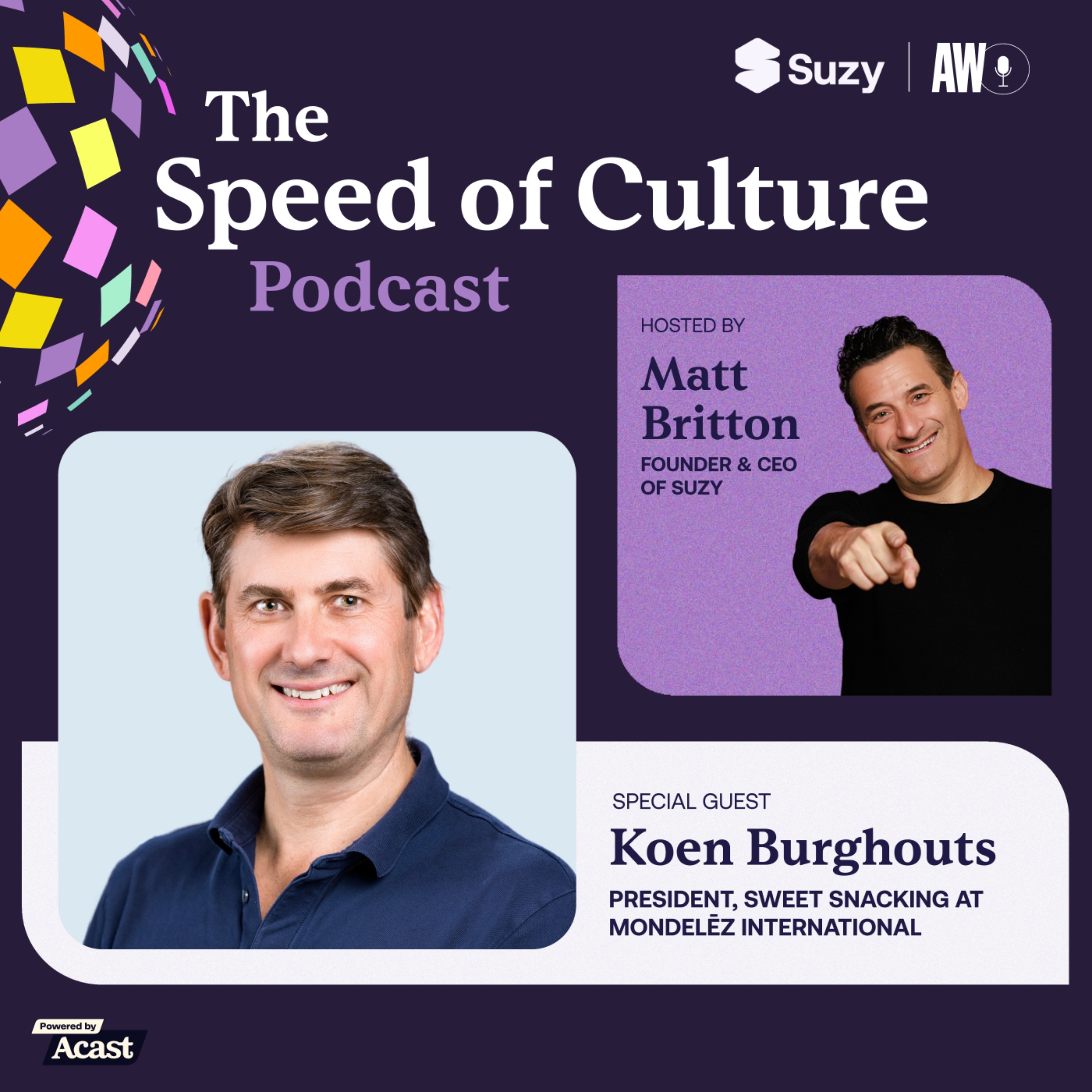
The Speed of Culture Podcast
Flavor Forward: How Mondelēz keeps Oreo and Chips Ahoy relevant by staying ahead of the curve
00:25:18
Loading summary
Transcript92 lines
- [00:01]
Capital One Announcer
This holiday season, Capital One reminds you to give yourself the gift of 1.5% cash back with the Capital One Quicksilver Card.
- [00:08]
Capital One Bank Guy
Can I earn 1.5% cash back on birds?
- [00:10]
Kuhn Bergauts
Birds?
- [00:11]
Matt Britton
What if you sent your true love two turtledoves plus a partridge and a pear tree?
- [00:16]
Capital One Announcer
Sure, but why would anyone want that?
- [00:18]
Matt Britton
The song was very convincing.
- [00:21]
Capital One Announcer
Earn 1.5% cash back on all your holiday purchases with the Capital One Quicksilver card. What's in your wallet?
- [00:27]
Capital One Bank Guy
Terms apply. See capitalone.com for details. With no fees or minimums on checking accounts, it's no wonder the Capital One bank guy is so passionate about banking with Capital One. If he were here, he wouldn't just tell you about no fees or minimums. He'd also talk about how most Capital One cafes are open seven days a week to assist with your banking needs. Yep, even on weekends, it's pretty much all he talks about. In a good way. What's in your wallet? Terms apply. See capitalone.com bank capital1NA member FDIC.
- [01:05]
Kuhn Bergauts
You need to be humble. I mean, the external environment is changing so fast. You need to build on others, you need to learn from others and quickly distill what is relevant for you. So having a certain openness for learning, and that's one side of the coin. The other side of the coin, the world out there is too complex to fully understand always. So you need to work with convictions. You need to work with hypothesis assumptions that you validate over time. Because if you're not doing that, you're losing speed and you're behind.
- [01:39]
Matt Britton
To thrive in a rapidly evolving landscape, brands must move at an ever increasing pace. I'm Matt Britton, founder and CEO of Suzy. Join me and key industry leaders as we dive deep into the shifting consumer trends within their industry, why it matters now, and how you can keep up. Welcome to the Speed of Culture. Up Today on the Speed of Culture podcast, we're thrilled to be welcomed by Kuhn Bergauts, the president of Sweet Snacking at Mondelez International. With extensive experience in innovation, brand strategy, and consumer insights, Kuhn has played a pivotal role in shaping the future of snacking on a global scale. Kun, so excited to see you today.
- [02:18]
Kuhn Bergauts
Thank you, Matt. Thank you. Happy to be here.
- [02:20]
Matt Britton
I'm a big fan of your work and the Mondelez company and his brand would love to hear from you. As we get started here, what's the road that you took to ending up in the seat that you're in today? It's such an interesting role and you're Leading the Mondelez brand at such a pivotal time. But what was the road that got you here?
- [02:38]
Kuhn Bergauts
Yeah, so actually I did grow up in Europe and I vividly remember with my parents traveling through Europe, and even in supermarkets in Europe, you see the same brands with different languages, different expressions, and as a kid, I always find that very fascinating. So that's how I started in food, as soon as I concluded on my business administration education. And that's what eventually took me to the US and to Monbalese.
- [03:08]
Matt Britton
Now I'm going way back here because we did our research, as we always do, but your career, like so many people who we've had on the podcast, started at Proctor and Gambler, where you actually spent five years. What were some of the benefits and learnings you had that you were able to extract from your time at P and G, which so many people said has been so critical at early stages in their career?
- [03:28]
Kuhn Bergauts
Absolutely. And especially beginning there. I think it's like a second level education. P and G is really well developed in defining the problems and having a standard template for all the solutions. So. So it's a great education, I would say. It gives you all the theory and all the tools to be successful as a manager.
- [03:50]
Matt Britton
And then over time, you would move on to Danone, where you were there for 10 years, still working in Europe. As you look back on your time there, I know it was a while ago now, but what is different about having a leadership role? And I guess then you were kind of on the up and coming portion of your career, but working in Europe versus the U.S. what are some of the differences that you remember being in Europe?
- [04:12]
Kuhn Bergauts
Yeah, so I think Europe is a combination of a lot of different cultures and every country is very different. So working in Holland and Belgium, Switzerland, Germany, Czech Republic, they all had their specifics, unique.
- [04:26]
Matt Britton
That's the amazing thing about Europe. Right. You can take a two hour train, you're in a completely different world.
- [04:31]
Kuhn Bergauts
Exactly. And you have people like educated differently. And so there's a host of differences. But I would say the big difference between the US and Europe is just the speed of taking decisions, the speed of doing business, the speed of implementation, and also the ambition level. To be honest, I think the ambition in the US is at a completely different level than in Europe. Not only on the company level, but also on individual level, I would say.
- [04:58]
Matt Britton
And then you would move on to us, where I agree we do operate here at the speed of culture. And you spent 10 years at PepsiCo. What were some of your key takeaways when you look back in your time actually more than 10 years at PepsiCo, on your time there and what were some of the things that you think help shape you and the leader you are today the most?
- [05:17]
Kuhn Bergauts
Yeah, so at Pepsi I had most global roles and I had very different roles. It was more business transformation, breakthrough innovation, but also leading brand portfolio that Pepsi called a more forward looking brand portfolio with Sun Chips and Popcorners. So I really learned that to work future back having a clear understanding what their future success would look like. And then how do you work that back to today and what are the decisions you have to take and what is the roadmap you need to develop to get there?
- [05:53]
Matt Britton
That's interesting. You know, Amazon and Jeff Bezos famously has this, I don't know if this is exactly what you're referring to, this practice where he writes a press release of what is the success will look like of a product launch or an initiative five, ten years from now. And then basically it's a work back schedule to say for that to be true seven years from now. What needs to be true a year from now? Is that kind of what you're referring to?
- [06:14]
Kuhn Bergauts
Yeah, exactly. We call it the North Star. So write up over future state not only from a consumer standpoint, but also from a technology standpoint, from a product deliverable standpoint. So we really tried to be more concrete than just a high level consumer statement or a consumer job to be done, for example.
- [06:34]
Matt Britton
Yeah, I mean, it's interesting because when you talk about how the US moves so fast, I think what comes along with that, and I see it in a lot of companies we work with, is there's a lot of focus on what's urgent versus what's important. You know, it's like whatever the topic du jour is or the fire drill du jour everyone kind of gravitates towards. And when you do that, you can kind of take your eye off the ball of the North Star. So I'd imagine as a leader it's a balancing act versus hitting this quarter's numbers and taking advantage of the opportunities that are right in front of you. But at the same time understand where you're going towards.
- [07:05]
Kuhn Bergauts
That's right. So I think a quarter and the pressure in the quarter could potentially slow you down for good reasons. But it could never to your point, you can never have the eyes of the ball. So I think that is always what I've been pushing for. You might slow down in the quarter, but you still need to make progress. You still need to progress to your end state and sometimes in a quarter you can go faster than you anticipate it and sometimes you need to be slower because you have a different trade off, short term versus long term. So that is a very life life debate, I would say.
- [07:38]
Matt Britton
Yeah, absolutely. So of course now you're here at Mondelez where you've been nearly three years and we'd love to hear about your current role as president overseeing the US brands and kind of where your areas of focus are heading into 2026.
- [07:51]
Kuhn Bergauts
Yeah, so I'm heading what we call all our sweet snacking brands. So think about Oreo, Chips Ahoy, Belveda Tates, to name a few. And the task is to get to the next level of growth. The brands and the portfolio and the company as a whole is very successful if you look at what the historic results from a share perspective, from a revenue perspective are super impressive. But now it's up to me and the full cross functional team to get to the next level of growth.
- [08:22]
Matt Britton
And of course a big commonality over the last several decades in your career has been you've been focused in the food and beverage space. What are some of the trends and changes in marketing food and beverage based products, especially maybe some of the brands that you mentioned that you're focused on today, Oreo, Chips Ahoy, et cetera, that have changed over time in terms of just consumer tastes and preferences and obviously so many broader trends which we can get into.
- [08:45]
Kuhn Bergauts
So if you take it from a consumer standpoint, especially also in the current economic context, there's always a need for a small treat and people are still willing to pay for that. So we call that premium indulgence. That is a clear area for us to focus upon. Obviously you have others like on the go, convenience on the go out of home consumption. We also look at better for you as a big trend that is shaping up snacking. So these are the three big themes we are looking at.
- [09:16]
Matt Britton
And when you look at a trend like GLP1s, do you see that impacting, I guess the way that consumers shop in terms of packaging and positioning. And how much does a trend like that impact the way you look at building the brands in the future?
- [09:29]
Kuhn Bergauts
Yeah, we are monitoring that. And better for you in its broader sense is changing. People are looking for snacks to deliver different benefits than maybe like 10 years ago. But it's many things in better for you. It's just not one thing what is changing. So we look at, and that is I think why we are better suited than probably others because we have a very Diverse set of brands that can tap in those opportunities.
- [09:57]
Matt Britton
And how about consumption habits in your category? Because obviously Covid brought on a whole new slew of ways that people purchase. Before COVID a lot of people don't realize the whole notion of ordering groceries was kind of a unique, kind of foreign concept. Now everybody does. And you look at the success of companies like Doordash and Instacart doing so well, how much of an impact does that have in terms of when you think about your product development pipeline and what innovation looks like?
- [10:25]
Kuhn Bergauts
For Mondelez, it's more what we call the delivery system and definitely your brand. If you take a brand of like Oreo or Chips Ahoy, you need to show up in very different channels on Amazon as well.
- [10:37]
Matt Britton
There's no checkout aisle like there is at a 711 or Walmart, where you're in the aisle and somebody might grab something that isn't really the same when you're buying online.
- [10:45]
Kuhn Bergauts
That's right. So you're right in the sense that you have way more business models to be successful in. And every business model has its unique opportunity and unique way of doing business. So I think it is up to us as leaders to truly understand all those models work and how consumers behave. And what are the pain points? Because there are still enough pain points for our opportunities, depending on how you want to define it, for us to solve for through the lens of the brand. So I'm personally very excited about all these new models emerging because it's not always set in stone how to be.
- [11:20]
Matt Britton
Successful, especially in this day and age.
- [11:22]
Kuhn Bergauts
Exactly. You need to have like an experimental mindset to a certain degree to just to figure it out and try and test and learn and adapt.
- [11:31]
Matt Britton
Yeah, because if you look at so many of the big brands that exist right now, especially in the food and beverage space, so many of them were built during kind of the golden age of television, when the brands had big checkbooks and they could kind of run ads in heavy rotation towards consumers, and they became kind of the de facto brands in the category. And on one hand, it's made it harder for kind of new, iconic brands to be built. But at the same time, since we're not nearly in the same TV centric world as we were in the past, there are new opportunities for emerging brands. And we're seeing that happen, especially when you look at what's happened with brands like Olipop and Poppy, which I'm sure you're familiar with, are coming out of nowhere. And we're seeing it happen in Almost every category where you're having emerging brands that are built for a new consumer, that don't have the barriers to entry that they used to have in terms of reaching people or with distribution. So in a lot of ways, I think the CPG leaders can't really rest on the laurels that they had in the past of kind of defensibility, if you will. And that might be what you're referring to in terms of the innovation of just the way that brands are built.
- [12:34]
Kuhn Bergauts
That's right. And I think one key element is how you show up in culture. And I think, honestly, Mondelez, even before I came, is highly successful in doing so. And if you take a brand like Oreo and that excites me a lot, it's not only how they show up in culture, but they actually shape culture.
- [12:52]
Matt Britton
Like the famous dunk in the Dark post that they did during the Super Bowl.
- [12:55]
Kuhn Bergauts
Exactly. And Oreo has its very specific ritual and people are playing with that and making their own version and racking up a lot of likes and Post shares, but just behind how they interact with Oreo. That is one example. Another example is it's not about how we show up in culture, but how we drive culture. If you take partnerships like what we do with Post Malone, it's just not a high level partnership, but it's a very intense partnership where we say, you know, let's look at the full marketing mix. Even the Cookie needs to be the Post Malone sign off cookie that he really believes in and he really develops. So that becomes more than just a high level brand partnership because it touches all the elements of the marketing mix.
- [13:43]
Matt Britton
We'll be right back with the speed of Culture. After a few words from our sponsors.
- [13:49]
Capital One Bank Guy
With no fees or minimums on checking accounts, it's no wonder the Capital One bank guy is so passionate about banking with Capital One. If he were here, he wouldn't just tell you about no fees or minimums. He'd also talk about how most Capital One cafes are open seven days a week to assist with your banking needs. Yep, even on weekends. It's pretty much all he talks about in a good way. What's in your wallet? Terms apply. See capitalone.com bank capital1na member FDIC.
- [14:19]
Capital One Announcer
If.
- [14:20]
Capital One Saver Card User
You love to travel, Capital One has a rewards credit card that's perfect for you. With the Capital One Venture X card, you earn unlimited double miles on everything you buy. Plus you get premium benefits at a collection of luxury hotels when you book on Capital One Travel. And with Venture X, you get access to over 1,000 airport lounges worldwide open up a world of travel possibilities with a Capital One Venture X card. What's in your wallet?
- [14:45]
Capital One Bank Guy
Terms apply. Lounge access is subject to change. See capital1.com for details.
- [14:52]
Matt Britton
I actually saw a post on Instagram yesterday, and in this day and age, you don't know if it's true or if it's AI, but it looked like there's a collaboration going on between Oreo and Rhesus, where it's kind of a joint product. Is that something that's coming to market?
- [15:05]
Kuhn Bergauts
Yes, that's right.
- [15:06]
Matt Britton
So where does a concept like that come from? And how do you gain conviction to dive into a partnership like that? Reese's is a. Is that Mondelez Brands or Hershey's brand, isn't it?
- [15:15]
Kuhn Bergauts
That's a Hershey brand.
- [15:16]
Matt Britton
Right. So that's kind of like coopetition. Right. Which I think is really interesting. Is that a concept that is hard to kind of gain conviction for and dive into? And what's the process behind something like that?
- [15:27]
Kuhn Bergauts
Yeah, so I think it starts with a strong conviction from both companies. What is the added value of your brand and how is it positioned? What role is it playing for consumers? Right. And if you then look at Oreo and you look at Reese's, then you could easily see that if you would, let's say, find a partnership, you can deliver a consumer experience that we individually as brands cannot deliver. And it's this highly multi texture, cross category chocolate cookie. The whole mix makes it very interesting. And we see that in the marketplace that one plus one is more than two, and that is really a collective success. And we both see the success of this.
- [16:14]
Matt Britton
Yeah. I mean, logistically, well, first and foremost, the fact I remembered in a world where, and obviously I am interviewing you today, but I don't even think that was on my mind when I saw the post. It was just really well done. And I think that the headline was something like, you spoke and we listened to, and it kind of really spoke to kind of like consumer centricity, that you have your finger on the pulse of your customer. And that is where culture is built. The biggest change we've seen in the social media era is brands are no longer kind of developed from the boardrooms or developed from the sidewalks. And this is kind of a perfect example of that.
- [16:45]
Kuhn Bergauts
Yeah, it is. And obviously I'm happy you say that because that is what we want to do more of. So we invest a lot in a company to be just close to culture, Understand? And then having a conversation. How is this relevant for us, how can we make it relevant for us and how do we execute against it? That is I would say 70 or 80% of the conversation I have with my teams to drive the business.
- [17:10]
Matt Britton
Yeah, I mean that probably wasn't the case 50 years ago. Somebody overseeing a snacks business probably wasn't thinking a lot about culture. They're probably thinking about more like the factories and the ability to distribute. But now that's become, while it's still important, you know, more commoditized. And really the differentiation is brand and brands differentiated by its ability to be central to culture and your consumers lives.
- [17:30]
Kuhn Bergauts
That's right. And I think the other side of that is you also need to have a nimble, cross functional structure to move with speed. So it is, on one hand it's absolutely what you said, but it's also, let's say the back office and making sure that the execution and the company works as one. Therefore, I come back to the concept of a North Star. And the concept of North Star needs to be more than a consumer statement because it also needs to be valid for R and D and it also needs to be valid for supply chain so that they understand the bigger objective we collectively work on.
- [18:03]
Matt Britton
So this year for the first time, the average age of a first time mom in the US is Gen Z. Which means that now the average new mom has grown up with the iPhone in the household, consuming content, looking down their phone versus at tv. Which means increasingly your buyer is going to be Gen Z and increasingly the way you're going to reach them is through the small screen. As we know, the way you reach consumers on the small screen isn't through traditional advertising, it is through content. And content is kind of part and parcel with culture when you think about content and on a broader lens, storytelling. What is kind of the approach moving forward for storytelling with Mondelez? And where do things like the creator economy as a distribution point fit in in that regard?
- [18:48]
Kuhn Bergauts
So there are multiple angles to this. Right. So I would say it is a bit of taking the Oreo Playbook and taking a page and making sure that it becomes relevant for other brands. And a good example is what we do with Chips Ahoy and Stranger Things. Stranger Things, right. It's the consumer insight behind Stranger Things. Is this like knack to nostalgia? That's exactly where we play as a brand. It's really a childhood memory for a lot of people and based on that, knowing that they came out with their fifth and last season highly relevant with Gen Z. So we started early conversations with Them. Okay, if we both have the same brand values, we have the same focus on Gen Z, how can we take the page from the Oreo Playbook and make it relevant for Chips Ahoy? And that's what the team has done successfully, but also touching the product. They made a unique product, unique packaging. If you do it, you need to go all the way. And I think that's what the team has done. But, you know, it's not only partnerships. You also need to build your own equity. And I'm very excited that if you look at what Mondelez is doing with Genai and how we leverage Gen AI to make story or have, like, storytelling on a completely different level, we leverage AI to generate stories in real time for our characters. Take Chip. Chip is a character we are using for Chips Ahoy. That is one we bring to life in culture on a daily basis. And, yeah, you can find creators to make that even bigger together. But these are all avenues we are exploring. And sometimes we scale it faster because it's an instant success, and sometimes it's more learning curve.
- [20:33]
Matt Britton
And you kind of took the words out of mouth in terms of. My next set of question was around AI. How do you think it changes the creative process? How do you think it changes what it means to be successful in a large enterprise like Mondelez, where a huge mandate is keeping the brand relevant in culture? Like, where does AI fit in the everyday job of somebody in this new day and age?
- [20:56]
Kuhn Bergauts
Yeah, so it's a multiple angles, right? Yes, it is. Part of it is efficiency and effectiveness. So you use it to reach people at the right moment and the right profile personalization. So that is really more an efficiency, effectiveness, a game. And I think we are quite advanced in that as well. But the true unlock for me comes in, you know, that it starts to drive content and starts to drive storytelling to your earlier point. And that is where we already have good successes with Chips Ahoy, for example, and we want to do more of that. And it's interesting because when we started to execute and work with Genai for Chips Ahoy, we also found out that we had to be sharper on the brand positioning, sharper on the exact tone of voice, because there's so much more nuance in Gen AI that you also need to be sharper on the brief than ever.
- [21:52]
Matt Britton
Yeah, it's like garbage in, garbage out. Right. So you really need to up the level. Like, the new brief is the prompt, almost.
- [21:58]
Kuhn Bergauts
Yes, that's a great way to put it. That's the prompt.
- [22:01]
Matt Britton
So what do you Think the future is. If you were suddenly tomorrow thrust into the role where you were heading a large ad agency network, what would you do? Where would you focus in terms of rebuilding advertising agencies in this new age?
- [22:15]
Kuhn Bergauts
Yeah, so I personally feel that creative horsepower triumphs everything. So whatever we think about Gen AI, it is about this brand idea that really travels across cohorts, travels across cult. So I would never compromise on the creative horsepower and make that your unique identity as an agency.
- [22:41]
Matt Britton
I think it's great feedback. So, switching gears, we wrap up here. Obviously, greatness is in the agency of others, especially at a large company like Mondelez. And I'm sure you have a great team and you focus a lot on team building. What advice would you have for younger people that are entering the workforce, that want to end up in the seat of president of a large company like Mondelez one day? What are some of the areas you think they should focus on? And in that regard, what are some of the areas that you think your team excels at that enables your brands to perform so well over time?
- [23:11]
Kuhn Bergauts
Yeah, so I think for most, and it started off also in our conversation, is you need to be humble. I mean, the external environment is changing so fast. You need to build on others, you need to learn from others and quickly distill what is relevant for you. So having a certain openness for learning, and that's one side of the coin. The other side of the coin, the world out there is too complex to fully understand always. So you need to work with convictions, you need to work with hypothesis, assumptions that you validate over time, because if you're not doing that, you're losing speed and you're behind. So it is this, let's say, balance between learning from others and driving your own convictions over assumptions that I believe is extremely helpful for younger people to start develop. And then if I look at the quality of our team, the quality of our brands, that is more or less exactly what we are trying to do. Move fast, work with assumptions, and make sure that there's a time to debate, but also a time to execute. And you need to really organize yourself around that.
- [24:19]
Matt Britton
Yeah, I think young people sometimes struggle with gaining that conviction just because many people are fearful. They don't want to lose their job, they don't want to take risks. So what they do is they kind of wait to be told what to do when they go into work every day. But I actually think those are the people that are at the most area of risk in the age of AI, I think it is to your point, people who take initiative that lean in. Those are the people that I think are going to be. They're going to be on the right side of all this change.
- [24:46]
Kuhn Bergauts
That's right. And I think the beauty of Gen AI is that you can experiment with a low cost, a low barrier of.
- [24:54]
Matt Britton
Entry without a lot of technical knowledge.
- [24:56]
Kuhn Bergauts
Exactly. And fast. So make sure that you keep sharpening your hypothesis with the help of AI.
- [25:02]
Matt Britton
Absolutely. Well, this has been such a great discussion. We always ask our guests to wrap up the podcast if there's a saying or mantra that's helped kind of encapsulate or package their career during the day. And obviously you've worked at so many great places and overseen so many incredible brands. Really curious what comes to mind for you.
- [25:19]
Kuhn Bergauts
Yeah, mine is never stop learning.
- [25:22]
Matt Britton
So it's about curiosity and a willingness to continue to uncover new things no matter where you are in your career.
- [25:28]
Kuhn Bergauts
Exactly. And never feel that you have arrived.
- [25:31]
Matt Britton
Yeah, I mean, I think that's so important. I think, you know, in this day and age, younger people are growing up with Instagram and they're seeing everybody else who they think are killing it. And I think even though it's just their highlight reels, I think what that does is it takes away people's patience. And I think because of that, when you don't have patience, a lot of times you don't have that curiosity. And I think that is kind of the challenge that many younger people in the workforce faces. You need to be patient, you need to put in the work and you need to be curious. And if you do that consistently over time, I think you're going to put yourself in the position to be successful.
- [26:06]
Kuhn Bergauts
That's right. And underlying all of that needs to be passion you need to be passionate about, because otherwise you will never go the extra mile to question yourself or question your environment.
- [26:16]
Matt Britton
Absolutely. Well, it's clear that you're incredibly passionate and a leader who has conviction, not afraid to take risks. And congratulations on all your success and wishing you a great 2026 at Mondelez.
- [26:28]
Kuhn Bergauts
You too, Matt. Thanks for the time.
- [26:29]
Matt Britton
Absolutely. On behalf of Suzy and we team, thanks so much. Zakuen Bergaut, the president of Sweet Snacking at Mondelez International, for joining us today. Be sure to subscribe rate review the Speed of Culture podcast on your favorite podcast platform. Till next time. See you soon, everyone. Take care. Foreign. Is brought to you by Suzy as part of the Ad Week Podcast Network and a guest creator network. You can listen subscribe to all Adweek's podcasts by visiting Adweek.com podcast To find out more about Suzy, head to Suzy.com and make sure to search for the speed of culture in Apple Podcasts, Spotify, or anywhere else podcasts are found. Click on Follow so you don't miss out on any future episodes. On behalf of the team here at suse, thanks for listening.
- [27:30]
Capital One Bank Guy
With no fees or minimums on checking accounts, it's no wonder the Capital One bank guy is so passionate about banking with Capital One. If he were here, he wouldn't just tell you about no fees or minimums. He'd also talk about how most Capital One cafes are open seven days a week to assist with your banking needs. Yep, even on weekends, it's pretty much all he talks about. In a good way. What's in your wallet? Terms apply see capitalone.com bank capital1na member FDIC.
- [28:00]
Kuhn Bergauts
Ready to order?
- [28:01]
Matt Britton
Yes.
- [28:02]
Capital One Saver Card User
We're earning unlimited 3% cash back on dining and entertainment with a capital1 saver card.
- [28:07]
Matt Britton
So let's just get one of everything.
- [28:08]
Kuhn Bergauts
Everything.
- [28:09]
Capital One Announcer
Fire everything. The Capital One Saver card is at table 27, and they're earning unlimited 3% cash back.
- [28:15]
Matt Britton
Yes, Chef.
- [28:17]
Capital One Saver Card User
This is so nice.
- [28:18]
Capital One Announcer
Had a feeling you'd want 3% cash back on dessert.
- [28:21]
Kuhn Bergauts
Ooh, tiramisu.
- [28:22]
Capital One Announcer
Earn unlimited 3% cash back on dining and entertainment with the Capital One Saver card. Capital One what's in your wallet?
- [28:28]
Capital One Bank Guy
Terms apply. See capitalone.com for detail.