← The Speed of Culture Podcast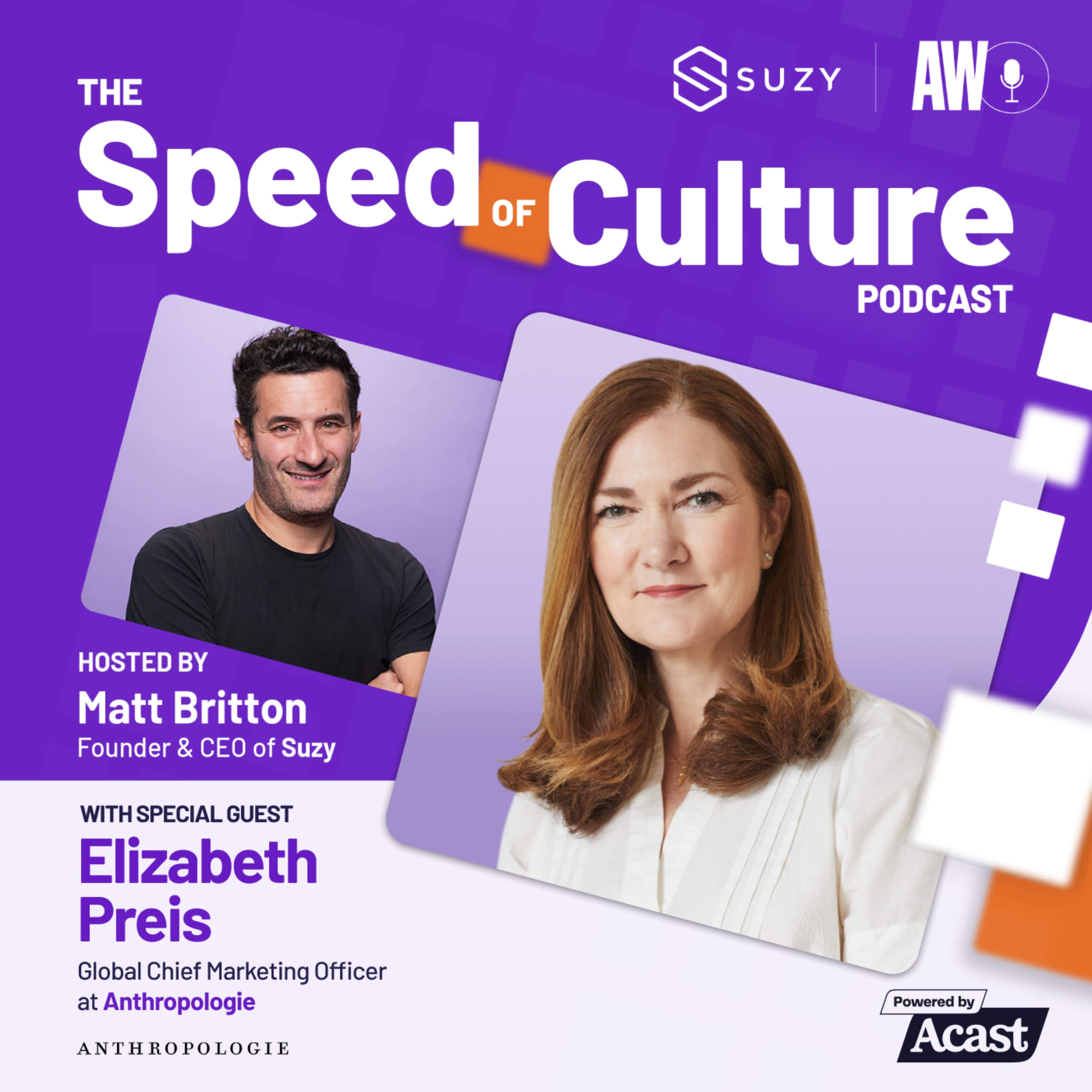
The Speed of Culture Podcast
From Data to Discovery: Anthropologie’s Secret to Retail Success with CMO Elizabeth Preis
00:34:54
Loading summary
Transcript72 lines
- [00:00]
Ryan Reynolds
Hey, I'm Ryan Reynolds. Recently I asked Mint Mobile's legal team if big wireless companies are allowed to raise prices due to inflation. They said yes. And then when I asked if raising prices technically violates those onerous two year contracts, they said, what the are you talking about, you insane Hollywood. So to recap, we're cutting the price of mint unlimited from $30 a month to just $15 a month. Give it a try@mintmobile.com Switch $45 upfront.
- [00:26]
Unknown Speaker 1
Payment equivalent to $15 per month New customers on first three month plan only taxes and fees extra speed slower above 40 gigabytes ET details if there's one thing that friends know me for, it's being an amazing gift giver. I owe it all to celebrations passport from 1-800-flowers.com my one stop shopping site that has amazing gifts for every occasion. With Celebrations Passport, I get free shipping on thousands of amazing gifts. And the more gifts I give, the more perks and rewards I earn. To learn more and take your gift giving to the next level, visit 1-800flowers.com acast that's 1-800-flowers.com acast.
- [01:04]
Elizabeth Price
As a group of brands, we prioritize creativity at the heart and soul of what we stand for. So every one of our brands, whether it be Urban Outfitters, Free People, Anthropologie, Terrain, or Nuuly, in fact, we are all driven by creativity and creativity in multiple different ways.
- [01:21]
Matt Britton
To thrive in a rapidly evolving landscape, brands must move at an ever increasing pace. I'm Matt Britton, Founder and CEO of Suzy. Join me and key industry leaders as we dive deep into the shifting consumer trends within their industry, why it matters now, and how you can keep up. Welcome to the Speed of Culture. Up today on the Speed of Culture podcast, we're thrilled to be joined by Elizabeth Price, Global Chief Marketing Officer at the Anthropology group. With over 25 years of experience spanning beauty, fashion and lifestyle brands, Elizabeth shares her insights and building brand love, creating memorable customer experiences, navigating the evolving landscape of digital discovery and community driven marketing. Elizabeth, so great to see you today.
- [02:03]
Elizabeth Price
Nice to be here, Matt. Thanks for having me.
- [02:05]
Matt Britton
Absolutely. And where does this podcast find you?
- [02:07]
Elizabeth Price
Well, typically I'm in Philadelphia, but right today I'm in New York City.
- [02:10]
Matt Britton
Gotcha. Okay, cool. So tell me about Anthropologie because I used to see anthropology a lot more in kind of retail than I do now and it's probably just because of my changing habits as a consumer. I don't go to the same buildings anymore. But how is the business doing over what does the retail footprint look like in the US and anywhere else that you might be located?
- [02:31]
Elizabeth Price
Great. So Anthropologie is a brand of 30 years young. We have many, many loyal customers. That's actually something that was surprising to me when I first joined, just how much brand love there already exists with the brand. So as a marketer, you can't ask for anything better. You're working with a brand that already has this intrinsic. People find joy in the brand with every time they walk into a store and every time they go onto the site. And then since I've joined about five years ago, one of the things that we've done as a team has really make sure that we amplify that love in many different ways. We amplify that love online, we amplify that love on our social platforms, and we also amplify that love through our store experience. It's exciting to see so many customers discover our brand in stores and now more and more they're discovering our brands online. And as a result, we've opened some great stores. We are in a mode right now where we've opened some stores this year and we're opening some even this fourth quarter, getting ready for the holiday season and bringing more brand love and an IRL experience as well.
- [03:27]
Matt Britton
And what do consumers come to Anthropologie for?
- [03:30]
Elizabeth Price
They come to just be surprised, delighted, and they come for a sense of discovery. I think so many times if I had a nickel for every time I hear from a customer, I had no idea you carried that. I had no idea I could find that. It's my favorite thing and I never thought I would find it at Anthropologie. It brings joy in some of the smallest things and some of the biggest moments in your life, whether it be a new mug to have your morning tea with or it could be your wedding dress where you walk down the aisle. So I think that's the magic of anthropology, frankly, because it can actually meet so many of your needs and your wants of your life.
- [04:02]
Matt Britton
So it seems that your retail kind of approach and methodology is to go across a multitude of different categories versus going very niche into one specialty retailer based approach. How does that introduce new challenges as a retailer in terms of continually having to up the game in terms of the merchandising approach?
- [04:20]
Elizabeth Price
That's a great question. I would say that even though we might span multiple different categories, the intrinsic value prop that we're offering the customer is consistent, which is we want to offer great quality, we want to offer great Style we want to offer a great experience they can't find anywhere else. And often that means they find product they can't find anywhere else. People don't always realize this, but we have a huge team of designers that create things in house. And the vast assortment of what we actually offer to our customer is products that have been designed in house and are offered only through Anthropologie. So I think that's what sort of sets us apart. We have a unique style. We have a unique range of styles that can meet what you might need for an every day, as well as what you might want for a special day in your life, whether it's what you're wearing or how you're entertaining or how you're sharing time with family and friends.
- [05:11]
Matt Britton
And of course, Anthropologie is part of a larger umbrella of urban brands, which include Urban Outfitters and Free People. And the approach of those retailers like yours is really about being eclectic and it's about discovery. And I would imagine that sort of inherent in DNA of the parent company. How does the approach and the overall brand of Urban Outfitters, which is a much more widely known brand, impact your overarching strategy? Is there sort of like a central theme of the overall umbrella that you kind of use as a playbook to drive your business forward?
- [05:44]
Elizabeth Price
Well, I mean, I obviously speak to the Urban Outfitters team as I speak to the Free People team, and I can't speak to obviously all their strategies in fine detail. But what I can say is that as a group of brands, we prioritize creativity at the heart and soul of what we stand for. So every one of our brands, whether it be Urban Outfitters or Free People or Anthropologie or Terrain, which is Division of Anthropology or Nuuly, in fact, we are all driven by creativity and creativity in multiple different ways. Creativity in terms of how we show up to our customer in ways that you may not even imagine outside of any of the brands other than these brands. And also we want to inspire the creativity in our actual consumer. How can they be creative in their own ways in terms of how, how they live, how they dress, how they put things together? We want to inspire that same level of creativity and discovery with our customers.
- [06:32]
Matt Britton
Right. And in that regard, what are some of the more emerging trends that you have your eye on heading into 2025 in terms of your target consumer and maybe some evolution in their tastes that make you impact what you put on your shelves?
- [06:44]
Elizabeth Price
Yep. I would say the area that we've really had some Great learnings from and that we all continuously try to push each other on is anthropology has often been a brand where people have a sense of pride, of saying, I've got this great dress I got at Anthropologie. There's a sense of pride and you can feel the emotion coming out of the person when they tell you it could be a special dinner party, it could be date night, it could be taking the kids to school for the first day. I mean, whatever that might be. There's a sense of pride and excitement when someone can say, oh, I love this dress too. I got it. At anthropology, we've owned that space for a long time with our customer. That is that sort of special occasion space. I would say that in real life today, there's been a casualization in how people actually live their lives. And how can we, with less people necessarily dressing up or dressing up the way they used to, how can we actually still be that preferred place where they actually find product to make their everyday more like a special day? And so that's been an area that we've really collectively between our product team, between our creative team, between how and what we look like in our own creative shoots, between the models we choose, between the media we use. All of that is to make sure that we're showing up in places that are more relevant to how customers live today. I say a lot with the team is like, in terms of our product and our content, having great product and having great content. When I say content, I mean creative. If you don't have it in front of the customers in the right places for relevancy and with enough frequency, we're missing the mark. So in our world, we're thinking about how do we make sure that we are owning more of that screen share. Where is that customer today? More often than not, they're on their screen. They're not sitting in front of a television the way they used to, they're on the screen. How do we own more screen share? How do we then create more mind share from that screen share? How do we then let that evolve into more heart share emotionally, and then how does that eventually turn into wallet share? So if we think about it, in that sort of evolution, we're constantly focused on how is the customer spending their time today and how do I make sure that anthropology is showing up relevantly, appropriately, and with enough frequency to actually cut through?
- [08:56]
Matt Britton
Yeah, I mean, there's a lot to unpack with what you just said. And I'll hit into a couple of the points. One of which is, and I think it's a really astute comment, is your focus primarily and increasingly on Gen Z. And Gen Z, of course, is the first generation to grow up with the iPhone in the household. They are the iPhone generation. They never knew world without the iPhone. So intuitively they're going to look at their phone for any type of content before anything else. And when they're looking at their phone, they're not just looking at content from traditional media sources. In fact, they're doing that less and less. They're mostly looking at content from other people. They're in the newsfeed. So that brings up the whole concept of the creator economy, I would imagine, given the space you play in, that's a huge overall part of your focus. Talk to me about some of the efforts that you have in that area so you can reach consumers where they are, that is on the phone.
- [09:42]
Elizabeth Price
Absolutely. Well, I mean, we have brand ambassadors who we work with on a regular basis over usually for a period of time. And they basically become like another extension of our brand associates, if you will. And then they have a group of followers themselves at their community, and they can speak to our products against their community. And then we also work with influencers on very dedicated programs like a dress campaign or a sports campaign or whatever that campaign might be from a product perspective and a product priority perspective. We try to make sure that we find relevant ambassadors, relevant influencers who could help share our story with their followers, with their group. I think there's an important comment here, important element, which is people inherently trust people before they trust brands. And you just sort of tapped on it yourself. Like, people will trust who they think they know, even if that influencer may not have been anyone they've ever met personally, but they feel that they have a commonality with them and there's a connection and there's a trust factor. And once you establish that trust factor, then your message can actually have a much stronger platform and a much easier way to actually ring true.
- [10:48]
Matt Britton
Yeah, I mean, we've seen this shift happen over the last two decades from consumers gravitating towards scripted content. Right. And it started with obviously, broadcast networks, then went to cable tv, and now slowly, over time, more and more time is focused on consuming content that is not scripted, that's coming from other people. Because people are inherently so much more interested than fabricated scripts of fictional people. Right?
- [11:12]
Elizabeth Price
100%. And I think the other thing that's also part of this is that in today's media world, that conversation is not one way that conversation invites you to be part of it through liking, engaging, sharing, commenting. And that did not exist before the social platforms came to be. So I think there's a couple things. Community is something that's obviously being built on these platforms, but the community and the inclusivity of that community, that people want to hear from their community and hear back from their community, is also a very important element of, I think, what has helped us evolve and thinking about these as very viable media platforms in which we need to make sure that our content is relevant. But that's a lot of work. I mean, obviously you can't, like, take a catalog in the old world and just slap it on Internet like, hello, 1994. You can't do that anymore. So you have to be thinking, like, what are people looking at these channels for and for a purpose, and how do I make sure that my messages are appropriate for those channels and for that audience?
- [12:10]
Matt Britton
It's interesting, too, because a lot of people might today falsely equate social media with community. And the reality is, many of the social platforms, when consumers are on them, they see less and less of people who they know, because the social platforms have really prioritized narrow algorithms, content from large news media organizations, as well as creators who command large audiences and large engagement. So now, more recently, we've seen consumers gravitate towards platforms like Reddit and other places where discord, where they can actually really have community, where they can really interact with people, and also the more private sources like WhatsApp and texting, et cetera. So we're definitely seeing a shift in the media landscape. But nonetheless, your point is well taken, which is consumers really do feel a connection with the influencers and the creators that they follow. And if you can kind of harness that to drive transactional volume for your business, I think it is a very scalable and powerful approach.
- [13:05]
Elizabeth Price
Absolutely. And I think it's part of an overall recipe. Like, I don't think any one of these things actually is the silver bullet of all of your eggs in that one basket. You need to have an approach that's like a portfolio. And with everything you do, what is that portfolio approach of what is the media mix you want to use? And I think that's what. And throughout that whole mix, the message needs to still be consistent. It's just the articulation of that message might change a little bit, but the actual message needs to. And for us, that message is, we bring joy not only on your special days, but we want to bring joy on your everyday. We want to bring joy when you're making your morning coffee or making morning tea. We want to bring joy, obviously, when you're walking down the aisle. But we want to play in more joy on more days than not. Because if we can own more joy and we can own more share of joy, then we will be the destination where people want to spend their time. They want to spend their time where they feel that they need to spend their time for functional needs, operational needs, getting gifts. Like we want that to be something they look forward to.
- [14:03]
Matt Britton
Yeah. And you had mentioned a term earlier that, frankly I hadn't heard until now, which was casualization, where essentially consumers aren't getting dressed to the nines anymore to go to work, et cetera. What do you think is driving that? Is that sort of a post Covid phenomenon that has kind of carried over from where Athleisure blew up during COVID and it kind of continued, or is there other factors that you think are contributing to that?
- [14:24]
Elizabeth Price
I think it started before COVID to be honest, and I think every time there's increments of it in a very sort of highly professional work environment. It's been a long time since people have been wearing ties. Like they might be still wearing a suit. They were wearing a suit for a while, but they weren't wearing a tie. And now they're not really even wearing a suit. They're wearing like maybe a jacket and slacks now. They're sort of not even wearing the suit jacket any longer. Now it's like a shirt and a puffer. That's like sort of the evolution, if you will, in a more sort of formal professional workplace. But I think the casualization happened. It's been happening for a while, and I don't think that's necessarily bad, to be honest. I think it's just sort of the way people's styles evolve and society evolves. I think what's the positive side of that is that there's a lot of casualization that's happening also in the entertaining space that is much more inclusive. I think in the old ways you'd have like a formal dinner party and everyone would be dressed up for their formal dinner party, and everything would be served formally on a full dinner plate and full service, et cetera. And now it's bring the kids over, let's all have a casual Friday evening pizza party. And the way we entertain and way we live is very different from what it might have been several years ago. And I don't think either is bad. It just means that for us as anthropology, if we still want to be the destination for joy, the destination for bringing happy times to happy people, then how do we do that through our product assortment? How do we do that with how we style? How do we do that with offering inspiration throughout our channels, whether it be Pinterest, whether it be Instagram, whether it be TikTok, et cetera, that actually responds to the changing and the evolving way in which people live?
- [15:57]
Matt Britton
And how are you able to keep your finger on the pulse of that, to constantly understand the changing needs and tastes of your consumers?
- [16:03]
Elizabeth Price
I mean, how do any of us do like. I mean, I feel like we're always chasing it to an extent. And I would say everyone in the company actually is bringing ideas and sharing what they've seen. I learn way more from the team who is part of my group than necessarily what I'm teaching them in many cases in this area. And I think that's the beauty about having a very diverse and far ranging group of people who work in an organization. Because the great ideas and the great trends and the great themes actually come from within as much as they come from without.
- [16:31]
Matt Britton
We'll be right back with the Speed of Culture after a few words from our sponsors.
- [16:37]
Ryan Reynolds
Hey, I'm Ryan Reynolds. Recently I asked Mint Mobile's legal team if big wireless companies are allowed to raise prices due to inflation. They said yes. And then when I asked if raising prices technically violates those onerous two year contracts, they said what the are you talking about, you insane Hollywood? So to recap, we're cutting the price of mint unlimited from $30 a month to just $15 a month. Give it a try@mintmobile.com Switch $45 upfront.
- [17:02]
Unknown Speaker 1
Payment equivalent to $15 per month New customers on first three month plan only taxes and fees Extra Speed slower above 40GB Details explaining football to the friend who's just there for the nachos Hard tailgating from home like a pro with snacks and drinks everyone will love an easy win. And with Instacart helping deliver The Snack Time MVPs to your door, you're ready for the game in as fast as 30 minutes. So you never miss a play or lose your seat on the couch or have to go head to head for the last ch Chicken wing shop game day faves on Instacart and enjoy zero dollar delivery fees on your first three grocery orders offer valid for a limited time. Other fees and terms apply.
- [17:41]
Matt Britton
So another way obviously brands are keeping in touch with their consumers is by their ability to collect first party data and As a retailer, you disproportionately have the ability. Now you spent some past time in the CPG world, which we're going to talk about, but as a retailer, unlike CPG companies, you do have the ability to have that first party data and obviously that can unlock so much as a marketer, how is Anthropologie leveraging its first party data from its customer base to drive loyalty and personalization as you move forward?
- [18:09]
Elizabeth Price
Don't get me started on this because I might never end. This is a favorite topic of mine.
- [18:13]
Matt Britton
Do tell.
- [18:14]
Elizabeth Price
And I will tell you that I feel exceptionally privileged to work for an organization that has such rich data. I have worked in organizations where we had our own data and I've also worked in organizations where we had to sort of infer data through our third party partners, retail partners. Having your own data is way more powerful and way more personal and that's incredible. I would say the first thing with data is recognizing the value across the organization. I think so often the data oftentimes in organizations it sits with your analytics team or it sits with your insights team, or it sits with your tech team. And it's actually, I think of it as a business driver for all the team and the level of information available. And the way we use that information is the most important part. And when I say that sometimes the most complex data will just be a complex string of information, but an insight and a statement and an opportunity and a size of the prize becomes a single statement that can actually motivate and galvanize an entire organization. So that's what I actually try to focus on with all the great data we have. And we have a lot of it. My challenge to myself and my challenge to my team is always, that's great, that's the what. But the next question I'm going to ask you is so what? And the third question after that is going to be what's next? So if you think of it that way, like all the what in the world doesn't mean anything unless you know, what is it really saying? And what is it saying in terms of are we growing our customer base? Are we not growing? Why are we growing it? Is it because we're getting more activity from our existing customers? Is it because we're bringing in new customers? All of those questions need to be answered, but they need to be answered in a simple way that the entire organization can understand them and not just the data scientists. Because I think if the data only assists with the data scientists, you end up not fully Leveraging the power of that data for motivating and building a business 100%.
- [20:06]
Matt Britton
I would make the same correlation with AI where. And obviously it's on the tip of every marketer's tongue, but if you just leave AI to your engineers and you don't actually think of how to apply it in terms of everyday marketing, whether it's for creative, whether it's for extracting insights, whether it's for driving personalization, you're leaving a lot on the table as well.
- [20:24]
Elizabeth Price
Absolutely. I mean, we love AI. I mean, AI is an absolutely positively powerful tool, and it can actually help enhance one's creativity, not replace one's creativity. It can enhance all the designers, not replace our designers. I mean, we all look at it as a way to augment the great amazing talent we already have on our teams. Whether it be in the copy editorial team, whether it be in the search marketing team, whether it be in the social media team, whether it be in the design team. It's all an enhancement. And it's another tool that allows us to be our most creative possible.
- [20:56]
Matt Britton
Yeah. And as a leader, how are you seeing your team sort of deal with the ramifications of AI? Because I've seen both ends of the spectrum. I've seen some people really want to lean in, look at it as a catalyst, really drive their growth forward. And other times people can be quite fearful of it, and in response to that fear, push it away, which can be challenging as a leader, because you obviously want to embrace the future. What have you experienced and how are you managing to integrate that within your approach?
- [21:23]
Elizabeth Price
I would say something like this, which is a new way of thinking about design and your workflows effectively. I think that the tone needs to be consistent at the top. And our CEO is very supportive of AI, is very supportive of creativity in general, and that this is a way that we can enhance our own people to be more creative. Great little known fact, but I'm gonna tell you right now that all of our holiday windows, which are all sort of made out of yarn, and they're like fantastical Christmas trees and winterscapes and truly amazing vignettes in our windows, they were all initially inspired by AI. So that is like a starting point. Now, did AI generate our Windows? No. But did they spark a creativity that was then enhanced way beyond what AI could have ever delivered? But the creativity that our team, that our amazingly creative visual team and our chief creative officer and all the visual merchants and all the visual designers and all the stores could take that and run with it, they turned it into something way beyond, which was the initial spark. They turned it into seeing knitted Vespas in store and knitted gondolas in store. They turned it into way beyond whatever could have been created initially with AI. But just having the conviction of allowing these tools to actually help you be better in your job, I think is our responsibility as marketers. Frankly, it's embracing new technologies to allow our own creativity to shine even further.
- [22:57]
Matt Britton
Yeah, I couldn't agree more. And as you put it, it was kind of just a spark for the creativity and the thinking. It didn't replace the creativity and the thinking, but it gave you a wide palette of ideas to dive into and push you along. And I think it's a perfect use case for how it should be integrated into the creative process.
- [23:12]
Elizabeth Price
And remember, it's not like it just starts from zero. You have to feed information, you're feeding it. So it's a feedback loop. So you're constantly like in this feedback loop of evolving and evolving and making it where fantasy for us, it's like where fantasy becomes reality. And when you walk into our doors this holiday season or online, but especially on doors, when you walk into our doors, you will see on the windows of our doors, our campaign, our holiday campaign, which we call that anthro magic, because that is truly what we deliver. We don't deliver just gifts. We deliver that anthro magic. And that magic is what you can see both inside the store, an element of magic, if you will, integrated with our own creativity genius, if you will, of making the experience of our stores be unlike anything else out there.
- [24:00]
Matt Britton
So you brought up the holidays, and we're recording this the week before Thanksgiving. As a result, the week before Black Friday, we've seen a lot of shifts in consumer shopping trends around the holidays. We've seen people shopping earlier. We've obviously seen a huge shift online. We've seen Amazon move up their prime day sooner. What are some of the trends that you've seen that particularly impact your business anthropology, that maybe impact your strategy this holiday season?
- [24:25]
Elizabeth Price
Well, I think that look in the U.S. especially, I mean, this Black Friday Cyber Monday week, that is a huge week. It's a huge event. I think many, many retailers, they actually lean into it even more with taking it beyond just 7 days, 8 days, 9 days, 10 days, they now get almost into a whole month. And I think there's pros and cons to that. I would say for us, that's more con than pro, to be perfectly frank. I think that as a Company. We believe that we have very unique assortment. We have, again, like I said earlier, much of what we sell is product that has been designed in house by our own design team and you will therefore not find it anywhere else. So we don't need to play that best price in town game with every other retailer selling our product. I also firmly believe, as does the rest of my partners, that if we are going to really sell that joy, and we want to really sell that emotion, then we need to make sure that we are talking up emotion more than we're talking up promotion. So it has to always be emotion outweighing promotion. And that takes many different sides. That takes many different ways. But one of the ways is to make sure that even during a very, very heavy promotional period like Black Friday and Cyber Monday week is, is to make sure that we can still deliver on emotion. We know that people are coming in. We know that new customers are coming to us that time too. We want to make sure that we can deliver and deliver a great experience, online experience and store experience. And yes, there will be a promotion involved, as there always is. But we try to make sure we contain that to the best we can. And we don't want to only deliver the promotion without still making good on our promise of delivering emotion during one of the most joyful times of the year.
- [26:05]
Matt Britton
Couldn't agree more and lots of great insights there. So shifting gears a little bit to you and your career. You've spent time, this is not your first rodeo, spent time at other major retailers. You were at Saks Fifth Avenue, you were at J. Crew. But more recently, you spent nearly seven years at Estee Lauder, which is, of course one of the biggest CPG and packaged goods companies in the world. What were some of your learnings and takeaways there from moving? You know, you basically sandwiched that in with big stints at retail companies. What's different about CPG companies and what were some of your core takeaways there that made you a better marketer coming out on the other side?
- [26:37]
Elizabeth Price
Great question. I would say that especially in beauty, especially in the more luxury beauty space, you really are selling. Yes, there's features and benefits. Yes, there's efficacy. Yes, there's all the, you know, does it work? Basically, whatever the product might be, but you're also selling emotion and you're selling a dream. And you need to make sure that the consistency of what your brand stands for is so heavily deliberate and you don't leave a lot to chance, especially in an environment where your brand, because you cannot impact the experience the way you can. And in your own stores, you are reliant on the retailers. You're reliant on the Nordstrom's or the Sephora's or the Macy's or the Ultas of the world to actually deliver the experience for you. Because you can't deliver that experience, your brand has to be so consistent and needs to be so true. And you need to understand what your brand promises. So whether you're a Clinique and you're focused on entry efficacious great skincare, or you're coming to La Mer at also great skincare, but at a much different price point, with much different customer, much different needs, you can still deliver both. So I would say that my almost 10 years in beauty, that really gave me a very solid marketing enhancement to my more soft goods space because it is so much about the emotion and so much about sort of what that brand stands for, both to me and what I want out of that brand and how I identify with that brand.
- [28:04]
Matt Britton
And when you make a decision to depart from a company like Estee Lauder or J. Crew or any other great companies you've worked at to go on to something new, what are the drivers of that decision? And how do you kind of get to a point of conviction where you're ready to make the leap? Because so many people probably stay at jobs for far too long and obviously the most precious commodity we have is time. You seem to have, I don't say mastered the art because none of us had, but really understand like, okay, you get to a certain point and now you're ready to go to what's next. How do you know when that time has come?
- [28:34]
Elizabeth Price
Well, I'm going to say something maybe a little controversial, which is I think too many people don't spend enough time because I don't think a lot of people really spend enough time to truly make an impact. And you think about your first year of any role, you're learning the ropes. I mean, you're sort of learning the cycle of the business, you're learning your partners, you're learning all that. The second year you're starting to, to comp yourself effectively. And then the third year you're starting to really start to make inroads in new things, hopefully. So it takes a while. I think that people underestimate the value of creating those relationships. And then you actually have a much smoother and much more accelerated way of growth once you have those relationships built and those contacts made. So I would say that don't underestimate the value of time in an organization, because that just makes your foundation that much stronger on which to actually then deliver better results more quickly. The second thing I would say is I don't think I've ever been anywhere less than five years or so. So I haven't. You know, I've been here now five years, and I still have a long Runway to go. I think. I think there's still a lot more opportunity here at anthropology. So I would say that when I have made a change, it's always been based on not unhappy of where I am now, but it's what am I excited about for doing next. And so, too often I hear I'm not really sure if I want to stay here any longer. I hear this all the time from people who reach out to me and children of friends, et cetera, et cetera. And I said, well, be careful that you're not running away versus running to. Because it's so easy to run away from something without really clear about what you want to run to. And then you end up actually repeating that same cycle two years down the road and then three years down the road, and you end up repeating the exact thing that made you run away the first time. So I would say that for me, it's always been about every single job I've taken. I've tried to make sure that I had a toolkit of real, credible experience that I knew I could bring to the table on day one. And then what excited me would be an opportunity that I could then add to my toolkit through that role. So if I think about my Saks to my J. Crew experience, I knew retail pretty well. I knew customer really well. I knew loyalty really well. But I didn't know digital. And that opportunity allowed me to now assume the digital onto my direct marketing purview. So that was the big plus up then. And then when I went to J. Crew, over to Estee Lauder companies, it was. I'd always been a soft goods. I'd never really worked for brand, a brand of beauty, a beauty space. I'd always worked in soft goods and never into the CPG or any other industry for that matter. And that's what excited me. In addition to it being a leader and in addition to it being a global organization, which J. Crew is not. So I always sort of wet the what can I bring? And then what can I gain from this experience that is not able to be gained in my current. Because if there's a way I can still gain it in my current. That's my path of least resistance. I want to gain everything I can in my current role before I start seeking opportunities elsewhere.
- [31:31]
Matt Britton
That's fantastic advice. And for some of the younger future marketing leaders who have not had the opportunity to even think about jumping yet because they're just getting started, what advice would you give to them in terms of where to focus at earlier stages in their career so they can set themselves up to have the proof of career that you have in the world of marketing?
- [31:50]
Elizabeth Price
Well, I wouldn't say my career is perfect, but I love what I do.
- [31:53]
Matt Britton
Prolific.
- [31:53]
Elizabeth Price
I said, oh, prolific. Okay, great. Okay. I'm like. I would not say it's perfect, but it's certainly one that I'm proud of and one that I work hard for. I would say step one is be curious every day. Like, you think about things you can learn every single day and take every day seriously. I often say to people on my team, like, every opportunity, every meeting, every call, every email is an opportunity to grow and to shine. And if you don't take that opportunity fully and if you don't take it seriously, then you're doing yourself a disservice. So I think take every single thing you do seriously because that signals that you take your own career seriously. The second thing I would say is form partnerships that may not be, quote, unquote, within your line of responsibility and line of seniority, like form partnerships with people in neighboring organizations or neighboring teams. Because your partnerships and your relationships are going to be fundamental to your future. And you may not necessarily realize it in the moment. They might come back many, many years later, but somehow, somewhere, all those relationships that you build and that you invest in is an investment in your own future and your own career. And with every investment, they often, over time, compound. So make sure that you're investing in those relationships as much as you're investing in the actual work at hand.
- [33:15]
Matt Britton
Yeah. I mean, your network becomes so increasingly important as your career goes by, whether you're at times of transition and jobs or you need a business connection, whatever it may be. And it's so much easier to form that network and strengthen it at younger stages in your career.
- [33:29]
Elizabeth Price
Yeah. And I would say also with that is think of those relationships as not always with an intent to get.
- [33:37]
Matt Britton
Yeah. Transactional.
- [33:38]
Elizabeth Price
Yes. Think of them as an intent to give. And if you go at it with the intent to give, then once you do need something, it will not feel like an ask because people will be happy to help you. But if you think about every Day as an opportunity to give versus an opportunity to get, then I promise you, you will end up getting way more over time.
- [33:58]
Matt Britton
That's fantastic advice. And to wrap up here, Elizabeth, is there a quote or a mantra that you like to live by to kind of guide your professional journey?
- [34:06]
Elizabeth Price
Well, okay, I can give you two. One is every day is a day, a new day. Every day is a new way to do your best. Like, every day is a new day. Like, that's one. And it's up to you on how you're gonna use it. No one's telling you you can use it however you want, but use it to its fullest capacity. And the second one I would say is actually a comment from my mom. I'm one of three children, and you know, as all children, I'm sure you're like, but no, so and so got something I didn't get or why didn't I get this? And my mother says something very true to me, which I don't have children, so I can't impart that knowledge down. But I can say that she said, if I'm going to treat you all fairly, I need to treat you all differently. And I've never forgotten that, because what that means is I need to understand what is it that you, you match you, whomever, need to be successful or to be your happiest or to be your whatever. And that might be different from your sibling, and that's okay. So if I'm gonna do best for you, I need to make sure that I know what that best is or I can at least infer what that best is. And I can give you something different than I'm gonna give your sibling. And I think of that as my own team. Like, get to know your senior leaders of your team. Get to know what makes them tick, not just tick on the career side, but makes them tick on a personal side. And when you can start to communicate with them in ways that make them feel special and unique, then I think you really have, I believe, the magic happening in an organization.
- [35:33]
Matt Britton
Yep. It's all about figuring out what it takes to unlock people's unique potential. And none of us are created equally.
- [35:38]
Elizabeth Price
Yep.
- [35:39]
Matt Britton
Absolutely. Well, this has been such a great conversation and frankly, much more insightful career and overall leadership advice than I even expected. And I'm so glad that we had the chance and the time to go into it because I think our listeners are getting a ton of value. So I just want to thank you for taking the time today and can't wait to see what's up for you next in Anthropology and wishing you a very successful holiday season.
- [36:00]
Elizabeth Price
Absolutely. Thanks Matt. Pleasure meeting you and thanks for your time.
- [36:03]
Unknown Speaker 2
Likewise.
- [36:04]
Matt Britton
On behalf of Susie and iboutine, thanks again to Elizabeth Price, the Global Chief Marketing Officer of Anthropology, for joining us today. Be sure to subscribe, rate and review the Speed of Culture podcast on your favorite podcast platform. Till next time. See you soon everyone. Take care. The Speed of Culture is brought to you by Suzy as part of the Adweek Podcast Network and Agath Creator Network. You can listen subscribe to all Adweek's podcasts by visiting Adweek.com podcast to find out more about Suzy, head to Suzy.com and make sure to search for the Speed of Culture in Apple Podcasts, Spotify or anywhere else podcast are found. Click follow so you don't miss out on any future episodes. On behalf of the team here at Suzy, thanks for listening.
- [37:05]
Unknown Speaker 1
If you're a facilities manager at a university, you know students rely on the.
- [37:09]
Unknown Speaker 2
Cafeteria for breakfast, lunch, dinner and the.
- [37:11]
Unknown Speaker 1
Occasional late night snack.
- [37:12]
Unknown Speaker 2
So when a dishwasher breaks down and dirty plates pile up, the mess hall can turn messy in the blink of an eye.
- [37:19]
Unknown Speaker 1
Enter Grainger with over a million industrial.
- [37:21]
Unknown Speaker 2
Grade products and fast delivery, the product.
- [37:23]
Unknown Speaker 1
You need now is never far away. So you can turn that dishwasher back.
- [37:28]
Unknown Speaker 2
Into a lean, clean washing machine. Call click grainger.com or just stop by.
- [37:33]
Unknown Speaker 1
Grainger for the ones who get it done.
- [37:35]
Unknown Speaker 2
Running an online business requires passion, knowledge and a lot of dedication. Adding the complexities of setting up and managing hosting for your website piles on more work when you already have so many plates spinning. Whether you manage one WordPress website or dozens, Kinsta's managed solutions give you access to a platform that's optimized for the fastest speed, has enterprise grade security features, and is powered by an intuitive custom dashboard with everything you need to manage your sites efficiently. Plus, Kinsta provides human only WordPress expert support which is available 247365 to assist with even the most complex sites Sites Forget frustrating AI chatbots. Kinsta gives you complete peace of mind by ensuring that your WordPress sites are always online, secure and performing at their best. Start your journey with Kinsta today and get your first month free. Don't have time to migrate your site? Kinsta takes care of everything for you. Learn more@kinsta.com podcast that's K-I-N-S-T-A.com podcast.