← The Speed of Culture Podcast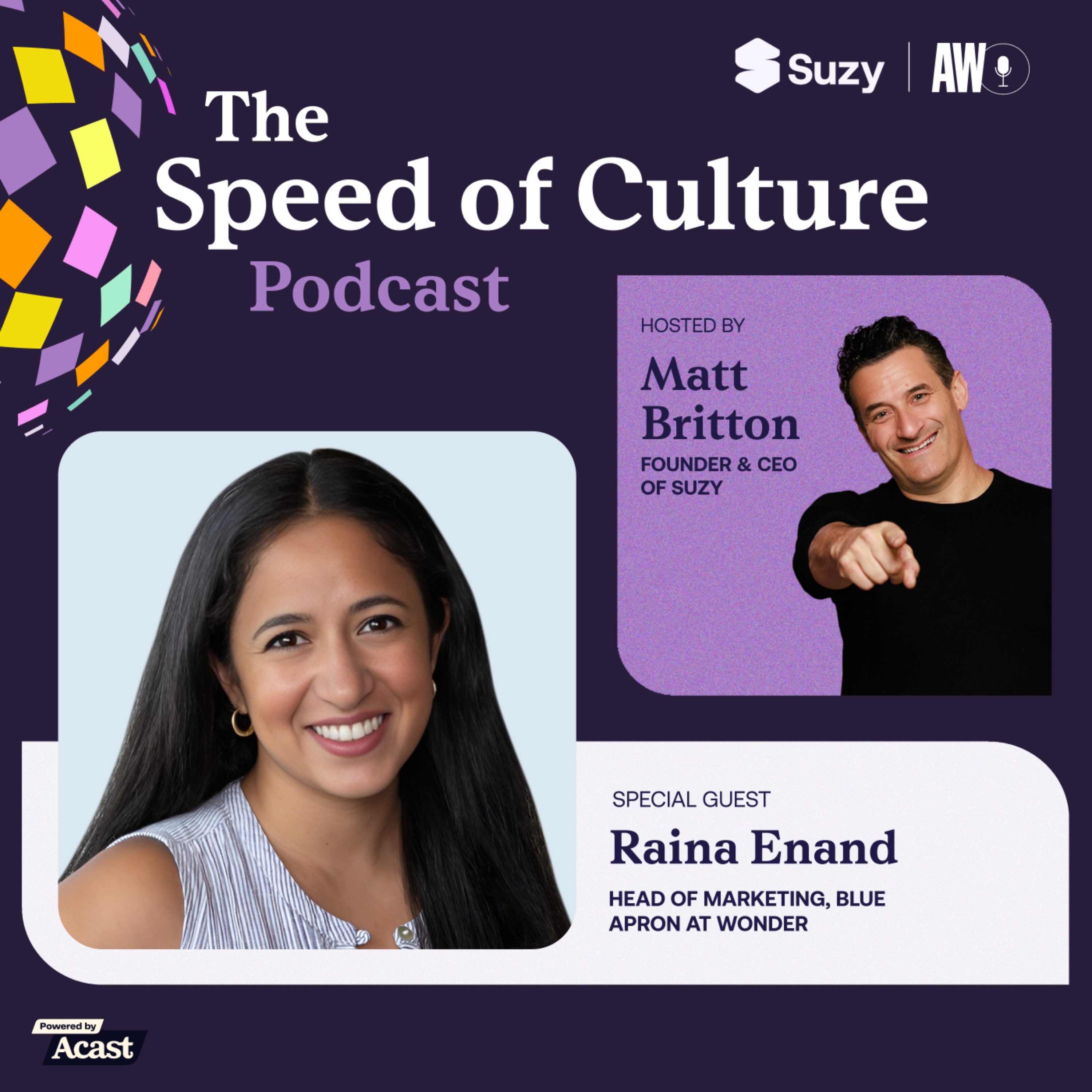
The Speed of Culture Podcast
From Subscription to Freedom: Raina Enand on Blue Apron’s New Era of Flexible Commerce
00:28:21
Loading summary
Transcript64 lines
- [00:01]
Raina Anand
If you love to travel, Capital One has a rewards credit card that's perfect for you. With the Capital One Venture X card, you earn unlimited double miles on everything you buy. Plus you get premium benefits at a collection of luxury hotels when you book on Capital One Travel. And with Venture X, you get access to over 1,000 airport lounges worldwide. Open up a world of travel possibilities with a Capital One Venture X card. What's in your wallet?
- [00:27]
Capital One / Wix Advertiser
Terms apply. Lounge access is subject to change. See capitalone.com for details.
- [00:30]
Matt Britton
We will answer your call as soon as we can.
- [00:33]
Capital One / Wix Advertiser
Are you still running your business? With one creaky old phone system, missing calls, losing track of messages, and scrambling to keep up with your team, it's time to break up with the past and say hello to Kuo. Kuo is the number one business phone system with 4.7 stars across 3,000 reviews on G2. Quo brings all your business phone calls and texts into one app for your team. No more juggling devices or being tied to a landline. Huo's built in AI logs calls, creates summaries, automates follow ups, and can even answer and route calls so you never miss an opportunity. Whether you're a solo operator or leading a growing team, Quo keeps you connected and helps you deliver standout customer experiences. Join over 90,000 businesses using Quo and see why it's the number one business phone system for customer satisfaction. Level up your workflow with quo get started free plus get 20% off your first six months at quo.comtech that's quo spelled Q-U-O.com tech and if you have existing numbers with another service, quo will port them over for free. Quo no missed calls, no missed customers.
- [01:45]
Experian Advertiser
Finding the right audience shouldn't feel like doom scrolling with Experian. It doesn't. Experian syndicated audiences help you reach holiday shoppers, car buyers and more across over 200 top platforms with over 2,400 pre built audiences. There's no more doom scrolling. It's audience targeting you can trust. Made simple. Learn more@experian.com Adweek that's experian.com Adweek.
- [02:17]
Raina Anand
I think that it absolutely changes everything. And so the first is the most important message that we're going to market right now is like making sure that people understand that what they knew about Bluey brand is different. So the most important message that we're hitting right now in the funnel is this is not what you know or thought of. We're not the same blue apron, we're not a subscription and we're not like a difficult meal kit.
- [02:41]
Matt Britton
To thrive in a rapidly evolving landscape, brands must move at an ever increasing pace. I'm Mat Matt Britton, Founder and CEO of Suzy. Join me and key industry leaders as we dive deep into the shifting consumer trends within their industry, why it matters now, and how you can keep up. Welcome to the Speed of Culture Up Today on the Speed of Culture podcast, we are joined by Raina Enand, the head of marketing at Blue Apron, a wonder company with over a decade of experience scaling innovative brands across beauty, e commerce and food and beverage. Lena has read marketing teams to major transformations from being Wonder's first marketing h to now guiding Blue Apron's brand relaunch. Raina, so great to see you today. Thanks so much for joining.
- [03:23]
Raina Anand
Thank you so much for having me. I'm so excited to be here.
- [03:26]
Matt Britton
Likewise. So a lot of people have heard of Blue Apron, but maybe not everyone knows exactly what the company does. For those listeners who aren't as familiar, would you mind just describing Blue Apron's business as well as Wonder and the other companies that are in that broader portfolio?
- [03:40]
Raina Anand
Absolutely. So Blue Apron sells meal kits. A meal kit is basically a meal that comes prepackaged with pre portioned ingredients. Ingredients and a recipe card that you can follow step by step to make a home cooked meal at home. But the kind of the benefit of that is that everything is pre measured, pre organized for you as well as like, you don't have to like kind of invest in like these obscure sauces or ingredients that you probably want to use again for another recipe. So it kind of really minimizes the waste and encourages you to try new things that maybe you wouldn't do before. Blueprint also sells pre made meals that kind of go in your microwave or oven that actually don't require any cooking at all now.
- [04:21]
Matt Britton
And I know that Blue Apron has recently become part of Wonder. So describe what Wonder does and how that's changed the overall opportunity for Blue Apron.
- [04:30]
Raina Anand
So Wonder is a company that has an app that allows you to order from multiple restaurants all at one time. And so you can visit a wonder store within a physical restaurant. And in the physical restaurant there's about 30 restaurants that are being cooked and made in that one physical space. So if you walk in, it doesn't look that big, but it's like a dining room with like a giant kitchen in the back.
- [04:52]
Matt Britton
So it's like a ghost kitchen. Is that the best way to describe it as a ghost kitchen?
- [04:55]
Raina Anand
It's not a ghost kitchen because there is a dining hall so think of it more like a food hall or a food court. So like when you go to a food hall or a food court, each restaurant usually has like its own stand. At a Wonder restaurant, there's one stand, but you can access all the brands through that, like one counter. But there is a place for you to dine in and sit and eat as compared to a ghost kitchen, which wouldn't have those things. And the best part is that you can actually order from multiple restaurants at once for pickup or delivery. And so one of my favorite things is that my husband always wants to eat wings and I am not a big wing person. And so when we order dinner from Wonder, I can order from the Chinese restaurant and he can order from the wings restaurant. And it all comes together in one order and one delivery. Perfectly piping hot.
- [05:35]
Matt Britton
Got it. So the synergies between Blue Apron and Wonder are kind of clear. One's delivering pre cooked meals, the other kind of combines multiple restaurants. But ultimately it's all about delivering food and giving consumers sort of the comfort of eating at home with the convenience of having other people cooking.
- [05:52]
Raina Anand
That's great. The long term vision for Wonder is deeper out for mealtime. And so it's that one stop destination where anything that you wanted for food would be located in that one app. In the Wonder app today, you can actually order both from Wonder restaurants, but you can also access Blue Apron through the Wonder app right now.
- [06:11]
Matt Britton
Gotcha. Now, Blue Apron has obviously experienced huge booms since the pandemic as people couldn't go to restaurants. Has that momentum stayed? And how has, I guess since COVID the business model and overall growth of Blue Wonder change as kind of the world has gotten back to normal?
- [06:28]
Raina Anand
Yeah, I think the biggest change as the world has gotten back to normal is that people have lost time during COVID Like all that time that you spend commuting or doing other things, you had that time to be at home. And so you did see a surgeons in people adopting meal kits because it was a way for them to cook through a 45 minute or a 60 minute recipe at home. And it was almost like one of those projects that you picked up. Like, I don't know if you picked up a skill. During COVID I learned how to cut hair, but I feel like a lot of my friends learned how to do sourdough insert. One of these very popular, trendy things here. Since COVID has happened, people have lost time. Like now what people are looking for is. And that's really what the new play Burn is focused at is like people are like I am time starved. I come home from work at five o' clock and my second shift begins. I had two very hungry children who are screaming at me and I need to get dinner on my table in 30 minutes or less. That is like fast, delicious and nutritious. And so that's what a lot of the new focus of Blue Aprain is all about, is giving customers flexibility but also simplifying the experience so that we can meet the need of consumers as the need has shifted from a post Covid era.
- [07:39]
Matt Britton
Yeah, I mean there's also other trends like obviously urbanization and people staying in cities for longer as well as the growth of two income households. So I would imagine all of those are drivers of demand for blue labor.
- [07:51]
Raina Anand
Yeah, definitely.
- [07:52]
Matt Britton
So when you look at the consumer, obviously there's lots of trends in the food and beverage space that are changing tastes and behaviors. What are some of the broader trends that you're seeing with consumers that you think are opportunities for the business moving forward?
- [08:07]
Raina Anand
Yeah, so the broader trend that we're seeing is one is control. So a lot of customers want to be able to control exactly what goes in their meals and have a really good understanding of the different nutritional values and benefits of it. And so now 70% of the menu of Louis brand is actually customizable and you can actually choose what proteins you go into it you're gonna see in the. I can't really talk about it yet, but you're gonna see us continue to double down on this concept of customization and control and giving that to consumers in the coming months with new product development that will come out. The second is protein. Protein is the number one most sought after attribute in the food and bev industry. It's experienced double digit growth for the past five years in Google trends.
- [08:51]
Matt Britton
Wow. Why is that you think it's just all health? Like people just want less carbs, more protein, just change in overall preferences.
- [08:59]
Raina Anand
Yeah, I think that it's partially driven by like the health trend which is, I think there's a few different factors. The first is the health trend which is protein makes you feel full longer. And so the more protein you can get in your diet versus relative to carbs or like empty calories, the better. And the second is I think with you're seeing a lot of an increased focus on not that this is a bigger trend, but a minor trend is picking up a lot of speed on like GLP1s and things like that. Like those also require you to have a pretty high protein diet.
- [09:28]
Matt Britton
Yeah, I would imagine it's going to have a huge impact moving forward. GLP1s.
- [09:32]
Raina Anand
Yeah. And so the new Dish by Blue Apron product line that we just rolled out as part of the new Blue Apron launch has an entire focus on protein. So every meal is made with a minimum of 20 grams of protein. The actual number of grams of protein is printed right on the packaging, as well as the calories, really giving that nutritional control to our customers. And a lot of the meals have, like, 30, 45, 40 grams of protein. Really trying to, like, amp up how much you can get. So. Because I know that a lot of people are trying to hit their. And I feel like in the 90s, people would count calories, and now, like, in 2025, people are counting protein and grams of protein they're eating in a day.
- [10:09]
Matt Britton
Interesting. And obviously, in order for you to continue to build the business, you have to focus across the funnel. And I guess the top of that funnel is making sure that you're continuing to drive overall awareness and interest in Blue Apron. Let's talk about the Blue Apron brand. How do you see the brand evolving? What are some of the brand pillars and what are some effective channels that you've leaned into to continue to build the brand?
- [10:33]
Raina Anand
Yeah, absolutely. So the interesting thing about the new Blue Apron launch, so just to kind of take a step back, the new Blue Apron that just rolled out two weeks ago is a big transformation of the company. We walked away from subscription, which is as the first meal kit company in America. We created subscription and the concept of meal kits.
- [10:51]
Matt Britton
In this space, everyone's going towards subscription. And it's very interesting that Blue Apron is moving away from it.
- [10:56]
Raina Anand
Yeah, I think let's, like, put a pin in that, because I'm going to circle back to that comment. And so walking away from subscription is like a massive change. Rolling out new two new product lines, Assemble and Bake and Dish by Buoy brand, which are really aimed at an easy, quick meal that you can get your dinner on your table. Brand new rebrand, new website, new app, and all of this is intended at giving customers an understanding that this is not the Bluey brand that you used to know. Bluey Brand has incredible brand awareness. I think, like, in my experience being on the brand, it's really hard to find someone that's either neither heard of blueprint nor tried blueprint at one point in their life. Like, I know a number of people say, oh, I work on Blue Apron now. They'll be like, oh, yeah, I did that thing once or twice. A few years ago, et cetera. But I think where Blue Apron has lost its way is actually like a step lower in the funnel, which is in the consideration part of the funnel. And that's really what the new relaunch is aimed at, is like changing the way people consider us, changing the notion that meal kits are long and time intensive and subscriptions are difficult and lock you in and difficult to manage. And so a lot of the new branding and new campaign that's actually going to be rolling out in a few days right after Labor Day is going to be aimed at really breaking those preconceived notions that people have with the Blue Apron brand and like, shattering them apart. And so Blueprint will be entering upper funnel for the first time in a few years, coming back with a big boom. So we'll be back in linear tv, connected tv, podcast, streaming audio. We were like one of the first brands to advertise in podcasts and podcast advertising first debuted well over a decade ago, and we haven't been in the podcast space medium for at least five years now. And so we'll be coming back in a pretty big and exciting way in the coming weeks.
- [12:48]
Matt Britton
So you'd mentioned the move away from subscriptions, and obviously subscriptions are a great thing in terms of a business model because recurring predictable revenue. What went behind that decision? Because that's a major structural shift in the business model. And I would imagine it wasn't a decision that was taken lightly. Just talk to me about that process and what that means for the brand and the business and frankly, how you spend your time moving forward.
- [13:11]
Raina Anand
Yeah, absolutely. You know, for the past year, we've been looking at consumer trends, we've been talking to customers, understanding what our data is telling us. And really the like, takeaway that we got is, I need more flexibility. My life is too unpredictable. Blueybron was historically a weekly subscription. There was no other option to be weekly. And the reality is, is like, every week your life changes. Sometimes you have leftovers, sometimes you go.
- [13:37]
Matt Britton
On vacation or true, sometimes people travel, Right?
- [13:39]
Raina Anand
Yeah. Sometimes your in laws brought you a bunch of food and like, the amount of frustration you hear from customers being like, ah, I forgot to skip my week or I forgot to do this and I love Guibrin, but like, it was just too much for me to manage the notifications on my phone to remind myself to either skip that week or like, change my settings for what meals were coming my way. And so in the new boy brand, we walked away from subscription to give customers that flexibility, control but really what it is is really opening up the funnel to allow customers to shop the way they want to so you can come to Blade brand and shop a la carte, buy whatever you want. I think we draw a lot of parallels to like almost like an Amazon. So you can go to Amazon, you can buy whatever you want, you can sign up for their membership, you can sign up for Blade brand plus and you can get free shipping. But we also have this product called Auto Ship and Save. There is a large customer base that enjoys the load of weekly meal planning that Blue Apron takes off their plate. The fact that I don't have to think about what meals I'm going to make every week and Blue Apron does all of it for me. And so we have a new product feature called Auto Ship and Save that allows you to tell us how many meals you want at what delivery cadence. You can like basically control every setting of the would have been subscription but is now just like a product feature that you're toggling on and off and control exactly what you get. And so it's more I think like now I'm more excited that the funnel is more open to like an increased TAM and allows me to go after more consumers and give them more options like Blue Apron is here to meet as compared to forcing you to meet us and our business model.
- [15:20]
Matt Britton
We'll be right back with the Speed of Culture after a few words from our sponsors.
- [15:24]
Experian Advertiser
Finding the right audience shouldn't feel like doom scrolling with Experian. It doesn't. Experian syndicated audiences help you reach holiday shoppers, car buyers and more across over 200 top platforms. With over 2,400 pre built audiences, there's no more doom scrolling. It's audience targeting you can trust. Made simple. Learn more at experian.com adweek that's E-P-E-R-I-A-N.com adweek.
- [15:56]
Capital One / Wix Advertiser
Banking with Capital One helps you keep more money in your wallet with no fees or minimums on checking accounts and no overdraft fees. Just ask the Capital One bank guy. It's pretty much all he talks about in a good way. He'd also tell you that this podcast is his favorite podcast too. Ah really? Thanks Capital One Bank Guy. What's in your wallet? Term supply see capitalone.com bank capital1na member FDIC how many times have you wished.
- [16:25]
Experian Advertiser
You could be in two places at once?
- [16:27]
Capital One / Wix Advertiser
With Wix you practically can. Wix's website builder is packed with powerful AI tools to make running your business online Easier build a full site just by talking with AI. Get an AI agent to manage your sales and marketing or work like a 10 person team even if it's just you. So you don't need superpowers to get everything done, you just need Wix.
- [16:48]
Experian Advertiser
Try it out for yourself@wix.com.
- [16:53]
Matt Britton
I would imagine though, as a marketer, when you have a subscription base, the notion of driving usage is important. But you have the revenue coming in from subscriptions. Obviously you want to prevent churn and make sure that people are getting benefit from it. But now it's a completely different ballgame because you need to continually drive trial. Somebody could use it once and their chance of using it twice I would imagine is far less if they're not a subscriber because they can go do other options. So does that change the way that you think about marketing and the messaging that you put out to consumers and even the channels that you lean into?
- [17:27]
Raina Anand
Yeah, I think that it absolutely changes everything. And so the first is the most important message that we're going to market right now is like making sure that people understand that what they knew about about Bluey brand is different. So the most important message that we're hitting right now in the funnel is this is not what you know or thought of. We're not the same blue apron, we're not a subscription and we're not like a difficult meal kit when we think about the funnel going forward. I think it's interesting that there's one way to approach this problem which is how do you bring customers in and like keep them. But there's an interesting way of also approaching this problem which is the inverse in a subscription model. If someone doesn't want to be a customer anymore and they churn, I don't actually have a mechanism to save them other than trying to keep them in the subscription. It's a black and white. You're in or you're out. That's it. As compared to now. If someone doesn't want to be in a subscription but wants to be able to come in and out of blueprint and use it the way that you want to, I have more ways of saving that customer because I have more options to give that customer to shop with us, which is a tool that I actually didn't have previously. And so I think it's actually might be a little bit easier. I'm hoping that it'll be a little bit easier from a marketing perspective because instead of saying like you're in or you're out, we can Say, okay, great, if this doesn't work for you, why don't you try this one or try this.
- [18:44]
Matt Britton
There's trade offs and you also have a bigger tam. So I think that it'll be different. And if the product is great, which a lot of people obviously love the product and I think you're only going to open up more opportunity that way. And I agree that I think consumers want flexibility, especially with something like eating. You're right, they do travel a lot. Their lives are changing more than ever before. They're mobile, they're zoom based work so people can work from different locations. So to be locked into something, I've personally been locked in the meal plans before and I've always canceled them for that exact reason. So I think it makes a lot of sense that you're re looking at things.
- [19:16]
Raina Anand
And I think like to your point earlier about like how everything is a subscription, I think that's like also a little bit of like the consumer, the global trend that's causing the burnout. Like for me the other day I bought a new scale and to use the scale to measure my weight I had to subscribe which was absurd and I got so frustrated. And so I think that there are a number of like those examples that you can come up that even like right before COVID that did not exist that you would like say that, oh, now I have like all these different subscriptions just to use daily devices in my household.
- [19:50]
Matt Britton
That's right. And it is growing. And there's subscriptions for your smart thermometer in the house and for your scale and for your doorbell and everything else. And not to mention the 20 subscriptions you need to watch TV. So it does add up for sure. So obviously in terms of continually engaging with consumers, content is a huge piece, especially if looking at Gen Z who this year, for the first time ever in America, the average age of a first time mother is Gen Z. And Gen Z grew up staring at the mobile device. And when they're staring at the mobile device it's not from traditional media sources but from other people, which is where creators come in I would imagine in your space that's a big topic and a big area of focus. Is creators getting into News Feed really driving a robust content strategy and just curious to hear your thoughts on how the creator economy has evolved and some of the efforts you're eyeing in that space.
- [20:39]
Raina Anand
Yeah, a big part of our relaunch. The strategy I've kind of coined the term Own the feed. Own the feed to me has different components the one component is influencers and content creators. The second component is organic social and user generated content. And then there's a third component of paid advertising and paid social which we traditionally know. We made the choice to bring our influencer program in house and manage it directly one on one with content creators. I knew that content creators were going to be a big part of our relaunch strategy because of your exact point. People get their content from different sources nowadays. But also food is such an intimate product and it's such a great glimpse into someone's life and how a meal kit can make that eating time occasion really joyful and really simple. And you really can only bring that level of like, authenticity and that level of like, pureness of like, what does dinner time look like in someone's home? Through really great partnerships and content creators, I think like, you really get to see that like, like warmthness, the people sitting at the table, the whoever is cooking the meal, how long it took them and what they were doing. And so actually like a really big conversation that we had was should we bring on a celebrity to be the face of the new Buoy brand and be part of the relaunch marketing strategy? And I actually advocated to, instead of doing that, to bring on like a hundred content creators and take that investment and put it into the content space and bring on as many people as we could to talk about the need blue aprain. And so that's what you're going to start to see go live in the coming weeks. But to me, the content creator space is to be successful. The most important thing is that we have the best relationship with our content creators and that they can be as authentic to their audience and their voice as possible. And so we try to keep our brand guidelines as really loose and have it more as like a relationship going back and forth, which is why we brought it in house, because you're talking directly to the person that sits on the team and be like, hey, great idea. Or what about this? We can bounce ideas back and forth and so that we can get, get the best content that feels great for our brand, but also the creator itself.
- [22:46]
Matt Britton
Yeah, it's interesting you bring up celebrities because obviously, as I'm sure you're aware of, Martha Stewart just got behind this big meal delivery venture. And I think there's two ways to build brands in this day and age in 2025. One way is kind of the way that Blue Apron's done it, which is hard work overtime, building trust, building loyalty, or there's a sort of like quick fix solution of partnering with a celebrity. I just recently read an article yesterday there was like 17 celebrity boosted tequila brands that shut down last year. So I do think we are entering an era where people are really starting to doubt the authenticity of those types of partnerships. And just attaching a celebrity to a brand launch, even if they're a quote unquote partner, isn't as impactful as it was when we saw Jennifer Aniston behind smart water or Dr. Dre behind beats. I mean, or George Clooney behind Casamigos. There was a period where it really made sense and now I feel like even that world might be a little bit oversaturated at the same time where traditional celebrities are losing a little bit of a mystique and power relative to these creators who have, to your point, much more authentic, deep rooted relationships with their audience.
- [23:52]
Raina Anand
Yeah, I literally could not agree more. And I think, especially when you're thinking about a Gen Z audience, that is exactly like the level of, I think like mystique or misnomer that brands are always like trying to pull over and like Gen Z is very astutely aware of those things.
- [24:08]
Matt Britton
Absolutely. So to talk about you and your career and shifting gears a little bit here, Raina, I know that you worked at Jet for three years prior to you joining Wonder. And obviously the common connection there is Mark lr, who is the founder of both companies as well as diaper.com, one of the most successful entrepreneurs in E commerce in our era and someone who I have a lot of admiration for. What's it like to work under an organization that's driven by Mark Lure? And what about the culture that he builds was so exciting for you that you decided to spend essentially the last nearly 10 years of your career working under him in different capacities?
- [24:47]
Raina Anand
It's a great question. So the funny part of the story starts is that Jet was my favorite job that I have ever had. It was the best company. The culture was incredible. It was a place where everyone you worked with was so smart, any idea you had, no matter how bold it was, was encouraged to go after. And really like just a place where it like kind of had this like, no big egos, no bias, like just everyone was in it. And the culture was really built to like, if you had an idea. Everyone was like, yeah, go for it, go test it, Go one, like, why isn't it live now? And when I heard rumblings that some Jet people were getting together to start Wonder, I was like, hi, I'm coming. Me too. I'm running. I didn't like, you're not doing this without me. This is the best job I ever had and I'm coming with you guys. And so you're right that I have, like, stayed with it. I think to me, the biggest thing that I've learned in my career is that one of the most important things to me is who you work with and who you work for. And the people that Mark attracts in his orbit are exactly true to the Wonder culture as it is in the jet culture, which is like, in total empowerment from top to bottom. Like, I never felt like if I didn't have an idea or if I wanted to, like, run something that maybe felt a little brand dangerous or brand crazy. Mark was always there to say, go for it, try it, test it. Let's learn from it. To him, the better thing is that we actually try to learn than if it, like, worked or didn't work. And I really value that aspect. The second is speed. Mark operates at the speed of light, and I think I, like, really thrive in that type of environment as well. There is a bias towards. An extreme bias towards action and then being action oriented and quick versus, like, slower, methodical, if that makes sense. Because again, it kind of all roots back to that. Like, learn as fast as you can, because if you learn it, then you can quickly optimize it and fix it and change it, et cetera. And then third, Mark is an incredible visionary. I mean, I just truly believe in what we're building here at Wonder. And I think, like, when you hear Mark talk about building the super app for mealtime in an app where you can get anything related to food in one place, something that doesn't exist anywhere in the market, to me, it's like, really inspiring, and I think Wonder is very poised to hit that goal. And it's really exciting to be part of.
- [27:07]
Matt Britton
Yeah, for sure. It's been really inspiring to see the growth of his companies. And Blue Apron obviously has a huge potential and obviously challenges in a competitive space, but obviously you guys serve a huge market, so it's will be exciting to see this new story unfold. To wrap up here, Raina would love to hear from you, your learnings from your career. You've worked at a lot of great companies. We didn't even mention l', Oreal, which is another place that you spend time at when you look back at your career journey. What is some of the skill sets that you think you've been able to accumulate over time that have put you in a position that you're in today that maybe some of our younger listeners can take note from as they're beginning their journey.
- [27:43]
Raina Anand
I was really intentional in how I crafted my career to spend enough time in different functions of marketing to learn them enough to be dangerous but not get pigeonholed. And I think that was something that I like really quickly figured out. I spent time in brand marketing and paid social and paid search and in offline media, but I didn't want to be the director of paid social. And that was something. When I figured that out, what I wanted to know was how can I piece all these pieces together and really use my experience in different roles and functions and industries to understand actually like the consumer journey doesn't stop when you acquire them. There's also all the CRM part of it. There's the LTV part of it. And I think one of my superpowers that I gained from my work experience is being able to see how different dots connect against different teams or different marketing functions that sometimes can exist in silos or people don't realize that if you pull on this thread, it actually impacts this thread as well. And so what I would encourage everyone on my team is that even if you are our CRM manager and you're really interested in learning paid social or you really interested in understanding how paid media works, I love to include those people in our meetings. I love for them to meet with the paid social manager to understand how the campaigns work. If you want to move to a different part of the team or to pick up a different project, that's something I'm like always encouraging for people on my team because I think that the more you can understand how different parts of marketing actually interact and impact each other, the more successful you'll be later on in your career.
- [29:17]
Matt Britton
Absolutely. As well. Things are changing so quickly. I think understanding the confluence of different factors and a lot of which we talked about today, whether it be industry trends, evolutions in business models, like where you're going from moving away from subscription models and of course the consumer and all the drivers of the consumer which we talked about today, including the pandemic and GLP1s, and the rise of Gen Z as a household buyer. I mean, it's an exciting time, but you definitely be have to be on top of your game and have your finger on the pulse of the consumer always, or you're going to get lost in this crazy world we're in.
- [29:46]
Raina Anand
Yeah, absolutely. Marketing's always part science, part math.
- [29:50]
Matt Britton
It sure is. Absolutely. So to wrap up here, we always ask our guests if there's a saying or a mantra that helps encapsulate their career during the days. So what comes to mind for you?
- [29:59]
Raina Anand
The number one thing that my team will say that I constantly say to everyone on my team, which I think is like my own personal mantra, is like, if you see something, say something. And I that applies to if you see an idea or you see a campaign that you find interesting. Let's talk about it all the way to if you see something in the data that doesn't make sense, say something about it. But I think that the best thing I can do is like, my mantra is just, just speak up and like, ask questions as much as you can. Because assuming that someone has already thought of that is like always the wrong assumption. And so you'll see that, like, it's just something I like, probably say like 15 times a week, which is like, see something, say something.
- [30:37]
Matt Britton
I also think it's a great message for younger women in the workforce, especially in advertising. I think it's important that they speak up. They don't feel like they have to cower down. It doesn't matter who's in the room if it's a bunch of old executives that are in the room. It doesn't matter if you have conviction what you believe and speak up and speak your truth, because that's how you're going to break through.
- [30:56]
Raina Anand
Couldn't agree more.
- [30:57]
Matt Britton
Absolutely. Well, it's clear you've done that, Reyna, and it's been a great discussion today and congrats on all your success and looking forward to great things for this new journey with your business, Blue Apron.
- [31:07]
Raina Anand
Thank you so much.
- [31:08]
Matt Britton
It's been a great pleasure talking to you. Absolutely. On behalf of Susie and I would keen thanks again to Raina Anand, head of marketing at Blue Apron, for joining us today. Be sure to subscribe, rate and review the Speed of Culture podcast on your favorite podcast platform. Till next time. See you soon, everyone. Take Care of Foreign is brought to you by Susie as part of the Ad Week Podcast Network and a guest creator Network. You can listen subscribe to all Adweek's podcasts by visiting Adweek.com podcasts to find out more about Suzy, head to Susie.com and make sure to search for the speed of culture in Apple Podcasts, Spotify or anywhere else podcasts are found. Click follow so you don't miss out on any future episodes episodes. On behalf of the team here at Suzy, thanks for listening.
- [32:06]
Experian Advertiser
Finding the right audience shouldn't feel like doom scrolling with experian it doesn't Experian Syndicated audiences help you reach holiday shoppers, car buyers and more more across over 200 top platforms with over 2,400 pre built audiences. There's no more doom scrolling. It's audience targeting you can trust. Made simple. Learn more@experian.com Adweek that's experian.com Adweek.
- [32:39]
Capital One / Wix Advertiser
Banking with capital One helps you keep more money in your wallet with no fees or minimums on checking accounts and no overdraft fees. Just ask the Capital One Bank Guy. It's pretty much all he talks about in a good way. He'd also tell you that this podcast is his favorite podcast too. Ah, really? Thanks Capital One Bank Guy. What's in your wallet? Terms apply. See CapitalOne.com Bank Capital One NA Member.
- [33:03]
Raina Anand
FDIC when you've got too many ideas and too little time, that's when you need wix for your website. Wix helps business owners like you and me get more done without burning out. It's packed with AI tools that actually make running your business online easier. Build a full site just by talking with AI, get an AI agent to manage your sales and marketing, or work like a 10 person team even if it's just you. Try it for yourself@wix.com.