← The Speed of Culture Podcast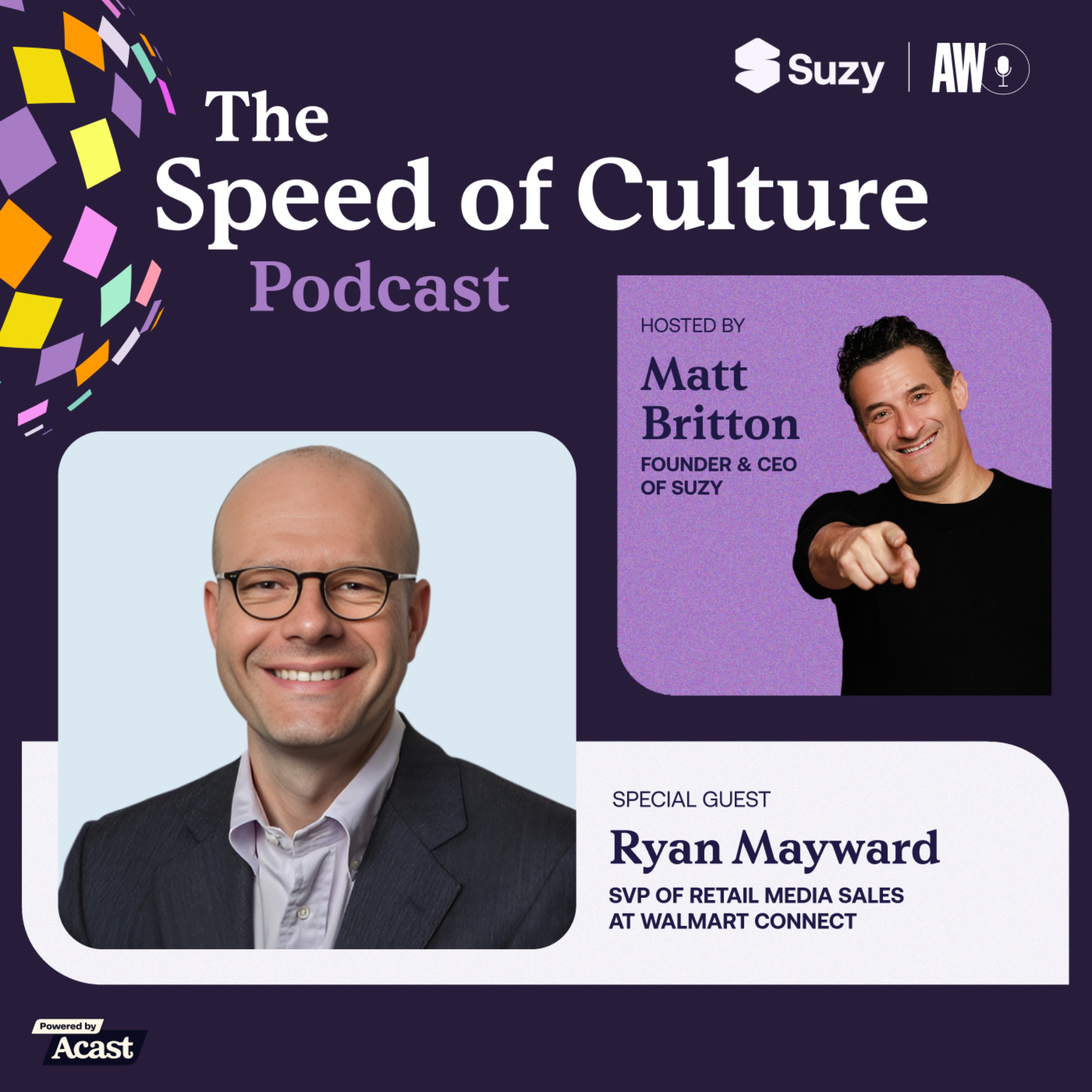
The Speed of Culture Podcast
How Ryan Mayward Is expanding Walmart Connect’s retail media empire
00:29:24
Loading summary
Transcript135 lines
- [00:00]
Ryan Mayward
Ready to order?
- [00:01]
Matt Britton
Yes. We're earning unlimited 3% cash back on dining and entertainment with a Capital One Saver Card. So let's just get one of everything.
- [00:08]
Ryan Mayward
Everything.
- [00:09]
Chef
Fire everything. The Capital One Saver card is at table 27, and they're earning unlimited 3% cash back.
- [00:15]
Ryan Mayward
Yes, Chef.
- [00:16]
Matt Britton
This is so nice.
- [00:18]
Chef
Had a feeling you'd want 3% cash back on dessert.
- [00:20]
Matt Britton
Ooh, tiramisu.
- [00:22]
Chef
Earn unlimited 3% cash back on dining and entertainment with the Capital One saver card. Capital One, what's in your wallet?
- [00:28]
Capital One Representative
Terms apply. See capitalone.com for details.
- [00:31]
Ryan Mayward
Race the rudders. Race the sails. Race the sails.
- [00:35]
Host
Captain, an unidentified ship is approaching.
- [00:37]
Ryan Mayward
Over.
- [00:38]
Capital One Representative
Roger, wait.
- [00:40]
Ryan Mayward
Is that an enterprise sales solution?
- [00:43]
LinkedIn Representative
Reach sales professionals, not professional sailors. With LinkedIn ads, you can target the right people by industry, job title, and more. We'll even give you a $100 credit on your next campaign. Get started today at LinkedIn.com Terms and Conditions apply.
- [01:03]
Philo Ads Representative
This episode is brought to you by Philo Ads. Want to get your brand in front of the right audience? Philo Ads is the way to go. With 98% of viewing on connected TVs and over 900 million monthly ad impressions, Philo gives advertisers unmatched accessibility, flexibility, and results. Power your next campaign with Philo Ads. Today, head to Ads Philo TV to get started.
- [01:30]
Ryan Mayward
Personalization is an interesting topic in the sense that it consists of three things. It's the audience, who are you addressing, and what do you know about them? It's the context, what's the environment in which they're in, or at least the environment in which you're going to deliver the ad. And then there is the creative message itself.
- [01:48]
Host
To thrive in a rapidly evolving landscape, brands must move at an ever increasing pace. I'm Matt Britton, founder and CEO of Suzy. Join me and key industry leaders as we dive deep into the shifting consumer trends within their industry, why it matters now, and how you can keep up. Welcome to the Speed of Culture. We're here live at the Possible conference in Miami. And today, we're thrilled to welcome Ryan Mayward, the SVP of Sales at Walmart Connect. Ryan is driving the future of retail media, leveraging Walmart's massive consumer insights and innovative technology to help brands connect with customers in meaningful ways. Ryan, so great to see you today.
- [02:26]
Ryan Mayward
Thanks for having me. I'm delighted to be here.
- [02:28]
Host
Absolutely. So how is the retail landscape for Walmart evolved over time to the point now where you can actually offer this retail media network as sort of an added benefit to the merchants.
- [02:39]
Ryan Mayward
Walmart Connect has a dense history that's unfolded over a relatively short period of time, I would say. Walmart Connect was founded, call it five years ago, end of 2019, beginning at 2020. Of course, Walmart through various partnerships had been selling ads on Walmart.com before that.
- [02:56]
Host
Yeah.
- [02:56]
Ryan Mayward
But the company decided to that capability in house, build an advertising business in house with their own product and tech teams. And I joined a couple years ago. But in the several years before I got there, the first ad product that they built from the ground up from scratch with Walmart engineering talent was their paid search platform to enable brands to arrange the digital shelf. And it started off as a managed service offering, but now it's a contemporary high performing search platform powered by programmatic APIs. Yeah. An auction based CPC paid search offering. And then from there built out display and video ad units within the Walmart Shopping app. So we can drive brand discovery, close the sale with search and lots of other rich experiences. Things like brand shops where a brand can present their assortment to our customers in their own way, use their own brand imagery, their own voice.
- [03:46]
Host
Just powered by Walmart.
- [03:47]
Ryan Mayward
Yeah, exactly. And then the area that's grown a lot over the last two or three years has been advertising outside the Walmart environment. So we set up the Walmart DSP several years ago in partnership with the trade desk. That paved the way for us to get into ctv. We partnered with Paramount plus and NBC Universal and Disney started applying Walmart audiences to their CTV inventory and measuring sales outcomes did something similar in parallel with the major social platforms with Meta and TikTok and Pinterest. And then of course through the DSP we also access open web inventory when consumers are just checking out the news, the weather. We're able to also address shopper based audiences on that inventory and measure sales outcomes. And then more recently we have been experimenting with ad products or ad formats in stores, mainly focused on screens.
- [04:36]
Host
Right.
- [04:37]
Ryan Mayward
And so we've had say the TV wall for a long time and we have had experimented with advertising there for a while, but lots of new screens popping up, particularly in new and remodeled Walmart super centers. So lots going on. I think we have a lot of touch points to offer brands and all this has come to fruition in the last five years.
- [04:54]
Host
Yeah. So for the audience that maybe isn't in this specific industry, the way I interpret what you just said is that Walmart has a lot of first party data. You're selling to millions and millions of customers and you understand on an anonymized basis what those customers buy. And then you can reach those customers in a variety of different places, obviously in your first party channels like your website and in store, but as well as various places around the web, like social platforms as well as on tv. So your ability to capture this first party data allows you to give your merchants really a whole different level of targeting to reach the consumers that matter most.
- [05:28]
Ryan Mayward
Yeah, our suppliers, the brands that we sell in our stores. And yeah, I think an important point you made that I wasn't explicit about is underpinning all of these channels and formats is our first party data set, which enables us to target customers based on their purchase behavior across all of our retail departments. The daily, or rather the weekly grocery shopping trip, consumables, purchasing, fashion, general merchandise, all these different categories and then measure what happens as they move from awareness to consideration to purchase.
- [05:58]
Host
The whole attribution funnel.
- [06:00]
Ryan Mayward
All closed loop. Yeah, exactly.
- [06:02]
Host
And for the brands that are working with you, what are some of the creative types of activations that are working? Is it all discounted promotion base? Is it top of the funnel? What are you seeing really gain traction?
- [06:14]
Ryan Mayward
Yeah, I think that we like to talk about campaigns through the lens of touchpoints. I think the last 10 or so years we've become increasingly uncomfortable talking about campaigns or big programs of brands through the funnel language.
- [06:28]
Host
Right.
- [06:28]
Ryan Mayward
We know as E commerce has grown that the customer journey is not this linear, orderly thing. Right. It's condensed, it's asymmetrical and a customer's phase, or rather their journey from becoming aware of a brand, discovering a brand and thinking about it, researching it and buying, buying it. It's a fluid system or a fluid process that unfolds very quickly and so.
- [06:50]
Host
Varies by category, I would imagine.
- [06:52]
Ryan Mayward
Exactly. Whether it's a lower consideration, food item that you buy every week to an expensive TV that you buy once every four or five years. Exactly. And so what we've learned as we've developed all of these touch points, that the more that you add to a program, the more product a brand will sell. So what do I mean by that? You will sell a lot of stuff if you invest in search ads, when you add in video and display in the shopping app, you're going to sell more stuff. When you layer in the off site media, whether it's open, web, social, ctv, you're going to sell even more stuff. And the trick to it all is having a consistent, well defined audience that represents the customers that you need to win in order to achieve your goals and then using the same data set to get at the measurement component. Did you solve your business problem of ending or reducing customer attrition or winning new to brand customers or winning customers that are new to Walmart? We've been public about a lot of higher income customers coming into Walmart through grocery delivery. Whatever your goal is, we can measure it through the data that we have that underpins all of these touch points. So I think it's more productive to talk about big programs like that as a collection of touch points, audiences and measurement. And then the creative assets that come into play are entirely dependent on what sort of message the brand wants to deliver. It could be about a new product launch, some limited time offer, it's some innovation product that they're bringing to market. It could be savings oriented, although that's usually not the message given our approach to everyday low prices.
- [08:25]
Host
Right.
- [08:26]
Ryan Mayward
We're not a high, low retailer and so pricing messaging is not the core of it. Instead, it's about the value prop to the customer. What does the brand want to convey in that regard? And they have had at Walmart connect richer and richer opportunities to do that through video, through TV ads, through social experiences and all the other formats that we offer.
- [08:46]
Host
Yeah, it's interesting to hear you talk about CTV as one of your mediums because television for so long was just like monolithic 18 to 49 demographic. And now increasingly you're hearing at conferences like CES the ability to really be able to make that an addressable medium and target people on very specific sort of airtight attributes. And to see you layering that on for advertisers is really interesting. And frankly something I hadn't thought of is that really gaining a lot of traction and how much are advertisers shifting their overall spend from mass broadcast to CTV powered by companies like Walmart?
- [09:19]
Ryan Mayward
Yeah, well, I think CTV is, it's growing quickly as brands are following customers.
- [09:24]
Host
Yeah, yeah, exactly.
- [09:26]
Ryan Mayward
Cutting the cord, seeking out CTV opportunities that are increasingly, as the cost of all these different subscriptions starts to pile up, they're increasingly opting for an ad supported package. So that gives us a lot of opportunity. And we are making CTV work harder for brands by addressing TV ads based on shopping behavior and then measuring what happens next. I think the measurement question is particularly interesting. The question is, what does CTV do? Like historically you would look at TV as you described, it's this monolithic thing. It drives reach, it drives frequency, it drives mindshare awareness about your products, but it does more than that. But it's been hard to quantify Those things over the years.
- [10:05]
Host
The famous John Wanamaker quote.
- [10:06]
Ryan Mayward
Right, Right. Which half are you wasting? I don't know. But now I think one of the areas where I think retail media can help in particular is shining a light on what happens in the middle of that purchase journey or the customer journey, which we've characterized as consideration. How do you quantify considerations? And for us, once you see the ad, you may not immediately go to our search page and like hit the plus sign next to the item and add it to your basket. You might go to an item detail page. You might go to the brand's brand shop. In the app, you might read customer reviews. These are the things that are leading indicators of sales.
- [10:40]
Host
Yeah.
- [10:40]
Ryan Mayward
And I think we can optimize to those things for formats like TV to show the value before the purchase actually happens. Especially in an environment where there isn't an immediate call to action and an immediate opportunity to add something to your basket. Although there is a lot of demand for that too. We get asked about shoppable TV every day, practically.
- [10:59]
Host
Yeah, I'm sure. I still don't understand why somebody's watching a TV show. They can't say, oh, where's that couch from? I want to buy it. Yeah, like, I feel like that's going to be here before you know it because that's how people are learning about that.
- [11:09]
Ryan Mayward
It's showing up, I'm sure.
- [11:11]
Host
So one area, obviously AI is a big topic here at possible conferences as well as every other conference here in 2025. And one of the main ways I think AI is going to be able to unlock the power of, frankly, what companies like yours are doing is through hyper personalization because you have all this first party data and now you can serve things that are directly relevant to that individual. What type of work are you guys doing in that regard to kind of unlock creative personalization at scale for your advertisers?
- [11:39]
Ryan Mayward
Yeah. Well, I think personalization is an interesting topic in the sense that it consists of three things, two of which we have a good handle on. It's the audience, who are you addressing and what do you know about them? It's the context, what's the environment in which they're in, or at least the environment in which you're going to deliver the ad. And then there is the creative message itself as it pertains to the first one. We obviously know a lot about our customers and what they like to purchase over time, so that helps us decide what's the right message to show to that customer. We're only going to show messages to them for which they have some high propensity to take an action, some product they're likely to buy. In terms of the context, when they're in the Walmart shopping app, we know the context. We know whether they're on a page relevant to food, they're building a grocery basket. When they're outside of our environment, we can rely on the publisher or the tech partner to convey the context to us. We may not know it ourselves, but they can tell us what it is. So that's solvable. The thing that we, we do not own or completely control is the creative asset. That's where the brand participates. It's their responsibility to bring forward assets to use to show their brand message to the customer. And I think that historically things like dynamic creative optimization have been complicated, expensive.
- [12:53]
Host
Hard to do better in theory than in execution, limited scale.
- [12:57]
Ryan Mayward
And this is where AI has I think tremendous opportunity to unlock the value of creative. I think that's sort of the next frontier in retail media is since we've sort of mastered the first two components, how do we use AI tools to enable and unlock the value in more personalized creative. And we are working on the tooling for that. No big announcements to share today, but I think that it'll be a combination of third party technology as well as stuff that we build in house and then brands readiness to embrace it and to build creative AI enabled tools into their workflows. And I know that and we're hearing from big brands that they're getting better and better at that. They tested them out last year, they're rolling them out and scaling them this year and would expect them to be making a serious impact next year.
- [13:41]
Host
Yeah, I mean the technology's here now. As somebody who's built hyper personalized tools and AI, you can easily create websites that are completely dynamic based upon the person. You can now create videos that are based upon the person's interest. And I think three, four years from now, if I watch a TV show and you do, what's in it will be different based upon what we like. It could even be products that are featured in it. And that's the world that we're heading towards so quickly.
- [14:06]
Ryan Mayward
Yeah, absolutely. I think with our existing targeting and segmentation capabilities, we can decide what sort of product you should see right in the ad. But making that creative asset dynamic and tweaking it just enough so that it feels different and more tailored to you and then doing the same for me, like that is the next unlock that's the hard part. But I think it's about to get a lot easier.
- [14:28]
Host
100% getting more and it's getting easier every day is like what you probably hear in AI is like today's the worst it'll ever be. There's still a lot of people that think if you create a video of a person they're going to have seven fingers. That might have been true seven months ago, but now it's really lifelike and who knows where it's going to be seven months from now. And that's how quickly this is all evolving.
- [14:46]
Ryan Mayward
Yeah.
- [14:46]
Host
What are you seeing in terms of the consumer? I know that Walmart and other contemporaries in the retail space have seen softness from the consumer based upon a variety of different factors that we're seeing in the macro. Is there anything you're seeing in terms of buyer habit that are interesting and worth noting?
- [15:03]
Ryan Mayward
Yeah, I think that in an environment like this, Walmart tends to do well.
- [15:06]
Host
Yeah.
- [15:07]
Ryan Mayward
I think that's the fortunate thing about Walmart. We do well when the economy is doing well and we do well when the economy is not doing well.
- [15:12]
Host
Yeah.
- [15:12]
Ryan Mayward
Because we're able to deliver everyday low prices to customers and our mission is to save them money so that they can live better. So we're feeling good about our opportunity ahead. We're really excited about a couple things. One, our grocery business, the thing that Covid did was it made online grocery a permanent part of online.
- [15:31]
Host
You probably saw it firsthand there too.
- [15:33]
Ryan Mayward
Yeah, absolutely. And before COVID it was a niche thing. It was kind of expensive. It was in dense urban areas where there was a clear need.
- [15:39]
Host
Yeah.
- [15:40]
Ryan Mayward
But now people in the burbs love ordering their groceries online and having them delivered. It's a huge, huge time saver. And so we remain super excited about that business. Deliveries overtaken pickup, which is exciting. Growth of things like Walmart plus has enabled that. And I also am excited about our marketplace business. The last few years years we have built out a platform for third party sellers to come onto Walmart and make their products available using our retail tools and that's dramatically expanded our assortment, particularly in general merchandise. So the marketplace has been growing rapidly the last couple of years and that has presented a large new advertising opportunity for us. Sure. It's introduced us to tens of thousands of net new advertisers who want to use search to bring their products to the the forefront and show them to customers and drive sales. So those two areas, I mean there's lots of bright spots across the Walmart retail business, but those Two in particular are exciting to me.
- [16:36]
Host
We'll be right back with the speed of culture after a few words from our sponsors.
- [16:41]
Philo Ads Representative
If you're looking to connect with younger, highly engaged audiences on the biggest screen in the house, Philo Ads has you covered. From flexible buying options to powerful targeting and transparent results, Philo Ads makes premium CTV accessible to brands of every size. Visit Ads Philo TV and start building your next campaign today.
- [17:08]
Capital One Representative
Ready to order?
- [17:09]
Ryan Mayward
Yes.
- [17:10]
Matt Britton
We're earning unlimited 3% cash back on dining and entertainment with a Capital One Saver Card. So let's just get one of everything.
- [17:16]
Host
Everything.
- [17:17]
Chef
Fire everything. The Capital One Saver card is at table 27 and they're earning unlimited 3% cash back.
- [17:23]
Ryan Mayward
Yes, Chef.
- [17:25]
Matt Britton
This is so nice.
- [17:26]
Chef
Had a feeling you'd want 3% cash back on dessert.
- [17:29]
Matt Britton
Oh, tiramisu.
- [17:30]
Chef
Earn unlimited 3% cash back on dining and entertainment with the Capital One saver card. Capital One what's in your wallet?
- [17:36]
Capital One Representative
Terms apply. See capital1.com for details.
- [17:38]
LinkedIn Representative
Does it ever feel like you're a marketing professional just speaking into the void? Well, with LinkedIn ads, you can know you're reaching the right decision makers. You can even target buyers by job title, industry, company seniority skills. Wait, did I say job title yet? Get started today and see how you can avoid the void and reach the right buyers with LinkedIn ads. We'll even give you a $100 credit on your next campaign. Get started at LinkedIn.com results. Terms and conditions apply.
- [18:11]
Host
So your job is obviously to help drive growth for Walmart Connect. And obviously you're working with customers. Both. Both, I would imagine, on the brand and agency side.
- [18:20]
Ryan Mayward
Yeah.
- [18:20]
Host
In terms of your ability to capture their mindshare and their attention in a conference like this and day in, day out, work what works for you in terms of being a value partner and engaging with those people that you want to reach.
- [18:32]
Ryan Mayward
Yeah. I think part of what's unique about our business is our ability to identify the right business problem to solve for a brand. You've probably heard about a data platform that we have called Scintilla. It used to be called Luminate. It's a subscription based product and it does a few things. It helps brands understand customer behavior of their products. What are they buying? And as well, is the brand winning new customers, do they have a customer retention challenge? What sort of category share, household penetration do they have? You learn all of that. You learn about channel performance, how much product are you selling in our stores, online for pickup and delivery, ship to home, and then we have this Panel that you can use to access Walmart customers and get their ideas or their sentiment around innovation, package design and other things. And brands use that directly to learn about their Walmart business and optimize it. We at Walmart Connect also use all that data to help brands understand what is the next opportunity for them.
- [19:29]
Host
How can they keep new insights key to their business?
- [19:31]
Ryan Mayward
Yeah, exactly. And I think that that's just an incredibly powerful thing to be able to do to say this brand has a challenge with customers, switching to a competitive brand or leaving the category entirely. Here are the tactics that are tailored to do that. So we're really excited about being to use this vast omnichannel retail data set to put to work for brands and solving their problems. It makes us more of a consultant.
- [19:55]
Host
Right.
- [19:56]
Ryan Mayward
Than a media sales organization.
- [19:58]
Host
Yeah. Ultimately it's about adding value. Right. Because no matter who you want to talk to, there's probably several dozen other people that also want to talk to that person. And despite the fact that you have a powerful name, I'm sure it doesn't hurt. Obviously you want to also deliver that value. And it sounds like with the treasure trove of data you have and your ability to glean insights from that and makes it worthwhile for someone to pick up the phone and talk to you.
- [20:19]
Ryan Mayward
Yeah, and who benefits? At first it's the sales and shopper marketing organization inside the brand that's focused on Walmart. But there are rich insights there that can inform what the CMO is doing.
- [20:30]
Host
Advertising, strategies, development, all of that, as.
- [20:34]
Ryan Mayward
Well as the GMs running the brand who want to understand how the data can not only solve marketing problems for them, but also inform their supply chain decisions and help them optimize their businesses.
- [20:45]
Host
To win future innovation as well.
- [20:46]
Ryan Mayward
I'm sure it opens a lot of doors. It gets us into all the different corners of the client's organization to help them understand where their pain points are and what we can do to help.
- [20:57]
Host
You know, it's interesting the trend that we're seeing because Walmart in the past was the advertiser versus the advertisee, if you will. And Walmart's not the only one. You know, you have see PayPal rolling out their own media network, Chase bank is rolling. So it seems like there's more and more companies that are also trying to sell versus buy. And obviously for the advertiser it can be confusing, but it also makes me feel think like, is this the new media company? Because the traditional media companies don't necessarily have the first party Data certainly don't have shopper data like you have. Like where do you see this all going in terms of, I guess this crossroads we seem to be at.
- [21:33]
Ryan Mayward
I think it comes down to who has the most valuable data.
- [21:36]
Host
Yeah.
- [21:36]
Ryan Mayward
You do not have to be media owner. The media platforms are happy to partner with you to help them better monetize their inventory. And that's what we've found firsthand. We have stores. There's the one on your phone in your pocket and then there are 4,600 plus physical stores. We don't run a social network. We are not a broadcaster. Right. But we're there. And we're there because we have incredibly valuable data that's helping solve problems that our advertisers have and our advertisers are shared with those other media companies and we want to come together to solve problems for them. It makes us both more valuable.
- [22:07]
Host
Absolutely. Yeah. I mean, the space just has evolved so quickly that somebody in marketing right now, really, it's not just about you look at if you watch Bed Men. Right.
- [22:16]
Ryan Mayward
Yeah.
- [22:16]
Host
And the way they thought about advertising. And you fast forward to the discussion we're having today. It shows just how much things have evolved and how much science and technology has really entered the fray to be an effective marketer.
- [22:28]
Ryan Mayward
Absolutely. You can't do my job and crack open a bottle of Canadian whiskey at noon. Like all we're doing is we're doing math and we are picking the right audience segmentation and we're running programmatic ad platforms. And the math men, I guess, have won over Madison Aven since that show.
- [22:47]
Host
It seems that way. So I was on CNBC like probably five or six years ago saying that Netflix should buy a company that makes TVs because ultimately whoever owns the last mile in technology could kind of control the user interface, maybe even have the remote, etc. And now they're not at risk anymore from another company doing it. Because if Netflix is relying upon Samsung to distribute, what if Samsung cuts a deal with Hulu? Right. And then I saw Walmart acquire Vizio, which I thought was such a brilliant acquisition for that reason. Where does Vizio fit in the overall strategy in terms of having physical, low price, very accessible and really high quality, I believe, because I own a couple of them devices in the home.
- [23:29]
Ryan Mayward
Yeah, we're really excited about that partnership. The fortunate thing is for a couple of years before deal closed last December, we learned a lot about CTV through our partnerships with the broadcasters and accessing their inventory through the dsp. So we were able to learn how to talk CTV to our clients, we were able to figure out what does CTV do to drive solutions for brands? Is it sort of the middle funnel solution? Is it a sales driver? Is it about winning net new customers? Is it about driving branded search on Walmart? We're learning all those things and packaging up CTV as a solution. And now we're ready because we have a lot more CTV inventory available to us. And our first beta with Vizio just came out a couple weeks ago. We took it to agencies and it is what you would think it is. It's the opportunity to use Walmart audiences on all of Vizio's inventory. They have great inventory. Most of their ad supported hours are driven by Watch Free plus their free ad supported streaming channel. So we'll be able to identify Walmart customers in there, show them tailored ads, measure sales outcomes as well as do that across the ad supported apps on their platform. So we're excited to bring them a lot more demand, leverage their inventory and deliver results for customers. Our mutual clients brands are asking us about all kinds of stuff about what's in the hopper, what's next. Everybody wants more shoppable formats. We'll have more to talk about that in the future. But the deal just closed four months ago. But we're excited with the pace at which we're moving.
- [24:54]
Host
Yeah, I mean what I would do if I were in charge of all Walmart is I would one day try to have Vizio be Walmart tv, give it away for free TV away for free to Walmart plus customers. And then the screensaver essentially becomes you're out of inventory that you have in stores. Like it's just like you have a physical device. I think there's so much power in that. I'm shocked that Netflix, Apple, these companies did not roll a device because I understand the margins are razor thin. But it becomes a loss leader and it allows you to really have that device in the home which controls the eyeballs where people are shopping, especially for products that they end up buying at Walmart.
- [25:28]
Ryan Mayward
Yeah, well, I mean everybody who buys a TV expects to see ads on it. And the fortunate thing and what you just said as a Vizio customer is they make an awesome TV that people are willing to pay for. So it's just a great business to add to Walmart for a lot of reasons. And the advertising piece in particular is exciting to us.
- [25:45]
Host
Yeah. And it just sort of exemplifies where the value has changed in the overall ecosystem because the value used to be in the hardware but then as manufacturing became much more commoditized, those margins got shrunk and now the value is clearly in the data.
- [25:59]
Ryan Mayward
Yeah.
- [25:59]
Host
So that's what you're, we're even seeing Apple, their biggest growth areas in services, which is essentially in data. Yeah, but, but hardware is still very powerful because it's what's the consumers touch and feel to interact with the data.
- [26:10]
Ryan Mayward
Yeah. It's a disruptive time in the TV space, but there's a lot of opportunity for new companies and we're one of those new companies.
- [26:16]
Host
Absolutely. So let's shift gears a little bit as we wrap up here. Just to you and your career, Ryan. I mean you've been in sales for a while and you've worked at some of the best companies in the world. Technology companies like Amazon, Instacart, now of course Walmart. What are some of the things that you think you do particularly well that differentiate you from others that's kind of generated such success in your professional journey?
- [26:37]
Ryan Mayward
Well, one of the things that I've tried to do consistently is carve out time and create this as part of my routine, like have structured self driven learning. The business has changed so much over the last 25 years. I think that as we were just talking about regarding AI tools and what they'll unlock in the coming years, they're going to make what we're doing this year look crude and stone age by comparison. And I think that it's very easy to say after a while, I'm an expert, you know, I've been doing this a while, like I'm pretty successful, like I'll read that article tomorrow, you know, I'm busy with work or I got to go home and do this thing with my family. Family. And I think when you get to that sort of stasis, that plateau that can be career ending.
- [27:17]
Host
You wouldn't know it today, but eventually you'd find that out.
- [27:19]
Ryan Mayward
You would, you would look back and you'd be like, oh, that's why I became irrelevant. I stopped learning. So it's critical to build it into your daily routine. It is part of your job to keep learning. And I think that's been one of the drivers of my success over the last 20 or so years.
- [27:33]
Host
And in that regard, for maybe some of the younger listeners here at the podcast, obviously I'm sure you work with a lot of great young talent as part of your organization. What is the common thread for young talent that you know will be this guy or gal is going to be really successful future in their Career. What are the attributes that they possess?
- [27:52]
Ryan Mayward
Yeah, I would say entrepreneurial thinking. Like a business owner coming in and wanting to understand the broader context in which they're operating and in which they're learning. It's easy to come in and say, okay, here's my lane, here's my job. I'm going to put the blinders on and do that thing and wait around for a promotion. I think that the people who do the best and who show the most promise early on are the ones who they don't have maybe a five year or ten year career plan. They're not gunning for a specific role or a specific title, but they act like entrepreneurs and they want to just solve problems at the business. They're raising their hand saying, what can I do next? Or volunteering. Like I uncovered this. Here's an insight I want to share with my colleagues or, or here's a challenge that our team is running into. I want to solve it. Those are the people who have the most problems.
- [28:38]
Host
So true.
- [28:39]
Ryan Mayward
So true.
- [28:39]
Host
I think too many people, they'll walk by the proverbial empty bag of trash in your office every day. It's not my job and I'll just step over it. And I think it's those people that really care about the business. Not because doing that one thing will directly lead to a promotion, but because they really care and they want to drive impact over time. All those little acts end up to you being somebody who adds value and will be on the fast track and wherever you want to get to.
- [29:03]
Ryan Mayward
Absolutely.
- [29:03]
Host
Yeah, for sure. So it's been such a great chat. I just wondering. We wrap up our podcast by asking our guests if there's a mantra or saying that's helped guide their professional journey. Is wondering what might come to mind for you.
- [29:14]
Ryan Mayward
Well, I don't know if it's a mantra or saying, but there's an idea I've tried to hang on to since I was a teenager, I guess. And it kind of came to me as I watched two movies in particular that were influential on me. The first, the Graduate, Great Mike Nichols film, early Dustin Hoffman and his character Benjamin Braddock. His central idea or central message from the movie to me me was I want to live a different life. His parents and his parents friends were portrayed by the movie as these sort of empty people who are floating between the firm and the country club and the next cocktail party. And as his parents were sort of pressuring him like it's time to find your girl, find your job. As they said to him you could.
- [29:51]
Host
End up like us.
- [29:52]
Ryan Mayward
Yeah, right. He was like, I do not want to be you. I want to do my own thing. I want to forge my own path. Which you see him in this sort of anti hero moment at the end of the movie do as he rides off into the sunset in the bus with his girlfriend who he just whisked away from her other wedding. So I loved that message. Like, do it on your own terms, live your own life. And in a different, more relevant context, that message came forward. And of course, Ferris Bueller's Day off, you don't have to study that movie. Very hard to find the central theme because Matthew Broderick delivers it to you in a monologue at the end while he's laying in his bed and talking about life being too short to live it on somebody else's terms and to do it your way. And so I guess those ideas coalesce around this notion of taking the path less traveled. I wouldn't say I take the path untraveled. I mean, there's tall grass there. Somebody probably went before me. I'm not really sure what's down that path, but I'm probably going to get something new, learn something out of it, find a new opportunity. And taking that option versus the well traveled one is something that's served me really well over the years.
- [30:53]
Host
Yeah. And I think for younger people, their problem with doing that is impatience. They want the money now because they're on Instagram to seeing everybody else, quote, unquote, killing it. So instead of them doing what might feel best for them, they do end up living someone else's life and they do end up following that because they're chasing something where the people that really win any end are the ones who, they do walk through the tall grass, so to speak.
- [31:15]
Ryan Mayward
They do. And I think you find a lot of those people in our business, which makes it so satisfying for me.
- [31:19]
Host
Absolutely. Well, this has been a fantastic discussion. I want to thank you for taking time out of your busy schedule here at the possible conference to chat with today. Amazing insights.
- [31:26]
Ryan Mayward
My pleasure. Thank you, Matt.
- [31:27]
Host
Absolutely. On behalf of Susie and I team, thanks again to Ryan Mayward, SVP of Sales at Walmart Connect, for joining us today. Be sure to subscribe rate review the Speed of Culture podcast on your favorite podcast platform. Till next time. See you soon. Every want. Take care. The Speed of Culture is brought to you by Susie as part of the Adweek Podcast Network and AAST Creator Network. You can listen subscribe to all Adweek's podcasts by visiting adweek.com podcast to find out more about Susie, head to Suzy.com and make sure to search for the speed of culture in Apple Podcasts, Spotify or anywhere else podcasts are featured found, click follow so you don't miss out on any future episodes. On behalf of the team here at Suzy, thanks for listening.
- [32:25]
Philo Ads Representative
Philo Ads is changing the way advertisers think about connected TV. With nearly a billion monthly impressions, 98% of viewership on CTV and fan favorite channels like Discovery, TV One, MTV, A&E, Own, Lifetime and more, it's a smarter, more impactful way to advertise. So switch up your ad strategy and head to Ads Philo TV to get started today.
- [32:53]
H
If you love to travel, Capital One has a rewards credit card that's perfect for you. With the Capital One Venture X card, you earn unlimited double miles on everything you buy. Plus you get premium benefits at a collection of luxury hotels when you book on Capital One Travel. And with Venture X, you get access to over 1,000 airport lounges worldwide. Open up a world of travel possibilities with a Capital One Venture X card. What's in your wallet?
- [33:19]
Capital One Representative
Terms apply. Lounge access is subject to change. See capitalone.com for details.
- [33:23]
I
What makes a great pair of glasses? At Warby Parker, it's all the invisible extra without the extra cost. Their designer quality frames start at $95 including prescription lenses plus scratch resistant, smudge resistant and anti reflective coatings and UV protection and free adjustments for life. To find your next pair of glasses, sunglasses or contact lenses, or to find the Warby Parker store nearest you, head over to warbyparker.com that's warbyparker.com.