← The Speed of Culture Podcast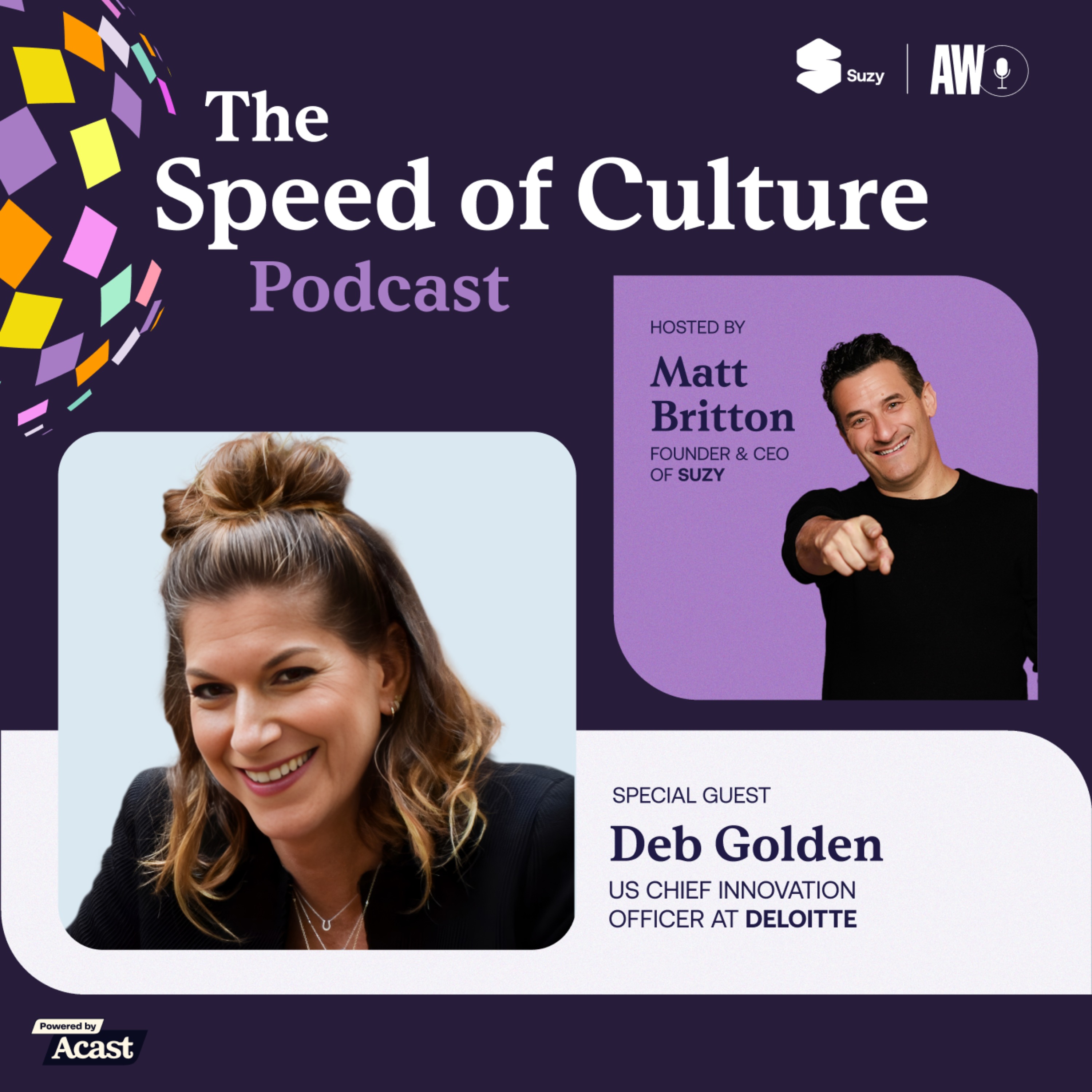
The Speed of Culture Podcast
How to Turn Uncertainty Into Opportunity with Deb Golden, Chief Innovation Officer at Deloitte
00:28:45
Loading summary
Transcript150 lines
- [00:00]
LinkedIn Advertiser
Does it ever feel like you're a marketing professional just speaking into the void? Well, with LinkedIn ads, you can know you're reaching the right decision makers. You can even target buyers by job title, industry, company seniority, skills. Wait, did I say job title yet? Get started today and see how you can avoid the void and reach the right buyers with LinkedIn ads. We'll even give you a $100 credit on your next campaign. Get started at LinkedIn.com results, terms and conditions apply.
- [00:30]
Redfin Advertiser
With the Redfin app, you'll know the moment your next place hits the market. Whether you're looking to buy your dream home or rent a sweet apartment, Give Redfin your gotta have it wish list of property features and you'll receive real time notifications tailored just for you, ready to see it up close. And personal scheduling, a tour is just a tap away. Don't wait to find your perfect match. Download the Redfin app and start searching. Today.
- [00:59]
Deb Golden
Speed without any trajectory is literally chaos. And so you have to understand what that progress is and what the impact is going to be that you're looking to achieve. There is always going to have to be a change with any sort of approach that anybody's making to have impact, period. And so we should always, as humanity, want to have continuous growth.
- [01:22]
Matt Britton
To thrive in a rapidly evolving landscape, brands must move at an ever increasing pace. I'm Matt Britton, Found and CEO of Suzy. Join me and key industry leaders as we dive deep into the shifting consumer trends within their industry, why it matters now, and how you can keep up. Welcome to the Speed of Culture.
- [01:43]
Deb Golden
Up.
- [01:44]
Interviewer
Today, live in Las Vegas at ces. We're thrilled to welcome Deb golden, the US Chief Innovation Officer at Deloitte. With decades of experience driving transformative change, Deb's visionary approach to innovation is shaping industries and redefining possibilities. Deb, so great to see you today.
- [01:57]
Deb Golden
Thank you. Thank you for having me.
- [01:59]
Interviewer
Absolutely. I've been always fascinated with the business of consulting at the level of Deloitte, because companies like yours have really done a great job at solidifying yourselves in the C suite largely by being connected to business results. So if I look at a lot of the ad agencies, many of which are here at ces, I think there has been sort of a predisposition for ad agencies to lean into, like, vanity metrics, like, whether it's impressions or winning awards at hand, lions. And I feel like companies like Deloitte are like, no, we understand what drives shareholder value. We're going to stick to that. We're going to drive it. How are you able to do that as a company at scale? Because I just know there's only so many people who can do that. Well, like how do you build a business around that?
- [02:39]
Deb Golden
Yeah, I mean, I think it's twofold. I think there's both the importance of driving at scale but also having your focus on the edges. So I think it's an. And not necessarily a. Or because you always have to be looking at what is scale. But having that pulse on the edge is important.
- [02:56]
Interviewer
The edge of.
- [02:56]
Deb Golden
The edge of what's next. Because it's not just about what's now, it's about what's about tomorrow.
- [03:01]
Interviewer
Yeah.
- [03:02]
Deb Golden
And being careful, but also curious about asking that question.
- [03:07]
Interviewer
Well, it's also, it's also cutting edge and bleeding edge, I think. Yes, bleeding edge is like it'll get you a press release in the story, but it's probably two steps away from driving business results. But cutting edge, like AI right now is kind of where you need to be.
- [03:18]
Deb Golden
Well, and I also think there's this notion of results.
- [03:21]
Interviewer
Yeah.
- [03:22]
Deb Golden
So it's the weirdest thing to me. Like what is a result? Everybody is so fixated on short term results and what do long term results mean? Because obviously we have shareholder results, but we also have what is the result for tomorrow. And especially in the world of AI, if you look at only short term results, you're actually going to lose focus on what is even midterm. Of course, time means nothing at all.
- [03:44]
Interviewer
I remember when Facebook, I was an early investor. Facebook, not early enough, but fairly early. And when they dropped, their stock dropped from like $50 to $10 when they announced that they're shifting to mobile because they were trading desktop dollars for mobile dimes. I remember that's what CNBC said. And their stock dropped dramatically. And it's like short term. Yeah, they took a drop. What if they didn't shift to mobile? Where would they be today?
- [04:04]
Deb Golden
Well, that's right. You look like even at brick and mortar stores. Right. They've changed even completely. Or if you look at how online shopping has changed, how stores and retail has changed and if you even just think about consumer preference today and how we're going to have to change business models.
- [04:17]
Interviewer
Yeah.
- [04:18]
Deb Golden
Thinking about that. So scale and what scale means to your question? Scale is also about how to change business models. So you're not scaling the same thing that do today. And so if your metrics and your vision for what short term and long term looks like, you have to actually be able to adopt your business Models to be able to look at short term and long term goals. So goals mean nothing if you can't actually figure out how to adopt those models.
- [04:39]
Interviewer
So I was saying scale. What I meant was you have hundreds or thousands of clients around the world and you have to deliver a type of quality and strategic rigor at scale. Yes, that's what I mean by scale. It's very hard to find people that, you know, 50 people, let alone five people, or that you can go send somebody on a plane and meet with CEO of a Fortune 100 company and know that they're going to be able to go toe to toe with them and really help them do that over and over and over again consistently to me is a fascinating thing as somebody who's run agencies before.
- [05:08]
Deb Golden
And I think it's also the discipline of being able to have both specialists in certain things and then also individuals who can look across those different things. And to me, like that's also a little bit of my secret sauce is being able to connect all those dots. And so my career has enabled me to be in a lot of different things. So our commercial businesses, our government businesses, in our consulting businesses and CY businesses and global. And particularly in today's day and age, when you look at how all these things are converging, being able to see that across the board is a lot of where we are today. So things are blending so much. What's solving for healthcare today is not really healthcare.
- [05:45]
Interviewer
It could be, yes. There's businesses everywhere, not just technology. Right, right.
- [05:49]
Deb Golden
And they're popping up to solve. I mean, who knows, tomorrow we could go get our car washed in a car wash and you're getting a body scan. Who knows? Right. You know, and so when you think about what is solving tomorrow, the ability to ask those questions is not going come from the traditional businesses. And so to me, that is the beauty of a large type business. When you have so many people who have disciplines in different things, but also the ability to see across the board. So that's category, the beauty of it. Yeah, yeah.
- [06:15]
Interviewer
It's like there's core drivers that all these businesses have in common across industries in terms of the challenges they face, whether it's inflation or a polarized culture. Like there's certain things that just. Or macroeconomic issues, whatever it may be. But then there's nuances to each business industry sector that bleed over and allow you to take learnings from one to the next.
- [06:35]
Deb Golden
That's right, that's right.
- [06:36]
Interviewer
So what is Deloitte's approach to innovation? Because this is a kind of broad question, but I know there's like kind of two ways you can go about it. Right. You can start with the company inside out, figure out industry to category, et cetera, or you can say this is where the world's headed, this is where the consumer is headed. What can we do about it?
- [06:53]
Deb Golden
Right. So there's again, twofold, I think it's a. And so we innovate, I would say every day. So with our clients, we're innovating every single day. So whether that's in engagement, whether that's on a specific topic, could be innovation every day. But then there's also what I'll call midterm transformational innovation.
- [07:10]
Interviewer
Right.
- [07:10]
Deb Golden
So what I'm focused are the 18 to 36 months out, which I joke about because again, time to me right now is almost irrelevant because we're moving. Speed is also like a crazy word. Right. So what is the next thing? So whether that's space, whether that's. There's a lot of obviously talk right now on quantum, there's space, computing, robotics. Right. How are we evolving to the next thing? So those are the more transformative innovation. Everyone that's not 100% of the company focused on those things. You don't need 100% of any company focused on those things. Right. So in everyday life, everybody is probably innovating in some capacity, as they should be. There's a smaller portion that's focused on these bigger, larger, transformative. What does that mean for us as a business? And by the way, the US could be our clients. It could be us as our own company or it could be us as our ecosystem partners.
- [07:59]
Interviewer
Yeah.
- [07:59]
Deb Golden
So as we think about that, again, I think part of it is, and what works for me fundamentally is how do we challenge today's demands? And you have to be willing to ask the why not question. It's fundamental to who I am, it's fundamental to what I do.
- [08:14]
Interviewer
Yeah.
- [08:14]
Deb Golden
It's fundamental to pushing past, optimizing for efficiency.
- [08:18]
Interviewer
Right.
- [08:19]
Deb Golden
I think AI and what I believe is an over pivot on optimization is table stakes. Right. So AI has proven to us that we have to focus on operational efficiency. Right, we know that. Right?
- [08:31]
Interviewer
Yes.
- [08:32]
Deb Golden
While innovation, because it is definitely innovation, that is not how we create net new businesses. It is giving us the path to net new businesses. We've only started to begin to see the value of AI. And so what is that going to be in the next 18 to 36 months?
- [08:48]
Interviewer
Well, it's about the AI is not the solution because you have to figure out what the problem is first. What's the problem of the business? What's our best way to get there? And yes, in this day and age, AI will probably play a role in it. I think where a lot of companies make sense, like, we need an AI strategy. Like, you don't need an AI strategy. You need to figure out what the biggest problems are in your business. And then how do we approach it, knowing that AI is a tool.
- [09:09]
Deb Golden
Right. And if you ask the why not? Right now, people think of a tendency to ask that we do things today because we have to do them that way. And if you ask the question, why not? Why do we do it the way that we do it today? And I fundamentally believe there's not a shortage of people that desire change. There's not. And we can say it's a certain generation. It's not. It's across generations. Our goal has to be to bridge generations. It's not to separate generations. And there's not one person that doesn't desire change. Transformation, growth, development. The challenge is that we have systems that don't enable that change.
- [09:42]
Interviewer
And the generational gaps is a good point. I mean, I'm a Gen Xer.
- [09:46]
Deb Golden
Yeah.
- [09:46]
Interviewer
I did not grow up with the Internet in the household. I tell my kids that they're like, what, you didn't have the Internet when you're in high school?
- [09:51]
Deb Golden
Wait a minute, did you have a tv? Exactly. Like, did you have the Stone Age? What did you have?
- [09:55]
Interviewer
Exactly. And then you have Millennials, and they were the first generation to grow up with the Internet in the household. You have Gen Z, the first generation go with the iPhone. Right. And now you have Gen Alpha, first generation go up with AI. And those are huge generational gaps that make people rewire differently.
- [10:10]
Deb Golden
Correct.
- [10:11]
Interviewer
And right now, the Millennials are slowly entering the C suite.
- [10:14]
Deb Golden
Yes.
- [10:14]
Interviewer
And like, you know, I was talking with a friend last night, the ad industry still has a kind of like that old boy network, and that's how work was done. But when Millennials become the new cmos, that's just not how they are. It's about hand on keyboard. And so then the way that industry, as way of example, it's gonna be done differently. And that's a perfect example of how generational shifts once those people get in the C suite will change things a lot.
- [10:37]
Deb Golden
And if you look at it. But if I were to ask all, if we were to take one from every one of those generations, I guarantee you every one of them, if asked in different ways, would Say they empower and thrive for some sort of change.
- [10:48]
Interviewer
Yeah.
- [10:48]
Deb Golden
The systems again that are built are not built for them to thrive.
- [10:52]
Interviewer
You're right. The way that they want these systems.
- [10:54]
Deb Golden
Correct. And so take something as simple as everyone cannot really agree on what go back to work means. Right. Cannot agree no matter how you redefine what go back to work looks like. Look at how the offices are built. The offices have never changed since 1980.
- [11:09]
Interviewer
People are going to come in now, we open up an office, everyone's like we want it. And then when people showed up, since most of our company is still distribute it, everyone's on zooms anyway. No one can hear each other.
- [11:18]
Deb Golden
Well. Right. And so if you're asking people to come back into the building and yet the building hasn't systemically changed.
- [11:24]
Interviewer
Right.
- [11:24]
Deb Golden
You're not changing the system in the past. That's right. And so that's the easiest visual idea to get. Right. And so if you think about there's a desire to change, you've got a multi dimensional issue with many different generations all desiring to have change and yet you're not actually focused on the systems that are the things that need to change.
- [11:44]
Interviewer
There's a hard part about that though is that talk about the speed, right. Of thing like AI and the things that you can do. Today with AI, I spend about 95% of my time in it is so much more powerful than even six months ago. So I run a software company. We have an R and D team that is built on a pre AI era, their jobs, the way they work, et cetera. So the question becomes, for me it's like, well, what do you do? Do you just completely rebuild it from scratch? No, you don't do that. That's so disruptive. But what if you don't have the right skill sets? What if you need different skill sets? And I think a lot of it is just getting off the fence and you do have to make some hard decisions.
- [12:18]
Deb Golden
Right.
- [12:18]
Interviewer
Because you're never going to drive change in this is your same example as your office.
- [12:21]
Deb Golden
So I would. And the debate would be. And doing nothing does what?
- [12:24]
Interviewer
Doing it. You're going to be stuck. Right, right, exactly.
- [12:27]
Deb Golden
So fear option fear right now is causing a lot of instability.
- [12:33]
Interviewer
Yeah. No.
- [12:33]
Deb Golden
And also lack of movement.
- [12:35]
Interviewer
And so I have a 30,000 employees like yes. Because Mark's. It's a single shareholder, he's going to come in and be like I'm doing it. And that's how it is. So some companies have figured out how to move quickly and make it happen.
- [12:46]
Deb Golden
Well, and I think if you think about moving quickly, speed without actual focus is just chaos.
- [12:52]
Interviewer
Yeah.
- [12:53]
Deb Golden
And so understanding what disruption means and understanding how people move is actually really important. So that's why even when I think about time and this notion of speed, time is important to understand what is the target. I can move fast, I can move perversely slow. Speed without any trajectory is literally chaos. And so you have to understand what that progress is and what the impact is going to be that you're looking to achieve. There is always going to have to be a change with any sort of approach that anybody's making to have impact, period. And so we should always, as humanity want to have continuous growth. I don't care if that's AI. I don't care if that was in the Stone Age, I don't care if that's with a pen and paper. I don't care if that's it's quantum. I don't care if that's as fusion. That is who we are as humanity, we evolve. And so when you think about what that is, is it scary? Of course it is, because you don't know what it is.
- [13:45]
Interviewer
And a lot of people just have fear. Like when the printing breasts came, everyone was fearful and you know, mobile replaced a worsen carriage. That's right, Jobs.
- [13:54]
Deb Golden
That's right. And I think now what it is, is you just have so many individuals with different generations that have very different characteristics about how they address things like change, like fear, like hope, like speed. And I think instead of looking at it as I look at it as like I wake up every single day and I say I hope I can have some impact on the world and I hope the world can have some impact on me. And we need to adopt that and learn from everyone around us knowing that uncertainty is also an opportunity.
- [14:26]
Interviewer
Yeah.
- [14:26]
Deb Golden
And if we can do that, that doesn't mean that it's going to be easy. Of course it's not going to be easy. But if we don't start, we're never going to keep the momentum moving. I do though think this notion of speed is an erroneous goal because the number one question I get is I'm not moving fast enough, Deb, what do I do? I'm like, well, what is fast enough? Right? Like what is enough? I'm so confused. I'm so confused.
- [14:49]
Interviewer
Part of its optics and part of it is.
- [14:51]
Deb Golden
But what's the benchmark of enough?
- [14:53]
Interviewer
Right.
- [14:53]
Deb Golden
Who's the enough? Because somebody to the left or the right of you is Faster. Like what is that?
- [14:57]
Interviewer
It's whoever the arbiter of speed is, whoever they report.
- [15:00]
Deb Golden
And I've yet to figure out is that again, is that the stone Age? Am I looking at the sun? Because I'm not sure what that is. And so again, how do you measure that in a way that your stakeholders and your consumers and what actually makes me a little bit concerned about that is when you think about the world that we do live in today, particularly around consumers with hyper personalization, with AI, I don't know about you, but you walk around and you see the happy button. I call them the happy button. So everywhere you go there's a are you satisfied with something? So whether it's you're online, are you satisfied at the airport, are you at the doctors, I'm coming out of the bathroom at the airport, we're in happiness, enthusiasm, right? Are you happy? And I don't know, I'm walking out of the airport and it's like, are you happy? It's like, I don't know. Again, think about your backend systems. Are your systems going to support that input? So I'm getting input now from my consumer that says, right, so now how does speed impact that? So every time I'm hitting the happy button or the sad button or I'm not, what am I doing with that? And so this notion of how do I take consumer preference, hyper personalization and human empathy and tie that back into my system and that is the disconnect that we are not seeing and paying enough attention to. We are very focused on the notion of we need consistency, consumer preference and hyper personalization. But again, do I have a system development and software engineering team that's built for 24 by 7 update? No. Right. Should I? Probably not. Because I probably don't need to be updating that. And to your point, is there a metric that's going to actually define that to be important and or critical? Do I care if my happy button isn't happy all the time? Can it be off by 5% or 10% or 15%? And that's where I think organizations really need to challenge that question around speed. But again, always going back organization of change.
- [16:47]
Interviewer
Right? So if you had a CEO of a company that was super metrics driven, that figured out what the four main metrics are for a company and was able to push that down throughout the organization, then you'd have answer for how fast is fast?
- [16:59]
Deb Golden
Correct.
- [16:59]
Interviewer
So it really starts at the top.
- [17:00]
Deb Golden
Correct. And with a goal on long term impacts, with short term results.
- [17:05]
Interviewer
Yes. Or, I mean, some companies can afford to go the route Facebook lent. Other companies might not have that type of patience with their shareholders or like, and, and, and it's not, I'm not saying it's good to be shareholder driven, but ultimately there's a board of directors and they dictate.
- [17:19]
Deb Golden
We all respond to somebody.
- [17:20]
Interviewer
Exactly.
- [17:21]
Deb Golden
We all respond to somebody. And understanding what that impact is and understanding how to drive to that impact is going to be critical, period.
- [17:27]
Interviewer
We'll be right back with the Speed of Culture after a few words from our sponsors.
- [17:33]
Freddie Wong
Hi, this is Freddie Wong from Dungeons and Daddies and this episode is sponsored by Rocket Money Blast Houston. We have a savings. That's right. Rocket Money is a personal finance app that empowers you to save more, spend less and take control of your financial life. Basically, you can see all of your checking, savings, credit cards and investments in one convenient place. You can understand your spending trends and most importantly, you can categorize those expenses and set up a custom budget by identifying top spending categories. Listen, you want to track bank statements, it's very difficult. Use Rocket Money to help keep track of all your finances. Rocket money is over 5 million happy members and it saved its users over $1 billion across all of the app's premium features. Let Rocket Money help you reach your financial goals faster. Get Rocket money today@rocketmoney.com allinone that's rocketmoney.com.
- [18:19]
Ryan Reynolds
Allinone Ryan Reynolds here from Mint Mobile. I don't know if you knew this but anyone can get the same Premium Wireless for $15 a month plan that I've been enjoying it' not just for celebrities. So do like I did and have one of your assistant's assistants switch you to Mint Mobile today. I'm told it's super easy to do@mintmobile.com.
- [18:38]
Deb Golden
Switch upfront payment of $45 for three month plan equivalent to $15 per month.
- [18:44]
Redfin Advertiser
Required intro rate first three months only, then full price plan options available, taxes and fees extra.
- [18:49]
Deb Golden
See full terms@mintmobile.com.
- [18:54]
Interviewer
So let's talk about Deloitte a little bit. What do you see as Deloitte's role with its customers and then what is your role as Chief Innovation Officer to help, I guess round out that offering?
- [19:04]
Deb Golden
Yeah, I mean obviously always looking to make a difference with all these shifts. I mean we're here to serve our clients as with anybody in a customer service oriented organization.
- [19:13]
Interviewer
What's a common use case? Like why would a company hire delay?
- [19:16]
Deb Golden
We are all over the board. I mean obviously we serve from an audit tax consulting, advisory perspective. So, I mean, that is a wide breadth, as you might imagine. And so being able to do that, I think puts us in a very unique position to be able to do both audit and tax services at the same time, being able to provide consulting and advisory capabilities. And the reason I love that about what we can provide is our clients have such a myriad of complex issues that they can be traversing many different things and not know what they even need at any given point in time.
- [19:47]
Interviewer
Yeah, yeah, yeah.
- [19:48]
Deb Golden
So if they're looking at net new businesses and say they're getting into a new business or they're transforming and let's say they are looking at us for digital transformation and they're doing something all of a sudden now globally, that was once in the U.S. well, what's the tax implication? Hold on a minute, let me go get you the tax.
- [20:04]
Interviewer
What global business is doing. I mean, having the connective tissue to a company's P and L and balance sheet allows you to really understand things in a way that other people just don't.
- [20:14]
Deb Golden
The beauty of having the ecosystem, both internally and externally, is, I think, a invisible value that particularly again, in today's day and age, how we solve problems historically has been very siloed. Meaning, I don't just mean like a individual Deloitte or a competitor perspective. People used to solve problems inside their own four walls and in today's day and age, problems are solved as an ecosystem. Now, the fact that not only can Deloitte do that within ourselves, across the board, the ecosystem that we share with our ecosystems and alliances, partners with our academic partners, with our broader, even candidly, our competitor sets and our clients is massive. So being able to do that. So one of the things I am working on are these flywheel events. So when you think about academic research, so things like quantum computing, yeah. I'm not going to sit there and go and hire thousands of people to go research quantum computing, but I'm going to go create very important academic research with other entities that can help us go build that and think about the forefront with our clients.
- [21:18]
Interviewer
Sure.
- [21:19]
Deb Golden
So those that are looking at doing clinical research trials and how can we go and advance that, we're actually doing use case development with academics to go and build that, and we're going to go do that on a global aspect so that we can actually produce academic research in that vein. So those are the types of ways that it's like we're not just going to do that independently to say Deloitte said, this is amazing. We're going to say Deloitte said this amazing with an academic research entity, with a client, with an ecosystems partner, and potentially with even a competitor. And think about how impactful that is not only for ourselves, but for our clients and for the world. So that's, I think, how we're going to solve these types of problems. And for me that really adds to where we see the complexity of today's day and age. So that to me is just a fascinating way of looking at the world.
- [22:03]
Interviewer
Absolutely. So when a company is operating well, that enables them to have the right mixture of conviction and speed and strategic acuity to make sure that you understand where you're going, that you're not just stepping on the gas without a steering wheel. What is normally the case with the leadership of that company that you found to be common?
- [22:21]
Deb Golden
They're uncommonly common. Maybe that sounds a little bit, you know, it's interesting. Everybody's like, what's checklists for leaders? I don't know that I have a checklist for leaders which I often actually get empathy. I do. I have a big thing on leading from human centricity and empathy. I know there's a lot of discussion around authenticity, but I tend to go towards empathy and individuals who not only listen, but obviously I come from a huge background of being able to challenge the status quo. We solve for people problems and I think the people who are willing to solve for those people problems. And again, I don't care what day and age we're in. You're always solving for a people problem. And when I learn from, I mean, I've watched 13 year olds who are solving highly complex technical problems because they lost a parent at a young age or because they're a first generation immigrant or because they asked simply like, why does it exist this way? And I don't know another different way to think about it. And so when I think about the leaders who are really solving and changing the way that they approach the world, it's because they're solving from a human centered grounding.
- [23:34]
Interviewer
Right. It's interesting that just it really doesn't matter about the age. It's kind of a way of thinking and it's just that's why I think a lot of companies mistakenly have this sort of tenure based approach to promoting leaders.
- [23:46]
Deb Golden
Yes.
- [23:46]
Interviewer
And it's just because you've been there for 20 years doesn't mean you should be working for people who've been there for five. I mean, ultimately there's some things you just can't teach. And you see that. And I think a lot of companies are scared to promote a 30 year old to COO, but like. Or they shouldn't be scared to promote an 80 year old or hire an 80 year old. Like, I think ultimately you have to look at what that innate human skill is.
- [24:06]
Deb Golden
Yeah. And it's interesting to me, like when I think about tenacity and the types of skills that you bring to the table and how to actually balance iq, eq, management style, management skill. Because understanding those things that you can actually all bring to the table and surrounding yourself by individuals who actually bring those challenges and ask those very difficult questions, it's not only important to ask the why not, it's to have the courage to lead through the why not. Because it's really difficult to manage through change. It's not easy. One person once asked me, and I'll never forget it, I moved through this entire very difficult, challenging thing, got through it very, very successfully. And the individual looked at me and they're like, deb, you should be so proud of yourself. It was amazing. And I was like, yeah, it was really great. I was like. But I was kind of sort of expecting, you know, some grand thing at the end and they're like, were you expecting someone to clap for you? I was like, you know, it kind of sort of was like, where were the applause? And it really made me sit back and think, what is the expectation? Knowing that change is really difficult and that there aren't a lot of people who can really move through a lot of systemic change because of what it actually take to move through that change. And so when you think about the people who need to lead through the why nots, it's to have the courage to be able to actually take the time and the energy and the challenge that comes with the why not.
- [25:29]
Interviewer
Yeah, for sure. So shifting gears to you as we wrap up here. I mean, I'm first of all curious how much time you spend personally on thinking about the consumer and consumer trends and where are you getting those insights and information? Because obviously it's two thirds of the economy. It's a. Ultimately it's connected to everything at companies. I'm just curious how you spend your time in that regard.
- [25:48]
Deb Golden
I think about the consumer all the time. I'm also a consumer, so I think about a consumer all the time. I am logged into just about everything. I mean, whether that's paper, whether that's reading, and yes, I'm still paper, I actually still write things. I'm very connected to Writing with pen and paper.
- [26:03]
Interviewer
Generational gaps, right?
- [26:04]
Deb Golden
Yeah, I love, I actually love a Sharpie and a post it note is like my still fan favorite. But I'm also connected. I love data and automation, so I am typically connected actually to automation on everything that's wearable. But then I also take it. I created my own LLMs for my data analytics for my health.
- [26:24]
Interviewer
Yeah, the same thing.
- [26:25]
Deb Golden
Yep. So I'm very, very connected and very aware. And then for external consumer, listen to a lot of podcasts yours. But I also listen to just very different and dynamic views. Again, as I said, I love to be impacted by those around me. So listening to very, very diverse voices is very important to me. So understanding things that I wouldn't normally probably listen to is the way just go about listening to that.
- [26:49]
Interviewer
Makes sense.
- [26:50]
Deb Golden
Yeah.
- [26:50]
Interviewer
So we have a lot of younger listeners of the podcast who want to be in a role like the Chief Innovation Officer at Deloitte one day. And what are some of the things that you think young people should be focused on earlier in their career to put themselves on the right track so they can stand out and, and really excel in an increasingly competitive, globalized world.
- [27:07]
Deb Golden
So this one's going to sound super simple, but never, ever, ever stop being curious.
- [27:13]
Interviewer
Yeah, we hear that a lot.
- [27:14]
Deb Golden
I mean, my mother died when I was was young, and one thing that she did, which I found years later, was she saved all of my report cards from when I was younger. And regardless of the fact that I did very well in school, when I was young, I talked a lot. Also not a surprise. What I was talking about was I was asking a lot of questions. And my mother always wrote, because you always had a sign, even if you did well in school, you had to sign the report cards back then. And she would always write because a teacher would be like, deb likes to ask a lot of questions. And my mother would always say, perhaps instead of asking why she's asking questions, support her asking those questions. And every year she asked that from literally like two through nine. I mean, it's amazing to be able to have that memory.
- [27:57]
Interviewer
It is.
- [27:58]
Deb Golden
And so I would say not only be curious, but surround yourself by people who challenge you every single day to sustain that curiosity. And to this day, I surround myself by a core group of people who are not only happy to be around me, but challenge me to be true to who I am and actually really embrace the fact of my curiosity and really push me to continue to want to excel.
- [28:26]
Interviewer
Yeah, to embrace your strengths.
- [28:28]
Deb Golden
Yes.
- [28:28]
Interviewer
Awesome. Well, we always wrap up the podcast by asking if there's a mantra or saying that's got your professional career, you just shared some. But is there anything else that comes to mind?
- [28:36]
Deb Golden
Biggest one for me is being willing to lose in order to win.
- [28:39]
Interviewer
Yeah, that's huge.
- [28:40]
Deb Golden
It's again, the thing about innovation as well. Specifically, you have got to fail more than you win. I mean, a hundred percent, you are actually not innovating if you're not failing. And a lot of people say that, oh yeah, we do that. We're in a fail culture. We actually really aren't. And so you really have to understand what that failure is. And realizing it is a very different mindset. And I live a lot by sports culture.
- [29:06]
Interviewer
Me too.
- [29:07]
Deb Golden
A lot of what I live behind. And so if you think about a lot of how people become very elite in their sports culture, they really do fail a lot at what they do. But they also surround themselves by a lot of things that have nothing to do with sports. They do a lot of other things around nutrition, around sports psychology, around other ways to actually build their mind, build their bodybuilder entity, and build their downtime.
- [29:29]
Interviewer
Yeah.
- [29:30]
Deb Golden
And so when you think about all those things and how to actually build and grow, they're also losing a lot of other things before they're actually winning. And so when you think about that mindset, you can say it a lot, but you actually have to go and live it as well. And so understanding how to do that and understanding it may take you 15 times of doing something, failing at it, recovering very quickly, and then when you get that win, understanding why you won that, and then moving on to the next one. So that is the biggest thing for me, and I really, honestly thrive around doing that.
- [30:01]
Interviewer
Awesome.
- [30:01]
Deb Golden
Yeah.
- [30:02]
Interviewer
Well, this has been such a great chat and thanks for taking time on your busy schedule here at ces.
- [30:05]
Deb Golden
Thank you. Thank you.
- [30:06]
Interviewer
Tell me about all the great work you're doing at Deloitte and I appreciate it. I can't wait to see what's next for you. So, on behalf of Susan Iowa team, thanks again to the great Deb Golden, US Chief Innovation Officer for Deloitte, for joining us today. Be sure to subscribe rate review to Speed a culture podcast on your favorite podcast platform. Till next time. See you everyone. Take care. Bye bye. Foreign.
- [30:25]
Matt Britton
Speed of Culture is brought to you by Suzy as part of the Ad Week Podcast Network and a guest Creator Network. You can listen subscribe to all Adweek's podcasts by visiting Adweek.com podcast. To find out more about Suzy, head to Suzy.com and make sure to search for the speed of culture in Apple Podcasts, Spotify or anywhere else podcasts are found. Click follow so you don't miss out on any future episodes. On behalf of the team here at Suzy, thanks for listening.
- [31:08]
Boost Mobile Advertiser
To make switching to the new Boost Mobile risk free. We're offering a 30 day money back guarantee.
- [31:13]
Redfin Advertiser
So why wouldn't you switch from Verizon or T Mobile?
- [31:16]
Boost Mobile Advertiser
Because you have nothing to lose. Boost Mobile is offering a 30 day money back guarantee.
- [31:19]
Redfin Advertiser
No, I asked why wouldn't you switch from Verizon or T Mobile?
- [31:23]
Boost Mobile Advertiser
Wouldn't because you love wasting money as a way to punish yourself because your mother never showed you enough love as a child.
- [31:30]
Freddie Wong
Whoa, easy there.
- [31:31]
Deb Golden
Yeah.
- [31:32]
Interviewer
Applies to online activations. Requires port in and auto pay. Customers activating in stores may be charged non refundable activation fees.
- [31:39]
LinkedIn Advertiser
Does it ever feel like you're a marketing professional just speaking into the void? Well, with LinkedIn ads you can know you're reaching the right decision maker. You can even target buyers by job title, industry, company seniority skills. Wait, did I say job title yet? Get started today and see how you can avoid the void and reach the right buyers with LinkedIn ads. We'll even give you a $100 credit on your next campaign. Get started at LinkedIn.com results terms and conditions apply.