← The Speed of Culture Podcast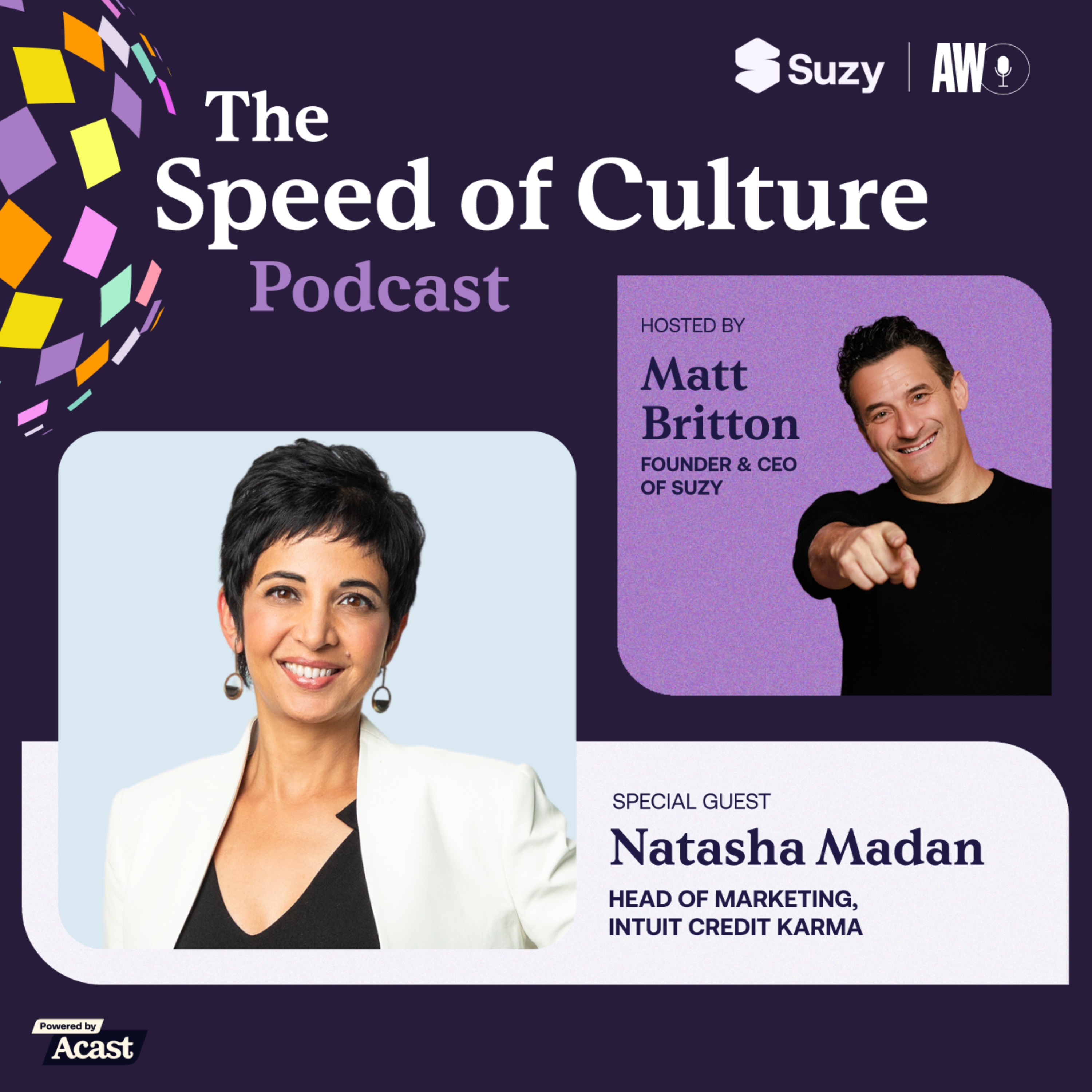
The Speed of Culture Podcast
Money Moves: How Credit Karma uses AI to power smarter financial decisions
00:23:35
Loading summary
Transcript116 lines
- [00:01]
Chelsea Bakken
Does using social media ever make you feel like you're just yelling into an algorithmic void? That feeds have started to feel a lot less, you know, social. Well, we're doing something about it. I'm Chelsea Bakken, Head of Audience Development and Social at Adweek, and I'm so excited to invite you to Social media week this April 14th through 16th. We're bringing together creators, marketers and social leaders in a vibrant IRL space in New York City for three days of connection, collaboration and learning. You'll get the chance to dish on the latest tools and tricks, hear fresh perspectives on the year's most viral moments, and get the slot free inspiration you need to connect with your audience and optimize performance. Head to adweek.com events to learn more.
- [00:41]
Natasha Maidan
We all prefer things a certain way.
- [00:43]
Chelsea Bakken
Like groceries.
- [00:44]
Natasha Maidan
If you want groceries just how you like them, you gotta try Instacart. They have a new preference picker that lets you pick how ripe or unripe you want your bananas. Shoppers can see your preferences upfront, helping guide their choices. Because when it comes to groceries, the details matter. Instacart get groceries just how you like.
- [01:06]
LinkedIn/Comcast Business/LifeLock Announcer
Does it ever feel like you're a marketing professional just speaking into the void? But with LinkedIn ads you can know you're reaching the right decision makers. A network of 130 million of them. In fact, you can even target buyers by job title, industry, company seniority, skills and. Did I say job title? See how you can avoid the void and reach the right buyers with LinkedIn ads? Spend $250 on your first campaign and get a free $250 credit for the next one. Get started@LinkedIn.com campaign. Terms and conditions apply.
- [01:37]
Natasha Maidan
We have 140 million members and now we have the ability to understand and ask them what they want and actually get it done. For them
- [01:46]
Matt Britton
to thrive in a rapidly evolving landscape, brands must move at an ever increasing pace. I'm Matt Britton, Founder and CEO of Suzy. Join me and key industry leaders as we dive deep into the shifting consumer trends within their industry, why it matters now and how you can keep up. Welcome to the Speed of Culture. We are live here at CES in Las Vegas and today we are thrilled to welcome Natasha Maidan, the head of Marketing at Intuit Credit Karma. Natasha is a growth focused marketing leader with deep experience spanning Amazon, Meta, Nestle and other high growth startups. Today she leads end to end marketing for Credit Karma, driving financial progress for more than a 150 million members. Through data, AI and deeply consumer led Strategy. Natasha, thanks so much for joining today here at ces.
- [02:33]
Natasha Maidan
Thank you. Pleasure to be here.
- [02:34]
Matt Britton
Absolutely. So when you come to CES every year, obviously it's such a busy time. It's not exactly the most convenient time to be away from the office for a week. Why is it valuable to you, and why do you take the time to come here to Las Vegas?
- [02:45]
Natasha Maidan
I think it's a great time to look at what's happening around us. We get so focused into what we are doing and what we are building. But to, like, really widen your perspective in terms of what's happening in the world, even learning from our agency, partners, vendors, has been just so great.
- [02:59]
Matt Britton
Absolutely. And from your seat, in terms of overseeing the Credit Karma brand, what are some of the evolutions and innovations you're seeing here at CES that are most interesting to you?
- [03:08]
Natasha Maidan
I mean, I think everybody's talking about AI, and the way everyone's embracing AI, I think, is a big thing. What we have to really look forward to is how do we differentiate ourselves
- [03:18]
Matt Britton
as we move forward, as every software company has.
- [03:21]
Natasha Maidan
As every software company. You know, we saw when social media came in, media was democratized. Like, it was so easy to buy media. There was no divide between a larger company or a smaller company. And now with AI, we are seeing creative getting democratized. You know, we can build creative, we can lend these people product. So what are companies like ours, a brand like ours, going to do in the future and differentiate ourselves? I think, is the question for us.
- [03:48]
Matt Britton
Yeah. And of course, the biggest moat, I believe, at least in the world of AI, is data.
- [03:52]
Natasha Maidan
Yes.
- [03:53]
Matt Britton
And with that, Credit Karma sits on top of one of the richest consumer financial data sets in the world.
- [03:57]
Natasha Maidan
Yes.
- [03:58]
Matt Britton
Right. So that, I imagine, is something you're probably thinking about leaning into. Just love to hear what your thoughts are around that.
- [04:04]
Natasha Maidan
Yeah. 100%, maybe 140 million members. So the scale is huge. Right. And we have 40 million monthly active users that come to our platform. We have a lot of daily users, 7 to 8 million daily users. So I think what's in front of us is how do we leverage the insights that we get from data and how we can actually make their lives much easier. We are in the thick of tax season. For example, now we help our members tell us what's going on in their lives. Like, if you bought a house, for example, there's a deduction, or they got, like, a new tax document they can upload and we can actually fill their taxes. And if it's a do it yourself tax, you could do it in 30 minutes or less.
- [04:46]
Matt Britton
Yeah.
- [04:47]
Natasha Maidan
That's where we are leveraging AI to say it's creating those done for you experiences. When they file their taxes, they get their refund. We can tell them how best to use that money. Putting in a high yield savings account or paying off their debt or if they want to get a car, how would they be able to do that? So there's a lot of that work that's happening and now we have the ability to understand and ask them what they want and actually get it done for them.
- [05:13]
Matt Britton
Yeah, I mean I think there's such a big opportunity as I think about financial data as a consumer. Right. The world is more complex than ever before. So for example, you might be paying for the same Netflix subscription in two different places, or you may have just incurred a medical cost that your health insurance provider provides. Or you might have a Chase Sapphire credit card and you just paid for a hotel, but they reimburse you $300 a year. Like there are so many nooks and crannies of every consumer and the complexity and I think what credit karma can do with all this data is make it simple and unpack insights that ultimately make consumers better purveys of their financial situation.
- [05:53]
Natasha Maidan
2000%, you're right. We are able to like there are over 80,000 data points that we have.
- [05:59]
Matt Britton
80,000, yes.
- [06:01]
Natasha Maidan
And our models are built to personalize information for them, understand what their intent is. If they're coming to check a credit score, we better give them the credit score and also tell them how they can build their credit. If they're coming to get a credit card. We tell them what are their best credit card options and give them advice and actually get them to help get the credit card so we understand what they're aware of and provide them with those personalized solutions. I think as we look forward, we would love to understand how do we connect the dots between what their financial journey is. We are very good about giving them the next best action, moving them along that journey. But really understanding what their long term goals are and being able to help them drive towards that would be the next frontier.
- [06:42]
Matt Britton
Yeah, it's interesting. We're seeing the same sort of thing happen in the personal health space where you have this notion of quantified self. Right. Where it's like you have your Apple watch and you have your eight sleep mattress and your aura. Right. And you're tracking all these things and that data can unlock insights about your health. I was recently speaking at a retirement industry conference and I was saying the two actually might collide because if quantified self helps you understand how long you're going to live.
- [07:08]
Natasha Maidan
Yes.
- [07:09]
Matt Britton
And then financial planning is obviously something that's going to support that lifespan. The two, it all might come together as like a personal data driven dashboard of you as an individual and the decisions you need to make.
- [07:19]
Natasha Maidan
You know, I always say this. Finances and health are the two most personal things. So many emotions attached to it. And those outcomes on the financial side and the health side determine how you live.
- [07:32]
Matt Britton
And when people talk about privacy, those are the privacy areas. Right. That's what people care about. They care about their health data and their. And you being able to have access to that data to be able to make the right decisions in your life, I think is such a big unlock.
- [07:45]
Natasha Maidan
Yes.
- [07:46]
Matt Britton
So when you think about, I guess driving the brand forward because credit karma used to just be you checked your credit score and then it became more of a platform and of course it got acquired by Intuit, I believe, and now it's obviously has its tentacles many different places. Where are the areas that you're really leaning into for the brand here in 2026?
- [08:04]
Natasha Maidan
Yeah, great question. We started out as a credit score provider and we were very trusted for that. Like we were really, we were saying unblocking the financial system, which was a big black box. So making sure our members understand what is a credit score, what does it do for you and how it can unlock your financial trajectory. But that become commoditized now.
- [08:26]
Matt Britton
Right.
- [08:26]
Natasha Maidan
So the challenge for us right now is to actually look at a member's entire financial journey and be able to provide them the messaging with the products and the right targeting in terms of what they can do. So right from financial advice, which is not just about building credit, it is really about building a financial health profile and then being able to give you the tools to be able to do those things. We ask members how much they want to engage with it. So for example, there are few who would be like, I want to set it and forget it. You automate everything for me. There are others who are like, no, I'm going to get into it just like health. Right. I'm going to manage this for my own self. And we just need guidance from you. So understanding what they want and what we can give them along the journey is like what we are trying to do. My goal here is from a marketing standpoint, push the original mission, which is very much championing financial progress.
- [09:19]
Matt Britton
Yeah.
- [09:19]
Natasha Maidan
And that means different things to different people. So we are really Expanding the brand from a narrow credit score focus to more of a helping them drive financial progress for them.
- [09:31]
Matt Britton
Of course, Intuit used to own an overseer product called Mint, which I used all the time. And then Mint got kind of discontinued and then now Credit Karma is kind of slowly taking its place. So is the future to be that individual's kind of personal financial dashboard that does all these things?
- [09:46]
Natasha Maidan
That's exactly what it is. We really want to make sure folks can maximize their money outcomes. And there are many ways to being able to do that. Consolidating debt, saving on taxes, saving money for the bigger goals and making the right investment. So it's really from credit building to wealth building. That's what we are building our platform for.
- [10:06]
Matt Britton
It's interesting because there's a lot of discussion right now in terms of like what's the future of work, what jobs really matter. When I think about the financial services space, you think about an accountant that just does somebody's taxes. I personally believe that AI is going to be able to do all of our taxes for us moving forward. As long as you have the data platform like Credit Karma and you might not need an accountant. So that's great for a consumer, maybe not so great for an accountant, but an accountant needs to figure out how can they uplevel and be an advisor. But the question I have in my mind is are we going to need wealth managers moving forward? If all my information is in Credit Karma and you have 140 million other members information and you actually have historical data, you could know, here's how you should look at investing. Here's how you should look at spending as a percentage of your income or your mortgage payment. And really that data driven framework, if somebody follows it, they will lead a path towards financial wellness. So just interesting like that if you become the platform and you have the data, it really opens up a huge opportunity for the brand.
- [11:07]
Natasha Maidan
And I also think that you'll always need both. Yeah, we will need the data to get educated, do a lot of things for you. But the need for an expert will always be there. We are seeing in taxes too. We always say it's age, human intelligence and AI artificial intelligence. You need an expert to say, hey, these should be your strategies moving forward for next year.
- [11:26]
Matt Britton
Keep going for these.
- [11:28]
Natasha Maidan
Yeah, I think you'll need both. I do not think we'll be at a place where we can completely eliminate expenses.
- [11:33]
Matt Britton
Right? I mean, all depends upon the differentiated value. Because already if you look at the returns generated by the wealth management community minus their Fees. It doesn't even outperform the S&P 500. So even before an age of AI, you have to question it. So I guess my point is it's a perfect, perfect opportunity. And a lot of people can't afford wealth managers. Let's be real. So I think putting that aside for a second, this does create the opportunity for somebody to have sort of a financial consultant in a pocket.
- [12:01]
Natasha Maidan
Yes. This is, you know, and we talk about that. We want to be the financial assistant in your pocket. You gotta be able to do it over your phone. I think it does open up a lot of opportunity for small businesses who have access to. They had to pay a lot of money. It's the same thing with a lot
- [12:17]
Matt Britton
of other folks globally, too.
- [12:18]
Natasha Maidan
Gen Z millennials, like, they're coming and learning and they're going to social media to lear. They're coming to our platforms to learn. So for sure, it is democratized, that information access.
- [12:28]
Matt Britton
Yeah. I have two kids in college right now and like, I help them get their first credit card set up and help them. And a lot of kids who are going into college and exiting, they don't teach financial literacy in school like they should. And it's so important. Yeah. And they don't even know what their credit score means. So I know that you have a product called Credit Spark that helps turn everyday payments into credit. Building opportunities. Talk to me about financial literacy, the new consumer, and some of the opportunities you think exist there.
- [12:56]
Natasha Maidan
It's huge right now, Matt. There is so much information that is available on the Internet and we call it FinTalk. People go to TikTok to get a lot of financial advice. It's not personalized. And so when they come to our platform, we have an opportunity to understand what their goals are, understand their financial picture even when they don't have it. Help them build it step by step and do it in a way where it's durable. We don't go back and say, hey, you increase our credit score in three days. Like, that's not durable. How do you actually save money? What are your best financial habits that you want to be able to build? Can you pay your rent and get credit for that and build credit through your rent? So there's many aspects of building credit that we actually educate and help make it happen for our members. And that's what Credit Spark does.
- [13:43]
Matt Britton
And of course, over time, you're going to be able to continue to do that in a personalized way as well.
- [13:47]
Natasha Maidan
Yeah, 100% personalized.
- [13:50]
Matt Britton
We'll be right back with the speed of culture after a few words from our sponsors.
- [13:53]
LinkedIn/Comcast Business/LifeLock Announcer
Does it ever feel like you're a marketing professional just speaking into the void? But with LinkedIn ads, you can know you're reaching the right decision makers, a network of 130 million of them. In fact, you can even target buyers by job title, industry, company seniority, skills and did I say job title? See how you can avoid the void and reach the right buyers with LinkedIn ads. Spend $250 on your first campaign and get a free $250 credit for the next one. Get started@LinkedIn.com Campaign terms and conditions apply.
- [14:26]
Chelsea Bakken
Does using social media ever make you feel like you're just yelling into an algorithmic void? That feeds have started to feel a lot less, you know, social? Well, we're doing something about it. I'm Chelsea Bakken, Head of Audience Development and Social at adweek, and I'm so excited to invite you to Social media week this April 14th through 16th. We're bringing together creators, marketers and social leaders in a vibrant IRL space in New York City for three days of connection, collaboration and learning. You'll get the chance to dish on the latest tools and tricks, hear fresh perspectives on the year's most viral moments, and get the slot free inspiration you need to connect with your audience and optimize performance. Head to adweek.com events to learn more.
- [15:06]
LinkedIn/Comcast Business/LifeLock Announcer
Comcast Business helps retailers become seamlessly restocking frictionless paying favorite shopping destinations. It's how nationwide restaurants become touchscreen ordering, quick serving eateries and how hospitals become the patient scanning data managing healthcare facilities that we all depend on. With leading networking and connectivity, advanced cybersecurity and expert partnership, Comcast Business is powering the engine of modern business powering possibilities. Restrictions apply.
- [15:38]
Matt Britton
So obviously as somebody who had the marketing for Credit Karma, growth is obviously a big mandate heading into any marketing heads list of priorities entering the year. What does growth look like for Credit Karma? Whether it's driving more business for existing users or preventing churn or acquiring new users, how do you stack rank that and what are some of the strategies you're looking to deploy in the year ahead?
- [15:59]
Natasha Maidan
Yeah, great question. We have 140 million members. We want to make sure that we are serving them well. Yeah, it's very easy to go out and get more members which we are going to do. I think from a growth standpoint our acquisition is going to be focused on Gen Z. So younger consumers Credit Karma was built on the premise that we were educating younger consumers how to use credit. We Built it on Millennials, how to use the credit score and get their first credit card, their car or whatever. But we kind of lost our way a little bit with the younger consumers now the 18 to 24. So we are going specifically to acquire those in social channels, being where they are. But the rest, 140 million members that already come to our platform, we have huge opportunity for them to try our other products. Yeah, we have grown beyond credit scores. We have now Credit Spark. We talk about that they can pay taxes with us. We credit Karma Money Account description monitoring tool. Yeah, all of that. So there's an ability to be able to do that, which I think it behooves us as marketers to create those engagement funnels to actually make sure that they are attaching to two or three different products when they come to even check a score. Can we actually have them look at a credit card? When they come to buy a credit card or take a credit card from our platform, can we have them look at our Credit Karma Money account and see if that would be a place that they would bank for us? So we are working through a lot of creating a lot of those growth loops for existing members and those funnels.
- [17:23]
Matt Britton
Right. And when you talk about Gen Z, of course, they're known as the iPhone generation. The first generation group is the iPhone in the household, and that's their de facto way of consuming content. And when they're looking at their phone to consume content, they're consuming content not from traditional media sources, but from other people, which is where the creator economy comes in. So curious to hear how you're looking at storytelling, content creation and creators in driving growth and going after this Gen Z audience.
- [17:48]
Natasha Maidan
Exactly. The more AI gets adopted and prevalent, and you'll see that at CES we were talking about this morning, is that targeting is going to be learned. It's going to become more and more of a science, right?
- [18:00]
Matt Britton
Yeah.
- [18:00]
Natasha Maidan
Content creation will become more and more of a science. AI is going to be able to generate a lot of that.
- [18:05]
Matt Britton
Couldn't agree more.
- [18:06]
Natasha Maidan
Right. So who are people going to believe? They're going to believe people they trust and brands and brands they trust. Right. So for us, our strategy now is really to invest in micro influencers and creators, because when it comes from them and their communities that they are leading and there's trust within those communities, who they're going to listen. Listen to, it's going to be less important in terms of what is being said is going to be more important of who is going to say it.
- [18:31]
Matt Britton
Medium over message. Yes. Right.
- [18:33]
Natasha Maidan
So that, I think is a big focus for us, especially as we connect with Gen Z.
- [18:38]
Matt Britton
And how do you drive that type of execution at scale? Because it's, it's one thing to, I mean, when you think about the scale of your business, to be able to create a network of micro influencers at scale, I would assume executionally isn't the easiest thing.
- [18:51]
Natasha Maidan
It's not the easiest thing. It's for us to be able to give them the tools actually to be able to do that. So they can scale.
- [18:58]
Matt Britton
Right.
- [18:58]
Natasha Maidan
And they can scale their messages and amplify and we are able to do that. And it's going to be a part of our media mix.
- [19:04]
Matt Britton
Of course.
- [19:04]
Natasha Maidan
Be the only thing.
- [19:05]
Matt Britton
Of course. And when you think about just storytelling in general and we talk about financial literacy, do you find that just adding value to consumers and creating content that helps them financially is the best way that you can just capture their attention and drive any type of business impact?
- [19:22]
Natasha Maidan
I do think as long as we are adding value and solving a problem that is important to them, they will listen in.
- [19:29]
Matt Britton
Yeah.
- [19:29]
Natasha Maidan
And it's important to understand that for them to understand that we get them. You know, the big part of the brand work we did is what we understood was finance is so personal, just like health is. And it is so deeply rooted in how they grew up, what was the financial institution at home, what are their aspirations. There are folks who may have had an easier life, they're folks who may have not had an easier life. How we talk to them and how we engage with them, how we make them feel seen and heard is really important. And it's a very thin rope that we have to walk on. If we say, oh, we got this done for you, don't worry about it. They're like, you don't even understand myself. Or we say, this is really, really hard. They're like, oh, I'm very stressed about this. You're making me even more stressed by telling me what so much work that I need to do. So we just have to understand where they are in their journey and how do we communicate with them. And that's a big part of storytelling, is understanding their fears, their aspir, where they feel guilt, where do they feel shame, and what is our role over there. It's super complex to be able to do that. And, you know, we don't claim that we've figured it out or we understand it, you know. Right.
- [20:38]
Matt Britton
Shifting gears, we wrap up here. I'd love to hear a little bit more about you and your career journey, you know, as I mentioned, at the jump, you spent time at Amazon and Meta and Nestle. When you look back at your career journey, what are some of the things that you think you focus on next that in the rearview mirror ended up being fortuitous sort of. Right. Things to focus on just in terms of personal and professional development?
- [21:00]
Natasha Maidan
Yeah, great question. I think the through line for me has been I was always focused on building the right skillset and maniacally focused on what I don't have. I don't think it's the right thing to do all the time is like, I need to build. So when this was pre social media, when that came in, we were like, we need to be at the forefront of experimenting into it. We were at Nestle. Ours was the first brand with Butterfinger and Nerds, the Wonka Candy that we participated in a Facebook campaign. That was the first time we did it. We didn't know whether this would work or not work. So being able to be adaptable to change, see what's coming new, and being able to participate has, I think, been the through line for me. I've also really focused on, you may not get the best job or the job that you want all the time, but the job that's given to you need to ace it, you can get to the next job. And I think what helped me was really getting closer to the consumer at Nestle because that's the holy grail for like really understanding CPG marketing. Right. As you know, is understand the feelings, the aspirations, the fears of our members and really deeply empathizing with them that when you come into the tech world is such an addition where you are actually using models and science.
- [22:17]
Matt Britton
EQ versus iq, right?
- [22:18]
Natasha Maidan
Yes, EQ versus iq. And when you bring the two together, you create breakthrough creative and that works and that saves money, time and everything.
- [22:27]
Matt Britton
In terms of some of the takeaways you may have from companies like Amazon and matter where you work, like what is it about those cultures or the way that there are new employees or train their existing employees that makes them so successful?
- [22:39]
Natasha Maidan
I think at Amazon, I will say customer obsession is actually at the heart of everything. You may be at any other function, you may work in any function. It doesn't, you know, in many companies it sits with marketing and your little voice of the consumer. Everyone's focus on customer obsession at Amazon, which I really loved, and everyone's trying to solve a customer problem through just different lenses. And we don't settle. We actually bring in folks we think are going to be able to do that. And folks who are actually challenging the status quo has been a big thing. And I think the tech companies that have been successful have brought in people who are more amenable to change and have been able to adopt. They sit there and say, well, there is a problem here. I'm going to go tackle it. I'm going to run an experiment. And it's easy to be able to do that, whereas in cpg, it's just hard. You try to change something, you have to get distribution, get on shelves.
- [23:33]
Matt Britton
There's a physicality to do it to
- [23:36]
Natasha Maidan
it, and it gives you a month before you get any kind of data back.
- [23:40]
Matt Britton
That's why I understand the consumer is so important, because once you bring something to the shelf, it better be right.
- [23:44]
Natasha Maidan
It better be right. And you're spending all of your capital in predicting what that future can be. And you do it by understanding the customer deeply. Here, if you come into tech, you can just experiment and see if something's working or not. But imagine when you bring the two together, you just become that much smarter.
- [24:02]
Matt Britton
Yeah, I love that. That's a great framework. So to wrap up here, we always ask our guests if there's a saying or mantra that helps kind of encapsulate their professional journey to date and just want to know what comes to mind.
- [24:12]
Natasha Maidan
For you, I think for me, I always say if I don't drive, I will be driven, so I need to drive.
- [24:18]
Matt Britton
So what does that look like for you?
- [24:20]
Natasha Maidan
Being proactive?
- [24:21]
Matt Britton
Yeah, that's huge. Taking initiative.
- [24:23]
Natasha Maidan
Right, Taking initiative, looking around the corners, making sure you have an amazing team that can tackle the here and now, so you have the ability to look across and look around the corner, and you're more prepared for what is to come next.
- [24:37]
Matt Britton
Either you're trying to. After that, you want them to take initiative, too, right?
- [24:40]
Natasha Maidan
Exactly. And I think if we do all that job well, we are already ahead of the curve, so we are not reacting. You have to play offense. You cannot play.
- [24:49]
Matt Britton
I think a lot of younger people in the professional world just wait for permission because they don't want to disrupt the status quo. But I think, especially in a world like now, and you see this evidently at a place like ces, the world's changing so fast, and by the time you get your permission, it's going to be too late and you just have to dive in. I think for younger people, the biggest
- [25:08]
Natasha Maidan
risk is not taking one correct 2,000%. I think there will be no room for reactive.
- [25:15]
Matt Britton
Right. There has to waiting to be told
- [25:17]
Natasha Maidan
what to do, waiting to be told you have to jump in. And companies like ours. I am looking for folks on my team to tell me what we are missing. What's missing? And how can we build products that are different? How can we build messages that are different? And if I don't hear that, then we are not pushing ourselves.
- [25:32]
Matt Britton
That's right.
- [25:33]
Natasha Maidan
And if we are afraid of failing, we are not pushing ourselves enough. So that is a given. I feel now.
- [25:39]
Matt Britton
I love that. Well, you heard it here, everybody. Drive or be driven. And it's clear that Natasha here is doing the driving of the Credit Karma brand. I just want to thank you for taking the time today during your busy CES week to chat with us today.
- [25:52]
Natasha Maidan
Thank you. It was amazing, Chad.
- [25:53]
Matt Britton
Absolutely. It's been a great discussion and there'll be more. Here we are live here in Las Vegas at ces. On behalf of Susie Adin, thanks again, Natasha Maidan, the head of marketing at Intuit Credit Karma, for joining us today. Be sure to subscribe rate review the Speed of Culture podcast on your favorite podcast platform. Till next time. See you soon, everyone. Take care. Bye bye. The Speed of Culture is brought to you by Suzy as part of the Adweek Podcast Network and a guest creator network. You can listen subscribe to all Adweek's podcasts by visiting Adweek.com podcasts to find out more about Suzy, head to Suzy.com and make sure to search for the Speed of Culture in Apple Podcasts, Spotify, or anywhere else podcasts are found. Click follow so you don't miss out on any future episode episodes. On behalf of the team here at Suzy, thanks for listening.
- [26:55]
LinkedIn/Comcast Business/LifeLock Announcer
Does it ever feel like you're a marketing professional just speaking into the void? But with LinkedIn ads, you can know you're reaching the right decision makers. A network of 130 million million of them. In fact, you can even target buyers by job title, industry, company seniority, skills, and Did I say job title? See how you can avoid the void and reach the right buyers with LinkedIn ads. Spend $250 on your first campaign and get a free $250 credit for the next one. Get started@LinkedIn.com Campaign terms and conditions apply.
- [27:28]
Chelsea Bakken
Does using social media ever make you feel like you're just yelling into an algorithmic boy that feeds have started to feel a lot less, you know, social. Well, we're doing something about it. I'm Chelsea Bakken, head of audience development and social at Adweek, and I'm so excited to invite you to Social media week this April 14th through 16th. We're bringing together creators, marketers and social leaders in a vibrant IRL space in New York City for three days of connection, collaboration and learning. You'll get the chance to dish on the latest tools and tricks, hear fresh perspectives on the year's most viral moments, and get the slot free inspiration you need to connect with your audience and optimize performance. Head to adweek.com events to learn more.
- [28:09]
Matt Britton
LifeLock how can I help?
- [28:10]
Chelsea Bakken
The IRS said I filed my return, but I haven't.
- [28:13]
LinkedIn/Comcast Business/LifeLock Announcer
One in four tax paying Americans has paid the price of identity fraud.
- [28:16]
Natasha Maidan
What do I do?
- [28:17]
Matt Britton
My refund though. I'm freaking out. Don't worry, I can fix this.
- [28:20]
LinkedIn/Comcast Business/LifeLock Announcer
LifeLock fixes identity theft guaranteed and gets your money back with up to $3 million in coverage.
- [28:26]
Natasha Maidan
I'm so relieved.
- [28:27]
Matt Britton
No problem. Problem. I'll be with you every step of the way.
- [28:29]
LinkedIn/Comcast Business/LifeLock Announcer
One in four was a fraud paying American.
- [28:32]
Matt Britton
Not anymore.
- [28:33]
LinkedIn/Comcast Business/LifeLock Announcer
Save up to 40% your first year. Visit lifelock.com Special offer terms apply.