← The Speed of Culture Podcast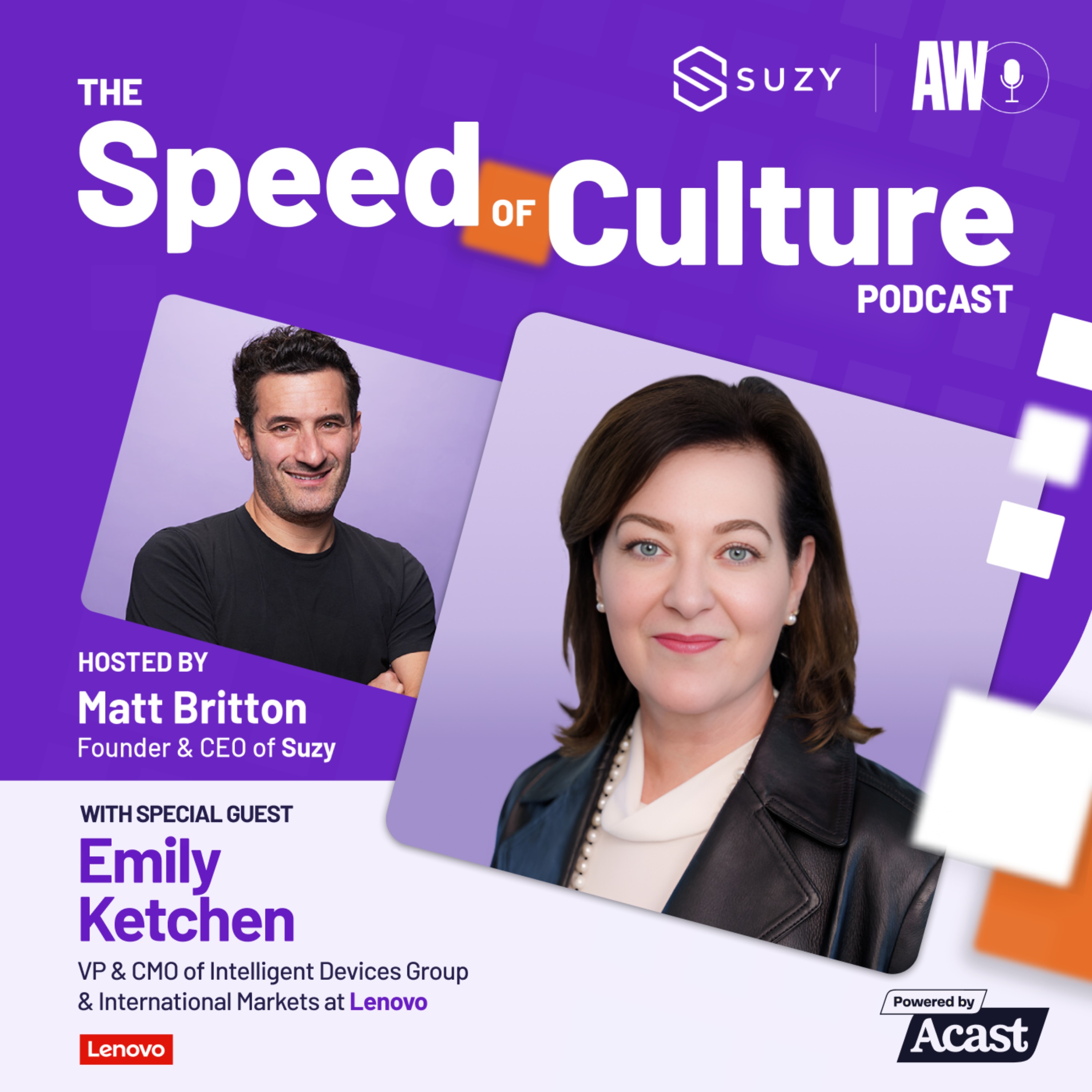
The Speed of Culture Podcast
Next-Gen Intelligence: Lenovo’s Emily Ketchen on the Tech Revolution You Can’t Ignore
00:30:09
Loading summary
Transcript96 lines
- [00:00]
Matt Britton
Ryan Reynolds here from Mint Mobile with a message for everyone paying big wireless way too much. Please, for the love of everything good in this world, stop with Mint. You can get premium wireless for just $15 a month. Of course, if you enjoy overpaying. No judgments. But that's weird. Okay, one judgment anyway. Give it a try@mintmobile.com Switch upfront payment.
- [00:22]
Emily Katchen
Of $45 for three month plan equivalent to $15 per month required intro rate first three months only, then full price plan options available, taxes and fees extra. See full terms@mintmobile.com with the Redfin app, you'll know the moment your next place hits the market. Whether you're looking to buy your dream home or rent a sweet apartment, give Redfin your gotta have it wish list of property features and you'll receive real time notifications tailored just for you. Ready to see it up close and personal. Scheduling a tour is just a tap away. Don't wait to find your perfect match. Download the Redfin app and start searching today.
- [00:56]
Matt Britton
Foreign.
- [00:59]
Emily Katchen
It'S really about Gen Z now. That's a population that has grown up with technology from ground zero. Can you imagine now that Gen Alpha will only have AI enabled devices? And what's going to happen to beta who were recently announced for this particular year? What's it going to look like for them and what are the implications for them?
- [01:21]
Matt Britton
To thrive in a rapidly evolving landscape, brands must move at an ever increasing pace. I'm Matt Britton, founder and CE Susie. Join me and key industry leaders as we dive deep into the shifting consumer trends within their industry, why it matters now, and how you can keep up. Welcome to the Speed of Culture Up Today we're live in Las Vegas at ces. I'm thrilled to welcome back a rare second time guest on the Speed of Culture podcast. Emily Ketchin is a CMO and VP of Intelligent Devices Group and International Markets Lenovo. Emily has a lot to say about the future of personal computing and I cannot wait to dive in. Emily, so great to see you.
- [02:01]
Emily Katchen
So great to see you. Thank you so much for having me back. It's great to be here with you in Las Vegas.
- [02:05]
Matt Britton
Absolutely. So what does CES mean to Lenovo and why is it an important place for you guys to keep having a presence at?
- [02:11]
Emily Katchen
It is probably one of the greatest gatherings for technology and innovation and so for us the show is incredibly important for us to be able to talk about the innovations that we're bringing to the market for our customers this year. There's a lot of emphasis as there is for a lot of technologists on AI and the advent of AI and what that means in all of our different form factors. I'm super excited to share with you that we got best in show for our brand new Lenovo Legion Go2. So super excited about that. And it's a great moment for us that other technologies that we bring to bear and sort of are able to be here as part of the market. So, yeah.
- [02:50]
Matt Britton
So, I mean, for desktop computing, AI is driving a whole new buying cycle because the power of the compute, with all the like, increased needs and applications that's gonna pull down, I would imagine part of it has to be on the device. Is that kind of what's driving?
- [03:06]
Emily Katchen
I think that's exactly what is driving that. This sort of seismic shift is that you will be able to compute on device versus computing on cloud. And so what that means is better productivity, better performance and better protection. So if you're trying to keep something inside your organization, which you generally would be, you can compute on device versus computing on cl.
- [03:26]
Matt Britton
The model run on the device.
- [03:28]
Emily Katchen
It will. Yes, it absolutely will. Which I think will be fantastic for companies and for productivity. Also, imagine when you're traveling, which you do all the time. You want to be out there and productive. You can be productive in what would have otherwise been considered downtime on an airplane. Exactly. To reach the cloud or wherever your documents and things may be stored. So that's going to be a huge shift.
- [03:50]
Matt Britton
I mean, that's crazy because they talk about regulation AI, but if you can put it on your local device, it's going to be kind of hard to regulate because something could just put it on a thumb drive and you have this incredible power of an LLM in your pocket and it really can't be regulated. Right. I mean, it's out of the bottle and to some extent.
- [04:06]
Emily Katchen
Well, I love that. Like I like to say, you can't put the toothpaste back in the tube, Right. It's out. And many, many years ago, we all kind of thought, huh, the Internet.
- [04:14]
Matt Britton
Right.
- [04:15]
Emily Katchen
People weren't really sure what that was. They weren't sure how they were going to use it. Yeah, we had never imagined a smartphone. So we are there, but I think there will be. You will see a lot of dialogue, conversation and progress around the right ways to use AI and the wrong ways to use AI. And we are very, very committed to the ethical use of AI and thinking about guidance for that. Because, of course, as you say, you don't want to train models in the wrong way and so having it local, having companies think about their policies and their governance is going to be super important. And we certainly are spending a lot of time on that ourselves.
- [04:48]
Matt Britton
What are some ways that this AI innovation era is different than the advent of the Internet or the mobile device?
- [04:55]
Emily Katchen
Well, the first thing I would say is they're similar in that for a marketer this is a once in a 30 year opportunity for someone like me to be able to get out there and market the benefits of something as incredibly different and sensational as this. So I would say there's a similarity. What I would say is the interesting part of this is as you think about who we're targeting in our consumer facing marketing, for example, it's really about Gen Z now. That's a population that has grown up with technology from ground zero zero. Can you imagine now that Gen Alpha will only have AI enabled devices? And what's going to happen to Beta who were recently announced for this particular year? What's it going to look like for them and what are the implications for them? So I think what's going to happen is it's going to scale much more quickly. Right. Because you have these generations that have a proclivity to technology, they understand it, they use it, it is oxygen to them. So I think that's going to change how quickly and how pervasively this technology gets out there and their contributions to the technology as it grows. AI doesn't have emotion, it doesn't have feelings, but boy can it be incredibly helpful in terms of productivity. And I think you'll see them participate in what that looks like.
- [06:12]
Matt Britton
Yeah, I mean Gen Alpha is going to redefine expectations for companies too. They're going to want personalization first and foremost. They're going to want any business they interact with to know them because that's all they will ever know. And once they start driving these new expectations through, then it spreads to broader markets. And that's what we saw with digital, that's what we saw with mobile, et cetera.
- [06:31]
Emily Katchen
You're 100% right. And what we saw with those was that interactivity between the customer expectation and the customer usage drove innovation. And so as an innovation company, we look forward to seeing how our audiences, how companies will have requirements that we then lean in to meet or that we're ahead of them and they're coming to us. So it's this wonderful interactivity between ourselves and our customers around this is what's useful, this is what's not so useful. Maybe we change that. And I think it's going to be super interesting to see how that happens. The key is, I think to your well made point and to your great question, it's the speed we thought that was really fast. Whoa. This is going to be even faster.
- [07:09]
Matt Britton
Yeah, I mean, I just wrote a book called Generation AI and it's How Gen Alpha and the Age of AI Will Change the World Forever. And the book was due last week and it doesn't come out till May and it was like I was updating it till the last second because everything I write is going to be so dated in May. I mean, it's basically like AI is the fastest thing ever. Book publishing the slowest thing ever. I'm trying to make them both work, but it just goes to show how quickly things. And it's really hard for companies to know how to plan because you can plan for something a quarter from now, but whatever you plan for might be irrelevant based upon new technology.
- [07:43]
Emily Katchen
This tension that you're pointing out between the incredible speed with which AI is coming to market, your idea to pen, what this is going to mean, and your consciousness that that's going to change in three months, you're exactly right. I mean, so we're thinking about the pace of that and the pace of change and one of the things that we're doing that I wanted to share with you and with your listeners is we have set up an internal organization and a governance council on AI. Now, why is that important? Because you're going to ask me how are we thinking about using AI in our marketing? So not just for customers, Right. But how are we using it? So what we decided to do was put together a governance council that includes members of our security organization, members of our legal organization, and it's foundational to teaching our teams really how to use the AI first and then think about the implications for that AI when they're doing their marketing. So we have an 11 set of courses that everyone in the organization is taking. They're leaning in, they're using it, we've bought the licenses, we're working with a bunch of organizations to kind of understand how best to use the actual AI.
- [08:51]
Matt Britton
And what's been fascinating in like everyday.
- [08:53]
Emily Katchen
Work, in everyday work and like folks are taking it super seriously. We have this incredible subcommittee that's emerged, matt of this constituent of folks who call themselves like the AI marketing community. So there's the governance council, but this is a community of folks who are meeting themselves every five or six weeks to advance the work that we're doing. And do you know what They've done. They've come up with prompt engineering, prompt curation and a prompt library. Wow. Which is, like, extraordinary, right?
- [09:19]
Matt Britton
Yeah.
- [09:20]
Emily Katchen
Incredible. The passion they have for it. And I'm excited because we can't think about the implications for our customers unless we know what they are for ourselves.
- [09:27]
Matt Britton
Sure. I think with all these changes, companies will need new and differentiated skill sets. We are going to see a big shift. And it's not always going to be fun of companies who are getting pressured to move faster, be more efficient, and they're going to look at their workforce and they're going to say, do we really need that department? Do we really need these people? What's your advice to people to future proof themselves amidst this change?
- [09:51]
Emily Katchen
I'm so glad you asked because it's really a great question and it's driving a lot of dialogue. The first thing I would say is the most important thing you can do is educate yourself, yourself and use it. And I'm not saying just educate yourself and just use it. Make yourself familiar. Force yourself to do it. The other thing I will tell you is AI is not going to replace you. It's not right. However, the people who are your peers and your colleagues who know how to use AI better than you do will replace you. So that's what you have to be conscious of. Can they curate? Can they query? Can they make their work better? Can they do research before they sit down with you and your listeners to have a conversation and just be better prepared? That's what's going to make the difference. It's not about replacing. It's about folks who know how to use the AI to their advantage. That's where I would say everybody needs to be focused.
- [10:43]
Matt Britton
Yeah.
- [10:44]
Emily Katchen
And then I'm like, delighted about the removal of menial tasks. What if I told you that an agent could come in from an AI perspective and take care of making sure that my expenses are read the right way, making sure that the right car is going to the right location. All of those kinds of things that seem a bit more menial. Things like checking the difference between an invoice and a statement of work. Fantastic. Great. Take those tasks. I can then focus on the bigger picture and driving my marketing forward and leading my organization.
- [11:12]
Matt Britton
Yeah. What I found in terms of really a good path to understand AI is you don't just say, I have to say, I'm going to understand AI. I think what you try to do is figure out what's an interesting problem that you want to solve either in your life or in your career and then go down the path of trying to solve that problem with AI because then you're very intentional about how you're using it and you're methodical about doing. I think companies that say, oh, we have an AI strategy, to me it doesn't make. You should have a business strategy and then figure out with these great new technologies how you can achieve that strategy in a much more efficient way using AI. So it's a different way of approaching it.
- [11:48]
Emily Katchen
I'm so glad that you wrote the book because I think you're exactly right. I mean, I would say that's exactly. There is no such thing as a cogent and well defined full strategy, yet it's all about how does it help you? How does it lift the work that you're doing, how is it additive and accretive.
- [12:03]
Matt Britton
Right.
- [12:03]
Emily Katchen
And making us more productive.
- [12:06]
Matt Britton
Right.
- [12:06]
Emily Katchen
And protected. Because I think to your point, you want to make sure that's the case and then obviously personalized.
- [12:12]
Matt Britton
Yeah.
- [12:12]
Emily Katchen
It gets to know me, it gets trained on the way that I think about things and that's going to be huge. Couldn't agree more.
- [12:17]
Matt Britton
What I'm fascinated with is the education system. Because the education system to date in America especially has been predicated on memorization and regurgitation. Right. But in many ways now the retention of facts has been commoditized in the world of Google and a word of and it's less about information you can retain and how you're a problem solver, critical thinker, collaborator, all those things. What are your thoughts on just how kids should be educated given the world that we're heading into?
- [12:43]
Emily Katchen
So the first thing I would say, and I had a great conversation with, I have two gen zers in my house. We talked about this the last time you and I had a chance to chat. And my 21 year old is now a junior in college. And so we were talking about this over the break, like what do you think about this? Is it challenging you when you're at school? Like, how are you using it? What are you thinking about it in the context of education? She's a history major, so therefore implicit in that is that she's a writer. And so she's very much about I never want the AI to write for me. Yeah, I don't mind if it checks my grammar, I don't mind if it helps me do a few bits and bobs. But I think the integrity of the idea and the hypothesis and the synthesis is super important. Right. So if you take that to the educational system, you need to be a much better editor, you need to be a much better writer, you need to be able to sustain your idea. What is the thesis? How are you going to prove that one way or the other? How are you going to explain it? So I think it's going to turn out a generation of much better writers because to your point, it won't be wrote, it won't be. What was the vocabulary? What was the tense of that? What was the factoid? It's. No, no, no, it's much more about creativity.
- [13:46]
Matt Britton
What are you trying to say? Yeah, 100%.
- [13:48]
Emily Katchen
100%. And how will you say it is what they, I think will be sort of graded against, if you will, the development of that argument. The ability to be persuasive because the facts will be so available.
- [14:00]
Matt Britton
Yeah, I wrote my first book 10 years ago and the difference in the experience 10 years ago today is just so dramatic. One in terms of research. Like, if I had a thesis that I want to prove with data, I have to give it to a research team and wait to hear back from them if it validated whatever I thought. And then I couldn't really move on because I didn't want the next thing to conflict with it. And now I just put it in perplexity and it does it in the flow of my work. The second thing I did, and it's really relevant to a point that you brought up, is what I would do is I'd write a chapter and I would then and write a prompt saying using between 95 to 97% of my original words and writing. Rewrite this for fluency because I have great ideas. I'm not the world's greatest writer, but I do have great ideas. So to your point, I can lean into what really matters, which is what I'm trying to say versus trying to. So what? Sentence come first? How do I move that stuff around? That's what I can do better. But it has to come from my.
- [14:54]
Emily Katchen
I think that's exactly right. What you're talking about is the origination of the idea. The ideas are original to you. Now, you know, in Isabella's case, she's a student and she graded on the integrity and the thoughtfulness and the ability to write. Right. In your case, you're saying I'm an excellent ideator. Yeah, I am. In the culture. That's really what you're doing. Right. You're helping to educate us on the culture of Gen Alpha and the implications of that for AI. So your ideas or your integrity, this just makes you Better at telling that story. I think that's perfect. It's a little different when you talk about the education system and their value struggle with that.
- [15:25]
Matt Britton
They are the old and the new and, you know, the how do we balance?
- [15:28]
Emily Katchen
That's the right way to think about that. And it's going to be super interesting in that conflict or like I always say, get comfortable being uncomfortable. Then what comes? What's the innovation out of that? What's the next horizon right. For kids to be thoughtful about their creativity? I don't think they'll be limited by, well, you must have your vocabulary correct and your spelling correct before you can go to X. They might be able to do all kinds of things because that won't be quite as important. I don't.
- [15:57]
Matt Britton
Correct. But the problem is that a lot of the educators don't know about AI themselves. They're teaching textbooks that were written in 2015 before any of this existed. So it's going to take a whole reimagination. And that's so important because how's America going to continue to be a leader if we are not embracing the future and how we're teaching? It's just going to be. And it's not just an American problem. Obviously it's all around the world. But it's going to be fascinating to see how quickly. And I think that's a corporate problem as well. It's like you don't want to fire 90% of your team because you'll never build a culture that way. You never build anything. But at the same time, if you just put your head down and stick with the same skill set, how are you really going to evolve at the pace in which things are moving?
- [16:36]
Emily Katchen
So my answer to that, which will not surprise you, is the incredible ability of our technology to help you to solve that. Because what you're talking about is a conundrum that can be solved by educating teachers through the use of technology. We have personal devices. We are smarter technology for all. We believe in democratization of technology. So you have that device at your fingertips. That device, an hour a day will help you bridge, will help a teacher understand Gen Beta, Gen Alpha. You're right. The teacher's 30 or 40 years old. They're not going to be able to relate. So if you're using technology to help you, it will bridge that divide. I think that's the promise for corporations, I think that's the promise for individuals. And it's our responsibility and opportunity to bring that to your fingertips.
- [17:22]
Matt Britton
We'll be right back with the speed of culture After a few words from our sponsors.
- [17:28]
Emily Katchen
My dad works in B2B marketing. He came by my school for Career.
- [17:32]
Matt Britton
Day and said he was a big roas man.
- [17:34]
Emily Katchen
Then he told everyone how much he.
- [17:36]
Matt Britton
Loved calculating his return on ad spend.
- [17:39]
Emily Katchen
My friends still laugh at me to this day. Not everyone gets B2B, but with LinkedIn you'll be able to reach people who do. Get a $100 credit on your next ad campaign. Go to LinkedIn.com results to claim your credit. That's LinkedIn.com results. Terms and conditions apply. LinkedIn the place to be To Be it took a lifetime to find the person you want to marry. Finding the perfect engagement ring is a lot easier. At Bluenile.com, you can find or design the ring you've always dreamed of with help from Blue Nile's jewelry experts who are on hand 247 to answer questions and the ease and convenience of shopping online for a limited time. Get $50 off your purchase of $500 or more with code listen@bluenile.com that's $50 off with code listenile.com.
- [18:31]
Matt Britton
So let's talk about your products. You know you sell personal computing devices. The laptop for a while was like left for dead. And then Covid came, everyone got laptops and now you have this new buying cycle and it's a good time to be selling laptops. And for a while people weren't sure that they wouldn't shift to tablets and other where do you see the future of that modality of computing in a world where we have wearables and all sorts of different ways that people can now interact with data.
- [18:55]
Emily Katchen
And yeah, I think it's a great question. My view is the future is very bright for these devices because I think the other thing that you're going to start to see is AI is going to force the opportunity for the ecosystems to converge. So yes, you may have a wearable, yes, you may have a phone, and we have incredible Motorola devices that are extraordinary. What is the connective tissue between those devices? And so I think the future for the form factor is very, very bright. It goes back to what you talked about at the beginning of our conversation, which is resident on your device is all the data that you will need. How do you then port that within your ecosystem? And we are absolutely thinking about that, innovating on that and thinking about how do we bring all of those things together. So it's very easy for you to go between these different devices. I don't think that things like content creation and the ability to get your work done will move off of that form factor. It's too fantastic, right? I mean, the laptop is there, it's perfect. We just announced a brand new product, our ThinkBook Gen 6, which is what we're calling a rollable device. I kid you, where you are with a laptop and all of a sudden the laptop starts expanding up and giving you all of this new horizon. It is sensational. You have all this new real estate to get your work done. You can't do that on a smaller device. You need to be able to see what you're working on. What if you want to split your screen and do more than one thing? So I see the future as very, very bright with a combination of these new and interesting form factors that we'll continue to innovate on. And then the advent of AI, which just makes it much more simple than with an ecosystem where you can go from one to the next. I think the future is bright.
- [20:30]
Matt Britton
Not to mention as we talked, the increased demand in compute to get tests done, like with all these new capabilities requires more compute. And the laptop is a type of device that can actually handle that.
- [20:41]
Emily Katchen
That's right. That's exactly right. And the demands that we're talking about of children vis a vis education of people in corporations, it's just going to mean they're going to need those devices even more to be able to stay ahead of the curve and do what they need to do for their jobs. Absolutely, absolutely.
- [20:57]
Matt Britton
So when you look at the Lenovo brand, which is obviously a big part of your job is shepherding the brand, the global brand, how do you look at the evolution of the brand itself and the storytelling and the key brand pillars in the wake of all these changes that you're going through?
- [21:12]
Emily Katchen
I think we have the most wonderful opportunity ahead of us and it anchors back to our mission and our vision, which is smarter technology for all. So think about it. Smarter is the AI part of the conversation and for all is the democratization of technology for everyone. So from my perspective, what our brand stands for and how we bring that to life now in smarter, AI for all is a perfect, perfect. It's a perfect fit. Right? So we are staying on message, we're staying on task, we are adding some layers of personalization. Right. So smarter AI for you might be a take on that for the consumer, but there's no doubt that what our brand stands for, that equal measure of intelligence and AI being democratized to everybody means we stand for the ability for Everybody to have access, access to technology, to devices and to the AI they're in to make them even stronger and better at what they do.
- [22:08]
Matt Britton
That's cool. So in 2025, obviously you're going to want to be out in the market a lot and telling these stories and helping the customer understand how you're different and how you've really taken advantage of all these incredible new capabilities offered to the consumer. What are your. Some of your plans on the marketing front to execute on that?
- [22:26]
Emily Katchen
Yeah, you will see us bold and bright in all of the work that we're doing. So we're spending a lot of time talking about our devices. We've touched on some of the great Innov and they've been recognized for a brand that isn't just doing the same thing over and over again. Right. But really genuinely continuing to innovate for the customer, for the consumer, using those consumer insights in the journey. So you will see us come forth with continuations around our campaigns for our devices and our products. You will see us continue our partnership with the F1. So we are stepping up to the global level there and you'll see quite.
- [23:01]
Matt Britton
A bit which continued to grow.
- [23:02]
Emily Katchen
Which continued to grow. And it's a fantastic intersection point with our particular audiences. The highest growth in the F1 audiences are, wait for it, women and Gen Z. So what a perfect same way. Yeah, I mean, it's just incredible the growth that's happening there. We very recently announced a partnership with FIFA, so that is hugely popular. Right. So if you have the world's most technical sport, which is the F1, and you have the world's most popular sport, which is FIFA, what a fantastic sport.
- [23:32]
Matt Britton
Why are sports important for Lenovo?
- [23:34]
Emily Katchen
I think from our perspective, it's really the connection to the technical side of it for the F1, and the ability, ability to reach those customers telling that story who really appreciate technology. And then same with a journey into the most popular sport in the entire world. Performance and global and emotional and being able to reach consumers and customers. And that's very nascent. We're just starting that. So I'm excited to see where the company takes that. But those are all things for our brand that are hugely meaningful. The last piece that you and I have talked about is what about Lenovo's vision for work and technology for good? That's very, very important to us. Right. So we have our product diversity office. We've talked about that. Making sure our products are fit to everybody and all of humanity, but then also taking measures to work With Gen Z and others around, work for humankind and the initiative we built there, really technology for good, that's a big differentiator for us and for our brand. So I see us continuing that next year.
- [24:32]
Matt Britton
And you've mentioned personalization a lot in terms of the consumer use case of your devices coupled with the power of AI. How do you look at personalization in terms of where it fits into the marketing strategy?
- [24:44]
Emily Katchen
Yeah. Huge opportunity for marketers. Right. So it's a fantastic way for us to be able to finally use AI, which I think will be the key to unlocking this incredible number of data sets that are not useful until they're useful. Right. So for us, that journey to personalization will be how do you use AI to help you unlock the data, to give you the insights to actually deliver personalization, which in my own hypothesis, Matt, it needs to remove the friction. It needs to be additive and complimentary and good to my experience, not encroaching or uncomfortable. Right.
- [25:20]
Matt Britton
So that's the opportunity, that's the fine line. Always.
- [25:22]
Emily Katchen
100%.
- [25:22]
Matt Britton
Yeah. I mean, I don't think messaging moving ahead is going to be one to many. I think it's going to truly be one to one at scale. And obviously first party data enables that. So when you sell through third party retailers, you don't always collect that data. Although I'm sure you guys have warranties and all sorts of different ways where you can collect that. Where does first party data fit in your strategy?
- [25:41]
Emily Katchen
Definitely. Right, definitely. And first party data is incredibly important. I think we were all super, super concerned about the deprecation of the cookie. Yeah, right, of course. Now I think what I'm starting to see, and we're spending a lot of time thinking about our digital transformation, as are a ton of marketers years. It's very fun for me because I love technology. So talking about the stack and getting into that is a happy place for me. What I think we're starting to see is what is the role of AI in helping you to figure out that customer journey and where your customers are. Again, always in the right way, but where we thought there would be a hard wall, I now see a ton more opportunity through the use of AI in the proper way to be able to help you tell customers where they are in their journey, what the right intersection point may be for them.
- [26:22]
Matt Britton
Yeah. So it's been an awesome conversation. We can go on forever. But with the busy schedules here at ces, I'd love to shift gears. We wrap up here and talk a little bit. About the role of the modern cmo and you've been a marketing leader for a while and you've experienced a lot of change in the marketplace, etc. What is today's role of the CMO and what do you need to do to make sure that you keep pace and lead at the level in which you have.
- [26:44]
Emily Katchen
Yeah, I think there's a foundation layer of the things that you just talked about. You got to keep pace. You got to be prepared. You've got to be conscious of all the trends and those kinds of things. My own hypothesis is that to be a great chief marketing Officer, you have to be a great chief growth officer. We are here to grow the bottom lines of our companies. I am very business focused. You know that about me. I always have been. I think creativity is incredibly important and will continue to be the differentiator because that cannot be run by AI or anything else. But I really firmly believe it's seeking out those pools of profitability, knowing where the trends are going and intersecting your brand at the right place and growing the bottom line for the company.
- [27:24]
Matt Britton
Naturally. Data driven. Ultimately the job.
- [27:26]
Emily Katchen
100% data driven. Yeah.
- [27:27]
Matt Britton
And marketing has done sometimes a disservice to itself, the marketing and advertising industry of just losing sight of the business results. Yeah. Beautiful super bowl spot. But then no one remembers what the brand is behind it or yeah. Big splashy parties. It's like, how is this driving business? Does a shareholder ultimately that wants a return. Return. And the dollars that you invest in marketing is dollars. You're not investing in R and D or somewhere else.
- [27:53]
Emily Katchen
Couldn't agree with you more. And you see beautiful. Just to add to your examples. Beautiful out of home. And you think, oh, that was interesting. But what was the brand and what was that for?
- [28:00]
Matt Britton
Right.
- [28:00]
Emily Katchen
It's because folks forget what is the benefit of your product? Why? You know that very simple question. You learn in Marketing 101 that you're very kind. A long time. Yes. Decades ago in my case. Right. When you're learning that process and you're inherently curious and asking those questions, I'm asking our product teams all the time, why that innovation? What's it for? How does it help my customers? And if there's not an answer there, there's not a value proposition. So keeping your eye on that ball. And then of course, to your point, being memorable in how you deliver that. We've also seen great super bowl ads, changed categories. I think it's a balance of that and the benefit of having the experience I have is having those years and some wisdom to be able to make those right decisions. But I would say, as you and certainly your listeners are in that journey of marketing, stay curious and stay. Stay comfortable being uncomfortable. Lean into the unknown and figure out what it means for you and for your company.
- [28:53]
Matt Britton
Especially, what is one thing that you spend time on that might surprise people that you find important that maybe people wouldn't think would be part of your job?
- [29:02]
Emily Katchen
Oh, gosh, the most important thing is the love and care of my team. Yeah, right. I mean, people overlook that really easily, and you are nothing without your organization. I had a super interesting conversation several months ago with Oscar Munoz, who is the ex CEO of United, as you know. And he came and he spoke to us and spent some time with us. And one of the things that he and I talked about was that sort of conditional effort. People can clock in to their jobs and they can clock out of their jobs, but when they stay and when they put everything they have behind the success of the company, you know, you have a great team on side and you cannot take that for granted. Granted, I spend a lot of time thinking about my team, worrying about their careers, making sure they have opportunities. But Matt, what if you have somebody who isn't ready for an opportunity and they're at a point in their life where they just need to take a beat? You have to understand your people and you have to know what motivates your people. Empathy is super important, and I would never underestimate the value of kindness.
- [30:02]
Matt Britton
Yeah, I love that. So to wrap up here, as you might remember, we asked our guests here at the podcast to name a quote or mantra that helps define their professional journey. Anything come to mind today?
- [30:12]
Emily Katchen
You know, I love the Madeleine Alpright quote, which is one that has always stuck with me. And she always said that there is a very special place in hell for women who don't support women. I could not agree more. But I also believe you can take that a step further and you can just say, humans supporting humans. We're all on the journey together. And I think that's incredibly important. And it pulls on those areas of empathy and kindness that I think we have to keep at the front of all the we do.
- [30:37]
Matt Britton
Especially given the state of the world right now, 100% and such a scary place. So many unknowns, so much potential, but also so much fear and divisiveness. And I just think being kind and just giving people the benefit of the doubt that everyone's kind of going through something is incredibly important.
- [30:52]
Emily Katchen
Unconditional positive regard. It works really well.
- [30:55]
Matt Britton
Awesome. We're going to leave it at that. As always, great conversation. We will have you as a third time guest. I won't stop until I get there but thanks so much for spending time time during your busy schedule. It's a yes.
- [31:05]
Emily Katchen
Always so inspiring to sit down with you. I cannot wait to see the book and read it and pick it up.
- [31:10]
Matt Britton
I'll copy it on your way.
- [31:11]
Emily Katchen
Okay. Loved it. Thank you so much.
- [31:12]
Matt Britton
Thank you on behalf of Susie and adwee team. Thanks again to Emily Katchen, the CMO and VP of Intelligent Devices Group and International Markets at Lenova, for joining us today. Be sure to subscribe, rate and review the Speed the Culture Podcast on your favorite podcast platform. We're here live at CES in Vegas. See you soon. Bye bye. The Speed of Culture is brought to you by Susie as part of the Adweek Podcast Network and a Guest Creator Network. You can listen subscribe to all Adweek's podcasts by visiting Adweek.com podcasts to find out more about Susie, head to Susie.com and make sure to search for the Speed of Culture in Apple Podcasts, Spotify or anywhere else podcasts are found. Click follow so you don't miss out on any future episodes. On behalf of the team here at Susie, thanks for listening.
- [32:14]
Emily Katchen
If you're a facilities manager at a university, you know students rely on the cafeteria for breakfast, lunch, dinner and the occasional late night snack. So when a dishwasher breaks down and dirty plates pile up, the mess hall can turn messy in the blink of an eye. Enter Grainger. With over a million industrial grade products and fast delivery, the product you need now is never far away. So you can turn that dishwasher back into a lean, clean washing machine. Call click ranger.com or just stop by Granger for the ones who get it done. My dad works in B2B marketing. He came by my school for career.
- [32:48]
Matt Britton
Day and said he was a big roasman.
- [32:51]
Emily Katchen
Then he told everyone how much he.
- [32:53]
Matt Britton
Loved calculating his return on ad spend.
- [32:56]
Emily Katchen
My friends still laugh at me to this day. Not everyone gets B2B, but with LinkedIn you'll be able to reach people who do get a hundred dollar credit on your next ad campaign. Go to LinkedIn.com results to claim your credit. That's LinkedIn.com results. Terms and conditions apply. LinkedIn the place to be to be.