← The Speed of Culture Podcast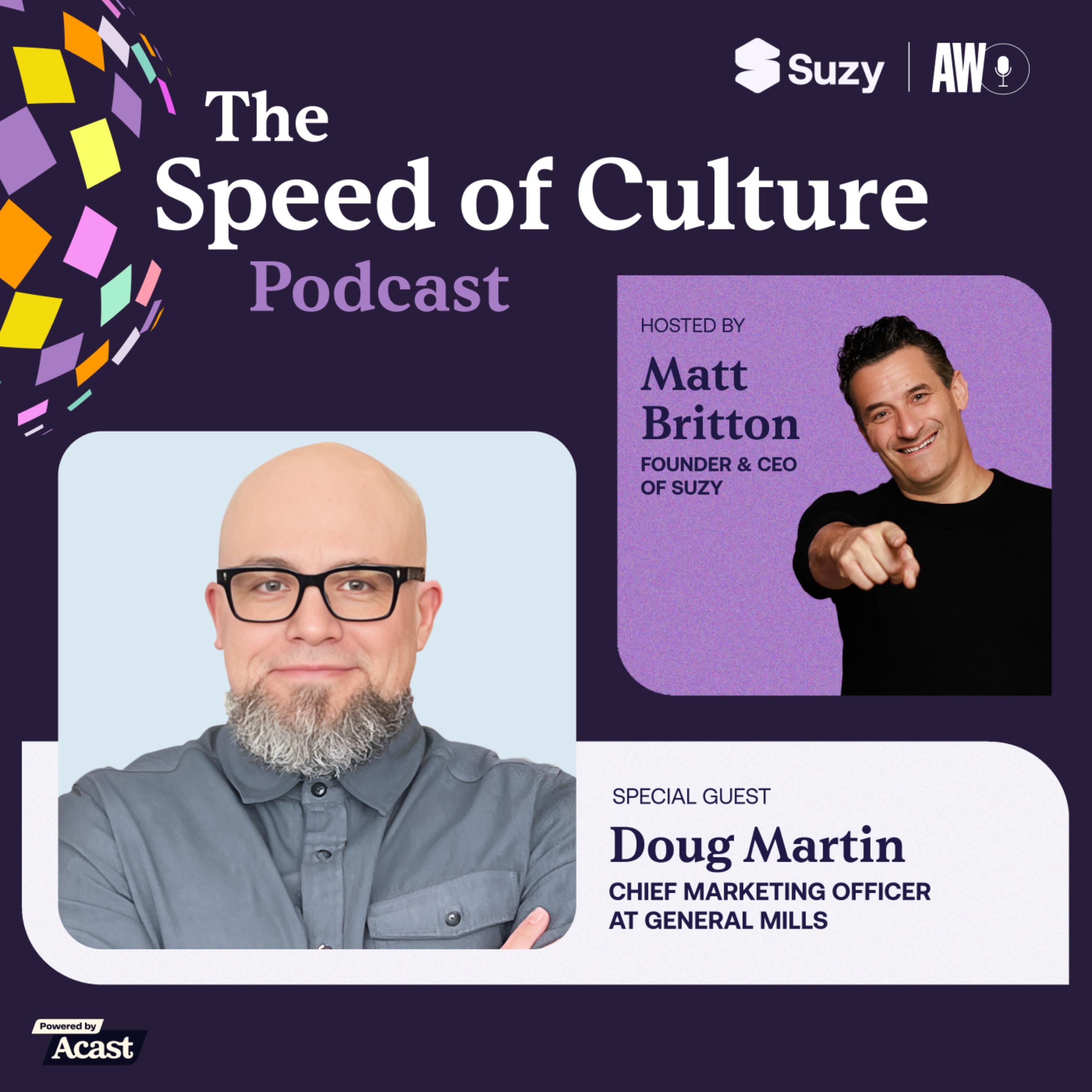
The Speed of Culture Podcast
No expiration date: General Mill’s Doug Martin ensures classic food brands stay fresh
00:29:35
Loading summary
Transcript73 lines
- [00:02]
Doug Martin
Race the rudders. Race the sails. Race the sails.
- [00:05]
Matt Britton
Captain, an unidentified ship is approaching. Over.
- [00:08]
Doug Martin
Roger, wait. Is that an enterprise sales solution?
- [00:13]
LinkedIn Ads
Reach sales professionals, not professional sailors. With LinkedIn ads, you can target the right people by industry, job title and more. We'll even give you a $100 credit on your next campaign. Get started today at LinkedIn.com results, terms and conditions apply.
- [00:30]
Ryan Reynolds
Ryan Reynolds here from Mint Mobile with a message for everyone paying big wireless way too much. Please, for the love of everything good in this world, stop with Mint. You can get premium wireless for just $15 a month. Of course, if you enjoy overpaying. No judgments. But that's weird. Okay, one judgment anyway. Give it a try.
- [00:49]
Mint Mobile
@Mintmobile.Com Switch upfront payment of $45 for 3 month plan equivalent to $15 per month Required intro rate first 3 months only, then full price plan options available, taxes and fees extra. See full terms@mintmobile.com.
- [01:04]
Doug Martin
I think that bar to break through for the consumer is higher than it has ever been. And if you're talking about AI in marketing, what is AI proof and not AI proof in marketing? I believe two things at the same time. Number one, I believe it is fundamentally going to change how we do marketing. And number two, I also believe that there is a fundamentally human creative component that is going to be really hard to replace.
- [01:32]
Matt Britton
To thrive in a rapidly evolving landscape, brands must move at an ever increasing pace. I'm Matt Britton, founder and CEO of Suzy. Join me and key industry leaders as we dive deep into the shifting consumer trends within their industry, why it matters now, and how you can keep up. Welcome to the Speed of Culture. Up to the Speed of Culture podcast. We are thrilled to welcome Doug Martin, the Chief Marketing Officer at General Mills, the powerhouse behind some of the world's most beloved brands like Cheerios, Haagen, Dazs, Yoplais, Totinos, and so many more. Doug has spent nearly two decades at General Mills shaping its marketing playbook and driving innovation across its impressive portfolio. Doug, so great to see you today.
- [02:13]
Doug Martin
Matt, thank you for having me. I'm excited to be here.
- [02:16]
Matt Britton
Absolutely. So when you're the CMO of a house of brands, so to speak, how do you balance your time between all the brands? It's kind of like how do you balance your love between all your children, I guess, and what dictates your areas of focus in a given?
- [02:31]
Doug Martin
It's a great question. It's kind of an omnipresent challenge. I think the most obvious part of it is I try to really focus on our larger brands and devote more of my time to our billion dollar brands, of which we have nine, and feel good about those. And so those are the places where I feel like my impact is going to be scalable and have the biggest impact overall in the company. I would say the challenge is not really like, what brands do you focus on? I think a lot more of the challenge is how do you think about your time in advancing a particular set of work versus advancing a system, advancing everything we're doing. And I think that's where I spent a lot of time trying to get that right balance that you never get perfect.
- [03:08]
Matt Britton
Gotcha. So an example of that would be more foundational, like how do you evaluate creative, how are you tracking media spend things of that nature.
- [03:15]
Doug Martin
Exactly. And how do I make sure that all the people at this company who are touching the creative process are thinking about creative the same way, evaluating it the same way, et cetera.
- [03:24]
Matt Britton
So in 2025, what are some of those systems that are most important to you in terms of moving the ball forward?
- [03:30]
Doug Martin
Well, I tell you what, I think the most important thing at the most simple level for me is for all of our marketers across the system to be realizing that what they're doing is trying to get a human being to make a different decision at the end of the day. And if they can't look at each other and say, is what we're doing today in this meeting or with this event or with anything else likely to have an impact, then let's do something else. So I think that's the first thing that I'm trying to reinforce over and over again, is that it comes back to people, their lives, the choices, and we're making food that goes into their bodies. So those are number one and number two and number three. But then after that, there's obviously a million other things like how are we building a marketing ecosystem that gives us advantage or makes us faster, better, cheaper than others? And that takes a ton of work as well.
- [04:15]
Matt Britton
Yeah, it's interesting because I've had a lot of discussion internally about what is AI proof and what is sort of AI dependent, so to speak. And ultimately we still need to eat as human beings. AI can't feed us. So you're in an industry where unless there's some intravenous way for us to get nutrition, we're always going to need to think about what we're eating three times or more a day. But at the same time, what does consume the customer's mind throughout the rest of the day? Will likely change due to all these technological evolutions that we're experiencing at really light speed right now. What are your thoughts about the changing consumer as a byproduct of what the externalities are in today's world?
- [04:56]
Doug Martin
Well, side note, I was having a conversation with my 16 year old son and he's thinking about college and he's thinking about like hey Dan, what should I go into that's going to be AI proof? And I was like, I don't know, I think for the first time maybe the advice do what you love makes sense because other than that we don't know what is going to be disrupted. He was very impressed when I told him that food was AI proof and he asked me if that's why I joined this company 20 years ago.
- [05:19]
Matt Britton
You knew, didn't you Doug?
- [05:21]
Doug Martin
Yeah, I wish I had any kind of prescience like that. But in terms of the consumer, I think from my chair the most obvious change is the continued increase in the flow of information and messaging to consumers and then also just how kind of split and fractured that whole system is becoming. So when I started this company, you could do a pretty good job as a brand manager if you had like a great campaign. And by campaign we meant TV spots and like a really good coupon plan. And you manage your like price points at grocery, right? You do those three things, you're in great shape.
- [05:59]
Matt Britton
That was your top and bottom of the funnel, right?
- [06:01]
Doug Martin
Yeah, totally. And now I think that bar to break through for the consumer is higher than it has ever been. And if you're talking about AI in marketing, what is AI proof and not AI proof in marketing? I believe two things at the same time. Number one, I believe it is fundamentally going to change how we do marketing. And number two, I also believe that there is a fundamentally hu human creative component that is going to be really hard to replace because otherwise we're all going to be saying the same thing in the same channels at the same.
- [06:32]
Matt Britton
Time, all feeding off the same data.
- [06:34]
Doug Martin
And it's all going to be equally ignorable. So I think the need to in some ways surprise the consumer and delight is higher than it has ever been. And as far as I can look forward, it seems like it's going to stay high.
- [06:49]
Matt Britton
So in your experience, through your decades of work, obviously working with these iconic brands, what are sort of the common themes when you you have been able to successfully surprise and delight the consumer and break out and really impact them?
- [07:02]
Doug Martin
Yeah, it is always a combination of surprising or delighting them with Something relevant to their life where they immediately say, oh, okay, that actually fits into what I am doing. It's not you trying to convince me. You never want to be in a position of convincing. So that's number one. And then number two is if you can wrap that in a little bit of human emotion and make it more compelling, then those tend to be cliched. But one plus one equals three situations. It is always tempting to just do the telling. Let me tell you how great this product is. And unless that's connecting on a little bit of a deeper level, so many of the decisions that we make day to day are on autopilot. I wish everyone thought about Cheerios as much as I do, but they probably don't. And so how do you kind of short circuit some of that and get into a quicker, more emotive kind of conversation? I think it's really important.
- [07:59]
Matt Britton
Yeah, and you kind of alluded to this, but one way to do that is really being personalized in your approach. So unlike what was possible when you started at General Mills, now the technology certainly exists for you to be personalized in your approach. One challenge for big CPG companies, traditionally the majority of your sell through has gone through third party big box retailers, grocery stores, et cetera. And as a result, you don't have access to first party data to be able to do that. Personalization at scale, how are you looking at that paradox moving forward and what are some of the efforts you're undertaking through your brands to try to maybe get your hands on more first party data if you think that's relevant?
- [08:37]
Doug Martin
Yeah, I mean, first of all, I will say that professionally I'm always a little bit jealous of people who own their retail channel for this exact reason. And we still almost exclusively sell through a third party. It is just that now someone is getting that click and collect or getting it delivered or whatever the new modality is. But we are not that retailer. So I think two things. One is the concept of personalization. I am thinking less about, hey Matt, here's something exactly to you and more about what is contextually relevant for you. And so how can we figure out what those contextual relevance cues are so that we're just showing up at a moment where you're more likely to listen. And some of those are really obvious and time honored. Like for example, it's when you're driving home at 5:05 that you're like, oh shit, what's for dinner tonight? Maybe that message of a really easy dinner solution where you just buy pillsbury dough and Progresso soup and now you got dumpling soup. Maybe that's the right moment for you. And then of course it gets more contextually like fitted from there. But one of the things we're doing is we have a partnership with Fetch, which is a rewards app, and so we can start to understand what are some of the things that go together in terms of purchase behavior and where might we look for triggers that perhaps you wouldn't think about intuitively and talk to people just to ensure that that relevance part of the communication is starting from as far down the track as you can get it.
- [10:13]
Matt Britton
And you mentioned getting the message out and radio is a way for consumers to listen. Obviously that's evolved the podcast. And one thing I often think about for leaders in TPG is that right now Gen z is aged 12 to 27, which means nearly half of Gen Z is kind of out of college and in the home. And over time that means that the majority of your customer who's thinking about what cereal to bring for the household is going to be a consumer that grew up with the iPhone in the household. Which means the whole way in which they consume media is farly different than the consumer that you thought about building a brand in with in the last maybe 10 to 15 years. So to me that means creators getting in a newsfeed, user generated content. Where are your brands in terms of the evolution path to really re looking how you distribute your content in its entirety so you can reach this new demographic?
- [11:06]
Doug Martin
Yeah, I mean, first of all, let me say General Mills as a company has traditionally won when there are a couple of kids in the house and that Gen Z is getting to that point now where the kids being born are starting to be in that generation. So we really do always have to be highly aware of how that moment or dad is thinking about shopping and consuming media. And so then I think you make the right point, which is if we assume that the world is continually getting noisier and it's harder and harder to break through and an advertisement therefore has got the deck stacked against it more and more. The question for us is how do we get other people to be talking about our brands for us and how can we leverage influencers big and small to do that just to get a volume of conversation that we feel good about. And I think the thing we have to be really continuously recalibrating is we're not going to have total control over that conversation. And that is okay. I actually like how much that forces our brand teams to say hey, Cheerios. What do you stand for? 7 words or less? You know, like, you cannot have an elaborate positioning statement that you're hoping to translate to a hundred influencers. And so we've done things on the big side where it's like, listen, Kelsey Brothers are a lot of fun and our kids cereals are a lot of fun. Let's put something together. And that's worked very effectively. And then on the smaller side, there are a ton of people out there talking about food on the Internet. We're lucky in that this is a conversation people are having. It's not like people are having as many organic conversations about insurance as they are about what's for dinner, what will my toddler eat, what won't they eat, et cetera. And so I think our brands getting sharper point of view of where they could possibly fit into a stream of conversation that's moving in a direction is where we need to continue to develop.
- [12:56]
Matt Britton
And do you see the need to evolve some of your heritage brands, Cheerios, for example, to a newer demographic? I mean, are you leaning to more nostalgia? Do you look at a brand like Cheerios or any of your brands have been around for a long time and say, we need to come up with a new logo. We need to change the look, tone, feel to speak to today's generation. How do you look at that balance?
- [13:16]
Doug Martin
Yeah, I look at it like we don't want to do a late 90s thing where we put an X in every logo or remove the vowels.
- [13:22]
Matt Britton
Right.
- [13:23]
Doug Martin
The vowels are coming back. And I've been team vowel since day one.
- [13:27]
Matt Britton
No Cheerios. C, H, R, S. Cheerios.
- [13:30]
Doug Martin
Yeah, like your jaws wired shut. No, I think the answer to your question is yes. We are always thinking about how to evolve, but we want to do it thoughtfully. It's not like time to change the logo. I do think, you know, we've been talking about our brands need to be distinct and enduring. And that enduring nature has got to be about the values and the cultural impact, but distinction so enduring, really, you don't want to change those things over a short period of time unless something's really dramatically changed in the world. But what is distinct today is very different from what was distinct a couple of years ago. And so we sort of to adopt some Taylor Swift language. We've talked about a brand like Cheerios has been Cheerios for 75 years, but there have been different eras within that where, like, how mom is represented has changed. Like, Cheerios was launched as a convenient way to get oatmeal without Cooking like that's not really a message today that's going to resonate. So you have to update in terms of those eras to make sure that you are talking to today's mom, that you are talking to today's kid. And by the way, one of the things that we own in that brand is like we are so many people's first finger folk and there's like an actual like developmental milestone called pincer grip. And it's really important. And like we need to tell that story to today's mom of a nine month old who may now be Gen Z.
- [14:53]
Matt Britton
Right. Of course, today's mom knows those complex medical terms far more than the moms of the past.
- [14:59]
Doug Martin
Totally. And in the past we did some great things with like, let's make sure your pediatrician has the information. And it's just not as effective doing those sort of traditional, like, imagine a flyer you would get at the doctor versus how many conversations are happening online about baby health and development. You know, a ton. And that's where people are and that's where we need to be too.
- [15:19]
Matt Britton
Yeah. I mean, not only do moms kind of join Facebook groups about their baby's health, they'll join a Facebook group about babies who were born in May 2021 and their health.
- [15:28]
Doug Martin
Yeah. Where are our cohort of babies today?
- [15:31]
Matt Britton
We'll be right back with the speed of culture after a few words from our sponsors.
- [15:37]
LinkedIn Ads
Does it ever feel like you're a marketing professional just speaking into the void? Well, with LinkedIn ads, you can know you're reaching the right decision makers. You can even target buyers by job title, industry, company seniority skills. Wait, did I say job title yet? Get started today and see how you can avoid the void and reach the right buyers with LinkedIn ads. We'll even give you a $100 credit on your next campaign. Get started at LinkedIn.com results, terms and conditions apply.
- [16:07]
Ryan Reynolds
Ryan Reynolds here from Mint Mobile. I don't know if you knew this, but anyone can get the same Premium Wireless for $15 a month plan that I've been enjoying. It's not just for celebrities. So do like I did and have one of your assistant's assistants switch you to Mint Mobile today. I'm told it's super easy to do@mintmobile.com.
- [16:25]
Mint Mobile
Switch upfront payment of $45 for 3 month plan equivalent to $15 per month required intro rate, first 3 months only, then full price plan options available, taxes and fees, extra default terms@mintmobile.com.
- [16:40]
Matt Britton
So you mentioned earlier that obviously food is AI proof, which is true. Do you think brand is AI proof? Because obviously the barriers to entry to creating content are so low right now. And now we're dealing with synthetic or avatar based influencers, which lowers the bar even more in the social media sphere, where people can create limitless content with really zero marginal costs, which we've never seen before. What do you think that's going to do to a company like yours, ability to build brands? Because so many of your brands were built during the heyday of television, where it was quite the opposite.
- [17:15]
Doug Martin
So first of all, it is true that if you were to roll back to when Cheerios became a big brand, there were things like our ability to get on shelves nationwide that was a barrier to entry, our ability to be on television was a barrier to entry. And many of those things, those barriers are coming down. That is true my belief, and it may be related to the chair I sit in, but my belief is that that is the time to triple down on brand distinction. Because that's what's going to matter at the end of the day, is there are going to be new category entrants. There are going to be people who are like, hey, listen, I started this bar company in my garage and we got into one region of Whole Foods and let's see what happens. That's inevitable. People want choices, but our brands have to stand for something a little bit more and they have to stand for them over time. And we have to make sure that we're earning the right day in, day out to be a part of your life. So is the experience you're having tomorrow morning when you sit down with the family at the breakfast table to have Cheerios? Is it excellent? Is it remarkable? Was it crispy and delicious and do you feel good about it afterwards? Like, we really have to stay on top of that stuff now because you have to continuously earn your right to.
- [18:28]
Matt Britton
Be there, for sure. So speaking of earning your right to be there, obviously CMOs are looking at themselves in the mirror every day and know that they need to earn the right to be in their seat. It's a hot seat at many companies and obviously a big part of it is that the role of the CMO is much different today than it was a decade ago. How is it different? If somebody was entering the office of the CMO today at a major company, what would you tell them? Are the mandates in terms of things they needed to master to make sure they were in that same seat 10 years from now?
- [18:55]
Doug Martin
From my perspective, the job has gotten so much More complex. I came to this company almost 20 years ago because I was at a student event and the CMO came to talk to us and he was so smart and funny and energetic. And I was like, that sounds fun, I want to do that. And prime, primarily, he would have been really focused on the creative development of our brands and he was amazing at it. You look at what the job is today, it is still all of that and it is still the person who needs to stand on the stage and evangelize human connections and making an actual difference in people's lives. And at the same point in time, the technical aspects of the job just continue to get more and more complex. What is your system going to do differentially versus some other system? Where are you going to drive advantage? Where are you going to leverage external partners? Because you're not going to drive advantage. How are you going to stitch it all together into a workflow that your company can digest and operate in? And so you have to be cross functionally connected in a way that I don't think you had to before. Like, you have to be best friends with your chief technology officer just as much as you need to understand where the finance organization is coming from in terms of evaluating the impact of your work. So I think that person today needs to be an almost unicorn blend of human insightful metrics, focused and digitally and technically savvy.
- [20:17]
Matt Britton
That's well put. Yeah, it's definitely different than what I think a lot of people are learning. You know when you said earlier about your 16 year old and what should be focused on, it's so hard right now for education curriculums to really know the answer. I mean, if you think about it, I'm sure your son's school has textbooks that were written far before AI was really a thing. So how can those teachers train your son for a future world when the most important technology in our lifetime is kind of not even in those textbooks?
- [20:47]
Doug Martin
Yeah, and we still are in like chapter one of what Is It Going to Do?
- [20:52]
Matt Britton
So it's fascinating. One other change that's occurred, particularly impacting your industry and your brands, is the advent of GLP1s or the dissemination of it. Are you seeing an impact in terms of consumption and preferences from consumers coming out of this yet I tell you.
- [21:07]
Doug Martin
We spend a lot of time with consumers who are on GLP1s to understand what is changing, what's different, what are your needs, et cetera. So I think there are going to be also new opportunities that come with that. And I think the two things that we hear the most are, well, I am much more focused on kind of the quality of what I'm eating if I'm going to eat less. And so I want to make sure I'm getting the right amount of protein because they're a little bit worried about like losing muscle when they lose weight quickly. And also Americans don't eat enough fiber to begin with. And if you eat less but eat the same way now, you're even more fiber deficit. So kind of two old school solutions of protein and fiber seem to be the new school answers for consumers on these medications. And so I think we're going to be thinking and continue to think about are there new ways that we can provide those and with the taste, convenience and all the rest of it that you would expect from General Mills.
- [21:59]
Matt Britton
Sure. And as part of your role, are you working with the innovation team and the product team in terms of how they're going to evolve, whether flavors, packaging, things in terms of that are coming out next based upon what you are hearing from the consumer?
- [22:11]
Doug Martin
Yeah, I think our brand teams are really at the center of like, who are we for? And for that person we're for how big a deal is GLP1 and therefore, what should we do? And so you look at a brand like Progresso and Canned soup is having a bit of a moment for us because it actually does such a good job of delivering against those things. Like, you know, there's 15 grams of protein in regular chicken noodle soup. And for Progresso, they're also looking at a 55 plus consumer. And for that 55 plus consumer, you're seeing a much higher usage of GLP1. So like that team is all over it and thinking about now how do we want to message these benefits? And really that's where I would say I'm more involved is like, okay, now we have the facts behind it and now let's figure out what is the story that we're telling that's compelling.
- [23:00]
Matt Britton
It's interesting. So as you know by now, like the CMO is a rock star of the advertising industry. Everybody wants to meet with a cmo, have them at the conferences, et cetera. And I'm sure given today's world, you have no shortage of people that want to sell to you and put you on their calendar, et cetera. And obviously you can't meet with everyone and you can't spend money with everyone. You have to make tough decisions as part of your job. What has been common throughout your career when you chose to work with a partner either on the agency side or the ad tech side or whatever it may be that allowed them to break through and really add value to you as a cmo.
- [23:37]
Doug Martin
I'll tell you the kind of the flip side of that is that you start to learn to notice when someone is selling their story and not trying to help you build yours.
- [23:48]
Matt Britton
Almost what you're saying earlier about what works for your consumer.
- [23:50]
Doug Martin
Exactly. I mean it is just marketing to me. But when you're like, I don't quite understand, I also, I'm not a genius. But at the same point in time when I'm sitting in something and I'm like, why do I feel this stupid? That is generally an indication that it might not be exactly what you're looking for. And what I have found is those partners who are like going to take a moment to understand what you're trying to accomplish and then acknowledge that they don't have it all figured out but are willing to work on it with you. Those are the partners where those relationships become much more long standing and fruitful. Because like we said, like this is just starting some of this technology work and so, so porting over a solution from over here in health and wellness or hospitality or whatever, it might not perfectly fit for a consumer products company. And you gotta be willing to learn together.
- [24:39]
Matt Britton
Yeah, I mean we talk a lot about customer centricity and really that's what you're talking about is no one cares about someone else's unique selling propositions. Everyone wakes up every day and whether they're picking what cereal they eat or what advertising agency to hire, they have their own things that make up success for them and it has to be about them if they're going to listen and it's worth their time.
- [24:57]
Doug Martin
Totally. Exactly. And I also think that bar of it's about me doesn't have to go all the way about all the way to one to one. Like there was a little cabaret's execution that I love from the uk, but it basically had the front of pack design and it splits up the bar into like the person who made dinner, the person who did the dishes, and the person who just enjoyed it only gets this much chocolate. And what a beautiful and simple way to say, oh, I actually get what's going on around this product in a way that they didn't have to drop an Alexa into your house for a year to find out what you were up to, but you still feel seen by that product. So I think we're always looking for those type of examples as well as like, do you really understand how people are living with whatever to progresso Cheerios, et cetera, the way you fit into your life and how can you show them you get that?
- [25:43]
Matt Britton
I love that. So shifting gears as we wrap up here, Doug, obviously you've had a great run and continue to do great things with Jermo Mills and their brands. If you look back on your career, what are some of the decisions that you think you made that were the right ones that put you in the position that you are today?
- [25:59]
Doug Martin
That's a good question. I will say there have been times in my career where I've had the right boss at the right time that's had a lasting impact.
- [26:08]
Matt Britton
What made them the right boss?
- [26:09]
Doug Martin
So it was like the thing that I needed to learn at that moment. And so that I've tried to pay off in the way that I lead, but there was a boss I had when I rotated onto Cheerios for the first time, and she was like, doug versus what you've done in the past. This brand is differentially important to consumers and moved by comms. I need you to listen and learn about everything that Cheerios has done over the last 10 years and the way that consumers have interacted with it. And that helped to deepen my appreciation for the relationships that brands can build. Even if most of our business is transactional, you can build some of these relationships. And then a little bit later, when I got promoted to director, I had a boss who was more conscientious about his role as a leader in the company than I had been used to and was thought a lot about what it meant to the employees in our operating unit, how he showed up day in, day out. He was just really put a lot of thoughtfulness into that. And initially I was like, I don't know. Shouldn't he? Is he focused on the right stuff? And of course, the answer is, yeah, he was, because people did great work for him. They knew what his priorities were, and they also knew that he was going to see and value their contributions. And so that had a huge impact on me as well.
- [27:22]
Matt Britton
So just like how you've gotten a lot of value from those you've worked for, obviously people are getting a lot of value working for you, and vice versa. And obviously, greatness is an agency of others, and you wouldn't be able to manage all these brands by yourself. What is true, especially with the newer employees that are coming to your organization, when you see somebody that's like a rising star and you're like, that person really gets it it what normally do they possess that makes you feel that way about them?
- [27:48]
Doug Martin
I'm going to tell you this, the simplest answer and it is curiosity. Like the people who come in and you have opinions, it's great. And you share those opinions. And it's the people who then understand that, well, that wasn't a good idea. But let me understand why. Okay. What did you learn when that happened before? Oh, I understand. And why do people think that? Oh, I get it. And why doesn't Totinos say this? Ah, like it's a continual questioning that has people at the center that I think makes a great marker. And I also think you can, you can tell people that and people can model that behavior. But there is an innate curiosity that some people have that's just a little bit more hungry to know. That makes a huge difference.
- [28:30]
Matt Britton
I think a lot of it also has to do with patience. I mean, I think maybe when sometimes people meet with you or they'll meet with me, they have an agenda and they just want to solve that agenda, whether it's selling something or getting me to sign something or whatever it may be. And ultimately they have to really be in love with whatever the problem or the deeper reason that they've come to work at your organization to begin with. And it's not just so short term that I want to get a promotion or I want to sell this thing tomorrow. Because when that happens, curiosity kind of goes away because you become kind of a heat seeking missile to what's next. And when you have a love for what you're doing or a passion for what you're doing or even just you really care, that's when curiosity comes out naturally. Because obviously if someone called you and said your son broke his leg, you'd have a ton of questions. Because you want to know everything about it naturally. You're curious about something because you care about it. And I think when you care, you probably take care in your career and you probably do a much better job.
- [29:21]
Doug Martin
And I think there's a way to. I mean of course people want to make progress, but I think there's a way to frame that. It's like I am not here to get the promotion. I'd like to learn more about E Commerce because I think that's going to be critical for our business in the future and that might have an impact on the role that you're taking. It's really about just framing that as a learning opportunity. Opportunity to broaden a skill set, I think makes a huge difference in terms of how people connect 100 so Doug.
- [29:43]
Matt Britton
Wrapping up here, we ask our guests on the Speediculture podcast if there's a saying or mantra that helps kind of encapsulate or define their career during the date. Just wondering what might come to mind for you.
- [29:53]
Doug Martin
So the one that I think about the most is my dad would say to me and I think a lot of people have said it, but I always remember him saying it is that at the end of the day, people remember how you make them feel, not what you say. And I think about that a lot, both in terms of like my personal impact on people at work, but also in marketing. Are they going to remember feeling something from a curios ad or what you said? I think it's also true they're going to remember that feeling.
- [30:17]
Matt Britton
Well, I feel really grateful that you joined the podcast today. I think it was a great conversation. You're obviously somebody who shoots from the hip and has a lot of experience. And again, I'm really grateful you took the time to share some of your thoughts and your experiences.
- [30:29]
Doug Martin
Well, I really appreciate you having me and your background is on point. I love the Cricket Boxes staff through.
- [30:35]
Matt Britton
A lot of testing and optimization. You know, I've been working on it. So I have a new book coming out, Generation AI. It's about Gen Alpha and their impact on society. So I'm going to send you a copy. Here's what you think. Yeah. Thank you. Well, thanks so much for joining. On behalf of Susan, Iowa Keen, thanks again to Doug Martin, Chief Marketing Officer of General Mills, for joining us today. Be sure to subscribe rate Review the Speed of Culture podcast on your favorite podcast platform. Till next time. See you soon everyone. Take care. The Speed of Culture is brought to you by Susie as part of the Ad Week Podcast Network and a guest Creator Network. You can listen subscribe to all Adweek's podcasts by visiting Adweek.com podcasts to find out more about Susie, head to Suzy.com and make sure to search for the Speed of Culture in Apple Podcasts, Spotify or anywhere else podcasts are found. Click follow so you don't miss out on any future episodes. On behalf of the team here at Suzy, thanks for listening. With the IHG1 rewards Premier Business Credit Card earn up to 200,000 bonus points. Limited time offer ending April 30th. Visit ihg.com.com Business card cards issued by JP Morgan Chase bank and a member FDIC offers subject to change terms apply.
- [32:00]
LinkedIn Ads
Auto insurance can all seem the same until it comes time to use it. So don't get stuck paying more for less coverage. Switch to USA Auto Insurance and you could start saving money in no time. Get a quote today. Restrictions apply.