← The Speed of Culture Podcast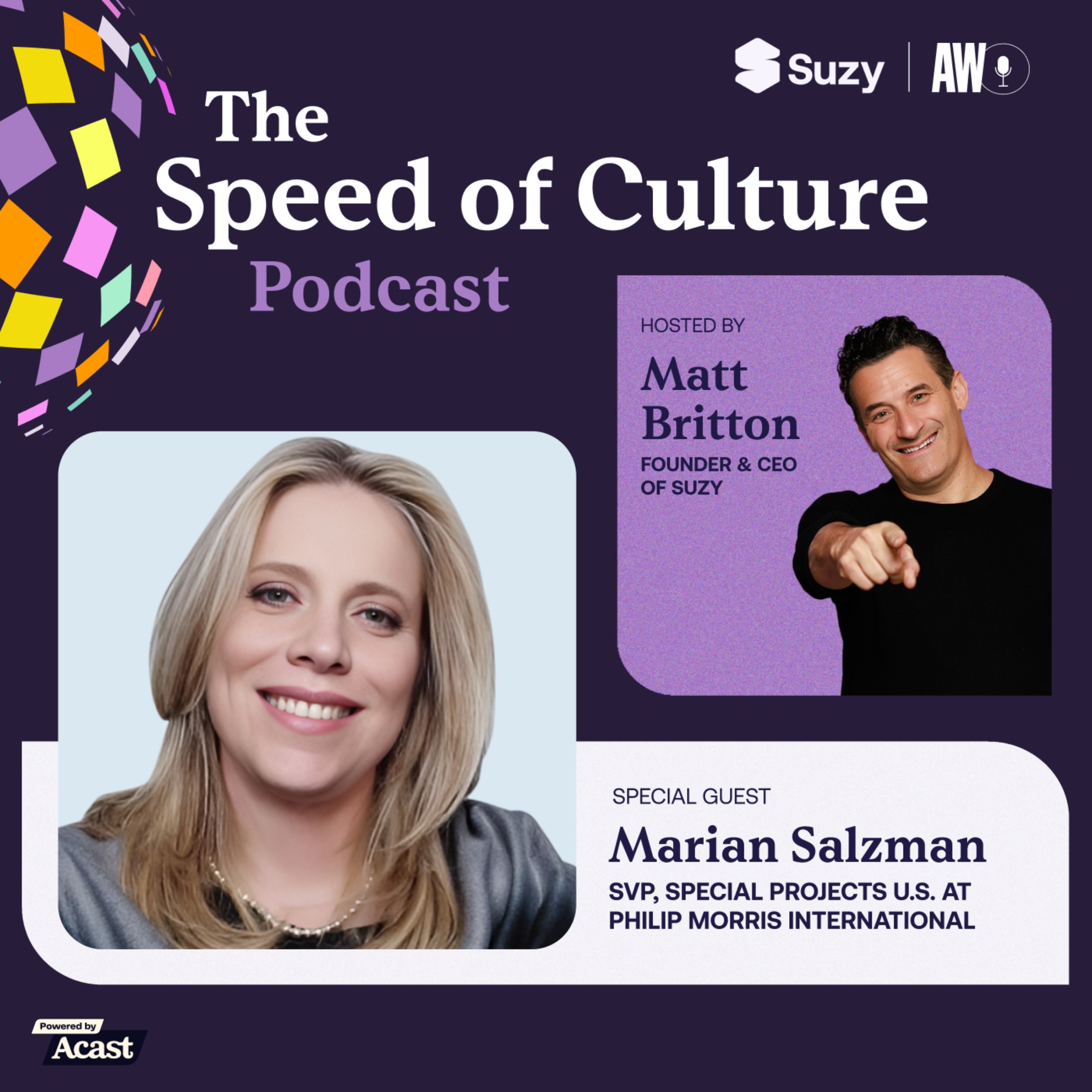
The Speed of Culture Podcast
Rising from the ashes: Marian Salzman on creating a tobacco-free future for Philip Morris
00:32:03
Loading summary
Transcript77 lines
- [00:00]
Instacart Ad
Instacart is on a mission to have you not leave the couch this basketball season because between the pre game rituals and the post game interviews, it can be difficult to find time for everything else. So let Instacart take care of your game day snacks or weekly restocks and get delivery in as fast as 30 minutes because we hear it's bad luck to be hungry on game day. So download the Instacart app today and enjoy. $0 delivery fees on your first 3 orders. Service fees apply for 3 orders in 14 days. Excludes restaurants.
- [00:31]
Matt Britton
Race the rudders, Race the sales, Race the sales Captain, an unidentified ship is approaching. Over. Roger, wait, is that an enterprise sales solution?
- [00:43]
Marion Salzman
Reach sales professionals, not professional sailors. With LinkedIn ads, you can target the right people by industry, job title and more. We'll even give you a $100 credit.
- [00:53]
Matt Britton
On your next campaign.
- [00:54]
Marion Salzman
Get started today@LinkedIn.com terms and conditions apply. I think that AI is going to take us to a different plane and they're taking us there at a meteoric speed. And those who reject it are just going to be collecting data. And data is valuable, but insights are more valuable.
- [01:18]
Matt Britton
To thrive in a rapidly evolving landscape, brands must move in an ever increasing pace. I'm Matt Britton, founder and CEO of Suzy. Join me and key industry leaders as we dive deep into the shifting consumer trends within their industry, why it matters now, and how you can keep up. Welcome to the Speed of Culture. Up today in the Speed of Culture podcast, we are thrilled to welcome Marion Salzman, a globally renowned trendspotter, communication strategist and cultural forecaster who has spent decades helping brands stay ahead of the curve. Marian's built a career at the intersection of marketing, cultural shifts and consumer behavior, shaping narratives that drive real world impact. Today, Marian serves as SVP at pmi, formerly known as Philip Mars International, and she's well known in the industry. She is very provocative. And Mary, I'm so happy I finally got you on the podcast.
- [02:07]
Marion Salzman
Thanks for having me, Matt.
- [02:08]
Matt Britton
Absolutely. So for those in the audience who don't know you, why don't you give a high level background of your career that led you to the position that you're in today?
- [02:16]
Marion Salzman
I would say it's just been a career of really good luck being at the right place at the right time, or making it either the right place or the right time. Probably best known, unfortunately, for the discovery of metrosexual man going back to 2003. Before that, I would say really the most impactful thing for me was creating the first Online market research company, which we did in the early 1990s when people didn't know what the Internet was. Probably two weeks before I created the company. I thought it was something for military people and academicians to share scientific knowledge. I've been really lucky. I've worked for three great agency companies over time. I've worked at Havas, I worked at wpp, specifically at jwt. And then I spent really the most important for me impact on my career was at Chia Day, which became TBWA International, which is how I ended up moving to the Netherlands in the mid-1990s to take this thing called the Internet into everyday marketing life in Europe, Middle east and Africa. So I've had a career that's been kind of on both sides of the Atlantic with a lot of travel. I have not been to Antarctica, but I've been everywhere else proselytizing about change.
- [03:33]
Matt Britton
So a lot to unpack there. There were three points that I really want to dive deep into before we dive into what you're doing now. First and foremost, you mentioned online research, which obviously is something near and dear to my heart as a CEO of Suzy. Talk to me about your early work in online research, how research has evolved over time, and where do you think the future of research is in the landscape of AI?
- [03:55]
Marion Salzman
First of all, I am an AI addict. I spend around two hours every weekend writing a novel with the best writing partner I've ever had, ChatGPT. And even better, when I finish the chapter, I do one chapter every weekend. I then ask it to be rewritten. If Carrie Bradshaw wrote it and if Joan Didion wrote it. I have the really basic one Marion Salzman and ChatGPT wrote. And then I have these two others that are really recast through different pop culture lenses. And that's pretty analogous to how I teach myself everything I learn it by doing so. Going back to very early 1990s, Jay Shiat, my then boss and business partner, said to me, marian, I'm gonna put you in charge of the Internet. And I was like, okay, great. And I didn't know what to do about this thing. And so I decided to write kids books so I could ask the dumbest questions on the planet and get away with it. So I did a Girl's guide to the Internet. I did Kids Online. I did the online Homework Helper so I could ask every mundane question simultaneously. In, I guess around 93, I was doing a project for Rolling Stone magazine. Jan Wenner asked me which online service Rolling Stone belonged on. I didn't Want to admit to him, I didn't know what an online service was. So I went home with these discs. The only disc I was able to install by 4:00 in the morning was America Online. Now, before you're impressed with, I could install it. I later learned it was already pre installed on my computer, as was CompuServe and Prodigy. And then right across my screen, it was summertime. I was in flannel pajamas with the air conditioning turned way up. This guy pinned across my screen. Hi, Marian. How great you look. I think I look like a sweaty fool. But we start this conversation and I realized, oh, my God. Because at that point, I had two contracts. One was the Esquire magazine sex survey. One was the Glamour magazine sex survey. And I realized all the questions I couldn't ask looking you in the eye, I could ask over type. And I sat down and wrote a business plan. I went to the Rolling Stone offices. That next morning, I confronted the guy from America Online. I was like, oh, my God, I have this big idea because I have the Levi's Boys panel. Can I have the market research rights? And somehow they gave them to me because I could bring them subscribers. Then I did the first Citizens of Cyberspace study. So it was shy day was my employer, my partner, Atlantic Monthly and Time magazine. And it was really kind of this wild west where you ask people for things and they were like, oh, yeah, sure, why not? Little did I realize how important it would be. Little did I realize how stupid I was. Because when we were sold to tbwa, I sold the limited amount we had in the company to an investment group. And if I was still sitting on that, I would be long retired and I would be the best pickleball player in the Southwest.
- [06:44]
Matt Britton
So where do you see research going in the age of AI in terms of how more traditional research is going to be used and maybe how some new tactics will be adopted based upon what AI is capable of?
- [06:55]
Marion Salzman
Well, first of all, AI is like your smartest friend sitting on your couch, talking about any idea you want to talk about. I mean, last night I was trying to plan a family trip to Barcelona and I was arguing with ChatGPT for hours. No, I don't want to spend that much on that hotel. No, we want a more foodie location. No, I want spa. Anything you want to do, you can learn. Sometimes it's wrong. And I want to be careful of that because my husband is an academic and he's constantly telling me, you can't trust this. Things are in source, blah, blah, Blah. That's not really true because I can't trust even the conversation. Like, I know you, Matt, I want to trust you. But 10% of what you tell me is going to be through a selectively objective 100%.
- [07:35]
Matt Britton
Right.
- [07:36]
Marion Salzman
Or you could have just been misinformed because your wife told you something this morning that she misinterpreted.
- [07:40]
Matt Britton
Yeah, people often like to compare things with perfection, even with like driverless cars. And the reality is people text and drive all the time. People aren't perfect either.
- [07:48]
Marion Salzman
Exactly. So I think that AI is going to take us to a different plane and they're taking us there at a meteoric speed. And those who reject it are just going to be collecting data. And data's valuable, but insights are more valuable. But I actually believe with AI, the best consumer insights analysts are going to truly have knowledge because they have a way to test and verify. They have a way to engage with all the archives of the thinking fodder of the world. And then it's really going to be a question of how smart are they at the right prompts? And then how do you take a massive transcript? Let's say I did an online focus group with 25 people for an hour and a half talking about corporate philanthropy. I can send that transcript to AI and it's going to do that work that I would have spent three days doing when I was younger, analyzing it, looking for pull quotes. It can tell me the key themes, it can tell me what is working, what isn't working. It's like having a built in genius in my spare pocket. So it's going to change everything. Now. I think the problem is it doesn't change the need for human dialogue. It doesn't change the need for that intense probe. It doesn't change the need to verify with dyads and triads and all those cool things we've always done. But it allows us to synthesize and go to a much higher plane much more quickly, which allows much more time to say, okay, what does it really mean?
- [09:13]
Matt Britton
Right, the why behind the what?
- [09:15]
Marion Salzman
And then maybe even the why turbocharged. Because it's not just the why I thought to ask, it's the why that all those geniuses that have been called into this knowledge system that I can borrow from.
- [09:26]
Matt Britton
And another area I know it's impacting and I'm just more curious to hear your journey in this area is writing. So you've, you're the author of 18 books, so you obviously love writing. What has being a writer and author done for you in terms of your career, to open up creativity and evolve you as a professional.
- [09:42]
Marion Salzman
So I actually hate writing. I love the written word. So I have this love hate thing. Every time I sit down to do a book or even a post, I say, this is the last one I'm going to do. And then I get through it. And then I like the written product. I like even better the continuous dialogue that comes from having this product so that people can debate it, declare it wrong, declare it right. I think as a writer, I've become very sloppy thanks to AI because I lay out my thoughts and I say, okay, what are you thinking about this? I mean, so I gave a speech, very quick speech last week to a PR group, and I came away with a few thoughts, but I shared it with AI it drove me to a completely different place. My question was, we're going out there to honor all of these young people who are making extraordinary difference in the comm space. Super important. I'm thinking about, as I looked out at the audience, There was probably seven or 800 people there. I was like, but what about the people who've been coming to these things for three or four decades? What's their stories? And I pulled this together with AI I posted it, and I'm starting to get really interesting responses from people sort of my age and a little bit younger who were like, this is such a good point. Because the journey we've been on for three or four decades, we've seen everything. I mean, I remember when Persuasion, which is the forerunner of PowerPoint, was a big innovation. I remember people saying, oh, Marian is so smart. She taught her self Persuasion. I had no choice. I was so junior in the agency. It was either that or handwrite the acetates. Listen, really. So I think, look, we're living in an age where technology is either paralyzing or empowering. And I think we each have to make a choice. Do we want to go into the future or do we want to stay where we are? And either choice is okay. But I'm going to say most of the jobs that I knew growing up in the business are gone. And if they're not gone, you haven't gone to the funeral just because you don't realize a friend of yours died.
- [11:37]
Matt Britton
Yeah. And they say the majority of the new jobs created by 2030 don't even exist today. So I think that rate of change is only going to accelerate with all the technologies we're seeing.
- [11:45]
Marion Salzman
And it certainly creates argument that, what do you study to be prepared? I mean, I Would say the greatest gift was something my father in particular was appalled by. I mean, I'm a sociology major from Brown. I took all kinds of airy fairy courses that taught me how to think. I didn't know very much. When I graduated, my father, who was a small business owner, was like apoplectic. What do you mean? We're paying for like sex roles in politics or the history of Mark Twain, but it's actually that kind of hyper specific, dig deep, ask a lot of tough questions. I feel like the really risky stuff is to go study event planning or even communications. I'm very, very worried about people who go out and study communications in this day and age because they don't even know what communication is going to be. If I had done that in my time, there was no Internet, there was spss, you know, for data for social.
- [12:39]
Matt Britton
Scientists, which we still use in market research, believe it or not.
- [12:42]
Marion Salzman
I know I recently asked someone here, I said, do we have SPSs? And they looked at me like, huh, Well I kind of want to see a cross tab. Because I was looking to try to understand a sort of a correlation. And they were like, what? I'm like nevermind, I'll just figure it out.
- [12:55]
Matt Britton
Yes, I mean you're unique in that you obviously love art. Like you're a writer, you like expressing yourself or you like the written word as you put it. But you also love data. So kind of left and right brain. A lot of people go to one area or the other and it definitely, I think, creates a framework for what younger people need to be learning. Because I do think you either need to make a choice, in your case, you did both. Going deep into an art or deep into a science. It's those people in the middle that I think are really going to struggle moving forward because that's the middle is where the AI will probably be taking over.
- [13:24]
Marion Salzman
It's exactly what happened to R.H. macy and company. If you think about Macy's today, Macy's when I was growing up, it was the flagship store. I mean it was place you could go and buy everything from your underwear to a hairdryer to designer ish jeans. And today there's no reason for it to exist. I mean, or its reasons become harder and harder to justify because it's the tyranny of the middle. But the flip side of it is specialists who become so ingrained in their specialty and don't keep reinventing are gonna be equally as obsolete. I mean, I look at young people here and I say, oh my God, you Need another experience. Me? Look, the best thing that ever happened to me was with the sale of Chia Day. Jay came to me and said, do you wanna go and do this thing called the Internet for the rest of the world? And I was like, yeah, I'll go do that. If I hadn't taken an international assignment when I was super young, I never would have become a globalist. I wouldn't have the job I have today. We wouldn't have the familial wealth we have today because international was my superpower. Because most American women wouldn't have upped and left in the 90s. They certainly wouldn't have gone beyond London, maybe Paris.
- [14:33]
Matt Britton
And you mentioned obviously how impactful your time in the agency world was to the professional you are today. What do you think were some of the specific takeaways you got out of your agency days? Because obviously now you're on the brand side and we'll get into that in a second. But when you look back your agency days in terms of how it's prepared you and gave you a more well rounded worldview and skill sets, what comes to mind?
- [14:54]
Marion Salzman
First of all, I worked for the greatest names that they used to have their names on the door and you could buy osmosis, learn from them. So whether it was Jay or it was Bill Tragos or it was Bob Cooperman or it became Ron Berger and Bob Schmetter, it doesn't matter. I mean, and then in my sort of most hands on job in the agency, it was as chief of staff for Bob Jeffrey at jwt. I was learning from a generation that these kids will never know who they are. I mean, nothing ever amazes me more. They're like, j who? And I'm thinking like when I got my job at Shy day, people were like, oh my God, you walk on water. So there was that. It was just the quality of the people that were there and the hard knocks they had taken to get to where they were and the absolutely brilliant work they had done. I mean, by osmosis you could learn. I would say also it was the work ethic. I mean, you didn't think about life, work, balance as much as you thought about balancing your brain culturally.
- [15:51]
Matt Britton
There's just been the shift.
- [15:52]
Marion Salzman
I mean, Chite Day was the first virtual office. So going back in the early 90s, I came and went as I pleased, but I wanted to be there. Now I hear, you know, we had a young person over our house a couple of months ago and she said, me, I'm not going Back to that job if they tell me to come in more than two days a week. And I'm thinking this is what's broken. Not that they'll tell you to come in, but that you don't want to be there and you don't want to be communing with other people. So I think that it was a very special time in the advertising business. I mean, I wish I'd been there. Maybe not in the Mad Men era, but maybe in the 70s and 80s.
- [16:26]
Matt Britton
Yeah, wild stories from that time, I'm sure.
- [16:28]
Marion Salzman
I mean, I think I would have different bruises, right?
- [16:31]
Matt Britton
Exactly. Emotional and physical. So let's move on to your role today. So obviously now you are on the client side at pmi, otherwise known as Phil Mars International. What first and foremost gave you the conviction to take a role there? What did you hope to accomplish and where are you in that journey today?
- [16:49]
Marion Salzman
So first of all, when they phoned me, I was completely angry. Like, why would a tobacco company call me to come and work for them? I really liked the headhunter at Heidrich and Struggles, Gene Allen, who phoned me. But I was like, I'm not going to be interested in this. This is smoking. And then it wasn't smoking at all. I started doing research. I wanted to be nice to her because she's such a good person. So I was like, I'll call you back with names. It's not going to be for me. I had my job at Havas and I would have stayed there for the rest of my working career. I'd been there already in many different roles over 15 years and I had no complaints. And then the more I learned about it, and then literally it was like birthing an elephant. I mean, I got to know them over nine months. They got to know me over nine months. And I kept being more and more and more intrigued. And then I was like, what do I have to lose? Meaning they didn't want me to work on cigarettes. It was around a smoke free future. It was about letting the outside in. It was everything I kind of understood. And I really, really had come to respect and like the people. So the final decision to go, which would have been in December of 17, wasn't very hard. The many months it took to get there. I mean, I might have thought about pulling out five different times because did I really want to move to Lausanne, Switzerland? Did I really want to disrupt our family, which was already scattered across the country, and kind of add a European thing to it? And then I decided, look, I'm going to go do it for five years. Well, fast forward. I'm on seven now. I'm moving into my one. I was SVP chief communications officer. Then I came back to do an external affairs role. Then I was been doing special projects in philanthropy. And now I'll go into a new job probably in this company. I can't even tell you how wonderful it is because every day I learn something new. And I learned from people who are junior to me. I learned from people that are I'm peers with. I learned from people that I work for and with. I learned from our board of directors. I learned from the zeitgeist. I mean look, I've been through this insurrection now. I mean, so when I think I can't learn anything new or see anything new, don't worry, in this business something new happens. Also it's been wonderful because at the same time the company sponsored me to go back to school some halfway through a master's degree in government at Johns Hopkins. And as someone who was educated in the 80s and had to learn a whole different political structure, everything we knew to be true then isn't quite true now. And so it's been wonderful. It's a learning job. I mean, the good news is so far they thought that I've given them more than they've given me. But I'm not sure that they're right.
- [19:22]
Matt Britton
We'll be right back with the speed of culture after a few words from our sponsors.
- [19:29]
Marion Salzman
Race the rudders.
- [19:31]
Matt Britton
Race the sails. Race the sails. Captain, an unidentified ship is approaching. Over. Roger, wait. Is that an enterprise sales solution?
- [19:41]
Marion Salzman
Reach sales professionals, not professional sailors. With LinkedIn ads, you can target the right people by industry, job title and more. We'll even give you a $100 credit.
- [19:51]
Matt Britton
On your next campaign.
- [19:52]
Marion Salzman
Get started today at LinkedIn.com results, terms and conditions apply.
- [19:58]
Instacart Ad
What makes a great pair of glasses at Warby Parker? It's all the invisible extras without the extra cost. Their designer quality frames start at $95 including prescription lenses plus scratch resistant, smudge resistant and anti reflective coatings and UV protection and free adjustments for life. To find your next pair of glasses, sunglasses or contact lenses or to find the Warby Parker store nearest you, head over to warbyparker.com that's warbyparker.com.
- [20:31]
Matt Britton
So obviously the big mission that you were brought on to help evolve is a smoke free future for the company. So let's just talk about what that means. What are the products, the smoke free products that you're working on or the organization's working on how is the consumer shifting their behaviors and habits towards tobacco consumption and where do you think this is going moving forward?
- [20:54]
Marion Salzman
So it's a wonderful role because it's really about giving adult smokers better options. The best choice for any smoker is to quit tobacco and nicotine altogether. No question about that. But for those who don't quit, and a lot of people won't quit, the best choice is to switch to these better alternatives. Since 2008, long before I got here, so I am just a bit player in everything but the public story. PMI has invested over 14 billion in smoke free products. These are products that are scientifically demonstrated to be a better choice than continuing to smoke. Which is the most harmful way obviously to consume nicotine? It's the burn. I mean, after you spend two hours with me, you will never light up your Weber grill again. I mean, I have two homes, both of which have fireplaces. And I will be damned if anyone's going to use. I mean, what you learn about the burn you want to just run away from.
- [21:46]
Matt Britton
You think consuming something or something's burned as a byproduct of consuming it.
- [21:50]
Marion Salzman
You don't want to inhale smoke. So iqos is our heated tobacco product. It delivers flavors and nicotine through an electronic device. It's not a vaping device. It's heated tobacco, which has been authorized by the Food and Drug Administration under Dr. Scott Gottlieb. And then Zyn is a nicotine pouch that's held between the lip and the gum. Zyn does not contain tobacco and that was authorized in the last week of the Biden administration. Both of them differ from cigarettes because they don't burn. And that's really the critical distinction. The primary cause of smoking related disease is the burning of the tobacco which releases all these harmful and potentially harmful chemicals. By eliminating this burn, you can reduce the production of harmful chemicals. And so that's really what I've been here to advocate is essentially unsmoking the planet. And it's an incredible opportunity to get people who would otherwise continue to smoke to either quit. I mean, we came up with this thing called the triplet, which is if you don't smoke, don't start. If you smoke, quit. If you won't quit, change. And we're very, very comfortable with that as our mantra. And it's been wonderful to take that message around the world. I mean, there's something really funny about a very, very American, as you can see, I sound like a Valley girl, a very, very American person going to Almaty, Kazakhstan, to launch on smoke, I mean, or to South Africa or to New Zealand. I mean I've been all around the world proselytizing. If you don't smoke, don't start. If you smoke, quit. If you won't quit, change. And it's been really rewarding. So I did that for six years and then I came back to the US not at the end of last year, at the end of the year before to start to work on the development of our American company after the Swedish Match acquisition.
- [23:39]
Matt Britton
And are you finding that over time it's become easier? Like what does the data say in terms of smoking habits in the US and how fast has efforts like yours and others in the industry had a real impact on the data and consumer behavior?
- [23:53]
Marion Salzman
So we don't have any cigarettes in the US and we separated from Altria back in 2008. So what you know is Philip Mars USA is Altria. We haven't had cigarettes here. Look, Americans are smart about the anti smoking message. The anti tobacco activists have done a good job of conditioning people that cigarettes are a bad choice. But it's easier for me to explain today that I work for Philip Morris International because we've gotten increasingly better known for moving away from cigarettes. Our global CEO Jacek Olczyk said in London, and I almost fell off my chair when he said it, that he's looking forward to a day when his kids have to go to museums to see what a cigarette was. Which is very interesting coming from somebody who grew up in our Polish cigarette company and then went on to obviously be part of the architecture of this bold new world.
- [24:46]
Matt Britton
It's fascinating. Other than the impacts changing the industry that you play in today, what are some other consumer trends? Because I know that you're just an avid reader and writer and you've always kind of had your finger on a puzzle where things were going. Whether the types of consumer trends interest you right now from a professional standpoint.
- [25:02]
Marion Salzman
Well, I mean on a watching around me level, I mean the whole rise of GLPs and the fact that people are using medical antidotes to things that they couldn't hear to for change. And so I'm really curious what it means for the food industry.
- [25:16]
Matt Britton
I think what they'll have to do is probably start to evolve and many of them are that their product set and their product portfolio to more healthy alternatives which I think a lot are trying to adopt.
- [25:26]
Marion Salzman
I think that's a really fair conclusion. For now my question's going to be how are things going to Fuse together. I mean, you're already seeing people come out with healthier meals. You're seeing people come out with different food delivery systems. I'm not convinced that today's portfolio from food companies is reflective of where they're going to be by 2030, let alone by 2035. So that's one trend that really interests me. Another trend that really interests me is the new antisocial. It interests me. It doesn't make me happy.
- [25:57]
Matt Britton
Elaborate on the new antisocial.
- [25:59]
Marion Salzman
I was in a restaurant the other night and I looked over at a table of five people. They were clearly either a family or some version of family. And all five of them had their phones out and they were texting other people. And I was thinking to myself, well, this is really a great dynamics. And then I think about again, young people who don't want to go back into an office, they don't want to go back into a heavy social life. They sort of talk about wanting balance, but balance is really almost a refuge from what's being they're being bombarded with. So it worries me about social ties. I mean, a book that I reread every six to nine months. It's funny, our US CEO just went on vacation. I made her take a copy with her and I said, you're going to hate me when you get 3/4. Is bowling Alone by Robert Putnam. I think that is such an insightful book that lays the scenario for where we're headed towards. People have stopped joining things, they've stopped belonging. And it's not about bowling leagues. It's the fact that we used to belong to things like a bowling league. And we had a repetitive behavior of socialization. And those things are gone now. People don't join PTAs, people, they don't.
- [27:08]
Matt Britton
Date at early ages. People are not, you know, it's all sorts of those things.
- [27:12]
Marion Salzman
Just the idea that you can swipe left and end a relationship or swipe right and start a relationship.
- [27:18]
Matt Britton
It's really evolving humanity. The question becomes, with AI, is it going to drive people more down this path? Because now you can create a relationship with a chatbot. You can get some of the human payoff now through technology in a way that you weren't able to get in the past. So it's one thing if you're not seeing people because you're texting other people. What if you're not even texting people, you're just texting a chatbot. That's the next evolution that creates risk.
- [27:41]
Marion Salzman
And I think there's an extraordinary risk because I wonder how we are going to be emotionally fulfilled in some of these relationships. The flip side of it is again, another one, Amelia, is the whole role of pets as a consequence. I mean, you see something like 40% of Americans consider their pet a family member. That's probably a good thing. But then a not so tiny percentage of people think that their most important relationship in their life is with their pet. And you know what? Even if you want people to quit smoking, you talk to them about becoming a parent, becoming a grandparent, or becoming a pet owner. It's the best way to get somebody to quit.
- [28:17]
Matt Britton
That's interesting. So shifting gears as we wrap up here, Marianne, this has been a fascinating discussion, as I knew it would. When you look back on your career and you look at some of the things that you did right, how would that impact maybe advice that you would give to somebody young and hopeful that's entering the advertising marketing space, that wants to ends up having the career that you did.
- [28:36]
Marion Salzman
First of all, I think you've got to be fearless. I've never had a fear of failing. Maybe because I'd failed so frequently. It's more like that, go home, crawl under your duvet, sulk for an hour, and then pick it up and go back to it. The second, and look, it's a very unpopular comment to make right now. I think you've got to have global experience to live in an American bubble. Unless you're going to do very, very hyper local. Yeah. If you just want to go into San Antonio, Texas, or Nashville, Tennessee, maybe you can build a career that's very, very relevant to that community.
- [29:05]
Matt Britton
So early in your career, when you can, maybe before you have as many things tying you down, take a global role, get that experience. Get that global worldview.
- [29:13]
Marion Salzman
I mean, I think it's the two bumpers on your life. It's when you're independent and free or only slightly encumbered early in your career or once your family's grown. But I think you kind of need to do both. And I think it's putting yourself into an international mindset. So it's. I mean, I remember back in the 90s, starting to read Korea Daily. I mean, I was reading the British newspapers. I was obsessed with the news. Even now, I have to admit, my dirty secrets. The Daily Mail, I don't agree with very much that they write, but I find it fascinating to see things through that Middle England lens. So I'd say it's be fearless. It's get international experiences. My great regret is Never learning foreign languages. I always say I'm going to retire and go back and regain my Spanish. But I mean, I've lived in Dutch language country, I've lived in a French and German country. I only know enough to go grocery shopping. And I really wish, because the most important thing where you hear that big wow that becomes an insight is in the small talk. And so I think it's that. And then probably the last thing I would say is become a generalist with a lot of specificity. In the early days, my areas of expertise were quite specific. I mean, first of all, it was online market research. It was insights and ideas around fast moving consumer goods. And over time it's really been this bizarre, or maybe not so bizarre, fusion between technology and regulation and political sentiment. And I think you have to keep learning. And today everything online, I mean, which gives you a lot of flexibility because you can study when you need to study. I mean, when I do my Hopkins classes, I would lay out a schedule for myself, but I was always in the wrong time zone. So I remember having to meet with my professors at 1:30 in the morning and I would put over my pajamas a leather jacket. So they didn't realize that I was like literally in my pajamas. But it was necessary. And I think learning, you've got to keep learning. If you stop learning, you're really going to be very stagnant, very fast.
- [31:10]
Matt Britton
Yeah. And you'll find at some point you're just interesting where you're headed. And I think evolution keeps you passionate and give you curiosity and a thirst for life that you need to continue to perform.
- [31:19]
Marion Salzman
There's one other thing that I would say to people is people jump around a lot these days and I'm not sure that's all that helpful in terms of both your career and your learning. I think sometimes when things get really bleak in a workplace, you need to hunker down and figure out what else you're going to learn to make a contribution. And I think that it was something that was always told to me growing up in the era I grew up and where people did stay places for a very long time. But I think that this moving around and When I see CVs of people that move around every nine months, they make me nervous.
- [31:49]
Matt Britton
A red flag.
- [31:50]
Marion Salzman
Yeah.
- [31:50]
Matt Britton
Because it's like what happens, the first sense of any type of challenge or adversity, you leave somewhere else and then you don't really get that skill set.
- [31:57]
Marion Salzman
Exactly. And I think it's also you don't build a deep relationship if Somebody sees you as transient.
- [32:02]
Matt Britton
Absolutely. So to wrap up here, we always ask our guests on the podcast if there's a saying or mantra that has helped encapsulate their professional journey is wondering what might come to mind for you.
- [32:14]
Marion Salzman
It's really stupid. It's go with the flow. When things are moving in one direction, I'll either go with it or I'll zag. But I'm kind of always aware of where the flow's going.
- [32:23]
Matt Britton
And is that about dealing with adversity, being flexible? Like what are the core traits behind that?
- [32:28]
Marion Salzman
Yeah, I mean, Look, I'm a three time brain tumor survivor and I've had stage four Hodgkin's lymphoma. All thanks probably to be downtown during 9 11. And I never saw it as something that was done to me. I saw it as an opportunity to learn more about the medical profession, more about how hospitals work, more about. I mean I think you can make lemonade out of lemons or you can wallow in the fact you've just been killed by citric acid. I would prefer to make lemonade.
- [32:53]
Matt Britton
I love that. Yeah. I mean I think it's great note and I could see now that you gave that context on what you said and I think so many of us deal with adversity and it's how you deal with it, how you respond, that makes you the person you are. So thank you so much for joining us. It's been amazing hearing about your journey as I knew it would be and I continue to be a huge fan of of you and all the work you're doing and I appreciate the time.
- [33:14]
Marion Salzman
Thanks, Matt.
- [33:14]
Matt Britton
Absolutely. On behalf of Susie and as we team, thanks again to Marion Salzman, SVP of PMI for joining us today. Be sure to subscribe brave to see me the culture podcast on your favorite podcast platform. Till next time. See you soon everyone. Take care. Speak Speed of Culture is brought to you by Suzy as part of the Adweek Podcast Network and a guest creator network. You can listen subscribe to all Adweek's podcasts by visiting adweek.com podcasts to find out more about Susie, head to Suzy.com and make sure to search for the Speed of Culture in Apple Podcasts, Spotify or anywhere else podcasts are found. Click follow so you don't miss out on any future episodes. On behalf of the team here at Suzy, thanks for listening.
- [34:13]
Instacart Ad
What makes a great pair of glasses at Warby Parker? It's all the invisible extras without the extra cost. Their designer quality frames start at $95, including prescription lenses plus scratch resistant, smudge resistant and anti reflective coatings and UV protection and free adjustments for life. To find your next pair of glasses, sunglasses or contact lenses, or to find the Warby Parker store nearest you, head over to warbyparker.com that's warbyparker.com with the.
- [34:43]
Matt Britton
IHG1 Rewards Premier Business Credit Card. Earn up to 200,000 bonus points. Limited time offer ending April 30th. Visit ihg.com businesscard cards issued by J. P Morgan Chase bank and a member FDIC offer subject to change terms apply.